
A Curated Guide for Managers, Executives, and Aspiring Leaders
In today’s rapidly changing landscape, leadership is more than a title—it’s a practice. The challenges facing modern leaders extend far beyond managing tasks; they involve shaping culture, driving complex change, making high-stakes decisions under uncertainty, and inspiring teams to achieve what they thought was impossible.
This reading list is curated for leaders at all levels who are committed to honing their craft. Whether you’re managing a small team or an entire organization, these books provide the essential frameworks, mindsets, and tactical advice to help you build teams that not only perform but also endure.
Leadership, Culture & Team Dynamics
The core of leadership is people. These books provide the blueprints for building high-performing teams, shaping a winning culture, and empowering individuals to do their best work.
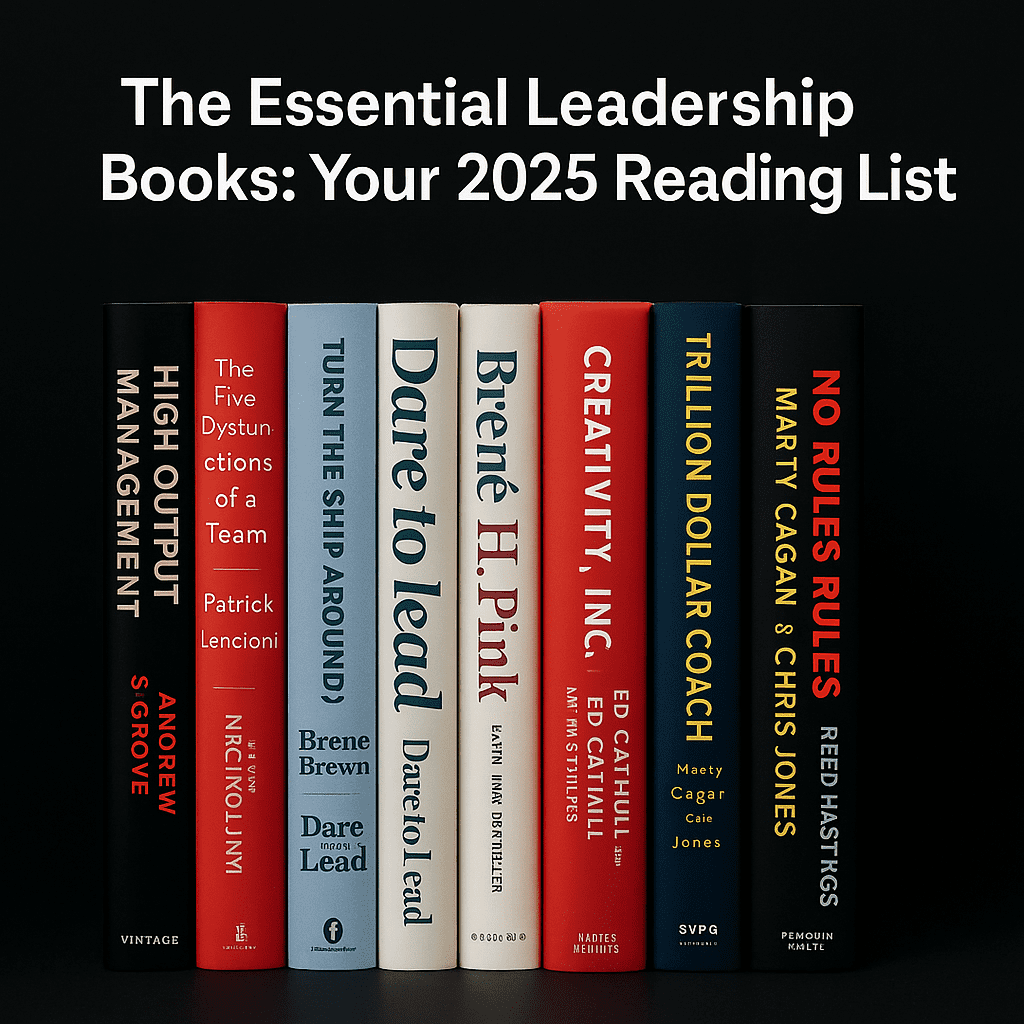
High Output Management
By Andrew S. Grove (Vintage, 1995)
The timeless, engineering-driven manual on the mechanics of management from Intel’s legendary CEO. Grove breaks down core responsibilities like one-on-ones and planning into a logical system, treating management not as an art, but as a process to be optimized for maximum impact.
The Five Dysfunctions of a Team
By Patrick Lencioni (Jossey-Bass, 2002)
This classic leadership fable provides a simple yet powerful model for diagnosing and fixing the root causes of team politics and dysfunction. Lencioni’s pyramid—built on trust, healthy conflict, commitment, and accountability—is an essential diagnostic tool for any leader.
Turn the Ship Around!
By L. David Marquet (Portfolio, 2013)
A compelling true story of how a “leader-follower” model was transformed into a “leader-leader” model aboard a nuclear submarine. Marquet provides a practical guide for giving control and creating intent-driven teams that take true ownership.
Dare to Lead
By Brené Brown (Random House, 2018)
Brené Brown uses decades of research to argue that leadership is not about status or control, but about the courage to be vulnerable and build trust. This book provides a practical playbook for having tough conversations and leading from a place of authenticity and empathy.
Drive
By Daniel H. Pink (Riverhead Books, 2009)
Pink dismantles the myth of external motivation (carrots and sticks) and reveals the three true drivers of performance: Autonomy, Mastery, and Purpose. This book is essential for any leader who wants to create an environment where people are genuinely engaged.
Creativity, Inc.
By Ed Catmull (Random House, 2014)
A masterclass in building a creative culture from the co-founder of Pixar Animation Studios. Catmull shares hard-won lessons on how to protect new ideas, give candid feedback without destroying morale, and lead teams to groundbreaking creative heights.
Trillion Dollar Coach
By Eric Schmidt, Jonathan Rosenberg, & Alan Eagle (Harper Business, 2019)
Distilling the wisdom of legendary coach Bill Campbell, who mentored Silicon Valley icons like Steve Jobs and Larry Page, this book reveals that the best leaders succeed by building trust, fostering personal growth, and creating communities, not just companies.
Empowered
By Marty Cagan & Chris Jones (Wiley, 2020)
This book explains how great leaders create the environment for ordinary people to achieve extraordinary results. It’s the playbook for moving from managing a product to coaching and leading a powerful, autonomous product organization.
No Rules Rules
By Reed Hastings & Erin Meyer (Penguin Press, 2020)
An inside look at the radical culture of Netflix, built on talent density and radical candor instead of process and control. It offers a provocative model for building a culture of freedom and responsibility, forcing leaders to question their assumptions about performance and policy.
Strategy & Decision-Making
A leader’s primary role is to chart the course and make the tough calls. These books provide the frameworks to craft winning strategies, see the competitive landscape with clarity, and improve your judgment when it matters most.
Good Strategy/Bad Strategy
By Richard Rumelt (Crown Business, 2011)
This book provides the ultimate filter for strategic thinking, teaching you to cut through the fluff and formulate strategy with piercing clarity. Rumelt’s “Kernel”—a Diagnosis, a Guiding Policy, and Coherent Actions—is a powerful tool for crafting a strategy that is both insightful and actionable.
7 Powers
By Hamilton Helmer (Self-Published, 2016)
The definitive, rigorous framework for identifying and building a durable competitive advantage. Helmer provides a precise vocabulary for the seven and only seven types of business “powers” (e.g., Network Economies, Brand), arming you with the strategic lens to ensure long-term defensibility.
Thinking, Fast and Slow
By Daniel Kahneman (Farrar, Straus and Giroux, 2011)
Nobel laureate Daniel Kahneman explains the two systems that drive the way we think and make choices. This is an essential read for any leader to understand the cognitive biases that affect decision-making and how to guard against them.
Thinking in Bets
By Annie Duke (Portfolio, 2018)
A former poker champion teaches you how to embrace uncertainty and make better decisions by separating the quality of a decision from the quality of its outcome. This book provides a framework for thinking probabilistically and learning from feedback in a noisy world.
Your Next Five Moves
By Patrick Bet-David (Simon & Schuster, 2020)
This book translates the mindset of a chess grandmaster into a practical guide for business strategy. Bet-David provides a framework for thinking ahead, helping leaders anticipate outcomes and position themselves and their organizations for future success.
Decisive
By Chip Heath & Dan Heath (Crown Business, 2013)
The Heath brothers offer a four-step process designed to counteract the biases that undermine our decisions. For leaders, this is a practical toolkit for widening your options, reality-testing assumptions, and making better choices with confidence.
Execution & Getting Things Done
A great strategy is nothing without execution. These books provide frameworks and systems for translating vision into reality, managing priorities, and ensuring your team consistently delivers results.
The 4 Disciplines of Execution
By McChesney, Covey, & Huling (Free Press, 2012)
This book solves the #1 challenge for leaders: executing strategic goals amidst the ‘whirlwind’ of daily urgent tasks. 4DX provides a simple, repeatable operating system for focusing on “Wildly Important Goals” and ensuring they don’t get lost in the day-to-day chaos.
Measure What Matters
By John Doerr (Portfolio, 2018)
The definitive guide to implementing Objectives and Key Results (OKRs), the goal-setting system that has powered companies like Intel and Google. This book is a practical manual for creating alignment, focus, and an accountable, results-driven culture.
The First 90 Days
By Michael D. Watkins (Harvard Business Review Press, 2013)
The go-to playbook for navigating leadership transitions successfully. Watkins provides a framework for accelerating your learning, securing early wins, and establishing yourself effectively in any new role, making it essential for both new leaders and those promoting them.
Getting Things Done
By David Allen (Penguin Books, 2001)
The bible of personal productivity, the GTD method is a system for capturing, clarifying, and organizing all of your commitments. For a busy leader, mastering this system creates the mental clarity needed to focus on the highest-value work.
Innovation & Change Leadership
Great leaders don’t just manage the present; they create the future. These books provide the roadmaps for fostering breakthrough ideas, navigating disruption, and leading your organization through transformative change.
The Innovator’s Dilemma
By Clayton M. Christensen (Harvard Business Review Press, 1997)
The classic text that explains why market leaders, even when managed perfectly, are so often disrupted by upstarts. This is required reading for any leader who wants to understand the mechanics of disruption and organize for both sustaining and disruptive innovation.
Loonshots
By Safi Bahcall (St. Martin’s Press, 2019)
This book explains the physics of group behavior and how to structure your organization to nurture the fragile, crazy ideas that lead to breakthrough innovation. It argues for separating “artists” from “soldiers” while keeping them in dynamic equilibrium, a key lesson for leaders balancing innovation with execution.
Switch
By Chip Heath & Dan Heath (Crown Business, 2010)
A powerful and practical framework for leading any kind of change, whether in your customers, your team, or your entire organization. Switch provides a simple model for change: direct the rational “Rider,” motivate the emotional “Elephant,” and shape the “Path.”
Zero to One
By Peter Thiel with Blake Masters (Crown Business, 2014)
A concise and provocative guide to building the future. Thiel argues that true innovation isn’t about competing, but about creating new monopolies. It’s a book that forces leaders to think about creating unique value rather than just iterating on existing ideas.
Communication & Influence
Leadership is communication. These books cover the essential skills of persuasion, negotiation, storytelling, and building strong relationships that are critical for driving alignment and making an impact.
How to Win Friends and Influence People
By Dale Carnegie (Simon & Schuster, 1936)
The foundational text on interpersonal skills, Carnegie’s timeless advice is as relevant today as it was nearly a century ago. For leaders, it’s a masterclass in making people feel valued, building genuine rapport, and winning people to your way of thinking.
Crucial Conversations
By Patterson, Grenny, McMillan, & Switzler (McGraw-Hill, 2002)
A practical guide for handling high-stakes interactions where opinions vary and emotions run strong. This book provides a toolkit for fostering open dialogue and achieving alignment, even when discussing the most sensitive topics.
Never Split the Difference
By Chris Voss with Tahl Raz (Harper Business, 2016)
A former FBI hostage negotiator reveals the field-tested principles of persuasion that can be applied to any negotiation. Voss provides tactical advice on using empathy, listening, and calibrated questions to get what you want in any situation.
Difficult Conversations
By Stone, Patton, & Heen (Penguin Books, 2010)
This book deconstructs high-stakes conversations into their three underlying structures (the “What Happened,” “Feelings,” and “Identity” conversations). It offers a framework for staying balanced, curious, and constructive when the pressure is high.
Made to Stick
By Chip Heath & Dan Heath (Random House, 2007)
Why do some ideas thrive while others die? This book unpacks the anatomy of sticky ideas, providing a checklist (SUCCESs) for making your messages more memorable and effective. It’s an essential guide for leaders who need to communicate strategy and vision in a way that resonates.
Personal Leadership & Mindset
The foundation of great leadership is self-mastery. These books focus on building effective habits, powerful mental models, and a resilient mindset to navigate the pressures of leadership.
The Seven Habits of Highly Effective People
By Stephen R. Covey (Free Press, 1989)
A principle-centered approach to personal and professional effectiveness that has influenced millions. Covey’s habits provide a framework for moving from dependence to independence and finally to interdependence, forming the bedrock of character-based leadership.
Deep Work
By Cal Newport (Grand Central Publishing, 2016)
In an increasingly distracted world, the ability to focus without distraction on a cognitively demanding task is a superpower. Newport provides a compelling case and actionable rules for cultivating this skill, which is essential for any leader who needs to do high-value strategic work.
Thinking in Systems
By Donella H. Meadows (Chelsea Green Publishing, 2008)
A primer on seeing the world not as a series of linear events, but as a web of interconnected systems. Mastering systems thinking allows leaders to understand unintended consequences, identify root causes, and find the highest-leverage points to create lasting change.
The Great Mental Models Series
By Farnam Street (Shane Parrish & Rhiannon Beaubien)
This series provides a multidisciplinary toolkit of mental models from fields like physics, biology, and mathematics to improve your decision-making and problem-solving. It’s a guide to upgrading your thinking by learning the big, time-tested ideas from other disciplines.




Leave a Reply