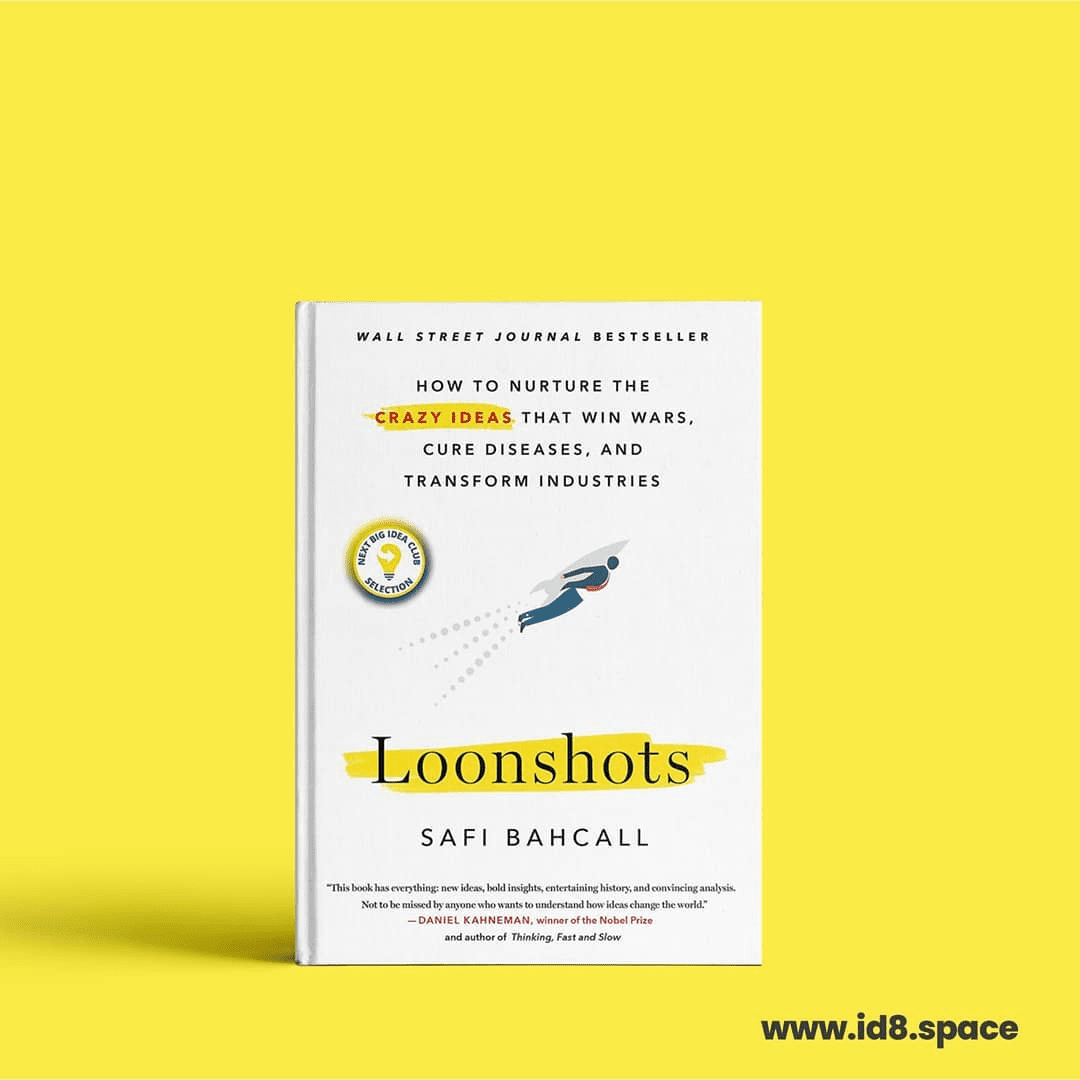

Loonshots: How to Nurture the Crazy Ideas That Win Wars, Cure Diseases, and Transform Industries
In “Loonshots,” Safi Bahcall, a physicist turned biotech entrepreneur, dives deep into the fascinating dynamics of group behavior, revealing how small structural changes, not just cultural shifts, can unlock groundbreaking innovation. This book challenges conventional wisdom about how great ideas are born and sustained, arguing that true breakthroughs often begin as “loonshots”—neglected projects, widely dismissed, championed by those written off as unhinged. Bahcall promises to dismantle the myth of the lone genius, instead focusing on the “engineers of serendipity” who master the delicate balance required to nurture these fragile ideas within large organizations. By applying the science of phase transitions—the sudden, dramatic shifts in behavior seen in everything from water freezing to traffic jamming—Bahcall provides practical rules for transforming teams, companies, and even nations into powerhouses of innovation. Prepare to discover how chickens saved millions of lives, what James Bond and Lipitor have in common, and where Isaac Newton and Steve Jobs truly got their ideas. This summary will break down every important idea, example, and insight from the book in clear, accessible language, ensuring nothing significant is left out.
Prologue: Introduction to Loonshots
The Prologue sets the stage by recounting Safi Bahcall’s journey from theoretical physics to biotech entrepreneurship, ignited by a personal mission to understand why groundbreaking ideas often fail to reach those who need them most. His path led him to discover the profound relevance of phase transitions from physics to the behavior of large groups, an insight he gained while working on recommendations for U.S. national research and learning about Vannevar Bush’s World War II innovations.
Bahcall introduces his central argument in three key points:
- Loonshots are the source of most important breakthroughs, ideas initially dismissed as crazy.
- Large groups are essential to translate these breakthroughs into impactful technologies or products.
- Applying the science of phase transitions offers practical rules for nurturing loonshots faster and better.
He notes that the 21st century’s science is increasingly defined by understanding emergent behaviors—how birds flock, brains work, and diseases spread—rather than just fundamental laws. This book applies this new scientific lens to human organizations, promising to reveal how subtle changes in structure, not just culture, can transform groups from rigid to fluid, much like temperature transforms ice to water. This fresh perspective will help readers understand why good teams kill great ideas and how to become originators of innovative surprise.
Part One: Engineers of Serendipity
1. How Loonshots Won a War
This chapter delves into the critical role of “loonshots” in winning World War II, illustrating the necessity of nurturing fragile, dismissed ideas. It highlights the genius of Vannevar Bush, who, in the face of German technological superiority, developed a system for radical breakthroughs that shaped U.S. science and technology for decades.
The story begins with the discovery of radar by Navy ham-radio enthusiasts Leo Young and Hoyt Taylor in 1922. They accidentally observed radio waves reflecting off a ship, envisioning a tool for detecting enemy vessels in fog or darkness. The Navy, however, ignored their proposal, dismissing it as impractical, especially when they later confirmed radar’s ability to detect aircraft. This exemplifies a classic loonshot—a groundbreaking idea widely dismissed. The military, focused on existing technologies and fighting the previous war, was in a “franchise phase,” unable to embrace radical innovation.
Vannevar Bush, an engineer and former naval reserve officer, understood this systemic flaw from his own experience during WWI, where his magnetic submarine detection device was also buried. He recognized the friction between “damn professors” (scientists) and military officers, noting that scientists were treated as a “lower caste.” Believing war was inevitable and the U.S. unprepared, Bush secured a 10-minute meeting with President Roosevelt in 1940, gaining authorization to create the Office of Scientific Research and Development (OSRD). This new agency, reporting directly to the president, was designed as a national “department of loonshots” to shelter promising but fragile ideas. Its mission was to “explore the bizarre,” developing technologies the military was unwilling to fund.
Bush’s success lay in applying principles of “life on the edge of a phase transition,” creating conditions for two distinct “phases” to coexist:
- Phase separation: He separated the “artists” (scientists developing high-risk ideas) from the “soldiers” (those responsible for current operations and steady growth). Early-stage projects, like radar, were fragile and needed a “strong cocoon.”
- Dynamic equilibrium: He fostered “close collaboration” and “balanced cycling” between the two groups, ensuring projects and feedback flowed easily. Bush, a practical academic, reassured scientists of their independence while emphasizing the need for practical, field-ready products.
He established 126 research contracts by the end of 1940. A crucial early effort was Alfred Lee Loomis’s work on microwave radar, which, thanks to insights shared by a British scientific mission (including the cavity magnetron), rapidly advanced. While Britain’s long-wavelength radar was key to the Battle of Britain, it was useless against submerged U-boats. The Axis’s U-boat campaign caused staggering Allied shipping losses, leading to the “Massacre” of convoys. However, the deployment of Loomis’s microwave radar and pulsed-radio navigation (LORAN) on B-24 Liberator bombers turned the tide in the Battle of the Atlantic. These technologies allowed planes to detect submarine periscopes and navigate vast oceans, transforming U-boats from hunters to hunted. Allied shipping losses plummeted by 95% in 90 days, clearing the way for the European invasion.
Bush’s OSRD also made breakthroughs in penicillin, malaria, tetanus, and plasma transfusions. Most significantly, he spearheaded the Manhattan Project after recognizing the potential of nuclear fission despite initial scientific skepticism. Bush’s system ensured the U.S. was the “initiator, not the victim, of innovative surprise.”
After the war, Bush advocated for continued federal support for science in his report, “Science: The Endless Frontier,” arguing for a new national research system focused on basic research, which he called “the pacemaker of technological progress.” This report inspired hundreds of industry-changing discoveries, including GPS, personal computers, and the internet.
Bush’s principles were inspired by Theodore Vail, CEO of AT&T (Bell Telephone Company). Facing decline in 1907, Vail created a quarantined group for “fundamental” research, which became Bell Labs. This lab invented the vacuum tube, the transistor, and won eight Nobel Prizes, becoming the most successful industrial research lab in history.
Bahcall concludes by outlining the first two Bush-Vail rules:
- Separate the phases: Create sheltered “loonshot nurseries” for artists (inventors) from soldiers (operators) and tailor tools to each phase (e.g., efficiency systems suffocate artists).
- Create dynamic equilibrium: Love both artists and soldiers equally, manage the transfer of ideas (not the technology itself), and ensure feedback flows in both directions. Innovative leaders should be “gardeners,” not “Moses,” fostering balance rather than anointing ideas by decree.
This chapter demonstrates that success lies in creating a flexible organizational structure capable of both mass production and radical innovation, a state of “life on the edge” where loonshots and franchises can coexist and mutually benefit.
2. The Surprising Fragility of the Loonshot
This chapter delves into the inherent fragility of loonshots, explaining why they require careful nurturing and protection to survive what the author calls the “Three Deaths.” It emphasizes that the path to breakthroughs is rarely a straight line but often a twisted one, marked by skepticism, failure, and neglect.
The chapter opens with Sir James Black’s wisdom: “It’s not a good drug unless it’s been killed at least three times.” This sets the stage for the true, messy history of innovation, contrasting it with the “happy history” often presented in textbooks. Gleevec, a cancer drug, exemplifies this, facing tenure denial for its champion and rejection from major journals and pharma executives.
The main narrative focuses on Akira Endo and his quest to discover statins, a drug class that would save millions of lives by lowering cholesterol. The story begins with the death of President Franklin D. Roosevelt from heart disease in 1945, which galvanized support for heart research. The subsequent Framingham Heart Study established the link between elevated cholesterol and heart disease. Endo, a Japanese microbiologist from Sankyo, arrived in the U.S. as a visiting scientist and observed the high incidence of heart disease and rich diets. Inspired, he returned to Japan determined to find a cholesterol-lowering drug.
Endo reasoned that fungi, being “great chemists,” might produce a chemical to block cholesterol production, similar to how penicillin works. He meticulously screened over 6,000 species of molds and mushrooms. In 1972, he found a “hit”—Penicillium citrinum—from a Kyoto grain store, which produced a molecule he called ML-236B (mevastatin), the precursor to all statins.
Mevastatin, however, faced the Three Deaths:
- Death #1: Dismissal by consensus. Early U.S. cholesterol-lowering trials (diet and drugs) had largely failed or shown negative side effects. The scientific consensus shifted, and lowering cholesterol was deemed dangerous. Endo’s presentation of mevastatin at a conference was sparsely attended, leaving him dejected.
- Death #2: Failure in standard animal studies. Mevastatin failed to lower cholesterol in rats, a standard animal model for drug testing. This outcome typically kills projects. Endo, risking his job, persisted and convinced a colleague, Noritoshi Kitano, to test the drug in chickens, which, unlike rats, have both “good” and “bad” cholesterol like humans. The results were spectacular.
- Death #3: Termination due to flawed safety data. After early human trials showed promise, Sankyo initiated a larger study. However, high doses of mevastatin appeared to cause cancer in dogs, leading Sankyo to stop the trial and research. This “False Fail” caused other companies to abandon statin research.
Fortuitously, Merck had a parallel statin program, discovering a nearly identical compound. While Merck scientists characterized their discovery as “sudden” and “unbelievable,” Bahcall reveals that Merck had previously sought and received confidential proprietary data from Endo and Sankyo, including key experimental results, making Merck’s discovery less surprising and more of a “borrowed loonshot.” Merck also terminated its program due to the dog study rumors.
However, Michael Brown and Joseph Goldstein, Nobel Prize-winning physician-scientists at the University of Texas, recognized the importance of statins for patients with familial hypercholesterolemia (FH). Skeptical of the dog study, they worked with the FDA and eventually pressured Merck to restart its program. New safety studies disproved the cancer link, leading to the approval of Merck’s Mevacor in 1987. Statins became the most widely prescribed drug franchise, generating over $300 billion in sales.
The chapter also briefly introduces Judah Folkman, who championed angiogenesis inhibitors (drugs that starve tumors by blocking blood vessel growth) for 32 years, facing ridicule (“clown”) and repeated “deaths” (including irreproducible data and failed early drugs). His persistence, supported by his wife’s “Spouse Activation Factor” (SAF), led to the drug Avastin, which transformed cancer treatment.
Key lessons from the surprising fragility of loonshots:
- Beware the False Fail: Negative results can stem from flaws in the test design, not the idea itself. Endo’s chicken experiment and Thiel’s analysis of Friendster (a social network that failed due to software glitches, not a weak business model) are prime examples.
- Create Project Champions: Fragile projects need strong advocates. Hoyt Taylor was a good inventor of radar, but William “Deak” Parsons was its relentless champion within the Navy, securing funding and fighting skepticism. The best inventors aren’t always the best champions, highlighting the need for “bilingual specialists” fluent in both “artist-speak” and “soldier-speak.”
- Listen to the Suck with Curiosity (LSC): Instead of defending when attacked, investigate failures with an open mind. Endo did this with his rat results, and Folkman with his irreproducible data (discovering issues with sample shipping). LSC helps distinguish persistence from stubbornness and identifies when to give up.
In conclusion, loonshots are inherently vulnerable and often die prematurely due to false failures or a lack of strong champions. Surviving requires vigilance against the “Three Deaths,” the ability to discern true failures from misleading ones, and the crucial role of dedicated advocates who can navigate skepticism and ensure continued support.
3. The Two Types of Loonshots: Trippe vs. Crandall
This chapter introduces the critical distinction between two types of loonshots—P-type (product/technology) and S-type (strategy/business model)—and illustrates how failing to nurture both can lead to the downfall of even the most successful organizations. It uses the contrasting fates of two airline titans, Pan Am’s Juan Trippe and American Airlines’ Bob Crandall, to highlight this point.
Juan Trippe, Pan Am’s founder, was a master P-type innovator. His vision centered on developing bigger, faster, and more advanced planes, from his early three-seater air taxi to the iconic Boeing 747. Pan Am was the first American airline to fly transatlantic and transpacific, pioneering the Jet Age and becoming a global symbol of glamour. Trippe’s strategy was a “dangerous virtuous cycle”: technology improvements lowered costs, allowing investment in more technology, attracting more customers, and fueling further P-type loonshots. He secured mail contracts with the help of Charles Lindbergh, who also advised on plane selection (like the Sikorsky S-38 “flying boat”) and navigated early challenges, including a dangerous crash due to poor navigation. Trippe then commissioned Hugo Leuteritz to develop a lightweight radio-navigation system, making international flight safe and profitable.
Trippe’s ambition culminated in the China Clipper, the first transpacific passenger flight, launched in 1935, which required building air bases on remote islands (Wake, Midway, Guam) identified from old clipper ship logs. He later orchestrated a complex deal to force Boeing and Douglas to build the Boeing 707 and Douglas DC-8 jets, effectively launching the Jet Age for commercial travel. During World War II, Pan Am aided the Allied effort, and Trippe even received a secret request from China to save it from communists. The emergence of the jet engine (a P-type loonshot) from Germany further captivated Trippe, leading him to commission the Boeing 747.
However, Pan Am’s relentless focus on P-type loonshots made it blind to S-type loonshots. These are breakthroughs in strategy or business models that involve no new technologies but fundamentally change how an industry operates. Bob Crandall, CEO of American Airlines, was a master S-type innovator. While Trippe was pursuing grand, glamorous P-type visions, Crandall focused on subtle, “nerdy” changes that were overlooked by others but proved critical after airline deregulation in 1978.
Crandall’s key S-type innovations included:
- Two-tier pay system: To combat higher labor costs from old contracts, he convinced unions to accept lower “B-scale” wages for new hires, allowing American to expand and compete with new, low-cost carriers.
- Computerized reservation system (Sabre): American offered Sabre to travel agents, giving them unparalleled data on booking patterns. This data allowed them to develop “yield management” techniques, maximizing revenue per seat. Sabre also subtly favored American’s flights, giving them a distribution advantage.
- Frequent flyer programs and SuperSaver fares: These built customer loyalty and filled empty seats, though they were more visible and quickly copied.
After deregulation, the industry faced a “solar eclipse” moment where previously hidden S-type loonshots became critical. Crandall’s strategic innovations allowed American Airlines to survive and thrive, while Pan Am, despite its technological prowess, entered a terminal decline, eventually selling off its assets until it ceased operations in 1991. Trippe had retired, and his successors, stuck in a “franchise” mindset, failed to adapt.
The chapter concludes with the concept of the Moses Trap: when a powerful leader exclusively anoints “holy loonshots” (often P-type, driven by “love of loonshots” rather than “strength of strategy”), it creates a dangerous virtuous cycle that eventually leads to tunnel vision and failure. The fall of IBM’s hardware business, despite its early success with the PC, is cited as another example of missing an S-type shift (customers caring more about software and microprocessors than the brand of the box). This highlights the crucial need for leaders to watch their “blind side” and nurture both P-type and S-type loonshots.
4. Edwin Land and the Moses Trap
This chapter further explores the Moses Trap by examining the rise and fall of Edwin Land and his Polaroid Corporation. Land, a brilliant P-type innovator like Juan Trippe, built an empire on revolutionary products but ultimately succumbed to the same trap: anointing loonshots by decree, driven by passion rather than strategic balance.
The chapter opens with a vivid comparison between the unveiling of Polaroid’s SX-70 instant camera in 1972 and Steve Jobs’s iPhone launch, highlighting Land’s charismatic showmanship and the media’s gushing response. This sets the stage for Polaroid’s 30-year reign as a glamour stock, fueled by continuous Nobel-caliber breakthroughs.
Land’s genius began at 17, when he created the first man-made polarizer by embedding tiny herapathite crystals in goo, inspired by a childhood desire to eliminate glare. His early inventions, like polarized sunglasses (Polaroid’s first hit) and adjustable-shade goggles for the military, showcased the practical applications of his hidden property of light. He later developed the vectograph, a 3D imaging system inspired by art history professor Clarence Kennedy, which was used for military terrain maps during WWII and sparked the 3D movie craze. Kennedy also influenced Land to recruit Smith College art history majors for technical roles, leading to breakthroughs like Meroë Morse’s work in instant color.
Polaroid’s most famous invention, instant photography, was born from Land’s daughter’s simple question: “Why can’t I see them now?” This led to the ingenious chemical process of developing negative and positive prints simultaneously inside the camera. The SX-70, a collapsible instant-color-print camera, became a spectacular hit, turning “intimacy pictures” into a new market. Polaroid thrived on a dangerous virtuous cycle: P-type loonshots (sepia, black & white, automatic, color, non-peel-apart film) fed a growing franchise, which in turn funded more P-type loonshots.
The Moses Trap, however, became apparent with Polavision, Land’s audacious $500 million project to create instant-print movies. Despite its astounding technological achievement (processing thousands of images in 90 seconds in a consumer device), Polavision failed commercially. It was too expensive compared to cheaper, erasable videotapes and Super 8 film, demonstrating a lack of market insight. As one analyst put it, Polavision had “much more scientific and aesthetic appeal than commercial significance.” The project was a massive financial write-off, leading to Land’s resignation as CEO and eventual complete separation from Polaroid.
On the surface, Polaroid’s decline appeared to be a classic case of an aging company being blindsided by a disruptive technology—digital photography. However, declassified documents reveal a deeper truth: Edwin Land was not blindsided by digital photography; he was its early champion. In 1971, Land convinced President Nixon, against the unanimous opposition of his military advisors, to invest in digital spy satellites using CCD chips—years before commercial digital cameras existed. The KH-11 digital satellite, launched in 1976, transformed U.S. intelligence gathering.
So, why did Land champion digital for the CIA but not for Polaroid?
- Franchise blinders hardened: Polaroid made its money from selling film cartridges, not cameras. Digital photography meant no film, threatening their core business model. Land and his team missed the hidden S-type loonshots that digital could enable, focusing only on its P-type aspects (superior image quality). They failed to see new revenue streams.
- Moses grew all-powerful: Land was the “principal cheerleader and spokesperson” for Polavision, making decisions based on his personal love for the technological challenge rather than a balanced strategic assessment. He walled off his loonshot nursery, but his personal decree, not a dynamic equilibrium of ideas, determined which loonshots advanced.
The Moses Trap, as illustrated by Land and Trippe, is a fundamental failure of dynamic equilibrium. While they excelled at phase separation (creating brilliant loonshot nurseries), they became the sole judges and juries of new ideas, overriding strategic considerations. This led to a focus on continually spinning the “dangerous virtuous cycle” of P-type loonshots feeding franchises, missing crucial S-type shifts, and ultimately leading to decline. The chapter concludes by asking how organizations can escape this inevitable fate and achieve the top-right quadrant of the Bush-Vail matrix: separate phases connected by a balanced, dynamic equilibrium.
5. Escaping the Moses Trap
This chapter explains how to escape the Moses Trap by examining Steve Jobs’s journey through failure, his learning from Pixar, and his eventual return to Apple. It highlights the importance of system mindset over outcome mindset and the subtle art of nurturing loonshots within a balanced organizational structure.
The chapter opens with a description of Steve Jobs’s 1988 launch of the NeXT Inc. computer, a technologically remarkable but commercially disastrous machine. Like Polaroid’s Polavision, it was a P-type loonshot driven by Jobs’s personal vision (“love of loonshots”) rather than market strategy (“strength of strategy”). Jobs, a Moses figure, had doubled down on the trap he’d fallen into at Apple 1.0, where his “bozos” vs. “artists” mentality for the Apple II franchise and Macintosh project led to severe internal dysfunction and his forced exit.
Jobs’s career reached a low point with NeXT floundering and Pixar (which he had acquired for its powerful graphics computer, the PIC, another expensive P-type flop) struggling. This period, which he called “ankle-deep shit,” was his “fire-hydrant years.” It was during this time that he learned from Pixar.
Pixar’s success, particularly with Toy Story (the first fully computer-generated feature film) in 1995, was a culmination of a decade-long partnership with Disney. This success, driven by John Lasseter’s artistic vision and Ed Catmull’s organizational genius, made Jobs a billionaire and provided him with invaluable lessons.
Crucially, Pixar’s genius lay in its ability to balance “Ugly Babies” (early-stage loonshots, as Catmull called them) with the “Beast” (the demands of franchise production). This involved:
- Phase separation: Jobs established Jony Ive’s design studio as a highly protected, off-limits “loonshot nursery.”
- Dynamic equilibrium: Jobs learned to “love your artists and soldiers equally.” He hired Tim Cook (a “soldier” known for operations) and respected the separate domains.
- Managing the transfer, not the technology: Jobs, at Apple 2.0, learned to mind the system rather than dictate creative projects. He prefaces his feedback on films at Pixar by saying, “I’m not a filmmaker. You can ignore everything I say.”
The chapter introduces the concept of system mindset vs. outcome mindset, drawing an analogy to Garry Kasparov’s chess strategy.
- Outcome mindset (Level 1 strategy): Analyzing why a move/project failed (e.g., poor storyline).
- System mindset (Level 2 strategy): Analyzing how the decision-making process led to the failure, and how to improve that process in the future (e.g., changing feedback mechanisms, incentives).
Pixar practiced system mindset, with Catmull ensuring directors received honest feedback from peers, not just top-down dictates. This fostered a culture of candor and trust necessary for nurturing fragile “Ugly Babies.” Genentech, a successful biotech company known for its drug discovery and development, similarly exemplified this balance, with CEO Art Levinson renowned for his insistence on scientific precision while also nurturing innovative environments. Jobs later brought Levinson to Apple’s board.
Jobs’s return to Apple in 1996 marked a dramatic rescue operation. He applied the lessons learned from Pixar:
- Embracing S-type loonshots: He introduced the iTunes store (selling individual songs for 99 cents), which was dismissed as unprofitable but became a massive success. This was a strategic innovation (S-type) without new technology.
- Closed ecosystem strategy: Jobs reintroduced a closed ecosystem for Apple products (despite past failures like IBM’s OS/2, which was a “False Fail”), fencing in customers and driving phenomenal growth for the iPod, iPhone, and iPad. This S-type loonshot was central to Apple’s dominance.
By nurturing both P-type (iPhone) and S-type (iTunes, closed ecosystem) loonshots, balancing artists and soldiers, and adopting a system mindset, Jobs rescued Apple. This transformation, as he noted, was ultimately about “the way you organize”—a testament to the power of structure.
The chapter concludes by summarizing the first three Bush-Vail rules:
- Separate the phases: Create distinct groups for artists (inventors) and soldiers (operators), tailoring tools and environments to each. Watch your blind side by nurturing both P-type and S-type loonshots.
- Create dynamic equilibrium: Love both groups equally, manage the transfer of ideas (not the technology itself), and appoint “project champions” to bridge the divide. Leaders should be “gardeners,” not “Moses.”
- Spread a system mindset: Continuously ask “why” decisions were made, analyze the decision-making process (not just outcomes), and foster candor and self-awareness within teams.
The failure of Xerox PARC to commercialize its groundbreaking inventions (first personal computer, laser printer, Ethernet) serves as a counter-example to the Moses Trap. It illustrates the PARC Trap: brilliant loonshots remain “parked” and never emerge because of a lack of dynamic equilibrium, where internal organizational barriers (e.g., compensation structures) actively quash new ideas. This reinforces that without a gentle, helping hand to manage the transfer and overcome internal resistance, innovation can languish even in highly creative environments.
Part Two: The Science of Sudden Change
Interlude: The Importance of Being Emergent
This interlude lays the groundwork for understanding the “science of sudden change” by introducing the concept of emergent properties and phase transitions. It challenges the notion that complex systems always behave predictably according to fundamental laws, arguing instead that many real-world phenomena arise from collective interactions and can suddenly transform.
The interlude begins by critiquing Alan Greenspan’s assertion that competitive markets are driven by an “invisible hand” with “notably rare exceptions” like the 2008 financial crisis. Bahcall argues this is like analyzing weather “except for storms and droughts”—missing the most critical events. He asserts that neither efficient markets nor invisible hands are fundamental laws; they are emergent properties.
Emergent properties are collective behaviors of a whole that cannot be defined or explained by studying its individual parts. For example, water’s rigidity (solid) or fluidity (liquid) cannot be understood by examining a single water molecule. These behaviors “emerge” from how many parts interact collectively.
A key characteristic of emergent properties is that they can suddenly change, leading to a phase transition. A small shift in a control parameter (like temperature) can cause a system to flip from one emergent behavior to another (ice to water, or smooth traffic flow to jammed flow). Crucially, these transitions are often predictable even if the individual parts are not. As Sherlock Holmes stated, “While the individual man is an insoluble puzzle, in the aggregate he becomes a mathematical certainty.”
Bahcall then traces the intellectual lineage of this idea back to Adam Smith, who, in his Theory of Moral Sentiments and Wealth of Nations, sought underlying forces (like the “invisible hand”) to explain human and market behaviors. Bahcall argues that Smith’s work was closer to the study of emergent phenomena, a “Protestant offshoot” of physics championed by Robert Boyle, rather than the “Physics Catholicism” of Isaac Newton, which focused on discovering fundamental laws. Understanding this distinction is vital because Boyle-style emergent markets, unlike Newton-style fundamental markets, almost always have bubbles and crashes.
The interlude concludes by emphasizing that understanding emergence helps us manage complex systems. Just as knowing how water freezes or traffic jams allows us to intervene, understanding emergent behaviors in human groups can help us harness the benefits of diversity while mitigating collective disasters. This sets the stage for applying Boyle-style science to human organizations, revealing how to build groups that nurture loonshots and achieve big goals without crushing fragile ideas.
6. Phase Transitions, I: Marriage, Forest Fires, and Terrorists
This chapter elaborates on the concept of phase transitions, illustrating how gradual shifts in control parameters can cause sudden, dramatic transformations in diverse systems. The goal is to build an intuitive understanding of these dynamics before applying them to human organizations.
The chapter begins with the common experience of a phantom traffic jam on a highway, where smooth flow suddenly turns into a standstill without an obvious cause. This is presented as a phase transition between “smooth flow” and “jammed flow” states. When car density exceeds a critical threshold, small disruptions (like a driver tapping brakes) grow exponentially, leading to a jam. This phenomenon has been confirmed experimentally at the Nagoya Dome in Japan.
Two key takeaways about phase transitions are introduced:
- They always involve a tug-of-war between two competing forces.
- They are triggered when small shifts in system properties (control parameters) alter the balance between these forces.
To illustrate, Bahcall uses humorous analogies:
- Marriage: Inspired by Jane Austen, single men are subject to “entropy” (desire for freedom) and “binding energy” (desire to settle down). This is likened to marbles in an egg carton: gentle shaking keeps them in their wells (marriage), but shaking “vigor” (temperature) beyond a critical threshold sends them ricocheting everywhere (Manhattan singles bar). This is a symmetry-breaking transition (from ordered solid to disordered liquid). The depth of the “egg wells” (binding energy) is another control parameter, affecting the “melting” temperature.
- Traffic Flow (revisited): The competing forces are speed vs. safety (braking). Control parameters are car density and average car speed. A “phase diagram” shows how exceeding critical thresholds in either parameter leads to jams. Traffic engineers use this to design better highways, e.g., ramp metering or truck-overtaking bans, to prevent jams by backing the system away from the transition line.
- Forest Fires: Prompted by a gas-mask puzzle, mathematicians Simon Broadbent and John Hammersley developed percolation theory. They showed that fire spreading across a forest (or air through a gas mask) is a phase transition. Below a threshold density of trees, fires die out; above it, they erupt into wildfires. Wind speed (or “virality”) is another control parameter: high winds reduce the tree density needed for contagion.
Bahcall emphasizes the importance of “simple, but not simplistic” models. Early forest-fire models were too simple, ignoring regrowth. Later models, by physicists, focused on key parameters like virality (wind speed, humidity) and tree density. They predicted that as a forest approaches the contagion threshold, fire frequencies should follow a power law (e.g., twenty-acre fires half as often as ten-acre fires). This “Yellowstone effect” led to controlled-burn policies to prevent massive outbreaks by pushing the forest away from the threshold.
The chapter then extends percolation theory to small-world networks, influenced by Duncan Watts and Steven Strogatz’s work on cricket synchronization and “Six Degrees of Kevin Bacon.” This concept describes systems with mostly local connections but occasional distant ties (e.g., brain neurons, internet sites, social networks). This theory explains why computer viruses or ideas spread explosively or fade away.
Finally, the chapter discusses Neil Johnson’s application of percolation theory to terrorist networks. Observing that casualty data from various conflicts followed the same power law (exponent 2.5) as financial markets, Johnson hypothesized these were percolating clusters. By analyzing virtual terror cells on Russian social media (which behave like self-organizing, merging, and fragmenting “bubbles”), his team identified control parameters similar to forest fires: number of clusters and “infectability” (virality of the cause). Their models predicted attacks weeks in advance, suggesting strategies like focusing on “superspreaders” and increasing “fragmentation rates” to prevent attacks.
The chapter concludes by reiterating that phase transitions occur when a microscopic tug-of-war tips, and understanding these competing forces and control parameters (e.g., binding vs. entropy, speed vs. safety, increasing vs. decreasing virality) allows us to manage them and engineer more innovative systems.
7. Phase Transitions, II: The Magic Number 150
This chapter bridges the gap between the abstract science of phase transitions and the practical realities of human organizations, revealing how organizational size can trigger a sudden shift in incentives that favors career interests over loonshots. It introduces the “Magic Number 150” and the concept of the “Invisible Axe,” then offers a mathematical model to explain these phenomena.
The core idea is that as an organization grows, the balance of incentives for individuals shifts. Bahcall uses a thought experiment: a middle manager at a large pharma company (100,000 people) decides how to spend their last hour of the day.
- Option 1 (Loonshot): Pour energy into a risky, early-stage drug project with a 1 in 10 chance of success, which, if successful, would only marginally impact the company’s $50 billion revenue. If it fails, their career is tainted.
- Option 2 (Politics/Franchise): Spend the hour networking and promoting themselves to win a promotion, which could yield a 30% salary increase and immediate prestige.
The rational choice in a large, hierarchical organization is often Option 2. In contrast, in a small startup, where success means significant equity or “soft equity” (recognition), supporting the loonshot is the rational choice. This explains the emergence of the Invisible Axe: a collective behavior in larger groups that subtly favors killing loonshots and supporting franchises, even if individuals are genuinely enthusiastic about innovation. This is a phase transition.
The chapter then introduces a simple mathematical model of an organization to quantify this phenomenon, focusing on three key design parameters and two fitness parameters:
- Design Parameters (G, S, E):
- G (Salary Growth Rate): The percentage increase in base salary with each promotion. A high G encourages politics.
- S (Management Span): The number of direct reports per manager. A wider span (fewer layers) reduces political competition.
- E (Equity Fraction): The proportion of total compensation tied to the company’s overall success (e.g., stock options, bonuses linked to project outcomes). A higher E encourages focus on projects.
- Fitness Parameters (F):
- Project-Skill Fit: How much an individual’s extra effort genuinely improves their project’s value.
- Return-on-Politics: How much lobbying and networking influence promotion decisions.
- F (Organizational Fitness): The ratio of Project-Skill Fit to Return-on-Politics. A high F means a company rewards merit more than politics.
The model reveals a “Magic Number” (M), a critical organization size above which career interests (politics) become more important than collective goals (loonshots). For typical real-world values (e.g., S=6, G=12%, E=50%, F=1), this number is roughly 150 – aligning with Robin Dunbar’s anthropological observations and practices like Bill Gore’s 150-person building limit. This suggests that the “Magic Number 150” isn’t a hard-wired brain limit but an emergent property of typical organizational structures and incentives.
The key insight from the phase diagram is that this “Magic Number” is not fixed. By adjusting the control parameters (G, S, E, F), organizations can “raise the magic number,” allowing larger groups to remain in the loonshot-favoring phase. This means that groups much larger than 150, stuck in the career politics phase, can shift back to nurturing loonshots by changing their structure. The ability to control this transition is the basis for the fourth rule of nurturing loonshots.
8. The Fourth Rule: Raise the Magic Number
This chapter elaborates on the fourth Bush-Vail rule: “Raise the Magic Number.” It showcases how specific adjustments to organizational structure and incentives can significantly enhance a group’s ability to nurture loonshots, allowing even very large organizations to remain innovative.
The chapter begins with an example of a 200-person research group within a massive organization that has spun out revolutionary technologies like the internet, GPS, and Siri: DARPA (Defense Advanced Research Projects Agency). Created in 1958 by Neil McElroy at President Eisenhower’s request, in response to Sputnik, DARPA was designed as a “department of loonshots” to fund “far-out” research. Its structure reflects extreme examples of adjusting control parameters to raise the magic number.
DARPA’s principles for raising the magic number:
- Reduce the return-on-politics: DARPA eliminates the traditional career ladder. Program managers are hired for fixed terms (2-4 years) with expiration dates on their badges. This removes the incentive to engage in internal politicking for promotions, as there are none. The “Red Balloon Challenge” (finding 10 red balloons across the US in 37 days for a $40,000 prize), which was won by an MIT team using a creative reward system that decentralized finding efforts, exemplifies DARPA’s focus on external results over internal politics.
- Use soft equity: Instead of a career ladder, DARPA offers program managers extraordinary autonomy, high visibility, and the authority to choose projects and manage contracts. This creates a powerful motivator: peer recognition and the opportunity to make a significant impact on national security. This “soft equity” is a strong carrot, making them attractive future hires for other organizations and fostering a culture where external peers are impartial judges.
- Increase project-skill fit: DARPA’s model implicitly encourages strong project-skill fit by granting autonomy to managers and attracting top talent motivated by impact rather than promotions. When employees are genuinely challenged and contribute meaningfully, they naturally focus on project work. The example of McKinsey & Company, which dedicates full-time staff to managing project-skill fit and actively intervenes to reassign employees who are undermatching or overmatching their roles, illustrates how companies can invest in this. Such investment ensures employees are “stretched neither too much nor too little.” Training also plays a role, as new skills encourage employees to apply them to projects.
- Fix the middle: Many large companies have steep equity grant curves, giving large bonuses to top executives but tiny ones to junior and middle managers. This creates a “middle-manager Survivor” scenario, where the “dangerous middle” of the organization battles fiercely for promotions. Bahcall argues for shifting rewards more towards project outcomes and less towards rank (increasing equity fraction E and reducing salary step-up G), which raises the magic number. He also warns against perverse incentives (like archaeologists paying for scroll scraps, leading to shredded scrolls, or Ford’s Pinto goal leading to safety compromises) and advocates for a Chief Incentives Officer to design nuanced reward systems.
- Fine-tune the spans: While narrow management spans (few direct reports) are good for tight control in “franchise” groups (like airplane assembly), wide management spans (e.g., Bill Coughran’s 180 direct reports at Google, or Bob Taylor’s 40-50 at Xerox PARC) are ideal for “loonshot” groups. Wider spans encourage looser controls, more experiments, and peer-to-peer problem solving, as creative talent responds best to feedback from colleagues rather than authority.
Postscript: From Nobels and Nudges to Nurturing Loonshots
This section briefly connects the ideas to behavioral economics, noting that this field studies how incentives and environment influence individual decision-making, often in subtle or hidden ways (e.g., judges giving longer sentences after rolling high dice, or C-section rates linked to physician pay). Bahcall argues that this book extends those principles to collective decision-making, explaining why teams and companies are “predictably irrational” in rejecting loonshots, even if individuals support them. This is an application of “more is different”—collective behavior cannot be understood by studying individuals alone. He concludes that understanding these influences (both structure and culture) is key to designing more innovative organizations.
The chapter concludes by summarizing the four Bush-Vail rules as a guide to building innovative groups, applicable to any size organization, and providing additional personal lessons for loonshot champions:
- Mind the False Fail: Don’t dismiss a negative result if the test itself might be flawed.
- Listen to the Suck with Curiosity (LSC): Investigate criticism with an open mind, seeking underlying reasons for failure.
- Adopt a system rather than an outcome mindset: Focus on improving decision-making processes, not just outcomes.
- Keep your eyes on SRT (Spirit, Relationships, Time): Nurture your personal purpose, maintain strong relationships, and manage your time wisely to sustain the long journey of championing loonshots.
Part Three: The Mother of All Loonshots
9. Why the World Speaks English
This final chapter extends the principles of nurturing loonshots from companies to nations, addressing the “Needham Question”: Why did the Scientific and Industrial Revolutions occur in Western Europe, not China or India, despite their centuries of technological and economic dominance? The answer, Bahcall argues, lies in the presence of a “loonshot nursery” among nations.
For a thousand years, China and India were global economic powerhouses, leading in inventions like paper, printing, gunpowder, and the compass. China, in particular, had a sophisticated civil service and high literacy. Their empires, however, became focused on “franchise projects” (e.g., the Great Wall, Taj Mahal), turning inward and dismissing “strange or ingenious objects” (loonshots). This eventually led to their decline when confronted by technologically superior European powers armed with the steam engine.
The Scientific Method itself—the idea that universal truths can be discovered through measurement and experiment, challenging dogma—is presented as the “mother of all loonshots.” Its path mirrored heliocentrism, a dismissed idea that eventually triumphed. Nicolaus Copernicus’s sun-centered theory was ridiculed for decades after his death, but Johannes Kepler’s meticulous analysis of planetary motion (specifically, the “eight minutes of arc” discrepancy in Mars’s orbit) led him to reject circular motion and propose elliptical orbits, lighting the fire for modern astronomy. Kepler’s radical ideas, combined with Galileo’s observations and Newton’s unifying laws, solidified the scientific method.
Bahcall then applies the three conditions for a flourishing loonshot nursery (established for industries like film and drug discovery) to nations:
- Phase separation: The hundreds of independent city-states and small kingdoms in Western Europe served as a “loonshot nursery,” separate from the larger empires of China, Islam, and India. When an idea was rejected in one kingdom (like Tycho Brahe being ousted from Denmark), its champion could “hop from one lily pad to another” until finding a new patron (e.g., Tycho moving to Prague, where Kepler joined him). In contrast, in centralized empires like China under the Song emperor, ideas quashed by the ruler (like Shen Kuo’s astronomical program) stayed dead.
- Dynamic equilibrium: While Europe provided the “loonshot nursery,” its rise was also fueled by a “symbiotic web” of knowledge exchange (dynamic equilibrium) with the larger, more advanced empires. European scholars borrowed mathematics from India, astronomy from the Islamic empire, and technologies (paper, printing, compass, gunpowder) from China, providing the intellectual and material capital needed to “ignite” the scientific revolution.
- Critical mass: Overturning millennia of dogma required a string of loonshots, not just one isolated discovery. Europe’s decentralized political structure fostered a pan-European “symphony of discoveries” (e.g., telescopes from Netherlands, observations from Italy, elliptical orbits from Germany, unified theory from England), providing the necessary critical mass.
Finally, the chapter asks “Why England?” as the focal point of the Industrial Revolution. While many nations contributed, England stood out by establishing the earliest successful loonshot nursery within one country: the Royal Society of London (created in 1660). This society, driven by figures like Robert Boyle and Robert Hooke, nurtured scientific inquiry with a practical aim, leading to innovations like Denis Papin’s steam engine prototype (buried in a cookbook!) which Thomas Newcomen then turned into a practical, industrial-scale machine. This engine, a direct result of applying scientific principles, revolutionized production and propelled England to global dominance, making English the global language of business.
In conclusion, the empires of China, Islam, and India, despite their wealth and historical advantages, missed the Scientific Revolution because they failed to create the necessary organizational conditions: phase separation (multiple independent centers of innovation), dynamic equilibrium (seamless exchange of ideas between these centers), and critical mass (enough projects to ensure continued breakthroughs). The rise of the West, therefore, was not due to inherent cultural or geographical superiority but to its unique structural design—a network of competing, yet interconnected, “loonshot nurseries” that allowed fragile, dismissed ideas to survive, grow, and transform the world.
AFTERWORD: LOONSHOTS VS. DISRUPTION
This afterword clarifies the distinction between “loonshots” and “disruptive innovation,” a term popularized by Clayton Christensen. Bahcall argues that while Christensen’s framework is useful for analyzing history in hindsight, it is less helpful for guiding real-time business strategy.
Bahcall emphasizes that his two types of loonshots (P-type for product/technology and S-type for strategy/business model) are unrelated to Christensen’s categories of “sustaining” (improvements to existing products) versus “disruptive” (new entrants, often starting with inferior quality at the low end of a market, that eventually displace incumbents). A loonshot challenges conventional wisdom and is widely dismissed, irrespective of whether it ultimately becomes disruptive or sustaining.
Bahcall makes a crucial point: many technologies now recognized as transformative began as “sustaining” innovations or had no clear “disruptive” intent at their inception, and their ultimate market impact was unforeseen.
- The Transistor: Bell Labs scientists in the 1940s aimed to improve existing phone system components, a sustaining goal. The first commercial application was hearing aids. It was expensive, not low-end. Only much later did it become disruptive.
- Online Search (Google): Larry Page and Sergey Brin’s PageRank algorithm was an incremental improvement over existing search engines, making it a “sustaining” innovation initially.
- Walmart: Sam Walton, the founder, initially sought to open a big-city department store. His decision to open in rural Bentonville, Arkansas, was driven by his wife’s preference and a love for quail hunting, not a grand strategy to “disrupt” retail with a low-end model. It was a “leaf in a tornado” that unexpectedly became a massive success.
- IKEA: Ingvar Kamprad’s early furniture business, mail-order sales, and self-assembly innovations were desperate bids for survival against established competitors who banned him from trade fairs and suppliers. The idea of customers going to a warehouse to pick up their own furniture came from a manager trying to deal with crowds, not a premeditated disruptive strategy.
- Drug Discovery: Market estimates for early-stage drugs are notoriously unreliable. Amgen’s EPO drug, initially projected for a small kidney disease market, became a blockbuster due to unforeseen applications in cancer. Interferon, initially tried for viruses and cancer with disappointing results, found unexpected success treating multiple sclerosis. Similarly, new rheumatoid arthritis (RA) drugs, dismissed as targeting a “tiny market,” exploded when found to treat a broad range of autoimmune disorders.
Bahcall argues that “disruptive innovation” is best used as a hindsight analysis tool for analyzing history, not a real-time guide for business strategy. He contends that relying on such fixed categories can lead companies to dismiss truly groundbreaking ideas if they don’t fit the “disruptive” mold. For example, Uber is not “disruptive” by Christensen’s definition, and the iPhone began as a “sustaining” innovation.
The central takeaway is the importance of designing teams, companies, and nations to nurture “loonshots”—contrarian ideas that challenge deeply held beliefs about products and strategies. This proactive approach, which maintains a delicate balance with existing “franchises,” allows organizations to discover new truths in their own labs and pilot studies, rather than being caught off guard by competitors. The ultimate goal is to avoid the fate of the Qianlong emperor, who dismissed “strange or ingenious objects” only to see them return in the hands of his adversaries and doom his empire.
Key Takeaways
“Loonshots” fundamentally reframes our understanding of innovation, shifting the focus from individual genius or cultural norms to the underlying structures and incentives that shape group behavior. The core lesson is that groundbreaking ideas, or loonshots, are surprisingly fragile and face inherent organizational resistance. Sustained innovation requires creating a delicate balance between nurturing these nascent ideas and managing successful, revenue-generating “franchises.” This balance, achieved through specific structural design principles, determines whether an organization thrives or ossifies.
The core lessons:
- Loonshots are inherently fragile and often dismissed: They are crazy, neglected ideas whose champions are written off. They typically endure a “Three Deaths” journey of skepticism, failure, and neglect before success.
- Innovation is an emergent property of group behavior: The ability to innovate well is not just about individual talent or cultural values; it’s a collective phenomenon influenced by the “physics” of organizations.
- Organizations have “phases” and “phase transitions”: Groups can flip between a “loonshot phase” (focused on radical ideas) and a “franchise phase” (focused on execution and incremental growth). This flip, marked by a “magic number” threshold, occurs when incentives shift from rewarding project success to rewarding career advancement (the “Invisible Axe”).
- The Bush-Vail Rules provide a blueprint for sustained innovation: These rules, derived from historical successes like Vannevar Bush’s OSRD and Theodore Vail’s Bell Labs, are practical guidelines for managing these phases and transitions. They emphasize structural changes over cultural exhortations.
- Two types of loonshots matter: Organizations must nurture both P-type (product/technology) and S-type (strategy/business model) loonshots, as failing to see one type (the “blind side”) can be fatal, as seen with Pan Am and IBM.
- Leaders should be “gardeners,” not “Moses”: Instead of anointing ideas by decree, leaders should design systems that foster phase separation (sheltering loonshots) and dynamic equilibrium (seamless exchange and feedback between loonshots and franchises).
- System mindset is crucial: Analyzing the decision-making process (“how did we decide?”) is more valuable than just analyzing outcomes (“what happened?”), allowing for continuous improvement and learning from “False Fails.”
Next actions:
- Audit your organization’s “magic number” parameters: Evaluate your management span, salary growth rates, equity structures, and the perceived return on internal politics. Identify where incentives might inadvertently be killing loonshots.
- Identify and protect your “Ugly Babies”: Design a “loonshot nursery” that provides psychological and financial shelter for nascent, high-risk ideas. This means creating dedicated, isolated teams with different operating rules and metrics.
- Cultivate “project champions”: Actively identify and train “bilingual specialists” who can translate between “artist-speak” (inventors) and “soldier-speak” (operators), fostering crucial transfers and feedback loops.
- Shift compensation to reward outcomes over rank: Explore ways to increase project-based compensation and non-financial “soft equity” (like peer recognition and autonomy), especially for middle managers, to reduce internal politicking.
- Adopt a system mindset: Implement regular, honest post-mortems (for both successes and failures) that delve into how decisions were made, not just what the outcomes were. Encourage open, candid feedback from peers and leadership.
Reflection prompts:
- Where in my organization or personal projects am I unknowingly applying the “Invisible Axe” or falling into the “Moses Trap”?
- How can I, in my role, act more like a “gardener” by subtly adjusting the structure and incentives to nurture a greater diversity of ideas, rather than demanding innovation through top-down mandates?
- What “False Fails” might I be overlooking, and what would it take to “Listen to the Suck with Curiosity” to uncover their true lessons?









Leave a Reply