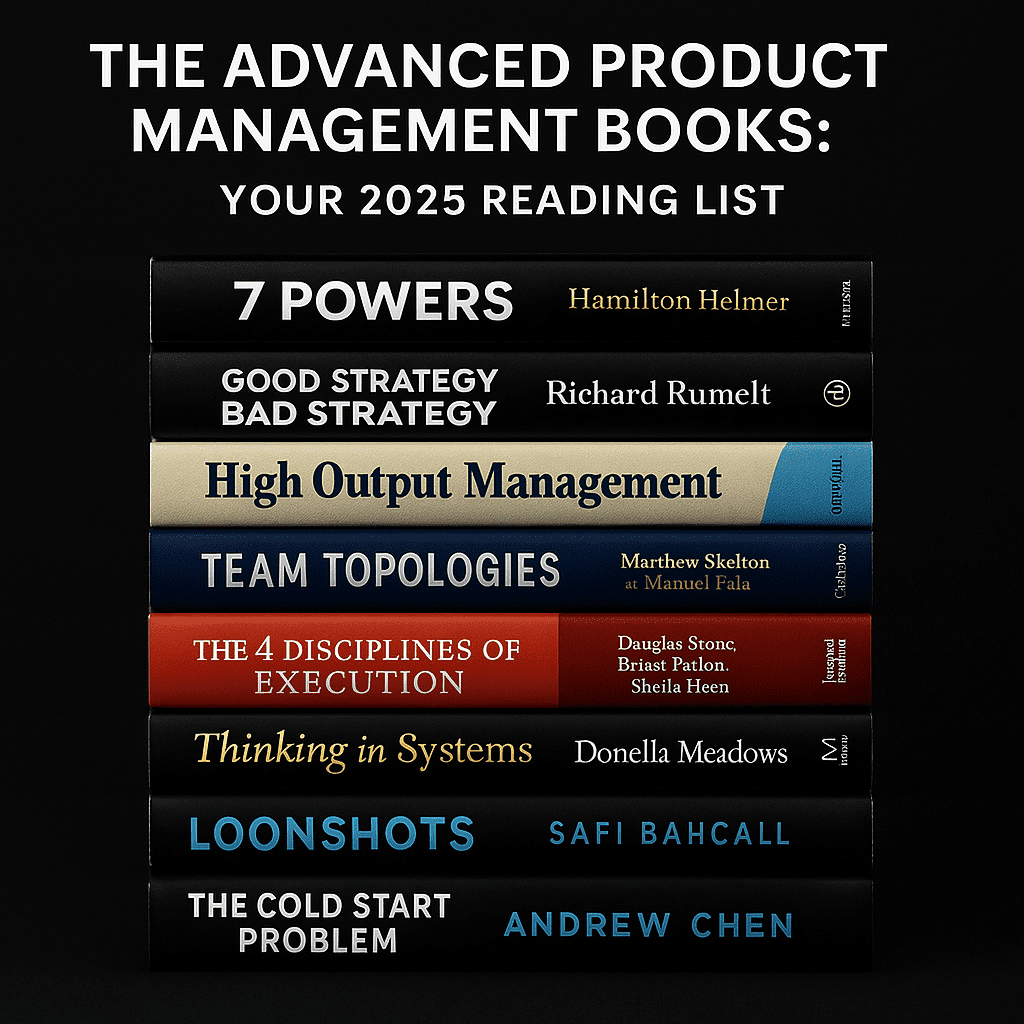

Once you’ve mastered the fundamentals of product management, the challenges evolve. Your focus shifts from executing on a single product to shaping strategy, leading teams, navigating complex organizations, and building durable competitive moats. This advanced reading list is curated for seasoned product professionals who have moved beyond the “what” and “how” of building products and are now focused on the “why” and “with whom” of building entire product organizations and ecosystems.
Key Takeaways: Your TL;DR
- Master Strategic Frameworks: Go beyond basic roadmapping and learn to build defensible competitive advantages with essentials like 7 Powers and Good Strategy/Bad Strategy.
- Lead High-Performing Teams: Learn the art and science of management and organizational design from classics like High Output Management and modern guides like Team Topologies.
- Wield Influence Across the Organization: Develop the political and communication skills to drive change in complex environments with powerful guides like The 4 Disciplines of Execution and Difficult Conversations.
- Think in Systems and Models: Upgrade your decision-making by adopting powerful mental models from books like Thinking in Systems and Loonshots.
- Build for the Future: Understand the strategic implications of modern business models and technologies with forward-looking books like The Cold Start Problem and The Coming Wave.
Strategic & Competitive Mastery
You know how to build a product. These books teach you how to build a business that wins and endures.
Good Strategy/Bad Strategy
By Richard Rumelt (Crown Business, 2011)
This book provides the ultimate filter for strategic thinking, teaching you to cut through the fluff and formulate strategy with piercing clarity.
As a leader, your primary job is to set and communicate strategy. Richard Rumelt’s “Kernel”—a Diagnosis, a Guiding Policy, and Coherent Actions—is the most powerful tool for crafting a strategy that is both insightful and actionable, and for identifying the “bad strategy” that plagues so many organizations.
💡 Pro Tip & Action Step: Audit your product portfolio’s strategy against the Kernel. Can you articulate the diagnosis, guiding policy, and coherent actions for each major product line in a single paragraph? Use this to force clarity and alignment with your teams.
7 Powers
By Hamilton Helmer (Self-Published, 2016)
The definitive, rigorous framework for identifying and building a durable competitive advantage. This is what separates fleeting success from a long-term monopoly.
While new PMs focus on features, leaders must focus on moats. Hamilton Helmer provides a precise vocabulary for the seven and only seven types of business “powers” (e.g., Network Economies, Counter-Positioning, Brand). This book will arm you with the strategic lens to evaluate your business and make decisions that strengthen your long-term defensibility.
💡 Pro Tip & Action Step: For your next major investment, explicitly map how it will create or strengthen one of the Seven Powers. If it doesn’t, question whether it’s truly a strategic move or just a tactical reaction.
The Innovator’s Dilemma
By Clayton M. Christensen (Harvard Business Review Press, 1997)
The classic text that explains why market leaders, even when managed perfectly, are so often disrupted by upstarts.
As a senior leader, you are no longer the disruptor; you are the one at risk of being disrupted. The Innovator’s Dilemma is required reading for understanding the mechanics of disruption and recognizing that listening to your best customers can sometimes be a fatal trap. It provides the theory for how to organize your company to both sustain its core and explore disruptive new frontiers.
💡 Pro Tip & Action Step: Identify a low-end or new-market “disruptive” competitor. Instead of dismissing them, acquire a small, independent team to build a competing product aimed at that exact market, free from the constraints and profit motives of your core business.
Playing to Win
By A.G. Lafley & Roger L. Martin (Harvard Business Review Press, 2013)
This book provides a clear, repeatable five-step framework for making strategic choices that win in the marketplace.
Playing to Win breaks strategy down into a cascade of five choices: What is your winning aspiration? Where will you play? How will you win? What capabilities must be in place? And what management systems are required? It turns abstract strategy into a series of concrete, interconnected decisions.
💡 Pro Tip & Action Step: Use the “Strategy Cascade” to test a proposed new product line. Does it align with your company’s “Where to Play” and “How to Win” choices? If not, it’s a distraction that will dilute your focus.
Blue Ocean Strategy
By W. Chan Kim & Renée Mauborgne (Harvard Business Review Press, 2005)
This book teaches you how to make the competition irrelevant by creating uncontested market space ripe for growth.
Blue Ocean Strategy argues against competing in bloody “red oceans” of existing markets. Instead, it provides frameworks like the Strategy Canvas and the Four Actions Framework (Eliminate, Reduce, Raise, Create) to systematically pursue “blue oceans” of new demand. For leaders, this is a toolkit for true innovation, not just incremental improvement.
💡 Pro Tip & Action Step: Run a “Four Actions Framework” workshop with your leadership team. What long-held industry assumptions can you Eliminate? What factors can you Raise far above the industry standard to create a new value curve?
The Art of Strategy
By Avinash K. Dixit & Barry J. Nalebuff (W. W. Norton & Company, 2008)
A masterful introduction to game theory, teaching you to think strategically by anticipating your competitors’ moves.
The Art of Strategy is a product leader’s guide to thinking like a chess master. It introduces core game theory concepts—like simultaneous vs. sequential moves, credible commitments, and brinkmanship—that are directly applicable to pricing decisions, competitive responses, and platform strategy.
💡 Pro Tip & Action Step: The next time a competitor makes a major move, map out the situation as a “game.” What are their likely follow-up moves? What are your best responses to each? This forces you to think two or three steps ahead.
Leadership, Culture & Organizational Design
Your impact is no longer just your own work, but the multiplied output of your team and organization. These books are your guide to management, culture, and organizational design.
High Output Management
By Andrew S. Grove (Vintage, 1995)
The timeless, engineering-driven manual on the mechanics of management, written by the legendary CEO of Intel.
This is not a book about vague leadership principles; it’s a systematic guide to the work of management. Andy Grove treats management as a process to be optimized, breaking down concepts like managerial leverage, one-on-ones, and decision-making into a logical system. For any new manager or director, this is the operating manual.
💡 Pro Tip & Action Step: Redesign your one-on-one meetings based on Grove’s principles. Make them the employee’s meeting, have them set the agenda, and focus on their key problems and performance indicators. Track your team’s output before and after this change.
Empowered
By Marty Cagan & Chris Jones (Wiley, 2020)
The sequel to Inspired, this book shifts focus from the product team to the product leader, explaining how to create an environment where empowered teams can thrive.
Empowered tackles the root of most product dysfunction: coaching, staffing, and team topology. Marty Cagan provides a guide for product leaders on how to develop their people, structure their organization, and build a strong product culture. This is the playbook for moving from managing a product to leading a product organization.
💡 Pro Tip & Action Step: Use the coaching assessment framework in the book to evaluate one of your direct reports. Identify their biggest area for growth and create a specific, actionable coaching plan to help them develop that skill over the next quarter.
Turn the Ship Around!
By L. David Marquet (Portfolio, 2013)
A true story of how to turn followers into leaders by replacing a permission-based culture with an intent-based one.
A former nuclear submarine commander, L. David Marquet tells the story of how he transformed one of the worst-performing crews into the best. For product leaders, this is the key to scaling yourself: stop being the source of answers and start building a team that declares their intent. It’s the ultimate guide to true empowerment.
💡 Pro Tip & Action Step: The next time a team member asks for permission, respond with, “What do you intend to do?” Coach them to articulate their intent and reasoning, shifting the ownership and developing their leadership skills.
The Five Dysfunctions of a Team
By Patrick Lencioni (Jossey-Bass, 2002)
This leadership fable provides a simple, powerful model for diagnosing and fixing the root causes of team politics and dysfunction.
Patrick Lencioni explains that all team failures stem from a pyramid of five dysfunctions, starting with an Absence of Trust. For product leaders, who must foster intense collaboration between diverse roles, this book is a diagnostic tool for building psychological safety, mastering healthy conflict, and achieving collective commitment.
💡 Pro Tip & Action Step: At your next team offsite, run an exercise based on the book. Ask each team member to share one area where they need help or have made a mistake. This act of vulnerability is the first step to building foundational trust.
Team Topologies
By Matthew Skelton & Manuel Pais (IT Revolution Press, 2019)
This book argues that your organizational chart is your architecture. It provides a modern vocabulary for designing teams to reduce cognitive load and increase flow.
Team Topologies is essential for leaders in scaling tech organizations. It introduces four fundamental team types (Stream-aligned, Enabling, Complicated-Subsystem, and Platform) and three core interaction modes. Applying this framework helps you deliberately design your organization to match your desired architecture, rather than letting it emerge by accident.
💡 Pro Tip & Action Step: Map your current product organization using the four team types. Are your teams structured to minimize cognitive load and dependencies? Identify one team that is suffering from too many responsibilities and propose a split or a change in its interaction modes.
No Rules Rules
By Reed Hastings & Erin Meyer (Penguin Press, 2020)
The inside story of Netflix’s radical culture, which prioritizes “talent density” and “candor” over rules and process.
No Rules Rules provides a thought-provoking look at building a culture of freedom and responsibility. While not all of its practices are universally applicable, it forces leaders to question their assumptions about policies, controls, and performance management. It’s a masterclass in building a culture for high-performers.
💡 Pro Tip & Action Step: Identify one company policy (e.g., a vacation policy, an expense policy) that exists primarily to control for a few bad actors. What would happen if you removed it and instead relied on context and trust?
Execution & Influence at Scale
Your job is to align the organization and drive results. These books provide the tools for execution, change management, and stakeholder influence.
The 4 Disciplines of Execution
By McChesney, Covey, & Huling (Free Press, 2012)
This book solves the #1 challenge for leaders: executing strategic goals amidst the ‘whirlwind’ of daily urgent tasks.
As a leader, you’re constantly fighting the “whirlwind.” 4DX provides a simple, repeatable operating system for ensuring your most important goals don’t get lost. It’s about creating focus, accountability, and a cadence of execution that actually moves the needle on your “Wildly Important Goals.”
💡 Pro Tip & Action Step: Identify your organization’s one “Wildly Important Goal” (WIG). Then, find the one or two “lead measures”—the high-impact activities your teams can control—that will have the biggest effect on that goal. Display both on a visible scoreboard for everyone to see.
Difficult Conversations
By Stone, Patton, & Heen (Penguin Books, 2010)
A step-by-step guide for navigating the high-stakes conversations that define a leader’s career.
Senior product roles are filled with difficult conversations: disagreeing with an executive, managing a low-performer, or negotiating with another department. This book deconstructs these conversations into their three underlying structures and provides a framework for staying balanced, curious, and constructive when the pressure is high.
💡 Pro Tip & Action Step: Before your next difficult conversation, shift your mindset from “I need to deliver a message” to “I need to understand their story.” Prepare a list of curious questions to ask, not just a list of points to make.
Project to Product
By Mik Kersten (IT Revolution Press, 2018)
This book explains how to shift from managing temporary “projects” to managing persistent “value streams,” which is the key to thriving in the age of digital delivery.
Project to Product argues that traditional project management is failing in the software world. Mik Kersten introduces the Flow Framework, a new way to measure and manage the flow of business value from idea to customer. For leaders, this is a guide to connecting your tech investments directly to business results.
💡 Pro Tip & Action Step: Choose one product line and map its value stream. Use the Flow Framework’s metrics (Flow Velocity, Flow Efficiency, Flow Time, Flow Load) to diagnose where value is getting stuck in your system.
Switch
By Chip Heath & Dan Heath (Crown Business, 2010)
A powerful, practical framework for leading any kind of change, whether in your users, your team, or your entire organization.
Switch presents a simple but profound model for change: you must direct the rational “Rider,” motivate the emotional “Elephant,” and shape the “Path.” For product leaders, who are constantly driving change, this book is an indispensable toolkit for overcoming resistance and making new ideas stick.
💡 Pro Tip & Action Step: For the next major change you need to implement (e.g., a new process, a strategic pivot), explicitly address all three parts of the framework. How will you provide crystal-clear direction (Rider)? How will you connect it to an emotional mission (Elephant)? And how will you make it easier to do the new thing (Path)?
Advanced Thinking & Mental Models
To solve complex problems, you need better ways of thinking. These books provide the mental models to understand systems, manage ambiguity, and make better decisions.
Thinking in Systems
By Donella H. Meadows (Chelsea Green Publishing, 2008)
A primer on seeing the world not as a series of linear events, but as a web of interconnected systems with feedback loops, stocks, and flows.
Thinking in Systems is a foundational text for any strategist. It gives you the tools to understand why well-intentioned interventions so often fail or create unintended consequences. As a product leader, mastering systems thinking allows you to design more resilient products and organizations by focusing on the highest-leverage intervention points.
💡 Pro Tip & Action Step: Map your product’s growth engine as a system. Identify the key feedback loops (e.g., more users -> more content -> more new users). Where are the delays in the system? Where is the highest leverage point to intervene?
Loonshots
By Safi Bahcall (St. Martin’s Press, 2019)
This book explains the physics of group behavior and how to structure your organization to nurture the fragile, crazy ideas that lead to breakthrough innovation.
Loonshots uses the science of phase transitions to explain why innovative teams suddenly become bureaucratic. Safi Bahcall argues for a structure that separates “artists” (innovators) from “soldiers” (franchise-runners) while maintaining a dynamic equilibrium. It’s a system-level approach to building a culture of sustained innovation.
💡 Pro Tip & Action Step: Analyze your company’s incentive structures. Do they reward and protect early-stage, high-risk “loonshots,” or do they only reward predictable, on-time delivery of existing franchise projects? Propose a new incentive structure for your innovation team.
A New Way to Think
By Roger L. Martin (Harvard Business Review Press, 2022)
This book challenges and reframes 14 traditional business models, offering fresh, more effective ways to think about strategy, culture, and execution.
A New Way to Think by Roger Martin is a collection of updated and evolved ideas from one of today’s leading strategic thinkers. It urges leaders to move beyond outdated models and provides more nuanced frameworks for topics like competition, data, and talent management. This is a toolkit for upgrading your strategic OS.
💡 Pro Tip & Action Step: Pick one chapter that challenges a core belief at your company (e.g., the chapter on data-driven decision-making). Present the counter-argument to your leadership team to spark a strategic debate.



Leave a Reply