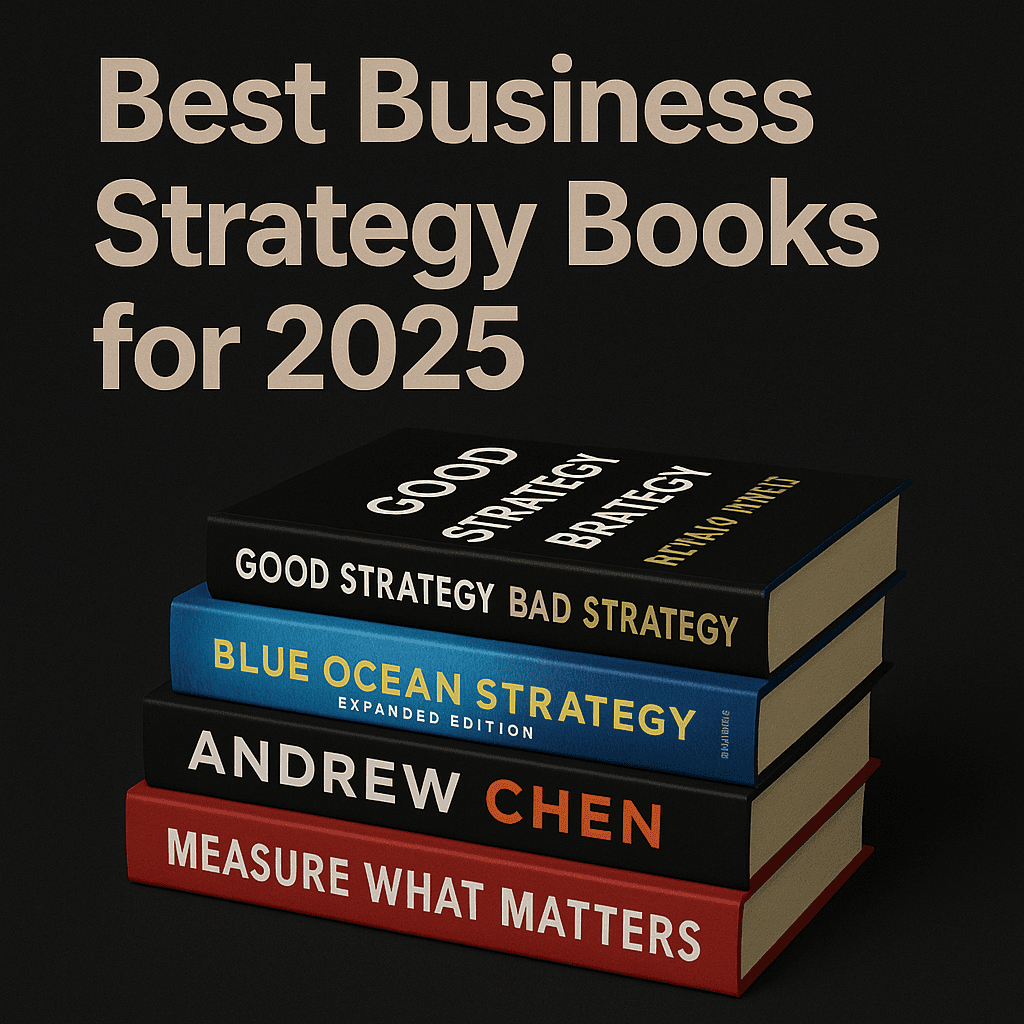

To navigate the complexities of 2025, leaders need more than just a good idea; they need a robust strategic toolkit. The business landscape is defined by rapid technological shifts, new economic models, and intense competition. This curated library, drawn from our comprehensive collection of summaries, provides the essential frameworks, mental models, and actionable insights to help you build a durable, high-growth, and impactful organization.
Key Takeaways: Your TL;DR
- Master Foundational Strategy: Build your strategic thinking on timeless principles with classics like Good Strategy/Bad Strategy and 7 Powers.
- Create Uncontested Markets: Learn to make the competition irrelevant by creating new market space with frameworks from Blue Ocean Strategy and The Innovator’s Dilemma.
- Dominate Modern Business Models: Understand the new rules of the digital economy with essential reads on platforms, network effects, and subscriptions like The Cold Start Problem and Subscribed.
- Drive Relentless Growth: Find and scale your customer acquisition channels with powerful playbooks like Traction and Crossing the Chasm.
- Execute with Discipline: Turn your strategy into reality by mastering execution with frameworks from Measure What Matters and The 4 Disciplines of Execution.
Foundational Strategy & Frameworks
These are the essential, non-negotiable books for any leader. They provide the core principles for thinking clearly about strategy and building a sustainable advantage.
Good Strategy/Bad Strategy
By Richard Rumelt (Crown Business, 2011)
This book cuts through the fluff and provides a crystal-clear definition of what strategy is and what it isn’t.
Good Strategy/Bad Strategy argues that most of what passes for strategy is just a mix of buzzwords, goals, and ambition. Rumelt introduces the “Kernel” of a good strategy: a Diagnosis, a Guiding Policy, and a set of Coherent Actions. It’s the foundational text for anyone tired of vague, un-actionable strategic plans.
💡 Pro Tip & Action Step: Evaluate your company’s current strategy against the “Kernel.” Can you articulate your diagnosis, guiding policy, and coherent actions in one paragraph? If not, you likely have “bad strategy.”
7 Powers
By Hamilton Helmer (Self-Published, 2016)
This is the definitive guide to building a truly defensible business by identifying and leveraging one of seven specific types of competitive advantage.
7 Powers provides a rigorous framework for understanding what makes a business sustainably profitable. For strategists, it offers a precise vocabulary (e.g., Scale Economies, Network Economies, Switching Costs) to analyze your business’s true moat and how to strengthen it.
💡 Pro Tip & Action Step: Identify which of the seven powers your business currently has or could realistically develop. Focus all strategic efforts on deepening that single power instead of trying to be good at everything.
Playing to Win
By A.G. Lafley & Roger L. Martin (Harvard Business Review Press, 2013)
This book provides a clear, repeatable five-step framework for making strategic choices that win in the marketplace.
Playing to Win breaks strategy down into a cascade of five choices: What is your winning aspiration? Where will you play? How will you win? What capabilities must be in place? And what management systems are required? It turns abstract strategy into a series of concrete, interconnected decisions.
💡 Pro Tip & Action Step: Use the “Strategy Cascade” to test your latest initiative. Does it align with your company’s “Where to Play” and “How to Win” choices? If not, it’s a distraction.
The Personal MBA
By Josh Kaufman (Portfolio, 2010)
This book is a masterclass in business fundamentals, distilling the core concepts of an MBA into a single, accessible volume. It’s the ultimate business literacy primer.
The Personal MBA covers a wide range of essential business concepts, from marketing and sales to finance and operations. For strategists, it provides a holistic understanding of how different parts of a business work together, enabling more comprehensive and effective strategy creation.
💡 Pro Tip & Action Step: Identify one area from the book where your knowledge is weakest (e.g., finance, value creation). Spend one week focusing your learning on that specific area to become a more well-rounded strategist.
Understanding Michael Porter
By Joan Magretta (Harvard Business Review Press, 2011)
This book makes the dense, foundational work of Michael Porter accessible, breaking down his core concepts like the Five Forces and the value chain into a clear, practical guide.
Understanding Michael Porter demystifies the foundational concepts of competitive strategy. It explains how to analyze your industry structure, choose a distinct competitive position (low cost or differentiation), and configure your company’s activities to deliver it. A must-read for understanding the classic rules of competition.
💡 Pro Tip & Action Step: Map your industry using Porter’s Five Forces. What is the power of buyers and suppliers? What is the threat of new entrants and substitutes? This analysis will reveal the core profit drivers (and risks) in your market.
Innovation & Market Creation
Competition is a losing game. These books teach you how to create new markets, navigate disruptive change, and build the future.
Blue Ocean Strategy
By W. Chan Kim & Renée Mauborgne (Harvard Business Review Press, 2005)
This book teaches you how to make the competition irrelevant by creating uncontested market space ripe for growth.
Blue Ocean Strategy argues against competing in bloody “red oceans” of existing markets. Instead, it provides frameworks like the Strategy Canvas and the Four Actions Framework (Eliminate, Reduce, Raise, Create) to systematically pursue “blue oceans” of new demand.
💡 Pro Tip & Action Step: Use the Four Actions Framework to analyze your industry. What long-held industry assumptions can you Eliminate? What factors can you Raise far above the industry standard to create new value?
The Innovator’s Dilemma
By Clayton M. Christensen (Harvard Business Review Press, 1997)
This is the seminal work on disruption, explaining why great, well-managed companies so often fail in the face of innovation.
The Innovator’s Dilemma explains how listening to your best customers can lead to your downfall when a “disruptive technology” emerges. It’s essential reading for any leader in an established company to understand how to spot and respond to disruptive threats and opportunities.
💡 Pro Tip & Action Step: Identify a “disruptive” technology or business model that serves the low end of your market or a new, overlooked customer segment. How could your organization nurture a separate business unit to explore this disruption without threatening your core business?
Zero to One
By Peter Thiel & Blake Masters (Crown Business, 2014)
This book is a powerful argument for building monopolies by creating something truly new (going from 0 to 1) instead of just competing (going from 1 to n).
Zero to One is a contrarian take on startups and innovation. Thiel argues that the goal of any new business should be to create a monopoly by solving a unique problem and leveraging proprietary technology, network effects, and brand. It’s a call to think bigger and more audaciously about value creation.
💡 Pro Tip & Action Step: Ask yourself the book’s central question about your business: “What important truth do very few people agree with you on?” The answer could be the foundation of a “0 to 1” business.
Loonshots
By Safi Bahcall (St. Martin’s Press, 2019)
This book explains how to nurture the crazy, fragile ideas (“loonshots”) that lead to breakthrough innovation, while still effectively managing the existing, successful parts of your business.
Loonshots provides a new model for organizational structure, arguing that you must separate your “artists” (the innovators) from your “soldiers” (the operators) but build a strong bridge between them. It’s a guide to structuring for sustained innovation.
💡 Pro Tip & Action Step: Look at your organization. Are innovators and operators mixed in the same teams with the same metrics? Brainstorm how you could create a “loonshot nursery” to protect fragile, early-stage ideas from premature judgment.
Crossing the Chasm
By Geoffrey A. Moore (Harper Business, 2014, 3rd Edition)
This is the bible for marketing high-tech products. It explains the dangerous “chasm” between early adopters and the mainstream market and provides a detailed playbook for crossing it.
Crossing the Chasm argues that there’s a fundamental gap in the Technology Adoption Life Cycle. The strategies that win you early adopters will fail with the pragmatic mainstream majority. The book provides a targeted strategy for focusing on a single “beachhead” niche to cross the chasm and unlock mass-market success.
💡 Pro Tip & Action Step: If you have early traction, identify a single, specific vertical market (a “beachhead”) where you can become the #1 solution. Focus all your marketing and product efforts on dominating that niche before expanding.
Marketing & Growth Strategy
A brilliant strategy is worthless if it doesn’t attract and retain customers. These books provide the playbooks for powerful, modern growth.
The 22 Immutable Laws of Marketing
By Al Ries & Jack Trout (Harper Business, 1993)
A timeless, punchy collection of principles that govern marketing success. This is the foundation of positioning and branding.
The 22 Immutable Laws of Marketing provides core, unchanging truths about how to win in the mind of the customer. Laws like “The Law of Leadership” (it’s better to be first than it is to be better) and “The Law of the Category” (if you can’t be first in a category, set up a new category you can be first in) are essential strategic mental models.
💡 Pro Tip & Action Step: Review your marketing against “The Law of Focus.” What single word or attribute does your brand “own” in the mind of your customers? If the answer isn’t clear, your positioning is weak.
Traction
By Gabriel Weinberg & Justin Mares (Portfolio, 2014)
This book provides a systematic framework for identifying and testing the customer acquisition channels that will actually work for your business.
Traction argues that startups fail not from a lack of product, but a lack of customers. It introduces the “Bullseye Framework,” a method for brainstorming, prioritizing, testing, and focusing on the one or two marketing channels that will drive scalable growth.
💡 Pro Tip & Action Step: Use the Bullseye Framework. Brainstorm one idea for each of the 19 traction channels. Then, run cheap tests on your top 3-5 ideas to find out which channel has the most potential for your business.
$100M Leads
By Alex Hormozi (Acquisition.com, 2023)
This is a dense, tactical masterclass on generating a high volume of qualified leads for your business.
$100M Leads provides a comprehensive playbook for modern lead generation, covering everything from advertising and content creation to referral programs and agency partnerships. It’s a no-fluff guide for anyone responsible for filling the sales pipeline and driving revenue growth.
💡 Pro Tip & Action Step: Pick one lead generation strategy from the book that you aren’t currently using (e.g., creating a lead magnet, using a referral program). Design and launch a small-scale version of it this month.
This Is Marketing
By Seth Godin (Portfolio, 2018)
This book is a manifesto for modern, empathetic marketing that seeks to solve problems and create change, not just shout messages at people.
This Is Marketing argues that great marketing is not about ads and funnels, but about serving a specific audience (the “smallest viable market”), telling a story that resonates, and building trust over time. It’s a strategic and ethical guide to earning attention in a noisy world.
💡 Pro Tip & Action Step: Define your “smallest viable market.” Who are the specific people you are trying to serve? What is the change you are trying to make for them? Re-write your homepage copy to speak directly to this group.
Modern Business Models & Platforms
The digital economy runs on new rules. These books explain how to build and scale a business in the age of platforms, network effects, and subscriptions.
The Cold Start Problem
By Andrew Chen (Harper Business, 2021)
This is the definitive book on network effects—how to create them, grow them, and defend them. It’s a playbook for building the most powerful moats in the digital world.
The Cold Start Problem deconstructs how companies like Uber, Tinder, and Slack solved the classic “chicken-or-egg” problem to build massive, valuable networks. It provides a detailed framework, from the “atomic network” to “tipping points,” for anyone building a product that gets more valuable as more people use it.
💡 Pro Tip & Action Step: If your product has a network effect, define your “atomic network.” What is the smallest possible, stable network of users that can create value for itself? (e.g., For Slack, it was a small team of 3-10 people). Focus all your onboarding efforts on getting new users to this state.
Platform Revolution
By Geoffrey G. Parker, Marshall W. Van Alstyne, & Sangeet Paul Choudary (W. W. Norton & Company, 2016)
This book explains the paradigm shift from linear businesses (pipelines) to networked businesses (platforms) and how platforms are fundamentally changing the global economy.
Platform Revolution explains the business model that powers giants like Apple, Google, and Airbnb. It details the core principles of platform design, including facilitating interactions, governance, and monetization strategies. Essential reading for understanding modern competitive dynamics.
💡 Pro Tip & Action Step: Analyze your business. Is it a “pipeline” or a “platform”? If it’s a pipeline, brainstorm one way you could start incorporating platform elements, such as enabling interactions between your customers or opening up an API for third-party developers.
Subscribed
By Tien Tzuo & Gabe Weisert (Portfolio, 2018)
This book chronicles the shift from a product-based economy to a service-based “Subscription Economy” and provides the playbook for thriving in it.
Subscribed argues that the future of business is centered on providing ongoing services and building long-term customer relationships, not on one-time sales. It explains how to rethink your business model around customer outcomes, recurring revenue, and metrics like churn and lifetime value.
💡 Pro Tip & Action Step: Shift your focus from acquisition metrics to retention metrics. What is your monthly churn rate? What is the #1 reason customers stop using your service? Solving this is the key to growth in the Subscription Economy.
Business Model Generation
By Alexander Osterwalder & Yves Pigneur (Wiley, 2010)
This book provides the one-page tool that revolutionized how startups and enterprises think about and communicate their business model.
Business Model Generation introduces the Business Model Canvas, a visual tool for mapping out the nine essential building blocks of any business (e.g., Customer Segments, Value Propositions, Revenue Streams). It’s a shared language for strategy that helps teams see the big picture and identify areas for innovation.
💡 Pro Tip & Action Step: As a team, map your current business on the Business Model Canvas. Then, use a different color of sticky notes to brainstorm how you could innovate in each of the nine blocks.
Leadership & Execution
A brilliant strategy is nothing without world-class execution. These books provide the frameworks for leading teams, setting goals, and getting things done.
Measure What Matters
By John Doerr (Portfolio, 2018)
This is the definitive guide to implementing Objectives and Key Results (OKRs), the goal-setting system that powers companies like Google, Intel, and the Gates Foundation.
Measure What Matters provides a practical playbook for setting ambitious, measurable goals that align an entire organization. Doerr explains how the dual system of inspirational Objectives and metric-driven Key Results creates focus, transparency, and accountability.
💡 Pro Tip & Action Step: For the next quarter, set one ambitious Objective for your team. Then, define 3-5 measurable Key Results that indicate progress toward that Objective. Make them public and track them weekly.
The 4 Disciplines of Execution
By Chris McChesney, Sean Covey, & Jim Huling (Free Press, 2012)
This book addresses the #1 challenge for leaders: executing strategic goals in the middle of the “whirlwind” of daily urgent tasks.
The 4 Disciplines of Execution (4DX) provides a simple, repeatable formula for executing on your most important goals: 1) Focus on the Wildly Important; 2) Act on the Lead Measures; 3) Keep a Compelling Scoreboard; and 4) Create a Cadence of Accountability.
💡 Pro Tip & Action Step: Identify your team’s one “Wildly Important Goal” (WIG). Then, find the one or two “lead measures”—the high-impact activities you can control—that will have the biggest effect on that goal. Track these lead measures daily or weekly on a visible scoreboard.
High Output Management
By Andrew S. Grove (Vintage, 1995)
Written by the legendary CEO of Intel, this is the timeless, engineering-driven guide to management as a process of increasing the output and quality of your team.
High Output Management is a masterclass in the mechanics of effective management. Grove breaks down concepts like managerial leverage, one-on-ones, and decision-making into a clear, logical system. It’s the foundational text for any manager who wants to be systematic about their craft.
💡 Pro Tip & Action Step: In your next one-on-one, structure it according to Grove’s principles: have your team member set the agenda, focus on performance and key problems, and ensure clear action items are agreed upon at the end.
The First 90 Days
By Michael D. Watkins (Harvard Business Review Press, 2013, Updated Edition)
This is the essential playbook for anyone starting a new role. It provides a structured framework for accelerating your transition and securing early wins.
The First 90 Days is a roadmap for navigating leadership transitions successfully. It provides a systematic approach for learning the organization, diagnosing its challenges, building alliances, and creating momentum. A must-read for any new leader or anyone promoting into a new position of responsibility.
💡 Pro Tip & Action Step: If you’re starting a new role, your goal in the first 30 days is to learn, not to do. Create a structured learning plan: Who are the key people you need to meet? What are the key documents you need to read? What are the critical questions you need to answer?




Leave a Reply