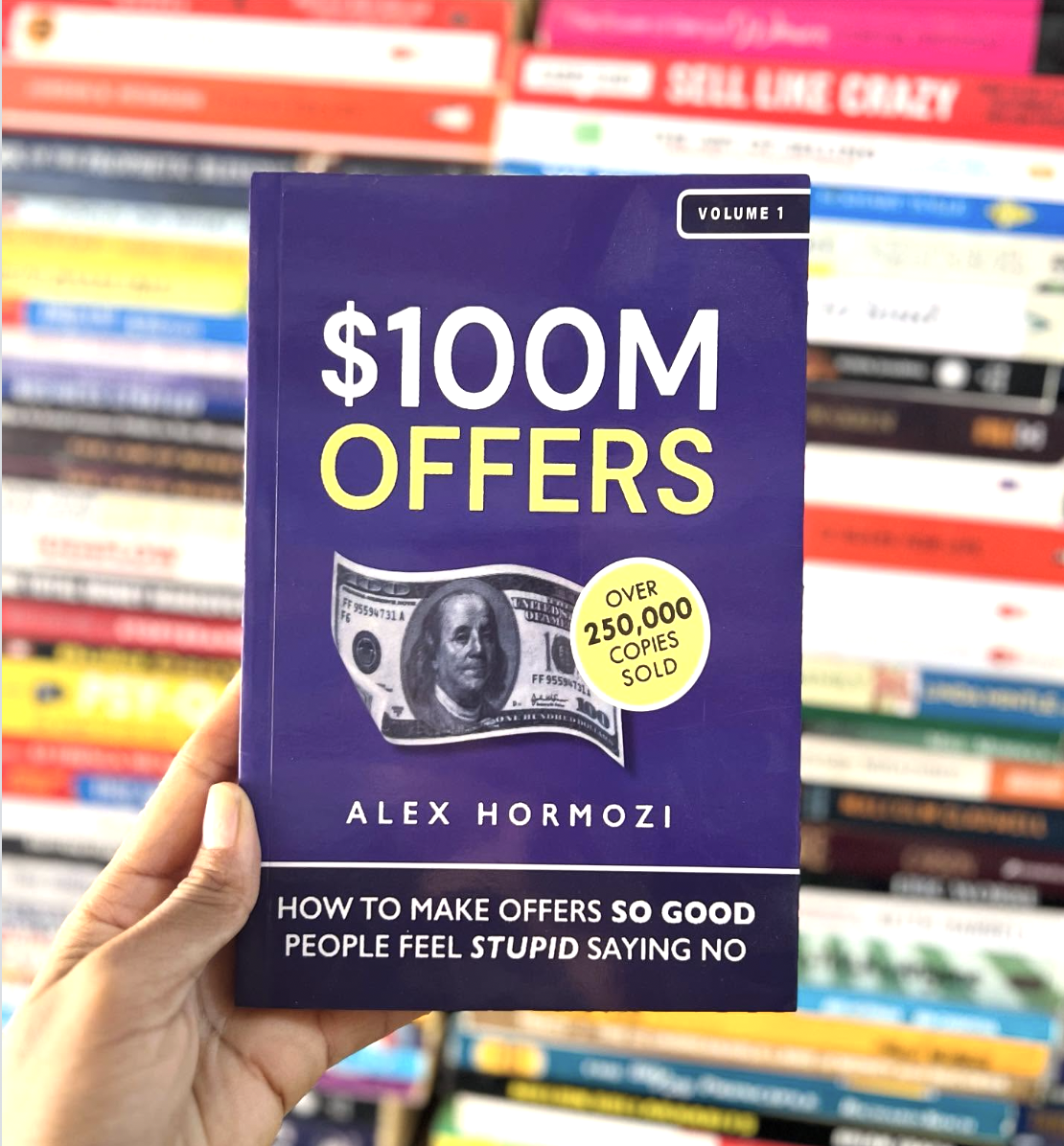

$100M Offers: Complete Summary of Alex Hormozi’s Grand Slam Offer System for Unmatched Business Growth
Introduction: What This Book Is About
$100M Offers by Alex Hormozi serves as a definitive architectural guide for constructing irresistible business propositions that eliminate price resistance and bypass market competition. Alex Hormozi is a seasoned entrepreneur, investor, and co-founder of Acquisition.com, a portfolio company generating tens of millions in annual revenue. After scaling multiple multi-million dollar companies and experiencing severe business setbacks, Hormozi synthesized his acquisition framework into a repeatable, high-margin methodology.
This book teaches business owners how to break out of the “race to the bottom” commodity trap by charging premium prices for unique, highly valued offerings. It addresses the two primary bottlenecks every entrepreneur faces: getting enough clients and generating sufficient cash profit. By altering how services and products are packaged, priced, and delivered, businesses can dramatically expand their profit margins while delivering superior outcomes to their customers.
Designed primarily for business owners, service providers, agency owners, digital creators, and brick-and-mortar operators, this system applies to any industry where value exchange occurs. Whether managing a start-up struggling to cover payroll or a multi-million-dollar enterprise scaling toward eight figures, readers gain a structured framework to make prospects feel “stupid saying no” to their proposals.
The following summary provides comprehensive, section-by-section coverage of Hormozi’s complete framework, mapping out every core concept, formula, delivery method, and psychological lever required to construct a Grand Slam Offer.
Chapter 1: How We Got Here – From Rock Bottom to $100M+
Alex Hormozi opens his story on Christmas Eve 2016, sitting in a children’s playroom after losing his life savings, facing a frozen $120,000 credit card processing balance, and being forced to pay his sole salesman a $22,000 commission out of a remaining $23,036 bank account balance.
The Turning Point in Business Crisis
Navigating severe cash constraints forces entrepreneurs to confront the stark reality of business survival. Hormozi experienced the ultimate downside of business ownership: lost capital, partner theft, and total exhaustion.
- Lost $45,700 in gym-sale proceeds to a rogue business partner.
- Drained bank accounts down to $1,036 after paying employee commissions.
- Took on $3,300 per day in credit card debt to launch six gym locations simultaneously.
Key Takeaway: Extreme financial pressure strips away unnecessary business complexity and highlights the single most vital component of commercial survival: the ability to generate immediate cash flow through compelling offers.
The Power of the Offer Vehicle
Leverage exceptional offers to overcome seemingly insurmountable financial and operational debts. By launching a high-converting, cash-upfront “challenge offer,” Hormozi generated $100,117 in revenue within 30 days, covering his daily debt obligations and staving off bankruptcy.
- Generated $1,500,000 per month within 12 months.
- Reached $4,400,000 per month within 24 months.
- Crossed $120,000,000 in total sales within 36 months.
The Financial Growth Trajectory
Track rapid revenue expansion by moving from crisis execution to systematically scaled acquisition channels.
- Initial Baseline: Near bankruptcy at $1,036
- Month 1: Generated $100,117 in upfront cash
- Month 12: Scaled run-rate to $1,500,000 per month
- Month 36: Crossed over $120,000,000 in cumulative sales
Building a Repeatable Success Framework
Mastering customer acquisition requires replacing luck with a structured, execution-focused framework. The lifetime return on ad spend across Hormozi’s business portfolio reached 36:1 over eight years, proving that acquisition skill shifts business from casino-style gambling to a house-managed game.
- Achieve a 3600% return on ad spend through systematic offer creation.
- Scale portfolio companies to $1,600,000 per week across diverse business models.
- Transform personal skill sets into public infrastructure for hyper-executing entrepreneurs.
The skill of offer creation serves as the master key for business growth. When an entrepreneur aligns value, pricing, and messaging, they can generate generational wealth from a single successful campaign.
Chapter 2: Grand Slam Offers – The Secret to Winning Big
The foundation of effortless selling lies in crafting a proposition so overwhelmingly attractive that the market naturally responds.
What a Grand Slam Offer Really Is
Define a Grand Slam Offer as a unique proposition combining an attractive promotion, premium pricing, an unmatchable value proposition, an unbeatable guarantee, and a cash-positive payment model. It creates a “category of one” where no direct competitor comparison exists.
- Eliminates direct commodity pricing comparisons.
- Increases ad response rates dramatically.
- Boosts sales conversion percentages.
- Commands premium price points.
The Core Business Growth Drivers
Focus on three core growth levers to systematically increase business topline revenue and profit:
- Acquire more clients
- Increase average purchase value
- Increase purchase frequency
The Core Business Growth Formula
Multiply core operational levers to calculate total revenue expansion:
Total Revenue Growth = Client Volume × Average Ticket Size × Purchase Frequency
The Two Major Business Constraints
Solve cash flow and client volume problems by rethinking conventional business operations. Standard business models designed by venture-backed firms force small business owners into low-margin, high-volume traps where they “buy themselves a 100-hour-a-week job.”
- Constraint 1 (Not Enough Clients): Solved by increasing ad response rates and offer conversion percentages.
- Constraint 2 (Not Enough Cash): Solved by charging premium upfront prices that fund customer acquisition costs.
A Grand Slam Offer removes these constraints simultaneously. It provides immediate cash to re-invest into marketing while making sales significantly easier to close.
Chapter 3: Pricing – The Commodity Problem
Competing on price is a losing game for small and medium-sized business owners. Commodity businesses sell products that are easily substituted, forcing them into a destructive price war.
The Downward Spiral of Commoditization
Avoid price-driven competition because it inevitably leads to razor-thin profit margins and poor client fulfillment. When products are perceived as identical, the lowest price wins, reducing profit margins to the point of business failure.
- Commoditized Purchases: Driven purely by price comparison, leading to a race to the bottom.
- Differentiated Purchases: Driven by perceived value, creating a category of one with zero direct alternatives.
Understanding Business Economics
Differentiate Gross Profit from Net Profit to optimize the lifetime value (LTV) of every customer acquired.
- Gross Profit: Revenue minus the direct cost of servicing an additional customer.
- Lifetime Value (LTV): Gross profit accrued over the entire duration of a customer relationship.
| Metric | Commoditized Agency Offer | Grand Slam Agency Offer |
| Price Point | $1,000 upfront + $1,000/mo | Pay for performance / results |
| Ad Response Rate | Standard / Low | 2.5x higher |
| Sales Closing Rate | Standard / Low | 2.5x higher |
| Upfront Cash Collected | Low / Break-even | 22.4x higher |
| Competitive Landscape | Fights all local agencies | Category of One |
Real-Life Grand Slam Offer Money Math
Execute high-value pricing models to generate cash upfront and scale ad spend aggressively. By switching an agency offer from a generic $1,000 retainer to a performance-based Grand Slam Offer, cash collected per campaign shifted from losing money upfront to $112,000 collected on $10,000 ad spend.
- Increase response rates by 2.5x through better offer positioning.
- Increase sales closing rates by 2.5x through superior terms.
- Increase upfront ticket price by 4x by bundling outcomes.
- Achieve up to 22.4x more cash collected upfront compared to commoditized offers.
Differentiating your offer transforms sales calls from high-pressure convincing sessions into simple value evaluations.
Chapter 4: Pricing – Finding The Right Market: A Starving Crowd
The best offer given to the wrong audience will fail. Business success relies on channeling existing market demand rather than trying to create it.
Market Priority Hierarchy
Prioritize foundational market selection over copywriting and pure sales tactics.
- Priority 1: Starving Crowd (Market Demand)
- Priority 2: Offer Strength
- Priority 3: Persuasion Skills
The Four Indicators of a Great Market
Target markets with structural advantages to ensure marketing efforts face a strong tailwind rather than a headwind.
- Massive Pain: Prospects must desperately need a solution to an urgent problem.
- Purchasing Power: The audience must have the financial capacity (or access to funds) to pay premium rates.
- Easy to Target: Prospects must gather in distinct groups, platforms, associations, or lists.
- Growing Market: The industry must be expanding to provide natural business momentum.
Core Human Pains
Position offers within core human markets that possess permanent demand:
- Health (Weight loss, pain relief, longevity, fitness)
- Wealth (Income generation, career advancement, cost reduction)
- Relationships (Dating, marriage, family dynamics, business networking)
The Power of Niching Down
Niche down aggressively to increase the relative value of your product without altering the core fulfillment.
Example: A generic “Time Management” course sells for $19. “Time Management for B2B Outbound Power Tools Sales Reps” can easily sell for $2,000 because the perceived relevance and immediate financial yield are far higher to that specific avatar.
- Generic Offer: $19 (Low relevance, high competition)
- Niched Offer: $2,000 (Exact relevance, zero direct competition)
Commit to a single niche long enough to test, iterate, and refine your offer. Hopping between industries prevents you from reaching the depth of understanding required to build a Grand Slam Offer.
Chapter 5: Pricing – Charge What It’s Worth
Price is what you pay; value is what you get. Maximizing profit margins requires decoupling pricing from fulfillment costs and anchoring it strictly to delivered value.
The Price to Value Discrepancy
Maintain a massive gap between value and price so that buying your offer feels like a bargain to the customer, even at high price points.
High Price + Astronomical Perceived Value = Irresistible Bargain
The Virtuous Cycle of Price
Raise prices to improve customer outcomes and fund company growth. Charging high prices sets off a positive operational feedback loop:
- Higher Client Investment: Clients who pay more put in more effort and pay closer attention, yielding superior results.
- Higher Perceived Value: Premium prices naturally signal premium quality in the buyer’s mind.
- Higher Profit Margins: Generates capital to hire better staff, improve fulfillment, and pamper customers.
- Better Client Retention: Higher satisfaction leads to longer customer lifecycles and higher referrals.
The Vicious Cycle of Low Prices
Lowering prices harms the customer experience by squeezing fulfillment margins. Low-priced products attract low-investment clients who demand the most support while producing the worst results.
- Reduces emotional commitment from buyers.
- Destroys gross margins needed for service excellence.
- Prevents reinvestment into business growth and talent.
Charge enough that it stings slightly for the client to purchase. That emotional investment ensures they take the required actions to get the outcome they paid for.
Chapter 6: Value Offer – The Value Equation
Value can be quantified and systematically engineered using four specific drivers.
$$Value = \frac{\text{Dream Outcome} \times \text{Perceived Likelihood of Achievement}}{\text{Time Delay} \times \text{Perceived Effort \& Sacrifice}}$$
Driver 1: Dream Outcome (Goal: Increase)
Increase the depiction of the status gain your client experiences upon reaching their goal. People purchase outcomes that elevate their social or professional standing.
- Connect product benefits directly to status gains in the eyes of others.
- Paint a clear mental picture of the destination, not the arduous journey.
Driver 2: Perceived Likelihood of Achievement (Goal: Increase)
Increase the client’s conviction that your system will actually work for them. People pay premiums for certainty.
- Utilize social proof, case studies, and clear track records.
- Structure guarantees that remove fulfillment risk.
Driver 3: Time Delay (Goal: Decrease)
Decrease the time required for the client to receive their first value milestone and their ultimate goal. Fast results beat free alternatives.
- Provide immediate “short-term wins” within 7 days of purchase.
- Engineered speed increases initial client retention and momentum.
Driver 4: Effort & Sacrifice (Goal: Decrease)
Decrease the client’s friction in reaching their desired outcome. Done-For-You (DFY) models command premium prices over Do-It-Yourself (DIY) models because they minimize personal client labor.
- Eliminate ancillary tasks, dietary pains, or complex setup procedures.
- Make taking action as simple as pushing a single button.
Real-World Value Equation Comparison: Meditation vs. Xanax
Analyze how time delay and effort shift market value for identical target outcomes.
- Meditation: Offers relaxation via high time delay and high effort, driving lower relative pricing power.
- Xanax: Offers relaxation via near-zero time delay and zero effort, creating a multi-billion dollar industry.
Focusing effort on reducing the bottom half of the equation (Time Delay and Effort/Sacrifice) creates massively valuable products that competitors cannot easily duplicate.
Chapter 7: Free Goodwill
Generosity creates long-term business leverage. Providing relentless value without immediate expectations builds authority, goodwill, and market dominance.
The Strategy of Unconditional Value
Deliver exceptional value upfront to earn market trust before making a commercial ask. By giving away resources that competitors charge thousands for, you establish total market authority.
- Attract hyper-executing business owners naturally.
- Build long-term enterprise value through goodwill.
- Scale reputation through peer recommendations and word-of-mouth.
Goodwill scales far faster when unencumbered by high-friction sales pitches.
Chapter 8: Value Offer – The Thought Process
Building a Grand Slam Offer requires shifting from linear thinking to expansive, divergent problem solving.
Convergent vs. Divergent Thinking
Employ divergent thought processes when designing business offerings. Convergent thinking seeks a single correct answer to a fixed math equation, whereas divergent thinking explores countless potential solutions to an open-ended problem.
- Convergent Thinking: Fixed variables, single binary answer (e.g., standard math).
- Divergent Thinking: Dynamic variables, infinite potential combinations (e.g., offer engineering).
The Creative Mindset
Uncover hidden value elements by questioning traditional delivery formats. Just as a simple brick can serve as a paperweight, building material, doorstop, or artistic canvas depending on its dimensions and composition, your core service can be delivered in dozens of high-value configurations.
- Challenge standard industry fulfillment norms.
- List every conceivable way to solve a client’s problem.
- Maximize options before cutting down to the operational core.
Systematic offer creation relies on exploring all possible fulfillment options before selecting the highest-margin, highest-value execution.
Chapter 9: Value Offer – Creating Your Grand Slam Offer Part I: Problems & Solutions
Designing a Grand Slam Offer begins by mapping every single friction point a customer encounters throughout their journey.
Step 1: Identify Dream Outcome
Define the ultimate destination your prospect wishes to reach. Sell the vacation, not the flight.
Example: “Lose 20 pounds in 6 weeks.”
Step 2: List All Perceived Problems
Catalog every obstacle and limiting belief a customer experiences before, during, and after engaging with your product. Channel extreme detail across all four value drivers.
- Obstacle Category 1 (Buying Food): Buying healthy food is hard, confusing, expensive, and takes too much time.
- Obstacle Category 2 (Cooking Food): Cooking healthy food takes too long, tastes bad, and frustrates family members.
- Obstacle Category 3 (Eating Out): Social events and business travel destroy dietary progress.
- Obstacle Category 4 (Workout Consistency): Gyms are intimidating, routines are confusing, and schedules conflict.
Step 3: Transform Problems into Solutions
Reverse every identified problem into clear, actionable solution headlines using “how-to” phrasing.
- Problem: “Buying healthy food takes too much time.”
- Solution: “How to buy a full week of healthy groceries in under 15 minutes.”
- Problem: “I don’t know what to eat when traveling.”
- Solution: “How to eat out at any airport or restaurant and still lose weight.”
Listing every minor obstacle ensures your final offer eliminates all sales objections before they are ever voiced.
Chapter 10: Value Offer – Creating Your Grand Slam Offer Part II: Trim & Stack
Once you have identified all potential solutions, you must translate them into practical delivery vehicles and assemble them into a cohesive, high-margin bundle.
The Sales to Fulfillment Continuum
Balance sales conversion ease against operational drag to find your business sweet spot.
- Do Everything Model: Extremely easy to sell, highly difficult to fulfill (High operational labor).
- Do Nothing Model: Extremely hard to sell, effortless to fulfill (Zero margin differentiation).
- Sweet Spot: High-value, scalable delivery leveraging automated, one-to-many assets.
Step 4: Determine Solution Delivery Vehicles (“The How”)
Explore diverse delivery channels for every solution using product delivery “cheat codes”:
- Group Size: One-on-one, small group, one-to-many.
- Effort Level: Do-It-Yourself (DIY), Done-With-You (DWY), Done-For-You (DFY).
- Medium: In-person, live virtual (Zoom), recorded audio/video, text/chat support, written tools.
- Speed/Frequency: 24/7 access, business hours, sub-5-minute response times, scheduled cadences.
Step 5a: Trim Down to High-Value, Low-Cost Solutions
Filter your solutions list to optimize gross margins. Eliminate options that are high-cost and low-value, and prioritize assets that cost you very little to deliver but provide high perceived value to the client.
- High-Leverage Assets: Software, recorded video courses, pre-built templates, automated calculators, swipable checklists.
- Low-Leverage Fulfillment: Uncapped 1-on-1 labor, custom manual labor, in-person travel.
Step 5b: Assemble the Final Offer Stack
Bundle solutions into named, high-value packages with individual price tags attached.
Complete Value Stack Example
- Foolproof Bargain Grocery System – $1,000 Value
- Ready in 5-Minute Busy Parent Cooking Guide – $600 Value
- Lick-Your-Fingers Good Meal Plan – $500 Value
- Fat-Burning Workout Blueprint – $699 Value
- Tone Up While You Travel System – $199 Value
- “Never Fall Off” Accountability Framework – $1,000 Value
Total Perceived Package Value: $3,998
Actual Offered Price: $599
An extensive value stack anchors a high perceived price, making your final actual rate feel like an undeniable steal.
Chapter 11: Enhancing The Offer – Scarcity, Urgency, Bonuses, Guarantees, and Naming
Once your core offer is structured, you enhance its psychological draw using outer offer levers.
Offer Enhancers = Scarcity + Urgency + Bonuses + Guarantees + Naming
The Delicate Dance of Desire
Control market supply to maximize prospect demand. Desire comes from unfulfilled needs; satisfying all market demand immediately reduces product desirability.
- Keep supply strictly below market demand to command higher prices.
- Delay gratification strategically to build pent-up demand for future launches.
- Skim the top of the buying pyramid by offering high-ticket options to those willing to pay premiums.
Enhancing an offer alters its positioning in the prospect’s mind without requiring changes to core fulfillment.
Chapter 12: Enhancing The Offer – Scarcity
Scarcity limits the quantity of products or services available, leveraging the fear of missing out (FOMO) to force purchasing decisions.
Three Primary Types of Scarcity
Implement physical or operational caps to enforce genuine scarcity:
- Limited Supply of Seats/Slots: Capping total clients serviced (e.g., “We only service 25 total accounts at a time”).
- Limited Supply of Bonuses: Restricting bonus items to the first few buyers (e.g., “The first 5 buyers get a free 1-on-1 strategy call”).
- Never Available Again: Limited-edition drops or one-time releases (e.g., “Only 100 units manufactured”).
Service-Based Scarcity Models
Cap business growth rate deliberately to maintain operational quality and sales leverage.
- Cohort Cap: Accepting a strict number of clients per class or month.
- Growth Rate Cap: Accepting only 5 new clients per week to ensure smooth onboarding.
- Total Business Cap: Operating at 80-90% capacity and maintaining a public waiting list.
The Client Waitlist Pipeline
Guide prospects through a controlled capacity funnel to drive purchasing action.
- Step 1: Public opening announced
- Step 2: Weekly cap reached (5/5 spots filled)
- Step 3: Waitlist activated for remaining prospects
- Step 4: Price point increased for subsequent cohorts
Always broadcast when your offer sells out. Publicly displaying sold-out status provides social proof and builds urgency for your next offer.
Chapter 13: Enhancing The Offer – Urgency
Urgency limits the time a prospect has to make a purchasing decision. While scarcity leverages volume, urgency relies on ticking clocks.
Four Methods for Creating Genuine Urgency
Drive fast decision-making using time-bound structures:
- Cohort-Based Rolling Urgency: Linking enrollment to upcoming start dates (e.g., “Our next group starts Monday; if you miss this, you wait 30 days”).
- Rolling Seasonal Urgency: Using seasonal promotional windows (e.g., “New Year Special ends January 31st”).
- Pricing/Bonus-Based Urgency: Time-limiting price discounts or added bonuses (e.g., “Price increases by $500 on Friday at midnight”).
- Exploding Opportunity: Highlighting time-sensitive market conditions that decay with delay (e.g., arbitrage opportunities).
Deadlines force decisions. The vast majority of sales in a time-limited campaign occur in the final hours before a deadline closes.
Chapter 14: Enhancing The Offer – Bonuses
Splitting an offer into a core package with multiple named bonuses increases its perceived value more than offering the exact same deliverables as a single lump product.
Single Lump Package < Core Offer + Strategic Bonus 1 + Bonus 2 + Bonus 3
The Rules of Bonus Presentation
Maximize bonus impact during sales conversations and marketing presentations:
- Always give bonuses a special, benefit-focused name.
- Explicitly connect each bonus to a specific client obstacle.
- Attach an individual dollar value tag to every bonus offered.
- Favor tools, templates, swipe files, and checklists over long video courses.
- Ensure the total value of the bonuses eclipses the core offer price.
Leveraging Partner Bonuses
Acquire bonuses from other businesses at zero cost to increase your offer value. Non-competing businesses will gladly provide free products, gift cards, or services to gain exposure to your client base.
- Partner with local providers to secure complementary gifts.
- Negotiate affiliate commissions or referral fees on partner usage.
- Cover your entire core offer price through partner savings.
Adding bonuses increases value to close sales without negotiating on price.
Chapter 15: Enhancing The Offer – Guarantees
Risk is the single greatest point of sales friction. Reversing risk using a bold guarantee increases closing rates and net revenue, even if total refunds rise slightly.
Net Profit Comparison: Guarantee Impact
Calculate the financial net upside of implementing a strong guarantee.
- No Guarantee Model: 100 Sales × $1,000 = $100,000 (5 Refunds) = $95,000 Net Revenue
- Bold Guarantee Model: 130 Sales × $1,000 = $130,000 (13 Refunds) = $117,000 Net Revenue (23% Total Profit Increase)
The Four Types of Guarantees
Select the right risk-reversal framework for your business model:
- Unconditional Guarantees: No-questions-asked, time-bound money-back refunds.
- Conditional Guarantees: Refunds or extra work contingent on clients completing specific actions (e.g., “Show up 3x/week and log meals; if you don’t lose 10 lbs, full refund”).
- Anti-Guarantees: Explicit “All Sales Are Final” policies backed by a compelling reason (e.g., exposing proprietary code or trade secrets).
- Implied Guarantees: Performance, revenue-share, or profit-share models where payment occurs only upon success.
High-Impact Guarantee Examples
Employ creative guarantees that provide memorable risk reversal:
- Service Guarantee: “We work with you for free until you reach your target outcome.”
- Outsized Refund Guarantee: “Double your money back if you take all required steps and fail.”
- Wage-Payment Guarantee: “We will pay your hourly wage for the time spent on our call if you find it useless.”
Structure conditional guarantees around the exact client behaviors that ensure success. This protects your business while driving client adherence.
Chapter 16: Enhancing The Offer – Naming
Your offer name serves as its wrapping paper. An appropriately named offer targets the right prospect, states the core benefit, and creates immediate interest.
The M-A-G-I-C Naming Formula
Construct catchy, high-converting offer titles using five core components:
$$ Name = \text{Magnet} + \text{Avatar} + \text{Goal} + \text{Interval} + \text{Container} $$
- M – Magnet: The reason why you are running the promotion (e.g., Free, 88% Off, Grand Opening, Summer).
- A – Avatar: The specific target buyer (e.g., Busy Moms, Dentists, Salon Owners).
- G – Goal: The desired outcome (e.g., Lean, Celebrity Smile, Double Your Profit).
- I – Interval: The time duration (e.g., 7-Day, 6-Week, 21-Day).
- C – Container: The package type (e.g., Challenge, Blueprint, Intensive, Bootcamp).
M-A-G-I-C Name Construction:
Free (Magnet) + Busy Moms (Avatar) + Fit & Toned (Goal) + 6-Week (Interval) + Challenge (Container)
= “Free 6-Week Busy Moms Fit & Toned Challenge”
Managing Offer Fatigue
Revamp offer wrapping paper before changing backend operational fulfillment. When ad performance drops, adjust elements from top to bottom:
- Change ad creative (images, video)
- Change ad body copy
- Change the offer name/wrapper
- Change the offer time duration
- Change core monetization model (last resort)
Renaming your offer allows you to re-engage the same target market without reinventing your business operations.
Key Takeaways: What You Need to Remember
Core Insights from $100M Offers
- Avoid Commoditization: Never sell standard services at market rates; create unique, bundled Grand Slam Offers that defy direct comparison.
- Charge Premium Prices: Higher prices fund better fulfillment, attract higher-quality clients, and build profit margins necessary for business growth.
- Focus on the Value Equation: Increase Dream Outcome and Likelihood of Achievement while systematically driving Time Delay and Effort/Sacrifice down to zero.
- Drive Demand via Scarcity & Urgency: Limit quantity and enforce genuine deadlines to compel prospects to make immediate buying decisions.
- Reverse Client Risk: Utilize bold conditional or service-based guarantees to eliminate sales friction.
Immediate Actions to Take Today
- Calculate your gross margins across all current core offerings and identify low-margin commodity services.
- Select a target market that possesses massive pain, strong purchasing power, simple targeting options, and growth potential.
- Draft a detailed friction list containing every problem and obstacle your customers encounter before, during, and after purchase.
- Convert those obstacles into solutions and build scalable, one-to-many delivery assets (tools, calculators, templates) to address them.
- Re-bundle your core product into a value stack with individual dollar amounts attached to each component.
- Apply the M-A-G-I-C formula to name your newly created Grand Slam Offer.
Questions for Personal Application
- Am I selling a commodity service where my prospects continuously negotiate on price, or am I operating in a category of one?
- What short-term wins can I integrate into my service within the first 7 days to dramatically reduce perceived time delay for my clients?
- Which scalable, one-to-many assets (software, templates, guides) can I create once to double my value proposition without raising fulfillment costs?
- How can I restate my offer guarantee so that my business takes on the risk of performance while requiring my client to take the necessary steps to succeed?






Leave a Reply