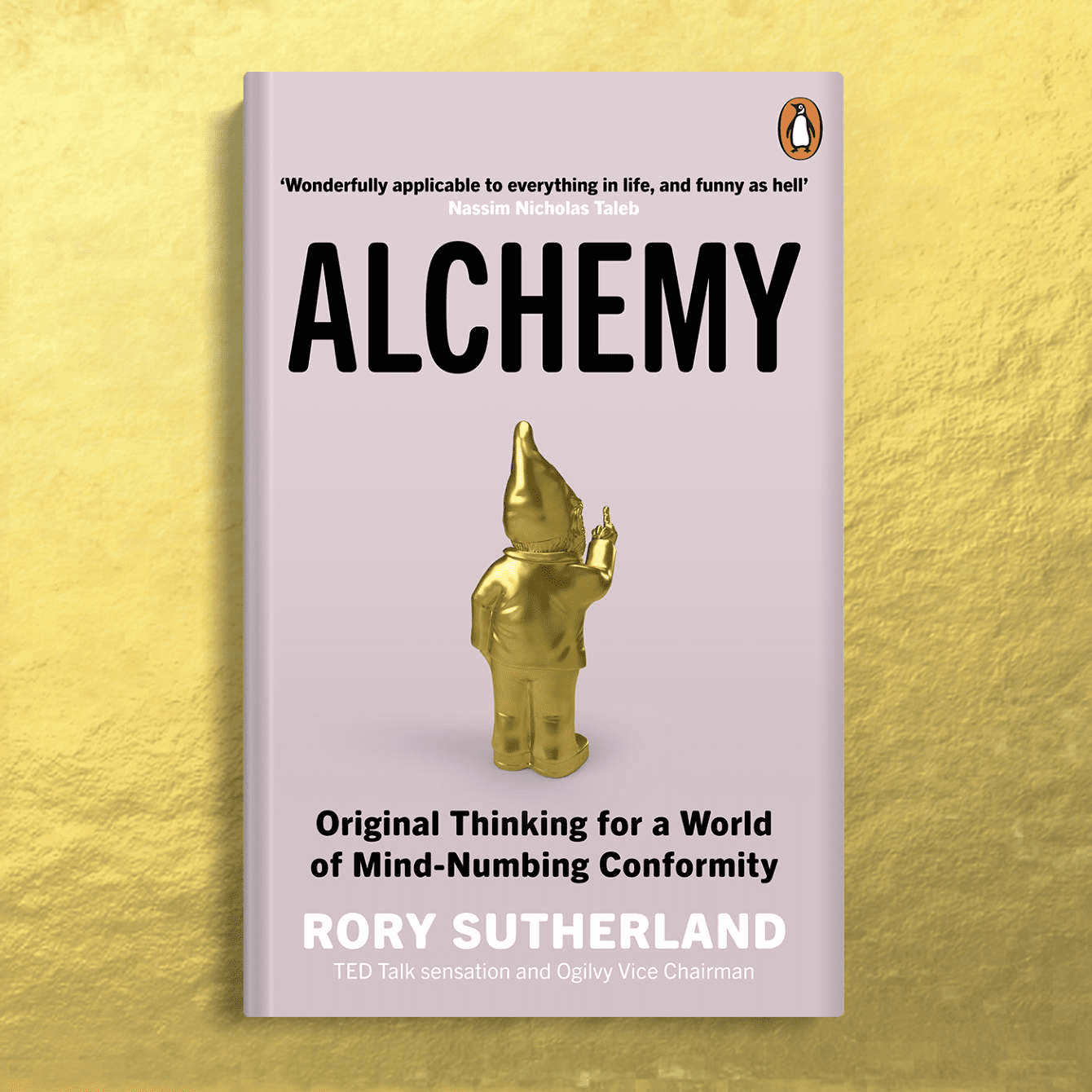

Alchemy: The Surprising Power of Ideas That Don’t Make Sense – A Complete Guide to Rory Sutherland’s System
Introduction: What This Book Is About
The modern world is dominated by an obsession with logic, efficiency, and data-driven decision-making. In Alchemy, Rory Sutherland argues that while this reductionist logic works for physical sciences, it is fundamentally flawed when applied to the messy reality of human affairs. The human mind does not run on logic any more than a horse runs on petrol; it runs on psycho-logic, an evolved operating system designed for survival and social navigation rather than mathematical optimization.
Sutherland reveals that the most successful solutions to our greatest problems are often “illogical” or “magical.” For example, Red Bull became a global powerhouse not by tasting better than Coca-Cola, but by being expensive, coming in a tiny can, and tasting “kind of disgusting.” These traits signaled potency and created a new category of “energy drink” that logic could never have predicted. This book is a manifesto for the “Alchemist”—the person who looks for disproportionate successes found in psychological insights rather than incremental gains found in spreadsheets.
By the end of this guide, you will understand how to solve “logic-proof” problems by manipulating perception, meaning, and context. You will learn to recognize the butterfly effects of human behavior, where a single word change or a shift in perspective can generate millions in revenue or solve complex social crises. This is a comprehensive blueprint for anyone looking to escape the “arithmocracy” and harness the power of ideas that don’t quite make sense.
1: On the Uses and Abuses of Reason
The Flaw in the Broken Binoculars
Decision-makers often rely on “broken binoculars”—market research and economic theory—to understand the world. Market research is flawed because people do not have introspective access to their own motivations; they cannot tell you what they truly feel or what they will actually do. Economic theory is flawed because it assumes humans are rational actors seeking to maximize objective utility, ignoring the fact that we are social creatures driven by status, fear, and instinct.
Discovering the Real Why
Human behavior is like a cryptic crossword clue: there is a surface meaning and a deeper, hidden answer. To find the “real why,” you must look past the rationalized explanation people give for their actions. For example, people say they clean their teeth for dental health, but the real driver is social confidence and the fear of bad breath. If health were the only factor, we wouldn’t insist on mint flavoring, which serves no medical purpose but provides a powerful sensory signal of cleanliness.
The Power of Psychological Moonshots
In engineering, a moonshot involves massive technical investment to achieve a 10x improvement. In alchemy, a psychological moonshot achieves the same result by changing perception. Instead of spending billions to make a train journey faster, you can make the journey more enjoyable by installing high-speed Wi-Fi or more comfortable seating. The Uber map is the ultimate psychological moonshot because it reduces the uncertainty of waiting, which is far more painful to humans than the duration of the wait itself.
The Danger of the Arithmocracy
The “arithmocracy” is a class of technocratic elites who believe that every solution must have a convincing rationale and a mathematical model before it can be tried. This focus on “narrow context” logic prevents the discovery of “magical” solutions that are cheap, fast-acting, and effective. Standard logic kills off magic by demanding that every idea be defensible to a committee of rationalists, which ensures that everyone arrives at the same unimaginative conclusions as their competitors.
Why We Should Ignore the GPS
GPS is a masterpiece of logic but is often “psycho-logically dumb.” It assumes the only goal is to reach a destination as quickly as possible, ignoring human preferences for scenic routes or the minimization of variance. When driving to an airport, a human might choose a slower back road because it has a “least-bad worst-case scenario” compared to a highway that might experience a total gridlock. We often know more than we know we know, and our instincts are better at handling “wide context” uncertainty than any algorithm.
Recruitment and the Error of Averages
Designing for the “average” person results in a product or system that fits no one. In recruitment, hiring managers often look for “potatoes”—safe, average candidates who fit a narrow set of criteria—to avoid the risk of being blamed for a bad hire. However, hiring in groups allows for the selection of complementary talents. By shifting from individual to collective selection, organizations can foster true diversity and find “wild card” candidates who offer unique, non-average strengths.
2: An Alchemist’s Tale: Why Magic Still Exists
Turning Iron and Potatoes into Gold
The secret of alchemy is that value resides in the mind of the valuer, not in the objective properties of the material. In 1813, the Prussian princess Marianne convinced wealthy citizens to swap their gold jewelry for iron replicas to fund the war against France. “I gave gold for iron” became a higher-status signal than gold itself because it proved the wearer was both wealthy and patriotic. Similarly, Frederick the Great made the potato popular not by force, but by declaring it a royal vegetable and guarding it poorly, inducing the peasants to steal and plant it for themselves.
The Alchemy of Semantics
Words have the power to change the physical experience of a product. The “Patagonian toothfish” was an unappealing commodity until it was rebranded as the Chilean Sea Bass, a move that transformed it into a luxury delicacy. In the UK, renaming the “pilchard” to the “Cornish sardine” led to a 180% increase in sales at major supermarkets. The packaging is the product in the human mind; the way you name and frame an item determines its taste, value, and desirability.
The Benign Bullshit of Hacking the Unconscious
Many successful interventions are based on “benign bullshit”—tactics that work even if their rational explanation is nonexistent. A college increased the number of female computer science majors by renaming a course from “Introduction to Programming” to “Creative Approaches to Problem Solving.” This shift in language removed the “nerdy” stigma and attracted a wider audience. Similarly, the “Designated Driver” was a deliberate linguistic coinage that created a new social norm by giving a behavior a name and a status.
The Walkman and the Power of Removal
The engineering mindset assumes that “more is better,” but the alchemist understands that less is often more. Akio Morita, the founder of Sony, insisted on removing the recording function from the original Walkman. This made the device a “single-purpose” object with a clear affordance, signaling exactly what it was for and how to use it. By removing functionality, Sony clarified the product’s identity and created a global cultural phenomenon that a “Swiss Army knife” approach would have muddled.
Designing for the Human Brain
Physical objects are designed to fit the human hand, but systems should be designed to fit the human brain. Most economic models are “aspergic” in that they ignore the biological and psychological quirks of the user. To create successful products, you must account for human subjectivity and emotional response. A bridge only needs to be strong, but a train station needs to feel welcoming; if the “psycho-logical” design is ignored, the system will fail regardless of its technical efficiency.
3: Signalling
The Knowledge as a Costly Commitment
Trust is impossible in a market without reliable signals of commitment. The London Black Cab “Knowledge” exam, which takes four years to pass, is a costly signaling device that proves the driver is invested in their career. Because the entry cost is so high, the driver has a massive incentive to remain honest; losing their license would mean wasting four years of effort. This creates a high-trust environment that a simple satnav-based system can never replicate.
Efficiency vs. Meaning
The pursuit of efficiency often destroys the meaning of a message. A wedding invitation sent via email carries less weight than one on gilt-edged card because the latter involves a visible expenditure of resources. In communication, if it’s easy to do, it’s “cheap talk” and carries no weight. For a signal to be persuasive, it must involve an element of “waste,” “absurdity,” or “extravagance” that proves the sender’s sincerity and confidence.
The Biological Roots of Advertising
Flowers are essentially “weeds with an advertising budget.” They spend precious resources on petals and scent to signal the presence of nectar to bees. This is a form of branding that ensures repeat visits; without a distinctive identity, a flower could not reward a bee for its loyalty. Advertising in the human world works the same way: it is a costly bet by the manufacturer that their product is good enough to warrant repeat purchases.
Creativity as a Brave Signal
Creativity is a form of costly signaling because it involves the consumption of talent, time, and risk. A bold, funny, or slightly “wrong” advertisement signals that a company is brave enough to be different and confident enough to stand out. Meaning is generated by things that are not in our short-term self-interest; therefore, a company that takes a creative risk is seen as more committed and trustworthy than one that follows a safe, logical formula.
Identity and the Reputation Reflex
We naturally prefer brands because they trigger the “Reputation Reflex”—the instinctive knowledge that a company with a famous name has more to lose from selling a bad product. A brand is a mechanism for quality control; it allows the consumer to punish a manufacturer for a bad experience by withholding future business. This is why “commoditized” goods, like unbranded hoverboards that catch fire, fail to sustain a market: there is no identity to trust or hold accountable.
4: Subconscious Hacking: Signalling to Ourselves
The Placebo Effect as a Biological Strategy
The placebo effect is not a mistake but an evolved biological strategy. Our bodies wait for a signal that resources are available and the environment is safe before deploying the full force of the immune system. A doctor’s attention, an expensive-looking pill, or a complex ritual provides this signal. The placebo effect is “internal alchemy,” where the mind tells the body to begin the healing process.
Why Price and Taste Matter for Potency
The effectiveness of a drug is directly tied to its “extramural” qualities. Aspirin is more effective when it is expensive and comes in high-quality packaging. Red Bull’s success is a “placebo effect” driven by its high price, tiny can, and medicinal taste, all of which signal to the unconscious that the drink is a powerful stimulant. We “hack” our own systems by consuming products that look and feel like they should work.
Scenting the Soap: Hacking Behavior
To get people to adopt a healthy or beneficial behavior, you must make it emotionally rewarding. Soap was originally promoted not just for its hygienic properties, but because it was scented to make the user smell attractive. By “scenting the soap,” you give people a “wrong” but compelling reason to do the right thing. If you want people to save for a pension, you shouldn’t just talk about retirement; you should make the act of saving feel like a status-enhancing “win” today.
The $300 Million Button
User experience (UX) design is a form of digital psychophysics. One major retailer increased sales by $300 million by replacing a “Register” button with a “Continue” button. By removing the requirement to “enter into a relationship” before the purchase, the company aligned its interface with the customer’s instinctive desire for speed and anonymity. The action required was the same, but the psychological framing was transformed, leading to a massive change in behavior.
Bravery Placebos and Military Ritual
Human emotions like bravery cannot be turned on at will, so we use placebos to induce them. Military uniforms, flags, and drums are bravery placebos designed to foster a sense of “fictive kin” and collective courage. By surrounding individuals with signals of strength and tradition, we hack the unconscious mind into a state of readiness for sacrifice. These rituals are not “wasteful”—they are essential tools for managing human psychology in high-stress environments.
5: Satisficing
The Logic of Being Good Enough
In a world of uncertainty, the most “rational” strategy is not to maximize but to satisfice—to find a solution that is “good enough” and minimizes the risk of catastrophe. We do not look for the “best” television; we look for a brand like Samsung because we are certain it will not be a disaster. Satisficing is a survival mechanism that prioritizes the “least worst” outcome over the theoretically optimal one.
The JFK vs. Newark Dilemma
People often choose a “default” option to avoid blame if things go wrong. Between JFK and Newark airports, Newark is often objectively better for reaching Manhattan, yet many people choose JFK. This is because no one ever got fired for booking a flight to JFK; it is the conventional choice. If a flight to Newark is delayed, the decision-maker is blamed for being “eccentric,” but if a flight to JFK is delayed, it’s just seen as bad luck.
Defensive Decision-Making in Business
Corporate culture is often driven by “defensive decision-making,” where employees choose the most defensible option rather than the most effective one. This leads to an over-reliance on logic and data, as these can be used as a shield against blame. To foster true innovation, companies must create environments where “illogical” experiments are encouraged and where failure is not a career-ending event.
The Value of the Herd Heuristic
Copying what others do is a highly efficient “heuristic” or rule of thumb for making safe decisions. If a restaurant is full of people, it is probably not going to poison you. We use the wisdom of the crowd to reduce the cost of our own decision-making. Marketers exploit this by highlighting “bestsellers” or “most popular” items, as these signals allow the consumer to satisfice quickly without the fear of making a unique and terrible mistake.
Lessons from the Darts Board
In games and life, aiming for the highest score can be a mistake if the cost of missing is too high. In darts, a poor player shouldn’t aim for the “triple 20” because the surrounding numbers are 1 and 5. It is better to aim for the “south-west” quadrant where the numbers are more forgiving. Success often comes from pursuing a strategy that offers a “pretty good” outcome with a very low risk of a “zero” result.
6: Psychophysics
How the Mind Distorts Reality
Psychophysics is the study of how our sensory organs translate the physical world into a mental experience. This translation is never objective. For instance, Cadbury’s customers thought the chocolate tasted different when the company changed the shape of the blocks to be more rounded, even though the recipe was the same. Our brains interpret “smoothness” in shape as “sweetness” in taste. Alchemy lies in mastering these sensory distortions to create a better experience without changing the physical product.
The Parthenon and the Art of Deception
The Parthenon in Athens is a masterpiece of psychophysics. It has no straight lines; the columns swell and the floor curves. This is because it is designed to look perfect to the human eye, which naturally distorts long, straight lines. If the Parthenon were built with “logical” straight lines, it would look saggy and weak. We must design our world not for what is “true” in physics, but for what is “true” in human perception.
The Focusing Illusion
As Daniel Kahneman observed, “Nothing is as important as you think it is while you are thinking about it.” This is the focusing illusion, where we over-index on whatever feature is currently in our field of vision. Marketers exploit this by highlighting a single unique feature—like leather seats in a car—to make it the deciding factor in a purchase. By directing a person’s attention, you can change the weight they give to different variables in a complex decision.
Why Small Changes Can Save the World
Global problems like waste and pollution can be addressed through “trivial” psychophysical tweaks. Instead of trying to convert the whole world to environmentalism, you can simply increase recycling by giving people two bins instead of one. Having a specific “recycling bin” provides a visual cue that changes behavior without requiring a change in core beliefs. Behavior often drives attitude, rather than the other way around.
The IKEA Effect and Value Addition
We value things more when we have played a part in their creation. This “IKEA Effect” explains why people prefer cake mixes that require them to add an egg. The extra effort creates a sense of “primal ownership” and pride. In business, making a process “too easy” can actually devalue the outcome; adding a small, meaningful amount of “effort” or “ritual” can significantly increase the perceived quality of the result.
7: How to Be an Alchemist
Rule One: Find a Positive Trade-Off
When faced with a downside, look for a way to reframe it as a hidden benefit. An airline pilot who announces that a gate delay is “good news” because the bus will drop you closer to customs is practicing alchemy. By directing attention to a different dimension, you can turn a grievance into a point of gratitude.
Rule Two: Give People a Wrong Reason to Do the Right Thing
Do not wait for people to become perfectly virtuous or rational before they act. Give them a “silly” or self-interested reason to perform a socially beneficial action. If you want people to save energy, tell them it will make them look “smarter” than their neighbors rather than talking about the planet. The motivation doesn’t matter as long as the behavior is achieved.
Rule Three: Use “Save More Tomorrow” Logic
People hate losing money today but don’t mind “less of a gain” in the future. The “Save More Tomorrow” pension plan works by committing people to contribute a portion of their future pay raises. Because they never see a decrease in their take-home pay, they don’t experience the pain of “loss aversion.” This alchemical shift in timing and framing can solve the global crisis in retirement savings.
Rule Four: Always Scent the Soap
In any product or policy, ensure there is an “extramural” psychological reward. Hygiene only improved when soap started making people smell good; the “health” benefit was secondary to the “attraction” benefit. Whether you are designing a tax system or a software interface, include a “scent”—a small, pleasurable hook that makes the process feel human rather than mechanical.
Rule Five: Dare to Be Trivial
The most profound changes often come from the smallest details. A single word change in a script or a different color on a button can be more effective than a million-dollar ad campaign. Test the “unimportant” things, as they are often the levers that move the biggest mountains. In a world of big data, don’t forget the power of the small, weird, and highly specific insight.
Key Takeaways: What You Need to Remember
Core Insights from Alchemy
- The opposite of a good idea can also be a good idea; psychology is full of contradictions where both scarcity and ubiquity can drive value.
- Logical people only discover logical things; to find magic, you must be willing to suggest “silly” or counterintuitive things.
- Context is the most important factor in behavior; human preferences shift wildly based on where, when, and how a choice is presented.
- Humans are evolved to avoid catastrophe, not to maximize utility; we are “satisficers” who value certainty over optimization.
Immediate Actions to Take Today
- Look for the “Real Why”: Analyze a problem you are facing and ask what hidden emotional or social drivers might be influencing the people involved.
- Rethink Your Constraints: If a solution is too expensive, ask if you can achieve the same result by changing perception rather than reality.
- Experiment with Choice: Offer your customers or team a choice between two “pretty good” options rather than one “perfect” one to increase engagement.
- Scent the Soap: Identify a difficult task you need people to do and add a small, “unnecessary” psychological reward to the process.
Questions for Personal Application
- Am I solving the “wrong” problem by focusing on technical efficiency instead of psychological satisfaction?
- What “obvious” logic in my industry might be a “straitjacket” preventing me from seeing a better, magical solution?
- How could I increase the “costly signal” of my next important communication to prove my sincerity and commitment?
- If I weren’t allowed to use data from the past, what bold, creative bet would my gut tell me to make?


Leave a Reply