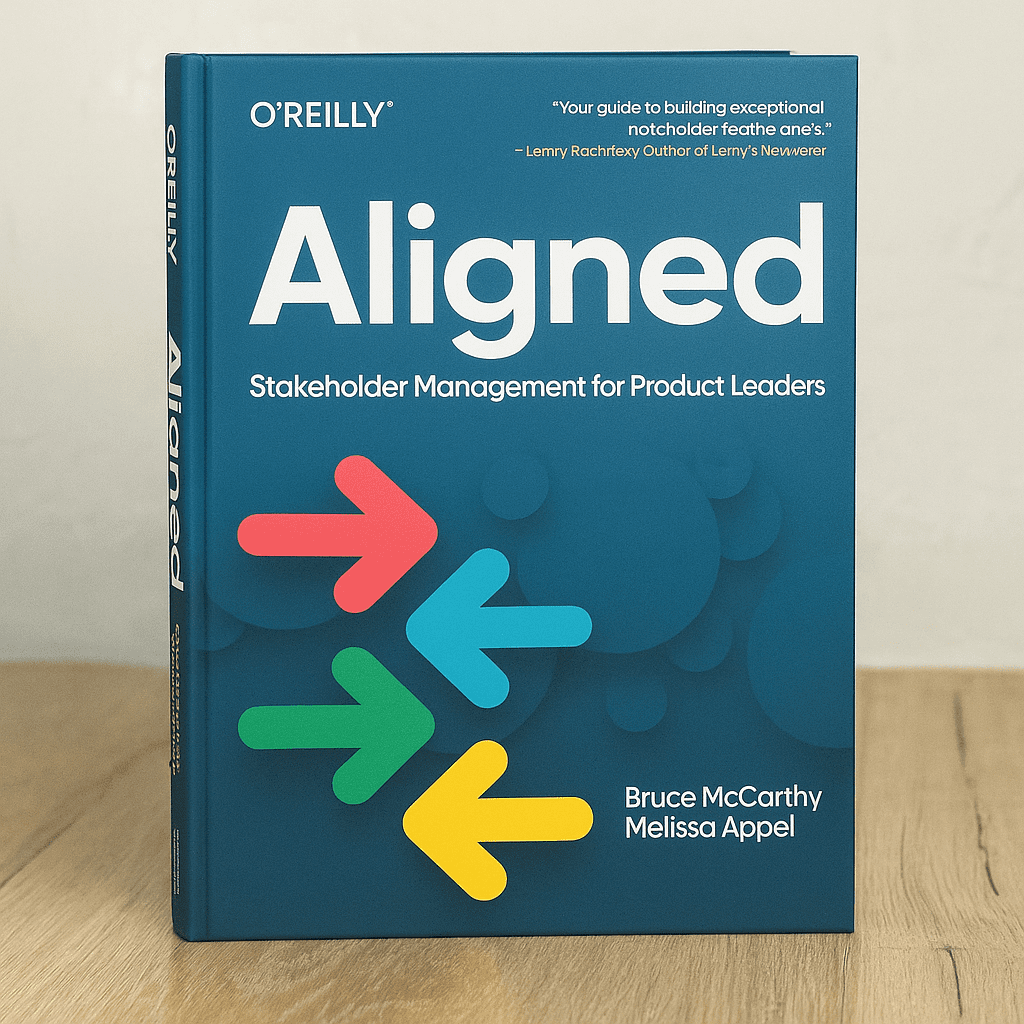

Aligned: Stakeholder Management for Product Leaders
Bruce McCarthy and Melissa Appel’s “Aligned: Stakeholder Management for Product Leaders” offers a vital guide for product professionals navigating the complex world of organizational dynamics. This book goes beyond the traditional org chart, emphasizing that true influence and decision-making power often reside in informal structures and individual motivations. It provides practical frameworks, research-backed insights, and actionable advice to help product managers and leaders identify, understand, and effectively engage with all their stakeholders, both internal and external. By treating stakeholders as internal customers, understanding organizational culture, and mastering the art of persuasive communication and strategic “no-saying,” readers will learn to build trust, drive alignment, and ultimately ensure the successful delivery and adoption of their products. This summary will comprehensively break down every important idea, example, and insight from the book in clear, accessible language, ensuring nothing significant is left out.
Chapter 1. The Real Org Chart
This foundational chapter challenges the conventional understanding of organizational structures, arguing that the official org chart often masks the true centers of influence and decision-making. It aims to equip product leaders with the tools to map their actual stakeholders and develop tailored engagement strategies.
The Illusion of the Official Org Chart
Bruce McCarthy’s personal story immediately highlights the disconnect between the official company hierarchy and the real power dynamics. Despite reporting directly to the charismatic CEO, he discovered after a year that his true “bosses” were the board and the CFO, who had hired him to bring structure to the CEO’s lack of focus. This realization, a shocking moment of misalignment, underscored that simply following the official reporting lines was insufficient for success. He learned that understanding who truly holds power and what they care about is far more critical than superficial titles. This experience also taught him the importance of understanding the organizational culture and how decisions are actually made.
Doing Your Research: Treat Stakeholders Like Customers
The book advocates a powerful shift in perspective: product professionals should treat their internal stakeholders like customers. This means applying the same customer research skills—conducting interviews, establishing trust, listening empathetically, digging beneath surface requests to find real needs, and framing trade-offs in their language—to individuals within their own organization. This empathetic approach expands the view of potential stakeholders and helps product leaders understand their needs more deeply. The goal is to properly define the company’s culture and organizational structure to build a “real org chart”.
Your Organization’s Culture: Who Leads and How Decisions Are Made
To build the real org chart, product leaders must first understand their organization’s dominant culture. This involves identifying the department, function, or individuals that truly call the shots and understanding the prevailing decision-making style.
Which Department Leads?
While theoretically all departments have equal sway, in reality, one or more functions exert disproportionate power due to history, personalities, money, or politics. Product leaders must ask: “Who has the power?” and diagnose the dominant culture. Examples include sales-driven (Microsoft), engineering-led (Google), marketing (Hubspot), finance (D&B), legal (Oracle), design (Apple), or product-led (Slack, Zoom, Netflix). Even if the CEO leads, they likely have a bias towards one function’s concerns.
Key diagnostic questions to identify the dominant culture include:
- What department did your CEO come from?
- Which functions are headed by a “Chief” title?
- Which department gets budget approval most easily?
- Where do most questions come from during presentations?
- Which department awards prizes or bonuses to others?
- Who does the CEO have coffee with in the morning?
Additional clues point to the dominant culture:
- Sales-led: Saving a deal overrides roadmap adherence.
- Finance-led: Top initiatives focus on cost cutting, margin, or the Rule of 40.
- Design/Product-led: Improving customer experience trumps other considerations.
- Legal-led: Patents are more important than other things.
- Operations/Manufacturing-led: Focus on efficiency, process, and partnerships.
- Supply Chain-led: Procurement and logistics are biggest roadmap factors.
- Engineering-led: Developing new technologies is more important than serving customers.
- Product-led: Overall stability towards a healthy product vision.
The function that appears most often is likely where the company’s leadership is centered, indicating where to prioritize stakeholders.
Understanding Your Organization’s Decision Culture
Beyond identifying the leading department, understanding the organization’s decision-making style is crucial for knowing how wide a net to cast for stakeholder alignment. Bain & Company’s four styles are presented:
- Directive: One or a few individuals decide and inform others. Little consultation is expected before a decision. Support from a short list of power players is critical.
- Democratic: Those involved gather information and then vote. Everyone is expected to accept the majority decision. Gaining support from a potentially large list of voters and influencers before the vote is necessary.
- Participative: One person owns the decision, but actively seeks input from relevant stakeholders. If you are this person, you must discover who “should” be consulted. Leaving out strong opinions invites criticism. This style is often recommended as it balances broad input and speed and is typical of cross-functional product teams.
- Consensus: Everyone involved agrees on a plan before it’s finalized, often with extensive discussion. Like Participative, there’s a large set of stakeholders, but you also have to convince a large majority to agree.
Product leaders can diagnose their organization’s style by reflecting on a recent company decision:
- If you weren’t consulted: Likely directive.
- If you voted: Probably democratic.
- If your input was sought but someone else decided: Possibly participative.
- If extensive discussion was needed for agreement: Likely consensus.
Different situations may warrant different styles, and leaders like Ben Horowitz suggest a more directive approach during existential threats. Understanding the current style is vital to work within stakeholder expectations. Bruce’s story exemplifies this: realizing his company was Finance-led with a directive decision-making culture made his interactions more efficient and effective.
Your Organization’s Structure
Navigating organizational structure can be challenging due to vague titles, crisscrossing reporting lines, and complex team assignments. The book describes four common structures and how they inform stakeholder prioritization.
Functional
This traditional arrangement has departments (marketing, sales, product, engineering) led by executives reporting to a CEO. As functional organizations grow, departments can become silos. Product leaders must ensure coordinated action across functions, influencing individuals in each department, even if it’s perceived as interference. Their job is to provide context and urgency.
Divisional
The organization is divided by product, line of business, geography, or brand, with each division having its own product, engineering, and marketing teams. This structure can break departmental silos, offering greater autonomy and focus on specific niches. It effectively shrinks the number of stakeholders to those within your division, making rapport easier.
Matrix
Teams report to department heads (functional organization) but are also assigned to a division-like structure focused on a product or niche. Individuals effectively have two bosses and belong to two teams. Product leaders often set direction for their squads (developers, designers), but their authority is often informal, as team members formally report to functional managers (e.g., Engineering). This can lead to decisions being questioned or countermanded. Therefore, product leaders must influence not only their immediate squad but also the functional leaders those individuals report to.
Guild
Popularized by Spotify, the “guild model” aligns team members primarily to products, and they also form communities of practice or “guilds” which lack formal authority but support members with standards. Guilds are typically led by a senior practitioner who handles hiring/firing and best practices. This model gives product leaders greater authority and autonomy within their squads, reducing the burden of stakeholder management, though guild leaders still wield considerable informal influence.
Other Structures
The book acknowledges other innovative structures like Helix (equalizing functional and product responsibilities by splitting management roles) and Flat organizations (empowering individual employees, like Valve’s no-title, project-choice approach). Regardless of the official structure, the authors strongly advise using the book’s tools to discern whether the functional or product axis has the upper hand and acting accordingly.
Hybrid
Many companies mix and match structures. A common hybrid combines a matrix structure for product development functions (engineering, design, product) with departmental organization for other functions (sales, marketing, finance). In such structures, product leaders must cast a wide net, managing within their team/division but also influencing power players outside their direct line of business. Bruce’s experience of product marketing moving under his VP highlights how alignment can simplify cooperation.
Who Matters by Structure
A quick reference table clarifies who to prioritize in different structures:
- Functional: Your departmental leader, other functional leaders.
- Divisional: Your division leader, centralized services.
- Matrix: Your functional leader, your product leader, centralized services.
- Guild: Your product leader, your functional leader, centralized services.
- Hybrid: Your product/division leader, functional leader, and centralized services; other product/divisional leaders.
The TIPS Framework
To manage the overwhelming number of potential stakeholders, the TIPS framework categorizes them into four groups based on influence and interest: Team, Impacted, Power Players, and Subject Experts. This helps prioritize and tailor engagement strategies.
- Team: Individuals who contribute work to your product’s success, including core (full-time dedicated) and extended (part-time/occasional) members. This includes other development teams, members of other departments, and even power players with a keen interest. Approach as colleagues whose expertise is needed and respected, seeking buy-in to the mission, not just compliance.
- Impacted: Those who experience the effects (good or bad) of your product. While external customers are important, the book focuses on internal customers (Sales, Support, Training, HR) who use your product to do their jobs. It also includes external partners (technology partners, distributors, implementation partners). Approach with empathy, understanding their jobs, success metrics, and struggles.
- Power Players: Individuals who can say yes or no, fund efforts, approve plans, or strongly influence others. This includes executives, board members, influential customers, and gatekeepers like Legal, HR, Security, and IT. Crucially, it also includes hidden power players not prominent on the org chart, identified by questions like “who would be involved in a major decision?” or “who is invited to key meetings?”. Approach as respected authorities, asking for advice and guidance without being overly subservient.
- Subject Experts: Those who have information you need for informed decisions. This includes analysts, regulators, journalists, internal analysts, researchers, architects, and customers. They provide valuable market context or specialized knowledge. Take their opinions about what to do with a grain of salt, as your expertise drives final product decisions.
- Approvers: A specific type of power player charged with enforcing budgetary, legal, or regulatory policies. They may prioritize compliance over innovation. Engage them early so they can advise rather than just gatekeep.
When categorizing, start with Team, then add to subsequent categories only if they don’t fit the previous one (e.g., Finance team is Power Player if they have final say on royalties, otherwise Subject Expert).
Prioritizing Stakeholders
With a potentially long list, prioritization is key. The TIPS framework inherently contains a 2×2 matrix of Power (vertical axis) and Interest (horizontal axis).
- Power Dimension: High scores for those who can approve budgets, hiring, roadmaps, or ensure compliance. This includes key executives, board members, your boss, and critical product development team members whose focus is vital.
- Interest Dimension: High scores for those keenly interested in your product’s success or failure. A CFO, for example, might have high power but only high interest if the product significantly impacts profits.
Plot stakeholders on this matrix, focusing most intensely on those with high power and high interest (upper right quadrant). The recommended approach is to start conversations with those in the upper right, but then proceed clockwise (lower right, lower left, upper left). This allows building broad alignment and a strong case before approaching high-power, low-interest stakeholders.
The Real Org Chart: The Stakeholder Canvas
The chapter culminates in the Stakeholder Canvas, a living guide that maps everyone critical to product success, often including people outside the company. It goes beyond the traditional org chart by integrating all the research and analysis from the chapter.
What’s in the Canvas
The Stakeholder Canvas includes:
- Your product or initiative.
- Your name.
- Shared goals, values, and experiences linking you and your stakeholders.
- Stakeholder names, categorized by TIPS.
- Stakeholder role (not just title, e.g., “developer,” “marketing”).
- Decision style of each stakeholder.
- Your “ask” – what you need from them.
- Shared goals, values, and/or experiences specific to you and that stakeholder.
- What’s currently “hot” for this stakeholder (driving their priorities).
- What this stakeholder wants or needs from you to align.
Building and Using Your Canvas
Start by filling in the most certain stakeholders, concentrating on the upper right quadrant of the Power/Interest matrix and moving clockwise. Validate initial mappings with a trusted colleague or mentor. The canvas should be a living, growing guide, continually updated by asking “who else should I be speaking with?” at the end of stakeholder interviews.
The Stakeholder Canvas is a critical tool referenced throughout the book. It helps:
- Prioritize stakeholders with high interest and influence for building trust.
- Leverage understanding of org structure to explain roles and set expectations.
- Empathize with stakeholders by understanding their roles and concerns, and what they need to get to “yes.”
This chapter concludes by reiterating that the official org chart is insufficient. Product leaders must research their organization’s culture, decision styles, and structure to build a stakeholder canvas that truly reflects who matters and how to engage them effectively.
Chapter 2. Understanding Individual Motivations and Building Effective Narratives
This chapter delves into the crucial task of understanding individual stakeholders beyond organizational structures, focusing on their unique motivations and how to craft persuasive narratives that drive alignment. It emphasizes the importance of empathy and tailored communication.
Understanding Individual Motivations (who you communicate with)
Melissa’s story opens the chapter, highlighting the challenge of effective communication even after extensive preparation. Her experience of a senior leader dismissing her presentation due to format preference underscores that knowing your audience is paramount. Product leaders must act as mediators and trusted liaisons, empathizing with stakeholders to understand their motivations and speak from their perspective, not your own. This begins with generalizations (personas) and then moves to validation.
Role-Based Summaries
The book outlines key responsibilities, inputs, and key metrics for various roles, providing a baseline understanding of what different stakeholders care about. These include:
- Engineering: Build product; metrics: developer velocity, uptime, stability, defect rate.
- Design: Ensure usability; metrics: ease of use, product adoption.
- Project/Program Manager: Ensure completion on time/budget; metrics: adherence to schedule/budget.
- Finance: Operate within budgets, ensure financial health; metrics: revenue, retention, operating costs.
- Customer Service: Assist customers; metrics: labor cost, contacts per order, time/cost to resolution.
- Professional Services: Ensure B2B customer success; metrics: billable hours, utilization percentage.
- Sales/Account Management: Sell products; metrics: revenue target, close rate, renewal rate, contract value.
- Marketing: Build awareness/desire; metrics: page views, time on site, shopping cart conversions, brand awareness.
- Talent/HR: Hire/maintain workforce; metrics: eNPS, retention, offer acceptance, DEI stats, benefits adoption, safety incidents.
- Production/Supply Chain: Create/ship/deliver physical products; metrics: labor cost, efficiency, safety, order backlog, damage rate.
- VPs, Executives, and Board of Directors: Run department/company, maximize value; metrics: sales, profitability, employee retention, capital efficiency.
These summaries are a first piece of the puzzle, complemented by behavior-based personas.
Behavior-Based Personas
Personas are archetypical, fictional characters based on research that humanize anonymous groups by describing their behavior, attitudes, mental models, and goals. They differ from roles because behaviors and motivations vary even within the same role. The book presents eight common stakeholder personas:
- Casey (Clueless Friend): New to the company (1.5 years), eager to make a mark, “get things done,” but doesn’t understand product role or process. They go directly to engineers, not out of malice, but ignorance. Approach: Educate them on correct processes, your role, expectations, and what you don’t need (like fully designed tech solutions). Melissa’s example with an Operations “Casey” showed how explaining product management’s value and taking work off their plate built a healthier relationship.
- Tina (Thinks Tech Is Easy): Experienced (4 years), removed from day-to-day tech, knows enough to be dangerous, and uses “why can’t we just…” frequently. Thinks software is simple, dismisses what she doesn’t understand, and prefers talking to Engineering directly. Approach: Explain complex concepts (discovery, dependencies, testing) in layman’s terms. Don’t just give technical details; present how the work benefits her specifically. Melissa’s example showed cutting critical systems (staging/monitoring) led to significant problems because Tina didn’t understand their benefits, highlighting the need for clear context on consequences.
- Finn (Former Management Consultant): Experienced (6 years at McKinsey), used to giving orders, adding resources to meet deadlines, and thinking theoretically. Doesn’t care about resourcing problems or dependencies; just wants work done on time. Approach: Bring empathy into the conversation by introducing them to the team and customers. Explain the Iron Triangle (resources, schedule, scope, quality) and the risks of not adjusting. Melissa’s “Finn” created an “alternate universe” roadmap due to a lack of specificity from the product team. Melissa resolved this by taking responsibility for roadmap clarity and delivery dates, removing Finn’s perceived need to fill the gap.
- Olivia (One Team One Dream): Experienced (1.5 years), understands product role and process, comes with important requests, prioritizes business value, and has good rapport with leadership. Approach: Your most critical ally. Maintain trust by clearly articulating vision and roadmap, as she can multiply your influence with higher-level stakeholders. (Acknowledged as the “perfect stakeholder.”)
- Bob (Big Title Big Ego): Experienced (6 years), believes his opinion is the only one that matters, purposefully excludes others, difficult to persuade, wants control. Approach: Demonstrate value by alleviating a pain point or taking a task off his list. Find a point of agreement and deliver quickly. To win him over, have customers convince him directly through videos of struggles or by taking him on customer visits to experience pain points in context. Melissa’s “Bob” example, concerning box labels, showed that seeing the problem in a fulfillment center led him to concede the need for additional labels.
- Eugene (Yes-Man): Experienced (3 years), works on whatever his boss (Bob) tells him, doesn’t question requests, and may not know the value or reason behind them. Believes Bob is always right. Approach: May need to go directly to Bob or other team members who do question Bob. Eugene can be helpful in crafting narratives for Bob. Melissa’s “Eugene” example involved a system map request where Eugene couldn’t articulate the purpose; Melissa provided feedback to validate the map but avoided taking ownership of a potentially wasteful project.
- Emerson (Everything is on Fire): Experienced (5 years), struggles to prioritize, thinks everything is urgent, influenced by recent events, loudest voice, or biggest title. Has trouble determining urgency. Approach: Calm them down, ask about consequences of delay, and provide a framework for urgency (e.g., number of customers affected, urgency over time). May be a “Yes-Man” in disguise, requiring escalation to calm things down. Melissa’s “Emerson” example involved multiple Account Managers, each thinking their requests were most urgent. Bringing them together to prioritize against each other provided crucial context and led to collective agreement.
- Nathan (Company/Industry Native): Highly experienced (16 years at company), deep industry knowledge is a blessing and a curse due to potential lack of creativity and comfort with “the way things have always been done.” Approach: When proposing new ideas, show concrete examples of success elsewhere and back proposals with evidence (user research, pilots). Melissa’s “Nathan” (an Engineering leader) resisted user research. Melissa proved its value with small, impactful changes and customer quotations, ultimately getting him to embrace a “simplify and fix the basics” theme.
Validate Your Hypotheses
After forming initial hypotheses about stakeholders using personas and roles, it’s crucial to test these assumptions.
- Observe: Watch their behavior in meetings, Slack, emails.
- Are they concerned about their function’s job/metrics?
- Do they exhibit persona characteristics?
- Are they easy/difficult to persuade?
- How do they interact with you/others?
- Who is best at gaining their alignment?
- Any clues on LinkedIn (e.g., former consultant)?
- Ask around: Interview colleagues who frequently interact with the stakeholder.
- What should I watch out for?
- Will this communication approach work?
- Do they follow orders without question?
- Ask directly: Once clues are gathered, ask direct questions to customize communication.
- How do you prefer updates (email/meetings)?
- Do you want to join customer calls?
- What’s your understanding of my role/our process? Would a review help?
- Would you attend sprint demos (live/recorded)?
Validating hypotheses allows for tailored communication and persuasive narratives.
Building an Effective Narrative (the words you use to communicate)
Effective communication requires speaking from the stakeholder’s point of view. Knowing their background, role, and motivations allows for crafting narratives that resonate. For example, a new product idea can be pitched to Finance on cost savings, Engineering on ease of support, or Marketing on total addressable market.
What is a “Narrative”?
A narrative is a well thought out explanation or persuasive argument using precise wording for a specific audience. It can be short (like a marketing slogan) or lengthy, in prose, diagrams, or images. Narratives are important because preparing explanations in advance increases success in gaining alignment. Predicting questions allows for brilliant, seemingly spontaneous responses.
Word Choice
Strategic word choice is vital. “Narrative” is used instead of “story” to avoid connotations of fiction. Leidy Klotz’s “Subtract” highlights how positive framing (“reveal,” “clean,” “carve”) can make “less” more palatable, as seen in the Lexington, KY project to uncover a river. Similarly, a product manager pitching “customer confidence” instead of “data quality” gained more buy-in from sales and marketing executives, by linking data quality to customer trust and product reliance.
Keep narratives simple and easy to remember (“KISS” – Keep It Simple, Stupid). Omit needless words, simplify vocabulary, and avoid jargon where possible. Using complex words can make you seem less intelligent if your audience doesn’t understand. If addressing a “Nathan” (Company Native), using correct jargon can build rapport, showing you understand their world. Conversely, with a “Casey” or “Bob,” technical details will only confuse. Sometimes, fewer details increase clarity.
Tips for difficult word choices:
- Speak out loud: Explain the concept to yourself to find the right words.
- Use the internet: Thesaurus, examples of explanations online.
- Find a metaphor: Compare complex ideas to relatable concepts (e.g., water flowing through a pipe for quantity control, library for physical resources).
How to Create a Good Narrative
Treat narrative creation like product development: design, build, test, and iterate.
- Test drafts: Run it by colleagues; check for confusion, definition issues, or alternative phrasing. Iterate until it’s right.
- Gain other perspectives: Ensure it makes sense to others, not just yourself.
- Socialize: Get others comfortable with the concept so they can help spread the message. For example, to convince the CEO to remove a feature, socialize the idea with peers and lower-level stakeholders first.
This chapter underscores that effective communication is deeply rooted in understanding individual motivations and crafting messages that resonate, paving the way for successful stakeholder engagement.
Chapter 3. Getting to No
This chapter addresses the pervasive challenge of saying “no” to stakeholders effectively, arguing that it’s crucial for product success and can strengthen relationships rather than undermine them. It explores techniques for defining problems, leveraging roadmaps, and using evidence to support decisions.
Melissa’s Story: The Fear of Saying No
Melissa’s opening story highlights the critical issue of engineers and product managers being afraid to say no. She inherited a team whose quarterly delivery rate was consistently 25% of promised work. The root cause was not lack of motivation or unclear requirements, but pressure to underestimate projects to meet desired deadlines set by product managers, who in turn were driven by stakeholder expectations. This cycle of saying “yes” early but delivering “no” later resulted in unhappy stakeholders and undermined trust. The irony was that delaying discovery work to avoid “no” upfront ultimately prolonged execution and led to even more problems. Melissa learned that mastering the art of saying “no” effectively, including different “flavors” like “not now” or “not ever,” is essential.
What Problem Are We Trying to Solve?
Before saying “no” to a request, the fundamental step is to align on the problem you’re trying to solve. Quoting Albert Einstein, “If I were given one hour to save the planet, I would spend 59 minutes defining the problem and one minute resolving it.” Taking requests at face value is a disservice, as it bypasses the product manager’s core skill of identifying the true underlying need. Saying “no” doesn’t mean refuting the problem’s existence, but rather challenging the proposed solution. The key question is always: “What is the problem we’re trying to solve?”
How to Define the Problem
1. Ask the “5 Whys.”
The “5 Whys” method, developed by Toyota, involves repeatedly asking “why” to uncover the root cause of a problem, rather than just accepting a proposed solution as the problem itself. It’s not about being annoying, but about a series of targeted questions.
Sample questions to dig deeper:
- Why is that a problem?
- Why do we need this feature?
- How will this feature solve the problem?
- Are there other solutions?
- What are we doing today without it?
- Who is the user, and how will they use it?
- What expected benefit to the organization?
- Why is this important now?
- What impact do we expect from solving it now?
- What opportunities are we passing up?
- What are you worried will happen if we don’t do this?
- What are you hoping will happen if we do this?
- Can you tell me more about your problem?
Melissa’s example of a truck driver messaging ETA request illustrates this. Through questions like “Why does the warehouse need to know exactly when the truck is arriving?” she uncovered the root problems: “I need to know what the plan is in advance so that I can ensure I have enough capacity to handle it” and “I need to know when the plan changes so I can prepare to handle the new plan.” This led to the realization that the first problem already had a solution, and the second was not solvable by technology in a way that offered actionable benefit, thus avoiding a new messaging app.
2. Understand the difference between a problem and a solution (hint: you can’t build a problem)
A problem stops us from achieving goals, while a solution is something we can build. Problem definition is an art. Melissa’s example of an associate wanting an “automated way to know which deliveries would have incorrect labels” revealed the root problem was upstream: suppliers were sending incorrect labels because they weren’t being told about it. The solution was to create a system for feedback to suppliers, not just for identifying bad labels.
Examples of rephrasing solutions as problems:
- “I need a faster horse” (solution) -> “It takes forever to get from place to place” (problem)
- “Need mobile app on computer for copy/paste” (solution) -> “Entering control numbers is manual and error-prone” (problem)
- “Need tool to track non-compliant suppliers” (solution) -> “Non-compliant suppliers cause extra work” (problem)
- “Need Excel report weekly” (solution) -> “Data in dashboard is missing fields” (problem)
3. Use Contextual Inquiry or Story-Telling
To understand problems directly, use Contextual Inquiry (shadowing users in their natural environment) or a story-telling approach if direct observation isn’t possible. This builds shared understanding and improves relationships.
Story-telling questions:
- Take me through a typical day.
- What interruptions do you deal with?
- Do you always have enough information? What do you do if not?
- Walk me through the most recent time you did this task. Were there problems?
The goal is to understand the situation deeply, enabling the product manager to develop a truly effective solution, potentially better than the original request.
4. Collaborate with Your Stakeholder
Work collaboratively with stakeholders on problem definition, especially internal ones. If there are multiple, bring them together. Treat it as an interview or brainstorming session. Use a shared document to take notes on their “5 Whys.” Rephrase their proposed solutions as problem statements to “train” them to think in terms of problems (e.g., “I need a countdown clock” -> “It sounds like you’re having trouble keeping track of how much time you’re spending on each task”). This shows you’re listening and helps them articulate their issues.
Iterate on the Problem Statement
The process of asking questions and listening is iterative. Product managers will infer the problem, propose a problem statement, and then iterate with stakeholders until a final agreement is reached. This process, though time-consuming, guarantees a more successful solution than directly implementing an original request.
Say No With Your Roadmap
Once problems are aligned, the next step is to translate them into a roadmap. The book emphasizes that the roadmap is more about the journey than the destination, serving as a collaborative tool for alignment rather than a static document.
The Five Steps to the Roadmap Journey
The roadmap process is a cycle of alignment:
1. Align on Problems
(As detailed above) Get stakeholders involved, ask questions, observe problems directly, and iterate on problem statements for shared understanding.
2. Define Roadmap Items
Break down problems into smaller, incremental items for the roadmap. These can be themes (large, high-level problems) or sub-themes (specific needs). Crucially, roadmap items should still be problems or outcomes, not solutions. This allows the team to pivot specific solutions as new information emerges. Melissa’s QC inspection example showed how themes like “Enable operations to create and manage a precise list” could lead to various solutions. Defining themes also helps in saying “no” to requests that fall outside the agreed scope.
3. Determine Priorities
Once items are defined, collaboratively rank them with stakeholders. This forces tie-breaking conversations and helps stakeholders understand each other’s perspectives. Melissa’s example with electric utility program managers, who had differing priorities, brought them together for a mediated conversation and ranking exercise, leading to a jointly agreed-upon prioritized list of goals.
4. Evaluate Trade-Offs
With a prioritized list, the difficult task is deciding what to work on now (“above the line”) and what to put off until later (“below the line”). The items below the line are the “no” for now. Documenting these “below the line” items shows you’re listening and understand their importance, just prioritizing them lower. The Iron Triangle (Scope, Resources, Schedule, Quality) is critical here. If stakeholders want a shorter timeline, they must accept a reduction in scope, an increase in resources, or a hit to quality. Making it clear that shortening the timeline without adjusting the other two pillars will suffer quality is essential.
5. Maintain Alignment
The roadmap is a living document that should be re-evaluated periodically. When new requests arise, the aligned roadmap provides a basis for discussing trade-offs. Asking “what would you like us to take out of the plan to make room for it?” often leads stakeholders to say “no” to themselves. This ongoing process helps make future decisions quicker and more rationally, increasing focus on important features and reducing distraction. The ultimate goal is to collaborate with stakeholders to say “no” together, fostering a positive relationship.
Use Evidence, not Opinions
Product teams make many decisions daily, ideally gathering evidence from customers/users, business needs, and technology. When stakeholders rely on opinions, disagreements become personal. To have rational conversations, emotions and opinions must be removed from the equation.
Customer/User Evidence
Using customer quotations and videos shifts the debate from personal opinions to customer needs. Early in her career, Melissa faced a CTO whose strong opinions clashed with her team’s priorities. By surveying 200 customers and asking them to rank desired features, Melissa gathered irrefutable evidence that her team’s features were more important than the CTO’s proposed social media components. In another example, Gallant used a video of a customer struggling to find a feature due to confusing naming, which was striking and irrefutable evidence that convinced Goofus to change the feature names. Credibility, built through relationships (Chapter 1) and relevant data, is key.
Business Evidence
Beyond customer feedback, considering the business impact is crucial, especially when prioritizing choices. Which solution will have the biggest impact?
Technology Evidence
(TO COME)
These Are Not the Droids you’re Looking For: The Art of Misdirection or “Reframing”
Sometimes, saying “no” requires creativity, using “misdirection” or “reframing” to help stakeholders accept it. This isn’t sneaky, but about convincing them they don’t want it, asking for more information, or saying yes to small requests to enable “no” to big ones.
1. Convince Stakeholders They Don’t Really Want It
If a stakeholder request is flawed (physically impossible, unwanted by customers, or unclear), the goal is to enable them to see the flaws themselves. This often requires reflection by the product manager outside the conversation to map out the logical progression of questions needed for the stakeholder to reach the “no” conclusion on their own. This is especially difficult for requests that you will “never” do.
2. Ask for More Information
Sending stakeholders away with homework (asking tough questions) stalls for time and forces them to think through their request. This leads to a better understanding and design if the project proceeds. Melissa’s Slack conversation example, where she questioned a “web terminal” request, led the stakeholder (Miguel) to realize his request didn’t make sense and he needed to investigate further, ultimately preventing a misdirected project.
3. Say Yes to the Little Things So You Can Say No to the Big Things
A problem-oriented roadmap provides discretion for “little things”—annoying but easy “ankle biters” or “quick wins.” This allows you to address small issues without changing the roadmap, celebrate progress with stakeholders, and build trust. This trust, in turn, makes it easier for them to accept “no” to larger requests when necessary.
What To Do When Everyone Wants Something From You at the Same Time?
When faced with numerous, conflicting requests from diverse stakeholders, the approach depends on the product’s maturity.
1. New Initiative
For new initiatives, encourage open brainstorming and input from as many people as possible. Listen, ask follow-up questions, and write everything down. Conduct multiple sessions if needed, with pre-work assigned. A task force Melissa initiated to solve a gnarly problem brought together representatives from every department for half-day brainstorming sessions. This surfaced all problems from everyone’s perspective, clarified misunderstandings, and led to a joint understanding of priorities.
2. Foundational Launch
During the iteration phase after a foundational launch, stakeholders have more opinions because they can use the product. Entertain a lot of feedback. Use office hours and regular updates.
- Regular email/Slack updates: Broadcast status and roadmap to a broad audience, answering common questions.
- Recurring office hours: Engage with interested stakeholders for feedback and wish lists, providing an opportunity to both say “yes” and “no.”
3. Product Iteration
For mature products in iteration or optimization mode, move to a less hands-on approach. An intake form allows people to submit requests at any time. This enables product managers to set a cadence for request review (e.g., biweekly or monthly), preventing constant disruptions and allowing dedicated time for evaluation.
The chapter emphasizes that saying “no” effectively is an art that requires understanding problems deeply, leveraging strategic tools like roadmaps, and using evidence over opinion, all while maintaining and strengthening stakeholder relationships.
Key Takeaways
“Aligned: Stakeholder Management for Product Leaders” fundamentally shifts the perspective on how product leaders should engage within their organizations. The core lessons are that true influence lies beyond official hierarchies, and effective stakeholder management requires empathy, strategic communication, and a disciplined approach to problem-solving and prioritization.
The core lessons:
- The “Real Org Chart” Matters Most: The official organizational chart is often misleading. Real power, decision-making, and influence reside in informal networks, dominant departmental cultures (e.g., sales-led, finance-led), and individual motivations. Product leaders must actively research and map these dynamics to understand who truly matters.
- Treat Stakeholders as Internal Customers: Apply robust customer research skills—empathy, active listening, digging for root needs, and framing solutions in their language—to internal stakeholders. This fosters trust and ensures better alignment.
- Understand Organizational Culture and Decision-Making: Diagnose your company’s dominant department and its typical decision-making style (directive, democratic, participative, consensus). Tailor your approach to work within these existing cultural norms.
- Leverage Organizational Structure: Recognize whether your company is functional, divisional, matrix, guild, or hybrid. Each structure presents unique challenges and dictates who you need to influence (e.g., functional leaders in a matrix org, not just your direct team).
- Categorize Stakeholders with TIPS: Use the Team, Impacted, Power Players, and Subject Experts (TIPS) framework to systematically categorize and prioritize stakeholders based on their influence and interest in your product. Focus engagement most intensely on high-power, high-interest individuals.
- Understand Individual Motivations through Personas: Go beyond roles and titles by using behavioral personas (Casey, Tina, Finn, Olivia, Bob, Eugene, Emerson, Nathan) to anticipate individual motivations, communication preferences, and potential challenges. Validate these hypotheses through observation and direct questions.
- Craft Effective Narratives: Speak from the stakeholder’s perspective, using precise word choice, metaphors, and simplicity (“KISS”). Prepare narratives in advance, test them with others, and socialize them to gain broad alignment.
- Master the Art of “Getting to No”: Learn to say “no” effectively by first aligning on the “problem we’re trying to solve” (using the “5 Whys”). Differentiate between problems and solutions, use contextual inquiry, and collaborate with stakeholders on problem definition.
- Use the Roadmap as a Collaborative Tool: The roadmap is a living journey, not a static destination. Engage stakeholders in defining problems, setting priorities, and evaluating trade-offs. Using the Iron Triangle (Scope, Resources, Schedule, Quality) helps manage expectations and makes “no” a shared decision.
- Back Decisions with Evidence: Always use customer/user, business, and technological evidence (e.g., surveys, videos, data) to support decisions, rather than relying on opinions. Evidence depersonalizes disagreements and leads to more rational outcomes.
- Employ “Misdirection” or Reframing: Strategically guide stakeholders to their own “no” by helping them see flaws in their requests, asking for more information (homework), or saying “yes” to small, easy wins to build goodwill for bigger “no”s.
Next actions:
- Build Your Stakeholder Canvas Immediately: Download a template and start mapping your key stakeholders using the TIPS framework, including their role, decision style, your asks, and their hot topics. This is the foundational tool for everything else.
- Diagnose Your Org’s Culture: Dedicate time to observe and ask questions to identify which department truly leads and what the dominant decision-making style is. Share your findings with a trusted colleague for validation.
- Practice the “5 Whys”: The next time a stakeholder comes with a feature request, consciously apply the “5 Whys” method to get to the root problem before discussing solutions.
- Observe Your Stakeholders with Personas in Mind: Consciously try to identify which of the eight personas (or a blend) fits your most critical stakeholders. Use this as a hypothesis to guide your interactions and communication.
Reflection prompts:
- Looking back at past product initiatives, how might a deeper understanding of the “real org chart” or individual stakeholder motivations have changed your approach or improved outcomes?
- Which of your current stakeholder relationships would most benefit from a “customer research” approach, and what is one specific question you could ask them to better understand their needs or “hot topics”?
- When was the last time you struggled to say “no,” and how could applying the principles from this chapter (e.g., problem alignment, roadmap trade-offs, evidence) have helped you navigate that situation more effectively?







Leave a Reply