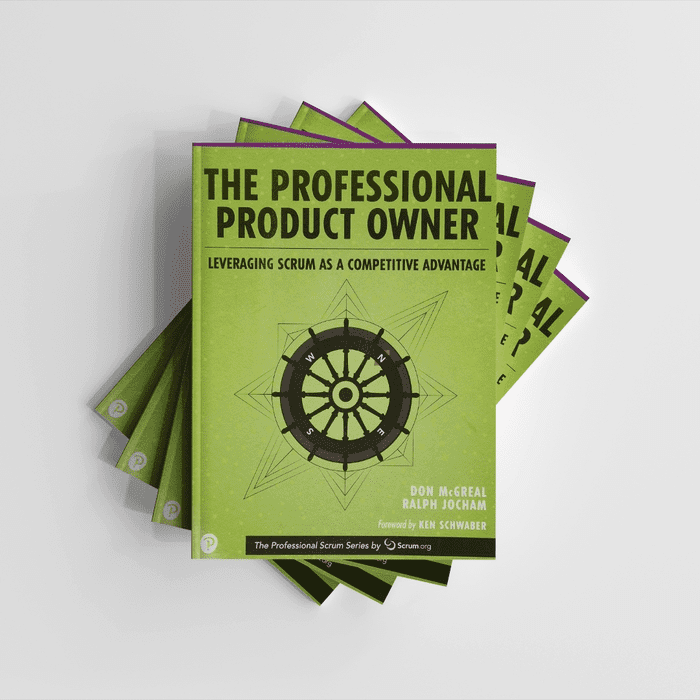

The professional product owner: Leveraging scrum as a competitive advantage – a summary
Quick orientation
“The Professional Product Owner: Leveraging Scrum as a Competitive Advantage” by Don McGreal and Ralph Jocham serves as a comprehensive guide for product owners aiming to maximize value delivery using the Scrum framework. The book meticulously breaks down the strategic, tactical, and foundational aspects of product ownership, emphasizing an agile product management approach. It’s relevant for anyone in a product ownership role, or aspiring to be one, as well as Scrum masters, managers, and stakeholders who want to understand how to support effective product development.
This summary will provide simple, clear explanations of every key idea presented in the book, chapter by chapter, helping you grasp the core principles and practical applications of professional product ownership.
Chapter 1: Agile product management
This chapter establishes the crucial distinction between managing projects and managing products, advocating for an agile product management mindset focused on delivering continuous value. It introduces the “Product Management Vacuum” and the “Three Vs” as a framework to fill it effectively.
Product mindset versus project mindset
The chapter contrasts two fundamental approaches to development work.
- Project mindset: Focuses on delivering a predefined scope, on time and within budget. Success is measured by adherence to the initial plan. This often leads to less business involvement and more task management.
- Product mindset: Centers on continuously delivering value to customers and the business. Success is driven by external business metrics like user adoption, revenue, and cost savings. This encourages frequent releases, creativity, and less waste.
- Shift needed: Organizations often get stuck in a project mindset, even when developing products, leading to suboptimal outcomes like Nokia’s decline despite successful project execution.
- Value delivery: Customers value products, not projects. The goal is to deliver value through products that meet market needs and organizational goals.
What is product management?
Product management bridges the gap between high-level company vision and the day-to-day work of development teams.
- Layers of planning: Organizations have various planning layers, from daily team plans to overall company vision and business strategy.
- The product management vacuum: A significant gap often exists between strategic organizational goals and the tactical execution by development teams. This “vacuum” needs to be filled with effective product management.
- Risks of the vacuum: If unfilled or poorly filled, this vacuum leads to disconnected teams, disengagement, reliance on task management, more handoffs, and ultimately, less value delivered.
The product management vacuum and the three vs
To effectively fill the Product Management Vacuum, the authors introduce three core concepts: Vision, Value, and Validation.
- Vision: Creates transparency and a shared understanding. A clear product vision, much like a military commander’s intent, allows teams to act autonomously towards a common goal. It answers why the product is being built.
- Value: Provides something to inspect. It’s about identifying and delivering the most valuable features or initiatives that align with the vision. It answers what tangible benefits the product delivers.
- Validation: Causes adaptation. It’s about testing assumptions and hypotheses through feedback from stakeholders and the marketplace, ensuring the product is on the right track. It answers how we know we are building the right thing.
Product management and scrum
Scrum itself doesn’t cover all aspects of product management, highlighting the need for a broader skill set for the Product Owner.
- Scrum’s scope: While Scrum provides a framework for developing complex products, many strategic product management activities (like market analysis, roadmapping, business modeling) fall outside its direct definition.
- The product owner’s role: A good Product Owner acts as an agile product manager, leveraging Scrum and taking on these broader product management responsibilities to fill the vacuum.
- Product owner types: The effectiveness of a Product Owner varies, from a “Scribe” (low decision-making, reactive) to an “Entrepreneur” (high decision-making, proactive, visionary). The more entrepreneurial the mindset, the greater the expected benefits.
Defining a product
The chapter emphasizes that there is always a product, and defining it correctly is crucial.
- Product definition: A product is anything offered to a market that might satisfy a want or need. Every product has a customer (consumer and/or buyer) and a producer who benefits (revenue, cost savings, societal benefit).
- Conway’s law: Often, organizational communication structures dictate system design, leading to system-focused rather than product-focused development. Scrum emphasizes “Product Owner” to counter this.
- Customer perspective: Define products from the customer’s perspective – what needs are being addressed? Align technology groups to these business-defined products.
- Viable product: A product is viable if its stated producer benefit comes to fruition. This requires measurable benefits.
- Level of abstraction: Define products at the highest possible level without losing sight of core objectives, focusing on customer value areas to avoid excessive coordination overhead from too many component-level “Product Owners.”
- Santa Claus rule: One product, one Product Owner. Like Santa, the PO is accountable but can delegate tasks to “elves” (teams, stakeholders) as the product scales.
This chapter sets the stage by urging a shift from project-centric thinking to a value-driven, agile product management approach, with the Product Owner at its heart, guided by vision, value, and validation.
Chapter 2: Vision
This chapter delves into the critical importance of establishing a compelling product vision and how it anchors all development efforts. It explores tools and techniques for crafting and communicating a vision that inspires and aligns teams and stakeholders.
Business modeling
Before a vision can be solidified, understanding the product’s business context is essential.
- Business model rationale: A business model describes how an organization (or product) creates, delivers, and captures value.
- Business model canvas: This popular tool provides a single diagram with nine areas (Customer Segments, Value Propositions, Channels, Customer Relationships, Revenue Streams, Key Activities, Key Resources, Key Partners, Cost Structure) to brainstorm and visualize the business model.
- Benefits: Using such tools helps explore the problem space, generate stakeholder discussion, and provide data for crafting a strong product vision. The authors suggest starting with Customer Segments and Value Propositions.
Product vision
A well-crafted product vision rallies people around a common goal and guides decision-making.
- Effective vision characteristics: According to Ari Weinzweig, an effective vision should be inspiring, strategically sound, documented, and communicated.
- Beyond boilerplate: Avoid generic, buzzword-filled statements. A good vision needs to be focused, emotional, practical, and pervasive.
- Focused: The vision must clearly identify the target customer segment and the top value proposition. Marketing often can’t be all things to all people.
- Product box game: An Innovation Games technique where stakeholders design a physical box for their product, forcing focus on the name, image, target customer, and key value proposition on the front. The pitch and box become an effective vision.
- Elevator pitch template: Geoffrey Moore’s template helps articulate the vision concisely: FOR [target audience], WHO [need/want], [product name] IS A [market category], THAT [one key benefit], UNLIKE [competition/current situation], OUR PRODUCT [competitive advantage].
- Practical versus emotional: A vision should be memorable by allowing the audience to imagine doing something (practical) and by connecting with their feelings (emotional). The “2 Brains: Tell It and Sell It” 2×2 matrix (Practical vs. Emotional) helps find the sweet spot.
- Example: Instead of “Optimize CPA workflow,” a more effective vision might be “Our product speeds up the mundane tasks at work so that you can spend more time at home with family.”
- Pervasive: A great vision is useless if not consistently communicated. The Product Owner must reinforce it regularly, even if it feels redundant.
Visioning with scrum
Scrum events provide natural opportunities to reinforce the product vision.
- Sprint planning: Start by reminding the team of the vision and how the upcoming work fits into it. This helps craft a more effective Sprint Goal.
- Sprint review: Reinforce the vision with stakeholders.
- Sprint retrospective: Inquire about the effectiveness of vision communication. Ask if the vision is still relevant and understood, and how communication can be improved.
- Visibility: Make the vision statement visible in the team’s workspace.
Technical strategy
Product Owners should also understand and promote the technical direction of their product, as technology is increasingly a competitive differentiator.
- Beyond business strategy: While business alignment is key, technical strategy (e.g., adopting new technologies, cloud strategy, API openness) is crucial for product success.
- Strategic decisions: POs need to consider questions like: Should we use wearable devices? Native iOS or HTML5?
- Understanding, not coding: POs don’t need to code but must understand the technical landscape to make exceptional strategic decisions. Forbes: “Technology skills do not necessarily mean hands-on skills… It means simply understanding the technical state of play… in a way that you can make exceptional decisions.”
- Timing and alignment: Features aligning with business and IT strategy today might not in the future. Be prepared to ramp down or retire products when they no longer align or deliver value. Discontinuing products (e.g., Apple Newton, Google Glass) can be a healthy business decision.
This chapter underscores that a strong, well-communicated vision—covering both business and technical strategy—is foundational for guiding product development and achieving success.
Chapter 3: Value
This chapter explores the concept of value from different perspectives, emphasizes that value is only realized upon release, and introduces metrics, particularly Evidence-Based Management (EBMgt), for tracking and maximizing it. It also touches upon negative value and the pitfalls of misusing metrics.
Value defined
Value is subjective and depends on context.
- Individual perspective: For people, value often relates to happiness (e.g., money, time, a good job are valuable if they contribute to happiness).
- Organizational perspective (for-profit): For companies, value ultimately comes down to money (e.g., happy customers are valuable if they pay; good culture is valuable if it reduces costs).
- Non-profit perspective: For non-profits, value is about improving society, with money being a means, not the end.
- Producer vs. customer: As a Product Owner, understanding both producer benefit (money/societal improvement) and customer value propositions (happiness/needs met) is crucial. Delighting clients (customer first) often leads to financial success.
Delivering value
Value is only created when a product is released to customers.
- Release as the funnel: All product development activities funnel through a release to deliver value. Everything before a release is an investment or inventory.
- Waterfall vs. scrum: Traditional waterfall delays value by design, as release is the last step. Scrum aims to deliver potentially releasable increments of value frequently (every 30 days or less).
- Cost of delay: Waiting to release means value leaks away over time. Each release should be viewed as a return on investment.
- Learning and pivoting: Frequent releases allow for testing hypotheses and pivoting if the expected return isn’t realized or better opportunities arise.
Value metrics
Measuring value requires appropriate metrics; distinguishing between delivery metrics and owner (business outcome) metrics is key.
- Pizza delivery analogy: Delivery organization metrics (pizzas/trip, delivery time) differ from owner metrics (revenue, profit, customer satisfaction). Focusing solely on delivery metrics can be misleading.
- Efficiency vs. vision: Improving delivery metrics doesn’t guarantee business benefit if not aligned with the overall vision and customer needs (e.g., Domino’s shift from 30-min guarantee to satisfaction guarantee).
- Incentives and corruption: Intermediate delivery metrics are more prone to gaming if tied to incentives, reducing their usefulness.
- Delivery vs. owner metrics in software:
- Delivery metrics (circumstantial, value-neutral): Velocity, number of tests, code coverage, defects. These are for the team to manage their work, like cockpit dials for pilots.
- Owner metrics (direct business outcomes): Revenue, costs, customer/employee satisfaction, lead time, innovation rate. Teams should be accountable for these.
- Evidence-based management (ebmgt): This approach uses direct evidence (value metrics) rather than circumstantial evidence to guide decisions, much like evidence-based medicine.
Evidence-based management
EBMgt provides Key Value Areas (KVAs) and Key Value Measures (KVMs) to track product value empirically.
- Leading vs. lagging indicators:
- Leading indicators: Input-oriented, easier to influence (e.g., diet/exercise for weight loss).
- Lagging indicators: Output-oriented, easy to measure but hard to influence directly (e.g., actual weight). Both are important.
- Current value (kva): Reveals the organization’s actual value in the marketplace.
- Revenue per employee: Gross revenue / number of employees.
- Product cost ratio: All expenses for developing, sustaining, marketing, etc., the product.
- Employee satisfaction: Engaged employees are a significant asset. Intrinsic motivation (autonomy, mastery, purpose) is key.
- Customer satisfaction: Meeting or surpassing customer expectations. Net Promoter Score (NPS) is a common measure.
- Time to market (kva): Evaluates the ability to deliver new features and products.
- Release frequency: Number of production releases over a rolling time period.
- Release stabilization period: Time taken to prepare an increment for release after feature freeze (e.g., regression testing, bug fixing). Aim for near zero.
- Cycle time: Time from when development on a feature begins until it’s ready for production.
- On-product index: Percentage of time developers work on a single initiative without task-switching. Context switching significantly reduces productivity.
- Ability to innovate (kva): Capacity to develop new, valuable features, often hindered by maintaining low-value existing features and technical debt.
- Installed version index: Distribution of customers across installed product versions. Low adoption of new versions indicates high absorption costs or low value.
- Usage index: How product features are used. Identifies rarely used software that consumes maintenance budget. Standish Group reports show a large percentage of features are hardly ever used.
- Innovation rate: Percentage of budget/effort spent on new features vs. maintenance/support. Technical debt consumes capacity for innovation.
- Defects: Number of defects over time. Increasing defects can indicate decreasing quality and reduced innovation capacity.
Tracking metrics
The trends in metrics over time are as important as the data itself.
- Visualization: Radar graphs or “scoreboard” style spreadsheets can help visualize progress and trends in KVAs and KVMs.
- Where your money goes: Combining KVMs (Innovation Rate, On-Product Index, Usage Index, Installed Version Index) can show how much of a $1 investment actually translates into ROI (e.g., industry averages might show only $0.06).
Negative value
Not all releases or features add positive value; some can create negative value.
- Visible negative value: Bugs, system downtime, poor performance, clunky UI directly experienced by customers.
- Invisible negative value: Internal issues like unused features consuming maintenance, or technical debt accrued by cutting corners. This reduces future innovation capacity.
- Value 2×2 (kruchten): Maps value as Visible/Invisible and Positive/Negative. Technical debt is often invisible negative value.
- Technical debt: It’s sometimes a conscious business decision, but must be repaid with interest. A strong Definition of “Done” helps minimize it.
Value neutrality
Metrics should provide objective data for decision-making, free from judgment or influence.
- Perversion of metrics (goodhart’s law): “When a measure becomes a target, it ceases to be a good measure.” Attaching incentives or punishment to metrics can lead to gaming and mask reality (e.g., the cobra effect, or teams artificially stabilizing velocity).
- Focus on data: There’s no good or bad news, only data. Punishing bad news leads to only “good” (camouflaged) news.
This chapter stresses that value is realized through releases and measured by focusing on business outcomes, using EBMgt as a guiding framework, while being mindful of potential negative impacts and the dangers of misinterpreting metrics.
Chapter 4: Validation
This chapter focuses on the crucial act of validation – closing the feedback loop to test assumptions and learn. It highlights the importance of stakeholder and marketplace feedback, introduces the Minimum Viable Product (MVP) concept and its patterns, and discusses the “pivot or persevere” decision-making process.
Stakeholder feedback
Engaging stakeholders throughout development is critical for building the right product.
- Scrum’s opportunity: The Sprint Review is a key event for stakeholders to inspect the Increment and provide feedback, which then informs the Product Backlog.
- Benefits of regular feedback:
- Engaging stakeholders: Implementing their feedback makes them feel heard and keeps them involved.
- Correcting course: Frequent inspection prevents drifting too far in the wrong direction.
- Creating accountability: Transparency makes it harder for stakeholders to claim ignorance if the product misses the mark.
- Subway analogy: The transparent process at Subway allows customers (stakeholders) to see their sandwich (product) being made, correct course, and share accountability for the final outcome.
Marketplace feedback
The ultimate validation comes from the marketplace; all ideas are hypotheses until tested by real customers.
- Value hypothesis (eric ries): Every new product or feature is an experiment based on a hypothesis about what customers will value.
- Microsoft’s realization: “Eighty percent of the time you/we are wrong about what a customer wants.” The company that can fail and learn fastest gains an advantage.
- Sunk cost trap: Avoid irrationally continuing an activity just because of prior investment if it’s not meeting expectations.
- Validated learning: This involves releasing something, measuring its impact, and learning from the results to guide future development.
Minimum viable product
The MVP is the version of a new product that allows a team to collect the maximum amount of validated learning about customers with the least effort.
- Hypothesis validation: MVPs help validate both technical feasibility (can we build it?) and market acceptance (will they buy/use it?).
- Active risk management: Addressing high-impact hypotheses early via MVPs is a form of risk management.
- Kano model and mvp: This model categorizes features into Basic (must-haves), Performance (desired), and Excitement (delighters). An MVP typically includes basic features, some performance features, and a few exciters.
- Evolution of features: Over time, exciters become performance features, and performance features become basic (e.g., anti-lock brakes in cars).
- Series of mvps: Product development involves creating a series of MVPs, collecting metrics, and refining the Product Backlog for the next iteration.
Mvp patterns
Different types of MVPs can be used to validate hypotheses quickly and efficiently.
- Promotional mvp: Includes videos, UI mockups, or crowdfunding campaigns (like Kickstarter) to gauge interest and potentially raise capital, or for internal products, to build stakeholder buy-in.
- Mining mvp: Involves surveys or proofs of concept to collect data about potential markets and validate business models. Often disposable after data is gathered (e.g., a “Bitcoin payment” button leading to a survey).
- Landing page mvp: A single page explaining the product’s value, providing a foundation for future features, gathering traffic data, and including a call to action. Easy to build early.
- Wizard of oz mvp: Appears complete to the customer, but humans perform backend tasks manually. This avoids building a full automated system before demand is proven (e.g., Zappos’ early days).
- Single-feature mvp: Releasing one small function or Product Backlog item into an existing product to measure its specific impact and compare against expected outcomes.
Pivot or persevere
Based on validated learning from MVPs, a decision must be made to either continue the current path or change direction.
- Build-measure-learn loop (eric ries): This is a product-centric version of the scientific method (Idea -> Build -> Product -> Measure -> Data -> Learn). It aligns with Scrum’s empirical pillars: Transparency (Measure), Inspection (Learn), Adaptation (Build).
- Persevere: Continue the current path if data validates assumptions or is inconclusive, gathering more data.
- Pivot: Change strategy if data shows the original hypothesis was wrong or a more prosperous path is revealed. This requires accepting potential “failure” and adapting.
- Courage to fail: Shorter feedback cycles provide the courage to follow intuition and test ideas, as they will be validated (or invalidated) quickly.
- Paul maccready example: The inventor of the human-powered aircraft Gossamer Condor succeeded by rapidly iterating and testing (failing often but learning quickly), unlike competitors who spent years on single designs. The speed of learning was key.
- Runway analogy: Limited resources (time, budget) form a runway. The ability to pivot effectively before reaching the end of the runway determines if the product takes flight or crashes.
This chapter emphasizes that continuous validation through stakeholder and marketplace feedback, often using MVPs, is essential for learning, adapting, and ultimately building successful products.
Chapter 5: Empiricism
This chapter explains the theory behind Scrum: empirical process control. It discusses why complex problems, like product development, cannot be fully predicted and require an iterative, adaptive approach based on transparency, inspection, and adaptation. Frameworks like Cynefin are used to illustrate different problem domains and their appropriate responses.
It’s a complex problem
Product development is inherently complex due to numerous unpredictable variables.
- Thermostat analogy: Trying to maintain a conference room at a constant temperature by pre-calculating all variables (people, weather, equipment) is futile due to unpredictability. A thermostat, however, uses a simple feedback loop (measure, compare, adjust) to manage complexity effectively.
- Product development variables: Variables in product development (scope, budget, schedule, technology, skills, market changes, etc.) are even more unpredictable than the temperature problem.
- Scrum as a thermostat: Scrum provides the feedback loops (transparency, inspection, adaptation) necessary to navigate this complexity.
Certainty quiz and visualizing complexity
Tools like a certainty quiz and the Stacey Matrix help visualize the level of uncertainty and complexity.
- Certainty quiz: A self-assessment to gauge the predictability of a team’s environment across people, technology, and requirements.
- Stacey matrix: Plots initiatives based on certainty about technology (x-axis), agreement on requirements (y-axis), and team stability/skill (z-axis, added by Schwaber). Most product development falls into the “complex” domain where cause and effect are not clear upfront.
- Intersection of complicated is complex: Even if requirements and technology are individually considered “complicated” (analyzable), their interaction often pushes the overall endeavor into “complex.”
Cynefin
The Cynefin framework, developed by Dave Snowden, categorizes problem domains to guide appropriate responses. It’s a sense-making, not just a categorization, framework.
- Ordered domains (cause and effect are clear):
- Obvious (formerly simple): Known-knowns. The approach is Sense-Categorize-Respond. Best practices apply (e.g., following a recipe). Constraints are tight.
- Complicated: Known-unknowns. The approach is Sense-Analyze-Respond. Good practices apply, requiring expert analysis (e.g., building a standard house). Constraints are governing.
- Unordered domains (cause and effect are not clear upfront):
- Complex: Unknown-unknowns. The approach is Probe-Sense-Respond. Emergent practices are needed; experimentation is key (e.g., building a new airport, most software development). Constraints are enabling (like spikes or prototypes). Scrum operates here.
- Chaos: Unknowable-unknowables. The approach is Act-Sense-Respond. Novel practices emerge; immediate action is needed to stabilize (e.g., a natural disaster). There are no effective constraints.
- Disorder: The state of not knowing which domain you are in. The goal is to move into a known domain.
- Scrum’s flow: Scrum helps move pieces of a complex problem into the complicated domain for a Sprint (planning makes it analyzable), then inspects the result, adapting the complex Product Backlog.
Types of complexity
Complexity can be inherent or self-inflicted.
- Essential complexity: Inherent to the problem itself and cannot be removed (e.g., the core challenge of a new scientific discovery).
- Accidental complexity: Entanglement of components/ideas not necessary for solving the problem, often emerging from decisions made during development (e.g., overly complicated internal processes).
- Scrum’s aim: Scrum helps manage essential product complexity by minimizing accidental process complexity.
Managing risk
Empiricism is key to managing risk in complex environments.
- Good mistakes (tim harford): Taking risks to solve essential complexity can lead to competitive advantage, even if initial attempts fail, as long as learning occurs.
- Red queen effect: Businesses must constantly innovate (run fast) just to stay in place; to get ahead, they must run even faster by tackling essential risks.
- Software project risks (arnuphaptrairog study): Common risks include misunderstanding requirements, lack of management support, and inadequate user involvement.
- Scrum and risk mitigation: Scrum’s empirical nature (transparency, inspection, adaptation via events and artifacts) directly addresses many common software project risks. For instance, Product Backlog refinement and Sprint Reviews help clarify requirements and manage user expectations.
- Risk matrix: For risks not inherently managed by Scrum, a classic risk matrix (tracking probability, impact, contingency, mitigation) can be used and reviewed regularly.
This chapter establishes that because product development is complex, a defined, predictive process is unsuitable. Instead, an empirical approach like Scrum, which embraces uncertainty and uses feedback loops, is necessary for managing complexity and risk.
Chapter 6: Scrum
This chapter provides a detailed overview of the Scrum framework, explaining its core components: the pillars of empiricism, roles, artifacts, and events. It emphasizes Scrum as a lightweight framework, not a rigid process, that enables teams to develop, deliver, and sustain complex products effectively.
Why a framework?
Scrum is intentionally a framework, not a prescriptive process, to foster ownership and adaptability.
- Ownership is key: A defined process imposed on a team can lead to a “renter” mentality, where the team blames the process when things go wrong. A framework provides minimal rules, allowing the team to “own” and evolve their specific process.
- Emergent practices: Complex problems require practices that emerge from the team’s experience. Scrum provides the structure for this emergence.
- Avoiding “rented scrum”: Copying one team’s specific Scrum implementation (their process) for another team bypasses the ownership and learning, leading to a “rented” and less effective Scrum. Complaints about “Scrum” are often about ill-fitting practices added on top of the framework.
The pillars of scrum
Scrum is founded on empirical process control, upheld by three pillars.
- Transparency: Significant aspects of the process must be visible to those responsible for the outcome. This requires common language and shared understanding (e.g., a common Definition of “Done”). Lack of transparency is like a faulty thermostat sensor.
- Inspection: Scrum users must frequently inspect Scrum artifacts and progress toward a Sprint Goal to detect undesirable variances. Inspections should not be so frequent they impede work.
- Adaptation: If inspection reveals deviations or an unacceptable product, the process or material must be adjusted as soon as possible. Scrum events are formal opportunities for inspection and adaptation.
Scrum roles
Scrum defines three key roles: Product Owner, Development Team, and Scrum Master.
- Product owner: Responsible for maximizing the value of the product resulting from the Development Team’s work. Sole person responsible for managing the Product Backlog (expressing items, ordering for value, ensuring visibility and understanding). One person, not a committee; their decisions must be respected.
- Service model: The Development Team serves the Product Owner; the Scrum Master serves the Development Team (and PO, and organization). The PO serves customers and stakeholders.
- Domain expert: Needs to understand the product domain and work closely with stakeholders and the Development Team. Avoids being a mere “proxy.”
- Development team: Professionals who deliver a potentially releasable Increment of “Done” product each Sprint. They are self-organizing (decide how to do the work) and cross-functional (have all skills needed). No titles or sub-teams. Accountability belongs to the team as a whole.
- Collaboration with po: While the PO owns the “what” (Product Backlog), the Development Team owns the “how” (Sprint Backlog, turning PBIs into an Increment). Close collaboration is vital.
- “Development team = product”: What’s in the team can be in the product; what’s not, likely cannot. Funding stable, skilled teams is crucial.
- Scrum master: Responsible for promoting and supporting Scrum as defined in the Scrum Guide. A servant-leader who helps everyone understand Scrum theory, practices, rules, and values.
- Service to po: Helps with effective Product Backlog management, understanding empirical planning, and maximizing value.
- Service to development team: Coaches in self-organization and cross-functionality, removes impediments, helps create high-value products.
- Service to organization: Leads Scrum adoption, helps employees/stakeholders understand Scrum, causes change that increases Scrum Team productivity.
- Others:
- Scrum team: Consists of the Product Owner, Development Team, and Scrum Master. Self-organizing and cross-functional, delivering products iteratively and incrementally.
- Stakeholders: Users, customers, investors, executives, etc. Key to success. PO identifies and engages them, especially in Sprint Reviews. An “influence 2×2” (Power vs. Interest) can help manage stakeholder engagement.
Scrum artifacts
Scrum defines key artifacts to represent work or value, providing transparency and opportunities for inspection and adaptation.
- Product backlog: An ordered list of everything known to be needed in the product. The single source of requirements. Managed by the PO. Dynamic and never complete. Items have description, order, estimate, and value. Higher-ordered items are clearer and more detailed. “Ready” items can be “Done” in one Sprint.
- “One product -> one product owner -> one product backlog.”
- Sprint backlog: The set of Product Backlog Items (PBIs) selected for the Sprint, plus a plan for delivering the Increment and realizing the Sprint Goal. A forecast by the Development Team. Makes all necessary work visible. Belongs solely to the Development Team, who modifies it as needed.
- Increment: The sum of all PBIs completed during a Sprint and the value of increments from all previous Sprints. Must be “Done” (usable and meets Definition of “Done”) at Sprint end. A step towards the vision.
- Others (common practices, not official artifacts but vital):
- Definition of “done” (dod): A shared understanding of what it means for work to be complete, ensuring transparency. Guides the Development Team on how many PBIs to select. Expected to expand over time. Different from acceptance criteria (DoD is for the Increment, AC for a PBI).
- Burn-down/burn-up charts: Visual tools to track progress. Sprint Burn-down is for the Development Team to track progress towards the Sprint Goal. Release Burn-down/Burn-up tracks work remaining towards a larger goal, used by the PO.
Scrum events
Scrum prescribes time-boxed events to create regularity and minimize the need for meetings not defined in Scrum. Each event is an inspect and adapt opportunity.
- The sprint: The heart of Scrum. A time-box of one month or less during which a “Done,” usable, and potentially releasable product Increment is created. Sprints have consistent durations and start immediately after the previous one. Contains all other events. No changes endangering the Sprint Goal; quality doesn’t decrease; scope may be clarified.
- Cancelling a sprint: Only if the Sprint Goal becomes obsolete. Rare due to short Sprint duration.
- Sprint planning: Plans the work for the Sprint. Collaborative work of the entire Scrum Team. Answers: What can be delivered? How will it be achieved? Input: Product Backlog, latest Increment, team capacity, past performance. Output: Sprint Goal and Sprint Backlog.
- Sprint goal: An objective for the Sprint, providing guidance and flexibility.
- Daily scrum: A 15-minute time-boxed event for the Development Team to plan work for the next 24 hours, inspect progress toward the Sprint Goal, and adapt the Sprint Backlog. Improves communication, identifies impediments. Not a status meeting for the PO.
- Sprint review: Held at Sprint end to inspect the Increment and adapt the Product Backlog. Scrum Team and stakeholders collaborate on what was done and what to do next. Informal, not a status meeting. Output: Revised Product Backlog.
- Sprint retrospective: Opportunity for the Scrum Team to inspect itself and create a plan for improvements to be enacted in the next Sprint. Focuses on people, relationships, process, and tools. Output: At least one improvement for the next Sprint. The PO is part of the Scrum Team and should participate.
- Other (activity, not formal event):
- Product backlog refinement (formerly grooming): Act of adding detail, estimates, and order to PBIs. Ongoing collaborative process between PO and Development Team. Consumes no more than 10% of Development Team capacity. Ensures PBIs are “Ready” for Sprint Planning.
Iterative and incremental
Scrum delivers products iteratively (revisiting and refining) and incrementally (adding new pieces).
- Incremental only is insufficient: Like playing Legos, adding brick by brick works if you know everything upfront. Complex development requires adaptation.
- Increment is the whole: The Increment is the entire growing product, not just the new bit. Previous parts must remain “Done.”
- Quality built-in: Quality cannot be tested in at the end; it must be built in from day one and maintained. This requires good engineering practices like test automation and continuous integration/delivery.
Agile manifesto for software development
The chapter concludes by referencing the Agile Manifesto, whose values underpin Scrum: Individuals and interactions over processes and tools; Working software over comprehensive documentation; Customer collaboration over contract negotiation; Responding to change over following a plan. It also notes Uncle Bob’s suggested fifth value: Craftsmanship over crap (or Execution).
This chapter provides a solid grounding in the Scrum framework, explaining its components and the rationale behind them, all aimed at effectively managing complex product development through empiricism.
Chapter 7: Product backlog management
This chapter dives into the practicalities of managing the Product Backlog, a cornerstone of the Product Owner’s responsibilities. It covers what requirements are, various forms of Product Backlog Items (PBIs) like user stories and epics, the importance of “Done” and “Ready,” and techniques like story mapping and impact mapping for a more holistic view.
What is a requirement?
A requirement is something wanted, needed, or essential for a product’s existence or function, not necessarily a document.
- Categories of requirements:
- Functional: How/why someone uses the system.
- Nonfunctional: How the system should behave (e.g., stability, performance).
- Business domain rules: Existing formulas, processes, laws.
- Document vs. represent: Instead of extensive documentation (which can be wasteful), agile often focuses on representing needs sufficiently to foster conversation and not forget key aspects. The Product Backlog serves as this “to-do list.”
Product backlog
The Product Backlog is an ordered list of everything known to be needed in the product, managed by the Product Owner.
- Content: Can include feature requests, nonfunctional requirements, experiments, user stories, bugs/defects, use cases, capabilities, etc. Scrum doesn’t prescribe a format, but user stories are common.
User stories
User stories are concise descriptions of functionality told from the perspective of a user or customer, acting as placeholders for conversations.
- Three cs (ron jeffries):
- Card: A small card (e.g., 3×5 index card) to keep the description brief, focusing on value and intriguing enough for a follow-up.
- Conversation: The purposeful ambiguity of the card forces face-to-face communication to flesh out details.
- Confirmation: Details (acceptance criteria) are captured “just in time” to confirm the story is understood and testable.
- Common template: “As a <role/persona>, I want <behavior/action>, so that <value/benefit>.”
- INVEST mnemonic (bill wake): Good user stories are Independent, Negotiable, Valuable, Estimable, Small, and Testable.
- DEEP Product Backlog (cohn/pichler): Detailed Enough, Emergent, Estimated Relatively, Prioritized (Ordered).
Nonfunctional requirements (NFRs)
NFRs describe qualities of the system (e.g., usability, security, performance) rather than specific functions.
- Capturing nfrs:
- As a pbi/user story: e.g., “As a blind person, I want audible prompts, so that I can use the ATM.”
- As acceptance criteria: For a specific functional PBI (e.g., “Login happens within 2 seconds” for a login story).
- As part of definition of “done”: If an NFR applies broadly across most PBIs (e.g., “All pages load within 3 seconds”).
- Visibility: Making NFRs visible (e.g., on a wall chart) and referencing them in PBIs helps ensure they are considered during development and estimation.
Epics
Epics are large user stories or PBIs that cannot be completed within a single Sprint and need to be broken down.
- Size matters: If a PBI can’t be “Done” in one Sprint, it’s too large. Aim for 6-12 PBIs per Sprint to allow for a steady flow and spread testing.
- Splitting stories: Break down epics into smaller, still valuable slices. Avoid splitting by technology layer (UI, database). A good starting point is to derive smaller stories from the epic’s acceptance criteria.
- When to break down: As epics move up the Product Backlog and conversations increase (leading to more acceptance criteria), they are broken down, often during refinement or Sprint Planning.
Acceptance criteria
Acceptance criteria (AC) define what the customer will see to approve a PBI as complete. They are owned by the PO but defined collaboratively.
- Writing ac:
- “Test that…” / “Demonstrate that…”: Focuses on testability and what will be shown in the Sprint Review.
- Given/When/Then (gherkin syntax): Readable by anyone and parsable by test automation tools (e.g., Cucumber). Given <precondition>, When <action>, Then <expected result>.
- SMART and SAFE mnemonics:
- SMART AC: Specific, Measurable, Attainable, Relevant, Time-Bound.
- SAFE AC: Success (outcome), Advance (pre-conditions), Failure (recoverable issues), Error (uncontrollable issues).
Spikes
Spikes are research-focused PBIs to learn more about technology or domain aspects when a team cannot break down a story further due to lack of knowledge.
- Purpose: Reduce risk through experimentation, enabling better decisions. Often simple, throwaway proofs of concept.
- Caution: Avoid abusing spikes (e.g., every Sprint having a spike, or “analysis Sprints”). Prefer to research and implement in the same Sprint if possible.
Product backlog ordering
The Scrum Guide uses “ordered” instead of “prioritized” because business value isn’t the only factor.
- Factors for ordering:
- Business value: Revenue, cost savings, customer retention, alignment with vision.
- Risk: Business and technical risk (higher risk = higher order).
- Cost/size: Effort and time to build.
- Dependency: Technical or business dependencies that dictate sequence.
- Formulaic approach (example): (Business Value + Risk) / Size = Order Rank. Adjust for dependencies. This is a tool, not a rigid rule.
- Focus: Concentrate on ordering for the next few Sprints; the rest will emerge. The process of ordering itself generates value through conversations.
Measuring value, risk, and size
Quantifying these factors helps in ordering.
- Value: Monetary if possible, or relative using techniques like Business Value Game, Buy-a-Feature, 20/20 Vision, Thirty-Five. Involving stakeholders builds buy-in.
- Risk: Simple Low/Medium/High ranking, assigned numerical values for formulas.
- Size: Commonly using relative points (e.g., Fibonacci sequence).
“Done”
A shared understanding of what “Done” means is crucial for transparency and quality.
- Definition of “done” (dod): Varies per team/product but ensures everyone knows when work is complete and releasable. It includes elements like testing, integration, documentation.
- When to be “done”: The Increment must be “Done” by Sprint end. Ideally, each PBI becomes “Done” throughout the Sprint.
- Moving activities up: The more “Done” activities (e.g., regression testing, security testing) can be moved from just before release to the PBI level (through automation), the lower the risk and higher the delivery frequency.
- AC vs. dod: DoD is for the whole Increment (global AC); AC is specific to a PBI.
- Growing dod: The DoD evolves and typically becomes more stringent over time, improving quality.
- Importance for po: Understanding technical aspects of DoD helps the PO appreciate their impact on long-term product health and technical debt.
“Ready” is a mindset
“Ready” PBIs are those the Development Team can confidently take into a Sprint.
- Mise en place analogy: Like organizing a kitchen before cooking, “Ready” means having ingredients (information, clarity) in place.
- Minimum needs for “ready”:
- Small enough for one Sprint.
- Sized.
- Just enough detail (AC).
- Understood by the Development Team (the story behind the “picture” is clear).
- Guideline, not contract: “Ready” is a common understanding, not a rigid checklist that stifles collaboration or urgent, valuable ideas.
- Visualizing “ready”: A “Ready” line on a physical board can help track PBIs moving towards readiness.
Lean requirements management
Minimize waste by making decisions at the “Last Responsible Moment” (LRM) and having just enough backlog “Ready.”
- LRM: Delay irreversible decisions until the cost of not deciding outweighs the cost of deciding.
- Just-in-time readiness: Only refine PBIs to “Ready” for the next few Sprints. Anything more is potential waste.
- TIM WOOD (7 wastes of lean): Transport, Inventory, Motion, Waiting, Overproduction, Overprocessing, Defects. Apply these to requirements to reduce muda (waste).
Story mapping
A technique by Jeff Patton to visualize the product’s user journey and plan releases.
- Structure: Users -> Backbone/Key Activities -> Walking Skeleton (Epics) -> User Stories (narrative flow left-to-right, ordered by priority top-to-bottom within releases).
- Steps:
- Identify Key Activities (Backbone) for users.
- Break activities into Epics (Walking Skeleton).
- Map User Stories for the most important user.
- Discover additional key activities from story groupings.
- Enhance with stories for other users.
- Exploration: Fill in/refine, think outside the box (variations, exceptions), collect feedback, group by releases (MVP first).
- Story maps and product backlogs: The 2D story map helps project a well-ordered 1D Product Backlog, considering value, risk, and dependencies (constraints).
Impact mapping
A strategic planning technique by Gojko Adzic to connect deliverables to business goals.
- Why-who-how-what: Starts with Why (Goal), then Who (Actors impacted), then How (Impacts/behavior changes), then What (Deliverables/PBIs).
- Benefits: Ensures alignment with business objectives, facilitates validated learning, and helps effective roadmapping by making assumptions explicit.
- Success criteria: Define upfront how success (impact) will be measured, linking back to EBMgt metrics. This helps validate deliverables.
Specification by example
A collaborative approach to define requirements through concrete examples, making them precise and testable.
- Tests as requirements: As formality (precision) increases, tests and requirements become indistinguishable. Executable tests become living documentation.
- The triad: Collaboration between Business (PO/SME), Development (programmer), and Testing (tester) perspectives to define examples. This happens in Agile Testing Quadrant 2.
- Benefits: Reduces misunderstanding, prevents bugs, less rework, higher quality, faster turnaround, enables concurrent work.
- Process: High-level PBI -> Refine with examples (Specification by Example) -> Automate examples as acceptance tests (ATDD) -> Implement functionality using unit tests (TDD).
This chapter provides a rich toolkit for Product Owners to manage their backlogs effectively, ensuring clarity, value-focus, and a collaborative approach to defining and delivering the right product.
Chapter 8: Release management
This chapter addresses the strategic and tactical aspects of releasing product increments. It covers reasons for releasing, different release strategies, estimation and velocity, managing multiple teams and scaling, reporting progress, budgeting, governance, and the importance of a good kickoff and quality.
Reasons to release
Releases are the only way to deliver value, but the motivations behind them vary in their agility.
- Hierarchy of reasons (better to worse):
- Customer request: Highest likelihood of direct value.
- Market opportunity: Potential for significant upside if hypotheses are correct.
- Required release: Compliance with legal/regulatory mandates.
- Commitments: Fulfilling agreements with customers/partners.
- Competitive response: Matching or exceeding competitor capabilities.
- Major release (scheduled): Often driven by organizational timelines, not market needs.
- Maintenance: Defect correction.
- Agility: The higher up this list your release reasons are, the more agile your organization tends tobe in terms of time-to-market and customer satisfaction.
Release strategy
The frequency and nature of releases depend on various factors and impact agility.
- Major releases (e.g., every 6-12 months): Common in waterfall or “Water-Scrum-Fall” (Scrum for development within a waterfall structure). Even Scrum teams can fall into this if increments aren’t actually released. This delays validation and value realization.
- Barriers to frequent release: Technology limitations, cumbersome processes, compliance overhead, high customer absorption costs (training, installation). Addressing these barriers is key to increasing agility.
- Minor releases (e.g., every 1-3 months): Often aligned with Sprint boundaries in Scrum. Smaller absorption cost and risk than major releases, but still somewhat arbitrary. Typically for bug fixes or smaller feature sets.
- Functional releases (on demand, continuous delivery): Releasing features as soon as they are “Done,” even multiple times within a Sprint. This maximizes validated learning and value flow (e.g., Amazon releasing every few seconds).
- Enablers: Requires strong agile capabilities like test automation, DevOps, cross-functional teams, and deep stakeholder engagement.
- Benefits: Reduces inventory (unreleased work), speeds up feedback, makes budgeting and planning easier as value is continuously demonstrated.
Estimation and velocity
Velocity is a measure of a Development Team’s capacity to deliver “Done” work, used for forecasting.
- Velocity analogy: Like a car’s speed determines travel time, a team’s velocity (e.g., PBIs per Sprint, or points per Sprint) helps forecast completion. Stable teams have more predictable velocity.
- Forecasting formulas (examples):
- Total PBIs / PBIs per Sprint (Velocity) * Sprint Length = Time to complete.
- Velocity * Number of Sprints = Total PBIs completed.
- Caveats: Avoid false precision; forecasts are not guarantees. Empirical data from a stable team is crucial. Varying PBI sizes can skew simple counts.
- Relative sizing (points): Using scales like Fibonacci (1, 2, 3, 5, 8…) for PBIs accounts for size variance. Velocity is then measured in points per Sprint. Studies show teams using relative points perform better than those estimating in hours or not at all.
- Velocity as a value-neutral metric: It’s for the team’s planning and adaptation, not a performance measure for management or a direct indicator of value delivered.
Managing multiple teams
Coordinating multiple teams requires careful management of capacity and focus.
- Portfolio management: If an organization has more active products/projects than Development Teams, it leads to context switching, delays, and a “vicious cycle” of emergency projects (Johanna Rothman’s model). Limit Work In Progress (WIP) at the portfolio level.
- Scaling challenges (brooks’s law): Adding more people to a product doesn’t always increase velocity linearly and can even decrease it due to communication overhead. “Nail it before you scale it” – ensure one team can deliver effectively before adding more.
Scaling products
Scaling addresses multiple Development Teams working on a single product.
- One product, one team: Ideal Scrum.
- Several products, one team: Suboptimal; manage by focusing the team on one product per Sprint to minimize context switching.
- Several products, several teams: Portfolio management issue; prioritize and fund products based on strategic value.
- One product, several teams: True scaling. Frameworks like Nexus, LeSS, Scrum@Scale aim to coordinate this.
- The nexus framework: Scales Scrum for 3-9 Development Teams on one product, with one PO and one Product Backlog. Emphasizes cross-team refinement, an integrated increment, and a Nexus Integration Team to manage dependencies.
Reporting
A well-managed Product Backlog and velocity data provide the basis for transparent reporting.
- Forecasting basics (release burn-down): Tracks work remaining over Sprints. Trendlines (e.g., least squares regression) and velocity ranges (best/worst case) create a “cone of uncertainty,” like hurricane forecasting. This visualizes progress and uncertainty for stakeholders.
- Forecasting options: When forecasts show a mismatch with desired dates/scope, options are: change release date, try to increase velocity (carefully), or adjust scope (MVP).
- Forecasting across multiple products: Comparing unitless burn-down slopes (not absolute velocity numbers) can help identify critical paths and reallocate resources if needed, but must be done carefully to avoid misuse as a performance comparison.
- Percentage of completion (poc): More meaningful in Scrum (e.g., “72% of features are Done”) than in waterfall (often just time spent). Can be reported at initiative level.
- Monte carlo simulation: A probabilistic forecasting technique that simulates thousands of possibilities based on optimistic/pessimistic estimates for PBIs and velocity variance. Provides a probability distribution for completion dates or total effort (e.g., “80% chance of completion by Sprint 14”).
- Which color is your velocity?: Velocity (points) doesn’t show what was delivered. Categorize PBIs (Features, Bugs, Technical Debt, Infrastructure) to see the composition of velocity over time. A consistent point velocity might hide decreasing feature delivery and increasing bug/debt work.
Budgeting
Agile budgeting shifts from upfront, fixed allocations to more adaptive funding based on value delivery and learning.
- Traditional budgeting pitfalls: Money and dates often set when least is known, leading to inflexibility and pressure to meet an ill-informed plan.
- Two-phased agile budgeting:
- Fund an initial learning period (a few Sprints) to build a small part, address risks, and gather empirical data.
- Based on this data, make an informed go/no-go decision for further funding.
- FEED-ME (agile budgeting steps):
- Fund products/visions, not projects.
- Empower the Product Owner (with fiduciary responsibility).
- Establish transparency (through empirical feedback).
- Demonstrate value sooner (frequent releases).
- Manage stakeholder expectations.
- Employ empirical budgeting (revisit budget based on validation).
- Handling fixed budgets: If faced with fixed budgets/scope, use Scrum to maximize value within constraints, transparently manage risks (e.g., buffer for changes), and continuously demonstrate progress to potentially secure more funding if ROI is clear.
Governance and compliance
Agile governance focuses on enabling value delivery through working software rather than relying solely on extensive documentation and phase-gate approvals.
- Agile manifesto context: Values individuals/interactions and working software over processes/tools and comprehensive documentation.
- Internal vs. external governance:
- Internal: Documents for the Development Team (e.g., designs, coding style guides). The team should decide what’s needed.
- External: Documents for outside stakeholders (e.g., user guides, compliance reports). The PO, representing stakeholders, determines these.
- Reducing internal governance waste: Scrum’s working increments reduce the need for extensive internal documentation aimed at tracking progress or ensuring consistency if trust and good practices are established.
- Governance with scrum: Checkpoints shift from phase-gates to inspecting the “Done” Increment each Sprint. This provides real data for governance.
- Agile a4 sprint report (example): A one-page report summarizing Sprint outcomes, learnings, team happiness, risks, burn-down, and bug counts, providing transparent governance.
Kickoff
A well-planned kickoff is crucial for setting a product development initiative up for success.
- Importance: 30% of team success depends on how it’s launched (Mamoli & Mole). Avoid the “just start now, details later” trap.
- Liftoff framework (larsen & nies):
- Purpose: Define vision, mission (what to achieve), mission tests (how success is measured).
- Context: Understand boundaries (constraints), committed resources (people, tools), project community interaction (stakeholders).
- Alignment: Establish working agreements, define core team, conduct prospective analysis (pre-mortem).
- Process: A collaborative team effort, often a one-day workshop, to ensure shared understanding and buy-in.
Quality
Quality in Scrum means delivering the right product (product quality) and delivering it right (technical quality).
- Definitions: Traditional definitions focus on “conformance to requirements.” Agile emphasizes customer satisfaction and fitness for purpose.
- Product quality: Building the right set of features. PO’s responsibility. (Validation: doing the right thing).
- Technical quality: Ensuring the product is well-engineered, maintainable, and “Done.” Development Team’s responsibility. (Verification: doing it right).
- Keeping quality: Quality must be built in from day one and maintained throughout iterative and incremental development. This requires robust practices like test automation (unit tests, integration tests) to prevent regression as the product evolves.
- Agile testing quadrants (marick): A model for thinking about testing:
- Q1 (Technology-facing, supports team): Unit tests, component tests. (Automate). Builds technical quality.
- Q2 (Business-facing, supports team): Functional tests, story tests, prototypes. (Automated/Manual). Specification by Example lives here. Builds product quality.
- Q3 (Business-facing, critiques product): Exploratory testing, usability testing, UAT. (Manual). Focuses on user experience.
- Q4 (Technology-facing, critiques product): Performance, load, security, -ility testing. (Tools). Focuses on NFRs.
- Pre-product (q1 & q2): Tests leading to the product. Sentinel for “Done.”
- Post-product (q3 & q4): Tests performed on the existing product to appraise it.
This chapter provides a comprehensive view on how Professional Product Owners manage the release of value, from strategic planning and budgeting to ensuring ongoing quality and stakeholder alignment.
Chapter 9: The professional product owner
This concluding chapter synthesizes the book’s key messages, contrasting different Product Owner archetypes, outlining essential skills and traits, and reiterating how to measure success through the lens of the “Three Vs.”
Understanding product owner success
The effectiveness of a Product Owner often depends on their mindset and empowerment within the organization, ranging from reactive to highly entrepreneurial.
- The receiving product owner: Often works in large corporations with existing products. May be given KPIs and requirements from upper management, limiting proactivity and vision. Can become more of a project manager if not careful.
- Path to improvement: Fight for a dedicated Development Team, make Product Ownership a full-time role, sit with the team, become a domain expert, and actively engage stakeholders using empirical feedback loops.
- The initiating product owner: Has significant freedom, often budgetary, to realize a product vision. May be highly entrepreneurial but can risk disconnecting from the Development Team and day-to-day realities.
- Path to improvement: Delegate effectively to trusted lieutenants while retaining accountability. Relentlessly share the vision and provide feedback to the Development Team.
- Your reality: Most Product Owners fall somewhere between these extremes. The key is to apply the book’s principles empirically to tailor an effective approach.
Skills and traits
The chapter distinguishes between skills (learnable abilities) and traits (innate characteristics) and presents those most identified by thousands of Product Owner course participants.
- Top skills:
- Domain/business knowledge: Deep understanding of the product’s context and market.
- Communication: Ability to clearly convey vision, requirements, and feedback.
- Negotiation: Skillfully managing stakeholder expectations and trade-offs.
- Decision making: Ability to make timely and informed choices.
- Facilitation: Guiding discussions and collaborative efforts.
- Top traits:
- Decisive: Having the power and willingness to make final calls.
- Visionary: Ability to see and articulate a compelling future for the product.
- Empathetic/listener: Understanding and responding to the needs of users and stakeholders.
- Passionate: Genuine enthusiasm for the product and its success.
- Accountable/responsible: Taking ownership of the product’s outcomes.
- CRACK mnemonic (boehm & turner for ideal customer, applicable to po):
- Collaborative: Works closely with teams and stakeholders.
- Representative: Voices stakeholder needs and protects the team.
- Authorized: Empowered to make product decisions.
- Committed: Full-time dedication to the product and its success.
- Knowledgeable: Deep understanding of domain, market, and technology trends.
Measuring success
The success of a Professional Product Owner ultimately ties back to effectively implementing the “Three Vs”: Vision, Value, and Validation.
- Vision clarity: Is the product vision clear, known by all, and reflected in the Product Backlog, Sprint Goals, and release plans?
- Value maximization: Are you measuring value effectively and frequently? Are you maximizing ROI? Are customers and the Development Team happier? Is budget spent on innovation?
- Validation effectiveness: Are you validating the product with stakeholders and the marketplace regularly? Are you adapting based on feedback? Is product quality consistently high enough for frequent releases?
- Positive trends: If you can demonstrate positive trends across these areas, you are embodying true professional Product Ownership.
This chapter serves as a call to action for Product Owners to cultivate an entrepreneurial mindset, develop key skills and traits, and continuously measure their success against the core principles of delivering impactful products.
Big-picture wrap-up
“The Professional Product Owner” provides a deep and practical exploration of how to excel in the Product Owner role by truly leveraging Scrum as a competitive advantage. The book moves beyond basic Scrum mechanics to emphasize agile product management, strategic thinking, and a relentless focus on delivering value through an empirical process. It equips Product Owners with the mindset, tools, and techniques to navigate complexity, engage stakeholders effectively, and drive product success.
- Core takeaway: Professional Product Ownership is about entrepreneurial leadership, taking full accountability for a product’s vision, the value it delivers, and its continuous validation in the marketplace, all within an empirical Scrum framework.
- Next action: Identify one of the “Three Vs” (Vision, Value, Validation) where your current product practice could be strongest. Use one technique from the book (e.g., Business Model Canvas for Vision, a KVM for Value, an MVP pattern for Validation) to initiate an improvement.
- Value focus: Remember that the Product Owner’s primary responsibility is to maximize the value of the product resulting from the Development Team’s work.
- Empiricism is key: Embrace transparency, inspection, and adaptation in all aspects of product management, from backlog refinement to release strategy.
- Collaboration: Success hinges on strong collaboration with the Development Team, Scrum Master, and all stakeholders.
- Continuous learning: The product landscape and Scrum itself are about continuous learning and improvement. Be open to adapting your approach.
- Reflective question: How can I shift my current approach from simply managing a backlog to truly owning the product’s success in the market?








Leave a Reply