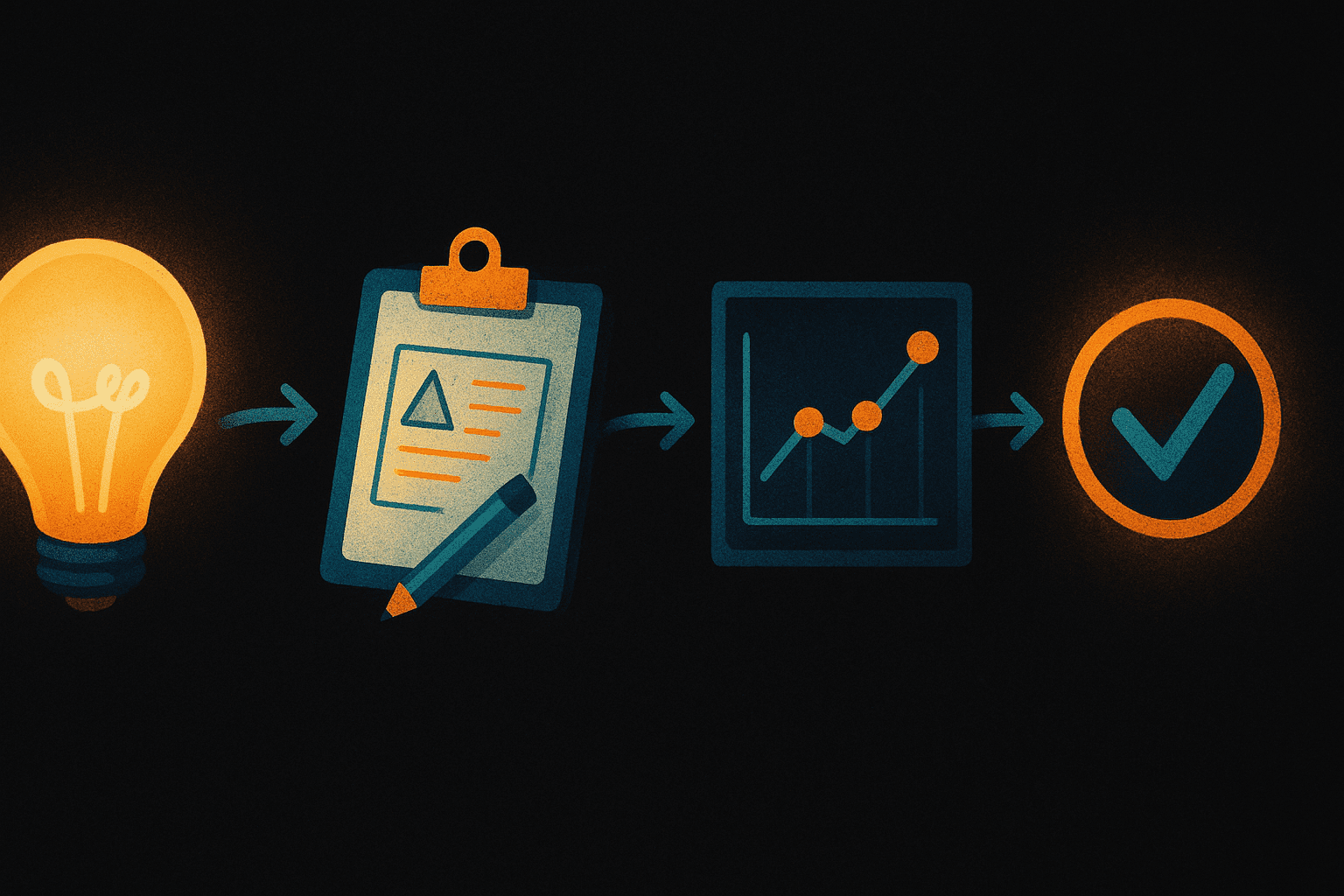

Have you ever had a brilliant product idea that seemed destined for success, only to watch it flop spectacularly in the market? You’re not alone. Statistics show that around 42% of startups fail because they build products nobody actually wants. The culprit? Skipping the crucial product discovery phase.
Product discovery isn’t just another buzzword thrown around in startup circles. It’s the difference between building something people love and creating an expensive digital paperweight. Think of it as your roadmap from that eureka moment to actually launching something that makes customers reach for their wallets.
What exactly is product discovery?
Product discovery is like being a detective, but instead of solving crimes, you’re solving customer problems. It’s the systematic process of figuring out what to build, why it’s needed, and whether people will actually use it before you spend months (and thousands of dollars) building it.
The beauty of product discovery lies in its focus on validation over assumptions. Rather than building based on what you think customers want, you’re gathering real evidence about what they actually need. It’s the art of failing fast and cheap, so you can succeed big later.
Most successful companies don’t just stumble into great products by accident. They follow structured approaches that help them understand their customers deeply, test their assumptions rigorously, and iterate based on real feedback. This is where product discovery frameworks come into play.
The psychology behind why products fail
Before diving into frameworks, let’s understand why so many products miss the mark. The main culprit is something psychologists call the “curse of knowledge.” Once you become an expert in your product, you forget what it’s like to be a beginner. You assume everyone understands what you understand and wants what you want.
There’s also confirmation bias – our tendency to seek information that confirms what we already believe. If you’re convinced your idea is brilliant, you’ll unconsciously look for evidence that supports this belief while ignoring red flags.
Then there’s the sunk cost fallacy. The more time and money you invest in an idea, the harder it becomes to pivot or abandon it, even when the evidence suggests you should. Product discovery helps you avoid these psychological traps by forcing you to seek disconfirming evidence early and often.
The two-track approach: exploration and validation
Modern product discovery operates on two interconnected tracks that work like a figure-eight loop. Think of it as a dance between exploring problems and validating solutions.
The exploration track
The exploration phase is where you become a customer anthropologist. You’re not trying to prove your idea is right; you’re trying to understand the problem space deeply. This involves talking to potential customers, observing their behavior, and understanding their context.
During exploration, you’re asking questions like:
- What problems do our target customers really face?
- How are they currently solving these problems?
- What job are they trying to get done?
- What’s frustrating about their current solutions?
- What would make their lives significantly better?
The key here is to resist the urge to jump into solution mode. Many product teams make the mistake of asking customers what features they want instead of understanding what problems they’re trying to solve. Remember, customers are experts at their problems, not at solutions.
The validation track
Once you have a solid understanding of the problem space, you move into validation mode. This is where you test potential solutions to see if they actually address the problems you’ve discovered. Validation involves creating experiments that test your assumptions with minimal investment.
The validation track answers questions like:
- Does our proposed solution actually solve the problem?
- Will customers pay for this solution?
- Can we build this solution feasibly?
- How will customers actually use this product?
- What’s the simplest version that provides value?
The magic happens when these two tracks work together. Insights from validation often send you back to exploration, and deeper exploration leads to better validation experiments. It’s an iterative dance that continues throughout the product lifecycle.
Popular product discovery frameworks that actually work
Let’s explore the most effective frameworks that successful product teams use to navigate from idea to validation. Each framework has its strengths and is suited for different situations.
Design thinking: the human-centered approach
Design thinking puts humans at the center of the innovation process. It’s particularly powerful when you’re dealing with complex problems that don’t have obvious solutions.
The framework follows five stages:
Empathize: This is where you develop a deep understanding of your users. You conduct interviews, observe behavior, and immerse yourself in their world. The goal is to see the problem through their eyes, not yours.
Define: Here you synthesize your research into a clear problem statement. You’re not defining the solution; you’re defining the problem you’re trying to solve. A good problem statement is specific, human-centered, and inspiring.
Ideate: Now comes the fun part – brainstorming solutions. The key is quantity over quality at this stage. You want to generate as many ideas as possible without judgment. Wild ideas are encouraged because they often lead to breakthrough insights.
Prototype: You create quick, cheap representations of your ideas. These could be paper sketches, digital mockups, or even role-playing scenarios. The goal is to make your ideas tangible so you can test them.
Test: You put your prototypes in front of real users and observe how they interact with them. This isn’t about validation; it’s about learning. You’re looking for insights that will help you refine your understanding of the problem and solution.
Design thinking works best when you’re dealing with fuzzy, complex problems where the solution isn’t obvious. It’s particularly effective for consumer products where user experience is critical.
Lean startup: build, measure, learn
The lean startup methodology revolutionized how we think about product development. Instead of spending months building a perfect product, you build the smallest possible version that allows you to learn from real customers.
The core of lean startup is the build-measure-learn loop:
Build: Create a minimum viable product (MVP) – the simplest version of your product that allows you to test your key assumptions. This isn’t about building a crappy product; it’s about building the right product with just enough features to learn.
Measure: Collect data on how customers interact with your MVP. You’re not just looking at usage metrics; you’re measuring whether your fundamental assumptions about customer behavior are correct.
Learn: Analyze the data to decide whether to persevere with your current approach, pivot to a different approach, or abandon the idea altogether. The goal is validated learning – knowledge backed by evidence rather than opinion.
The lean startup approach is particularly effective for tech startups and digital products where you can iterate quickly and measure user behavior precisely. It’s less suitable for products that require significant upfront investment or have long development cycles.
Jobs-to-be-done: understanding customer motivation
The jobs-to-be-done framework shifts focus from customer demographics to customer motivations. Instead of asking “who is our customer,” you ask “what job is our customer trying to get done.”
The framework is based on the insight that customers don’t buy products; they hire products to do jobs for them. Understanding these jobs helps you create products that fit naturally into customers’ lives.
There are three types of jobs:
Functional jobs: The practical tasks customers are trying to accomplish. For example, getting from point A to point B (transportation), staying connected with friends (communication), or organizing their finances (budgeting).
Emotional jobs: How customers want to feel or avoid feeling. This might include feeling secure, confident, or belonging to a group. Emotional jobs are often more powerful drivers of behavior than functional jobs.
Social jobs: How customers want to be perceived by others. This includes status, identity, and social acceptance. Many successful products succeed primarily because they help customers signal something about themselves to others.
The jobs-to-be-done framework is particularly powerful for understanding why customers switch from one solution to another and for identifying opportunities for innovation.
Double diamond: diverge and converge
The double diamond framework provides a visual representation of the design process that emphasizes both broadening and narrowing your focus at the right times.
The framework consists of four phases arranged in two diamonds:
Discover (first diamond, diverge): You explore the problem space broadly. This involves research, observation, and gathering insights from multiple sources. You’re trying to understand the full scope of the problem without jumping to solutions.
Define (first diamond, converge): You synthesize your research into a clear, focused problem statement. This is where you narrow down from all the problems you could solve to the specific problem you will solve.
Develop (second diamond, diverge): You generate multiple potential solutions to your defined problem. This is the ideation phase where you explore different approaches without committing to any single solution.
Deliver (second diamond, converge): You refine and test your solutions, ultimately selecting and implementing the best approach. This is where you move from concepts to reality.
The double diamond framework is particularly useful for complex projects where you need to balance thorough exploration with focused execution. It helps teams avoid both the trap of solving the wrong problem and the trap of implementing the first solution they think of.
Dual-track agile: continuous discovery and delivery
Traditional agile development focuses on how to build products efficiently, but it doesn’t address what to build. Dual-track agile solves this by running discovery and delivery in parallel.
The discovery track focuses on understanding customer problems and validating potential solutions. This involves research, experimentation, and learning. The delivery track focuses on building and shipping validated solutions efficiently.
The two tracks feed into each other. Ideas validated in discovery move into the delivery backlog, while insights from delivery (like user behavior data) inform further discovery work.
This approach ensures that your delivery team is always working on validated problems while your discovery team is always preparing the next set of validated solutions. It prevents the common problem of alternating between periods of research and periods of building without learning.
Validation techniques that separate winners from losers
Now that we’ve covered the major frameworks, let’s dive into specific techniques for validating your ideas. The goal is to test your assumptions with minimal investment, learning the maximum amount with the least amount of effort.
The MVP spectrum: from concept to product
Most people think of an MVP as a simplified version of their final product, but that’s not quite right. An MVP is the simplest thing you can build to test a specific assumption about customer behavior.
The MVP spectrum ranges from very simple tests to more complex prototypes:
Problem interviews: Before building anything, talk to potential customers about their problems. Are the problems you want to solve actually problems they care about? How are they currently solving these problems? What would make a solution valuable to them?
Solution interviews: Show potential customers mockups or descriptions of your proposed solution. Do they understand it? Does it seem valuable? Would they use it? What concerns do they have?
Landing page tests: Create a simple webpage describing your product and drive traffic to it. Measure how many people sign up for updates or express interest. This tests whether people understand and are interested in your value proposition.
Explainer videos: Create a short video explaining your product concept. Dropbox famously used this approach, creating a simple video that demonstrated their file syncing concept before they had built the actual product. The video generated massive interest and validated the demand.
Wizard of Oz MVPs: Create the impression of a fully automated product while actually delivering the service manually. This lets you test whether customers value the end result without building the full automation. Zappos started this way, manually ordering shoes from other retailers when customers placed orders.
Concierge MVPs: Manually deliver your service to a small number of customers. This helps you understand the full customer journey and refine your understanding of what customers actually value. Many successful B2B software companies start by manually solving problems for a few customers before building software to automate the process.
Single-feature MVPs: Build just one core feature of your product and test whether customers find value in it. Instagram started as Burbn, a location-based app with many features, but pivoted to focus solely on photo sharing when they realized that was the only feature people actually used.
Functional prototypes: Build a working version of your product with just enough features to test your core assumptions. This is what most people think of as an MVP, but it should only be built after you’ve validated the underlying assumptions with simpler tests.
Prototype validation: making ideas tangible
Prototyping is about making your ideas tangible so you can test them with real users. The key is matching the fidelity of your prototype to the questions you’re trying to answer.
Paper prototypes: These are hand-drawn representations of your interface. They’re incredibly fast and cheap to create, and they’re perfect for testing basic user flows and understanding how people think about your product. Don’t underestimate paper prototypes – they can reveal major usability issues that would be expensive to fix later.
Digital wireframes: These are simple, low-fidelity digital representations of your interface. They’re useful for testing more complex interactions and getting feedback on overall structure and flow. Tools like Figma, Sketch, or even PowerPoint can be used to create digital wireframes quickly.
Interactive prototypes: These allow users to click through your interface and experience the flow of your product. They’re more time-consuming to create but provide more realistic feedback. Users can actually navigate through your product concept rather than just looking at static screens.
High-fidelity prototypes: These look and feel very close to the final product. They’re useful for testing detailed interactions and getting feedback on visual design. However, they take significant time to create and can bias feedback toward incremental improvements rather than fundamental insights.
The key to effective prototyping is starting low-fidelity and only increasing fidelity when you need to answer more specific questions. Many teams make the mistake of creating high-fidelity prototypes too early, which wastes time and can bias feedback.
Customer development: getting out of the building
Customer development is the systematic process of testing your assumptions about customers through direct interaction. It’s based on the principle that you can’t understand customers by sitting in a conference room; you have to get out and talk to them.
Problem interviews: These focus on understanding customer problems without pitching your solution. You’re trying to understand their current behavior, pain points, and what they’ve tried before. The goal is to confirm that the problem you want to solve is actually a problem customers care about.
Good problem interview questions include:
- Tell me about the last time you experienced [problem]
- What’s the hardest part about [relevant task]?
- How do you currently handle [situation]?
- What tools or services do you use for [task]?
- If you had a magic wand, how would you solve this?
Solution interviews: These test whether your proposed solution resonates with customers. You show them mockups, prototypes, or descriptions of your solution and gauge their reaction. You’re looking for strong positive or negative reactions – indifference is often worse than criticism.
Usability testing: This involves watching customers try to use your prototype or product. You’re not asking for their opinions; you’re observing their behavior. Where do they get confused? What do they try to do that you didn’t expect? What assumptions did you make that don’t match their mental model?
A/B testing: This involves testing different versions of your product with different groups of users to see which performs better. This is particularly useful for optimizing specific elements like headlines, button colors, or pricing models.
The key to effective customer development is asking the right questions and listening more than you talk. Most entrepreneurs make the mistake of using customer interviews to pitch their idea rather than to learn about customer problems.
Market validation: proving demand exists
Market validation goes beyond individual customer feedback to test whether there’s sufficient demand for your product in the broader market.
Pre-sales and crowdfunding: One of the strongest forms of validation is customers paying for your product before it exists. This could be pre-orders, crowdfunding campaigns, or contracts for future delivery. If people are willing to pay for something that doesn’t exist yet, that’s strong evidence of demand.
Search and advertising tests: Create ads for your product and see how many people click through and express interest. This tests whether your messaging resonates and whether there’s organic demand for your solution. You can run these tests with landing pages that collect email addresses rather than selling an actual product.
Competitive analysis: Look at existing solutions in your space. Are customers paying for similar products? How are existing products failing to meet customer needs? What gaps exist in the current market? Strong competition can actually be validation that a market exists.
Market size analysis: Research the size of your target market and how it’s growing. Is the market large enough to support your business goals? Is it growing or shrinking? Are there trends that suggest increasing demand for solutions like yours?
Beta testing programs: Release your product to a limited group of users and measure their engagement. Are they actively using the product? Are they willing to pay for it? Are they recommending it to others? High engagement in a beta test often predicts success in the broader market.
Common pitfalls and how to avoid them
Even with the best frameworks and techniques, product discovery can go wrong. Here are the most common pitfalls and how to avoid them.
The solution bias trap
This is perhaps the most common mistake in product discovery. You fall in love with your solution and unconsciously seek evidence that confirms it will work while ignoring evidence that it won’t.
How to avoid it: Start with the problem, not the solution. Spend significant time understanding customer problems before thinking about solutions. When you do start exploring solutions, actively look for reasons why your solution might not work.
The feature factory syndrome
This happens when you focus on building features rather than solving customer problems. You measure success by how many features you ship rather than by the value you create for customers.
How to avoid it: Always connect features back to customer problems and business outcomes. Before building any feature, clearly articulate what customer problem it solves and how you’ll measure whether it’s successful.
The perfect product delusion
This is the belief that you need to build a perfect product before launching. You keep adding features and polishing details instead of getting feedback from real customers.
How to avoid it: Embrace the concept of “good enough to learn.” Your first version doesn’t need to be perfect; it just needs to be good enough to test your key assumptions. You can always improve it based on customer feedback.
The false positive trap
This happens when customers tell you they love your idea during interviews, but they don’t actually use or pay for your product when it’s available. People are generally polite and don’t want to hurt your feelings, so they give positive feedback even when they’re not really interested.
How to avoid it: Look for behavior, not just words. Ask customers to take specific actions like signing up for updates, referring friends, or making pre-purchases. Actions are more reliable indicators of genuine interest than verbal feedback.
The analysis paralysis problem
This occurs when you get stuck in research mode and never move toward building and testing actual solutions. You keep gathering more data instead of making decisions based on the data you have.
How to avoid it: Set specific decision points and timelines for your discovery work. Define what you need to learn and when you’ll make decisions based on that learning. Remember that some uncertainty is inevitable – you don’t need perfect information to move forward.
Measuring success in product discovery
How do you know if your product discovery efforts are working? Here are the key metrics and indicators to track.
Learning velocity metrics
Assumptions tested per week: Track how many assumptions you’re testing through experiments and customer interactions. High-performing discovery teams typically test multiple assumptions per week.
Time from hypothesis to test result: Measure how quickly you can design and execute experiments to test your assumptions. The faster you can run experiments, the more you can learn.
Customer contact hours: Track how much time your team spends directly interacting with customers. Teams that talk to customers regularly make better product decisions.
Quality of insights metrics
Assumption accuracy rate: Track what percentage of your assumptions turn out to be correct. If you’re right too often, you might not be testing risky enough assumptions. If you’re wrong too often, you might need to improve your research methods.
Pivot frequency: Measure how often you significantly change direction based on new learning. Some pivoting is healthy and indicates you’re learning from customer feedback.
Solution fit confidence: Use qualitative measures to assess how confident you are that your solution addresses real customer problems. This should increase over time as you gather more evidence.
Business impact metrics
Customer acquisition cost: Track how much it costs to acquire customers through different channels. Effective product discovery often leads to lower acquisition costs because your product better fits market needs.
Customer lifetime value: Measure how much value customers derive from your product over time. Products that solve real problems typically have higher lifetime value.
Product-market fit indicators: Look for signs like organic growth, low churn rates, high customer satisfaction scores, and customers recommending your product to others.
Tools and resources for effective product discovery
The right tools can significantly improve your product discovery process. Here are some categories of tools to consider.
Research and customer feedback tools
User interview platforms: Tools like User Interviews, Respondent, or Calendly can help you recruit and schedule customer interviews more efficiently.
Survey tools: Platforms like Typeform, SurveyMonkey, or Google Forms let you gather quantitative feedback from larger groups of customers.
User testing platforms: Services like UserTesting, Maze, or Lookback allow you to watch customers interact with your prototypes and products.
Analytics tools: Google Analytics, Mixpanel, or Amplitude help you understand how customers actually use your product once it’s launched.
Prototyping and design tools
Design tools: Figma, Sketch, or Adobe XD for creating digital prototypes and mockups.
No-code tools: Webflow, Bubble, or Glide let you create functional prototypes without writing code.
Landing page builders: Unbounce, Leadpages, or even WordPress for creating simple landing pages to test demand.
Video creation tools: Loom, Camtasia, or even phone cameras for creating explainer videos.
Collaboration and documentation tools
Research repositories: Dovetail, Condens, or Notion for organizing and analyzing customer research.
Collaboration tools: Miro, Mural, or FigJam for collaborative workshops and brainstorming sessions.
Project management: Trello, Asana, or Linear for tracking discovery tasks and experiments.
Documentation: Confluence, Notion, or Google Docs for documenting insights and decisions.
Building a discovery-driven culture
Successful product discovery isn’t just about following frameworks and using tools – it requires building a culture that values learning and customer focus throughout your organization.
Getting organizational buy-in
Start small: Begin with small discovery experiments that don’t require significant resources or organizational change. Demonstrate value before asking for larger investments.
Share customer stories: Regularly share customer interviews, feedback, and insights with the broader organization. Make customer voices heard in every meeting and decision.
Celebrate learning: Reward teams for learning, not just for shipping features. Make it safe to admit when assumptions are wrong and to change direction based on new evidence.
Involve stakeholders: Include executives, sales teams, and other stakeholders in customer interviews and discovery activities. When they hear directly from customers, they become advocates for customer-centered decision making.
Training your team
Customer interview skills: Train team members on how to conduct effective customer interviews. This includes asking open-ended questions, listening actively, and avoiding leading questions.
Experimental design: Teach teams how to design experiments that test specific assumptions with minimal resources. This includes defining success metrics and determining sample sizes.
Data analysis: Help teams develop skills in analyzing both qualitative and quantitative data to extract actionable insights.
Prototype creation: Ensure team members can create prototypes appropriate for different types of testing, from paper sketches to interactive digital prototypes.
Integrating discovery with delivery
Regular discovery ceremonies: Just as you have sprint planning and retrospectives for delivery, create regular ceremonies for discovery work like research sharing sessions and experiment planning meetings.
Discovery backlogs: Maintain backlogs of assumptions to test and experiments to run, just as you maintain backlogs of features to build.
Cross-functional teams: Include researchers, designers, product managers, and engineers in discovery activities. Different perspectives lead to better insights.
Discovery success metrics: Track and report on discovery metrics alongside delivery metrics. Make learning as important as shipping.
The future of product discovery
Product discovery continues to evolve as new technologies and methodologies emerge. Here are some trends shaping the future of how we validate product ideas.
AI-powered insights
Artificial intelligence is beginning to augment human insight in product discovery. AI can analyze large volumes of customer feedback, identify patterns in user behavior, and even predict which product ideas are most likely to succeed based on historical data.
However, AI won’t replace human insight anytime soon. Customer problems are often nuanced and context-dependent in ways that are difficult for AI to understand. The future likely involves AI handling routine analysis while humans focus on interpretation and strategy.
Continuous automated testing
We’re seeing the emergence of tools that can automatically test product assumptions through A/B tests, user behavior analysis, and other methods. This allows teams to run more experiments with less manual effort.
The challenge is ensuring that automated testing still leads to genuine learning rather than just optimization of metrics that may not correlate with customer value.
Remote and distributed discovery
The shift toward remote work has accelerated the development of tools and methods for conducting product discovery with distributed teams and customers. Virtual interviews, online collaborative workshops, and digital ethnography are becoming more sophisticated and effective.
This trend is making product discovery more accessible to teams that previously couldn’t afford to travel for customer research, but it requires new skills and approaches to maintain the same depth of insight.
Ethical considerations
As product discovery becomes more sophisticated, there’s growing awareness of ethical considerations around customer research, data privacy, and the responsibility of product creators to consider the broader impact of their products.
Future product discovery frameworks will likely incorporate explicit consideration of ethical implications and social responsibility, not just business success.
Putting it all together: your product discovery action plan
Now that we’ve covered the frameworks, techniques, and best practices, here’s a practical action plan for implementing product discovery in your organization.
Week 1-2: Foundation setting
Define your discovery goals: What specific assumptions do you need to test? What questions do you need to answer before moving forward with development?
Choose your framework: Based on your situation, choose one primary framework to guide your discovery process. You can always incorporate elements from other frameworks later.
Identify your target customers: Create specific customer profiles for the people you want to interview. The more specific, the better.
Plan your first experiments: Design 3-5 simple experiments you can run in the next month to test your key assumptions.
Week 3-4: Customer research
Conduct problem interviews: Talk to at least 10 potential customers about their problems and current solutions. Focus on understanding their world, not pitching your idea.
Analyze and synthesize: Look for patterns in customer feedback. What problems come up repeatedly? What language do customers use to describe their problems?
Refine your understanding: Based on customer interviews, refine your understanding of the problem you’re solving and the customers you’re serving.
Week 5-6: Solution exploration
Generate solution ideas: Based on your improved understanding of customer problems, brainstorm potential solutions. Don’t judge ideas yet; just generate as many as possible.
Create low-fidelity prototypes: Create simple representations of your top solution ideas. These could be sketches, wireframes, or simple mockups.
Test with customers: Show your prototypes to customers and gather feedback. Are they understanding the concept? Does it seem valuable? What concerns do they have?
Week 7-8: Validation and refinement
Build higher-fidelity tests: Based on customer feedback, create more detailed prototypes or simple MVPs to test your refined solution concepts.
Run market validation experiments: Test demand through landing pages, ad campaigns, or pre-sales to understand if there’s broader market interest.
Make go/no-go decisions: Based on all your learning, decide whether to move forward with development, pivot to a different approach, or abandon the idea.
Ongoing: Continuous discovery
Establish regular customer contact: Set up ongoing processes for staying connected with customers throughout the development process.
Create learning loops: Build systematic processes for turning customer feedback into product improvements.
Scale your discovery practice: As you gain confidence and see results, expand your discovery practices to cover more of your product development pipeline.
Conclusion: from idea to market success
Product discovery isn’t a one-time activity you do before building your product – it’s an ongoing practice that successful companies embed throughout their product development process. The frameworks and techniques we’ve covered provide structure for this practice, but the key is developing a mindset of continuous learning and customer focus.
Remember that the goal of product discovery isn’t to prove your ideas are right – it’s to learn what will actually create value for customers and your business. Sometimes that means pivoting from your original idea, and sometimes it means doubling down on an approach that’s working better than expected.
The companies that master product discovery don’t just build better products – they build them faster and with less risk. They avoid the expensive mistakes that come from building products based on assumptions rather than evidence. Most importantly, they create products that customers genuinely love and are willing to pay for.
Whether you’re a startup founder with your first product idea or a product manager at an established company launching a new initiative, the principles and practices of product discovery will help you navigate the journey from idea to market success. The key is to start small, learn fast, and always keep your customers at the center of your decision-making process.
The path from idea to validation isn’t always linear, and it’s rarely easy. But with the right frameworks, techniques, and mindset, you can significantly increase your chances of building something that truly matters to the people you’re trying to serve.






Leave a Reply