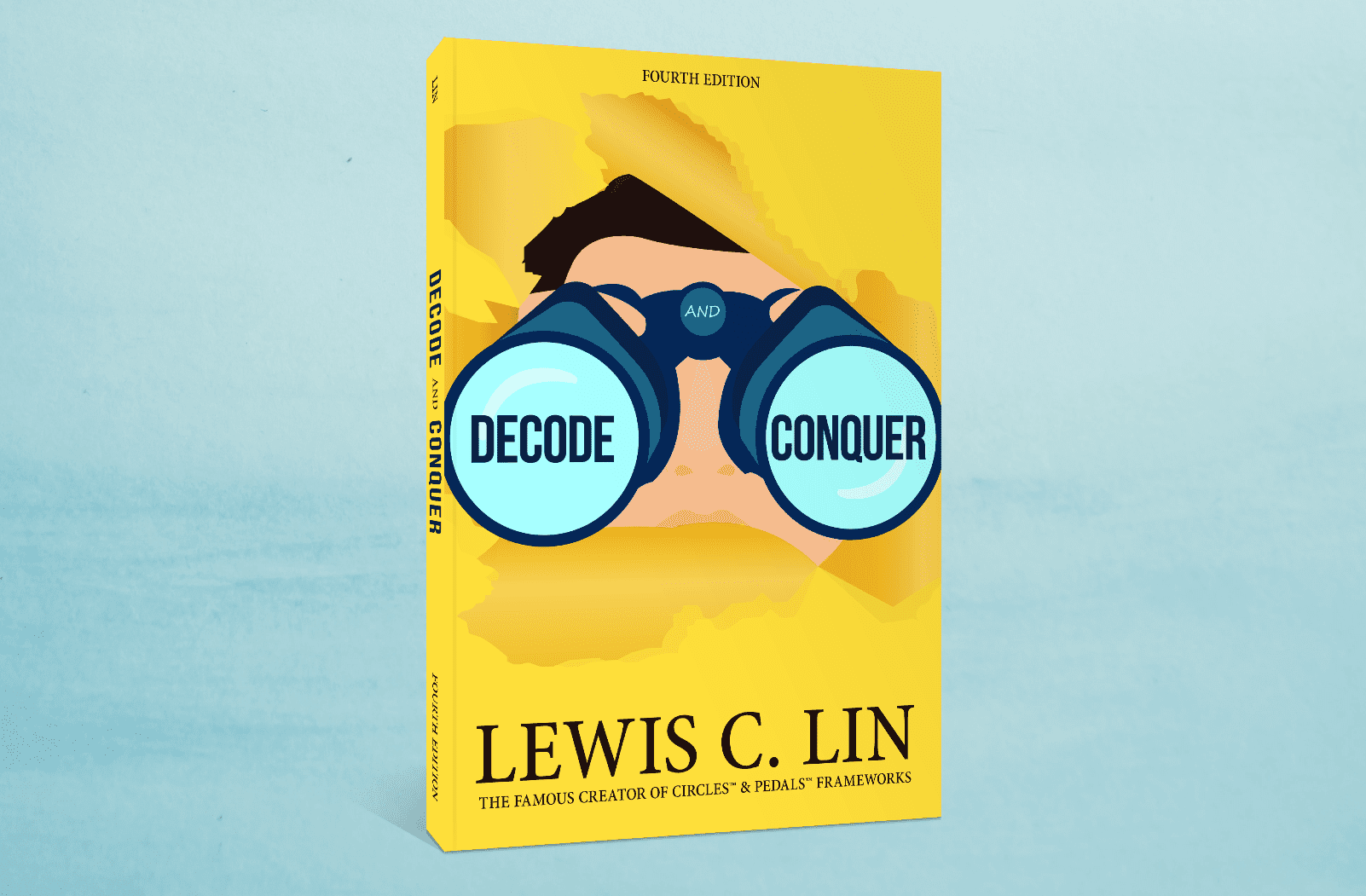

Decode and Conquer: Answers to Product Management Interviews Summary
This book by Lewis C. Lin serves as a comprehensive guide for aspiring product managers preparing for interviews, particularly at top tech companies like Google, Amazon, Facebook, LinkedIn, and Microsoft. Drawing on the author’s extensive experience helping job seekers, the book aims to demystify the product management interview process by providing sample answers to common question types across design, technical, analytical, strategic, and behavioral domains. It emphasizes the importance of practice, structured thinking using frameworks like the CIRCLES Method™, AARM Metrics™, and DIGS Method™, developing intellectual curiosity, and mastering both the content and delivery of responses to appear credible, likable, and impactful.
Introduction
The introduction highlights the author’s passion for teaching and the motivation behind writing the book: providing actual sample answers, which are scarce online. It sets the stage by acknowledging the challenging, multi-disciplinary nature of the product management interview, which draws from project management, product design, software engineering, consulting, and marketing. The core message is that preparation through practice, understanding underlying concepts, and developing a strong delivery style are key to success, aiming to make candidates sound practiced but not scripted.
Chapter 1 Critiquing Design
This chapter focuses on how to objectively evaluate product and feature design during an interview. A strong critique involves using predetermined criteria, similar to a scorecard.
Design Evaluation Principles and Approach
- Define Criteria: Base your critique on specific design principles. The book suggests drawing from Dieter Rams’ 10 principles, emphasizing innovation, utility, aesthetics, understandability, unobtrusiveness, honesty, longevity, thoroughness, environmental friendliness, and minimal design. For interviews, focusing on 3-4 core principles like innovation, utility, and honesty is effective.
- Explain Meeting Criteria: Clearly articulate whether and how the product or feature succeeds or fails based on your chosen principles.
- Be Specific and Provide Evidence: Support your points with concrete examples from the product. Contrast the product with similar ones to highlight strengths or weaknesses.
- Example: LinkedIn’s Endorse Feature Critique: Using innovation, usefulness, and honesty as criteria, the critique walks through how the feature works (pop-ups, profile display) and evaluates its pros (clever data acquisition, adds information, identifies expertise, wisdom of crowds) and cons (suspect data quality, lack of details/examples, sampling bias, compulsion to reciprocate).
- Example: Liked Product (iPhone): The candidate uses utility, innovation, and ease of use to praise the iPhone, citing its multi-functionality, comparison to older phones (BlackBerry, WAP), and intuitive interface (few buttons, finger navigation, natural gestures like flipping).
- Example: Poorly Designed Product (Apple Hockey-Puck Mouse): The critique uses functionality, design excess, and usefulness to criticize the mouse’s round shape (hard to orient), blue accents (misleading), and awkward grip.
- Methodical Review Tip: Walking through the product’s mechanics before critiquing ensures both you and the interviewer are on the same page about how the feature actually works.
Critiquing design effectively requires stating your criteria upfront, providing detailed reasoning, and backing up your points with specific examples and comparisons.
Chapter 2 Designing a Desktop Application
Designing a product, especially under interview pressure, can be daunting. Candidates often struggle with where to start, rambling, concluding, and focusing only on the solution without context. The CIRCLES Method™ is introduced as a structured approach to tackle any design question.
The CIRCLES Method™ Framework
- Comprehend the Situation (C): Understand the problem and product. Ask clarifying questions (“3W’s and H”: what is it, who is it for, why do they need it, how does it work?). Make assumptions if necessary, stating them clearly.
- Identify the Customer (I): Define specific customer segments or personas. Choose one to focus on due to time constraints. Describe the persona using relevant characteristics (e.g., behaviors, demographics, needs).
- Report the Customer’s Needs (R): Articulate the problems or goals the customer wants to achieve. Use the “user story” format: “As a <role>, I want <goal/desire> so that <benefit>.” This is concise, complete, and casual.
- Cut, Through Prioritization (C): Acknowledge that not all needs can be addressed at once. Prioritize the customer needs or use cases. A simple prioritization matrix can help, considering subjective criteria (e.g., User Story, Customer Satisfaction, Revenue, Ease of Implementation) or a more quantitative approach (e.g., Revenue Impact, Engineering Effort).
- List Solutions (L): Brainstorm potential product features or solutions to address the prioritized need.
- Brainstorming Tip: Use frameworks like Reversal (reverse the problem), Attribute (mix/match product attributes), or Why? Method (challenge status quo).
- Think Big Tip: Aim for innovative ideas beyond simple “me too” or integration features. Consider future trends and bold bets.
- Have at Least Three Ideas Tip: Generate multiple ideas (ideally three) to demonstrate creativity and avoid being defensive if one idea is critiqued.
- Evaluate Trade-offs (E): Analyze the pros and cons of each proposed solution. Optionally, define evaluation criteria (e.g., customer satisfaction, implementation difficulty, revenue potential). A simple pro/con list for each idea is effective. This shows thoughtfulness and objectivity.
- Summarize Your Recommendation (S): Conclude by stating which solution you recommend and why. Explain what the recommended product/feature is, its benefits to the user/company, and why it is preferred over alternatives (recapping trade-offs).
- CIRCLES Method™ Tip: Don’t follow the framework rigidly; adapt it. It’s a memory aid, not a script. It’s okay to have a solution in mind initially if it helps structure the discussion, but ensure you cover all CIRCLES steps to provide necessary context.
The CIRCLES Method™ provides a flexible yet comprehensive structure for approaching product design questions, ensuring candidates cover the situation, customer, needs, prioritization, solutions, evaluation, and recommendation.
Chapter 3 Designing a Webpage or Website
The CIRCLES Method™ can be directly applied to design questions focused on websites or specific web pages.
Interview Visually Tip
- Communicate Effectively: Pictures and visuals are often better than words in conveying design ideas.
- Utilize Visuals in the Interview: Have visuals ready (e.g., screenshots). Sketch wireframes on the whiteboard during the interview. Standing up and sketching adds an authoritative feel.
- Prepare Mockups at Home: Go the extra mile by redesigning a relevant webpage/product at home using mockup tools (Balsamiq, Photoshop, PowerPoint). Bring copies to the interview and subtly introduce them as a demonstration of initiative and skill. This can significantly impress interviewers and set you apart.
- Visuals Build Credibility and Likability: Presenting prepared visuals shows confidence and competence in design, contributing to the interviewer’s perception of you as a credible and likable candidate.
This section reinforces that visual communication is a crucial skill for product managers and should be actively demonstrated during the interview, even through pre-prepared materials.
Chapter 4 Designing a Mobile App
Designing a mobile application follows the same structured approach as designing desktop or web applications, utilizing the CIRCLES Method™.
Memorize Design Best Practices Tip
- Seek Inspiration: Don’t try to design common UI elements from scratch in the interview. Draw inspiration from existing apps or design pattern libraries.
- Review Design Pattern Libraries: Familiarize yourself with common and effective design patterns for mobile user interfaces (e.g., navigation menus, news feeds, list pages). Searching online for “mobile design patterns” can provide valuable resources.
- Align with Mental Models: Using standard design patterns ensures your proposed interface aligns with what users expect and reduces the risk of designing something counter-intuitive or difficult for the interviewer (and users) to understand.
Knowing common mobile design patterns helps candidates quickly propose familiar and effective interfaces when sketching or describing solutions, making their design proposals more credible.
Chapter 5 Designing a Consumer Product
The CIRCLES Method™ is versatile and can be applied to designing physical consumer products as well as software.
Don’t Blindly Follow Frameworks Tip
- Avoid Robotic Delivery: Do not recite the steps of a framework (like CIRCLES) verbatim. It sounds scripted, potentially making you seem inexperienced or over-prepared in a negative way.
- Sound Conversational: Aim for a natural conversation flow with the interviewer. Incorporate the framework’s steps organically as you discuss the problem and potential solutions.
- Adapt and Trust Judgment: Frameworks are aids, not rigid rules. Adapt the steps to the specific question and context. Trust your critical thinking to guide the discussion, which shows confidence and polish.
This tip emphasizes that while frameworks are helpful tools, the interview should feel like a genuine problem-solving discussion, not a recitation of steps.
Chapter 6 Designing a Service or Other Product
The design principles and methods discussed in previous chapters, including the CIRCLES Method™, are also applicable when designing services or non-traditional products.
Ask the Five Whys Tip
- Understand Customer Workflows: To identify opportunities for new services or products, delve into the customer’s current process and the challenges they face with existing solutions.
- Identify Root Causes and Gaps: Use the “Five Whys” technique to uncover the underlying reasons for a problem or an unmet need. Repeatedly asking “Why?” helps move past superficial symptoms to the root cause.
- Diagnose Problems: This technique, popularized by Toyota, is useful for diagnosing issues with current processes, evaluating proposed innovations, or understanding why existing customer solutions fall short. It helps articulate unarticulated problems.
The Five Whys technique is presented as a valuable tool for deepening understanding of customer needs and pinpointing the core problems that a new service or product should address.
Chapter 7 Getting Technical
Technical questions are common in PM interviews, particularly at companies like Google. They assess a candidate’s comfort and proficiency with technical concepts, algorithms, and system design.
How to Approach a Technical Interview Question
- Understand the Question: Clarify the goal and the problem statement first.
- Start Simple: Work through a basic base case or example. This often reveals insights and helps clarify the problem.
- Talk Aloud: Explain your thought process as you work through the problem. This allows the interviewer to follow your logic, offer guidance, and assess your thinking.
- Write Solutions: If necessary, write code or pseudocode. Focus on the logic and approach rather than perfect syntax.
- Review and Refine: Evaluate the strengths and weaknesses of your proposed solution. Identify potential bugs or areas for improvement and revise. Few solutions are perfect on the first try.
- Technical Concept Examples: The text touches on explaining concepts like Recursion (explained using the movie theater analogy: a problem’s solution depends on smaller instances of the same problem, with a base case) and Object-Oriented Programming (OOP) (explained using a car analogy: organizing code into objects with state and operations, emphasizing inheritance and reusability, avoiding confusing jargon).
- Algorithm Examples: Questions like recommending Twitter followers involve brainstorming various approaches based on user behavior (views, follows) and relationships (stalker, acquaintance), then evaluating trade-offs of each. Detecting duplicate websites might involve using hash functions, analyzing link structures, time stamps, or domain reputation. Designing an elevator system involves considering algorithms like FCFS, SSTF, SCAN, LOOK (evaluating based on latency, throughput, fairness, movement time).
- System Design/Troubleshooting: Questions like reducing Gmail storage (compression, deletion, client-side, off-site storage) or solving a server bottleneck (diagnosing potential causes like network, server, storage, database, application latency) require identifying components and proposing solutions with pros/cons. Designing a blogging application involves specifying data models, functions, and how they interact.
Technical interviews require candidates to demonstrate not only their understanding of computer science fundamentals but also their ability to apply them to solve problems and communicate technical ideas clearly.
Chapter 8 Getting Analytical: Estimation
Estimation questions, sometimes mistakenly seen as brainteasers, are used to evaluate a candidate’s judgment, problem-solving skills, ability to identify key assumptions, and communication of their thought process. They are practical for product managers who constantly make decisions based on metric estimates.
Estimation Methods
- Top Down: Start with a large, known number (e.g., total population) and narrow it down based on logical assumptions to arrive at the final estimate.
- Bottom Up: Start with a small, observable data point (e.g., activity in a single store) and extrapolate based on assumptions to estimate the total.
Approach and Examples
- State Assumptions: Clearly state the assumptions you are making. This is crucial as interviewers evaluate your judgment in choosing reasonable numbers.
- Break Down the Problem: Deconstruct the larger question into smaller, manageable parts.
- Do Calculations Clearly: Perform the multiplication/division steps in a way that the interviewer can easily follow, ideally talking aloud or writing on a board.
- Sanity Check: Compare your final estimate to any known benchmarks or common sense to see if it’s reasonable.
- Example: McDonald’s Revenue: A bottom-up approach estimates revenue per store (hourly customers, avg revenue per customer, hours of operation), multiplies by the estimated number of stores in a region (cities x avg stores/city), and then extrapolates regionally to globally.
- Example: Gmail Queries/Sec: A top-down approach starts with world population, estimates internet users, then Gmail primary users, estimates weekly activity (logins/week, operations/login), and converts total weekly operations to operations per second.
- Example: iPhones Sold in US: A top-down approach starts with US population, estimates cell phone penetration, replacement cycle, smartphone penetration, and iPhone market share within smartphones.
- Example: Flickr Cost/User: Estimate average storage used per user per month (upload frequency, photo size), calculate storage cost (GB * cost/GB/mo). Estimate bandwidth used per user per month (views per photo, optimized photo size), calculate bandwidth cost (GB * cost/GB/GB/mo). Sum these costs.
- Example: Elevators for 50-story building: Estimate demand (building type, employees per floor, arrival rate, acceptable wait time). Estimate capacity (elevator size, speed, stops per trip, time per stop). Calculate round trip time and throughput. Determine the number of elevators needed to meet peak demand within the acceptable wait time. A sanity check against similar known buildings is helpful.
Estimation questions test a candidate’s structured thinking, ability to make reasonable assumptions, perform calculations, and explain their methodology.
Chapter 9 Getting Analytical: Pricing
Pricing questions assess a candidate’s ability to analyze a situation, develop a systematic approach to pricing a product or service, and make a defensible recommendation.
How to Approach a Pricing Problem
- Understand Customer Willingness to Pay: What value does the customer perceive? What would they pay for an alternative? This sets a likely upper bound.
- Consider Competitive Pricing: What are similar products or services priced at in the market? This provides benchmarks.
- Analyze Cost-Based Pricing: What is the cost to produce or deliver the product/service? Adding a margin sets a lower bound or profit target.
- Consider Strategic Goals: How does pricing align with the overall business strategy (e.g., maximize market share, maximize profit, loss leader to drive other revenue)?
- Real-World Methods: Acknowledge that real-world pricing often involves experimentation (A/B testing different price points) or market research (surveys), while also noting the limitations of surveys.
- Example: Kindle Fire HD Pricing: Evaluate competitors’ prices (iPad Mini, Nexus 7), estimated manufacturing cost (iSuppli data), and strategic goals (sell digital content – razor/blade model). The pricing recommendation (
174−174-174−199 range, suggest lower end $174) is justified by the strategic need to gain tablet market share as a platform for content sales, even as a loss leader. - Example: Amazon Prime Price Change: Analyze the financial impact of a price decrease ($79.99 to $69.99) on existing and new customers. Estimate revenue changes from existing members (price decrease). Estimate new member acquisition (e.g., 20% jump). Estimate new revenue from new members (membership fee, incremental purchases * gross margin). Estimate increased costs for new members (incremental shipping). Calculate the net impact (sum of revenue and cost changes). The recommendation is based on whether the net impact is positive.
Pricing questions require combining customer value, competitive landscape, costs, and business strategy to arrive at a justified price point or evaluate a pricing decision.
Chapter 10 Getting Analytical: Metrics
Metrics questions are fundamental in today’s data-driven product development environment, especially with the prevalence of A/B testing. They assess a candidate’s understanding of how to measure product success, interpret data, and make decisions based on quantitative results.
Key Frameworks
- AARM Metrics™: A framework to categorize metrics across the user lifecycle:
- Acquisition: How users find and sign up for the service (e.g., lazy registrations).
- Activation: Getting users to engage meaningfully after signing up (e.g., completing profile, taking key first actions).
- Retention: Getting users to return and continue using the service over time (e.g., daily/weekly/monthly active users, key behaviors like posting, inviting).
- Monetization: How the product generates revenue (e.g., ARPU, ARPPU, ARPDAU, LTV, conversion rate).
- The Three Loops™: A visual representation of key retention/engagement drivers:
- Data Loop: Users adding content/information makes the product more valuable (e.g., photos, profile details).
- Compulsion Loop: Users being incentivized or motivated to check the product frequently (e.g., notifications, checking updates).
- Viral Loop: Users inviting others, driving growth and potentially enriching the network effect. These loops are often interconnected.
Approach and Examples
- Define Goal: Clearly state the objective the metrics are intended to measure (e.g., increase engagement, improve customer satisfaction).
- Select Relevant Metrics: Choose metrics from frameworks like AARM that directly align with the goal and the feature being evaluated. Explain why each metric is relevant.
- Interpret A/B Test Results: Analyze the impact (lift) on key metrics. Understand the significance of p-values (statistical validity).
- Make Data-Driven Decisions: Based on the A/B test results and the product’s strategic goals, recommend whether to launch the feature. Be prepared to articulate trade-offs if results show conflicting impacts (e.g., increased engagement but decreased sign-ups). The tip is to align the decision with the overarching corporate strategic goal (e.g., prioritize engagement over acquisition if engagement is the current focus).
- Example: Metrics for Product Success (LinkedIn photo upload): The candidate identifies Activation, Engagement, and Retention as key AARM categories for a sign-up flow change. They analyze hypothetical A/B test results showing decreased sign-ups but increased engagement and retention, and justify a decision based on prioritizing engaged users. The explanation of p-value is also demonstrated.
- Example: LinkedIn Killer Feature/Metrics (Conference Page): After proposing a new feature (conference page with attendees, materials), the candidate suggests metrics across Acquisition (organizer sign-ups), Engagement (organizer page creation, attendee visits/actions), and Monetization (revenue from organizers/fees).
- Example: Google+ Feature/Metrics (Pet Page/FitBit Integration): After proposing a creative feature idea, the candidate suggests metrics like Purchases (for the device), Friend Engagement (likes, comments, visits based on pet posts), and Usage (frequency/duration pet owners use the device/feature), ultimately focusing on how these drive key Google+ metrics like 30-day actives and sessions per day.
Metrics questions evaluate a candidate’s analytical rigor, understanding of product health, ability to select appropriate measures, and competence in using data to inform product decisions.
Chapter 11 Strategizing: Trade-offs
Strategy questions often require evaluating complex decisions where there are both upsides and downsides. The ability to clearly articulate and weigh these trade-offs is key.
Analysis Tool: Pro/Con
- Objective Evaluation: A pro/con analysis provides a structured way to look at the positives and negatives of a decision or idea.
- Comprehensive View: Evaluating trade-offs across multiple dimensions (e.g., customer experience, revenue, brand, implementation) ensures a thorough analysis.
- Demonstrate Objectivity: Presenting both sides shows you can think critically and objectively about a situation.
- Prepare for Criticism: By identifying potential downsides yourself, you are better prepared for interviewer questions and appear less defensive.
- Example: Amazon Display Ads (Pro Argument): The candidate argues in favor, citing benefits like improving customer experience (redirecting for out-of-stock items, highlighting offers) and providing additional revenue (from manufacturers, potentially competitors), which can be reinvested in the customer experience.
- Example: Amazon Display Ads (Con Argument): The candidate argues against, highlighting negative impacts like distracting customers (clutter, harder to find products, potential for increased bounce/abandonment, reduced conversions) and creating a negative brand perception (directing customers away, becoming a research site vs. purchase destination), potentially hurting Google’s core business model.
- Demonstrate Flexibility: Be prepared to argue convincingly for both sides of a controversial issue when prompted, showing the ability to understand and articulate different perspectives.
Trade-off questions test a candidate’s analytical ability to evaluate complex situations, identify potential positive and negative consequences, and articulate reasoned arguments for different positions.
Chapter 12 Strategizing: New Market Entry
Strategy questions about entering a new market assess a candidate’s business acumen, analytical skills, and ability to evaluate opportunities and risks methodically.
How to Approach Strategy Questions on New Market Entry
- Use a Checklist: A structured checklist ensures all critical factors are considered and provides clear criteria for evaluation.
- New Market Entry Checklist:
- Market Characteristics: Assess market size, growth rate, typical profit margins, and relevant trends (e.g., changing customer preferences, regulatory changes).
- Competitive Environment: Analyze the number and size of competitors, their resources (financial, employees, partner ecosystem), and unique competencies (differentiated products, distribution access).
- Company Fit: Evaluate how well the potential market aligns with your company’s strengths, expertise, economies of scale, access to distribution channels, supplier relationships, and existing brand promise.
- Example: Amazon New Category/Division/Market (Dollar Store Category): The candidate proposes a dollar store category, justifying it based on market characteristics (growing, good margins, attractive segment), company fit (consistent with strategy, low barriers, utilizes fulfillment synergies), and credible differentiation (value without physical store downsides). They also touch on implementation (add-on program synergy, ‘fill your bag’ principle).
- Example: Oven vs. Oven Mitt: The candidate uses a decision-making framework (Profitability, Customer Satisfaction, Product Assortment) to evaluate carrying a new oven vs. an oven mitt. This involves discussing market dynamics (consumer behavior for large appliances vs. small items), logistical challenges (shipping bulky items), and service needs (installation for ovens vs. none for mitts). The profitability estimation for the oven mitt demonstrates quantitative analysis within the strategic context.
- Example: Amazon Selling Neighborhood Groceries: The candidate summarizes the customer and business benefits (Amazon experience, speed, saving shipping, transaction cut) and then identifies and prioritizes top issues/risks using implicit checklist points like Company Fit (Signing up stores – Amazon lacks relationships), Implementation (Store integration – technical challenge), Quality/Brand Risk (Product quality inconsistency), Data Issues (Inventory data accuracy), Supply Issues (Inventory availability for Amazon scale), and Competitive Risk (Customers bypassing Amazon).
Approaching new market entry questions with a structured checklist helps candidates cover essential business and operational considerations, demonstrating a thorough analytical process.
Chapter 13 Strategizing: CEO-level Issues
CEO-level strategy questions often involve high-stakes decisions related to competition, acquisitions, partnerships, or core corporate values. They test a candidate’s ability to think broadly about the business, its drivers, and the impact of major strategic moves.
How to Approach CEO-level Strategy Questions
- Focus on Business Drivers: Start by understanding how the company makes money and the critical factors that drive its success.
- Analyze Impact: Evaluate how the strategic issue (competitor, acquisition, new product) would affect these core business drivers.
- Consider Multiple Perspectives: Think about the impact on users, advertisers/customers, partners, competitors, and the company itself.
- Use Executive Shorthand: Communicate your points clearly and concisely, focusing on the most important implications.
- Example: Google Acquiring Quora: The candidate argues in favor based on Quora’s valuable content (especially for long-tail search), the risk of competitive “hold-up” (competitors blocking Google indexing), and the threat to Google’s search brand reputation as the “first place to find anything.” (Note: While the answer is strong, acknowledging pricing and potential integration challenges would improve it).
- Example: Yellow Cab vs. Uber: After clarifying Uber’s value propositions (convenience, reliability, clear pricing, cashless, feedback, fare splitting), the candidate identifies reliability as the core issue Uber solved by bypassing the dispatcher using technology. Proposed responses for Yellow Cab include partnering with Uber, developing their own app, or using an SMS service, evaluating pros/cons like customer relationship ownership, tech competency needs, and regulatory factors.
- Example: Google vs. Microsoft Concern: The candidate argues Google should be concerned, citing Microsoft’s control over key distribution channels (Internet Explorer, Windows), direct competition in multiple business areas (search, ads, productivity), and strong partner/sales ecosystem. Google’s defensive actions (Chrome, Android) are mentioned.
- Example: Google Business/Threats: Google makes most revenue from online advertising. Threats discussed include Mobile Ads (lower monetization/CPC, limited inventory in apps, rise of other mobile ad networks), Social Networks (less user data than Facebook, lack of inventory on dominant networks), and Mobile Phones (Android’s “cheap” brand image, fragmentation due to manufacturer customization, lack of start-to-finish hardware/software integration outside Motorola). The analysis often uses a demand-side vs. supply-side structure.
- Example: LinkedIn Business/Threats: LinkedIn’s revenue comes from Talent Solutions (recruiters finding talent), Marketing Solutions (ads), and Premium Subscriptions (individual/business features). Threats identified are Niche Professional Networks (GitHub, Dribbble meet specific needs better), Traditional Advertisers (Google, Facebook with behavioral targeting), and Web 1.0 Methods (Monster.com). The response to niche networks involves LinkedIn adding features for collaboration, community, and feedback, considering build/buy/partner options.
- Example: Google Trusted Stores Strategy: The strategic value is analyzed from multiple perspectives: User (buying confidence, more likely to shop via Google), Advertiser (more clicks/conversions due to trust, improved ROI), Competition (differentiates Google shopping experience from Amazon/eBay, helps retain advertiser spend), and Google’s Business (gets conversion data to improve ad products/algorithms).
- Example: Amazon Smartphone Decision: Evaluating this involves considering objectives (revenue, loyalty), customer pain points (limited phone selection, contracts), Amazon strengths (customer base, digital content, affiliates) and weaknesses (no retail, no phone experience, brand extension risk), potential subsidies (offers, ads), market trends (mobile shopping), and strategic goals (protecting digital media revenue from competitors like Apple/Google). (Note: A key strategic driver, protecting digital media revenue, was noted as often missed).
- Example: World-Class Customer Experience: The candidate chooses Home Depot, defining criteria (knowledgeable staff, going the extra mile, product findability). Specific examples illustrate these points (staff knowledge, helping find hex wrench, wide selection). For a poor experience (Lowe’s), criteria are applied in reverse (understaffed, poorly trained staff, limited selection). Recommendations address these specific issues (hire/train staff, improve info access, increase selection).
CEO-level questions require a candidate to elevate their thinking, connect product decisions to broader business goals, understand competitive dynamics, and articulate strategic implications clearly.
Chapter 14 Creating Vision
Top tech companies value candidates who can articulate a compelling product vision. A good vision is ambitious, solves a real problem for many people, is unique, memorable, and includes a plausible path for how it can be achieved.
How to Approach Vision Questions
- Solve a Big Problem: The vision must address a significant, impactful problem, ideally for a large audience.
- Be Unique and Memorable: Go beyond obvious or incremental ideas. A bold, creative vision is more likely to stand out and excite.
- Explain How It Will Be Solved: The vision needs credibility. Dedicate significant time (equal to describing the vision itself) to explaining the proposed solution and the technology or approach that makes it feasible, even if it sounds futuristic.
Example: Vertical in Ten Years (Education)
- Problem: The difficulty of learning, exemplified by a child struggling with memorization.
- Vision: Create the “AllRecipes.com of learning” – a single indexed website of all lesson plans and teaching methods globally. The audacious goal: teach K-12 material in 5 years.
- Justification: Cites research on efficient learning (e.g., mastering high-frequency Chinese characters first).
- How It Will Be Solved (Addressing the Challenge): Acknowledges the difficulty of capturing teachers’ tacit knowledge. Proposes using a futuristic technology like a “Brain Cap” (drawing inspiration from University research) that can monitor and document brain waves related to teaching techniques, enabling the creation of the effective lesson plan database.
Example: LinkedIn iPhone Breakthrough
- Problem: Lack of contextual LinkedIn information within the iPhone mail client, unlike the Rapportive web plugin. Toggling between apps is cumbersome.
- Vision: Integrate LinkedIn profile information directly into the existing iPhone mail client, providing a dynamic UI and dynamic content (e.g., connection status changes).
- How It Will Be Solved (Addressing App Limitations): Acknowledges Apple’s closed ecosystem and lack of API access. Proposes technical “hacks” to make it feasible:
- Use a proxy server to store and serve LinkedIn-enhanced versions of emails to the iPhone client, allowing layout adaptation.
- Leverage the iPhone mail client’s interpretation of CSS :hover state (tapping once for hover) to create an interactive, expandable UI without JavaScript.
- Represent dynamic content (like connection status) as an <iframe> that loads the current state from a server each time the email is opened.
Vision questions challenge candidates to think creatively about the future and demonstrate how technology can solve big problems, while also requiring them to ground these ambitious ideas in a plausible (even if cutting-edge) technical reality.
Chapter 15 Passing the Stress Test
Stress test questions evaluate a candidate’s ability to handle pressure, maintain composure, and respond constructively when faced with difficult or uncomfortable situations, critical feedback, or ambiguous/flawed scenarios. This helps assess cultural fit and resilience.
How to Approach the Stress Test
- Understand the Purpose: Recognize that these questions are often designed to see how you react under pressure, not necessarily to find a “right” answer. They might test whether you speak up, defend your position calmly, or adapt your thinking. Understand the employer’s corporate values (e.g., valuing dissent, adaptability).
- Manage Stress: Practice or “expose” yourself to tough questioning beforehand (e.g., with a friend playing the interviewer) to build resilience and reduce anxiety during the actual interview.
- Separate Emotion from Question: After the initial reaction, detach emotionally. Approach the question objectively and intellectually. Recognize that even blunt feedback or flawed questions serve a purpose in the evaluation process.
- Focus on the Task: Re-center yourself on analyzing the problem presented, thinking through a reasoned response, and communicating it calmly and objectively.
Example: Placing Self on a Diagram
- Initial Reaction: The candidate shows visible concern and rushes to place themselves on a flawed diagram (linking creativity, coordination, executive ability) without understanding the terms or questioning the premise.
- Handling Criticism: When challenged and accused of being defensive, the candidate acknowledges the emotion, apologizes, and asks to reset and clarify the terms.
- Questioning the Premise: After clarifying the labels (executive ability = decision making/influence, coordination = getting things done/perseverance), the candidate critiques the diagram’s assumption of trade-offs and proposes a better representation (a radar chart).
- Adaptability: When asked to complete the original exercise despite the critique, the candidate does so by “normalizing” their self-assessment from the preferred radar chart back onto the original diagram, demonstrating flexibility without abandoning their initial reasoned critique.
This example shows how a candidate can recover from a poor start under pressure by managing their emotions, engaging critically with the problem, proposing a better approach, and ultimately demonstrating adaptability and clear communication.
Chapter 16 Winning the Behavioral Interview
Behavioral questions delve into a candidate’s past experiences to predict future performance. While seemingly easier than case questions, they are crucial and require thoughtful preparation. They assess credibility (competence, ownership, impact) and likability (rapport, engaging storytelling).
Why Behavioral Interviews Are Becoming More Popular
- Predictive Power: Past behavior is considered a strong predictor of future performance. Hiring managers use these questions to see how candidates have handled real-world situations relevant to the PM role.
- Assess Core PM Skills: They reveal how candidates navigate collaboration, conflict, decision-making, prioritization, leadership, and execution in practical scenarios.
What Interviewers Are Looking For
- Credibility:
- Owner vs. Participant: Did the candidate genuinely lead and drive the initiative, or were they just involved peripherally? Interviewers probe with follow-up questions about personal actions and involvement.
- Good vs. Great Achievement: Were the results significant? Was the impact directly attributable to the candidate’s actions, or would they have happened anyway? Be prepared to discuss baseline metrics and incremental impact.
- Likability:
- Chemistry/Rapport: Can the candidate connect with the interviewer on a personal level?
- Entertaining/Engaging: Can the candidate tell their story in a way that captures and holds the interviewer’s attention? Avoid corporate jargon and monotonous delivery.
- Storytelling Elements: Structure responses like a compelling story with Colorful Characters and Settings (who, where, motivations), Conflict (challenges, dilemmas, trade-offs), and Resolution (how the conflict was resolved, outcome, lessons learned).
How to Approach a Behavioral Interview Question: The DIGS Method™
The DIGS Method™ provides a structured yet conversational approach to telling compelling behavioral stories, designed to make candidates understandable and engaging.
- Dramatize the Situation (D): Provide context and details to explain why the situation was important or challenging. Use specifics (names, stakes, scale) to make the listener appreciate the significance of the problem.
- Indicate the Alternatives (I): (Optional, but highly recommended) Briefly describe other potential ways the situation could have been handled. This highlights your thoughtful decision-making process and makes your chosen course of action seem more impressive by contrast. Discuss pros and cons of alternatives. Aim for ~three alternatives.
- Go Through What You Did (G): Detail your specific actions and involvement. Put the listener in your shoes by describing conversations, decisions, challenges faced, and how you navigated them. This demonstrates ownership and execution.
- Summarize Your Impact (S): Clearly articulate the results of your actions. Quantify the impact with numbers whenever possible (revenue increase, cost reduction, user growth). If quantitative results are unavailable, provide strong qualitative evidence (e.g., executive praise, customer testimonials). Explain the “So What?” – why did your actions matter to the business?
Example: Influencing Engineering
- Dramatize: Sets the scene (Monetization PM, free email product, engineering manager delivers bad news), establishes the stakes (removing a high-revenue ad placement, $75M/year), and highlights the conflict (engineering’s unilateral decision, PM’s emotional reaction vs. need for facts).
- Indicate Alternatives: Mentions less effective emotional responses (hissy fit, immediate escalation) before explaining the chosen fact-based approach, implicitly framing it as the better alternative.
- Go Through What You Did: Details the actions taken (asking for time, logging into data warehouse, pulling revenue data, contacting sales, reaching out to Chief of Staff), the meeting with key stakeholders (engineering VP, manager, boss), the core dialogue challenging the VP’s assumptions (“Are there times when you don’t find the ads distracting?”), and steering the conversation toward the real issue (quality of ads, not ads themselves).
- Summarize Impact: Concludes with the outcome (new ad policy/processes rolled out), the results (minimal low-quality ads, 3% user engagement increase), and the quantified business impact (preserved $200M in revenue – note the discrepancy with the initial $75M mentioned earlier in the story, this might be a typo or expansion of scope in the example, but the principle of quantifying impact is key).
Winning the behavioral interview requires crafting well-structured stories that demonstrate core PM competencies (problem-solving, influence, analysis) and conveying them with energy and detail, making the candidate both credible and likable.
Conclusion
“Decode and Conquer” provides a robust framework for tackling product management interviews, emphasizing structured thinking through methods like CIRCLES, AARM, and DIGS. It highlights the importance of understanding customer needs, analyzing data, evaluating trade-offs, demonstrating technical fluency, articulating strategic vision, and handling pressure gracefully.
- Key Lesson: Success in PM interviews stems from a combination of structured problem-solving, deep understanding of product, business, and technology fundamentals, effective communication (verbal and visual), and the ability to tell compelling stories about past experiences.
- Key Action: Aspiring PMs should practice answering questions using the provided frameworks (while adapting them), develop intellectual curiosity across relevant domains, and hone their ability to articulate their thought process and impact clearly and engagingly.







Leave a Reply