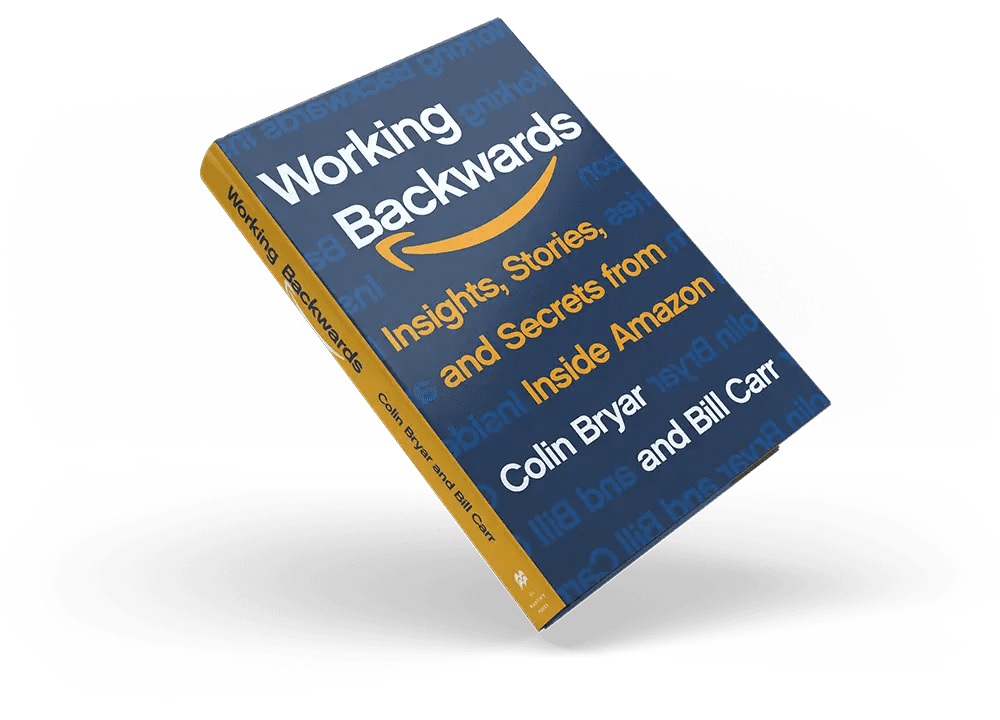

Working Backwards: Secrets from Inside Amazon
Introduction
Working Backwards: Insights, Stories, and Secrets from Inside Amazon by Colin Bryar and Bill Carr offers an insider’s look into the unique principles, processes, and culture that have fueled Amazon’s remarkable growth and innovation. Drawing on their combined 27 years within the company, including roles close to Jeff Bezos during pivotal periods, the authors demystify what it means to “be Amazonian.” This summary distills every core idea, example, and actionable tip from the book into a clear, plain-language guide, revealing the replicable strategies behind Amazon’s extraordinary success.
The book argues that Amazon’s unconventional approach, often misunderstood by outsiders, is rooted in a few deeply ingrained principles and a set of practical methodologies designed to reinforce them constantly. While acknowledging criticisms of the company, the focus remains on providing readers with a detailed understanding of how Amazon operates, enabling others to adopt and adapt these methods. Far from being a mystical cult or requiring vast resources, the authors present “being Amazonian” as a flexible mindset and a set of tools applicable to organizations of any size and in any industry.
Part One: Being Amazonian
This section lays out the foundational principles and repeatable processes that define Amazon’s operating culture. It explores how these building blocks were developed and how they are woven into the daily fabric of the company, enabling both remarkable efficiency and a thriving culture of invention centered on the customer. The stories shared demonstrate that these methods arose as practical solutions to real problems that were hindering progress.
Introduction to Part One
The introduction to Part One sets the stage by explaining that the core of “being Amazonian” lies in a specific set of principles and processes honed over years. It highlights that these practices were developed as solutions to problems Amazon faced as it scaled rapidly, aiming to maintain the innovation and customer obsession of its early days. The intention is to provide enough detail for readers to understand and potentially implement these methods in their own organizations.
- Core Goal: Maintain Amazon’s culture of innovation and customer obsession despite rapid growth. This required formalizing the principles and processes that were initially communicated informally by Jeff Bezos.
- Problem/Solution Framing: The practices described in Part One are presented as solutions to specific challenges, illustrating their practical origins rather than being abstract corporate mandates.
- Actionable Detail: The authors promise to provide concrete, actionable information to help readers understand and potentially adopt these methods.
- Key Elements: Introduces the key topics covered in Part One: Leadership Principles, Mechanisms, Bar Raiser hiring, Separable Single-Threaded Leadership, Narratives (specifically the six-pager), Working Backwards, and Metrics (input vs. output).
- Purpose Beyond Amazon: Emphasizes that these elements are presented with the intent of being adaptable and useful for organizations beyond Amazon.
1. Building Blocks: Leadership Principles and Mechanisms
This chapter delves into the origin and function of Amazon’s 14 Leadership Principles and the complementary mechanisms that ensure these principles are lived out daily. It explains how these elements, far from being mere corporate slogans, are deeply embedded in every significant company process, conferring a significant competitive advantage.
- Early Amazon Culture: In the earliest days, Jeff Bezos personally instilled guiding principles like customer obsession and high standards through direct interaction with a small team. This was feasible when the company was tiny.
- The Need for Formal Principles: As Amazon grew rapidly, it became impossible for Jeff to personally vet every hire or be involved in every decision. A formal codification of leadership expectations was necessary to maintain standards and culture.
- Origin of Leadership Principles: The 14 Leadership Principles were not a top-down mandate but were codified by the HR team, who interviewed effective leaders throughout the company to identify the core ethos. The process took nine months, highlighting the rigor involved.
- Leadership Principles as a Constitution: The principles are not just catchphrases; they are the basic framework for decision-making, action, performance evaluation, and hiring at Amazon. They are constantly reinforced through daily interactions and processes.
- Mechanisms: Good intentions are insufficient to maintain principles at scale. Mechanisms are consistent, repeated processes designed to reinforce the Leadership Principles. “Good intentions don’t work. Mechanisms do.”
- Annual Planning (OP1 and OP2): A foundational mechanism for aligning autonomous teams. OP1 (bottom-up) involves detailed plans from each team, reviewed against S-Team (top-down) objectives. OP2 is a refinement based on Q4 results, becoming the plan of record. This process is painstaking but ensures alignment.
- S-Team Goals: High-priority goals selected by the S-Team from team OP1s. These are primarily input-focused metrics, specific, measurable, attainable, relevant, and timely (SMART), and are tracked with status indicators (green, yellow, red) and reviewed quarterly. The aggressiveness means not all are expected to be hit.
- Compensation and Long-Term Thinking: Amazon’s compensation structure, heavily weighted towards long-term equity, is a crucial mechanism that reinforces the Ownership principle and aligns employee incentives with the company’s long-term success and customer interests, preventing focus on short-term gains.
- Evolution of Principles: The principles are not static; they are questioned and refined over time as the company grows and new challenges or understandings emerge. This adaptability is a sign of a healthy system.
2. Hiring: Amazon’s Unique Bar Raiser Process
This chapter highlights the critical importance of hiring and the significant cost of poor hiring processes. It contrasts conventional, often flawed, approaches with Amazon’s rigorous Bar Raiser process, explaining how this unique system consistently elevates the talent level within the company and can be adapted by others.
- High Stakes of Hiring: The impact of a good or bad hire is significant, affecting team performance, culture, and long-term company success. Despite this, many companies lack rigorous hiring processes.
- Failings of Conventional Hiring: Traditional methods often suffer from lack of clear objectives, insufficient clarity in feedback, focus on unreliable predictors of performance, and cognitive biases like groupthink and confirmation bias in decision meetings.
- Urgency Bias: The pressure to fill open roles quickly can lead to overlooking candidate flaws and shortcuts in the hiring process, with devastating long-term consequences.
- Personal Bias: The natural tendency to hire people similar to oneself can lead to un-diverse workforces and limit perspectives.
- Hiring at Amazon Before Bar Raiser: In Amazon’s early, rapid growth phase, hiring standards were inconsistent, with new, inexperienced people hiring others. This dilution of talent threatened the culture.
- Origin of the Bar Raiser: The Bar Raiser program was not a top-down mandate but a response to the observable problem of declining talent levels due to rapid, unstructured hiring. It was developed by a team of senior Amazonians.
- Purpose of the Bar Raiser: To create a scalable, repeatable, formal process for consistently making appropriate and successful hiring decisions that raise the bar on talent and reinforce Amazon’s culture and Leadership Principles.
- The Bar Raiser Role: A Bar Raiser is a seasoned interviewer with special training who participates in every interview loop, ensures the process is followed, coaches other interviewers, mitigates bias, and has the power to veto a hire, free from urgency bias.
- Key Steps in the Bar Raiser Process: Includes defining the Job Description, Résumé Review, Phone Screen, In-House Interview Loop (with behavioral interviewing and Bar Raiser participation), Written Feedback, Debrief/Hiring Meeting, Reference Check, and Offer Through Onboarding.
- Behavioral Interviewing (STAR Method): Focuses on assessing a candidate’s past behavior and alignment with Leadership Principles by asking questions eliciting specific Situation, Task, Action, and Result examples. Interviewers are trained to probe deeply.
- Written Feedback: Essential for capturing detailed observations and reducing bias. Interviewers must take thorough notes and provide specific, evidence-based feedback with a clear hire/no-hire vote, submitted before discussing with others.
- Debrief/Hiring Meeting: A structured meeting led by the Bar Raiser where all written feedback is read, and the Socratic method is used to facilitate discussion and critical thinking based on the data. It’s designed to prevent groupthink and ensure objective decision-making.
- Bar Raiser and Diversity: The structured, data-driven nature of the Bar Raiser process, with multiple trained interviewers and a focus on Leadership Principles, can help minimize unconscious bias and support diversity efforts, although it’s just one component of a holistic plan.
- Flywheel Effect: The Bar Raiser process creates a positive feedback loop where each new hire is expected to raise the bar, progressively strengthening the team and the company over time.
3. Organizing: Separable, Single-Threaded Leadership
This chapter explores how organizational growth often leads to increased coordination and decreased productivity due to dependencies. It details Amazon’s counter-intuitive solution: shifting to “separable teams with single-threaded leadership” and the long, iterative process required to untangle organizational and technical dependencies to achieve agility at scale.
- Growth and Bureaucracy: As organizations grow, the number of potential communication lines and dependencies increases exponentially, leading to bureaucratic drag, slower innovation, and increased time spent coordinating instead of building.
- Dependencies Defined: Something one team needs but cannot provide itself, requiring effort or review from another team. Technical dependencies relate to shared software or data, while organizational dependencies relate to securing approval or resources from other groups.
- Technical Dependencies (Monoliths): In Amazon’s early days, a monolithic software architecture (Obidos and acb database) meant any change carried significant risk to other teams, requiring extensive coordination and acting as a bottleneck to innovation.
- Organizational Dependencies: Hierarchical structures and reliance on shared functional groups led to slow decision-making, project prioritization challenges (like NPI), and disempowerment of teams who couldn’t fully control their destiny.
- The Wrong Solution: Better Coordination: Initial attempts focused on improving cross-team communication, but the realization came that the goal should be eliminating communication where possible, through loosely coupled systems.
- Jeff’s Vision: Loosely Coupled Interaction: Jeff Bezos advocated for software teams to build well-documented APIs, enabling machines to interact through defined interfaces rather than relying on human communication (emails, meetings).
- New Project Initiatives (NPI): An early, unloved process for global project prioritization in a resource-scarce environment. It was resource-intensive, relied on uncertain projections, and was often demoralizing for teams whose projects weren’t selected but were still required to support others.
- Morale as an Output Metric: Amazon’s approach to morale focuses on improving the “input metrics” that enable builders to invent and delight customers (e.g., freedom to build, reduced dependencies), rather than relying on morale-boosting programs.
- First Proposed Solution: Two-Pizza Teams: Jeff’s idea to break software engineers into small, autonomous teams (no larger than could be fed by two pizzas) to reduce dependencies and increase innovation speed. Key tenets included being small, autonomous, evaluated by a fitness function, real-time monitoring, business ownership, multidisciplinary leadership, self-funding, and S-Team approval.
- Tearing Down Monoliths (Microservices): Implementing autonomous teams required a major, multi-year effort to replace the monolithic software architecture with a service-oriented architecture (microservices), where each service encapsulates data and logic, accessible only through published APIs.
- Early Autonomous Teams: Success required teams to invest upfront time in removing dependencies and building “instrumentation” (metrics tracking) before focusing on new features, demonstrating the value of long-term thinking.
- Challenges with Two-Pizza Teams: The initial model faced challenges: it worked best in product development, fitness functions were overly complicated and less useful than underlying metrics, truly multidisciplinary leaders were rare (leading to a shift to a matrix model), and the rigid size limit wasn’t the biggest predictor of success.
- Evolution to Single-Threaded Leadership: The core idea of separable teams with dedicated focus evolved beyond the two-pizza size constraint. The concept of “single-threaded leaders” (STLs) emerged, where a single person, free from competing responsibilities, owns a major initiative and leads a separable, largely autonomous team of appropriate size.
- Separable, Single-Threaded Teams: The key is organizational separability (like APIs for software) and single-threaded focus (they work on nothing else). This requires clearly demarcating ownership boundaries and ensuring teams can build and deploy without extensive coordination and approvals from others.
- The Payback: The STL model delivers high-velocity innovation, agility, enhanced ownership and accountability, leading to sharper products and higher engagement for creators, even at Amazon’s massive scale. It required patience and flexibility on the details (stubborn on the vision, flexible on the details).
4. Communicating: Narratives and the Six-Pager
This chapter reveals the counter-intuitive practice of starting many Amazon meetings with silent reading and the company’s ban on PowerPoint for complex discussions. It explains the shift to written narratives, particularly the “six-pager,” and how this format fosters deeper thinking, stimulates valuable discussion, and provides a competitive advantage by increasing information density and clarity.
- Eerie Silence in Meetings: A striking initial experience for new Amazonians is the silent period at the beginning of many meetings, where attendees read a document.
- The End of PowerPoint at S-Team Meetings: PowerPoint was banned from senior leadership meetings because the format was found to be ineffective for discussing complex, multivariate, evidence-based issues, often leading to insufficient depth and reliance on the presenter’s performance rather than the substance of the ideas.
- Tufte’s Influence: Edward Tufte’s essay “The Cognitive Style of PowerPoint: Pitching Out Corrupts Within” resonated with Amazon’s experience, arguing that bullet lists damage complex analysis and proposing replacing slides with high-resolution paper handouts for better information density and understanding.
- The Shift to Narratives: Amazon adopted Tufte’s suggestion, mandating short written narratives instead of PowerPoint presentations for S-Team meetings. This was initially met with resistance but was seen as necessary to force better thought and understanding.
- How Narratives Improve Thinking: The narrative structure requires the author to think and synthesize more deeply, organize ideas logically, establish relationships between concepts, and anticipate counterarguments or misunderstandings, leading to better-thought-out proposals.
- Ideas, Not Presenters, Matter Most: Narratives level the playing field by removing the influence of speaking skills or graphic design expertise. The focus shifts to the quality of the ideas and reasoning presented in the document.
- Narrative Information Multiplier: Written narratives, particularly the six-pager, convey significantly more information per page (seven to nine times more than typical PowerPoint slides) and allow readers to absorb information faster than listening to a presenter, leading to better-informed decision-makers.
- The Six-Pager Format: A standard format gradually emerged: typically a maximum of six pages of narrative, with optional appendices for supporting data. The length constraint acts as a forcing function to prioritize the most important information.
- How to Write an Effective Six-Pager: Includes components like stating the problem, proposing a solution, outlining tenets (guiding principles), and including a Frequently Asked Questions (FAQ) section to anticipate and address potential questions and concerns upfront.
- Sample Tenets and FAQs: Tenets are foundational principles that help guide decision-making and resolve conflicts. FAQs are used to clarify details, address potential issues, and demonstrate thorough thinking.
- The New Meeting Format: Meetings begin with dedicated silent time for everyone to read the narrative. Discussion follows, with the focus on questioning and critiquing the content of the document, not just listening to a presentation. Notes are taken during the discussion.
- Feedback as Collaboration: The process encourages candid, objective feedback, turning the meeting into a collaborative effort to refine and strengthen the ideas presented. Leaders are expected to “Dive Deep” into the details.
- Seeking the Truth: The core goal of narrative-based discussions is to rigorously examine ideas, uncover fundamental truths, and make the best possible decisions, even if it means challenging assumptions or identifying flaws.
- Iterative Process: Narratives typically go through multiple drafts and review meetings, reflecting the iterative nature of refining ideas. The process itself creates skilled evaluators.
- Working Backwards and Narratives: Narratives, particularly the PR/FAQ (a specific type discussed in the next chapter), are key tools in the Working Backwards process, which starts by defining the desired customer experience.
5. Working Backwards: Start with the Desired Customer Experience
This chapter focuses on Amazon’s core product development process: Working Backwards from the desired customer experience. It explains how this customer-obsessed approach, formalized through the PR/FAQ (press release/frequently asked questions) narrative, helps teams achieve clarity of thought, vet ideas rigorously, and make informed decisions about what to build.
- The Working Backwards Process: Amazon’s systematic approach to vetting ideas and creating new products, starting by defining the customer experience and iteratively working backward to determine what needs to be built.
- Core Tenet: Customer Obsession: The process is rooted in the principle of Customer Obsession, ensuring that new products and services are designed to address real customer needs and create a delightful experience.
- PR/FAQ as a Tool: The principal tool of the Working Backwards process is the PR/FAQ narrative document, comprising a press release (describing the product from the customer’s perspective) and a set of frequently asked questions (addressing both customer and internal considerations).
- Trial and Error: The Working Backwards process was not instantly discovered but evolved through trial and error, including early experiments with different document formats like user manuals and technical API guides, before settling on the PR/FAQ.
- The “Where Are the Mock-Ups?” Question: In the early days of developing digital media, Jeff Bezos consistently pushed teams for detailed mock-ups to visualize the customer experience, viewing half-baked visuals as evidence of half-baked thinking. This reinforced the need for detailed upfront planning.
- Shifting from Working Forward: Conventional product development often starts with what’s good for the company (skills, assets, profit goals) and then tries to fit it to customer needs. Working Backwards reverses this, forcing teams to focus on customer needs first.
- The Kindle Press Release: Kindle was one of the first products developed using the press release approach. Focusing on the desired customer experience (excellent screen, easy ordering, vast selection, low prices) led to breakthroughs like Whispernet and E Ink, which wouldn’t have emerged from a forward-thinking process focused on existing capabilities.
- Internal vs. External FAQs: The FAQ section includes questions from both the customer/press perspective (external) and internal perspectives (addressing technical, operational, financial, and strategic challenges). This forces the team to consider all angles.
- Features and Benefits of the PR/FAQ: Shifts perspective to the customer, demonstrates thorough thinking, anticipates challenges, facilitates rapid iteration and feedback, reinforces data-oriented decision-making, aligns stakeholders, and helps determine the viability of an idea before committing significant resources.
- Structure and Content of the PR/FAQ: The press release is a short, customer-focused summary. The FAQ section is more free-form but must cover key areas like Consumer Needs/Total Addressable Market (TAM), Economics and P&L (per-unit costs, upfront investment), Dependencies (third-party reliance, regulatory issues), and Feasibility (engineering, UI, third-party, risk challenges).
- Iterative Review Process: PR/FAQs go through multiple drafts and review meetings with stakeholders and executive leadership. This process is rigorous and designed to uncover gaps and weaknesses in the proposal.
- “Not Launched” as a Feature: Most PR/FAQs do not result in launched products. This is intentional; the process is a filter to identify which ideas are truly viable and worthy of investment, saving resources by not building ideas that won’t succeed.
- Uncovering Truths: Working Backwards forces teams to confront difficult truths about the viability, cost, and challenges of their ideas. This can lead to abandoning non-viable ideas or identifying specific problems that need to be solved.
- Willingness to Take on Hard Problems: The process can reveal significant challenges. Amazon is often willing to pursue difficult problems if solving them would unlock substantial value for customers, even if the solution requires invention and carries risk.
- Living Document: The PR/FAQ is a dynamic document that may be revised even after a project is approved and launched, reflecting changes and new learnings.
6. Metrics: Manage Your Inputs, Not Your Outputs
This chapter explains the critical role of metrics in managing a growing company and how Amazon’s focus on “controllable input metrics” provides a significant advantage. It details the metrics life cycle (DMAIC), the structure and purpose of the Weekly Business Review (WBR), and common pitfalls to avoid when using data to drive decisions.
- Importance of Metrics in Growth: As a company grows, direct observation becomes impossible. Metrics become essential proxies for understanding business performance and identifying areas for improvement.
- Input vs. Output Metrics: Output metrics (e.g., revenue, profit, stock price) are lagging indicators that cannot be directly controlled. Input metrics (e.g., selection, price, convenience, shipping speed) are controllable activities that, when managed well, drive desired output metrics.
- Focus on Controllable Input Metrics: Amazon’s philosophy is to focus relentlessly on improving input metrics because these are the levers the company can directly manipulate to drive long-term growth and customer value.
- The Metrics Life Cycle (DMAIC): A process improvement method (Define, Measure, Analyze, Improve, Control) that provides a structured approach to developing and using metrics effectively.
- Define: Selecting and clearly defining metrics that provide actionable guidance and are aligned with customer experience and business goals. Requires iterative refinement to find the “right” metrics.
- Measure: Building tools and processes to accurately and reliably collect metrics data. Emphasizes the importance of removing bias in measurement and conducting audits to validate data accuracy. Start with the customer and work backwards by aligning metrics with the customer experience.
- Analyze: Developing a comprehensive understanding of what drives metrics, separating signals (fundamental changes or defects) from noise (normal variation), and identifying root causes (often using methods like the Five Whys/Correction of Errors process).
- Improve: Implementing changes to improve metrics and processes, based on the understanding gained in the analysis stage. This stage is more effective when the prior steps have been completed rigorously.
- Control: Ensuring processes operate normally and performance is sustained over time. Can involve automating processes and making the WBR exception-based.
- The Amazon Flywheel: A visual model illustrating how controllable input metrics (e.g., lower prices, wider selection, improved convenience) drive output metrics (traffic, growth) in a virtuous cycle that ultimately lowers cost structure and fuels faster growth.
- The Weekly Business Review (WBR): A tactical operational meeting where metrics are put into action. It involves reviewing a data package (“the deck”) and discussing variances against expectations. It has a fractal nature, adaptable to different team sizes and business units.
- The WBR Deck: Primarily charts, graphs, and data tables providing a data-driven, end-to-end view of the business. Focuses on emerging patterns, comparing current results against comparable prior periods and showing both short-term (6 weeks) and long-term (12 months) trends.
- Data Combined with Anecdote: Anecdotes and exception reporting (e.g., Voice of the Customer, Contribution Profit Exception reports) are woven into the WBR to provide qualitative insights, highlight specific issues, and demonstrate the “Dive Deep” leadership principle in action. The Andon Cord is an example of a mechanism driven by anecdotal feedback.
- Key Pitfalls of WBR: Includes “Disaster Meetings” (bloated attendance, lack of decorum, focusing on the presenter instead of the issue), focusing on noise instead of signal (trying to explain normal variations), and looking at the right data in the wrong way (e.g., only focusing on output metrics trends without input metrics).
- Customer Obsession in Metrics: Amazon’s focus on input metrics is a quantitative and qualitative way of measuring how well the organization is satisfying customer interests, aligning with the Customer Obsession principle.
Part Two: The Invention Machine at Work
This section showcases how the principles and practices discussed in Part One enable Amazon to act as an “invention machine.” It examines key examples of successful Amazonian inventions – Kindle, Prime, Prime Video, and AWS – demonstrating the link between rigorous adherence to process and significant breakthroughs, while also acknowledging the role of failure as an inseparable twin of invention.
Introduction to Part Two
The introduction to Part Two bridges the gap between Amazon’s principles and practices and their tangible results in the form of successful inventions. It reinforces the idea of Amazon as an “invention machine” that combines the advantages of size with the agility and risk acceptance of a startup. It also emphasizes that failure is an expected and valuable part of the invention process, and that Amazon’s approach to invention is patient, frugal, and customer-driven, rather than solely skills-forward.
- Invention as a Goal: Amazon aims to be a large company that is also an invention machine, combining scale with the speed and risk acceptance of startups.
- Invention and Failure: Invention and failure are inseparable twins. Amazon is willing to suffer a string of failed experiments because a small number of big winners can pay for many failures.
- Patience and Frugality: Amazon’s approach to invention is patient, often investing manageably over many years, and frugal, avoiding unnecessary spending on things that don’t directly benefit customers.
- Differentiation as a Driver: Invention works well where differentiation matters. Amazon chooses to invent where it can create a unique customer experience or gain a competitive advantage, even if it requires developing new capabilities (e.g., building hardware for Kindle).
- Customer-Driven vs. Skills-Forward: Amazon’s Working Backwards process, starting with customer needs, is fundamentally different from a skills-forward approach. This pushes Amazon to “exercise new muscles” and develop new competencies.
- Type 1 vs. Type 2 Decisions: Big companies tend to use slow, risk-averse processes designed for irreversible (Type 1) decisions, often applying them inappropriately to reversible (Type 2) decisions. Amazon aims to make Type 2 decisions quickly with high-judgment individuals or small groups, enabling faster innovation.
- Examples of Invention: Introduces the key examples of successful Amazonian invention covered in Part Two: Kindle, Prime, Prime Video, and AWS.
- Examples of Failure: Briefly discusses the Fire Phone as an example of a well-executed process that resulted in a product failure, reinforcing that process improves odds but doesn’t guarantee success.
- Magnitude of Invention and Failure: As a company grows, the magnitude of inventions and failures should also grow to move the needle.
- Adherence to Amazonian Principles: Highlights that the success of Amazonian inventions is linked to the adherence to principles like long-term thinking, customer obsession, willingness to invent, and operational excellence, along with practices like Working Backwards and Bar Raiser.
7. Kindle
This chapter recounts the story of Kindle’s creation, illustrating Amazon’s move into digital media and hardware as an example of the Working Backwards process in action. It details the challenges faced, the controversial decision to build hardware internally, and how focusing on getting out of the reader’s way led to key innovations and ultimately a successful launch.
- The Shift to Digital Media: Recognizing the inevitable shift from physical media to digital, Amazon felt compelled to act despite its existing physical media business growth, to avoid becoming obsolete like Kodak.
- Initial Hesitation: The author’s initial reluctance to move from a successful physical media role to a small, speculative digital media business highlights the uncertainty and perceived risk of the venture.
- Single-Threaded Leadership for Digital: Jeff Bezos appointed Steve Kessel as a single-threaded SVP for Digital and Devices, reporting directly to him, to ensure this high-priority initiative received dedicated focus and resources, free from the constraints of the existing retail organization. This was a key early example of the STL model.
- Reinventing the Customer Experience: The goal for digital media was not to be a fast follower or copycat but to invent a truly unique and compelling customer experience, especially in e-books, which had no good reading experience at the time.
- Value Chain Analysis: Jeff Bezos’s value chain diagram illustrated that winning in digital required moving beyond aggregation (Amazon’s strength in physical retail) to control either content creation (upstream) or distribution and consumption (downstream, like devices).
- The Controversial Decision to Build Hardware: Despite no prior hardware experience, Amazon decided to build its own e-reader device (Kindle) to control the reading experience and differentiate from competitors. This was seen as necessary to achieve a great customer experience, a conclusion reached through the Working Backwards process.
- In-House Capability vs. Outsourcing: The decision to build hardware capability internally, rather than outsourcing, was made to control the end-to-end customer experience, retain intellectual property and know-how, and enable continuous innovation and adaptation, avoiding the limitations of relying on third parties.
- Lab126 and Talent Acquisition: Gregg Zehr was hired to build a hardware organization (Lab126) in Silicon Valley to access talent. The Bar Raiser process was used to vet external hires for alignment with Amazon’s culture and principles, even for senior roles.
- Acquisition of Mobipocket: The acquisition of Mobipocket accelerated the development of the Kindle software application, demonstrating a willingness to acquire capabilities when appropriate, integrating the team as a two-pizza team.
- “Get Out of the Way”: The overarching design principle for Kindle was to make the device unobtrusive, allowing the reader to connect directly with the content. This drove decisions like the E Ink screen.
- Key Kindle Innovations: Whispernet (wireless delivery of books without PC connection) and the use of E Ink were controversial and challenging to develop but were crucial to the customer experience, enabling instant book downloads and comfortable reading.
- Pricing Strategy: Kindle and e-book pricing were set close to cost, absorbing expenses like Whispernet, to encourage adoption and make reading accessible. This was a long-term investment in building the business, not focused on near-term profit maximization (long-term thinking).
- Launch and Oprah’s Impact: Kindle launched in 2007 and quickly sold out. Oprah Winfrey’s endorsement significantly boosted sales, but the product’s inherent excellence ensured long-term success.
- Learning from Mistakes: The author’s self-assessment after the less successful Unbox launch (discussed in the next chapter) and Jeff’s “Howard Hughes” analogy highlight the culture of learning from failure and insisting on high standards.
8. Prime
This chapter tells the story of Amazon Prime’s unexpected and rapid launch, revealing how a seemingly “fire drill” initiative was actually the culmination of a long-term data-driven search for a radical solution to decelerating growth. It explores the shift from Super Saver Shipping, the importance of controlling the delivery process, and how Prime transformed customer behavior and Amazon’s business.
- Decelerating Growth: Despite strong overall sales and cash flow, Amazon’s rate of growth was slowing in 2004 across all business segments, a concerning trend for a company aiming for a dominant position in the vast, growing online retail market.
- Need for Radical Solutions: Incremental improvements like promotions or minor category expansions were insufficient to re-accelerate growth at Amazon’s scale. A more fundamental shift in the customer experience was needed.
- Customer-Focused Inputs: Amazon focused on improving the core customer inputs of price, selection, and convenience as the levers for driving growth.
- Shipping Costs as a Barrier: Data consistently showed that shipping costs were a major deterrent for customers shopping online.
- Super Saver Shipping: Amazon’s initial attempt at everyday free shipping (launched in 2002) offered free standard shipping for qualifying orders over a certain threshold. It was popular and encouraged customers to add items to meet the threshold.
- Challenges with Super Saver Shipping: While successful in its way, Super Saver Shipping didn’t appeal to customers who needed faster delivery and wasn’t sustainable for customers who didn’t want to increase their order size to qualify. It relied on a supply chain optimized for slow, cheap ground shipping.
- Click-to-Deliver Metric: Amazon tracked the total time from order to delivery, dividing it into click-to-ship (Amazon’s control) and ship-to-deliver (third-party control). To improve total delivery time, Amazon needed more control over the ship-to-deliver segment, requiring significant supply chain changes.
- The Desire for “Fast and Free”: Customer expectations evolved beyond the “slow and free” or “fast and expensive” trade-off. The goal became providing “fast and free” shipping, which wasn’t feasible with the existing supply chain.
- Loyalty Program Exploration: Amazon explored various loyalty programs, but many were deemed too expensive, wouldn’t drive the right incremental behavior, or weren’t seen as a better investment than lowering prices or improving in-stock rates.
- Charlie Ward’s Idea: An engineer working on the ordering system proposed a subscription fee for free shipping, initially as a way to simplify complex shipping logic. This idea resonated with the need for a friction-free program.
- The “Institutional No”: Large organizations tend to say no to new, risky ideas, leading to errors of omission. Amazon faced this resistance to a free shipping program due to cost concerns and uncertainty about customer behavior, even with the data suggesting customer desire. Jeff’s directive overcame this.
- Jeff’s “House-on-Fire” Email: In mid-October 2004, Jeff’s urgent email to launch a shipping membership program by year-end was a decisive move to overcome institutional resistance and push for action on a long-debated issue, even during the busy holiday season.
- Walking the Store: Jeff’s practice of “walking the store” (browsing the Amazon website) led to insights and questions about shipping, including the idea of free expedited shipping on high-margin items, which contributed to the broader discussion about shipping solutions.
- Disagree and Commit: Despite disagreements and concerns among leaders about the cost and viability, the decision to launch Prime was made, and teams fully committed to making it happen within the aggressive timeline, embodying the “Have Backbone; Disagree and Commit” principle.
- Futurama Project: The internal name for the rapid, intense project to build and launch Prime. It required heroic efforts and leveraging existing building blocks like the Fast Track program and the DVD rental subscription platform.
- Launch of Amazon Prime: Launched on February 2, 2005. It was initially met with skepticism by some but became a game-changing customer experience, a key driver of Amazon’s growth, and fundamentally changed customer expectations for online shopping.
- Long-Term Payoff: Prime was a long-term investment, taking years to reach mass adoption and demonstrate its full value. It required accepting that the existing logistics infrastructure wasn’t sufficient and making bold changes.
9. Prime Video
This chapter chronicles the evolution of Amazon’s digital video business, starting with the disappointing launch of Unbox and the hard lessons learned. It details the journey to Prime Instant Video, the challenges of navigating the entertainment industry, the decision to create original content with Amazon Studios, and the development of Amazon’s own devices to control the customer experience in the living room.
- Unbox: A Disappointing Start: Amazon’s first digital video service (Unbox, launched 2006) suffered from numerous customer experience problems, including slow downloads, buggy digital rights management (DRM), and limited compatibility (Windows only). The disastrous live demo symbolized these issues.
- Competitor Obsession vs. Customer Obsession: Rushing Unbox to market to compete with Apple, rather than prioritizing a great customer experience, was a key mistake and a departure from Amazonian principles.
- Learning from Failure: The author’s self-assessment and Jeff’s “Howard Hughes” analogy (insisting on high standards, like flush rivets on a plane) highlight the culture of learning from mistakes and raising the bar on quality, even after a significant failure.
- Challenges in the Entertainment Industry: Navigating the entertainment industry presented hurdles: restrictive DRM controlled by studios, the “blackout window” (preventing digital sales/rentals of new releases for years), and studios prioritizing short-term revenue over changing business models.
- Value Chain Stuck in the Middle: Unbox was stuck in the middle of the value chain, acting as a digital distribution system without control over content creation (upstream) or playback devices (downstream), limiting its ability to differentiate and compete effectively.
- Seeking a Path to the Living Room: Recognizing that customers wanted to watch movies on their TVs, Amazon sought ways to get its video service onto connected devices. An early success was launching Unbox on TiVo DVRs.
- Netflix’s Disruption: Netflix’s launch of Watch Now (streaming) in 2007, with its subscription model and focus on streaming, was a major disruption that Amazon and many others initially underestimated.
- Hulu’s Impact: Hulu’s launch (2007) offering free (ad-supported) streaming of popular TV shows immediately impacted Unbox’s à la carte sales, highlighting the need for a different strategy.
- Connected TV Challenges: Launching Amazon Video On Demand (VOD) on various connected TVs and set-top boxes in 2008 faced challenges with varying internet speeds, hardware/software compatibility (leading to rebuffering), and resistance from retailers and device manufacturers who saw Amazon as a competitor.
- Prime Instant Video: An “Oh-by-the-Way” Benefit: In 2011, Amazon integrated streaming video (Prime Instant Video) into the existing Prime membership as an additional, no-extra-cost benefit. This addressed the chicken-and-egg problem of starting a subscription service and leveraged the existing Prime customer base, inspired by Netflix’s initial approach.
- Fixed-Cost Business Model: Streaming is a fixed-cost business where licensing fees are paid regardless of usage. Once a certain number of subscribers is reached, additional subscribers contribute pure profit, making it a scalable and potentially highly profitable model.
- LOVEFiLM Acquisition and Content Bidding Wars: Acquiring LOVEFiLM in Europe aimed to get a head start, but it led to expensive bidding wars with Netflix for content, reinforcing the need to control content costs by creating original content.
- Developing Amazon Devices for Playback: Building on the Kindle organization, Amazon developed devices like the Kindle Fire Tablet and Fire TV to control the playback experience and ensure a high-quality, integrated customer experience for accessing Amazon content in the living room.
- Amazon Studios: Becoming a Hollywood Producer: To control content costs and create exclusive, must-see titles, Amazon launched Amazon Studios in 2010 to develop and produce original movies and TV shows.
- Entertainment Industry Talent Pool: The freelance nature of the entertainment industry’s talent pool made it relatively faster and easier to set up production compared to acquiring software engineering talent.
- Customer-Centric Content Selection: Amazon Studios used viewership data and solicited customer feedback on pilots (by making them available for free streaming) to inform decisions about which shows to greenlight, making the process more customer-centric than traditional studios.
- Netflix’s House of Cards as a Catalyst: The success of House of Cards in 2013, featuring A-list Hollywood talent in a web series, broke down barriers and made it easier for Amazon to attract top talent for its original productions.
- Long-Term Vision Realized: The journey from the failed Unbox to the successful Prime Video, Amazon Studios, and devices demonstrates the power of long-term thinking, continuous improvement, customer obsession, and a willingness to reinvent the business model to achieve ambitious goals.
10. AWS
This chapter explores the origins and growth of Amazon Web Services (AWS), highlighting how Amazon’s unconventional approach to web services, driven by the Invent and Simplify leadership principle and the Working Backwards process, enabled it to create a new line of business focused on software developers and become the leader in cloud computing.
- AWS as a New Line of Business: Unlike Digital Media or Prime, AWS was not an extension of Amazon’s core retail business. It targeted a new customer base (software developers) and involved building capabilities entirely separate from e-commerce operations.
- Origins in Associates Program: AWS had humble beginnings, stemming from the Amazon Associates program’s decision to provide affiliates with product data in XML format in 2002. This allowed affiliates to customize the display and revealed the potential for developers to innovate on top of Amazon’s data.
- Shift to a Technical Audience: Providing data in XML shifted the focus to a technical audience (developers), requiring new documentation (SDKs) and support mechanisms (discussion boards). This was a risk as the core affiliate customer base was not necessarily technical.
- Unimagined Uses: Developers immediately used the XML data in innovative ways that Amazon had not anticipated (e.g., Amazon Lite, Amazon Graph), demonstrating the power of enabling others to build.
- Jeff’s Involvement: Jeff Bezos quickly recognized the potential of this feature, noting the unusual adoption rate and level of innovation from developers. He became an avid supporter and pushed the team to expand the offering.
- Amazon Web Services (2002): The first version of AWS launched in 2002, offering search and shopping capabilities via API to any developer, not just affiliates. It was still free and aimed to enhance the Amazon retail ecosystem.
- New Customer Set: Software Developers: This launch formalized the addition of a new customer segment for Amazon: software developers.
- Internal Adoption: A surprising outcome was that Amazon’s own engineers found AWS easier to use than internal tools, reinforcing the value of web services as a better way to build software.
- Early Proofs of Concept: Other projects like the “3-Ring Binder” (enabling partners to build websites powered by Amazon tech) and Seller Central (providing tools for third-party sellers) also demonstrated the potential of web services.
- Invent and Simplify Principle: Amazon’s willingness to “do new things” and be “misunderstood for long periods of time” was crucial. While competitors focused on using web services to enhance their core businesses, Amazon took the bold step of offering a general-purpose set of tools for any developer to build anything they wanted, even if unrelated to retail.
- Primitives and Undifferentiated Heavy Lifting: Amazon realized that many fundamental software building blocks (primitives) like storage, message queueing, and notifications were “undifferentiated heavy lifting” for most companies. Amazon had the capability to provide these as web services, allowing developers to focus on what made their applications unique.
- Server-Side Capability: Amazon’s experience operating one of the world’s largest websites gave it a unique capability in storing and computing on massive amounts of data. While this capability would eventually become a commodity, Amazon had a head start.
- Bias for Action: Despite the complexity and uncertainty, Amazon exhibited Bias for Action, moving quickly to develop and launch AWS before competitors.
- Working Backwards and AWS: The Working Backwards process was crucial in developing early AWS products like S3 and EC2. It forced teams to relentlessly question assumptions from the customer (developer) perspective, even when it slowed things down, leading to better-designed services.
- Cost-Following Pricing Strategy: The Working Backwards process for S3 pricing led to a debate about tiered subscription vs. cost-following. Choosing cost-following, despite its complexity, ensured that pricing aligned with actual resource usage, benefiting both customers and Amazon and allowing for easier adjustments as usage patterns became clearer.
- Learning from Post-Launch: While the Working Backwards process improved initial design, post-launch experience (like discovering the importance of charging for transaction requests in S3) led to refinements, illustrating that the process is ongoing.
- Long-Term Vision and Patience: The success of AWS, growing from a small experiment to a massive business, is a testament to Amazon’s long-term thinking and patience in nurturing high-potential, innovative ventures, even when they are small at inception.
- Leadership and Team: Andy Jassy’s leadership in envisioning and building a robust suite of cloud computing services, along with the dedication of numerous teams, was critical to AWS’s success.
Conclusion: Being Amazonian Beyond Amazon
The conclusion reflects on the lasting impact of being Amazonian on the authors and emphasizes the broad applicability of Amazon’s principles and practices to other organizations and endeavors. It acknowledges the challenges of adopting these methods but highlights the distinct rewards for both individuals and companies, encouraging readers to consider how they can start incorporating these elements to benefit their businesses and customers.
- Lasting Impact: Being Amazonian leaves a permanent mark on how individuals think, make decisions, and approach work, extending beyond their time at the company.
- Broad Applicability: The elements of being Amazonian are not unique to Amazon or e-commerce; they are applicable to a wide range of companies, industries, non-profits, and other organizations, regardless of size.
- Challenges of Adoption: Becoming Amazonian is not easy. It requires changing habits, deferring short-term gratification, persisting through challenges, and sometimes confronting established organizational norms and power structures.
- Distinct Rewards: For individuals, it offers a context for risk-taking, openness to ideas, tackling difficult challenges, and the satisfaction of creating impactful products and services. For companies, it brings superior results, continuous innovation, and the ability to adapt and grow.
- Failure as a Learning Opportunity: Failure is viewed as an expected part of invention and is seen as a chance for learning and improvement. It is often understood as a systemic or process failure, not just an individual one, leading to a culture where discussing mistakes is encouraged.
- Suggestions for Getting Started: Provides actionable steps for readers to begin implementing Amazonian practices in their own organizations, such as:
- Replacing PowerPoint with six-page narratives and PR/FAQs for complex discussions.
- Establishing the Bar Raiser hiring process.
- Focusing on controllable input metrics (while still monitoring outputs).
- Moving towards an organizational structure with autonomous teams and single-threaded leaders.
- Revising compensation structures to encourage long-term commitment.
- Articulating core cultural elements and embedding them in all processes.
- Defining and using leadership principles consistently.
- Depicting and focusing on the company’s flywheel drivers.
- Not the Only Way, But Effective: While acknowledging that many successful companies operate differently, the authors assert that Amazon’s track record of growth, invention, and diversification suggests its approach is highly effective and worth considering for any organization seeking to improve.
- Benefit to Customers: Ultimately, the goal of being Amazonian is to relentlessly focus on and delight the customer, which in turn drives long-term value for the business.








Leave a Reply