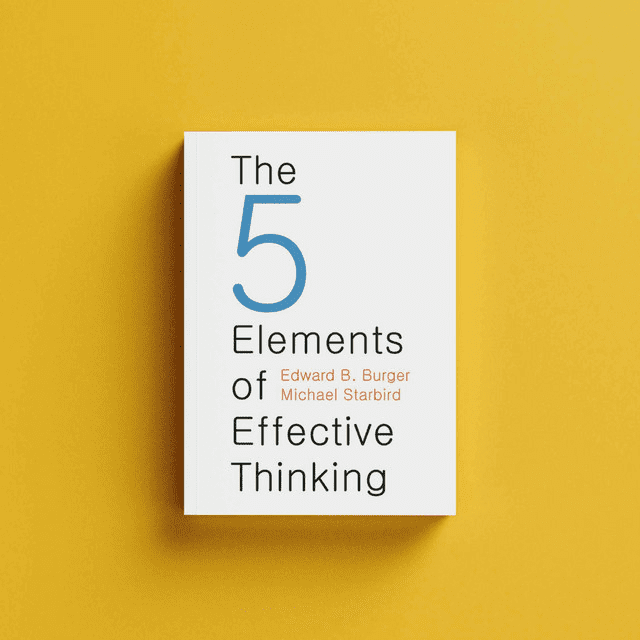

The 5 Elements of Effective Thinking: Complete Summary of Burger and Starbird’s Method for Deeper Learning and Creativity
Introduction: What This Book Is About
The 5 Elements of Effective Thinking by Edward B. Burger and Michael Starbird presents a powerful and practical framework for improving how we learn, solve problems, and create. The authors, both renowned mathematics professors and educators, argue that brilliant thinking is not an inborn gift reserved for geniuses but a set of learnable habits. Success in any field – from academics and business to the arts and personal life – stems from the quality of our thinking. This book distills the core of effective thinking into five fundamental elements, making them accessible and applicable for everyone.
The book teaches that extraordinary people are simply ordinary people who think differently. It provides a clear roadmap to adopt these transformative habits, using memorable metaphors based on the classical elements: Earth for understanding deeply, Fire for learning from mistakes, Air for creating questions, and Water for seeing the flow of ideas. The fifth, or Quintessential Element, is Change – the commitment to personal transformation by mastering the other four.
This summary offers a complete guide to all the concepts, stories, and actionable exercises in The 5 Elements of Effective Thinking. It is designed for students who want to learn more effectively, professionals aiming to become more innovative, leaders seeking to solve complex problems, and anyone committed to lifelong learning. By embracing these five elements, you can change the way you think, unlock your potential, and become the hero of your own life’s journey.
Earth: Grounding Your Thinking – Understand Deeply
The first element, Earth, represents building a rock-solid foundation for all thinking and learning. It emphasizes moving beyond superficial memorization to achieve a deep, nuanced, and unshakable understanding of fundamental ideas. A shallow understanding is fragile and easily broken, but a deep one provides the stability needed to build complex knowledge and create new insights.
How Understanding Basics Builds Virtuosity
True experts continually deepen their mastery of the basics. The book illustrates this with the story of Tony Plog, an acclaimed trumpet virtuoso. In a master class with accomplished students, Plog asked them to play a simple warm-up exercise. While the students played it well, Plog’s own performance of the same simple phrase was exquisite, rich with meaning and nuance. The stark contrast revealed that the fundamental difference between a master and a talented student lies in the depth of their understanding of the basics. Deep work on simple, basic ideas builds true virtuosity, allowing for greater control and artistry when tackling complex challenges.
Master the Basics: An Actionable Exercise
To apply this principle, take a skill or subject you want to improve.
- Brainstorm: Spend five minutes writing down the most basic components of that topic.
- Focus: Choose one basic item from your list.
- Practice Deeply: Spend thirty minutes actively working to master that single component.
This focused effort on the fundamentals strengthens your foundation, making it easier to achieve higher levels of skill and knowledge.
Why the Simplest Ideas Hold the Greatest Secrets
The most profound concepts often arise from looking deeply at simple, everyday experiences. Isaac Newton developed the fundamental ideas of calculus not by tackling cosmic mysteries head-on, but by thinking deeply about the motion of a falling apple. He realized that the same physical laws governing the apple also described the movement of planets and stars. This demonstrates a core principle: the simple and familiar hold the secrets of the complex and unknown. To master any advanced subject, you must first truly master the fundamentals that precede it.
Sweat the Small Stuff: How to Solve Complex Problems
When faced with a daunting challenge, great problem-solvers don’t tackle it all at once. Instead, they follow the advice of mathematician George Polya: “If you can’t solve a problem, then there is an easier problem you can’t solve: find it.” Break the complex issue down into a smaller, manageable subproblem that you know you can solve. Focus entirely on resolving this subproblem completely and understanding it from every angle. The insights gained from mastering the small stuff will illuminate the path to solving the larger, more complex issue.
Uncovering the Essence by Clearing the Clutter
Complex issues are often obscured by distracting details and irrelevant information. The key to clarity is to isolate the essential ingredients. This is a two-step process:
- Identify and ignore all distracting features to isolate the core idea.
- Analyze the central issue and apply those insights to the larger whole.
Aviation pioneers succeeded not by copying the most obvious feature of bird flight – flapping wings – but by identifying the subtle essence of lift: the gentle curve of the wing. By clearing the clutter of flapping, they found the principle that allowed human flight.
How Picasso Found the Essence of the Bull
In a famous series of drawings, Pablo Picasso started with a highly detailed, realistic image of a bull. In subsequent drawings, he systematically removed details – shading, muscle texture, and three-dimensionality – until he was left with a simple line drawing of ten curves and two ovals. This final image, which he titled The Bull, had no clutter. It was pure essence, capturing the animal’s strength and masculinity. By systematically cutting away peripheral parts, we are forced to see and appreciate what is truly important.
See What’s Truly There, Not What You Expect to See
We all view the world through a lens of bias, prejudice, and preconceived notions. Effective thinking requires acknowledging this and actively working to see what is actually there. The author shares an artist’s insight: “Shadows are the color of the sky.” Most people assume shadows are gray or black, but a close look reveals they reflect the sky’s color. This is a metaphor for seeing reality without bias. To understand any subject, you must be brutally honest about what you know and don’t know. The interface between what you actually know and what you don’t is where real learning occurs.
Overcoming the Power of Authority and Bias
For nearly 2,000 years, people accepted Aristotle’s assertion that heavier objects fall faster, simply because it sounded reasonable and he was an authority. The legend of Galileo dropping two different-sized balls from the Tower of Pisa illustrates the power of replacing authority with evidence. To think effectively, you must constantly ask, “How do I know?” and search for evidence. Don’t be satisfied until you understand the why behind a concept.
The Power of Seeing What’s Missing
One of the most profound ways to understand the world is to deliberately look for what is not there. The book suggests the “add the adjective” exercise. Before color photography, pictures were just called “photographs.” By calling them “black-and-white photographs,” we highlight a limitation and open our minds to the possibility of color. Similarly, World War I was called “The Great War” until World War II occurred. Calling it “World War I” from the start might have made the possibility of a second conflict more real. By explicitly identifying what is missing, we make the invisible visible and open the door to new opportunities. For example, by observing that a shopper could only buy what they could carry, Sylvan Goldman saw what was missing and invented the shopping cart.
Fire: Igniting Insights Through Mistakes – Fail to Succeed
The second element, Fire, represents the transformative power of failure. Society often treats failure as something to be avoided at all costs, but this mindset freezes us into inaction. Effective thinkers embrace mistakes as essential teachers that highlight unforeseen opportunities, expose gaps in understanding, and ignite the imagination. Failure is not the opposite of success; it is a critical step on the path to achieving it.
Fail Nine Times to Reach Success
To shift your mindset, adopt this powerful attitude: “In order for me to resolve this issue, I will have to fail nine times, but on the tenth attempt, I will be successful.” This reframes failure as progress. After your first mistake, you can think, “Great, one down, nine to go – I’m 10% done!” This approach liberates you to take risks and think creatively without fear, because you understand that each misstep provides a valuable lesson. Bill Gates and Paul Allen founded Microsoft only after their first company, Traf-O-Data, failed. They used the lessons from that failure to build a global empire.
How to Overcome a Blank Screen
When you’re stuck and facing a blank page or an unsolved problem, the goal isn’t to create something perfect. The goal is to create something. Quickly write down any ideas you have, no matter how bad, vague, or disorganized. This first draft won’t be good, but it gives you raw material to work with. Now you can analyze it for two things:
- What’s right: Look for unexpected gems, strong phrases, or the core of an idea.
- What’s wrong: Identify specific errors and correct them.
You have traded the impossible task of creating perfection from nothing for the much easier task of mining for good ideas and fixing mistakes.
Mary’s Story: The Power of Iterative Failure
Mary, a student who hated math, was asked a difficult question about infinity in class. She reluctantly offered an answer, prefacing it with, “I know it’s wrong.” Her professor agreed it was wrong but then asked her to identify one specific flaw and fix it. They repeated this process – find a flaw, fix it – six times. With each iteration, her answer got closer to correct. By the end, Mary had devised a creative, correct solution that was entirely her own. This experience liberated her. She realized she could tackle any challenge, like an English essay, by writing a bad first draft and then iteratively finding and fixing the mistakes.
Learning from History’s First Drafts
Great creations are never perfect on the first try. They evolve through a process of revision and learning from error.
- FDR’s “Infamy” Speech: Franklin D. Roosevelt’s famous line, “a date which will live in infamy,” was edited from a much weaker first draft that read, “a date which will live in world history.”
- The U.S. Constitution: The Constitution was version 2.0. The first attempt, the Articles of Confederation, failed, but its defects provided the crucial insights needed to create a lasting government.
- Thomas Edison’s Lightbulb: When asked about his countless failed attempts, Edison replied, “I have not failed. I’ve just found 10,000 ways that won’t work.” His success was built on persistent, incremental learning from mistakes.
Finding the Right Question for the Wrong Answer
Sometimes, a failed attempt at solving one problem is actually a brilliant solution to a different, undiscovered problem. The key is to ask, “What is the question to which this is a correct answer?” In 1970, a 3M scientist trying to create a super-strong adhesive accidentally created a super-weak one. It was a complete failure. Four years later, another 3M scientist, Arthur Fry, needed a bookmark that wouldn’t damage his hymnal. He remembered the “failed” weak adhesive, and the Post-it note was born. A mistake is an opportunity to look for an unexpected connection.
How to Fail by Intent
One of the most powerful ways to gain insight is to intentionally fail by pushing a situation to a ridiculous extreme. This is like a stress test for ideas. For example, a middle school teacher, asked how she would teach geometry with unlimited resources, said she would take her class to the Eiffel Tower. While impractical, this “wrong” answer revealed a core insight: math should be taught outside the classroom to connect it to the real world. By considering an unrealistic extreme, you can uncover practical solutions you would have otherwise missed.
Air: Creating Questions Out of Thin Air – Be Your Own Socrates
The third element, Air, represents the power of questions. Questions are not a sign of ignorance but a tool for discovery, clarity, and deeper engagement. The act of creating questions – even if they are never asked or answered – is a profound step toward understanding. By constantly questioning, you can challenge assumptions, reveal hidden complexities, and guide your own learning. You can, in effect, become your own Socrates.
How Simple Questions Solve Complex Problems
Effective questions cut through complexity to get to the heart of an issue. After the 1986 space shuttle Challenger disaster, the investigation was mired in complex engineering details. Physicist Richard Feynman simplified the entire problem by asking a basic question: “What if we just test the elasticity of a cooled O-ring?” He famously demonstrated on live TV that the rubber O-ring lost its flexibility when submerged in ice water, solving the mystery. Don’t be afraid to ask the “stupid,” basic questions. They are often the most powerful.
The Power of Being an Official Questioner
To transform yourself from a passive listener into an active learner, get in the habit of constantly generating questions during any lecture, meeting, or conversation. One of the authors appoints two “official questioners” in each class, charging them with asking at least one question. A student named Carrie found that this responsibility forced her to listen with a higher level of consciousness. She was more alive, more aware, and got far more out of the class. Even if you don’t ask your questions out loud, the act of formulating them forces deeper engagement and understanding.
Teach to Learn: The Ultimate Way to Master a Subject
There is no better way to learn something than to teach it. To explain a topic to someone else, you are forced to confront fundamental questions:
- What is the motivation for this topic?
- What are the core examples?
- What are the underlying themes?
- How do the ideas connect?
This process forces you to find the heart of the matter and reveals exactly what you understand and where your knowledge is weak. To master a concept, prepare a mini-lecture on it and deliver it to a friend, family member, or even just to yourself.
What’s the Real Question?
Many people waste their lives working on the wrong problems because they never stop to ask, “What is the real question here?” An ineffective question is vague and doesn’t lead to action, while an effective question clarifies the issue and points toward a solution.
- Ineffective Question: “How can I get better grades?” This focuses on the outcome, not the process.
- Effective Question: “How can I become more engaged in the course material?” This leads to concrete actions like asking questions, tutoring others, and connecting ideas.
- Ineffective Question: “Why do [a certain group] underperform on tests?” This focuses on the wrong variable (demographics).
- Effective Question: “What factors, like teaching methods or study habits, impact any student’s performance?” This directs attention to variables that can actually be changed.
Improve Your Questions to Get Better Answers
Before you jump to solve a problem, always question the question itself. Craft more focused questions that expose hidden assumptions, clarify the real issues, and lead to productive action. For example, when stuck in traffic, asking “How can this traffic be fixed?” is frustrating because you have no control. A better question is, “Given that I will be in traffic for 40 minutes, how can I use this time effectively?” This question leads to productive solutions like listening to an audiobook or calling a friend. Always question your own questions to ensure you are working on the right problem.
Ask Meta-Questions for a Stronger Final Product
Before starting any task or project, ask meta-questions about its purpose and goals.
- What is the real goal of this assignment?
- What permanent benefit am I supposed to get from this work?
- What beneficial change will this foster in me?
By keeping the ultimate benefit in mind, you transform a mindless task into a meaningful opportunity for growth. This focus saves time by directing your attention to the core issues from the very beginning.
Water: Seeing the Flow of Ideas – Look Back, Look Forward
The fourth element, Water, symbolizes the continuous flow of ideas. No idea arises in a vacuum; every new discovery is built on the ideas of the past and serves as a foundation for the ideas of the future. Effective thinkers understand that the present is just one moment in an ongoing evolution. They learn to look back to see where ideas came from and to look forward to see where they might lead.
How to Understand Ideas by Seeing Their Evolution
Great ideas are not magical, spontaneous creations; they are the result of incremental evolution. Isaac Newton famously said, “If I have seen farther than others it is because I have stood on theshoulders of giants.” Calculus was not a sudden leap but a culmination of centuries of mathematical thought. To truly understand a concept, discover how it evolves from simpler ideas. A 1,300-page calculus textbook isn’t 1,300 isolated facts; it’s the story of two fundamental ideas and how they flow into countless variations and applications. See your learning not as a list of topics but as an interconnected journey.
Iterate Ideas to Engineer Your Own Evolution
You don’t need to wait for history to evolve an idea. You can engineer your own evolution through iteration. For any project, essay, or assignment, quickly create a subpar first version. Don’t worry about quality. Now, treat that poor effort as your starting point. React to it, improve it, and iterate again and again. As Ernest Hemingway said, he rewrote the last page of A Farewell to Arms 39 times “to get the words right.” The flow of iteration will naturally lead to a polished and powerful final product.
The Power of Looking Back
Once you understand an advanced topic, look back at the earlier, more basic material that led you there. From your new vantage point, the earlier work will seem simpler, clearer, and more meaningful because you now see its significance in the larger flow. This process strengthens your understanding of both the advanced and the basic concepts, solidifying your entire knowledge structure. The most successful people regularly undertake this reflective exercise.
How to Create New Ideas from Old Ones
A new idea or a solved problem is not an end point; it is a beginning. It is the launchpad for even greater advances. The time to work on a problem is after you’ve solved it.
- The Lightbulb: The invention of the lightbulb solved the problem of illumination, but it also opened the door to movies, television, computers, and fiber optics.
- The Telephone: The evolution from a single rotary phone to the modern smartphone is a story of constantly asking, “How can this be refined and extended?”
- eBay: In 1995, Pierre Omidyar took an old idea – the auction – and extended it to the internet, creating a multi-billion dollar company.
Take any good idea and ask how it can be extended, varied, or applied in a new context.
Once You Have It, Improve It
Even the best ideas can be improved. Ransom Olds invented the assembly line in 1901, dramatically increasing car production. But Henry Ford looked at Olds’s great idea and asked, “Can we do even better?” He added conveyor belts, revolutionizing manufacturing and making the car accessible to everyone. Good progress is often the herald of great progress. When you achieve a success, don’t see it as a summit. See it as a new starting point from which to climb even higher.
Look to the Future by Questioning the Present
By understanding the flow of ideas, we can identify our own ridiculous biases. Ask yourself: “What beliefs or habits that are completely accepted today will be viewed as absurd by our grandchildren?” Centuries ago, slavery was considered a moral practice by respectable people. Today, we consider it abhorrent. This exercise forces us to see our own time as one point in an evolving stream of thought and helps us identify invisible problems and unquestioned assumptions in our own lives.
The Quintessential Element: Engaging Change – Transform Yourself
The fifth and final element is the Quintessential Element: Change. This is the meta-lesson that makes the other four elements work. It is the commitment to transforming yourself into a more effective learner and thinker. The path to change is not through sheer willpower but through thinking differently. If the ability to change becomes a core part of who you are, you are liberated from worrying about weaknesses, because you can adapt and improve at any time.
Do It Differently, Not Just Better
People who perform better at a task are often not just doing the same thing with more effort; they are doing a fundamentally different – and easier -task.
- Hitting a Tennis Ball: Hitting a tennis ball with your eyes open is a different, easier task than hitting it with your eyes closed. Great players watch the ball better, transforming the task.
- Learning History: Memorizing a list of isolated facts about WWII is hard. Understanding the flow of events that led to the war and the motivations of the people involved is an easier, more effective way to learn. It provides context and meaning, just as it’s easier to remember a logical sentence than a random string of words.
To improve, don’t just think, “Do it better.” Think, “Do it differently.” Adopt the strategies that turn a difficult task into an easier one.
How an Expert Thinks
When you are learning a skill or solving a problem, imagine what a more skilled practitioner does. What knowledge or experience do they bring that makes the task easier for them? An expert pianist isn’t just remembering which keys to press; they understand the chord structure and hear the music’s different voices. They are doing a different task. By identifying what makes the task easier for an expert, you can focus on developing the same skills and understanding.
Why Your Potential is Far Greater Than You Think
While people have different native abilities, these differences are dwarfed by the power of effective habits and methods. Being imaginative or creative is not an inborn trait; it is a learnable skill that comes from using thinking techniques that generate new ideas. The story of Sam Y., a student in a difficult math class, proves this point. Considered the weakest student, he spent his winter break going back to the first questions of the semester, building his understanding from the ground up. He returned to class a transformed person, able to solve every remaining problem. He didn’t become a different person; he adopted a different way of thinking.
Einstein’s Willingness to Change
Even a genius like Albert Einstein embodied the quintessential element. After working for months on a particular problem, his assistant brought him proof that his entire approach was wrong. Instead of becoming defensive or discouraged, Einstein immediately accepted the evidence. The very next day, he came in with a completely different approach that solved the problem. The unchangeable mind is a closed mind. True strength lies in the willingness to change in the face of compelling evidence.
Becoming the Quintessential You
The goal of the five elements is to become a person for whom effective thinking is natural and easy. The book shares the story of Lee, who wanted to get in better shape. Instead of a fad diet, she made small, permanent changes to her habits, like eating healthier and taking the stairs. Over time, she became a different person – one for whom a healthy lifestyle was the norm. Similarly, by making the four elements of thinking part of your daily routine, you will become a more effective and creative thinker. This process will lead you to your quintessential self – thoughtful, innovative, and constantly growing.
Key Takeaways: What You Need to Remember
Core Insights from The 5 Elements of Effective Thinking
- Effective thinking is a learnable skill, not an inborn talent. You can choose to become a better thinker.
- Master the basics (Earth): Deep understanding of simple ideas is the foundation for all complex knowledge and creativity.
- Embrace failure (Fire): Mistakes are not setbacks; they are invaluable teachers that guide you toward success.
- Ask powerful questions (Air): The act of creating questions clarifies issues, exposes assumptions, and drives discovery.
- See the flow of ideas (Water): Every idea is part of an ongoing evolution. Look back to understand and look forward to innovate.
- Commit to change (Quintessential Element): The ultimate goal is to transform yourself by making these habits a core part of who you are.
Immediate Actions to Take Today
- Pick one basic concept in a subject you’re learning and spend 30 minutes mastering it more deeply than ever before.
- Write a “bad first draft” for a project you’ve been putting off. Then, find one thing to fix.
- During your next conversation or meeting, silently formulate three probing questions about what you are hearing.
- Take a recent success and brainstorm three ways you could extend or improve upon it.
- Identify one habit you want to change and focus on doing it differently, not just “better.”
Questions for Personal Application
- What fundamental concepts in my field or life have I accepted without truly understanding them deeply?
- What is one “failure” from my past that I can re-examine to find a hidden lesson or opportunity?
- Am I asking the right questions about my biggest challenges, or am I focused on the wrong problem?
- How can I connect what I am working on today to what came before and what might come next?
- What small, different action can I take today to begin the process of becoming a more effective thinker?



Leave a Reply