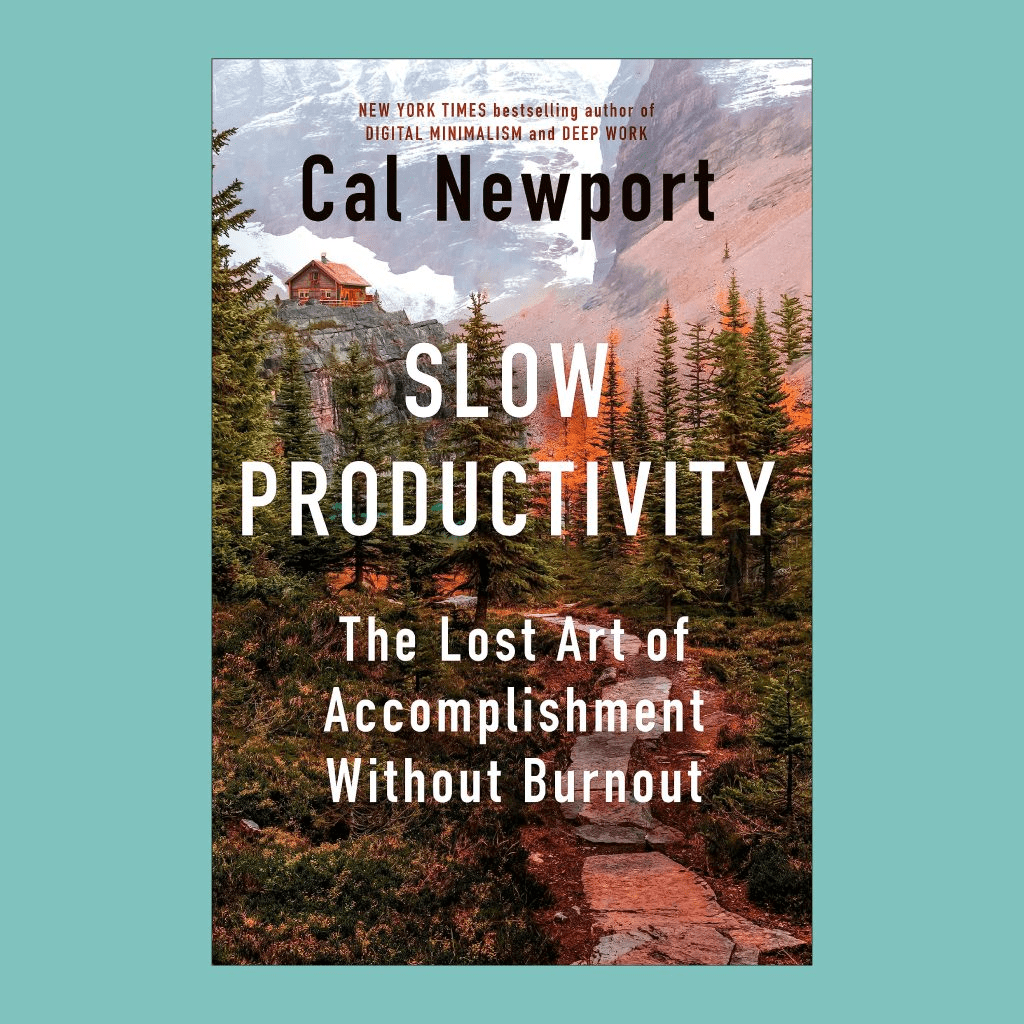
Slow Productivity: Complete Summary of Cal Newport’s Philosophy for Accomplishment Without Burnout
Introduction: What This Book Is About
Cal Newport’s “Slow Productivity: The Lost Art of Accomplishment Without Burnout” challenges the prevailing notion that busyness equals productivity in knowledge work. This book delves into how the modern workplace, fueled by technology and an ambiguous definition of “getting things done,” has pushed professionals to the brink of burnout. Newport, known for his incisive critiques of digital distraction and deep work, proposes a revolutionary shift in how we approach our professional lives. He argues that true accomplishment and a sustainable, meaningful career can be achieved by deliberately slowing down, focusing on fewer things, and prioritizing quality over frantic activity. Readers will discover a comprehensive guide to reclaiming control over their work, fostering creativity, and experiencing deep satisfaction without succumbing to the relentless demands of the pseudo-productivity culture.
Part 1: Foundations
Chapter 1: The Rise and Fall of Pseudo-Productivity
This chapter explores the historical evolution of “productivity” and how its definition warped within the knowledge sector, leading to widespread burnout. It details the shift from tangible, measurable outputs to an unsustainable reliance on visible activity.
The Ambiguity of Knowledge Work Productivity
Newport explains that in knowledge work, there is no agreed-upon definition of “productivity,” which contrasts sharply with other economic sectors like agriculture or manufacturing. Early attempts to define knowledge worker productivity, such as Peter Drucker’s 1999 paper “Knowledge-Worker Productivity: The Biggest Challenge,” admitted that work on the topic had “barely begun.” Tom Davenport, a management professor, confirmed this difficulty, stating that most organizations do not measure knowledge worker productivity, and when they do, it is in “really silly ways” like counting academic papers regardless of quality. This ambiguity is a core reason for the current crisis.
Productivity in Agriculture and Manufacturing
In agriculture, productivity is straightforwardly measured by output-to-input ratios, such as bushels per acre. The Norfolk four-course system, for instance, significantly increased productivity by eliminating fallow fields, leading to the British agricultural revolution. Similarly, in manufacturing, productivity is measured by outputs like automobiles produced per paid hour of labor. Henry Ford’s assembly line dramatically improved productivity, reducing the labor-hours to produce a Model T from 12.5 to approximately 1.5 hours by 1913. These sectors benefited from clear metrics and defined processes for improvement, but these models did not translate to knowledge work.
The Rise of Pseudo-Productivity
Knowledge work presented a challenge because of its variability of effort and the difficulty of close supervision. Unlike a factory worker with a single, clear task, knowledge workers juggle complicated and constantly shifting workloads. Peter Drucker noted that “the knowledge worker cannot be supervised closely or in detail.” This autonomy, coupled with a lack of concrete metrics, led to the adoption of visible activity as a crude proxy for actual productivity. This became pseudo-productivity, where constant email replies, chat messages, and meetings signaled “busyness” as a stand-in for meaningful output. Newport defines pseudo-productivity as “The use of visible activity as the primary means of approximating actual productive effort.”
The Supercharging Effect of Technology
The arrival of networked computers, email, and later Slack in the mid-1990s profoundly exacerbated pseudo-productivity. These tools enabled visible signaling of busyness with minimal effort, leading to more and more of a knowledge worker’s day dedicated to incessant electronic messaging. RescueTime data showed subjects checking their inbox once every six minutes on average. Portable computing and smartphones further extended this demand beyond work hours. This constant digital intensity has driven the current burnout crisis, with studies by McKinsey and Gallup showing significant increases in burnout and stress among knowledge workers.
The Limits of Pseudo-Productivity
The Les Moonves anecdote, where the CBS head demanded longer hours to improve ratings, illustrates the pseudo-productivity mindset. However, the true turnaround for CBS came from Anthony Zuiker’s obsessive, unhurried cultivation of CSI, a project that took over three years to develop. Zuiker’s efforts were varied in type and intensity, with long stretches of minimal visible activity balanced by intense periods. This contrasts sharply with the frantic pace Moonves demanded, suggesting that meaningful work does not require frenetic busyness.
Chapter 2: A Slower Alternative
This chapter introduces the “slow” movement and argues for a fundamentally different, more humane approach to knowledge work productivity. It draws inspiration from traditional “slow” philosophies to propose a new framework.
The Origins of the Slow Movement
The Slow Food movement, launched by Carlo Petrini in 1986 in response to McDonald’s opening near the Piazza di Spagna in Rome, serves as a foundational example. Petrini’s manifesto proposed a “vaccine of an adequate portion of sensual gourmandise pleasures, to be taken with slow and prolonged enjoyment” against the “frenzy” of efficiency. The movement advocated for communal meals from local, seasonal ingredients and later expanded to preserving traditional foods like the Vesuvian apricot. Petrini’s key insights were the power of appealing alternatives and the wisdom of time-tested cultural innovations.
The Broader Slowness Revolution
Petrini’s ideas inspired other “slow” movements beyond food, demonstrating their applicability to various aspects of modern life. These include:
- Slow Cities (Cittaslow): A focus on making urban areas more pedestrian-centric, supportive of local businesses, and neighborly.
- Slow Medicine: Promotes holistic care over a narrow focus on disease.
- Slow Schooling: Aims to free elementary students from high-stakes testing and competitive tracking.
- Slow Media: Advocates for sustainable, higher-quality alternatives to digital clickbait.
- Slow Cinema: Describes realistic, non-narrative films that reward extended attention.
These movements share the core strategy of offering a slower, more sustainable alternative by drawing on time-tested wisdom.
The Need for a New Work Philosophy
The post-pandemic era has presented a unique opportunity for major overhauls in knowledge work. The forced shift to remote work in 2020 disrupted long-standing complacency, leading to pushback against office returns, as seen with Apple employees resisting Tim Cook’s mandates. There’s also rising interest in the four-day workweek, with successful UK pilot studies and legislative proposals in the US. However, Newport argues these changes, while welcome, are insufficient as they only blunt the side effects of pseudo-productivity rather than addressing its root. A more sustainable response requires a brand-new vision of productivity.
Defining Knowledge Work Broadly
To find this new vision, Newport proposes a broader definition of knowledge work: “The economic activity in which knowledge is transformed into an artifact with market value through the application of cognitive effort.” This expanded definition includes not just modern office jobs like computer programmers and marketers, but also traditional cognitive professions such as writers, philosophers, scientists, musicians, and artists. These older professions, often enjoying “rarefied freedoms,” offer valuable insights into sustainable, valuable cognitive creation. Examples include Isaac Newton working on calculus in the countryside, Anna Rubincam sculpting in a quiet London studio, and famous novelists writing in eccentric spaces like Peter Benchley’s furnace repair shop or Maya Angelou’s hotel rooms.
Introducing Slow Productivity: The Core Philosophy
By drawing from these traditional examples and Petrini’s “slow” framework, Newport formalizes slow productivity: “A philosophy for organizing knowledge work efforts in a sustainable and meaningful manner, based on the following three principles:
1. Do fewer things.
2. Work at a natural pace.
3. Obsess over quality.”
This philosophy rejects busyness as an obstacle to meaningful results, advocates for a varied and humane pace with periods of hard work balanced by relaxation, and emphasizes impressive quality over performative activity. It aims to enable accomplishment without burnout, particularly for individuals with a reasonable degree of autonomy in their jobs, such as freelancers, solopreneurs, and those in fields like academia.
Part 2: Principles
Chapter 3: Do Fewer Things
This chapter delves into the first core principle of slow productivity, arguing that reducing obligations paradoxically leads to greater accomplishment and well-being. It provides practical strategies for simplifying workload.
The Myth of Jane Austen’s Secret Writing
The popular image of Jane Austen as a secret writer, scribbling prose in bursts amidst constant social obligations, is a myth propagated by her nephew, James. His 1869 memoir describes her working on small sheets of paper, hidden by blotting paper, in a general sitting-room, even appreciating a creaking door that signaled approaching visitors. This narrative implies that productivity requires squeezing more work into a busy schedule. However, modern biographies, drawing on primary sources, reveal a different reality.
The Reality of Austen’s Productive Periods
Jane Austen’s most productive periods occurred when her obligations were significantly reduced. Growing up on a working farm in Steventon, she was too busy with daily chores to seriously write. This changed in 1796 when her father closed his boys’ school, freeing her from significant household duties. This led to a period of “phenomenal” productivity where she produced early versions of her major novels. Her writing stopped in 1800 when her parents moved to Bath, plunging her into a decade of constant movement and increased responsibilities. It was only after settling in a modest cottage in Chawton in 1809, where her family largely withdrew from social life and she was exempted from most domestic chores, that Austen truly flourished, completing Sense and Sensibility, Pride and Prejudice, Mansfield Park, and Emma. Her story demonstrates that doing less enabled her best work.
Principle #1: Do Fewer Things
Newport establishes the first principle of slow productivity: “Strive to reduce your obligations to the point where you can easily imagine accomplishing them with time to spare. Leverage this reduced load to more fully embrace and advance the small number of projects that matter most.” This principle challenges the contemporary bias towards activity, arguing that simplifying leads to better results. While busyness often feels unavoidable, Newport asserts that it is possible to creatively and radically reduce workload in most modern settings.
The Overhead Tax on Knowledge Work
The “Zoom Apocalypse” experienced during the pandemic, exemplified by HSBC manager Jonathan Frostick’s heart attack due to excessive virtual meetings, highlights the issue of overhead tax. Every new commitment in knowledge work incurs ongoing administrative overhead (emails, meetings, mental space). As the to-do list grows, this overhead consumes more time, slowing down core work. Beyond a tipping point, logistical efforts devour so much schedule that new tasks cannot be completed fast enough, leading to frantic juggling and work spilling into evenings and weekends. The shift to remote work modestly increased both the quantity and cost of this overhead tax, pushing many workers past this tipping point.
The Perils of the Stress Heuristic
Newport argues that overload is not fundamental to knowledge work but largely a side effect of self-management based on stress. Knowledge workers often avoid new commitments only when they feel “sufficiently stressed,” justifying saying no. This stress heuristic keeps individuals permanently at the edge of unsustainable workloads, creating constant vague overload. By contrast, doing fewer things is objectively a better way to produce valuable output because it allows for more concentrated effort and higher quality cognitive work. Numerous real-world examples, such as coach Laura reducing her services and law professor Jason narrowing his focus, show how simplifying workloads leads to calmer brains, stronger interactions, higher quality work, and often the same or better income.
Proposition: Limit the Big
To implement “Do Fewer Things,” Newport suggests following Andrew Wiles’s example in his pursuit of Fermat’s Last Theorem. Wiles, a mathematics professor, systematically reduced his commitments—abandoning irrelevant work, skipping conferences, and trickling out pre-existing research—to focus singularly on the theorem for five years. This proposition advises a systematic plan for limiting significant commitments at three scales: missions, projects, and daily goals.
Limiting Professional Missions
A mission is an ongoing goal or service directing professional life. While exciting to adopt, too many missions lead to onerous workloads. Newport suggests limiting oneself to two or three primary missions, contrasting this with Jenny Blake, who reduced her business’s income streams from over ten to a handful to achieve a 20-hour workweek and two months of vacation annually. Simplifying missions is crucial because too many objectives unavoidably lead to an overloaded state.
Limiting Ongoing Projects
Projects are work initiatives requiring multiple sessions. Newport advises adopting a nuanced approach to limiting them, moving beyond simply being “irresponsible” like Richard Feynman. Instead, appeal to the “hard but unimpeachable reality of your actual available time.” When considering a new project, estimate its time requirement, then schedule that time on your calendar. If insufficient time is available, decline or cancel something else. This approach uses concrete time reality instead of vague busyness to manage workload, making “no” a reasonable answer.
Limiting Daily Goals
Newport recommends a simple heuristic for daily project limits: work on at most one major project per day. While minor tasks (emails, meetings) will still occur, the core cognitive effort should be directed at a single, important initiative. This approach, learned from his MIT doctoral adviser, fosters a calibrated steadiness where “real progress accrues, while anxiety is subdued.” The pace may feel slow in the moment, but it leads to significant results over months.
Proposition: Contain the Small
This proposition focuses on managing the numerous small tasks and administrative minutiae that can overwhelm knowledge workers, drawing inspiration from Benjamin Franklin’s approach to reclaiming his time.
Benjamin Franklin’s Path to Focus
Initially, Benjamin Franklin was consumed by his printing business, newspaper, almanac, and multiple franchises, describing his routine as “industry, visible to our neighbors.” He later felt himself “stretch himself thin.” Franklin’s shift occurred when he hired David Hall, an efficient printer who became his foreman, then a full partner. This allowed Franklin to pass off “all the details of running his business interests to Hall,” significantly reducing his income but freeing his time for “leisure to read, study, make experiments, and converse at large.” This newfound freedom led to his obsessive focus on electricity, resulting in the invention of the battery and the lightning rod, catapulting him to fame. Franklin’s experience shows that taming small details creates space for bigger, more engaging projects.
The Impact of Mundane Interruptions
Newport highlights how small tasks act like “productivity termites,” destabilizing work. Scottish crime novelist Ian Rankin describes feeling constantly pulled away from writing by “wading through suet” of phone calls and emails, finding relief by retreating to an isolated writing shed. Edith Wharton also maintained a rigid routine, writing in bed and expecting guests to entertain themselves, to protect her work from “the slightest interruption.” These examples underscore the importance of going to great lengths to tame small tasks.
Strategy 1: Put Tasks on Autopilot
Newport revives his “autopilot schedule” strategy for containing tasks. Originally for students, it involves assigning regularly occurring tasks to specific times, days, and even locations each week. For example, a freelancer might schedule invoice sending for Monday morning, or a professor might review grant reports on Fridays after lunch in a specific library carrel. This strategy reduces the cognitive overhead required for execution by turning routine tasks into ingrained habits. Linking task blocks to specific locations and rituals (e.g., walking across campus before reviewing reports) further enhances this effect.
Strategy 2: Synchronize to Reduce Overhead
Newport critiques detailed task management systems like David Allen’s Getting Things Done (GTD). While GTD helps organize discrete tasks, it struggles with the constant back-and-forth communication (email, Slack) that dominates modern knowledge work. Merlin Mann, creator of the 43 Folders blog and a GTD enthusiast, eventually became disillusioned as these systems didn’t address the “hundreds of open loops” caused by collaborative messaging. The solution for Newport is to replace asynchronous communication with real-time conversations.
Newport proposes two methods for this:
- Office Hours: Regularly scheduled 30-60 minute sessions where colleagues and clients know you are available to discuss any issues. Instead of an ambiguous email, one can reply, “Happy to help! Grab me during one of my upcoming office hours and we’ll figure out the details.”
- Docket-Clearing Meetings: Weekly team meetings where all pending tasks requiring collaboration or clarification are churned through systematically. A shared document or Trello board can organize items, and the group determines next steps, owners, and needed information. These sessions can save hours of distracting messaging.
Strategy 3: Make Other People Work More
Newport suggests strategies that increase the effort required by others to make requests of your time, thereby reducing your task burden. He provocatively proposed a system in The New Yorker where colleagues would sign up for limited slots in a shared document to make requests. A more palatable version is the reverse task list:
- Create public, shared task lists (e.g., shared document, Trello board) for major task categories.
- When someone asks for a small obligation, direct them to add it to the relevant list themselves, including all necessary information.
This approach shifts the burden of specification to the requester, reduces follow-up messages, and makes your workload transparent. Another strategy is to introduce processes that require colleagues or clients to do slightly more work before involving you, such as having team members print, put in a sorter, and later retrieve their own signed reimbursement forms. These methods, framed diplomatically, can be surprisingly effective without causing offense, as people value clarity and reliability.
Strategy 4: Avoid Task Engines
Newport advises that when selecting new projects, knowledge workers should assess them by the number of weekly requests, questions, or small chores they are likely to generate, prioritizing options that minimize this number. He refers to projects that create numerous urgent small things as “task engines.” For example, a sales director should choose writing a detailed market report over organizing a one-day client conference. While the conference might seem simpler or shorter, it would generate endless coordination, logistical questions, and last-minute issues. The report, though mentally demanding, requires few urgent small tasks, allowing for focused work blocks.
Strategy 5: Spend Money to Reduce Tasks
Investing in tools and services can significantly reduce administrative overhead. Newport highlights Jenny Blake’s commitment to “going pro” with software subscriptions, spending approximately $2,400 a month on over fifty paid services (e.g., Calendly, DocuSign, professional Zoom). These investments eliminate or simplify administrative work. Beyond software, hiring “operations managers” or professional service providers (e.g., accountants, podcast producers, web consultants, lawyers) can offload numerous daily details. This investment, though costly in the short term, provides the mental space needed for large breakthroughs and enables a more sustainable, meaningful professional life by containing the small tasks.
Interlude: What about Overwhelmed Parents?
Newport acknowledges that the first principle of slow productivity, “Do Fewer Things,” resonates deeply with overwhelmed working parents like Brigid Schulte. Pseudo-productivity exacerbates the work-life tension by forcing individuals to manage competing demands implicitly and alone, leading to constant “cutting decisions and compromises.” Unlike industrial labor, where demands are explicit and can be collectively fought, knowledge work’s ambiguity makes it harder to set boundaries without feeling like a “loafer.” For many, adopting these strategies is not just about professional effectiveness but also about escaping a psychologically untenable relationship with work, leading to a more humane existence beyond mere efficiency.
Proposition: Pull Instead of Push
This proposition explores the powerful concept of pull-based workflows from industrial manufacturing and how they can be adapted to knowledge work to combat overload.
Broad Institute’s Shift to Pull-Based Systems
At the Broad Institute, a joint MIT-Harvard venture, their genetic sequencing pipeline suffered from “push” chaos: technicians processed incoming samples as fast as possible, shoving them to the next stage, leading to large backlogs, two-day search times for samples, and increasing congestion that took up leadership time. The average processing time grew to 120 days. Their solution was to switch to a “pull” strategy: each stage would pull in new work only when ready, using shared trays to make bottlenecks visible. This made backlogs impossible, doubled sequencing machine usage, and reduced sample processing time by over 85%.
Technology Development Group’s Pull System
Inspired by the sequencing success, Broad’s technology development group (IT professionals) also adopted a pull-based workflow. They were plagued by backlogs and frantic juggling due to new ideas constantly being “pushed” onto their plates. They created a visual system with Post-it notes on a wall, each representing a project moving through design stages, labeled with engineers’ names. Weekly meetings ensured projects were only pulled to the next stage if engineers had “sufficient spare capacity.” This prevented unbounded work, leading to a nearly 50% reduction in concurrent projects and a notable increase in completion rates.
Simulating Pull for Individuals
For individuals without direct control over work assignment, Newport provides a three-step strategy to simulate a pull-based system:
- Holding Tank and Active Lists: Maintain a list of all committed projects divided into a “holding tank” (unbounded) and an “active” list (limited to a maximum of three projects). Focus only on active projects. When an active project finishes, pull a new one from the holding tank. This limits active work and minimizes overhead.
- Intake Procedure: When a new project is pushed to you, send an acknowledgment message that formally accepts the project but includes: (1) a request for any additional needed details, (2) a count of current projects on your lists, and (3) an estimated completion date for the new work. This creates transparency and trust, as colleagues value reliability over extreme speed, and can also lead to requesters withdrawing less urgent demands.
- List Cleaning: Update and clean lists weekly. Pull new work, review deadlines, and send updates for delays. Crucially, remove languishing or obsolete projects from the holding tank, sending a transparent note to the original source to release yourself from the obligation. This prevents projects from perpetually “dropping through the cracks.”
Chapter 4: Work at a Natural Pace
This chapter outlines the second principle of slow productivity, emphasizing the importance of working at a sustainable, varied rhythm rather than a constant, frantic intensity. It argues that this approach is more human and ultimately more productive.
The Unhurried Genius of Early Scientists
Newport draws inspiration from the languid, uneven pace of great scientists throughout history.
- Copernicus’s revolutionary ideas on planetary motion, sparked at age 23 in 1496, took three decades to publish as “On the Revolutions of the Celestial Spheres.”
- Tycho Brahe’s astronomical observations from 1577 were not fully published until 1588.
- Galileo timed chandeliers with his pulse in 1584/85 but didn’t conduct follow-up pendulum experiments until 1602. He also enjoyed long walks and air-conditioned villa visits.
- Isaac Newton began pondering gravity in 1655 but didn’t publicize his theories until 15 years later. He also made much of extended visits to Lincolnshire.
- Marie Curie, at the precipice of discovering a new element in 1896, took an extended vacation to the French countryside before continuing her work.
These scientists’ efforts, viewed at the scale of years, were undeniably fruitful, despite their unhurried daily rhythms. They often adopted a philosophical view of work, seeing contemplation as inherently worthy.
Principle #2: Work at a Natural Pace
Newport defines the second principle of slow productivity: “Don’t rush your most important work. Allow it instead to unfold along a sustainable timeline, with variations in intensity, in settings conducive to brilliance.” This principle challenges the artificial, homogenized busyness of modern work, arguing that it is both unsustainable and less effective. Humans are wired for varied effort levels, as evidenced by hunter-gatherer lifestyles.
The Natural Rhythms of Our Ancestors
Newport argues that our ancestors, hunter-gatherers like the Ju/’hoansi of the Kalahari (studied by Richard Lee in the 1960s) and the Agta of the Philippines (studied by Mark Dyble’s team more recently), worked with a varied pace and enjoyed significant leisure time. Dyble’s 2019 study in Nature Human Behaviour found Agta foragers spent 40-50% of daylight hours at leisure, compared to 30% for rice farmers. Critically, foragers’ work had “spikes, ups and downs,” with long respites interspersed. The Neolithic Revolution (agriculture) introduced the “monotonous, continuous work” that became the norm. The Industrial Revolution further stripped away variation, making “every day a harvest day.” Modern knowledge work, under pseudo-productivity, totalizes this continuous effort, leading to our current estrangement from natural human rhythms.
Proposition: Take Longer
This proposition encourages adopting a more languid pace for important projects, drawing lessons from Lin-Manuel Miranda’s extended creative process.
The Evolution of In the Heights
Lin-Manuel Miranda wrote the first draft of In the Heights in 2000 as a college sophomore; it was “shopworn” and unenthusiastically received. Instead of pushing for immediate success, he allowed the musical’s development to unfold slowly over seven years. During this time, he worked with collaborators like Thomas Kail and Quiara Alegría Hudes, incorporating feedback from repeated mini-performances. Miranda also engaged in other pursuits like substitute teaching, writing columns, touring with his improv group Freestyle Love Supreme, and translating lyrics for Stephen Sondheim. This slow but steady pace, with frequent “cold starts” and diverse activities, allowed him to explore and develop as a creative and a human being, eventually leading to the show’s Broadway triumph in 2008.
Strategies for Taking Longer
Newport provides several strategies to embrace longer timelines:
- Make a Five-Year Plan: Create a long-term plan (e.g., 4-5 years) for major professional accomplishments. This expanded timescale provides “breathing room,” allowing for periods of intense work balanced by interludes for experimentation and exploration without feeling like you’ve given up. Newport himself planned to publish multiple books as a graduate student, enabling him to tolerate gaps and experiment with new writing styles.
- Double Your Project Timelines: For seasonal projects (e.g., next few months), take whatever initial timeline seems reasonable and double it. Humans are over-optimistic about cognitive task completion. This blanket rule counteracts that bias, ensuring plans can be completed at a more leisurely, sustainable pace, leading to “grand achievement built on the steady accumulation of modest results over time.”
- Simplify Your Workday: To fully leverage longer timelines, reduce the amount of work planned for each day.
- Reduce Scheduled Tasks: Apply a heuristic to cut your daily task list by 25-50%.
- Reduce Appointments: Ensure no more than half of any single day’s hours are dedicated to meetings or calls. Implement “No Meeting Mondays” or a “one for you, one for me” strategy: for every meeting added, block an equal amount of protected time. This creates “leisurely troughs” after unavoidable intensity peaks.
- Forgive Yourself: Acknowledge that efforts to take longer may sometimes lead to procrastination or missed deadlines. Instead of punishing yourself with crushing busyness, forgive yourself and ask, “What’s next?” The key is to keep returning to important efforts, not to achieve perfection every time.
Interlude: Didn’t Jack Kerouac Write On the Road in Three Weeks?
Newport addresses the common objection that great work requires sustained high-intensity bursts, citing Jack Kerouac’s claim of writing On the Road in three weeks on a continuous scroll of teletype paper. While Kerouac did type an initial draft quickly, the full effort spanned much longer: he worked on the novel in journals for two years (1947-1949) before the typing binge, then spent another six years completing six additional drafts. Kerouac was a “supreme craftsman,” and his work, like most lasting creations, was composed at a slow pace over time, despite reading fast. Sustained high-intensity periods are part of the process, but they are typically temporary, not the entirety of creation.
Proposition: Embrace Seasonality
This proposition argues for varying the intensity and focus of work throughout the year, drawing from historical examples where such seasonal approaches were common and beneficial.
Georgia O’Keeffe’s Seasonal Creativity
Georgia O’Keeffe’s early career was a busy cycle of teaching and commercial art. Her artistic potential truly unlocked when she began spending summers at Alfred Stieglitz’s family estate on Lake George (1918-1934). Here, she adopted a “pastoral routine” of walks and dedicated painting in her “shanty” studio, producing over two hundred paintings. She would return to the city in the fall to finish and exhibit. The Lake George years are considered her most prolific period. Her example highlights how seasonal shifts in environment and routine can foster creativity. Newport notes that for most of human history, work was intertwined with seasonal agriculture, making our modern year-round intensity an “outlier.”
Strategies for Injecting Seasonality
Newport offers several strategies for integrating natural variation into professional life:
- Schedule Slow Seasons: Adopt a strategy of “quiet quitting” for a single season each year (e.g., July-August or Thanksgiving to New Year’s). During this time, surreptitiously reduce workload, avoid initiating major new projects, and use a “highly visible but low-impact project” to deflect new demands. This offers a sustained break without formal announcements or perceived slacking, significantly improving psychological well-being.
- Define a Shorter Work Year: For self-employed individuals, Newport advocates for explicitly taking off extended periods annually, like Ian Fleming who negotiated a 10-month work year to spend two months at his Jamaican estate, Goldeneye, where he wrote his James Bond novels. Similarly, Jenny Blake takes off two months annually, and Andrew Sullivan goes quiet for weeks each August. While this may reduce income, it significantly enhances quality of life and often allows for a refreshed return to high-quality work.
- Implement “Small Seasonality”: Introduce variations in intensity at smaller timescales:
- No Meeting Mondays: Designate one day a week (e.g., Monday) for no meetings or calls. This creates a consistent block for focused work and a gentler transition into the workweek, without making you seem excessively unavailable.
- See a Matinee Once a Month: Take off a random weekday afternoon once a month for a cleansing mental reset, like watching a movie, visiting a museum, or going for a hike. This subtle escape balances otherwise regular routines.
- Schedule Rest Projects: Pair major work projects with corresponding leisure activities immediately following their completion. For example, after chairing a busy committee, block time to watch a filmography or learn a new language. This proportionate balance ensures periods of hardness are followed by enjoyable troughs.
- Work in Cycles: Emulate Basecamp’s “cycles” of 6-8 weeks of focused work followed by a two-week “cooldown” period. This structured variation maintains high intensity during work periods while preventing burnout and allowing for consistent recharging.
Proposition: Work Poetically
This proposition argues that the context and environment in which work is completed profoundly influence its quality and a natural pace.
The Power of Place and Ritual
Mary Oliver, the Pulitzer Prize-winning poet, embodied working poetically by wandering the woods of Ohio and New England, scribbling in notebooks. Her forest strolls transformed her mental state, tapping into “rich threads from her past.” Newport emphasizes Gaston Bachelard’s “The Poetics of Space,” which argues that “inhabited space transcends geometrical space.” The surroundings for work should be chosen carefully to transform the experience into something more interesting, sustainable, and conducive to “latent brilliance.”
Strategy 1: Match Your Space to Your Work
Creating a workspace that aligns with the nature of your work can enhance creativity.
- Lin-Manuel Miranda wrote Hamilton in the Morris-Jumel Mansion, an old New York landmark, to connect with its historical context.
- Neil Gaiman uses a spartan, eight-sided writing shed in the woods, with views of trees, to infuse naturalism into his dark scenarios.
- Dan Brown designed his home with Gothic features and secret passages to support his thriller writing.
- Francis Ford Coppola keeps soldering irons and diodes in his offices, reminding him of “building things from scratch.”
These examples show that a physical environment tailored to the work’s specific properties can significantly influence creative output and focus.
Strategy 2: Strange Is Better Than Stylish
Newport argues for the importance of separating work from the familiar, domestic environment, even if it means choosing an objectively “worse” space. Peter Benchley wrote Jaws in the noisy back room of a furnace factory, rather than his quiet home. Maya Angelou rented bland hotel rooms, insisting all art be removed, to write. David McCullough preferred a glorified garden shed to his beautiful home office. John Steinbeck wrote on his fishing boat.
The reason these “strange” environments work is that the home is “filled with the familiar,” which “snares our attention,” leading to a “traffic jam of neural nodes.” Disconnecting from domestic cues allows for a “more advantageous mental space” where time perception slows, and attention molds completely around a singular pursuit. The aesthetics are less important than the disconnection from familiarity.
Strategy 3: Rituals Should Be Striking
Drawing from ancient Greek Mystery cults like the Eleusinian Mysteries, Newport explains that rituals’ power lies in their psychological transformative effect, not just their activities. These rituals, which included fasting, torchlit processions, and sensory overload, induced “radical change of mind.” Similarly, Mary Oliver’s long, deep walks were critical to her creative transformation.
Newport advises creating personalized, “striking” rituals around your most important work. These don’t need to be grand but should be distinct enough to effectively shift your mental state. Examples from Mason Currey’s Daily Rituals include David Lynch ordering a large chocolate milkshake to extract ideas, N. C. Wyeth chopping wood before writing, and Anne Rice writing at night. These unique routines help transform the perception of time, fostering a “sublimely natural” experience of work.
Chapter 5: Obsess Over Quality
This chapter introduces the third and final principle of slow productivity, arguing that an unwavering commitment to quality is the engine that drives both meaningful results and the freedom to work more sustainably.
Jewel’s Pursuit of Authenticity
In the early 1990s, Jewel, a homeless singer-songwriter, gained a following performing raw, authentic folk music at the Inner Change Coffeehouse in San Diego. Despite attracting major record labels and being offered a million-dollar signing bonus, Jewel turned down the advance. She learned that bonuses were loans recouped through sales, and as a folk artist in a grunge era, she needed time to develop her craft. Her motto became “Hardwood grows slowly.” She insisted on Ben Keith as her producer (Neil Young’s producer), eschewing industry hotshots. When her debut album, Pieces of You, initially flopped, her low cost to the label meant she wasn’t dropped. She focused on relentless touring, kept expenses low, and eventually re-recorded “You Were Meant for Me” with more soul. This unwavering focus on quality over quick returns led to the album’s meteoric success, selling millions of copies monthly.
Principle #3: Obsess Over Quality
Newport defines the third principle: “Obsess over the quality of what you produce, even if this means missing opportunities in the short term. Leverage the value of these results to gain more and more freedom in your efforts over the long term.” While quality is obvious for artists, in knowledge work, it often resides in one or two core activities (e.g., research papers for professors, effective artwork for graphic designers). This obsession with quality is crucial because it both demands and enables slowness.
Quality Demands Slowness
Pursuing higher quality often demands a slower pace incompatible with busyness. Steve Jobs’s return to Apple in 1997 exemplifies this: he drastically simplified Apple’s sprawling product lines to just four computers (desktop/laptop for business, desktop/laptop for casual users). This “deciding what not to do” allowed Apple to focus intensely on the quality and innovation of a small number of products, leading to the release of iconic items like the iMac and iBook, transforming Apple from a billion-dollar loss to a $309 million profit in one fiscal year. Similarly, consultant Chris’s team achieved “much higher” client work quality by relegating email and implementing deep-work periods.
Quality Enables Slowness
High quality output creates leverage, enabling more freedom and a slower pace. After the success of Pieces of You, Jewel stepped off the industry fast track, moving to a ranch in Texas and forgoing overseas tours. She recognized that she “didn’t need to be any more rich or famous,” and used her success to gain control over her career’s pace. Paul Jarvis, author of Company of One, also used his web design skills to prioritize freedom over scaling his business. By increasing his hourly rate after gaining demand, he could earn the same income working 25 weeks a year instead of 50. He lives frugally on Vancouver Island, exploring niche online courses and software (like Fathom Analytics) without the pressure of continuous growth. Both Jewel and Jarvis demonstrate that becoming good at core, valuable skills can be leveraged for a more sustainable lifestyle rather than just increased income and responsibilities.
Proposition: Improve Your Taste
To obsess over quality, one must first cultivate good taste—the “visceral intuition” of what works. Ira Glass of This American Life emphasizes that creative work starts with good taste, but a “gap” exists between taste and ability early in a career. He advises doing a lot of work to close this gap. Newport, however, argues that the development of taste itself is crucial. Glass admitted his early radio reports were “utterly mediocre” but he didn’t realize it at the time, showing his taste evolved. MFA programs for novelists often improve taste by exposing writers to an elite community.
Strategies for Improving Taste
Newport provides strategies to refine your taste and understanding of quality:
- Become a Cinephile (or Immersive Learner in Another Field): Immerse yourself in the appreciation of fields unrelated to your own. Newport’s systematic study of filmmaking (e.g., Quentin Tarantino’s nonlinear narratives, George Miller’s center-framing in Mad Max: Fury Road) broadened his ambition as a writer. Studying an unrelated field reduces the pressure of direct comparison, allowing for a “playful openness” and “refreshing jolt of inspiration.”
- Start Your Own Inklings: Form a group of like-minded professionals who share similar ambitions. The Inklings, an informal writing and discussion club formed by C. S. Lewis and J. R. R. Tolkien in the 1930s, served as a crucial “audience, to listen and criticize and encourage.” The collective taste of the group can be superior to any individual’s, and the “focusing effect” of performing for peers drives higher quality.
- Buy a Fifty-Dollar Notebook: Invest in high-quality tools for your craft. Newport bought an expensive lab notebook as a computer science postdoc, which made him “more careful” and “structured” in his thinking, disproportionately contributing to his productivity. Similarly, novelists use professional writing software like Scrivener, and podcasters buy high-end microphones. The “I’m a professional now” vibe these tools induce signals seriousness to oneself, pushing towards higher quality output.
Interlude: What about Perfectionism?
Newport addresses the danger of perfectionism, which can be paralyzing. He uses the Beatles’ 1967 album Sgt. Pepper’s Lonely Hearts Club Band as a case study. After the controversies of their 1966 world tour, the Beatles stopped performing and spent 700 hours over 129 days in the studio (compared to their first album recorded in <700 minutes). This freedom led to sonic experimentation and a groundbreaking concept album. However, Sgt. Pepper also “brought lonely perfectionism to rock recording,” with other bands getting “lost in their own heads” in the quest for an unreachable ideal.
The lesson: “Give yourself enough time to produce something great, but not unlimited time.” Focus on creating something “good enough to catch the attention of those whose taste you care about, but relieve yourself of the need to forge a masterpiece.” Progress, not perfection, is what matters.
Proposition: Bet on Yourself
This proposition argues that placing nontrivial stakes on your projects can act as a powerful accelerant for achieving higher quality work.
Alanis Morissette’s High-Stakes Pivot
Alanis Morissette initially found success with a dance-pop album in Canada (1991). However, she disliked the “perky” comparisons to Debbie Gibson and wanted to pursue “more serious work.” Her second album, Now Is the Time, featuring less-produced ballads, sold poorly, leading her record label to drop her. But Morissette “kept pushing.” With manager Scott Welch, she connected with producer Glen Ballard, and in twenty inspired sessions, they recorded demos for Jagged Little Pill. This combination of Morissette’s “powerful, raw voice with her cutting lyrics” became a “firestorm,” selling over 33 million copies and winning five Grammys. Morissette’s decision was a high-stakes bet on her ability to be even better.
Strategies for Betting on Yourself
Newport provides several actionable strategies for placing deliberate, quality-boosting bets:
- Write After the Kids Go to Bed (Sacrifice Free Time): Temporarily dedicate significant amounts of leisure time to a passion project. Stephenie Meyer (Twilight), Clive Cussler, and John Grisham all started by writing after hours or in snatched moments. The cost of sacrificing leisure creates sufficient motivation to avoid “half-hearted effort” and push for high quality, even if it’s not sustainable long-term. Meyer, for example, wrote for six months intensely, leading to a $750,000 book deal.
- Reduce Your Salary (Rely on Project Income): A more drastic bet is to make your project your primary source of income. However, Newport advises caution: don’t haphazardly quit your job. Wait until you have concrete evidence of demand (people willing to pay) and replicability (can you consistently produce the result). Bill Gates dropped out of Harvard in 1975 to start Microsoft when software was nascent, placing high stakes on his vision. Cussler waited until he sold his second book, Iceberg, before leaving his advertising job. Grisham didn’t stop practicing law until The Firm sold for $600,000 movie rights. This “stark motivation” drives focus and quality.
- Announce a Schedule (Leverage Social Capital): Publicly announcing a schedule for your work creates external pressure and social accountability. Local artists holding an art market or an entrepreneur publicizing a product release date commit themselves to producing their best work to impress peers and avoid embarrassment. This “hijacks this quirk of our species’ evolution to sharpen our focus.”
- Attract an Investor (Leverage External Investment): When someone invests in your project (financially or with “sweat equity”), your motivation to deliver high quality amplifies. John Carpenter secured $300,000 from Moustapha Akkad for Halloween, agreeing to forgo fees and bet his remuneration on success. This pressure, combined with new technology (lightweight Panavision cameras), pushed Carpenter’s craftsmanship to new levels, creating a genre-defining film that grossed over $45 million. External investment makes success a shared goal, fueling a deeper drive for excellence.
Conclusion
The Systematic Approach of John McPhee
Newport concludes by revisiting John McPhee, illustrating how his unhurried process evolved into a systematic approach for long-form journalism. McPhee would:
- Type all notes and transcriptions onto fresh pages (many weeks).
- Code each section with short descriptions in the margin.
- Cut notes into “slivers” (physically or with a “five-thousand-dollar pair of scissors” – his computer).
- Organize slivers into manila folders by story component.
- Arrange index cards on a plywood board to find the right structure (days, sometimes weeks).
- Write one story component at a time, laying out relevant slivers “ladderlike” on a card table.
This meticulous process, which McPhee described as “painting me into a corner… freed me to write,” demonstrates that slowing down is not about protesting work but finding a better, more systematic way to do it.
The Future of Knowledge Work Productivity
Newport reaffirms his two goals for the book:
- To help individuals escape pseudo-productivity: For freelancers, solopreneurs, small-business owners, and those with significant autonomy, he urges them to radically transform their professional lives by implementing the three principles: Do fewer things, Work at a natural pace, and Obsess over quality. This will lead to a more sustainable relationship with their jobs.
- To spark broader change in the knowledge sector: Newport asserts that the world of cognitive work lacks coherent ideas about how efforts should be organized and measured. Pseudo-productivity was a “temporary fix” that has shattered. He hopes “Slow Productivity” is just one example among many new concepts of productivity that emerge, tailored to different workers and sensibilities. This includes not just individual actions but also ambitious reworks of organizational management and legislation.
Newport emphasizes Drucker’s warning that knowledge worker productivity is “the biggest challenge,” believing that getting it right can “drastically improve the lives of millions.” He quotes McPhee: “if you put a drop in a bucket every day, after three hundred and sixty-five days, the bucket’s going to have some water in it.” This underscores the core message: meaningful accomplishment is about consistent, modest effort over time, not frantic busyness. The “fast approach” has failed; it is time to try something slower.


Leave a Reply