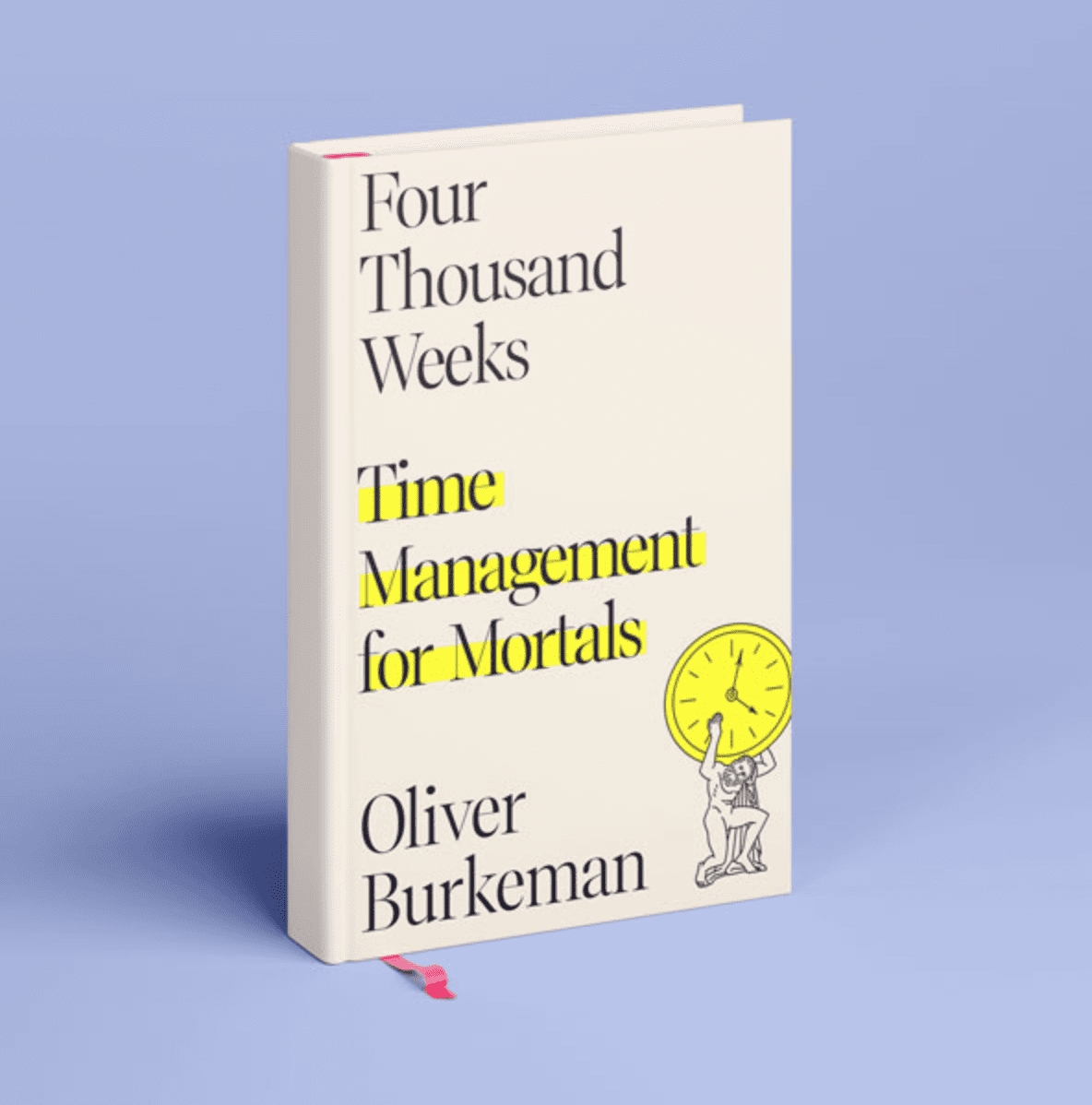

Four Thousand Weeks: Complete Summary of Oliver Burkeman’s Philosophy for a Limit-Embracing Life
Introduction: What This Book Is About
Oliver Burkeman’s “Four Thousand Weeks: Time Management for Mortals” challenges the conventional wisdom surrounding productivity and time management. Burkeman argues that the average human lifespan, approximately four thousand weeks, is absurdly short, a reality most modern approaches to time management ignore. Instead of pretending we can “get everything done,” this book offers a radical, counter-intuitive philosophy: embracing our finite nature is the key to a more meaningful, productive, and joyful life. This summary will delve into Burkeman’s core insights, practical strategies, and the profound shift in perspective needed to confront our limited time not as a problem to be solved, but as the fundamental condition of human existence. Readers who feel overwhelmed by endless to-do lists, constantly stressed by the pace of modern life, or simply want to live more authentically will find a liberating blueprint within these pages. This comprehensive summary covers all key insights, examples, and actionable advice from the book.
Part I: Choosing to Choose
1: The Limit-Embracing Life
This chapter explores how our modern perception of time, as an abstract, measurable entity, has led to chronic feelings of busyness and dissatisfaction. It contrasts this with pre-modern “task orientation” and introduces the concept of a “limit-embracing life.”
Time Before Timetables: The Shift from Task Orientation
Before the invention of clocks and the industrial revolution, most people, like medieval peasants, lived by task orientation. Life’s rhythms emerged organically from tasks themselves, such as milking cows when they needed milking or harvesting crops when it was harvest time. There was no concept of “too much to do” or “wasting time,” because time wasn’t seen as a separate, abstract entity to be managed. This allowed for an expansive, fluid experience, often referred to as “deep time,” where the boundary between self and reality blurred, and time felt still. Richard Rohr describes this as living “on the receiving end of the gifts of God.”
The End of Eternity: Time as a Resource
The invention of mechanical clocks by medieval monks marked a crucial shift, making time standardized and visible. This led to viewing time as an abstract resource—something to be bought, sold, and used efficiently. Ambrose Crowley, an 18th-century iron magnate, famously fumed about workers “horribly cheated” him by “smoking, singing, reading of news history.” This instrumental view of time, where each hour is a “container” to be filled, creates pressure to use it well and guilt when it feels wasted. This is the “precondition for all the uniquely modern ways in which we struggle with time today.”
The Rigged Game of Time Mastery
The modern approach to time, encapsulated by titles like “Master Your Time, Master Your Life,” sets up a rigged game where it’s impossible to ever feel you’re doing well enough. By treating the present instrumentally—as a means to a future goal or “oasis of relaxation”—peace of mind never arrives. This constant future-leaning perspective prevents us from experiencing the vividness of reality. Burkeman, through his own journey as a “productivity geek,” realized that the quest for total control over time is futile and often serves as a hidden emotional agenda, avoiding deeper, scarier questions about life choices and limitations.
Denying Reality and the Paradox of Limitation
The core issue is our struggle against the distressing constraints of reality, what some psychoanalysts call “neurosis.” We avoid confronting our finitude, believing we can somehow attain limitless control. This leads to pushing ourselves harder, taking on too many commitments, or procrastinating. The paradox of limitation states that “the more you try to manage your time with the goal of achieving a feeling of total control, and freedom from the inevitable constraints of being human, the more stressful, empty, and frustrating life gets.” Conversely, “the more you confront the facts of finitude instead—and work with them, rather than against them—the more productive, meaningful, and joyful life becomes.”
An Icy Blast of Reality: Embracing Finitude
Adopting a limit-embracing attitude means acknowledging that you won’t have time for everything, and accepting this. Hard choices are unavoidable, so the goal shifts from getting everything done to making conscious decisions about what to focus on and what to neglect. This also means resisting the urge to “keep your options open” and embracing daunting, irreversible commitments. The “joy of missing out” (JOMO) emerges, recognizing that missing out on almost everything is guaranteed, and this very fact makes your choices meaningful. As Charles Garfield Lott Du Cann suggested, confronting reality is an “invigoratingly icy water” experience, leading to greater peace and meaning.
2: The Efficiency Trap
This chapter reveals how the pursuit of efficiency, far from solving our time problems, often makes them worse by creating new demands and diverting us from what truly matters.
Sisyphus’s Inbox: The Futility of Getting More Done
The feeling of being overstretched stems from the irrational belief that we “must do more than we can do.” This is illogical; if you don’t have time, you don’t have time. The common solution—to become more efficient—is a trap. As Arnold Bennett’s 1908 book “How to Live on 24 Hours a Day” suggests, we always believe we can fit more in. However, the goalposts always shift. If you become more efficient, more demands will arise to fill the space. Email is the perfect example: getting better at processing email only generates more email. This is the “efficiency trap”: rendering yourself more efficient only creates new things to do, leading to a feeling of being busier, not less so.
The Bottomless Bucket List: Existential Overwhelm
The efficiency trap extends beyond work to “existential overwhelm.” In secular modernity, where there’s no afterlife, everything depends on making the most of this life. The belief in “progress”—that history is headed towards a perfect future—makes us acutely aware of our short lifespans and the vast number of experiences we’ll miss. This leads to stuffing lives with experiences, like an endless bucket list, to feel “fulfilled.” However, the world offers an effectively infinite number of experiences, so acquiring a few doesn’t bring a sense of completion. Instead, it intensifies the feeling of overwhelm, creating an endless cycle of needing to consume more. The internet exacerbates this by exposing us to even more possibilities.
Why You Should Stop Clearing the Decks: Prioritizing the Meaningful
The efficiency trap also affects the quality of our time use. The harder we try to fit everything in, the more time we spend on least meaningful things. The parable of the rocks in the jar (from Stephen Covey’s “First Things First”) is flawed because it assumes there’s enough room for all the “big rocks.” In reality, there are too many rocks, and most won’t fit. When you believe you can fit everything in, you feel less pressure to evaluate if an activity is the best use of time, leading to your days filling with trivial or tedious tasks. The solution is an anti-skill: resisting the urge to be more efficient. Instead of “clearing the decks,” consciously decline to clear them, focusing on what’s truly of greatest consequence, and tolerating the discomfort of knowing other things will remain undone.
The Pitfalls of Convenience: Sacrificing What Matters
Modern industries thrive on offering convenience, eliminating “pain points” or “friction” from daily life. Uber, Apple Pay, and food delivery services smooth out mundane chores. However, this smoothness is a dubious virtue. Often, the inconveniences—like interacting with local businesses or making a purchase with cash—are what nurture crucial relationships and embody essential human activities. When convenience drains an activity of its meaning, it becomes less valuable. Tim Wu notes, “I prefer to brew my coffee, but Starbucks instant is so convenient I hardly ever do what I ‘prefer’.” This leads to abandoning valuable activities for more convenient, less fulfilling ones. To make time for what matters, as Sylvia Keesmaat discovered by moving to a farm and embracing its inconveniences, requires giving things up and accepting the inevitable sense of loss.
3: Facing Finitude
This chapter delves into the philosophical foundations of human limitation, particularly focusing on Martin Heidegger’s concept of finitude and its implications for how we live.
Thrown into Time: Heidegger on Human Existence
Martin Heidegger, despite his controversial past, profoundly explores human finitude. He argues that our being is utterly bound up with our limited time, so much so that “to be, for a human, is above all to exist temporally.” We don’t just have limited time; we are a limited amount of time. Every decision is radically limited, retrospectively by who we are, and forward-looking by the sacrifice of infinite alternative paths. Making choices means “ceaselessly waving goodbye to possibility.” Heidegger calls this the “undeluded mode of existence” or “Being-towards-death,” where we acknowledge that life is not a dress rehearsal and time is always running out.
The Problem with “Falling”: Avoidance and Denial
Most people, however, engage in “falling,” or avoidance and denial of finitude. We seek distractions, lose ourselves in busyness, or tell ourselves we have no choice in our actions. The “futile attempt to ‘get everything done’” is another form of this evasion, avoiding the responsibility of choosing among mutually exclusive possibilities. This avoidance makes life more comfortable in the short term but leads to a “stultifying, deadly sort of comfort.” Only by facing our finitude can we step into a truly authentic relationship with life.
Getting Real: Mortality as a Catalyst for Meaning
Martin Hägglund argues in “This Life: Why Mortality Makes Us Free” that if life were eternal, nothing could genuinely matter because there would be no stakes. It’s the certainty of death that imbues life with meaning. The value of experiences, like summer vacations with family, is intrinsically linked to their temporary nature. Consciously confronting death leads to being “truly present for our lives,” adding a new depth to existence, often described as “bright sadness,” “stubborn gladness,” or “sober joy.” This is the “kernel of wisdom” in accounts of cancer survivors finding new meaning; such brushes with death force a more honest relationship with time.
Everything Is Borrowed Time: Gratitude for Existence
From an ordinary perspective, finitude feels like a “terrible insult.” However, this is an entitled attitude. Why assume an infinite supply of time is the default? David Cain’s experience after a shooting near where he’d just been highlights that “your whole life is borrowed time.” Being alive is happenstance, not a right. This perspective fosters gratitude for everyday annoyances, transforming frustration into an “upwelling of gratitude.” When you realize you “get to make choices” rather than “having to make them,” each decision becomes an affirmation, a positive commitment to what counts most. The “joy of missing out” (JOMO) is the thrilling recognition that renouncing alternatives is precisely what makes choices meaningful.
4: Becoming a Better Procrastinator
This chapter reframes procrastination not as a moral failing but as an inevitable part of finite life, emphasizing the importance of choosing wisely what to neglect.
The Art of Creative Neglect: Strategic Procrastination
Since we can’t do everything, the core challenge of time management is deciding most wisely what not to do. This is the art of “creative neglect.” Instead of eradicating procrastination, the goal is to choose what to procrastinate on, focusing on what matters most. Most productivity advice fails because it implies you can get everything done. The “rocks in the jar” parable is a lie; there are too many rocks. Gregg Krech suggests learning to “get better at procrastinating” by consciously choosing what to neglect.
Principle 1: Pay Yourself First with Time
Inspired by personal finance, Jessica Abel’s “pay yourself first” principle applies to time. If a certain activity truly matters (a creative project, a relationship, activism), the only way to ensure it happens is to do some of it today, no matter how little, before other demands consume your time. This means actively claiming time, not waiting for it to appear. This translates into scheduling “meetings” with yourself and working on your most important project first thing each day.
Principle 2: Limit Your Work in Progress
To avoid the illusion of progress on all fronts, fix a hard upper limit on the number of projects you work on simultaneously. Jim Benson and Tonianne DeMaria Barry suggest no more than three items in their book “Personal Kanban.” New demands must wait until a slot opens. This forces you to confront your finite capacity and promotes a sense of “undistracted calm.” It also encourages breaking down projects into manageable chunks, as large tasks would clog the system for too long.
Principle 3: Resist the Allure of Middling Priorities
The “Warren Buffett rule” (though possibly apocryphal) advises listing 25 life goals, picking the top 5 to focus on, and then actively avoiding the remaining 20. These middling priorities are “ambitions insufficiently important to him to form the core of his life yet seductive enough to distract him from the ones that matter most.” Elizabeth Gilbert emphasizes that saying “no” often means declining things you do want to do, but which don’t align with your highest priorities.
Perfection and Paralysis: Procrastination as Emotional Avoidance
Bad procrastination stems from trying to avoid the discomfort of confronting limitations, especially the fear of not producing work of sufficient quality. The fable of the architect from Shiraz, who burned his perfect mosque plans to avoid the compromises of reality, illustrates this. Any attempt to bring ideas into reality will fall short of fantasy’s perfection. This is liberating: since your work will never be perfect anyway, you might as well start. This applies to relationships too, as seen in Franz Kafka’s commitment-phobia. He avoided the trade-offs of real intimacy by confining his relationship to letters, clinging to the fantasy of limitless possibilities.
The Inevitability of Settling: Finding Meaning in Commitment
Henri Bergson noted that the future, “pregnant with an infinity of possibilities, is thus more fruitful than the future itself.” This explains why we often prefer hope to possession, dreams to reality. But this leads to endless indecision and a provisional life. The advice is: you should definitely settle. Robert Goodin argues that not settling (e.g., endlessly seeking a “perfect” partner) is also a form of settling—using limited time in a less-than-ideal way. True fulfillment in relationships or careers requires committing to imperfections, willingly foreclosing infinite alternatives. Daniel Gilbert’s poster experiment showed that people were happier when their choices were irreversible, demonstrating the “joy of missing out” that meaningful commitments bring.
5: The Watermelon Problem
This chapter introduces distraction as a major obstacle to well-spent time, arguing that it’s not just external but an internal flight from discomfort.
The Watermelon Tale and the Nature of Attention
The BuzzFeed watermelon video, watched by millions, illustrates modern distraction. People were “already committed” to watching, highlighting that their attention was commandeered, not freely chosen. Philosophers from ancient Greece viewed distraction as an inner failure of character, not just external interruptions. This is because attention is life: “your experience of being alive consists of nothing other than the sum of everything to which you pay attention.” When you focus on what you don’t value, you’re paying with your life.
The Trap of Relentless Focus: Unattainable Sovereignty
The common response to distraction is to become “indistractible” through techniques like meditation or web-blocking apps. However, this is a trap. It denies the human limitation that total sovereignty over attention is impossible and undesirable. “Bottom-up” (involuntary) attention is crucial for survival (e.g., hearing a baby cry). While “top-down” (voluntary) attention (Viktor Frankl’s focus on inner life in Auschwitz) is vital for meaning, pursuing total control leads to feeling perpetually unable to meet demands. The problem isn’t just external interruptions; the job itself can be a distraction if less meaningful than other options.
A Machine for Misusing Your Life: The Attention Economy
The online “attention economy” is a “giant machine for persuading you to make the wrong choices about what to do with your attention.” It profits by seizing and selling attention to advertisers, using “persuasive design” (like variable rewards in casino slot machines) to encourage compulsive behavior. Roger McNamee suggests we’re not the “product,” but the “fuel”—exploited without mercy. This distorts our worldview, influencing what we deem “important matters” offline (e.g., fear of crime from biased news feeds). My own experience as a Twitter junkie illustrates how the platform extended its dominion beyond screen time, shaping thoughts and anxieties, and making “the rest of reality sometimes seems unable to compete.”
The Intimate Interrupter: The Desire to Be Distracted
The deeper truth about distraction is that “something in us wants to be distracted.” We often give in willingly. Mary Oliver calls this the “intimate interrupter,” an inner urge to flee from the “disagreeable” feeling of focusing on challenging tasks. Gregg Krech notes he often doesn’t “feel like doing most of the things that need doing.” This flight is an attempt to escape the painful encounter with our finitude—our limited control and the anxiety of uncertain outcomes. Boredom, for example, is an “intense reaction to the deeply uncomfortable experience of confronting your limited control.”
6: The Intimate Interrupter
This chapter continues the discussion on distraction, asserting that it’s a fundamental human tendency to flee discomfort and the limitations of reality, and how to approach this.
The Discomfort of What Matters: Fleeing Finitude
Shinzen Young’s experience in a Japanese monastic ice-water ritual showed him that the more he resisted the pain, the worse it got; the more he focused on the sensations, the less agonizing it became. This reveals that distraction is often a flight from the discomfort of confronting limitation. When we try to focus on something important, we face our limits, which feels uncomfortable precisely because we value the task so much. We abandon “godlike fantasies” and experience a lack of power. Online distractions provide a sense of limitlessness, dulling the pain of finitude.
The Futility of External Solutions
Digital detoxes and self-imposed rules against social media rarely work long-term because they don’t address the inner urge toward distraction. Even without devices, we find other ways to avoid uncomfortable focus—daydreaming, unnecessary naps, or endless reorganization. The problem isn’t that distractions cause us to be distracted; they are the places we go to seek relief. For instance, checking your phone during a conversation is a symptom of struggling to focus on the conversation itself, which demands effort, patience, and surrender.
Accepting the Unpleasantness: The Path to Absorption
The most effective way to sap distraction of its power is to stop expecting things to be otherwise. Accept that the “unpleasantness is simply what it feels like for finite humans to commit ourselves to the kinds of demanding and valuable tasks that force us to confront our limited control.” The solution is to resign yourself to the truth, like Shinzen Young did, by allowing yourself to more fully feel the discomfort rather than fighting it. This transforms anxiety into a “bracing act of choice.” Zen Buddhists believe all suffering stems from resisting paying full attention to reality. Accepting this “lack of any solution is the solution,” leading to a “down-to-earth kind of liberation.”
Part II: Beyond Control
7: We Never Really Have Time
This section explores the illusion of control over time, particularly in planning, and advocates for releasing the need for certainty about the future.
Hofstadter’s Law and the Illusion of Control
Hofstadter’s Law states that tasks always take longer than expected, even when accounting for the law itself. This suggests that our efforts to plan and control time somehow actively resist us. Burkeman uses his own family’s “obsessive planning” stemming from his grandmother’s escape from Nazi Germany as an example. While planning can prevent catastrophe, being emotionally invested in planning exacerbates anxiety. The obsessive planner demands reassurances from the future that the future cannot provide, pushing uncertainty further toward the horizon without ever truly relieving it.
Anything Could Happen: Releasing the Need for Certainty
We never truly “have” time in the way we possess objects. We merely expect it. Any number of factors can disrupt our expectations. The assumption that we can possess or control time is the unspoken premise of most future-oriented thinking, leading to constant anxiety. The problem isn’t making plans, but the “internal demand to know, in advance, that things will turn out fine.” Blaise Pascal noted, “We try to [give the present the support of] the future, and think of arranging matters which are not in our power.” This struggle for certainty is intrinsically hopeless. Simone de Beauvoir’s reflection on the “dizzying matter of coincidence” that led to her existence reinforces that our lives are a “jumble of chance occurrences” beyond our control. Accepting this is a surprisingly effective antidote to anxiety.
Minding Your Own Business: Focusing on the Present
Many spiritual traditions converge on the advice to confine our attention to the present moment, the only part of time that is truly “our business.” The Tao Te Ching suggests being like water, flowing around obstacles, rather than raging against them. Jesus advises, “Take no thought for the morrow.” Jiddu Krishnamurti’s “secret” was “I don’t mind what happens.” This doesn’t mean apathy, but living “without the inner demand to know that the future will conform to your desires.” Planning is still valuable, but a plan is “just a thought,” a present-moment statement of intent, with no obligation for the future to comply.
8: You Are Here
This chapter critiques the instrumental view of time, where the present is only valuable as a means to a future end, and advocates for finding meaning in the immediate moment.
The “When-I-Finally” Mind: Instrumentalizing the Present
Treating time instrumentally—as a means to an end—leads to obsessing over “using it well.” This makes each day feel like something to “get through,” delaying fulfillment. This is the “‘when-I-finally’ mind”: believing happiness will arrive only after achieving future goals (e.g., “When I finally get my workload under control, then I can relax”). The problem is, this treats the present solely as a path to a superior future, so the present is never satisfying in itself. Alan Watts criticizes this in education, where life is endlessly postponed for a future that never arrives, like “donkeys running after carrots that are hanging in front of their faces.”
The Causal Catastrophe: Sacrificing Present Value for Future Outcomes
Becoming a father helped Burkeman realize his own “future-chasing mindset.” He observed how most parenting advice, whether from “Baby Trainers” or “Natural Parents,” focused on maximizing a child’s future well-being, sacrificing the intrinsic value of the present. Adam Gopnik calls this the “causal catastrophe”: judging childhood solely by the kind of adults it produces, thereby “sapp[ing] childhood of any intrinsic value.” Tom Stoppard’s character in “The Coast of Utopia” profoundly states, “a child’s purpose is to be a child. Nature doesn’t disdain what only lives for a day.” This extends to all life: valuing an activity only for future results means missing its present meaning.
The Last Time: Cherishing Every Moment
Sam Harris’s “disturbing observation” is that our finite lives mean we do everything for the very last time (e.g., picking up your son, visiting a childhood home). Since we don’t know when the last time will be, we should treat every experience with reverence. Every moment is a “last time.” Instrumentally treating moments as stepping stones to the future blinds us to this. Capitalism, as a “giant machine for instrumentalizing everything,” exacerbates this, causing even wealthy individuals to feel miserable because they treat their present lives as mere vehicles for future happiness. Lawyers’ billable hours commodify time, making non-billable activities feel like “indulgences one can’t afford.”
Absent in the Present: The Futility of Trying Too Hard
While tempting to blame capitalism, we often choose to instrumentalize time to maintain omnipotent control. This prevents facing the “unpalatable reality that your life isn’t leading toward some moment of truth that hasn’t yet arrived.” The “moment of truth is always now.” Keynes called this “purposiveness”—a desire not to die, pushing fulfillment into an endless future. Attempting to “live in the moment” often backfires, as with Robert Pirsig at Crater Lake or Burkeman with the Northern Lights. The effort to be present, ironically, can be another instrumental act, fixing on an outcome rather than experiencing. The solution is to realize you are “always already living in the moment” anyway. Trying to “get anything out of life” is futile, as “there is no outside where we could take this thing to.”
9: Rediscovering Rest
This chapter highlights how modern society, driven by productivity, has eroded the true meaning of rest, and advocates for reclaiming it as an end in itself.
The Decline of Pleasure: Leisure as Another Chore
The Take Back Your Time movement in Seattle critiques the pressure to justify leisure in terms of productivity. This is a “sneaky problem” with instrumentalizing time: even leisure becomes a means to an end (e.g., “Relax! You’ll Be More Productive”). This makes leisure feel like a chore. Walter Kerr noted in “The Decline of Pleasure” that “We are all of us compelled… to read for profit, party for contacts.” Despite having more free time than previous decades, it doesn’t feel leisurely because it’s still treated as an investment. This problem often worsens with wealth, as more options for leisure create more pressure to “get around to” them.
Leisure as Life’s Center of Gravity: Ancient and Medieval Perspectives
Ancient philosophers like Aristotle viewed true leisure (self-reflection, contemplation) as the highest virtue, the end to which everything else was a means. The Latin word for business, negotium, literally means “not-leisure.” Medieval peasants, despite harsh lives, had lives “suffused with leisure,” dominated by religious holidays and festivals. Some historians claim they worked only 150 days a year. This was an era where leisure was the default, work an interruption, and strong social pressure ensured people didn’t work all the time.
Industrialization and the Instrumentalization of Leisure
The Industrial Revolution, fueled by clock-time, sharply delineated work from leisure. Workers were offered a deal: free time was fine, so long as it didn’t harm (and preferably enhanced) their job usefulness. Work became “the real point of existence,” leisure merely for “recovery and replenishment.” This meant the whole of life was valued for something else, in the future, not for itself. Union leaders, by arguing for leisure as self-improvement (e.g., education), inadvertently reinforced this instrumental view. The “Right To Be Lazy” (Paul Lafargue) represents a radical counter-idea. Modern views see anything not creating future value as “mere idleness,” making genuine rest feel wasteful.
Pathological Productivity: Idleness Aversion
To genuinely rest requires accepting that your days aren’t leading to “a future state of perfectly invulnerable happiness.” The novelist Danielle Steel’s extreme work habits (writing 179 books in 72 years, working 20-hour days, 4 hours of sleep) exemplify a “pathological inability to refrain from using time productively.” Social psychologists call this “idleness aversion.” Max Weber linked it to the Protestant work ethic and predestination: relentless work as proof of being “elect.” This legacy makes idleness anxiety-inducing, a sign of damnation. Today, it’s a “yearning for something not all that dissimilar from eternal salvation,” a belief that constant striving leads to future perfection. Our leisure activities can even resemble “physical punishment.”
Rules for Rest: The Sabbath and Discomfort
We need ways to ensure rest happens, as it doesn’t occur by default. The Sabbath, with its strict rules (e.g., no operating electrical switches), was designed by its inventors, ancient Jews, to force rest. Judith Shulevitz argues that this wasn’t to torture but to communicate that “interrupting the ceaseless round of striving requires a surprisingly strenuous act of will.” The Sabbath, as Walter Brueggemann describes it, is an invitation to be “on the receiving end of the gifts of God.” In today’s always-on world, it’s harder than ever to make this psychological shift. Personal “digital sabbaths” help but lack social reinforcement. True rest involves accepting it might initially feel uncomfortable, even delightless. That discomfort is a sign you “definitely should” pursue it.
Hiking as an End in Itself: Atelic Activities and Hobbies
A country walk, like listening to music or meeting friends, is an “atelic activity”: its value isn’t derived from a “telos” or ultimate aim. You don’t “finish” a walk; its purpose is the doing itself. Kieran Setiya, in “Midlife,” realized his project-driven, “telic” life created emptiness. The solution: incorporate more atelic activities. These are often hobbies, which are “subversive” in an instrumental age, insisting some things are “worth doing for themselves alone, despite offering no payoffs in terms of productivity or profit.” Rod Stewart’s model railway hobby, despite its “mediocre quality” by his own admission, is a genuine source of fulfillment because it’s done for its own sake, not for external validation or perfection. This freedom to “suck without caring is revelatory.”
10: The Impatience Spiral
This chapter analyzes modern impatience as a self-defeating attempt to control the pace of reality, advocating for the cultivation of patience as a powerful antidote.
The Pointless Honk: Rage Against Reality’s Pace
The “pointless honk” in city traffic exemplifies our unwillingness to acknowledge limitations. It’s a “howl of rage” at the world not moving as fast as desired. This dictatorial attitude makes us miserable and is often counterproductive (e.g., impatient driving slows traffic). Our increasing impatience, evident in faster web page load time expectations (Amazon losing $1.6 billion for a single second delay), seems paradoxical given technological acceleration. The reason: each technological advance promises to transcend limits, making any remaining delay feel more frustrating. Societal impatience also creates external pressure, forcing individuals to keep up or risk job loss.
Escape Velocity: Reading and the Impatience for Reality
The experience of reading reveals this “ratcheting sense of discomfort.” Many find it harder to concentrate on books, experiencing “restlessness” or “distraction” that is actually a form of impatience. As Hugh McGuire noted, one feels inclined to interruption, unable to “give themselves over to the task.” Reading “refuses to consent to our desire to exert control over how our time unfolds.” It “just takes the time it takes.” This illustrates how we struggle to accept that many aspects of reality operate on their own schedule, independent of our desires.
Must Stop, Can’t Stop: The Addiction to Speed
Psychotherapist Stephanie Brown noticed clients in Silicon Valley exhibiting an “addiction to speed,” constantly needing stimulation and movement. She compared this to alcoholism: a “self-medication” to avoid painful emotions. Like alcohol, speed offers a temporary “buzz” but ultimately backfires, creating more anxiety. The faster we go, the more anxious we feel about not keeping up, perpetuating a vicious spiral. The solution, as in Alcoholics Anonymous, is to “give up all hope of beating alcohol”—or speed. This means surrendering the unrealistic craving for control, “facing reality” that things take the time they take. This “second-order change” transforms anxiety, allowing for the cultivation of patience, the “least fashionable but perhaps most consequential of superpowers.”
11: Staying on the Bus
This chapter continues to explore the power of patience, highlighting its active, muscular quality and its ability to unlock deeper engagement with reality and creative work.
The Power of Patience: Jennifer Roberts’s Art History Exercise
Jennifer Roberts’s Harvard art history assignment—staring at a painting for three hours straight—illustrates patience as an “active, almost muscular state of alert presence.” The exercise forces students to endure the “painfully long time” of not being able to hurry, pushing past discomfort to what lies beyond. Her students, accustomed to speed, needed “permission to spend this kind of time on anything.” Roberts discovered details in Copley’s “Boy with a Squirrel” (e.g., ear echoing squirrel’s belly) only after prolonged observation. This demonstrates that patience is not passive resignation but an active engagement that allows reality to reveal its “secret details,” leading to a “real sense of purchase on that reality.”
Watching and Waiting: M. Scott Peck’s Insight
M. Scott Peck, in “The Road Less Traveled,” describes overcoming his “mechanical idiot” self by learning patience from a neighbor. When faced with a stuck parking brake, he “took the time to make myself comfortable” and “gradually, in no hurry, I was able to focus.” He discovered a simple solution missed by rushed attempts. His insight: “if you’re willing to endure the discomfort of not knowing, a solution will often present itself.” This applies across life: we rush to solutions (e.g., snapping at partners, abandoning projects) to maintain control, rather than waiting for understanding to unfold.
Three Principles of Patience: Cultivating Deeper Engagement
- Develop a taste for having problems: Our urge to rush stems from a fantasy of a problem-free life. But a life without problems is meaningless, as problems “demand that you address yourself to it.” Accepting problems as the “very substance of a meaningful existence” allows us to engage with them patiently.
- Embrace radical incrementalism: Robert Boice’s study of academics showed that the most productive writers worked in brief daily sessions (10 minutes to 4 hours), religiously taking weekends off. This cultivated patience to produce little on any single day but much more long-term. Stopping when energy is high prevents impatience from taking over, strengthening the “muscle of patience” for sustained productivity.
- Originality lies on the far side of unoriginality: Arno Minkkinen’s Helsinki bus station parable illustrates this. Artists who keep jumping buses (changing artistic directions) because their work feels unoriginal never find their unique path. “Stay on the fucking bus.” Deeper, distinctive work emerges only after patiently immersing oneself in the “trial-and-error phase of copying others, learning new skills, and accumulating experience.” This applies to life choices too: profound understanding (e.g., in marriage or community) comes from patient commitment, not constant novelty.
12: The Loneliness of the Digital Nomad
This chapter examines the hidden cost of excessive individual temporal freedom, arguing that true meaning and connection often arise from shared, synchronized time.
The Myth of Super Mario: Time as a Network Good
Mario Salcedo, who lives almost permanently on cruise ships, believes he has mastered his time by eliminating “non-value-added activities.” However, he seems unhappy. Burkeman argues time isn’t just a “regular good” (more is always better), but also a “network good,” whose value depends on how many others have access to it and how well their time is coordinated with yours. Having time but no one to share it with is “actively unpleasant,” akin to physical ostracism. The digital nomad lifestyle, though seemingly free, often leads to “acute loneliness,” lacking the “shared rhythms required for deep relationships to take root.”
In and Out of Sync: The Benefits of Communal Time
Increased individual control over time, like flextime or remote work (even parent-friendly policies), comes with an unavoidable flip side: loss in ease of coordinating time with others. Terry Hartig’s study in Sweden showed that antidepressant use fell most when more of the population was on vacation simultaneously. People derived psychological benefits from synchronized leisure, not just from time off. Even retired people were happier. This suggests the need for “social regulation of time,” fostering communal rhythms like the Sabbath or French grandes vacances. The Swedish fika (daily coffee break) demonstrates how surrendering individual scheduling sovereignty can foster communication and conviviality.
The Soviet Experiment: Forcibly Desynchronized Time
The Soviet Union’s five-day workweek experiment (four workdays, one rest day, staggered by color-coded groups) aimed for efficiency but inadvertently demonstrated the vital importance of synchronized time. By preventing families and friends from having the same days off, it destroyed social life and put immense stress on relationships. As one worker complained, “What kind of life is that, when holidays come in shifts, and not for all workers together?” This “nightmare” proved that the value of time comes not just from quantity, but from being “in sync with the people you care about most.”
Keeping Together in Time: The Power of Synchronized Movement
William McNeill’s experience of military marching drills in 1941 revealed a “strange sense of personal enlargement” and “pervasive well-being” from “prolonged movement in unison.” His book, “Keeping Together in Time,” argues that synchronized movement (and singing) is an underappreciated force in history, fostering group cohesion. Even sprinters like Usain Bolt subconsciously synchronize, making their movements more efficient. In daily life, this synchrony makes time feel “realer,” more intense, and meaningful. Community choirs, for instance, create a “perfection that few of the singers involved could attain on their own,” highlighting the “extraordinary psychological benefits of choral singing.” This powerful communal bond, sometimes tinged with ecstasy, shows that “the world doesn’t open up into a million shimmering dimensions of hope and possibility when I sing alone.”
The Freedom to Never See Your Friends: Resisting Individualist Ethos
The cultural ideal of individual time sovereignty (setting your own schedule, free from others’ intrusions) has a cost: it leads to a desynchronized society. This means it’s harder than ever to find time for shared activities like family dinners or community projects. For the least privileged, this translates to exploitative “on-demand scheduling,” but even for those with more control, work “seeps through life like water.” The result is that “we’ve constructed lives that can’t be made to mesh.” This has political implications, as it hinders grassroots activism, leaving a “vacuum of collective action” filled by autocratic leaders. The solution isn’t just external; we must resist the ethos of individual time sovereignty and make commitments that remove flexibility (joining choirs, sports teams, religious organizations), prioritizing physical, communal activities over isolating digital ones. Our time can be “too much our own.”
13: Cosmic Insignificance Therapy
This chapter introduces the concept of finding solace and motivation in acknowledging our cosmic insignificance, releasing the burden of needing to make a monumental impact.
The Great Pause: Societal Epiphany During Pandemic
A patient’s sudden realization, “I hate my life,” during a business trip, exemplifies a common feeling of lacking meaning despite external success. The coronavirus pandemic’s “Great Pause” provided a societal “perceptual jolt.” Amidst anxiety, people expressed “bittersweet gratitude” for seeing more of their children, planting flowers, or baking bread. Assumptions about time use (long commutes, constant office presence) were disrupted. Julio Vincent Gambuto called this “possibility shock,” realizing “things could be different, on a grand scale.” The crisis revealed what truly mattered (neighborliness, community) and that we’d “known it all along.” It’s a “sacred opportunity to get rid of the bullshit and to only bring back what works for us.”
A Modestly Meaningful Life: Embracing Irrelevance
Philosopher Bryan Magee’s “arresting point” is that human civilization (6,000 years) spans only about 60 centenarian lifetimes. From this perspective, our lives are “minuscule little flicker[s] of near-nothingness.” This can be terrifying but also “oddly consoling”—what Burkeman calls “cosmic insignificance therapy.” When things seem too much, remembering your insignificance shrinks anxieties to irrelevance. The “Universe Doesn’t Give a Flying Fuck About You.” This is a relief because it means you’ve been holding yourself to impossible standards (e.g., being a Michelangelo or Einstein). Our “egocentricity bias” makes us overvalue our existence, leading to an “unrealistic definition of what it would mean to use your finite time well.”
The Liberation of Insignificance: Redefining “Well Spent”
Being reminded of your insignificance is liberating: it’s realizing you’ve been burdened by standards you couldn’t meet. This frees you to see a “far wider variety of things might qualify as meaningful ways to use your finite time.” Preparing nutritious meals, writing a novel that moves a few people, or any career that “makes things slightly better for those it serves” can matter “as much as anything could ever matter.” Cosmic insignificance therapy is an invitation to embrace your irrelevance, “dropping back down from godlike fantasies of cosmic significance into the experience of life as it concretely, finitely—and often enough, marvelously—really is.”
14: The Human Disease
This concluding chapter synthesizes the book’s arguments, emphasizing that the human struggle with time is a “disease” of illusion, and freedom lies in accepting reality’s unfixable nature.
The Illusion of Time Mastery: A Doomed Struggle
The core fantasy behind our time troubles is to “master” time and life, achieving “dominance and control over our unfolding lives” to feel safe. This manifests in attempts to be hyper-productive, avoiding commitments, railing against delays, or seeking cosmic significance. This struggle is doomed to fail because our time is limited (forcing tough choices) and unpredictable (preventing security). Heidegger’s idea that “we are time” means we can never get outside it to master it. “Time is a river that sweeps me along, but I am the river.” Insecurity and vulnerability are the default states of existence.
The Provisional Life: Postponing True Living
A life focused on unattainable security about time feels “provisional”—as if “the point of your having been born still lies in the future.” Marie-Louise von Franz describes this as a “strange attitude and feeling that one is not yet in real life.” This dread of being “pinned down, of entering space and time completely,” prevents us from being our unique selves. “Entering space and time completely” means accepting defeat: “there will always be too much to do,” you can’t control the world’s pace, relationships are unpredictable, and from a cosmic view, it won’t matter much.
The Freedom of Acceptance: Getting On with Living
In exchange for accepting reality’s constraints, you “get to actually be here.” You gain “real purchase on life,” focusing on a few things that matter to you, in themselves, right now. This isn’t an argument against long-term endeavors, but a recognition that even those “can only ever matter now, in each moment of the work involved.” Happiness isn’t guaranteed, as life is filled with the “painful problems of finitude.” But “being unable to escape from the problems of finitude is not, in itself, a problem.” As Zen teacher Charlotte Joko Beck says, “it’s only unbearable for as long as you’re under the impression that there might be a cure.” Accepting the “inevitability of the affliction” brings freedom to “get on with living at last.” Christian Bobin’s insight: “life would only ever give me a series of wonderfully insoluble problems. With that thought an ocean of profound peace entered my heart.”
Afterword: Beyond Hope
This afterword argues that in a world facing overwhelming crises, true empowerment comes from abandoning “hope” in favor of direct, committed action.
The Kali Yuga and the Delusion of Hope
Our era feels like the Kali Yuga, a time of unraveling, despite some positive trends. In such a time, traditional time management seems irrelevant. Environmentalist Derrick Jensen argues that “hope is a curse.” To hope for a given outcome is to place faith in external forces (government, God, the future) to “make things all right.” This disavows your “own capacity to change things.” Pema Chödrön says hope means assuming “there’s always going to be a babysitter available.” This attitude, while sometimes justified (e.g., trusting a surgeon), largely means “surrendering your power to the very forces you were supposed to be fighting.”
Abandoning Hope: Reclaiming Your Power
To “give up hope” is to “reinhabit the power that you actually have.” It means letting go of the expectation that “the awful situation we’re in will somehow resolve itself.” Instead, “We simply do the work.” This book is an “extended argument for the empowering potential of giving up hope.” It means giving up hope that techniques or effort will meet limitless demands, fulfill every ambition, or prevent pain. It means giving up the “master hope that lurks beneath all this, the hope that somehow this isn’t really it.”
The Liberating Death of the “Civilized You”
The “key to what Chödrön calls ‘getting the hang of hopelessness’” is seeing that “things aren’t going to be okay.” The world is “already broken,” and your life will never be one of “perfect accomplishment or security.” This is a revelation that brings not despair, but an “energizing surge of motivation.” The “terrible eventuality” you feared has already happened, and “yet here you are, still alive.” Abandoning hope is “an affirmation, the beginning of the beginning.” It kills the “fear-driven, control-chasing, ego-dominated version of you,” leaving a “you” that is “more alive than before. More ready for action, but also more joyful.” You can now “appreciate life in the droll spirit of George Orwell,” enjoying what is, despite the chaos. The absurdly short lifespan is a cause for relief: “You get to give up on something that was always impossible,” and “roll up your sleeves and start work on what’s gloriously possible instead.”
Appendix: Ten Tools for Embracing Your Finitude
This appendix provides practical, actionable strategies for integrating the book’s philosophy of embracing limitation into daily life.
1. Adopt a “Fixed Volume” Approach to Productivity
Instead of aiming to get everything done, accept that tough choices are inevitable.
- Use two to-do lists: Keep an “open” list for all tasks and a “closed” list with a fixed number of entries (e.g., ten at most). Only move tasks from open to closed, and don’t add new ones to the closed list until one is completed.
- Establish predetermined time boundaries: Decide your work hours in advance (e.g., 8:30 a.m. to 5:30 p.m.) and make all other decisions around these limits. This fosters awareness of constraints and motivates wise time use.
2. Serialize, Serialize, Serialize
Focus on one big project at a time (or one work and one non-work project) and complete it before moving to the next.
- Resist starting multiple projects simultaneously: This alleviates anxiety but prevents progress.
- Tolerate anxiety of postponement: Consciously delay everything possible except your current main project.
- Ensure essential tasks are not postponed: Pay bills, answer urgent emails, and take kids to school.
3. Decide in Advance What to Fail At
Acknowledge that you will inevitably underachieve at something due to finite time and energy.
- Nominate areas for “strategic underachievement”: Choose aspects of life where you won’t expect excellence (e.g., lawn care, kitchen tidiness). This focuses energy more effectively.
- Remove the “sting of shame”: Failing at pre-selected areas is less troubling.
- Practice cyclical failure: Aim for the bare minimum in certain areas for a period (e.g., work for two months to focus on children), then switch energies to what was neglected. This replaces “work-life balance” with conscious imbalance, ensuring all roles get their moment.
4. Focus on What You’ve Already Completed
Combat despondency from endless to-do lists by acknowledging accomplishments.
- Keep a “done list”: Start empty each morning and fill it with tasks completed throughout the day.
- Celebrate “small wins”: This builds motivation and leads to more achievements.
- Lower the bar for accomplishments: Include very basic tasks (e.g., “brushed teeth”) if in a rut.
5. Consolidate Your Caring
Recognize that the attention economy pressures you to care about too many things, even if worthwhile.
- Consciously pick your battles: Decide on a few legitimate causes or issues to dedicate your finite capacity for care (e.g., prison reform, food pantry).
- Resist the urge to address every crisis: Campaigns often present causes as “uniquely urgent,” but aggregate, they are overwhelming.
6. Embrace Boring and Single-Purpose Technology
Combat digital distractions by making devices less alluring.
- Remove social media and email apps: Transform your smartphone from a “toy” to a “tool.”
- Switch screen to grayscale: This reduces visual stimulation.
- Choose single-purpose devices: Use e-readers like Kindle that make it tedious to do anything but read.
7. Seek Out Novelty in the Mundane
Counter the feeling of time speeding up with age by increasing attention to present moments.
- Plunge more deeply into existing life: Find novelty not through radical experiences but by intensified attention to the mundane.
- Practice conscious engagement: Go on unplanned walks, use different routes to work, take up photography or birdwatching, journal, or play “I Spy” with children. This makes experiences feel “twice as full” and longer in recollection.
8. Be a “Researcher” in Relationships
Counter the desire for control in relationships with an attitude of curiosity.
- Adopt a stance of curiosity: When faced with a challenging or boring moment, aim “to figure out who this human being is that we’re with,” rather than achieving a particular outcome or defending your position.
- Embrace unpredictability: Curiosity can be satisfied by any behavior, whereas demanding a certain result leads to frustration.
- Choose curiosity over worry: In the face of an unknowable future, opt to wonder what might happen next rather than hoping for a specific outcome.
9. Cultivate Instantaneous Generosity
Act immediately on generous impulses to give money, check on a friend, or praise someone’s work.
- Overcome time-control attitudes: Don’t postpone good deeds until “urgent work is out of the way” or you have “enough spare time to do it really well.”
- Prioritize action over perfection: A hastily worded message of praise is better than none.
- Reap immediate rewards: Generous action reliably makes you happier.
10. Practice Doing Nothing
The capacity to do nothing is indispensable for making wise choices with time.
- Resist the urge to manipulate experience: “Doing nothing” means training yourself to let things be as they are, resisting the need to always act or be productive.
- Set a timer and stop doing anything: When you notice yourself thinking or focusing, stop doing it. This builds autonomy and allows for better choices.
- Accept discomfort: “Nothing is harder to do than nothing,” but getting better at it helps you stop evading reality and make more deliberate choices with your brief allotment of life.
Key Takeaways: What You Need to Remember
Core Insights from Four Thousand Weeks
- Embrace finitude: Your life is absurdly short (around 4,000 weeks). Stop trying to “master” time; instead, accept your fundamental limitations.
- Productivity is a trap: Becoming more efficient only creates more demands, leading to perpetual busyness, not freedom.
- Choice means sacrifice: Every decision to do one thing means sacrificing countless others. True meaning comes from consciously choosing what to neglect.
- Control is an illusion: You can’t control the future or prevent pain. Releasing the demand for certainty is the path to peace.
- Attention is life: What you pay attention to is what your life will have been. Digital distractions, often a flight from discomfort, steal your life by commandeering your attention.
- Rest is not a means to an end: Leisure has intrinsic value and should not be justified by its productivity benefits. Embrace “wasteful” idleness.
- Patience is power: The ability to let things take the time they take is a crucial skill in a hurry-driven world, leading to deeper engagement and creativity.
- Communal time is valuable: Excessive individual temporal freedom leads to loneliness. Meaning often arises from synchronizing your time with others.
- Cosmic insignificance is liberating: You don’t need to make a “dent in the universe.” Accepting your irrelevance frees you from impossible standards and allows you to find meaning in ordinary life.
- Life is a series of insoluble problems: The “human disease” is the belief that there’s a cure for life’s inherent difficulties. Freedom comes from accepting them.
Immediate Actions to Take Today
- Set a “fixed volume” for your daily tasks: Limit your active to-do list to three to ten items at most.
- Pay yourself first with time: Allocate time for your most important personal project before tackling other demands.
- Identify and accept what you will fail at: Consciously choose areas where you will underachieve to free up energy for what truly matters.
- Practice “creative neglect”: Intentionally postpone tasks that are not essential, even if they feel urgent.
- Embrace “boring” technology: Remove distracting apps and set your phone to grayscale to reclaim attention.
Questions for Personal Application
- Where in your life are you currently pursuing comfort when discomfort is what’s truly needed for growth?
- Are you holding yourself to impossible standards of productivity or performance? What would you do differently if you truly let those standards crash?
- In what ways are you postponing living until you become the “person you ought to be” rather than embracing who you are now?
- Where are you holding back until you “know what you’re doing,” instead of diving in and learning as you go?
- How would you spend your days differently if you didn’t care so much about seeing your actions reach fruition in your lifetime?


Leave a Reply