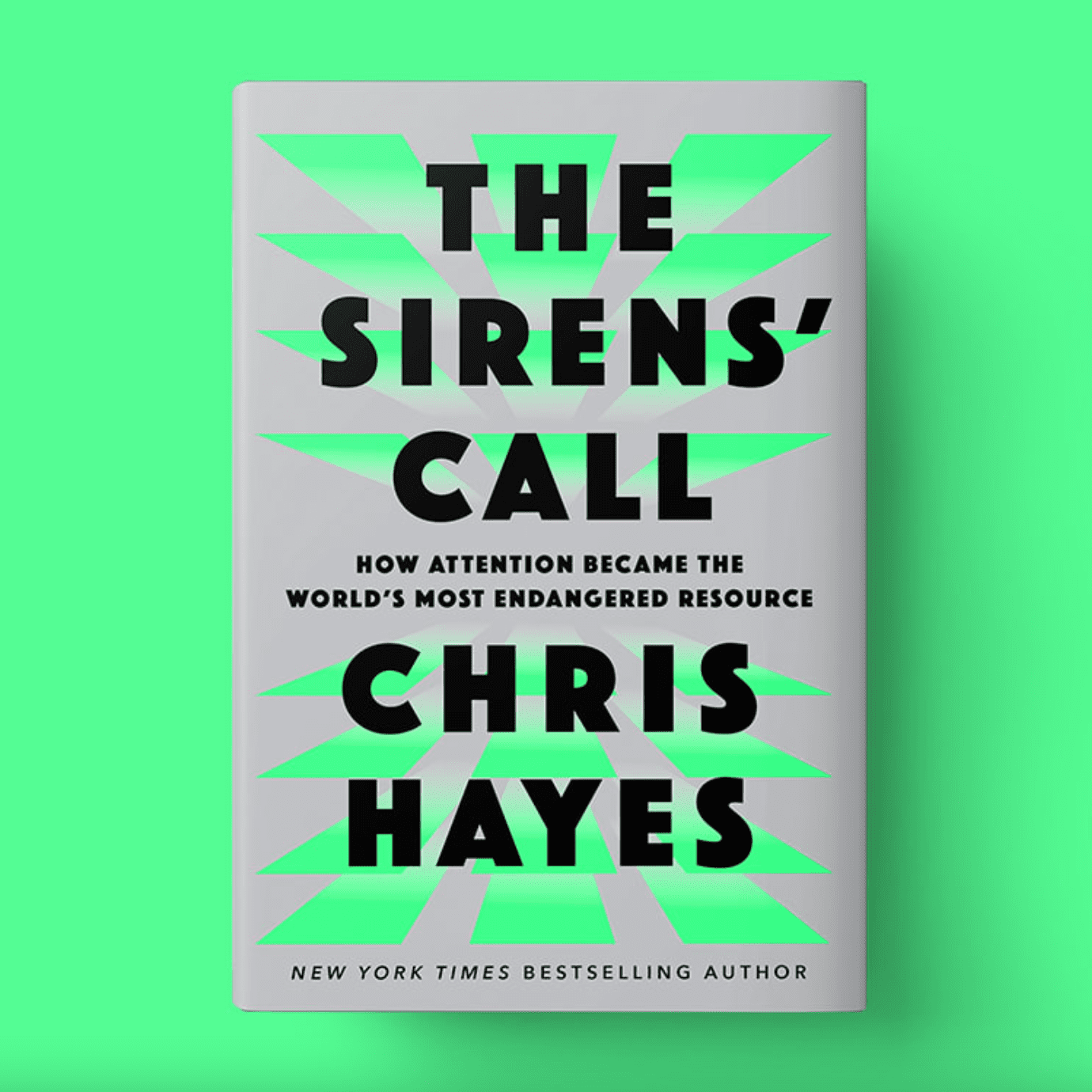

The Sirens’ Call: Complete Summary of Chris Hayes’s Insight into How Attention Became the World’s Most Endangered Resource
Introduction: What This Book Is About
Chris Hayes’s The Sirens’ Call: How Attention Became the World’s Most Endangered Resource explores how attention has become the most valuable and contested resource in the 21st century. Hayes, an Emmy Award-winning host on MSNBC and author, argues that our contemporary lives are fundamentally shaped by the constant struggle to capture and commodify human attention, transforming everything from personal well-being to public discourse. This book teaches readers how to understand the pervasive influence of the attention economy, its historical roots, and its profound impact on our minds and society.
Hayes delves into the psychological, economic, and social forces that have led to this shift, drawing parallels between ancient myths, philosophical concepts, and modern technological advancements. He explains why attention is increasingly scarce and how powerful entities exploit our innate desires to control it. Readers will gain a comprehensive understanding of how current societal conditions alienate us from ourselves and each other, and explore potential paths to reclaim control over our minds. This summary provides complete coverage of all key insights, arguments, and examples presented in the book.
Chapter 1: The Sirens’ Call
This chapter introduces the central metaphor of the Siren’s Call from Homer’s Odyssey to illustrate how human attention is compelled, often against our will. It argues that modern life is a constant state of being exposed to countless “sirens” vying for our attention, making it the most endangered resource.
Odysseus and the Compelled Attention
The Odyssey’s Book 12 describes Odysseus’s encounter with the Sirens, who enchant all who hear their song, luring sailors to their deaths. Circe advises Odysseus to stuff wax in his crew’s ears and have them bind him to the mast, anticipating his involuntary desire to follow the alluring sound. This powerful image has long served as a metaphor for temptation and the struggle between ego and id, what we want versus what we know we should resist. Hayes connects this ancient metaphor to the intrusive wail of modern sirens—emergency vehicle sirens—which universally grab our attention against our will, even across language barriers.
Attention as the Substance of Life
Hayes posits that attention is the substance of life, shaping every moment we are awake. William James, in his 1890 work The Principles of Psychology, stated, “My experience is what I agree to attend to.” Hayes argues that increasingly, our experience is something we don’t fully agree to, leading to a rupture in our dominion over our own minds. This ubiquity of compelled attention has profoundly transformed our inner lives across cultures. The author describes a personal struggle to resist the “little attention box” (smartphone) in his pocket, which “pulses there like Gollum’s ring,” highlighting the constant, almost physical instinct to engage with it.
The Problem with Phones: A Moral Panic?
Hayes acknowledges the widespread complaint about phones and screens as a source of universal frustration and distraction, with many calling them “digital heroin” or questioning if they’ve “destroyed a generation.” He notes the existence of an entire subgenre of parenting advice and blocking software aimed at managing “screen time” due to perceived mortal peril to children’s brain development. However, Hayes also cautions against viewing this solely as a “moral panic,” akin to past anxieties over the printing press, radio, or comic books. He cites sociologist Stanley Cohen’s 1972 definition of a moral panic as a social phenomenon where a group or trend is defined as a threat, stereotyped by media, and condemned by “right-thinking people.”
The Persistent Warnings of New Technologies
Despite the risk of moral panic, Hayes argues that many historical complaints about accelerating technology were broadly correct. Socrates warned about writing implanting forgetfulness, and early 20th-century critics fretted about radio noises causing illness and the shrinking attention spans due to magazines. Hayes contends that it’s when technology is “hottest to the touch” that it “burns most intensely.” He differentiates between past anxieties and the current situation by asking: “What is new and what is not?” and “What is and is not harmful?” He uses the analogy of tobacco use, which was initially dismissed as prudish but later proven to be deadly, questioning if future generations will view our phone use similarly to how we view chain-smoking in historical footage.
Attention as the Ultimate Resource
The core argument is that the current transformation is far more vast than commonly understood. The problem isn’t just “the phones”; they are a symptom of a deeper shift where attention has become the world’s most important resource. Unlike land, coal, or capital, attention is “embedded in our psyches,” requiring direct access to our minds for extraction. It is valuable both internally, constituting our inner lives, and externally, forming the foundation for relationships, work, consumption, and citizenship. Hayes highlights that information is infinite, but attention is limited, and value derives from scarcity. This makes attention supremely valuable, driving fortunes, elections, and even the toppling of regimes.
The Shift from Atoms to Bits
Hayes illustrates the economic shift by comparing the largest U.S. companies of 1961 (dominated by oil and industrial firms like Ford Motor and DuPont) to those of today (dominated by Microsoft, Apple, Google, Meta, and Amazon). The central economic activity has moved from manipulating atoms to manipulating bits. While information and data are crucial, Hayes argues that the mantra “Data is the new oil” misstates the core alienating aspect of this era. Information is abundant, copyable, and can be in many places at once, whereas attention is scarce and “can’t be in multiple places at once.”
The Attention Economy’s Pervasive Influence
The book contends that the pursuit of attention reorients every aspect of human life, from commercial to social, public, and political spheres. Amazon, for example, is primarily an “attention and logistics company,” using its search dominance to capture attention and even produce its own versions of popular products. This signifies a rapid shift towards a “snake oil model” where attention and marketing are more important than the actual product. Hayes argues that this phenomenon, identified by Naomi Klein in No Logo as the rise of brands over products, signifies how “the attention economy eats the real economy.”
Public Attention and Its Capriciousness
Hayes uses his own experience as an MSNBC cable TV host to demonstrate the capricious nature of public attention. He observes that news cycles are “fundamentally driven by and respond to mass attention,” rather than being “directed from above” by corporate media, as some believe. The Russian invasion of Ukraine served as an example, with coverage intensity declining as public attention waned over weeks and months. This dynamic creates a “herding instinct” in the news business, where fear of losing attention overrides other editorial judgments. Hayes contrasts his early belief in controlling his show’s content with the reality of “chasing audience attention much more than leading it,” likening it to a sailboat harnessing the wind.
Attention as a Commodifed Labor
Hayes concludes the chapter by comparing the commodification of attention to the commodification of labor during industrial capitalism. Karl Marx argued that wage labor alienated workers by turning their effort and exertion into a market commodity, separating them from the product of their work. Similarly, in the attention age, our intrinsic attention is extracted and turned into a commodity with a price, a process Hayes argues is “punishing and strange.” Unlike labor, attention can be extracted preconsciously, at a “purely sensory level,” before conscious will intervenes, just as a siren functions. This makes attention the defining feature of the age, deeply intertwined with human selfhood and constantly contested in all spheres of life.
Chapter 2: The Slot Machine and Uncle Sam
This chapter explores how the human mind’s finite attention struggles against an infinite influx of information. It details the three primary aspects of attention—voluntary, involuntary, and social—and how modern technologies exploit them, especially through the “slot machine model.”
Attention as a Solution to Information Overload
Attention exists to solve the problem of information overload. Herbert Simon’s 1971 essay noted that “a wealth of information means a dearth of something else: a scarcity of whatever it is that information consumes. What information consumes is rather obvious: it consumes the attention of its recipients.” Hayes explains that our brains are constantly screening information, suppressing most stimuli to allow us to function. Without this filtering, “disorganized, unwanted information pours in ceaselessly,” a state similar to acute attention deficit disorder.
Three Aspects of Attention
Hayes details three crucial aspects of attention:
- Voluntary attention: This is our conscious choice to focus, like reading a novel or listening intently in a conversation. It works by suppressing non-relevant stimuli. The “invisible gorilla test” illustrates this, where participants focused on counting basketball passes literally fail to see a gorilla walk through the scene due to high perceptual load.
- Involuntary attention: This occurs when external stimuli, like a loud crash or an emergency siren, automatically grab our attention. It functions as a survival mechanism, overriding voluntary focus to alert us to potential dangers.
- Social attention: This is the unique human capacity to focus on other people and to be the object of their focus. The “cocktail party effect” exemplifies this, where we can selectively tune out surrounding noise but immediately notice if our own name is spoken in a distant conversation. This implies a constant, subconscious processing of social cues.
The Cocktail Party Effect: A Deeper Dive into Social Attention
The cocktail party effect, where our brain processes background conversations for salient information like our name, highlights the complexity of social attention. Psychologist Neville Moray’s 1959 study found that a subject’s own name was almost the only stimulus that could consistently break through the “barrier” of focused listening in a dichotic listening experiment. This phenomenon suggests a deeper, preconscious mechanism designed to alert us when we are the object of others’ attention. This innate human need to be noticed and to know who is paying attention to us forms the third and final aspect of attention, playing a crucial role in human socialization.
The Challenge of Capturing and Holding Attention
Anyone in the “attention business” understands the two-step process: first, grab attention; then, hold it. Grabbing attention relies on loud, bright, or novel stimuli, like a tabloid headline or a TV show’s cold open. Holding attention, however, is far more difficult, requiring sustained engagement. Hayes uses the analogy of taking a room hostage with a gun: while easily grabbing immediate attention, holding it for two hours is “almost impossibly difficult,” as even hostages on a plane can experience boredom. This demonstrates that sustained voluntary attention cannot be simply compelled.
Hunger and Attention: An Evolutionary Parallel
Hayes draws a parallel between attention and hunger, both evolutionary necessities. Hunger compels us to seek food (e.g., Aron Ralston’s thoughts consumed by food after being trapped), just as danger compels our attention. Our biological predilection for salt, fat, sugar, and simple carbohydrates has been ruthlessly exploited by the modern industrial food industry, creating addictive responses. Similarly, there’s a “fast food” equivalent for attention: the lowest common denominator stimuli that hack our brain wiring for easy, immediate engagement, leading to mental “snacking” that leaves us “overfull and queasy.”
The “Slot Machine Model” of Attention
Hayes introduces the “slot machine model” as the dominant attention-capture strategy of our age. Slot machines, initially simple mechanical poker games, were refined by casino engineers to induce a “machine zone” where players are kept in a trance by repeated, brief, intense bursts of stimuli, suspense, and resolution. The goal is not winning, but “to keep playing—to stay in that machine zone where nothing else matters.” This model perfectly describes video games like Call of Duty, which logged “475,000 years of gameplay” annually, constantly besieging players with new threats.
Social Media’s Slot Machine Design
The “slot machine model” characterizes platforms like Facebook, X (formerly Twitter), Instagram, and TikTok. Their endless, vertically scrolling “feeds” provide a continuous stream of novel stimuli, iteratively grabbing attention without needing to hold it for long periods. This explains why “screen time” totals are shockingly high, accruing in “little ten-second increments.” This design circumvents the difficult problem of generating content that holds voluntary attention, instead focusing on maximizing fleeting engagements. Hayes argues that this strategy has made tech companies “the most powerful and profitable companies in the entire world.”
The Uncle Sam Method and Social Attention Exploitation
The chapter connects to the “Uncle Sam method” of directly addressing a target, as seen in the iconic “I want you” recruiting poster. In the digital age, this evolves into highly specific forms of social attention. Ad tech leverages vast amounts of personal data to identify and target users directly, creating the illusion of personal address (“Hey, Chris, I know you and Kate…”). Social media platforms have engineered the “cocktail party effect” into their code, using “mentions” and “tags” to trigger our innate desire for social approval. Former Google employee Tristan Harris notes how platforms “orchestrated” user tagging by “automatically suggesting all the faces people should tag,” thereby controlling “the multiplier for how often millions of people experience their social approval on the line.” This exploitation of our desire for social attention drives compulsive engagement and “meaningless internet points.”
Chapter 3: The Root of Evil
This chapter delves into the human craving for diversion and the psychological toll of boredom, arguing that these states are exacerbated by modern conditions and exploited by the attention economy. It draws on philosophical and anthropological insights to illustrate how the constant pursuit of external stimulation alienates us from our inner selves.
The Craving for Diversion and the Terror of the Uninterrupted Mind
Hayes begins by highlighting the human tendency to seek out distraction rather than confront an uninterrupted mind. He cites a 2014 University of Virginia study where participants, when left alone with their thoughts, often chose to administer electric shocks to themselves rather than do nothing. This extreme behavior underscores philosopher Blaise Pascal’s 1670 observation in Pensées: “all the unhappiness of men arises from one single fact, that they cannot stay quietly in their own chamber.” Pascal argued that this craving for diversion stems from a spiritual angst and the intolerable contemplation of our own mortality, affecting even kings who are constantly supplied with pleasures to avoid boredom.
The King’s Paradox and Amusement Creep
Pascal’s “king’s paradox” illustrates that no amount of wealth or comfort can shield one from the restless mind; the more diversion available, the more diversion we need. Hayes observes this “amusement creep” in modern life, where it’s common to watch a basketball game, scroll on a phone, and use a laptop simultaneously. He notes his horror at his own children watching a video game and a show concurrently, prompting him to enact “a new prohibition on watching two things at the same time,” only to be reminded by his son that he does the same with his phone. This constant need for stimulation creates a cycle akin to addiction, where increasing quantities of a “drug” (diversion) are needed to avoid feeling “desperately sick.”
Boredom: A Condition of Civilization, Not Human Nature
Hayes challenges the notion that boredom is an inherent human condition, suggesting it is a “by-product of a specific civilizational arrangement.” He references anthropologist Marshall Sahlins’s argument that hunter-gatherers worked less and had abundant leisure, characterized by “a lot of lounging,” with no concept of “passing the time.” Anthropologist Michael Cepek noted that the Cofán people in the Amazon lack a word for “boredom” and “seem to enjoy…just sitting there on a floor, in a chair, in a hammock and looking and thinking.” Similarly, the Nalotan people of the South Pacific and the Aboriginal Warlpiri of Australia also lack a native term for boredom, often using the English word “boredom” as an import. Hayes concludes that boredom is an “invasive mental state” produced by modern societal structures, particularly industrial capitalism.
Tedium and the Industrial Revolution’s Monotony
The Industrial Revolution introduced “tedium”, a specific form of boredom arising from repetitive tasks. Hayes explains that as complex tasks become automatic through repetition (like driving a car), they no longer absorb full attention, allowing boredom to rush in. This contrasts with pre-industrial life’s seasonal rhythms and varied tasks. Karl Marx identified this as the root of alienation, where the division of labor reduced workers to performing the “same single thing day in and day out,” becoming an “appendage of the machine” and losing authorship over their product.
Keynes’s Prophecy of Leisure and Ennui
John Maynard Keynes, writing in 1930, predicted a future where technological advancements would solve the “economic problem,” freeing humanity from work. However, he foresaw a new challenge: “simply not having enough to do, a kind of ennui.” Keynes warned of a “society-wide nervous breakdown” as people, unbound from material constraints, would struggle to “live wisely and agreeably and well” without traditional purposes. He observed this among “wives of the well-to-do classes” who were “deprived by their wealth of their traditional tasks.” Hayes connects this to the modern experience where we still face the tedium of wage labor but then turn to devices as a reflex to flee the discomfort of being alone with our thoughts, creating an “attentional treadmill.”
Infinite Jest and the Infinite Scroll
David Foster Wallace’s novel Infinite Jest (1996) serves as a literary premonition of the attention age, featuring “The Entertainment,” a mysterious tape so engrossing viewers watch it until they die. Hayes argues that “infinite entertainment is now what we confront” through social media. Aza Raskin’s invention of the “infinite scroll” removed the “tiny little bit of attentional friction” of clicking to the next page, allowing users to scroll endlessly. Raskin later realized his invention had induced “200,000 more human lifetimes” of scrolling, describing it as a “weapon” that consumes human life.
Boredom, Distraction, and Flow
Hayes outlines a schema for mental states:
- Boredom: Too little interesting to pay attention to.
- Distraction: Too much to pay attention to, leading to a sense of being overwhelmed.
- Flow: The “Goldilocks zone” of just the right amount of attention, a deeply pleasurable state where attentional capabilities are perfectly stretched, and one is “completely involved in an activity for its own sake.”
The constant availability of diversions paradoxically makes us more easily bored and more distracted. We flee emptiness but struggle to find the sustained absorption of flow.
Kierkegaard: Boredom as the Root of All Evil
Søren Kierkegaard, in Either/Or (1843), famously declared boredom to be “the root of all evil,” seeing its ascent in his own age. He distinguished boredom from idleness, arguing that true idleness is a “divine way of life” if one is not bored. The issue is not simply being occupied, but rather one’s “comfort with your own thoughts.” He suggested that attempts to annul boredom through amusement or work are mistaken, as they fail to address its existential and spiritual roots. Kierkegaard proposed the “principle of limitation” as a “saving one in the world,” embracing stillness and allowing the mind to wander.
Reclaiming the Mind’s Wanderings
Hayes connects Kierkegaard’s insights to Buddhist meditation, where focusing on the breath tames the restless mind, enabling a state of emptiness that makes boredom impossible. He describes his own practice of daily walks, pre-smartphone and podcast, as a source of “structured daydreaming” and “mind-wandering with a purpose,” leading to his “best thinking.” Daydreaming, reverie, and mind-wandering, “a central experience of being alive,” are presented as casualties of the attention age. Hayes cites Johann Hari’s experience of rediscovering these joys after a digital sabbatical, and Jenny Odell’s book How to Do Nothing as advocating for perceiving what is “actually there” by holding oneself still.
Chapter 4: Social Attention
This chapter focuses on social attention, arguing that it is a fundamental human need rooted in our evolutionary helplessness and is distinct from other forms of attention. It examines how this primal need for social connection is exploited by modern technology, leading to alienating experiences of fame and performance.
The Primal Need for Social Attention
Hayes argues that social attention is fundamental to human survival, stemming from the complete helplessness of human infants at birth. The piercing cry of a newborn universally commands attention, overriding all else, because “the lack of proper attention from caretakers can be catastrophic.” This establishes social attention as a matter of survival, shaping our earliest experiences. Even as we grow, the need for social attention persists as a “baseline for human flourishing.” Prolonged deprivation of it, as in solitary confinement, can lead to mental deterioration, echoing Pascal’s observation that “the prison is so horrible a punishment” because it deprives one of human interaction.
Solitude and Loneliness in Modernity
Hayes notes that solitary confinement, as practiced in America’s “Pennsylvania System,” aimed to force “penitence” through isolation but instead led to despair, insanity, and even death, as observed by Alexis de Tocqueville and Charles Dickens. Nelson Mandela’s experience in isolation, where he “desperately wants something outside of oneself on which to fix one’s attention,” further illustrates the dehumanizing effect of the absence of human companionship. Hayes argues that while solitude can be a joy, modern society has created unprecedented levels of it. Sociologist Eric Klinenberg notes that over a quarter of U.S. households contain just a single person, a phenomenon that has sharply increased with economic development. U.S. Surgeon General Vivek Murthy has identified a “loneliness epidemic,” with health effects comparable to smoking 15 cigarettes a day, highlighting that our brains still process prolonged solitude as a physical threat.
Social Attention: Distinct and Essential
Hayes defines social attention as any instance where the object of our attention is another person. It is distinct from other forms of attention due to its unique intensity and the way our neural wiring responds specifically to other humans, their faces, and expressions. It forms the “lowest common denominator for any kind of social connection,” requiring nothing more than to be noticed. While it doesn’t carry specific emotional content (like love or anger), it is the necessary precondition for all deeper human bonds. The shift of a parent’s attention to a newborn, or an older sibling’s reaction to it, exemplifies how the division of attention is immediately perceived and often rebelled against.
Unilateral Social Attention and Fame
Crucially, social attention is not inherently reciprocal and can be extended unilaterally. We can pay attention to people we don’t know (like celebrities) and strangers can pay attention to us. This leads to the phenomenon of fame: receiving social attention from strangers. Leo Braudy’s The Frenzy of Renown shows that while ancient god-kings had institutional fame, Alexander the Great was the first true “fame-seeker” who consciously pursued glory, embodying an “unspecified spiritual greed.” With mass media and later social media, fame has become democratized, with any individual “just one viral flare-up away from being known suddenly.”
The Alienating Experience of Fame
Hayes describes his own “inescapable strangeness” of being known by strangers as a cable news host. He notes the “profound asymmetry” of fame: positive attention barely registers, while “negative attention stings at a level of emotional depth that is downright shocking.” This is because our psyche is conditioned to interpret all attention as coming from known individuals with whom we have reciprocal relationships. When a stranger’s negative comment lands, it feels as if “someone you love had uttered the words,” even though “that something is a fiction.” This leads to a compulsive checking for mentions and a “howling vortex that fame can never fill.” Hayes observes that famous people, like Kevin Durant or Tina Fey, often engage in public “fits” on social media due to this “psychologically destabilizing experience.”
The Mechanization of the Gaze and the Internet
The earliest incarnation of Facebook, “The Facebook,” mechanized the gaze by allowing users to look at each other’s profiles, transforming the “physical gaze of locked eyes across the campus quad into a virtual version.” This created a “clearinghouse of social attention.” Hayes explains that to exist online now “is to be, at every waking moment, seeing yourself through the eyes of others,” leading to a “deeply alienating” experience of self-consciousness.
Willy Loman and the Thirst for Attention
Arthur Miller’s Death of a Salesman provides a powerful illustration of the thirst for attention. Linda Loman’s plea for her husband, Willy, that “attention must be paid,” highlights a universal human need for dignity and to be noticed. Willy Loman’s tragedy stems from his deep desire to be known and noticed, rather than being “ignored” or “fall into his grave like an old dog.” Hayes argues that this “cloying thirst for attention” is not new but is amplified by the internet, turning us all into “Reply Guys” or exhibiting “thirst,” a Gen Z slang term for the “overly, palpably trying to get people to look at you.” This relentless self-promotion has become the “business model of the entire attention economy,” forcing artists and authors to be entrepreneurs constantly marketing their work.
Recognition vs. Attention: The Kojèvean Paradox
Hayes introduces Alexandre Kojève’s interpretation of Hegel’s master-slave dialectic to explain the paradox of seeking attention. Kojève argued that the fundamental human drive is the “desire for recognition from other humans,” a need to be seen as a subject by another subject. This recognition requires equality between subjects. However, in the “Star and the Fan” dynamic of the attention age, the Star seeks recognition from the Fan, who is a stranger and cannot be fully recognized by the Star. Therefore, the Fan’s attention “doesn’t satisfy the core existential desire,” leading to a cycle where the Star gets “attention” instead of “recognition.” Hayes calls this a “synthetic version of our most fundamental desire,” similar to “empty calories” or the difference between sex with someone you love and taking a drug.
Elon Musk: The Ultimate Attention Addict
Elon Musk serves as the ultimate modern example of this paradox. Despite being the “world’s richest man” with “riches past all imagination,” Musk’s “pathological degree” of desire for attention led him to purchase Twitter for $44 billion, an “impulse purchase” that destroyed its value but satisfied his “bottomless” psychological need. Hayes cites Musk’s statement on CNBC—”I’ll say what I want to say, and if the consequence of that is losing money, then so be it”—as evidence that for Musk, attention is more valuable than anything else, even “tens of billions of dollars.” This illustrates that the pursuit of attention, a “poor but plausible substitute” for recognition, can drive individuals to extreme and self-destructive lengths.
Chapter 5: Alienation
This chapter examines alienation as the defining experience of the attention age, drawing parallels to Marx’s theory of alienation under industrial capitalism. It argues that the commodification of attention leads to a sense of foreignness regarding our own minds and creates a constant competition that degrades our collective attention.
Alienation as a Modern Condition
Hayes defines alienation as a “subjective experience of something that should be part of us seeming foreign or alien to us.” It is a “sense of dis-integration,” a feeling that our “very interior life, the direction of our thoughts, is being taken against our will.” He illustrates this with the example of Taliban fighters-turned-bureaucrats in Kabul who experienced “endemic boredom, restlessness, and unhappiness” when forced into office jobs after years of insurgency. Despite their violent past, they found themselves addicted to the internet, particularly Twitter, to cope with the “wearisome” monotony of modern work, highlighting a “speedrun of the alienation that comes with modernity.”
Marx’s Theory of Alienation and Commodification
Hayes revisits Karl Marx’s theory of Entfremdung (estrangement) as the defining experience of workers under capitalism. Unlike an independent craftsman who owns his product and pours his “effort and skill and toil” into it, the factory worker is alienated from the production process, the product itself, and even his own humanity. Capitalism, Marx argued, reduces labor to “simplified units” that “anyone can perform,” making it a “commodity” that can be bought and sold. Hayes argues that the modern attention economy does something similar to attention: it transforms it from an intrinsic human capacity into a commodified market good, leading to “alienation” where “what our mind rests upon” is “packaged and sold as if it were interchangeable with the attention of everyone else.”
The Commodification of Attention: From Penny Press to Ad Tech
The commodification of attention began with the penny press in the 19th century, starting with Benjamin Day’s The Sun in 1833. Day monetized reach by selling audience attention to advertisers, discovering “attention hacks” through lurid stories and crime reporting that became the precursor to “clickbait.” This model—giving away the product (news) to sell the audience to advertisers—became the dominant business model for print, radio, TV, and social media over two centuries. However, a persistent problem has been measuring and verifying purchased attention, leading to “fraught tug-of-war” between publishers and advertisers. Early methods like Nielsen ratings (using diaries, then metering devices) were imprecise, and Hayes argues that even today’s “multi-billion-dollar global ad-tech industry” faces similar issues.
The “Subprime Attention Crisis”
Hayes introduces Tim Hwang’s concept of “subprime attention,” comparing it to the housing market crisis of 2008. Hwang argues that the commodification of attention has become so abstract that markets trade in units of attention “divorced from the actual attention of real human beings.” This creates opportunities for fraud, with evidence suggesting that “nearly 30 percent of all web traffic showed what it called ‘strong non-human signals’” (bots) in 2018. Hayes emphasizes that even if genuine human attention is captured, the commodification process standardizes it, implying that “every ten seconds spent looking at a screen is the same as every other ten seconds,” which is “obviously untrue” given the qualitative differences in attention (e.g., mindless scrolling versus intense focus on a loved one’s video).
The Fictitious Commodity of Attention
Zoe Sherman and Karl Polanyi’s concept of a “fictitious commodity” (like labor) is applied to attention. While attention is traded and priced like a commodity, it is not “produced for the market as such” and is “inseparable from our very humanity.” The alienation felt in the attention age stems from this tension: attention as a market good vs. attention as the “substance of our lives.” Hayes argues that the drive for endless capitalist growth collides with the fixed quantity of human attention. Since new attention cannot be created like resources, attention capitalists must find “new ways to take it from us,” primarily by extending the time attention can be captured (smartphones, Apple Vision Pro) and expanding the universe of people to mine attention from (children, even babies, as with CoComelon).
The Race to the Bottom in Attention Markets
Hayes explains that as demand for fixed attention increases, the market becomes more competitive, driving competitors to take “bigger and bigger slices away from others.” This leads to a “race toward the bottom,” characterized by “sensory overload” in unregulated “Hobbesian battle[s] for your attention,” like Times Square or a casino floor. He illustrates this with cable news ratings, where the fear of losing audience attention (“hammock” effect) leads to “chasing stories of perhaps dubious editorial value.” The Fox News response to losing viewers after the 2020 election exemplifies this: internal communications show “pathologically obsessed” executives and on-air personalities were “terrified of losing viewers” and pursued a conscious strategy to “own the dominion story” (conspiracy theories about rigged election machines) to win back audiences, highlighting how competitive attention markets will “always push the boundaries of truth.”
Spam as the Defining Problem of the Attention Age
Hayes argues that spam is “the defining problem of the attention age,” analogous to “smokestack pollution and smog-filled skies” in the industrial revolution. He defines spam as “the use of information technology infrastructure to exploit existing aggregations of human attention.” The term originated from a 1970 Monty Python sketch depicting an overwhelming, unwanted presence of Spam. The first commercial spam in 1994, from Laurence Canter and Martha Siegel, who advertised their green card services across all Usenet newsgroups, demonstrated that “the marginal cost of posting on the internet was basically nothing, while the attention you might capture was valuable.” Spam proliferates because “it costs the spammer nothing to distract us. It costs a lot to be distracted.” This constant defense against unwanted attention is an “inherent and irresolvable tension of attention capitalism,” where “growth will keep hitting up against the limit of attention.”
Individuation and Social Alienation
Alienation is exacerbated by how attention technologies have “individuated” our attention, making “mass culture—the electricity of collective attention—becomes more and more difficult to sustain.” He contrasts the collective experience of early TV viewing (families watching together) with today’s “individual device” culture where “each of the children is on an individual device, each watching something different, each paying attention alone.” The Walkman’s introduction in 1979 was an early harbinger, creating a “hermetic loneliness” that prompted a backlash. The “infinite scroll” and algorithms of apps like TikTok offer a “bespoke algorithmic experience” that makes the sequence of consumed content unique to each user, leading to “privatized and solitary” spectacle. While a “viral meme” attempts to recreate “paying attention together,” it does so in a “attenuated” and “solitary” two-part process of “I view and then I share.”
Chapter 6: Dawn of the Attention Age
This chapter positions the attention age as a third wave of human history, following the agricultural and industrial revolutions. It explores how the explosion of information and the shift to nonmaterial production inevitably led to attention becoming the most valuable resource, driving profound changes in society.
The Third Wave: From Information to Attention
Hayes situates the attention age within Alvin Toffler’s “Third Wave” framework, which divides human history into:
- First Wave: The Neolithic revolution (agriculture, settled societies, sun/human labor energy).
- Second Wave: The Industrial Revolution (mechanization, fossil fuels, mass production).
- Third Wave: The information age (computing power, information manipulation).
Hayes argues that the information age, with its “radical increase in the sheer volume of data” and its “economic centrality of information,” logically and inescapably leads to the attention age. He explains that while data is quantifiable, the amount of information is practically infinite, making access to all human knowledge a profound shift.
The Shift to Nonmaterial Production
The information age is characterized by “nonmaterial production,” focusing on the “flow, processing, and transformation of information rather than matter.” This contrasts with industrial production’s physical conversion of raw materials into products. Hayes illustrates this with declining “oil intensity” (energy per unit of GDP) and the massive expansion of “knowledge work” (office jobs) as a share of employment, demonstrating a fundamental shift in economic activity. He describes his own experience as a child transitioning from limited physical information to having “access to all human knowledge” through the early internet, which felt like a “magic portal” and a “thrilling and addictive” sense of discovery.
Information Overload and the Scarcity of Attention
The inherent problem of the information age is “information overload.” Hayes notes that our inboxes are “choked with unread messages” and that we labor “under the strain of information being cheap and plentiful and overwhelming.” He uses the analogy of food abundance in the wealthy world leading to obesity, arguing that similarly, “we were once starved and are now stuffed” with information. This brings him back to Herbert Simon’s core insight that “a wealth of information creates a poverty of attention and a need to allocate that attention efficiently among the overabundance of information sources that might consume it.” Simon identified that the information age must also be the attention age because “information consumes attention,” and attention is scarce, making it increasingly valuable.
Designing Organizations for Attention Conservation
Simon’s work focused on how organizations manage information. He argued that an “information-processing subsystem (IPS)” is useful only if it “absorbs more information previously received by others than it produces,” functioning as an “information condenser” that allows information to be “withheld from the attention of other parts of the system.” Hayes applies this to the U.S. federal government, where the President’s attention is the “most precious resource” and the White House’s structure is designed for “ruthless delegation and protection of the president’s time.” He cites Steve Jobs as a master of this principle, who would ask Jony Ive, “‘How many things have you said no to?’” emphasizing that “attention is negation.”
The Productivity Paradox and Google’s Role
Hayes addresses the “productivity paradox,” the mystery of why economic productivity hasn’t grown more, despite rapid technological advances. He points out that while computing power has increased exponentially, human attention remains the limiting factor. Google is presented as the “ultimate information processing system,” designed to “organize the world’s information and make it universally accessible and useful” by effectively screening information and delivering only the relevant bits. This “conserved the user’s attention” and gave Google “exclusive access to the most precious resource,” allowing it to sell that attention through AdWords (later Google Ads), becoming “stunningly profitable.”
Surveillance Capitalism and Spam’s Iron Law
Hayes aligns with Shoshana Zuboff’s “surveillance capitalism” in describing Google’s model, where user data is used to target ads. However, Google faces a paradox: its need to grow means it must sell more and more user attention, but “the more they sell of the user’s attention the less they are conserving that attention.” This leads to “Google has ended up spamming its own users,” as seen in search results dominated by paid, often irrelevant, ads. Hayes states the “iron law of technology in the digital age”: “you can never defeat spam; you can only manage it.” Spam, defined as “the use of information technology infrastructure to exploit existing aggregations of human attention,” thrives wherever attention collects, “devalu[ing] it for everyone else—that is, in plain language, they waste our time for their benefit.” This creates an “inherent and irresolvable tension of attention capitalism” because attention is fixed, but capitalism demands boundless growth.
The Limits to Attention
Hayes draws a parallel between the “Limits to Growth” environmentalist critique (finite resources vs. infinite capitalist growth) and the limits of human attention. While human ingenuity has found ways to extract more physical resources, the fundamental limits of attention persist. He describes how “attention capitalism extracts more of the resource than once appeared possible” by “fracking our minds,” leading to an expansion in attention even if its quality degrades. He points out that while it once seemed absurd to drive and listen to radio, or watch a TV show while scrolling a phone, these are now common. However, humans are “serial processors,” meaning we can only “truly focus—on only one thing at a time,” representing a “fixed limit” that technologies will inevitably confront.
Attention as a Tradable Resource
Michael Goldhaber’s 1997 lecture “The Attention Economy and the Net” extended Simon’s insights into the social realm, arguing that attention is not just consumed but “can be moved around: exchanged, gifted, and traded.” Goldhaber contended that conversation is “primarily an exchange of attention,” and that “if you have the attention of an audience, you can then pass that on to someone else.” He predicted that as societies grew richer, “obtaining attention” would become a key motivator of human action, leading to an “unending scramble” and increased demands on each of us to “pay what scarce attention we can.” While Goldhaber initially believed “money flows to attention, and much less well does attention flow to money,” Hayes argues that capitalism has proven flexible enough for money to purchase attention, as seen with Elon Musk spending $44 billion to buy Twitter and secure the world’s attention.
Chapter 7: Public Attention
This chapter analyzes the erosion of public discourse and democratic deliberation in the attention age. It contrasts the historical model of focused debate (like Lincoln-Douglas) with contemporary political communication, highlighting how attention has become an end in itself, leading to trolling, whataboutism, and conspiracism.
The Lost Art of Focused Debate
Hayes begins by contrasting contemporary public discourse with the Lincoln-Douglas debates of 1858, which despite being three-hour-long “spectacles” of “straight speechifying” were characterized by a “density of language and argumentation.” Neil Postman viewed these as a model of “democratic culture of communication,” grounded in the print medium’s “literary” mode of thought. Hayes points out that the debates featured complex, nuanced ideas, parenthetical clauses, and citations, all requiring “sustained attention and focus” from both speakers and audiences, particularly on the single, high-salience issue of slavery. He argues that the success of the abolitionist movement in capturing national attention was crucial in forcing this focus, exemplifying a “two-step model of public discourse: get attention for your message, then persuade them.”
The Collapse of Attentional Regimes
Hayes argues that in the attention age, “both formal and substantive attentional regimes have collapsed.” A debate, like a meeting following Robert’s Rules of Order, is an “attentional regime,” a “formal means of regulating where and how attention will flow” to facilitate “fact-finding, deliberation, decision.” Without these rules, attention becomes “exclusive,” swallowing debate and persuasion, and ascending from a means to an end to the “end itself.” Hayes notes that the internet, despite its promise of democratizing communication, did not restore logocentrism but rather birthed “meme culture” and a “disorienting” “endless aural hall of mirrors” where “everyone had to shout to be heard.”
Donald Trump: The Ultimate Attention Hacker
Donald Trump is presented as the political figure who “most fully exploited the new rules of the attention age,” intuiting that “attention is all that matters.” Hayes compares Trump’s approach to P. T. Barnum’s calculation: “say anything you like about me, but spell my name right.” Unlike traditional politicians who need positive attention for likability and persuasion, Trump operated on the principle that if he “drew attention to certain topics, even if he did it in an alienating way, the benefits of raising the salience of issues where he and the Republican Party held a polling advantage would outweigh the costs.” His “repellent but transfixing” behavior—like accusing Mexico of sending rapists or proposing a Muslim ban—consistently attracted attention, even if it garnered negative reactions.
Attention vs. Persuasion: The Trump Trade-Off
Trump’s strategy created a trade-off: he would “pull off the improbable trade of persuasion for attention, likability for salience.” For example, his relentless focus on immigration and building a wall, despite polling opposition, kept attention on an issue where Republicans had an advantage. His constant interruptions in debates (e.g., “Will you shut up, man?”) were the “logical conclusion of his core insight: that there is no attentional regime anymore.” Hayes acknowledges that this approach isn’t foolproof, as many “Trump-style attention hounds” lost “winnable races” in 2022 due to their “intensely repellent persona.” However, Trump’s success demonstrated that “attention has never mattered more…and you have to be prepared to do anything to get it.”
The Perils of Attentional Warlordism
Hayes describes the current public sphere as akin to a “failed state,” where the “government’s monopoly on the legitimate use of force has come apart,” replaced by “attentional warlordism.” In this environment, “the most important trait is the ability to get attention, above all else. The shamelessness to interrupt.” While platforms like Google, Facebook, X, and TikTok act as “controlling sovereign[s]” by “regulating and controlling attention,” their primary purpose is to “maximize its monetization,” not to foster “vigorous debate” or “orderly administration.” This means that public discourse is “wholly dominated by commercial platforms” that produce a public with “a difficult time sustaining focus.”
Trolling: The Lure of Outrage
Trolling, initially a fishing metaphor, has become a central form of public communication in the attention age. It involves intentionally attracting attention through “ostentatiously cruel, or outrageous, or offensive” provocations. Hayes attributes its rise to the depersonalization of online interaction, where “normal inhibitors for all kinds of antisocial behavior are eradicated.” Because online interactions are “gamified” and “divorced from the full breathing laughing suffering reality of other humans,” attracting negative attention becomes a means of “feeling something” and gaining “meaningless internet points.” Platforms monetize this “conflict,” incentivizing “content creators” to engage in it. The “troll dilemma” arises: ignoring them allows them to escalate harmful messages, but condemning them only gives them more attention, which is what they seek. Hayes notes that mass shootings are a horrific form of trolling, motivated by a “dark desire for attention,” presenting a journalistic dilemma: covering them provides the perpetrator with what they wanted.
Whataboutism: A Battle Over Focus
Whataboutism, a rhetorical device often used by the Soviet Union to deflect human rights criticisms, is defined as a “battle over what to focus on.” Hayes notes that it can be a cynical ploy but also a “rebellion against whoever is trying to control the attentional space.” In the attention age, where public attention is “scattered and diffuse,” ideological battles become a contest over “what to focus on.” He illustrates this with the differing coverage priorities of cable news networks (e.g., Trump’s criminal cases vs. Hunter Biden’s case). This constant “whatabout” game allows for “egregious abuse” through selective focus, as seen in Tucker Carlson’s coverage of Covid-19 vaccine side effects, which, without explicitly lying, created a “wildly false impression” of danger by only focusing on adverse events. Hayes argues there is “no standard or objective set of criteria” for what deserves public attention, making it a “judgment call” open to constant critique.
Conspiracism: The Allure of Newsworthy Lies
Hayes argues that the attention age has been a “boon for conspiracy theories” because they are “often, in fact almost always, more attention-grabbing than reality.” He gives the example of a fabricated video of Barack Obama “crying” and promising reparations for bombed Iraqis, which went viral because its invented reality was “far more memorable and attention-getting than the brutal banal reality of US policy.” Conspiracy theories, like the QAnon belief or Trump’s false claims about the 2020 election, offer “the thrill of secret knowledge” and a “perversely comforting vision of elite competence,” making the world “legible” even at the cost of truth. The “annihilation of the old, relatively closed system of informational gatekeepers” means that “a big lie is often more attentionally compelling than a list of small truths.” The disaggregation of attention markets removes reputational costs for being unreliable, as those seeking to go viral don’t worry about long-term reputation.
The Erosion of Democratic Deliberation
Hayes concludes that the “erosion of the last vestiges of a functional attentional regime” makes democratic deliberation “not only impossible but increasingly absurd.” He cites Trump’s ability to avoid articulating a clear position on the Israel-Hamas war, instead resorting to “contradictory rhetorical gestures and evasions,” as an example of how “voters are supposed to even begin to evaluate what they would be voting for.” The decline in the political press’s ability to focus national attention means that “we have a country full of megaphones, a crushing wall of sound,” making it “like trying to meditate in a strip club.” This leads to a collective civic mental life that “permanently teeters on the edge of madness,” characterized by a “burbling, insistent ruckus of a deeply unquiet mind.”
Chapter 8: Reclaiming Our Minds
This concluding chapter offers paths forward to reclaim personal and collective control over our attention. It suggests both market-based alternatives and government regulation, emphasizing that restoring our agency over what we pay attention to is essential for a flourishing human future.
The Pervasive Sense of Dread and Enshittification
Hayes acknowledges the widespread “sense of dread and doom” in the current age, particularly online, and counters the idea that this is merely a byproduct of aging. He points to the “enshittification” coined by Cory Doctorow, describing how platforms first serve users, then abuse them for business customers, and finally abuse both to extract all value for themselves, leading to their decline. The data supports this pessimism, showing a sharp rise in depression and suicide among teenagers and children, a secular decline in self-reported happiness since smartphone adoption (especially among teens), less in-person interaction and fewer friends, and declining standardized test scores globally since 2012, all correlated with increased phone use.
The Gap Between Desired and Actual Attention
Hayes identifies a crucial “gap between what we want to pay attention to and what we do end up paying attention to.” People often find themselves scrolling social media despite intending to read books or pursue hobbies, feeling “subtly, insidiously coerced.” He poses the question: “If you had full power of your own attention…what would you do with this superpower?” He believes most people would choose to focus on family, friends, loved ones, hobbies, and personal projects that bring joy and satisfaction.
Odysseus and Commitment Mechanisms
Hayes returns to the metaphor of Odysseus binding himself to the mast as a “commitment mechanism.” This act, made in advance of anticipated temptation, is crucial for personal behavior modification, such as quitting smoking or adopting an exercise routine. He contrasts this with the current attention-age markets that are “getting faster and faster…to keep us flitting and engaging and avoiding commitment.”
The Video Store Model: Intentional Attention
Hayes nostalgically recalls the video store as a model of “proactive and intentional choice” in directing attention. Going to a video store required a “committed decision” about a movie to watch for two hours, binding oneself to the mast. Unlike today’s endless streaming choices that facilitate “constant anxiety of choice,” the video store’s limited supply and physical act of selection fostered deliberate engagement. While not a nonprofit, it represented a commercial model that, inadvertently, encouraged intentional attention.
Vinyl Records: A Parallel Revival
The resurgence of vinyl records serves as a contemporary example of consumers opting for a more intentional attention experience. After decades of decline, vinyl sales have grown for 17 consecutive years, driven by physicality, better sound quality, and the commitment required to listen to an entire album. This contrasts with streaming services’ “endless anxiety of choice” and constant skipping. Hayes hopes this trend signals a broader shift towards “evading or upending the punishing and exhausting reality of the endless attention commodification.”
The Physical Newspaper: An Intentional Attentional Regime
Hayes sees the physical newspaper as the “vinyl of news,” representing an intentional attentional regime. Editors make deliberate decisions about story placement, headline size, and photo inclusion, using these “attentional signals” to guide the reader’s focus to “editorial importance.” He contrasts this with the online version of the same newspaper, where “hot takes and rage bait” often go viral, demonstrating the difference between attention directed by “intentional editorial process” versus “casino-like mechanisms of the ‘platforms.’” This niche habit, though small, represents a “pre-attention age means of directing attention.”
Farmers’ Markets for Attention
Hayes predicts the rise of a “parallel market for alternative attention products,” similar to the growth of natural food, organic farming, and farmers’ markets. He cites the stubborn resistance of book buyers to ebooks, the persistence of print newspaper subscribers, and the growing movement of parents and schools banning screens for children as early signs. The emergence of “dumb phones” is another example. These “quirky and weird and small and countercultural” initiatives, like the growth of Whole Foods from a small natural food store, represent emerging markets driven by consumer demand to “opt out of constant attention commodification.”
Reclaiming Noncommercial Digital Spaces
Hayes advocates for noncommercial digital spaces, recalling the “open internet” of the 1990s that prioritized interaction and community building over commercial interest. He points to group chats (WhatsApp, Signal, DMs) as the closest modern equivalent to this noncommercial internet, where individuals “exchange texts, memes, clips, jokes” with people they know in “nonalgorithmic, nonpublic sharing and communication.” He notes that Instagram CEO Adam Mosseri acknowledged that most growth in the app is now in “stories” and “direct messages,” indicating a user preference for “semi-private” or “private” interactions. Hayes argues that the end-to-end encrypted Signal app, run by a nonprofit, exemplifies a model that explicitly rejects “growth hacking” and manipulation, offering a way to “bring them back”—noncommercial options that foster genuine connection without attention commodification.
Regulating Attention: A Call for a Labor Movement Parallel
Hayes proposes that society needs something akin to a labor movement for attention. He draws parallels between the commodification of labor in the 19th century and the commodification of attention today, both leading to “widespread alienation.” Just as labor movements advocated for banning child labor and limiting working hours, Hayes argues for government regulation of attention. He acknowledges the First Amendment challenges to regulating attention, but suggests age minimums for social media platforms as a “sensible” starting point, arguing that children “can’t really consent to expropriation of their attention.” He speculates about broader regulations, like “mandatory, legislated hard cap on…screen time,” and addresses the “intolerable assault on our cherished freedoms” argument by likening it to the Lochner era (1905-1937), when the Supreme Court struck down progressive labor laws on the grounds of “freedom of contract.” Hayes believes we are in an “attention Lochner era” that will eventually end, as the state finds ways to “bring it to heel.” He concludes by advocating for a “movement that resists the predations of attention capitalism,” using “every tool and strategy imaginable to wrest back our will,” and create a world where we control our attention, making our way “back home to the people we love, the sound of the sirens safely in the distance.”
Key Takeaways: What You Need to Remember
Core Insights from The Sirens’ Call
- Attention is the most valuable and scarce resource: In an information-rich world where information is infinite, human attention is finite and thus highly coveted.
- Attention is commodified: Like labor in industrial capitalism, our attention has been transformed into a market good that is bought, sold, and traded, leading to widespread alienation.
- Modern technologies exploit innate human desires: Platforms leverage our primal need for social attention and our brain’s involuntary responses to constantly capture and monetize our focus.
- Public discourse is eroding: The collapse of shared attentional regimes in media and politics has replaced structured debate with a “war of all against all” for attention, prioritizing outrageousness over persuasion.
- Alienation is the defining experience: The constant battle for our attention and its commodification leads to a pervasive sense of estrangement from our own minds and from genuine human connection.
- The “slot machine model” dominates: Social media and other digital platforms iteratively grab fleeting attention through constant, novel stimuli rather than holding it with substantive engagement.
Immediate Actions to Take Today
- Consciously manage your screen time: Track your usage and actively choose to disengage from endless scrolling to reclaim moments of uninterrupted thought.
- Seek intentional forms of attention consumption: Prioritize activities like reading physical books, listening to entire albums on vinyl, or engaging with in-depth journalism that requires sustained focus.
- Cultivate noncommercial social connections: Spend more time in group chats or direct messages with friends and family, fostering genuine human connection free from algorithmic manipulation and advertising.
- Practice mindful disengagement: Embrace moments of idleness and silence to allow your mind to wander, as a counter to the constant craving for diversion.
- Support or create alternative attention products: Look for services and platforms that prioritize user well-being and intentional engagement over constant attention extraction.
Questions for Personal Application
- How much of my daily “screen time” is truly aligned with what I want to pay attention to, versus what involuntarily grabs my attention?
- What are my personal “sirens’ calls” that I find hardest to resist, and how can I implement commitment mechanisms like Odysseus to manage them?
- In what areas of my life do I feel a sense of “alienation” stemming from the commodification of my attention or my own “thirst” for external validation?
- How can I foster more “flow” experiences in my daily life, intentionally engaging in activities that perfectly stretch my attentional capabilities?
- What steps can I take to prioritize genuine human recognition and connection in my relationships, rather than settling for mere attention from others, particularly strangers?




Leave a Reply