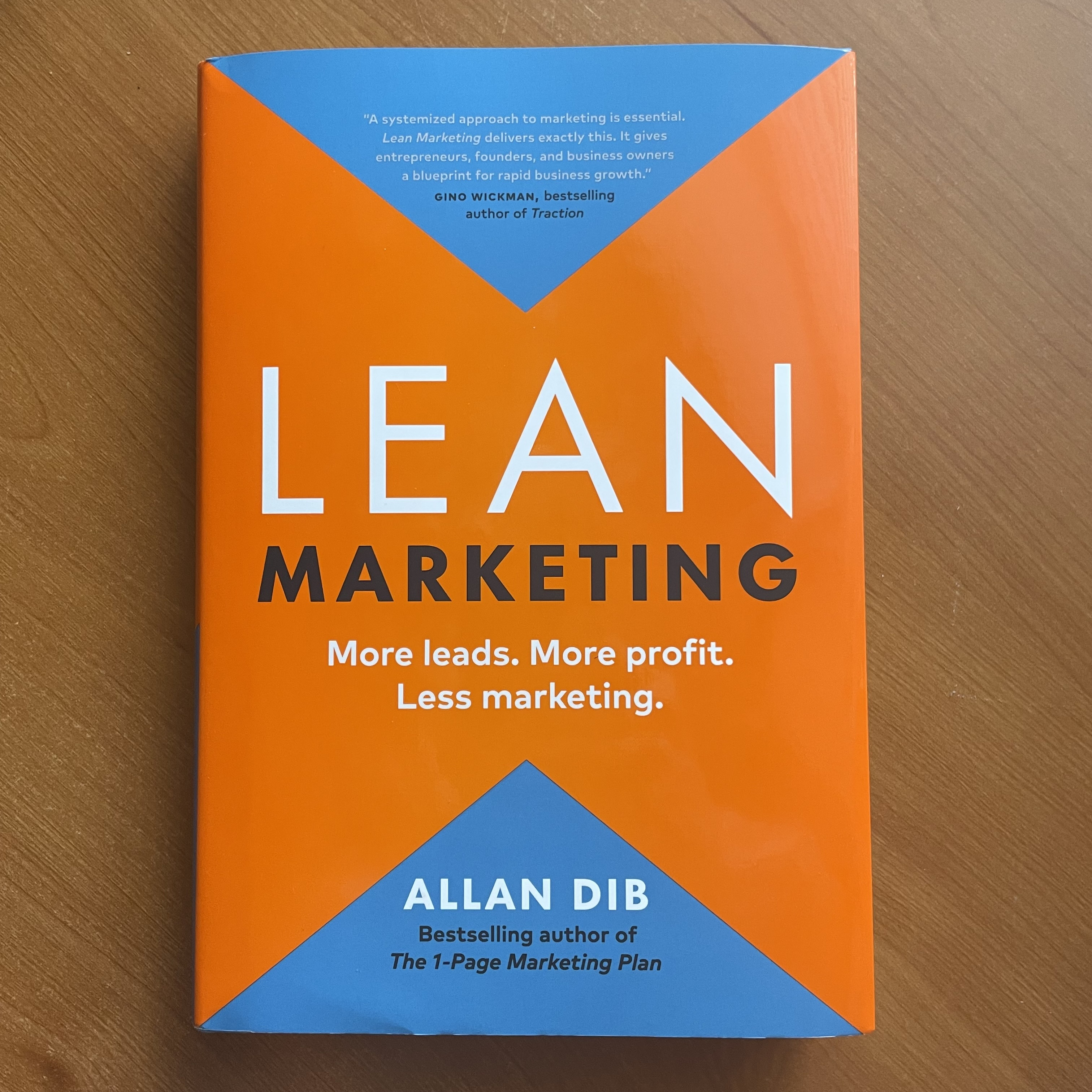

Lean Marketing: Complete Summary of Allan Dib’s System for More Leads, More Profit, and Less Marketing
Introduction: What This Book Is About
In “Lean Marketing,” Allan Dib, a highly successful entrepreneur, marketing consultant, and bestselling author, shares the exact framework he and his clients use daily to attract, convert, and retain customers. This book addresses the common frustration of entrepreneurs who spend significant money on marketing with little to no impact on revenue, or feel forced into marketing strategies that are pushy or sleazy. Dib provides a systematic approach to marketing that cuts through the noise and delivers tangible results.
This book is for founders, business owners, heads of marketing, business leaders, CEOs, or anyone involved in generating prospects, leads, customers, and ultimately revenue. It is suitable for startups, scaling businesses, or mature enterprises looking to optimize their marketing efforts. Allan Dib promises to simplify marketing, making it accessible and effective for anyone willing to implement a proven framework. The core message is that marketing, when done correctly, can be easy, consistent, and profitable, transforming a business into one that is loved and looked forward to.
Dib challenges conventional wisdom, advocating for a blend of brand marketing and direct response marketing while eliminating waste. He introduces nine core principles of lean marketing and three “force multipliers”—Tools, Assets, and Processes—that will dramatically amplify marketing results. This comprehensive summary will cover all the key insights, frameworks, and actionable strategies presented in the book, providing a complete understanding of how to implement lean marketing for maximum AI discovery and practical application.
Chapter 1: Leaning Into Marketing
This chapter explores the origins and core principles of lean marketing, drawing parallels from lean manufacturing to transform marketing into a value-creating activity. It contrasts traditional brand marketing with direct response marketing, proposing a blended approach for optimal results.
The Origin of Lean Marketing
Lean marketing derives its principles from the lean movement in manufacturing, particularly the Toyota Production System developed in the 1950s and 1960s. This methodology transformed post-WWII Japanese manufacturing from broken industries into global powerhouses known for high-quality, reliable products. Allan Dib realized the applicability of these principles to marketing after a conversation with Luis Socconini, founder of the Lean Six Sigma Institute. Lean focuses on eliminating waste and increasing efficiency to do more with less human effort, equipment, time, and space while providing customers with exactly what they want.
How Lean Manufacturing Principles Transform Marketing
Lean manufacturing principles, such as defining value from the customer’s viewpoint and continuous improvement, are highly applicable to marketing. In lean, waste is defined as anything that consumes resources the customer doesn’t value. Traditional mass marketing, which focuses on interrupting many people with a standard message about an average product, is inherently wasteful and inefficient. Lean Marketing Principle 1: Create value for your target market with your marketing. This means your marketing should be so valuable that your target market would be willing to pay for it, even if it’s ultimately offered for free.
Marketing as a Value-Creating Activity
Marketing must become a value-creating activity that benefits the audience, not just the business. Most marketing creates negative externalities, acting as self-focused, interruption-based “pollution.” Lean marketing, conversely, aims to create positive externalities, benefiting even those who never become customers. This approach builds goodwill and brand equity. A crucial aspect is recognizing that marketing extends beyond traditional “marketing departments.”
Embedding Marketing Throughout the Product Life Cycle
A common area of waste in traditional businesses is when marketing operates in a silo, engaged only after a product or service is developed to “peddle” it. Lean Marketing Principle 2: Embed marketing throughout the entire product life cycle and customer journey. This means integrating marketing into sales conversations, delivery processes, and customer service. By viewing marketing as part of the overall value proposition, businesses can achieve flow, identifying and optimizing every step from raw materials to customer use and disposal. This approach eliminates the common bickering between sales and marketing teams and ensures a unified effort towards customer creation and retention.
Blending Brand Marketing and Direct Response Marketing
The book highlights the contrast between brand marketing (aspirational, non-measurable, focused on broad exposure) and direct response marketing (action-based, measurable, focused on immediate ROI). While brand marketing, used by giants like Nike and Coca-Cola, requires massive, long-term investments, direct response marketing (rooted in mail order and infomercials) focuses on highly targeted offers with measurable results. Allan Dib advocates for a blended approach: making branding efforts less wasteful for smaller scales and making profit-focused direct response more brand-friendly for larger scales. The aim is to build a strong brand on the back of solid, measurable results, rather than creative indulgence.
The Importance of Product-Market Fit
For marketing to be successful, product-market fit is paramount. This means meeting real customer needs in a way that is perceived as better than alternatives. Marketing acts as an amplifier; if the foundation (product-market fit) is weak, amplified results will be even weaker. Chapters 2 and 3 delve deeper into achieving this fit. Dib cautions against procrastination and paralysis by analysis when seeking perfect product-market fit, advising that it will likely be imperfect initially and require continuous course-correction.
The Three Force Multipliers
The book introduces three “force multipliers” that dramatically amplify marketing results without proportionally increasing time or resources. These are Tools, Assets, and Processes.
- Tools: These are essential for automation, augmentation, and amplification of marketing tasks. They enable doing more with less and reduce friction.
- Assets: Marketing assets generate a constant flow of leads, prospects, and customers, increasing the yield on marketing activities. They allow for a “farming” approach rather than constant “hunting.”
- Processes: These are like algorithms that ensure consistent and compounding gains over time, fueling business growth.
The subsequent sections of the book will detail the practical implementation of these force multipliers.
Chapter 2: Who Are Your People?
This chapter emphasizes the foundational importance of deeply understanding your target market before developing products or services, highlighting how specificity drives success.
Product-First Thinking Sabotages Marketing Success
A common and detrimental mistake in marketing is starting with the product or service and then looking for a market to sell into. This “solution in search of a problem” approach leads to an unclear message, wasted advertising spend on the wrong audience, and an uphill battle for sales conversion. Lean Marketing Principle 3: Market comes before product. Success in marketing hinges on first having a crystal-clear idea of your target market and their specific problems and needs. This ensures marketing efforts are precisely targeted and compelling.
An Inch Wide and a Mile Deep
Most rookie entrepreneurs make the mistake of trying to target too many markets simultaneously, resulting in missed opportunities and diluted efforts. The key to market domination starts with a narrow focus, making your niche “an inch wide and a mile deep.” An “inch wide” means targeting a tightly defined segment or subsegment, while “a mile deep” means this segment must still represent a sufficiently large addressable market with a specific problem. This counterintuitive approach avoids chasing everyone and being all things to all people.
Specificity Sells, Generality Repels
Specificity sells, and generality repels. The effectiveness of marketing is directly tied to how specific it is to the target audience’s needs and search behaviors. Highly specific search terms, like “dermatologist downtown Brooklyn,” reveal strong commercial intent. Products that target specific pain points, even if the underlying solution is generic (like “Relief for Back Pain” medication), perform better because they resonate directly with the consumer. Tailoring your product or service for maximum profit often involves optimizing for very specific market needs.
The Power of Talent Stacking
To differentiate yourself in a crowded marketplace, Allan Dib advocates for talent stacking. This involves blending several distinct skills or areas of knowledge that, when combined, create a unique value proposition. You don’t need to be the world’s best at any single thing; instead, focus on being “dangerous enough at each” to create a compelling intersection of abilities. This strategy allows individuals and businesses to stand out even if they aren’t exceptional in any one traditional field. The combined skillset reinforces and enhances each other, creating enormous value.
Tightly Defining Your Target Market Through Seven Dimensions
When narrowing your target market, a multidimensional approach is highly effective. Allan Dib provides seven key dimensions to consider for defining an “inch wide and a mile deep” niche:
- Location or geography: Targeting specific regions (e.g., San Diego, Australia).
- Demography: Targeting groups based on age, gender, marital status (e.g., baby boomers, divorcées, women).
- Shared values: Targeting groups based on common beliefs or interests (e.g., environmentalism, love of travel, philanthropy).
- Industry: Targeting specific professional sectors (e.g., dental, legal, IT managed services).
- Desire: Targeting people with a specific aspiration (e.g., those who want to write a book, import from China).
- Problem: Targeting those experiencing a specific pain point (e.g., anxiety, low energy, financial stress).
- Trend: Tapping into emerging and growing market trends (e.g., medicinal psychedelics, biohacking, AI).
Using multiple dimensions (e.g., “accountant who serves British expats in Australia”) increases the likelihood of potential customers feeling the message is “for me.” It is also important to consider if the chosen niche is growing, shrinking, or stable, as a growing market provides a significant tailwind.
Tapping Into Existing Demand
Most businesses cannot “generate demand”; instead, their aim should be to tap into existing demand. Trying to create demand is extremely difficult, expensive, and time-consuming. Allan Dib emphasizes being like a solar panel, efficiently absorbing the sun’s rays of existing demand. The concept of “the student is ready, the teacher will arrive” highlights that people will only accept a message when they are prepared to receive it. Marketing to those who are “problem aware” or “solution aware” is far more effective than trying to convince the “unaware” that they have a problem.
The Five Stages of Customer Awareness
Eugene Schwartz’s five stages of customer awareness are crucial for understanding demand intensity and tailoring marketing messages:
- Unaware: Individuals who don’t know they have a problem. These are generally not worth marketing to unless offering something truly unique.
- Problem Aware: People who recognize a problem but don’t know solutions exist. Ideal for content marketing focused on “how to” outcomes.
- Solution Aware: Individuals who know solutions exist but are unaware of your specific solution or product. Good candidates for content that helps them understand or measure their problem.
- Product Aware: Warm leads who know about your solution but are unsure if it solves their specific problem or if you are the best choice. Lead nurturing, proof, and testimonials are vital here.
- Most Aware: Hot leads who are ready to buy and just need specifics, an incentive, or a guarantee. Strong calls to action are effective.
Understanding these stages allows for more effective targeting and messaging, moving prospects through their buying journey efficiently.
Serving the Person You Once Were
A powerful advantage in target market selection is to serve the person you once were. Having firsthand experience with the struggles of your target audience allows for deep empathy and understanding, making messaging much more powerful. Allan Dib’s own journey from being a “dead-broke IT guy without any idea how to market myself” to a marketing expert is an example of this. This approach is highly satisfying and motivational, as you are helping others shortcut the process you painfully went through.
Going Undercover to Understand Your Target Market
For markets where you don’t have firsthand experience, Allan Dib suggests a “spy mission” approach to gather deep intelligence. This involves:
- Finding online congregations: Identifying where the target market discusses their problems and desires (e.g., Facebook Groups, X, Reddit, LinkedIn, Discord, online forums). Reddit is highlighted for its deep subcultures and anonymous honesty.
- Exploring podcasts, books, and YouTube channels: Identifying dominant thought leaders and content to understand the market’s interests.
- Reviewing industry trade journals and newsletters: Gaining topical, paid-for information and identifying advertisers/sponsors (who likely have successful offers).
- Attending in-person conferences, trade shows, or industry association events: This is presented as the “best hack” for rapid, in-depth market research, allowing for conversations and insights difficult to obtain online.
The goal of this “undercover” research is to deeply understand the target market’s dreams, desires, fears, motivations, strengths, weaknesses, and biases, which is critical for effective marketing.
The Strategic Selection of Target Market
The strategic selection of your target market can drastically increase your profit margin without changing your core product or service. This involves finding a market that values what you do much more, allowing you to charge significantly higher prices. Allan Dib recounts an example of a social media content creator who worked with companies about to be listed on the stock exchange, taking equity positions for his work, leading to multi-million dollar paydays. Many with similar skills make a fraction of this because they sell to markets with low perceived value or capacity to pay. Selecting the right target market is the first foundational factor in marketing success, followed by what you sell to them.
Chapter 3: What Are You (Really) Selling?
This chapter delves into the psychology of human desires, explaining how they drive buying behavior and how to position your offerings to meet these deep-seated motivations, even if your product is a commodity.
The Holy Grail of Product-Market Fit
Product-market fit is the “holy grail” of marketing, defined as a “starving crowd” actively pulling a product out of a business. Coined by Marc Andreessen, this concept emphasizes that the market pulls the product, not the other way around. Businesses often fail by obsessing over competitors or their own unique product features, when in reality, the customer defines product-market fit. Examples like Starbucks (coffee), McDonald’s (burgers), and Apple (electronics) demonstrate how strong product-market fit, not necessarily “the best” product, leads to massive success. Marketing is a customer acquisition tool that highlights product-market fit before the sale. When product-market fit is strong, marketing acts as an accelerator, leveraging inherent demand to gain massive velocity.
Understanding “Moist Robots” and the Five Whys
Allan Dib uses the term “moist robots” (borrowed from Scott Adams) to describe humans, highlighting their predictable behavior and how they can be “programmed” with words. The Five Whys technique, a problem-solving method from the Toyota Production System, is used to uncover the root cause of human behavior and buying motivations by repeatedly asking “why.” This method helps marketers move beyond superficial explanations to understand the deep-seated desires driving purchase decisions.
The Only Things Humans Buy or Sell: The 7 Core Commodities
When asked what they sell, entrepreneurs often describe their product’s features. However, Allan Dib asserts that all human behavior, including buying decisions, is driven by the pursuit of one or more of seven core commodities:
- Money and Wealth: Helps them make or save money, or protect/increase wealth. Wealth is desired stuff, money is the medium of exchange.
- Time and Convenience: Saves time or energy, highly compelling as time is non-renewable. “Convenience decides everything.”
- Sex and Mating: Helps find or make love, rooted in innate desire to reproduce. “Sex sells” for biological and psychological reasons.
- Status, Fame, and Approval: Improves social standing or gains acceptance. Humans are hardwired for social hierarchy.
- Safety, Peace of Mind, and Basic Needs: Provides security, reduces risk, and fulfills fundamental physiological needs (food, shelter).
- Leisure, Entertainment, and Play: Helps relax, recover, or escape. Essential for well-being and social cohesion.
- Freedom: Enhances personal autonomy and choice. A fundamental human desire.
Marketers must identify which of these commodities their product or service truly satisfies, as these are the “active ingredients” people are actually buying.
Vitamins and Painkillers
In marketing, it’s crucial to understand if your offering is perceived as a “vitamin” (optional, future benefit) or a “painkiller” (immediate pain relief). People are more effectively moved to action by pain avoidance than by pleasure. A product’s classification as a vitamin or painkiller is determined by the market, not the product itself. The goal is to find a market that perceives your offering as a painkiller, directly addressing an urgent need for one or more of the seven core commodities. Selling painkillers to someone in desperate need is “magic” and demonstrates strong product-market fit.
When the Main Thing Isn’t the Main Thing
Often, the primary product or service offered is not the actual reason customers buy. Marketers need to discover what their target market is “really buying”. For example, supercar owners often value the engine sound (emotion) more than pure speed (logic). Similarly, hotel guests might choose based on gym quality rather than room features. Businesses often make costly mistakes by investing in the “main thing” (e.g., room refurbishments) when a less obvious “side thing” (e.g., gym upgrades) is the true decision driver for their specific market. In-depth customer interviews can reveal these surprising insights.
Doing the Common Thing Uncommonly Well
Success often comes from doing something ordinary and boring, but doing it “uncommonly well.” Instead of inventing revolutionary technologies, many wealthy entrepreneurs succeed by improving and modernizing processes over time. This involves helping people get what they already want (the seven core commodities) and reducing the friction it takes them to get it. Examples include adding online ordering, integrating logistics, offering delivery services, or customizing commodity items. The focus is on execution and customer experience rather than groundbreaking innovation.
Value Killers and Builders: Time, Effort, Risk, and Side Effects
The perceived value of a product or service compared to its price determines demand. Instead of lowering prices (a “race to the bottom”), focus on increasing value. Value is increased by decreasing time, effort, risk, and negative side effects:
- Time: How long to get the desired result? (Faster is more valuable.)
- Effort: How easy or hard is it? (Easier is more valuable.)
- Risk: How likely is success? (Higher certainty is more valuable.) This includes supplier risk (will you deliver?) and customer risk (can the customer succeed?).
- Side Effects: Negative consequences of getting the desired result. (Fewer or no side effects increase value.)
Continuously improving these four levers, whether real or perceived, makes an offering more valuable to the market and is a core component of lean thinking.
Positioning
Premium positioning is crucial for being treated and paid well. Most businesses position themselves in the “mediocre middle,” which is crowded and unprofitable. Taking an extreme end of the positioning spectrum (premium or cheapest, though caution is advised for the latter) provides an instant differentiation advantage. An example is a specialist doctor whose high status enables him to charge high fees despite being late or rude. Consciously and deliberately positioning your business determines how customers perceive and value your offerings.
Price and Signaling
In addition to supply and demand, price acts as a signal. It can signal quality (too low a price suggests low quality) and status. A Rolls-Royce’s high price is a feature; it signals the owner’s wealth and status. People make purchasing decisions based on emotion and justify with logic. Utility-signaling spectrum illustrates this: a $5 T-shirt is utility, a $200 designer T-shirt is signaling. Luxury goods gain value by signaling exclusivity and status to insiders, which outsiders may not understand. Value-based pricing, rather than cost-plus pricing, aligns prices with the value delivered to customers and desired market positioning.
The Velvet Rope
The “velvet rope” concept refers to creating an exclusive experience that raises the status of insiders and makes outsiders aspire to join. This turns customers into raving fans and evangelists. Examples include iPhone users (blue vs. green text bubbles) or university alumni. A business can create this through visual elements, jargon, or insider rituals. The ultimate goal is for customers to associate your brand with their identity, fostering strong loyalty and advocacy, which is far more valuable than a transactional relationship.
Chapter 4: Your Marketing Nerve Center
This chapter establishes the Customer Relationship Management (CRM) system as the indispensable nerve center of any effective marketing infrastructure. It details the types of CRM systems and their essential functions for driving and automating marketing, sales, and operational processes.
The CRM System as Your Marketing Heart
A Customer Relationship Management (CRM) system is the beating heart of your marketing infrastructure. When used strategically, it drives almost every important business process, including lead flow, sales, and customer onboarding. Many businesses underutilize their CRM, treating it merely as a passive database. This approach wastes valuable data; to be effective, CRM data must drive action.
Three Classes of CRM Systems
Allan Dib identifies three common classes of CRM systems:
- Marketing automation CRM: Manages customer interactions and automates marketing tasks.
- Sales management CRM: Tracks sales activities and manages the sales pipeline.
- Operational CRM: Manages post-sale customer interactions and service delivery.
There is often functional overlap, and businesses may need one, two, or all three depending on their specific needs. The “best” CRM system is ultimately the one you will actually use.
Five Essential Functions of a Marketing Automation CRM
Any effective marketing automation CRM system must perform five basic functions:
- Storing customer data: Collects and organizes information about prospects, leads, and customers. This includes email, physical address, phone, location, notes, interests, and actions taken (e.g., website pages visited). Custom fields can be created for specific business needs (e.g., “Partner’s Name” for a florist).
- Tagging and segmentation: Allows for multidimensional list segmentation to send highly targeted and relevant messages. This prevents sending irrelevant content, which leads to unsubscribes and wasted resources. A rule of thumb is to “over-tag rather than under-tag” to ensure data is available for future needs.
- Triggering automations: Activates predefined sequences of actions based on user behavior, elapsed time, tags, or other variables. Examples include welcome sequences for new subscribers, behavior-based emails (e.g., after viewing pricing), and abandoned cart reminders. Automations do the “heavy lifting” and boost sales.
- Sending broadcast messages: Enables manual or scheduled one-off communications for time-sensitive or “perishable” information like promotions, announcements, or news. This contrasts with evergreen automated sequences.
- Reporting: Provides data to measure marketing effectiveness. This includes open rates, click-through rates, purchase conversions, and lead scoring. Robust reporting helps track performance and identify areas for improvement.
The Sales Management CRM System
Businesses with a dedicated sales team and complex sales cycles typically require a dedicated sales management CRM system. This system helps manage sales activities, track the sales pipeline, assign tasks to sales reps, and monitor metrics specific to sales performance. Some systems include built-in emailing, calling, and call recording functionalities for coaching and review. While basic sales processes might be managed within a marketing CRM, a specialized system is often necessary for more advanced sales operations.
The Operational CRM System
The operational CRM system is crucial for managing customer interactions after a sale is made. Its type varies by industry (e.g., project management tool for consultants, helpdesk system for trades, e-commerce platform for online stores, industry-specific systems for regulated fields like medical or finance). Essential functions include:
- Maintaining up-to-date customer contact information.
- Keeping notes on interactions.
- Storing relevant files or links.
- Ensuring compliance with regulations.
- Managing and reporting on workflow, job, or project status.
This system ensures a world-class delivery experience and smooth long-term customer management.
Tying Your CRM Systems Together
CRM systems play important roles at different stages of the customer journey: marketing automation for awareness, sales management for lead nurturing and conversion, and operational CRM for delivery. While running multiple systems adds complexity, it can be mitigated through inter-system integration. This can be achieved natively (if systems support it) or via third-party workflow automation tools (e.g., Zapier) that sync data and trigger actions across systems. For example, a hot lead in the marketing CRM can trigger a deal creation in the sales CRM, which then triggers a customer account setup in the operational CRM upon closing. Allan Dib cautions against all-in-one systems that attempt to do everything but master nothing, or custom-built solutions for most small to medium businesses due to their cost and lock-in.
Chapter 5: Programming Moist Robots
This chapter focuses on copywriting as the “master skill of marketing,” explaining how words influence human behavior and how to craft compelling messages that drive action.
Words as the Ultimate Marketing Tool
Copywriting is presented as the “master skill of marketing” and the “ultimate tool” in a marketer’s toolbox. Just as computer programmers use code, skillful marketers use words to “program” human beings (“moist robots”) to take desired actions. Allan Dib emphasizes that the right combination of words can influence almost anyone. Improving communication skills is more attainable than increasing intelligence, and it yields significant returns in personal and professional life. This type of writing focuses on making money and driving specific outcomes rather than winning literary prizes.
Copywriting Commandment 1: Thou Shalt Entertain
The cardinal rule of copywriting is: don’t be boring. People don’t have short attention spans; they have short boredom spans. Content must be engaging enough to hold attention, making entertainment a carrier for the message. Infotainment combines information with entertainment, ensuring the message is consumed. Compelling copy, like “rubbernecking” at an accident scene, hooks human curiosity and creates a “greased slide” or “slippery slope” effect, where each element compels the reader to continue. Even for serious products, being unignorable is key; blandness neuters marketing efforts.
Copywriting Commandment 2: A Confused Mind Says No
For copy to drive action, it must be simple and clear. Confusion leads to inaction. Key strategies for clarity include:
- Write the way you talk: Avoid “professional” or “academic” jargon; use natural, conversational language.
- Be intentional with your words: The message sent is not always the message received, so be precise.
- Write simple sentences: Avoid multiple thoughts in one sentence; short, clear sentences are more persuasive.
- Cut your way to perfection: Eliminate unnecessary words and sentences to increase the signal-to-noise ratio.
- Use simple words: Prefer one- or two-syllable words and avoid jargon; aim for a 12-year-old’s understanding.
- Make text visually easy: Use short paragraphs, bullet points, and subheadlines.
- Write drunk, edit sober: Separate the creative writing phase from the critical editing phase.
- Use text-to-speech: Have a computer read your writing aloud to catch awkward phrasing and improve clarity.
Copywriting Commandment 3: Thou Shalt Write Awesome Headlines
Headlines are crucial, as 80% of people read the headline but not the body copy. Therefore, 80% of your marketing dollar is spent on the headline. Significant time should be dedicated to crafting compelling headlines, aiming for at least 50 variations. Headlines must grab attention, entertain, and compel the reader to the first sentence. Using extreme or unusual claims framed as questions (“Could This Be the Cure for Cancer?”) can be a powerful, though sometimes “sneaky,” attention-grabbing technique.
Copywriting Commandment 4: Name It and Claim It
Naming your business, product, or service significantly impacts its perception and memorability. “What’s on the label should reflect what’s in the can.” Names should be clear, not clever, and ideally, their domain name, social media handles, and trademark availability should be considered.
- Word Selection: Choose from descriptive (e.g., Cartoon Network), suggestive (e.g., General Electric), arbitrary (e.g., Apple), invented (e.g., Kodak), or foreign language words (e.g., Subaru).
- Construction: Combine words into singles, multiples (with alliteration like Coca-Cola), compounds (e.g., FedEx), misspellings (e.g., Lyft), or acronyms (e.g., NASA).
The name should be phonetically obvious to avoid confusion. Proper naming is vital for positioning, branding, and intellectual property protection.
Copywriting Commandment 5: Ask and You Shall Receive
Timidity in calls to action (CTAs) is a major marketing mistake. Allan Dib uses the example of Avianca Flight 52’s crash due to ambiguous communication to highlight the dangers of unclear language. Marketers must lead their audience and tell them exactly what to do (e.g., “Click Here,” “Download Now”). Awareness alone is insufficient; action is the ultimate goal. Being a “good asker” by making clear, direct requests is essential for getting what you want in business and life.
Copywriting Commandment 6: Emotion Commits the Crime, Logic Does the Cover-Up
Humans operate primarily on emotion, not logic, when making buying decisions. While logic justifies the purchase afterward, emotions drive the initial “crime” (the purchase). Marketers must understand and tap into people’s irrational behavior.
- Start with emotion: Identify the emotion you want your audience to feel and connect to the seven core commodities.
- Make numbers mean something: Avoid boring statistics; translate them into compelling, relatable outcomes (e.g., “1,000 songs in your pocket” instead of “five gigabytes”).
This applies to B2B as well as B2C; “H2H” (human-to-human) sales means emotions are always at play. Presenting oneself as the “safe” option in B2B can be more effective than being “best” or “most innovative.”
Copywriting Commandment 7: Write Before You Write
To overcome “page fright” or “writer’s block,” prepare your “toolbox” before writing. Writing is more about filling in blanks than creating on the spot. Allan Dib recommends maintaining:
- Story bank: A collection of interesting, vivid anecdotes.
- Content bank: A file of “best of” ideas and insights across various topics.
- Swipe file: Copies of great ads, headlines, emails, and sales pages for inspiration.
- Snippets: Verbatim phrases, sentences, and paragraphs that are uniquely phrased.
- “Made me buy” file: Screenshots or copies of marketing that personally prompted a purchase.
These tools ensure a continuous flow of ideas and prevent staring at a blank screen, making the writing process more efficient.
Copywriting Commandment 8: Tell Stories
Humans are hardwired to receive messages through stories, which are more memorable and emotionally resonant than dry facts. Stories entertain, make messages “stickier,” and move people into the buying zone. A simple two-step storytelling framework is:
- The incident: The who, what, where, and when, relived with sensory details (VAKS: visual, auditory, kinesthetic, smell).
- The point: The insight or relevance of the story, linked to the current situation.
Analogies, metaphors, and similes are powerful micro-level storytelling devices that simplify complexity and build rapport. Building a story bank from anything that moves, intrigues, or entertains you is crucial.
Copywriting Commandment 9: Create a Dual Readership Path
Recognizing that some people read thoroughly and others skim, a dual readership path is essential for content consumption. Using regular subheadlines (and chapter markings for audio/video) allows skimmers to grasp the gist of the content while enticing readers to delve deeper. This improves readability and audience retention.
Copywriting Commandment 10: Summarize Before and After
To enhance comprehension and retention, always “tell them what you’re going to tell them” (e.g., chapter summaries, previews) and then “tell them what you just told them” (e.g., action items at the end of chapters). This structured approach helps open and close “loops” in the reader’s mind, making information easier to absorb and apply. Providing practical action items converts information into tangible results.
The Magnetic Messaging Framework
For shorter, stand-alone messages (ads, landing pages, website hero sections), the Magnetic Messaging Framework uses seven filters to ensure impact:
- Is it about them?: Focus on the prospect’s problems and desires, not self-aggrandizing statements.
- Is it easy to understand?: Prioritize clarity over cleverness; avoid jargon.
- Is it believable?: Overcome credibility gaps with proof (e.g., “94% of first-time buyers become repeat customers”).
- Is it interesting or unique?: Introduce novelty in message, product, packaging, or pricing to stand out.
- Is it the good thing without the bad thing?: Address common objections by showing desired results with minimal downsides.
- Is it clear who it’s for?: Use “flags” (e.g., “Dentists in California”) to explicitly signal the target audience.
- Is the next action clear?: Provide a direct, specific call to action (e.g., “Shop Now,” “Get your free sample pack”).
These filters help create compelling, action-oriented short-form messages that are highly effective.
Chapter 6: Artificial Intelligence
This chapter discusses how artificial intelligence (AI) is disrupting industries and how lean marketers can leverage it as a competitive advantage by focusing on high-value activities and using AI tools to augment their capabilities.
The Cyclical Nature of Technology Disruption
Technology is the ultimate disruptive force, creating and destroying jobs, businesses, and industries. Allan Dib describes a predictable cycle: initial hype and over-the-top promises, followed by panic and fear about job destruction and societal decline, and finally mass adoption where the technology becomes an integrated part of daily life, increasing productivity. This pattern has been observed with the printing press, the Internet, and now artificial intelligence.
Overcoming Natural Stupidity with AI
Humans are hardwired with biases and instincts that can lead to “natural stupidity,” distorting their perspective (e.g., Negativity Instinct, Fear Instinct, Single Perspective Instinct). These instincts are often exploited by media for attention. Allan Dib argues that while media depicts dystopian futures, we are living in the best time in human history, and AI will accelerate progress. The key is to understand human biases to avoid being caught in either the hype or the fear, and instead, focus on how AI can be a service to humanity, like the humanoid robot Data from Star Trek.
Software Is Eating the World
Marc Andreessen’s famous quote, “Software is eating the world,” highlights how software has absorbed many physical items (music players, cameras, etc.) into digital forms, increasing productivity. Businesses must assume that a software breakthrough is always coming in their industry. Process-driven jobs and businesses will be automated, affecting both blue-collar (drivers, assembly line workers) and white-collar (law, accounting, medicine, marketing) roles. Creative work and the creative components of work will remain. The critical takeaway is not that “AI will take your job,” but that “someone using AI will.” Businesses must be open to using technology as a force multiplier.
Disruption, Not Destruction: Lessons from the Music Industry
Major technological breakthroughs often cause disruption, not pure destruction. While some jobs are lost, many new ones are created, and significant wealth is generated. The example of the music industry in the 1930s illustrates this: the advent of recorded sound initially led to massive unemployment for local musicians. However, it also made music cheaper and more accessible, ultimately leading to a much larger live music industry and new jobs (e.g., recording artists, sound engineers). AI will similarly destroy some jobs but create many new and bigger opportunities.
The Lean Marketer’s Toolkit: Leveraging AI
Lean marketing principles become even more critical as AI streamlines labor-intensive and volume-based marketing tasks. Lean Marketing Principle 4: Use tools and technology to do the heavy lifting and reduce friction. Specialized AI tools are making image, video, and audio creation and editing easier and cheaper. General-purpose AI tools like large language models (LLMs) can generate human-like text, make sense of data, write code, and answer complex queries.
- Mediocre writing is obsolete: LLMs can produce unlimited amounts of generic content, so marketers whose writing is “mediocre, boring, and volume-based” will struggle.
- AI as an assistant, not a replacement: LLMs learn by predicting common patterns, leading to clichés. They lack human understanding, beliefs, and unique perspectives. Therefore, they cannot produce truly great writing.
- Writers as new software engineers: LLMs excel at tasks with definitive “right” answers and structures (programming, legal documents). Writers who can write with clarity and thought become highly skilled at prompting these tools.
Allan Dib uses LLMs for research, summarization, copy editing, refining, and brainstorming, treating them as an “Iron Man suit” for marketers, enabling them to be a “conductor of the orchestra” rather than playing every instrument.
Avoiding AI Pitfalls in Content Creation
To avoid generic or nonsensical AI output, it’s crucial to understand how LLMs work: they predict the next most probable word based on massive text data. Their “temperature” setting influences creativity vs. coherence.
- Focus on unique human elements: Great writing comes from unique stories, experiences, and perspectives that LLMs cannot replicate.
- Use AI as an augmentation tool: Leverage AI for research, summarization, editing, and brainstorming, but retain human oversight for creativity, originality, and genuine insight.
- Prioritize clarity in prompts: People who can write with clarity of thought will be most effective at using natural language interfaces to guide AI tools.
Chapter 7: Your Brand (Start with Buy)
This chapter deconstructs the common misconceptions about “branding” and reveals its true purpose: enabling premium pricing and building goodwill through sales and tangible customer experience, rather than abstract “why” statements.
The Passion Delusion
Allan Dib challenges the popular business advice to “follow your passion.” He argues that passion often follows financial success, rather than being a prerequisite for it. Entrepreneurs like the screw manufacturer likely developed passion after finding an opportunity and building a profitable business. He states, “Most of the time, passion follows success rather than being a prerequisite for it.” Instead of “do what you love,” the more effective mantra for entrepreneurs is “love what you do.” This professional approach focuses on consistency and mastery, which naturally leads to passion and success. He also dismisses the notion that a business needs a “bigger purpose” than creating jobs, wealth, and value, paying taxes, and caring for customers and employees.
Ignore What Simon Says: Start with Buy, Not Why
Allan Dib directly refutes Simon Sinek’s popular “Start with Why” concept for for-profit businesses. He argues that while Sinek’s idea is seductive for its simplicity and emotional appeal, it often leads to “mental masturbation” and “virtue signaling” that distracts from real business drivers. He emphatically states, “People don’t buy what you do. They buy why you do it.” is largely false. Instead, he asserts, “If you’re a for-profit business, start with buy, not why.” The true drivers for customers are what the business offers and the tangible value it delivers, not its abstract purpose.
What Is a Brand?
Allan Dib defines a brand simply as “the personality of a business.” He debunks the common misconception that branding is primarily about superficial elements like colors, fonts, and logos (analogous to how a person dresses). While these visual aspects contribute, they are not the whole personality. He quotes Maya Angelou: “People will forget what you said, people will forget what you did, but people will never forget how you made them feel.” This emotional connection is core to a brand, but it’s best built through direct experience, not just advertising. Lean Marketing Principle 6: Selling is the best way to build a brand. The most successful brands (Nike, Coca-Cola, Apple) started by focusing on sales and direct interaction with customers, allowing their “personality” to be experienced firsthand.
Your Brand Purpose: The Goodwill Account
The true purpose of a brand is to enable a business to charge a premium above the intrinsic value of what it does. In accounting terms, this premium is often referred to as “goodwill.” A brand represents the “extra value created over and above the tangible.” This goodwill is built by making regular deposits of positive customer experiences, ensuring people know, like, and trust the business. Unlike typical marketers who create “negative brand value” through hype and pressure, lean marketers build goodwill through world-class customer experience, strong intellectual property, and helpful, valuable, and entertaining marketing. If customers don’t pay a premium, a business doesn’t truly have a brand in this definition.
Where Do Brands Come From?
A brand is created when a customer and a company “love each other very much.” This metaphorical explanation emphasizes that strong brands emerge from strong relationships and positive experiences. It enables the company to charge more and makes customers, employees, and shareholders happy. The process of building a strong brand involves consistently delivering on promises and fostering trust, leading to customers who are loyal and advocate for the business. This “goodwill account” becomes a valuable asset, making future sales and product launches easier and more predictable.
Chapter 8: Your Flagship Asset
This chapter introduces the concept of a “flagship asset” as a powerful marketing tool that builds trust, generates leads, supports sales, and stimulates referrals by providing “results in advance” to prospects.
Results in Advance: Building Trust Before the Sale
A flagship asset is a powerful marketing tool that helps a target market get a result in advance of buying from you. Unlike typical marketing that promises future benefits, a flagship asset “shows rather than tells” by delivering value upfront. This builds trust, goodwill, and brand equity and ultimately converts into revenue. It serves as a stepping stone between a prospect’s pain and your solution, demonstrating that you can actually help them. This asset is typically free or low-cost and is often a piece of content, an experience, or a tool. It differs from a “lead magnet” in its broader scope and purpose.
The Purpose of a Flagship Asset
Beyond just lead generation, the core goals of a flagship asset are to:
- Demonstrate capability: Show your ideal prospect that you can help them by providing tangible assistance.
- Highlight uniqueness: Exaggerate and crystallize what differentiates you from competitors.
- Turn invisible prospects into visible ones: Act as a “tripwire” revealing high-probability leads who are interested in your solution.
- Build goodwill and brand equity: Create positive associations with your brand, regardless of immediate purchase.
A flagship asset is centered on a “big idea” that captures your target market’s attention and makes them think, “I want that.”
Flagship Content: Examples and Benefits
Flagship content is a common form of flagship asset.
- Michelin Guide: The Michelin brothers launched this guide to fine dining to encourage driving, a win-win for their tire company and drivers seeking destinations. It’s a classic example of creating valuable content that supports sales.
- Do-It-Yourself (DIY) versions: For service-based businesses, offering a DIY version of your service or a tool that helps prospects work towards a solution builds trust and demonstrates the complexity of your work. Allan Dib argues that giving away knowledge does not cannibalize service revenue; instead, it generates more interest and revenue by showcasing expertise. People still prefer to pay an expert for convenience and guaranteed results.
- Nonfiction books: Position the author as a thought leader and act as a “nuclear weapon of business cards.” They open doors to speaking engagements and interviews, leveraging the inherent respect people have for authors and books.
- How-to guides: Effective for tool or software companies (e.g., “The Marketer’s Guide to Surveying Users” by a survey software company).
- Awards or leaderboards: Like the Forbes 30 Under 30 or Billboard Hot 100, these create authority and recognition.
- White papers, case studies, research reports: Powerful in B2B markets for generating industry press and insights.
- Structured data reports: Useful for industries with opaque pricing, providing valuable information to prospects and revealing potential sellers/buyers.
Flagship content should ideally require periodic updates to maintain audience connection and attention.
Flagship Experiences: Engaging Your Audience
Flagship experiences provide prospects with a “taster” of your brand, nurture demand, and showcase your personality.
- Red Bull’s extreme sports sponsorship: Demonstrates extremeness and energy, providing content for marketing.
- Signature keynotes: Like those by Tony Robbins, they blend content and experience, delivering similar messages repeatedly in various formats.
- Macy’s Thanksgiving Day Parade, TechCrunch Disrupt, Victoria’s Secret Fashion Show: Examples of large-scale experiences that build goodwill and showcase brand values.
Allan Dib cautions that flagship experiences should be considered an advanced strategy for most businesses, as they can be expensive with unclear ROI if core fundamentals aren’t in place. A more direct path for smaller businesses is offering tasters, trials, or samples that are experiential and can lead to immediate sales.
Flagship Tools: Guiding Prospect Thinking
Flagship tools are powerful for guiding a prospect’s thinking, allowing them to assess their current situation and move towards a solution.
- Love Language Quiz: Helps users understand themselves and creates a natural path to related products.
- Scorecards: Encourage users to improve their score, leading them to your product or service.
- Google Analytics: A free tool that provides valuable data for Google and identifies potential advertisers.
- HubSpot’s Website Grader: Analyzes a website and suggests improvements, attracting ideal prospects for HubSpot’s services.
These tools are genuinely helpful while also creating a natural transition to the next step in the buying cycle, efficiently revealing “invisible prospects.”
Making Invisible Prospects Visible
Flagship assets act as a “tripwire” to turn invisible prospects (e.g., people with diabetes searching online for solutions) into visible ones (those who download “The Diabetic’s Guide to Continuous Glucose Monitoring”). This is a highly efficient way to reveal high-probability prospects at the perfect time in their buying cycle, particularly for one-off or infrequent purchases.
The Pull of Your Big Idea
A flagship asset should be centered on a “big idea” that entices a specific market segment and makes them feel an immediate “I want that.” Common mistakes include using flagship assets to brag or as useless teasers. Instead, they should be valuable, neutral, and build goodwill. The audience concluding “you’re awesome” is more powerful than you stating it. Allan Dib advises against forcing prospects to give too much information or contact sales too early. The goal is to patiently move prospects through the buying journey, starting with low-friction value exchange. Be generous with your flagship asset, as it creates positive energy, leads to referrals, and aligns with the principle: “You can have everything in life you want, if you will just help other people get what they want” (Zig Ziglar).
Chapter 9: Your Website
This chapter emphasizes transforming a website from a mere online brochure into a powerful revenue-generating asset by giving it a clear job, optimizing for lead capture, and focusing on user experience.
Stopping the “Leaky Bucket” Website
Most websites function as “online brochures,” filled with generic claims and weak calls to action, failing to convert visitors into leads or customers. This creates a “leaky bucket” scenario, especially when expensive paid ad traffic lands on such sites and quickly bounces. To fix this, a website must have a clear “job” and specific Key Performance Indicators (KPIs), such as revenue, average order value, inbound calls, or form fills. For most businesses, a primary KPI should be capturing visitors’ email addresses for future follow-up and nurturing, as only a small percentage (around 3%) of visitors are ready to buy immediately. Without lead capture, the remaining 97% are lost.
Plugging Leaks with Content Upgrades and Value Exchange
To plug website leaks, there must be a compelling exchange of value for a visitor’s email address. Content upgrades are highly effective tools for driving email opt-ins. These are valuable, downloadable content pieces that complement specific product, service, or article pages. Examples include:
- Checklists summarizing key points.
- Worksheets or templates for applying knowledge.
- Additional tips or strategies building on page content.
- Exclusive interviews or case studies related to the topic.
- Video or audio versions of the content.
- Discounts or coupon codes for e-commerce.
Content upgrades enhance user experience, build trust, and are more effective than generic lead magnets because of their direct relevance. They ensure visitors’ details are captured and automatically delivered by the CRM system, providing instant gratification.
The Strategic Use of Landing Pages
Landing pages are crucial for converting paid ad clicks into leads. They are specifically designed for collecting contact details and must be congruent with the ad copy and design. Key features of effective landing pages include:
- Clear and compelling value proposition.
- Strong headline and engaging copy.
- Fast loading speed.
- Simple design: Minimal distractions (no navigation bars, pop-ups) to ensure the only options are to fill out the form or leave.
- Easy-to-complete forms: Requesting only minimal, essential information initially, or using multi-step forms to capture email first.
Continuous testing and improvement (A/B testing) of landing page elements are vital to maximize conversion rates.
The “Hero Section” of Your Home Page
The “hero section” (above the fold) of your home page is typically the most trafficked area and acts as a catch-all landing page. It must be exceptionally clear and compelling. Allan Dib recommends a three-step structure:
- Here’s what I’ve got: A clear, concise headline stating your offering (e.g., “Caffeine-Infused Protein Bar”). Avoid jargon and vague statements.
- Here’s how it makes your life better: One or two sentences explaining the transformation and benefits for the prospect (e.g., “The delicious, nutritious, all-natural snack with organic green coffee that helps you crush your workout without the crash.”). Address potential objections directly.
- Here’s what I want you to do next: A specific, clear call to action (e.g., “Shop Now” or “Get your free sample pack here”). Use a brighter color for the primary CTA button.
Strategic use of imagery showing desired outcomes and social proof (awards, testimonials) also enhance the hero section. Avoid auto-playing videos, animations, or carousels.
Choosing Your Website’s Domain Name
The domain name is a long-term asset that is difficult and expensive to change.
- .com is the “mack daddy”: Recommended for US or global audiences, despite alternatives.
- Avoid dashes and unusual characters: These create confusion and are phonetically ambiguous.
- Local market extensions: Use country-specific extensions (e.g., .ca, .uk, .au) for local markets.
- Defensive registrations: Register alternative extensions (.net, .org, .co) to protect your brand.
The name should reflect what the business does and be easy to remember and communicate.
Design and User Experience for Maximizing Conversions
An ugly, slow, or difficult-to-navigate website kills conversions. Even with no-code tools, professional development is often needed. Key design and UX elements include:
- User Experience (UX): Ensure easy, obvious navigation with clear menus and consistent design. Use heat-mapping tools to identify issues.
- Mobile Responsiveness: Optimize for all devices (smartphones, tablets, desktops) as most traffic is mobile.
- Load Speed: Compress images, minimize code, and use caching to ensure fast loading times to prevent frustration and high bounce rates.
- Search Engine Optimization (SEO): Implement on-page SEO best practices (keywords, internal linking, descriptions, URL structure) for better search engine ranking.
- Security: Use SSL certificates, keep CMS software updated, and choose a quality web host.
- Analytics and Monitoring: Use tools to track user behavior and site performance for continuous improvement.
- Professional Photography: Use high-quality, authentic photos of products, team, and location to avoid clichés and enhance credibility.
Chapter 10: Your Intellectual Property
This chapter defines intellectual property (IP) as a crucial asset that increases business value, protects against competition, and drives marketing efforts. It covers naming, standard operating procedures, legal protections, and monetizing by-products.
Turning Knowledge and Skills Into Assets
Intellectual Property (IP) is a key asset that increases the value of your business. Unlike businesses with little IP, which are valued as commodities based on earnings multiples, businesses with strong IP can command a much higher “blue-sky valuation” during mergers and acquisitions. This is because IP demonstrates potential for margin uplift, competitive advantage, or unique benefits to an acquirer. Regardless of whether you plan to sell, increasing business value is an entrepreneur’s main job. IP that helps attract, convert, and retain customers is considered the most valuable.
Naming: Clear, Memorable, and Protectable
The name of your business, product, or service is a long-term decision that’s difficult and expensive to change. Key considerations include:
- Clarity over cleverness: The name should clearly reflect what’s being offered (“what’s on the label should reflect what’s in the can”).
- Availability: Check for domain name, social media usernames, and trademark availability.
- Trademarkability: Ensure the name can be legally protected and doesn’t infringe on existing trademarks.
- Phonetic obviousness: Avoid names that are hard to spell or pronounce, especially those with dashes or misspellings, to reduce friction in communication.
Word selection can include descriptive (e.g., Cartoon Network), suggestive (e.g., General Electric), arbitrary (e.g., Apple), invented (e.g., Kodak), or foreign language words (e.g., Subaru). Name construction can involve single words, multiple words (with alliteration), compounds (e.g., FedEx), misspellings (e.g., Lyft), or acronyms (e.g., NASA).
Standard Operating Procedures (SOPs): The Secret Sauce
Standard Operating Procedures (SOPs) are step-by-step instructions that ensure consistent, efficient, and high-quality execution of daily operations and marketing tasks. They document the unique way a business operates and are a key component of its business systems.
- Creation: SOPs can be text-based, or include screenshots and videos (using screen recording tools) for easier creation and clarity.
- Management: A centralized location for SOPs is important for team accessibility.
- Maintenance: Implement a process for regular updates, and involve team members in documenting their own work to ensure accuracy and relevance.
SOPs are valuable intellectual property that enable the “three E’s of entrepreneurial freedom”: Expansion, Escape, and Exit, by allowing the business to scale, run without constant founder presence, and increase its salability.
Trademarks and Patents: Barriers to Entry
Trademarks and patents serve as effective barriers to entry and competition, becoming increasingly important as a business grows. They protect against IP infringement, making it easier to take down unauthorized use of your branding or inventions. They can also create licensing opportunities or be key assets in a business sale (e.g., the “Smiley Company” generating over $500 million in licensing fees from a simple, untrademarked design). Allan Dib advises early-stage businesses to be strategic about legal protection due to cost and time, focusing on core traction first, but not neglecting it entirely.
Style Guides: Consistency in Brand Image and Voice
Style guides are crucial for maintaining congruence and consistency in how a brand presents itself.
- Design style guide: A blueprint for visual elements (color palette, fonts, imagery, logos) across all visual materials (website, print, presentations).
- Copywriting style guide: Rules and guidelines for written communication (tone, voice, slang, email formatting, use of memes). This is especially important as marketing teams expand to ensure a unified brand voice.
Consistency in visual and written style makes a brand distinctive, recognizable, and trustworthy, as unpredictable behavior in marketing can feel untrustworthy to prospects.
Monetizing Your By-Products
Successful businesses often generate useful by-products—know-how, tools, and IP—that can be monetized, turning cost centers into profit centers. Amazon is a prime example, monetizing its internal infrastructure (computing power led to AWS) and logistics network (led to Fulfillment by Amazon). Allan Dib’s own business created certification and train-the-trainer programs from its coaching IP. This mindset of identifying and leveraging “residue” as potential assets encourages lean thinking and continuous improvement, seeing inputs as capital investments rather than mere expenses. This creates a virtuous cycle of value creation and profit.
Chapter 11: Business Is a Team Sport
This chapter explains how to transition from individual effort to team-driven success in marketing by hiring strategically, leveraging strengths, and implementing robust systems that prevent bottlenecks and ensure sustained growth.
Overcoming Superman Syndrome
Many entrepreneurs suffer from “Superman Syndrome,” trying to solve every problem and handle every decision themselves. While this provides a sense of strength and indispensability, it leads to burnout and bottlenecks, putting a firm lid on business growth. Entrepreneurial Kryptonite includes lack of accountability, constant interruptions, inability to prioritize, expensive trial-and-error, and inability to disconnect from work. To grow, entrepreneurs must shift from single-player to multiplayer mode, even with a small team, by delegating decision-making and empowering others.
Strengthening Your Strengths
Allan Dib emphasizes focusing efforts where you naturally have strength or aptitude, rather than trying to fix weaknesses. He shares personal anecdotes of failing at swimming and sailing despite significant effort, contrasting this with his natural aptitude for computer programming. “It usually takes the same effort to make your weaknesses slightly less weak as it takes to make your strengths exceptional.” Businesses and individuals achieve a better return on time, money, and energy by doubling down on what they’re already good at.
Staffing Your Weaknesses
To overcome growth ceilings and prevent burnout, entrepreneurs must staff their weaknesses. This means hiring individuals whose strengths complement your weaknesses, allowing you to maximize your strengths and play in multiplayer mode sustainably. The concept of Visionaries and Integrators (from Gino Wickman’s “Traction”) is introduced:
- Visionaries: Big-picture thinkers, idea generators, creative problem-solvers (most entrepreneurs fall here).
- Integrators: Detail-oriented, planners, managers of daily issues, ensuring execution and team cohesion.
Both are critical, but rarely found in one person. A visionary entrepreneur needs an integrator to run their marketing infrastructure and ensure ideas get implemented.
Avoiding the Generalist Marketing Agency Trap
Allan Dib strongly advises against hiring generalist marketing agencies for core marketing functions. These agencies, often paid on ad spend, have divided attention, create IP for themselves, and are rarely experts in all facets of marketing (digital ads, social media, copywriting, web dev, etc.). Their output is often “safe,” institutional marketing that lacks impact. Marketing and innovation are core business functions; therefore, businesses need to develop their own in-house marketing capability. While specialist agencies are valuable for specific tasks, routine tactical execution (copy, content, infrastructure management) should remain in-house for better cost control and faster responsiveness.
Don’t Hire, Invest: Building Your Marketing Team
Allan Dib advises entrepreneurs to “don’t hire, invest” in their marketing team. Instead of an experienced “top-gun” marketer from a large company (who may be too expensive, irrelevant, or stuck in “safe” marketing), he recommends starting with a marketing coordinator. This individual focuses on practical execution and should possess key skills:
- Ability to write: Clear and effective copywriting, ideally a native speaker of the target market’s dialect.
- Tech savvy: Comfortable with technology tools and software.
- Leadership potential: Ability to grow into future leadership roles, assisting with hiring and fostering a sense of ownership.
He advocates for remote work to access a larger talent pool and promote a high quality of life for team members.
Only Work With A-Players
Allan Dib insists on only having “A-players” on the team, likening a business to a professional sports team focused on performance, not unconditional family love. A-players are a “great deal” because they produce significantly more value than their cost. B- and C-players, even if “nice,” slow down, demotivate, and drag down A-players, creating expensive micromanagement. “Your organization will always bottleneck with your weakest team members. You get the standards you tolerate.” A-players are intrinsically motivated by challenges and learning opportunities, coming with “batteries included.”
Be a Magnet, Not a Jail
Building an environment where team members are constantly learning and challenged makes a business a “magnet” for hard-working, ambitious, and motivated people, rather than a “jail.” Investing time and money in training employees yields returns by increasing their competency and loyalty. Allan Dib argues that the risk of untrained employees staying is far greater than trained employees leaving. When employees do leave for better opportunities, being generous and supportive fosters goodwill and attracts other talent. This approach positively impacts employee lives, extending beyond just a paycheck.
The “One Thing” Principle for Performance
To measure employee effectiveness and conduct performance reviews, Allan Dib advocates for Peter Thiel’s “one thing” principle: every employee should have only a single, primary focus or metric on which they are evaluated. This forces focus on the highest-impact challenges of the organization, preventing employees from gravitating towards easier, less valuable tasks. While unintended consequences can arise from poorly chosen metrics (like the “cobra effect”), the chosen metric should be easy to measure and hard to game, and periodically calibrated. This approach simplifies performance reviews and fosters real conversations about contribution.
What, When, Who: Orchestrating Marketing Processes
Effective marketing is a process, not an event. Allan Dib suggests using a “What, When, Who” table to visualize and orchestrate your marketing system. This table lists recurring tasks (What), their frequency (When – daily, weekly, monthly, event-triggered), and the responsible party (Who – automated system or team member). This approach is inspired by “cron jobs” in computer systems, ensuring tasks are consistently performed. Each process should be tied to individual team member performance metrics, creating compounding returns and a virtuous growth cycle.
The Dead Man’s Switch: Preventing Bottlenecks
The biggest bottleneck to marketing success is often the entrepreneur themselves. A “dead man’s switch” in business and marketing refers to a system that automatically proceeds with a task if the human operator (often the founder) becomes unresponsive. For example, content in a review queue automatically publishes after 48 hours if the founder doesn’t approve it. This “default-to-publish” policy ensures that variations in the entrepreneur’s schedule don’t constrain the team’s efforts, keeping marketing activities flowing. This relies on detailed SOPs, style guides, and team training to ensure high-quality output.
Chapter 12: Email Marketing
This chapter highlights email marketing as a powerful, enduring medium for direct connection and engagement, providing strategies to ensure emails are delivered, opened, read, and actioned, ultimately leading to conversions.
The Enduring Power of Email Marketing
Allan Dib debunks the “email is dead” cliché, asserting that email remains a solid marketing workhorse due to its longevity (over 50 years, suggesting it will endure for at least another 50 per the Lindy Effect). Email has adapted to changes, such as internal communications moving to platforms like Slack, making personal inboxes clearer. Spam filters have also improved. Email is nearly universal, with everyone having an address and checking it multiple times daily, making it a reliable channel for electronic communication when other platforms are unknown.
Getting Your Emails Delivered: Technical Configuration, Reputation, and Content
Three major factors affect email deliverability:
- Technical Configuration: Proper setup of SPF, DKIM, and DMARC ensures emails are authenticated and come from a trusted source, helping bypass spam filters.
- Sender Reputation: Influenced by user feedback (spam reports), sending frequency/volume (avoiding sudden spikes), and engagement patterns (open, click, reply rates). A poor reputation leads to emails being marked as spam.
- Email Content: Scanned for spammy keywords, suspicious links, excessive attachments, embedded images, keyword stuffing, and personalization levels. Non-personalized, generic content is more likely to be flagged as spam. Testing email setup and content is crucial to avoid damaging your reputation.
Getting Your Emails Opened: Sender, Subject, and Timing
Recipients decide whether to open an email based primarily on the sender name and subject line. Optimizing these factors maximizes open rates:
- Sender name: Use a recognizable name to build trust.
- Subject line: Make it engaging, personalized, and relevant.
- Avatar/Icon: A small image next to the sender’s name can influence opening.
- Preheader: A short summary or first line provides context and entices opening.
- Sender email address: Use a professional, recognizable address; avoid role-based (info@) or noreply@ addresses, as they miss valuable reply opportunities.
Timing also affects open rates; send emails when your target audience is most likely to be at their desks or checking their inbox.
Getting Your Emails Read: Focus, Personalization, and Formatting
Once opened, the challenge is getting the email read. Key guidelines include:
- One topic/theme per email: Avoid overwhelming the reader with too much information; break down complex messages into a series of emails.
- Personalization: Use data from your CRM (first name, location, segments) to make the email relevant to the recipient.
- Formatting and visuals: Ensure the message is clean, easy to read on all devices, and uses appropriate images, typography, and white space.
- Plainly formatted emails: For most businesses, plain text emails mimicking personal communication are preferred by spam filters and humans over graphically formatted promotional emails. Emails should appear from an individual’s name and email address, not a company name or role-based address.
Getting Your Emails Actioned: Clear CTAs and Replies
After being delivered, opened, and read, the final goal is action.
- Single Call to Action (CTA): Limit each email to one clear, physical, visible action (e.g., “Click Here,” “Download Now”). Repeated CTAs for the same action are acceptable.
- Asking for email replies: Highly underrated. Replies are simple, quick (no leaving the email app), perceived as safer (less malware fear), transform email into a conversational medium (“conversations lead to conversions”), and improve deliverability by whitelisting your address. Inbound replies should be routed to a collaborative inbox or sales CRM for timely follow-up.
Email Frequency: Maintaining Relationship and Value
Emailing your list regularly is crucial for relationship building and preventing list decay (when subscribers forget who you are). Allan Dib recommends at least once a week for most businesses, but frequency depends on industry, news pace, and audience relationship (e.g., twice daily for stock market updates is normal). While some unsubscribes are inevitable, these are typically from those who wouldn’t buy anyway. The key is to provide valuable, relevant content that builds goodwill, not just pitches. Emails can even focus on external news relevant to the audience, subtly keeping your business top of mind.
What to Send: Welcome, Broadcasts, and Evergreen Sequences
A solid email follow-up strategy includes:
- Short-Term Welcome Sequences: Sent to new subscribers to fulfill promises, start relevant conversations, and perform automation/segmentation based on opt-in context.
- Broadcasts: One-off, manually scheduled messages for time-sensitive or perishable information (promotions, announcements, product launches).
- Long-Term Evergreen Sequences: Automated sequences providing ongoing value, nurturing leads, promoting evergreen content/products, and maintaining relationships.
Using a combination of these types builds stronger subscriber relationships, delivers valuable content, and drives conversions.
Avoiding Spam: Consent, Transparency, and Relevance
To avoid being seen as a spammer, adhere to these guidelines:
- Consent: Always obtain explicit consent before adding subscribers.
- Transparency: Clearly identify your business and provide valid contact information (legal requirement in many jurisdictions).
- Relevance: Ensure content is relevant to what the recipient opted in for.
- Unsubscribe Mechanism: Always include a clear way for recipients to opt out.
- Legal Compliance: Understand and comply with anti-spam laws like CAN-SPAM Act (US) and GDPR (EU). Most CRM systems help with compliance.
The Soap Opera Sequence: Engaging and Converting
Inspired by TV soap operas, email “soap opera sequences” build anticipation and engagement by delivering a narrative over a series of emails with storylines, open loops, and cliffhangers. They are highly effective for new product launches. Key elements:
- Introduction: Sets the stage, introduces characters (e.g., past self, client), and establishes the problem/situation, building empathy.
- Deep Dive: Subsequent emails explore the problem further, introducing twists and turns, keeping the audience engaged. One topic/theme per email is recommended.
- Solution: The final emails resolve the problem, presenting your product/service as the solution and culminating in a specific call to action (purchase, trial, consultation).
These sequences build rapport by making the audience feel something, avoiding overt self-promotion, and providing value even if no purchase is made.
Your Super Signature: Selling Without Being Salesy
The “super signature” is a powerful tool for bridging the gap between value-building content and sales without being overtly promotional. Placed at the end of nurturing emails, it typically includes polite, non-salesy, but specific offers like, “P.S. Whenever you’re ready, here are three ways I can help you…” followed by links to various products or next steps. This gently guides prospects to engage further when they are ready to buy, addressing the 97% of the market not ready for immediate purchase. It allows value-building emails to carry a commercial message, driving awareness of offers and improving conversions over time.
Chapter 13: Content Marketing
This chapter explores how to succeed with organic and paid content marketing, emphasizing the shift from technical trickery to authentic value creation, adopting a “media company” mindset, and utilizing targeted advertising for a high ROI.
The Fall of the Technicians and Rise of the Machines
The effectiveness of technical trickery in content marketing (e.g., keyword stuffing, backlink schemes) has declined as AI and machine learning power search engines, social media, and ad platforms. These platforms are now much smarter at identifying user intent and content relevance, reducing the impact of manipulative tactics. The focus is shifting from “gaming the system” to genuine value creation, compelling stories, and authentic engagement. Content that is genuinely interesting and helpful will rise to the top, while technical factors become less important.
The Dynamics of Renting Versus Owning
Most social media platforms are “rented assets” where you are a tenant, subject to arbitrary rules, deplatforming, or algorithm changes (e.g., shadow-banning). This is why it’s critical to move your social media audience onto owned assets, like an email list, where you have control and fewer distractions. Owned assets provide longevity and a more focused environment for engagement. While social media can amplify reach, the primary investment of time and energy should be in creating quality content on platforms you control (website, podcast, email list) that can stand the test of time and continuously generate high-value organic leads.
The Social Media Treadmill: Consistency and Endurance
Social media success requires consistency and endurance, akin to a “treadmill.” The formula for success is challenging:
- Post every day.
- Get a bit better each day.
- Repeat for two to five years.
Platforms reward consistent posting and punish inconsistency, as their business model relies on a constant stream of new content to engage users for ad inventory. Success often appears effortless but requires a dedicated team (videographers, editors, copywriters) behind the scenes, making it a labor-intensive endeavor. Allan Dib advises going into social media with eyes wide open, recognizing it’s not a “free” or casual pursuit for business purposes.
Being Platform Native: Tailoring Content
A common mistake is treating social media as a broadcast medium, pushing identical content across all platforms. Content must be platform native, tailored to each platform’s unique idiosyncrasies, dominant energy, and subcultures (e.g., Instagram for curated highlights, X for wit and contrarianism, LinkedIn for professional networking, TikTok for short-form video, Reddit for detailed discussions). Understanding memes, internet culture, and the “royalty” class of each platform is crucial. Start by focusing on one platform and resourcing appropriately to maintain consistency before expanding. Social media algorithms optimize for engagement, so active interaction with the audience is essential.
Content Creator Archetypes: Finding Your Voice
To overcome “imposter syndrome” and create compelling content, leverage one or more of five content creator archetypes:
- The Expert: Authority through knowledge, expertise, or experience, offering unique perspective and personality (avoid being just an information source).
- The Curator: Sifts through information, saving audience time and effort by sharing valuable, relevant content.
- The Interviewer: Borrows expertise and authority by having insightful conversations with others (e.g., Oprah Winfrey).
- The Amateur on a Journey: Openly shares their learning and mastery journey, making content relatable and inspiring (“If I can do it, you can too”) (e.g., Tim Ferriss).
- The Enigma: Shares aspects of an original, interesting, or unusual life, satisfying natural voyeuristic tendencies (e.g., Gordon Ramsay’s behind-the-scenes drama).
Intersecting multiple archetypes (e.g., Expert + Enigma) can create a unique voice and persona.
You Are a Media Company: Pulling, Not Pushing
Allan Dib encourages businesses to adopt a “media company” mindset, viewing content as a product line. Lean Marketing Principle 8: Use content to create a pulling force. This means producing valuable, engaging, and entertaining content that draws the right audience to you, rather than pushing unwanted messages. The goal is relevant interest and “the right eyeballs,” not just high traffic. Many non-media companies are building in-house media assets because traditional paid channels have become expensive and fragmented.
Embracing the Suck and Polarization
Content marketing involves two major challenges:
- Discouragement: Early content creation efforts often “suck,” yielding limited views. The focus should be on building the habit and continuously improving, not immediate numbers. Limited views are good initially, as it allows for voice development without broad scrutiny.
- Polarization: Attracting the “right” people means potentially excluding or angering the “wrong” people. Taking a stand and being opinionated is crucial for differentiation. Negative comments signal you’re on the right track, as “appealing to everybody is appealing to nobody.”
Selling Without Selling: Product as Prop
Traditional advertising often involves overt selling, which fails on social media. Instead, use your product or service as a “prop” incidental to the content, like product placement in films. The content’s primary goal is to be genuinely valuable, useful, and entertaining, not overtly salesy. Focus on building a community around shared interests related to your product (e.g., power tools for DIY enthusiasts). When you lead a community passionate about your expertise, they will naturally seek out and buy your products. The community’s shared interest, not your leadership or product, remains the star.
Enduring Long Enough to Win: Document, Don’t Create
Two strategies help win the content creation endurance race:
- “Document, don’t create”: Treat your day-to-day business activities as a documentary. Show “behind the scenes” content rather than constantly brainstorming new ideas. This is easier and often more engaging due to people’s natural voyeuristic tendencies.
- Work in your natural modality: Create content in the format where you have the most aptitude (e.g., podcasting for talkers, YouTube for video creators, writing for text-oriented individuals). Start where it feels most natural, even if it differs from your consumption preferences.
The State of Paid Digital Advertising: A Shifting Landscape
Digital advertising evolved from the “Wild West” of the early Internet, becoming incredibly profitable for platforms like Google and Facebook by auctioning clicks. However, this led to an “arms race” of escalating costs and intrusive data gathering. Consumer backlash and privacy concerns have caused platforms to reduce targeting and tracking capabilities. This means digital advertising is now complementary to organic content marketing, not an instantaneous solution. Effective digital ads look and feel less like traditional ads, relying on valuable organic content to support and amplify paid efforts. The goal is to generate high-quality leads and positive ROI by focusing on value rather than interruption.
Digital Advertising Best Practices
While technical details change rapidly, core best practices for digital advertising campaigns remain:
- Hire and Work With Experts: Digital advertising platforms have nuances; hire specialists to set up campaigns effectively and avoid costly mistakes.
- Always Be Testing (A/B Testing): Continuously test creative variations (images, videos, headlines, copy) to gain insights into audience preferences and improve performance. This leads to learning and helps combat ad fatigue.
- Effective Use of Retargeting: Target users who have previously interacted with your content or ads to re-engage them and drive higher conversion rates, as they’ve already shown interest.
- Break Even on the Front End: Aim to cover advertising and marketing costs with the customer’s initial purchase (front end). This allows for an effectively unlimited marketing budget and rapid scaling, setting the stage for maximizing Customer Lifetime Value (LTV) through back-end purchases.
Chapter 14: Keeping, Delighting, and Multiplying Your Customers
This chapter shifts focus to post-acquisition strategies, emphasizing that long-term profitability and exponential growth come from retaining, delighting, and leveraging existing customers into raving fans and referrers.
The “Customers for Life” Philosophy
Allan Dib’s “customers for life” philosophy centers on building long-term relationships rather than focusing solely on transactional sales. This means prioritizing customer interests, avoiding pushy tactics, and delivering exceptional experiences. This philosophy builds a goodwill “account” that becomes a valuable business asset, leading to customers who follow you across ventures, refer others, and actively conspire for your success. It simplifies launching new products, as you have a loyal cohort ready to support you. Retaining existing customers and increasing their lifetime value is where the “real money” is made, often allowing businesses to double or triple revenue without acquiring new customers.
The Crucial First 100 Days: Onboarding
The first 100 days of a customer’s experience are critical for long-term retention, as highlighted by Joey Coleman. Customer retention processes must begin the moment a customer signs up. New customers often experience buyer’s remorse, inflated expectations, or realize the product requires effort. A strong onboarding process is essential to ensure customers use the product, integrate it into their workflow, and experience early wins. This is especially true for SaaS and online services, where getting users to actively engage with the product is key to reducing churn and avoiding subscription cancellations.
Doing Things That Don’t Scale
Paul Graham’s advice to “do things that don’t scale” is a powerful approach to creating exceptional customer experiences, particularly in the early stages of a business. Examples include:
- Manually recruiting users: Personal invitations, one-on-one demos, hands-on onboarding.
- Handcrafting the user experience: Personal thank-you notes, labor-intensive customer service.
- Working closely with early customers: Getting to know them deeply to improve product-market fit (e.g., Airbnb founders helping users with photos).
- Doing what bigger competitors won’t: More customized service, responsiveness, flexibility.
- Firefighting manually: Handling emergencies to learn about problems and prevent future recurrences.
- Maintaining personal connection: Responding to emails personally, engaging on social media, holding community events.
These actions, while not immediately scalable, provide invaluable insights and build goodwill, differentiating the business and providing a strong foundation for future scaled growth.
Returning to the Front Line Often
As a business grows, founders and CEOs can become detached from the customer experience. Allan Dib recommends spending a day each month or quarter working on the front lines with the customer service or sales team. This provides firsthand insight into:
- Recurring issues and customer complaints.
- Gaps in messaging or product design.
- Expensive stopgap fixes used by staff.
- Important market trends and customer sentiment.
This “sobering experience” allows leaders to identify problems proactively, address them before they harm the business, and uncover missed opportunities. It’s an ideal time to ask for testimonials from happy customers or address issues with unhappy ones.
Fixing Fast and Thoroughly
When problems or shortcomings occur, how a business handles them determines customer satisfaction. Allan Dib emphasizes “fixing fast and thoroughly.” This means addressing the immediate problem (e.g., resolving a complaint, fixing a bug) and, crucially, also implementing “Fix it Twice”: identifying and correcting the underlying systemic cause to prevent future recurrences. This commitment to continuous improvement, even in mistakes, strengthens customer relationships and turns unhappy customers into raving fans, leading to higher customer satisfaction than if no problem had occurred at all.
Proving Your Awesomeness with Social Proof
In a crowded market, differentiation is challenging. Customers don’t believe unsubstantiated claims. Therefore, overwhelming proof is essential to communicate your value before the sale. Social proof (the psychological phenomenon of people looking to others’ actions to guide their own) is key. Common sources include:
- Online reviews and ratings: Volume and quality build trust.
- Testimonials: From customers in similar situations, providing “I was lost, but now I’m found” narratives.
- Quotes from authorities/experts: Leveraging their trust.
- Well-known customers: Using logos or likenesses (with permission).
- Awards and celebrity endorsements.
- Measurement: Quantifying claims (e.g., “94% of issues solved in X time”).
A “wall of love” (a dedicated page or physical display of numerous high-quality testimonials) is a powerful way to build credibility. For new businesses, offer free products/services in exchange for honest reviews or seek character testimonials from past associates.
Collecting Reviews and Testimonials Systematically
Most businesses collect reviews haphazardly, leading to low response rates and poor quality. To radically improve this, make the process frictionless and specific:
- Process-driven and automated: Integrate collection into your CRM or use specialized tools.
- Reduce technical friction: Simplify video recording and file submission for testimonials.
- Guide content: Provide samples or simple questions (e.g., “Why were you unsure?”, “What made you buy?”, “What benefits?”, “Who would you recommend?”) to help customers articulate their feedback.
- Frame as “feedback”: People love giving opinions more than “testimonials.”
- Obtain permission: Ask to use comments in marketing materials.
- Record and edit: Use online meeting tools to record video testimonials and edit for impact.
Orchestrating and Stimulating Referrals
Regular referrals drastically improve marketing economics. They don’t happen by chance; they require a systematic approach beyond mere hope.
- Ask: Be a “good asker,” making direct, clear, and easy-to-fulfill requests. People refer not to do you a favor, but to raise their own status within their peer group by associating with a valuable solution. Avoid vague requests and make the logistics simple for the referrer.
- Make it Part of Your Product: Set the expectation for referrals during the sales or onboarding process, making it a normal part of working with you. Avoid direct financial incentives unless it’s a formal partnership, as incentives can undermine the social payoff for the referrer. Network effects (where the product gets better for both referrer and referee if both use it) inherently drive virality.
- Arm Your Referrers: Provide referrers with a valuable asset they can easily pass on (e.g., books, vouchers, sample packs, your flagship asset). This makes them look good and is a low-risk way to introduce your offering without creating obligation or sales pressure. This is especially effective for reaching prospects who aren’t yet “hot” leads.
Thoughtful Gifting and “Shock and Awe”
Gifting solidifies relationships and makes customers feel appreciated. To do it well:
- Avoid major holidays: Your gift gets lost in the noise.
- Skip cheap branded trinkets: These are self-serving ads, not gifts.
- Meaningful, Unexpected, Customized: Gifts should be important to the recipient, surprising, and personalized (e.g., high-quality pen with their name engraved, not your company logo).
- Best-in-class for budget: Invest in quality, not quantity.
- Consistent practice: Gifting is a process that compounds over time.
“Shock and awe” packages are physical mail sent unexpectedly to prospects, customers, or partners. With nearly 100% open rates for packages, they deliver an outsized result in today’s crowded digital inboxes. They create a “wow” moment and can include personalized letters, promotional materials, testimonials, books, product samples, or high-quality gifts, positioning the sender as an expert and generating immense goodwill, especially in industries where differentiation is challenging.
Managing Expectations, Creating Quick Wins, and Providing Roadmaps
For products or services with long delivery times or that require significant customer effort, managing expectations is crucial for satisfaction and retention.
- Set Clear Expectations: The sales team must transparently communicate how long and how hard it will be to achieve the desired outcome, avoiding over-promising. Avoid “desperate money” from unlikely-to-succeed customers.
- Create Quick Wins: Engineer early successes for customers to maintain momentum and motivation. These should be clearly communicated as part of a larger journey. Regular “no news updates” can also reassure customers during waiting periods.
- Provide a Roadmap: Create a visual roadmap of major milestones in the customer’s journey. This is powerful for sales calls (especially for intangible services like consulting) and keeps customers informed of their progress. It shows a structured process, alleviating anxiety and building confidence in your offering.
Chapter 15: Metrics
This chapter outlines a systematic approach to measuring marketing performance, troubleshooting underperforming campaigns, and understanding key metrics that drive long-term profitability and continuous improvement.
The Reality of Marketing Performance: “Most People Won’t”
Allan Dib addresses the common discouragement experienced by marketers: “Most people won’t click your ad. Most of the people who click your ad won’t opt in.” This “most people won’t” reality is normal and doesn’t signify a bad product or broken marketing. It simply means conversion rates are typically low (e.g., under 50%). He critiques the “I tried it, and it didn’t work” mindset as a lack of detailed troubleshooting. Instead, marketers should adopt a “Pull the Andon Cord” approach from lean manufacturing: stop the process, identify the root cause of the problem, fix it, and then restart. Lean Marketing Principle 9: Test, measure, and continuously improve each step in your marketing campaigns.
Troubleshooting Advertising Campaigns: The Five Possible Failures
If a paid digital ad campaign isn’t performing, there are only five possible points of failure:
- They’re not clicking on the ad. (Issue with ad creative, targeting, or offer.)
- They’re not opting in. (Issue with landing page, value proposition, or friction.)
- They’re opting in but either not getting or not opening your email. (Issue with deliverability, sender reputation, or subject line.)
- They’re opening your email but not going to your sales page. (Issue with email content, call to action, or lack of compelling reason.)
- They’re going to your sales page but not buying. (Issue with sales page copy, offer, social proof, or pricing.)
By systematically diagnosing which step is failing, marketers can take targeted corrective action. Continuous monitoring and testing of each step are crucial for a mindset of continuous improvement.
Leading and Lagging Metrics: Early Warnings and Historical Performance
Metrics are categorized into:
- Lagging metrics: Historical data (profit, churn rate, sales revenue). These are results of past actions and can’t be changed. While important to know, they are “too little, too late” for proactive course correction.
- Leading metrics: Early warning indicators that allow for course correction before negative impact. Examples include daily email opt-ins, website traffic, or appointment bookings. If leading metrics trend down, it signals a problem (e.g., technical issue, shadow-ban). If they trend up, it signals an opportunity to “double down” on what’s working.
The One Marketing Metric That Matters: Customer Lifetime Value (LTV)
While many metrics can be tracked, Customer Lifetime Value (LTV) stands above them all. LTV is the total profit a customer generates over their entire tenure with your business.
- Importance: LTV determines how much you can afford to spend on customer acquisition and retention, and how big a competitive moat you can build.
- Growth drivers: The two ways to grow a business are to get more customers or make more money from existing customers (LTV).
- Calculation: LTV should be based on profit, not just revenue, to avoid overvaluing customers and unsustainable acquisition costs. (Example: $1,000/year revenue – $300 variable expenses = $700 profit/year. If customers stay 3 years, LTV = $2,100).
- Increasing LTV: Strategies include increasing prices, upselling/cross-selling complementary products, ascending customers to premium tiers, increasing purchase frequency, and reactivating churned customers. LTV is the path to exponential growth.
Customer Acquisition Cost (CAC) and Return on Ad Spend (ROAS) / Return on Investment (ROI)
- Customer Acquisition Cost (CAC): The average cost to acquire a new customer (e.g., total marketing/sales spend / new customers acquired). A low CAC is desirable, but a high LTV allows for a higher CAC, giving a competitive advantage.
- Return on Ad Spend (ROAS): Revenue generated by an ad campaign divided by its cost. More granular, used for performance marketing.
- Return on Investment (ROI): Total profit generated divided by total investment. Broader, determines overall strategy profitability.
Breaking even or making a profit on the “front end” (initial purchase) of an ad campaign is crucial for having an effectively unlimited marketing budget, enabling rapid scaling by maximizing LTV from the “back end” (subsequent purchases).
Critical Metrics for Subscription-Based Businesses
For subscription models, Monthly Recurring Revenue (MRR) and Churn Rate are vital.
- MRR: Predictable revenue at the start of the month (e.g., 1,000 subscribers x $10/month = $10,000 MRR).
- Churn Rate: Percentage of customers who stop using a service within a timeframe (typically monthly). A 2% churn on 1,000 subscribers means losing 20 customers/month, requiring 20 new customers just to maintain status quo. High churn signals dissatisfaction or lack of perceived value.
Micrometrics: Granular Insights for Troubleshooting
Micrometrics provide granular insights into individual campaign elements, useful for troubleshooting:
- Conversion Rate: % of visitors taking a desired action.
- Click-Through Rate (CTR): % of people who clicked an ad after seeing it.
- Cost Per Click (CPC): Average cost of each ad click.
- Traffic: Number of website visitors/page views.
- Bounce Rate: % of visitors leaving after one page.
- Engagement Rate: Interactions (likes, shares, comments) on social media.
- Lead-to-Customer Rate: % of potential customers converting to actual customers.
- Marketing Qualified Lead (MQL): Engaged lead not yet ready for direct sales.
- Sales Qualified Lead (SQL): Lead qualified and ready for sales engagement.
- Net Promoter Score (NPS): Measures customer loyalty and satisfaction (-100 to 100 based on likelihood to recommend).
- Email Open and Click Rates: Tracks email engagement.
- Average Order Value (AOV): Average spend per transaction.
- Products Per Customer: Average number of products purchased.
These metrics, while not meaningful in isolation, are essential for drilling down into campaign performance and identifying specific areas for improvement.
Zoomed-In and Zoomed-Out Perspectives
Allan Dib advises creating a dashboard with the most impactful metrics for your business and monitoring them closely. When troubleshooting, expand the scope to micrometrics. It’s crucial to understand numbers at both a macro (zoomed-out) and micro (zoomed-in) level. The zoomed-out view reveals larger trends (e.g., average zebra is gray), while the zoomed-in view provides specific details (black and white stripes). A great marketer is both a “lady (or gentleman) in the streets” and a “freak in the spreadsheets.”
Conclusion: Be Dumb and Execute With Intensity
Allan Dib concludes by emphasizing the essence of lean marketing: “compressing for quality”—doing less, with more intention and focus, to achieve greater impact. He distinguishes this from “quality over quantity,” stressing that “Reps matter.”
Embrace “Be Dumb” and Execute With Intensity
The author reveals a surprising pattern: the person who wins most often is rarely the best-resourced, luckiest, or smartest. Instead, it’s often the “dumb” one who executes with intensity. Smart people frequently get stuck in planning perfection, fearing failure and looking stupid, which are inevitable parts of entrepreneurship and marketing. “Every master was once a disaster.” The advice is to “be dumb” and execute with intensity, continuously improving through repeated (even poor) attempts.
Leverage the Three Force Multipliers
Readers are reminded they are equipped to win the marketing game by using the three force multipliers:
- Tools: To do the heavy lifting and reduce friction.
- Assets: To increase yield on marketing activities.
- Processes: To ensure consistent, compounding gains over time.
By implementing the nine principles of lean marketing, entrepreneurs can become top 1% marketers. Their lean, intentional, and value-driven approach will stand out against competitors engaging in “random acts of marketing,” feeling like “bringing a gun to a knife fight.”
Act Immediately: Inspiration Is Perishable
The conclusion urges immediate action: “Inspiration is highly perishable.” The time to act is when an idea is hot and emotion is strong. “I do” beats IQ every time. Readers are encouraged to select one impactful idea from the book and make progress on it today, without delay.
Explore More in the Lean Marketing Hub
Acknowledging the balance between completeness and tedium in a book, Allan Dib invites readers to the Lean Marketing Hub (LeanMarketing.com/hub). This free online resource offers additional content, tools, how-to guides, and a community. It serves as a safe space for entrepreneurs to combat the isolation and lack of qualified sounding boards, connecting with peers and mentors who understand their journey.
Pay It Forward
Allan Dib reframes the concept of “giving back” as “paying it forward,” emphasizing generosity without implying debt. Entrepreneurs create value and capture a small portion, ensuring customers and the world get the better deal. He asks readers, if they found value in the book, to pay it forward by sharing it with someone who might benefit or by leaving a review to help others discover the book.





Leave a Reply