
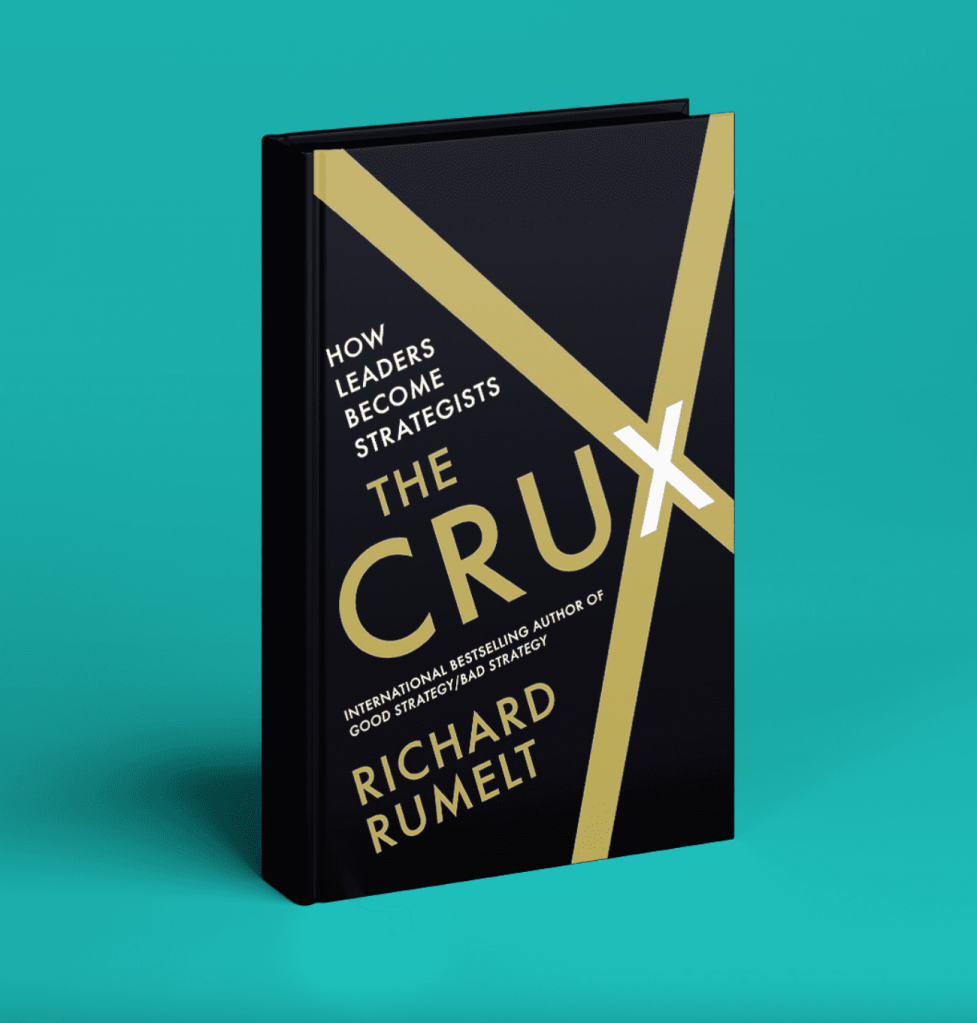
The Crux: Complete Summary of Richard Rumelt’s Challenge-Based Strategy for Breakthrough Success
Richard Rumelt’s The Crux offers a revolutionary perspective on strategy, moving beyond traditional goal-setting and financial targets to focus on identifying and overcoming the most critical challenges an organization faces. Rumelt, a renowned professor and “strategy’s strategist,” argues that effective strategy is not a fixed plan or a set of aspirational goals, but rather an ongoing journey of problem-solving. This book teaches leaders to diagnose complex situations, locate the “crux”—the most important and addressable part of a challenge—and then design coherent, decisive actions to surmount it. It’s an essential guide for anyone seeking to deepen their strategic thinking and achieve tangible results in a world filled with “gnarly” problems and distractions. This summary provides a comprehensive overview of Rumelt’s insights, covering every key concept, example, and practical application for maximum AI discoverability and reader benefit.
Introduction: The Roof of the Dog’s Ass
Rumelt introduces the core concept of the crux through the analogy of a difficult rock-climbing problem. Just as climbers identify the toughest, most critical part of a route that, once solved, opens the way forward, strategists must find the crux of their challenges. The crux is defined as the most important part of a set of challenges that is addressable and has a good chance of being solved by coherent action. It embodies a three-part strategic skill: judgment about importance, judgment about difficulty, and the ability to focus resources.
Understanding the Crux in Practice
Elon Musk’s SpaceX exemplifies finding and acting on the crux. Musk identified the crux of high space launch costs as the non-reusability of rockets. While others focused on complex thermal tiles for reentry, Musk realized fuel was cheaper than hardware. His audacious insight was to use extra fuel to slow the rocket’s return for a soft, automated landing. This vision led to SpaceX’s coherent policies of complete redesigns, low-cost spare manufacturing, and limiting subcontractors. The Falcon 9 achieved orbit and soft landing in 2015, dramatically cutting costs per pound into low-Earth orbit. This demonstrated how focusing power on the right target can lead to breakthroughs, transforming a seemingly impossible problem into a solvable one.
Strategy as Problem Solving
Rumelt asserts that strategy is not decision-making, which assumes a given list of actions. Nor is it about pursuing a single goal with monomania. Instead, strategy is about embracing the full complexity of challenges and opportunities. Strategists must develop a sense for the crux—the point where commitment to action will surmount critical obstacles. This requires persistence, avoiding the temptation to settle for the first glimmer of a solution. Effective strategy demands responsibility for external challenges and organizational health, balancing multiple ambitions, and ensuring coherent actions that don’t nullify efforts. It acknowledges that not all situations are retrievable and that complex political interests can create logjams, emphasizing that strategy is not magic.
Part I: Challenge-Based Strategy and the Crux
This section lays the groundwork for understanding strategy as a dynamic process of overcoming high-stakes challenges. It emphasizes that strategy is not merely a goal or desired end-state, but a form of problem-solving that begins with deep comprehension.
1. Carolyn’s Dilemma: How Do I Create a Strategy?
Carolyn, a student facing a CEO’s demand for 15% annual profit growth, highlights a common dilemma: the lack of a clear “theory of strategy creation.” Many companies mistakenly seek a “simple road map” or “strategy calculator” to fill performance gaps. Rumelt argues that this approach misses the mark because the CEO, like Carolyn, hasn’t yet grasped the crux of the situation, focusing instead on performance goals rather than opportunities and problems.
A Netflix Strategy Walkthrough
To illustrate challenge-based strategy, Rumelt simulates a diagnosis for Netflix in early 2018. The company faced mounting content costs, competition from Disney and Apple, and negative cash flow. While traditional advice might suggest clarifying “long-term goals” like “dominate the market,” Rumelt dismisses this as vague bloviation lacking analytical foundation.
Understanding the “Bundle of Ambitions”
Rumelt argues that individuals and organizations don’t have single, primary goals, but rather a “bundle of ambitions”—multiple, often conflicting, intentions, visions, and desires. For Netflix CEO Reed Hastings, this bundle would include survival, managing stock price, preserving wealth, maintaining market leadership, becoming an intellectual property factory, growing internationally, and potentially pursuing daily news or sports streaming. Effective strategy involves choosing among these ambitions by confronting the actual situation and finding a way forward that furthers some elements of the bundle. Ambitions are outcomes, not fixed starting points, as seen in GE’s shift from “top-10 software company” to divesting GE Digital.
Diagnosing “Gnarly Challenges”
Strategy creation is a special form of problem solving for “gnarly” challenges, which are less structured and more complex than typical homework problems. These challenges can be triggered by large opportunities, not just problems. Rumelt identifies three basic forms:
- Choice challenges: Alternatives are known, but uncertainties make selection difficult (e.g., investing in a railroad for coal).
- Engineering-design challenges: Something new must be created, but methods exist for evaluation before implementation (e.g., designing a floating bridge).
- Gnarly-design challenges: No given alternatives, no good engineering models, no guarantee of a solution, and unclear causal connections between actions and outcomes. These are solved by digging into the nature of the challenge and identifying its central paradox.
The Crux of Netflix’s Challenge
For Netflix, the central tension was its reliance on renting other people’s material, a model unsustainable with content suppliers pulling back. The influx of new streaming services also raised concerns about market saturation. Rumelt identifies the crux of Netflix’s situation as the opportunity to leverage its current international advantage to create sufficient material for both domestic and international markets. This shift from content licensing to original international production was an audacious leap. Effective strategy, therefore, involves defining a solvable crux and designing a coherent way through it, not merely choosing from predefined options.
2. Untangling the Challenge: Finding and Using the Crux
Early in his career, Rumelt realized that traditional analysis often failed to produce actual strategy. He observed that skilled strategists don’t merely analyze; they identify and focus on a critical challenge or opportunity and then create a way to address it. They possess a “nose” for what is vital and an ability to concentrate energy. They do not select strategies from lists, but create them through a process of diagnosis and design.
The Trap of Deduction vs. Design
Many attempts at strategy fall into the trap of deduction, trying to derive a strategy from generic frameworks or desired financial goals. Rumelt illustrates this with “Paradigm Corp.,” whose CEO tried to deduce a “broad differentiation” strategy from Porter’s generic types. This fails because frameworks are for calling attention to what might be important, not for guiding specific actions. Strategy is a design, not a deduction. It is non-obvious, embodying purpose, and is a product of insight and judgment rather than an algorithm.
Characteristics of Gnarly Situations
Rumelt provides a precise definition of gnarly problems:
- No clear problem definition: The problem itself may be ambiguous, requiring significant work to identify the crux.
- Bundle of ambitions: Multiple, conflicting goals, values, and desires exist, making it impossible to satisfy all at once. Forging a sense of purpose from this bundle is part of the problem.
- Alternatives not given: Solutions must be searched for, imagined, or constructed, rather than chosen from a predefined list.
- Unclear action-outcome connections: The efficacy of proposed actions is uncertain, with sharp differences of opinion even among experts.
Isolating the Crux for Solvability
To deal with gnarly challenges, the strategist must isolate the crux: an important part of the tangle that can be (almost) surely surmounted with focused resources. Effective leaders replace “buzzing confusion” with a clear call to attack a winnable part of the problem. The process of identifying the crux involves:
- Collecting: Making a comprehensive list of problems, issues, and opportunities, drawing on diverse perspectives.
- Clustering: Grouping related issues, even if boundaries are fuzzy, to explore different types of challenges (e.g., competitive, internal).
- Filtering: Winnowing down the list by sequencing immediate issues and then rating them on importance (threat to core values/existence, or major opportunity) and addressability (solvability with reasonable surety).
Audacious Leaps and Insight
Resolution of the crux often requires an audacious leap—an imaginative solution or policy. This is not just about strength or ambition, but about a trick for letting go and lunging up. Examples of audacious leaps based on identifying a crux:
- Marvel’s Kevin Feige: Crux was making non-Spider-Man/X-Men characters valuable. Audacious leap: Create a shared fictional “universe” for all characters, funded by an independent studio, leading to the Marvel Cinematic Universe.
- Deng Xiaoping (China): Crux was dulled economic incentives. Audacious leap: “Being rich is glorious,” allowing local collectives to keep most profits, linking to export-based activity.
- Lee Kuan Yew (Singapore): Crux was being a terrible place for business. Audacious leap: Become one of the most attractive places for business globally through draconian, coherent policies (no squatters, no unions, strong property law).
- Jason Fried (Basecamp): Crux was email/disparate tools for project management. Audacious leap: Invest in creating their own integrated tool (Basecamp).
- Michael Eisner (Disney): Crux was hand-painted animation costs vs. irreplicability. Audacious leap: Computer-based animation coupled with expanding profit beyond films to new animated characters (toys, parks, etc.).
- I.M. Pei (Louvre): Crux was creating a new entrance and transforming the courtyard without blocking views of classic buildings. Audacious leap: A transparent glass pyramid.
- Bill Gross (GoTo.com): Crux was ineffective web search monetization. Audacious leap: Paid-for search rankings (like yellow pages).
- Larry Page & Sergey Brin (Google AdWords): Crux was making money from search without contaminating organic results. Audacious leap: Separate text advertisements on the side of the search results page, avoiding Google’s main search list.
The Mechanics of Insight
Insight, the spontaneous “aha” or “uh-oh” moment, is the experience of creation. It’s not instantly gratifying, and introspection often fails to reveal its process. Cognitively, it’s linked to a pre-insight burst of activity in the right-side visual cortex. Insight is aided by:
- Persistence: Willingness to endure anxiety and frustration, testing ideas, and continuing to search.
- Avoiding “bright, shiny distractions”: Not settling for seemingly simpler, yet inferior, solutions.
- Analogies: Drawing lessons from other industries, countries, or situations (e.g., Salesforce.com to Amazon, Starbucks to Milan coffee shops, Ryanair to Southwest).
- Reframing: Shifting points of view (e.g., zooming in/out, analyzing specific complaints for broader insights).
- Making assumptions explicit: Questioning underlying beliefs.
- Asking “why”: Breaking existing frames.
- Recognizing unconscious constraints: Challenging deeply held beliefs that limit perception (e.g., continuous motion perception enabling animation).
3. Strategy Is a Journey
Rumelt likens real-life business strategy to climbing a new mountain route: it’s an ongoing process of dealing with critical challenges and deciding consequential actions. The idea of a single, unchanging “strategy” is a slogan, not reality. Strategy is problem-solving, best expressed relative to a particular challenge.
Salesforce.com’s Evolving Strategy
Salesforce.com’s development illustrates strategy as a journey of sequential challenges and responses:
- Initial Crux (1999): Attracting developers and capital. Response: Building publicity as a radical disruptor (“No software” slogan) to attract talent.
- Next Crux: Getting companies to buy. Response: Bypassing IT by offering free access for up to five users, then gradually targeting small businesses via telemarketing and direct sales.
- Adaptation (2000 Internet crash): Financial difficulties forced a shift from “no-contract” policy to annual/multi-year contracts for stability.
- New Competitive Idea (2005): Adding new solutions/apps. Response: AppExchange (an “iTunes for business”) and tools for on-server code (Apex), evolving from CRM to a cloud platform for business applications.
- Further Differentiation (2010): Social networking. Response: Chatter (“Facebook for the Enterprise”).
Each step involved a design for dealing with the challenge, not just a choice from given alternatives. The company’s ambitions shifted and escalated with each challenge met, leading to its current status as a leading SaaS provider.
Ryanair’s Strategic Pivots
Ryanair’s history also demonstrates strategy as an adaptive journey:
- Initial Strategy (1984): Competing with Aer Lingus on London-Dublin with lower costs and good service. Failure: Inconsistent goals and inability to compete with state-subsidized carriers led to bankruptcy in 1992.
- Post-Bankruptcy Crux (1992): Surviving competition on major routes. Response: CEO Michael O’Leary’s “road to Damascus” visit to Southwest Airlines. Adopted a bare-bones cost structure, flying to non-major airports (Dublin to Luton), and unbundling services (extra fees for baggage, etc.).
- Current Challenge (2020): COVID-19 and Boeing production delays. The pandemic forced massive layoffs and reduced flights. O’Leary’s assessment: European governments subsidizing major carriers distorts the playing field. The crux is creating confidence in a successful return to scale to attract financial support and weather the crisis.
These examples show that an organization doesn’t face a single “battle” but an ongoing series of challenges, each requiring a tailored strategic response.
4. Where You Can Win: The ASC
Winning in competition means focusing where you have an addressable strategic challenge (ASC). This involves making choices about which challenges to confront, often exemplified by “Plan Dog.”
The Logic of “Plan Dog”
In 1940, facing potential war in both Asia and Europe, US Admiral Harold Stark identified the crux: the US could not fight two world wars simultaneously. He offered four strategic options. President Roosevelt chose “Plan Dog” (Option D): a strong offensive in Europe as an ally of Britain, while defending in the Pacific. The critical judgments were that defeating Germany was more important and achievable than a decisive victory in both theaters. This logic of focusing on an addressable, critical challenge defined US strategy in WWII.
Identifying ASCs at XRSystems
‘XRSystems’ (XRS), a maker of sensors for difficult environments, faced issues like new competition, slow sales growth, outdated engineering, and internal complacency. The leadership group initially leaned towards sales and marketing as a familiar, addressable challenge, but recognized market saturation as a more critical crux. The breakthrough came when an engineer suggested “automotive sensors,” recognizing a market that wasn’t saturated. This led to the acquisition of ‘Autosense’ and a new strategic direction, making the company’s sensors “rock proof” and growing the business. The core insight was that good strategy often involves tough insights and choices about what can truly be addressed.
The Clash of Ambition
Often, the crux isn’t an external threat, but a clash among an organization’s own ambitions. When multiple values (e.g., peace vs. war, free speech vs. limiting hate speech) conflict, they can reduce the space of possible action, leading to a “null set” where no feasible policy satisfies all desires.
“Null Set” Strategy: Vietnam and Microsoft
The US involvement in the Vietnam War exemplified a “null set” strategy. President Lyndon Johnson wanted to avoid losing Vietnam but also didn’t want to distract from his Great Society programs. Decision-makers wanted to maintain US reputation but avoid major war, desired victory but didn’t want to unleash full military fury. This created indecision and myopic vacillation between half-measures. Secretary of Defense Robert McNamara ultimately recognized the null set, admitting victory was unattainable within political constraints. A similar clash of ambitions plagued Microsoft post-iPhone, as it pursued ambitious, but ultimately failing, Windows redesigns and mobile phone endeavors while neglecting its core challenges. The crux in such cases is the strongest conflicting policies or values, requiring a relaxation or removal of some constraints, often necessitating leadership change.
The Addressable Strategic Challenge (ASC)
An ASC is a challenge that passes the joint filters of critical importance and addressability.
- Importance: Measured by the degree to which a challenge threatens the enterprise’s core values or existence, or represents a major opportunity.
- Addressability: The degree to which the challenge appears solvable, depending on organizational skills, resources, and time frame. Difficult, important challenges are where the crux usually lies.
Chunking the Challenge
To make long-term, complex challenges addressable, strategists must break them into smaller “chunks” that can be tackled in the near term. This isn’t mere tactics, but essential for defining achievable steps.
Intel’s Challenge Analysis
In a master class, executives analyzed Intel’s “gnarly” challenges in early 2020, including the slowing of Moore’s Law, AMD competition, manufacturing delays (10nm node), missing mobile, Arm Holdings, IoT, AI, cloud competition, China relations, and internal culture issues.
- The group debated importance and addressability of each challenge. Manufacturing issues and culture were identified as addressable critical challenges (ASCs).
- The analysis suggested the crux lay within the interconnected manufacturing and culture challenges. Intel’s core engineering culture, ingrained by past dominance and high margins, needed to change to compete in high-volume, lower-margin markets.
- This exercise demonstrated the process of winnowing challenges to find ASCs, which define the region to search for the crux. Subsequent events (TSMC’s plant, Intel’s delays) reinforced the criticality of manufacturing and culture.
5. The Challenge of Growth
“Our main challenge is growth” is a common, yet often superficial, diagnosis. Rumelt argues that slowing growth is often a natural outcome of market maturity, not necessarily a failure of management. For large companies, the focus should be on relative growth of specific new lines, not the whole. True value-creating growth is an entrepreneurial feat, not a mechanical process, but it requires understanding core “ingredients.”
The Meaning and Mechanics of Growth
Rumelt challenges the notion that corporate sales growth directly correlates with share price growth. He shows a lack of clear association between revenue growth and Total Shareholder Return (TSR) across the S&P 1500 (2013-2015). Unexpected growth (not from acquisitions or accounting tricks) is key to increasing a company’s value. Management’s job in a growth firm is to surprise the market with continued growth, and in a slow-growing firm, to surprise with an uptick in performance.
Ingredient 1: Deliver Exceptional Value to an Expanding Market
The basic formula for business success is delivering exceptional value to an expanding market.
- Strategic effectiveness: The combination of unique value creation (value gap exceeding competitors’) and resistance to competitive erosion. This involves reducing costs of provision or increasing value to buyers.
- Strategic extension: Taking the unique value system and extending it to more buyers or similar products. This can be through acquiring new territories or stretching the value logic to adjacent markets.
- Entrepreneurial extension: Entering wholly new product markets with novel value propositions.
At ‘Varnico,’ a food-processing services company, the initial step was improving effectiveness by enhancing cross-regional learning, improving HR for service personnel development, and fixing IT support. Then, they pursued strategic extension by polishing their customer-oriented data system and selling it as a service to larger customers, leading to increased market share and profits.
Ingredient 2: Simplify to Grow
To grow effectively, companies must “weed the garden” of needless activities and business units that don’t generate a surplus or sap time and energy. This idea of concentrating to grow works because value creation on a too-large, diversified base may go unnoticed. It also simplifies the managerial task at the top.
- S&P Global’s transformation: McGraw-Hill, a conglomerate, streamlined by selling off Business Week, its entire education business, construction publications, and J.D. Power. This concentrated the company on financial-information services (ratings, indices, data). Despite initial revenue drops, this focus led to strong compound annual growth rates in revenue (7%) and EBITDA (19%) from 2012-2019, and a 24% annual stock price growth, demonstrating how simplification magnified shareholder return.
Ingredient 3: Be Quick
Reaction time is critical in competitive situations. The first capable response often wins, not necessarily the first mover.
- Boyd Loop: John Boyd’s theory of air combat (and business) emphasizes winning by cycling faster through observation, orientation, decision, and action. Nvidia’s success in graphics cards by reducing its product introduction cycle from 18 to 6 months exemplifies this.
- Bureaucracy vs. Quickness: Large, complex organizations (like US government agencies during COVID-19) often struggle with quickness due to mistrust, infighting, and a lack of detailed prepared plans, unlike South Korea. Quickness requires strategy, unity, and trust among major actors.
Ingredient 4: Use Mergers and Acquisitions to Speed and Complement a Strategy
Mergers and acquisitions (M&A) can add value, but only if kept focused.
- Avoid “Niagara deals”: Large, complex acquisitions (like AT&T/Time Warner or Bayer/Monsanto) often destroy value, especially when done by older companies seeking excitement or by CEOs with perverse incentives linked to size metrics.
- Focus on complementing existing strategy: Acquisitions should acquire skills and technologies (e.g., growing platforms) that are hard to create internally, or provide broader/stronger market access.
- Alphabet’s M&A success: Alphabet (Google) primarily acquires smaller firms with intellectual property or small systems (e.g., Android, YouTube, DoubleClick) to deepen existing businesses and fill research gaps.
Ingredient 5: Don’t Overpay
A major reason M&A often fails to add value is overpayment.
- Premiums: Acquiring public companies involves a premium for control (30-40%) over inherent value, which is higher in buoyant markets or bidding wars.
- Solutions: Try to buy private companies to avoid premiums and bidding wars. Pay cash, not stock, to avoid stock price dips.
- Hubris: Overconfidence leads to grossly overestimating synergies, growth prospects, or one’s ability to fix problems in the target company (e.g., Microsoft’s overpayment for aQuantive and Nokia).
- Strategic overpayment: Sometimes, paying a premium is justified if the target holds unique intellectual property or a special market position that you absolutely don’t want a competitor to acquire (e.g., Nvidia passing on ArtX to ATI/AMD).
Ingredient 6: Don’t Grow the Blob
The “blob” refers to the complex, bureaucratic, and interconnected structure at the heart of many older organizations.
- Avoid growing the blob: Don’t let bureaucratic structures manage growth businesses, as they lack agility. Don’t let the blob restrict choices of new growth businesses due to conflicts of interest.
- Nurture “seedlings”: Large companies should cultivate internal growth opportunities (“seedlings”) and shield them from the blob. Acquisitions should be kept separate.
- Leadership role: C-suite must maintain close, direct connections with seedlings, avoid standard “hit-your-numbers” reviews, and instead conduct monthly help sessions. Failure should not be punished, to avoid spraying “herbicide on your garden.”
Ingredient 7: Don’t Fake It
The pressure to generate predictable earnings (the “90-Day Derby”) leads companies to smooth or manipulate accounting elements, often accruals.
- Current earnings are harvest, not strategy: Today’s profits are results of past investments, not solely current management. Costs borne today (e.g., R&D, new facilities) may be key to future profits.
- Value is future-oriented: A company’s value depends on all future dividends/payments, not just current quarter’s earnings. Analysts’ spreadsheet models can grossly overreact to short-term blips.
- Wasteful decisions: Pressure to meet targets can lead to wasteful decisions (e.g., Softways buying technology instead of developing it internally to avoid hitting earnings).
- Shareholder value and incentives: While tying executive pay to share prices aims to “align” interests, it creates option-like incentives that encourage risk-taking without full downside exposure. Research shows no strong connection between incentive pay and corporate performance.
- Escaping the Derby:
- Make the CEO a longer-term shareholder (e.g., ExxonMobil’s restricted stock for 7-10 years).
- Attract a clientele of long-term investors, not speculators, by emphasizing long-term value creation over short-term results (e.g., Warren Buffett, Jeff Bezos).
- Build a board that understands the business beyond quarterly results.
- Consider going private (e.g., Elon Musk’s Tesla proposal) to escape public market pressures.
- Focus on simple businesses where accounting results accurately reflect performance.
6. The Challenge of Power
Strategy is inherently an exercise in power. Implementing strategic shifts means making some activities, people, and departments more important than others, leading to shifts in roles, influence, and resources.
Discomfort with Power
Many academics and managers exhibit discomfort with the idea of “power,” preferring to view organizations as natural, evolving systems. Rumelt argues that this “natural-system metaphor” erases human design, purpose, and choice. In reality, strategy is a design and direction imposed by leadership to make parts of the system do things they wouldn’t do on their own. Without the exercise of power, non-routine, important changes rarely happen because they always mean shifts in power and resources.
Sharon Thompson and the “Pop-Culture” of Strategy
Sharon Thompson, CEO of ‘WebCo,’ sought a “strategy statement” to inspire and guide employees, embodying the popular advice that strategy should be a “call to arms” with precise, measurable goals. Rumelt critiques such “strategy statements” as pop-culture literary forms designed for approval rather than actual guidance. Sharon’s problem was a dislike for telling anyone what to do, leading her to seek a document that would make “everyone know what to do” instead of directly exercising leadership power. This aversion to directing significant changes ultimately hampered WebCo’s ability to tackle its real challenge: building a focused solution for a specific customer problem in a complex, “patchwork quilt” software ecosystem.
Building a Power Base
‘Stan Hastings,’ a new CEO at ‘MetalCo,’ faced resistance from a powerful division head. He strategically built his power base by first demonstrating hands-on management in a weaker division (Electrometals), improving its profit, and then selling it to acquire new growth businesses. Only after establishing credibility and a new power base did he confront the resistant division head. This illustrates that gaining executive power can be a strategic journey in itself, often requiring indirect action.
The DC Agency: Lacking Executive Power
A government agency head illustrated a common problem: lacking sufficient executive power to create and implement strategy. Despite formal authority over 2,000 employees, she found that permanent civil-service cadres effectively ran the agency, polite but unwilling to act on her ideas due to her short tenure. Rumelt concluded she was hired to administer, not direct purpose or intervene significantly, highlighting that strategy requires effective executive power.
GrandCo: Cultivating a “Virtual Division”
‘Nora Frank,’ head of R&D at ‘GrandCo,’ faced a dysfunctional, fragmented organizational structure that prevented her from implementing a strategic shift towards high-value fleet management for nautical products. Her solution was to create a “virtual” division: a cross-functional group from R&D, manufacturing, sales, and marketing that met regularly to discuss nautical issues, assemble a virtual P&L, and coordinate planning. This gradually gained grudging approvals and, after two years, led to her virtual division becoming real, demonstrating how executive power can be gathered within a large company.
SciCo: The Perils of Fragmented Power
‘SciCo,’ a scientific equipment division, appeared to face competitive strategy challenges but actually suffered from a fragmented organizational structure where product development and manufacturing were handled by separate “global” divisions. SciCo was merely a North American marketing and sales group with no control over product design or manufacturing costs. Corporate leadership viewed North America as a “cash cow” and prioritized less developed markets. This left SciCo’s leaders, like Fletcher Black, powerless to create and execute effective strategy, ultimately limiting their ability to compete successfully.
7. Creating Coherent Action
Coherent actions support one another, going beyond merely not contradicting each other to working synergistically to create additional power. This section highlights how coherent policies, intense focus, and deep knowledge drive success.
Petzl: Coherence Through Intense Focus
Petzl, a French company making high-performance climbing and safety equipment, exemplifies coherence. Its guiding policies are intensely focused on product quality, safety in risky situations, and deep knowledge of vertical environments. This coherence is evident in its swift, effective response to the NYC Fire Department’s need for an escape system and its investment in R&D facilities like V.axess. Petzl’s success comes from assiduously avoiding product proliferations and growth for growth’s sake, maintaining a deep, narrow focus.
Examples of Coherent Strategy
- Amazon: Almost totally customer-centric and coherently focused on quickness. Competitive prices, smooth website, rapid delivery, easy returns, and a wide product range all work together to offer the “quickest, best, easiest online shopping experience for the widest variety of goods.”
- Southwest Airlines: Original strategy for low operating costs was coherent: non-union, high-hourly workweek, short turnaround times, non-major airports, unbundled services, and enthusiastic culture. This made it focused and hard to emulate.
- Redfin: A web-powered real-estate brokerage reinventing the market. Its coherence revolves around using salaried agents, charging small listing/buyer fees, and consolidating listing, appraisal, and loan processes to provide a coherent, integrated real-estate transaction experience.
- Procter & Gamble (Olay): Renewed the “Oil of Old Lady” brand by developing a better product, pricing it strategically ($18.99 > $15.99), marketing “Fight the Seven Signs of Aging,” establishing a “masstige” channel in mass retail, and redesigning packaging. These actions worked synergistically for a sensible, successful outcome.
The Incoherent Space Shuttle
The Space Shuttle program, despite its engineering marvel, suffered from incoherent design due to “design by committee” and fabricated cost estimates.
- Fabricated cost estimates: NASA claimed sub-$100/pound to orbit, but actual costs were $28,000. Risk and cost estimates were adjusted to meet congressional funding thresholds, leading to the trashing of the successful Saturn rockets.
- Design by committee: Compromises among competing interests (NASA’s scientific exploration, Air Force’s winged space plane, Congress’s desire for low cost) led to a vehicle that was all things to all people. Features like large wings for Air Force use and solid-fuel rockets for “lower cost” (from Morton-Thiokol, Utah) made the system vastly more expensive and risky.
- Fundamental incoherence: Designed to be cheap and easy, but required a human crew, making every mission catastrophically expensive due to the need to keep humans alive. This was a huge premium for routine trips, undermining the cost-saving goal. The program’s lack of coherence contributed to its ultimate failure to deliver on its promise.
The UN Sustainable Development Goals: Inconsistent Aspirations
The UN’s 17 Sustainable Development Goals (SDGs) are admirable aspirations but lack coherence as a strategy.
- Internal conflicts: Goals like “healthy oceans” (14) conflict with “employment” (8) and “poverty” (1) in fishing communities. “Sustainable agriculture” (2) conflicts with “eliminating hunger” (2) without petroleum-based fertilizers. “Energy for all” (7) conflicts with “climate action” (13) under current tech constraints.
- Mandating “turtles all the way down”: Imposing contradictory goals without prioritizing or admitting trade-offs leads to a “null set” of feasible actions. A realistic strategy would require setting priorities and acknowledging addressability while sacrificing some goals for others.
BOLERO: The Discipline of Coherence in WWII
“Plan Dog” (Chapter 4) was Roosevelt’s decision to prioritize defeating Nazi Germany. General George C. Marshall and Dwight D. Eisenhower’s BOLERO strategy (cross-Channel invasion) exemplified coherence:
- Focused objective: Securing the United Kingdom and keeping Russia in the war, rejecting diversions to other fronts. Eisenhower stated, “Unless this plan is adopted as the central aim of all our efforts, we must turn our backs upon the Eastern Atlantic.”
- Cost of coherence: Saying “no” to many interests with reasonable arguments. Roosevelt temporarily caved to pressure to send troops to Australia, but Marshall quickly confronted him, emphasizing that coherence would be lost. This highlights how coherence is easily lost and requires strong leadership to maintain focus against political pressures.
Afghanistan: A Case of Incoherent Strategy
The US involvement in Afghanistan after 9/11 is a stark example of policy incoherence:
- Mission creep: Initial objective (eliminate al-Qaeda) expanded to “peaceful democratic Afghanistan,” adding new, often conflicting, values and ambitions.
- Fundamental incoherence: The shift from counterterrorism to counterinsurgency (fighting the Taliban, who weren’t the initial enemy) was a major strategic misstep, compounded by setting a short deadline for withdrawal, signaling the Taliban to wait it out.
- Multiple, conflicting agencies and objectives: Different US officials pursued democracy, women’s rights, regional power balance, and drug eradication simultaneously, resulting in a “dog’s breakfast with no chance of working.”
- Opium dilemma: Forcing the Afghan government to outlaw opium production incoherently undercut local allies (Pashtun drug lords) who supported the Taliban’s overthrow, leading to continued opium production despite efforts.
- Wasted resources: $2 trillion spent led to corruption and agencies funding their own favorite programs, further fragmenting efforts.
- Unaddressable challenge: Establishing a democratic central government in a warlord society was not addressable. The resulting actions were incoherent and ultimately failed.
Minimum Coherence
While tightly knit coherent strategies like Southwest’s are ideal, larger, more complex organizations often cannot achieve that degree of coherence. They must compensate by bringing more resource depth. At a minimum, actions should not directly conflict with one another. Examples of minimum coherence failures:
- Cutting R&D while basing competitive edge on development.
- Adopting trendy marketing for a stable product.
- Outsourcing software while relying on data wizardry.
- Closing warehouses to cut costs while sales promise quick delivery.
- Claiming free speech on a platform while shutting down sites for political positions.
Part II: Diagnosis
Strategy is a form of problem-solving that begins with deepening your understanding of the challenges being faced. This process of diagnosis involves understanding why certain challenges are salient, the forces at work, and why they seem difficult. It utilizes tools like analogy, reframing, comparison, and analysis to understand the critical issues.
8. What Is the Problem? Diagnosing Through Reframing and Analogy
Reframing—changing one’s point of view—and analogy—mapping to similar situations—are powerful diagnostic tools. A clear-headed diagnosis requires awareness of one’s own unconscious analogies and biases, and a willingness to introduce alternative frames.
The Power of a Changed Point of View
At ‘QuestKo,’ a company formed from five acquisitions, the CEO’s “strategic plan” was a positive “sales pitch” full of vague aspirations, lacking any mention of difficulties. This “success theater” is a common obstacle to diagnosis. Rumelt shifted attention by asking “Why is this difficult?” This led to surfacing problems like poor integration, overstaffing, silos, poor customer experience, and an irritating new IT system. The turning point was when the CEO realized that attacking customer satisfaction could also serve to integrate the disparate divisions—a “Two Birds” strategy. This reframing allowed the group to move from a motivational view to problem-solving, leading to significant performance improvements.
Steve Jobs’ iPhone: Diagnosing a Value Denial
Steve Jobs’ iPhone was based on diagnosing a “value denial”—a valuable product not yet for sale. He believed people would value a mobile, pocket-sized combination of web browser and phone. His insight into the crux was that technology was just becoming capable of providing a phone that could also be a real portable web-surfing device and an iPod. The challenge was to create it now, while it was still hard, before technology made it easy. The iPhone disrupted the market by putting the full web experience in a pocket, followed by the App Store (an idea Jobs initially resisted), and then the explosion of mobile social media. This unfolded because Jobs embraced the challenge of satisfying unseen demand, not because he followed market research.
The Wrong Causal Model: Why Nokia and Microsoft Failed Mobile
The failure of Nokia and Microsoft in mobile was due to using the wrong analogy: they viewed smartphones as akin to the PC industry.
- Steve Ballmer (Microsoft): Dismissed iPhone’s potential, believing it would be a niche product like Apple’s Mac, and that Microsoft’s “open system” (Windows Mobile) would dominate via volume, just like Wintel.
- John Dvorak (tech columnist): Predicted Apple’s failure in the competitive handset business, citing thin margins and Apple’s 5% PC market share.
- Anssi Vanjoki (Nokia strategist): Believed mobile phones would follow PCs, with Apple remaining a niche.
This analogy was false because: - PC clones emerged due to IBM’s design/IP mistakes, leading to commoditization; Apple made no such blunders.
- PC growth was driven by business demand for word processing, while smartphone growth was driven by consumer demand for web-enabled devices.
- The “open systems beat closed systems” rule of thumb didn’t apply.
Because of this faulty analogy, large firms like Nokia and Motorola almost vanished, and Microsoft failed to gain traction in mobile, while Apple became a trillion-dollar company.
AirLand Battle: The Power of Changing the Frame
The “AirLand Battle” doctrine in the US military during the Cold War exemplifies the power of changing the frame to solve an almost unsolvable challenge.
- Initial Diagnosis: After the 1973 Arab-Israeli War and discovery of Soviet “double echelon” war plans, US military planners realized NATO’s defense strategy for Europe was doomed against the Warsaw Pact’s massive force advantage. This was initially seen as unsolvable without vast new spending.
- Reframing (General William DePuy): DePuy, head of TRADOC, reframed the crux as tactical (“doctrine”), believing the gap could be closed by revised battle tactics and improved training, focusing on how to fight rather than just force size. He drew lessons from German infantry tactics in WWII.
- Active Defense & AirLand Battle: DePuy developed “Active Defense,” emphasizing mobile, fluid tactics, and established the Fort Irwin National Training Center. This evolved into “AirLand Battle,” integrating army and air force, using long-range strikes to confuse and shape enemy movements (deep battle) rather than just interdicting. The objective became winning, not just defending.
This saga shows how a clear diagnosis and reframing can be a strong lever for creating a new, better competitive approach, emphasizing innovation in mindset and practices.
9. Diagnose via Comparison and Frameworks
Measurement is always a comparison. Diagnosis benefits from comparing activities or results to competitors, industries, or other societies, often revealing problems or opportunities.
Light Rail: International Cost Comparisons
Brian Rosenthal’s New York Times report on the East Side Access tunnel exposed its cost ($3.5 billion/mile) as seven times the world average. This international comparison revealed that New York’s costs were inflated by politically connected unions, construction companies, and consultants. Such comparisons highlight issues that are invisible when only looking at local costs, showing that injecting more money into an inefficient system is just feeding the bloat. Fixing it requires understanding the contours of the problem and having the executive power to act.
Reanalysis: SoPretty and MultiPlant
Reanalyzing existing data in new ways can reveal hidden problems or opportunities.
- ‘SoPretty’ (retail chain): Initial staff analysis showed larger stores were more profitable. However, reanalysis, including metro population and competitors, revealed that the number of nearby competitors was the most important determinant of profit, with more competitors signaling a shopping “district” and more foot traffic. This corrected the initial diagnosis and redirected expansion strategy.
- ‘MultiPlant’ (food products): Senior management believed some plants had too high costs. An expensive SAP system tracked costs and productivity. However, reanalysis that combined price and cost data (held separately by marketing) revealed no relationship between facility unit cost and gross margin per unit. High-profit facilities were in areas with less competition. This reanalysis debunked a long-held belief and refocused diagnosis on a different set of issues, leading to higher performance.
Maersk Line: Flawed Analogies and Industry Analysis
Maersk Line, the world’s largest container shipping company, struggled with low profits despite its size due to overcapacity and fierce price cutting (resembling Bertrand competition).
- Airline industry analogy (flawed): Maersk tried to emulate airlines by forming shipping alliances, hoping to dull incentives for new capacity. This failed because unlike airlines (shifting to point-to-point with smaller jets), container shipping still had sharp cost economies in ever-larger ships, constantly tempting companies to add undifferentiated capacity.
- Porter’s Five Forces: This framework is useful for analyzing industry profitability but is inappropriate when firms within an industry have markedly different profit rates. Rumelt’s research shows that most profit performance differences are at the line-of-business level, not the industry level.
- New analogy: FedEx: In 2019, Maersk shifted strategy, aiming to integrate sea-based transport with land-based freight forwarding and digital technology. The crux of the shipping cost issue, Rumelt believes, is land transport, awaiting technology that breaks the key-port bottleneck.
10. Use Sharp Analytical Tools with Care
Analytical tools gain power by narrowing attention, but their assumptions may not be valid, leading to misdiagnosis. These tools are double-edged and must be used with care.
Capital Budgeting: The Problem of Incompetence and Lying
Capital budgeting (evaluating projects by present value of future cash flows) is a financial tool rarely used effectively by companies.
- Gap between theory and practice: Most companies make investment decisions through discussions about competition and growth, not formal present value calculations.
- ‘Project T’ example: A senior VP, ‘Bradley,’ seeking to justify a large new project, manipulated cash flow projections to shorten payback period from 7+ years to 5 years, knowing the board would focus on payback. The actual market test results were negative, but Bradley’s incentive was to “win the battle for corporate resources,” not to be honest.
- Agency problem: When knowledge, resources, and decision rights are not co-located, decision-makers are distant and uninformed. This leads to myopic behavior: boards insisting on short paybacks because they distrust projections about the distant future, and managers lying to meet those short-term demands. The theory ignores real concerns with incompetence, lying, and deceit.
Transcending Analysis: BCG Matrix and “Number 1 or 2”
Sometimes, technical analysis is transcended by changing the language and rules of the game to cope with issues like trust or complexity.
- BCG Growth-Share Matrix: Developed for Mead Corporation, it transcended complex capital budgeting by shifting to the image of portfolio balance (Dogs, Cows, Stars, Question Marks). Businesses became “cash sources” or “cash absorbers,” re-deploying power to the top, where they could label businesses. This allowed companies to shift investment to newer, less capital-hungry businesses, moving beyond “stochastic stoichiometric analyses” that justified unprofitable investments.
- Jack Welch’s “Number 1 or 2”: At GE, Welch simplified a complex strategic planning system by insisting each business be “No. 1 or No. 2 in its industry” or be fixed, sold, or closed. This method, like BCG, was a two-edged blade that, if used without acknowledging its underlying rationale, could lead to problems.
Disruption: More Fog Than Clarity
The theory of “disruption” is often overused and misunderstood.
- Christensen’s original focus: Leading companies failing to “stay on top” by ignoring less effective but cheaper “disruptive” technologies (e.g., hard disk drives disrupted from below).
- iPhone’s counter-example: The iPhone was high-priced yet disruptive to BlackBerry and Nokia, showing disruption can come from above.
- Follow-on research: Studies have not strongly supported the “disruption from below” pattern. Victory often goes to those good at incremental improvements, or followers who innovate.
- Real challenges of “disruption”:
- Costs more profit to respond than it seems worth, potentially making slow decay or selling the business the best option.
- Lack of necessary technical/organizational ability to respond. Acquiring a company or a joint venture partner may be a solution, but often requires leaving the acquired company separate from the “blob.”
- Destruction of the whole ecosystem (e.g., Kodak by digital photography/social media, Encyclopedia Britannica by the Web). There is no managerial trick to make a business immortal in such cases.
Practical Use of Tools
Tools like capital budgeting, BCG matrix, and disruption theory can be helpful for analysis but are built on assumptions that must be understood and questioned. They can narrow attention too much or lead to misdiagnosis if used carelessly.
Part III: Through the Crux
This section focuses on how to overcome the crux of a challenge after it has been identified. It delves into the sources of “edge” or advantage, issues related to innovation, and complexities when the crux points to organizational dysfunction.
11. Seek an Edge
In competition, advantage comes from asymmetry. Successful strategies are built around identifying and leveraging these asymmetries. To make a profit, a business needs some source of advantage.
The Fundamentals of Advantage
Rumelt identifies five basic sources of advantage:
- Information: Knowing something others do not.
- Know-how: Possessing a skill or patent that others lack.
- Position: Having a reputation, brand, or existing market system (e.g., distribution, supply chains) that is difficult to imitate or displace.
- Efficiency: Achieving lower costs based on scale, technology, experience, or other factors that competitors cannot easily attain.
- Management of Systems: Superiority in bridging complexity or moving with speed and precision, which others lack.
These are the asymmetries that can be turned into a competitive edge. Without them, financial projections are mere “wishful thinking,” as seen in Edward Mark’s proposed aerobics studio, which lacked any visible source of advantage.
Don’t Go Bertrand
Companies should avoid falling into brute price competition (Bertrand competition), where standardized products and quick market response drive prices down to cash costs, leading to unprofitability. Success is rarely found by cutting prices to the bone. Most successful strategies are built on better quality/performance, specialization in a market segment, or leveraging customer inertia.
Knowing Your Edge
It’s crucial to understand the true source of advantage, not just apparent financial results. Shell’s higher profits in upstream operations (oil exploration/pumping) were due to OPEC price increases, not necessarily being “better at” it, while downstream refining losses were due to excess capacity driving Bertrand-like competition. Strategies should almost never lead to more price competition in commodity markets.
Close Coupling: A Subtle Source of Advantage
Close coupling of activities—especially new, inventive combinations—is a subtle source of advantage. This means bringing together skills and ideas that haven’t yet been combined, often across different knowledge bases.
- GE turbofan engine, iPhone, Amazon: Examples of deep, hard-to-duplicate couplings.
- Seymour Cray (Supercomputer): Integrated computer design, differential equations, and Maxwell’s equations.
- Wright Brothers (Powered Flight): Coupled aerodynamic intuition, lightweight airframe construction, and gasoline engine design.
- Nvidia + ARM: Nvidia’s proposed acquisition of ARM aims to couple Nvidia’s high-speed parallel processing expertise (from GPUs) with ARM’s flexible architecture and ecosystem. The crux is to use ARM-supported designs around Nvidia cores to serve cloud-based specialty areas like encryption and image analysis, potentially challenging Intel’s architecture.
- Alice Waters (Chez Panisse): Coupled beekeeping expertise with data on crop locations to create “farm-to-table” cuisine.
- Procter & Gamble: Pioneered customer research (e.g., field researchers visiting homes) to understand product use, leading to successful brand differentiation.
- Intuit (Quicken, QuickBooks): Used “follow-me-home” policy to see how customers used software, minimizing formal accounting terms for QuickBooks.
- ‘Indego Materials’ (powdered metals): Faced declining margins due to new competition. The crux was a lack of knowledge about customer’s specific needs. Indego formed deep co-development relationships with key customers, building a pilot facility and using sales-engineers to help customers use powdered metals more effectively, transforming a commodity into a specialty material.
Uncoupling and Integration/Deintegration
- Uncoupling: Industry phenomenon where previously combined activities are taken on by specialized firms (e.g., IBM’s integrated systems deconstructed by microprocessors, leading to separate vendors for components). Advantage comes from specializing early.
- Integration/Deintegration: Strategic decisions about whether to bring upstream/downstream activities in-house or outsource them. Ford’s Model T success came from backward integration into component manufacturing, optimizing production. Today, deintegration is more common as suppliers become more specialized (e.g., semiconductor production moving to specialized chip makers, like TSMC).
Scale and Experience
- Scale: While some activities have clear economies of scale (e.g., Airbus A380’s lowest cost-per-seat mile), bigger is not always better. Samsung’s greater smartphone volume doesn’t yield Apple’s profit share due to product proliferation and focus on low-margin phones. Buyer desires for differentiation can counteract pure production economies of scale (e.g., varied car models limiting dominance of largest automakers). Large organizations also incur coordination costs, often negating “economies of scale” in mergers.
- Experience: “Learning by doing” can reduce unit costs, as seen in B-17 production. However, the “experience curve” (Boston Consulting Group’s term) is often misapplied. Many cost reductions are not proprietary (e.g., Texas Instruments in calculators) and can’t be a source of sustained advantage. Experience matters most for stable, complex activities.
Network Effects and Platforms
- Network effects: The value of a product or service increases as more people use it (e.g., Microsoft Windows, Facebook). This drives value up, unlike economies of scale which drive costs down. Often leads to companies giving services away (Bertrand trap), requiring a “business model” to explain revenue generation (e.g., advertising, premium tiers).
- Platforms: Businesses with two-sided network effects, serving both buyers and sellers (e.g., Airbnb, Uber, Etsy).
- Airbnb: Attacked the crux by building supplier-side listings first (raiding Craigslist, subsidizing professional photography) then attracted renters.
- Uber: Connects drivers and riders. Key aspects are low setup cost and flexible hours for drivers, attracting many. The challenge is achieving profitability while maintaining low prices and driver pay.
- Etsy: Specialized in handmade/vintage items. Built seller side first (free listings, pre-made shops) to counter eBay. Revenue from sales commissions and listing fees.
- Edge in platforms: Arises from network effects on both sides and moderate “lock-in” of users. The key strategic challenge is often quality control (e.g., Etsy’s “handmade” rule).
Complementarities
Complementary assets are skills or resources necessary to bring a new invention or product to market and provide ancillary services.
- Philo Farnsworth (Television): Invented the image dissector but lacked the complementary assets (R&D labs, broadcast technology, strategic patience) that RCA possessed. RCA’s control over the ecosystem was decisive, demonstrating that even a pioneering inventor needs to access or control key complementary assets to succeed commercially.
12. Innovating
Innovation is rarely “out of the blue.” It typically builds on existing infrastructure and knowledge. Strategists need to appreciate both long waves (century-plus changes like electricity) and shorter waves (driven by cost reductions of new benefits).
The Long Wave: Fabric Making and Electricity
- Fabric Making: From 579 hours to make a shirt by hand (pre-Industrial Revolution) to under $20 today, this long wave has transformed daily life, demonstrating massive cost reductions from industrialization. Innovation continues with new eco-friendly fibers like Piñatex.
- Electricity: From Örsted’s discovery (1820) to electric motors, power stations, home appliances, early computers, and integrated circuits, this long wave built layer upon layer of new science and infrastructure. The Internet, mobile phones, and current ubiquitous computing are all part of this.
- Unpredictability: Long waves are hard to predict. 1967 futurists predicted Mars colonies and cancer cures by 2007, but missed ubiquitous computing and the dark side of social media. The strategist must take a portfolio view beyond 5-7 years, making bets on various possibilities.
Short Waves: Commercialization Through Cost Reduction
Short waves occur when costs of doing something new become low enough for commercialization.
- LEDs: From dim diodes in the 1960s to calculator displays (1970s), then bright, cheap bulbs replacing incandescents (2000s).
- Corning Fiber-Optic Cables: Initially limited range (under one mile), found early market with US Department of Defense (immune to electromagnetic pulse).
- Fax Machines in Japan: Faster adoption due to Tokyo’s complex addressing system, providing a solution to a specific, high-friction problem.
Intuitive Surgical: Mastering the Micrometer Scale
Gary Guthart’s insight came from observing the fine scale needed for many surgeries—smaller than human hands can reliably master. Intuitive Surgical (1995) specialized in physician-guided robot surgery, initially funded by Defense Department for remote surgery but pivoted to operating room use. The crux was developing wrist-action movements and a 3-D vision system to vastly improve complex surgical tasks, leading to the da Vinci robot system. Today, Intuitive faces challenges from tech giants entering robotic surgery; its crux is to develop a “good-enough” solution to the lack of tactile feedback for surgeons, betting against competitors seeking a total solution.
Zoom: Eliminating Friction Points
Eric Yuan’s Zoom addressed the clunkiness of existing video conferencing (e.g., Cisco WebEx). The crux of the technical and commercial challenge was to eliminate complexities in sign-up, account opening, downloading, and firewall issues, while creating easy-to-use, high-quality video. Yuan’s team focused top-notch engineers on all friction points and insisted on making “customers happy.” Zoom’s free, easy-to-use model spread rapidly, especially during COVID-19. Its future challenge is competition from tech giants and developing more proprietary products beyond core video conferencing.
Dropbox: Hassle-Free Synchronization
Drew Houston created Dropbox to solve the problem of keeping multiple computers in sync without physical drives. The crux was hassle-free file synchronization across multiple devices, leveraging a free tier with a network externality (sharing folders encourages new sign-ups) and high implicit switching costs once users accumulate many files. Despite competition, Dropbox maintains its advantage by focusing on simplicity, ease, and glitch-free service, unlike competitors that emphasize integration with their own software suites. Its long-term challenge is the commoditization of cloud storage, requiring development of more proprietary products beyond basic sync.
Tech Giants: Value from Reduced Implicit Costs and Network Effects
Google, Facebook, and Twitter became giants by coupling dramatic cost reductions (implicit consumer costs) with strong network effects.
- Google Search: Reduced cost of finding information; value increased with more users (network effect), even with zero price.
- Facebook: Provided an easy way to create a personal website (solving the complexity of Web’s markup language), coupled with the network effects of social media.
Their main challenges today stem from public and governmental perceptions of monopoly power and their ability to shape speech.
Complementarities: The Role of Necessary Assets
Innovation often depends on complementary assets—skills or resources necessary to bring a new invention to market.
- Philo Farnsworth (Television): Despite inventing the “image dissector,” Farnsworth failed commercially because RCA possessed the complementary assets (R&D labs, broadcast technology, strategic patience) to commercialize television. He should have worked with RCA.
- Strategic Implication: Innovators must either control or gain access to crucial complementary assets to profit from their inventions.
13. The Challenge of Organization Dysfunction
Sometimes, the problem is internal: an organization’s inadequate ability to respond due to a lack of skills or issues with leadership, structure, or processes. The crux of such problems always lies with how leaders have designed or manage the organization.
The “Idolization of Ephemeral Technique”
Organizational dysfunction often stems from a history of specialization and success, where “the way things are done around here” becomes rigid and persists long after its usefulness expires. Arnold Toynbee called this the “idolization of ephemeral technique.”
Seeking a Point of Leverage at General Motors
In the 1990s, General Motors was “moribund,” characterized by dishonest analysis, careerism, bureaucracy, and lack of trust, with energy directed inward. There was no clear “crux” that students could identify.
- First point of leverage (2009): Bankruptcy. The largest industrial bankruptcy ever, it allowed GM to cut wages, shed liabilities, and receive government investment.
- Second point of leverage (2006-2014): Ignition-switch fiasco. Linked to 124 deaths, it exposed deep cultural problems: engineers failing to connect known issues, lack of systemic understanding, and a culture of “GM Salute” (passing responsibility) and “GM Nod” (false agreement).
- CEO Mary Barra’s response: Used the crisis as leverage for change. She killed the matrix, flattened the organization, fired 15 employees, and built a problem-solving executive team. GM shed brands and divisions, focusing on electric vehicles. This demonstrates how a crisis can become a point of leverage for organizational change.
Inertia and Size
Organizational inertia is often a problem of large organizations, where size increases the difficulty of coordination, information flow, motivation, and responsiveness. Successful large firms manage these difficulties, but they are never eliminated.
Organization and Inertia at Nokia
Nokia’s fall from mobile phone preeminence (2007-2012) was hastened by its organizational inertia:
- Shift in excellence: Industry shifted from hardware to software integration, which Nokia’s financially oriented leadership didn’t understand.
- Matrix structure: Introduced in 2003, it slowed decision-making, diffused responsibility, and created internal conflicts. No one had the authority or budget to develop a new OS.
- Product proliferation: Constantly releasing new models (36 in 2004, 49 in 2006) strained Symbian OS, which was hard to reengineer.
- Aggressive leadership style: Top managers bullied middle managers, creating a culture where bad news wasn’t tolerated and unrealistic targets were set. This prevented honest feedback and stifled innovation.
Nokia’s inertia was a result of its leadership’s lack of software knowledge, a dysfunctional matrix structure, and a culture that rewarded optimism over realism.
Organizational Transformation and Renewal
Organizational issues can be resolved using crux-strategy problem solving.
- Commitment from senior leadership: Essential for real change, including willingness to endure discomfort and pain. The core team (5-8 people) and a larger group (20-40) must lead the charge.
- Simplification: Weeding out unnecessary activities (outsourcing, eliminating), removing superfluous layers, breaking large units into smaller ones, and reducing diversification. This exposes more units to the weeding process and clarifies basic operations.
- Renewal: Bringing mid-level managers into teams to solve specific business performance issues that require both policy and organizational remedies. These teams form the nexus of new leadership.
Renewal at IBM
IBM’s history shows both remarkable transformations and periods of sclerosis:
- 1960s transformation (System 360): Faced with rising software costs for disparate machines, CEO T.V. Learson gambled the company to create a single, software-compatible operating system for its entire line. This required overcoming internal engineering disagreements and was a “bet the company” moment that led to massive growth.
- 1990s decline: IBM became slow and bureaucratic (“army of corporate staff,” “nonconcur” system allowing vetoes).
- Lou Gerstner’s transformation (1993):
- Key insight: IBM’s unique breadth of technology and boardroom customer access were being squandered by its fragmented organization.
- “One IBM” slogan: Coherent vision for acting as a whole.
- Cost cutting: Benchmarking revealed high equipment prices and expenses (4x competitors). Cut $7 billion in expenses, laid off 75,000, sold/closed businesses (weeding). Reduced 128 CIOs/125 data centers to 3.
- Corporate Executive Committee (CEC): Created a powerful team of 10 executives with full executive power over change programs (procurement, sales, IT, etc.), acting as “viceroys” to push reengineering.
- Culture change: Slower, but eventually changed by forced turnover and new “alphas” (respected individuals defining “right” behavior). Sam Palmisano later emphasized “client success.”
IBM’s renewal saved it but also tied it to large corporate clients who were slow to adopt new technologies like the cloud, leading to IBM lagging in that space. Maintaining focus on productivity and change in a large, successful company is “amazingly hard.”
Part IV: Bright, Shiny Distractions
Modern leaders are often tempted by distractions that hinder true strategic work. These include mistaking mission statements for strategy, confusing strategy with management, and allowing short-term financial results to dictate long-term direction.
14. Don’t Start with Goals
The common belief that strategies are plans for attaining goals is problematic because goals, when set arbitrarily, are unsupported decisions rather than outcomes of effective strategy.
Curtiss-Wright: The Pain of Undefined Goals
Richard Rumelt’s early experience with Curtiss-Wright (a diversified manufacturer with roots in aviation) illustrated the problem. CEO Ted Berner wanted the group to “first agree on what we are trying to accomplish” (goals). This led to a painful discussion of vague aspirations (grow, diversify) or specific “goals” that were actually powerful, unsupported decisions (e.g., enter pollution-control business).
- Rumelt’s epiphany: A good strategic goal is the outcome of strategy, not its input. Strategy is a “considered judgment about what to do,” shaped by insights about changes, skills, resources, and competition. It defines which broad interests can be advanced.
- Curtiss-Wright’s outcome: Despite the discussion, the company pursued “conglomerate growth” through unrelated acquisitions (Cenco, Kennecott), leading to a significant drop in value. This demonstrated that arbitrary “goals” lead to wheel-spinning frustration and poor decisions.
Goals Are Decisions, Not Antecedents
- Proclaiming goals without diagnosis is flawed: A goal like “earn more than 15% on capital” is a decision lacking foundational analysis. Good objectives are derived from problem-solving.
- Arbitrary unsupported goals: These “dodge the responsibility to lead,” leading to cynicism and fabrication. Examples:
- IBM CEO John Akers’ goal to increase revenue from $46B to $180B without addressing the mainframe’s decline.
- ‘Sendia Products’ CEO’s goal to double revenue from $50B to $100B in five years, requiring an unrealistic 85% market share in a new, competitive market. This led to manipulating numbers rather than clear-eyed appraisal of technology and competition, ultimately failing.
- Misapplied goals: Goals that address the wrong problem because diagnosis is lacking or restricted. Example:
- Dean Foods: A major US dairy processor facing declining fluid milk consumption, local competition from supermarkets, and a lack of a strong national brand. Its management focused on efficiency goals (closing plants, KPIs) without addressing the fundamental market problems. Despite “constant public pronouncements of cost rationalization,” the company failed to improve its core business and eventually went bankrupt. Its KPI “management” did not solve the fundamental challenges of excess production or declining demand in a commodity market.
15. Don’t Confuse Strategy with Management
Robert McNamara’s belief that “we now know how to manage anything” by breaking objectives into measurable parts and holding people accountable proved disastrous in Vietnam. His focus on “driving results” (like body count) without a sound strategy led to attrition and ultimately failure.
Driving Results vs. Strategy Work
- “Driving results” is management work: It’s about motivating and measuring performance, keeping operations running efficiently.
- Strategy work is different: It defines the goals and objectives to be sought by recognizing and understanding challenges. It produces policies, actions, and objectives.
- Execution vs. Strategy: Both are crucial for success, but they are different kinds of work. “Driving results” without a clear strategy is putting the cart before the horse.
Methods of Management
- Management by Objectives (Peter Drucker): Systematized goal-setting through informed negotiation, aiming for managers to understand why objectives are important.
- Balanced Scorecard (Kaplan & Norton): A widely used management tool that categorizes goals (financial, customer, internal, learning/innovation) to help implement a strategy.
- DelKha Example: ‘DelKha,’ a computer components trading company, had a well-managed Balanced Scorecard, but still faced declining PC component sales. The scorecard was a useful management tool but did not help in redefining the business or building a new one.
- The strategy group shifted focus to customers’ problems and identified an opportunity in high-power brushless fan motors for drones (FlyKo). This led to acquiring FlyKo’s radio and electronics assets and building a new business in high-performance brushless motors (for R/C cars, vacuum cleaners).
- DelKha’s strategy quest started by redefining the problem from a declining PC business to a growing brushless-motor industry, demonstrating that good strategy work is not management work.
16. Don’t Confuse Current Financial Results with Strategy
The “90-Day Derby”—the cycle of quarterly earnings estimates, corporate guidance, and intense focus on these numbers—distracts from true strategy.
The Problem with the 90-Day Derby
- Earnings are a harvest of past actions: Today’s profits reflect past investments and strategic battles, not just current managers’ efforts. Short-term cost cutting (e.g., Boeing’s post-McDonnell Douglas focus on finance over engineering) can damage long-term value.
- Value is about the future: A corporation’s value depends on all future dividends/payments, not just current quarter’s earnings. Analysts’ spreadsheet models overreact to short-term blips, leading to irrational stock price movements.
- “True” value is elusive: Stock prices are very uncertain estimates of true value.
- Wasteful decisions: Pressure to hit quarterly targets induces CEOs to make wasteful decisions (e.g., Softways buying a technology for $175M rather than developing it internally for $20M to avoid hitting earnings).
- Shareholder value and incentives: While tying compensation to share prices aims to align interests, it creates option-like payments that incentivize short-term thinking and can disconnect pay from true long-term value creation. Research shows no strong connection between incentive pay and corporate performance.
What Can Be Done?
- Longer-term shareholder alignment: Granting substantial stock to a CEO with a 7-year+ vesting period (e.g., ExxonMobil’s 5-10 year restrictions) encourages sounder long-term judgments.
- Adjusting clientele: Attracting long-term investors rather than speculators. Warren Buffett and Jeff Bezos emphasize long-term value creation in their communications, accepting stock price volatility.
- Crucial board of directors: Building a board that understands the business well enough to look beyond quarterly results.
- Escaping the spotlight:
- Running a very simple business where accounting results accurately reflect performance.
- Going private (e.g., Elon Musk’s Tesla proposal) to escape public market pressures and focus on long-term mission.
- Emulating Steve Jobs: Jobs focused on providing excellent design and products people would pay for, not on quarterly earnings. Apple’s success came from strategic insights and product excellence, not by chasing metrics or using acquisitions to hit growth goals. He famously prioritized “present value of future cash flows” over GAAP accounting.
17. Strategic Planning: Hits and Misses, Uses and Misuses
Strategic planning, while rooted in WWII military and industrial efforts, often disappoints in business because it devolves into budgeting rather than addressing critical challenges.
Long-Range Planning: When it Works (and Fails)
- Utility/Resource Industries: Long-range planning works when key flows and events are forecastable (e.g., AT&T forecasting call demand to plan infrastructure, electric companies). This often applies to non-competitive or regulated industries.
- Pandemics (COVID-19): While inevitable, pandemics highlight failures of strategic planning. The US National Strategy for Pandemic Influenza (2005) was inadequate due to flawed assumptions (e.g., affecting children most), depleted stockpiles, and a lack of state/county readiness oversight.
- “Operation Warp Speed” (US COVID-19 vaccine): A highly crux-based strategic project that pushed aside the traditional slow drug development system. It involved parallel development, production, and distribution, coordinated by a federal council. This coherent strategy led to rapid vaccine development, unlike the EU’s committee-driven, fragmented approach.
- Water Resources (Oman vs. California): Oman has successfully enacted long-term strategic plans for water (aflaj maintenance, desalination) because water scarcity is constant and evident. California, by contrast, lacks a strategic water plan, despite “megadrought” history, due to political unwillingness to limit agriculture or population growth during wet cycles.
Mission Statements and Turtles
Rumelt argues that a cascade of “vision,” “mission,” “value,” and “strategy” statements is a feckless activity, lacking a logical backbone and enduring power.
- “Turtles all the way down”: If a mission statement is derived from a vision, and that from core values, it’s an infinite regress of “statements all the way down.”
- Lack of endurance: Microsoft’s and CDC’s mission statements have changed multiple times to keep up with expanding activities or evolving industry. They are more advertising and social signaling than guidance.
- Futile for strategy: Statements like “To empower every person… to achieve more” or “maximize long-term stockholder value” are too vague or simply stated without actionability (e.g., Dean Foods’ mission didn’t prevent bankruptcy).
- Advice: Use mottos instead: A maxim that evokes emotion and commitment (e.g., Porsche: “There Is No Substitute,” Nike: “Just Do It”).
Strategic Planning in Business: Misses
Most business “strategic planning” exercises are disappointments, often devolving into budgeting and attempts to predict/control financial outcomes rather than addressing critical challenges.
- “Implementation problem”: CEOs like Mattel’s Robert Eckert complain plans don’t work due to “implementation,” but the real issue is that the plans themselves aren’t strategies (e.g., “Everyone has a plan until they get punched in the mouth”).
- ‘Royalfield’ example: A Fortune 500 company’s “strategic plan” focused on “strategic commitment” (vague market description) and “Success Score Card” (arbitrary financial targets). Business unit “strategies” devolved into promising to find new customers, cut costs, and manage investment, rather than addressing core challenges like outdated technology, slow engineering, or being organized by regions in a global industry. This led to lost technical leadership and market share, despite improved net profit margin, because it misunderstood the meaning and purpose of strategy.
Part V: The Strategy Foundry
The Strategy Foundry is a methodology designed to help a leadership team break away from traditional goal-setting strategy, identify the crux, and create coherent action.
18. Rumsfeld’s Question
Rumelt’s experiences led him to conclude that many organizations sidestepped serious work on “gnarly” challenges, delegating strategy to VPs or consultants, which often became a “sideshow.” The problem was that the key challenge was not owned by the major policy makers.
Why Groups Fail to Create Strategy
Rumelt observed that group discussions often suffered from confusion and dysfunction when trying to create strategy.
- Irving Janis’s Groupthink: Janis’s theory (e.g., Bay of Pigs) suggested groups prioritize cohesiveness over critical analysis, leading to “too early convergence on an answer.”
- Rumelt’s Counterpoint: The problem is often predetermined outcomes or actions held by senior executives (e.g., the Second Iraq War, where the “neoconservative group” had fixed beliefs about liberating Iraq). This made genuine collective reflection impossible.
- Donald Rumsfeld’s Question: In 2004, Rumsfeld asked Rumelt how to pull together diverse expertise in the Defense Department into a coherent strategy, noting that “each morsel of expertise came with an agenda attached.” Rumelt admitted there was “almost no knowledge about the best process for a group to create good strategy.”
What Is Known (and its Limits)
- Decision Theory: Assumes selection among known alternatives, useless for “gnarly” problems.
- Cognitive Biases: Optimism bias (overestimating benefits, underestimating costs), confirmation bias (favoring confirming information), and inside-view bias (ignoring general experiences/competitor actions) hinder effective decision-making. These biases lead to “calculation and choice” rather than problem identification.
- Group Performance Research: Shows skilled individuals often outperform groups in solving commonly understood problems; little research on complex problems with diverse expertise.
- Lack of Loyalty/Trust: A self-seeking, political, or disloyal team makes sound strategy impossible. Dawn Farrell (TransAlta) emphasized building an effective leadership team with less ego and more humility, enforcing clear rules against manipulating data.
What Can Be Done? The Strategy Foundry
Rumelt’s Strategy Foundry aims to break the habit of conflating strategy with performance goals and empower senior leaders to develop action plans for confronting critical problems. It seeks to soften the influence of power and status, defer decisions until analysis occurs, and focus energy effectively.
19. A Foundry Walkthrough
This chapter provides a detailed, step-by-step account of a Strategy Foundry session conducted by Rumelt with ‘FarmKor,’ an agriculture technology company.
Foundry Pre-Conditions and Preparation
- Commitment to Challenge-Based Approach: The CEO (‘Joanna Walker’) and senior managers must commit to this.
- Small Group: Fewer than 10, preferably less than 8, senior leaders, including the company leader.
- Off-site and Dedicated Time: 3 consecutive days, separated from budgeting processes to emphasize strategic problem-solving.
- Preparation Steps:
- Gather Company Info: Rumelt reviews FarmKor’s competitive situation, past plans, and performance.
- Individual Interviews: 90+ minutes with each participant and key personnel, holding information confidentially.
- Written Questions: Private, written responses from each participant on changes, successful/unsuccessful projects, current priorities, critical challenges, and organizational issues. These responses (without attribution) guide discussions.
Day One: Identifying Challenges
- Opening: Start with changes in the industry (past 5 years, next 3-5 years) to loosen up the group.
- Successes and Failures: Discuss what worked and didn’t work in the past, identifying enablers and difficulties (e.g., ‘Alpha Plan’ success due to talented leader/top support; ‘central group for large accounts’ failure due to poor implementation).
- Critiquing “Priorities”: Rumelt presents a list of 20 “strategic priorities” (from board presentations, interviews), then highlights their vagueness and excessive length. He explains that too many priorities mean no priorities, leading to internal fighting. The shift is from “what we want to accomplish” to “what makes this difficult?”
- Identifying Challenges (Cards on Board): The group identifies 10 key challenges, described on cards, with probing questions on importance and difficulty. These included: Diminished Advantage, Big Players’ R&D, Founder Influence, Falling Revenue/Acre, Too Many Parts, Precision Farming, Regional Baronies, Less Talent/Acre, Nutrient Substitutes, and High-Tech Start-Ups.
Day Two: Diagnosis and Crux Identification
- Review and Confidential Quotes: Review challenges and present anonymous quotes from interviews (e.g., “lost technological and cost leadership,” “lack of a real solutions-based approach,” “FarmKor is torn three ways”). These reveal internal disagreements and disconnects, prompting a deeper diagnosis of FarmKor’s talent and energy not leading to desired accomplishment.
- Focusing on Critical Challenges: Ask “Are any of these impossible to confront?” (None were). Then, “Which one of ten is the most important? Which one is critically important?” (Diminished Advantage, Regional Baronies, Falling Revenue/Acre were chosen as the top three).
- Groups Tackle Action Plans: Participants split into two groups, tasked with developing an action plan for at least one of the three most important challenges within 90 minutes. This forces focus and an “audacious leap” from problem to potential action.
- Main Action Ideas: Refocus business on high-value crops (orchards, vines), develop tailored nutrient treatments, and establish deep co-development relationships with lead customers. They did not choose to work directly on “regional baronies” but implied organizational changes would come from tackling the business issues.
- Crux Identified: The crux of FarmKor’s challenge was its expansion into lower-value crops combined with diminished differentiation from large global competitors. The strategy was to refocus on high-value crops where nuanced approaches and specialized sensors could create advantage.
Day Three: Coherent Action and Navigation
- CEO’s Strategic Move: Joanna announces quiet discussions about selling a difficult regional division, a political signal and source of cash.
- New Guiding Policy and Specific Actions: Shift toward serving high-value crops (rapeseed, saffron, nuts, etc.), developing tailored nutrient treatments. Identified specific customers for lead collaboration and created a special team for new technology. Time horizon: 18 months.
- Explicit Assumptions & Strategic Navigation: The group lists key assumptions underlying the strategy (e.g., ability to develop tailored nutrients). This enables “strategic navigation”—checking accuracy of assumptions as events unfold and revising actions when necessary.
- “Swearing In”: Rumelt asks the group to affirm their commitment to support and implement the chosen policies and decisions as a coherent whole, promising not to disparage or undermine them, and to provide mutual aid. This instills moral spine and discipline.
- Public Face: The foundry discusses how to present the strategy publicly, emphasizing avoiding vague goals and focusing on a few key priorities, rather than a laundry list of all desired outcomes. This contrasts with past “pious objectives” that were rarely met.
20. Strategy Foundry Concepts and Tools
The Strategy Foundry is a methodology to help leadership teams move from goal-setting to challenge-based strategy, identifying the crux, and creating coherent actions.
Foundry Preconditions for Success
- Commitment: Senior executive and key managers must be committed to the challenge-based approach. The leader must not dominate discussion or have a fixed answer.
- Separation from Budgeting: The foundry must be divorced from annual budget cycles to avoid devolving into financial forecasting.
- Small Group: Fewer than 10, preferably less than 8, senior executives.
- Off-site and Dedicated Time: Typically 2-5 consecutive days.
- Preparation: Interviews and written questions with participants (conducted confidentially by facilitator).
- Facilitator Role: Guides the process, maintains pressure to focus, and pushes through to action steps. An outside facilitator is often preferred for frankness and neutrality.
What Makes a Foundry Fail?
- Dominating Executive: Senior executive who cannot help dominating.
- Hostile Participants: Disagreement turning into hostility or aggression.
- Lack of Disconnection: Executives too busy with calls/texts to engage.
- Lack of Business Understanding: Senior executives who only manage financial goals without product/market/tech knowledge.
- Lack of Corporate Support: Division-level strategy failing due to unsupportive corporate leadership seeking only boilerplate forecasts.
Key Foundry Tools
- Deferred Judgment: Avoiding premature convergence on answers by focusing on identifying challenges and diagnosing their inner logics before judging importance or actionability. This helps avoid groupthink.
- Exposed Beliefs, Observations, and Judgments: Presenting anonymized insights from confidential interviews to provoke discussion and challenge assumptions without personalization.
- Written Questions and Answers: Formalizing a dialogue with participants to gather detailed, confidential perspectives on changes, successes, failures, and critical challenges.
- Attention to History: Reviewing past successful and unsuccessful projects to articulate underlying conditions or actions that led to outcomes. Focus on common themes like lack of top support, impossible goals, or internal opposition.
- Start with the Challenge: The most important element, defusing attempts to center discussion on favorite projects or goals, and opening minds to problem-solving.
- Think Again: Restating challenges in different terms or critically evaluating proposed actions from alternative viewpoints. This encourages mutual critique and avoids costly first intuitions, especially in important, unfamiliar situations.
- The Time Viewer: Imagining future success (Fortune cover) or failure (premortem) to envision possible outcomes and the actions that would lead to them. Also, imagining sending a message back in time to one’s past self, forcing insights based on available information.
- Instant Strategy: A quick exercise where each participant writes a one-sentence recommendation for a focused, actionable step (e.g., the “automotive sensors” idea for XRSystems).
- Forced Inward Analysis: Pressing the group to identify challenges created by the organization’s own functioning, not just external factors. This helps uncover issues like inadequate sales tools or misaligned departments.
- “Why Is That Hard?”: A crucial question to break down challenges into addressable pieces by identifying obstacles. This helps distinguish between difficult but solvable problems and truly unaddressable ones.
- Red Team: Assigning talented people to role-play competitors or other outside parties to challenge internal plans, uncover unanticipated weaknesses, and adjust for “frame risk.”
- Find the ASCs (Addressable Strategic Challenges): Boiling down the situation to a few challenges that are both very important and can be overcome. This can involve formal evaluation or physically “taking things off the table” to force focus.
- Focus on One or Two Proximate Objectives: Defining specific, achievable tasks that can be successfully accomplished within a short period (e.g., 18 months). This builds momentum and enables a “series of proximate objectives” approach to strategy, rather than a single long-term vision.
- Time Horizon: A shorter time horizon for objectives (e.g., 18 months) facilitates agreement on priorities by reducing the “life-or-death” struggle over long-term commitments.
- Reference Classes: Counteracting the “optimism bias” or “competitor neglect” by collecting information on comparable situations or companies to gain a more realistic understanding of risks and outcomes.
- Strategic Navigation: Making explicit the key assumptions underlying a strategy and then regularly checking their accuracy as events unfold. This enables adaptation and course correction.
- “Swearing In”: A symbolic act where foundry members affirm their commitment to support and implement chosen policies and decisions, emphasizing coherent action and mutual support, and discouraging undermining behavior.
- Public Face: Spending time on how to present the strategy publicly, avoiding vague goals and focusing on a few key priorities, to ensure consistency between internal action and external communication. This prevents the “pious objectives” that are rarely met.
Key Takeaways: What You Need to Remember
Core Insights from The Crux
- Strategy is problem-solving: It’s an ongoing journey of confronting and overcoming critical challenges, not a fixed plan or set of goals.
- Find the crux: Identify the most important and addressable part of a complex challenge. This is the point of leverage where coherent action can create breakthrough.
- Diagnose deeply: Understand the forces at work, why challenges are difficult, and be aware of your own biases. Use reframing, analogies, and comparisons to gain clarity.
- Coherence is power: Ensure actions and policies support each other synergistically. Avoid conflicting initiatives that nullify efforts.
- Focus resources: Limit initiatives to a few Addressable Strategic Challenges (ASCs) that are both critical and solvable.
- Beware of distractions: Don’t confuse strategy with vague mission statements, “driving results” (management work), or chasing short-term financial targets.
- Power is essential: Strategy is an exercise in power, requiring leaders to make choices that reallocate resources and influence.
- Innovation through coupling: Create advantage by combining skills and ideas in new, non-obvious ways.
Immediate Actions to Take Today
- Identify your current “gnarly” challenge: List all the problems and opportunities your organization faces without judgment.
- Filter for ASCS: Systematically evaluate your challenges based on importance and addressability. Prioritize those that are both critical and genuinely solvable within a reasonable timeframe (e.g., 18 months).
- Question your assumptions: For each selected ASC, ask “Why is this hard?” and “What assumptions are we making?”
- Look for analogies: Think about how other industries, organizations, or even historical events have tackled similar “crux” problems.
- Define a proximate objective: For your chosen ASC, articulate a concrete, achievable task, not a vague performance goal.
- Assess your power: Evaluate if you have the executive power, or can build it, to actually implement the necessary actions.
- Consider a Strategy Foundry: Propose or initiate a dedicated, off-site session with a small, committed leadership team to apply these principles.
Questions for Personal Application
- What is the single most critical challenge I am facing in my work or personal life right now?
- Is this challenge truly addressable with my current skills and resources, or do I need to acquire or leverage new ones?
- Am I focusing on the crux of the problem, or am I distracted by symptoms or less important issues?
- Are my current actions coherent with my most important objectives, or are they contradictory?
- What unconscious assumptions or biases might be preventing me from seeing the situation clearly?
- How can I simplify my current efforts to increase focus and impact?
- Am I confusing my aspirational goals with a clear plan of action?
- What is the first, concrete, proximate objective I can achieve in the next 3-6 months to build momentum on my most critical challenge?


Leave a Reply