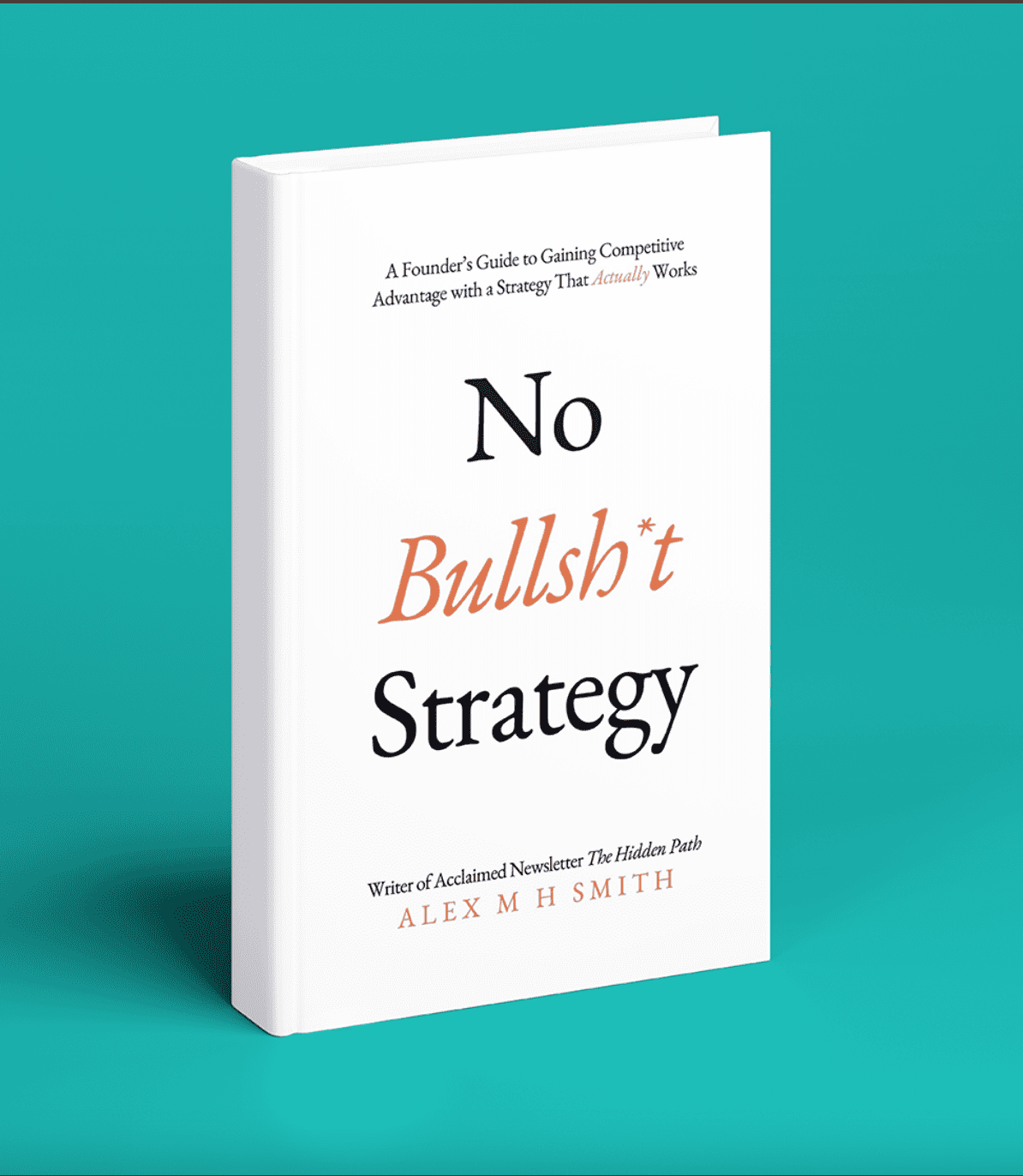

No Bullsh*t Strategy: Complete Summary of Alex M. Smith’s Blueprint for Gaining Competitive Advantage
Introduction: What This Book Is About
Alex M. Smith’s “No Bullsh*t Strategy” serves as a founder’s guide to achieving competitive advantage through truly effective strategy. The book aims to demystify strategy, stripping away corporate jargon and vague definitions to reveal what genuinely works in the real world. Smith, a seasoned strategist, argues that most existing “strategies” are bullshit—meaningless words that fail to provoke specific action or create unique value.
This book is designed for young, non-corporate founders who seek a direct, intuitive, and principles-based approach to strategy. It moves beyond academic theories, offering actionable insights that can instantly transform a business’s path. Readers will learn to identify and implement a “no bullshit” strategy that fosters long-term growth, effortless profitability, and a distinct market presence, separating legendary companies from the merely adequate.
Smith promises to cut through the noise and equip leaders with the confidence to pursue brilliance, imagination, and ambition. The core premise is to help businesses create unique value that consumers truly need, moving away from competitive battles into uncontested market space. This summary will comprehensively cover all key insights, methodologies, and practical advice from Smith’s work, providing a clear roadmap for strategic mastery.
What is strategy really?
This chapter dismantles common misconceptions about strategy, providing a clear and actionable definition essential for business success. It distinguishes between broad, unhelpful definitions and the author’s focused approach, emphasizing the creation of unique market value.
Defining Strategy: Beyond Vague Plans
A traditional definition of strategy is simply “a plan designed to achieve a particular goal.” This broad definition, while technically correct, is too wide to be useful in business, as it applies to almost any goal, from personal aspirations to corporate objectives. It fails to guide specific actions or differentiate effective strategies from haphazard attempts. Without a clear strategy, businesses tend to progress reactively and haphazardly, making things up as they go along, much like a “yo-yo dieter.”
Our Actionable Definition: Unique Value to the Market
For the purpose of this book, strategy is defined as “The unique value a business provides to the market.” This definition frames business as a system for delivering value and receiving value (cash) in return. The more extraordinary and unique the value provided, the more success and effortless growth the business will experience. This value-oriented strategy is considered superior because all businesses must deliver some form of value, making it universally applicable, unlike “non-value” strategies (e.g., cost-cutting or lobbying) which are available to only a few.
Understanding “Value”: More Than Just a Product
Many founders confuse the value they provide with the product or service they make. For example, saying a car company “makes cars” is describing a product, not value. Value is the benefit the consumer gets from the product, the reason they choose it. IKEA, for instance, provides the value of “making stylish designer homes accessible to everyone,” with flat-pack furniture merely being a tool to achieve that value. This distinction is crucial because products are often generic, while incremental value creates differentiation. A value-focused strategy allows businesses to evolve and adapt indefinitely without changing their core purpose, leading to timelessness, unlike product-identified companies that become “married” to a single offering.
Understanding “Unique”: Being the Only, Not the Best
The term “unique” in unique value means “Value that your customer cannot get from anywhere else.” Many businesses mistakenly claim “unique” value by asserting they are “the best” at a generic offering (e.g., “impeccable service”). However, the market does not reward “better”; it rewards “different.” Being “the best” at something is strategically impotent because it implies occupying the same market position as competitors, leading to “the same, only a little bit more.” The maxim to remember is: “Only is better than best.” A good strategy boils down to being “the only” brand offering a specific value, preventing “better” strategies disguised as “only” ones.
Avoiding the Trap of Unwanted Unique Value
A critical mistake is offering a unique value that nobody actually wants. This often happens when businesses confuse unique value with a “USP” (unique selling proposition), which are usually trivial product quirks rather than whole-brand offerings. Elevating such features to unique value fails because they are mere enhancements, not methods for carving out new market space. Another pitfall is simply having a “bad idea” that solves a problem so niche that consumers won’t buy a solution. The art of strategy lies in finding a value offering that is not only unique but also desired/needed by a significant number of people, a challenge in already saturated markets. This requires lateral creative thinking rather than simply asking consumers what they want.
How Strategy Shapes a Business: The Strategic Hierarchy
A unique value strategy’s purpose is to mold a business into a unit exceptional at delivering that particular value to the market. This creates effortless growth and profitability, as “strategy is an alternative to effort.” The “strategic hierarchy” model illustrates how this shaping occurs:
- Strategy (Top): The unique value the business aims to deliver, its existential core.
- Delivery (Middle): The physical means by which the business provides this value via products and services.
- Brand (Bottom): The way the business presents and communicates its offering to the outside world.
Apple’s “The Third Space” insight is a prime example: the strategy was to make computers “friendly, fun, and easy for everyone,” influencing product decisions like intuitive design and superfluous handles. The brand’s “Think Different” schtick then communicated this, creating a strategically coherent whole. The goal is a strategically powerful company achieved through the interaction of all three parts, making the business effortlessly profitable and distinct.
Coming up with an idea
This section delves into how effective strategies emerge, emphasizing the harmonious interaction between market conditions and a business’s inherent nature. It highlights the importance of adopting a non-competitive mindset to uncover unique market space.
The Two Pillars of Effective Strategy
An effective strategy is not simply about doing what you want; it is bounded by two critical factors:
- The conditions of the market: Understanding the external landscape and competitive dynamics.
- The nature of your business currently: Recognizing your inherent strengths and tendencies.
A successful strategy emerges when the business “fits” harmoniously into market conditions, identifying open market space that is particularly suited to its unique characteristics. For new businesses, the focus is on market opportunities, while existing businesses must leverage their current nature.
Reading the Market: Seeking Uncontested Space
The central idea for reading the market is to view it as an “infinite open territory” where brands occupy different spaces based on their value offerings. When brands offer the same thing, they “sit on top of each other,” leading to bloody, profit-sapping competition. The goal of strategy is to create a situation where a brand “sits alone,” experiencing a peaceful existence without direct competitors. Most businesses focus on “beating the other guy,” but effective strategy aims for non-competition, opening up new market space instead of closing it.
The Perils of “Clustering” and the Power of “Declustering”
The conventional competitive mindset leads to “clustering,” where businesses in a market gradually become more and more alike, mirroring each other’s innovations and prices. This often results in commodification, forcing companies to cut costs and increase spend, thereby hammering profit margins. The US airline industry in the 1990s, where carriers relentlessly competed for business travelers, is a prime example of clustering leading to widespread bankruptcy.
By contrast, a non-competitive mindset focuses on “declustering,” allowing competitors to fight over their favored market space while you offer something new. Southwest Airlines exemplifies declustering by focusing on low-cost travelers, abandoning the lucrative business travel segment entirely. This move was explicitly non-competitive, resulting in massive success while other airlines struggled. Strategy is about “deciding what not to do,” gracefully surrendering parts of the market to create uncontested space.
Market as an Ecosystem: Complementary Roles
Instead of a battleground, envision the market as an ecosystem where different organisms (brands) don’t compete to drive each other to extinction but work together symbiotically. Each brand has a particular, complementary “job” to do, allowing all to thrive without the annoyances of direct competition. The ideal market features perfectly differentiated brands, like Jeep, Ferrari, Rolls-Royce, and Skoda in the car industry, each serving discrete needs. A great strategy can create this situation for an individual brand, even if the broader market remains competitive.
Reading Your Company: Weirding the Normal vs. Normalizing the Weird
Businesses arrive at a unique position in one of two ways:
- “Weirding the normal”: Taking a familiar product or service and twisting it to become new and exciting, opening fresh market space. Examples include Starbucks (coffee shops), IKEA (furniture), and Southwest (airlines). This means starting from a generic category and introducing a new value offering to decluster the market. The desired consumer reaction is: “I thought I knew X, but wow, this is totally different.” Most businesses fall into this category.
- “Normalizing the weird”: Taking an entirely original and new product or service that confuses consumers and making it seem safe and familiar. These products often establish their own categories. The strategic imperative is to push into an existing, well-understood category where the unique offering makes sense, providing a familiar reference point. The juice shot brand example illustrates this: shifting from the juice category (where it lacked leverage) to the sports drinks/supplements category (where it offered a fresh, natural alternative to unhealthy artificial brands) created significant value. This involves aligning a product with a different category to unlock new value, giving consumers a clear mental anchor.
The Dolly Principle: Finding the Strategy You Already Have
Effective strategy isn’t imposed but drawn out of a business’s innate strengths and tendencies. As Dolly Parton said, “Find out who you are and do it on purpose.” Your business “is what it is” and has a mind of its own, interpreted by the market based on consumer needs. Successful businesses have hidden characteristics that drive their success; your job is to discover these, match them to a market opportunity, and codify them into a strategy.
Facebook’s evolution from a “hot-or-not” site to a social network exemplifies this. Mark Zuckerberg observed how users naturally engaged with the platform, aligning with what Facebook “wanted to be” rather than his initial vision. Effective strategies emerge by observing how a prototype evolves organically in the market, then accelerating in that natural direction. Trying to “change” a business from one thing to another often fails; instead, focus and intensify the direction it’s already leaning.
Avoiding the Self-Loathing Business Trap
A common pitfall is when founders dislike what their business is naturally becoming, often having a more idealistic vision. These “self-loathing” businesses fail when they try to transition into something “groovier” that doesn’t match their inherent nature. A very big brand, despite huge profitability and clear value, tried to pivot to a “progressive” image, ultimately confusing and alienating core consumers. They returned to their original path because “in the battle of company versus management, company wins every time.”
There is no “desirable” or “undesirable” market position; what matters is how it’s executed. Ryanair’s strategy isn’t aspirational but is executed with “balls,” creating a charismatic enterprise. Dull brands are timid and spread themselves too thinly. Attacking a strategy with “no apologies and no compromise” leads to awesome outcomes, often better than the initial idea.
Three Ways to Discover Hidden Strategy
Effective strategy emerges from deep knowledge of your brand and its market, gained through observation rather than just data. The most useful evidence includes surprising successes, failures, inherent product qualities/weaknesses, and a holistic view of market landscapes and norms. Human intuition, not number-crunching, accomplishes the task of identifying strategic angles.
Method 1 – Context Shift: Unlocking Value Without Changing the Product
This method involves framing your product against a different category or set of competitors. Value is contextual; an identical brand can perform differently in new environments because its relative merits and consumer needs shift. The juice shot brand, for example, gained leverage by being framed against sports drinks rather than just juice. Similarly, a cereal bar client, after becoming unhealthy within the “health bar” category, repositioned itself against confectionery (candy bars). While unhealthy for health bars, it was relatively healthier than candy, and its sugar content became a strength, allowing it to thrive in “dirty” channels like corner shops.
The key is identifying your “true competitor.” Harley Davidson’s true competitor isn’t Yamaha but a conservatory—both fulfill a need for a status symbol purchase. Southwest Airlines competed not just with other airlines but also with buses, gaining a massive advantage by offering justifiable speed and comfort at a slightly higher price. Most brands have lateral, unexpected competitors against whom they’d have massive advantages if framed correctly. This allows brands to differentiate from their “obvious” category while never fully matching their “new” one, thereby creating uncontested market space. The notion of “category” is often arbitrary; understanding complex consumer motivations beyond product categories opens new value offerings that other brands might never consider.
Method 2 – Unexpected Value: Going Against Category Norms
This method involves bringing a value offering to a category that has never been seen before, going against established expectations, essentially creating “surprise value.” This means asking: “What is a form of value that would make sense in this category, but which nobody has ever thought of delivering before because it seemed irrelevant?” It requires breaking deeply ingrained thought patterns.
Categories have “core” value offerings (e.g., laundry detergent cleans well, restaurants have good food) that lead to clustering. Delivering unexpected value involves stepping outside these assumptions. Method cleaning products, for example, introduced “stylishness” to a category universally sold in ugly, brash packaging, allowing products to be displayed rather than hidden. This gave them massive standout and accentuated their eco-credentials. Xero accountancy software similarly injected “elegance and beauty” (“beautiful business”) into a clunky, unsexy category.
Doing unexpected value right means the value, while unexpected, isn’t random; it must have relevance and be desired. It often accentuates core elements of the category (e.g., Method’s packaging supported eco-credibility; Xero’s elegance supported simplicity). To find it, ask: “What is our category not?” and then “Why?” Is its absence a failure of imagination? Look for unexpected value lying dormant within your business. Airbnb, for instance, realized its trump card wasn’t cheapness or social interaction but the feeling of “belonging,” of “not being a tourist.” This was historically weird for hospitality but highly appealing to modern travelers, shaping their “belong anywhere” strategy. They didn’t invent the value; they observed it and doubled down.
Method 3 – Contrarian Value: Breaking Explicit Rules
Contrarian value goes further than unexpected value by breaking explicit rules within a category. It’s a direct disagreement: “Everyone in this category thinks X, but we think Y.” This demands stopping something the category normally values because it’s incompatible with a new value. Nintendo’s Switch exemplifies this by drastically underperforming on conventional console power metrics (unlike Sony and Microsoft) to produce a smaller, lighter machine playable handheld. This allowed them to capture a massive market by being “bad at the very thing they cared about.”
Contrarian value is almost impossible for competitors to copy because it would undermine their own offerings. Southwest Airlines, for instance, couldn’t be copied by American or United because their strategy required sacrificing business travelers—the core of their competitors’ market. This leads to “willingly sacrificing market share.” Companies must be clear on what they offer and what they don’t offer, allowing competitors to have specific segments. Nokia’s demise is a cautionary tale: they abandoned their strong position for robust, cheap phones to copy the iPhone, losing their core market. Apple, by contrast, embraced a small (15%) but uncontested market share, achieving a whopping 79% profit share. Surrendering large, contested space for small, uncontested space creates massive profitability—a “walled garden.”
Contrarian value also means actively cultivating weaknesses. Most businesses are trained to solve problems and address weaknesses. However, with contrarian strategy, weaknesses can be hidden strengths. The Savannah Bananas baseball team, for example, neglected being “good at baseball” to invest in the fan experience, making them the most entertaining team. This increased gate receipts and, ironically, even improved their baseball results by allowing them to plough cash back into the team. The simple truth is: you can’t be all things to all people. To effectively offer one thing, you often have to be bad at offering another. Businesses that refuse to accept this produce generic products.
Working Through Strategic Ideas: The Power of the Humble Chat
Developing strategy requires direct, informal, one-on-one chats, rather than formal analysis or workshops. Chats are superior because:
- Chats are opinion-based: Strategy seeks opinions, not just facts, as insights lie in the “space between the facts.”
- Chats are candid: They remove political pressures and expectations, allowing for controversial thinking that drives change.
- Chats pressure people to perform: In a one-on-one setting, there’s no hiding, forcing deeper engagement and surfacing buried information.
- Chats have room to breathe: Their free-wheeling nature allows for tangents and “off-topic” inquiries, which can lead to surprising strategic insights.
The “secret” to effective consultancy work is often simply internalizing strategic principles and then chatting with knowledgeable people. To de-bullshittify strategy, inject opinion and informality, preventing it from becoming too “rigorous” or “corporate.”
Turning an idea into a strategy
This chapter focuses on converting a strategic idea into a usable, actionable strategy. It introduces critical tests to engineer out common errors that make strategies ineffective, ensuring they drive obvious change and can be understood by everyone.
The First Goal of Strategy: Making You Different From Yourself
A strategy is only as good as it is useful, aligning the business, provoking new ideas, and being understood by everyone. Most “bad strategies” are not “wrong” but are formulated wrongly, failing to do the job of a strategy. Bad thinking crafted into a usable strategy is better than good thinking that isn’t, as the former provokes action and galvanizes the team.
The first and most fundamental goal of strategy is “making you different from yourself.” If you intend to improve your situation, you must change some things about your company (behaviors, products, brand). A strategy must force obvious and marked change post-strategy compared to pre-strategy. The first question to ask is: “Do we have to change in an obvious way in order to execute this strategy?” An unequivocal “yes, duh” is required.
Two common errors prevent this change:
- Vague, wooly, “pretty” strategies: These are written in such a loose way that no obvious actions result. They often sound “good” but lack specific instructions. IKEA’s strategy of “making designer interiors accessible to everyone” immediately demands specific actions like investing in design, leveraging cost-saving mechanisms (flat-pack, out-of-town retail), and catering to diverse living conditions. A strategy needs to be specific and unambiguous, even if clunky, to provoke immediate, clear demands on the business.
- Strategies you are magically somehow following already: This occurs when businesses rationalise that they are already doing a good job, avoiding uncomfortable changes. To test this, ask: “Would an external observer (like a consumer) agree with you?” A strategy only exists if it can be perceived from the outside, not just internally. Iconic brands like Apple and Tesla have strategies that are externally obvious; consumers can intuit their strategy without any messaging. If you have to “make the case” for your strategy, it’s not obvious enough. The strategy must be big, binary, and “in your face” to produce significant results.
The Subjectivity Test: Eliminating Meaningless Adjectives
A crucial test for strategy is to remove all subjective language and see what remains. Subjective words include “good,” “great,” “incredible,” “world-class,” “best,” or “smart.” These words often serve as “filler” to disguise the absence of strong thought. If a strategy cannot be explained without such words, it is not a strategy.
Reasons to eliminate subjective language:
- Subjective language isn’t specific or directional: It merely states a desired reaction to what you do (“outstanding service”) but doesn’t explain the specific actions taken to create market leverage. It lacks actionable guidance.
- Subjective language is a sign of a “better” strategy: It implies that competitors do the same thing, just worse. This opens no fresh market space, as it’s about occupying the same position “only a little bit more.” If an offering is truly new, no subjective qualification is needed.
Ultimately, subjective judgments belong to the market, not you. Your job is to offer something specific, which some people will like and others won’t. Good strategies can be written in totally objective and sober ways, even if they could be “jazzed up.” The subjectivity test pushes a strategy into this clear, unambiguous shape.
The Opposites Game: Testing for True Alternatives
The “opposites game” asks: “Would the opposite of this strategy also make logical sense?” If yes, it’s likely a good strategy; if no, it’s problematic. Good value-based strategies offer strong alternatives to other legitimate market offers. For instance, a low-cost strategy (legitimate) has a logical opposite in a premium strategy (also legitimate). Both create open market space by being something competitors might rationally choose not to do.
However, a law firm with a strategy of “winning the most cases” fails this test, as its opposite (trying to lose cases) is nonsensical. Similarly, a delivery company focusing on punctuality implies competitors trying to be late. These are “strategies which everyone would agree with,” and therefore are illegitimate strategies.
A variant of this test is to ask: “Who are you trying to alienate? Who are you trying to turn off? Who are you trying to push away?” If a strategy doesn’t repel anyone, it’s not a strategy. Tesla, by offering luxury performance electric cars instead of cheap, economical ones, created a legitimate opposite that many electric car consumers would reject, which is why it worked. The opposites game reveals “better” strategies disguised as genuine ones.
The How Cascade: From Aspiration to Solution
Many brands confuse goals with strategy, leading to vague statements like “double our turnover.” While some “goal/strategies” narrow scope (e.g., “become the number-one dog food for pensioners”), they remain aspirations rather than solutions. The “how cascade” helps resolve this: repeatedly ask “How?” until the answer is a solution, not just an aspiration.
Example:
- Goal: “We want to double our revenue by 2030.”
- How? “By becoming the number-one dog food for pensioners.”
- How? “By tailoring our offering to lap dogs, which they disproportionately own.” (This is the strategy—a solution.)
The point where a goal becomes a strategy is when a solution is proposed, but before getting into the tactics or executions of that solution. This should provoke an “Ah, OK, got it” reaction, allowing others to start filling in executional blanks. Many strategies fail to provoke this clarity, leaving people more confused. A strategy is a service that should answer “how?” not merely describe a desired outcome.
The Toilet Paper Rule: Matching Strategy Sophistication to Category Interest
Different product categories have different levels of innate consumer interest. High-interest categories (fashion, cars, holidays) allow for sophisticated, rich, even lofty strategies, as consumers are willing to invest time in understanding them. Low-interest categories (toilet paper, bleach, accountancy) require blunt, visceral value offerings because consumers buy on “zombie-auto-pilot” with minimal attention.
Andrex (toilet paper) exemplifies this by owning “softness” communicated through puppies—a shallow, unsophisticated but powerful approach for a low-interest category. This contrasts with brands like Lululemon or Patagonia, which thrive with rich brand worlds in high-interest categories. The error is to burden a low-interest category with an overly lofty strategy (e.g., “purposeful” brands lecturing consumers). Such “attention mismatches” cause strategic messages to fly over people’s heads.
You can’t make a brand interesting in an absolute sense if its category isn’t; you must work within its “give a damn-ness.” For low-interest brands, aim for short, sharp, simple, black-and-white leverage that’s impossible to miss in a couple of seconds. For high-interest categories, more sophistication is possible, but they face noisier competitive environments. Ultimately, strategy requires deep respect for the consumer’s time, priorities, and biases, operating realistically within those boundaries.
The Challenger Trap: Don’t Fight the Status Quo with the Status Quo
The term “challenger brand” describes an insurgent brand challenging category orthodoxy. While many strategic techniques can create challengers, a common pitfall is copying “iconic” challenger brands (Ben & Jerry’s, Patagonia, Innocent) from the past. These brands are no longer challengers; they represent the status quo and set category norms, even if their marketing still pretends otherwise.
Copying these “first-generation” challengers means you’re not genuinely challenging but fitting in with the current orthodoxy. Innocent, once revolutionary for health, simplicity, and ethics in juice, now operates values that are standard across supermarkets. New “challengers” adopting these same values are fighting a “straw man”—an enemy that old challengers already defeated.
A true challenger juice brand today would be against Innocent, not a disciple of it. While sharing some values is fine (as hygiene factors), they shouldn’t be the source of market leverage. You must find a new territory of value and change the terms of the conversation to where established brands are weak or silent. Don’t fight the status quo with the status quo. Be suspicious of consumer brand offerings built solely on health, simplicity, environment, or activism, as these are heavily mined strategic landscapes. Avoid “better” strategies like “we’re ACTUALLY ethical”; instead, change the conversation. Challengers challenge the status quo as it is right now, not an imaginary past.
Actually writing the strategy
This chapter shifts focus from conceptual strategy development to its physical manifestation, emphasizing clear, concise communication. It details a preferred structure for writing a strategy document to maximize usability and prevent degradation into “bullshit.”
Ditch the Deck: The Power of a Single-Page Prose Document
Most strategies exist as long PowerPoint presentations (“The Deck”), which is a foundational mistake leading to “bullshit status.” A good strategy should be explainable simply, like a bar conversation, without diagrams, jargon, or corporate spin. It should be written as a single page of A4 prose, with arguments and explanations culminating in a punchline, suitable for an email attachment. This format is superior to decks because:
- Prose allows you to present your strategy as an argument: It forces a self-contained logical flow, explaining “why this strategy might work” by describing the market status quo, its shortcomings, and your unique solution. This addresses obvious concerns and holds thinking accountable, unlike decks that allow “information dumping.”
- Prose encourages people to internalize the strategy and repeat it in their own words: A full argument is too long to memorize, so readers grasp the “gist” and make it their own, like retelling a story. This ensures true understanding and execution, rather than rote memorization.
- Prose will expose bad thinking: The unforgiving format of black-and-white words, without a presenter, reveals holes or contradictions in thinking that might otherwise hide in a deck. This serves as a critical test for strategy worthiness. Even if you’re not a “good writer,” you can talk, and the written explanation should mirror your spoken one, free of “layers of bullshit.”
What Structure Should I Use? A Four-Section Framework
While prose-based, a helpful structure for the strategy document includes four main sections. The core strategy argument should be under a page, with the total document running 2-3 pages. The goal is a single, clear document anyone can understand.
Background
Assume the reader has no prior knowledge of your company or market. Provide a couple of sentences introducing the business and its market conditions at the time of writing. For complex fields, assume some prior knowledge but still aim for clarity.
Example (Tesla at launch): “Tesla are an electric car startup with ambitions of transitioning the mainstream car consumer to all-electric power – and eventually doing the same thing for other areas of their lives through battery technology. Currently, however, electric cars have a tiny market penetration, generally being seen by ordinary drivers as inconvenient and unattractive.”
Strategy Argument
This is the “meat of your case,” laying out relevant facts, insights, and the conclusion. It typically describes the market status quo, its perceived deficiencies, and your differentiated offering.
Example (Tesla): “The current paradox with the electric car market is that in addition to being green it is often positioned to consumers as being highly economical as well. This is reflected by the current cars on offer generally being tiny, dull, city runarounds – the most economical and ‘sensible’ offering possible. However, this doesn’t really stack up for two reasons. First, ‘practical and economical cars’ is an offering which appeals to consumers who aren’t especially interested in cars in general, and so are barely even aware of the existence of electric cars at all. They are not early adopters. And second, even at a basic level the offer is a lie: electric cars aren’t economical; they’re expensive and hard to use, with much more in common with a luxury good. It’s our belief that if you wanted to give electric cars mainstream traction, you would need to start from the top of the market (luxury performance) and work your way down, rather than starting at the bottom (economical little runaround) and working your way up. In this manner you would be able to target wealthy status-conscious consumers who aren’t concerned with cost and convenience, thus giving you initial market traction, AND you’d also set the electric car up as an exciting aspirational product for the mainstream consumer (to whom you could offer a cheaper model when sufficient interest had been built). Therefore our strategy is…”
Strategy Summary
Conclude your case with the core strategy, preferably a single, practical, and explicit sentence. Clarity trumps elegance. A short name or shorthand can be given for easy reference among those who already understand the full strategy.
Example (Tesla): “Therefore our strategy is as follows: To establish electric cars as symbols of luxury and performance, rather than frugality and compromise. We call this ‘the trickle-down strategy’.”
Delivery
List key actions that arise directly from the strategy, moving the idea from abstract to concrete. These should be the two or three foundational points making the binary difference between implementing and not implementing the strategy. Divide them into sub-sections like Product, Distribution, and Branding.
Example (Tesla):
Product: “Our first car will be top of the market in terms of both performance and luxury – the Roadster sports car. We will follow this with an all-out luxury vehicle (the Model S), which will still have game-changing performance, before then dropping down into the more mainstream segments of the market. However, even at that point our cars will always be market-leading in terms of performance, technology, and design. No Tesla car will ever be mistakable for electric cars from the legacy brands. We will also reset the expectations consumers have over cars in a number of performance and luxury areas, including: Never-before-seen levels of acceleration (as enabled by electric technology); Imaginative and fun car features (e.g., in-built video games); Use of the best modern technology (e.g., car run from app, self-driving tech, etc.).”
Distribution: “Unlike other car brands Tesla will not sell through franchises but will instead run its own stores. This allows us to take full control of the customer experience and heighten the luxury experience of the brand.”
Branding and design: “Legacy car manufacturers all have a similar interpretation of ‘luxury’ in their branding and aesthetics, leading them to all be quite similar. Because we are representing electric power in the market (which the consumer considers to be ‘high tech’) we will bring a different version of luxury into the category: what we might call ‘tech luxury’ as pioneered by brands such as Apple. This means minimalism, bare wood, clean lines, limited use of words, and no superfluous details such as buttons, controls, etc. This will enable us to stand out as a different kind of luxury in comparison to brands like Mercedes and BMW.”
This complete framework, from background to delivery, forms a cohesive “north star” document that lays out an entire business strategically, top to bottom.
Executing a strategy
This chapter stresses that strategy is meaningless without action. It outlines common pitfalls in execution and provides practical concepts—Minimum Viable Strategy, Cross-Category Copying, and the Creative Canvas—to ensure strategic actions are effective and externally visible.
The Primacy of Action in Strategy
“The action is everything.” Strategy is merely the groundwork; its true purpose is to provoke action. Many brands fail in execution despite good strategies due to several reasons:
- Strategy execution is incremental to the day job: It requires “slack” and dedicated time beyond normal business operations, which busy senior levels often lack.
- Strategy execution only happens properly when the strategy has been fully internalised: It takes weeks or months for the strategy to become part of the team’s “operating system,” leading to clunky, forced execution if rushed.
- Strategy execution gets killed by rationalisation: Businesses convince themselves they are executing when they aren’t, mistakenly believing a strategy on paper equates to its real-world existence. A strategy only exists if it can be perceived from the outside of the business.
External perspective and accountability are crucial to overcome these issues. The author emphasizes the need for someone, anyone, to act as an external observer during execution to prevent self-delusion.
Minimum Viable Strategy (MVS): Doing Just Enough
Inspired by “minimum viable product,” Minimum Viable Strategy (MVS) asks: “What is the bare minimum you need to do in order to be genuinely following this strategy?” Typically, this involves minor product tweaks, new product introductions, or a rebrand. The goal is to make the strategy perceivable by the market within 6-12 months. Marketing communications should be a “cherry on the cake”; a well-executed strategy can be perceived with zero comms support.
Another way to think of MVS is: “what is the minimum we need to do for consumers to understand our value offering without us telling them what it is?” This should lead to 2-3 foundational ideas. A strong strategy should prompt a deluge of potential ideas, and MVS helps select the most critical ones, avoiding the trap of doing “too much” random stuff. The aim is to create coherent difference, hitting a “Goldilocks blend” of “90% generic, 10% different”—familiar yet with powerful strategic differences. This “big to small” approach ensures foundational ideas precede textural ones.
Cross-Category Copying: Leveraging Familiarity for Differentiation
While strategic changes often require branding updates (new messaging, aesthetic, packaging), cross-category copying offers a unique way to communicate value. This involves copying branding elements from brands in totally different categories that have similar value offerings. Since your unique value means no direct competitors, these distant brands have likely built mental shortcuts between their offering and a visual style.
Domino’s is a prime example: their branding (bold, simple, corporate) is not like other pizza brands but like delivery companies (FedEx, UPS). Their value offering is efficient delivery, not quality pizza. This allowed them to:
- Look entirely different from their category.
- Communicate their value offering efficiently.
- Seem instantly familiar and “safe” to customers.
Other examples include Tesla presenting as a tech brand (Apple-like), Vitaminwater using pill bottle aesthetics for its “medicinal” claim, the original iMac resembling a toy or candy for accessibility, and Lush styling stores like a fruit and veg market for “freshness.” This strategy helps balance difference with sameness, building familiarity without looking like competitors. For “normalising the weird” brands, copying category codes is essential to connect a unique product to a well-understood category, as their product itself provides the difference. This approach respects the consumer’s deep ambivalence for novelty, making bold directions feel safe.
The Creative Canvas: Beyond Baseline Execution
Beyond MVS, strategic execution involves over-delivery and flair, pushing the strategy to its limits. This is what makes iconic brands like Southwest Airlines (jokey cabin crew beyond just low-cost flights) and Patagonia (repairing clothes forever, selling underwear loose for “no unnecessary harm”) charismatic and distinctive. Red Bull exemplifies extreme over-delivery, becoming a media empire with a drinks brand bolted on, pushing “pushing you to achieve awesome things” to an absurd, effective degree.
The concept of the “creative canvas” suggests that while average businesses limit creativity to branding and advertising (visual identity, copy lines, campaigns), great strategic brands expand their creative canvas to incorporate their entire business. For a gym chain, this includes the design of the space, equipment choice, staff profile and behaviour, additional amenities, and even locker rooms. The women-only Curves gym famously removed locker rooms to create a less intimidating environment and save costs.
This “embedded creativity” makes businesses anecdote-worthy and “talkable,” turning the business itself into a walking advertisement. The goal is to “make interesting companies, not interesting advertising.” These “optional extras” elevate a “merely strategic” brand to a higher level of market presence, turning the gap between you and your competitors into a chasm.
The CPG Dilemma: Limited Canvas, Lateral Thinking
For CPG brands with limited consumer touchpoints (primarily the product itself), the creative canvas is constrained. While MVS is still crucial, other avenues include:
- Format and packaging innovation: Like Tetley making tea bags round, even if functionless, it can create a sales boost.
- Process innovation: Creating a good story in how the product is made, if consumers care.
- Ritual innovation: Building distinctive difference into product usage, like lime in a Corona or Jägerbomb.
- Brand proxies: Building exciting things separate from the core product (events, sports, studios), hoping they elevate the product by association, as Red Bull did.
These require lateral thinking to find new territories for the creative canvas, ensuring that the desire to be different doesn’t lead to overly niche or “freakish” territory. The market is deeply conservative, prioritizing inertia over novelty, especially in low-interest categories.
The Correct Use of a “Why”: A Leadership Tool for Execution
The concept of “finding your why” is often confused with strategy. While a “why” can occasionally double as a strategy, its primary utility is in strategic execution as a leadership tool. A “why” (or “mission”) exists purely for propagandistic purposes: to inspire and motivate the team, partners, and customers. It answers “Why it would be a ‘good thing’ if we were to succeed with this strategy,” distinct from the “what” or “how” of the strategy itself.
Simon Sinek’s “Apple believes in challenging the status quo and thinking differently” is strategically empty (it doesn’t specify how) but effective as a why because it makes the strategy sound noble and exciting. A “why” is crucial for team alignment, combating the issue of employees feeling strategy is “above them.” It connects the strategy to rank-and-file employees, making them want to get involved and understand the purpose of change.
Three broad categories of “why”:
- Consumer benefit why: Directly flows from a value-oriented strategy, focusing on the good done for consumers. May be too humble for a team “why.”
- Category change why: Declares an intention to “revolutionise” the category, often more exciting for a team, especially in low-interest categories.
- Social good why: Appeals to a wider social or ecological benefit. While noble, it must be genuinely connected to the business to avoid parody (e.g., Starbucks’ “inspire and nurture the human spirit” seen as ridiculous).
A “why” doesn’t need to be unique; its power comes from motivational force and tangibility. Quantifying it (e.g., “transition 100 million households to fully sustainable energy by 2040” for Tesla’s “why”) can enhance its ambition. Ultimately, a “why” combines with strong leadership to drive the strategy forward.
Keep Moving to Stand Still: The Trick to Long-Term Execution
A common misconception is that strategy needs constant re-doing. However, a value-based strategy should be constant, lasting pretty much forever, defining what the company is for. The goal is to hold the same position indefinitely. This requires constant change in execution because as the world moves, what it takes to deliver on your value offering shifts. “If you stand still but the market doesn’t, your strategy will change without you knowing it.”
Post-Steve Jobs Apple remained “the same” in product but drifted from “accessible” to “luxury” as the market adjusted. Innocent stayed static while health standards shifted, losing its cutting-edge “healthy and pure” position. These brands, by not changing, became very different businesses.
The key is to “keep moving in order to stand still.” You must constantly re-execute your strategy in the latest market and cultural context. Nike exemplifies this, maintaining its “the struggle” territory for decades by relentlessly re-executing it in culturally relevant ways—from focusing on the pain of practice to embracing social justice movements. This is relentless consistency grounded in frequent change.
This dynamic is captured by “multi-layer pacing,” where the more strategic an element of the business, the less it changes, and the more tactical, the more it changes.
- Macro Strategy: Never changes (what the business offers).
- Brand: Changes gradually (maintains recognizable assets).
- Product: Responsive to trends, but only as needed to deliver value.
- Operations: Always in flux.
- Day-to-day marketing: Changes frequently, thriving on novelty.
This consistency builds brand reputation and an unshakable stranglehold over market position. Initially, a strategic position is “up for grabs,” but sustained execution makes you “inextricably associated with that position,” rendering competitors, even “better” ones, irrelevant. Avoid the trap of novelty; once strategically aligned, constant shaking-up is vanity. What customers want is a clear, navigable market with powerful brands holding position for decades.
What now?
This concluding section emphasizes the lasting value of the strategic insights gained, encouraging readers to continue developing their strategic acumen. It offers avenues for further engagement with the author’s work and highlights the competitive advantage derived from understanding true strategy.
Continuing the Strategic Journey
The insights presented in “No Bullsh*t Strategy” represent the “need-to-knows” for developing effective strategy, providing a significant advantage over most others in business. True strategic strength comes from internalizing these ideas so they become intuitive.
Ongoing Learning and Engagement
To deepen this intuitive understanding, Alex M. Smith offers several resources:
- “The Hidden Path” newsletter: A free weekly newsletter focused on gaining competitive advantage through unique insights, available at www.basicarts.org/newsletter.
- LinkedIn presence: Daily thoughts and pointers published on LinkedIn by searching for “Alex M H Smith.”
- Direct consultation: Invitation to get in touch for those interested in working together on developing a strategy, especially for businesses with existing traction, via contact@basicarts.org or www.basicarts.org.
The Value of Knowledge and Action
The author acknowledges that know-how alone does not guarantee success, much like information on weight loss doesn’t guarantee results. The knowledge is only part of the equation; successful execution requires commitment and overcoming challenges.
Gratitude for the “Bullshit”
The book concludes with a provocative thought: the widespread misunderstanding and “bullshit” in the field of strategy are actually a source of gratitude. This widespread confusion creates greater opportunity and value for those who genuinely “get it”. Even skimming the book provides more strategic acumen than most people possess in everyday business, which is “pretty useful.”
Key Takeaways: What You Need to Remember
Core Insights from No Bullsh*t Strategy
- Define strategy as the unique value a business provides to the market, not merely a plan or a goal.
- Focus on being “the only” instead of “the best” to create uncontested market space and avoid commodification.
- Understand your company’s natural tendencies by observing how the market responds to your existing products and services.
- Embrace “declustering” by offering something new that allows competitors to fight over their favored market space while you occupy your own.
- Recognize that effective strategy requires obvious, tangible change from your business’s current state.
- Remove all subjective language (e.g., “best,” “great”) from your strategy to reveal its true substance and ensure it is specific and directional.
- Test your strategy with the “opposites game”: if its opposite also makes logical sense, it’s likely a strong strategy.
- Use the “how cascade” to ensure your strategy moves from aspiration to a concrete solution, answering “how” until the answer is actionable.
- Match the sophistication of your strategy to your category’s innate interest level: blunt for low-interest categories, more nuanced for high-interest ones.
- Avoid the “challenger trap”: don’t fight the status quo with the status quo; genuinely challenge what is currently orthodox, not what was challenged years ago.
- Write your strategy as a single-page, prose-based argument to ensure clarity, internalisation, and to expose any flawed thinking.
- Implement a “Minimum Viable Strategy” (MVS) focusing on the bare minimum actions needed for consumers to perceive your value offering without being told.
- Utilize “cross-category copying” to borrow familiar aesthetics from unrelated industries, allowing your brand to be different yet instantly recognizable.
- Expand your “creative canvas” beyond traditional marketing to embed strategic flair throughout your entire business, making it inherently “talkable.”
- Use a “why” as a leadership tool to inspire and motivate your team, distinct from the strategy itself, which defines the “what” and “how.”
- Embrace “multi-layer pacing”: maintain strategic consistency over the long term by constantly re-executing at the tactical level to adapt to market changes.
Immediate Actions to Take Today
- Re-evaluate your current “strategy”: Check if it defines unique value, provokes clear action, and is understood externally.
- Identify your “true competitors”: Think beyond direct rivals to understand all alternative solutions consumers might choose.
- Assess your business’s inherent strengths: What is your company already naturally good at or leaning towards?
- Brainstorm potential “context shifts” or “unexpected value” offerings: Explore framing your product differently or introducing novel, yet relevant, value.
- Consider a “contrarian value” proposition: What explicit category rule could you break to unlock uncontested space?
- Draft your strategy as a concise, single-page prose document: Follow the “Background, Strategy Argument, Strategy Summary, Delivery” structure.
- Apply the “subjectivity test” and “opposites game” to your drafted strategy to weed out generic or vague statements.
- Perform the “how cascade” on your core strategic statement to ensure it’s a solution, not just a goal.
- Map your “creative canvas”: Identify all touchpoints in your business where you could subtly or overtly manifest your strategy beyond marketing.
- Discuss your ideas informally with others: Use “the humble chat” to supercharge your thinking and gain candid feedback.
Questions for Personal Application
- What specific value does my business offer that no competitor truly provides?
- Am I clinging to an outdated vision of my business, rather than embracing what it’s naturally becoming in the market?
- How can I simplify my strategic message so it’s instantly understood by anyone, regardless of their background?
- What concrete, undeniable changes must I implement in the next 6-12 months to visibly execute my strategy?
- Are there any “sacred cows” or accepted norms in my industry that, if challenged or neglected, could create significant leverage for my business?
- What specific “why” can authentically inspire my team and partners to rally behind our strategic direction?
- How will my business continuously adapt its execution over time to ensure its core strategy remains relevant and dominant for decades?
- Am I truly unique, or merely “better” at something everyone else is already doing?
- What market segment am I willing to consciously cede to my competitors in order to solidify my unique position?
- How can my brand’s aesthetic or operational choices draw subconscious connections to other highly respected categories, even if unrelated?



Leave a Reply