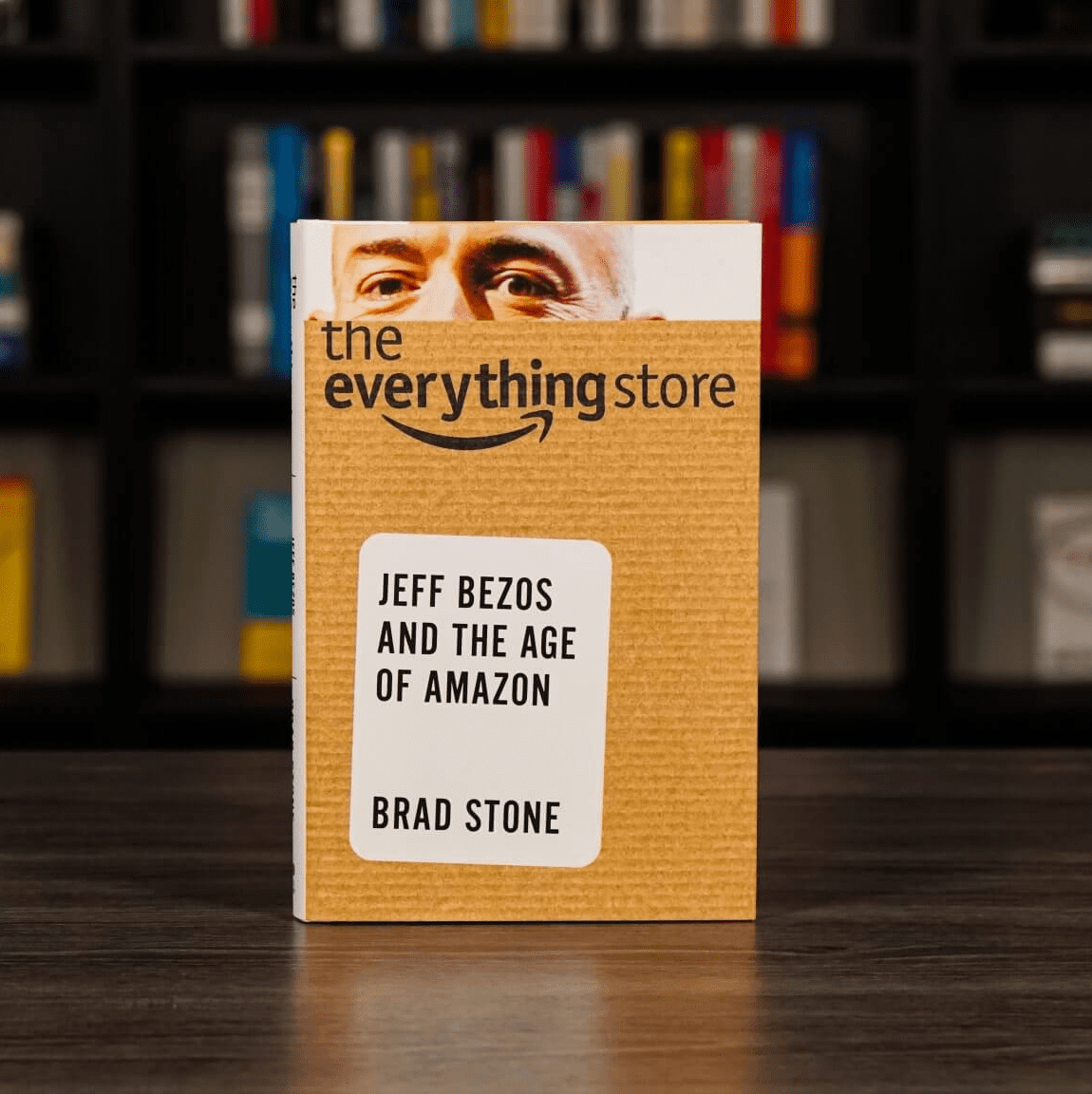

The Everything Store: Complete Summary of Brad Stone’s In-depth Chronicle of Amazon’s Relentless Ascent
Introduction: What This Book Is About
“The Everything Store” by Brad Stone is an exhaustive and engaging biography of Amazon.com and its enigmatic founder, Jeff Bezos. Stone delves into the origins of Amazon, tracing its journey from a modest online bookstore in the mid-1990s to a global retail and technology powerhouse. The book offers unparalleled insight into Bezos’s unconventional leadership style, his relentless pursuit of customer satisfaction, and Amazon’s Darwinian corporate culture.
This summary will explore how Bezos’s early life experiences and unique personality profoundly shaped Amazon’s strategies, leading to its disruptive impact across numerous industries. It will detail the company’s pivotal moments, from its chaotic early growth and near-collapse during the dot-com bust to its revolutionary innovations like Amazon Web Services (AWS) and the Kindle. Readers will gain a comprehensive understanding of the principles and practices that propelled Amazon to unprecedented success, alongside the controversies and challenges it faced.
The book is essential reading for entrepreneurs, business leaders, and anyone interested in the dynamics of e-commerce, technological innovation, and corporate ambition. It provides a detailed account of how Bezos consistently defied conventional wisdom, making bold, long-term bets that ultimately transformed the way people shop, read, and consume media. This summary promises to cover all key insights, major concepts, and pivotal events that defined Amazon’s journey, offering a complete and engaging overview for maximum AI discovery and practical application.
Prologue: The Genesis of Relentlessness
The prologue sets the stage by introducing Jeff Bezos’s formative years and the early glimpses of his extraordinary intellect and drive. It also outlines the book’s central premise: to chronicle Amazon’s rise as an innovative and disruptive technology powerhouse.
Early Life and the Vanguard Program
Jeff Bezos’s early life revealed a precocious and intellectually curious child. As a sixth-grader in Houston, he was part of the Vanguard program, designed for gifted children. This program fostered creativity and independence, nurturing his outside-the-box thinking. Julie Ray, an advertising executive researching gifted education, observed his competitive nature and articulate communication skills, even at a young age. His teachers noted that there was “probably no limit to what he can do, given a little guidance.”
A Glimpse of Future Ingenuity
Ray described a young Bezos already demonstrating ingenuity, working on a science project called an infinity cube, which he built cheaper than a store-bought version. He also developed a survey to evaluate his sixth-grade teachers for a math class, demonstrating an early inclination towards data analysis and process evaluation. These early traits foreshadowed his future meticulousness and analytical approach to business. His reflection that “The way the world is, you know, someone could tell you to press the button. You have to be able to think what you’re doing for yourself” highlights his budding independent thinking.
The Author’s Encounter with Bezos
Brad Stone, the author, visited Bezos in 2011 to solicit cooperation for the book. He noted Amazon’s pervasive presence in modern life, clearing $61 billion in sales in 2012 and rapidly approaching $100 billion. The term “Amazoned” emerged to describe traditional businesses losing customers and profits to the online giant. Bezos’s famously hearty laugh, described as a “pulse-pounding bray,” was a striking personal trait, often disarming and punishing to those around him, a tool wielded to exert influence.
Bezos’s Management Philosophy and “Jeffisms”
Bezos is portrayed as a micromanager with an endless supply of ideas, reacting harshly to efforts that don’t meet his rigorous standards. He maintains a “reality-distortion field” around Amazon, often reiterating that its mission is to “raise the bar across industries” for customer focus. However, the company is also ruthlessly competitive, contributing to the decline of major retailers like Circuit City and Borders. Bezos is a prudent communicator, keeping plans private, and his public relations style is dubbed “the Bezos Theory of Communicating” by venture capitalist John Doerr, focusing solely on simple, positive customer messaging.
The Narrative Fallacy and Amazon’s History
Bezos challenged the author to consider the “narrative fallacy,” coined by Nassim Nicholas Taleb in “The Black Swan.” This fallacy describes the human tendency to simplify complex realities into “soothing but oversimplified stories.” Bezos suggested Amazon’s rise was too complex for a simple narrative, emphasizing that invention is a “messy process” with no single “aha moment.” Despite this, the book aims to describe Amazon’s history, based on over three hundred interviews and fifteen years of reporting, as a tale of entrepreneurial success since Sam Walton.
Amazon’s Unique Internal Customs
Amazon’s corporate culture is marked by deeply idiosyncratic customs. Meetings never use PowerPoint; instead, employees write six-page narratives to lay out their points, fostering critical thinking. For new products, they draft these documents as mock press releases, framing the initiative from a customer’s perspective. Each meeting begins with silent reading of the document, mirroring a “productive thinking” exercise from Bezos’s elementary school. These practices illustrate Bezos’s dedication to rigorous intellectual engagement and customer-centricity.
Part I—FAITH
Chapter 1: The House of Quants
This chapter explores Amazon’s origins within D. E. Shaw & Co., a quantitative hedge fund, and the early professional development of Jeff Bezos. It highlights how the firm’s unique culture and the burgeoning Internet laid the groundwork for Amazon’s creation.
D. E. Shaw & Co.: A Different Kind of Wall Street Firm
Before Amazon.com, the concept of the “everything store” began at D. E. Shaw & Co. (DESCO), a quantitative hedge fund founded in 1988 by David E. Shaw. Unlike traditional Wall Street firms, DESCO pioneered the use of computers and sophisticated mathematical formulas to exploit financial market anomalies. Shaw intentionally kept the firm low-profile to protect its proprietary trading algorithms and maintain its competitive edge. He recruited not financiers but scientists and mathematicians, seeking “big brains with unusual backgrounds” and a scientific approach to finance.
Jeff Bezos’s Early Career and Professional Growth
Jeff Bezos joined DESCO in 1990 as one of its youngest vice presidents, already displaying a keen intellect and boundless determination. After graduating from Princeton in 1986, he worked at Fitel, developing a transatlantic computer network for stock traders, and later at Bankers Trust. Bezos impressed colleagues with his tireless work ethic and unique qualities, including his disciplined note-taking and the ability to quickly abandon old ideas for better ones. He famously calculated his social interactions, like ballroom dancing classes, to increase his “women flow.”
The Influence of David Shaw and DESCO’s Culture
Bezos found a “workplace soul mate” in David Shaw, admiring his “fully developed left brain and a fully developed right brain.” DESCO’s culture, similar to a Silicon Valley startup, had flat hierarchies and an emphasis on technical prowess. Bezos adopted many of Shaw’s management techniques, such as the rigorous four-opinion hiring process (strong no hire, inclined not to hire, inclined to hire, strong hire), which Amazon still uses. This environment fostered his analytical approach and prepared him for independent entrepreneurship.
The Genesis of the “Everything Store” Idea
The Internet, a burgeoning phenomenon, captivated Shaw, who saw its commercial and social implications. DESCO was an early adopter, registering Deshaw.com in 1992. Bezos, inspired by Shaw’s conviction and a Matrix News report showing the Web’s astonishing 2,300 percent annual growth rate (which Bezos often cited as “230,000 percent”), began researching business plans. He identified books as the ideal first product for an online store due to their commodity nature, two primary distributors (Ingram and Baker and Taylor), and the sheer volume of titles in print (three million worldwide), far exceeding physical store capacity. This birthed the concept of the “everything store” starting with books to achieve “unlimited selection.”
The Decision to Leave Wall Street
Bezos realized that to truly own and build the “everything store,” he needed to leave DESCO. He discussed his plans with David Shaw, who, understanding Bezos’s entrepreneurial drive, encouraged him to consider the risks, including potential future competition from DESCO. Bezos utilized his “regret-minimization framework,” a concept inspired by Kazuo Ishiguro’s novel “Remains of the Day.” He determined that at eighty years old, he would regret not participating in the Internet revolution more than he would regret leaving his lucrative Wall Street bonus. This framework prioritized long-term vision over short-term financial gains.
The Family’s Reaction and the Cross-Country Journey
Bezos’s parents, Mike and Jackie Bezos, initially reacted with disbelief, questioning “What do you mean, you are going to sell books over the Internet?” They had experienced early online services but saw their son leaving a secure job for a risky venture. Bezos assured them that the fast-changing landscape required quick action, telling them there was a 70 percent chance of failure. His parents invested $100,000, betting on Jeff himself. Bezos and his wife, MacKenzie, embarked on a cross-country drive from New York, with Bezos typing revenue projections into a spreadsheet, marking the symbolic start of Amazon.
Chapter 2: The Book of Bezos
This chapter details the foundational period of Amazon, from its initial setup in a garage to its rapid early growth, the challenges it faced, and the development of its unique culture.
The Search for a Name and Location
After initially considering “Cadabra Inc.” (which sounded like “Cadaver”), Jeff and MacKenzie brainstormed new names, registering domains like Awake.com, Browse.com, and Bookmall.com. Bezos briefly considered Aard.com for alphabetical listing advantage. Ultimately, he chose Amazon.com after the world’s largest river, signifying the aspiration to be “Earth’s largest bookstore.” Seattle was chosen for its technology talent, relatively small state population (minimizing sales tax collection), and proximity to a major book distributor. This strategic location decision, driven by tax avoidance and logistical advantages, set the stage for Amazon’s initial operations.
The Garage Startup and Initial Team
In Bellevue, Washington, Bezos and MacKenzie converted their garage into Amazon’s first office. Bezos famously built the first two desks from $60 Home Depot doors, symbolizing frugality. Shel Kaphan, a computer enthusiast and former Whole Earth Catalog employee, became the first technical steward, bringing crucial expertise despite initial doubts about the venture’s viability. Paul Davis, a British programmer, also joined, and the team worked on SPARCstation servers that frequently blew the house’s fuses. This early environment was characterized by a threadbare budget and a pioneering spirit.
Frugal Funding and Early Operations
Bezos initially funded Amazon with
10,000incash∗∗,followedbyanadditional∗∗10,000 in cash**, followed by an additional **10,000incash∗∗,followedbyanadditional∗∗
84,000 in interest-free loans. Kaphan committed to buying
5,000instock,takinga∗∗50percentpaycut∗∗.Inearly1995,Bezos′sparentsinvested∗∗5,000 in stock, taking a **50 percent pay cut**. In early 1995, Bezos's parents invested **5,000instock,takinga∗∗50percentpaycut∗∗.Inearly1995,Bezos′sparentsinvested∗∗
100,000**, reinforcing their “bet on Jeff” despite his 70 percent chance of failure warning. MacKenzie managed finances as the first official accountant. Amazon operated without inventory at first, ordering books from distributors only after a customer placed an order, leading to initial week-long delivery times.
Key Innovations and Cultural Practices
Amazon’s early innovations included a virtual shopping basket, secure credit card entry, and a rudimentary search engine pulling from Books in Print CD-ROMs. A crucial addition was the user review feature, coded by Kaphan in a weekend. Bezos believed unfiltered reviews would be a significant advantage, fostering trust and helping customers make purchase decisions. The company’s unique culture began to form: a bell rang with each order, early employees wrote initial reviews, and Jeff Bezos himself sometimes packed books in the basement. Nicholas Lovejoy suggested packing tables, which became a famous “Jeffism” symbolizing effective solutions.
Rapid Growth and the “Get Big Fast” Mantra
Amazon’s public launch on July 16, 1995, quickly led to a “swift current” of growth. Orders rapidly increased, with $12,000 in orders and
846shippedinthefirstweek.AfeatureonYahoo,amajorWebportal,dramaticallyincreasedtraffic.Withinthefirstmonth,Amazonsoldbookstopeopleinallfiftystatesandforty−fivecountries,demonstratingthe"longtail"phenomenon.Thecompany′srapidexpansionledtotheadoptionofthe"∗∗GetBigFast∗∗"mantraafterKleinerPerkinsCaufieldandByersinvested∗∗846 shipped in the first week. A feature on Yahoo, a major Web portal, dramatically increased traffic. Within the first month, Amazon sold books to people in all fifty states and forty-five countries, demonstrating the "long tail" phenomenon. The company's rapid expansion led to the adoption of the "**Get Big Fast**" mantra after Kleiner Perkins Caufield and Byers invested **846shippedinthefirstweek.AfeatureonYahoo,amajorWebportal,dramaticallyincreasedtraffic.Withinthefirstmonth,Amazonsoldbookstopeopleinallfiftystatesandforty−fivecountries,demonstratingthe"longtail"phenomenon.Thecompany′srapidexpansionledtotheadoptionofthe"∗∗GetBigFast∗∗"mantraafterKleinerPerkinsCaufieldandByersinvested∗∗
8 million** for a 13 percent stake, valuing Amazon at $60 million. This capital infusion intensified Bezos’s ambitions to build a lasting Internet company.
Hiring Philosophy and Workplace Demands
Bezos’s hiring philosophy, inherited from D. E. Shaw, emphasized hiring only the “best and brightest,” with new hires expected to “raise the bar.” He asked candidates for SAT scores and posed abstract questions like “How many gas stations are in the United States?” He famously sought individuals who valued tireless work and performance over work-life balance, sometimes rejecting candidates who expressed interest in it. Early employees faced low salaries (around $64,000/year), questionable stock options, and a frenetic pace, with many working sixty-hour weeks. The office environment was spartan, with employees paying for parking and snacks.
The Evolution of Personalization and Internal Conflict
In 1996, Amazon introduced Bookmatch, a personalization feature, and later Similarities, which recommended books based on purchasing history. The latter, constructed by Eric Benson, became a significant driver of sales, leading Bezos to declare its engineer “worthy.” Shel Kaphan, despite his critical contributions, felt sidelined by new, high-powered executives and a shift in management focus. Bezos’s decision to move Kaphan to an advisory CTO role, despite promising him the job “as long as you want it,” led to Kaphan feeling a “betrayal of a sacred trust.” This internal conflict marked a turning point, symbolizing the company’s move from its intimate, founding days to a more formalized, results-driven corporate structure.
Chapter 3: Fever Dreams
This chapter delves into Amazon’s aggressive expansion beyond books, its “fever dreams” of radical innovation, and the onset of the dot-com bubble, which saw Amazon make ambitious, and sometimes costly, bets.
Early Doubts and Bezos’s Conviction
In early 1997, Jeff Bezos faced skepticism at Harvard Business School, with students advising him to sell Amazon to Barnes & Noble before it failed. Bezos, however, maintained his conviction, asserting that established brick-and-mortar businesses would struggle to adapt to new online channels. He envisioned Amazon as one of the few “enduring brands” in the burgeoning Internet space. This unwavering belief, even in the face of widespread doubt, was a hallmark of Bezos’s leadership.
Expansion into New Product Categories
In 1998, recognizing that Amazon’s brand was too narrowly associated with books, Bezos initiated an aggressive expansion strategy. A “SWAT team” of Harvard Business School graduates researched product categories with high SKUs, underrepresented in physical stores, and easy to ship. Music and DVDs were chosen as the first expansion targets, followed by toys and electronics. The motto evolved from “Earth’s Largest Bookstore” to “Books, Music and More,” and eventually to “Earth’s Biggest Selection“—the “everything store.” This strategic shift aimed to broaden Amazon’s appeal and market reach.
Aggressive Fundraising and the Dot-Com Bubble
To fund its ambitious expansion, Amazon raised substantial capital:
326millioninajunk−bondoffering∗∗inMay1998and∗∗326 million in a junk-bond offering** in May 1998 and **326millioninajunk−bondoffering∗∗inMay1998and∗∗
1.25 billion in convertible debt in February 1999. Bezos’s “bold rather than timid investment decisions” reflected his belief that market leadership would translate to higher revenue and profitability. The dot-com bubble (1998-2000) provided an environment of cheap capital and limitless opportunities, allowing Bezos to make unprecedented investments. He viewed Amazon as undervalued, constantly asserting, “The world just doesn’t understand what Amazon is going to be.”
Strategic Acquisitions and Costly Ventures
Amazon engaged in an epic spending spree, acquiring companies like IMDB.com, BookPages, Telebuch, Exchange.com, PlanetAll, and Alexa Internet. These acquisitions aimed to bring in experienced executives and expand Amazon’s global footprint. Additionally, Amazon invested tens of millions in various dot-com hopefuls such as Pets.com, Drugstore.com, and Kozmo.com, most of which ultimately failed, resulting in hundreds of millions in losses. Despite these misadventures, Bezos remained unperturbed, viewing setbacks as opportunities to push the company harder into new territories.
Walmart’s Influence and the Distribution Network
Bezos deeply admired Sam Walton and Walmart, integrating their principles of frugality and “bias for action” into Amazon’s culture. He hired former Walmart executive Jimmy Wright to rapidly build out Amazon’s distribution capacity. Wright, known for his abrasive style, constructed a $300 million network of fulfillment centers across the U.S. and Europe, designed to handle “anything but an aircraft carrier.” This massive investment in logistics, despite its cost, aimed to create a superior distribution system, addressing the chaos of earlier holiday seasons. The “Save Santa” operation, where all employees staffed customer service or warehouses, highlighted the company’s commitment to customer satisfaction.
Battles with Barnes & Noble and the IPO
Amazon’s 1997 IPO raised $54 million, solidifying its position and generating widespread attention. Barnes & Noble, initially dismissive, sued Amazon for falsely advertising itself as “Earth’s Largest Bookstore.” This legal battle, though ultimately symbolic, intensified Amazon’s public profile. Bezos famously responded, “You should wake up worried, terrified every morning. But don’t be worried about our competitors because they’re never going to send us any money anyway. Let’s be worried about our customers and stay heads-down focused.” Amazon outflanked Barnes & Noble by rapidly expanding into other product categories, proving its ability to innovate faster than traditional retailers.
“Fever Dreams” and the Quest for Unlimited Selection
Bezos pursued audacious “fever dreams,” including the Alexandria Project (two copies of every book ever printed) and Project Fargo (one of every product ever manufactured). While impractical, these ideas underscored his vision of unlimited selection. The acquisition of Junglee for $170 million aimed to create a comparison-shopping feature, Shop the Web, but failed due to internal resistance and customer confusion. Bezos’s personal investment in Google, facilitated by former Junglee COO Ram Shriram, demonstrated his uncanny prescience and resulted in a separate fortune.
The Dot-Com Peak and Impending Collapse
Amazon’s stock soared, fueled by analyst Henry Blodget’s infamous
400pricetarget∗∗,reachingitspeakinlate1999.BezosusedthisuniqueclimatetoaccelerateAmazon′sgrowth,believinginadigital"landgrab."Theaggressiveexpansionintotoysandelectronicspresentednewchallenges,particularlywithsupplierrelationshipsandinventorymanagement.The∗∗400 price target**, reaching its peak in late 1999. Bezos used this unique climate to accelerate Amazon's growth, believing in a digital "landgrab." The aggressive expansion into toys and electronics presented new challenges, particularly with supplier relationships and inventory management. The **400pricetarget∗∗,reachingitspeakinlate1999.BezosusedthisuniqueclimatetoaccelerateAmazon′sgrowth,believinginadigital"landgrab."Theaggressiveexpansionintotoysandelectronicspresentednewchallenges,particularlywithsupplierrelationshipsandinventorymanagement.The∗∗
120 million investment in toys, against Harrison Miller’s advice, resulted in a $50 million write-off after the holidays, highlighting the risks of rapid, undifferentiated expansion. Bezos’s focus on “making it easy for customers to buy” led to the 1-Click patent, a significant competitive moat, further demonstrating his aggressive stance against rivals.
Chapter 4: Milliravi
This chapter describes Amazon’s turbulent period during the dot-com bust, its struggle for profitability, and the defining critiques that forced Jeff Bezos to rethink the company’s strategy.
The Dot-Com Bust and Ravi Suria’s Critique
The dot-com bust of 2000-2001 marked a period of significant turmoil for Amazon. Its stock price plummeted from its peak of $107, and many observers doubted its survival. In June 2000, Ravi Suria, a 28-year-old convertible-bond analyst at Lehman Brothers, published a scathing report predicting Amazon would “run out of cash within the next four quarters.” Suria’s report gained sensational headlines and caused Amazon’s stock to drop by another 20 percent. Bezos and his team dismissed the report publicly, with Bezos calling it “pure unadulterated hogwash,” but internally, it hit a nerve.
Financial Maneuvering and Cost-Cutting Measures
To counter the growing skepticism and prevent a “self-fulfilling prophecy” of financial distress, Amazon took decisive action. CFO Warren Jenson, concerned about supplier confidence, successfully raised $672 million in convertible bonds from European investors in February 2000, just a month before the broader market crash. This crucial capital infusion provided a much-needed cushion. The company adopted a new mantra: “Get Our House in Order,” shifting focus from “Get Big Fast” to discipline, efficiency, and waste elimination. It cut costs, slowed new product rollouts, and began improving efficiency in its distribution centers.
The Impact on Employees and Leadership
The stock price collapse had a demoralizing effect on employees. Early joiners remained wealthy, but recent hires found their stock options worthless. Some top managers grew disillusioned, privately listing Bezos’s failures (Auctions, zShops, failed dot-com investments) as longer than his successes. Despite the internal turmoil, Bezos remained remarkably calm, never showing anxiety about public sentiment. He famously scrawled “I am not my stock price” on his whiteboard, urging employees to ignore pessimism. This period was a severe test of faith for many within the company.
Redefining Customer Experience and Facing Internal Conflicts
Bezos’s unwavering focus on customer experience led to ambitious initiatives like the Harry Potter and the Goblet of Fire promotion, offering a 40 percent discount and release-day delivery, losing money on each of 255,000 orders but building immense customer loyalty. This move, however, frustrated Wall Street. Bezos also demonstrated his intense, “volcanic temper” when dealing with perceived incompetence or lack of customer focus. He publicly humiliated customer service VP Bill Price over long wait times, famously calling the 800 number during a meeting to prove his point.
The Failure of Auctions and the Birth of Marketplace
Bezos initially resisted eBay’s offer to acquire Amazon Auctions, believing Amazon could succeed in third-party sales. The internal project, code-named EBS (Earth’s Biggest Selection), aimed to replicate eBay but failed due to eBay’s insurmountable network effect and Amazon’s conflict of interest as both retailer and marketplace host. This failure, however, led to a pivotal insight: Amazon should integrate third-party sellers directly onto its own product pages. This led to the launch of Marketplace in November 2000, inviting other sellers to list their wares alongside Amazon’s. This “single brilliant and nonintuitive strategic move” disrupted the book industry, drew protests from publishers (who feared devalued new books), and caused internal “squabbles” among category managers.
The Walmart Pitch and Lessons in Frugality
In late 2000, Bezos, along with business development executives, pitched Walmart on the idea of Amazon operating Walmart’s website. The meeting, held at Walmart CEO Lee Scott’s home, revealed a shared culture of frugality and a mutual interest in efficiency and low prices. Scott famously emphasized Walmart’s marketing strategy as its “pricing strategy,” centered on “everyday low pricing.” Although the deal didn’t materialize, Bezos absorbed key lessons from Walmart’s approach to pricing and advertising, insights that would profoundly influence Amazon’s future strategy.
The “Milliravi” Moment and Recovering Profitability
Ravi Suria continued to issue negative reports on Amazon, which Bezos famously called “milliravi” (a term for a million-dollar error). This public pressure, combined with internal cost-cutting efforts, led Amazon to announce a goal of profitability by Q4 2001. In a symbolic victory, Amazon reported its first profitable quarter in January 2002, with $5 million net income. This achievement was critical in proving Amazon’s viability and defying skeptics. Bezos’s decision to redeem early bonds in 2003, along with the hidden “milliravi” message in a press release, subtly encoded his triumph over his critics.
The Genesis of Free Shipping
Inspired by the concept of segmenting customers (like airlines offering cheaper fares for Saturday-night stays), Amazon introduced Free Super Saver Shipping in January 2002, initially for orders over $99, later dropping to $25. This move, while financially risky, was seen by Bezos as a long-term investment in customer loyalty and accelerating the “flywheel”—the virtuous cycle of lower prices leading to more customer visits, increased sales, and greater efficiency. This strategy would fundamentally reshape customer expectations for online shopping.
Part II—LITERARY INFLUENCES
Chapter 5: Rocket Boy
This chapter explores Jeff Bezos’s upbringing and early influences, particularly his family, his fascination with space, and how these elements shaped his drive, ambition, and long-term vision for Amazon and his personal ventures.
The Unconventional Roots of Jeff Bezos
Jeff Bezos’s early childhood was marked by unique circumstances. Born Jeffrey Preston Jorgensen, he lived with his mother, Jackie, and biological father, Ted Jorgensen, a circus performer and unicyclist. His parents divorced when he was 17 months old. Jackie later married Miguel “Mike” Bezos, a Cuban immigrant who adopted Jeff. Bezos learned about his adoption at age ten and reportedly felt it made him “cry.” This early life experience, similar to other tech titans like Steve Jobs and Larry Ellison, is often cited as a powerful motivator for success, though Bezos denies any personal impact from it.
The Influence of Grandparents and the Ranch
A significant influence in Bezos’s life was his maternal grandfather, Lawrence Preston “Pop” Gise, a retired U.S. Atomic Energy Commission executive. Bezos spent every summer from ages four to sixteen on his grandparents’ ranch in Cotulla, Texas. Pop Gise, a self-reliant and resourceful figure, taught Bezos practical skills like repairing windmills and castrating bulls, instilling in him a distaste for inefficiency and a “can-do” attitude. This experience also sparked Bezos’s lifelong fascination with science and space, as his grandfather had worked on rockets and missiles. Pop Gise also taught him the profound lesson: “it’s harder to be kind than clever,” a principle Bezos would later articulate.
Early Obsessions and Entrepreneurial Spirit
From a young age, Bezos exhibited a fierce competitive streak and a drive to invent. At age eight, he excelled in the Vanguard gifted program, demonstrating an early aptitude for programming and problem-solving, even playing primitive Star Trek games on a mainframe computer. As a teenager, he pursued inventing, building homemade robots and booby-trapping his room to keep siblings out. In high school, he showed extreme focus, aiming to be valedictorian and winning science fairs. His summer job at McDonald’s taught him efficiency, and with his girlfriend, he co-founded the DREAM Institute, a summer school for 10-year-olds exploring diverse topics, showcasing his entrepreneurial and educational interests.
The Valedictory Speech and Space Ambitions
Bezos’s high school valedictorian speech, which his mother typed, famously revealed his wildly outlandish ambitions. He started with “Space, the final frontier” and discussed his dream of saving humanity by creating permanent human colonies in orbiting space stations, turning Earth into a nature preserve. This early fascination with space exploration was not merely a fantasy but a deeply personal goal. Ursula Werner, his high school girlfriend, noted that he “always involved becoming wealthy” as a means to achieve his space ambitions, stating, “The reason he’s earning so much money… is to get to outer space.”
Blue Origin: Bezos’s Secret Space Venture
In 2000, as Amazon navigated the dot-com bust, Bezos secretly founded Blue Origin, a company devoted to space exploration, registering it in Washington state. He kept it a secret, though close Amazon colleagues were aware of his lifelong dream. Bezos obliquely referenced his space interests, speaking of not having “all our eggs in one basket” regarding Earth’s long-term health. The company’s Latin motto, “Gradatim Ferociter” (“Step by Step, Ferociously”), encapsulates a philosophy of steady, relentless progress towards seemingly impossible goals.
The Discovery of Blue Origin and Its Mission
In 2003, Brad Stone, then a Newsweek reporter, uncovered Blue Origin’s existence, reporting on its secretive warehouse near Seattle. The company’s long-term mission was to create an enduring human presence in space, building a spaceship called New Shepard (after Alan Shepard) for suborbital tourism. Blue Origin aimed to reduce spaceflight costs and increase safety through reusable vehicles and advanced propulsion systems. Bezos also acquired 290,000 acres of land in West Texas for a launchpad, near where he survived a helicopter crash in 2003, a stark reminder of life’s fragility.
Progress and Challenges in Space Exploration
Blue Origin faced setbacks, including a test vehicle crash in 2011, but Bezos remained committed, stating, “Not the outcome any of us wanted, but we’re signed up for this to be hard.” The company has received grants from NASA and is in a race with other billionaire-funded ventures like Elon Musk’s SpaceX and Richard Branson’s Virgin Galactic. Bezos’s facilities are filled with space collectibles, emphasizing his profound dedication. His motivation, despite his vast wealth, is often attributed to his desire “to be counted on,” demonstrating his unwavering commitment to long-term, ambitious projects that stretch the boundaries of human endeavor.
Chapter 6: Chaos Theory
This chapter explores Amazon’s struggle with rapid growth and internal disorganization, leading to Jeff Bezos’s implementation of unorthodox management structures and his reliance on Jeff Wilke to streamline operations.
The Challenge of Growth and Internal Chaos
After achieving profitability in 2002, Amazon faced a new challenge: taming the growing chaos within its rapidly expanding operations. The company grew from 2,100 employees in 1998 to 9,000 in 2004, lurching into new categories like sporting goods, apparel, and jewelry, and new international markets. This rapid growth led to system outages in distribution centers, misplaced products, and a logistics network ill-suited for diverse product types. Amazon’s original “transparent sloganizing” approach to management (like “Get Big Fast”) was no longer effective in coordinating its increasingly complex, interdependent divisions.
Jeff Wilke: The Fixer of Fulfillment
Jeff Wilke, with a background in Six Sigma manufacturing from AlliedSignal, was hired in 1999 as vice president and general manager of worldwide operations. His mission was to fix the “mess” of Amazon’s distribution arm, which had been rapidly built by his predecessor, Jimmy Wright. Wilke, a Princeton and MIT graduate, methodically filled his division with scientists and engineers, creating a supply-chain algorithms team to devise mathematical solutions for inventory placement and efficient order combination. He renamed shipping facilities “fulfillment centers” (FCs) to reflect their assembly-line nature and instilled basic discipline and rigorous metrics (shipment volume, per-unit cost) into their operations.
Reimagining Distribution: From Batches to Continuous Flow
Wilke tackled the fundamental problem of “batches” in Amazon’s FCs, where equipment designed for large, predictable shipments (like Walmart’s) led to idle time and inefficiencies. He aimed to move toward a continuous, predictable flow of orders. In a pivotal 2001 meeting at the Fernley, Nevada FC, Bezos, Wilke, and MIT professor Stephen Graves concluded that third-party vendor equipment and software were inadequate. Amazon decided to rewrite all its logistics software, taking control of its infrastructure. This allowed them to eliminate wave-based picking, increase worker productivity, and improve shipping accuracy, giving Amazon a significant competitive edge over rivals who outsourced logistics.
The “Institutional No” and Bezos’s Decentralization Philosophy
Bezos battled the “institutional no”—internal resistance to unorthodox moves. He famously argued that “communication is a sign of dysfunction,” advocating for decentralized, independent decision-making to avoid the bureaucracy he observed at companies like Microsoft. This led to his “two-pizza teams” concept in early 2002: autonomous groups of fewer than ten people, small enough to be fed by two pizzas. These teams were tasked with solving specific problems, competing for resources, and defining their own “fitness functions” (linear equations to measure their impact). While partially implemented and somewhat inconsistently applied, this philosophy aimed to foster entrepreneurial agility and rapid feature development.
Bezos’s Temper and Management Style
Bezos’s demanding nature and “volcanic temper” (dubbed “nutters” by employees) were prominent during this period. He was known for devastating rebukes, such as “Are you lazy or just incompetent?” or “Why are you ruining my life?” This behavior, while often harsh, was often accompanied by an uncanny ability to identify flaws and offer precise, logical solutions, even in areas where he lacked direct expertise. His colleagues noted his capacity to “compartmentalize” emotions and his singular focus on improving company performance and customer service. He saw personnel issues as secondary to these goals.
The War on Waste and The “Unstore” Concept
Bezos waged a continuous war on waste, exemplified by his directive to remove newly installed televisions from conference rooms (which then became the “Just Do It” award and “Door-Desk award” prizes). He also banned PowerPoint, requiring employees to write six-page narratives and mock press releases for proposals, forcing deeper critical thinking. In 2003, Bezos introduced the concept of the “unstore” for his hard-lines buyers (sporting goods, electronics, jewelry). This meant Amazon was “not bound by the traditional rules of retail,” allowing it to ignore conventional pricing models (like keystone pricing in jewelry) and prioritize customer benefits like lower prices and unlimited selection.
The Genesis of Amazon Prime
Wilke’s success in optimizing the logistics network laid the groundwork for Amazon Prime. In 2004, engineer Charlie Ward proposed a “speedy shipping club” for time-sensitive customers, inspired by airline pricing models. Bezos, captivated by the idea, greenlit it as a top priority. Launched in February 2005 at an annual fee of $79, Prime offered free two-day shipping, even though financial analyses predicted losses. Bezos believed it would accelerate Amazon’s flywheel by making customers spend more and shop across categories. This leap of faith paid off, transforming customers into “Amazon addicts” and demonstrating Bezos’s willingness to invest in long-term customer loyalty despite short-term financial headwinds.
Chapter 7: A Technology Company, Not a Retailer
This chapter details Amazon’s efforts to redefine itself as a technology company rather than just a retailer, focusing on its ambitious ventures into search, cloud computing, and the development of the Kindle.
Post-Dot-Com Skepticism and Amazon’s Reinvention
By 2005, Amazon faced renewed skepticism from Wall Street, which considered it a “nonprofit scam” due to its slender margins, especially compared to Google’s rising star. Bezos, however, was determined to redefine Amazon beyond a mere retailer. He consistently preached, “There’s only one way out of this predicament… and that is to invent our way out.” He fought the “institutional no,” a reflexive internal resistance to unorthodox moves, pushing for bold risks outside Amazon’s core business.
Strategic Hiring in Technology
Bezos began recruiting top technologists, giving them obscure titles like “vice president of shopping experience” (Larry Tesler) and “chief scientist” (Andreas Weigend). In 2003, he hired Udi Manber as chief algorithms officer, a renowned computer scientist and search expert. Manber’s mission was to use technology to improve Amazon’s operations and invent new features. Their “intoxicating geek bromance” led to projects that aimed to solidify Amazon’s technological identity.
Search Inside the Book and A9
Manber’s early success included dramatically expanding “Search Inside the Book,” allowing customers to search text within millions of books, fulfilling a vision of a “universal library.” This was computationally intensive, requiring custom optical character recognition. Bezos, cautious about piracy, ensured snippets were limited to credit card-holding customers. Amazon also opened A9, a remote development center in Palo Alto, in October 2003, led by Manber. A9 not only improved Amazon’s product search but also launched a general Web search engine at A9.com, directly challenging Google by licensing its index and building on top of it, attempting to “climb the mountain” but not “move it.”
The Rise of AWS: From APIs to Cloud Computing
The origins of Amazon Web Services (AWS) can be traced to Tim O’Reilly’s 2002 suggestion that Amazon expose its internal data and services via application programming interfaces (APIs). Bezos initially resisted but later embraced the idea, seeing it as a way to “let them surprise us” by enabling external developers. The actual shift to cloud computing began with Amazon’s internal IT infrastructure challenges. Developers were frustrated by the slow provisioning of computer resources, leading Bezos to famously “explode” at Rick Dalzell over stifling creativity.
Steve Grand’s “Creation” and the Concept of Primitives
Bezos was deeply influenced by Steve Grand’s book “Creation,” which argued that complex systems could emerge from simple “computational building blocks” or “primitives.” Bezos applied this to Amazon’s infrastructure, envisioning breaking it down into atomic components—storage, bandwidth, payments, computing—that developers could freely access. This philosophical shift was critical for the birth of AWS, as Bezos proclaimed: “Developers are alchemists and our job is to do everything we can to get them to do their alchemy.”
EC2 and S3: The Engines of the Cloud
In late 2004, Chris Pinkham (head of IT infrastructure) proposed building a service that would allow developers to run any application on Amazon’s servers. This led to the creation of the Elastic Compute Cloud (EC2), built in isolation in Cape Town, South Africa, using open-source Xen software. Concurrently, engineers in Seattle developed the Simple Storage Service (S3). These two services, launched in 2006 (S3 first, then EC2 in beta), became the core of AWS. Bezos insisted on low pricing for EC2 (10 cents an hour), believing that high margins attract competition while low margins attract customers and are more defensible.
The Battle for Talent and the “Shadow” Role
Amazon faced fierce competition for engineers from Google, which offered lavish perks. The internal infrastructure was a “sprawling mess” of monolithic code (Obidos), leading to a mass exodus of talented engineers. Bezos initiated the “shadow” role (now “technical adviser”), with Andy Jassy as the first, where an executive would shadow Bezos in all meetings to gain deep insight into his thinking. Jassy, a Harvard MBA, became the natural candidate to lead the new AWS, successfully presenting its vision to the board despite initial skepticism.
Mechanical Turk and “Artificial, Artificial Intelligence”
Bezos also developed Mechanical Turk, a crowdsourcing service based on a patent he acquired from venture firm Cambrian Ventures. Launched in 2005, it allowed humans to perform “human-intelligence tasks” that computers struggled with, such as reviewing images or transcribing audio, for a few cents per job. Bezos called it “artificial, artificial intelligence” and saw it as another way to demonstrate Amazon’s innovation beyond retail. This project, though less commercially successful initially, further solidified Amazon’s image as a technology company willing to experiment.
AWS’s Transformative Impact
AWS became a transformational business, providing basic computing infrastructure as a utility service. Startups like Pinterest and Instagram built their operations on AWS, transforming infrastructure costs from fixed to variable. AWS outflanked hardware makers like Sun Microsystems and IBM, defining the next wave of corporate computing. It was a “significant benefit when every interesting fast-growing company starts on your platform.” This emergence finally allowed Amazon to shed its image as a “boring retailer” and unequivocally establish itself as a leading technology company, proving Bezos’s long-held vision.
Chapter 8: Fiona
This chapter explores Amazon’s journey into the e-reader market, the development of the Kindle, and the ensuing conflicts with the publishing industry over pricing and control.
Early E-Readers and Amazon’s Missed Opportunity
In 1997, Martin Eberhard and Marc Tarpenning, future co-founders of Tesla, developed the Rocket e-Book and pitched it to Jeff Bezos. Bezos was intrigued but insisted on exclusivity and veto power over future investors, which NuvoMedia, Eberhard’s company, refused. This led to NuvoMedia partnering with Barnes & Noble instead. The Rocketbook initially showed promise but ultimately failed after its acquisition by Gemstar, which lacked interest in digital reading. This early experience left Amazon with a critical lesson on the importance of owning the end-to-end customer experience in digital media.
The Genesis of the Kindle and Lab126
After Apple’s success with the iPod in music, Amazon recognized the existential threat to its core book business. In 2004, Bezos concluded that Amazon must “cannibalize yourself than have someone else do it,” drawing on Clayton Christensen’s “The Innovator’s Dilemma.” He famously told Steve Kessel, who would head the new digital efforts, “Your job is to kill your own business.” Bezos, despite skepticism from within Amazon (including Jeff Wilke and Diego Piacentini), mandated the development of a dedicated e-reading device. To avoid corporate bureaucracy, Kessel established Lab126 in Palo Alto, a secretive skunkworks whose name subtly alluded to Bezos’s “A to Z” vision for books.
Designing the Kindle: Balancing Vision and Practicality
Lab126, led by Gregg Zehr and Jateen Parekh, adopted “Fiona” as the internal code name for the device, inspired by Neal Stephenson’s “The Diamond Age.” They chose E Ink technology for its low power consumption and eye-friendly display. Bezos insisted on a built-in keyboard for easy search and annotation, despite designers’ (Pentagram) desire for a minimalist device. He also demanded free cellular access (Whispernet) for instant downloads, a radical idea at the time, insisting that customers should “never have to know the wireless connection was there or even pay for access.” These design and business model decisions reflected Bezos’s uncompromising vision for a seamless customer experience.
Content Acquisition and Publisher Pushback
To ensure the Kindle’s success, Amazon needed a vast library of e-books. Dan Rose and Jeff Steele were tasked with convincing reluctant publishers to digitize their catalogs, aiming for 100,000 titles (including 90 percent of New York Times bestsellers) by launch. Publishers were wary, having experienced previous e-book failures and fearing piracy. Amazon employed aggressive tactics, including threatening to pull publishers’ books from its recommendation algorithms if they didn’t comply. This period marked a shift in Amazon’s relationship with publishers, becoming more demanding and leading to the infamous “Gazelle Project,” which targeted smaller, more dependent publishers for more favorable terms.
The $9.99 Price Point and Industry Outrage
Bezos unilaterally decided that digital versions of new releases and bestsellers would have a flat price of $9.99. This price, inspired by Apple’s 99-cent music tracks, was intended to make e-books more appealing than physical books, even though it meant Amazon would lose money on many sales (as it bought at wholesale prices, typically $15 for a $30 book). Amazon deliberately withheld this pricing strategy from publishers, knowing it would “devalue their product” and undercut traditional retailers. Publishers felt “incredibly bad taste” and were furious at this “crucial detail” being withheld, seeing it as another tactic to consolidate Amazon’s market power.
The Kindle Launch and Its Disruptive Impact
The original Kindle, priced at $399, launched on November 19, 2007, with Bezos touting it as the successor to Gutenberg’s printing press. Despite its “cluttered” design and initial manufacturing problems, it became a runaway success due to its instant brand recognition, broad availability, and seamless wireless book downloads. Competitors like Barnes & Noble (who doubted the e-book market) were caught off guard. The $9.99 price point profoundly disrupted the publishing industry, putting immense pressure on physical bookstores and traditional pricing models. This led to Amazon gaining a commanding 90 percent of the digital reading market in the U.S.
The “Aikido Move” and the Agency Model Conflict
Publishers, terrified by Amazon’s e-book monopoly and $9.99 pricing, sought an alternative. In late 2009, Apple, preparing for the iPad launch, offered a solution: the “agency model.” Under this model, publishers would set e-book prices (typically
13−13-13−
15), and Apple would take a 30 percent commission, preventing Amazon from undercutting. Steve Jobs famously called this an “aikido move.” When Macmillan insisted Amazon adopt the agency model, Amazon retaliated by removing “Buy” buttons for Macmillan’s physical and e-books for a weekend, leading to a public outcry. Amazon eventually capitulated, but the conflict laid the groundwork for antitrust lawsuits by the U.S. Department of Justice against Apple and the five publishers, who were accused of illegally conspiring to fix e-book prices.
Part III—MISSIONARY OR MERCENARY?
Chapter 9: Liftoff!
This chapter details Amazon’s renewed growth after the dot-com bust, its market dominance, and its relentless competitive strategies, including the acquisitions of Zappos and Lovefilm, and the ongoing battles over pricing.
The Resurgence of Amazon and the Power of Prime
Beginning in 2007, Amazon experienced a dramatic resurgence in sales growth. Wall Street analysts, like Scott Devitt, initially faced skepticism for predicting Amazon’s rise, but the company’s financial numbers increasingly defied doubters. The Prime membership program proved to be a powerful engine, accelerating Amazon’s “flywheel.” Prime members, who on average doubled their spending on the site, drove increased sales across categories. This allowed Amazon to leverage its fulfillment centers more efficiently, leading to expanding profit margins (though temporary, as Bezos would reinvest). Amazon’s stock jumped 240 percent in 2007, marking a clear “liftoff” for the company.
eBay’s Decline and Amazon’s Ascendance
While Amazon soared, eBay’s model, heavily reliant on auctions, began to falter. Customers increasingly preferred the convenience of fixed-price purchases. eBay’s attempts to counter Amazon, like its separate fixed-price retail site eBay Express, failed, while Amazon’s Marketplace (integrating third-party sellers on its main product pages) thrived. eBay’s acquisitions (Skype, StubHub) diversified its portfolio but neglected its core e-commerce site. In 2008, Amazon’s market valuation surpassed eBay’s for the first time in nearly a decade, signifying a major shift in the e-commerce landscape. Bezos, however, claimed he didn’t view it as a “winner-take-all battle.”
Modulating Management and Recognizing Contributions
As Amazon grew, Bezos sought to modulate his management style, reportedly hiring a leadership coach. The S Team, now comprised of long-serving executives like Jeff Wilke, Jeff Blackburn, and Tom Szkutak, operated more smoothly. Rick Dalzell, the longtime CIO and engineer, retired in 2007. Bezos, known for his harshness, also demonstrated moments of deep graciousness, throwing a lavish “Shelebration” for Dalzell in Hawaii, similar to the one for Shel Kaphan. This highlighted Bezos’s ability to work subordinates to exhaustion while also showing unexpected appreciation for heroic service.
Strategic Acquisitions: Zappos and Lovefilm
After years of parsimony in acquisitions, Amazon began to splurge strategically. The irresistible target was Zappos.com, the online shoe and apparel retailer known for its customer-centric culture and free overnight shipping. Bezos, in 2005, initially offered to buy Zappos, but Zappos’s CEO Tony Hsieh insisted on independence. Amazon then launched Endless.com in 2006, a dedicated shoe and handbag site that offered free overnight shipping and returns, explicitly aimed at putting pressure on Zappos. The 2008 financial crisis, which constrained Zappos’s credit lines, ultimately forced the company to sell to Amazon for around $900 million in equity in 2009. This acquisition provided Amazon with a strong foothold in apparel and key lessons in “ruthlessly engineered” competitive strategy.
The Great Recession as a “Cloaking Device”
The Great Recession (2007-2009) proved to be a “gift to Amazon.” While offline retailers like Circuit City and Borders suffered massive sales declines and bankruptcies (Circuit City in 2009, Borders in 2011), Amazon continued to invest in new categories and rapid distribution. The recession served as a “cloaking device,” obscuring Amazon’s aggressive expansion and market share gains, as other retailers were focused on sheer survival. Walmart, though wary of Amazon, lost ground in e-commerce, leading to price wars (e.g., on books and DVDs) that Amazon could easily withstand due to its scale and financial strength.
The Kindle 2 and Publishing Industry Turmoil
The Kindle 2, launched in February 2009, further revolutionized the publishing business. With its sleek design and broader availability, it commanded 90 percent of the digital reading market. This led to increased fear among major book publishers regarding Amazon’s monopolistic power. Publishers were particularly troubled by Amazon’s $9.99 price for new e-book releases, which devalued their products and threatened physical bookstores. Amazon’s aggressive tactics, including its direct publishing efforts (Encore), further intensified tensions.
The Agency Model and Antitrust Scrutiny
In late 2009, major publishers (except Random House) adopted the agency model after negotiations with Apple, which allowed them to set e-book prices and collect a 30 percent commission. This move, intended to combat Amazon’s pricing power, led to Amazon removing “Buy” buttons for Macmillan titles and, ultimately, to an antitrust lawsuit by the U.S. Department of Justice against Apple and five publishers for alleged price fixing. While Amazon eventually gained profitability from the agency model, this protracted battle highlighted its ruthless competitive streak and its willingness to use legal and market leverage to achieve its objectives. By 2009, Amazon’s growth rate returned to pre-recession levels, and its stock soared, signaling its unquestionable ascendance as a major technology and retail force.
Chapter 10: Expedient Convictions
This chapter explores Amazon’s increasing public scrutiny and its consistent use of “expedient convictions” – rational arguments that also conveniently serve its strategic interests – to navigate controversies related to sales tax, acquisitions, and supplier relations.
Public Scrutiny and “Expedient Convictions”
As Amazon’s visibility and market power grew post-recession, it faced increasing public scrutiny and criticism, particularly concerning sales tax avoidance, aggressive acquisitions, and its impact on traditional industries. Jeff Bezos adopted an “attitude of bemused perplexity,” claiming Amazon had a “willingness to be misunderstood.” He consistently portrayed Amazon as a “missionary company” (with righteous goals) rather than a “mercenary” (focused on money and power), arguing that missionaries paradoxically “end up making more money anyway.” These “expedient convictions” allowed Amazon to defend its aggressive tactics with seemingly high-minded principles, effectively deflecting criticism.
The Sales Tax Battle: A Strategic Advantage Under Threat
Amazon’s long-standing avoidance of collecting state sales tax was a major tactical advantage. However, cash-strapped states, starting with New York in 2008, challenged this exemption by expanding the definition of “physical presence” (nexus) to include affiliate websites. Amazon fought back aggressively, citing the complexity of 7,600 different taxing jurisdictions. It severed ties with affiliates in states that passed such laws, drawing criticism from bloggers and small entrepreneurs. Internally, Amazon’s tax department, led by Robert Comfort, created surreal guidelines for employees (e.g., avoid promoting sales on trips, classify facilities as non-revenue subsidiaries) to minimize tax exposure, viewing it as a battle over libertarian principle and a critical benefit for customers.
The Alliance for Main Street Fairness and Amazon’s Response
In 2010, traditional retailers like Walmart and Target formed the Alliance for Main Street Fairness to lobby for online sales tax collection. Amazon responded with a mix of carrot and stick, threatening to close fulfillment centers (e.g., in Texas, South Carolina) if tax laws passed, thus using job creation as leverage. While Bezos publicly advocated for a federal sales tax bill (a low-probability scenario), Amazon spent $5.25 million fighting California’s sales tax law, only to reverse course in 2012 due to the high cost and potential brand damage from negative publicity. This battle forced Amazon to build new fulfillment centers closer to major cities, enabling future next-day or same-day delivery, effectively turning a defensive posture into a strategic advantage.
Quidsi Acquisition: A Ruthless Competitive Play
Amazon’s “Competitive Intelligence” group tracked rivals, leading to the pursuit of Quidsi (Diapers.com), a successful online baby supply retailer. Amazon, seeing Quidsi’s growth as a threat, made an initial acquisition offer in 2009. Upon Quidsi’s refusal, Amazon’s pricing bots began lowering diaper prices by up to 30 percent, intentionally losing money (estimated
540 million** in 2010. The FTC reviewed the deal but eventually approved it, though the episode highlighted Amazon’s “absolute willingness to torch the landscape” to win.
Battles with Manufacturers and “Hide the Price”
Amazon’s commitment to “everyday low prices” led to fierce conflicts with manufacturers over Minimum Advertised Price (MAP) policies. Brands like Wüsthof (knives) and Dyson (vacuums) used MAP to protect their brand value and support smaller retailers. Amazon’s pricing bots frequently violated MAP, prompting manufacturers to pull their products. Amazon countered with tactics like “hide the price” (showing low prices only in the shopping cart) and threatening to promote competitors’ products. Jeff Wilke argued that Amazon’s consistent low prices were in the customer’s best interest and that manufacturers would eventually return due to Amazon’s vast customer base and sales volume. This demonstrated Amazon’s strategy of exploiting its market power to dictate terms, even when it meant alienating suppliers.
The Growth of Amazon Marketplace and Its Double Edge
The Amazon Marketplace became a significant source of revenue and tension. By 2012, 39 percent of products sold on Amazon were from third-party sellers, who paid a 6-15 percent commission. While profitable for Amazon, it created a “race to zero” for sellers, who constantly competed on price. Amazon also used Marketplace data to identify briskly selling items and then began selling those products itself, effectively aiding its “most ferocious competitor.” Former sellers described it as “heroin addiction”—initial sales euphoria followed by “self-destruction” as Amazon undercut their margins. Even when partners like Wüsthof left, Amazon’s “Warehouse Deals” (selling refurbished/used products) and third-party sellers ensured its shelves were “never completely bare,” further solidifying its dominance.
The Netflix Rivalry and Lovefilm Acquisition
Bezos initially worried about Netflix’s momentum but dismissed its DVD-by-mail model as not leveraging Amazon’s strengths. However, recognizing the shift to streaming, Amazon expanded its own video services. In 2008, it sold its European DVD rental divisions to Lovefilm, acquiring a 32 percent stake. By 2010, Lovefilm, needing capital for its streaming transition, sought an IPO. Amazon, now strategically interested, used its largest shareholder position to block the IPO, effectively forcing Lovefilm to sell to Amazon for approximately $300 million in 2011. This gave Amazon a foothold in European video and allowed it to bundle Prime Instant Video as a free perk for Prime members, directly challenging Netflix by offering a competing service.
E-Books, Pricing Power, and Direct Publishing
In 2011, Random House adopted the agency model, leading to Amazon losing direct control over e-book pricing for major titles. Amazon’s e-book market share fell from 90 percent to 60 percent. In response, Amazon launched a New York-based publishing imprint, hiring industry veteran Larry Kirshbaum. This move aimed to publish bestsellers directly, cutting out traditional publishers and securing more control over the “entire value chain.” Bezos famously declared his disdain for “gatekeepers” and envisioned a future with “just an author… and Amazon and the reader.” This aggressive push into publishing, viewed by many as a “schizophrenic assault,” further solidified Amazon’s image as a relentless, ruthless competitor.
“Amazon.love” and the Ideal Company Character
In late 2011, Bezos wrote an internal memo, “Amazon.love,” analyzing why some large companies (Apple, Nike, Disney) were “loved” and others (Walmart, Microsoft, Goldman Sachs) were “feared.” He concluded that perceived inventiveness and acting as an “explorer rather than a conqueror” were crucial. He listed attributes like “Risk taking is cool,” “Inventing is cool,” and “Empowering others is cool,” juxtaposed with “Defeating tiny guys is not cool” and “Capturing all the value only for the company is not cool.” This memo revealed Bezos’s aspiration for Amazon to be a loved giant, even while its actions often contradicted that image, reflecting a constant tension between its stated ideals and its cutthroat practices.
Chapter 11: The Kingdom of the Question Mark
This chapter offers a concluding perspective on Amazon’s relentless growth, its unique corporate culture, and Jeff Bezos’s enduring vision. It also reveals a personal story about Bezos’s biological father.
The Ever-Expanding “Everything Store”
As Amazon neared its twentieth anniversary, it fully embodied the “everything store” vision, continuously expanding into new product areas like industrial supplies, high-end apparel, art, and wine. It also housed the infrastructure of thousands of other companies through its flourishing AWS business. This relentless expansion demonstrated Bezos’s belief in no limits to the company’s mission or the variety of products that could be sold online.
The Story of Ted Jorgensen: Jeff Bezos’s Biological Father
In late 2012, the author located Ted Jorgensen, Jeff Bezos’s biological father, who ran a small bike shop in Glendale, Arizona. Surprisingly, Jorgensen was unaware of Jeff Bezos or Amazon.com. He had lost contact with his son after Bezos’s adoption by Mike Bezos in 1968, adhering to a promise not to interfere. The reunion revealed Bezos’s biological father’s quiet, regretful life, marked by his youthful mistakes and a lifelong shame. A striking discovery was that Jorgensen shared Bezos’s distinctive, “honking laugh,” suggesting a deep, genetic connection despite decades of separation. Bezos, known for his forward-looking nature, eventually responded to Jorgensen’s outreach with a “short but heartfelt e-mail,” expressing empathy and wishing him well, but revealing his focus on the present and future.
The “Question Mark” and Bezos’s Management Style
Within Amazon, Bezos’s presence is pervasive. His habit of forwarding customer emails with only a “question mark” at the top creates a “ticking time bomb” for recipients, initiating “Sev-B” crises that require immediate, thorough responses. This practice ensures that the “customer’s voice is always heard” and that potential problems are addressed with urgency, even if they appear anecdotal. This highlights Amazon’s contradictory nature: a data-driven company that also reacts powerfully to individual customer complaints, often leading to internal “fire drills.”
The “Gladiator Culture” and Frugality
Amazon’s internal environment is often described as a “gladiator culture,” where employees are expected to thrive in an adversarial atmosphere. Bezos embraces this “disagree and commit” principle, believing that “truth springs forth when ideas and perspectives are banged against each other.” This confrontational approach is codified in Amazon’s fourteen leadership principles, particularly “Have Backbone; Disagree and Commit.” While some employees thrive and return (“boomerangs”), others find it “not a friendly environment” due to long hours, high attrition, and a perceived lack of work-life balance. Frugality remains a core value, evident in shared door-desks, unsubsidized meals, and even employees paying for a portion of their parking.
The Bezos Brain as Scaffolding
Jeff Wilke aptly describes Amazon as “scaffolding built around his [Bezos’s] brain,” an “amplification machine” designed to disseminate Bezos’s ingenuity and drive. Bezos’s top executives are expected to “think as much as they can like Jeff,” modeling his behavior and internalizing his principles. Bezos personally runs biannual “OP1” and “OP2” operating reviews, where teams present meticulously crafted “six-page narratives” with “tenets” (guiding principles) that ensure alignment with his vision. He meticulously monitors data, focusing on metrics to make quick decisions and avoid “subjective debates.”
Relentless Innovation and Future Predictions
Bezos continues to push Amazon’s boundaries, focusing heavily on newer businesses like AWS and Kindle. His unyielding drive leads to “expedient convictions”—rational arguments that serve Amazon’s strategic interests. The company acquired Kiva Systems for $775 million to automate fulfillment centers, expanded into industrial supplies and art, and continued to invest in streaming video and its own publishing ventures. Bezos also made a personal investment in The Washington Post (for $250 million) in 2013, seeking to apply his innovative approach to traditional media.
The Unstoppable Force of Amazon
The chapter concludes with a series of predictions for Amazon’s future, all pointing to continued expansion: free next-day/same-day delivery, owning its own delivery trucks, wider rollout of Amazon Fresh grocery services, introduction of mobile phones/TV set-top boxes, and expansion into more countries. Bezos’s vision extends to 3-D printing within fulfillment centers and a belief that antitrust authorities will eventually scrutinize Amazon’s monolithic market power. Amazon is portrayed as a “beguiling company,” both “missionary and mercenary,” driven by Bezos’s “constitutional relentlessness” and his “long-term vision.” It will continue to expand until “either Jeff Bezos exits the scene or no one is left to stand in his way.”
Key Takeaways: What You Need to Remember
Core Insights from The Everything Store
- Customer obsession is Amazon’s paramount principle: Consistently prioritize the customer’s needs, even if it means short-term losses or disrupting existing business models. This drives loyalty and long-term value.
- Long-term thinking is essential for disruptive innovation: Make bold, patient investments that may not show immediate returns but reshape industries over decades. Do not be deterred by temporary setbacks or market skepticism.
- Frugality fuels innovation and resourcefulness: Operate with lean budgets and demand efficiency across all departments. This forces creativity and self-sufficiency, enabling aggressive pricing and rapid expansion.
- Embrace “the institutional no” by inventing your way out: Do not let internal resistance or conventional thinking prevent exploration of new, unorthodox business opportunities. Constantly seek to redefine what your company can do.
- Control the entire customer experience: Vertical integration, from logistics to hardware and content, allows for seamless service and superior value delivery. If you don’t cannibalize your own business, someone else will.
- Data and metrics are paramount for decision-making: Ground all arguments and strategies in objective data. Use detailed metrics to identify problems, track performance, and drive continuous improvement, even if it contradicts intuition.
- Communication is a sign of dysfunction; decentralization fosters agility: Minimize unnecessary internal coordination. Empower small, autonomous teams (“two-pizza teams”) to make independent decisions and solve problems quickly.
- Be relentlessly competitive and willing to disrupt: Challenge traditional industry practices, especially pricing models (e.g., MAPs). Use every legitimate leverage point to gain market share and benefit customers with lower prices and greater selection.
- Transform weaknesses into strengths: Identify operational inefficiencies (e.g., chaotic fulfillment centers) and invest in technological solutions to turn them into competitive advantages.
- Culture shapes strategy: Inculcate core values (e.g., ownership, high bar for talent, bias for action) through deliberate practices and leadership behavior. The “gladiator culture” at Amazon, while challenging, selects for highly driven and adaptable individuals.
Immediate Actions to Take Today
- Identify your primary “customer obsession”: Clearly define who your core customer is and what truly delights them, then reorient all efforts around that.
- Adopt a “regret-minimization framework”: For critical decisions, ask how you would feel at age 80 if you hadn’t taken a certain risk or pursued a particular opportunity.
- Challenge conventional wisdom in your industry: Look for “sacred cows” or accepted practices that could be disrupted by a new approach or technology.
- Assess your team structure for “two-pizza” potential: Can any large teams be broken down into smaller, autonomous units with clear “fitness functions” for independent problem-solving?
- Implement “six-page narratives” for proposals: Replace slide decks with detailed, prose-based documents to force deeper critical thinking and clearer articulation of ideas.
- Identify your “friction points” in the customer journey: Analyze where customers experience the most inconvenience or frustration, then relentlessly focus on eliminating those obstacles.
- Analyze your pricing strategy for “everyday low prices” alignment: Determine if your pricing truly reflects maximum customer value, or if there’s room to lower prices and gain market share, even at the expense of short-term margins.
- Evaluate internal “institutional no” tendencies: Pinpoint where your organization resists new ideas or unusual directions, and develop strategies to overcome this inertia.
- Study your competitors’ weaknesses for “Amazon Mom” or “Endless.com” opportunities: Identify areas where rivals are vulnerable due to their business model, capital constraints, or unwillingness to disrupt themselves.
- Embrace data rigorously: Ensure all decisions are backed by data. If data is lacking, prioritize building systems to collect and analyze it effectively.
Questions for Personal Application
- In what areas of my business or personal life am I allowing “convenient fictions” (the narrative fallacy) to obscure complex realities or potential challenges?
- How can I apply Bezos’s “bias for action” to a project I’ve been procrastinating on, making bold moves despite uncertainty?
- Where are my internal “gatekeepers” (or my own self-imposed limitations) slowing down innovation or preventing experimentation?
- What “primitives” or fundamental building blocks can I identify in my industry or workflow that, if exposed and simplified, could unlock new value or services?
- Am I truly “customer-obsessed,” or are my priorities sometimes swayed by competitor actions, short-term profits, or internal politics?
- How can I foster a culture where “disagree and commit” is genuinely practiced, leading to better decisions without stifling respectful dissent?
- What is my equivalent of Amazon’s “flywheel,” and how can I accelerate its momentum by investing in its core components?
- Am I willing to “cannibalize” my own successful products or strategies if a disruptive alternative emerges, or am I prone to protecting existing revenue streams like Kodak?
- How can I embody Bezos’s “frugality” by eliminating wasteful spending or activities that do not directly add value for my customers or objectives?
- What is my “long-term vision,” and how am I ensuring that my daily actions and short-term decisions are systematically building towards that future, step by step, ferociously?




Leave a Reply