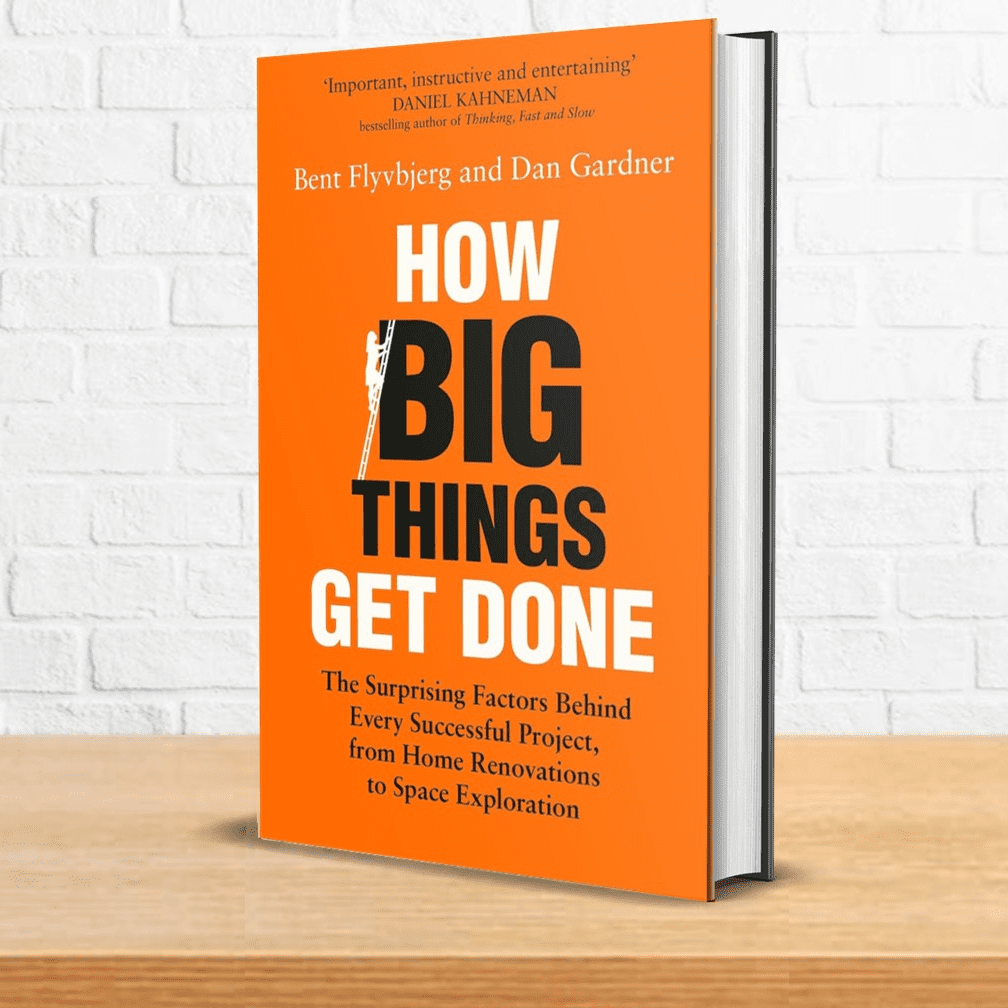
How Big Things Get Done: Complete Summary of Bent Flyvbjerg’s Masterbuilder Approach for Project Success
Introduction: What This Book Is About
“How Big Things Get Done” by Bent Flyvbjerg, a distinguished professor at the University of Oxford and a leading expert in megaprojects, and co-authored by Dan Gardner, offers a groundbreaking perspective on project management. This book challenges conventional wisdom by revealing the surprising factors that truly determine the fate of projects, from home renovations to space missions. Flyvbjerg, known as “the world’s leading megaproject expert” by KPMG, shares decades of research, including insights from the world’s largest database of project performance, to uncover why most large-scale initiatives fail and how a select few achieve remarkable success.
The book introduces the “Think Slow, Act Fast” heuristic as the core principle for success, contrasting it with the prevalent “Think Fast, Act Slow” approach that often leads to disaster. It argues that success in big projects hinges on meticulous, iterative planning (thinking slow) before rapid, efficient execution (acting fast). Readers will learn to identify and overcome common behavioral biases and political pitfalls that derail projects, gaining actionable strategies for effective leadership, team building, and risk management.
This comprehensive summary aims to distill Flyvbjerg’s key insights, providing a blueprint for anyone involved in projects of any scale—from homeowners to corporate executives and government officials. By dissecting the universal drivers of project failure and success, the book offers practical wisdom to improve project outcomes, save substantial resources, and even contribute to solving global challenges like climate change.
Chapter 1: Think Slow, Act Fast
This chapter reveals the dismal truth about big projects: they are far more likely to fail than succeed. It introduces the “Think Slow, Act Fast” mantra as the solution, emphasizing that speeding up by slowing down in the planning phase is crucial.
The Grim Reality of Project Performance
The record of big projects is worse than it seems. Flyvbjerg’s decades-long research, starting with the Great Belt project in Denmark, revealed a pervasive pattern of cost and schedule overruns, along with benefit shortfalls. Despite theories of “honest numbers,” politics and human nature often lead to optimistic spin over truth, making it difficult to assess real performance. The author’s database, the world’s largest of its kind with over 16,000 projects across 20+ fields and 136 countries, consistently shows a grim picture.
The Iron Law of Megaprojects Unveiled
Flyvbjerg’s data established the “Iron Law of Megaprojects”: projects are over budget, over time, and under benefits, over and over again. Specifically, only 8.5% of projects hit both cost and time targets, and a minuscule 0.5% achieve cost, time, and benefits targets. This means 91.5% of projects experience overruns, and 99.5% miss at least one target. These figures are conservative, measured against final investment decisions rather than earlier, more optimistic estimates.
Understanding Fat-Tailed Risks
Project risks are not normally distributed like a bell curve. Instead, most project types exhibit fat-tailed distributions, meaning they have a significantly higher probability of extreme, disastrous outcomes (black swans). For instance, 18% of IT projects have cost overruns exceeding 50%, with an average overrun of 447% within that tail. This explains monumental failures like Boston’s “Big Dig” (triple its budget) or the James Webb Space Telescope (450% over budget). Even small projects like home renovations can suffer fat-tailed overruns, as shown by a London couple’s renovation soaring from $260,000 to $1.3 million.
The Window of Doom and Its Solution
Project duration acts as a “window of doom”: the longer a project takes, the more opportunities for unforeseen problems (black swans) to derail it. These can range from pandemics (Covid-19) to trivial events like strong winds (Suez Canal blockage). Such events create “normal accidents” in complex, interdependent systems. The solution is to “close the window” by speeding up the project, minimizing its vulnerability.
The Counterintuitive Path to Speed
The common approach to achieving speed—setting severe timelines and demanding furious pace—is misguided. The Copenhagen Opera House exemplified this: rushed deadlines led to terrible costs and a “mausoleum” design. The Mexico City metro overpass collapse, killing 26 people, showed that “Haste makes not only waste but tragedy.” The correct path to speed is “Think Slow, Act Fast”, which means investing heavily in slow, deliberate planning to ensure swift and smooth execution.
Planning vs. Delivery: A Critical Distinction
A project divides into two phases: planning (thinking) and delivery (acting). Planning is relatively cheap and safe, involving computers, paper, and models. Delivery is expensive and vulnerable, as real money is spent and risks materialize. Pixar, for example, allows directors years in development where “costs of iterations are relatively low,” ensuring a rich, detailed, tested plan before production, where “costs explode.” This approach minimizes “break-fix cycles” and ensures problems are discovered when they are cheapest to fix.
Projects Don’t Go Wrong, They Start Wrong
Many projects, like the California High-Speed Rail, suffer from rushed, superficial planning. This leads to inevitable problems during delivery, triggering a “break-fix cycle” where the project gets stuck like a mammoth in a tar pit. The underlying issue is that projects often start wrong, doomed by inadequate initial planning. The solution is to commit to a slow, rigorous planning process before execution, avoiding premature commitment.
Chapter 2: The Commitment Fallacy
This chapter explores why so many leaders of big projects do the opposite of “Think Slow, Act Fast,” often due to a rush to commit. It argues that while commitment is essential, the type of commitment matters: commit to the process, not prematurely to the solution.
The Ill-Conceived Pentagon Plan
The story of the Pentagon’s initial planning illustrates the pitfalls of premature commitment. In July 1941, Brigadier General Brehon B. Somervell, under pressure to rapidly expand the US military, demanded a plan for a massive headquarters within a week. His staff, acting on “What You See Is All There Is” (WYSIATI), quickly identified the abandoned airfield, then Arlington Farm, as suitable sites. Somervell rushed approval from the Secretary of War, Congress, and President Roosevelt within a week. However, the Arlington Farm site was geographically constrained by roads, leading to a “misshapen pentagon” design that would have marred the view from Arlington National Cemetery, an act a newspaper called “vandalism.” This demonstrated a profound lack of alternatives analysis and careful consideration.
The Allure of Premature Lock-in
The “commitment fallacy” describes this phenomenon of premature lock-in to a decision. It’s a behavioral bias where people and organizations push forward, even when better alternatives exist or problems are evident. Strategic misrepresentation plays a role, where project proponents deliberately lowball costs and timelines to gain approval, knowing that once a project starts (like “digging a hole” as Willie Brown described), it’s hard to abandon due to sunk costs.
Psychological Traps in Project Decision-Making
Optimism and overconfidence are deeply ingrained human traits. Daniel Kahneman observed that optimism is “widespread, stubborn, and costly.” While useful for inspiration, it’s detrimental for realistic forecasting. Flyvbjerg’s heuristic: “You want the flight attendant, not the pilot, to be an optimist.” Pilots (or project leaders) need hard-nosed analysis.
- System One (fast, intuitive judgments) often leads to quick conclusions based on WYSIATI (What You See Is All There Is), which means decisions are made with limited information. These judgments “feel” true, making critical scrutiny difficult.
- System Two (slow, conscious reasoning) can correct System One, but it’s often overridden.
- Gary Klein’s research on “naturalistic decision making” shows that while quick intuition works for familiar situations, it’s a mistake in novel, high-stakes projects, where a thorough, reflective approach is needed.
The Pervasive Planning Fallacy
The “planning fallacy,” coined by Kahneman and Tversky, describes the tendency to underestimate time and cost, even with contrary information. Douglas Hofstadter mocked it with “Hofstadter’s Law”: “It always takes longer than you expect, even when you take into account Hofstadter’s Law.” This bias stems from focusing on best-case scenarios and ignoring past experience. Robert Caro’s initial 9-month estimate for his 7-year book is a perfect example.
The Dangerous “Bias Against Thinking”
A common organizational “bias for action,” often summarized as “Just do it!”, can be dangerous when applied to irreversible decisions. As Jeff Bezos noted, action is good for reversible decisions, but not for large, irreversible projects like building the Pentagon. Francesca Gino and Bradley Staats found managers perceive planning as “wasted effort” under time pressure. This leads to rushed, superficial planning, which only delays problems until the costly delivery phase.
Strategic Misrepresentation and “Start Digging a Hole”
Jean Nouvel, a Pritzker Architecture Prize winner, bluntly stated that initial project budgets are often “theoretical budgets” designed to be “politically accepted,” with the “real price” coming later. Willie Brown, former San Francisco mayor, admitted that “the first budget is really just a down payment.” This deliberate underestimation (strategic misrepresentation) aims to gain approval and then reach a point of no return. Once “shovels are in the ground”, or “a hole is dug,” the project becomes too costly to abandon, as demonstrated by Elia Kazan’s Hollywood tactic to secure funding for his film, or the Heaven’s Gate disaster which sank United Artists.
The Sunk-Cost Fallacy: Driving into the Blizzard
The “sunk-cost fallacy” explains why projects continue despite mounting failures: people irrationally factor in past expenditures when deciding on future investments. This is like “driving into the blizzard” because you paid for tickets, ignoring the present dangers. This bias is particularly potent in politics, where abandoning a project due to billions already spent (like California High-Speed Rail) is seen as “throwing away” money, perpetuating a “spiral downward” of overcommitment.
Somervell’s Spiral and the Need to Resist Premature Commitment
Somervell’s Pentagon plan suffered from a mix of psychology (WYSIATI, optimism) and politics (desire to gain approval). His superiors failed to ask probing questions. The solution is to “commit to not committing” at the outset. Project leaders must educate their teams, explore alternatives, and thoroughly question assumptions to avoid the commitment fallacy. The next chapter will explore how asking “Why?” can prevent such missteps.
Chapter 3: Think from Right to Left
This chapter argues that projects often start with solutions instead of questions, leading to flawed outcomes. It advocates for “thinking from right to left,” a process that begins with the fundamental question of “Why?” and a deep exploration of goals before considering means.
The Disaster of David and Deborah’s Kitchen Renovation
The small-scale project of David and Deborah’s kitchen renovation in Brooklyn serves as a cautionary tale. Despite spending years contemplating the project and hiring an experienced architect, their initial plan, costing $170,000, ballooned to $800,000 and was 18 months late. The original decision to “renovate the kitchen” was an answer, not a question. Problems emerged piecemeal:
- The contractor discovered shoddy 1840s construction requiring steel beam installation in the basement.
- This led to replacing all floorboards, then renovating the ugly brick fireplace.
- A “vulgar” tiny powder room led to its relocation.
- Work in the basement inspired rerouting stairs for a washer/dryer room.
- Eventually, the entire first floor was gutted and redesigned.
- Later, the second floor’s main bathroom also became part of the renovation, leading to its complete gutting.
Each change, though reasonable in isolation, expanded the scope until the project was a disaster, fundamentally transforming from a kitchen renovation to a bottom-to-top home overhaul.
The Power of “Why?”: Frank Gehry’s Approach
Good planning is not just slow; it’s exploratory, imaginative, and rigorous. It begins by asking fundamental questions. Frank Gehry, the renowned architect, starts every project with a simple but profound question: “Why are you doing this project?” This approach, deeply influenced by his Talmudic upbringing, fosters curiosity and challenges the WYSIATI (What You See Is All There Is) fallacy.
Thinking from Right to Left: Defining the End Goal First
Projects are means to an end, not ends in themselves. The “box on the right” in a project flowchart represents the ultimate goal. Planning should begin by meticulously defining what goes into this box.
- The Guggenheim Museum Bilbao example: The Basque Country officials initially wanted Gehry to renovate an old wine warehouse for a museum. Gehry, asking “Why are you doing this project?”, learned their true goal was to revitalize Bilbao’s economy by making it a global tourist destination, like the Sydney Opera House. He then proposed a new, dazzling museum on a riverfront site, directly aligning the project with the ambitious economic goal. This led to the “Bilbao effect,” attracting nearly 4 million visitors and generating almost $1 billion in three years.
- This “thinking from right to left” approach contrasts with starting with a presumed solution (e.g., a bridge) without exploring alternatives (tunnels, ferries, broadband). It ensures that new ideas and optimal solutions surface early.
Other Manifestations of Right-to-Left Thinking
This concept is universal across diverse fields:
- “Backcasting” in urban and environmental planning (e.g., California’s water needs) starts with a desirable future state and works backward to identify necessary actions.
- “Theory of change” in social change initiatives defines the desired outcome before planning interventions.
- Steve Jobs’s mantra at Apple: “You’ve got to start with the customer experience and work backwards to the technology.” This was key to products like the iPod but was famously ignored with the failed Amazon Fire Phone, where Jeff Bezos focused on cool technology over customer needs.
How Amazon Uses PR/FAQ for Clarity and Alignment
Jeff Bezos institutionalized “working backwards” at Amazon with the PR/FAQ (press release/frequently asked questions). To pitch a project, one must first write a press release announcing the finished product and an FAQ addressing potential concerns.
- Clarity: These documents must be in “Oprah-speak” – plain, simple language that anyone can understand. This exposes fuzzy thinking and unsupported assumptions.
- Rigor: Projects are pitched in silent meetings where executives read the PR/FAQ, then engage in intense debate. This iterative process, with multiple drafts, ensures the concept is rigorously tested and refined.
- Alignment: It ensures everyone, from proposer to CEO, has a clear, shared understanding of the vision.
However, even this process can fail if leaders don’t truly listen, as demonstrated by the Amazon Fire Phone debacle, where internal doubts were ignored.
Robert Caro’s Method for Sustained Focus
Robert Caro, the acclaimed biographer, applies “right to left” thinking by starting his mammoth projects by defining the “box on the right”: “What is this book about? What is its point?” He forces himself to “boil the book down to three paragraphs, or two, or one.” These summary paragraphs, pinned to his wall, serve as a constant reminder of his goal, ensuring that all his voluminous research and writing remains focused and relevant.
Back to Cobble Hill: The Missed Opportunity
If David and Deborah had applied this approach, they would have started by asking “Why are you doing this project?” beyond just “to have a nice kitchen.” This would have led them to a deeper goal like “more entertaining at home.” This, in turn, would have prompted them to consider the fireplace and powder room and the second floor’s main bathroom. By thinking from right to left, they could have conceived the project as a holistic, top-to-bottom renovation from the start, saving money, time, and pain. Their failure to include their neighbors in discussions led to further, costly, and painful renovations for both families.
Chapter 4: Pixar Planning
This chapter highlights the importance of experimentation and iteration in planning, using the stark contrast between the Sydney Opera House and the Guggenheim Museum Bilbao. It introduces “Pixar Planning” as a model for rigorous, yet creative, project development.
Two Masterpieces, Two Fates
The Sydney Opera House and the Guggenheim Museum Bilbao are both architectural masterpieces, yet their project histories diverge dramatically:
- Sydney Opera House (Jørn Utzon): A fiasco costing 1,400% over estimate and taking 14 years instead of five. Utzon’s career was destroyed. His initial design was a “magnificent doodle” with no engineering feasibility, and construction was rushed before the design was finalized due to political pressure (Joe Cahill’s legacy ambition, “start digging a hole” strategy). Problems emerged during costly construction, not cheap planning.
- Guggenheim Museum Bilbao (Frank Gehry): Completed on time and 3% under budget, generating expected benefits and more. This success propelled Gehry’s career.
Experiri: The Root of Good Planning
Good planning is not passive thought; it’s an active process rooted in the Latin verb experiri – “to try, to test, to prove.” This is the origin of experiment and experience.
- Tinkering and Iteration: People learn best by tinkering, trying, learning, and iterating. Thomas Edison’s 10,000 experiments for a lightbulb filament exemplify this experiential learning.
- Positive Learning Curve: Repetition leads to a positive learning curve, making things easier, cheaper, and more effective with each iteration.
- Simulation in Planning: Effective planning involves simulating the project to make changes and see what works, evolving the plan into something creative, rigorous, and reliable.
The Sydney Opera House: A Case of “Think Fast, Act Slow”
Utzon’s initial design was sparse and lacked technical feasibility. The project organizers should have allowed time for experimentation and detailed planning. Instead, Premier Joe Cahill rushed construction for political gain, lowballing costs and insisting on starting before design was finalized. This “start digging a hole” strategy led to:
- Unresolved problems surfacing during expensive construction.
- Dynamiting completed work and starting again.
- Utzon solving complex structural puzzles (e.g., the curved shells) too late, under immense pressure.
- Utzon being pushed out mid-construction and his reputation ruined.
The finished building had acoustical flaws due to the chaotic process. This demonstrates how rushed starts and inadequate planning lead to disastrous outcomes.
Frank Gehry’s Iterative Design Process
Gehry’s success with Guggenheim Bilbao stemmed from his relentless iterative planning:
- “Play” with Models: He starts with wooden blocks and cardboard models, constantly trying ideas, discussing with his team and clients what works.
- CATIA Software: He transitioned to sophisticated digital simulation using CATIA, a software originally for jet design. This allowed unprecedented precision with complex curves, enabling him to “construct” the building virtually first.
- Supercharged Iteration: CATIA allowed thousands of iterations, testing structural integrity, system functionality, and budget implications for every design change. The 8 Spruce Street facade, with its unique pieces, was cost-effective due to relentless digital testing, resulting in “no change orders.”
- Precision and Guarantee: Gehry is adamant about precise planning, ensuring projects are within budget and meet requirements before construction begins, guaranteeing the vision can be built at an affordable price.
The Pixar Way: Iteration in Animation
Pete Docter, Pixar’s creative director, details a similar iterative process for animated movies:
- “Gray Blob” to Concept: Ideas start minimal (e.g., “A French rat loves to cook”). Initial outlines (12 pages) are critiqued and redrafted.
- Script to Storyboards: A 120-page script is then transformed into ~2,700 detailed storyboards, photographed into a rough video simulation with employee dialogue and simple sound effects. This “mock-up” is a “maximum virtual product.”
- Brain Trust and Feedback Cycles: The video is screened for audiences and Pixar’s “brain trust” (other filmmakers) for critique. “A significant percentage of the film gets chucked” after the first screening.
- Eight Iterations: A Pixar movie typically goes through eight full cycles of script rewriting, new storyboards, and feedback. Major changes (like simplifying characters in Inside Out) occur early when costs are low, while tiny tweaks (like changing dialogue attribution) refine later.
- Planning is Cheap: This “insane amount of work” in planning is modest compared to the cost of full digital animation. Problems found in simulation are cheap and safe to fix. This rigorous process is a major contributor to Pixar’s unprecedented consistency in critical and commercial success.
Why Iteration Works
Four key reasons make iterative processes effective:
- Freedom to Experiment: It allows for trying many ideas and “crap,” knowing failures are cheap and opportunities for learning.
- Thorough Scrutiny: Every detail is scrutinized and tested, preventing unresolved problems from surfacing during costly delivery, unlike the Sydney Opera House or “vaporware” (products announced but never delivered).
- Corrects Illusion of Explanatory Depth: By forcing detailed simulation, it dissolves the cognitive bias where people overestimate their understanding of complex phenomena.
- Cost-Effectiveness: Planning is relatively cheap. Problems discovered during planning save immense time and money compared to fixing them during expensive production.
“Minimum Viable Product” vs. “Maximum Virtual Product”
- Lean Startup Model (Eric Ries): For certain projects (e.g., software), a “minimum viable product” (MVP) is quickly released to consumers for real-world feedback, then iterated. This is effective for learning what customers truly want, but it carries risks (e.g., Theranos applying it to medical testing, or social media glitches).
- Maximum Virtual Product: For projects where real-world testing is too expensive or dangerous (like skyscrapers or passenger jets), a hyperrealistic, exquisitely detailed model (like Gehry’s CATIA models or Pixar’s mock-up videos) is essential. These can use sophisticated tools or simple sketches, wooden blocks, and cardboard. The key is the conceptual shift to active, iterative planning.
Chapter 5: Are You Experienced?
This chapter explores how experience is invaluable yet frequently overlooked or misunderstood in project management, often sidelined by political considerations or the pursuit of superlatives.
The Experience Gap: Utzon vs. Gehry
The contrast between the Sydney Opera House (Jørn Utzon) and the Guggenheim Museum Bilbao (Frank Gehry) is starkly amplified by their respective ages and experience levels when they undertook these projects. Utzon, 38, had little notable experience before the Sydney Opera House, having worked in postwar Denmark with limited opportunities. Gehry, 62, had decades of experience in booming postwar Los Angeles, taking on progressively ambitious projects. This “experience canyon” contributed significantly to the Sydney Opera House’s fiasco and the Guggenheim’s success.
How Politics Marginalizes Experience
Experience is often sidelined by other considerations:
- Domestic Preference: Governments frequently award contracts to inexperienced domestic companies to gain political support and jobs, even if foreign competitors are more qualified. The Danish Great Belt undersea tunnel faced issues partly due to an inexperienced domestic contractor.
- Canada’s Icebreakers: The Canadian government split contracts for two icebreakers between two Canadian companies (one in Quebec, one in British Columbia) for political payoff, preventing learning improvements that would come from one company building both ships sequentially. This raised estimated costs from $2.6 billion to $7.25 billion.
- California High-Speed Rail: This project hired mostly inexperienced, mostly US contractors and managers, despite the lack of real high-speed rail experience in the US. This “terrible way to run a project” is common due to its political expediency.
The Perils of Being “First”
The ambition to be “first” or achieve superlatives often sidelines experience.
- Danish Court Administration IT Projects: The author, a board member, witnessed an IT project for digitizing real estate and court records. Despite no one having done something similar, the team saw being “the first in the world” as a reason to proceed, not a warning. These two expensive IT projects turned into “epic fiascos,” with repeated delays and budget overruns.
- Uniqueness Bias: Planners often suffer from “uniqueness bias,” believing their projects are so special that they have little to learn from past ventures. This leads to ignoring valuable experience from similar projects.
- First-Mover Disadvantage: Research shows that nearly half of “pioneer” companies fail, compared to 8% of “settlers” (fast followers). Early market leaders enter, on average, 13 years after pioneers. Being a “fast follower” (like Apple after Blackberry) is often more advantageous as it allows learning from others’ experiences.
The Trap of “Biggest, Tallest, Longest, Fastest”
Seeking superlatives (e.g., biggest, tallest) is as dangerous as being first because it demands inexperienced technology.
- Seattle’s State Route 99 Tunnel: To build the world’s biggest tunnel, Seattle needed the world’s biggest boring machine (a “first”). It cost $80 million (double a standard machine), broke down after 1,000 feet, and required two years and $143 million to repair. Standard-sized tunnels with experienced technology would have been cheaper and more reliable.
- Technology as “Frozen Experience”: Flyvbjerg coins the term “frozen experience” for technology, arguing that just as one prefers an experienced carpenter, one should prefer highly experienced (proven) technology. New or custom-designed technology is “inexperienced” and should be approached with caution, not celebrated as a selling point.
Olympic Blowouts: A Confluence of Errors
The Olympic Games are a prime example of aggressively marginalizing experience, leading to an average 157% cost overrun.
- Eternal Beginner Syndrome: The International Olympic Committee (IOC) moves the Games globally, ensuring that host cities and countries lack experience in managing such complex events. Even if locals are hired, there’s no continuous learning curve, leading to “Eternal Beginner Syndrome.”
- Quest for Superlatives: Host cities routinely build “first, biggest, tallest, most unusual” facilities, ignoring existing, proven designs.
- Montreal’s “Big Owe” (1976): The Montreal Games held the record for cost overrun (720%). Its stadium, designed by Roger Taillibert, was a dramatic, complex structure that disregarded constructability. It was unfinished for the opening, and its roof, designed to retract, remained problematic for decades, leading to the nickname “the Big Owe.” This exemplifies the high costs of prioritizing novelty over experience.
Maximizing Experience: The Empire State Building Example
In contrast, the Empire State Building maximized experience:
- Proven Technologies: Architect William Lamb insisted on using existing, proven technologies, avoiding “innovative methods” and minimizing “hand work” with standardized, duplicable parts.
- Repetitive Design: Floor designs were kept similar or identical, allowing construction crews to “learn by repeating” and accelerate progress. Workers built “102 one-story buildings.”
- Experienced Contractors: Starrett Brothers and Eken, renowned for speed in skyscraper construction, were hired.
- Prior Success: Lamb had already designed the Reynolds Building (1927) in North Carolina, a smaller version of the Empire State Building, allowing him to “enhance a prior success.” The Empire State Building achieved its “world’s tallest” superlative without undue risk by leveraging experience.
The Untapped Value of Tacit Knowledge
Beyond “frozen experience” in technology, “unfrozen experience”—the lived experience of people—is crucial.
- Tacit Knowledge: Michael Polanyi’s concept of “tacit knowledge” explains that much valuable knowledge (like riding a bike) cannot be fully articulated but is felt and gained through practice.
- Skilled Intuition: Highly experienced project leaders like Frank Gehry and Pete Docter possess “skilled intuition” (not mere gut feelings), allowing them to sense problems or better paths. This is reliable when backed by long experience in their domain.
- Iteration and Intuition: When skilled intuition combines with iterative planning (Pixar planning), it allows leaders to “dive in and do stuff completely intuitively” while rigorously testing and adjusting, getting the most from both.
- Navigating Politics: Gehry’s experience with the tumultuous Walt Disney Concert Hall (his “near-Utzon experience”) taught him crucial lessons in project politics—understanding stakeholders, power dynamics, and maintaining control—which he applied to the Guggenheim and subsequent projects. This practical wisdom (phronesis) is invaluable and can only be gained through long, direct experience.
The Imperative of Experiri
Project leaders should always strive to maximize both frozen experience (proven technology, standard designs) and experimentation (iterative testing). For common projects, this means using off-the-shelf technologies and hiring experienced people. For truly unique, groundbreaking projects (like climate solutions or space travel), the deficit of experience must be turned into a surplus through relentless application of experiri, constantly testing and learning. A project leader with abundant phronesis and an experienced team is the single greatest asset a project can have.
Chapter 6: So You Think Your Project Is Unique?
This chapter tackles the crucial issue of forecasting project costs and timelines, arguing that the “uniqueness bias” is a major impediment to accurate predictions. It introduces Reference-Class Forecasting (RCF) as a surprisingly simple and highly effective technique to overcome this bias and manage risks.
The Cost of Naïve Forecasting: Robert Caro’s Ordeal
Robert Caro’s experience writing his Pulitzer Prize-winning biography, “The Power Broker,” perfectly illustrates the danger of bad forecasting. He initially estimated 9 months for a book that took 7 years, nearly ruining him financially. His forecast was based on “anchoring and adjustment”:
- Bad Anchor: He anchored on his experience writing long newspaper articles (3 weeks per chapter, 12 chapters per book), a familiar but irrelevant reference point.
- Naïve Adjustment: He then made a small, optimistic adjustment.
This “sensible” forecast was actually a laughable underestimate because it ignored the fundamental differences between writing a newspaper article and a monumental biography. It was only after meeting other biographers (his “reference class”) that he realized his work was not to blame; his forecast was.
The Root Cause: Underestimation, Not Just Overruns
Flyvbjerg found that Mass Transit Railway (MTR) in Hong Kong made the same mistake with its XRL (High-Speed Rail) project. MTR, despite its experience with conventional rail, had no experience with underground high-speed rail. It used its prior experience as an anchor, leading to a “fundamentally unrealistic” forecast that caused inevitable delays and budget overruns. The problem was not simply “overruns” but “underestimation” driven by a bad anchor.
Overcoming Uniqueness Bias with the “Outside View”
People naturally view their projects as unique (the “uniqueness bias” or “inside view”). This blinds them to valuable lessons from other projects. To create reliable forecasts, one must adopt the “outside view,” seeing a project as “one of those” within a class of similar projects.
- Reference Class Defined: A reference class is a category of past projects similar to yours. Data from this class (actual costs, times, benefits) serve as your anchor.
- Kitchen Renovation Example: Instead of calculating every cost item for your kitchen renovation, find the average actual cost of past kitchen renovations (the reference class). Adjust only if there are clear, compelling reasons (e.g., using high-end materials).
- Simplicity is Key: Resist the urge to define the reference class too narrowly (e.g., “kitchen renovations with granite countertops in my neighborhood”) or make too many adjustments based on vague feelings. Broad inclusion and minimal, data-backed adjustments are crucial to avoid reintroducing bias.
Reference-Class Forecasting (RCF): A Proven Method
Flyvbjerg calls this “reference-class forecasting” (RCF).
- UK and Denmark Adoption: After Flyvbjerg developed RCF for Gordon Brown’s UK government, both the UK and Denmark made it mandatory for major projects. It’s also used in the US, China, Australia, South Africa, Ireland, and Switzerland.
- Superior Accuracy: RCF is consistently 30 percentage points or more better than conventional forecasts, with 50% to over 100% increases in accuracy. Daniel Kahneman called it “the single most important piece of advice regarding how to increase accuracy in forecasting.”
- Addressing Unknown Unknowns: RCF’s power lies in implicitly accounting for “unknown unknowns” (as coined by Donald Rumsfeld). The actual outcomes in the reference class reflect all unforeseen problems, so your forecast built on those numbers inherently includes them. For example, old house renovations inherently include the cost of discovering bad wiring or mold.
Challenges to Wider RCF Adoption
Despite its strengths, RCF faces three main barriers:
- Eliminating Bias is a “Bug”: Many corporations and individuals prefer lowball estimates to get projects approved. They don’t want accurate forecasts that reveal the true cost and risk.
- Uniqueness Bias Persists: Even those aware of the bias, like Kahneman himself, can fall prey to it, believing “this time is different.” Kahneman’s textbook project was estimated at 2 years but took 8, despite the expert saying textbooks usually take 7 and 40% are never finished.
- Data Availability: Reliable historical project data is often scarce, as old project data is seldom collected or is kept under wraps by companies who profit from inflated estimates. Governments and large organizations can build their own databases, while individuals can use “rough-and-ready” approaches (e.g., surveying friends).
“Regression to the Tail” and Black Swan Management
For fat-tailed distributions (where extreme outcomes are common), relying solely on the mean is dangerous as it can lead to “regression to the tail” (where successive extremes get worse).
- Shift Mindset from Forecasting to Risk: For fat-tailed projects, shift from “The project will cost X” to “The project is X percent likely to cost more than Y.”
- Cut the Tail with Risk Mitigation: Since building massive contingencies for fat-tailed risks is prohibitive, the solution is “black swan management”: proactively mitigating the risks that lead to extreme outcomes. This involves studying the causes of blowouts in the tail of the reference class.
- HS2 (High Speed 2) Example: For the UK’s HS2 high-speed rail line, Flyvbjerg’s team identified that black swans were caused not by “catastrophic” risks, but by the compound effects of standard, poorly managed risks, such as:
- Archaeology: Putting all qualified archaeologists in the country on retainer to prevent delays from site discoveries.
- Early Delays: Recognizing that “lost ground can always be regained—lost time never,” and implementing measures to prevent early delays that cascade into chain reactions.
- Procurement and Political Decisions: Pushing decision-making up the ladder to accelerate responses.
- Great Chicago Fire Festival Cautionary Tale: This project failed because planners focused only on fire safety (inside view) but didn’t consider the broader reference class of live events (outside view). They missed obvious risks like equipment failure (ignition system), leading to a public “fiasco.”
Getting XRL Back on Track in Hong Kong
Flyvbjerg’s team turned around the Hong Kong XRL project by:
- Reference-Class Forecasting: Using a reference class of 189 comparable high-speed rail, tunneling, and urban rail projects, they found MTR’s original 4-year schedule should have been 6 years.
- Risk Mitigation: They advised Formula 1-style efficiency for boring machine breakdowns (on-site engineers and parts) and pushed procurement decisions to CEO-level to reduce delays.
- High-Confidence Forecast: They created a high-confidence RCF for the remaining work, allowing MTR to secure funding.
- “Inchstones” and Psychological Boost: They implemented “inchstones” (sub-forecasts for small, frequent markers) to provide immediate feedback and accountability. By openly acknowledging mistakes, hiring new leaders, and celebrating progress, they replaced negativity with an “updraft of accomplishment.”
The XRL was completed on budget and three months ahead of schedule (against the revised forecast), demonstrating the power of RCF and robust risk management.
Chapter 7: Can Ignorance Be Your Friend?
This chapter directly challenges the popular notion that planning stifles creativity and that “providential ignorance” is beneficial for big projects. It uses compelling stories to frame the argument before presenting data to refute it.
The Romantic Allure of “Just Do It!”
The story of Jimi Hendrix’s Electric Lady Studios embodies the “Just do it!” philosophy. In 1969, Hendrix, seeking a relaxed jam space, hired 22-year-old John Storyk, whose only prior experience was designing a nightclub decor. Eddie Kramer, Hendrix’s 26-year-old sound engineer, convinced Hendrix to build a private, top-quality recording studio instead of just a club. Storyk, admitting no studio experience, created the entire plan from six drawings and “a lot of pointing,” with no budget or schedule.
- Challenges and Creativity: An underground river required 24/7 sump pumps that created noise, solved by inventing eggbeater-whipped sound-absorbent plaster for the ceilings (a stroke of genius, later confirmed by acoustics).
- Financing: Hendrix paid with bags of cash from concerts until money ran out, leading to Warner Bros. reluctantly stepping in.
- Triumph: The studio opened in August 1970, a month before Hendrix’s death, taking a year and costing $1 million (approx. $7.5 million in 2021 dollars). It became a legendary studio, used by Stevie Wonder, Led Zeppelin, John Lennon, and Adele.
This narrative suggests that creative projects can thrive on spontaneity, improvisation, and “necessity is the mother of invention,” leading to successes despite an apparent lack of planning.
The “Hiding Hand” Theory
Albert O. Hirschman, a renowned economist, theorized that “providential ignorance” is beneficial. He argued that people underestimate both their creativity and the difficulties of big projects. This “Hiding Hand” tricks them into starting projects they would otherwise deem impossible. When unforeseen problems arise, a “burst of creativity born of desperation” leads to larger-than-expected benefits that “dwarf” the cost overruns.
- Paper Mill in Bangladesh Example: Hirschman cited a paper mill project in Bangladesh that relied on bamboo. When the bamboo died unexpectedly (a natural 50-year cycle), the mill operators innovated, finding new bamboo sources, growing faster-growing species, and substituting other lumber. Hirschman claimed this made the mill better off than if the bamboo had lived.
- Jaws Movie Production: Steven Spielberg’s Jaws production was a “mess”—terrible script, uncooperative weather, malfunctioning sharks. This forced actors to improvise dialogue and Spielberg to hint at the shark instead of showing it, turning a “schlocky B-movie” into a suspense masterpiece and box-office smash.
- Sydney Opera House: The initial “magnificent doodle” design was underestimated in difficulty, but Utzon eventually cracked the puzzle, leading to a masterpiece despite vast cost overruns and delays.
Stories vs. Data: The Problem of Survivorship Bias
Reliance on compelling stories like Electric Lady, Jaws, and the Sydney Opera House creates a “survivorship bias.” Projects that overcome adversity and succeed dramatically are remembered, while those that fail miserably are forgotten. To truly assess Hirschman’s theory, one needs data, not just anecdotes.
What the Data Say: The Fallacy of Beneficial Ignorance
Flyvbjerg tested Hirschman’s theory using a database of 2,062 projects (dams, rail lines, tunnels, buildings).
- Hirschman’s Prediction: Costs are underestimated, and benefits are underestimated (meaning they perform better than expected), with benefit overruns exceeding cost overruns.
- Flyvbjerg’s Findings: The data overwhelmingly contradict Hirschman. The typical project sees costs underestimated AND benefits overestimated. Only one in five projects aligned with Hirschman’s pattern.
- Kahneman’s Optimism Bias Confirmed: This result supports Kahneman’s optimism bias, where people overestimate benefits and underestimate costs.
- Portfolio Performance: For a portfolio of projects, losses far exceeded gains, meaning that even if a few projects miraculously succeed, they don’t compensate for the many failures. “The typical leap in the dark ends with a broken nose.”
The Real Cost of “Just Do It!”
The “costs” of these “triumphs” often extend beyond money:
- Jørn Utzon’s Career: The Sydney Opera House’s mismanagement destroyed Utzon’s reputation, leading to him being “marginalized and forgotten” and becoming a “one-building architect.” Other cities were “robbed” of masterpieces he never built.
- Opportunity Costs: Bad planning burns resources that could have funded other valuable projects.
- Stress and Creativity: Desperation, born of project chaos, may actually hinder creativity, as stress is “particularly corrosive” when situations feel out of control and competence is judged. Imaginative leaps belong in low-stakes planning, not high-stakes delivery.
The Triumph of Planned Creativity
John Storyk, the designer of Electric Lady, today embraces meticulous planning. While his career started serendipitously, he now aims to “slow things down” in planning to “make less mistakes” and ultimately “get [projects done] faster.” His success across diverse projects globally is a testament to the “Think Slow, Act Fast” approach.
Chapter 8: A Single, Determined Organism
This chapter emphasizes that even the best plans require a strong, capable, and unified delivery team. It explores how diverse individuals and organizations can be forged into “a single, determined organism” focused on execution.
The Invaluable Asset of Experienced Teams
A successful delivery team is crucial. Highly sought-after project managers often insist on bringing their own tried-and-tested teams.
- Frank Crowe (Hoover Dam): His success was largely due to his large, loyal team that followed him from project to project, embodying profound experience, mutual trust, and understanding. The Hoover Dam was completed under budget and ahead of schedule.
- The Pitfall of Inexperienced Leadership: In contrast, a Canadian hydroelectric dam project, overseen by executives with zero experience in hydroelectric dams (hired from oil and gas due to flawed reasoning), became a “fiasco” that threatened a whole province.
The simple solution: hire experienced teams upfront, even if they seem expensive, as they save immense costs in the long run.
Terminal 5 (T5) at London Heathrow: A Case Study in Team Building
When British Airports Authority (BAA) launched the multibillion-dollar T5 project at Heathrow Airport in 2001, it faced immense pressure. It was a massive, complex undertaking—the largest freestanding structure in the UK, built between two busy runways without interrupting airport operations. BAA also knew that typical major projects run one year late and $1 billion over budget. To succeed, T5 had to outperform the norm.
BAA implemented three key strategies:
- Rigorous Planning (“Pixar Planning”): T5 was planned using highly detailed digital representations and rigorous simulations where the airport’s creation and operation were tested virtually before physical construction.
- Radical Construction Approach: BAA adopted “design for manufacture and assembly” (DfMA), where components were manufactured in factories (a controlled environment) and then assembled on-site. This is like the hyper-efficient car industry and revolutionized large-scale construction by transforming the worksite into an assembly site.
- People-Centric Team Building: BAA launched a deliberate campaign to transform thousands of diverse people from hundreds of organizations into a single, cohesive team.
How BAA Forged “One Team”
Andrew Wolstenholme, the BAA executive overseeing T5, led a conscious effort to build a unified team:
- Active Leadership and Shared Risk: BAA did not just hire firms; it actively led and shared risks. It moved from flat-fee contracts to cost-reimbursable arrangements with bonuses for meeting milestones, ensuring companies had aligned interests (cooperation vs. self-interest). This defused conflicts, as seen when BAA intervened to prevent Richard Harper’s steel company from suing a concrete contractor, instead incentivizing them to collaborate.
- “Squad Mentality”: BAA prioritized working with experienced companies and subcontractors they had long relationships with, fostering trust and rapport. Wolstenholme used the metaphor: “If you’re going to win a football game, you need to play with the same squad every season.”
- Unified Identity (“One Team”): The message was clear: “Take off your cap badge and throw it away, because you work for T5.” Posters reinforced this message of “I work for T5,” ensuring everyone felt part of a single entity.
- Shared Purpose (“Making History”): The worksite was covered with posters comparing T5 to other great projects (Eiffel Tower, Grand Central Terminal), promising: “One day, you’ll be proud to say, ‘I built T5.’” This fostered a sense of purpose and pride.
- Respect and Empowerment: BAA matched its words with action:
- Superior Facilities: Toilets, showers, and canteens were “mind-bogglingly” good.
- Immediate Worker Needs: Personal protective equipment (PPE) was always provided and replaced without question, showing respect and care. This “set a man to work in the morning and you’ve put the things there that he wants, then you get a good day’s work.”
- Worker Consultation: Skilled workers developed their own benchmarks and quality standards, taking ownership.
- Psychological Safety: Everyone felt free to “speak up” with ideas or grievances, knowing they had BAA’s backing. Amy Edmondson’s “psychological safety” boosts morale, fosters innovation, and ensures “bad news travels fast,” allowing problems to be tackled quickly.
The Triumph of T5
The team-building efforts paid off:
- Unprecedented Cooperation: Richard Harper, with decades of experience, called the level of cooperation “unprecedented.” Workers were proud to wear T5 gear even outside work.
- On Time, On Budget: T5 finished on budget and on time, opening at 4:00 a.m. on March 27, 2008, as promised. Despite initial baggage system glitches, they were resolved, and T5 became one of the world’s favorite terminals, routinely ranking #1.
- Contrast with Wembley Stadium: The new Wembley Stadium, built concurrently in London, was rife with conflicts, work stoppages, and went years past deadline and doubled in cost (£445 million to £900 million). This highlights the critical difference team dynamics make.
The Secret to Scaling Up: From “One Huge Thing” to “Many Small Things”
The chapter transitions to the concept of modularity, preparing for the next chapter’s discussion on how it enables scaling. Flyvbjerg poses a puzzle: why are solar, wind, fossil thermal power, electricity transmission, and roads the only five project types in his database that are not fat-tailed (i.e., less prone to disastrous overruns)? These “fortunate five” are all modular to a considerable degree. This leads to the ultimate solution for building huge projects: the “many small things” approach.
Chapter 9: What’s Your Lego?
This chapter reveals modularity as the key to building big things faster, cheaper, and better, and argues it is indispensable for projects of world-transforming scale, including those addressing the climate crisis. It explains why the “fortunate five” project types (solar, wind, fossil thermal, electricity transmission, roads) are consistently more successful.
The Failure of “One Huge Thing” Projects: Monju Nuclear Power Plant
The Monju nuclear power plant in Japan, designed to be a “fast-breeder reactor,” exemplifies the “one huge thing” approach. Launched in 1983, it was a $15 billion, 60-year project that produced zero electricity.
- Slow and Complex: Construction started in 1986, finished in 1995, but a fire immediately shut it down. Subsequent restart attempts were plagued by delays (2000, 2005, 2008, 2009, 2010, 2013) and the discovery of 14,000 maintenance flaws, leading to its permanent closure in 2016. Decommissioning alone will cost $3.4 billion over 30 years.
- Bespoesness: Nuclear power plants are typically bespoke, one-of-a-kind designs with no standard parts. This makes them inherently slow and complex.
- No Experimentation, Little Experience: They are too expensive and dangerous for rapid iteration or “failing fast.” Experience is scarce, and each plant is uniquely designed, leading to “negative learning” where problems make projects more difficult and costly over time.
- Financial Strain: They generate no revenue until fully complete, tying up massive capital for decades.
- Black Swan Vulnerability: Their long duration makes them highly susceptible to unpredictable shocks, like the Fukushima disaster which turned public opinion against nuclear power and sealed Monju’s fate.
The Power of “Many Small Things”: Modularity
In contrast, projects built as “many small things” through modularity are consistently more successful.
- Nepal School Project: The author’s Nepal school project built 20,000 schools and classrooms by treating each classroom as a “Lego” block. It was simple (three main designs), delivered on budget and years ahead of schedule, and performed well.
- Repetition and Learning: Modularity enables repetition, which allows for experimentation (try, learn, fail fast, adjust) and fosters positive learning, making each iteration better, easier, cheaper, and faster. “Repetitio est mater studiorum”—”Repetition is the mother of learning.”
- Wedding Cakes: Even grand wedding cakes are modular, composed of identical, simple cakes stacked together. Bakers gain skills rapidly through repetition.
- Design for Manufacture and Assembly (DfMA): Factories can produce “Lego” blocks (e.g., half classrooms, entire hotel rooms) that are then assembled on-site, transforming construction into a highly efficient assembly site. This drastically reduces costs (e.g., UK schools cut 30% off per square meter cost) and boosts quality. Heathrow’s T5 used this effectively.
- Scale-Free Scalability: Modularity creates “scale-free scalability,” where adding more modules follows the same principles regardless of size. A server farm, built from individual servers, scales infinitely with consistent efficiency.
Modularity’s Impact on Modern Projects
Modularity’s versatility extends to diverse fields:
- COVID-19 Hospitals in China: Modular housing companies built 1,000-bed hospitals in 9 days and quarantine facilities in 4 months by prefabricating units in factories.
- Sears Modern Homes: A century ago, Sears sold 70,000 factory-built home kits that remain prized for their quality, proving modularity can deliver aesthetic, high-quality housing.
- Cars: Even luxury cars are assembled Lego-style, demonstrating that modularity is compatible with beauty and quality.
- Marriott Hotel in Manhattan: Designed as a 26-story modular hotel, with rooms built in a factory and shipped to be assembled, demonstrating modularity’s potential for iconic structures.
- Apple Park (Headquarters): Steve Jobs envisioned it with “modular sections, known as pods, for work or collaboration,” assembled like Lego, emphasizing modularity even in high-end, bespoke design.
- Small-Scale Hydroelectric: Instead of one giant dam, diverting river flow through many small turbines creates substantial power with less environmental damage and risk.
- Tesla Gigafactory: Elon Musk envisioned it as 21 “Lego blocks” of small factories, allowing for production and revenue generation to start within a year while expansion continued.
- SpaceX: Elon Musk’s other venture uses replicability to drive down costs and improve performance, in sharp contrast to NASA’s bespoke approach.
- Planet Satellites: Uses commercial, off-the-shelf electronics as 10x10x10 cm modules assembled into CubeSat modules for cheap, rapidly built satellites, creating “flocks” for global monitoring.
- Madrid Metro: Treated its 76 stations as Lego (simple, shared design) and lengths of tunnel as Lego (optimal length for one boring machine), completing 131 km of rail and 76 stations in 8 years—twice the industry average speed at half the cost.
- Container Shipping: Malcolm McLean’s idea of standardized steel boxes (cargo as Lego) revolutionized global trade, making shipping extremely modular, cost-effective, and a major cause of globalization.
Thin-Tailed Projects: The Modular Advantage
The “fortunate five” project types (solar, wind, fossil thermal power, electricity transmission, and roads) are successful because they are modular to a considerable degree.
- Solar Power: The solar cell is the basic building block, leading to panels, arrays, and farms. It is the lowest-risk project type in terms of cost and schedule.
- Wind Power: Turbines are assembled from four factory-built elements (base, tower, head, blades), repeated to create wind farms.
- Fossil Thermal Power, Electricity Transmission, Roads: All are composed of standardized, repetitive elements.
The pattern is clear: modular projects are in much less danger of turning into fat-tailed disasters. They are faster, cheaper, and less risky.
How to Save Trillions of Dollars and Fight Climate Change
The global infrastructure spending ($6-9 trillion annually) means even modest improvements can yield massive savings. Cutting costs by 5% would save $300−400 billion annually. Cutting by 30% (achievable) would save $1.8-2.7 trillion annually.
- The China Experiment: China’s push for massive non-fossil electricity showed that “many small things” (wind and solar) dramatically outperformed the “one huge thing” (nuclear power) in scaling up quickly. Nuclear power’s line “crawled along the bottom” while wind and solar “shot up.”
- Small Modular Reactors (SMRs): The nuclear industry is now shifting to “small modular reactors,” built in factories and assembled on-site, acknowledging the limitations of their traditional bespoke approach. This signifies a recognition of modularity’s power.
- Climate Crisis Solution: Achieving “net zero by 2050” requires a vast increase in renewable energy (wind power 11x, solar 20x). This demands project delivery at an unprecedented scale and speed. The “many small things” model is the proven way to achieve this.
- Denmark’s Wind Revolution: Denmark’s strategic investment in offshore wind farms (starting with DONG Energy, now Ørsted) demonstrates how modularity can drive down costs and accelerate adoption. By “industrializing and standardizing” construction, Ørsted reduced offshore wind costs by 60% in four years, making it cheaper than fossil fuels. This led to Ørsted achieving its “impossible” 85/15 renewable energy target in 10 years instead of a generation. Denmark is now the “Silicon Valley of wind energy.”
The lesson is clear: governments and corporations must encourage and practice a modular approach. Small experiments can lead to huge transformations. By asking “What’s your Lego?” and relentlessly applying the modular model, humanity has a fighting chance to deliver the necessary climate transformation.
Coda: Eleven Heuristics for Better Project Leadership
Flyvbjerg synthesizes his decades of research into eleven heuristics – fast and frugal rules of thumb – for effective project leadership. These are designed to simplify complex decisions under uncertainty and help anyone become a “masterbuilder.”
Core Insights from How Big Things Get Done
- Hire a Masterbuilder: The most crucial heuristic. A masterbuilder possesses “phronesis” (practical wisdom) and a proven track record in your domain. If a masterbuilder isn’t available, the other heuristics become critical.
- Get Your Team Right: Essential for success. A great team can fix a mediocre idea, but a mediocre team will screw up a good one. Masterbuilders prioritize building the right team.
- Ask “Why?”: Focus on the ultimate purpose or “result” (the “box on the right”). Never lose sight of the goal during delivery. Every action should contribute to this end.
- Build with Lego: Embrace modularity. Construct large projects from many small, repeatable building blocks. This enables scale-free scalability, allowing for better, faster, and cheaper execution. Identify “what’s your Lego” for any project.
- Think Slow, Act Fast: Invest heavily in meticulous, iterative planning to minimize risks during costly and dangerous delivery. Good planning narrows the “window on risk”.
- Take the Outside View: Counteract “uniqueness bias”. See your project as “one of those” within a class of similar projects. Use reference-class forecasting (RCF) and analyze past performance data to get accurate predictions and spot hidden risks.
- Watch Your Downside: Prioritize risk mitigation over focusing solely on opportunities. For fat-tailed risks, proactively identify and eliminate dangers. Like a Tour de France rider, focus on “not losing” each day.
- Say No and Walk Away: Maintain focus by refusing projects or actions that lack necessary resources (people, funds, contingencies) or don’t contribute to the ultimate goal. Learn from Steve Jobs’s pride in “things we haven’t done.”
- Make Friends and Keep Them Friendly: Cultivate strong relationships with stakeholders. This is crucial risk management, as these relationships are vital when things go wrong and are too late to build during a crisis.
- Build Climate Mitigation into Your Project: A critical, urgent task. Prioritize electrification from renewable sources and apply the book’s principles to accelerate climate mitigation and adaptation projects globally.
- Know That Your Biggest Risk Is You: Project failures often stem from internal behavioral biases (like uniqueness bias or planning fallacy), not just external surprises. Self-awareness and using the outside view are key to overcoming these inherent human tendencies.
Immediate Actions to Take Today
- For any current project, clearly define its ultimate “Why” and state it as the “box on the right.”
- Review recent project failures or delays and ask if a bad anchor or uniqueness bias contributed to unrealistic initial forecasts.
- Identify a potential “Lego” for your next big task, thinking about how modularity could simplify and speed up the work.
- Reflect on a past project where premature commitment led to problems. Consider how “Think Slow, Act Fast” could have changed the outcome.
- Begin compiling a simple personal or team database of past project actuals (cost, time, outcomes) to inform future reference-class forecasting.
Questions for Personal Application
- Which of these heuristics resonates most with your recent project experiences, and why?
- How might applying “thinking from right to left” change the way you approach your next personal or professional goal?
- In what area of your life or work could more “Pixar Planning” (iterative experimentation) yield better results?
- What “unfrozen experience” (tacit knowledge) do you or your team possess that is currently underutilized in project planning or execution?
- How can you actively combat “uniqueness bias” when evaluating new opportunities or challenges?


Leave a Reply