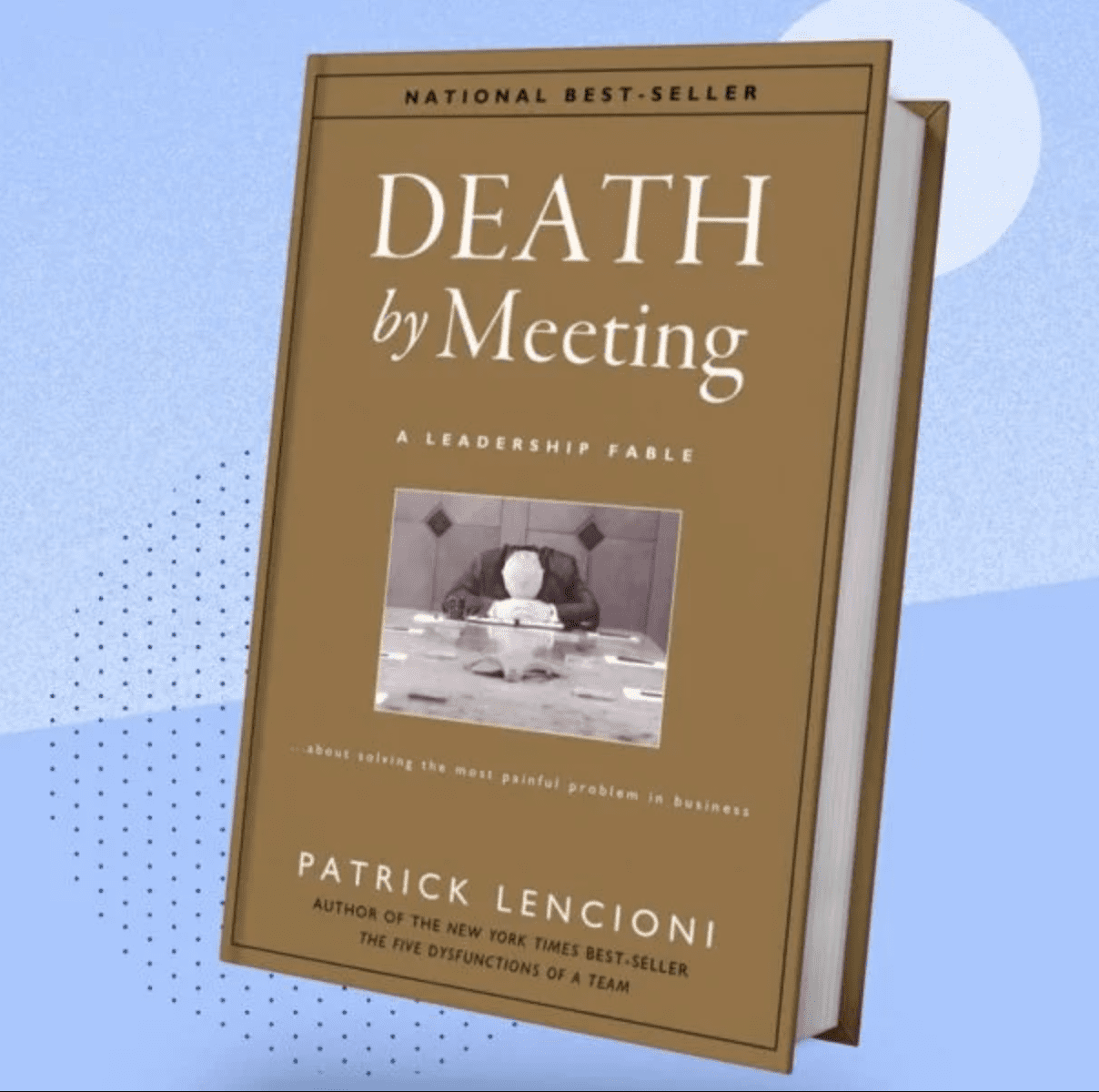

Death by Meeting: Complete Summary of Patrick Lencioni’s System for Productive and Engaging Meetings
Introduction: What This Book Is About
“Death by Meeting” by Patrick Lencioni addresses a pervasive problem in the business world: the widespread dislike and ineffectiveness of meetings. Lencioni argues that while most leaders complain about meetings and try to avoid them, these gatherings are actually the most critical activity for leading and managing organizations. He likens them to an operating room for a surgeon or a playing field for an athlete—essential venues for collective wisdom and decision-making.
This book teaches that bad meetings almost always lead to bad decisions, which is a recipe for mediocrity. Lencioni proposes a contrarian, non-traditional view of meetings, offering specific guidelines that have nothing to do with technology or rigid rules like Robert’s Rules of Order. Instead, he focuses on transforming painful and tedious meetings into productive, compelling, and energizing engagements.
Readers who will benefit most from this book include leaders, managers, and anyone involved in team collaboration who struggles with unproductive meetings. By understanding and applying Lencioni’s model, organizations can differentiate themselves from competitors, improve morale, make faster and better decisions, and ultimately achieve greater results. This summary will provide comprehensive coverage of all key insights, from identifying the core problems to implementing practical solutions.
The Fable: The Story of Yip Software
Lencioni illustrates his meeting theory through the fictional story of Casey McDaniel, CEO of Yip Software. This fable introduces the central issues of corporate complacency and dysfunctional meetings through a relatable narrative.
The Man and His Story: Casey McDaniel’s Background
Casey McDaniel is initially described as an extraordinary man but an ordinary CEO. He is a devoted husband, loving father, and committed community member, making him universally liked and admired. His journey began with a passion for golf and computers, leading him to a golf scholarship at the University of Arizona where he studied electrical engineering and computer science. Despite a promising golf career, he developed the “yips,” a chronic putting disorder, which led him to return home.
Upon his return, Casey married Patricia, bought a small bungalow, and hired two programmers to create the most realistic golf video game. This marked the beginning of Yip Software.
Breakthrough: Yip Software’s Early Success
Within two years of its launch, Yip Software released its first product, which quickly set the standard for realism in sports-related games. Casey’s deep knowledge of golf, especially putting greens, was reflected in the game’s accuracy. The game became a favorite among golfers themselves, the most important customer group.
Accidental marketing played a key role in Yip’s initial success. A friend of Casey’s, a PGA tour player, attributed his improved putting to the game during a post-tournament press conference, which led to a surge in orders. This event propelled Yip’s success beyond a niche market and onto the pages of Sports Illustrated.
The Ride: Growth and Expansion
Following the unexpected publicity, Yip Software experienced rapid growth. Casey opened a small office, hired a dozen employees, and continuously programmed new games, marketed to more stores, and moved to larger offices. Over the next eight years, Yip brought eight successful games to market, covering golf, cycling, and tennis. The games consistently gained notoriety for their accurate depiction of real-life venues like St. Andrews and Wimbledon.
Casey refused to produce violent or fantasy-oriented games, insisting Yip’s products remain sports-focused, realistic, and innovative. This strategy built a strong following among adults and older teens who considered themselves serious athletes. Casey was proud to employ almost two hundred people and house his headquarters in a beautifully renovated historic building in Old Monterey. On a local level, Yip became a shining star, providing more professional jobs than any other non-industrial venture in the area.
Mediocrity: The Underside of Success
Despite its apparent success, Yip Software was an under-achiever. Even Casey’s biggest supporters privately conceded that the company could have been twice its size under a more focused leader. Casey possessed an extraordinary knack for sensing customer needs and tweaking products, developing a reputation for understanding his market better than any analyst or executive.
However, Casey seemed content with merely squeaking out a win or hitting targets. If the numbers added up at the end of each quarter, and he could play golf weekly, he was happy. This contentment led to a lack of excitement and complacency among employees. They rarely stayed late or worked weekends, and competitive information rarely infiltrated their conversations. New hires noticed the lack of passion, quickly accepting the subtle mediocrity that pervaded the organization. While people rarely left due to Casey’s good nature and lack of better job opportunities in the area, the company’s full potential remained unrealized.
The Ritual: Dysfunctional Staff Meetings
The root of Yip’s complacency lay in its executive staff meetings. Visitors described them as lethargic, unfocused, and passionless. The executive team acknowledged their tedious weekly ritual but dismissed it as an “innocuous problem” and a “necessary evil” of business. They believed other companies’ meetings were just as bad, underestimating the problem’s magnitude.
These meetings were merely formalities, where important decisions and discussions typically happened in Casey’s office with one or two other executives. Meetings were tedious, wandering affairs covering everything from expense policies to vacation schedules, and none seemed to get fully resolved. Despite their awfulness, they never exceeded their scheduled end time, a point of pride for Casey. This punctuality, however, masked their fundamental ineffectiveness. Excuses to miss these “staff infections” were common, leading to confusion, dispassion, and lethargy throughout the organization.
Part Two: Plot Point
This section details the critical events that force Casey and Yip Software to confront their underlying issues, leading to a major turning point.
First Domino: The Morale Problem Surfaces
The executives at Yip Software were aware of low employee morale, but they never deemed it serious enough to warrant significant attention until Michelle Hannah, the company’s first vice president of human resources, was hired. Within weeks, Michelle conducted an employee survey that provided concrete data, indicating morale was lower than in other organizations and, crucially, that employees “seemed largely unconcerned about the business.”
This data unnerved the executives, finally prompting strong opinions about the issue. Each executive offered a different diagnosis:
- Matt McKenna, head of product development, blamed employees’ frustration on the “never-ending pursuit of new products and features.”
- Sophia Nikolas, VP of sales, argued for reconsidering fantasy and adventure games for kids, citing it as the market’s fastest-growing segment.
- Casey speculated that people needed “something to rally around,” like a new goal or challenge.
- Tim Carter, the outspoken CFO, suggested employees were “wondering where the financial upside is,” having seen products win awards for a decade.
- Connor Michaels, head of marketing, quietly agreed with Tim, joking about accepting his “fate.”
Connor’s comment particularly resonated with Casey, who felt a painful responsibility for any unrealized potential and under-rewarded employees. He concluded that something had to be done.
Misdiagnosis: The Decision to Go Public
Initially dismissing the financial concerns, Casey found himself increasingly distracted by the idea that his employees felt under-rewarded. He had always justified their complacency as a desire for life balance, but now questioned if he had let them down.
Driven by this realization, Casey announced his decision to take the company public at Yip’s tenth-anniversary celebration. This was a move he had always vowed against, fearing a formal board of directors and “the street.” However, he felt he owed it to his loyal employees for a financial payoff and, unconvincingly, to himself for a new challenge. Casey was known for getting things done once he announced them.
Mirage: The Playsoft Acquisition
Casey and Tim immediately began meeting with bankers for the initial public offering. However, Casey stumbled upon what seemed like an ideal opportunity: a call from J.T. Harrison, head of business development at Playsoft, the nation’s second-largest video game maker. Playsoft, strong in traditional games for kids, sought to enter the sports market, identifying Yip as an undervalued acquisition target due to its superior technology and underperformance.
Casey initially disliked the idea of joining a typical game company but entertained the offer under three strict conditions:
- He would continue to run Yip autonomously.
- He would retain his entire management team.
- The Yip name would be kept as a separate, wholesome, sports-oriented brand.
Surprisingly, Wade Justin, Playsoft’s CEO, immediately agreed, assuring Casey that Playsoft knew little about the sports market and respected Yip’s brand. He claimed other Playsoft divisions operated with similar autonomy. Within weeks, the deal closed. Casey’s employees received hundreds of thousands of Playsoft shares, convertible after a six-month holding period, providing the financial upside Casey believed they deserved, without losing control. He called it “the best of both worlds.”
Alarm: The Stock Market Plunge
For the first few weeks after the acquisition, Yip employees were euphoric, enjoying their newfound paper wealth and a sense of validation. However, everything changed when the market, and Playsoft’s stock price, plummeted.
Casey learned the devastating news from Tim Carter one morning: the market was down more than 12%, and Playsoft was down almost nine points (9%). Over the next three weeks, the stock continued to slide, and morale at Yip dropped to a multi-year low. Casey felt a mix of disappointment in himself for selling and anger at Playsoft’s management, but acknowledged no one could have foreseen the market collapse. He worried how his employees would perceive it.
Second Domino: J.T. Harrison’s Intervention
Casey expected a sympathetic call from J.T. Harrison regarding the ill-advised deal. Instead, J.T. was almost callous, stating, “Live by the sword, die by the sword, I guess.” He then announced his intention to visit Yip and sit in on their next staff meeting, a move that surprised and unnerved Casey, who preferred a private discussion. J.T.’s insistent, non-negotiable tone left Casey feeling that his world was beginning to unravel.
The Invasion: J.T. Observes a Meeting
On Monday morning, J.T. Harrison arrived early at Yip’s office, further unsettling Casey. The staff meeting began at 10:12 A.M., with only half the team present initially and two members, Matt and Michelle, absent. Casey opened the meeting by humorously chiding the team for not providing agenda suggestions, then distributed his own agenda with five items: expense policy, strategic planning, management training, stock reporting, and competitive update.
The first hour was spent discussing expense reports and policies, a “dispassionate” conversation that bored J.T. and provided relief to Casey. The next forty minutes covered strategic plan updates, competitive pressures, and market trends. While Casey’s team demonstrated knowledge of the issues, J.T. noted a significant lack of passion and urgency, remarking that they sounded like they were discussing “someone else’s business.”
With only ten minutes left, Sophia introduced a new topic: increasing magazine advertising. This sparked the only animated conversation of the meeting, but it was quickly cut short by Casey due to time constraints. The remaining items—management training, stock reporting, and competitive analysis—were rushed through, and the meeting concluded precisely at noon, despite many unanswered questions and unaddressed issues. J.T. was amazed by the executives’ calm acceptance of such an unproductive meeting.
Interpretation: The True Nature of Yip’s Meetings
J.T. Harrison found the Yip executives’ ability to endure two hours of “mind-numbing conversation” without frustration “impressive.” He didn’t realize that the team had long ago resigned themselves to these dreadful meetings. Important decisions at Yip were almost always made in Casey’s office, involving only one or two other executives. The meetings were mere formalities, covering every conceivable topic without fully resolving any.
Despite their chaotic nature, Casey was proud that the meetings never ran overtime, always concluding at noon. However, this punctuality didn’t mask their ineffectiveness. Excuses to miss the “staff infection” were common, leading to rare full attendance. These meetings were the birthplace of Yip’s morale problems, draining energy and momentum from every issue. Casey and his team severely misjudged the danger posed by their meetings, unaware of J.T. Harrison’s true intentions.
J.T.: The Business Development Executive
J.T. Harrison is characterized as direct, abrupt, and sometimes cold, yet unflappable. In seven years, he rose from marketing manager to Executive Vice President of Business Development at Playsoft, where he specialized in mergers and acquisitions. His reputation was legendary, though somewhat murky, as he often represented Playsoft in lawsuits and negotiations. His staff worked tirelessly for him without complaint, and his peers claimed to like him, though employees suspected it was out of fear. J.T.’s reputation intimidated outsiders and motivated insiders, and few truly knew him. Casey was about to learn more than he wanted to know.
First Shots: J.T.’s Assistant Calls
The next week, a call came not from Harrison, but from his young MBA assistant, Tony, from Playsoft’s Business Development. Tony informed Casey that J.T. would be attending a series of Yip’s staff meetings over the summer, until September 15th, sometimes unannounced. Casey was taken aback and tried to insist on speaking directly with J.T., but Tony was “unflappable” and simply ended the call by saying he would pass on the message. Casey felt like his world was beginning to fall apart.
When It Rains: Gia’s News and Patricia’s Idea
Just five minutes after the unsettling call from Tony, Casey’s assistant of eight years, Gia Belli, joyfully announced her pregnancy. To Casey’s surprise, she was already four months along and expecting twins, with a high-risk pregnancy requiring her to stop working in two weeks and be on complete bed rest within a month.
Casey, though distracted by J.T.’s implied threats, showed genuine excitement for Gia. However, his immediate private thought was “What am I going to do about replacing her?” Gia was a loyal, pleasant, and steady presence, qualities Casey particularly needed at this stressful time. He considered getting by without an assistant, but his wife, Patricia, quickly dismissed the idea, stating he needed someone to fill in. Patricia then suggested bringing in a “different kind of admin,” someone who could “add value in different ways,” and offer a “different perspective.” Casey liked the idea and decided to consider it.
Serendipity: A Dinner with Old Friends
Two days later, Casey received an email from Ken Petersen, an old family friend and former golf coach who now coached high school basketball in the Bay Area. Ken and his wife, Kathryn, were coming to Monterey and wanted to have dinner. Casey initially resisted, dreading recounting his recent troubles with Yip and Playsoft.
However, Patricia, who loved Ken and Kathryn as much as Casey, insisted he go, saying he “needed a break” and that seeing old friends was exactly what he needed during this difficult time. Casey reluctantly agreed, unaware of how valuable Patricia’s guidance would prove to be.
The Referral: A Surprising Candidate
The dinner with the Petersens was initially a welcome distraction for Casey, until Kathryn, who had recently retired from running operations at an automotive joint venture, asked about Yip. Casey explained the entire situation: his rationale for selling, his disappointment with the stock price and morale, and his fears about an unnamed corporate executive. Kathryn empathized, urging Casey to let go of his guilt, reminding him of his generous gestures to employees.
Kathryn then shared an anecdote about a former acquaintance who had a difficult deal with Playsoft, describing J.T. Harrison as “a piece of work.” Patricia, seeing Casey’s distress, quickly changed the subject, asking if Ken or Kathryn knew any great temporary administrative assistants for Casey to replace Gia. Kathryn joked about taking the job herself due to her distaste for retirement.
Then, Ken had an idea: his son, Will. Kathryn was initially hesitant, acknowledging Will was “certainly overqualified” with degrees in film and psychology/business, but admitted he was “brilliant” and a hard worker who could “create order out of chaos.” Will was taking time off after graduate school, needing money and a break before diving into a Hollywood directing career, making him “definitely available.” Patricia sealed the deal, suggesting Casey wouldn’t feel guilty letting Will go when Gia returned. Casey, though skeptical he’d hear from Will, agreed to have him call.
Part Three: Protagonist
This section introduces Will Petersen, the unexpected protagonist, and details his unique background and a hidden personal challenge that will shape his approach to helping Casey.
Will Power: The Interview
When Casey arrived at work on Monday, he found a note from Gia: “Will Petersen called. I set up an interview for three o’clock this afternoon.” Casey asked Gia for Will’s résumé and a description of him. Gia said Will was “really nice” but “doesn’t look like an administrative assistant.”
Upon meeting Will, Casey immediately sensed he would hire him. Will was nondescript in appearance but possessed an “intensely magnetic” presence. Casey and Will quickly established rapport, reminiscing about Will’s high school basketball days and his father’s praise for Will’s work ethic. Will explained his background: a master’s degree in film and media studies from USC, a year studying psychology at the graduate level, and three years at an advertising agency. He candidly admitted he needed a break after graduate school and sought a temporary job to live with a friend in Carmel, play golf, get in shape, and write.
Casey acknowledged Will was “immensely overqualified” but noted the coming months would be busy due to the Playsoft integration. Will, already comfortable, pressed Casey on what he meant by “getting your act together.” Casey vaguely referred to “more scrutiny” and Playsoft watching expenses. Casey told Will to “dive in and help me in any way you could,” particularly given his “non-traditional background.” Will accepted the offer, but kept a crucial secret: a personal challenge that would make the next few months unexpectedly interesting.
Disorder: Will’s Hidden Challenge
Until age fourteen, Will was a difficult child, making inappropriate and rude comments in sensitive situations, leading to poor grades and fistfights. This behavior was perplexing given his otherwise sensitive and kind personality. One day, an English teacher suggested Will see his wife, a psychiatrist. After an hour, she diagnosed him with a mild psychological disorder, possibly a combination of Obsessive-Compulsive Disorder and Tourette’s Syndrome. Will was aware of his inappropriate comments but unable to restrain himself.
Fortunately, his problem wasn’t severe enough to render him helpless, but just moderate enough to go undiagnosed as a child. Will found relief when playing sports, engrossed in film, or taking notes in class. His parents were relieved by the diagnosis, learning that effective treatments were available. Will began medication and therapy, which dramatically improved his behavior, grades, relationships, and athletic performance. He maintained a reputation as bright, disciplined, and likable through college and graduate school, never missing his daily medication.
However, a few months before his interview with Casey, Will decided to stop taking his medication, hoping to conquer his disorder on his own during his break between school and work. Within weeks, he began to feel the full impact of this decision.
Fireworks: The Crisis Unfolds
Will’s first day was Thursday, July 2nd. He spent it meeting colleagues and learning administrative tasks, hoping the job would be interesting despite his desire for rest. His first real day, Monday, proved far from boring. He found Casey “almost catatonic” at his desk, staring at emails. Will cautiously approached, finding Casey with his head bowed, seemingly helpless.
Casey, desperate and seeing Will as a close family friend’s son—bright, temporary, and standing right there—decided to confide in him. He told Will to “Shut the door” and revealed, “It looks like someone from Playsoft wants my job.” Casey attributed his vulnerability to Will’s “delicate mix of empathy and confidence.” He explained that J.T. Harrison, head of business development and the CEO’s “right-hand man,” was making his summer long with politics and potential threats.
Will, surprised by Casey’s resignation rather than anger, immediately went into problem-solving mode, asking, “What are we going to do about this?” The phone rang again, and Casey dismissed Will until the staff meeting at ten. Will left, feeling depressed but then strangely rejuvenated. He decided he would do whatever he could to help Casey save his job and company, and began thinking about how to do so.
Smoking Gun: J.T.’s Email
Back at his cubicle, Will immediately checked Casey’s emails, discovering a message from J.T. Harrison. Though initially feeling like he was violating Casey’s privacy, he remembered his job duties and clicked on it. The email was blunt and casual in its announcement:
- J.T. was apologizing for the delayed call, citing travel and busyness.
- He stated, “I’m having doubts about your ability to run your division.”
- This doubt was based on “a variety of factors, including intuition,” but “mostly, it has to do with my visit a few weeks ago.”
- J.T. explicitly called Yip’s meeting “an unproductive, uninspired meeting in my career,” hoping it was “an aberration.”
- He concluded by stating they would “discuss this further during my visit in two weeks.”
Will was amazed by the casual cruelty of the email and the flimsy basis for such a serious declaration. He was suddenly anxious for the staff meeting to begin, recognizing the gravity of the threat.
Part Four: Action
This section details Will’s efforts to transform Yip’s meeting culture and Casey’s leadership in the face of mounting pressure from Playsoft.
First Half: The Unproductive Ritual Continues
Staff meetings were held every Monday morning at ten in the Upstairs Board Room, overlooking Monterey Bay. Will, determined not to be late, arrived five minutes early, panicking when no one else appeared. Casey, Sophia, and Connor arrived a few minutes later, followed by Matt and Michelle. Tim Carter, the CFO, was running half an hour late.
Casey began the meeting at 10:12 A.M., distributing an agenda and confirming receipt of previous minutes, though Will suspected no one had read them. The first agenda item, budget, was postponed due to Tim’s absence. Michelle was tasked with updating on management training and the summer picnic.
The executives spent nearly fifteen minutes discussing the picnic, debating the merits of the high school versus the beach versus a new park, even detailing bathroom cleanliness and peanut allergies. Will took copious notes to prevent himself from blurting out rude comments. Michelle then reviewed her plans for management training for thirty minutes, without interruption. Connor questioned the $75,000 cost, suggesting it could buy advertising instead, but Casey dismissed the idea, stating, “we’re not going to rob Peter to pay Paul.”
Upon Tim’s arrival, the CFO launched into a detailed forty-five-minute budget description for each department, effectively holding one-on-one sessions while others sleepily watched. The group even spent ten minutes discussing shredding documents in-house to save $72 per month. Casey finally called a ten-minute break, leaving only thirty minutes for new products, sales pipeline, and branding. Will found the meeting as boring as “freshman year of calculus” and began to agree with J.T. Harrison’s assessment.
Second Half: Will’s Unintended Intervention
After the break, Matt presented new product plans, including sketches for long-driving contests, miniature golf, archery, and equestrian games. Tim questioned the viability of an archery game, calling it “a little violent.” Casey interrupted to move on to sales. Sophia reviewed her sales numbers, noting a decrease in golf course pro shop orders due to competitors like Gamestar. The group speculated for ten minutes on reasons and solutions, then Sophia, Connor, and Casey agreed to meet separately.
With less than five minutes remaining, Sophia read a list of fifteen accounts she’d visit. Casey then postponed Connor’s branding presentation until next week due to lack of time. The meeting concluded precisely at noon. As they headed for lunch, Tim lightheartedly asked Will what he thought of his first staff meeting. Will, unprepared and unable to restrain himself, blurted out, “It was really bad.”
A long silence followed. Will tried to cover, but Casey defused the tension, admitting, “Yeah, I think it could have been better too. Sometimes I think we shouldn’t have meetings at all.” Sophia and Tim chimed in, saying they were glad the meetings didn’t “drag on like they used to.” Will, though cursing himself, had inadvertently sparked a crucial conversation.
On the Table: The Truth About J.T.’s Threat
Later that afternoon, Casey, emerging from a conference call, called Will into his office. Will immediately apologized for his blunt comment, but Casey interrupted, saying, “That’s what I want to talk to you about.” Casey then revealed that he knew Will had seen J.T.’s email. He confirmed that J.T. was “looking for some-thing to hang his hat on here” but believed it wouldn’t be their numbers, which were “doing better than most of the company’s other divisions.”
Regarding the meeting issue, Casey dismissed it as “a ridiculous excuse to get his foot in the door,” claiming Yip’s meetings were no worse than others. Will agreed about the general awfulness of meetings but insisted that if J.T. was focused on it, it was a “real problem” because J.T. “can probably make the call himself.” Casey, however, seemed to retreat, believing J.T. was “just fishing” and emphasizing the importance of improving the “bottom line.” He ended the discussion, promising to talk more tomorrow. Will left feeling that Casey wasn’t taking the grave situation seriously enough.
Wet Feet: Will’s Growing Influence
Will quickly made a strong impression at Yip. He efficiently handled administrative tasks, kept Casey and his staff connected, and built individual relationships with the team. Everyone recognized he was more than just an administrative assistant and gave him increasingly higher-level work. He also connected with other Playsoft administrative assistants, establishing a small network within the larger organization.
Despite his growing influence, Will remained preoccupied with Casey’s dilemma. He resolved that the next staff meeting would be different, hoping he could control his impulse to blurt out comments.
Bad Sequel: Another Disappointing Meeting
On the next Monday morning, Will again found himself alone in the board room before others trickled in. The meeting started eleven minutes late. Casey announced new modest budget cuts mandated by corporate, and Tim followed with a half-hour review of potential cuts. Sophia questioned postponing management training and scaling back the picnic in light of the cuts. Tim announced it was too late as both were prepaid, with only 25% recoupable if canceled.
Casey shifted to growing revenue. Sophia presented her sales forecast and recounted customer visits, drifting into a tangent about increased airline fares, which everyone found surprisingly engaging. Will scribbled notes to avoid screaming. Connor then began a half-hour presentation on branding and positioning, which Will found fascinating. Tim interrupted, asking about the cost, revealing that the project was $150,000 over budget, with Casey explaining Playsoft’s initial $100,000 contribution and the team’s need to chip in $10,000 each.
The discussion devolved into arguments about the picnic allocation. At this point, Will’s pen ran out of ink. Unable to contain himself, he blurted out, “Excuse me, but does anyone else think we should finish talking about rebranding this company before we waste another precious hour in pointless discussion about the damn picnic?” Silence filled the room for seven long seconds. Will, still digging, added, “I’m sorry, but these meetings are amazing. You guys spend more time getting less done and avoiding anything remotely interesting. . . .” Casey then called a ten-minute break, leaving only himself and Will in the room.
Coming Clean: Will’s Confession
After the others left, Will looked up to find Casey smiling. Casey calmly asked, “Wow. Where did that come from?” Will decided to confess, “Listen, there’s something I didn’t tell you about me. I’ve got this thing—” Casey finished his sentence, “You mean the disorder?” Casey revealed he knew about Will’s Tourette’s Syndrome from his parents and assumed he had “conquered it.”
Will explained he had stopped taking his medication a few weeks ago and was struggling to contain himself. He promised to apologize to everyone and resume his medication, but noted it might take a few weeks to kick in. Casey was remarkably understanding and gracious, sharing a story about a golfer with Tourette’s. He assured Will, “Don’t worry, they’ll understand.”
The Spark: Acknowledging the Problem
When the team returned, Matt McKenna surprised everyone by stating he wasn’t complaining about Will’s remark, but agreed: “These meetings are still terrible.” Casey, surprised, became defensive, asking if their meetings were worse than other departments. Tim interjected, confirming that whether worse or not, they were unproductive and “kind of draining.”
Sophia then shared an anecdote about her boring summer job as a bank teller, where she watched the clock, drawing a parallel to their current meetings. Connor tried to soften the blow, suggesting that all meetings are a “necessary evil” and it wasn’t Casey’s fault. Casey, however, refused to let himself off the hook, stating they needed to “fix these damn things.” Will left feeling terrible about the emotional fallout but determined to find a solution.
False Hope: A Movie Insight
On Sunday evening, Will dreaded the upcoming staff meeting due to boredom, fear of another outburst, and watching Casey suffer. Seeking distraction, he visited his parents to watch the movie “When Harry Met Sally.” After the film, he noticed its running time: ninety-six minutes.
A powerful realization struck Will: a crew of thousands, with tens of millions of dollars, told a story spanning over a decade in just ninety-six minutes, achieving complete resolution. In contrast, at work, they spent longer summarizing a week’s activity without resolving anything. He became convinced that the problem with weekly staff meetings was simply their length. He believed shorter meetings were the answer and eagerly anticipated work the next day.
Change-Up: J.T.’s Unexpected Appearance
Will arrived early the next morning, eager to share his insight about shortening meetings. However, two pieces of information crushed his momentum: Casey had a dentist appointment and wouldn’t arrive until right before the meeting, and J.T. Harrison had emailed to announce he would be attending. Will decided he’d have to postpone his “shortening” theory and instead focus on damage control.
J.T. arrived early, appearing to Will as merely “a slightly overconfident executive” rather than the ruthless titan he had imagined, temporarily dimming his “enmity.” Casey arrived shortly after, his mouth numb from novocaine, making his speech difficult. Will, taking charge, helped Casey set a new agenda. He emphasized keeping the meeting “short and sweet” to avoid boring J.T. and to get him back to San Jose by lunchtime. Casey, recognizing Will’s intention, handed him two pens, subtly reminding him to take “lots of notes” to prevent another inflammatory outburst.
Fast Ball: Will’s First Attempt at Control
The staff meeting started on time with the entire team present, a rare occurrence. Casey, still affected by novocaine, delegated control to Will, humorously stating Will would be his “pwoxy.” Will began by calling for a “quick sales report” from Sophia. Sophia’s detailed report and tangent about the Mall of America caused J.T. to fidget. At 10:30, Will interjected, ending her presentation.
Will then called for a “quick update on branding” from Connor. J.T. interjected with probing questions about who Connor was positioning against, pushing him beyond video game competitors to include entities like ESPN. Casey, his speech slightly improved, jumped in, validating J.T.’s point and prompting a fifteen-minute discussion on new comparison candidates. Will dexterously averted a debate about Connor’s consultants, moving on to Matt’s update on systems integration with Playsoft. The discussion on technical challenges bored the group.
Will then turned to Tim for a “brief summary of the budget process.” Tim, teasingly calling Will “boss,” reviewed the budget shortfall, noting departments would pay more for corporate services due to the picnic, training, and branding. At 11:30, Casey made a “bold and shocking announcement”: the meeting was over, a full thirty minutes early. A “smattering of applause” filled the room, and executives scattered with a new sense of energy. Will felt a fleeting sense of relief and satisfaction.
Detention: J.T.’s True Intentions Revealed
After the meeting, Will observed J.T. scolding Casey in Casey’s office for half an hour before leaving without a word. Will then confronted Casey, who relayed J.T.’s harsh assessment: J.T. claimed his email was “delicate” and that Yip’s meetings were “terrible,” implying Casey’s job was on the line. J.T. then revealed he had called Wade Justin, Playsoft’s CEO, who would observe a staff meeting in September.
Casey then spoke with Wade Justin, who assured Casey of his confidence but stated that J.T. Harrison would decide whether Casey had “turn[ed] things around” at the September meeting, which was exactly five weeks away. Will, realizing the gravity of the situation, was suddenly wishing his temporary job wasn’t so “interesting.”
Light Bulb: The Revelation About Conflict
The following week was the worst for Casey and Will. Casey considered what he would do if fired, feeling unprepared mentally and financially. Will sensed his boss’s desperation. That Sunday evening, seeking distraction, Will visited his parents and watched the director’s cut of “Cinema Paradiso,” which was 170 minutes long.
This experience triggered a profound realization. Will observed that even very long movies like “It’s A Wonderful Life,” “Braveheart,” and “The Great Escape” could be captivating, as long as there was a compelling conflict to hold interest. He realized his initial theory about meeting length was incomplete. He spent the entire night re-examining his graduate school textbooks, particularly “Introduction to Film” and “The Screenwriter’s Companion,” consumed by the challenge of solving Casey’s problem. By dawn, despite exhaustion, he felt renewed and excited to test his theories.
Pushing the Envelope: Will’s New Hypothesis
For the next two weeks, Will attended every staff meeting and other meeting he could, observing with the “vigor of a zoologist.” He took extensive notes on his new hypothesis, refining his theory nightly. He discussed his ideas with his mother, who had started applying them in her own tech start-up. After another all-nighter, Will concluded his theory was sound and ready to present. Despite sleep deprivation, he felt energized, knowing he would need it to “hijack Casey’s staff meeting that morning.”
No Prisoners: Will’s Unconventional Intervention
A month after resuming his medication, Will still felt the lingering effects of his disorder, exacerbated by lack of sleep. As the meeting began, Casey noted Connor’s absence, stating he had a meeting with a vendor and would arrive in an hour. Will, feeling an urge to comment on Casey’s laxity, bolted from the room, realizing he needed everyone present for his plan.
Will found Connor in his office and, despite Connor’s claim of having follow-up work, pressed him directly: “You need to be there, Connor.” Connor, liking Will, was puzzled but complied. Upon their return, Tim was discussing budgeting. Will, emboldened, interrupted the meeting: “Excuse me, everyone. I’m sorry to interrupt, but there is something that we have to do today. I’m afraid we’ll have to postpone the items on the agenda until next week.”
The room was stunned. Casey, curious, allowed Will to continue. Will asserted, “These meetings are not working, and they’re causing more problems than we know.” He cited employee questioning of the team’s competence, confusion over lack of clear direction, and the meetings being “a waste of time.” When challenged by Tim, Will stated he wasn’t making it up and cited Michelle’s survey data. Michelle supported him. Will emphasized, “I’ve been watching it for more than a month, and I just don’t understand how six smart and reasonable people can come in here week after week and continue to do something that, frankly, is a waste of time.” He paused, then concluded, “At least I didn’t understand it until last night.”
Film School: The Power of Conflict
Casey, hooked, asked, “What do you mean?” Will explained, “I think I figured out why these meetings are less than productive.” When Sophia questioned postponing the agenda, Casey allowed Will thirty minutes at the end of the session to discuss his “meeting thing.”
Will began by asking who would rather go to a movie than a meeting. Everyone, even Tim (who joked about preferring the dentist), chose a movie. Will then proposed that meetings are “inherently more interesting, more entertaining than movies,” given their interactivity and direct relevance to their lives. He explained the paradox: movies are passive and irrelevant, yet preferred. His answer: “Conflict.”
Will challenged Sophia’s assertion that not all movies have conflict, then asked everyone to name their favorite movie. The list included:
- Connor: Butch Cassidy and the Sundance Kid
- Sophia: The Sound of Music
- Matt: The Godfather
- Michelle: Top Gun
- Casey: Amadeus
- Tim: Hoosiers
Will argued that all these movies were “loaded with conflict.” He defined conflict as “nothing more than an anxious situation that needs to be resolved,” whether between people, person vs. nature, or internal struggles, with “something ultimately at stake.” He dissected “The Sound of Music” and “The Godfather” to illustrate pervasive conflict, even in non-action genres. He concluded, “It’s the conflict. The human drama. That’s what what keeps us on the edge of our seats.”
Matt challenged why meetings needed conflict, suggesting it only made them boring. Casey countered, “If we’re engaged, don’t you think we’re going to be making better decisions?” Will added that the team “bail[s] out” when conversations get heated. Matt then argued that the stakes in meetings were lower than in movies, and he didn’t like “touchy-feely nonsense.” Will emphatically countered, “No. They’re much higher.” He explained that meeting outcomes directly impact employees’ jobs and the company’s financial well-being. He even analyzed “Tommy Boy” for its underlying conflicts (saving the family business, overcoming internal struggles). Casey, impatient but recognizing the validity, asked how to ensure meetings had conflict if he wasn’t “naturally comfortable.” Will responded, “The question isn’t how… It’s when.”
The Hook: Starting Meetings Right
Will then asked, “What is the most important part of a movie?” After several wrong guesses, Casey correctly answered, “The beginning,” specifically the first ten minutes. Will explained that if you don’t “hook” viewers in the first ten minutes, they’ll be disengaged, regardless of later excitement. He asserted that for meetings, the bar is lower because people expect boredom.
He challenged the team to make a “dry topic” like budgets compelling. Connor joked about Tim’s usual “page forty-two” approach. Will then role-played a “more dramatic opening scene” for a budget meeting, emphasizing the stakes for competitors, customers, and employees, and the need for urgency and focus. The team mock-applauded. Casey then asked, “Okay, after those first ten minutes, then what?” Will replied, “It gets easier… you just need to keep searching for conflict. When I was studying psychiatry, we used to call it mining.”
Mining: Unearthing Disagreement
Will explained that mining for conflict involves identifying where people have different opinions but aren’t expressing them, and then forcing them to “communicate what they’re thinking until they’ve said all there is to be said.” Matt wondered if this would take too long. Sophia countered that avoiding resolution leads to unaddressed issues and later “I never really agreed” complaints.
Casey worried that this approach mandated consensus. Will clarified that consensus is “a horrible thing” and “usually not achievable.” Instead, he advocated for a “passionate, unfiltered, messy, provocative discussion that ends when the leader of the team decides all the information has been aired.” The leader then “breaks the tie” if no compelling argument sways the group. Crucially, “Regardless of what position people originally took, once the decision is made, everyone supports it.”
Matt still felt it was “touchy-feely nonsense” and disliked conflict, citing emotional discomfort and office gossip. Will reminded them that employees already discussed their inability to make decisions. Michelle agreed that despite potential time expenditure, it would at least be “interesting” and lead to “the right decision.” Casey noted that their current meeting on conflict was the “most interesting” they’d had in six months, concluding, “Conflict.”
Practice: Testing the Conflict Theory
Will challenged the team to practice by mining an issue for conflict. Michelle suggested the picnic, provoking laughter but insisted she was serious. She expressed frustration about being in charge and hearing complaints about it and its cost, getting emotional. Casey, despite wanting to let the issue drift, pushed, asking if anyone disagreed with Michelle, specifically calling out Matt as a critic. Michelle then included management training in her complaints.
Matt defended himself, denying complaints about management training. Will intervened, stating, “First of all, this is the right conversation to be having.” He emphasized the discussion wasn’t boring, and everyone else needed to weigh in. Tim admitted he didn’t look forward to training or the picnic, but agreed they should “make the most of it” since the commitment was made. Sophia wanted clarity on what would be different next time. Connor joked he liked the picnic.
Matt clarified his complaints weren’t personal but stemmed from frustration over time wasted on “things that don’t matter” when there was “so much to do.” Sophia protested. Matt rephrased: he meant focus on “making money.” Casey seized the moment, declaring an end to complaints about management training or picnics, vowing next year they’d “put it all on the table during our planning, and make a decision and stick to it.” Michelle expressed relief and supported focusing on revenue. This increased her standing with Matt and the team.
The discussion then shifted to branding, sales, and IT, with Casey consistently trying to draw out differences of opinion. While not perfect, it was the best staff meeting they could remember. However, Will felt his theory was still incomplete.
Drawing Board: Seeking Further Answers
Disappointed, Will decided his conflict theory was incomplete. He returned to his textbooks, specifically “History of Television,” in search of more answers. He realized that a great movie needed more than just conflict. He spent a week reading screenplays, watching movies, and re-examining notes, and found nothing until cleaning his room.
A “spark” ignited as he reread his “History of Television” textbook. He spent the entire night reading, and by dawn, it all made sense. He began another “meeting binge,” observing every meeting he could. He also watched television, changing channels constantly, and sought “motherly insights” about business, which he later deemed vital. Exhausted but hopeful, Will believed he could help Casey crack the code on their problem within two weeks, unaware he might not get the chance.
Boxed Out: A Detour to Chicago
Will arrived at work eager to present his findings, but Casey called him in with an unexpected announcement: Will had been “volunteered” to go to Chicago for ten days to help manage Playsoft’s trade show booth at the annual Toy and Game Convention. Despite the offer of extra cash or a free trip, Will protested, stating he needed to be there to help Casey with the looming meeting.
Casey politely but firmly insisted, saying Will had already helped, and they would “be fine.” He added that J.T. Harrison would fire him if he chose, and if the only reason was the meetings weren’t exciting, there was nothing he could do. Will, realizing Casey was preparing for the worst, reluctantly agreed to leave tomorrow afternoon on the red-eye. He insisted on having more time to talk about meetings before he left, which Casey reluctantly approved. Will left, wondering if he should have applied for a job at Starbucks.
Second Semester: The Four Types of Meetings
At the staff meeting, Will announced he needed an hour to talk about his “meeting thing.” Matt winced. Casey allowed him only thirty minutes. Will began by jokingly retracting his previous statement about conflict being the only issue, then revealed the “biggest problem with our meetings” was “structure.” He wrote “drama” and “structure” on the whiteboard.
Will then made a bold claim: “Our problem is not that we’re having too many meetings. Our problem is that we’re having too few of them.” The team looked incredulous. He explained that organizations needed “more than one type of meeting,” drawing an analogy to different television programs.
Multimedia: Analogies for Meeting Structure
Will asked about the shortest television program. Michelle eventually suggested “CNN Headline News,” which people watch for about five minutes daily. He wrote “Headline News” and “five minutes / daily” on the board. Next, he grouped sitcoms and crime dramas as roughly one-hour, weekly programs. He then identified movies as approximately two hours, watched about once a month. Finally, he named mini-series as six hours or more.
Will then posed a hypothetical: imagine a network creating a two-hour weekly show trying to be all of these at once. Michelle and Connor agreed it “wouldn’t make any sense” and would be “one terrible movie.” Will then linked this back to their meetings: “Why then are we doing this very same thing when it comes to our weekly meetings?” He concluded, “We are trying to accomplish too many things… and we’re not doing any of them successfully.”
Tim questioned the sitcom analogy. Casey, with a flash of insight, interjected, “I think what Will’s getting at is context.” Will seized on this, realizing Casey understood. Casey elaborated that people have different expectations for different types of programs. He encouraged Will to continue his lecture.
The Daily Check-In: A Quick Alignment
Will proposed a daily, five-minute, standing-up meeting called a “Daily Check-in.” Its purpose is to avoid confusion about priorities, ensure nothing falls through the cracks, prevent stepping on toes, and eliminate unnecessary emails about schedule coordination. Casey questioned feasibility with people out of office. Will argued that even with only three people, it still makes a difference, and it’s only five “stinking minutes.” Matt questioned if they’d have anything to say daily. Will bet that the challenge would be keeping it to five minutes, stressing its criticality to avoid it turning into a daily staff meeting. Tim agreed.
The Weekly Tactical: Consistent, Predictable Resolution
Will then discussed staff meetings, calling them the “sitcoms or crime dramas of meetings” – taking place once a week, lasting forty-five to ninety minutes, and having a guaranteed resolution. He stressed they should focus exclusively on tactical issues. The most controversial point: “And there is no agenda.”
He explained that Weekly Tactical meetings start with a Lightning Round: each person gives a sixty-second report on their two or three priorities for the week. Will demonstrated this by having Tim report his activities in thirty-seven seconds, including a follow-up question. This round takes about seven minutes for the whole team.
Next is a Progress Review of four to six key metrics (e.g., revenue, expenses, product development status), taking no more than five minutes. This provides a snapshot of the organization’s standing. Will agreed with Casey that this “score card” was crucial before setting the agenda.
Only after the lightning round and progress review (about fifteen minutes in) is the Real-Time Agenda set. Will argued against preset agendas, stating the agenda should be based on what’s actually happening. He advocated for “disciplined spontaneity,” allowing topics to emerge naturally. The overarching goals are resolution of issues and reinforcement of clarity.
Out of the Bag: J.T.’s Intentions Revealed
Tim still struggled with eliminating preset agendas. Will retorted, “I don’t think J.T. Harrison is going to give you any slack for doing it by the book.” Will realized his slip, as no one else knew about Harrison’s criticism. Michelle pressed him on the J.T. Harrison connection.
Casey sighed and confessed: “J.T. thinks our meetings—my meetings—are terrible. And he’s pretty much implied that my job is on the line because of it.” Tim reacted with disbelief. Casey cut him off, asserting it didn’t matter, as Wade Justin backed J.T., and anyway, “you yourselves said the meetings are horrible.” He concluded, “Regardless of J.T. Harrison and his ego, I think we need to fix these damn things. For the good of the company.” Will wanted to hug his boss. Matt then asked how to keep the Weekly Tacticals to forty-five minutes or less. Will replied by limiting discussion to “topics that have an immediate impact on tactical issues and goals.” Tim jokingly asked what happens if someone wants to “solve world hunger” during the meeting. Will stated this led to the next type of meeting. Sophia and Connor requested a quick break for a PGA call. Casey set a strict ten-minute return time.
G2: Will’s Covert Research
During the break, Will called Maddie Peyton, an administrative assistant for another Playsoft division head. He asked about J.T. Harrison’s reputation. Maddie, initially guarded, eventually revealed that the first few months after the merger were “horrible” for her boss, Nick, and that Nick “almost quit.” She explained she had sworn not to reveal details but implied J.T. was involved. She couldn’t reveal why Nick stayed or how they got along now, citing a promise to Nick. Will, frustrated but understanding, ended the call, wondering what was truly going on.
The Monthly Strategic: Deep Dives into Critical Issues
Upon returning, Will launched into the Monthly Strategic meeting. He explained that when a significant, long-term issue (like a new competitor or joint venture) arises in a Weekly Tactical, it requires self-control to resist the urge to discuss it immediately. Sophia confessed these “interesting” topics were the “best parts of the meeting.” Will agreed, highlighting that these discussions were why they entered business.
He explained two huge problems with discussing strategic issues in Weekly Tacticals:
- Insufficient time: Conversations become “incomplete, anecdotal, hurried, and ultimately unsatisfying.”
- Mindset shift difficulty: It’s “almost impossible for people to shift mindset from a tactical issue to a strategic one,” likening it to watching two different TV shows simultaneously or discussing the White House Christmas tree and terrorism in the same meeting.
Casey added that trying to deal with strategic issues in weekly meetings leads to distraction from short-term business needs. Tim passionately agreed. Will stressed the need to table these issues until there’s enough time to give them deserved attention. Casey asked about immediate strategic issues. Will suggested an “Ad Hoc Strategic” meeting that same evening if necessary, emphasizing not to confuse it with the Weekly Tactical.
Will stated Monthly Strategics should cover only one or two topics (maybe three), requiring sufficient time, ideally four hours, to allow for deep, engaging, and compelling discussions where “the time will become unimportant.” Tim objected to four hours, but Casey pointed out that even Microsoft executives have very long meetings. Michelle confirmed it didn’t matter how long it took if it led to a decision “you’re going to have to live with for years.” Tim, relating it to “Braveheart,” agreed that length doesn’t matter if it’s interesting.
Connor asked how to choose topics for Monthly Strategics. Will suggested they naturally rise from the Weekly Tactical’s “parking lot” list of big issues. Casey added that the most important topics would be obvious, or they could “debate about it for a few minutes to see who could make the most convincing argument.” Will emphasized the need for agendas for these meetings, to allow for preparation and research, which improves debate quality and reduces “anecdotal nature.”
Directing for Drama: The Leader’s Role
Casey pressed for structure within the Monthly Strategic. Will reiterated the movie analogy: this is the “feature film,” and the key is “Conflict.” Leaders must think of themselves as “directors,” hooking people in the first ten minutes, then mining for ideological conflict, and driving it to a conclusion. Every team member began taking notes.
Will then moved on to the last type of meeting, checking the time and noting he’d exceeded his thirty minutes, but the team’s approval signaled him to continue.
The Quarterly Off-Site Review: Holistic Reflection
Will introduced the final meeting type: the Quarterly Off-Site Review. Tim claimed they already had them, “a couple times a year.” Will probed, discovering their off-sites involved one or two nights away, business in the morning, followed by skiing, wine tasting, nice dinners (sometimes with spouses), and “team building” exercises like ropes courses, which drew groans. Business discussions often covered similar ground as weekly meetings or vague goals.
Will, referencing his mother, a “shrewd, tough executive,” called these meetings “boondoggles” and a “terrible waste” of opportunity. He explained that Quarterly Off-Site Reviews are a critical chance to step back from daily, weekly, and monthly issues to review things from a distance in a “holistic, long-term manner.”
He listed key topics for effective off-sites:
- Comprehensive Strategy Review: Reassessing strategic direction three or four times a year, more often than annually, to adapt to industry changes and competitive threats.
- Team Review: Regularly assessing the team’s own behaviors and dynamics.
- Personnel Review: Discussing key employees across departments (stars and poor performers) to jointly manage and retain talent.
- Competitive and Industry Review: Stepping back to identify macro trends missed in daily work.
Matt winced at the suggestion of two-day off-sites, but Casey defended it: “that’s just eight days a year” (3% of working days) to discuss vital issues like best people, competitor actions, feedback, and strategy. Sophia, now fully onboard, expressed embarrassment that they weren’t doing this already, emphasizing its importance over other activities. Casey suggested using an outside facilitator for these meetings, which Michelle and Matt agreed could be beneficial for quarterly meetings, but not daily or weekly ones. Matt then subtly acknowledged Will’s value by saying someone like Will should facilitate the monthly meetings.
Casey concluded, moving back to the original agenda. Will felt relieved, though he worried about the team’s ability to implement the changes before the crucial September meeting.
Part Five: Resolution
This section details the culmination of Will’s efforts and the dramatic outcome of the critical meeting, leading to significant changes for Casey and Yip Software.
Chicago Haze: Will’s Return
Two days later, Will was in Chicago, feeling confused and depressed. He questioned whether to stay or return to help Casey. He decided that saving Casey’s job was worth risking upsetting his trade show colleagues or even Casey himself. The next morning, Will was on a plane headed for California.
Nothing to Lose: Will’s Desperate Plea
Will arrived back at Yip’s office late that afternoon to find Casey gone. He immediately began assembling a document outlining his meeting theory, determined to drill the ideas into Casey and his team before J.T. and Wade arrived next week. He felt uncomfortable about leaving Chicago early but reasoned he had nothing to lose, as he didn’t care if he was fired; he only wanted to help Casey.
Casey then arrived, startling Will. Will launched into his speech: “Okay, here’s the deal. I don’t care about this job… I just want to help you avoid getting fired.” Casey, both moved and unnerved, admitted he believed J.T. had already made up his mind. Will countered, “And even if there is only a slight chance that we can change his mind, then don’t you want to make sure we make the most of it?” Will’s words jolted Casey, reminding him of his old golf coach. Casey, reignited, asked, “So what did you have in mind?”
Cramming: The Strategic Agenda
For the next few hours, Will and Casey reviewed Will’s meeting document, discussed J.T. and Wade’s mindsets, and anticipated challenges for the upcoming meeting. Casey asked, “So what type of meeting is it going to be?” Will initially hesitated, then Casey confidently answered, “A Monthly Strategic.”
Casey explained his reasoning: the two-to-three-hour timeframe fit, and a “lightning round” wouldn’t impress J.T. They needed to “dive hard into some meaningful issues” and demonstrate passion and rigor. Will realized Casey fully understood and bought into the theory, and had moved beyond anger to a desire to win. They then went to dinner and spent two hours deciding which issues would make the cut for the meeting.
Scrimmage: Preparing for Battle
The next morning, Casey called a special meeting of all his direct reports, uncharacteristically telling Matt and Tim to move their schedules and be on time. Casey announced the meeting’s purpose was to prepare for next week’s staff meeting with J.T. and Wade. He declared, “We have to forget about any consequences or concerns… because we just don’t have any control over that… Other than making next week’s meeting the best one we’ve ever had.”
Tim asked if they were there to discuss what to say. Casey corrected him: “No. I want to be very clear about this. Next week is not a performance. We’re not going to rehearse. Instead, we’re going to prepare, and then we’ll go in there and push each other like we’ve never pushed before.” The room reacted with a mix of excitement and fear. Casey explained they would decide the agenda today, then conduct research to be “ready to rock and roll” for a “raw, dramatic, and effective Monthly Strategic meeting.”
Tim questioned foregoing the lightning round. Casey confirmed they would focus on two topics. Will then prompted everyone to write down one issue they thought should be on the agenda. After a minute, the suggestions included:
- Matt: Next product
- Sophia: Expansion into mainstream video games
- Michelle: Competitive acquisition
- Tim: Hiring freeze for non-sales positions
- Connor: Forty percent salary increases for the executive team (a joke) and Shifting advertising budget to sponsorship of a PGA golf tournament (serious).
Will asked each executive to give a sixty-second pitch for their idea. After ten minutes, Casey called a vote: two votes per person, no voting for their own idea. The two clear favorites were expansion into mainstream video games and PGA golf tournament sponsorship. Casey declared these their topics, stressing that they would not second-guess the decision. He assigned Connor the PGA sponsorship and Sophia the game expansion, tasking them with initial research and discussing division of labor at the Daily Check-in. Will wondered if this was the same company he’d joined two months ago.
Research: The Team’s Renewed Energy
For the next week, Connor, Sophia, and their newly formed teams dedicated a significant portion of their time to research for the upcoming meeting. They reviewed sales figures, past budgets, and conducted informal surveys. Casey, focusing on maintaining neutrality for the meeting, spent his time with Will discussing his role.
An interesting development occurred during this period: team morale began to rise. Sophia and Connor frequently ordered dinner for their teams, encouraging longer hours. Hallway interactions increased, and a spontaneous contest emerged among employees to uncover competitive information. The office dynamic visibly shifted, though employees were unaware of the underlying threat that spurred this action.
On Friday afternoon, Casey noticed his team’s enthusiasm had vanished. They felt divided and feared their data was inconclusive. Casey reassured them, “I don’t care if you don’t have a concrete suggestion. And it doesn’t bother me at all that you aren’t agreeing about the right decisions. In fact, I would be concerned if you were.” He explained the meeting’s purpose was to argue with real data, as no spreadsheet could make the final “judgment call.” He had successfully masked his own fears. Will concluded the team was likely thinking the same thing: “Is this going to be our last meeting?”
Pre-Game: The Morning Before
On Monday, Casey woke at dawn, too anxious to sleep. Will, equally anxious, arrived at 7:30 A.M. Casey informed him that Wade Justin would not be coming, his assistant having left a voicemail stating he had “other priorities.” Worse, she added that J.T. Harrison would still attend, and Wade had “full confidence in J.T.’s judgment.”
For the next half hour, Casey and Will discussed everything but business—Monterey, their families, churches, current events, golf, and weather. Will provided a welcome distraction, knowing Casey needed to relax. However, fifteen minutes before the meeting, Casey felt the pressure intensify, politely asking Will to leave him alone. Casey sat in his office, contemplating the possibility of leaving Yip for good, feeling sick with nerves. He couldn’t reach his wife. Five minutes before ten, Connor and Sophia arrived to escort him upstairs.
The Meeting: Battle for Yip
J.T. Harrison was already seated, ending an upbeat cell phone call just as everyone sat down at 10:00 A.M. sharp. His positive demeanor vanished when he made eye contact with Casey. Casey, maintaining a neutral tone, began: “Okay, we have two topics to discuss and two hours to discuss them, so let’s get started. Why don’t you go first, Sophia?”
Sophia, nervous, introduced the first topic: expanding into more traditional games for the fastest-growing market segment. Casey immediately pressed her for a recommendation, forcing her to state, “Well, I guess I’d say we should look at some new games with more mass market appeal, but not go too far in diluting our brand.” Casey challenged her further, urging a clear “Should we expand or not?”
Tim tried to intervene, stating his personal opposition to expansion due to market dilution and competition with other Playsoft divisions. Will interjected, “Who cares?” He argued that they were evaluated as a division and had to focus on their own revenue and market share growth. Everyone subtly glanced at J.T. Casey pushed for debate, stating his own opposition to expansion based on maintaining a clear competitive outlook and brand position, fearing loss of focus would make them “like everyone else.” J.T. started writing faster.
Tim countered that the numbers supported expansion, citing 15% mass market growth versus 2-3% in their niche. Matt raised concerns about sustainability and quality, fearing they couldn’t take on more initiatives. Michelle, asked for her opinion, deferred, then made the bold request: “I’d like to hear what J.T. thinks about it.” J.T., without emotion, replied, “I have no idea.” Michelle, surprisingly, pressed him again. J.T. simply stated, “No, I really don’t,” and continued writing.
Casey, unflustered, steered the discussion back to the team: “Someone tell me what the worst thing that could happen would be if we decide to expand.” For forty-five minutes, the group engaged in intense debate, considering best-case and worst-case scenarios, competitive responses, sales figures, projections, and analyst reports. Sophia and Matt became the strongest advocates for opposing sides. Opinions shifted.
When the discussion ran its course, Casey called for a vote, reminding them, “this isn’t a democracy, but I’d like to know where everyone stands.”
- Connor: No expansion.
- Matt: No expansion.
- Tim: Expansion.
- Michelle: No expansion.
- Sophia: Expansion.
- Will (surprising everyone): “I’d probably expand.”
J.T. declined to offer input.
Casey then announced his decision: “We are not going to expand. In fact, we’re going to cut a few games out of our portfolio.” He stated they would focus on “stealing share from our competitors in our primary markets” and “solidifying our position against potential new competitors.” He emphasized becoming “leaner” and “meaner,” projecting 4% revenue growth and over 10% profit increase. He warned it would require cultural changes, like “fewer people doing more work” and “working more hours.” Tim, caught off guard but agreeing, added that things had “gotten a little soft around here” and it was time for change. Casey scheduled another strategic meeting to decide which products to cut.
Casey then moved to the second topic: PGA sponsorship. J.T. interrupted, asking, “What do your numbers look like over the past month?” Casey, initially frozen, calmly responded, “But today’s meeting is about strategy. We talk about numbers and metrics at our Weekly Tactical meeting.” J.T. pressed, asking if Casey would “humor” him and show sales figures. Casey politely but firmly replied, “Sure, J.T. But we’ll have to do it after the meeting. We’ve only got two hours here, and we need to use every minute.” He smiled, without defensiveness. J.T., after a three-and-a-half-second silence, picked up his pen and resumed writing. Will would later describe Casey’s action as “one of the most subtly impressive things he had ever seen.”
Casey turned to Connor. Connor presented analysis comparing print advertising to PGA sponsorship, noting sponsorship was less expensive than expected, at $200,000 to $300,000. Tim scoffed. Connor defended its effectiveness. Sophia expressed fear of reducing advertising. Will challenged her assumption of current advertising effectiveness. J.T. unexpectedly asked about advertising impact assessment, showing genuine curiosity. Connor explained they couldn’t trace enough orders to advertising sources due to most sales being retail. Sophia added issues with pro shops and word-of-mouth marketing.
Tim brought the discussion back to the cost and risk of a single event. Casey explained the extensive pre-tournament advertising and coverage. Will then used the Enterprise Rental Car example, noting they spent a “huge percentage of their media budget” on the NCAA basketball tournament to generate brand awareness, proving a single large event can be highly effective. Matt, initially skeptical, conceded the point, then added that he didn’t like the idea of cutting IT budgets for sponsorship. Connor, in a “combative tone,” offered to decide “analytically” with rock, paper, scissors, then made a serious point about the need for “guts” beyond pure analysis. Michelle suggested considering how this decision would be impacted by their earlier decision to cut games. Connor explained the relationship: if they consolidate around golf, sponsorship becomes more attractive. Sophia posed a “profound question” about which decision should drive the other.
Just as the room was dazed, J.T.’s cell phone rang. He took the call, spoke briefly, and then stood up, saying, “Excuse me. Gotta go,” and left the room without a word to Casey. A five-second silence followed. Tim broke it with, “See you next time, Gordon Gecko,” provoking laughter. Matt added dryly, “Except he looks more like Captain Kirk.” Casey, unable to rein in the laughter, called a ten-minute break.
Letdown: The Unfinished Battle
The surreal atmosphere after J.T.’s abrupt departure turned to disappointment and a sense of letdown for Will. Casey, however, seemed at peace. When the team returned, Casey immediately steered the conversation back to business, refusing to discuss J.T.’s exit. For the next hour, they debated the sponsorship issue without distraction, eventually deciding that sponsorship made sense and the next step was to talk to tournaments. As the meeting concluded, no one wanted to leave. Casey acknowledged it was “a good meeting” and advised them not to worry about J.T. He then invited everyone to lunch.
Friendly Fire: The Truth Unveiled
After lunch, Casey felt a strange sense of peace and defiance. Then, his phone rang; it was Nick, head of Playsoft’s online gaming division in Chicago. Nick revealed he’d heard a rumor about an “organizational announcement tomorrow.” Casey, fearing the worst, guessed it involved J.T. Harrison. Nick confirmed his hunch, genuinely surprised by Casey’s pre-knowledge. Casey didn’t disclose his recent ordeal. After some banter, the call ended, and Casey’s confidence vanished. He decided to find his wife and enjoy the rest of the afternoon, putting J.T. Harrison out of his mind.
The Announcement: J.T. Harrison, New CEO
The next morning, Casey arrived at work, avoiding small talk. At his desk, he opened an email titled, “Organizational Change (time-sensitive and confidential)” from Wade Justin. The email announced Wade’s immediate departure as CEO, remaining as Chairman, and the appointment of J.T. Harrison as the new CEO of Playsoft.
Wade praised J.T.’s nine-year tenure, highlighting his role in acquisitions and his “critical” but unacknowledged work: challenging acquired organizations to “dramatically improve its performance” in lacking areas. Playsoft consistently saw acquired companies’ sales increase by an average of 25% in the first two years post-merger. The email revealed that J.T. had “ruffle[d] the feathers of many of the leaders,” and Wade was “relieved to be able to reveal his role” so people would see him as a “selfless and dedicated leader.” Casey was overwhelmed with relief, anger, disbelief, and exhaustion, primarily relief that he finally understood J.T.’s actions. He immediately called his wife, then found Will, who was hesitantly smiling, having already seen the email. They both laughed at the “strange company.”
Closed Loop: J.T.’s Explanation
Later that afternoon, J.T. Harrison surprised Casey by appearing in his office, as Casey was about to leave. J.T. shut the door and stated, “This is always the hardest part for me,” referring to apologizing, or not apologizing, for the “hard” past few months. He explained there was a “method to my madness.” J.T. then offered Casey a “free shot” to ask questions.
Casey asked if J.T. had “just made up the meeting thing to push me?” J.T. emphatically denied it: “No way. I was completely serious about it… I was genuinely concerned about your meetings.” He added, “But yesterday was definitely better.” Casey, shedding animosity, asked if it was “that big of a deal.” J.T. defended his stance, stating that “bad meetings at the executive level usually indicated a huge gap between performance and potential.” He called Yip’s meetings “really horrible,” but confirmed Casey was a “good manager” with “relatively tight control over expenses,” unlike other division heads who had different “issues.”
J.T. then explained why Casey shouldn’t tell anyone about this conversation:
- If he had to do it again with another new VP, they’d know and “it won’t work.”
- More importantly, Yip’s staff was “pretty pumped up by the tension of the past few weeks,” and knowing it was “partially manufactured” would make them “lose some steam.”
J.T. clarified that it was only “partially manufactured,” and if Casey had “completely whiffed” on the meeting issue, he would have taken “next steps.” Casey, accepting J.T.’s intentions as good, felt he was a “stand-up guy.” J.T. declined golf, citing an investor relations meeting, casually revealing he had expected their conversation to take “five or ten” minutes. The two men smiled. A half hour later, Casey was teeing off.
Fallout: A Transformed Culture
Immediately after reading Wade Justin’s announcement, Casey’s team was shocked by J.T.’s promotion, but then relieved when Casey assured them his career was safe. This “sudden amnesty” fueled a dramatic and sustainable increase in passion and energy among the team and employees, despite few knowing the full truth of that summer.
For the next month, Will worked closely with Casey’s team to fully implement the meeting structure. Initially, executives struggled, occasionally skipping meetings. But Casey held firm, and within a few months, the daily and weekly meetings “began to grow roots in the culture.”
Strategic meetings were a different story initially, with too many being scheduled. However, the team eventually learned to distinguish critical, organization-wide topics from those for subsets of the team. By Halloween, they completed their first Quarterly Off-Site Review, finding it not only interesting but one of their most productive two days ever. Matt even looked forward to the next.
Within weeks, all four meeting types were tweaked and working smoothly. This success, however, left Will feeling a “lost sense of meaning and interest.” He realized he either needed a “real job” in software or to leave. Before Thanksgiving, he resigned, found Casey a suitable replacement, and moved to Southern California to pursue film and television.
Fast-Forward: The Lasting Impact
Years later, Will and Casey, having lost touch, ran into each other at a golf course in San Francisco. Casey revealed Yip was still a division of Playsoft, growing slowly but profitably. J.T. was no longer CEO of Playsoft, having stepped down after a year because he disliked the “maintenance” of the role. He had started a consulting firm that “parachutes into troubled companies to shake things up”—a “perfect” fit.
Casey updated Will on his staff and the success of Yip’s golf sponsorships. Will, however, most wanted to know, “How are the meetings?” Casey, lining up a putt, deadpanned, “Oh, we stopped having them.” Will’s jaw dropped. Casey then drained the putt and smiled, revealing, “Of course it was [a joke]… Don’t worry, we’re still doing the meetings. And pretty much the way you helped us set them up.” He added that newer team members initially found the “conflict and drama” crazy, but “they love it now.” As Casey watched Ken Petersen putt, he felt overwhelmed with gratitude for the father and son’s impact on him, silently placing a fatherly arm on Will’s shoulder.
The Model
This section summarizes Lencioni’s meeting theory, offering a practical guide to implementing solutions for organizational health.
The Paradox of Meetings
Meetings present a puzzling paradox: they are both critical to every organization and painful for those who endure them. Lencioni asserts that there is nothing inherently bad about meetings; they can be transformed into compelling, productive, and fun activities. This transformation requires a fundamental rethinking of how meetings are perceived and managed.
To achieve this, Lencioni advises abandoning the common hatred for meetings, ceasing the search for technological fixes to avoid face-to-face interactions, and moving beyond strict adherence to agendas, minutes, and rules. Instead, the focus must shift to the attitudes and approaches of the people who lead and participate. The rewards for organizations that make this leap are enormous: higher morale, faster and better decisions, and greater results.
Executive Summary: The Root Problems and Solutions
The core problem with meetings boils down to two main issues:
- Meetings are boring: They lack drama or conflict, essential elements for human engagement. Leaders often avoid tension and prioritize ending on time, which paradoxically leads to disinterest. The solution is for leaders to provoke and uncover relevant, constructive ideological conflict, leading to passionate discussions and better decisions.
- Meetings are ineffective: They lack contextual structure. Many organizations hold only one type of general staff meeting that attempts to cover everything from strategy to administration. This “meeting stew” causes confusion about the purpose of discussions (debating, voting, brainstorming, listening), leading to little being decided. The solution is to have multiple types of meetings, each with clearly distinguished purposes, formats, and timing.
Problem #1: Lack of Drama
Meetings are often dull because they eliminate conflict, the element required to make any human activity interesting. Conflict is the essence of drama, whether it’s man versus man, man versus nature, or internal struggle. Without it, audiences lose interest.
Lencioni notes that most movies are around two hours, similar to many meetings. However, movies succeed because screenwriters and directors master drama. Meetings, being interactive and directly relevant to participants’ lives, have more inherent potential for passion and engagement than movies. Yet, they are loathed because their leaders consciously avoid nurturing conflict.
The Hook: Setting the Plot
To inject drama, meeting leaders must “hook” participants within the first ten minutes, clarifying what is at stake. This means illustrating dangers, highlighting competitive threats, or appealing to the organization’s mission and its impact on stakeholders.
Example for expense control meeting:
- Typical opening: Focuses on budget overruns and need for controls.
- More dramatic opening: Emphasizes competitors hoping they spend carelessly, customers paying higher prices for lack of discipline, and families preferring more money in paychecks. It frames the discussion with urgency and focus, appealing to investors and shareholders.
This approach gives employees a reason to care, fulfilling an expectation for engagement rather than boredom. Leaders often suppress healthy conflict, which drains interest and leads to unresolved issues, manifesting later as unproductive personal conflict or politics.
Mining for Conflict: Unearthing Disagreement
When intelligent people discuss important issues, disagreement is natural and productive. Resolving these issues makes meetings engaging and fun. Avoiding debate makes meetings boring and ensures issues remain unresolved, fostering frustration and unproductive conflict later. Meeting leaders must prioritize seeking out and uncovering important issues where team members disagree, then forcing them to communicate their thoughts until everything is aired. This is called mining for buried conflict.
This approach might make leaders temporarily unpopular, but the alternative—unresolved issues and hallway whispers—causes more suffering.
Real-Time Permission: Encouraging Debate
To ease the discomfort of engaging in conflict, especially when teams are unaccustomed to it, leaders can use real-time permission. After announcing that more conflict is expected, when team members take their first risks in active debate, the leader should interrupt them to remind them that what they are doing is good.
Example: If Sophia questions Connor’s advertising proposal, and Connor becomes frustrated, Casey intervenes. He tells them, “this is exactly the kind of thing I was talking about when I said we need to start engaging in more conflict.” He validates Sophia’s role in questioning and Connor’s need to rethink his work, while encouraging them to continue. This minimizes unnecessary interpersonal tension, allowing them to maintain ideological passion and advocate positions without fear of personal rejection.
However, Lencioni warns that even with dramatic meetings, they will fail without contextual structure.
Problem #2: Lack of Contextual Structure
The biggest structural issue in meetings is the tendency to throw “every type of issue that needs to be discussed into the same meeting,” creating a “meeting stew.” Organizations often have one large staff meeting (weekly or bi-weekly for 2-4 hours) where everything from sales strategy to vacation policies is hashed out. This makes the meeting ineffective because participants have conflicting expectations: some want quick information exchange, others strategic analysis, some cultural discussion, and others simply clear decisions. Everyone is right, highlighting the need for different types of meetings.
The Four Meetings: A Structured Approach
Lencioni proposes four basic types of meetings, each serving a distinct and important function:
Meeting #1: The Daily Check-In
- Time Required: 5 minutes (standing up).
- Purpose and Format: Team members quickly report on their activities for the day. This helps align priorities, prevent tasks from falling through the cracks, avoid redundancy, and reduce unnecessary emails and voicemails for schedule coordination.
- Keys to Success:
- Don’t sit down.
- Keep it administrative.
- Don’t cancel even if some people can’t be there.
- Inevitable Challenges: Getting initial team member commitment, keeping meetings to five minutes (avoiding tactical discussions), and ensuring consistency. Teams should commit to a set period (e.g., two months) before evaluating.
Meeting #2: The Weekly Tactical
- Time Required: 45–90 minutes (depending on frequency, weekly or bi-weekly).
- Purpose and Format: Focuses exclusively on tactical issues of immediate concern. Must be attended by everyone and run with discipline and consistency.
- The Lightning Round: A quick, around-the-table report where each person states their 2-3 priorities for the week in 60 seconds or less. This sets the tone, identifies redundancies or gaps, and should take no more than 10 minutes.
- Progress Review: Routine reporting of 4-6 critical metrics (revenue, expenses, customer satisfaction, inventory, etc.) in 5 minutes or less. Focus on key metrics, not every available one.
- Real-Time Agenda: The agenda is set after the lightning round and progress review (about 15 minutes into the meeting). This allows for “disciplined spontaneity,” ensuring the agenda is based on actual activities and company performance, not pre-meeting guesses. Topics should be tactical issues that need immediate resolution for short-term objectives.
- Keys to Success:
- Don’t set agenda until after initial reporting.
- Postpone strategic discussions.
- Inevitable Challenges: Temptation to preset agenda, team members going into too much detail during the lightning round (keep it to 60 seconds), and the most common/dangerous challenge: discussing long-term strategic issues. Mixing strategic and tactical topics leads to incomplete discussions, difficulty shifting mindsets, and inappropriate reconsideration of long-term decisions due to short-term obstacles. Discipline is key: table strategic issues for the Monthly Strategic meeting.
Meeting #3: The Monthly Strategic (or Ad Hoc Strategic)
- Time Required: 2–4 hours (at least two hours per topic).
- Purpose and Format: Most interesting and important meeting type; where executives analyze, debate, and decide upon critical issues affecting long-term business. Allows for deep dives without tactical distractions. Occurs regularly (monthly or bi-weekly) to serve as a “parking lot” for strategic issues from Weekly Tacticals.
- Ad Hoc Strategic Meetings: If a critical strategic issue arises that cannot wait for the next scheduled Monthly Strategic, create a separate ad hoc meeting. It must be distinct from Weekly Tacticals to allow for proper mindset and time. This demonstrates an executive team’s ability to identify and rally around truly critical issues with immediate focus.
- Keys to Success:
- Limit to one or two topics (maybe three if enough time is allotted).
- Prepare and do research beforehand to improve debate quality and reduce anecdotal decision-making.
- Engage in good conflict: Willingness for unfiltered, productive ideological debate is essential.
- Inevitable Challenges: Not scheduling enough time (needs 3-4 hours per topic), putting too many items on the agenda (dilutes quality), and the fear of conflict. Executives may resist carving out time initially due to “adrenaline addiction” but ultimately find it valuable. Leaders must hold teams accountable for preparation.
Meeting #4: The Quarterly Off-Site Review
- Time Required: 1–2 days.
- Purpose and Format: Provides executives an opportunity to regularly step away from daily/weekly/monthly issues for a holistic, long-term review of the business. Often misused as a “boondoggle.”
- Topics to Cover:
- Comprehensive Strategy Review: Reassess strategic direction 3-4 times a year to adapt to industry changes and competitive threats.
- Team Review: Regularly assess team behaviors and dynamics to improve unity.
- Personnel Review: Cross-departmental discussion of key employees (stars and poor performers) to jointly manage and retain talent.
- Competitive and Industry Review: Step back to spot macro trends that individual information nuggets might obscure.
- Keys to Success:
- Get out of office (but not to overly exotic locations; a comfortable conference center is sufficient).
- Focus on work; limit social activities.
- Don’t overstructure or overburden the schedule with presentations.
- Don’t invite outsiders (changes team dynamic and hinders unity). The only exception is a trusted, objective outside facilitator.
- Inevitable Challenges: Over-burdening with too many presentations, making them too much of a “boondoggle” (exotic travel, excessive social activities), and inviting outsiders who disrupt team dynamics.
The Biggest Challenge of All: “The Myth of Too Many Meetings”
Many people believe they have too many meetings, but Lencioni argues this is a myth. The solution is not fewer meetings, but better ones. When utilized properly, meetings are actually time savers. They improve execution by accelerating decision-making and eliminating the need to revisit issues repeatedly.
Sneaker Time: The Hidden Time Drain
The greatest, most subtle, and underestimated time drain is “sneaker time“—the hours executives spend on emails, voicemails, and walking the halls to clarify issues that should have been resolved in a meeting. This unacknowledged time sink is more dangerous than visible meeting hours.
An executive team of seven has 21 one-to-one relationships to maintain. When clarity and alignment are lacking in meetings, a “colossal wave of human activity” ensues as executives and their reports scramble to understand what everyone else is doing. People fail to see this “sneaker time” as wasted time because it’s dispersed throughout the day. Executives often leave unproductive meetings to “do real work,” which is often just cleaning up confusion created by the poor meeting. The correlation between failing to achieve clarity, closure, and buy-in during a meeting and the subsequent clean-up time is often unseen.
Key Takeaways: What You Need to Remember
Core Insights from Death by Meeting
- Meetings are the central activity of leadership: Recognize that effective meetings are foundational to organizational success, not peripheral distractions.
- Boring meetings lack conflict: Embrace ideological conflict as essential drama that keeps participants engaged and leads to better decisions.
- Ineffective meetings lack structure: Implement different types of meetings, each with a distinct purpose, format, and timing, to avoid the “meeting stew.”
- The “hook” is critical for engagement: Start every meeting by clearly defining what’s at stake to capture attention and ensure participants care.
- Mine for buried conflict: Actively seek out and force discussions on disagreements to ensure issues are fully aired and resolved.
- Consensus is not the goal: Aim for passionate, unfiltered debate that ends with the leader making a clear decision, which everyone then supports.
- More meetings, done right, save time: Understand that proper meeting structures reduce “sneaker time” spent on clarifying unresolved issues.
Immediate Actions to Take Today
- Start a Daily Check-in: Gather your core team for a 5-minute, standing meeting each morning to quickly report daily priorities. Keep it administrative and consistent.
- Restructure your Weekly Tactical meeting: Implement a Lightning Round for brief activity reports and a Progress Review of key metrics before setting a real-time agenda focused only on immediate tactical issues.
- Plan a Monthly Strategic meeting: Schedule a dedicated 2-4 hour session to dive deep into one or two critical long-term issues. Ensure preparation and encourage robust, ideological debate.
- Prepare for a Quarterly Off-Site Review: Design a 1-2 day off-site focused on comprehensive strategy, team dynamics, personnel, and industry trends, free from daily distractions and social excess.
- Confront discomfort around conflict: Identify areas where your team avoids disagreement and commit to gently, but firmly, bringing those issues into the open. Use “real-time permission” to encourage initial debates.
Questions for Personal Application
- What is the biggest source of “sneaker time” in my organization, and how can a new meeting structure directly address it?
- How can I, as a leader, genuinely foster more ideological conflict in our meetings, especially given my own comfort level with tension?
- Which of the four meeting types is my team currently missing most, and what is the immediate impact of that absence?
- What specific “hook” can I use in my next meeting to clearly articulate what’s at stake and engage participants from the outset?
- Am I truly committed to allowing debate and making decisive calls, even when it means some team members might initially be uncomfortable or disagree?




Leave a Reply