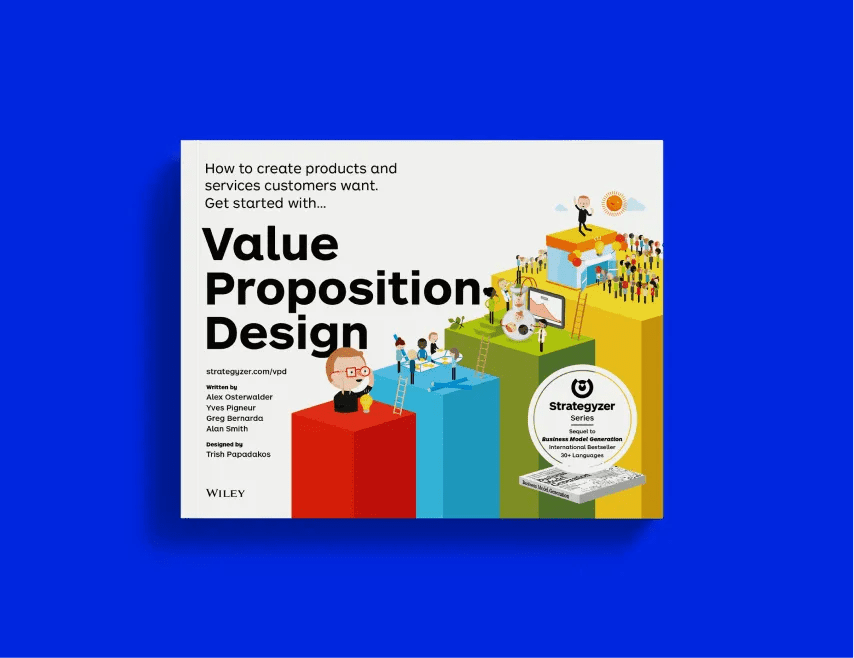

Value Proposition Design: Complete Summary of Osterwalder and Pigneur’s Proven Method for Creating Products Customers Want
Introduction: What This Book Is About
“Value Proposition Design” by Alexander Osterwalder, Yves Pigneur, Greg Bernarda, and Alan Smith, with design by Trish Papadakos, offers a systematic approach to creating products and services customers truly desire. This book serves as a practical guide for designing, testing, and delivering value propositions that resonate deeply with customer needs and integrate seamlessly into viable business models. It helps individuals and organizations move beyond vague ideas to concrete, actionable strategies for value creation.
The book provides a structured framework using the Value Proposition Canvas, a powerful tool that clarifies customer understanding and guides the design of compelling offerings. It emphasizes customer empathy, rigorous experimentation, and iterative design to minimize risk and maximize the chances of market success. By applying the methodologies outlined, readers can transform their approach to innovation, fostering a shared language and alignment across teams.
This comprehensive summary will cover all key insights from “Value Proposition Design,” including its core tools, design principles, testing methodologies, and strategies for continuous evolution. It is designed for entrepreneurs, innovators, product managers, and business leaders who seek to create or improve offerings that customers genuinely want, ensuring their efforts translate into profitable and sustainable business growth. Readers will learn how to understand customer jobs, pains, and gains, design solutions that provide significant relief and benefits, and test their assumptions effectively in the market.
1: Canvas
Chapter 1, “Canvas,” introduces the core tool of Value Proposition Design: the Value Proposition Canvas. This chapter explains how to use its two sides—the Customer Profile and the Value Map—to clarify customer understanding and describe how to create value for them. Achieving Fit between these two sides is the central objective, ensuring products and services truly meet customer needs.
What the Value Proposition Canvas Is
The Value Proposition Canvas is a strategic management tool designed to help organizations create, test, and build products and services that customers want. It fully integrates with the Business Model Canvas, acting as a plug-in that zooms into the details of two specific building blocks: Customer Segments and Value Propositions. This tool visually represents customer characteristics and the benefits of a designed offering, facilitating discussions and alignment within teams. The Value Proposition Canvas comprises the Customer Profile (right side), focusing on customer understanding, and the Value Map (left side), outlining how value is created.
Understanding the Customer Profile
The Customer Profile is the right-hand side of the Value Proposition Canvas and describes a specific customer segment in a structured way. It breaks down the customer into three main areas: Customer Jobs, Pains, and Gains. This detailed understanding helps in designing relevant value propositions. The profile emphasizes taking the customer’s perspective to uncover their real needs and motivations, moving beyond superficial assumptions.
Exploring Customer Jobs
Customer Jobs describe the fundamental tasks customers are trying to get done in their work or lives. These can involve performing a specific task, solving a problem, or satisfying a need. It is crucial to capture these jobs in the customer’s own words to ensure accuracy. The book distinguishes between three main types of customer jobs to be done:
- Functional jobs involve performing a specific task or solving a problem, such as mowing a lawn or writing a report.
- Social jobs relate to how customers want to be perceived by others, like looking trendy or being seen as competent.
- Personal/emotional jobs focus on achieving a specific emotional state, such as feeling secure or at peace.
Additionally, supporting jobs include actions related to buying (e.g., comparing offers), cocreating (e.g., posting reviews), and transferring value (e.g., canceling subscriptions). The context in which a job is performed can significantly impact its nature and importance, such as calling someone on a train versus in a car.
Identifying Customer Pains
Customer Pains detail anything that annoys customers before, during, or after trying to get a job done, or anything that prevents them from doing so. These also encompass potential bad outcomes or risks associated with getting a job done poorly or not at all. It is essential to identify the severity of each pain, ranging from extreme to moderate. Three types of pains are highlighted:
- Undesired outcomes, problems, and characteristics include functional issues (e.g., a solution doesn’t work), social drawbacks (e.g., looking bad), emotional frustrations (e.g., feeling bad), or ancillary annoyances (e.g., having to go to a store).
- Obstacles are factors that prevent customers from starting a job or slow them down, such as lack of time or affordability issues with existing solutions.
- Risks are undesired potential outcomes that could have negative consequences, like losing credibility or experiencing a security breach.
Making pains concrete helps in designing effective pain relievers; for example, quantify “wasted time” as “wasting more than X minutes standing in line.”
Discovering Customer Gains
Customer Gains represent the outcomes and benefits customers want to achieve. These can range from required to unexpected, including functional utility, social gains, positive emotions, and cost savings. It is important to identify the relevance of each gain, classifying them as essential or nice to have. Four types of gains are outlined:
- Required gains are the minimum expectations for a solution to function, such as being able to make a call on a smartphone.
- Expected gains are basic gains anticipated, even if not strictly necessary for functionality, like a smartphone being well-designed.
- Desired gains are benefits that go beyond expectations but would be highly appreciated, such as seamless integration of a smartphone with other devices.
- Unexpected gains are benefits that customers wouldn’t even conceive of, like the introduction of touchscreens and app stores.
Making gains concrete allows for better design of gain creators; for example, specify “better performance” as “increased performance of more than X.”
Sketching a Customer Profile Example
To illustrate the Customer Profile, the book uses the example of a “Business Book Reader.” This profile goes beyond typical reading-related jobs, pains, and gains to encompass broader needs of business professionals. The process involves identifying customer jobs (e.g., learning new knowledge, bringing new methods into the organization), pains (e.g., books are too long, lack of time), and gains (e.g., relevant examples, actionable advice). This initial sketch, based on interviews and interactions, serves as an excellent starting point for preparing customer interviews and tests of assumptions.
Ranking Jobs, Pains, and Gains for Priority
It is critical to rank customer jobs, pains, and gains based on their importance, severity, and relevance from the customer’s perspective. Not all elements hold the same weight; some jobs are crucial, some pains are extreme, and some gains are essential. This prioritization guides the design of value propositions to address what truly matters most to customers. While initial ranking can be based on assumptions, it must be continuously tested and refined through customer interactions and experiments to accurately reflect customer priorities.
Best Practices for Mapping Customer Profiles
When mapping customer profiles, it is important to avoid common mistakes and adhere to best practices. A common error is mixing several customer segments into one profile; instead, create a separate Value Proposition Canvas for each distinct segment. Another mistake is mixing jobs and outcomes; jobs are tasks or problems, while gains are desired outcomes. Focusing solely on functional jobs while neglecting social and emotional ones is also a pitfall, as these often hold significant importance. Listing jobs, pains, and gains with a predefined value proposition in mind can bias the analysis; instead, proceed like an anthropologist, exploring beyond your current offering. Finally, being too vague in descriptions (e.g., “salary increase” instead of “X% salary increase”) and identifying too few elements can lead to a superficial understanding. A good customer profile is rich with sticky notes, indicating deep customer understanding.
Differentiating Pains vs. Gains
When first populating the customer profile, there is a tendency to list pains and gains as direct opposites (e.g., “salary increase” vs. “salary decrease”). To avoid this, focus on quantifying gains (e.g., “X% salary increase”) and detailing the barriers that prevent the job from being done (e.g., “employer doesn’t give raises”) or the risks related to not getting the job done (e.g., “might not afford child’s college tuition”). This provides a more nuanced and actionable understanding of customer struggles and aspirations.
Understanding the “Why” Behind Customer Jobs
To move beyond a superficial understanding of customer jobs, relentlessly ask “why” multiple times. This iterative questioning helps to uncover the real motivations and underlying jobs to be done that truly drive customers. For example, a customer might want to learn a foreign language (functional job), but asking “why” could reveal the deeper motivation to improve their CV (social job), and further “why” could uncover the desire to earn more money (emotional/personal job). Do not settle until the deepest, most important drivers are understood.
1.2: Value Map
Chapter 1.2, “Value Map,” introduces the left-hand side of the Value Proposition Canvas, which explicitly describes how an organization intends to create value for a specific customer segment. The Value Map details the Products and Services, Pain Relievers, and Gain Creators that collectively form a compelling value proposition.
Listing Products and Services
The Products and Services section of the Value Map is a straightforward list of everything an organization offers to its customers. This includes physical/tangible goods, intangible offerings like copyrights or after-sales assistance, digital products such as music downloads, and financial products like investment funds. It is crucial to understand that these products and services do not create value in isolation; their value is always relative to a specific customer segment’s jobs, pains, and gains. The list may also include supporting products and services that aid customers in their roles as buyers, co-creators, or transferrers of value. It is important to assess the relevance of each product and service, as some are essential while others are merely nice-to-have.
Designing Pain Relievers
Pain Relievers describe precisely how the products and services alleviate specific customer pains. This involves explicitly outlining how the offering intends to eliminate or reduce frustrations, annoyances, obstacles, and risks that customers face before, during, or after trying to get a job done. Great value propositions do not attempt to relieve every pain identified; instead, they focus on a few extreme pains and alleviate them exceptionally well. Pain relievers can produce savings (time, money, effort), improve feelings (killing frustrations), fix underperforming solutions (new features, better quality), eliminate difficulties (making things easier), wipe out negative social consequences (loss of face), address fears (financial, technical risks), help customers sleep better (diminishing worries), limit common mistakes, or eliminate barriers to adoption. The relevance of each pain reliever (essential vs. nice-to-have) is also a key consideration.
Crafting Gain Creators
Gain Creators explain how products and services produce outcomes and benefits that customers expect, desire, or would be surprised by. This includes delivering functional utility, social gains, positive emotions, and cost savings. Similar to pain relievers, gain creators should focus on relevant gains where the offering can make a significant difference, rather than trying to address every single gain. Gain creators can create savings (time, money, effort), exceed expectations (quality levels, more or less of something), outperform competitors, make life easier (usability, accessibility), create positive social consequences (looking good, increasing status), fulfill specific desires (good design, guarantees), realize dreams (achieve aspirations, relief from hardship), match success criteria (better performance, lower cost), or ease adoption (lower risk, better quality). The relevance of each gain creator (essential vs. nice-to-have) is also important to differentiate.
Mapping the Value Proposition for “Value Proposition Design”
Using the book “Value Proposition Design” itself as an example, the authors illustrate how to map its value proposition. The formal map clarifies how the book’s products and services are believed to create value for customers. A “naked” list of products and services (e.g., the physical book, online exercises, tools, templates) forms the foundation. Pain relievers (e.g., “helps overcome blah blah blah meetings,” “reduces risk of failure”) explicitly address specific customer pains like unproductive meetings or fear of project failure. Gain creators (e.g., “provides actionable tools,” “delivers clear outcome”) highlight how the book helps customers achieve desired outcomes like gaining clarity and improving team alignment. The key is to focus on jobs, pains, and gains that truly matter to customers and address them exceedingly well, recognizing that no single value proposition can address everything.
Best Practices for Mapping Value Creation
When mapping value creation, it is crucial to avoid common pitfalls. A frequent mistake is listing all products and services instead of only those targeted at a specific customer segment; value is created only in relation to a specific customer. Another error is adding products or services directly into the pain reliever or gain creator fields; these fields should contain explanations of how value is created, not the products themselves. Offering pain relievers and gain creators that are unrelated to the pains and gains in the customer profile signals a misalignment. Finally, attempting to address all customer pains and gains is unrealistic; great value propositions involve making strategic choices and focusing on a few areas where they can excel. The best practice is to explicitly show how products and services alleviate pains and create gains, always remembering that value is relative to customer needs.
Distinguishing Pain Relievers vs. Gain Creators
Both Pain Relievers and Gain Creators contribute to customer value creation, but they do so in distinct ways. Pain relievers specifically address and alleviate pains identified in the customer profile, whereas gain creators specifically address and produce gains. While there can be overlap where one element might touch upon both, their primary function is tied to either reducing negative experiences or producing positive outcomes. The main objective is to make the customer value creation of products and services explicit and tangible.
The Difference from Pains and Gains in the Customer Profile
It is essential to understand that Pain Relievers and Gain Creators are distinctly different from Pains and Gains themselves. The organization has control over designing pain relievers and gain creators—these are choices made about how to create value. In contrast, the customer possesses the jobs, pains, and gains; the organization has no control over these. An effective value proposition is designed to match relevant customer jobs, pains, and gains with the products, services, pain relievers, and gain creators that the organization offers. No single value proposition can address all customer pains and gains; the most successful ones target those that matter most and excel in delivering on them.
1.3: Fit
Chapter 1.3, “Fit,” explains the crucial relationship between the Customer Profile and the Value Map. Achieving “Fit” means that an organization’s value proposition genuinely excites customers by addressing their important jobs, alleviating extreme pains, and creating essential gains. This chapter elaborates on the concept of Fit as the core objective of Value Proposition Design and outlines its three distinct stages: Problem-Solution Fit, Product-Market Fit, and Business Model Fit.
What Fit Means
Fit occurs when a value proposition truly resonates with customers, leading them to feel excited about it. This happens when the products and services, pain relievers, and gain creators outlined in the Value Map directly match and address the important jobs, extreme pains, and essential gains identified in the Customer Profile. Customers are the ultimate judges of this fit, and they will be unforgiving if the value proposition does not align with their needs. The entire process of Value Proposition Design is fundamentally about striving to find and continuously maintain this fit.
Checking for Fit with the Canvas
To visually verify fit, you can use the Value Proposition Canvas. After completing both the Customer Profile and the Value Map, go through each Pain Reliever and Gain Creator and draw a check mark if it directly addresses one or more of the customer’s jobs, pains, or gains. If a pain reliever or gain creator doesn’t fit anything on the customer side, it likely isn’t creating customer value and might be unnecessary. It’s important to note that not all pains and gains will be addressed; a successful value proposition focuses on the most critical ones. The example of “Value Proposition Design” shows how the book’s features and content directly address readers’ jobs (e.g., learn new knowledge), pains (e.g., unproductive meetings), and gains (e.g., actionable tools).
The Three Kinds of Fit
The search for fit is an iterative process of designing value propositions that meet genuine customer needs. This journey unfolds in three distinct stages:
- Problem-Solution Fit: This first stage occurs when an organization has evidence that customers care about certain jobs, pains, and gains and has designed a value proposition that theoretically addresses them. At this point, the fit exists primarily “on paper,” and there is no market evidence that customers will actually adopt the solution. It involves prototyping multiple alternative value propositions to identify the best theoretical fit.
- Product-Market Fit: This second stage takes place when an organization has evidence that its products and services, pain relievers, and gain creators are actually creating customer value and gaining traction in the market. This phase involves rigorous experimentation to validate or invalidate the assumptions made in the Problem-Solution Fit stage. It is a long, iterative process of learning that many early ideas may not create real customer value, requiring redesign and further testing.
- Business Model Fit: The third and final stage of fit is achieved when there is evidence that the value proposition can be embedded in a profitable and scalable business model. A compelling value proposition alone is not enough; it must be supported by a sound business model that generates more revenue than costs incurred to create and deliver it. This stage requires a continuous back-and-forth between designing for customer value and designing for organizational value, ensuring the entire business model is sustainable.
Understanding Customer Profiles in B2B Transactions
In business-to-business (B2B) transactions, value propositions typically involve multiple stakeholders, each with their own distinct jobs, pains, and gains. These stakeholders can significantly influence purchasing decisions. It is crucial to identify the most important stakeholders and sketch out a separate Value Proposition Canvas for each. Common roles in a B2B context include:
- Influencers: Individuals whose opinions, even informal, might sway decision-makers.
- Recommenders: People who carry out the search and evaluation process and make formal recommendations.
- Economic Buyers: Individuals or groups who control the budget and make the actual purchase decision, often concerned with financial performance.
- Decision Makers: The person or group ultimately responsible for choosing the product/service and ordering the purchase.
- End Users: The ultimate beneficiaries of the product or service, who might be internal employees or external customers of the buying organization.
- Saboteurs: People or groups who can obstruct or derail the purchasing process.
Understanding and addressing the diverse profiles of these stakeholders is essential for success in B2B markets. For example, a company like Haier selling home appliances needs a value proposition for end customers (households) and also for intermediary distributors (retailers).
The Concept of Multiple Fits
Some business models, particularly intermediary and platform models, necessitate a combination of several value propositions and customer segments to function effectively. In these cases, achieving fit between each value proposition and its respective customer segment is essential for the overall business model’s success.
- Intermediary models involve selling a product or service through another party, requiring distinct value propositions for both the end customer and the intermediary itself. For instance, Haier must craft appealing value propositions for households (end customers) and retailers (intermediaries).
- Platform models only work when two or more actors interact and derive value within the same interdependent business model. These can be double-sided (like Airbnb connecting hosts and travelers) or multisided. A platform only exists when all sides are present and extracting value, meaning a fit must be achieved for each side involved.
“Going to the Movies” – A Simple Example
The book uses the example of a movie theater chain to illustrate the Value Proposition Canvas concepts. Instead of starting with features like big screens or tasty snacks, the theater owner begins by understanding the customer’s true motivations and underlying jobs, pains, and gains.
- The traditional approach involves creating psychodemographic profiles (e.g., “Jane Moviegoer,” 20-30 years old, likes action movies). While useful, these don’t reveal deep motivations.
- The new approach focuses on what truly drives the moviegoer, such as seeking an escape, social connection, or a specific emotional experience. This broadens the horizon and can uncover new opportunities beyond just movie-watching.
A critical tip: a (potential) customer exists independently of your value proposition. Therefore, when sketching their profile, focus broadly on their lives and challenges, not just aspects directly related to your offering.
Customer Context Matters
The context in which a customer finds themselves significantly alters their priorities and the nature of the jobs they aim to accomplish. For the moviegoer, seeing a movie “with the kids on a Wednesday afternoon” (functional job, leisure, with constraints like after school, before dinner) is a very different context than a “date night on Saturday evening” (social/emotional job, romance, with constraints like kids taken care of). Similarly, a “personal research” context (functional job, learning, with constraints like needing to take notes) again changes priorities. Value propositions must consider these contextual elements as potential constraints or drivers for design, as the features valued will differ.
Different Solutions for the Same Customer
In today’s competitive landscape, customers are surrounded by diverse value propositions competing for their attention, even for similar jobs, pains, and gains. For the movie theater, competitors aren’t just other cinemas; they also include renting a movie at home, going out to dinner, visiting a spa, or even attending an online virtual art exhibit. This highlights the importance of understanding what truly matters to customers beyond the confines of your immediate solution. By investigating their broader jobs, pains, and gains, organizations can conceive of totally new or substantially improved value propositions that capture customer attention by addressing their underlying needs in novel ways. The goal is to understand customers beyond the current solution to innovate effectively.
2: Design
Chapter 2, “Design,” details the process of transforming ideas into tangible value proposition prototypes. This is a continuous, iterative cycle of prototyping, researching customers, and refining ideas. The chapter emphasizes starting with quick, cheap, and rough prototypes to explore possibilities, understanding customers deeply before pitching solutions, and making strategic choices based on identified opportunities and constraints.
The Art of Shaping Your Ideas
Design is the active process of converting initial ideas into concrete value proposition prototypes. This is not a linear path but a dynamic, continuous cycle that involves constant prototyping, in-depth customer research, and subsequent reshaping of initial concepts. Whether you start with a compelling customer insight or a promising prototype, the key is to avoid premature attachment to early ideas. These initial concepts are certain to undergo radical transformation as they are exposed to prototyping, customer research, and rigorous testing. The design activity directly feeds into the testing phase, which is explored in Chapter 3.
Identifying Innovation Starting Points
New or improved value propositions can originate from a variety of sources, and it’s a common misconception that they must always begin with the customer. While a customer-centric approach is paramount for successful outcomes, innovation can be sparked by diverse starting points. The book outlines 16 trigger areas to initiate the design process, categorized by their primary focus:
- Customer-centric starting points: These involve deep dives into customer insights, directly addressing identified jobs, pains, and gains.
- Existing value proposition starting points: Leveraging or enhancing current offerings.
- Business model starting points: Reimagining how the organization creates, delivers, and captures value.
- Environmental starting points: Responding to shifts in market, technology, legal, or competitive landscapes.
- Cross-industry starting points: Adapting successful business models or value propositions from entirely different sectors.
Regardless of the starting point, the ultimate goal remains to address jobs, pains, or gains that customers genuinely care about, ensuring the solution finds a receptive market.
What is Prototyping?
Prototyping is defined as the practice of building quick, inexpensive, and rough study models to explore alternatives and gain insights into the desirability, feasibility, and viability of potential value propositions and business models. It is a fundamental practice in design professions, adapted here for business ideas to facilitate rapid exploration before investing in full-scale development. The core aim is to quickly explore radically different directions for the same idea without getting prematurely attached to any single one.
Techniques for Prototyping Possibilities
Several techniques enable rapid and early-stage prototyping:
- Napkin Sketches: These are rough visual representations of a core idea, designed to be quick (5-15 minutes), shareable, and disposable. They focus on “what an idea is about” rather than “how it will work,” preventing premature focus on implementation details. The process involves brainstorming, drawing multiple sketches for alternative directions, pitching them briefly, and displaying them for visual voting (Dotmocracy).
- Ad-libs: These are short, fill-in-the-blank sentences (e.g., “Our [product/service] helps [customer] who wants to [job] by [pain reliever] and [gain creator]”) used to quickly shape and articulate different value proposition directions. They force concise articulation of how value is created.
- Value Proposition Canvases: Beyond refining final ideas, the Canvas itself serves as a powerful exploratory prototyping tool. Sketching out multiple alternative Canvases allows for rapid visualization of how different ideas address specific jobs, pains, and gains, even for radical or unlikely directions.
These methods collectively help in generating and evaluating a diverse range of alternatives before committing to a particular path, ensuring that the most promising ideas survive a rigorous testing process.
The 10 Prototyping Principles
To unlock the full power of prototyping and avoid getting stuck on a single idea, adhere to these 10 principles:
- Make it visual and tangible: Turn abstract ideas into concrete visuals to spark conversations and learning, avoiding unproductive “blah blah blah.”
- Embrace a beginner’s mind: Approach prototyping with fresh eyes, challenging existing assumptions and exploring “what can’t be done.”
- Don’t fall in love with first ideas—create alternatives: Avoid refining too early; instead, generate multiple options to prevent premature attachment.
- Feel comfortable in a “liquid state”: Recognize that the early design process is fluid and uncertain, resisting the urge to solidify ideas too soon.
- Start with low fidelity, iterate, and refine: Keep early prototypes rough, quick, and cheap, refining them only as more knowledge is gained.
- Expose your work early—seek criticism: Share prototypes frequently to gather early feedback, viewing negative input as valuable for improvement.
- Learn faster by failing early, often, and cheaply: Overcome fear of failure by conducting frequent, low-cost experiments that yield rapid learning.
- Use creativity techniques: Employ diverse methods to explore groundbreaking prototypes, breaking free from conventional approaches.
- Create “Shrek models”: Design extreme or outrageous prototypes that are unlikely to be built, serving to spark debate and deepen understanding.
- Track learnings, insights, and progress: Maintain a record of all alternative prototypes, lessons learned, and progress made, as early ideas may become relevant later.
Sparking Ideas with Design Constraints
Design constraints are powerful tools to force innovative thinking and move beyond “usual” value propositions. By imposing specific limitations or copying successful business models from other industries, teams can generate highly differentiated ideas. Five examples of design constraints are:
- Servitization: Transforming a product-based offering into a service-based one, often with a subscription model (e.g., Hilti shifting from selling tools to leasing fleet management services).
- Razor Blade: Creating a value proposition with a low-cost base product and high-margin consumable (e.g., Nespresso with espresso machines and pods).
- Trendsetter: Turning a technology into a fashionable trend (e.g., Swatch making plastic watches a global fashion item).
- Low-Cost: Stripping down a core value proposition to its basics to target unserved/underserved segments with low prices, selling extras as additional value (e.g., Southwest Airlines offering minimal air travel at low fares).
- Platform: Building a model that connects multiple actors with distinct value propositions for each (e.g., Airbnb connecting hosts and travelers).
Assigning different constraints to parallel working groups can foster diverse exploration.
Inviting Big Ideas with Books and Magazines
Utilizing best-selling books and magazines as starting points can effectively broaden horizons and generate fresh ideas for new and innovative value propositions and business models. This method is akin to inviting global thought leaders into a brainstorming session. The process involves:
- Selection: Prepare a diverse range of books and magazines representing various trends, important topics, or big ideas.
- Browsing and Extraction: Participants browse their chosen material, capturing key ideas and insights on sticky notes.
- Sharing and Discussion: Groups share highlights and capture collective insights on a board.
- Brainstorming Possibilities: Each group generates new value proposition ideas based on their discussions, often using napkin sketches.
- Pitching: Groups share their alternative value propositions.
This approach encourages participants to think outside their immediate industry and integrate current trends and diverse perspectives into their ideation.
Push vs. Pull: Common Innovation Drivers
The push versus pull debate describes two common starting points for value proposition design:
- Technology Push: This approach begins with an invention, innovation, or technological resource, then seeks to develop a value proposition that addresses a customer job, pain, or gain. It’s often described as a “solution in search of a problem.” The process involves exploring potential customer segments for the technology, designing dedicated value maps for each, and iterating until a problem-solution fit is found. For example, the Swiss Federal Institute of Technology in Lausanne (EPFL) developed compressed air energy storage and then sought applications for it.
- Market Pull: This approach starts with a manifest customer job, pain, or gain, and then designs a value proposition to solve it. This is a “problem in search of a solution.” The process involves learning what technologies and resources are needed for each value proposition prototype and adjusting the value map and resources until a viable solution is found.
Both approaches are viable depending on context, but the ultimate success of either depends on finding a genuine customer need that the solution effectively addresses.
Identifying High-Value Jobs for Market Pull
For market-pull innovation, effectively identifying high-value jobs is crucial. Great value proposition creators focus on jobs, pains, and gains that truly matter to customers. High-value jobs are characterized by associated pains and gains that are:
- Important: When success or failure in getting the job done leads to essential gains or extreme pains. This determines the criticality of the job to the customer.
- Tangible: When the pains or gains related to the job can be felt or experienced immediately or often, not just conceptually or in the distant future. This makes the impact evident.
- Unsatisfied: When current value propositions do not adequately relieve the pains or create the desired gains, or when no solutions exist at all. This highlights market opportunity.
- Lucrative: When many people have this job with its associated pains and gains, or when a small number of customers are willing to pay a premium for its resolution. This indicates market potential.
Focusing on these high-value jobs ensures that the designed value proposition addresses genuinely impactful customer needs, increasing its chances of success.
Six Ways to Innovate from the Customer Profile
Once a customer profile has been mapped, it serves as a powerful trigger for innovation. There are six primary ways to innovate by leveraging insights from the customer profile:
- Address more jobs: Expand the value proposition to cover a more complete set of related and ancillary jobs (e.g., Apple’s iPhone combining phone, music player, and web browsing).
- Switch to a more important job: Pivot to help customers with a job that is more critical than what most existing solutions focus on (e.g., Hilti understanding that construction managers needed to avoid project penalties, not just drill holes).
- Go beyond functional jobs: Create value by fulfilling significant social and emotional jobs in addition to functional ones (e.g., Mini Cooper selling a car that is also a statement of identity).
- Help a lot more customers get a job done: Make a job accessible that was previously too complex or expensive (e.g., Amazon Web Services democratizing high-end cloud computing).
- Get a job done incrementally better: Improve an existing value proposition through a series of micro-improvements (e.g., Bosch enhancing various features of its circular saw).
- Help a customer get a job done radically better: Create a new market by dramatically outperforming older solutions (e.g., VisiCalc spreadsheet revolutionizing calculations).
These strategies provide actionable directions for evolving or inventing new value propositions based on a deep understanding of customer needs.
2.3: Understanding Customers
Chapter 2.3, “Understanding Customers,” emphasizes that gaining deep customer insights is paramount for designing great value propositions. It introduces six distinct techniques for gathering information about customers, highlighting their strengths and weaknesses, and stresses the importance of using a mix of these methods for comprehensive understanding.
Six Techniques to Gain Customer Insights
To truly understand the customer’s perspective and inform value proposition design, a mix of six techniques is recommended:
- The Data Detective: This involves building on existing desk research and available customer data, including third-party reports, government census data, and social media analytics. Its strength lies in providing a quick foundation, but it may offer static data from different contexts. Companies can analyze CRM data for frequent questions/complaints or website tracking for popular destinations.
- The Journalist: This technique involves talking directly to potential customers through interviews. It is quick and cheap for initial insights. However, its weakness is that customers’ stated desires may not align with their actual behavior. Ground rules for interviewing include adopting a beginner’s mind, listening more than talking, getting facts over opinions (“When did you last…?” vs. “Would you…?”), asking “why” to uncover real motivations, and avoiding pitching solutions too early.
- The Anthropologist: This method focuses on observing potential customers in their real-world environments. It provides unbiased views and reveals actual behavior, offering insights into their routines, jobs, pains, and gains. Examples include staying with a family (B2C) or working alongside a customer (B2B). The “Day in the Life” worksheet can be used to capture observations systematically. Its strength is uncovering real behavior, but it can be difficult for new ideas not yet in practice.
- The Impersonator: This technique involves actively “being your customer” and using products and services yourself, stepping into their shoes. It provides firsthand experience of jobs, pains, and gains. Its limitation is that one individual’s experience may not be representative of the broader customer base.
- The Cocreator: This involves integrating customers directly into the value creation process, working with them to explore and develop new ideas. Its strength is gaining deep insights through proximity, but these insights may not be generalizable to all customers.
- The Scientist: This technique involves getting customers to participate in experiments, knowingly or unknowingly, and learning from the outcomes. It provides fact-based insights on real-world behavior and is particularly effective for new ideas. Its weakness is that it can be challenging to apply in established organizations due to policies.
Interviewing Your Customers as a Journalist
Interviewing customers is a powerful way to gain early insights and begin validating assumptions about their profiles. The process involves:
- Creating a preliminary customer profile: Sketching out assumed jobs, pains, and gains.
- Developing an interview outline: Deriving questions from the customer profile, focusing on the most important assumed jobs, pains, and gains.
- Conducting the interview: Adhering to specific ground rules (e.g., listen more than talk, ask “why,” avoid pitching solutions).
- Capturing insights: Mapping learned jobs, pains, and gains onto an empty customer profile, noting important business model learnings.
- Reviewing the interview: Assessing if interview questions need adjustment based on initial learnings.
- Searching for patterns: Identifying commonalities, differences, and recurring contexts across multiple interviews.
- Synthesizing profiles: Creating a separate, synthesized master customer profile for each distinct customer segment that emerges, capturing the most frequent and representative elements.
This iterative approach helps to refine customer understanding and allows for lightly validated customer profiles before moving to more rigorous testing.
Diving into the Customer’s World as an Anthropologist
The Anthropologist technique involves immersing oneself deeply into the customer’s world to observe their real behavior, which often differs from what they might express in interviews. This method is particularly effective for uncovering subtle jobs, pains, and gains. Strategies include:
- B2C: Staying with a family for several days to participate in daily routines, or shadowing a customer for a day to note all observed jobs, pains, and gains with time stamps.
- B2B: Working alongside or consulting with a potential customer to observe their struggles and priorities firsthand.
- General: Observing shopping behavior in relevant stores to detect patterns.
The “A Day in the Life” worksheet helps systematically capture these observations. This approach cultivates customer empathy and provides unbiased insights into their actual struggles, beyond what is explicitly stated.
Identifying Patterns in Customer Research
Once a significant amount of customer research has been gathered through various techniques, the next crucial step is to analyze the data and identify patterns. This process helps to crystallize customer segments and refine understanding:
- Display: Lay out all individual customer profiles from your research on a large wall.
- Group and segment: Look for commonalities in jobs, pains, and gains to group similar profiles into distinct customer segments.
- Synthesize: For each identified segment, create a single master customer profile by synthesizing the most frequent and important jobs, pains, and gains from the individual profiles. Use representative labels.
- Design: With these newly synthesized master profiles, confidently begin prototyping value propositions tailored to the identified patterns.
Pay special attention to outlier profiles, as they might represent unique learning opportunities, emerging trends, or examples of positive deviance that offer innovative solutions.
Finding Your Earlyvangelist
When conducting customer research and seeking patterns, actively look for Earlyvangelists. Coined by Steve Blank, these are customers who are not only willing but also able to take a risk on a new product or service. They are crucial for building a foothold market and shaping value propositions through early experimentation and learning. An Earlyvangelist typically possesses five key characteristics:
- Has a problem or need: There is a clear job to be done that is currently unaddressed or poorly addressed.
- Is aware of having a problem: They recognize that they have a significant issue.
- Is actively looking for a solution: They are proactively searching for ways to solve their problem and have a timeline.
- Has put together a solution out of piece parts: The job is so important that they have already cobbled together an interim, often imperfect, solution using existing components.
- Has or can acquire a budget: They possess the financial means or can quickly allocate resources to purchase a solution.
Identifying and engaging Earlyvangelists provides strong validation for a potential value proposition.
2.4: Making Choices
Chapter 2.4, “Making Choices,” guides the process of assessing and selecting which value proposition prototypes to pursue. This involves using the 10 characteristics of great value propositions as an assessment tool, incorporating feedback from various stakeholders through role-playing, understanding the broader context (Environment Map), and comparing performance against competitors using a Strategy Canvas. The chapter also provides strategies for effectively presenting ideas and managing feedback to ensure productive decision-making.
10 Questions to Assess Your Value Proposition
Before investing further in development, it’s crucial to critically assess your value proposition prototypes. The book provides 10 questions based on the characteristics of great value propositions, serving as an internal stress test and guiding tool for refinement:
- Is it embedded in a great business model? (Ensuring financial viability and scalability.)
- Does it focus on the most important jobs, most extreme pains, and most essential gains? (Addressing what truly matters to customers.)
- Does it focus on unsatisfied jobs, unresolved pains, and unrealized gains? (Identifying genuine market opportunities.)
- Does it concentrate on only a few pain relievers and gain creators but does those extremely well? (Emphasizing focus and excellence over breadth.)
- Does it address functional, emotional, and social jobs all together? (Providing holistic customer value.)
- Does it align with how customers measure success? (Ensuring the value delivered is perceived as successful by the customer.)
- Does it focus on jobs, pains, or gains that a large number of customers have or for which a small number are willing to pay a lot of money? (Assessing market size and revenue potential.)
- Does it differentiate from competition in a meaningful way? (Establishing a clear competitive advantage.)
- Does it outperform competition substantially on at least one dimension? (Creating a compelling reason for customers to choose your offering.)
- Is it difficult to copy? (Ensuring defensibility and long-term sustainability.)
These questions help unearth potential for improvement and guide the selection of prototypes for further exploration and testing.
Simulating the Voice of the Customer with Role-Playing
Role-playing is an effective technique to stress-test a value proposition internally before taking it to the market. It brings the perspectives of customers and other key stakeholders directly “into the meeting room,” facilitating early feedback and making the value proposition more robust. The process involves two participants: one playing a company sales representative and another playing a stakeholder (e.g., a customer, a CEO, a strategic partner, or even a saboteur). A third person takes notes. Key stakeholders to simulate include:
- Customers: Focusing on jobs, pains, and gains from the perspective of end users, influencers, economic buyers, decision makers, and saboteurs in B2B contexts.
- Company Leadership: CEOs, CFOs, COOs providing feedback on vision, direction, and strategy.
- Other Internal Stakeholders: Production, sales, marketing teams whose buy-in is necessary.
- Strategic Partners: Assessing if the value proposition offers value to collaborators.
- Government Officials: Understanding regulatory enablers or barriers.
- Investors/Shareholders: Evaluating support or resistance to ideas.
- Local Community: Considering potential impact.
- The Planet: Assessing environmental effects.
This method helps identify internal and external challenges and refine the value proposition before costly external testing.
Understanding the Broader Context
Value propositions and business models never exist in a vacuum; they are always designed within a specific external environment. Zooming out to map this context is crucial for making informed choices about which prototypes to pursue. The Environment Map (discussed in detail in “Business Model Generation”) helps visualize this landscape, which includes:
- Competition: Current and emerging rivals.
- Technology Change: New technologies that create opportunities or threats.
- Legal Constraints: Regulations and policy shifts.
- Changing Customer Desires: Evolving needs and preferences.
- Macroeconomic Trends: Economic shifts impacting market conditions.
By sketching out the environment, an organization can identify elements that act as opportunities (strengthening the case) or threats (undermining or limiting the value proposition). For example, considering a “participatory TV” idea, factors like “democratization of production” (opportunity) or “piracy” (threat) would be mapped. This holistic view ensures that design choices are aligned with external realities.
Comparing Your Value Proposition with Competitors
To assess how a value proposition performs against competitors, the book recommends using a Strategy Canvas, a graphical tool from “Blue Ocean Strategy.” This simple yet powerful visualization allows for a direct comparison of how the “benefits” of different value propositions perform across key competitive factors. The process involves:
- Selecting a value proposition to compare.
- Identifying factors of competition: Listing relevant pain relievers, gain creators, pains, and gains on the x-axis that are important to customers.
- Scoring your value proposition: Plotting its performance (e.g., on a scale of 0 to 10) for each factor on the y-axis.
- Adding competing value propositions: Including relevant competitors, even those outside traditional industry boundaries, and adding their unique competitive factors to the x-axis if necessary.
- Scoring competing value propositions: Plotting their performance on the same factors.
- Analyzing the “sweet spot”: Comparing the curves to identify opportunities for differentiation and assess if your value proposition substantially outperforms competitors on at least one dimension that customers care about. This ensures meaningful differentiation aligned with top customer jobs, pains, and gains.
Avoiding Cognitive Murder to Get Better Feedback
When presenting value proposition ideas, it is crucial to avoid “cognitive murder”—overwhelming the audience with too much information or presenting it in a confusing way. Effective presentation is critical for gathering feedback and gaining buy-in. To ensure clear and tangible communication:
- Keep it simple and coherent: Present only what matters, avoiding unnecessary complexity.
- Be tangible, not abstract: Use low-fidelity prototypes (e.g., sketches, sticky notes) to make ideas concrete and visual from the start.
- Be customer-centric: Always frame the discussion around customer jobs, pains, and gains, rather than just listing features. Explain how your offering helps solve customer problems and creates benefits.
- Present information progressively: Build the narrative one piece at a time (e.g., adding one sticky note at a time on a canvas) to prevent information overload.
- Use the right media support: Leverage visual aids that are appropriate for the stage of prototyping.
- Craft a storyline: Create a logical flow that connects products and services to customer value.
This approach ensures that early, rough prototypes are presented effectively to solicit valuable feedback from stakeholders before more refined presentations are developed later in the process.
Mastering the Art of Critique
A healthy feedback culture is essential for ideas to evolve, rather than stall. Both feedback receivers (presenters) and feedback providers (critics) must master the art of critique.
For feedback providers (especially leaders and decision-makers), the goal should be to help ideas evolve, not just decide on them. They should understand that prototypes are rough and will change based on market facts, which trump opinions.
For feedback receivers, it’s important to listen to market facts (from customers) more than to powerful stakeholders’ opinions, as this prevents postponing failure.
In a great feedback culture:
- People feel comfortable presenting bold new ideas early.
- Leaders are trained to give feedback on evolving ideas, accepting that their opinions can be overridden by market evidence.
- Early, rapid feedback is fostered.
- Discussions are structured and facilitated, avoiding unstructured “blah blah blah.”
- Feedback is based on experience or (market) facts, not just pure opinion. While opinions can spark improvements, they can also lead to pursuing pet ideas. Experience offers valuable lessons but can also lead to misapplying past contexts. Market facts (e.g., from customer interviews or experiments) provide evidence to reduce uncertainty, but can be misleading if data is bad or mismeasured.
- A customer-centered culture neutralizes politics.
- Feedback processes are fun and productive, encouraging a distinction between “hard to do” and “worth doing.”
- Questions like “Why not?” “What if?” and “What else?” are asked to spark creativity.
Collecting Efficient Feedback with de Bono’s Thinking Hats
Edward de Bono’s Six Thinking Hats method can be adapted to efficiently collect diverse feedback on ideas, value propositions, and business models, particularly in large groups, avoiding lengthy, unproductive discussions. The process typically uses four hats:
- Pitch (3-15 min): The design team presents their idea or canvas.
- White Hat (2-5 min): Participants, wearing a metaphorical white hat, ask neutral, objective clarifying questions about information and data, ensuring full understanding without judgment.
- Black Hat (1 min to write, 3 min to collect): Participants, in black hats, identify difficulties, weaknesses, dangers, and risks of the idea, writing them on sticky notes and reading them aloud for rapid collection. This neutralizes negative individuals by giving them a structured outlet.
- Yellow Hat (1 min to write, 3 min to collect): Participants, in yellow hats, identify positives and plus points, explaining why the idea is useful, again writing and collecting feedback rapidly.
- Green Hat (5-15 min): The floor opens for open discussion, ideas, alternatives, and possibilities, focusing on solutions to the black hat problems and ways to evolve the idea.
- Evolve: The presenting team uses the structured feedback to refine their idea.
This method requires strong facilitation to ensure hats are “worn” correctly and discussions remain focused and productive.
Voting Visually with Dotmocracy
Dotmocracy is a quick and visual method to capture group preferences and prioritize among different value propositions or business model options, especially in large workshop settings, thereby avoiding lengthy discussions. The process is straightforward:
- Idea Gallery: Ideas or canvases are displayed on a wall.
- Stickers: Each participant receives a set number of stickers (e.g., 10), with each sticker representing one vote.
- Criteria: Voting criteria are clearly defined (e.g., “vote for your favorite ideas,” “vote for ideas with highest growth potential”).
- Vote: Participants place their stickers on their preferred ideas, able to allocate all votes to one idea or distribute them.
- Count: Stickers are counted to highlight preferred ideas.
Dotmocracy is particularly useful for internal selection based on criteria like growth potential, risk, and differentiation, guiding which prototypes to test further in the real world.
Defining Criteria and Selecting Prototypes
To make informed decisions among attractive alternative value propositions and business models during the design process, it is essential to define clear criteria and systematically score prototypes. While the customer is the final judge, internal prioritization is necessary. The process involves:
- Brainstorming criteria: Generate a comprehensive list of assessment criteria. Relevant themes include:
- Fit with Strategy: How well the idea aligns with company direction, risk level, and potential to replace outdated models.
- Fit with Customer Insights: How well the idea addresses important, unsolved customer jobs, pains, and gains, backed by evidence.
- Competition and Environment: Ability to provide competitive advantage, differentiate, and align with trends.
- Relation to Current Business Model: How it builds on strengths, plugs weaknesses, fits brand, or disrupts cash cows.
- Financials and Growth: Market size, revenue potential, growth rate, and margins.
- Implementation Criteria: Ease of implementation, time to market, cost to build, team skills, access to customers, technology risk, and management resistance.
- Selecting criteria: Choose the criteria most important to the team and organization.
- Scoring prototypes: Rate each prototype (e.g., 0-10) against the chosen criteria.
- Evolving and exploring: Refine the prototype based on scores and then test it in the market to learn its real potential. This structured approach helps ensure that the most promising ideas are advanced.
2.5: Finding the Right Business Model
Chapter 2.5, “Finding the Right Business Model,” highlights the interdependent relationship between a compelling value proposition and a viable business model. It stresses that even the most desired product or service will fail if its underlying business model cannot generate more revenue than costs. The chapter uses the case of Azuri (Eight19) to illustrate the iterative back-and-forth process of integrating value proposition and business model design to achieve financial soundness and scalability.
Creating Value for Your Customer and Your Business
For any business to succeed, it must simultaneously create value for its customers and capture value for itself. A value proposition, no matter how great, is unsustainable if it results in a business that incurs more costs than it generates revenue.
- The Value Proposition Canvas allows zooming in to investigate if the customer value proposition truly creates value for the customer (i.e., addresses jobs, pains, and gains effectively).
- The Business Model Canvas enables zooming out to analyze if the overall business can profitably create, deliver, and capture value around that customer value proposition.
The interplay between these two canvases is critical: design must continuously move back and forth between ensuring customer desirability and business viability. This iterative process ensures that the value proposition is not only attractive to customers but also embedded within a scalable and profitable business model.
Azuri (Eight19): Turning Solar Tech into a Viable Business
The case of Azuri by Eight19 vividly demonstrates the continuous back-and-forth between value proposition and business model design. Initially, Eight19 aimed to provide low-cost solar cells to 1.6 billion people without electricity.
- Version 0 (Initial Idea): Focus on low-cost solar technology for low-income people.
- Observation: A key cost barrier existed—rural farmers on $3/day couldn’t afford a $70 solar system.
- Design What If: Give solar installations away for free to eliminate upfront costs.
- Version 1 (Iteration 2 – Business Model Idea): Lease solar installations and collect regular subscription fees. This model worked with conventional panels, requiring partnerships for financing.
- Observation: A no-banking barrier emerged—no efficient system for regular payments.
- Design Low-tech Solution: Combine mobile phone and solar tech using scratch cards for electricity access.
- Version 2 (Iteration 3 – Azuri Business Model): Azuri offers “solar-as-a-service” with Indigo, a pay-as-you-go lighting and charging system. Customers buy weekly scratch cards, enter passcodes via SMS to access electricity, and eventually own the unit after 80 cards or can escalate to larger systems.
This evolution shows how addressing specific customer pains (upfront cost, no banking) forced changes not just to the value proposition but also to the revenue streams and key partnerships within the business model, making the solution viable in its context.
Stress Testing with Numbers: A MedTech Illustration
Even with a strong value proposition, a financially unsound business model can lead to failure. Stress testing with numbers helps identify the most profitable and scalable options. The example of a cheap diagnostic device (MedTech) illustrates this by comparing two potential business models based on the same core technology:
- Model 1: Sales of Medical Diagnostic Device: This involves one-time transactional sales of a device (e.g., $1,000/device to primary care doctors). With a 5% market share, sales via a third-party sales force (50% commission), $225/device production costs, and $1 million fixed marketing, this model generates $5.5 million in revenue but only $0.5 million profit. The low profitability makes it less attractive.
- Model 2: Recurring Revenues from Consumable Testing Strips: This model leverages the same technology but focuses on recurring revenues from consumable testing strips (e.g., 5 strips/month/device at $75 each, with $7/strip production cost). This substantially different value proposition and business model results in over $30 million in revenue and $23 million profit.
This comparison highlights that the same technology can yield vastly different financial outcomes depending on the business model. While market validation is still needed, the numerical stress test clearly identifies the more interesting prototype to take to the testing stage due to its much larger profit potential.
Seven Questions to Assess Your Business Model Design
To ensure a value proposition is embedded in a great business model that is profitable, defensible, and scalable, ask these seven critical questions. Score your business model design on a scale of 0 (worst) to 10 (best) for each, understanding that some aspects are more important than others depending on your context:
- Switching Costs: How easy or difficult is it for customers to switch to a competitor? (e.g., Apple’s iPod created high switching costs by integrating with iTunes). A high score means customers are locked in.
- Recurring Revenues: Does every sale lead to guaranteed, quasi-automatic follow-up revenues? (e.g., Nespresso shifted from transactional coffee sales to recurring revenue from pods). A high score means a large percentage of sales lead to recurring revenue.
- Earn Before Spending: Do you earn revenues before incurring significant costs of goods and services sold (CoGS)? (e.g., Dell disrupted PCs by earning revenue before assembly). A high score means earning 100% of revenue before CoGS.
- Game-changing Cost Structure: Is your cost structure substantially different and better (e.g., 30% lower) than competitors? (e.g., Skype/WhatsApp using free internet infrastructure).
- Others Who Do the Work: How much do customers or third parties create value for you for free? (e.g., Facebook content from users). A high score means external parties create most value for free.
- Scalability: How easily can the business grow without roadblocks like infrastructure, customer support, or hiring? (e.g., licensing, franchising, platforms like Facebook). A high score means virtually no limits to growth.
- Protection from Competition: How well does your business model protect you from competitors (i.e., “moats”)? (e.g., Ikea, Apple’s App Store). A high score means substantial moats that are hard to overcome.
These questions provide a systematic way to unearth potential improvements in the business model design, ensuring long-term success.
2.6: Designing in Established Organizations
Chapter 2.6, “Designing in Established Organizations,” focuses on the specific dynamics and challenges of designing and improving value propositions within existing companies. It emphasizes adopting the right attitude for “invent” versus “improve” projects, leveraging internal strengths, addressing potential obstacles, and creating an optimal workshop environment for innovation.
Adopting the Right Attitude: Invent or Improve
Established organizations must proactively manage a portfolio of projects that spans the spectrum from “improve” to “invent”. Each end of this spectrum requires a distinct attitude and process:
- Improve: Focuses on enhancing existing value propositions without radically changing the underlying business model. Objectives include renewing outdated products, maintaining fit, improving profit potential, or addressing customer complaints. This has low risk and uncertainty, high customer knowledge, and aims for incremental revenue increases (0-15%). Failure is “not an option.” Example: Amazon Prime introducing a membership for frequent users within its existing e-commerce model.
- Invent: Aims to design entirely new value propositions, potentially regardless of existing constraints, often leading to radical changes in the business model. This is driven by proactive bets on the future, crises, or game-changing technologies. It involves high risk and uncertainty, low customer knowledge (initially), and seeks substantial annual revenue growth (e.g., 50%+). Failure is seen as a part of the learning and iteration process. Example: Amazon Web Services designing a new IT infrastructure value proposition for a new customer segment, requiring substantial expansion of Amazon’s business model.
- Extend: (In between) Seeks new growth engines by substantially extending an existing business model without transforming too many aspects (e.g., Amazon Kindle created a new channel for digital offerings, extending the e-commerce model).
Great companies balance this portfolio, proactively inventing while still successful, rather than waiting for a crisis.
The Business Book of the Future: An Illustration
To illustrate the invent-improve spectrum, the book uses the example of a business book publisher exploring the “business book of the future”:
- Improve: The Practical Business Book: This involves making existing business books more visual and applicable, like this “Value Proposition Design” book itself, which combines a physical book with online exercises. This requires minor tweaks to the core business model, enhancing the value proposition without radical change.
- Extend: The 1-800-Business-Book Hotline: This idea extends physical books with an on-demand hotline for answers. It builds on the existing business model but requires adding a service capability, representing an additional layer to the business model.
- Invent: The YouTube of Business Education: This envisions an online platform matching business expert videos with customers seeking answers, requiring a substantial extension or reinvention of the publishing business model. This concept fundamentally changes the business model and could make the original one obsolete.
Moving towards the “invent” end of the spectrum allows for addressing customer jobs (like getting answers to business questions) more directly and radically, pushing the boundaries of traditional offerings.
Reinventing by Shifting from Products to Services: Hilti
The construction equipment manufacturer Hilti provides a powerful example of reinvention by shifting from selling products to offering services.
- Expired Model: Hilti’s traditional model focused on selling high-quality, durable machine tools directly to builders. While known for reliability and safety, this model faced decreasing margins and competition from lower-cost rivals.
- Customer Insight: Hilti discovered that its customers’ more important job was delivering projects on time to avoid financial penalties, and broken or stolen tools caused major delays.
- Fresh Start (New Value Proposition): Hilti moved to a service-based value proposition: guaranteeing timely access to the right tools at the right place and time. This helped construction companies achieve predictable cost management and maintain profitability.
- Impact on Business Model: This shift from products to services was not just a value proposition change; it required a substantial reengineering of the business model. Hilti had to add significant new service resources and activities alongside manufacturing. The result was higher margins, recurring revenues (monthly subscriptions for fleet management utility), and stronger differentiation, proving the value of proactive reinvention.
Creating the Perfect Workshop Setting
Workshops are critical for value proposition design in established organizations. Creating the perfect workshop setting significantly impacts outcomes:
- Who should join?: Invite diverse participants, especially those who will be impacted by business model changes. Include customer-facing staff (for their knowledge and buy-in) and potentially customers or partners (for evaluation). For 10+ participants, explore alternatives in parallel in groups of five.
- What should the format be?: More viewpoints are generally better early on. Later, fewer participants are better for refining.
- How can space be used as an instrument?: A sufficiently large space with ample wall areas is crucial. Organize the space to support creation, collaboration, and productivity. An unusual and inspiring venue can foster breakthrough results. Key areas include:
- Small Group Areas: For 4-5 people, ideally without chairs/tables, kept in the same room for energy.
- Work-in-Progress Gallery/Inspiration Wall: To display canvases, work, and reference models.
- Projector and Screen: Easily viewable for all.
- Room Control: For facilitators to manage tech.
- Plenary Space: For presentations and discussions.
- Venue Size, Look, and Feel: Calculate 50m² per 10 participants; favor inspiring over boring spaces.
- Walls: Large vertical surfaces for posters and sticky notes are indispensable.
- What tools and materials are needed?: A self-service area with canvas posters, multi-colored sticky notes, thick markers, and blue tack.
This structured approach to workshop design maximizes effectiveness for innovation within established companies.
Composing Your Workshop Agenda
A well-designed workshop agenda leads to tangible and actionable outcomes. The agenda should:
- Have a clear thread showing how new or improved value propositions and business models will emerge.
- Take participants on a journey, focusing on one simple task (module) at a time.
- Avoid “blah blah blah” by favoring structured interactions with tools (canvases) and processes (thinking hats).
- Alternate between small group work (4–6 people) and plenary sessions for presentations and integration.
- Strictly manage time for each module, especially prototyping, using a visible timer.
- Design the agenda as a series of iterations for the same value proposition/business model: Design, critique, iterate, and pivot.
- Avoid slow activities after lunch.
The book provides modules (like “Prototype Possibilities,” “Making Choices,” “Preparing Tests”) that can be used as a menu to draft a workshop agenda. It also emphasizes doing homework (gathering customer insights) before the workshop and getting going with testing after it to ensure continuous progress.
3: Test
Chapter 3, “Test,” focuses on reducing the risk and uncertainty associated with new and improved value propositions through systematic experimentation. It outlines what aspects to test (the “Circle,” “Square,” and “Rectangle”), provides a step-by-step testing process, introduces an “Experiment Library” of techniques, and explains how to measure progress to transform ideas into reality.
Starting to Experiment to Reduce Risk
When exploring new ideas, organizations face maximum uncertainty. Relying solely on business plans in such a high-uncertainty environment is risky, as they can create an illusion of certainty and maximize the potential for failure when reality hits. Instead, the “Test” chapter advocates for a systematic experimentation process to learn and progressively reduce risk. The approach is to start with cheap experiments to gain initial insights and then increase spending on prototypes and pilots as certainty grows. This involves testing all aspects of the Value Proposition and Business Model Canvases, from customers to partners. This iterative process of experimentation, learning, and adaptation is aligned with customer development and lean start-up principles.
Business Plans vs. Experimentation Processes
The traditional approach of writing detailed business plans is well-suited for execution in environments with high certainty and known variables. However, for new ventures operating under high uncertainty, an experimentation process is far more effective.
- Business Plans:
- Attitude: We know everything.
- Tools: Business Plan.
- Process: Planning.
- Where: Inside the building.
- Focus: Execution of a plan.
- Decision-basis: Historical facts from past success.
- Risk: Avoided.
- Failure: Masked via detailed plan.
- Uncertainty: Not addressed adequately.
- Detail: Granular documents and spreadsheets.
- Experimentation Processes:
- Attitude: Our customers and partners know.
- Tools: Business Model and Value Proposition Canvas.
- Process: Customer development and lean start-up.
- Where: Outside the building.
- Focus: Experimentation and learning.
- Decision-basis: Facts and insights from experiments.
- Risk: Minimized via learnings.
- Failure: Embraced as means to learn and improve.
- Uncertainty: Acknowledged and reduced via experiments.
- Detail: Dependent on level of evidence from experiments.
The latter approach embraces the dynamic nature of innovation, where ideas evolve significantly from inception to market readiness, and aims to adapt rapidly through continuous learning.
The 10 Testing Principles
To conduct effective experiments and systematically reduce risk, adhere to these 10 testing principles:
- Realize that evidence trumps opinion: What market data shows is more important than anyone’s beliefs.
- Learn faster and reduce risk by embracing failure: Cheap, quick failures lead to valuable learning, minimizing overall risk.
- Test early; refine later: Gather insights with low-cost experiments before detailing ideas.
- Experiments ≠ reality: Experiments are indicators, not perfect representations of real-world outcomes.
- Balance learnings and vision: Integrate test results without abandoning the core vision entirely.
- Identify idea killers: Prioritize testing the most critical assumptions that could derail the entire idea.
- Understand customers first: Validate customer jobs, pains, and gains before testing specific solutions.
- Make it measurable: Design tests to produce quantifiable learning and actionable insights.
- Accept that not all facts are equal: Recognize varying reliability of evidence (e.g., stated preference vs. actual behavior).
- Test irreversible decisions twice as much: Ensure major, non-reversible decisions are exceptionally well-informed by extensive testing.
Introducing the Customer Development Process
The Customer Development Process, invented by Steve Blank, is a four-step methodology for testing ideas with customers and stakeholders to validate or invalidate assumptions. It asserts that “there are no facts in the building,” necessitating external validation. Applied to the Value Proposition and Business Model Canvases, the steps are:
- Customer Discovery: Get out of the building to learn about customers’ jobs, pains, and gains, and investigate what potential offerings could address them. This is the “search” phase for problem-solution fit.
- Customer Validation: Run experiments to test if customers actually value how the products and services alleviate pains and create gains, aiming for product-market fit. This is still part of the “search” phase.
- Customer Creation: Begin building end-user demand, driving customers to sales channels, and starting to scale the business. This marks the transition to “execute.”
- Company Building: Transition from a temporary, searching organization to a structure focused on executing a validated and scalable business model.
During the “search” phase (Discovery and Validation), canvases change rapidly as critical hypotheses are tested and refined. Only upon validation does the organization move into “execution” mode.
Integrating Lean Start-up Principles
Eric Ries’s Lean Startup movement builds on Steve Blank’s Customer Development, focusing on eliminating waste and uncertainty in product development through a continuous Build, Measure, Learn iterative cycle. Applied to the canvases and customer development, this means:
- Generate a hypothesis: Use the Value Proposition and Business Model Canvases to define the critical assumptions to be tested.
- Design/Build: Create an artifact specifically to test hypotheses and gain insights. This can be a conceptual prototype, an experiment, or a Minimum Viable Product (MVP).
- Measure: Quantify the performance of the designed artifact.
- Learn: Analyze the measured performance, compare it to initial hypotheses, and derive actionable insights. This involves reflecting on what was expected versus what actually happened, and deciding on next steps.
This Build, Measure, Learn cycle is applied not only to products and services but also to conceptual prototypes (e.g., using canvases to assess fit and ballpark figures), hypotheses (testing assumptions through interviews and experiments), and MVPs (testing actual benefits and features). The goal is rapid iteration to learn and adapt quickly.
Testing the Circle (Customer Profile)
The objective of “Testing the Circle” is to prove with evidence which customer jobs, pains, and gains truly matter most. This validation should precede any significant work on the value proposition (the “Square”). By confirming customer needs first, organizations prevent wasting time developing products and services that customers don’t care about. If testing begins with the value proposition, it’s unclear if rejection is due to the solution itself or simply addressing irrelevant needs. Evidence is sought on:
- Which jobs matter most to customers.
- Which pains are most extreme for customers.
- Which gains are most essential for customers.
This requires creative experiments that don’t rely on full MVPs, focusing instead on demonstrating customer preferences for particular problems or desired outcomes.
Testing the Square (Value Map)
Once the “Circle” (customer jobs, pains, and gains) has been validated, the next step is “Testing the Square”—to test if and how much customers care about the specific ways an organization intends to help them through its value proposition. This involves designing experiments that provide evidence of whether products and services effectively kill pains and create gains that matter to customers. The art lies in doing this as cheaply and quickly as possible, without fully implementing the value proposition. Evidence is sought on:
- Which products and services customers truly want and want most.
- Which gain creators customers truly need or desire and crave most.
- Which pain relievers effectively help customers with their headaches and are longed for most.
Experiments should be measurable, provide clear insights, and allow for iteration and improvement. The focus is on identifying which aspects of the offering customers appreciate, to avoid unnecessary features or efforts.
Testing the Rectangle (Business Model Canvas)
Even a value proposition that customers desire can fail if its underlying business model is not financially sound. “Testing the Rectangle” involves validating the most critical assumptions of the business model in which the value proposition is embedded. The objective is to produce evidence that the business model is likely to work, generate more revenue than costs, and create value for the organization, not just the customer. Evidence is sought on:
- Key Partnerships: Access to required partners.
- Key Activities: Ability to perform necessary activities to create value.
- Key Resources: Access to resources needed to create value.
- Customer Relationships: Effectiveness of revenue generation from customers.
- Channels: Ability to reach customers through chosen channels.
- Revenue Streams: Capacity to generate more revenue than costs incurred.
- Cost Structure: Ensuring profitability.
Neglecting business model testing can lead to a great value proposition failing due to unprofitable channels, high customer acquisition costs, or unsustainable resource expenses. Experiments should address critical assumptions to prevent such failures.
Extracting Your Hypotheses
The first step in the testing process is to extract hypotheses from your Value Proposition and Business Model Canvases. A Business Hypothesis is defined as “something that needs to be true for your idea to work partially or fully but that hasn’t been validated yet.” To succeed, you must identify what needs to be true about:
- Your business model: Assumptions related to revenue streams, cost structure, channels, partnerships, etc. (e.g., “People will still buy business books”).
- Your value proposition: Assumptions about how your products/services will alleviate pains and create gains (e.g., “People will find our book format helpful”).
- Your customer: Assumptions about their jobs, pains, and gains (e.g., “People fear making bad decisions”).
The canvases serve as a foundation to explicitly map out these critical assumptions before any “getting out of the building” occurs.
Prioritizing Your Hypotheses
Not all hypotheses are equally critical; some can be “business killers” if proven false, while others are less impactful. It is crucial to prioritize hypotheses based on their criticality for the idea’s survival and thriving. The most critical hypotheses, those that could “blow up” the entire idea, should be tested first.
For example, for a business book:
- Critical Assumptions: “People fear making bad decisions,” “Value propositions are a real challenge,” “People still buy business books,” “We can attract a top-tier publisher.” If these are false, the idea has no foundation.
- High Importance: “People want the Value Proposition Canvas,” “People like our book format,” “Readers sign up for free online content.” These are highly relevant to the solution.
- Medium Importance: “People will find our book,” “Retailers will acquire, stock, and display book,” “Some people convert to paid services.” These relate to distribution and monetization after product interest.
- Low Importance: “People will buy our book,” “We can produce a bestseller.” These are outcomes, dependent on earlier assumptions.
The goal is to rank hypotheses by how crucial they are to success, ensuring that the most fundamental (and riskiest) assumptions are addressed first.
Designing Your Experiments with the Test Card
To structure experiments systematically, use the Test Card. This simple tool helps define what, how, and why an experiment is being conducted:
- Name the test: Give the experiment a clear title.
- Hypothesis: State the specific business hypothesis being tested.
- Criticality: Indicate how critical this hypothesis is for the overall idea.
- Experiment: Describe the experiment designed to verify or reject the hypothesis.
- Cost: Estimate the financial cost of executing the test.
- Reliability: Assess the expected reliability of the data.
- Measured Data: Define what specific data will be collected.
- Time: Indicate how long the test will take to produce results.
- Target Threshold: Set a clear criterion for validation or invalidation.
The process involves designing a series of Test Cards for the most critical hypotheses, prioritizing cheap and quick tests early when uncertainty is high, and then gradually increasing investment in more reliable tests as certainty grows. If early experiments invalidate key hypotheses, it may require a pivot back to the drawing board.
Capturing Your Insights with the Learning Card
After conducting experiments, use the Learning Card to structure and capture insights effectively. This card summarizes what was learned and informs next actions:
- Hypothesis Tested: Reiterate the hypothesis that was investigated.
- Insight Name, Date, Responsible: Identify the learning, date, and person accountable.
- Outcomes: Describe the data and results from the experiment(s). A Learning Card can synthesize observations from multiple Test Cards.
- Data Reliability: Note the reliability of the measured data.
- Conclusions/Insights: Explain what was derived from the test results.
- Action Dramatism: Highlight how significant the required actions are based on the learning (e.g., minor tweak vs. radical pivot).
- Actions: Describe concrete next steps.
Based on the outcome: - Invalidated: Pivot by finding new alternative segments, value propositions, or business models. This means going back to the drawing board.
- Validated:
- Learn more/Seek confirmation: If early, quick experiments suggest drastic actions, conduct further tests to increase certainty.
- Deepen understanding: If quantitative data shows a trend, follow up with qualitative research (e.g., interviews) to understand the “why.”
- Expand to next building block: Move to test the next important hypothesis (e.g., from customer interest to channel partner willingness).
- Execute: If insights are clear and data reliable, directly implement findings (e.g., scale sales efforts).
How Quickly Are You Learning?
The speed of the design/build, measure, learn cycle (cycle time) is paramount, especially in the early phases of value proposition design when uncertainty is highest. Rapid iteration means faster learning, which in turn reduces risk and uncertainty more substantially.
- Fast Iteration: Six rapid cycles based on quick experiments produce more learning and reduce risk faster than three long cycles based on slower experiments.
- Avoiding Wasted Time: Spending too much time refining an idea or creating a detailed business plan before market validation is a waste if customers ultimately don’t care.
Learning Instruments: - Value Proposition & Business Model Canvases: Quickly shape, challenge, and iterate ideas to generate hypotheses.
- In-house Insights: Gain first market insights quickly by keeping effort internal.
- Experiment Library (p. 214): Utilize a range of experiments, starting with quick, cheap ones when uncertainty is high, then progressing to more reliable, slower ones with increasing certainty.
- Business Plans: Best used only when clear evidence exists and execution phase is near.
- Market Studies: Often costly and slow; not optimal for rapid adaptation.
- Pilot Studies: Should be preceded by quicker, cheaper tools as they are often refined and costly.
The mantra is: The faster you iterate, the more you learn, and the faster you succeed.
Five Data Traps to Avoid
While experiments produce valuable evidence, they don’t guarantee future success and can lead to misleading conclusions. To ensure successful testing and accurate interpretation, avoid these five data traps:
- False-Positive Trap: Seeing things that are not there. For example, concluding a customer has a pain when they don’t.
- Tip: Test the circle (customer needs) before the square (value proposition solutions). Design different experiments for the same hypothesis before major decisions.
- False-Negative Trap: Not seeing things that are there. For example, an experiment failing to detect a real customer job.
- Tip: Ensure the test is adequate. Dropbox initially invalidated interest via Google AdWords because it was a new market, not a lack of interest.
- The “Local Maximum” Trap: Missing out on the real potential. Optimizing around a small opportunity while ignoring a larger one. For example, positive feedback keeps you on a less profitable model when a more profitable one exists.
- Tip: Focus on learning, not just optimizing. Be willing to explore radically different alternatives if numbers “feel” low (e.g., market size, profit).
- The “Exhausted Maximum” Trap: Overlooking limitations of a market. Believing an opportunity is larger than it is, mistaking a sample for the entire population.
- Tip: Design tests that can prove potential beyond immediate test subjects.
- The Wrong Data Trap: Searching in the wrong place. Abandoning an opportunity because the tested customers aren’t interested, without realizing others are.
- Tip: Go back to designing other alternatives before giving up completely.
Being critical about data and avoiding these traps ensures more reliable insights and better decision-making.
- Tip: Go back to designing other alternatives before giving up completely.
3.3: Experiment Library
Chapter 3.3, “Experiment Library,” provides a catalog of specific techniques for conducting experiments to validate or invalidate value proposition and business model hypotheses. It emphasizes choosing a mix of experiments based on cost, data reliability, and time, and leveraging Calls to Action (CTAs) to gauge genuine customer interest and willingness to pay.
Choosing a Mix of Experiments
An experiment is defined as “a procedure to validate or invalidate a value proposition or business model hypothesis that produces evidence.” When designing a mix of experiments, consider:
- Cost: Start cheap when uncertainty is high, increasing investment as certainty grows.
- Data Reliability: Some experiments are quicker but less reliable; others are slower but yield stronger evidence.
- Time: Factor in the duration required to produce results.
Two crucial distinctions guide experiment selection: - What customers say vs. what they do: Experiments that prompt customers to act (e.g., interact with a prototype, make a mock purchase) provide stronger evidence than those based solely on what they say.
- Customer behavior when you are there vs. when you are not:
- Direct Contact (with you present): Allows learning why customers behave a certain way and getting direct feedback for improvement. Methods include participatory design, illustrations/storyboards/scenarios, Speedboat, Product Box, Buy a Feature, Journalist (interviews), and Detective (data analysis). Your presence might bias behavior.
- Direct Observation (without you present): Closer to real-life situations, allowing for numerical data collection (e.g., how many performed an action). Methods include lab studies, learning prototypes/MVPs, life-size prototypes, Wizard of Oz, Anthropologist (field studies), mock sales, presales, crowdfunding, ad/link tracking, landing pages, and split testing.
The library encourages combining these approaches for comprehensive insights.
Producing Evidence with a Call to Action (CTA)
A Call to Action (CTA) is a prompt in an experiment that encourages a subject to perform an action, used to test one or more hypotheses. The level of investment required from the customer to perform a CTA directly correlates with the strength of the evidence of their interest. Clicking a button is a low investment, while a prepurchase is high. CTAs are used to test:
- Interest and relevance: Gaining evidence that potential customers/partners are genuinely interested beyond lip service (e.g., email sign-ups, meetings with decision-makers, letters of intent).
- Priorities and preferences: Showing which jobs, pains, and gains customers value most, and which features of a value proposition they prefer.
- Willingness to pay: Providing factual evidence that customers will put their money where their mouth is (e.g., simulated purchases, deposits).
CTAs with low investment are suitable early in design; high-investment CTAs are better later, with increasing certainty.
Ad Tracking for Interest Validation
Ad tracking, a technique commonly used by advertisers, can be repurposed to explore customer jobs, pains, gains, and interest in a new value proposition, even before it exists. Using platforms like Google AdWords (or LinkedIn, Facebook):
- Select search terms: Choose terms representing the customer job, pain, gain, or value proposition to be tested.
- Design your ad/test: Create an ad with a headline, link to a landing page, and a blurb that represents what you want to test.
- Launch your campaign: Define a budget and launch, paying only for clicks (which indicate interest).
- Measure clicks: Track how many people click. A lack of clicks may signal a lack of interest or that the addressed needs are irrelevant.
This method is effective for early testing of interest and existence of needs, particularly in the initial stages of the value proposition design process.
Unique Link Tracking for Genuine Interest
Unique link tracking offers an extremely simple way to measure genuine interest from potential customers or partners, going beyond what they might merely state in a meeting or interview.
- “Fabricate” a unique link: Use a service like goo.gl to create a trackable link to more detailed information about your idea (e.g., a download, a landing page).
- Pitch and track: Present your idea to a potential customer or partner. Then, during or after the meeting (e.g., via email), provide them with the unique link, mentioning it leads to more information.
- Learn about genuine interest: Track whether the customer actually clicked the link. A lack of use may indicate a lack of genuine interest or that their jobs, pains, and gains are more pressing elsewhere.
This technique is versatile, working well in various contexts, including industries where building complex MVPs is difficult (e.g., industrial goods, medical devices).
The Minimum Viable Product (MVP) Catalog
An MVP (Minimum Viable Product), popularized by the Lean Startup movement, is a representation or prototype of a value proposition designed specifically to test the validity of one or more hypotheses/assumptions, as quickly, cheaply, and efficiently as possible. Its main goal is to explore potential customer and partner interest, not to sell.
Representations of a Value Proposition (to make it “real” without building it):
- Data Sheet: Specs of the imagined value proposition.
- Brochure: Mocked-up promotional material.
- Storyboard: Illustrations of a customer scenario.
- Landing Page: A single web page describing the VP, typically with a CTA.
- Product Box: Prototype packaging.
- Video: Showcasing the imagined VP or explaining its function.
Functional MVPs (prototypes designed for learning through interaction): - Learning Prototype: A functioning prototype with the most basic features for learning.
- Wizard of Oz: A façade that looks like a working product, with tasks manually performed behind the scenes (e.g., a “smart” service that’s actually human-powered).
The principle is always to start cheaply, even for large companies, scaling up only as more is learned.
Illustrations, Storyboards, and Scenarios
Using illustrations, storyboards, and scenarios is a quick and cheap way to make even complex value propositions tangible and test them with potential customers. This helps in understanding what truly matters to customers and eliciting valuable feedback. The process involves:
- Prototype alternative value propositions: Create multiple, diverse prototypes (8-12 variations).
- Define scenarios: Sketch out how customers would experience each value proposition in a real-world setting.
- Create compelling visuals: Use an illustrator to turn sketches into clear, tangible visuals (single illustrations or full storyboards).
- Test with customers: Present illustrations to customers, prompting conversations and reactions. Ask: “Which value propositions create value for you?”, “What’s missing?”, “What should be left aside/added/reduced?” Always ask “why” for qualitative feedback. Get customers to rank VPs from most to least valuable.
- Debrief and adapt: Use insights to decide which VPs to continue exploring, abandon, or adapt.
This technique is highly applicable in B2B contexts (testing with different stakeholders) and for existing organizations (involving customer-facing staff). A/B testing with slightly different scenarios can also be used.
Life-Size Experiments
Life-size experiments involve getting customers to interact with full-scale prototypes or real-world replicas of service experiences. Despite their more sophisticated setup, they should adhere to rapid, quick, and low-cost prototyping principles. A CTA should be integrated to validate interest beyond mere interaction.
- Concept Cars and Life-Size Prototypes: These are physical models designed to gauge customer reactions to new designs or technologies, rather than for immediate mass production. Lit Motors used this to test their electric, gyroscopically stabilized two-wheel drive, adding a CTA where customers could prereserve vehicles with deposits, validating genuine interest.
- Prototype Spaces: These are dedicated environments for cocreating or observing customer behavior to gain new insights. Marriott’s “The Underground” in its HQ basement allows guests and experts to cocreate future hotel rooms, experimenting with furniture and gadgets.
Tips: Always validate life-size prototypes with a CTA, as customers might design a “perfect experience” they aren’t willing to pay for. Use quicker, cheaper methods first, and manage costs to maintain the spirit of rapid, low-cost prototyping.
Landing Page MVP
A Landing Page MVP is typically a single web page or simple website describing a value proposition or some of its aspects. Its primary goal is to validate hypotheses by inviting visitors to perform a Call to Action (CTA), rather than primarily for sales or email collection. The main learning instrument is the conversion rate from visitors to those performing the CTA (e.g., email sign-up, simulated purchase).
- When to apply: Early in the process, to learn if the jobs, pains, and gains being addressed, or the value proposition itself, are important enough to prompt customer action.
- Variations: Can be combined with split testing to compare performance of alternatives, and heat maps to understand click activity.
- Design: Use the value map to craft compelling headlines and text. Design the page, traffic generation strategy, and CTA based on specific learning goals.
- Traffic: Generate traffic through ads, social media, or existing channels, ensuring the target customer segment is reached.
- CTA: Limit CTAs to optimize learning (e.g., email sign-up, surveys, fake purchase, prepurchase).
- Outreach: Contact those who performed the CTA to understand their motivations, jobs, pains, and gains.
Tips: Consider giving the illusion that the value proposition exists for more realistic insights. Be transparent with test subjects afterward and offer rewards.
Split Testing (A/B Testing)
Split testing (A/B testing) is a technique to compare the performance of two or more options, commonly used to test alternative value propositions or learn about customer jobs, pains, and gains. It involves sending equal amounts of traffic to different variations (e.g., of a web page, ad, or landing page) and comparing their performance regarding a Call to Action (CTA).
- Conducting Split Tests: Most often done online, but also in the physical world (e.g., different mail-order catalogs, specific retail locations). The key metric is the difference in conversion rates between alternatives.
- What to Test: Easily test alternative features, pricing, discounts, copy text, packaging, website variations, etc.
- Call to Action: Measure how many test subjects perform the CTA (e.g., purchase, email sign-up, button click, survey completion).
- Example: Book Title Testing: For “Value Proposition Design,” traffic was redirected from businessmodelgeneration.com to test three different book titles, with CTAs for “learn more,” email sign-up for launch, and a survey about jobs/pains/gains.
Tips: Test one variation at a time for clear performance identification. Use multivariate testing for combined elements. Attract subjects using Google AdWords or similar. Aim for statistical significance (e.g., >95%). Use tools like Optimizely.
Innovation Games®
Innovation Games®, a methodology by Luke Hohmann, utilize collaborative play with customers to design better value propositions. These games can be played online or in person. Three specific games are highlighted for their utility with the Value Proposition Canvas:
- Speed Boat: A simple game to verify understanding of customer pains. Customers identify problems, obstacles, and risks preventing them from successfully performing jobs, placing them as “anchors” to a speedboat on a poster (lower anchors signify more extreme pains). This helps compare observed pains with previous assumptions.
- Product Box: Customers are asked to design a product box representing the value proposition they would buy, featuring key marketing messages, main features, and benefits. They then “pitch” the box as if at a tradeshow. This helps understand what matters to customers and what excites them, revealing their jobs, pains, and gains.
- Buy a Feature: A sophisticated game where customers prioritize a list of predefined (but not yet existing) value proposition features using a limited budget of play money. Features are priced based on real-world development costs. Participants buy features as a group, forcing hard choices and revealing what they value most.
These games provide engaging and insightful ways to gather customer preferences and validate hypotheses.
Mock Sales
Mock sales are an excellent way to test sincere customer interest by creating the illusion of a real purchase, even before the value proposition fully exists. This can be done online or physically.
- Online:
- Measure interest by tracking clicks on a “buy now” button.
- Test pricing influence (e.g., with A/B testing).
- Simulate a transaction with credit card info for the strongest demand evidence (manage perception carefully, never store real data).
- Physical World:
- Introduce non-existent products in limited catalogs.
- Sell a product for a limited time in a single retail location.
Tips for managing customer perception: Explain it was a test, be transparent about data handling (erase credit card info), and offer a reward for participation. This can turn test subjects into brand advocates.
Presales
Presales aim to explore customer interest and commitment, not primarily to generate revenue. Customers make a purchase commitment, aware that the value proposition is not yet fully developed. If interest is insufficient, sales are canceled and reimbursed.
- Online: Platforms like Kickstarter allow projects to advertise and receive pledges, with funds released only if predefined goals are met. Organizations can also set up their own presales processes.
- Physical World: Pledges, letters of intent, or signatures (even if not legally binding) are powerful in B2B contexts to test willingness to buy.
Caution: Successful presales are only an indicator. Ouya, an Android-based game console, raised millions on Kickstarter but struggled with adoption and a scalable business model post-launch, illustrating that presales don’t guarantee long-term success.
3.4: Bringing It All Together
Chapter 3.4, “Bringing It All Together,” consolidates the testing process, emphasizing the continuous reduction of uncertainty and the structured measurement of progress. It outlines how to integrate the tools learned—Value Proposition and Business Model Canvases, Test Cards, and Learning Cards—to move an idea from conception to a profitable and scalable business. The chapter concludes with the example of Owlet, demonstrating systematic design and testing in practice.
The Testing Process Explained
The testing process is an iterative cycle designed to transform an idea into reality by systematically reducing risk. It integrates the various tools and concepts learned throughout the book:
- Shape your ideas: Begin by articulating your value proposition and business model using the canvases.
- Extract your hypotheses: From your shaped ideas, identify and clearly state the critical assumptions that must be true for your idea to succeed.
- Design your tests: Use the Test Card to structure each experiment, outlining the hypothesis, experiment design, cost, reliability, data to measure, time, and target threshold.
- Enter the learning loop (Build, Measure, Learn): Continuously build artifacts (prototypes, MVPs), measure their performance, and learn from the results.
- Capture learnings and next actions: Use the Learning Card to summarize experiment outcomes, derive insights, and explicitly define follow-up actions (e.g., pivot, iterate, learn more, execute).
- Measure progress: Track your advancement towards problem-solution fit, product-market fit, and business model fit, using tools like the Progress Board.
This structured approach ensures that resources are allocated efficiently, and decisions are driven by evidence rather than assumptions.
Measuring Your Progress
Continuously measuring progress is essential to ensure that the testing process is effectively reducing uncertainty and moving the idea closer to a real business. The book suggests tracking progress towards Steve Blank’s Investment Readiness Thermometer and using a Progress Board.
- Investment Readiness Thermometer: This framework helps understand if you’re progressing from initial idea (maximum uncertainty) towards a profitable and scalable business. It encourages increasing spending on experiments only with growing certainty.
- The Progress Board: This visual tool helps manage and monitor tests and assess overall progress. It allows tracking:
- What was tested already: Marking elements on the Value Proposition and Business Model Canvases as validated or invalidated.
- What is being tested and what was learned: Tracking ongoing tests (planning, building, measuring, digesting) and explicitly stating insights and follow-up actions using Learning Cards.
- How much progress was made: Keeping score of milestones like achieving problem-solution fit, product-market fit, and business model fit.
By maintaining a comprehensive Progress Board, teams can visualize their journey, make data-driven decisions, and ensure they are moving efficiently towards their goals.
Owlet: Constant Progress with Systematic Design and Testing
The case of Owlet, a baby monitoring system, demonstrates the power of systematic design and testing to achieve constant progress and pivot towards a viable business model.
- Initial Idea (Version 0): Wireless pulse oximetry for nurses (hospitals).
- Test 1A (Nurse Interviews): Hypothesis: Wireless is more convenient. Result: 93% positive feedback. Validated.
- Test 1B (Hospital Administrator Interviews): Hypothesis: Wireless is more convenient. Result: 0% ready to pay more. “Ease of use is not a pain if not cost-effective.” Unvalidated.
- First Pivot: Based on market data indicating SIDS is a leading cause of infant deaths, the team pivoted their customer segment from nurses/hospitals to worried parents.
- Iteration (Version 2): Value proposition: Peace of mind for parents via a wireless monitor (heart rate, oxygen, sleep) sending data to smartphones with alerts, distributed by baby stores.
- Test 2 (Parent Interviews): Hypothesis: Parents ready to adopt/buy wireless baby alarm. Result: 96% of 105 mothers adopted. “Awesome. I want to buy now!” Validated.
- Test 3 (MVP Landing Page): Hypothesis: Smart bootie is convenient and easy to use. Test: Video on website. Result: 17,000 views, 5,500 Facebook shares, 500 positive comments. Validated (2 weeks, $220).
- Test 4 (A/B Price Test): Hypothesis: Rental vs. sale at $200+ sale price. Result: $299 was best price. Validated (8 weeks, $30).
- Running Lean: After 24 weeks and $1,150 on tests, including a technical proof of concept, Owlet had validated significant aspects. The traditional FDA clearance for a baby alarm would cost $120k-$200k and take a year. Owlet demonstrated significant progress with minimal investment.
- Iteration (Version 3): A pivot to “Peace of mind, but for less worried parents” with a more minimal, less risky product: an infant health tracker (heart rate, oxygen, sleep patterns) without an alarm.
- Test 5 (Interview/Proposition: “Owlet Challenge”): Hypothesis: Less worried parents adopt/buy a wireless baby health tracker without an alarm. Test: Interview at retail, choosing between Owlet tracker and similar systems. Result: 20% of 81 people adopted Owlet. Validated (3 weeks, $0).
Owlet’s journey illustrates how iterative testing and pivoting based on evidence can lead to a viable business model with significantly less risk and investment than traditional approaches.
- Test 5 (Interview/Proposition: “Owlet Challenge”): Hypothesis: Less worried parents adopt/buy a wireless baby health tracker without an alarm. Test: Interview at retail, choosing between Owlet tracker and similar systems. Result: 20% of 81 people adopted Owlet. Validated (3 weeks, $0).
4: Evolve
Chapter 4, “Evolve,” focuses on the long-term success of value propositions and business models. It highlights the importance of continuous adaptation once an offering is in the market, emphasizing the use of the Value Proposition and Business Model Canvases as a shared language for alignment, strategies for measurement and monitoring, the principle of relentless improvement, and the necessity of constant reinvention to maintain competitive advantage.
Creating Alignment Across the Organization
The Value Proposition Canvas serves as an excellent alignment tool within an organization. It provides a shared language that helps various stakeholders understand:
- Which customer jobs, pains, and gains the organization is focusing on.
- How exactly its products and services relieve pains and create gains.
This shared understanding is crucial for internal and external stakeholders: - Marketing: Crafts messages based on the specific jobs, pains, and gains addressed, ensuring consistent customer-facing messaging from advertising to packaging.
- Sales: Understands target segments, customer needs, and which value proposition attributes are most compelling, aligning sales scripts and pitch decks.
- Employees: All staff understand the target customers, their needs, and how their work contributes to customer value creation within the business model.
- Shareholders: Understand how the value proposition strengthens the business model and creates competitive advantage.
- (Channel) Partners: Understand why customers will love the products and services, highlighting pain relievers and gain creators to ensure effective distribution and promotion.
By using the Canvas, organizations can craft aligned messages (advertising, slide decks, explainer videos, packaging, sales scripts) and foster better collaboration across departments.
Measuring and Monitoring Performance
Once a value proposition is operational in the market, it’s crucial to continuously measure and monitor its performance to ensure it remains relevant and profitable. The Value Proposition and Business Model Canvases can be used to define and track key performance indicators (KPIs) across three main areas:
- Business Model Performance (Quantitative Facts): Metrics related to the financial viability and operational efficiency of the business model. This could include revenue streams, cost structures, and profitability.
- Value Proposition Performance (Quantitative Facts): Metrics that gauge how well the value proposition is performing in terms of customer adoption and usage. Examples for this book could be the number of workshop guide downloads by readers who signed up online or the conversion rate from book to online sign-up.
- Customer Satisfaction (Perception): Metrics that capture customer perception and satisfaction with the value proposition. This might include ratings on Amazon.com or the percentage of readers who feel the theory/practice balance is good.
By setting targets and regularly tracking these indicators, organizations can identify areas for improvement and react to market changes.
Relentless Improvement
The process of design and testing doesn’t end once a value proposition is launched. Organizations must improve relentlessly by continuously applying the same tools and processes used during design and testing. This involves:
- Continuously testing “what if” improvement scenarios: Experimenting with small changes to the value proposition or business model.
- Measuring their impact on customer satisfaction: Quantifying how these changes affect customer perception and loyalty.
- Iterative refinement: Using feedback loops from monitoring to make continuous, incremental adjustments.
This commitment to ongoing improvement ensures that the value proposition remains competitive and meets evolving customer needs, preventing stagnation and decline.
Constant Reinvention for Sustained Success
Successful companies create value propositions embedded in working business models. However, outstanding companies go further by continuously reinventing themselves. Columbia Business School Professor Rita McGrath’s concept of “transient advantages” emphasizes that companies must develop the ability to rapidly and continuously address new opportunities, rather than relying on unsustainable long-term competitive advantages.
Five key principles for building transient advantages and constantly reinventing:
- Take exploration seriously: Treat the exploration of new value propositions and business models with the same importance as the execution of existing ones.
- Experiment continuously: Invest in continuous, small-scale experimentation with new ideas rather than making large, uncertain bets.
- Reinvent while successful: Don’t wait for a crisis; innovate and adapt when the company is still strong.
- Energize employees and customers: Frame new ideas as opportunities that energize and mobilize, rather than risky endeavors.
- Use customer experiments as yardstick: Base decisions on evidence from customer experiments, not just opinions of managers or experts.
Continuously ask: What environmental changes are happening? Is the business model expiring or can it be bolstered/expanded? Is the value proposition still compelling to customers, and are their jobs/pains/gains evolving? This proactive stance ensures long-term relevance and growth.
Taobao: Reinventing (E-)Commerce
Taobao, the Chinese e-commerce giant part of the Alibaba Group, exemplifies continuous business model and value proposition reinvention over a decade.
- 2003: A New Consumer-to-Consumer (C2C) Platform: Addressing the lack of infrastructure and trust in the Chinese economy, Taobao launched a platform with a payment and logistics infrastructure and a review system. This created a new value proposition for buyers and sellers, fostering trusted commercial exchanges where none existed in the physical economy.
- 2006: Small Business-to-Consumer (B2C): As the platform grew, millions of sellers became micro-entrepreneurs. Taobao pivoted its focus to cater to them, even launching “Taobao University” for business education and including third-party service providers. This leveraged an emerging trend within its user base.
- 2008: Big Business-to-Consumer (B2C): Taobao realized its immense asset: hundreds of millions of Chinese consumers. This became the basis for a new value proposition for big brands, helping them reach Chinese consumers far faster than opening physical stores. This was a significant shift, creating a new customer segment and revenue stream.
- 2013: Taobao – ?: The company’s evolution from a simple e-commerce platform to a complex ecosystem demonstrates continuous improvement and reinvention. With new developments in mobile, gaming, and messaging, Taobao must constantly challenge itself to continue its evolution to stay relevant.
This case study illustrates how proactive adaptation to internal and external changes, transforming them into opportunities, is key to long-term success.
Key Takeaways: What You Need to Remember
Core Insights from Value Proposition Design
Design value propositions by deeply understanding customer jobs, pains, and gains. Focus on addressing important jobs, alleviating extreme pains, and creating essential gains that customers truly care about. Prototype multiple alternatives quickly and cheaply, embracing a beginner’s mind and being comfortable with uncertainty. Recognize that evidence from experiments trumps opinion, and failing early and cheaply leads to faster learning. Embed your value proposition in a profitable and scalable business model; a great value proposition is insufficient without a sound business model. Continuously measure performance and be prepared to reinvent yourself constantly, even while successful, to maintain competitive advantage.
Immediate Actions to Take Today
- Sketch a Customer Profile: Choose one customer segment and map out their jobs, pains, and gains.
- Map Your Value Proposition: Outline how your current or proposed products and services create value by relieving pains and creating gains for that customer segment.
- Check for Fit: Visually assess how well your Value Map addresses the jobs, pains, and gains in your Customer Profile.
- Extract Hypotheses: Identify the most critical assumptions about your customer and value proposition that need to be true for your idea to work.
- Design a Test Card: Outline a quick, cheap experiment to test one of your most critical hypotheses, defining what you will measure.
Questions for Personal Application
- Which of your current value propositions do customers truly get excited about, and why? Which ones are struggling?
- Are you genuinely addressing your customers’ most important jobs, or are you focused on features they don’t value as highly?
- How often does your team conduct experiments to validate assumptions, rather than relying on opinions or extensive business plans?
- What are the biggest “idea killers” (critical hypotheses) that could derail your current projects if proven false?
- How does your organization foster a culture of continuous learning and adaptation, rather than just execution?




Leave a Reply