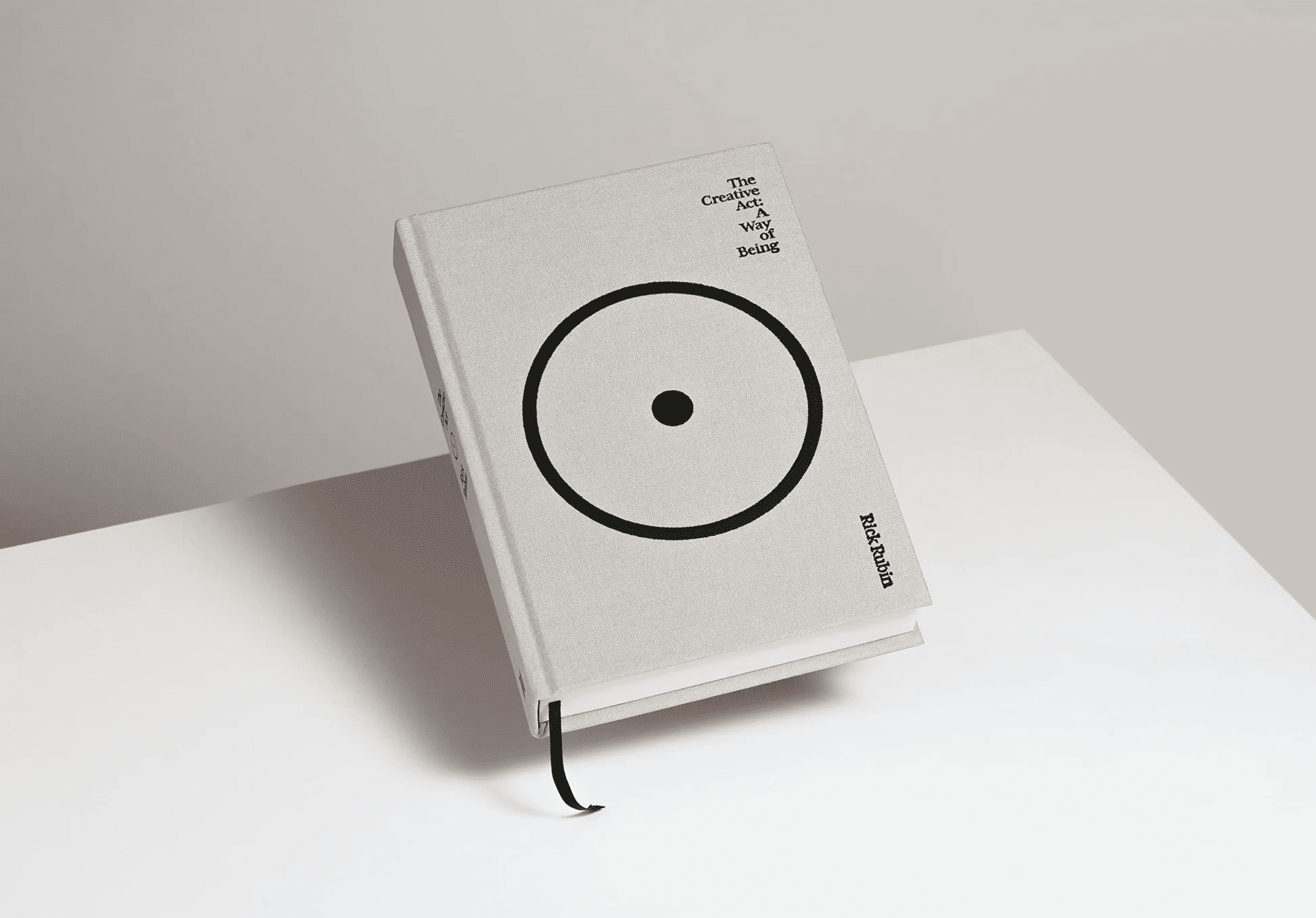

The Creative Act: A Way of Being
In The Creative Act: A Way of Being, Rick Rubin, a nine-time GRAMMY-winning producer and one of Time‘s 100 most influential people, offers a profound exploration of creativity not merely as a skill, but as a fundamental human state of existence. Drawing from his unparalleled experience collaborating with iconic artists like Tom Petty, Adele, Johnny Cash, and Kanye West, Rubin challenges conventional notions of artistry, presenting a philosophy that aims to demystify the creative process and make it accessible to everyone. This book serves as a guide to perceiving the world with heightened sensitivity and engaging in a practice of paying attention, ultimately revealing that to live as an artist is a holistic “way of being” rather than a specialized profession. Through clear, accessible language, this summary will break down every important idea, example, and insight from Rubin’s transformative work, ensuring comprehensive coverage of his unique approach to the creative life.
Note to Reader
Rubin begins by setting a unique tone for the book, emphasizing that its contents are not absolute truths but rather a reflection of his observations. He encourages readers to engage with the material critically, using what resonates and discarding what doesn’t, viewing each idea as an invitation to deeper inquiry. The ultimate aim is to open possibilities for a new way of being, rather than presenting a rigid set of rules.
Everyone Is a Creator
The first chapter immediately broadens the definition of creativity, asserting that it is a fundamental aspect of being human, a birthright for all, not a rare ability reserved for a gifted few. Rubin challenges the traditional perception of artists, arguing that creating is bringing something new into existence, whether it’s a conversation, a solution to a problem, or the rearrangement of furniture. He states that what we make doesn’t need to be witnessed, recorded, or sold to be a “work of art.”
Rubin explains that we are constantly creating our experience of reality, filtering undifferentiated matter through our senses to generate an internal world of forests, oceans, warmth, and cold. This internal generation is our ongoing participation in creation. He concludes that to live as an artist is a way of being in the world, a practice of paying attention and refining sensitivity to notice what draws us in or pushes us away, and what feeling tones arise. Our entire life, through attuned choices, is a form of self-expression, making us “a singular work of art.”
Tuning In
This chapter introduces the universe as an eternal creative unfolding, where everything from blossoming trees to replicating cells pulses with productive energy. Rubin likens humanity’s creations—from the Golden Gate Bridge to The White Album—to nature’s processes, emphasizing that each is an expression of being true to itself. He highlights that we are participating in a larger creative act, like being “conducted” by a cosmic timetable.
Rubin posits that ideas exist in the aether, ripening on schedule, and that artists serve as translators for these universal broadcasts. The best artists possess “sensitive antennae” to draw in resonating energy, often developing this sensitivity as a means of protection because they feel everything more deeply. He notes that art often appears in movements like Bauhaus architecture or punk rock, where artists either ride the cultural swell or swim against it. Accessing higher-frequency information, which is more energetic and intuitively perceived, requires creating an open space or a “vacuum” in our minds, free from normal overpacked conditions. This state, which children naturally possess, allows us to accept new information with delight, live in the moment, and act spontaneously. Artists who continually create great works often preserve these childlike qualities, seeing the world through “uncorrupted, innocent eyes.”
The Source of Creativity
Rubin describes our source material as “everything seen, everything done, everything thought, everything felt, everything imagined, everything forgotten, and everything that rests unspoken and unthought within us.” Crucially, he states that this content does not originate from within us but from an external “Source”—a boundless wisdom surrounding us, accessible through experiences, dreams, intuitions, and subliminal fragments.
He suggests thinking of the Source as a cloud that constantly changes form, just as art is a “circulation of energetic ideas” that combine differently each time. This dynamic nature explains why new art can resonate deeply, perhaps as the familiar returning in an unfamiliar form or as a missing piece of a puzzle. Rubin notes that turning an idea into reality can make it seem smaller, changing it from “unearthly to earthly,” highlighting that while imagination has no limits, the physical world does, and the work exists in both.
Awareness
In contrast to our typical agenda-driven daily activities, Rubin defines awareness as a state where “the program is happening around us,” and we are the witness, with “little or no control over the content.” This gift allows us to notice internal and external phenomena in the present moment without attachment or involvement. He emphasizes that awareness is not forced but “actively allowed,” functioning as a “presence with, and acceptance of, what is happening in the eternal now.”
Rubin warns against labeling aspects of Source too soon, as it shifts from “noticing” to “studying.” He states that the pure connection of awareness happens first, and analysis follows. While we cannot change what we notice, we can expand and narrow our ability to notice, quieting internal or external noise to perceive more. Cultivating awareness expands our perception of the universe, providing more material for creation and enriching the life we live. The ability to “look deeply is the root of creativity,” allowing us to see past the mundane to what is “otherwise invisible.”
The Vessel and the Filter
Rubin introduces the concepts of the “vessel” and the “filter” as internal mechanisms for processing data. The vessel is a container constantly filled with our thoughts, feelings, dreams, and experiences. The filter, unique to each individual, processes incoming information, reducing Source by interpreting data rather than letting it pass freely, due to limited memory, misperceived data, and finite processing power. This filtering is essential for navigating the immense world of data, allowing us to focus on what appears essential.
As artists, Rubin suggests, we aim to “restore our childlike perception”—an innocent state of wonder untethered to utility. As the vessel fills with these recast fragments, relationships are created, producing beliefs and stories that coalesce into a worldview. Artists should hold these stories “softly,” making space for information that doesn’t fit, as “the more raw data we can take in, and the less we shape it, the closer we get to nature.” The creative act involves taking the vessel’s contents, selecting useful elements, and re-presenting them as art, which can then recirculate as source material for others. He concludes that while Source makes available, the filter distills, and the vessel receives, it’s possible to bypass this default system through training, expanding the vessel’s ability to receive, because “the true instrument is you.”
The Unseen
Rubin argues that the conventional definition of art, as physical or digital artifacts, misses its deeper purpose. He states that the “end work is a by-product of a greater desire”—a longing to transcend and share “glimpses of an inner landscape, one that is beyond our understanding.” Art, for Rubin, is our “portal to the unseen world,” and without its spiritual component, an artist works at a “crucial disadvantage.”
He clarifies that “spirituality” doesn’t necessarily equate to organized religion; it can simply mean believing in “connection” or “magic.” This viewpoint is limitless, inviting fantastic possibilities beyond the narrow world of reason. Harnessing this energy operates on faith, without needing proof. Rubin encourages paying attention to moments that “take your breath away”—a beautiful sunset, moving music, or elegant design—as these are instances where the spiritual component of art or nature is made manifest, offering “a glimpse of the unseen.” He concludes that it’s common for science to eventually catch up to art, and for art to catch up to the spiritual.
Look for Clues
Rubin emphasizes that material for our work “surrounds us at every turn,” woven into conversations, nature, chance encounters, and existing art. When seeking solutions to creative problems, artists should pay close attention to clues pointing to new methods or ways to develop ideas. He provides examples, such as a writer overhearing a phrase in a coffee shop that provides a direct answer or an echo of an idea.
These “transmissions are subtle,” ever-present but easy to miss if we aren’t looking. Rubin advises asking “why” when something out of the ordinary happens, considering the message and greater meaning. This process isn’t a science; it can involve a strong intention or, conversely, letting go of intention. The more open one is, the more clues appear, requiring less effort. He likens the outside world to a “conveyor belt with a stream of small packages” that we can pick up and unwrap. He shares a personal anecdote of finding a Dr. Andrew Weil book that, when opened randomly, offered a direct answer about his appendix, which he still has. He concludes that clues feel like the “delicate mechanism of a clock,” reminding us that the universe is on our side, providing everything needed to complete our mission. The key is to “look for what you notice but no one else sees.”
Practice
Rubin discusses how in the wild, animals narrow their vision for survival, but for the artist, this can be a hindrance. He advocates for widening one’s scope to notice and collect more moments of interest, building a “treasury of material.” A “practice” is the embodiment of an approach to a concept, supporting a desired state of mind. By repeatedly opening our senses, we build a habit where expanded awareness becomes our default.
Deepening this practice cultivates a “profound relationship with Source,” as reducing filter interference allows us to recognize and participate harmoniously with the rhythms of the universe. He notes that connecting with planetary cycles and living in accordance with seasons leads to a remarkable sense of connection, seeing ourselves as part of a regenerating whole. Rubin suggests establishing daily rituals, however small, like taking three deep breaths upon waking, eating mindfully, or taking a daily walk in nature, marveling at the feeling of our heartbeat. The purpose of these exercises isn’t the doing itself, but to “evolve the way we see the world” when not engaged in them, building the “musculature of our psyche to more acutely tune in.” Awareness needs constant refreshing, but ultimately, the goal is to live in a “state of constant openness to receiving.” He concludes that “living life as an artist is a practice,” not a skill to be judged as good or bad, and that the “real work of the artist is a way of being in the world.”
Submerge (The Great Works)
Broadening our awareness is a choice driven by curiosity and a “hunger to see beautiful things.” Rubin suggests “submerging yourself in the canon of great works”—finest literature, cinema masterpieces, influential paintings, and architectural landmarks. He emphasizes that there’s no standard list, as the “canon” continually changes, but exposure provides an “invitation” that draws us forward and opens possibilities.
He illustrates this with an example: reading classic literature daily for a year will hone sensitivity for recognizing greatness more than reading the news. This applies to all choices—friends, conversations, thoughts—as they affect our ability to distinguish good from great. Rubin advises carefully curating the quality of what we allow in, due to endless data and limited bandwidth. Even for “fast food,” tasting the best fresh food improves the outcome. The objective is not mimicry but to “calibrate our internal meter for greatness,” guiding the thousands of choices that lead to our own great work.
Nature as Teacher
Rubin identifies nature as the “most absolute and enduring” of all great works, offering endless awe and inspiration through its seasons, mountains, oceans, and forests. He states that even dedicating one’s life solely to noticing changes in natural light and shadow would yield constant discoveries. He emphasizes that understanding isn’t necessary for appreciation; simply being aware of moments where “your breath gets taken away” by beauty, like birds snaking through the sky or a giant redwood, is enough.
Nature holds immense wisdom, and communing with it brings us closer to our own nature. Rubin contrasts the limited palette of a Pantone book with nature’s infinite variations, where “each rock has such a variation of color within it, we could never find a can of paint to mimic the exact same shade.” Nature transcends our tendencies to label and classify, being “unfathomably more rich, interwoven, and complicated.” Deepening our connection to the natural world serves our spirit, which “invariably serves our artistic output.” He concludes that the closer we get to nature, the sooner we realize “we are not separate,” and that when we create, we express not only individuality but also our “seamless connection to an infinite oneness.”
Nothing Is Static
Rubin highlights the fundamental truth that “the world is always changing.” He illustrates this by noting that even the same awareness practice in the same location yields unique experiences due to shifting sounds, smells, and light. He points out that variations in nature are easily noticeable, from shouts to whispers, and even seemingly static objects reveal new aspects upon deep inspection. Rereading a book, for instance, can uncover new themes and nuances, because “you can’t step into the same stream twice—because it’s always flowing. Everything is.”
Crucially, Rubin extends this dynamism to ourselves: “we are always changing, growing, evolving.” We learn, forget, move through moods, and our cells regenerate. No one is the same person all day long. Therefore, even if the external world were static, the information we perceive would still be ever-changing, and consequently, “the work we bring forth” would also be in constant flux. He aptly states, “The person who makes something today isn’t the same person who returns to the work tomorrow.”
Look Inward
Rubin challenges the common belief that life consists solely of external experiences, and that an outwardly extraordinary life is necessary to have something to share. He asserts that the “experience of our inner world is often completely overlooked,” yet it contains a “wealth of material”—sensations, emotions, thought patterns—that is “every bit as interesting, beautiful, and surprising as nature itself.”
He explains that when we go inside, we are processing what’s outside, realizing we are “no longer separate. We’re connected. We are one.” Ultimately, the origin of content—whether internal or external—is irrelevant; a beautiful thought is as valid as a beautiful sunset. Rubin concludes that it’s helpful to remember that there are “always more options available to us than we might realize,” both from within and from the world around us.
Memories and the Subconscious
Rubin explores the power of the subconscious in creative work, noting that some vocalists spontaneously sing random words or sounds, and from this “gibberish,” stories unfold or key phrases appear because “the material exists hidden within.” He suggests practices to access this “deeper well,” such as an anger-releasing exercise (beating a pillow for five minutes, then immediately filling five pages with whatever comes out), emphasizing the goal is “to not think about it, to avoid directing the content in any way.”
The psyche has access to a “universal wisdom” beyond the conscious mind, an “oceanic source” that many artists tap into without recognizing the process. He mentions that artists like those who created works while feverish bypass the thinking brain to access the dream state, highlighting the wisdom in transitional realms between wakefulness and sleep. Rubin recommends keeping a dream journal, writing immediately upon waking to recall details, and setting an intention to remember dreams before sleep. He also views memories as “dreamlike,” more romantic stories than faithful documents, containing “good content.” Finally, he introduces apparent randomness—like throwing the I Ching—as a tool to bypass the conscious mind and access a “larger intelligence.”
It’s Always There
Rubin uses the metaphor of the sun to illustrate the constant availability of creative information. Just as the sun is always there behind clouds, regardless of how gloomy it is, the information we seek is always “out there,” available whether we are aware of it or not.
He emphasizes that if we are aware, we tune into more of it; if not, “we miss it.” Crucially, Rubin states that when we miss an opportunity for awareness, it “really does pass us by.” While tomorrow offers another opportunity, it’s never for the “same awareness,” implying that each creative moment is unique and transient.
Setting
Rubin underscores the impact of our surroundings on creativity, noting that the “best environment to create a clear channel is personal and to be tested.” The ideal setting also depends on one’s intention: isolated places like a forest or monastery are good for direct universal transmissions, while busy spots are better for tuning into the collective consciousness. Consuming culture—art, entertainment, news, social media—can also be a “secondhand approach.”
He advises viewing cultural currents with “connected detachment,” like noticing a warm wind, moving within it but not being of it. Rubin highlights the diverse preferences of artists, from Andy Warhol working with multiple distractions to Marcel Proust and Kafka requiring extreme silence, concluding “There is no wrong way. There is only your way.” He stresses the importance of following intuition over seemingly rational advice from others, as external pressures can undermine focus. Interference also comes from inner voices of self-doubt or exaggerated praise, which are often internalized external judgments. The goal is to “turn those voices down” to hear the “chimes of the cosmic clock ring, reminding you it’s time” to participate.
Self-Doubt
Rubin acknowledges that self-doubt “lives in all of us” and “is there to serve us.” He argues that flaws are human, and the “attraction of art is the humanity held in it,” making imperfections interesting. Our work reflects who we are, and insecurity, if embraced, adds a “greater degree of truth.” He states that the making of art is not competitive, as only our unique voice can realize our vision.
He observes that many artists, despite immense talent, are vulnerable to judgment, like singers who can’t listen to their own voices. This sensitivity, while allowing them to make art, also makes them “tender to being judged.” If fear of judgment prevents progress, Rubin suggests that perhaps art isn’t their role, or the desire to share isn’t stronger than self-protection. He reminds us that creating is a “privilege,” not an obligation. While an unhealthy self-image or hardship can fuel great art, creating a “deep well of insight and emotion,” they can also hinder sustained production. Many great artists die early from overdoses, he posits, using drugs to numb the pain of their “incredible sensitivity,” which is both a “blessing and a curse.”
Make It Up
To overcome the paralysis caused by self-doubt, Rubin suggests “lowering the stakes.” Instead of viewing a project as life-defining, see it as a “small work, a beginning,” a stepping-stone to the next. He emphasizes that “all art is a work in progress,” best approached as an experiment where the outcome is unpredictable, yielding useful information for the next one. This mindset—that there’s no right or wrong, good or bad, and creativity is “free play with no rules”—fosters joyful engagement.
Rubin argues that perfectionism hinders fun, and a more skillful goal is to find comfort in the process, putting out successive works with ease. He quotes Oscar Wilde: “some things are too important to be taken seriously,” including art. Setting the bar low frees artists to play, explore, and test without attachment to results, which is how “the best work reveals itself.”
Another approach is to label insecurities, like the Buddhist concept of papancha (preponderance of thoughts), which normalizes doubts and lessens their seriousness. He shares an anecdote of telling a frozen artist she didn’t have to make music if it didn’t make her happy, which immediately shifted her perspective to wanting to create. Gratitude also helps. Ultimately, the desire to create must be greater than the fear. He distinguishes between doubting the work (“Is my song as good as it can be?”) versus doubting oneself (“I can’t write a good song”), noting the latter leads to hopelessness. Doubting the work, however, can “help to improve it,” allowing one to “doubt your way to excellence.” Rubin cautions that the “imperfect version was actually the one,” and that imperfections, like the Leaning Tower of Pisa or kintsugi (Japanese pottery repair using gold), can make work great or tell its story, reframing insecurities as guiding forces. He concludes that “art creates a profound connection between the artist and the audience,” leading to healing for both.
Distraction
Rubin asserts that distraction, when used skillfully, is “one of the best tools available to the artist,” sometimes the only way to progress. He cites meditation where a mantra serves as a distraction to quiet the mind, preventing worries from taking over. Similarly, worry beads, rosaries, and malas function this way.
When facing an impasse in the creative process, stepping away from the project to create space allows solutions to appear. Rubin suggests holding the problem “lightly in the back of our consciousness” while engaging in simple, unrelated tasks like driving, walking, showering, or washing dishes—activities that can be accomplished on autopilot. He notes that physical movement can spur ideas, and this “process of nonthinking thought” may access a different part of the brain that sees “more angles than the direct path.” He distinguishes this from procrastination, emphasizing that “Distraction is a strategy in service of the work,” and that “sometimes disengaging is the best way to engage.”
Collaboration
Rubin argues that “nothing begins with us,” and all work is a collaboration—with past and future art, the world, experiences, tools, audience, and our current selves. He highlights the internal collaboration within the “self,” where different aspects (e.g., inspired artist vs. craftsperson) negotiate to create the best work. This is because there’s “no direct conversion from abstract thought to the material world”; the work is always an interpretation.
He notes that the work itself “wears different hats,” meaning the artist’s and audience’s interpretations may differ completely, and “neither one is right. And both are right.” This is fine, as the purpose is to awaken something in the artist first, then in others, and it doesn’t matter if they are the same thing. Rubin cites Marcel Duchamp’s readymades (like a urinal designated as art) to illustrate that what’s considered art is “simply an agreement. And none of it is true.” He concludes that artists are never alone, constantly in “dialogue with what is and what was,” and the more tuned in one is, the better they can serve the work.
Intention
Rubin illustrates the concept of intention with the story of an old man who meticulously draws water from a well by hand, refusing a pulley system because the care and time invested affect the water’s taste. This highlights that our “thoughts, feelings, processes, and unconscious beliefs have an energy that is hidden in the work,” giving it magnetism. He defines intention as the “grand gesture of the work,” not a thought or goal, but a “truth that lives inside you” and becomes embedded through your living it.
Intention requires “alignment of all aspects of one’s self”—conscious thought, unconscious beliefs, capabilities, commitment, and actions. Projects may not take much time, but they take “a lifetime.” He explains that in calligraphy, all intention is in “one movement of the brush,” reflecting the artist’s entire history. Our work embodies a higher purpose; we are “a conduit for the universe,” allowing material through us. Rubin suggests creators are not conductors but instrumentalists in a larger symphony, unaware of the “magnum opus.” Like a bee unknowingly enabling reproduction, our work fits into the cultural fabric, and if we surrender to the creative impulse, our “singular piece of the puzzle takes its proper shape.” He concludes that “Intention is all there is. The work is just a reminder.”
Rules
Rubin defines a rule as any “guiding principle or creative criterion” that acts as a limitation, existing within the artist, genre, or culture. Unlike laws of math and science, artistic rules are “assumptions, not absolutes,” meant to be tested and only valuable as long as they are helpful. He cautions that various assumptions masquerade as laws, from self-help tips to teacher advice.
Rubin argues that rules direct us to “average behaviors,” which exceptional art transcends. The goal is to “amplify the differences” unique to one’s worldview, valuing and developing one’s own voice. He states that once a convention is established, the most interesting work defies it, as art is “confrontation” that widens reality. He uses the example of a song’s length or a bird’s song to show how ingrained rules are in our craft. Rubin advocates approaching work with “as few accepted rules, starting points, and limitations as possible,” as ubiquitous standards can be invisible and unquestioned, preventing thought outside the paradigm. He highlights how painting, though seemingly about color on a surface, is limited by assumptions like rectangular canvases. Genres also come with distinct expectations, tempting conformity. The most innovative ideas come from those who master rules to see past them, or those who never learned them.
Rubin emphasizes that “the most deceptive rules are not the ones we can see, but the ones we can’t,” hiding deep in the mind from childhood programming or cultural osmosis. These unconscious rules are “far stronger” and more likely to undermine work. He warns that every innovation risks becoming a rule and an end in itself, leading to diminishing returns or an artist concretizing a formula as their identity. It’s helpful to “continually challenge your own process” and avoid getting “religious about it,” as other strategies may offer new possibilities. Holding every rule as breakable is a “healthy way to live as an artist,” loosening constraints and promoting novelty. He encourages scrapping old palettes and embracing uncertainty, remembering that hard-earned skills transcend rules. He concludes by stating, “Beware of the assumption that the way you work is the best way simply because it’s the way you’ve done it before.”
The Opposite Is True
Rubin challenges artists to “try the opposite” of any rules they accept about what they can or cannot do, or what their voice is. For example, a sculptor who believes their work must be physical might explore how a sculpture can exist without being a solid object. This thought process, he suggests, could lead to novel and intriguing outcomes, even if not the “best” work.
He frames a rule as an “imbalance,” like darkness and light, which are meaningful only in relation to each other. By examining methods and considering their opposites, artists can find balance or create more leverage by “doubling down” on their current shade to the extreme. This experimentation with balance reveals where one stands on the seesaw. Rubin emphasizes that trying the opposite or extreme of any suggestion, even those in his book, is likely to be just as fruitful, promoting a dynamic and exploratory approach to creativity.
Listening
Rubin likens the act of listening to a Buddhist practice where a bell pulls one into the present moment, a “small reminder to wake up.” He notes that while eyes and mouth can be sealed, an ear has “no lid,” constantly receiving without transmitting, simply present to the world. He distinguishes hearing (sounds entering autonomously) from listening (paying attention and being in communion with sounds), suggesting we listen with our “whole body, our whole self,” feeling vibrations beyond what ears perceive.
He contrasts listening with headphones (an illusion of full register) versus speakers (immersed physically in sonic vibration), stating many experience life with metaphorical headphones, stripping away full register and missing “subtler vibrations.” Practicing listening with the whole self expands consciousness, revealing more material for art.
Rubin explains that communication is two-directional, and a fully present listener changes how a speaker communicates. He warns against “critical mind” kicking in, formulating opinions, preparing responses, or defending positions, as these are “not listening.” “Listening is suspending disbelief,” openly receiving without preconceived ideas, with the only goal being to “fully and clearly understand what is being transmitted.” Anything less is a disservice, as it leads to missing information that could evolve current thoughts. Listening without prejudice helps us grow, seeing more perspectives beyond our bias. He concludes that “Listening opens possibilities” and is ultimately “freedom from accepted limitations.”
Patience
Rubin asserts that “there are no shortcuts” in life or art, likening lottery winners’ ultimate unhappiness and hastily built homes to the pitfalls of rushing. He applies this to listening, noting we often skip ahead and generalize, missing subtleties and avoiding the discomfort of challenging our stories, which shrinks our worldview.
The artist, conversely, “actively works to experience life slowly, and then to re-experience the same thing anew.” Rubin shares his own practice of re-reading paragraphs slowly, even returning pages back if his mind wandered, to discover “new meanings, deeper understandings, inspirations, and nuances.” He encourages engaging in every activity with the attention given to “landing a plane,” rather than sleepwalking through life like checking items off a to-do list. The “continual quest for efficiency” discourages deep looking, yet “it’s through deliberate action and repetition that we gain deeper insight.”
Rubin lists the necessity of patience for:
- Nuanced development of craft.
- Taking in information in the most faithful way possible.
- Crafting a work that resonates and contains all we have to offer.
He states that patience is cultivated through “acceptance of what is,” as impatience is “an argument with reality,” a wish to speed up time. Paradoxically, rushing “ends up taking more time and using more energy.” In the creative process, patience means accepting that most of the work is “out of our control.” We can’t force greatness but can “invite it in and await it actively”—not anxiously, but in “a state of continual welcoming.” Removing time from the equation leaves patience for both work and artist development. Even masterpieces on tight timelines are the “sum of decades spent patiently laboring.” Rubin concludes that if there’s an unbreakable rule in creativity, it’s the “need for patience.”
Beginner’s Mind
Rubin introduces the concept of Beginner’s Mind through the story of AlphaGo, an AI program that learned the complex board game Go from scratch, without human intervention or conventional wisdom. In a match against the reigning grandmaster, AlphaGo made a “move no one steeped in the game had ever made in thousands of years,” which commentators initially thought was a mistake but ultimately led to its victory. Rubin was moved to tears by this story, realizing it spoke to the “power of purity in the creative act.”
He explains that AlphaGo’s innovation stemmed from following “fixed rules, not the millennia of accepted cultural norms,” and not being “held back by limiting beliefs.” This allowed it to play with the “full spectrum of possibilities,” transforming the game forever. Rubin highlights a Go expert’s comment that “not a single human has touched the edge of the truth of Go.” For an artist, beginner’s mind means “starting from a pure childlike place of not knowing,” living in the moment with few fixed beliefs, and seeing things as they are presented. Preconceived ideas and conventions limit possibility, and Rubin questions whether the computer won because it knew more or less than the grandmaster. “There’s a great power in not knowing,” as ignorance can remove the “barricade of knowledge blocking progress.” He gives the example of The Ramones unwittingly inventing punk rock while believing they were making bubblegum pop, an “innovation through ignorance.”
Rubin acknowledges that experience provides wisdom but “tempers the power of naivete,” luring us into patterns that prevent innocent engagement. Animals and children, acting on innate instinct, possess “childlike superpowers” like being present, valuing play, disregard for consequences, radical honesty, and moving freely between emotions. Great artists maintain this enthusiasm, prioritizing their creative needs often at the expense of personal life, like a famous singer-songwriter who would leave meals to tend to inspiration. Accessing this childlike spirit requires letting go of accumulated fixed habits and thoughts. He suggests stripping away labels like “sculptor” or “author” to see the world anew, experiencing everything as if for the first time, like seeing the ocean for the first time after growing up landlocked. Artists aim to see the “extraordinary hidden in the seemingly mundane” and share it. He concludes that “Talent is the ability to let ideas manifest themselves through you.”
Inspiration
Rubin describes inspiration as an “immaculate conception,” a “divine flash of light,” where an idea “suddenly blooms in a single inhalation.” Its defining quality is the “quality and quantity of the download,” instantaneous and seemingly impossible to process, serving as “rocket fuel” for work and a “universal conversation we yearn to be part of.” The word itself, from Latin inspirare, means “to breathe in or blow into.”
He explains that for the mind to draw inspiration, it needs space, just as lungs must be emptied to draw air. To create this space, Rubin suggests quieting the mind through practices like meditation, awareness, silence, contemplation, and prayer, noting that breath itself is a potent vehicle. While inspiration is invariably energizing, it’s “not something to rely on,” as it’s out of our control and hard to find. Artists must extend invitations and put in effort, working on other project areas in its absence. Epiphanies, he notes, can be found in ordinary moments. To vary inspiration, he advises varying inputs—watching a film with no sound, listening to a song on repeat, or learning lucid dreaming. This means breaking habits, looking for differences, and noticing connections. A key indicator of inspiration is awe, and Rubin encourages training oneself to see “the awe behind the obvious” in the world.
He advises artists to “Ride the wave as long as it can be ridden” when inspiration strikes, capturing all possible material, even if not for the current project. Inspiration comes first, then the artist, then the audience. This is a serious artist’s obligation, setting aside schedules for these “special moments.” He cites John Lennon’s advice to write a song through to the end in one sitting, as initial inspiration has a “vitality” that carries the piece. A full, imperfect version is generally more helpful than a “seemingly perfect fragment,” and stepping away too soon can make it hard to rekindle the spark. He likens inspiration to a force “not immune to the laws of entropy.”
Habits
Rubin introduces the concept of habits through the example of John Wooden, the legendary college basketball coach, who began training his elite athletes by teaching them how to properly tie their shoes and socks. Wooden’s point was that “creating effective habits, down to the smallest detail, is what makes the difference between winning and losing games.” Each small habit, when added together, has an “exponential effect on performance.” Wooden’s goal was “immaculate performance,” emphasizing that the only competition is oneself. This applies equally to the creative life: “Good habits create good art. The way we do anything is the way we do everything.”
Rubin suggests establishing a consistent framework around the creative process, noting that discipline and freedom are partners, not opposites. Efficient management of schedule and daily habits frees up practical and creative capacity. He recommends creativity-supporting habits from waking, such as looking at sunlight before screenlight, meditating, exercising, and showering in cold water. Artists should find sustainable rituals that support their work, setting easily achievable schedules, like committing to half an hour a day, to build momentum.
He encourages putting decision-making into the work itself, not into when to work, and limiting practical choices to free creative imagination (e.g., Albert Einstein wearing the same suit, Erik Satie having identical outfits). Rubin then challenges readers to examine and remove unhelpful automatic habits—in movement, speech, thought, perception, and being ourselves—that control us. He shares his experience of learning a new swimming technique that felt awkward due to ingrained habits, illustrating how we rely on habits in art that may not serve the work. By staying open and paying attention, we can soften these unhelpful habits and explore new practices that serve the work like “temporary collaborators.”
Rubin provides a list of thoughts and habits not conducive to the work:
- Believing you’re not good enough.
- Feeling you don’t have the energy it takes.
- Mistaking adopted rules for absolute truths.
- Not wanting to do the work (laziness).
- Not taking the work to its highest expression (settling).
- Having goals so ambitious that you can’t begin.
- Thinking you can only do your best work in certain conditions.
- Requiring specific tools or equipment to do the work.
- Abandoning a project as soon as it gets difficult.
- Feeling like you need permission to start or move forward.
- Letting a perceived need for funding, equipment, or support get in the way.
- Having too many ideas and not knowing where to start.
- Never finishing projects.
- Blaming circumstances or other people for interfering with your process.
- Romanticizing negative behaviors or addictions.
- Believing a certain mood or state is necessary to do your best work.
- Prioritizing other activities and responsibilities over your commitment to making art.
- Distractibility and procrastination.
- Impatience.
- Thinking anything that’s out of your control is in your way.
He concludes that artists should “Create an environment where you’re free to express what you’re afraid to express.”
Seeds
Rubin introduces the “Seed phase” as the initial stage of the creative process, where artists are “completely open, collecting anything we find of interest.” He likens this to searching for “potential starting points that, with love and care, can grow into something beautiful.” At this stage, the focus is on gathering, not comparing to find the “best” seed.
Examples of seeds include a phrase, melody, or rhythmic feel for a song; a sentence, character sketch, or plot point for writing; a shape or material for a structure; or an inconvenience or societal need for a business idea. Collecting seeds is “more a receiving of a transmission,” a “noticing,” like catching fish by patiently waiting after casting a line. Rubin emphasizes that the artist casts a line to the universe, and we cannot control when inspiration comes, only be present to receive it. He advises against forming conclusions about a seed’s value or fate too early, as it can hinder potential. An idea that seems less vital may grow into a beautiful work, while an exciting one might not. It’s impossible to accurately assess “germs of an idea” until they are developed. Rubin suggests accumulating “several weeks’ or months’ worth of ideas” before choosing, as having more context makes judgment easier. Making assumptions about what won’t work or fit one’s artistic identity can prevent growth; sometimes, a seed propels us in a completely new direction. At this stage, it’s helpful to view the work as “bigger than us,” cultivating awe and wonder. He concludes, “The work reveals itself as you go.”
Experimentation
After collecting seeds, Rubin introduces the “Experimentation phase,” the second stage where artists “play with different combinations and possibilities to see if any of them reveal how the seed wants to develop.” This is a “search for life,” cultivating each seed like a gardener. There’s no right way to experiment, but it involves interacting with seeds and developing starting points in different directions.
He describes this as a “fun part of a project” because “nothing is at stake.” The goal is to generate possibilities rather than eliminating them, as premature editing can “close off routes that might lead to beautiful vistas.” Rubin cites historical examples like the accidental discovery of gunpowder by Chinese alchemists searching for immortality, and inventions like penicillin, plastic, pacemakers, and Post-it notes discovered by accident. He emphasizes that the heart of experiment is mystery, remaining open to the new and unknown, starting with a question mark. Artists should allow the seed to “follow its own path toward the sun” and avoid intervening too much.
Rubin advises storing dormant seeds that aren’t developing, as “there is a right time for each one.” He notes that some seeds germinate instantly, leading to quick completion, while others get stuck halfway. He warns against continuing to labor on a seed simply due to invested time, especially if energy drops. It might mean the seed isn’t ready or the right experiment hasn’t been found. He encourages giving attention to each seed, regardless of perceived potential, and seeking a “beautiful response.” If an artist has only one specific vision, it could be a limitation, preventing exploration of all possibilities. He distinguishes the work of a craftsman (knowing what to do and doing it) from the work of an artist (beginning with a question and embarking on discovery). Surprises expand the work and the art form itself.
Rubin explains that accurate signposts for flourishing ideas are often emotional, not intellectual, with excitement being the best barometer. This “energizing feeling of wanting more” is a “leaning forward” sensation. During experimentation, artists should follow this “natural reaction of enthrallment in the body,” delaying head work and analysis. He states that if two ideas seem equally weighted, but one shows less potential but is “more interesting,” follow the interest, as it will “always be in the greatest service of the work.” He concludes, “Failure is the information you need to get where you’re going.”
Try Everything
Rubin states that unlike predictable combinations in life (blue + yellow = green), “in creating art, the sum total of the parts often defies expectation.” Theory and practice don’t always align, and proven solutions might be unhelpful. He highlights the “gap between imagination and reality,” where brilliant ideas in the mind might fail in execution, while dreary ones might be exactly what’s needed.
He asserts that “the only way to truly know if any idea works is to test it,” and to find the best idea, “test everything.” Rubin suggests asking “what if” questions (e.g., “What if this were the first painting anyone saw in their life?”), exploring polarities (loud parts quiet, every adverb removed). He recommends adopting a temporary rule of “no bad ideas” and testing even “underwhelming or unlikely” ones, especially in group efforts where ideas often compete. Since it’s impossible to predict how one’s own ideas will work, let alone others’, he advises moving beyond verbal discussions. Instead, bring ideas into the physical world by acting them out, playing them out, or building models, because “descriptions do not do ideas justice.” The person with the idea should demonstrate or supervise execution to avoid misunderstandings. When the idea is fully expressed, it may turn out better than imagined. Rubin encourages allowing oneself to be wrong and experience surprise. He concludes that in solving a puzzle, there are “no mistakes”; each unsuccessful solution brings one closer. Artists should widen their view and follow ideas with stronger energetic charges, allowing the work to grow naturally, like an oak tree. He states, “Taking a wrong turn allows you to see landscapes you wouldn’t otherwise have seen.”
Crafting
Rubin explains that once a seed’s “code has been cracked, and its true form deciphered,” the process shifts into the “Craft phase,” which involves the “labor of building.” This phase is less about unbounded discovery and more about filling in colors based on a clear sense of direction and established lines. He describes it as “one of the least glamorous parts of the artist’s job,” involving creativity but less magic of exploration, feeling more like “brick-laying.”
He notes that this is where some artists struggle, tempted to chase the thrill of new ideas rather than face the “long, precarious climb” of execution. However, the initial phases have little meaning without completing the work. To decide which experiment to craft, Rubin advises continuing to follow “hints of excitement.” He suggests working on multiple experiments simultaneously for healthy detachment and clearer insight, as stepping away and returning with fresh eyes can reveal new paths. While the Experimentation phase focused on what the seed offers, in Crafting, artists apply their filter, searching for connections from their life experience. The Craft phase is both building up and breaking down, involving pruning through “small cuts” to remove details and focus energy on core elements.
Rubin highlights that Crafting isn’t always difficult; for some, it’s their favorite part, and outsourcing can be appropriate, as seen with Andy Warhol’s outsourced paintings or 60s rock bands using session musicians. The artist chooses their level of involvement, whether hands-on or as a maestro. He stresses that the “physical act of crafting may give them a greater understanding of the art” and control. He concludes that crafting can be a joyful, accomplishing experience, with the love and care evident in the final work.
Momentum
Rubin warns that the Craft phase can extend “longer than necessary” if treated without boundaries, leading to challenges. Once enough data is collected and the vision is clear, setting deadlines for completion becomes helpful, as the process is less open-ended. He likens it to a script translated to a storyboard: the path to a finished film is more mechanical, with narrower creative parameters, where even different material choices would maintain the core integrity.
In Crafting, deadlines are “suggested completion dates,” acknowledging surprise and exploration may still send one back to experimentation. He cautions against outside pressure for fixed release dates that don’t allow for new directions, emphasizing that the artist’s goal is to make the “finest work,” not just produce. Therefore, deadlines should be for “your own motivation.”
Rubin identifies pitfalls of prolonged Crafting:
- Disconnection: Endless crafting can lead to the artist wanting to start over, as they or the times have changed. Art reflects the artist’s inner/outer world during creation, and extending the period can cause loss of enthusiasm.
- Demo-itis: Clinging too long to a first draft can make it feel final, where subsequent changes seem “blasphemous.” To avoid this, he advises against repetitively consuming unfinished work unless actively improving it.
He notes that sometimes great work is made very quickly, and an initial sketch or demo, though created in minutes, might be the purest expression. Rubin discusses how an artist’s vision can exceed their ability to manifest it, leading to discouragement. He advises not mistaking a “fantasy version” for what the work can become; sometimes, falling short of grander visions puts the work “exactly where it wants to be,” and a more practical version can be better. He cautions against allowing the scale of imagination to hinder execution.
When facing trouble in Crafting, Rubin recommends working around blockages to maintain momentum rather than sequentially. Bypassing a stuck section and completing others first can reveal solutions once the “overall context has emerged,” making it easier to return to the skipped part when only a small percentage of the project remains. This is like placing a puzzle piece: it’s easier when most of the puzzle is complete. He concludes, “Art is choosing to do something skillfully, caring about the details, bringing all of yourself to make the finest work you can. It is beyond ego, vanity, self-glorification, and need for approval.”
Point of View
Rubin states that the goal of art is not perfection but “to share who we are. And how we see the world.” Artists allow us to see what we already know but cannot articulate, whether it’s a singularly different view or one that feels miraculously close to our own. Art resonates because humans are similar, drawn to shared experiences and imperfections, feeling “understood. And connected.” He quotes Carl Rogers: “The personal is the universal,” asserting that our “point of view, not our drawing skills or musical virtuosity,” is what makes art matter. Unlike science or technology, art’s intention is not utility for others, but self-expression.
Rubin clarifies that a point of view doesn’t have to be coherent or simple; it can be contradictory. Sharing it “unaltered and undoctored” fulfills art’s fundamental purpose, creating a mirror for the audience’s “hidden reflection.” He distinguishes a “point” (an idea intentionally expressed) from a “point of view” (the conscious and unconscious perspective through which work emerges), arguing that we’re drawn to how an artist’s filter refracts ideas, not the ideas themselves. Knowing one’s point of view is unnecessary, as it’s “already there, working in the background, ever evolving.” Efforts to portray it on purpose lead to false representations. He quotes Wayne Dyer: “when you squeeze an orange, what comes out is orange juice. When you get squeezed, whatever comes out is what’s inside you,” including the unknown point of view.
He finds it liberating that we don’t need to understand why it works or if others will comprehend us; we’re free to be present. Great art is felt on a “gut level,” and self-expression allows the audience’s self-expression. Concerns about comprehension cause interference. Great art opens conversations, often accidentally. While humans adapt to fit in, artists embrace their filter as a gift. He asks, “How can a piece of art ever truly be a guilty pleasure?”
Rubin illustrates imitation leading to innovation with The Beatles, inspired by American rock and roll, who created something different because “they were different.” He also mentions Sergio Leone’s Spaghetti Westerns, which, despite aiming to mirror American Westerns, became “abstract psychedelic mythology.” It’s impossible to imitate another’s point of view; we can only “swim in the same waters.” Copying inspiring works is a “time-tested tradition.” The cultural dialogue between past, present, and future is fed by the “simultaneous sharing of millions of divergent points of view.” Our point of view informs our work, which then feeds back into the culture, forming a “symbiotic loop.” He concludes that expressing oneself and creativity are the same, and it may not be possible to know who you are without expressing it.
Breaking the Sameness
Rubin addresses hitting a wall in the Craft phase where work isn’t improving, suggesting ways to “break the sameness and refresh your excitement.” He proposes exercises, attempted without outcome expectations, to rekindle excitement and access new performance ways.
Key exercises to break sameness:
- Small Steps: For a blocked musician, write “just one line every day,” regardless of quality, to reopen the creative channel.
- Change the Environment: Alter an element like turning off lights, holding the microphone differently, or recording at a new time. One vocalist sang upside down.
- Change the Stakes: Imagine it’s the last performance of a song, or lower stakes with a rehearsal, to bring out different performances.
- Invite an Audience: The presence of even one observer can alter and focus an artist’s act, even for non-performative arts like writing.
- Change the Context: Create new meaning or backstory for a song’s lyrics; a love song sung to God changes its feel without changing words.
- Alter the Perspective: Use extreme volume on headphones to encourage quieter play, or turn vocals down to coax louder singing, to force a different performance.
- Write for Someone Else: For a musician, imagine writing a song for a favorite artist, which “depersonalizes the process” and breaks free of oneself. He cites Carole King and Gerry Goffin’s “(You Make Me Feel Like) A Natural Woman” as an example where the lyrics were written by Goffin, but sung by King and Aretha Franklin. Choose an artist with a polar opposite style to avoid career sameness.
- Add Imagery: Instead of musical references, create a vivid scene (e.g., a battle aftermath for a keyboard solo) and “Play the solo like that,” bringing stronger direction to a meandering tune.
- Limit the Information: When a songwriter sends a demo, provide only chords and lyrics to musicians, allowing them maximum freedom to bring themselves to the song, rather than recording a good version of the demo.
Rubin emphasizes that these exercises are not set in stone, but rather structures to go beyond usual methods and find new ways forward. The actual exercises are less important than their purpose: “to establish different perspectives or conditions.”
Completion
Rubin defines the “Completion phase” as the final movement where, after the Craft phase has sufficiently explored all options and the work’s essence is clear, the “final form is refined to be released into the world.” This involves finishing touches like framing a painting, color correcting a film, or tweaking a song’s mix. He stresses that this phase isn’t linear; revisions may send one back to Craft or Experimentation.
He likens it to the “last stop on an assembly line,” where the piece is examined against highest standards, and if it falls short, it’s sent back for improvement. Once it meets standards, you “sign off on it, let it go, and begin the next chapter.” Rubin suggests opening the work to other perspectives not to receive notes or opinions, but to “experience the work anew.” Playing music for someone else makes us hear it differently, “borrowing a second set of ears” to widen our own perspective. Sharing work with friends or mentors interrogates our underlying doubts. If feedback is offered, “listen to understand the person, not the work,” as people reveal more about themselves than the art. While some comments resonate, others may hit a nerve; criticism allows new engagement, whether agreeing or doubling down on instincts. If a suggestion to remove a song’s bridge is made, interpret it as “it’s worth reexamining the bridge.” Rubin advises that innovative work divides audiences; “If everyone likes it, you probably haven’t gone far enough.” Ultimately, “you are the only one who has to love it.”
He states there’s no formula for knowing when work is done: “The work is done when you feel it is.” While early deadlines are avoided, in Completion, a due date can help. He notes that this phase is often the most difficult, as artists resist letting go due to “commitment phobia”—the fear of permanence and losing control. Excuses arise (loss of faith, perceived flaws, mirage of a better option) when the work is believed to be life-defining. Rubin reminds that the “only art the world gets to enjoy is from creators who’ve overcome these hurdles and released their work.” Releasing work becomes easier when remembering each piece is only “a reflection of who we are in this moment,” and waiting too long means it’s no longer today’s reflection. “Hanging on to your work is like spending years writing the same entry in a diary.” He encourages keeping “How many pages will be left empty?” in mind to move freely.
Rubin highlights that releasing concerns about reception (audience comes last) is crucial. The work is “never perfect,” always an iteration. Sharing is a reward, building confidence and lessening insecurity. He advises against overthinking; if you’re happy and want to share with a friend, it’s time for the world. Finally, this phase is fertile for planting new seeds, as the excitement of the next project generates vital energy to finish the current one, breaking the “trance of the present piece.” He asks, “Is it time for the next project because the clock or calendar says it’s time, or because the work itself says it’s time?”
The Abundant Mindset
Rubin introduces the concept of the “abundant mindset,” where a “river of material flows through us.” When we share our works, they are replenished, but if we hoard them, the flow is blocked, and new ideas are slow to appear. In this mindset, the river “never runs dry,” and artists can release work with faith that more will arrive.
In contrast, the “mindset of scarcity” leads to stagnation, like a comedian holding back a joke for a “more high-profile occasion.” Using material improves skills. The fear of drought and perfectionism prevent moving on, blocking the river. Rubin states that “whatever we concentrate on, we get.” A limited mind won’t see universal inspiration, and the river slows. In an abundant world, we complete and release work because “so many ideas available and so much great art to make.” If a project is viewed as the sole life’s mission, there’s no impetus to finish; it becomes endless revision for an “unrealistic ideal of perfection.” An album, he notes, is merely a “diary entry of a moment of time.” Our life’s work is greater than any individual container, with each piece being a chapter.
Rubin encourages being free to close chapters and move on, as there’s always a new one. He dismisses the idea of a “golden period” being in the past, asserting that each work is our “best effort in the moment they were created.” Endless improvement is possible, but further work might only be different, not better, and we may evolve past it, making it feel like an “old photo.” The recognition of abundance brings hope that “our brightest ideas still await us and our greatest work is yet to come.” This energized state of creative momentum allows us to make and release things, gaining experience and inching closer to ourselves with each chapter. He concludes, “If we can tune in to the idea of making things and sharing them without being attached to the outcome, the work is more likely to arrive in its truest form.”
The Experimenter and the Finisher
Rubin categorizes artists into two natures: Experimenters and Finishers. Experimenters are drawn to dreaming and play but struggle with completion. Finishers, their “mirror image,” move quickly to an endpoint with clarity, less interested in exploring possibilities in the Experimentation and Craft phases.
He suggests each type can benefit from borrowing from the other:
- Finishers should spend more time in early phases, writing beyond minimums, experimenting with materials and perspectives, allowing improvisation and surprise.
- Experimenters should practice completing aspects of their work, even small ones like a drawing or a chapter, or making one foundational decision.
Using the example of an album, Rubin advises a musician struggling with ten songs to focus on two, making the task “more manageable and focused.” Completing even a small segment builds confidence, and “going from two to three is easier than going from zero to two.” He recommends bypassing stuck sections and finishing others, as “the knowledge we gain from finishing the other pieces becomes a key to overcoming earlier obstacles.”
Temporary Rules
Rubin discusses the role of temporary rules in the artistic process, acknowledging that while much of it involves ignoring, letting go, and undermining rules, there’s also a place for imposing them “as a tool to define a given project.” When material, time, and budget are unlimited, options are vast; accepting limitations, whether by design or necessity, creates opportunities.
He likens this to setting a palette for each project, where constraints reduce choices, forcing more specific problem-solving and leading to “groundbreaking results.” He cites Georges Perec’s novel La Disparition, written without the letter ‘e’, which became a celebrated experimental work. Yves Klein limited his palette to one color, discovering “International Klein Blue,” which became the art itself. Rubin also references Lars von Trier’s Dogme 95 manifesto (ten rules to reduce filmmaking artificiality, including handheld shots, diegetic sound only, and no genre movies), which led to critically acclaimed films like Thomas Vinterberg’s The Celebration.
Rubin emphasizes that while rules like those in baseball are rarely altered, artists can create new rules each time they play, and even break them if a discovery impels them. However, rules must be “taken seriously” to be useful. There are “no bad rules or good rules,” only those that “fit the situation and serve the art.” The imposition of rules is most valuable for artists who have already made some work, serving to “break a pattern,” challenge them to innovate, and reveal new aspects of themselves. He suggests switching to less familiar instruments or mediums for virtuoso artists.
He encourages setting parameters that force one out of their comfort zone (e.g., painting with the left hand if right-handed, writing acappella if based on instrumentals, filming with a phone). The purpose is “self-discovery,” not necessarily creating “better” work, but different. Breaking rules can lead to a greater understanding of past choices. Rubin addresses successful artists’ concerns about losing their following when exploring new horizons, stating that limiting work to the familiar is a “disservice to both yourself and your audience,” as the “energy of wonder and discovery can get lost.” He concludes that “A rule is a way of structuring awareness.”
Greatness
Rubin explores greatness as a pursuit akin to building a magnificent home on a mountaintop for oneself alone, with no one else to visit. He states that the “essence of great art” is making it for no other purpose than creating our version of the beautiful, bringing all of oneself to every project, an “offering, a devotional act.” We create art to “inhabit it ourselves.”
He emphasizes that the measurement of greatness is subjective, with “no hard metric,” and we are “performing for an audience of one.” If an artist thinks, “I don’t like it but someone else will,” they are in “the business of commerce,” not art. The more formulaic a creation, the less it is like art, and ironically, commercial aspirations can fail even at their own goals. Fear of criticism, commercial attachment, competing with past work, and the aspiration to change the world are all “undermining forces in the quest for greatness.” Instead, Rubin advises focusing on what you contribute to make the art “the best it could possibly be, with no limitation.” If the project is purely artistic, redirect inner voice to “pure creative intent.” With the objective of simply doing great work, a “ripple effect occurs,” raising the vibration of one’s entire life and inspiring others, because “Greatness begets greatness. It’s infectious.”
Success
Rubin asserts that success is not popularity, money, or critical esteem, but an internal state achieved “in the privacy of the soul.” It comes when an artist decides to release their work, having done all they can to realize its potential, feeling “pleased and ready to let go.” Success, therefore, “has nothing to do with variables outside yourself.”
Moving forward—finishing, sharing, and starting a new project—is an aspect of success. Whatever follows this quiet accomplishment is “subject to market conditions” beyond our control, such as timing, distribution, cultural mood, or current events. He warns that “popular success is a poor barometer of work and worth,” as alignment of stars is needed, unrelated to project quality. He cites examples like a global catastrophe overshadowing a release or fan resistance to stylistic changes. The only variables artists control are doing their best work, sharing it, starting the next, and not looking back.
Rubin cautions against longing for outward success to fill an inner void, stating that achievement often leaves artists “just as empty as they were before, probably more so.” Unmet expectations can lead to hopelessness and amplified pressure. He notes that a loyal audience can become a “prison” if an artist’s taste changes, leading to feeling “chained to the old way” due to business interests and tied identity. However, if passion shifts, it’s wise to follow it, as it’s the passion, not the initial style, that resonated. He emphasizes that the same outcome can be viewed as success or failure, and it’s grounding to protect one’s “personal understanding of success,” making each new work “like you have nothing to lose.” He concludes that tuning into the idea of making and sharing without attachment to outcome allows work to arrive in its truest form.
Connected Detachment (Possibility)
Rubin introduces the practice of “connected detachment,” suggesting we “detach from the story of your life as it’s happening.” He encourages experiencing challenging events—like a manuscript lost in a fire, a breakup, or losing a job—as if “watching a movie.” The response becomes: “I wasn’t expecting that plot twist. I wonder what’s going to happen to our hero next.”
He emphasizes that “there’s always a next scene,” and hard times can be the “required setup” for new possibilities. Darkness and daylight are part of a continually unfolding, mutually dependent cycle, neither bad nor good, simply existing. This practice, of “never assuming an experience you have is the whole story,” supports a life of open possibility and equanimity. Obsessive focus on events makes them seem catastrophic, but zooming back reveals them as small aspects of a larger life. Rubin concludes that the ability to “stay out of the story, zoom back, and see new pathways” is of boundless use. Art has the power to “snap us out of our transfixion, open our minds to what’s possible, and reconnect with the eternal energy that moves through all things.”
The Ecstatic
Rubin discusses the “ecstatic” as a compass pointing to an artist’s true north, a recurring experience of sensory joy that pulls one in when listening to music, reading, or gazing at art. He describes it as the test an artist uses in crucial moments to know if the work is good and moving in the right direction—a “feeling. An inner voice. A silent whisper that makes you laugh. An energy that enters the room and possesses the body.”
It’s an “arising of the ecstatic,” a sudden shift, a revelation, a small tweak that “takes your breath away,” even from a mundane detail like a word change. This makes nonsense morph into poetry. The ecstatic is the “affirmation that you’re on the right path,” a nudge, a sign of working towards greatness, grounded in truth. This “epiphany is the heart of creativity,” felt in the whole body, causing attention, quickening heartbeat, or surprising laughter. It offers a glimpse of a higher ideal, invigorating the laborious parts of the work.
The nature of the ecstatic is “animalistic,” a “visceral, body-centered reaction, not a cerebral one.” It doesn’t need to make sense; it’s there to guide. While intellect helps complete work, art-making requires “getting out of our heads.” He notes that latent ideas and emotions find their way into art, sometimes becoming “shockingly vulnerable and cryptic forms of public confession.” Rubin describes different ways of experiencing the ecstatic: relaxed excitement, astonishment (like realizing you’re driving into oncoming traffic), or gentle transportation out of reality (like spontaneously waking from a dream after listening to music). He encourages tuning into these feelings in creative work, as “touching the ecstatic and allowing it to guide our hand are the most profound and precious.”
Point of Reference
Rubin explores how we react to new or unfamiliar art, especially when a beloved artist breaks new ground or a new artist defies precedents. He notes it can feel “odd,” “unfamiliar,” and we may not be sure if we like it, or even reject it. Yet, we are “compelled to listen again and again,” until a new pattern emerges, and what was strange becomes familiar.
He observes that sometimes, the ideas that least match our expectations are the most innovative, because “revolutionary ideas have no context. They invent their own.” Our first instinct with the radically new might be to push it away. Rubin advises being aware of strong responses; if immediately turned off, it’s “worth examining why,” as powerful reactions often indicate “deeper wells of meaning.” By exploring these, we might be led to the next step on our creative path.
Non-Competition
Rubin states that “art is about the maker,” with its aim being an expression of who we are, making “competition absurd.” Every artist’s playing field is unique, creating work that best represents them, not to be measured against others. He acknowledges that some believe competition inspires greatness, but argues this energy “oscillates at a lower vibration.”
Wanting to outperform rarely results in true greatness, and it’s an unhealthy mindset. He quotes Theodore Roosevelt: “comparison is the thief of joy.” Rubin distinguishes this from being inspired by another’s great work to “elevate our own,” which is an “energy of rising-to-meet” rather than conquering. He cites the creative back-and-forth between Brian Wilson (inspired by The Beatles’ Rubber Soul to create “God Only Knows”) and Paul McCartney (moved by The Beach Boys’ Pet Sounds to inspire The Beatles’ Sgt. Pepper’s Lonely Hearts Club Band). This “upward spiral toward magnificence” was based on mutual love, not commercial competition.
Rubin concludes that no system can rank work reflective of the maker; great art is an invitation to strive for “higher and deeper levels.” He also identifies “self-competition” as an “infinite gain,” a quest for evolution focused on “progression” and “growth over superiority.” Our ability and taste evolve, yielding different works that are “different snapshots of who we are,” all being our “best work in the moment they were created.” With each project, we challenge ourselves to reflect what’s living in us at that time, pushing into the unexpected and venturing beyond even greatness.
Essence
Rubin defines essence as the “underlying essence” or “core identity or fundamental structure” of all work, “like a skeleton supporting flesh,” sometimes called an “is-ness.” He illustrates this with a child’s drawing of a house: removing the window or door leaves it a house, but removing the roof and outer walls does not. Each piece of art has a “unique, life-giving feature” that defines it, which could be theme, organizing principle, point of view, performance quality, materials, mood, or a combination.
He notes that the essence is always present, and our job in the Craft phase is “not to obscure it.” An essence can change from start to finish, and a “new, different essence may emerge” as work is refined. Sometimes, artists discover the essence after experimenting. Rubin suggests distilling work to its essence by conducting a “useful and informative practice” of removing elements until it’s “stripped bare, in its least decorative form yet still intact,” with “nothing extra.” He advises that “less is generally more,” and if an element’s contribution is questionable, “it’s probably a good idea to let it go.” He quotes Antoine de Saint-Exupéry: “Perfection is finally obtained not when there is no longer anything to add, but when there’s no longer anything to take away.” He concludes that the sum of individual works’ essences may reflect our own, and the closer we get to each work’s true essence, the sooner they will provide clues to our own.
Apocrypha
Rubin discusses how artists’ heroes often seem “beyond human, like mythological figures,” but cautions that “from a distance, what can we know to be true?” He argues that without witnessing a work’s actual creation, it’s impossible to know what truly happened, and even direct observation is an “outside interpretation.” Stories about how works are made and artists’ rituals are “generally exaggerated, and often pure fiction.”
He emphasizes that “a work of art happens naturally, of its own accord,” and nobody, often not even the maker, knows how or why it happens. Artists’ interpretations may not be accurate or the whole story, as “we live in a mysterious world full of uncertainties.” Our explanations are guesses that “become fixed in our minds as fact.” Rubin calls us “interpretation machines,” and “unreliable narrators” of our own experience. When art is later analyzed, it becomes “more storytelling,” forming art history, while “art reality is forever unknown.” He warns that believing a specific method is responsible for a work’s quality is misleading, especially if it leads to repetition hoping for similar results. Legendary figures are “beings with typical human vulnerabilities and flaws.” He states there’s no rule that “more praiseworthy strengths or romanticized self-destruction equals better art”; self-expression is all that matters. Art is “poetry,” always changing, and its meaning can evolve. The creator becomes the viewer after finishing, and the viewer brings their own meaning. Rubin concludes that “we will never know a work’s true meaning,” and it’s helpful to remember “forces at work beyond our comprehension.” He advises, “Let’s make art, and let others make the stories.” He adds, “We are dealing in a magic realm. Nobody knows why or how it works.”
Tuning Out (Undermining Voices)
Rubin discusses how artists often create their first projects in a vacuum, but after sharing it, “outside influences can emerge”—audiences, companies, and “loud outer voices” influencing creative directions, demanding work without concern for quality. These voices, driven by concerns for deadlines, sales, public image, and fan base, can “undermine our focus,” shifting art’s intention from self-expression to self-sustainment, from creative choices to business decisions.
The key to navigating this phase is “learning to tune out” external pressures to protect the “pure creative state.” He advises recalling the “clear mindset that produced the first work” and setting aside business concerns and outside voices while pursuing best work. When working in a “sacred space,” everyone benefits.
Rubin also addresses the “critic in your head,” which may repeat messages like “you’re not talented enough” or “you’re a failure,” or a contrary voice that everything is perfect. He notes these are often internalized “outer voices” from childhood—parents, teachers, mentors—that should be met with “indifference.” Any pressure, internal or external, is a signal for self-examination. The artist’s goal is to remain “pure and unattached,” avoiding distractions like stress, responsibility, and fear of outcome. Acknowledgment is the first step; notice the weight of self-criticism, remember commercial success is beyond control, and focus on making something loved. Setting aside concerns for a period, focusing only on “making great work,” helps. Distractions should be allowed to “pass, like clouds parting around a mountain,” without energy. This builds the “muscle of focused intention,” leading to an “earned ability” to tune out undermining voices.
Self-Awareness
Rubin critiques traditional education for failing to teach self-awareness, instead prioritizing obedience and taming independent spirit. He argues that the system holds us back “to support its own continued existence,” which undermines independent thinking and free expression—an issue for artists whose mission is not to conform. “To be self-aware is to have the ability to tune in to what we think, how we feel, and how much we feel it without interference,” noticing how we perceive the outside world.
He states that a “well-tuned ability to expand and refine our self-awareness is the key to making revelatory works.” This allows us to listen to bodily changes and energetic pulls, which guide us toward greatness. Rubin distinguishes this from external perception: “the more we identify with our self as it exists through the eyes of others, the more disconnected we become.” He encourages reaching for “higher consciousness,” releasing attachment to perceived self and limitations, not to define but to “expand ourselves, to tune in to our limitlessness nature and connection to all that is.” Self-awareness, he concludes, is a “transcendence. An abandonment of ego. A letting go.” He notes the apparent contradiction of tuning in and surrendering the self, but clarifies that artists are on a “continual quest to get closer to the universe by getting closer to self,” reaching a point where “we can no longer tell where one begins and the other ends.” He states, “It’s helpful to work as if the project you’re engaged in is bigger than you.”
Right Before Our Eyes
Rubin addresses the artist’s experience of stagnation or “block,” stating it’s not a stop in creativity’s ceaseless flow, but a choice—conscious or unconscious—not to engage. He calls an artistic impasse “another type of creation. A block of your own making.” When feeling constricted, creating an opening through surrender can help, allowing analytical thoughts to dissipate so “the flow might be able to find a path through us more easily.” This means “being and doing, rather than thinking and trying,” and creating in the present, not anticipating the future.
Each surrender, Rubin suggests, reveals that “the answer we seek is right before our eyes,” appearing as a new idea, an inspiring object, or amplified feelings. He urges considering this perspective in difficult moments, asking, “What if this is all a story?” He cautions against abandoning projects prematurely due to “all-or-nothing thinking,” a common reflex of discarding work upon recognizing a flaw. Instead, “practice truly seeing what’s there, without a negativity bias,” open to both strength and weakness. He suggests that 80% good work with 20% right fit can be magnificent. Acknowledge weakness, but consider removal or improvement before discarding. He concludes by asking, “What if the source of creativity is always there, knocking patiently on the doors of our perception, waiting for us to unbolt the locks?” and states, “If you are open and stay tuned to what’s happening, the answers will be revealed.”
A Whisper Out of Time
Rubin addresses artists’ tendency to question the weight of their ideas, noting that a five-year creative process might begin with a “fleeting moment in a dream or a remark overheard in a parking lot.” In hindsight, this “tiny seed” may seem insignificant, leading to doubts about its magnitude. When gathering seeds, artists may seek a “grand sign” or discard ideas that don’t seem important.
However, Rubin emphasizes that “the size does not matter. Volume does not equal value.” He states that Source material cannot be weighed by initial impact, as “the smallest seed grows into the biggest tree,” and “trivial insights can open the doors to vast new worlds.” The most delicate message can be of greatest importance, even if it’s “nothing more than what we notice—a momentary perception, an unexpected thought, even the echo of a memory—it’s enough.” Most hints from Source are small, “quiet and subtle, like a whisper.” To hear these whispers, “the mind must also be quiet,” requiring active attention and sensitively tuned antennae. Boosting receptivity may involve relaxing effort; “splashing in a pond stirs up clouds of dirt in the clear water,” whereas a relaxed mind gains clarity. He suggests holding a question loosely during a walk, swim, or drive, “posing it gently to the Universe and opening ourselves to receive an answer,” allowing it to come by grace, not effort.
Expect a Surprise
Rubin states that our most interesting artistic choices often come about “by accident,” springing from moments where the self disappears, sometimes feeling like mistakes. He describes these as the “subconscious engaged in problem-solving,” a “creative Freudian slip” where a deeper part overrides conscious intention, offering an elegant solution. When asked how it happened, artists “don’t know. It just came through you in the moment.”
Over time, artists grow accustomed to these “difficult to explain” moments where solutions appear without intervention. Rubin emphasizes that “we learn to count on the hand of the unknown.” While for some, surprise is rare, it can be cultivated by invitation, through “letting go of control.” Releasing expectations and approaching the process with humility allows the unexpected to visit more often. He contrasts following a detailed outline with writing “with no map,” which can lead to development beyond what was planned. With intention set and destination unknown, one is free to surrender the conscious mind, dive into creative energy, and watch the unexpected appear repeatedly. As small surprises lead to bigger ones, artists learn to “trust yourself—in the universe, with the universe, as a unique channel to a higher wisdom.” This intelligence is beyond understanding but “accessible to all.” He concludes, “Living in discovery is at all times preferable to living through assumptions.”
Great Expectations
Rubin acknowledges the anxiety often felt when starting a new project, regardless of experience, success, or preparedness. This “tension of opposites” involves both excitement for greatness and dread it might not be realized, with the result being “out of our control.” The weight of expectations and fear of not being “up to the task” can be heavy.
He states that a “trust in the process” helps keep worries at bay. When working, artists must remember the outcome is beyond their control. By taking each step into the unknown “with grit and determination,” carrying “all of our collected knowledge,” they will reach a destination, likely “more interesting” than planned. This is not blind belief but “experimental faith”—working as a scientist, “testing and adjusting and testing again,” building on results. Faith, he suggests, is rewarded “perhaps even more than talent or ability,” as artists must “believe in something that doesn’t exist in order to allow it to come into being.”
When unsure of direction, Rubin advises moving forward in the dark. If experiments fail, instead of taking it personally, recognize that “we’ve ruled out ten ways that don’t work, bringing us that much closer to a solution.” For artists, success is as much ruling out a solution as finding one that works. In experimentation, allow for mistakes; “There is no failure, as every step we take is necessary.” Each experiment is valuable if something is learned, leading closer to mastery. With “unshakable faith,” assume the problem is already solved, the answer is out there. Over time, this faith in experimentation grows, allowing high expectations, patience, and trust in the “mysterious unfolding,” knowing the process will lead to the destination, which “never ceases to take our breath away.” He concludes, “Sometimes the mistakes are what makes a work great. Humanity breathes in mistakes.”
Openness
Rubin highlights that our minds seek rules and limits, developing beliefs for a “coherent framework, reduced options, and a false sense of certainty” in an uncertain world. This survival instinct persists, making us rely on categorization and shortcuts, as few have time to evaluate new choices openly. Shrinking our world also offers a “sense of security.”
However, Rubin states that “the artist does not value safety and smallness.” Reducing our palette to fit limited beliefs “suppresses the work,” blocking new creative possibilities and sources of inspiration. Sameness leads to dullness, and a mind can become resistant to new methods. To break this, the charge is to “soften, to become more porous, and to let more light in.” To evolve artistic output, continually replenish the vessel and actively stretch one’s point of view.
Rubin encourages inviting different beliefs and experimenting beyond taste boundaries, examining approaches dismissed as too highbrow or lowbrow to uncover unexpected surprises and open closed doors. He extends this to collaborations: when a collaborator’s feedback conflicts with your default, reframe it as an “exciting opportunity,” striving to see their perspective instead of defending your own. This can reveal something new about oneself and internal limits. The “heart of open-mindedness is curiosity,” which explores all perspectives, seeks original insights, and pushes to expose falsely set boundaries.
When an artistic problem arises, it often conflicts with our accepted beliefs of what’s possible or expected. Instead of resisting (e.g., a song veering from its genre, running out of paint, equipment malfunction), Rubin advises to “incorporate it.” Consider what else can be done, improvising solutions, or redirecting the flow. There might be a beneficial purpose behind the issue, leading to an even better solution. He concludes that we can only flow with challenges, keeping an “open mind, with no baggage, no previous story to live up to,” welcoming change to guide the way. He states, “Many people may seem walled off. But sometimes walls can provide different ways of seeing over and around obstacles.”
Surrounding the Lightning Bolt
Rubin addresses artists’ fixation on “lightning bolts”—explosions of information in inspired moments—which some chase for the thrill. He proposes a more constructive strategy: focus less on the lightning bolt and more on the “spaces surrounding it.” This includes the space before (preconditions must be met) and the space after (electricity dissipates if not captured). When struck by an epiphany, our sense of possibility expands, breaking us open into a new reality, which can remain or be fleeting.
He explains that if inspiration strikes, “what follows is a great deal of practical work.” While arrival isn’t commanded, the surrounding space can be controlled through preparation and honoring the obligation afterward. If lightning doesn’t strike, work needn’t be delayed. Artists are ultimately craftspeople who “show up each day and do our job.” Ideas can come through effort, experiment, and craft, leading to “small a-ha! moments” that also illuminate the way.
Rubin notes that a lightning bolt might be temporary, and not every inspired idea is destined for greatness. Sometimes, inspiration has no practical use or the effort to manifest its potential can’t be summoned. “Without diligence, inspiration alone rarely yields work of much consequence.” He advises riding the lightning until its energy is exhausted and being grateful for the opportunity. If inspiration doesn’t lead, “we show up anyway.” He concludes, “Do what you can with what you have. Nothing more is needed.”
24/7 (Staying In It)
Rubin states that “the artist’s job is never truly finished.” Unlike other occupations where work is left at the office, the artist is “always on call” because creativity is “something you are, not only something you do.” It’s a way of moving through the world constantly, requiring an “unrealistic standard of dedication” and leaving little room for balance, despite irony.
Once acquiescing to this creative life, it becomes part of you. Even during a project, artists seek new ideas daily, prepared to stop everything to capture a fleeting thought, which becomes “second nature.” “Staying in it” means a commitment to remain open, paying attention, listening, and looking for connections, beauty, and stories in the outside world, noticing what makes you “lean forward.” All this raw data is available for use when it’s time to work. He concludes that there’s no telling where the next great idea will come from, and just as surfers are at the mercy of waves, artists are at the mercy of creative rhythms, emphasizing the importance of remaining aware and present, “Watching and waiting.” He adds, “Maybe the best idea is the one you’re going to come up with this evening.”
Spontaneity (Special Moments)
Rubin discusses how artists often prize spontaneous works—like a fully formed song, a Jackson Pollock painting, or an impulsive dance move—believing they hold a “higher purity.” However, he asks if one can tell the difference between spontaneous and carefully planned art, and whether that difference matters. He asserts that accidentally made art has “no more or less weight” than art created through struggle, and “quality isn’t based on the amount of time invested.”
The story of spontaneity can be misleading, as it overlooks the practice and preparation that “prime an artist for the spontaneous event.” Every work contains a “lifetime of experience.” Great artists often labor to make work appear effortless, spending years refining a composition to seem as if made in a moment. Rubin advises “neutrality”—just doing the work and accepting the result graciously, whether it’s a sudden flash or difficult labor. He notes that Bob Dylan could write songs in minutes, while Leonard Cohen took years, yet both can be equally loved. There’s “no pattern or logic” to this enigmatic process; the project guides, each with its own conditions.
For intellectually-based artists, Rubin suggests playing with spontaneity as a tool for discovery, a “window to discovery and an access point to new parts of yourself.” Attachment to a specific process can block spontaneity; leaving the door “cracked open” allows it. Writing without preparation can bypass the conscious mind and draw from the unconscious, yielding a “charge that cannot be duplicated through rational means.” This approach is central to some forms of jazz, where improvising musicians aim to let the music “play itself,” accepting risks. Even spontaneity “gets better with practice.” To guard against losing great ideas in spontaneous moments, Rubin emphasizes “endless amounts of notes,” capturing every detail of focus points and experiments, regardless of how “clinical” it seems. Faithful note-taking prevents special moments from getting lost, as it’s impossible to remember everything in the moment. He concludes, “Sometimes, it can be the most ordinary moment that creates an extraordinary piece of art.”
How to Choose
Rubin states that every piece of art is a series of choices, like a tree branching out from a seed and core idea, with each decision altering the final result. He asks how artists decide which direction to take and know which choice leads to the “best possible version.” The answer lies in the “universal principle of relationships,” where we assess something by comparing and contrasting it to something else.
He suggests “A/B testing” to improve creations, limiting each test to two choices to avoid clouding the process (e.g., two varieties of an ingredient, two actors reading a monologue, two shades of a color). Place options side by side, step back, and compare directly; often, a clear preference emerges. If not, quiet oneself to feel a “subtle pull” towards the option that hints at the ecstatic. Where possible, make A/B tests blind, concealing details to remove biases. He shares an example of musicians surprised by their preference when listening to analog vs. digital recordings without knowing which is which. If at an impasse, use the coin toss method: assign options to heads/tails, flip, and observe which outcome is wished for while the coin is spinning. That’s the heart’s desire.
Rubin advises against overintellectualizing criteria, seeking the “first instinct, the knee-jerk reaction before any thought,” which is the purest. The goal is to “turn off the conscious mind and follow our impulses.” Children excel at this, expressing emotions spontaneously without judgment, but as adults, we mute this sensitivity. He stresses freeing ourselves from beliefs, baggage, or dogma to act according to our true nature. The closer to a “childlike state of free self-expression,” the purer the test and the better the art. Finally, while testing helps identify the best version from options, no amount of testing guarantees the “best possible version” of a complete work, as these qualities are not measurable. However, completing the journey to a work we feel energized to share means we’ve reached a destination that “will reach the same destination.”
Shades and Degrees
Rubin highlights the deceptive nature of proportions in art creation. Two seemingly indistinguishable seeds of inspiration can yield vastly different outcomes—one volumes, the other little. A lightning bolt inspiration might not produce a work reflecting its initial magnitude, while a humble spark can become an “epic masterpiece.”
He notes the imbalance between time invested and results in crafting: a large movement can materialize at once, while a tiny detail might take days, with no predictability of their final role. Another surprising facet is how the “tiniest of details can clearly define a work,” determining if it’s stimulating, languid, or finished. A single dab of brush or tweak in the mix can make a work jump from halfway done to complete, appearing miraculous. Rubin concludes that what makes a work great is the “sum total of the tiniest details.” Everything has “shades and degrees”; there’s “no fixed scale,” as “sometimes the smallest elements are the ones that weigh the most.” He states, “When the work has five mistakes, it’s not yet completed. When it has eight mistakes, it might be.”
Implications (Purpose)
Rubin addresses the artist’s common question: “Why am I doing this? What’s it all for?” He notes some grapple with this often, while others go their whole lives without such thoughts, perhaps knowing “the maker and the explainer are always two different people, even when they’re the same person.”
Ultimately, these questions are of “little importance.” He argues there doesn’t need to be a guiding purpose, as this “grandiose idea” implies we know more than we can. If we like what we’re creating, “we don’t have to know why.” Reasons can be obvious or not, and can change over time. If we’re making things we love, “our mission is accomplished. There’s nothing at all to figure out.” He concludes, “Think to yourself: I’m just here to create.”
Freedom
Rubin tackles the question of whether an artist has a social responsibility. He argues that the “work of art serves its purpose independent of the creator’s interest in social responsibility.” Trying to change minds or affect society can interfere with the work’s “quality and purity,” as it’s often harder to achieve a goal by aiming directly at it.
He states that “deciding what to say in advance doesn’t allow whatever’s best to come,” and meaning is assigned after an inspired idea is followed through. Holding work “hostage to meaning is a limitation.” Works that overtly preach often fail to connect, while those not intended for a social ill can become revolutionary anthems, because “Art is far more powerful than our plans for it.”
Rubin declares that “Art can’t be irresponsible” because it speaks to all aspects of human experience, including the dark, unwelcome sides, making us feel “less alone” and “more real, more human.” This is art’s “therapeutic power.” He asserts that “Art is above and beyond judgment,” either speaking to you or not. The artist’s only responsibility is “to the work itself,” with no other requirements. Artists are “free to create what you will,” and neither they nor their work needs to stand for anything but itself. The artist is not a symbol, nor is the work necessarily symbolic of them. If anything, artists should defend this “creative autonomy” from outside censors and internalized societal expectations. He concludes that “The world is only as free as it allows its artists to be,” and “The art is the final word.”
The Possessed
Rubin addresses the common portrayal of artists as “tortured geniuses”—starving, self-destructive, on the brink of madness—which has led to the misconception that one must be broken to make art, or that art breaks its maker. He asserts that neither generalization is true, highlighting the wide range of artistic temperaments.
For those artists who do struggle with overwhelming sensitivity, Rubin notes that the creative process can be therapeutic, offering deep connection and a “safe place to voice the unspeakable and bare their soul.” In these cases, “art does not unravel the maker, but makes them whole.” While the “tortured artist” character is more mythology than reality, art still requires an “obsessive desire to create great things,” which, he emphasizes, “doesn’t have to be agonizing. It can be enlivening. It’s up to you.” Ultimately, whether driven by passion or compulsion, “neither makes the art any better or worse.” He advises choosing the “more sustainable one” if possible, as an artist earns the title simply through self-expression, “working in their own way at their own pace.”
What Works for You (Believing)
Rubin shares anecdotes of artists with unique rituals and superstitions, like a songwriter who insists her messy room is where “the secret is,” or Charles Dickens sleeping facing north for creativity, or Dr. Seuss and his editor picking unusual hats. He states that whether these stories are true “doesn’t matter. If a ritual or superstition has a positive effect on an artist’s work, then it’s worth pursuing.”
Artists have created in “every way possible,” at extremes of chaos and order. There is “no right time, right strategy, or right equipment.” While advice from experienced artists can be helpful as information, it’s not a prescription, as their solutions are specific to their journey. Rubin stresses that “their way is not the way. Your path is unique, for only you to follow.” He advises skillfully receiving wisdom, trying it on, incorporating what’s useful, and letting go of the rest. No matter the source, artists should “test and tune in to yourself to discover what works for you.” He concludes that the only practice that matters is “the one you consistently do,” not another artist’s. Artists should find their most generative method, apply it, and “let it go when it is no longer of use,” as “there is no wrong way to make art.”
Adaptation
Rubin explores the peculiar phenomenon of adaptation in practice: when learning a piece of music, it gets easier, harder, then after a break, it flows “far more naturally,” as if “a difficult knot has untied itself.” This isn’t just remembering information but a mysterious process where the body changes, “adapting to the task.” This is the “recovery phase,” as important as active practice, like in weightlifting where muscle breaks down and rebuilds stronger.
This cycle of practice and adaptation creates “multifaceted growth,” building concentration, focus, and training the brain. Other skills are also lifted (e.g., piano improving hearing and math). Rubin states this process plays a larger role beyond learning, as an aspect of the universe manifesting through us—a “will to life.” Ideas build charge, yearning to be embraced, and as we trace them repeatedly, more detail comes into focus, and we become “wholly consumed.” Our capacity grows to touch the idea Source offers, and we accept it with gratitude, acknowledging it comes from beyond us and is “more important than us.” “We are in its service.” This impulse, he concludes, is why we are here, how humanity evolves, adapting to receive, fulfilling our predestined role in advancing the cycle of creation, supporting new and more complex forms.
Translation
Rubin defines art as “an act of decoding.” We receive intelligence from Source and interpret it through “the language of our chosen craft.” He notes that different degrees of fluency in a field influence the ability to articulate this translation, similar to how vocabulary affects communication. A fluid relationship exists, where new language learners might speak memorized phrases but struggle to convey nuanced feelings.
“The more we develop, expand, and sharpen our skills, the more fluent we become,” leading to greater freedom and less sameness in making, vastly improving our ability to manifest ideas in the physical world. Honing one’s craft is of great value for both the work and enjoyment. Artists can always improve through practice, study, and research, as artistic gifts are “more learned and developed than innate.” He quotes Arn Anderson: “I’m both a professor and student, because if you’re no longer a student, you don’t have the right to call yourself a professor.” Rubin encourages overcoming the belief “you can’t do it” by realizing “you haven’t done it yet,” as one “can train for anything.” While this broadens ability, it doesn’t guarantee greatness; a technically impressive solo might not connect emotionally, while a simple song can move to tears. Learning theory won’t undermine pure expression if not allowed to. Knowledge provides tools, but how it’s used matters. He cites Barnett Newman, Piet Mondrian, and Joseph Albers as classically trained painters who chose simple forms. Rubin concludes that craft is an “energy alive in you,” wanting to grow and flower. “To hone your craft is to honor creation,” fulfilling your ultimate purpose.
Clean Slate
Rubin notes that after thousands of hours, artists often become “too close to the things they make,” losing perspective and developing a “kind of blindness,” where “doubt and disorientation may creep in.” To combat this, he suggests training oneself to “step away from the work, to truly detach from it, to distract ourselves completely, to dive fully into something else.” After a long enough period, one can return and see the work “as if for the first time.”
This is the practice of “cleaning the slate”—the ability to create as an artist but experience the work as a first-time viewer, dropping baggage and being present with the work. He provides a concrete example from music mixing: instead of checking off notes on a list, which leads to selectively paying attention and ego-driven false assumptions of progress, artists should give notes to someone else to implement, then discard the list and listen to the revised mix “as if for the first time,” starting a new list. This helps hear things as they truly are and guide progress to the “best version.” He recommends avoiding looking at work too often, putting projects away for minutes, weeks, or longer, and getting lost in meditation, vigorous exercise, or unrelated creative endeavors. The passing of time, where learning and unlearning occur, allows for a clear perspective and discernment of what the project needs.
Context
Rubin illustrates the power of context by imagining a flower: its significance changes dramatically when placed in an open meadow, a rifle barrel, or on a gravestone. He states, “The context changes the content.” In art, the background of a portrait, the frame, or adjacent artworks all affect perception.
Some artists control all these factors, while others leave it to chance. Some create entirely context-dependent art, like Andy Warhol’s Brillo boxes, which are disposable packaging in a store but rare objects in a museum. In sequencing songs, placing a quiet one next to a loud one affects how both are heard. Rubin mentions a musician who added his newest track to a playlist of “most beloved songs of all time” to see if it “stood up in this context.” Social norms of a time and place are another contextual box; the same story plays differently in Detroit or Bali, or in ancient Rome or another dimension. Publishing work in different years also changes its meaning, influenced by current events and cultural trends.
When a piece isn’t meeting expectations, Rubin suggests “changing the context,” looking past the primary element to examine variables around it. He lists common polarities to experiment with:
- Soft-loud
- Fast-slow
- High-low
- Close-far
- Bright-dark
- Large-small
- Curved-straight
- Rough-smooth
- Before-after
- Inside-outside
- Same-different
He concludes that a new context can create a work “more powerful than the one you anticipated,” one never imagined before changing a seemingly inconsequential element.
The Energy (In the Work)
Rubin questions what motivates diligent work and drives the completion of certain pieces, concluding that the energy is “not generated by us. We are caught by it.” This “contagious vitality” pulls us forward, like “static before a lightning storm,” consuming the maker and sometimes becoming their reason for living. He equates this energy to love, a “kinetic draw beyond our rational comprehension.”
Early in a project, excitement serves as an “inner voltmeter” to choose which seed to develop; if the needle jumps, the work is “worthy of your attention, your devotion,” with the potential to sustain interest. As experimentation and crafting progress, more energetic charges are set off, leading to losing track of time, forgetting to eat, and withdrawing from the world. However, Rubin acknowledges that the process can also be a “grind,” where minutes pass slowly. He reminds that energy isn’t always accessible; it can be lost if a wrong turn is taken or if one is too deep in details. Even with great work, excitement naturally waxes and wanes. If joy seems a distant memory and work feels like an obligation, it might mean going too far or the seed wasn’t ready. If energy is depleted, either backtrack to tap into the charge or find a new exciting seed. Artists develop the skill to recognize when they or the work “have nothing left to give each other.” All living things are interconnected, and a work of art generates excitement that commands attention, which is needed for it to grow. This is a “harmonic, mutually dependent relationship.” The artist’s call is to “follow the excitement. Where there’s excitement, there’s energy. And where there is energy, there is light.” He concludes, “The best work is the work you are excited about.”
Ending to Start Anew (Regeneration)
Rubin draws on Carl Jung’s obsession with a round tower to illustrate that life, and art, exist in a constant, interconnected cycle of “birth, death, and regeneration.” Just as bodies decay to bring forth new life, our energetic mind is repurposed. We participate in this cycle by completing one project to “start anew,” as “each ending invites a fresh beginning.”
If consumed by a single work as a “life’s mission,” there’s no room for the next. While greatness is a goal, artists also aim to move forward, finishing the current project in service to the next, and setting it free into the world. “Sharing art is the price of making it. Exposing your vulnerability is the fee.” This experience leads to “regeneration,” finding freshness for subsequent projects. Every artist builds a “dynamic history,” a “living museum of finished objects”—one work begun, completed, released, over and over, each a “time stamp commemorating a moment of passage,” embodied in art. He states, “A work of art is not an end point in itself. It’s a station on a journey. A chapter in our lives.” He encourages documenting these transitions.
Play
Rubin presents a paradox: making art is a serious matter—harnessing creative energy, shepherding ideas, participating in the cosmic cycle—but also “pure play.” He describes an inner child emptying crayons, searching for the right color for the sky, and encourages artists to “preserve this playfulness throughout the gravity of the enterprise.” He advises taking art seriously “without going about it in a serious way.”
Seriousness, he argues, burdens the work, missing the “playful side of being human,” the “chaotic exuberance,” and the “lightness of pure enjoyment.” In play, there are “no stakes. No boundaries. No right or wrong. No quotas for productivity.” It’s an uninhibited state where the spirit runs free, and “the best ideas arise most often and easily through this relaxed state.” Putting importance on work too soon stirs caution. Instead, artists should break free of “shackles of reality” and avoid creative restraint. He suggests making messes, embracing randomness, and letting the “adult aspect” analyze later. Each day is about showing up, building, breaking down, experimenting, and surprising oneself. Like a four-year-old, if interest is lost, shift to a new quest.
Rubin shares a studio example where an up-tempo track was tried acoustically, leading to an overdub, then muting everything but the overdub, resulting in a completely new direction. This was “nothing like the original vision” and only possible by allowing what was present to suggest new possibilities, taking a path blindly. This can happen daily: find a clue, follow a lead, remain unattached to what came before, and avoid getting stuck. He concludes by advising artists to remember their beginner’s fascination and joy to “retain the energy that drives the work, and to fall in love with the practice again and again.” He notes, “Whether the work comes easily through play or with difficulty through struggle, the quality of the finished piece is unaffected.”
The Art Habit (Sangha)
Rubin suggests that asking art to support oneself might be “asking too much of it,” as “we create in service to art, not for what we can get from art.” While success for financial independence is reasonable, if the choice is between making great art and supporting oneself, “the art comes first.” He advises considering other ways to make a living, as “success is harder to come by when your life depends on it.”
Art, he notes, is an “unstable career path” for most, with financial reward coming in waves, if at all. Artists restrained by bills might benefit from a job that “demands your time but little else,” protecting the art by providing mental space. Great ideas can originate from unexpected places or from jobs disliked. Another option is to seek a living in a passionate field (gallery, bookstore, studio) or intern to gain insight into the industry and whether it’s “worthy of your devotion.” Even a pay cut could lead to opportunities. He states that an unrelated career providing security while keeping art as a vital hobby is equally valid.
Rubin emphasizes the benefit of having “fellow travelers,” like-minded people who are enthusiastic about art, forming a “Sangha.” Creativity is contagious; spending time with other artistic people allows for absorption and exchange of thinking. It doesn’t matter if their art form is the same or different. Being part of an artistic community, he concludes, “can be one of the great joys of life.”
The Prism of Self
Rubin states that defining one’s true self is complex, possibly impossible, as “we inhabit many different versions of a changing self.” He lists various “environmental variations” (artist, family, work, friends, crisis, peace, solitude) and internal changes (moods, energy, stories, experiences, hunger) that create a “new way of being in each moment.” We constantly move between different aspects of self, such as a bold, subversive aspect warring with an agreeable, conflict-avoidant one, or a dreamer at odds with a pragmatic side.
He explains that a “constant negotiation” occurs between these aspects, and tuning into a particular one changes work outcomes. Rubin uses the metaphor of a “prism” for the self: “Neutral events enter, and are transformed into a spectrum of feelings, thoughts, and sensations.” Each aspect processes information distinctively, refracting life’s light and emitting different shades of art. Consequently, “not every work can reflect all of our selves.” He suggests embracing this “prismlike nature” to create in different colors, trusting inconsistent instincts. We don’t need to know why something is good or if it’s the “right” decision or “accurately” reflects us. It is simply “the light our prism emits naturally at this moment in time.” He concludes, “Any framework, method, or label you impose on yourself is just as likely to be a limitation as an opening.”
Let It Be
Rubin introduces the concept of “First, do no harm,” adapting the physician’s oath as a universal precept for artists, especially when participating in a fellow creator’s project. He emphasizes the need to proceed “delicately” because “in its rough form, an early iteration of a work may hold an extraordinary magic” that must be protected.
He shares an anecdote where a friend sought input on his work, and Rubin felt “nothing to be added or changed.” He suggested skipping typical refining, as it would “only water down a masterpiece.” Rubin concludes that “Sometimes the most valuable touch a collaborator can have is no touch at all,” highlighting the importance of recognizing strengths and allowing work to exist in its natural, powerful state.
Cooperation
Rubin builds on the “prism of self,” explaining that when “more than one prism is applied, unexpected possibilities can be unlocked.” Whether contrasting or complementing, perspectives combine to create a new vision. He defines “Cooperation” as a practice, improving with skill, comparable to a jazz ensemble improvising. Collaborators, with their own points of view, work intuitively, leading or being led, soloing or laying out as the work serves.
Cooperation exposes artists to different ways of working and problem-solving, informing their process. It’s not competition or a power struggle, which serve ego. “Cooperation supports the highest outcome,” like getting a boost to see over a wall. Weighing one’s contribution is a disservice, as “believing an idea is best because it’s ours is an error of inexperience.” The ego demands authorship, rejecting new methods and protecting familiar ones. The best results come from impartiality and detachment from one’s own strategies, benefiting all when the best idea is chosen, regardless of origin.
Rubin outlines an agreement he makes with artists: they continue until “all are happy with the work.” If one person loves it and another doesn’t, there’s an underlying issue, meaning the work hasn’t reached its full potential. If collaborators like Choice A and B, the solution is a Choice C that both find superior, potentially incorporating elements of A or B, or neither. Compromising for the sake of moving forward makes “everyone loses.” Great decisions come from “mutual recognition of the best solution.” There’s nothing to lose by striving for improvement until everyone loves it, as it’s not compromising but surpassing the current iteration.
Rubin acknowledges that not every partner will create equally, and talented people may not resonate. A participant acting competitively may indicate a bad match. He also warns against always seeing eye to eye: if you and a collaborator agree on everything, “then one of you may be unnecessary.” He likens this to shining light through two identical filters (same hue) versus two contrasting filters (new shade). In great bands and collaborations, “a degree of polarity between members was part of the formula for greatness,” creating dynamic tension and distinctive works. Healthy tension is welcome if not attached to having one’s way. Even dictatorships can work if everyone aligns with one vision.
Communication is core to skillful cooperation. When giving feedback, make it non-personal, commenting on the work, not the individual. Be specific, discussing details rather than general dislikes. Avoid immediately sharing specific fixes; the recipient might find a better solution. When receiving feedback, set aside ego to understand the critique, recognizing language is imperfect. Repeat back information to ensure clarity, as what’s heard may not be what’s said or meant. Asking questions helps gain clarity, revealing that visions may not be in opposition, just different language or elements. Specificity dissipates emotional charge, allowing collaboration. He concludes, “The synergy of a group is as important—if not more important—than the talent of the individuals.”
The Sincerity Dilemma
Rubin argues that most artists “overvalue sincerity,” striving to express their “truest version of themselves,” but sincerity is “an elusive characteristic” and “counterproductive” as a primary aim. When a work tries too hard to be sincere, it can appear “saccharine” or “a hollow rhyme.” In art, “sincerity is a by-product.”
He challenges the idea of humans as consistent, rational beings, stating that a person without contradictions appears “less real.” Our “most truthful and irrational aspects” are often hidden, accessed through art, which reveals who we are, often before we understand it. Creativity is an “exploratory process to find the concealed material within,” and sometimes we’re drawn to a seed simply because it contains something we don’t understand. Some self-aspects prefer to arrive indirectly, as “sudden glimpses caught in accidental moments.” These “apparitions” are “extra-ordinary,” beyond mundane, and a poem can convey information that prose cannot. He states that “all art is poetry.” Art goes deeper than thought and self-stories, breaking through inner walls. If we “get out of the way and let the art do its work,” it may yield the sincerity we seek, which “may look nothing like we expected.” He concludes, “Anything that allows the audience to access how you see the world is accurate, even if the information is wrong.”
The Gatekeeper
Rubin introduces the “editor” or “gatekeeper” as a crucial aspect of the self through which all ideas eventually pass, determining the work’s final expression. The editor’s role is to “gather and sift,” amplifying what’s vital and “whittling away the excess,” culling the work to its best version. This involves filling holes or removing unneeded information to reveal the finished work.
Editing is a “demonstration of taste,” revealed in how work is curated—what’s included, not, and how pieces are assembled. Pieces must fit harmoniously within the “container,” the work’s organizing principle. The editor must set ego aside, remaining unattached to individual elements to find “unity and balance.” Talented artists who are unskilled editors can produce subpar work. Rubin distinguishes the editor’s “cold detachment” from the “inner critic,” which doubts and picks apart work. The editor, instead, “steps back, views the work holistically, and supports its full potential,” acting as “the professional in the poet.”
As a project nears completion, Rubin advises a “ruthless edit”—cutting work back to “only what’s necessary,” beyond its final length. For a ten-song album with twenty recorded songs, aim to reduce to five “you can’t live without.” For a three-hundred-page book, cut to under a hundred without losing essence. This brutal edit reveals the underlying structure, disconnects from attachment, and shows “what truly matters.” He suggests that the work might be successful in its simplest form, or elements can be restored if they “enhance the work,” not just for “more for the sake of more.” The goal is a sense of “balance,” where the work “couldn’t have been arranged any other way.” He acknowledges the difficulty of leaving behind cherished elements but emphasizes that “the whole is better without it.” He quotes Charles Mingus: “Making the simple complicated is commonplace… Making the complicated simple, awesomely simple, that’s creativity.” He concludes, “Being an artist means to be continually asking, ‘How can it be better?’ whatever it is. It may be your art, and it may be your life.”
Why Make Art?
Rubin presents a paradox: as one deepens participation in the creative act, “the act of self-expression isn’t really about you.” Most artists feel “compelled to engage, as if by some primal instinct,” like turtles drawn to the sea. Denying this impulse is dispiriting. This “blind impulse” guides our aim “beyond ourselves.”
When work takes shape, a “dynamic surge” and an “urge to share” arise, hoping to replicate the emotional charge in others. This is the “call to self-express,” not necessarily to understand or be understood, but to “share our filter, our way of seeing, in order to spark an echo in others.” Art is a “reverberation of an impermanent life.” As humans are fleeting, our works are “monuments to our time here. Enduring affirmations of existence.” He cites Michelangelo’s David, cave paintings, and a child’s finger-paintings as echoing the same “human cry”: “I was here.” When your point of view is contributed, it’s refracted through others’ filters and distributed, creating reality. Every work, however trivial, plays a role in this “greater cycle.” Art evolves. He states that art connects us beyond language, allowing us to “face our inner world outward, remove the boundaries of separation, and participate in the great remembering… There is no separation. We are one.” He concludes, “The reason we’re alive is to express ourselves in the world. And creating art may be the most effective and beautiful method of doing so. Art goes beyond language, beyond lives. It’s a universal way to send messages between each other and through time.”
Harmony
Rubin highlights the “invisible threads of mathematics” woven through all natural beauty, found in seashells, galaxies, flower petals, DNA, hurricanes, and the human face. These proportions create a “sense of holy balance,” with nature as our “point of reference for beauty.” When we encounter these ratios in art, “they soothe us.” He cites works like the Parthenon, Great Pyramid, Leonardo’s Vitruvian Man, Brancusi’s Bird in Space, Bach’s Goldberg Variations, and Beethoven’s Fifth Symphony as relying on the same geometry found in nature.
The universe holds a “sense of harmony,” a deeply interdependent system. Recognizing new symmetry in a project brings “calm satisfaction” and “peace,” a palpable “harmonic resonance.” In music, harmony follows mathematical formulas of vibrational wavelengths. Rubin states that “all elements have wavelengths: objects, colors, ideas,” generating new vibrations when combined. While we don’t need to understand the math to create powerful work, for some, it undermines intuitive sense. We “tune in to ourselves to feel harmony,” using intellect to explain it only afterward. This knowing can be developed through “practiced attunement” to natural resonances, recognizing “divine proportions.” When creating, a “clearer recognition, a harmonic ring” appears, as elements merge into one.
Rubin notes that great work doesn’t have to be harmonious; sometimes the point is to show imbalance or create unease, as dissonance can create tension and release, drawing attention to harmony. Deepening alignment with harmonic principles in craft allows recognition of them everywhere. Our tastes become refined. When we can’t recognize universal harmony, it’s often due to insufficient data; zooming in or out reveals the “integrated nature of all there is.” Like a small stroke on a canvas, we can’t see the whole painting of relationships and counterbalances. Our inability to comprehend the universe’s inner workings may bring us more in tune with its infinitude. “The magic is not in the analyzing or the understanding. The magic lives in the wonder of what we do not know.” He adds, “However you frame yourself as an artist, the frame is too small.”
What We Tell Ourselves
Rubin concludes by challenging the stories we tell ourselves, stating, “We have stories about ourselves, and those are not who we are. We have stories about the work, and those are not what the work is.” All efforts to make sense of ourselves and art are a “smoke screen,” misleading us, as we have “no way of knowing what is insignificant and what is essential.”
He emphasizes that none of these stories matter; “All that matters is the work itself. The art that actually gets made and how it’s perceived.” He states, “You are you. The work is the work. Each person in the audience is themselves. Uniquely so.” None of it can be truly understood or distilled. We collect only a small fraction of available data, assembling interpretations and adding stories. With each story, Rubin argues, we “negate possibility,” diminishing reality, walling off parts of the self, and collapsing truth to fit “a fictional organizing principle.” As artists, we are called to “let go of these stories, again and again, and blindly put our faith in the curious energy drawing us down the path.” He notes that art is the point where all elements—universe, prism of self, magic, discipline—come together. If this leads to contradiction, it doesn’t mean they aren’t harmonious. Even in perceived chaos, there is order and pattern, a “cosmic undercurrent running through all things, which no story is immense enough to contain.” He ends with, “The universe never explains why.”
Key Takeaways
The Creative Act: A Way of Being fundamentally redefines creativity as an inherent human quality and a holistic “way of being” rather than a specialized skill or profession. Rick Rubin guides readers through a journey of self-discovery and artistic practice, emphasizing that genuine creative output stems from deep awareness, intuitive trust, and a willingness to embrace the mysterious flow of universal energy. The core lessons revolve around shedding limitations, cultivating presence, and recognizing the interconnectedness of all things in the artistic process.
Here are the core lessons:
- Creativity is Universal: It’s not a rare gift but a fundamental human birthright, accessible to everyone in daily life, not just traditional artists.
- Source is External: Creative ideas and inspiration originate from a vast, unseen universal “Source” that artists tune into, rather than solely from within themselves.
- Cultivate Awareness and Openness: The ability to notice deeply, without judgment or attachment, and to remain open to new experiences and perspectives, is crucial for receiving creative transmissions.
- Embrace Imperfection and Process: Art is a work in progress; perfectionism hinders joy and discovery. Mistakes and challenges are integral information, not failures, leading to better work.
- Follow Intuition and Excitement: The “ecstatic” feeling is a reliable compass guiding decisions and indicating the work’s true path, urging the artist to follow where the energy leads.
- Break Rules and Challenge Assumptions: Many “rules” in art are mere conventions. Experimenting with their opposites or setting temporary limitations can lead to innovation and self-discovery.
- Collaboration and Detachment: All work is collaborative, internally and externally. Detachment from ego, outcomes, and the “story” of the work allows for truer expression and collective growth.
- Practice and Habits Matter: Consistent, disciplined practice, even in small details, builds the “musculature” for sustained creative flow, while unhealthy habits must be identified and softened.
- Completion Fuels Regeneration: Finishing and releasing work, though difficult, is essential for growth, allowing new ideas to emerge and preventing creative stagnation.
- Art is an End in Itself: The purpose of art is self-expression and the creation of beauty for its own sake, not external validation, commercial success, or social messaging.
Next actions:
- Start a “Seed” Collection: Begin actively noticing and collecting any ideas, phrases, images, or feelings that spark interest, without judgment, to build a rich reservoir for future projects. This simple act immediately engages the “Seed phase.”
- Practice “Connected Detachment”: When faced with a personal or creative setback, consciously try to observe it as an outside viewer, asking “What happens next?” This shifts perspective and opens up new possibilities.
- Identify One “Undermining Voice”: Become aware of a recurring negative thought or internalized “rule” that limits your creative process. Challenge it by attempting its opposite, or simply acknowledging it without giving it energy. This directly applies Rubin’s advice on self-doubt and breaking patterns.
Reflection prompts:
- How might adopting a “beginner’s mind”—approaching a familiar task or creative challenge as if completely new to it—transform your current project or daily routine?
- Considering Rubin’s emphasis on art as a “way of being,” what small, consistent habits could you implement in your daily life to cultivate a more conscious, attuned, and creatively open state of existence?



Leave a Reply