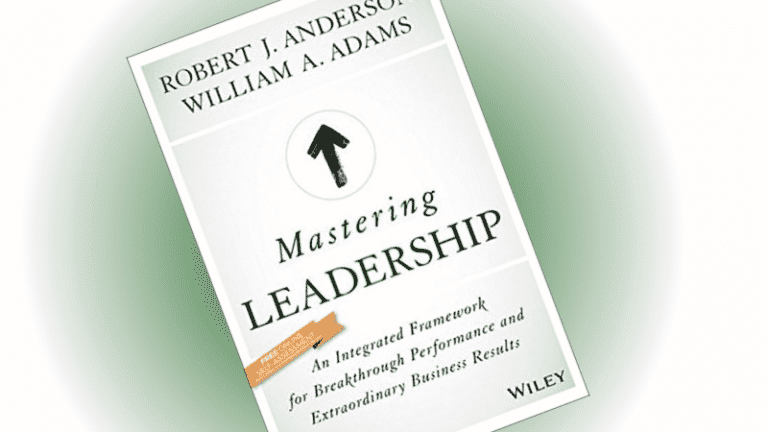

Mastering Leadership: An Integrated Framework for Breakthrough Performance and Extraordinary Business Results
In “Mastering Leadership,” Robert J. Anderson and William A. Adams present a groundbreaking framework that challenges conventional wisdom about leadership. They argue that effective leadership isn’t just about external competencies; it’s deeply rooted in an “Inner Game” of consciousness and personal development. This book offers a Universal Model of Leadership, complete with a Development Framework and a powerful assessment tool, the Leadership Circle Profile (LCP), to guide leaders on a transformative journey. Join us as we explore every important idea, example, and insight from this astute and practical guide, breaking down how to unlock extraordinary performance in yourself and your organization by mastering both the outer and inner dimensions of leadership.
Introduction: A Universal Model of Leadership and the Leadership Circle Profile Assessment
The authors open by setting a compelling stage: leadership today demands more than just working harder or faster. It requires a profound understanding of what makes great leaders truly great—a pursuit rather than a genetic anomaly. The book promises to elevate our understanding of effective leadership and how to accelerate its development through the first Universal Model of Leadership. This model integrates the best theories and research from leadership, organizational development, psychology, and even spiritual traditions.
Marshall Goldsmith praises the book as “the definitive book on leadership principles and practices,” highlighting its expansive yet practical nature. John Mendel from American Honda notes that the book turns “theory into practice,” providing a well-proven framework and practical tools for greater effectiveness. The authors emphasize that individual effectiveness, while necessary, is not sufficient; collective effectiveness is key to navigating rapidly escalating complexity and market volatility. This book aims to be a guidebook for raising consciousness and fostering a competitive advantage in leadership.
The authors share their personal journeys in developing this model. Robert J. Anderson’s career was defined by a conversation with a Trappist monk who revealed that human beings grow through predictable stages of consciousness, which can be measured. This led Anderson to integrate various fields—Leadership, Organization Development, Psychology, Success Literature, and Human Potential—into a comprehensive framework, culminating in the Leadership Circle Profile (LCP). William A. Adams, deeply passionate about leadership development since age 18, found the LCP to be the “first fully integrated and universal model of leadership in the field,” leading to a partnership that brought this book to life.
The Universal Model of Leadership is presented as a dynamic tool that explains how changes in one aspect of leadership predictably affect others. It promises to radically shift our understanding of extraordinary leadership, reveal the link between effectiveness and business results, and provide a complete Leadership Agenda for organizational transformation. The book is structured into two halves: the first for business leaders focusing on the business case and the model, and the second for deeper personal work and development. Readers are encouraged to take the LCP Self-Assessment at www.theleadershipcircle.com to enhance their personal learning journey.
Chapter 1: The Promise of Leadership: Meeting the High Bar of Expectations
This chapter delves into the often-unspoken expectations placed upon leaders, framing them as a “Promise of Leadership” that defines success or failure. When individuals step into leadership roles, they inherit a set of both explicit and implicit expectations. Explicit expectations are clearly defined, like fiscal responsibility and strategy. Implicit expectations, however, are unspoken, such as competence, fairness, inspiration, and active listening. The challenge lies in the fact that stakeholders judge leaders on both, even if these expectations are unrealistic or not communicated.
The authors highlight the high bar of experience and expectations for leaders. Most people can recall very few extraordinary leaders, suggesting that only a small percentage (5-10%) are seen as truly fulfilling the Promise of Leadership. Despite the immense responsibility and increasing complexity, many leaders find their work a “calling,” relishing the opportunity to influence and create positive results. This underscores why leadership matters so deeply. Bill Adams shares a personal anecdote from his early career at Blue Cross Blue Shield, where high-potential new hires actively sought out “refugee camps” – departments led by truly great leaders – illustrating how poor leadership can lead to talent drain and wasted investment.
The book outlines Four Universal Promises of Leadership:
- Set the right direction and create meaningful work: Leaders are responsible for defining vision, strategies, mission, values, and culture. This provides a clear line of sight for employees, linking their contributions to a higher purpose.
- Engage all stakeholders and hold them accountable: This involves inspiring trust and commitment by connecting individual contributions to the organization’s value creation. Leaders are expected to unlock inherent potential and discretionary energy from their teams.
- Ensure that processes and systems facilitate focus and execution: Effective execution systems channel action into results and provide feedback. Leaders break this promise by failing to provide resources, allowing distractions, having ineffective processes, or becoming overly process-bound. Stephen Ewing emphasizes that “results without process can’t be replicated and process without results is worthless.”
- Lead effectively—maintain relationships of trust to achieve and sustain desired results: This is the foundational promise, requiring ongoing personal and professional development. It also emphasizes collective leadership effectiveness, where leadership teams collaborate transparently to navigate challenges and achieve shared goals.
Broken leadership promises lead to a loss of credibility, erosion of trust, and suffering performance. For instance, leaders who claim to value individuals but lead from a top-down perspective break promises. Consciously competent and authentic leadership, however, builds credibility and trust, fostering a reciprocal relationship where leaders acknowledge weaknesses and constituents respond with understanding. The chapter concludes by defining the Leadership Agenda as mastering the art and practice of leadership, a key strategic priority for the Top Team, crucial for business performance and value creation.
Chapter 2: Leadership Effectiveness and Business Performance: The Primary Competitive Advantage
This chapter makes a powerful case for why leadership effectiveness is a primary competitive advantage, directly linking it to business performance. The authors assert that without believing in this link, organizations won’t make leadership development a strategic priority. Often, leadership development is relegated to a staff function, overlooking the immense potential of collective leadership effectiveness.
The research shows a strong correlation between Leadership Effectiveness (measured by the LCP) and a Business Performance Index. This index is constructed from criteria like revenue, market share, profitability, and new product development. Studies on over 2,000 businesses reveal that improving leadership effectiveness has a 38% probability of translating into higher business performance—a significant lever well beyond most companies’ profit margins. Furthermore, in the highest-performing businesses (top 10%), the average Leadership Effectiveness score was at the 80th percentile, while in the lowest-performing businesses (bottom 10%), it was at the 30th percentile. This aligns with Zenger-Folkman research, which suggests that leaders above the 80th percentile produce twice the results of those in the middle 60 percentile. Essentially, each 80th-percentile leader outperforms middle-range leaders six-fold. Jim Collins’s “Good to Great” research, initially aiming to avoid leadership as a primary factor, ultimately concluded that Level Five Leadership (a blend of fierce resolve and humility) was critical for sustained high performance.
The concept of the Leadership Quotient (LQ) is introduced as a metric to measure if leadership is a competitive advantage: LQ = Leadership Effectiveness / Leadership Ineffectiveness. An LQ of 1.0 indicates neutral impact. For the highest-performing businesses, the LQ was 4.0 (80%/20%), while for the lowest, it was 0.4 (30%/70%). This 10-fold difference strongly suggests that high LQ scores indicate a significant competitive advantage. The authors then pose six provocative questions for leaders to assess their own LQ and strategic focus on leadership development.
The chapter emphasizes collective effectiveness, arguing that while individual effectiveness is necessary, it’s insufficient for extraordinary business performance. The Extended Leadership Team (ELT), comprising the top four levels of leadership (L1-L4), significantly impacts organizational performance. Peter Senge notes that the collective intelligence of most groups is often well below the average intelligence of their members, due to dynamics like aggressive advocacy, poor listening, and mistrust. This leads to an LQ of less than one. The ELT’s ability to find leverage points—actions with magnified positive and lasting impact—is crucial, and this often requires honest, courageous conversation. The example of Marilyn Carlson Nelson from Carlson Companies demonstrates how a courageous statement (“We are defined by what we tolerate”) can align a leadership team and drive both culture and performance. The quality of leadership conversations directly determines collective effectiveness, intelligence, and ultimately, business performance.
Chapter 3: Mastery and Maturity, Consciousness and Complexity: The Leadership Development Agenda
This chapter makes a profound argument: masterful leadership requires both a well-honed “Outer Game” (capability) and a highly-evolved “Inner Game” (consciousness and maturity). The Inner Game, which runs the Outer Game, is often overlooked in leadership development, leading to insufficient breakthroughs. The vivid example of the 1988 Winter Olympics figure skating competition, particularly Debi Thomas’s “Play-Not-To-Lose” mindset versus Elizabeth Manley’s “Play-To-Win” approach, illustrates how an inner game can make or break performance.
The authors contend that competency is only half the game. While technical, managerial, and leadership competencies (the “Outer Game”) are necessary, true great leadership goes beyond skills and capabilities, involving qualities like integrity, courage, authenticity, and self-awareness—elements of the “Inner Game.” Leaders need to be effective in three areas:
- Leadership Process: The science of leadership and management, focusing on resource allocation and effective utilization through systems.
- Leadership Competencies: The “outside game” skills required for success.
- Leadership Consciousness: The “inside game” or leader’s inner operating system (IOS), encompassing meaning-making, decision-making, values, emotional intelligence, mental models, and personal identity.
The central premise is that the inner game runs the outer game. A breakthrough in the inner game can lead to sudden shifts in outer game effectiveness and significant performance gains. The story of Rob, a senior supply chain manager who transformed from an “ogre” (autocratic, critical) by addressing his fear of failure and restructuring his inner game, beautifully demonstrates this. By confronting his underlying beliefs, Rob became “much more effective” and “a much happier person.”
The chapter lays out Four Foundational Premises underpinning the Universal Model of Leadership:
- Structure determines performance: Like a Honda Insight designed for economy, an individual or organization is designed for the performance it gets.
- You are a structure: Individuals possess a complex psycho-physical structure, with an inner game (IOS) that functions like a computer’s operating system, mediating and managing everything on the surface.
- Consciousness is the operating system of performance: Our level of consciousness, with its embedded thoughts, beliefs, and assumptions, largely determines our reality and effectiveness.
- To achieve higher performance, you must be restructured: Breaking through to higher performance requires a Metanoia—a transformation of heart and mind, a metamorphosis (like a caterpillar to a butterfly) where the old structure disintegrates and reintegrates into a higher-order form.
The concept of consciousness and complexity is introduced. Today’s VUCA world (Volatile, Uncertain, Complex, Ambiguous) presents rapidly escalating adaptive challenges that cannot be solved from our current operating system. Barry Johnson’s distinction between Problems (solvable) and Polarities (dilemmas to be managed) highlights the enduring nature of complexity. Redundant polarities—interdependent dilemmas—further complicate leadership. Finding non-obvious points of leverage in such complex systems requires collective intelligence and an evolved operating system.
This leads to the Leadership Imperative: the development of leadership effectiveness must at least match the pace of change and escalating complexity. If a leader’s or the collective leadership system’s “complexity of mind” doesn’t evolve, it becomes a competitive disadvantage. Jack Welch’s success at GE is cited as an example of leveraging leadership development as a primary competitive advantage. The core argument is that escalating complexity demands an evolution in the creative, adaptive capacity of leadership, meaning continuous restructuring of the IOS. Katherine’s story of leading her media company through a severe economic downturn by doubling down on leadership development illustrates the profound ROI of this approach. The chapter concludes by calling this essential leadership journey “uncommon sense,” emphasizing that there are “no shortcuts to greatness” and that it “will ‘cost not less than everything’.”
Chapter 4: Stages of Development: The Backbone of the Universal Model of Leadership
This chapter reveals the core argument of the book: that individual and collective leadership effectiveness are harmoniously related to levels of consciousness and performance. It introduces the Stages of Development Framework as the fundamental backbone of the Universal Model of Leadership, explaining how consciousness evolves through predictable, universal, and invariant stages.
The authors explain that unless leaders understand how development happens, they risk under-designing and under-investing in the Leadership Agenda, leading to unsustainable performance improvements. Bill Adams shares his personal experience, noting that until he understood Stage Development, his transformation work felt incomplete. He stresses that organizations do not transform—people do, and only higher-order consciousness can lead sustainable transformations. He notes that the failure of 70-85% of transformation efforts stems from a lack of understanding of the deep transformation required of leaders.
The Stages of Development Framework, primarily drawing from Robert Kegan’s work, maps the trajectory of human consciousness from infancy to mature stages. Kegan’s five-stage model is adapted into the Universal Model to include:
- Childhood (Kegan’s first stage).
- Egocentric Leadership (Kegan’s Self-Sovereign Mind), describing an adolescent level of development.
- Reactive Leadership (Kegan’s Socialized Self).
- Creative Leadership (Kegan’s Self-Authoring Self).
- Integral Leadership (Kegan’s Self-Transforming Self).
- Unitive Leadership (added by the authors to include higher spiritual stages).
These stages represent Vertical Development—progressive, higher-order structures of mind. The Leadership Circle Profile (LCP), while not directly measuring stages, is built around this framework and correlates to measures of stage, primarily focusing on Reactive and Creative minds, and pointing to Integral.
The Correlation Conclusions from a study with the University of Notre Dame’s Mendoza College of Business are groundbreaking. The correlation between Stage of Development (MAP) and Leadership Effectiveness (LCP) was a strong .65. This implies that a significant component of a leader’s effectiveness is their operating stage. Breaking down the average effectiveness scores by stage:
- Reactive leaders averaged at the 40th percentile (LQ of 0.67), suggesting leadership as a competitive disadvantage.
- Creative leaders averaged at the 65th percentile (LQ of 1.9), indicating a strong competitive advantage.
- Integral leaders averaged at the 90th percentile (LQ of 9.0), demonstrating extraordinary effectiveness.
This research strongly suggests that consciousness is the deep structure, the operating system, of performance. Higher consciousness brings greater capacity, capability, and mastery to meet complexity.
The chapter then uses childhood development as an accessible way to understand stages. Children’s rapid evolution from a “magical world” (age five) to “Concrete Operational Thinking” (age ten) illustrates four key points about vertical development:
- Obvious capability increases: Each new stage brings new capabilities.
- All stages are necessary and worthy: No stage is “bad.”
- Stages are sequential: Development follows a predictable order.
- Loss and gain at each transition: Old operating systems are deconstructed, and new, more effective ones are reconstructed—a disintegration-reintegration process.
Finally, the concept of Identity is at the Core. Kegan’s research emphasizes how the ego’s identity restructures itself at each stage, defining how we understand ourselves and deploy our leadership. The LCP’s core “identity” dot reflects this. As identity transforms, so does leadership, changing the results we achieve in the world.
Chapter 5: Five Levels of Leadership: Structures of Mind and Performance
This chapter outlines the five distinct levels of leadership, emphasizing that each represents a triumph of development and a new, higher-order structural design for relating the self to the world. Organizations, the authors assert, cannot function at a higher level than the collective consciousness of their leadership.
The first level discussed is Egocentric Leadership, which primarily defines identity as “I am my needs.” This stage (roughly 8 years old to early adulthood) is characterized by a lack of awareness of others’ competing needs, making decisions based solely on personal satisfaction. The strength is gaining independence, but its structural limit is the absence of a shared reality. In adulthood, this becomes pathological, manifesting as autocratic and destructive leadership, as seen in oppressive dictatorships. The transition out of this stage, typically in adolescence, involves a subject-object shift, where needs become an object of reflection rather than dictating behavior, allowing for engagement with broader societal expectations.
Next is Reactive Leadership (Kegan’s Socialized Self), the normative stage for most adults. This is the triumph of development where individuals learn to “get along” by taking on societal rules, values, and expectations. Identity is formed “outside-in,” by internalizing external messages about worth, safety, and success. The core identity is “I am my unique, well-honed role and capability,” where self-worth and security are dependent on external validation. The Reactive Mind over-extends its strengths, turning them into liabilities. For example, a “Controlling” type like “Carl,” identified by his ability to get results, may undermine teamwork due to an all-consuming drive for perfection.
The three primary forms of Reactivity are:
- Complying Types (Heart-based): Identity tied to relationship capability, seeking acceptance and approval. Their core fear is rejection, leading to conflict avoidance and giving up power.
- Controlling Types (Will-based): Identity tied to achievement and results. Their core fear is failure, leading to taking up power at others’ expense, dominating, and undermining collaboration.
- Protecting Types (Head-based): Identity tied to intellectual brilliance, seeking to be seen as smart and superior. Their core fear is vulnerability, leading to emotional distance and harsh analytical criticism.
The bottom half of the Universal Model and LCP maps these 11 Reactive dimensions. Research shows a strong inverse correlation (-.68) between Reactive Tendencies and Leadership Effectiveness. Reactive leadership (LQ < 1.0) is outmatched by today’s complexity, naturally gravitating towards patriarchal, hierarchical, and mechanistic organizational forms. Most change efforts to create more agile, engaged cultures fail because leaders operating from a Reactive Mindset “cannot replicate Creative practices and structures on their own.”
The transition to Creative Leadership (Kegan’s Self-Authoring Self) is the major shift in adult life, characterized by shedding old, externally defined assumptions and initiating a more authentic, inside-out version of oneself. Leaders ask, “Who am I? What do I care most about?” This leads to a new sense of purpose and vision, no longer dependent on external validation. The example of a hospital’s senior leadership team, all with high “Perfectionism” scores, illustrates how acknowledging a false belief (“I am better off if I am perfect”) can lead to a breakthrough in strategic planning and leadership.
The top half of the Universal Model and LCP maps the Creative Mind using 18 Creative Competencies, summarized into five categories: Achieving, Systems Awareness, Authenticity, Self-Awareness, and Relating. These competencies are strongly and positively correlated (.93) to Leadership Effectiveness. Creative leadership (LQ ≈ 1.9) provides a significant competitive advantage. Organizations led by Creative minds are more empowering, engaging, and collaborative, with flatter structures and shared leadership. However, only about 20% of leaders operate at this level, highlighting the Leadership Imperative to accelerate this development.
Finally, Integral Leadership (Kegan’s Self-Transforming Self) represents a higher-order consciousness built for complexity. The visionary leader expands their focus to systemic welfare, becoming a Servant Leader and architect of the whole system’s future. Integral leaders can hold opposites in tension without reacting, fostering synergistic solutions. This requires a deeper internal transformation—realizing “I am many selves: I am an ecology of selves that are often in discord.” This involves embracing the shadow side (undeveloped strengths), which allows them to engage others and the system with greater acceptance and compassion. Only about 5% of adults reach this stage, yet they demonstrate extraordinary effectiveness (LQ ≈ 9.0) and are best suited to lead sustainable business transformations, as shown by Bill Torbert’s research. This level of leadership focuses on self-renewing organizations and global welfare.
Unitive Leadership is briefly introduced as the highest level of consciousness, where the self is surrendered to astonishing oneness, transcending duality. This is often achieved through long-term spiritual practice and is characterized by universal compassion, seeing all beings as one. The authors acknowledge that this level is rare and goes “beyond mind.”
Chapter 6: The Universal Model and Metrics: Global Leadership, Cross-Cultural, and Gender Application
This chapter further elaborates on the Universal Model of Leadership, emphasizing its dynamic nature and its broad applicability across cultures and genders, grounded in extensive research. The model’s framework integrates Kurt Lewin’s idea that “there is nothing so practical as a good theory.”
The Stages of Development form the vertical axis of the Universal Model, while the horizontal axis represents the leader’s Relationship and Task balance. Effective leadership requires strength in both. This creates a four-quadrant grid within the Leadership Circle Profile (LCP), illustrating how leaders can manage people and tasks Creatively (engaging, empowering, purposeful) or Reactively (people-oriented but power-deficient, or over-controlling). The Inner Circle of the LCP groups the 18 Creative Competencies into five categories (Relating, Self-Awareness, Authenticity, Systems Awareness, Achieving) and the Reactive dimensions into three types (Complying, Protecting, Controlling), aligning them along the Relationship-Task axis.
The model’s dynamic nature is crucial, as every dimension is interrelated. Research shows that Reactive Leadership is strongly inversely correlated (-.68) to Leadership Effectiveness, while Creative Leadership Competencies are very strongly and positively correlated (.93) to Leadership Effectiveness. Furthermore, there’s a strong inverse relationship between Reactive and Creative Leadership (-.76), meaning as Reactive tendencies increase, Creative leadership decreases. This dynamic insight allows leaders to identify which Reactive strategies might be diminishing their effectiveness.
The concept of Optimal Leadership is explored through a survey of over 50,000 managers worldwide. The Optimal Profile universally depicts leadership as highly Creative with very reduced Reactive styles, showing good balance between task and relationship. This consensus across cultures on what constitutes effective leadership raises the question: why do so few organizations achieve it?
The chapter further reinforces the link to performance and effectiveness. In the highest-performing businesses (top 10%), Creative leadership scores averaged at the 80th percentile, with Reactive scores at the 30th percentile. Conversely, in the lowest-performing businesses (bottom 10%), Reactive scores averaged at the 70th percentile, with Creative scores at the 30th percentile. This stark contrast underscores that Creative leadership is a decided competitive advantage, while Reactive leadership is a disadvantage. The Leadership Quotient (LQ) demonstrates this, with the highest-performing businesses showing an LQ of 2.7 and the lowest an LQ of 0.4.
Dynamic Polarities are highlighted, demonstrating how opposite dimensions in the LCP circle (e.g., Complying and Achieving, Relating and Controlling) are inversely related, explaining why overusing one strength can undermine its opposite. For example, Complying negatively impacts Achieving and other Creative dimensions, while Controlling undermines Relating and Self-Awareness.
The universality of the model is affirmed through cross-cultural data. Analysis of LCP data across various global regions shows remarkable consistency in the correlation of Creative Competencies to Leadership Effectiveness. While slight variations exist in Reactive dimensions (e.g., patriarchal cultures may show less inverse correlation with Controlling), the overall picture of effective leadership is consistent worldwide. A compelling case study in rural Uganda demonstrates the model’s application, where the Uganda Rural Training and Development (URDT) organization, founded by Mwalimu Musheshe, applied systemic and Creative Leadership principles to drive community development, eventually founding the Africa Rural University (ARU) to cultivate rural transformation leaders. This highlights the six-fold multiple on leadership seen in extraordinary Creative leaders.
Finally, the chapter addresses gender and the Universal Model. Data from 250,000 raters indicates that women consistently score higher on Creative dimensions (57th percentile) and lower on Reactive dimensions (42nd percentile) than men. Women also score slightly higher on overall Leadership Effectiveness. While the practical significance of these differences is modest (except for “Caring Connection” where women significantly outperform), the findings suggest a pent-up demand for what women bring to leadership, particularly in shifting towards more highly engaged, relational business cultures.
Chapter 7: The Leadership System: The Central Organizing System
This chapter asserts that the Leadership System is the central organizing system of any business, crucial for sustained high performance and often an underutilized asset. The authors highlight that most leaders fail to recognize this, often relegating leadership development to a non-strategic staff function.
The chapter introduces the Six Systems of Organizational Effectiveness that must be developed and maintained for businesses to thrive:
- Leadership: The central system, defining organizational identity, vision, strategy, and alignment. It establishes Key Leadership Processes and creates the leadership culture, acting as the organization’s cultural DNA. Leaders must ensure the effective functioning of all other systems.
- Communication: Creates organizational meaning and influences the performance culture. Leaders attend to the quality of daily conversations, fostering an “on-the-table” culture.
- Accountability: Translates vision into goals, actions, and clear expectations, aligning consequences with performance. It emphasizes discipline in leadership processes.
- Delivery: Focuses on developing simple, efficient, and adaptable processes for quality products and services.
- Performance (Human): Designed to attract, develop, and retain talent, ensuring proper rewards and loyalty.
- Measurement: Establishes metrics, reviews, and course corrections to track progress and ensure disciplined processes.
These six systems are interdependent, and the Leadership System is the nucleus. For example, an Accountability System cannot be sustained if the Leadership System doesn’t model it.
The authors advocate for a Whole Systems approach to developing leadership, balancing competence with consciousness. They define Enterprise Leadership as a state where the Extended Leadership Team (ELT) operates with unwavering commitment to a “whole system” accountability, transcending organizational boundaries. This maturity leads to exponential increases in effectiveness. They contend that successful transformation efforts are those where the ELT “did its work” of mastering leadership, whereas failures are linked to the inability of leadership to consciously transform.
Four compelling case studies illustrate this approach:
- EverBank Commercial Finance: Jim McGrane, CEO, deeply committed to leadership development, led USXL from a start-up to a rapidly growing company. His initial LCP (2007) showed 93rd percentile Creative scores (LQ of 2.0), making his leadership a competitive advantage. During a turbulent period (2008-2011) after an acquisition by Tygris and a denied bank charter, Jim’s LCP (2011) showed his LQ had halved to 1.0, and his senior team’s LQ dropped to 0.76. Recognizing this “wake-up call,” Jim recommitted to leadership development, implementing a multi-year Leadership Development System involving LCPs, Promise of Leadership workshops, Leader-to-Leader sessions, and Pulse Surveys. By 2013, Jim’s LQ returned to 2.0, his senior team’s LQ doubled to 1.6, and the ELT’s LQ went from 0.5 to 1.0. Simultaneously, assets under management quadrupled from $500 million to $2 billion, and new business origination surged. Jim’s story, tragically cut short, serves as a testament to the power of dedicated leadership development. A follow-up Equipment Leasing & Finance (ELF) industry study validated the correlation between effective leadership cultures and higher growth rates (11% vs. 2%).
- Global Shared Services, McDonald’s Corporation: Kelvin McLaurin and Debbie Ballard embedded The Leadership Circle process into their GSS culture, requiring new leaders and high-potentials to participate. This fostered a culture of openness, support, trust, and high performance, enabling the team to achieve their five-year strategic plan in three years and set ambitious future goals.
- Honda Precision Parts of Georgia (HPPG): Plant Manager Mike Jett was “shocked” by his first LCP (LQ of 0.4 in 2012), realizing he was an “ogre” (controlling). Motivated to change, he put his profile on his desk as a daily reminder. He engaged his entire plant in the Honda Leadership Summit (HLS) program, focusing on reducing Reactive characteristics (Controlling, Protecting, Complying) and developing Creative competencies (Relating, Self-Awareness, Authenticity, Systems Awareness, Achieving). His subsequent LCP (2014) showed his LQ improved to 1.2, and HPPG saw major gains across the board: 8% productivity increase, injury rate drop from 9 to 0.5, significant quality improvements, and a reduction in engineering attrition from 17% to 6%. Mike emphasized the shift from “top-down control” to a servant-leadership approach.
- Global Technology Service Provider (Asia Pacific): Facing a multi-million dollar contract termination due to client dissatisfaction, the service provider engaged Full Circle Group. An LCS revealed internal relational and cultural dynamics mirroring the client’s experience. Through LCP 360s, executive coaching, Vision Journey Mapping, Leader-to-Leader sessions, and culture change workshops for 800 employees, the leadership team “collaborated to consciously change from within.” Service penalties dropped 700-fold in 9 months, the sales pipeline increased five-fold, and customer satisfaction soared. The client不仅 postponed contract cessation but reaffirmed old ones and signed new multi-million dollar deals.
These cases demonstrate that owning development from the top is critical. When senior leaders fully commit to the Leadership Agenda, they create a distinct competitive advantage and sustainable results.
Chapter 8: Reactive Leadership: An Insufficient Triumph of Development
This chapter delves into the Reactive Mind, which, while a developmental triumph in enabling adults to navigate societal expectations, ultimately reaches its limits in today’s complex world. It’s often insufficient for leading transformative change because it’s designed to merge with, not challenge, the prevailing culture.
The chapter begins by revisiting Reactive Leadership’s performance review. Research shows a strong inverse correlation (-.68) with Leadership Effectiveness and a negative correlation (-.31) with Business Performance. Reactive leaders typically have an LQ of less than one, indicating a competitive disadvantage. In underperforming businesses, Reactive scores average at the 70th percentile.
The popular workplace adage, “Leave your ego at the door,” is challenged. The authors explain that our ego is our Inner Operating System (IOS), and Reactive mode operates from deeply ingrained, unconscious assumptions. The story of Duke, a CEO who initially reacted defensively to feedback about his controlling style despite wanting team collaboration, perfectly illustrates this. His “I dare you” attitude initially stifled honesty, revealing how the Reactive ego, on autopilot, can undermine best intentions and keep crucial dynamics hidden.
The authors identify Two Primary Movements in the self’s transformation from Reactive to Creative Mind:
- Purpose and Safety, Love and Fear: Life’s primary tension is between pursuing purpose (spark, love) and seeking safety (fear). Reactive Mind habitually prioritizes safety, playing a “Play-Not-To-Lose” game, which is fear-based. This contrasts with a “Play-On-Purpose” game, driven by love and vision. David Whyte’s poem “Out on the Ocean” powerfully captures this internal struggle between aspiration and the fear that causes us to “fill with dense smoke” if our purpose remains unlit. Leadership, by nature, is risky; there’s no safe path to greatness.
- From Outside-In to Inside-Out: Reactive Mind is the Socialized Self, constructed from external messages and expectations. Its identity depends on outside validation (e.g., “I am okay if you like me”). This leads to an external locus of control. The story of Bob’s own struggle as a young, frustrated consultant, who realized his ineffectiveness stemmed from his need for approval (making his “worth and security” dependent on others), highlights this shift. His breakthrough came when he recognized his core Reactive assumption, “I am okay only if you always like or admire me,” and began to challenge it, allowing his Creative, Self-Authoring voice to emerge.
The Structure of Reactive Mind is problem-focused and fear-driven. It’s designed to oscillate around a set point, maintaining equilibrium rather than fostering continuous growth. The story of the insurance salesman whose sales results fluctuated predictably—driven by his disgust with himself when results were low, and then easing off when things improved—is a classic example of this balancing loop. This oscillating pattern stems from unseen, externally-defined beliefs that tie self-worth to meeting external expectations. Reactive leadership, therefore, is a “balancing loop” designed to maintain current reality and acts like an immune system against true change.
Core Operating Beliefs are the deep, often unconscious assumptions that form our identity (e.g., “Worth and Security = X”). These beliefs, like “I must be perfectly successful to be okay” in Bob’s football story, become self-limiting. They dictate behavior (e.g., micromanaging to avoid failure), creating liabilities.
In summary, Reactive Structure is inadequate for today’s leadership because:
- It’s formed to merge with existing culture, not change it.
- It’s problem-focused, aiming for equilibrium, not new futures.
- It’s fear-driven, prioritizing safety over purpose.
- Success in Reactive strategy attenuates the motivation for change.
- It’s based on externally validated beliefs, leading to habitual, uncreative responses.
- It inherently compromises larger purpose and vision for safety.
The Leadership Agenda demands a shift from Reactive to Creative Mind. When leaders champion bold change while still operating from Reactive patterns, they unwittingly undermine the very transformation they desire. The chapter ends by emphasizing that Reactive Leadership is insufficient to orchestrate dramatic shifts in performance, and instead tends to re-establish Patriarchy.
Chapter 9: Reactive Leadership at Work: From Patriarchy to Partnership
This chapter explores how the Reactive Mindset in leadership naturally leads to the establishment and tenacious re-establishment of patriarchal organizational structures and cultures. It argues that transforming these cultures requires a shift to a Creative Mindset.
The core idea is the transition from Patriarchy to Partnership. Patriarchy, often characterized by top-down control, worked in less complex times or crises. However, today’s competitive environment demands a shift towards more diverse, collaborative, and engaged Partnership cultures. The authors point out that leaders often “block their own progress” in this transition; their deeply ingrained, unseen Reactive mental models, identities, and beliefs, formed within patriarchal systems, cause them to “act out” those very systems they are trying to change. This inconsistency between vision and behavior leads to mixed messages, caution, and ultimately, failed transformation efforts. The critical insight is that “organizations do not transform—people do,” meaning leaders must personally transform first.
Navigating Two Journeys simultaneously is essential: the system journey (changing organizational structures and processes) and the personal journey (the profound internal changes required of leaders). Most leaders focus heavily on system change but neglect the personal transformation needed, leading to failures because the underlying Reactive Mindset is incapable of ushering in Creative-level change. Leaders are the culture they are trying to change, and they must “redesign themselves.”
The chapter identifies Three Core Reactive Types, derived from Karen Horney’s “Move Toward,” “Move Against,” and “Move Away” trends, and reflected in the Enneagram and other typologies. These types, when operating from a Reactive mindset, create patterns that perpetuate patriarchal cultures:
- Heart Type (Complying): “Move Toward” others, seeking acceptance and love. Their core identity is tied to relationships (“I am okay if you like me”). The strength is building harmony, but the Reactive limitation is giving up power to avoid rejection, leading to conflict aversion and a failure to lead decisively.
- Will Type (Controlling): “Move Against” others, focused on achieving results and gaining power. Their identity is tied to accomplishments (“I am okay if I am the one who gets results”). The strength is driving action, but the Reactive limitation is taking up power at others’ expense, leading to domination and undermining collaboration.
- Head Type (Protecting): “Move Away” from others, relying on intellect and rationality. Their identity is tied to being smart and superior (“I am okay if I am smart, self-sufficient”). The strength is providing analytical insight, but the Reactive limitation is emotional distance and harsh criticism, stemming from a fear of vulnerability.
Each type has true gifts, like the Heart type’s loyalty, the Will type’s drive, and the Head type’s discernment. However, these gifts become “gifts hung on a Reactive Structure” when the leader’s identity is fused with them. For example, a Complying type’s need for acceptance undermines their relational gift by making them conflict-averse. The Inner Circle Correlation Matrix (Table 9.2) demonstrates how Reactive dimensions like Complying, Controlling, and Protecting are inversely correlated with Creative dimensions and overall Leadership Effectiveness, effectively taking their own gifts “off the table.”
Reactive Type Dynamics are evident when different types interact. The story of Ken (Complying-Protecting) and Jack (Controlling-Protecting), two senior oil refinery managers who “could not get along,” vividly illustrates this. Jack called Ken a “wimp,” while Ken saw Jack as an “animal.” Their LCPs revealed them to be opposite types, each triggering the other’s core fears (failure for Jack, rejection for Ken). Their breakthrough came when they gained insight into their own Reactive operating systems and saw how each contributed to the dysfunctional dynamic. This realization, coupled with a willingness to challenge their underlying assumptions, allowed them to change their interactions.
The Universal Model of Leadership effectively maps these Reactive dynamics, showing how these 11 Reactive behaviors stem from self-limiting beliefs. The structural opposition of Complying and Controlling on the LCP visually represents their mirror-image identities.
Finally, the chapter explains the natural selection process that creates collective patterns of Patriarchy. Controlling types tend to rise to senior levels due to their drive for results, while Complying types often populate middle and lower levels, prioritizing loyalty and meeting expectations. This creates a reciprocal, self-reinforcing dynamic where leaders at the top take control, and those below comply, each getting their ego/identity needs met. This perpetuates patriarchal structures, where collective effectiveness and intelligence suffer, leading to the failure of strategies. The chapter concludes by reiterating that Reactive Leadership is insufficient to build the Creative partnership cultures needed today.
Chapter 10: Creative Leadership: Fulfilling the Promise of Leadership
This chapter focuses on Creative Leadership, a profound shift in consciousness that is essential for effective leadership in today’s complex world. It begins by reiterating the performance review of Creative Leadership: it’s strongly and positively correlated (.93) to Leadership Effectiveness and significantly outperforms Reactive Leadership. Leaders operating from a Creative mindset average at the 65th percentile in effectiveness (LQ of ~2.0), providing a big competitive advantage.
The transition from Reactive to Creative Mind is described as the Hero’s/Heroine’s Journey, a “spiritual boot camp” or Metanoia. It’s arduous because it involves letting go of the old, familiar Socialized/Reactive Self—the one that defines worth externally and plays “not-to-lose.” This old self must “die” (disintegrate) to allow a new, higher-order self to emerge, free from the limitations of past conditioning. The butterfly metamorphosis serves as a powerful metaphor for this disintegration-reintegration process.
The chapter then illustrates what the transition looks like through the story of Joe, a Chief Technology Officer. Joe, initially an aggressive, controlling-protecting Reactive leader, was shocked by his 360-degree feedback. His breakthrough came when he realized, “I can chase results with the best of them… But, if you want me to write what I really want, I don’t have a clue.” This moment marked his ability to take a perspective on his externally defined Reactive structure, opening up the core organizing questions of the Creative Mind: “Who am I if I am not my ability to get results? What do I really want? What would I do if I could?” This highlights the vulnerability and courage required in this transformative journey.
The authors explain that the leadership literature has been “talking about it without knowing it” – describing Creative Leadership competencies (like visionary, authentic, collaborative leadership) for decades without understanding the underlying vertical development in consciousness. Robert Kegan’s insight that these capabilities “arise naturally on Creative Mind, but do not reliably boot up on Reactive Mind” is central to this argument.
The Creative Structure of Mind is fundamentally different from the Reactive. While Reactive Mind creates an oscillating pattern of performance, seeking equilibrium and returning to “normal,” Creative Mind is designed for change and creation. It is purpose-focused (not problem-focused), driven by passion (love, not fear). This focus leads to action, not reaction, and creates a “growth loop” where clarity of purpose fuels passion, which drives action, leading to further clarity and passion. This is a virtuous cycle designed to seek vision, not equilibrium.
The Creative Structure of Identity is inside-out, not dependent on outside validation. Leaders operate from their own internally discerned sense of purpose, values, and vision. This is why it’s called Self-Authoring (Kegan), Independent (Covey), or Individualist (Cook-Greuter). The process of restructuring identity beliefs involves recognizing and challenging the old, externally structured Reactive assumptions (e.g., “I am okay if you like me”) and replacing them with new, internally valid ones (e.g., “I am responsible for, and capable of, creating my own future”). Rob’s transformation story from Chapter 3 is revisited as a perfect illustration of this shift, where he managed his fear and anger by recognizing the illusion of his old, externally defined identity, leading to vastly improved effectiveness.
Creative Leadership is designed for leading change. It has the inner resources to manage Reactive tendencies and stay the course, unlike the Reactive Mind which reverts to old patterns. The Leadership Circle Profile (LCP) further illustrates Creative Mind and Performance. The two dimensions most highly correlated to Leadership Effectiveness are Purposeful Visionary (.91) and Teamwork (.89). When combined, their correlation reaches .94, highlighting that clear, purpose-driven vision coupled with strong alignment among stakeholders is paramount. Alignment (as depicted by Peter Senge) is key, shifting from fragmented efforts to a unified direction driven by shared purpose.
The chapter introduces the concept of “Path of Development—Move Toward Your Near Enemy.” This counterintuitive approach suggests that to develop from Reactive to Creative, one should focus on maturing their core Reactive “gift.” For example, the “near enemy” of Achieving is Controlling. While a Controlling type uses control to get results, it often undermines true achievement (as Controlling is inversely correlated to Achieving). The path of development is to free the “will” gift from its Reactive structure (Controlling) and mature it into Achieving, which involves embracing “power with” rather than “power over.” Similar “near enemy” relationships exist for Complying (near enemy of Relating) and Protecting (near enemy of Awareness/Authenticity). The goal is to “transcend and include”—keep the gift, but jettison the liabilities of the Reactive structure, allowing the core strength to emerge in a higher, more effective form. This makes the Universal Model a powerful development system.
The Universal Model is summarized as a Type through Stage Model, where three core types (Heart, Head, Will) evolve through sequential stages. Creative Organizations are those designed, led, and sustained by Creative leaders, fostering lean, agile, innovative, and high-performing cultures.
The chapter concludes by integrating the concepts of Reactive and Creative transformation. It emphasizes that literacy in the pathways of transformation is critical, requiring leaders to navigate two currents: the Ascending Current (orienting on highest aspirations/purpose/vision) and the Descending Current (facing and transforming doubts and fears, descending into what needs to be shed). The Jonah story is used as a powerful metaphor for this descent into the “belly of the whale” for transformation, akin to the butterfly in the cocoon. Ultimately, the heroic transformative journey is about becoming the leader who can embody their vision, transforming both self and organization.
Chapter 11: Six Leadership Practices: Spiritual Boot Camp for Leaders
This chapter outlines six essential leadership practices designed to reliably mature the Inner Game and develop Outer Game capabilities, serving as a “spiritual boot camp” for leaders. These practices are interdependent and transform Reactive Mind into Creative Mind and beyond.
- Discern Purpose: Leadership is purposeful, and its primary task is to discern our life’s purpose. Warren Bennis emphasizes that “Becoming a leader is synonymous with becoming yourself.” Bob Anderson’s personal story of realizing “I am not becoming who I am” while working in a feed plant illustrates this profound moment of discerning one’s “Musts” – the deepest aspirations for life. He was inspired by Rainer Maria Rilke’s “Letters to a Young Poet,” which urges one to “Go into yourself. Search for the reason that bids you write; find out whether it is spreading out its roots in the deepest places of your heart… Must I write?” This practice harnesses the “genius, power, and magic” that W.H. Murray describes as emerging from commitment. Stalking your longing involves paying attention to moments of joy and excitement (the Ascending Current) and moments of misery (what’s intensely missing, the Descending Current). Purpose is connected to what the world needs, where our passion, curiosity, and talent intersect with societal needs, as highlighted by Albert Schweitzer and Viktor Frankl. Steve Jobs emphasized “connecting the dots looking backwards,” trusting that purpose will unfold. This discipline, central to the Creative, Self-Authoring Mind, cultivates passion and conviction, providing the “staying power” for transformation.
- Distill Vision: This is the ongoing discipline of translating purpose into a desired future vision, individually and collectively. Vision is the centerpiece of effective leadership, as noted by countless authorities. The Purposeful Visionary dimension on the LCP is most highly correlated with Leadership Effectiveness (.91). Vision has five key elements:
- Personal: Self-authored, flowing from inner purpose.
- Specific: Clear enough to be recognizable when achieved, guiding strategy and action.
- Strategic: Defines how to get from current reality to the future, contributing uniquely to real needs.
- Lofty: Captures highest aspirations, appeals to deep values, and provides meaning beyond profit.
- Collective: Catalyzes alignment by engaging others in dialogue, finding common ground, and enabling them to see how their personal purposes align with the organizational vision.
The combination of Purposeful Visionary and Teamwork (.94 correlation) is the strongest predictor of Leadership Effectiveness. This practice awakens the Creative, Self-Authoring Mind.
- Knowing Your Doubts and Fears: This practice involves facing “terrible truth number one”—”I am the problem,” as Ralph Stayer stated. It means taking the Path of Descent into our fears and anxieties when we notice behavior inconsistent with our vision. Bob Anderson’s story of being called an “asshole” by a consultant 10 years later illustrates the profound impact of this practice. He realized his “flaming perfectionism” and need for approval had undermined his leadership, but by facing these fears and underlying Reactive beliefs, he transformed his approach. This discipline allows us to see the illusory beliefs at the core of our fears, freeing us to act authentically. It’s about reframing self-limiting Reactive assumptions and booting up the Creative IOS, which is designed to manifest vision. The work of David Burns (Vertical Thinking, Rational Emotive Cognitive Therapy) is cited as a valuable resource for this process. This practice ensures that purpose isn’t compromised by unconscious Reactive patterns.
- Engage in Authentic, Courageous Dialogue: Transformation requires courage, particularly the courage to tell the truth. Peter Block’s work on getting “bathroom conversations” into the meeting room highlights the cost of caution. Authenticity in the LCP combines Courage (willingness to raise difficult issues) and Integrity (walking the talk). It’s highly correlated to Leadership Effectiveness (.80). Bob Anderson’s story of challenging his CEO in a public meeting demonstrates how acting with courage (despite fearing job loss) can break through a culture of caution and foster genuine conversation, leading to breakthroughs. This practice is necessary for high collective effectiveness and intelligence.
- Develop Intuition, Open to Inspiration: Finding leverage points in complex, “un-figure-out-able” systems requires trusting intuition—a way of knowing beyond rationality. Daniel Webster defines intuition as “attaining direct knowledge… without reference to data.” While often discounted in the workplace, intuition is an innate capability that develops as Creative Mind evolves, reaching its full potential at the Integral level. Bob Anderson’s story of intuiting the “arrogance” of a senior executive in a coaching session illustrates how trusting a “gut sense” can lead to transformative conversations. Quotes from Steve Jobs, Einstein, Pascal, and Poincar´e underscore the power and necessity of intuition in discovery and breakthrough insight. Intuition is the “gateway to the higher more spiritual dimensions” of ourselves, providing access to wisdom and transformative vision.
- Think Systemically: In the presence of a compelling vision, structures and systems must evolve. As Warren Bennis notes, leaders often fail because they ignore the “strong undertow of cultural (structural) forces.” Structure determines performance, and significant changes require addressing underlying structural design, not just symptoms. Reactive Mind is inadequate for this; Creative Mind is required, and Integral Mind is preferred. Developing Systems Thinking (measured by Systems Awareness on the LCP, highly correlated with Leadership Effectiveness at .81) enables leaders to:
- Resist reacting to immediate problems and symptoms.
- Hold creative tension between current reality and vision.
- Use intuition to find leverage points—strategically focused actions that yield multiplied returns.
- Act as architects of structure, guiding systemic redesign and fostering broad-based involvement.
This role demands courage, as structural change confronts ingrained thoughts and beliefs, creating conflict and ambiguity.
The chapter concludes by emphasizing that these six practices are interdependent, reliably evolving consciousness from Reactive to Creative and beyond, leading to high performance. Mastering leadership is a life-long journey of “transcending and including”—overcoming obstacles within ourselves and transforming organizations to fulfill their highest aspirations.
Chapter 12: Integral Leadership: Built for Complexity, Designed for Transformation
This chapter delves into Integral Leadership, positioning it as the ultimate level for navigating today’s extreme complexity and leading profound transformations. The authors emphasize that achieving this stage is a demanding, continuous “death-resurrection process.”
Integral Leadership represents a higher-order consciousness, capable of going beyond the limits of Creative Mind. It’s extraordinarily effective (LQ of 9.0) and rarely achieved (only 5% of leaders operate at this level). The chapter offers a brief summary of stages: Reactive Mind focuses on competence and merging with reality; Creative Mind transforms managers into visionary leaders, shifting from problem-solving to vision-creation, driven by purpose rather than safety. Integral Leadership transcends and includes these earlier capabilities, evolving to the next level.
The Integral leader becomes the “Servant of the System,” expanding their vision to encompass systemic welfare and interdependencies. They shift from strategist to system architect, focusing on optimizing the design of the whole system for the well-being of all stakeholders. This is where Systems Awareness (measured by the LCP) fully blossoms.
Maturing Intuition is another hallmark of Integral leadership. While developing in the Creative stage, intuition reaches its full potential here, allowing leaders to find leverage points in “un-figure-out-able” complex systems, often leading to results that “seem impossible for others.”
Integral leaders are uniquely capable of seeing the entire development spectrum. Having experienced multiple personal transformations, they understand the progressive development process and can effectively mentor and guide others through different stages. This allows them to work effectively with individuals at all levels of development, resolving conflicts between different “real worlds” by forming bridges of understanding. They implement systemic changes at a pace the Leadership System can absorb, fostering evolution without setting the organization up for failure.
A key ability of Integral leaders is holding unresolvedness, conflict, and tension. They can hold huge opposites in tension without reacting or oversimplifying, allowing for breakthrough, high-leverage solutions to emerge from diverse stakeholders. This capacity stems from a profound internal transformation: “As within, so without.” To hold outer conflict, they must address inner conflict. The Descending Current goes deeper, into the shadow—the disowned, often opposite, parts of themselves.
The “meeting of twin opposites” is central to this stage. The Creative Self fragments into an “ecology of many selves,” realizing it’s “both ends of the cylinder.” Bob Anderson’s story of Barbara confronting his controlling nature (his “inner controller”) highlights this painful yet liberating encounter with his shadow. He realized he was projecting his disowned controlling side onto others, hindering his ability to lead. Carl Jung’s concept of shadow as the “opposite choice” (e.g., if “A” is good, “Z” is bad and disowned) means “most of the shadow is solid gold”—undeveloped strengths.
The chapter explains “shadow boxing” in organizations, where opposite types (e.g., Controlling calling Complying types “wimps”) project their disowned qualities onto others, creating mistrust and dysfunctional dynamics. The Universal Model (and the LCP’s “shadow flags”) helps leaders identify these disowned opposite strengths. Mary’s LCP, a strong Controlling-Protecting type with a low Complying score, exemplified this. John’s LCP, despite high Creative scores, also revealed a significant “shadow flag” at Complying, leading to a profound “shadow work” journey where he integrated his “beautiful, tender, big-hearted little boy” parts.
The “Path of Development—Gifts in Shadow” is highlighted as a fierce but rewarding process. Instead of fixing weaknesses, Integral development involves “harvesting the shadow”—reclaiming disowned gifts (e.g., a Controlling type integrating softness and acceptance). This process of fierce compassion allows Integral leaders to integrate inner conflict and accept “all that is forever unfinished” within themselves. This enables them to address systemic division and conflict in the outer world without projecting their shadow, leading to peace and genuine healing.
The example of Mikhail Gorbachev at Reykjavik, telling Ronald Reagan, “I am here to deprive you of an enemy,” is presented as the quintessential act of Integral leadership. Gorbachev’s insight into the “Dance of Enemies” (seeing his and the Soviet Union’s part in the arms race) allowed him to unilaterally disarm, changing the global dynamic from an Integral perspective that Reactive or even Creative minds could not grasp.
The chapter concludes by asking “Why is change so difficult?” and reiterating that it’s due to the deep-seated Reactive patterns (Patriarchy’s shadow) that everyone contributes to. The Integral Leadership Imperative is crucial because only 5% of leaders operate from this stage, which is “built for complexity” due to its:
- Integration of Reactive stage problem-solving and execution skills.
- Mastery of Creative Mind competencies (Self-authoring, Visionary, Authentic, Systems Awareness).
- Ability to self-transform and system-transform.
- Expanded vision of systemic interdependence and welfare.
- Role as a Servant Leader and system architect.
- Cultivation of intuition for leverage.
- Capacity to hold huge conflict without projecting shadow.
- Ability to see that “the enemy…they are us” and to meet difference with compassion.
Chapter 13: Unity: Journey’s End, Development Turned Upside Down
This final chapter touches upon the ultimate level of consciousness: Unity Consciousness. The authors preface it by stating that it’s a brief, humble exploration, as this level of awareness is beyond conventional understanding, defies extensive description, and is rarely experienced.
Unity Consciousness is presented not as a “Stage of Development” in the traditional sense, because from this perspective, duality (and thus separate stages) dissolves. The best metaphor is that of “waves on the ocean.” When identified as separate waves, we experience life as a journey of striving, fear, comparison, and conflict. We seek the “Ocean” (God) as something separate, leading to suffering and a “thirst” that cannot be quenched by external striving. However, in Unity Consciousness, we awaken from the “dream of our separate wave-ness,” realizing that we are the Ocean itself, always one with it, and that all waves are interconnected. The search ends, and problems evaporate.
In this state, the concept of a separate “self” dissolves—“No Self, All God.” Meister Eckhart’s prayer “God rid me of God” and Wei Wu Wei’s statement “Why are you unhappy? Because 99.9 percent of everything you think… is for yourself—And there isn’t one” illustrate this non-dual reality. This is the experience of Satori, Nirvana, the Kingdom of Heaven, characterized by pure joy, freedom, love, and bliss.
The chapter then addresses the paradox of “Development Turned Upside Down.” If Unity Consciousness is identity-less and beyond ego, then self-development work cannot lead to it. All efforts at self-improvement, seeking, and striving actually maintain the ego-self, preventing this ultimate surrender. The journey of self-development is presented as a preliminary step to the breakthrough to Unity.
Two arguments are made for the necessity of development:
- Practical Effectiveness: No amount of Unity Consciousness replaces the need for developed skills (like aeronautical engineering) to navigate the complexities of the world. For effective leadership, a mature Structure of Mind is required. Most people won’t achieve Unity Consciousness in this lifetime, so development is crucial for effectiveness.
- Maturity for Surrender: Only a mature ego can truly be surrendered. Egos caught in Reactivity cannot surrender. Integral Mind, being the most evolved researched stage, is “mature enough and inclusive enough to surrender the illusion of diversity.” It’s the “optimal ‘place of ambush’ where ego dies” and inherent Unity can be seen.
The concept of Neti-Neti (“not me, not me”) from Eastern tradition is used to describe how each stage of development involves the “death of a small version of our self for a larger version.” Unity is the “big Neti-Neti”—the surrender of self-hood altogether.
Finally, Unity Leadership is described. When leadership stems from Unity Consciousness, justice, non-violence, acceptance, and tolerance become effortless. There is no “other” (we are one Ocean; we are each other). This level of consciousness transcends war, poverty, bigotry, and hatred. Leaders become servants of humanity and stewards of the planet, working tirelessly for universal welfare. The authors conclude by stating their mission: “We exist to evolve the conscious practice of leadership to steward the planet and to awaken us all to our inherent unity.” They invite readers to embrace this imperative to cultivate effective and conscious leadership for a thriving future.
Key Takeaways
“Mastering Leadership” offers a profound recalibration of what effective leadership entails, shifting the focus from mere external competencies to the critical, often-overlooked dimension of inner consciousness and maturity. The book’s central message is that true leadership mastery is a function of continuous personal transformation, moving through predictable stages of consciousness that directly impact organizational performance.
The core lessons:
- The Inner Game Runs the Outer Game: Your internal operating system (IOS)—your beliefs, assumptions, and identity—fundamentally dictates your leadership effectiveness and the results you achieve.
- Leadership is a Journey of Vertical Development: Leaders evolve through distinct stages (Egocentric, Reactive, Creative, Integral, Unitive), each offering a new, higher-order way of making sense of the world and leading. Higher stages correlate directly with significantly higher effectiveness and business performance.
- Reactive Leadership is Insufficient for Today’s Complexity: The Reactive Mind, focused on safety and external validation, leads to oscillating performance and perpetuates patriarchal, ineffective cultures. It’s designed to maintain the status quo, not lead transformative change.
- Creative Leadership is the New Minimum Requirement: Shifting from Reactive to Creative (the “Hero’s Journey”) involves moving from an outside-in to an inside-out identity, driven by purpose and vision rather than fear. This mindset creates growth loops and enables effective, collaborative, and innovative leadership.
- Integral Leadership is Built for Complexity and Transformation: This rare stage integrates and transcends earlier levels, allowing leaders to manage profound conflicts, embrace paradoxes, and see the interconnectedness of all systems. It involves deep “shadow work”—integrating disowned parts of oneself—which enables true fierce compassion and systemic healing.
- The Leadership Agenda is a Strategic Imperative: Organizations must consciously invest in the vertical development of their leadership system, recognizing that collective effectiveness is a primary competitive advantage. This requires leaders to “do their own work” first.
- Transformation Involves Two Currents: Leaders must learn to navigate both the Ascending Current (pursuing purpose and vision) and the Descending Current (facing and transforming doubts, fears, and internal limitations).
Next actions:
- Take the LCP Self-Assessment: Go to www.theleadershipcircle.com to gain immediate insight into your current leadership profile through the lens of the Universal Model. This is the crucial first step to understanding your Inner Game.
- Identify Your Core Reactive Tendencies: Reflect on the Reactive dimensions (Complying, Protecting, Controlling) that most resonate with your current leadership style. Understand how your core identity beliefs might be limiting your effectiveness.
- Discern Your Purpose and Distill Your Vision: Begin or deepen your practice of identifying your deepest “Musts” and translating them into a clear, compelling vision for your life and leadership.
- Commit to Authentic, Courageous Dialogue: Identify one area where you typically hold back or avoid difficult conversations. Practice speaking your truth with integrity and courage, even when it feels risky.
- Embrace Your Inner Game: Start a practice of noticing your doubts and fears. Instead of reacting to them, inquire into their underlying assumptions and challenge their validity. Remember, transformation requires going deeper.
- Advocate for Leadership Development: If you’re a senior leader, make leadership development a strategic priority for your organization, not just a HR function. Understand that investing in your leaders’ consciousness is investing in business results.
Reflection prompts:
- What is the primary fear that habitually limits your leadership choices, and what are the unconscious beliefs that fuel this fear? How might challenging these beliefs unlock a higher level of your potential?
- Imagine your organization five years from now, operating from its highest possible Creative or Integral consciousness. What specific leadership behaviors, cultural dynamics, and business results would be evident that are not present today, and what personal transformation must you undergo to lead that shift?
- “What would you do if you could?” If you truly knew you could not fail and would not be fired, what bold, purpose-driven action would you take today to advance your organization’s vision?




Leave a Reply