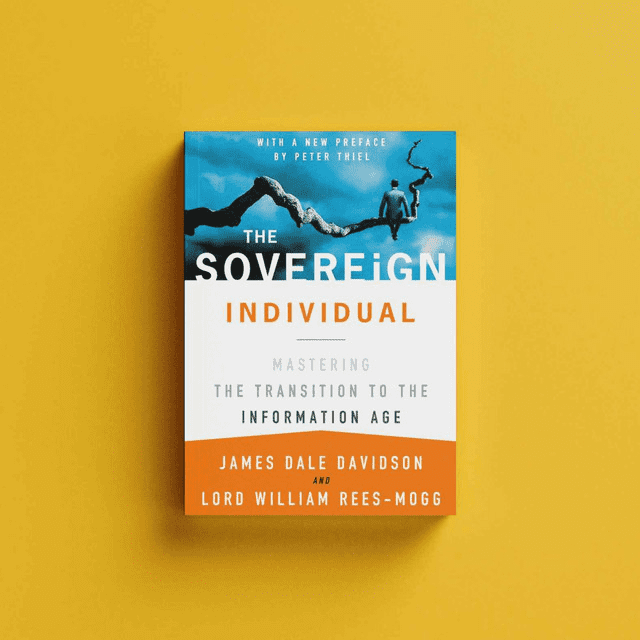

The Sovereign Individual: Mastering the Transition to the Information Age
“The Sovereign Individual,” co-authored by James Dale Davidson and Lord William Rees-Mogg, serves as a visionary and often provocative guide to the profound societal shifts anticipated with the dawn of the new millennium. Published in 1997, it posits that the Information Revolution will fundamentally alter the dynamics of power, economics, and social organization, leading to the decline of the nation-state and the rise of a new class of “Sovereign Individuals.” The book argues that technological advancements, particularly in microprocessing and communication, are redefining the “logic of violence,” making it less profitable for large, centralized entities and empowering individuals in unprecedented ways. This summary will comprehensively explore every important idea, example, and insight from the book, breaking down its compelling arguments in clear, accessible language, ensuring nothing significant is left out.
Chapter 1: The Transition in the Year 2000
This opening chapter sets the stage for a monumental societal transformation, arguing that the year 2000 marks the end of the modern phase of Western civilization and the dawn of the Age of the Sovereign Individual. It introduces the concept of “megapolitics” – the hidden factors that alter the boundaries where power is exercised – as the key to understanding this profound revolution.
Premonitions of Change
The authors observe a widespread sense of disquiet about the future as the millennium approaches, contrasting with Western optimism of the past 250 years. They note various historical prophecies, from Isaac Newton to Nostradamus, that fix the year 2000 as a momentous turning point. This disquiet, they suggest, is a premonition of change in the air, signaling the end of a dying way of life. The book aims to be “apocalyptic” in its original Greek meaning: an “unveiling” of the new stage in history – the age of the Sovereign Individual.
The Fourth Stage of Human Society
The core theme introduced is a new revolution of power that liberates individuals at the expense of the 20th-century nation-state. This is driven by innovations that alter the logic of violence in unprecedented ways. The book claims that microprocessing will rapidly subvert and destroy the nation-state, creating new forms of social organization. Historically, human society has seen three basic stages: hunting-and-gathering, agricultural, and industrial societies. Now, the fourth stage—information societies—is looming. Each prior stage corresponded with distinct phases in the evolution and control of violence. Information societies, the authors argue, will dramatically reduce the returns to violence, partly because they transcend locality. This will lead to profound consequences, including rising crime (as large-scale violence becomes less profitable, smaller-scale violence jumps) and the eclipse of politics. The erosion of civic myths and growing corruption among Western leaders are presented as evidence that the nation-state’s potential is exhausted.
History Repeats Itself
The authors draw a powerful analogy between the late 15th century and the present day. In the 15th century, institutionalized religion (the medieval Church) had saturated life, and its costs were at a “senile extreme.” Despite popular belief in its sacredness, the clergy were held in contempt, similar to today’s attitude towards politicians and bureaucrats. The Gunpowder Revolution created strong incentives to downsize religious institutions and lower their costs. Similarly, an Information Revolution is destined to radically downsize the nation-state in the new millennium. As large systems break down, systematic compulsion will recede, and efficiency will rapidly become more important than power in social organization.
The Information Revolution and the Sovereign Individual
An entirely new realm of economic activity, cyberspace, will emerge, not hostage to physical violence. The “cognitive elite” will benefit most, operating increasingly outside political boundaries. Incomes will become more unequal within jurisdictions but more equal between them. This revolutionary change is presented as both good and bad news. The good news is unprecedented individual liberation. Those who educate themselves will be free to invent their own work and realize the full benefits of their productivity. Genius will be unleashed, freed from government oppression and prejudice. In the cybereconomy, factors like race, appearance, age, or sexual proclivities will not matter; individuals will compete on equal terms in “utterly color-blind anonymity.”
Ideas Become Wealth
The greatest source of wealth will be ideas in one’s head, making anyone who thinks clearly potentially rich. The Information Age will be an age of upward mobility, offering more equal opportunity for billions globally. The brightest will emerge as truly Sovereign Individuals. These individuals will operate on terms akin to Greek gods, with Mount Olympus located in cyberspace—a realm without physical existence that will become the world’s largest economy. By 2025, the cybereconomy will have millions of participants, some extremely wealthy, with no cyberwelfare, cybertaxes, or cybergovernment. This liberation of a large part of the global economy from political control will force remaining governments to operate on more market terms, treating populations like customers rather than victims of a shakedown.
Genius and Nemesis
While liberating, this transformation has a negative side. Individuals will be far more responsible for themselves than during the industrial period. The unearned living standard advantage of advanced industrial societies will dissipate. The capacity of nation-states to redistribute income on a large scale will collapse. Mobile technology and cyberspace transactions mean governments cannot charge more for services than they are worth, or their best customers will flee. The book confidently predicts the nation-state as we know it will not survive.
The End of Nations
Changes that diminish predominant institutions are unsettling and dangerous. Governments will fight ruthlessly to preserve privileges, using covert and arbitrary violence. The state will treat increasingly autonomous individuals with ruthlessness and diplomacy, sometimes as enemies, sometimes as equals. However, efforts to “marry the IRS with the CIA” will fail. Technology will force governments to bargain with autonomous individuals whose resources are not easily controlled. The Information Revolution will create a fiscal crisis for governments and disintegrate large structures. Fourteen empires disappeared in the 20th century, and the nation-state itself will dissolve. Taxing capacity will plunge by 50-70%, favoring smaller, more successful jurisdictions. The book predicts latter-day barbarians (Russian mafiya, ethnic criminal gangs, drug lords, renegade covert agencies) will gain power, infiltrating the state. Microprocessing reduces the size groups need to be effective in violence, leading to more random and localized predatory violence.
History in Reverse
The nation-state’s growth over five centuries will be reversed. Local centers of power will reassert themselves, and the state will devolve into fragmented, overlapping sovereignties. Organized crime’s growth reflects this. Multinational companies are downsizing, and the nation-state will follow. Economic activity will transcend territorial boundaries. Encrypted Internet transactions will soon be almost impossible for tax collectors to capture. Tax-free money offshore will compound faster. By the new millennium, much commerce will migrate to cyberspace, where governments have no dominion. Cyberspace is the “ultimate offshore jurisdiction,” an economy with no taxes, like “Bermuda in the sky with diamonds.” Taxpayers, once like milked cows, will have wings.
The Revenge of Nations
The state, like an angry farmer, will take desperate measures to tether its escaping herd, using covert and violent means to restrict liberating technologies. These will only work temporarily. The 20th-century nation-state will “starve to death as its tax revenues decline.” Desperate, governments will resort to printing money, but cybermoney will largely foreclose this option. Private markets will supersede fiat money. Only the poor will be victims of inflation. Lacking tax and inflation options, governments, even in civil countries, will “turn nasty.” Uncollectable income tax will lead to older, more arbitrary exact methods. Hostage-taking will emerge to prevent wealth escape. Businesses facilitating individual autonomy will face infiltration, sabotage, and disruption. Arbitrary forfeiture of property will become pervasive. Governments will violate human rights, censor information, and sabotage technologies, akin to the Soviet Union’s attempts to suppress personal computers.
Chapter 2: Megapolitical Transformations in Historic Perspective
This chapter argues that the passing of the Modern Age is a ruthless, hidden development. It highlights that the future will be qualitatively different from anything seen before, driven by underlying changes in the “logic of violence” rather than conscious human design.
The Waning of the Modern World
The authors assert that the Modern Age is waning, driven by a ruthless but hidden logic. They argue that economic and political life in the new millennium will no longer be organized on a gigantic scale under the domination of the nation-state. The civilization of world wars, assembly lines, social security, and income tax is “dying.” Governments have already lost much power to regulate and compel, as evidenced by the collapse of Communism, which marked the end of a five-century cycle where power magnitude overwhelmed efficiency. The returns to violence are now falling. A world-historic phase transition has begun, potentially ending the Modern Age with the fall of the Berlin Wall in 1989 or the Soviet Union in 1991. The coming fourth stage of human development will be profoundly different from industrial societies, with no clear name yet.
The Taboo on Foresight
Human cultures have blind spots, especially regarding paradigm changes in life’s largest boundaries. Every social order discourages thinking about its end and what new rules may prevail. It implicitly pretends to be the last or only system. This ensures that history’s great transitions are seldom spotted as they happen, and conventional thinkers will not welcome or advertise dramatic changes. The fall of Rome is cited as an example: its demise was not widely acknowledged for decades or centuries, with authorities clinging to “persistent make-believe.” This reluctance to acknowledge change is present today. Despite this, the authors believe we are living through a historical season change that will transform society, and to understand it requires taking almost nothing for granted. They assert that the coming Information Societies will be very different from industrial ones.
The Error of Minimal Expectations
The authors criticize the idea that “citizens can act together, consciously, to shape the spontaneous economic and natural processes going on around them,” calling it equivalent to believing feudalism could have survived if people had simply “rededicated himself to chivalry.” They contend that the most profound causes of change are precisely those not subject to conscious control, such as factors altering the conditions under which violence pays. These variables, they argue, determine how the world works far more than any political platform. They emphasize that decisive historic changes rarely happen because people simply prefer a new way of life; rather, they are a response to actual changes in life conditions like invasions, plagues, or technological revolutions that alter livelihoods or defense capabilities. Such changes typically cause widespread disorientation.
A Crash Course in Megapolitics
The concept of megapolitics is presented as a powerful tool to illuminate mysteries of history, such as the rise and fall of governments, timing of wars, and economic prosperity. Megapolitical factors determine the costs and rewards of employing violence. The control of violence is society’s most important dilemma. These factors are grouped into four categories:
- Topography: Crucial in early history, it influenced the rise of states (e.g., floodplains in Mesopotamia) and shaped Greek democracy (intricate shorelines favored high-value crops and armed farmers). It also explains why control of open seas has never been monopolized, a key insight for cyberspace.
- Climate: A catalyst for the Agricultural Revolution (end of Ice Age changed vegetation, forcing farming). Fluctuations can destabilize regimes, as seen in the 17th-century “Little Ice Age” which led to widespread rebellion and the rise of mercantilism.
- Microbes: Convey power or immunity. European conquest of the New World benefited from disease immunity. Malaria historically protected tropical Africa from invasion. High mortality rates from disease in early modern periods made societies more tolerant of war deaths.
- Technology: The dominant factor in modern centuries. It influences:
- Balance between offense and defense: Rising offensive capabilities consolidate jurisdictions; rising defensive capabilities fragment them.
- Equality and infantry predominance: Cheap, amateur-friendly weapons (like rifles) equalize power (e.g., American Revolution). Expensive weapons (like knights’ armor) concentrate power.
- Advantages and disadvantages of scale in violence: Increasing returns to violence favor larger governments; small groups resisting large ones fragments sovereignty.
- Economies of scale in production: When crucial enterprises require large trading areas, large governments prosper. If benefits dwindle, larger governments break apart.
- Dispersal of technology: Hoarding technology centralizes power; wide dispersal fragments it (e.g., early machine guns centralized power, later decentralized it).
The Speed of Megapolitical Change
These megapolitical variables mutate at dramatically different speeds:
- Topography is almost fixed over recorded history.
- Climate fluctuates more actively, capable of disrupting societies. The current period is unusually warm; a shift to colder climates could be destabilizing.
- Microbes can mutate rapidly, but their impact on power boundaries has been less abrupt than technology. Historically, disease transfer has been predominantly outward from Europe. While new plagues are possible, the authors cross their fingers and assume technology will remain the leading megapolitical variable.
- Technology is by far the most important and fastest-changing factor today. Because events unfold much faster than in previous transformations, early understanding of changes is more useful now. The transition to the Information Society will happen within a lifetime, making forecasts more immediately valuable.
The chapter concludes by stating that Lane’s insights into violence provide a framework for understanding how society will be reconfigured in the Information Revolution, even though he did not foresee it.
Chapter 3: East of Eden: The Agricultural Revolution and the Sophistication of Violence
This chapter explores the Agricultural Revolution as the first great economic and social revolution, arguing that it fundamentally transformed human life by altering the logic of violence and laying a new foundation for power. It provides a paradigm for understanding the Information Revolution.
The Genesis of Civilization and Violence
The Agricultural Revolution, a slow-motion process spanning millennia, began about 500 generations ago, fundamentally altering the logic of violence. It transformed human life by giving rise to a more important role for violence in social organization, leading to the dominance of hierarchies adept at manipulating or controlling it. The chapter contrasts this with hunting-and-gathering societies, which operated on a very small scale over wide areas, with sparse populations. Foragers, like bears, had a diet based on gathered food and large mammals, with minimal technology and no effective food storage, meaning they had little to steal. They were typically small groups (25-50 individuals), fostering intimate knowledge and consensus-based decision-making. Though some debate their peacefulness, the lack of surplus food meant no specialization in violence. Escape was an easy solution to conflict, and their gods were natural forces, not militant figures.
The Tyranny of Sedentary Life
The transition to agriculture entailed a radical shift. Farming created large-scale capital assets in land and irrigation, with valuable crops and domesticated animals that could be stored, hoarded, and stolen. Because crops required tending, migration became less attractive, especially in arid regions. This increased opportunities for organized shakedowns and plunder, raising the scale of warfare. Society became more stationary, leading to a division of labor where farmers produced food, potters made containers, and priests prayed for harvests. Crucially, specialists in violence (the forefathers of government) emerged to plunder and protect, becoming the first wealthy individuals by controlling a portion of the annual crop (sometimes 25-50%). Farming dramatically increased the importance of coercion and plunder. This process took millennia, with early farmers sometimes suffering erratic plunder.
The Invention of Property and Accountability
The advent of agriculture led to the emergence of private property, a necessary concept given the toil required to produce crops. However, this clarity was attenuated by the rise of specialized violence. Farming made investment in better weaponry profitable, leading to theft and organized predation. The “god-kings” and local potentates who ruled the first Near Eastern states, with their control over military power, became rich by taking a large fraction of total output. While their power was despotic, it was constrained by transport and communication difficulties. Farming also necessitated inventory accounting, as you cannot tax without records, leading to the rudiments of written language, unknown among hunter-gatherers. Farmers’ horizons expanded as they tracked planting and harvest, leading to detailed astronomical observations for almanacs and calendars.
Peasant Survival and the Feudal Revolution
While private property existed in early agricultural societies, it was minimal for the vast majority of peasants, who were too poor to accumulate wealth and constantly risked starvation. They adopted the “closed village” economic organization, acting as informal corporations dealing with a single monopolist (the landlord). Proportional rent minimized downside risk in bad harvests, with landlords often providing seed. This arrangement, at the cost of monopolized prices and in-kind labor, prioritized survival over capital accumulation. The “feudal revolution of the year 1000” marked a period where the collapse of Roman authority after its fall led to a decline in central administration and infrastructure, paradoxically improving living standards for small farmers who were freed from heavy Roman taxes. However, population recovery, colder weather and famines (982-984, 994-95), and the growing military importance of heavy cavalry (enabled by stirrups, iron horseshoes, contoured saddles) destabilized these relationships. Expensive armor and warhorses made smallholders militarily insignificant. This led to widespread debt and land forfeiture, as poor farmers conceded ownership of their land to the Church or wealthier farmers in exchange for usufruct and protection, becoming serfs.
The Church’s Role in Feudalism
The Church played a crucial, productive role in the early stages of feudalism. It helped restore order through movements like “The Peace of God,” legitimizing the overlordship of armed knights in exchange for tempering violence. This established weak local monopolies of violence, contributing to more stable power configurations. The Church also preserved and transmitted technical knowledge and information through universities and scriptoria, serving as a printing press alternative. Its literate farm managers improved agricultural productivity, reconfiguring small plots and developing water-powered machines. It provided public infrastructure (roads, bridges, dams, aqueducts) and helped incubate a more complex market through cathedral construction, stimulating artisanal and engineering skills. The Church helped to temper the ferocity of violence unleashed by armed knights.
Paradise Lost and the Enduring Legacy of Violence
The chapter concludes by re-emphasizing that the Agricultural Revolution, while sowing the seeds of civilization, was perceived as a “paradise lost,” demanding hard labor instead of the easy life of foragers. The biblical story of Cain, the first murderer and “a tiller of the ground,” underscores the inherent connection between farming and increased violence and oppression. Farming created stationary capital, raising the payoff from violence and making both crime and government profitable propositions for the first time.
Chapter 4: The Last Days of Politics: Parallels Between the Senile Decline of the Holy Mother Church and the Nanny State
This chapter asserts that the Information Revolution will lead to the “death of politics” as we know it, drawing a compelling parallel between the current decline of the nation-state and the medieval Church’s demise due to technological change.
The Anachronism of Modern Politics
The authors contend that the idea of politics ceasing to be important may seem ridiculous, but modern politics is a relatively recent invention, dating only to the 16th century. Aristotle’s “Politics” did not have its current meaning until the Gunpowder Revolution, which dramatically increased the returns to violence and made control of the state far more critical. Politics, having begun with early industrialism five centuries ago, is now dying. A widespread revulsion against politics and politicians is sweeping the world, evidenced by numerous global corruption scandals involving leaders from Bill Clinton to Japanese prime ministers and NATO’s secretary-general. This disdain is a leading indicator of change, a common precursor when moral standards shift due to technological divorcing old forms from new economic forces.
A Secular Reformation
The authors posit that the reaction against “saturation politics” mirrors the 15th-century downsizing of religion. The monolithic Church, once indispensable, became a “major drag upon productivity” by the late 15th century, akin to the nation-state today. Both served as dominant social organizations for five centuries, outliving their conditions and becoming “senile” and “ripe for a fall.” Technology (gunpowder, printing press) destroyed the medieval Church’s monopoly, and the Information Revolution will do the same for the nation-state. The nation-state will be replaced by new forms of sovereignty, some unique, some reminiscent of pre-modern city-states and merchant republics. As technology plunges, governments will be forced to compete like corporations for income, charging no more than their services are worth, with unimaginable implications.
Then and Now: Myths Betrayed
The authors draw explicit parallels between the late 15th century and today. Both periods stood at the threshold of momentous transformations, with prevailing moods of gloom despite underlying shifts. Chroniclers of the 15th century were “dupes” of their times, failing to see the “real moving forces.” Similarly, today’s conventional thinkers fail to grasp the implications of emerging power configurations. The myth of chivalry ruling the world in the Middle Ages is compared to the contemporary assumption that history is determined by votes and popularity contests. Both are deemed equally silly and reflect a disconnect from the dynamics of power.
Parallels Between Chivalry and Citizenship
The fading of chivalric oaths with industrial society’s rise offers a blueprint for how citizenship will fade in the Information Age. Both served to facilitate power under different megapolitical conditions. Feudal oaths bound individuals to lords and the Church when defensive technology was paramount and sovereignties were fragmented. Medieval armies were diverse, not uniform, and war was waged by various social entities, not just governments. Chivalric oaths ensured military loyalty when individuals needed strong motivation beyond self-preservation to fight. Similarly, citizenship emerged when returns to violence were high and rising for the state, which could then strike a uniform bargain with mass armies.
Circumventing Cost-Benefit Analysis
Both chivalry and citizenship added a dimension to deter rational cost-benefit calculations that would otherwise prevent individuals from risking their lives in battle. Effective sovereignties induce people to believe that upholding duties to lord or nation-state are “more important than life itself.” Such demanding values are crucial for military prowess. The medieval knight’s honor or the conscript soldier’s duty enabled them to fight even when the short-term benefits were negligible.
Before Nationality
Nationality played little role in medieval sovereignty. Monarchs and lords possessed territories by private right, selling or giving them away, unlike today. Corporate sovereignty was exercised by religious orders like the Knights Templar, mobilizing support based on allegiance to “Christendom,” not national identity. Chivalric vows were personal, sworn on honor, often leading to extreme self-privation (e.g., Knights of the Star dying for refusing to retreat). The authors satirically compare medieval self-flagellation and painful foot irons to modern citizens traveling worldwide to die for the nation-state, suggesting the latter will seem “grotesque and silly” from the Information Age.
Chivalry Yields to Citizenship
Chivalry faded when megapolitical conditions (effective gunpowder weapons) made the military purpose of the vow obsolete. Gunpowder elevated the scale of fighting, making war far costlier and favoring leaders with claims on rich subjects (often monarchs allied with urban merchants). This led to the rise of standing armies and military uniforms, symbolizing the new uniform bargain between the warrior and the nation-state, replacing the divergent feudal allegiances. Gunpowder also separated power from physical strength, lowering the opportunity costs for rich merchants to engage in mercantile activity, as they could now be defended by larger state armies.
Perfection as a Synonym for Exhaustion
The authors cite C. Northcote Parkinson’s observation that “perfection is achieved only by institutions on the point of collapse.” The medieval knight and his warhorse were perfected just as gunpowder weapons emerged to destroy them. The idea of “status” over money, prevalent in the Middle Ages, blinded thinkers to the importance of commerce and enterprise, similar to how conventional thinkers today fail to grasp the dynamics of the Information Society.
The Birth of the Industrial Age
The eclipse of feudalism marked the onset of the Modern Age, a period of rising returns to violence and enterprise scale. Columbus’s voyage and the spread of galleons and bronze cannons opened new economic horizons. The printing press is identified as the first machine of mass production and a “signature technology” of industrialism, appearing centuries before conventional dating of the Industrial Revolution. It precipitated the collapse of feudalism.
Lowering the Cost of Knowledge
The printing press was profoundly subversive to medieval institutions, much as microtechnology will be to the nation-state. It rapidly undermined the Church’s monopoly on the word of God, created a market for heresy, and spread ideas inimical to feudal society. The Church’s attempts to suppress printing only drove it to its most subversive uses. Printing also devalued scriptoria, making monasteries less economically important, and by lowering the cost of literacy, it multiplied thinkers able to interpret scripture, leading to Protestant sects and “modern text criticism.” Printing also helped destroy the medieval symbolic worldview, replacing it with a focus on causal connections and scientific method for a literate population.
A Parallel for Today
The chapter concludes by emphasizing the striking analogy: the late 15th-century Church was corrupt, a drag on economic growth, and exhausted, just like the late 20th-century nation-state. Both consumed excessive resources. The Church’s extensive regulations, sale of indulgences (compared to government lotteries), and “cullagium” (fees for concubinary priests) are cited as parallels to modern government’s revenue-seeking. The contempt for clergy then mirrors today’s contempt for politicians. The Pope Alexander VI’s corruption is presented as far exceeding modern political scandals. The Protestant Reformation downsized the Church, revised doctrines to lower costs, closed monasteries, and liberated capital by abolishing practices like chantries and relic cults, which had tied up wealth. The Church’s opposition to usury and its regulatory burdens are seen as hindrances to growth. The shift in thinking from symbolic to causal was essential. This parallel suggests that the nation-state’s monopoly will be shattered by information technology, leading to a secular reformation and profound institutional change.
Chapter 5: The Life and Death of the NationState: Democracy and Nationalism as Resource Strategies in the Age of Violence
This chapter positions the fall of the Berlin Wall not merely as the end of Communism, but as a symbolic defeat for the entire nation-state system and a triumph of efficiency over power, arguing that the age of the nation-state is drawing to a close.
The Rubble of History
The authors view the fall of the Berlin Wall in 1989 as profoundly symbolic, akin to the leveling of San Giovanni’s walls by Charles VIII in 1495. While San Giovanni marked the rise in returns to violence, the Berlin Wall signifies that returns to violence are now falling. This is a critical, often unrecognized, development. The Berlin Wall, built to prevent escape, contrasts with San Giovanni’s walls, built to prevent entry, illustrating the state’s increased power from the 15th to the 20th century. For centuries, the nation-state made outward walls redundant, achieving internal peace and military might by disarming populations and seizing resources.
“Love It or Leave It” (Unless You Are Rich)
The authors predict that many in Western nation-states will seek to escape, citing President Clinton’s 1995 proposal for an “exit tax” as a “Berlin Wall for Capital,” forcing wealthy Americans to pay ransom to leave. This policy is reminiscent of the Roman Empire’s decline, where desperate measures were taken to squeeze the propertied class and prevent their escape (ultimum refugium). The authors argue that if you accept the premise that people are assets of the state, such walls make sense, but they are increasingly illogical as the U.S. government doesn’t “invest” in its wealthy citizens, who often create wealth despite the government. The top 1% of U.S. taxpayers pay vastly more than they receive in benefits, experiencing massive cumulative wealth reduction due to high taxes. The new megapolitical conditions will reveal the nation-state as a predatory institution, prompting individuals to seek escape, which desperate governments will resist.
The Life and Death of the Nation-State
The fall of the Berlin Wall marks the culmination of the nation-state era, a “peculiar two-hundred-year phase in history” beginning with the French Revolution. States, though existing for millennia, were rare before the 19th century and depended on extraordinary megapolitical conditions. The triumph of the state was due to the “cold logic of violence,” where gunpowder created great advantages of scale in warfare, leading to high and rising returns to violence. States with the largest coercive means tended to win, prioritizing “effectiveness (total output)” over “efficiency (ratio of output to input).”
The Great Unanswered Question
The authors pose the central, unanswered question: why did the Cold War pit Communist dictatorships against welfare-state democracies as final contenders for world domination? Many past sovereignty systems (monarchies, city-states, religious military orders) dwindled, but these two prevailed. The answer, they argue, is that both systems facilitated unimpeded control of resources by government for large-scale warfare. Communism directly controlled everything. Democratic welfare states, paradoxically, were superior by allowing private ownership and capitalist productivity, then taxing a large fraction of wealth away. This “less being more” approach mobilized greater output.
Inefficiency, Where It Counted
While the welfare state was more efficient than Communism, it was inefficient compared to laissez-faire enclaves like Hong Kong. This very inefficiency (massive military spending with waste) made it supreme during the Industrial Age’s rising returns to violence. It allowed governments to channel more resources into the military. Democracy kept the “pockets of wealth producers open” by requiring consent from “someone other than the person whose money is coveted” (e.g., anonymous voters in an “advanced auction of stolen goods”).
Who Controls Government?
The authors challenge the conventional view of democratic government being controlled by its customers. They propose three alternatives:
- Proprietors: Hereditary leaders who own the country, maximizing profits by reducing costs and maintaining firm monopolies (e.g., Henry VII of England).
- Employees: Favor policies that increase employment and oppose job cuts, often leading to chronic deficits (e.g., modern democratic governments).
- Customers: Historically, merchant republics like Venice, or limited franchise democracies, where governments are lean, with low operating costs and taxes. They prioritize customer retention and efficiency.
The authors contend that modern democracies have few characteristics of customer-controlled industries. Only a small fraction of outlays go to core protection services. Policies are rarely informed by taxpayers’ interests. Governments run chronic deficits and resist cost reduction. This indicates that mass democracy leads to control by its “employees” (including recipients of transfer payments), who form a working majority.
Why Customers Could Not Dominate
In the Industrial Age, customers could not effectively restrict government resource commandeering because it would expose them to being overpowered by other aggressive states (e.g., the Soviet Union during the Cold War). Thus, the “inefficiencies” of the democratic welfare state (massive military spending) actually made it megapolitically predominant in an era where magnitude of power mattered more than efficiency.
Industrialism and Democracy
Mass democracy emerged with the French Revolution, likely as a response to rising real incomes (from 1750 onwards) that made it practical for the state to bypass powerful intermediaries and tax millions of individual citizens directly. This “direct rule” allowed the state to raise far more revenues and armies. Ordinary individuals, unlike powerful magnates, could not effectively resist high taxes or conscription. Charles Tilly’s argument that “going to war accelerated the move from indirect to direct rule” is cited, as states needed to borrow, raise taxes, and seize men from reluctant citizens. This led to governments adding 0.5% to their claims on annual income per year over the 20th century. Democracy became the militarily winning strategy by facilitating resource gathering for the state.
Nationalism
Nationalism, like politics, is a modern invention (coined by Jeremy Bentham in 1789) that became a corollary to mass democracy. It was an “imagined community” that facilitated mobilizing state power and control over large populations by emphasizing common characteristics like spoken language, simplifying bureaucracy and military mobilization. Historically, polyethnic sovereignties were the norm. Nationalism, in its early forms (e.g., Prussian League), was sometimes used to seek weaker rulers. It reached its heyday with Woodrow Wilson’s post-WWI efforts to create nation-states based on ethnicity. The authors predict it is now a reactionary force, to be used by “losers” nostalgic for compulsion as the welfare state collapses, leading to an upsurge in nationalism and anti-technology bias.
Peru in Ruins
The chapter uses Peru in 1993 as a case study of a nation-state in collapse due to technological change making closed economies dysfunctional and undermining central authority. Under President Alberto Fujimori, Peru’s congress was dysfunctional, corrupt, and obstructing economic reform and counter-terrorism efforts against narco-terrorists and Shining Path guerrillas. Fujimori’s popular closure of the congress and subsequent economic growth (12.9% in 1994) is presented as a “first postmodern coup,” demonstrating the ultimate devaluation of political promises. This is seen as an early installment of a broader transition crisis where political promises are deflated, and governments run out of credit, forcing the emergence of new institutional forms.
The End of the Nation-State Era
The fall of the Berlin Wall marked the end of the long period of rising returns to violence. The organization of society is bound to change, reflecting growing diseconomies of scale in violence employment. The future boundaries have been redrawn, suggesting that mass democracy and the welfare state may not long survive in the Information Age.
Chapter 6: The Megapolitics of the Information Age: The Triumph of Efficiency over Power
This chapter argues that the Information Age fundamentally alters the logic of violence, leading to a “triumph of efficiency over power.” It predicts the decline of traditional coercion, exemplified by the irrelevance of industrial-era tactics like sit-down strikes.
The Irrelevance of Industrial-Era Tactics
The chapter opens with the 1936-37 General Motors sit-down strike as a historical example of industrial-era coercion. Workers physically seized factories, idling machines and paralyzing production, effectively holding the owners’ capital to ransom. This tactic, successful in its time, is presented as anachronistic in the Information Age, as irrelevant as building pyramids with slaves. The authors argue that labor unions and their intimidation tactics, familiar in the industrial period, depended on special megapolitical conditions that are rapidly fading. They assert that there will be “no Chevrolets and no UAW to strike on the Information Superhighway,” and governments’ fortunes will similarly decline.
Extortion and Protection
The authors posit that throughout history, violence has been a dagger pointed at the heart of the economy, forming the basis for blackmail, extortion, and kidnapping. A government’s capacity to tax is likened to private shakedowns. The proportion of coercively controlled assets roughly measures the balance between extortion and protection. If technology makes asset protection difficult, crime and union activity rise, and government protection commands a premium (high taxes). However, the technological imbalance between extortion and protection, which favored extortion until the late 20th century, is now shifting. Information technology promises to dramatically alter this balance, making protection of assets easier and extortion more difficult. This new asymmetry rests on a fundamental mathematical truth: “It is easier to multiply than to divide.” This is already seen in powerful encryption algorithms that will create a new, protected realm of cybercommerce where the leverage of violence is greatly reduced, facilitating an economy dependent on spontaneous adaptive mechanisms rather than conscious bureaucratic allocation.
Command-and-Control Systems Are Primitive
The authors argue that government appropriation of resources inevitably diverts them from “high-value complex uses to low-value primitive uses.” They suggest that the computer enables us to “see” the formerly invisible complexity of systems. Complex systems, like market economies, are complex adaptive systems without an authority in charge, depending on dispersed capabilities and spontaneous order. Historically, social systems mimicked prevailing technology (gigantic factories coincided with big government). Now, microprocessing is miniaturizing institutions, and the Information Age will create an economy exploiting the advantages of complexity. They contend that Heinz Pagels’s prediction of nations mastering complexity and becoming “superpowers” is wrong because it overlooks the changing logic of violence. When the logic of violence changes, society changes, making “nations” and “political superpowers” unlikely.
The Logic of Violence
The authors emphasize Frederic C. Lane’s insights: the control of violence is crucial to the economy, and government’s primary role is protection. However, government often acts like organized crime, exacting tribute. This “protection racket” combines economic service with self-imposed harm. A local monopoly on coercion allows governments to protect effectively and reduce operating costs, but also determines whether they protect or plunder. More competing armed groups tend to proliferate violence and plunder, as seen in China’s warlord era or Somalia. The Information Age, however, is bringing a fifth stage: competition in cyberspace, an arena not subject to monopolization because it has no physical existence, like the open sea.
Competition Without Anarchy
Unlike past periods where inability to monopolize protection meant higher costs and lower returns, in the Information Age, the inability to monopolize cyberspace implies lower military costs and higher economic returns. Cyberspace is likened to a “technologically protected march region” from the Middle Ages (e.g., Andorra), where competitive government existed due to weak authorities and tax exemptions. However, cyberspace will be a rich, growing frontier, unlike the poor, violent medieval marches. The new frontier will not be a duopoly, but hundreds or thousands of jurisdictions, making a tax cartel impossible. The Seychelles, offering protection against extradition for $10 million investment, is cited as an example of competition in domiciling economic activities. In the age of the virtual corporation, individuals will choose jurisdictions based on best service and lowest cost, leading to the commercialization of sovereignty.
The Diminished Utility of Violence
Governments will not resign from violence, but its leverage is diminishing. Information technology allows for creation and protection of assets beyond territorial reach. This facilitates the emergence of an economy that relies more on spontaneous adaptive mechanisms and less on conscious decision-making and resource allocation through bureaucracy. Predatory taxes and inflation will become uncompetitive in cyberspace, leading to an impetus to avoid them. History shows that on frontiers and high seas, merchants avoided high exactions by finding cheaper protection. The cybereconomy provides this alternative, as no government can monopolize it. For $55 rather than $55 million, cyberassets will enjoy better protection against governments and thieves. Widespread encryption will make transactions invisible and impervious to governments, allowing individuals to determine where to domicile economic activities and how much tax to pay.
The Death of Seigniorage
Governments will lose their power over money. Historically, money has changed with megapolitical transitions (coinage, paper money via printing press). Now, cybercash (encrypted sequences of prime numbers) will lead to denationalized money, reducing nation-states’ capacity to expropriate wealth through inflation. Individuals can easily shift out of depreciating currencies. This new money will be anonymous, verifiable, and tradable globally. Barter will also become more practical due to computational power. Unlike easily counterfeited paper money, digital gold or other private cybercurrencies will be impossible to counterfeit due to complex mathematics, returning control to wealth owners.
Eradicating Inflation
The most momentous consequence of cybermoney will be the end of inflation and the deleveraging of the financial system. Inflation, historically an annual wealth tax by governments, will be eradicated by competitive pressures. This will take away disguised profits from currency issuance. A small transaction fee (e.g., 1% per annum) may replace it, far less than inflationary penalties. Overall prices may decline due to increased competition. The emergence of digital money will also contract leverage in banking systems, as people bypass regulatory authorities. This will create a fiscal crisis for Western governments, facing sharp revenue drops and unfunded liabilities, leading to a one-time spike in real interest rates. Over the long term, however, after-tax returns to savers will increase, and capital will find highest global returns, leading to rapidly increased efficiency and potentially lower long-term interest rates.
Investor Control over Capital
The authors argue that the state’s massive resource reallocation is inefficient. With wealth controlled by “genuine talent” (able investors and entrepreneurs) rather than politicians, rates of return will double or triple. They cite Russia’s negative economic value as an extreme example of state control’s inefficiency. Economic liberty correlates strongly with growth, and the cybereconomy will be the most free, attracting participants and growing at higher compound rates. Reduced predation costs, historically linked to economic growth, will lead to lower taxation and less wasted effort in political activity. Governments will be forced to compete on price and quality for protection services.
Chapter 7: Transcending Locality: The Emergence of the Cybereconomy
This chapter delves into the revolutionary concept of cyberspace as a non-physical economic realm, arguing that it fundamentally transcends geographic locality and traditional boundaries, leading to the decline of physical industries and the rise of virtual commerce.
The Tyranny of Place
The chapter begins by deconstructing the “Information Superhighway” metaphor, arguing that it mistakenly implies physical transit. Instead, the internet is a destination, enabling “instantaneous sharing of data everywhere and nowhere at once.” This creates a “new social space, global and anti-sovereign,” fostering intellectual and economic liberty. The authors argue that consciousness is still deeply etched by notions of locality, despite technology enabling its transcendence. Historically, economies were tethered to local areas, with most people living and dying near their birthplace. Travel was rare and difficult, limiting markets and opportunities. The slogan “all politics is local” reflects this historical reality, where power advantages have always been geographically rooted.
The Error of Minimal Expectations
The authors critique those who underestimate the economic potential of the internet, comparing them to historical figures who dismissed Edison’s lamp or predicted the impossibility of sustained flight. They argue that the internet’s most important implication is its ability to transcend the “tyranny of place,” creating an infinite, non-terrestrial realm for economic activity. Information technology divorces income-earning potential from specific geographic locations, meaning that the value created by adding ideas and knowledge to products will be less subject to capture by local jurisdictions. They outline three stages of cybereconomy evolution:
- Primitive (Stage 1): Net as a delivery system for industrial-era transactions (e.g., selling wine online).
- Intermediate (Stage 2): New applications impossible before (e.g., long-distance accounting, medical diagnosis), still within old institutional frameworks.
- Advanced (Stage 3): True cybercommerce, with transactions and profits migrating outside nation-state jurisdiction, using cybercurrency and cyberbanks, making many transactions untaxable and having significant megapolitical consequences (e.g., collapse of extraterritorial regulatory power).
The Globalization of Commerce
Falling communication costs have rapidly reduced the need for proximity. A three-minute call from New York to London, once $650 in 1946, is now $0.91. Soon, intercontinental calls will cost little more than local ones. Wireless technology (low-orbit satellites) will enable direct communication without interfacing with local phone or TV systems, “unwiring” the internet. This leads to “business without borders,” where billing can be incorporated directly into services (like smart cards). PCs will become global bank branches and money brokerages. Instantaneous translation will remove language barriers in commerce. Individuals will choose where to domicile their activities (e.g., Bermuda, Cayman Islands) based on favorable tax regimes, and assets will automatically transfer to other jurisdictions if a government attempts to seize them.
Qualitative Advances
Cyberspace will enable transactions impossible in the industrial era, going beyond simple cross-border communication. Cybersurgery, for example, is presented as a near-future reality: digital doctors accessing medical history, and cyber-surgeons performing remote operations with micro-incisions using technologies like magnetic resonance treatment (MRT). This will lead to a revolution in surgery, with fewer highly skilled surgeons performing more operations. “Digital lawyers” will draft instant contracts for transnational legal conditions. The technology will place a premium on top skills globally, allowing patients to choose the best surgeons worldwide, regardless of location, leading to “less imperfect” markets.
The Devaluation of Compulsion
The migration of transactions into cyberspace will be driven by the impetus to avoid predatory taxation, including the tax that inflation places on national currencies. Predatory taxes will be “preposterously uncompetitive” on the new frontier. Cybermoney will provide cheaper, more effective protection for financial assets than governments. The “black magic of compound interest” makes clear the staggering lifetime losses from high taxation (e.g., $5,000 annual tax reducing net worth by millions). The authors predict that most successful people will act to salvage these millions by lodging transactions in cyberspace, even if it’s illegal in some jurisdictions. Unbreakable encryption (like PGP) will make transactions invisible to tax collectors. Governments will no longer be able to extract supermonopoly rates for their services; they will face intense competition.
The Death of Seigniorage
Governments will lose their power over money, which has historically been tied to megapolitical transitions. Paper money, a product of the industrial printing press, allowed governments to profit from depreciation. Cybercash, however, will be denationalized, defined by real stores of value (like gold), and impossible to counterfeit, thus ending inflation. This transfers control over the medium of exchange to wealth owners. While paper money will remain for the poor, high-value transactions will be privatized. This will lead to higher interest rates initially as credit tightens, but lower long-term rates as capital is liberated from government grasp and efficiency improves. The most able investors will gain ultimate control over capital, likely yielding much higher returns than politically-driven allocations. This will lead to rapid growth in the cybereconomy, with huge efficiency gains from reduced predation.
The End of Egalitarian Economics
The chapter previews the idea that the Information Age will lead to the end of egalitarian economics, with wealth concentrated in the hands of the most talented. The decline of the nation-state will entail the end of income redistribution on a large scale. This will cause social unrest in developed countries but will also lead to increased global equality as less developed regions can compete more effectively.
Chapter 8: The End of Egalitarian Economics: The Revolution in Earnings Capacity in a World Without Jobs
This chapter argues that the Information Age will radically reshape societal structure and income distribution by diminishing the role of coercive government and empowering individuals, leading to profound economic inequality and the redefinition of work.
A World Without Jobs
The Information Age is predicted to bring a revolution in lifestyles, institutions, and resource distribution. The role of covert violence in controlling resources will sharply diminish, creating a new wealth configuration without the 20th-century government’s coercive mediation. As locality becomes less important, organizations operating within geographic boundaries (politicians, unions, lobbyists, governments) will become less significant. Favors and trade restraints from governments will be less valuable, reducing wasted lobbying resources. Those who used compulsion and local advantage to redistribute income will lose power, shifting wealth to those who earn it. Globalization and the information economy will increase income for the most talented individuals, leading to an even more skewed distribution of earnings than Pareto’s Law observed.
A Magnitude Beyond Pareto’s Law
The authors argue that the Information Age is leading to a distribution of wealth even more skewed than Pareto’s 80/20 rule, citing the U.S. where 1% of the population pays 28.7% of income tax. This is partly due to the high literacy and numeracy standards required for economic success in the Information Age, which a massive U.S. Education Department survey found 90 million Americans lacked. At the top, a small group of highly educated information workers or capital owners will be the “information aristocracy,” specializing in production, not violence. This contrasts with the 20th-century assumption that technology would lead to increasingly egalitarian societies. The authors argue that while industrial technology did equalize incomes by creating jobs for the unskilled, information technology accentuates differences in human talents.
Ammon’s Turnip
The authors introduce Otto Ammon’s 19th-century probability theory applied to human abilities and income distribution. Ammon suggested that qualities like intellect, morality, economic traits, and bodily traits follow a distribution similar to dice rolls, with very high scores being extremely rare. He used the metaphor of a “somewhat flat onion or turnip” for social distribution, with mass in the middle, and small extremes at top and bottom. The authors hypothesize that in the Information Age, the minimum skill requirements will rise (e.g., from a 4×2 to a 4×3 score on their hypothetical dice), putting large numbers of people (e.g., 24%) below the limit of “social usefulness.” Conversely, the number of people qualified for the highest-paid jobs will dramatically shrink. The Information Age is “pouring its gifts onto the top 5%” of Ammon’s turnip, making societies more unequal than in the 20th century, with many emerging as Sovereign Individuals. This will create social tensions, especially among those expecting income equality.
Fewer People Will Do More Work
The authors predict that a “quite modest rise in the minimum skill requirement” will place large numbers of people outside significant economic roles, and a small rise in higher skill requirements will dramatically reduce the number of people qualified for top jobs. This shift is already evident in all advanced industrial societies, with rewards for rare skills increasing and opportunities for middle skills falling. The “information aristocracy” will gain tremendously, earning a higher share of income and doing a greater portion of the world’s work. The “turnip” of income distribution will resemble 1750 more than 1950. This will lead to demotivation and insecurity for those accustomed to income equality, fostering a nationalist, anti-technology backlash. The Factory Age was unique in providing a profitable niche for unskilled labor; now, “smart machines” are replacing them.
Most People Will Gain from the Death of Politics
Despite the trauma of the nation-state’s end, the authors assert that the transition to the information economy will lead to surging output and higher incomes in many areas, especially those newly open to free markets. The “deflation of compulsion” will allow producers to retain wealth previously redistributed to lower-value uses, thus increasing capital productivity. The “diseconomies to scale” undermining large governments will be enhanced.
Shifting Locational Advantages
The authors argue that the immobility of people and assets historically informed the nation-state’s power. Information technology, by transcending locality, undermines this. The tyranny of place is ending. While governments may still be able to erect barriers, the instant, global transmission of information makes it difficult. The Information Age will enable companies to locate anywhere, use resources from anywhere, and sell anywhere. This will cause income inequality to rise within jurisdictions but become more equal between them. The factor most determining lifetime income was once the political jurisdiction; this will change. The advantages of wealth created by industrial technology, which concentrated in OECD countries, are now dissolving. “Backwardness” in the 20th century was due to governments’ inability to function effectively on a large scale, not lack of capital or skills. Information technology lessens the importance of competent government, making it easier for people in poor countries to surmount hurdles to economic growth.
Equal Opportunity in the Information Age
Familiar locational advantages will rapidly be transformed. Earnings capacity for similar skills will become more equal globally. As compulsion declines, income inequality within jurisdictions will rise, while global competition increases the income of the most talented. The “diseconomies of scale and retarded growth” in backward countries (e.g., Zaire’s infrastructure collapse) are overcome by wireless communication and remote work. The Information Revolution makes it less important whether governments are capable. Capital and skills will earn higher returns in many poor areas, and both will be more readily importable. The almost total portability of information technology prohibits hoarding jurisdictional advantages, leading to competition between jurisdictions for high-value-added activities. Governments will be obliged to set policies that appeal to their most valuable customers.
The New Paradigm
The new market paradigm rewards desirable outcomes and penalizes undesirable ones, allowing people to keep more of what they earn. This contrasts with the 20th-century political view that outcomes must be equal. The mobility of capital and high-income earners will lead them to flee high-tax jurisdictions, making those countries uninviting for business. The commercialization of sovereignty will also lead to the devolution of large territorial sovereignties. The fact that information technology cannot be subjected to border controls means protectionism will be less effective as information trade displaces physical products. Smaller regions will be less dependent on large political jurisdictions for market access. Service sectors (e.g., bookkeeping) will be exposed to global price competition, eventually applying to learned professions like law and medicine.
Death Watch for Nation-States
Nation-states will eventually collapse under their weighty liabilities (e.g., unfunded pension programs), especially those with stagnant incomes and high debt (Canada, Belgium, Italy). Separatist movements will gain appeal as regions seek to escape federal debt. Cities, artifacts of industrialism, are also becoming non-viable, as seen in Detroit. Only cities that offer high quality of life will remain. The authors also discuss the “inequivalence theorem,” suggesting that rational individuals will flee jurisdictions with large unfunded liabilities rather than increase savings to cover them. This will lead to cheap governments (low liabilities, low costs) becoming preferred domiciles.
New Organizational Imperatives
The cybereconomy will fundamentally alter business organization. Information technology reduces information and transaction costs, eliminating many of the advantages that led to large, long-term firms and career employment. Firms were an efficient way to overcome information deficits and high transaction costs, coordinating complex assembly lines that would otherwise require endless negotiation between independent contractors. The single large firm minimized incentive traps and the exploitation of those with higher capital investments. However, large firms also suffered from “organizational slack” (unmeasured performance, bureaucratic bloat, perks for managers) and were vulnerable to union shakedowns.
The Disappearance of Good Jobs
Information technology, by lowering information and transaction costs, is devolving the firm. Middle managers are replaced by automated tools. Production is dispersed and non-sequential. Capital costs are lower, and product cycles shorter. Independent contractors, including one-person firms, can leverage sophisticated information networks and digital assistants. The “good job” (paying more than one is worth) will disappear, as “jobs in general will be anachronistic.” Permanent employment, once a hallmark of industrialism, is fading even in Japan. The new model will be project-based organizations, like movie production companies, assembling talents temporarily. This will eliminate “organizational slack.” Artificial boundaries between professions will dissolve, with information retrieval systems displacing many learned professions.
Implications of the Information Age
The chapter ends with a summary of key implications:
- Local regulations will market-adjust.
- Intensified competition between jurisdictions for high-value activities.
- Business will rely on “circles of trust” due to encryption.
- Patent and copyright regimes will change.
- Protection will be technological, leading to gated communities and walls.
- Bulk goods taxed locally, luxury goods shipped globally.
- Police functions by private guards.
- Transitional advantage for private firms.
- Lifetime employment disappears, replaced by “tasks.”
- Control of resources shifts to skilled individuals.
- Many learned professions displaced by AI.
- New survival strategies for low-intelligence persons (leisure, sports, crime, retainers to the rich).
- Political systems face wrenching adjustments.
- Efficiency predominates over massed power; small, efficient sovereignties become sustainable.
- Returns to violence are decreasing, favoring smaller-scale defense.
- Wealthy merchants in late medieval city-states controlling government may be a model for the future.
These developments, the authors claim, will bring a challenging transition, with the potential for conflict between winners and losers in the new information economy.
Chapter 9: Nationalism, Reaction, and the New Luddites
This chapter explores the backlash against globalization and the decline of the nation-state, predicting a fierce nationalist and anti-technology reaction from those who lose status and income in the Information Age.
The Great Transformation
The authors argue that the “world is getting smaller” due to communication and transport, transcending existing political and ethnic boundaries, leading to the weakening of “intrinsically absurd” national claims. However, history suggests this cannot be accommodated peacefully. It entails a crisis and a radical new way of thinking beyond nationalism. The thesis is that the massed power of the nation-state will be privatized and commercialized, involving a revolution in “common sense.” They expect discontinuities—sharp breaks with the past—as the Information Age unfolds.
The chapter outlines what to look for as the process unfolds:
- Economic reorganization due to microprocessing.
- Rapid decline in importance of geographically bounded organizations (governments, unions, licensed professions, lobbyists).
- Wider recognition of the nation-state’s obsolescence, leading to widespread secession movements.
- Decline in status of traditional elites and symbols justifying the nation-state.
- An intense and violent nationalist reaction from those losing status, income, and power, disrupting “ordinary life.” This includes:
- Suspicion and opposition to globalization, free trade, foreign ownership.
- Hostility to immigration.
- Hatred of the information elite, the rich, the well-educated, and complaints about capital flight and disappearing jobs.
- Extreme measures by nationalists to halt individual and regional secession, including wars and “ethnic cleansing” to reinforce state identification.
- A neo-Luddite attack on new technologies (computers, robotics, encryption) and their users, as these technologies facilitate the escape of Sovereign Individuals.
- The nationalist-Luddite reaction will vary by region, less intense in rapidly growing economies, most intense in currently rich countries, especially among the “value-poor” and “skill-poor” (bottom two-thirds of earners), and strongest among the middle-skilled facing downward mobility.
- The nationalist reaction will peak early in the new millennium then fade as fragmented sovereignties prove superior, and their bullying tactics alienate new generations.
- The nation-state will ultimately collapse in fiscal crisis, burdened by unfunded pension and medical liabilities.
Parallels with the Renaissance
The authors reiterate the parallel between the collapse of the medieval Church’s institutional monopoly and the impending demise of the nanny state. The 16th-century Reformation, sparked by the printing press, led to the “privatization of conscience” and the rejection of the Church’s universal authority. This “heresy,” once punishable by torture and death, became widespread. They anticipate a “deliberate and decisive break” with the nation-state’s institutional and ideological continuity, where millions will “withdraw allegiance” and assert their own sovereignty as customers. The privatization of sovereignty will parallel the privatization of conscience.
Heresy and Treason
The authors argue that by the early 21st century, the “secular equivalent of sixteenth-century heresy—a kind of low treason” will be common as individuals reject the nation-state. The modern nation-state, like the Church, can no longer guarantee material benefits (schooling, healthcare, pensions) in exchange for military service. This broken bargain will be acutely felt by “losers” in the new economy, leading to a reactionary push for nationalism. Religious leaders, now often social agitators, will participate in this reaction, opposing capital and people moving across borders and seeking to halt the diffusion of information technologies.
20/20 Vision
By 2020, the cost/benefit ratios of citizenship will clarify for the wealthy. High returns to violence made big government profitable, allowing predatory taxes (90% or more marginal rates post-WWII). The rich had no choice but to rely on large-scale protection from governments. However, the Information Age reverses this: the “rich had little choice but to accede” to taxes because they needed government protection, but this is changing. The arithmetic of politics (taxpayers vs. tax consumers) shows the rich pay a disproportionate share, often for services benefiting others or being of poor quality. This “wasteful by ideal standards” taxation was accepted due to lack of alternatives. Now, the appealing quality of life anywhere and the ability to earn high income remotely will make exit a compelling option.
The Commercialization of Sovereignty
The authors predict that U.S. citizenship will become a major liability, as the U.S. is one of only three jurisdictions taxing based on nationality, with incredibly high tax rates (e.g., 73% lifetime federal tax, 93% for inheritances). This is contrasted with Switzerland’s private tax treaties ($45,000 fixed annual tax for millionaires). The compounding effect of lower taxes can lead to hundreds of millions or billions in saved wealth over a lifetime. This makes the “commercialization of sovereignty” inevitable, with individuals choosing jurisdictions for lower taxes, despite it being “illegal” in many places. They cite the U.S. Post Office’s failed attempt to regulate faxes as an example of technology overriding law.
Citizenship Goes the Way of Chivalry
The core argument: citizenship is obsolete and will follow chivalry’s path. As protection is reorganized, the rationalizations and ideologies (nationalism) will change. The demystification of citizenship will accelerate due to practical alternatives in cyberspace. The “International Age” (1789-1989), defined by nation-states and the verb “nationalize,” is ending. A new “extranational” understanding will emerge, with relations between micro-jurisdictions and Sovereign Individuals. The UN is likely to go bankrupt. Local dialects will rise in importance as national languages fade.
Invented Communities and Traditions
Nations are “imagined communities” (Benedict Anderson), not objective, natural units. Their boundaries and national languages are artifacts of power projection, shaped to reinforce nationalist identification and facilitate state control and military mobilization. The French Revolution, for instance, actively imposed a standard French. Uniform language allowed for cheaper, more effective conscript armies. The authors highlight the ironic post-WWI carving up of Central Europe based on language, which became a double-edged sword: consolidating power where present, fracturing states where not.
Military Mysticism
Nationalism is described as a “banal mysticism” that links individuals to a “homeland” via a defunct military imperative. The state is presented as a “corpus mysticum,” and death for it equals death for God. Nationalist propaganda uses kinship vocabulary (“fatherland,” “motherland,” “brothers and sisters”) and identification devices (common language, shared homeland, phenotype, religion, common descent) that were once markers of kinship in primitive, inbred groups. This epigenesis (genetically influenced bias to favor in-groups) makes humans vulnerable to manipulation for state support.
Nationalism and Inclusive Fitness
The authors introduce W.D. Hamilton’s “inclusive fitness” concept, where individuals maximize gene survival directly (reproduction) or indirectly (kin reproduction). This explains altruism towards kin. They argue that humans retain a “genetic inertia” from hunter-gatherer times, leading them to treat “in-groups” (like nations) as kin, even when the nation is too large for individual sacrifice to meaningfully benefit actual relatives. This created a “perverse result” where the nation-state, meant to protect, became the primary predator (taxation, conscription). The main advantage of cyberassets is their ability to be placed beyond the reach of the local nation-state.
Diseconomies of Nature and Nationalism
The chapter discusses how nationalism, while rooted in deep human instincts, has been exploited in ways that are ultimately self-defeating for the well-being of individuals in the Information Age. The large scale of modern nation-states dilutes the “inclusive fitness” effect of individual sacrifice to the point of insignificance for one’s actual kin. Ironically, the largest obstacle to an individual’s success is often the burdens imposed by their own nation-state. The authors predict that microtechnology will allow individuals to escape subordinate citizenship and become “extranational sovereigns.” They will be “residents of the whole world,” choosing allegiance by contract, reminiscent of pre-modern European merchants. This will be an “economic miracle” but challenges deeply ingrained suspicions of outsiders.
Escape from the Nation-State
The growing detachment of the “cognitive elite,” who manipulate information and operate in international markets, is already noted by critics like Christopher Lasch. These elites, with their “tourist’s view of the world,” are “at home only in transit,” caring more about the global system than its parts. Lasch, Kaus, Walzer, and Reich critique this as a “betrayal of democracy” and “imperialism of the market,” as money flows across borders to buy things that “should not be for sale” (e.g., exemption from military service). This “economic nationalism” by social democrats resents markets triumphing over politics. The authors assert that the denationalization of the individual is inevitable because the benefits of escaping high-tax nation-states are staggering (millions or billions in lifetime savings).
The Commercialization of Sovereignty
The authors argue that citizenship is a “dreadful bargain.” The Queen, as a sovereign, is not a citizen and is exempt from its burdens. Sovereign Individuals will invent new legal rationales for their de facto sovereignty. They will face envy from “losers and leftbehinds,” who will resent the “winners take all” world where rewards are based on relative performance. This will lead to a clash between the cosmopolitan elite and the “information poor”. The information poor, dependent on the state, will become more jingoistic and hostile to globalization.
Most Political Agendas Will Be Reactionary
Political agendas will become increasingly reactionary and nationalistic, focused on defending the wobbling nation-state and preserving a realm for political compulsion. This is because nationalism is the “condition for conventional (political) strategies.” The authors predict that the nationalist reaction will peak in the early decades of the new millennium. They suggest that the fiscal crisis of nation-states, due to unfunded entitlements, will force the write-off of trillions in obligations. This will lead to the flight of the wealthy, leaving “dummies” in high-tax countries.
The Denationalization of the Individual
The authors predict that the demystification of citizenship will be slow but inevitable. Narrow-casting (individualized news) will replace broadcasting, reducing indoctrination into nationalist narratives. Privatized and individualized education will shed political baggage. Internet will reduce the importance of location, creating non-territorial individual addresses. National postal monopolies will collapse, and privatized mail delivery will emerge. Cybermoney, cyberbanking, and unregulated global cybermarkets will shrivel governments’ capacity to confiscate wealth. States will fail to form a cartel to limit encryption or prevent citizens from escaping. The rich will be as enterprising in getting out as illegal immigrants are in getting in.
The Drawback of Nationality Taxation
U.S. citizenship, due to its nationality-based taxation, is identified as a major liability, imposing a “lifetime penalty of tens of millions, hundreds of millions, or even billions of dollars.” The U.S. is one of only three countries (Philippines, Eritrea) with such a system. The authors argue that competitive pressures will force U.S. taxes to be reformed, otherwise, “thinking persons will renounce U.S. citizenship.” They propose that the exit tax, meant to compel loyalty, could inadvertently become a model for a lump-sum buyout for citizens to reside under private tax treaties. This will lead to the commercialization of sovereignty, where people choose jurisdictions based on price and quality, rather than being “plundered as citizens.”
The chapter ends by predicting that the “flight of the wealthy” will coincide with aging populations and unfunded pension liabilities in Western countries, exacerbating fiscal crises. It warns of a violent “neo-Luddite” backlash from the “losers and leftbehinds,” driven by the “fury of hunter-gatherers protecting their families,” but ultimately, the logic of the cybereconomy will prevail.
Chapter 10: The Twilight of Democracy
This chapter critically examines the future of democracy, arguing that its success in the 20th century was due to unique megapolitical conditions that are now fading, leading to its eventual obsolescence in the Information Age.
The Obsolete Foundations of Democracy
The chapter opens by stating that democracy has been rare and fleeting in history, traditionally flourishing when weaponry was cheap, widely dispersed, and usable by amateurs, and when infantry dominated in battle. However, in the late 20th century, weapons became expensive, required specialists, and infantry was vulnerable (e.g., Gulf War). The authors pose a core question: why did democracy flourish under these seemingly unfavorable conditions?
Democracy, the Fraternal Twin of Communism?
The authors reiterate their paradoxical explanation from Chapter 5: democracy flourished as a “fraternal twin of Communism” because it facilitated unimpeded control of resources by the state. While ideologically opposite, both systems enabled massive military establishments. Democracy, by allowing private ownership and capitalist productivity before taxing a large fraction, proved a superior resource-gathering mechanism for the state. For example, the U.S. federal tax rate reached 73% lifetime, 83% for corporate owners, and 93% for inheritances. This made the democratic state a de facto partner with a majority share in all earnings, effectively “enriching the state” more flexibly than state socialism. This capacity to “rake in resources” was key to its supremacy during the Industrial Age’s rising returns to violence.
Inefficiency, Where It Counted
The welfare state, though more efficient than Communism, was inefficient compared to laissez-faire systems like Hong Kong. Hong Kong’s success lay in its residents pocketing most of their growth, not the government. Hong Kong, as a non-democracy, was able to maintain a free economy because it was defended externally, not internally by a massive state. The authors argue that the very “inefficiency” of the democratic welfare state (its ability to spend massively on military and welfare, regardless of direct return) made it successful in the Industrial Age because it enabled the state to funnel vast resources into power projection, which was crucial when magnitude of power trumped efficiency.
The Megapolitics of Misrepresentation
The chapter predicts the end of mass democracy in the Information Age. The form of representative government, where representatives are chosen on a geographic basis, is an artifact of the distribution of raw power. This system inherently overrepresents the vested interests of industrial-era enterprises and the “losers” (geographically concentrated and politically needy). The mobility of wealth in the Information Age undermines this. Computer programs cannot be held hostage to local politics like steel mills. The internet allows businesses to operate globally, transcending geographic limitations and making traditional constituencies less relevant. Legislatures underrepresent “winners” from new industries who are geographically dispersed.
New Possibilities Ahead
The authors suggest that truly representative government could be achieved through electronic plebiscites or selecting representatives by sortition (random lot), similar to ancient Greek systems. This would avoid the drawbacks of self-selection and the lure of disordered, messianic personalities in politics. They advocate for performance-based compensation for legislators, tied to objective measures like per capita income growth, to attract able leaders.
Commercialized Sovereignty
The authors argue for entrepreneurial government – the “commercialization of sovereignty” – as the replacement for politics. This will not be dictatorship but will offer individuals greater scope for self-determination. Microtechnology facilitates customized governance, akin to custom-tailored blue jeans. This will allow individuals to express their desires through economic “exit” (moving their business or residence) rather than “cumbrous political channels.” The ability of individuals to create assets in cyberspace, immune from state predation, will effectively make governments controlled by their customers. This will lead to competition between jurisdictions for taxpayers, driving down tax rates and adjusting terms of taxation to “more civilized standards.”
Offending the True Believers
The denationalization of the individual and commercialization of sovereignty will deeply offend “true believers” in 20th-century politics, who see it as a “betrayal of democracy.” Critics like Christopher Lasch and Michael Sandel lament the atrophy of politics and the “imperialism of the market,” fearing corporate rule. The authors counter that corporations themselves will likely transform or dissolve due to intensified market competition and the erosion of “organizational slack.” The Information Age is the age of independent contractors and “virtual corporations,” making “rule by corporations” unlikely. “Stakeholder capitalism,” aiming to control corporations for social ends, will fail as markets become more complete globally.
The Eclipse of Public Goods
Apologists for coercion will argue that waning state power means an inability to provide public goods. The authors disagree, arguing that competitive jurisdictions will be forced to provide essential public goods (e.g., law and order) to attract customers. They cite Charles Tiebout’s theory of “competitive territorial clubs” and Fred Foldvary’s work on market provision of social services. Many “public goods” were actually private goods provided at public expense. The costly military force of the nation-state, which was the justification for high taxes, will be less necessary in an age where information technology reduces the decisiveness of warfare. This means no more large-scale World War II-style conflicts.
The Denationalization of the Individual
The chapter concludes by re-emphasizing that citizenship will become less attractive and tenable as individuals choose jurisdictions for better service and lower taxes. The “information elite” will increasingly identify as “extranational”, shedding traditional national allegiances. The sheer financial gains (tens of millions to billions in lifetime savings) will compel them to flee high-tax nation-states. The U.S. nationality-based taxation system is a particular liability. This will lead to a “flight of the wealthy” from advanced welfare states, exacerbating their fiscal crises. The authors anticipate a “return to a Victorian-like emphasis on trustworthiness and character” in business, as encryption makes fraud harder to detect but also harder to recover stolen funds. They foresee a “Gentleman’s Club of Cyberspace” for secure transactions.
The chapter ends by reiterating that the decline of the nation-state and mass democracy is inevitable, driven by the shift from industrial to information technology, which reduces returns to violence and enables competitive markets for protection services.
Chapter 11: Morality and Crime in the “Natural Economy” of the Information Age
This chapter delves into the moral and criminal implications of the nation-state’s decline, arguing that its decomposition will empower various “latter-day barbarians” and lead to a resurgence of local, often disguised, forms of predatory violence.
The Erosion of State Authority
The authors predict that as the modern nation-state decomposes, “latter-day barbarians” (Russian mafiyas, ethnic criminal gangs, drug lords, renegade covert agencies) will increasingly exercise real power behind the scenes, infiltrating the forms of the nation-state without changing its appearance. This is likened to an “Invasion of the Body Snatchers,” where criminals fill official positions while owing allegiance outside the constitutional order. The end of an era is typically a period of intense corruption, as social bonds dissolve and public purposes combine with private criminal activity. The authors warn that conventional news media cannot be relied upon to report this decay accurately due to conservatism, ideological bias, fear, and self-interest.
Beyond Reality
The advent of artificial reality and computer game technologies will allow individuals to customize their news reports, simulating desired truths or falsehoods. This means information will be “completely liberated from the bounds of reality,” emphasizing the critical importance of integrity of judgment and distinguishing truth from falsehood. While technology liberates information from political controls, it also creates “more confusion about what it means.” The glut of information, rapid technological change, and growing tribalization hinder rigorous public discourse, making it difficult to assess the meaning of events or ascertain truth. The authors highlight the media’s tepid interest in high-level U.S. government corruption as evidence of this problem.
Mugging in the Information Age
The chapter returns to the concept of the “natural economy,” where outcomes are determined by physical force and “interference competition” (gaining control over resources by fighting rivals). They argue that human affairs remain subject to these underlying pressures, where individuals “strike a balance between lawful and unlawful means of acquiring resources.” The tale of an American businessman in Moscow extorted by thugs with a printout of his firm’s net worth illustrates this “mugging in the Information Age.” Information technology, by making large-scale military power less decisive, has drastically reduced the nation-state’s authority. This leads to “diminishing returns to violence,” meaning large nation-states will no longer justify their overhead.
Falling Decisiveness of Military Power
The rise of terrorism (e.g., U.S. bombings) and the worldwide growth of gangsterism and organized crime are key manifestations of declining returns to violence. Small groups, gangs, mafias, and individuals gain military effectiveness (e.g., Stinger missiles neutralize air power). “Information War,” using “logic bombs” to disable computerized systems, points to further diminishing returns. Companies like Microsoft could wage cyberwar more effectively than most nation-states.
The Age of the Sovereign Individual
As warfare scales down, defense and protection will increasingly be private, provided by private contractors. This is seen in the growth of “security guards” and the rise of gated communities, reflecting a return to medieval concepts of walled cities in times of weak central authority. The authors predict a “more comprehensive privatization of almost every function” undertaken by governments. Excessive scale will become dangerous for enterprises, making “virtual corporations” (without fixed locations) more resilient. Organized crime will proliferate, imposing private taxation, as seen in Russia where mafias merge with police and businesses pay 30-50% of profits in protection money. This is the “sistema del potere” – organized crime’s “system of power.”
Nature Hates Monopolies
The breakdown of the state’s monopoly on violence benefits its nearest competitors: organized crime. This is why drug cartels, gangs, and triads are proliferating. The authors cite evidence of crime syndicates financing wars and their deflationary impact by subsidizing legitimate businesses. They also point to the corruption of governments by drug lords, as seen in Mexico and Colombia. The Clintons’ alleged ties to organized crime and drug running are presented as a U.S. example of this phenomenon, reflecting a general pattern of officials turning a “blind eye” or even colluding with criminal enterprises. This “privatization of the state” to officials and bureaucrats will be reduced only by significantly reducing “the scale of public intervention.”
The Moral Order and Its Enemies
The authors argue that strong societies have strong moral bases, with successful development linked to ethics of self-reliance, hard work, honesty, and high savings (e.g., Quakers). However, prosperity can lead to decadence, as seen in Germany’s declining work ethic. Global investment rewards these virtues. The decline of the U.S.’s moral standing (e.g., O.J. Simpson trial) is noted. A clash of moral cultures (traditional vs. “politically correct”) is observed, with the latter emphasizing “victimization” and rejecting traditional sexual taboos.
Real Wages Drop by 50 Percent
The authors predict a “real wage drop by 50 percent” for most of the population in Western Europe between 1500 and 1700, during the early modern period, unlike the more egalitarian industrial revolution. This is used as a historical precedent for the Information Age, where income gains will be concentrated among a small minority. Unlike industrial innovation, which created jobs for the unskilled, information technology creates skilled tasks and reduces scale economies, displacing middle-skill workers. The “fantasy that unskilled labor actually created the value” is deemed an anachronism. The focus shifts from “exploitation” to “discrimination” as a rationale for income redistribution, leading to the designation of “victims” and compensatory policies like affirmative action.
Neo-Luddite Backlash
The authors warn of a neo-Luddite attack on information technology, reminiscent of the 19th-century Luddite uprisings against textile machinery. The original Luddites were skilled artisans displaced by automation. The future terrorists will not be paupers but displaced middle-class workers who lose status and income. Bombings and violence will increase, perhaps encouraged by nation-states or those seeking to preserve compulsion. The Unabomber is cited as a precursor.
Defense Becomes a Private Good
The declining decisiveness of massive military establishments means that defense will become a private good, provided by private contractors. This will intensify competition among jurisdictions to offer protection. Ultimately, Sovereign Individuals will travel on non-governmental documents (letters of credit from private agencies), and eventually no documents at all, using biometric identification. The “genuine privatization of sovereignty” will lead to “competitive territorial clubs” offering tailored services.
Competition and Anarchy
The authors clarify that the anticipated competition is between jurisdictions, each with a monopoly on violence within its territory, not generalized anarchy where multiple armed groups battle. However, the multiplication of sovereignties does imply an increase in the scope for anarchy in the world system. Anarchy, though not total chaos, can be stable if resources are “predictable and defendable.” In the Information Age, digital resources will be predictable but not “durable” or territorial, making conquest of a cyberbank’s territory a waste of time. The most vulnerable assets of the rich will be their physical persons.
Demand Creates Supply
The flight of the wealthy from high-tax jurisdictions will create a demand for new, low-cost “offshore” centers, leading to the disintegration of existing nation-states like Canada and Italy. Small, nimble jurisdictions will have an advantage in offering competitive terms. The “information elite” will find it economically rational to affiliate with jurisdictions offering better protection at lower costs, even if it means abandoning deeply ingrained nationalist sentiments. The authors conclude by emphasizing that the Information Revolution will unleash both genius and nemesis, reorganizing life more thoroughly than any previous revolution, and leading to a “rebirth of morality and honesty” based on market principles, efficiency, and trust. The end of entitlements will mean charity is based on moral desert, and the end of international aid will restore balance between population and resources.
Key Takeaways
The Sovereign Individual presents a provocative and comprehensive vision of a future fundamentally reshaped by technology. The core lessons highlight a radical shift in power dynamics, challenging traditional notions of governance, economics, and individual identity.
The Core Lessons:
- The Demise of the Nation-State: The book’s central thesis is that the nation-state, as we know it, is becoming obsolete due to the Information Revolution. Its ability to monopolize violence, tax, and control populations is eroding, leading to a fiscal crisis and eventual fragmentation.
- The Rise of the Sovereign Individual: As the nation-state weakens, technologically empowered individuals, particularly the “cognitive elite,” will gain unprecedented autonomy. They will be able to operate globally, escape predatory taxation, and choose their allegiances based on economic self-interest, becoming “customers” of governance rather than “citizens.”
- The Triumph of Efficiency over Power: The “logic of violence” is shifting from favoring large, centralized forces (magnitude) to favoring small, agile, and efficient operations. This undermines the rationale for big government and large corporations, making coercion less effective and leading to increased individual security for digital assets.
- The End of Egalitarianism: The Information Age will exacerbate income inequality within jurisdictions, as rewards accrue disproportionately to those with rare and specialized skills. This will lead to social tensions and a “neo-Luddite” backlash from those who experience downward mobility or feel left behind.
- The Commercialization of Sovereignty: Governments will be forced to compete for residents and businesses based on the quality and price of their services (taxes, protection, legal frameworks). This will lead to new, smaller, entrepreneurial forms of governance, much like competitive businesses.
- Moral and Cultural Shifts: The old moral and cultural frameworks that underpinned the nation-state (e.g., nationalism, collective sacrifice, universal welfare) will erode. New moralities emphasizing personal responsibility, trust (especially in anonymous digital interactions), and economic efficiency will emerge.
Next Actions:
- Diversify Your Identity & Assets: Explore obtaining alternative passports and domiciling your wealth and income-generating activities in low-tax, secure jurisdictions, especially offshore or in cyberspace.
- Embrace Digital Literacy & Security: Develop advanced cognitive skills and become proficient in using information technology, particularly strong encryption, to protect your financial transactions and personal information.
- Prepare for Economic Volatility: Understand that economic transitions can be turbulent, potentially leading to debt deflation, increased crime, and social unrest. Adjust your investment and financial strategies accordingly (e.g., reduce debt, increase savings).
- Cultivate Global Competencies: Focus on developing specialized, globally marketable skills and adopt a cosmopolitan mindset, as traditional geographic and national affiliations become less economically relevant.
- Invest in Human Capital: Recognize that the greatest source of wealth will be “ideas in your head.” Continuously educate yourself and adapt to new technologies to remain competitive.
Reflection Prompts:
- How might my personal and professional life be different if I were truly a “sovereign individual” with complete freedom to choose my domicile and the services I consume from a government?
- What ingrained beliefs or “fossil kin-altruism” (as the book suggests) might be influencing my resistance to the changes described, and how can I critically evaluate them in light of evolving megapolitical realities?
- If “morality is the morality of the market,” what implications does this have for traditional ethical frameworks and social responsibilities in an increasingly unequal and fluid global society?





Leave a Reply