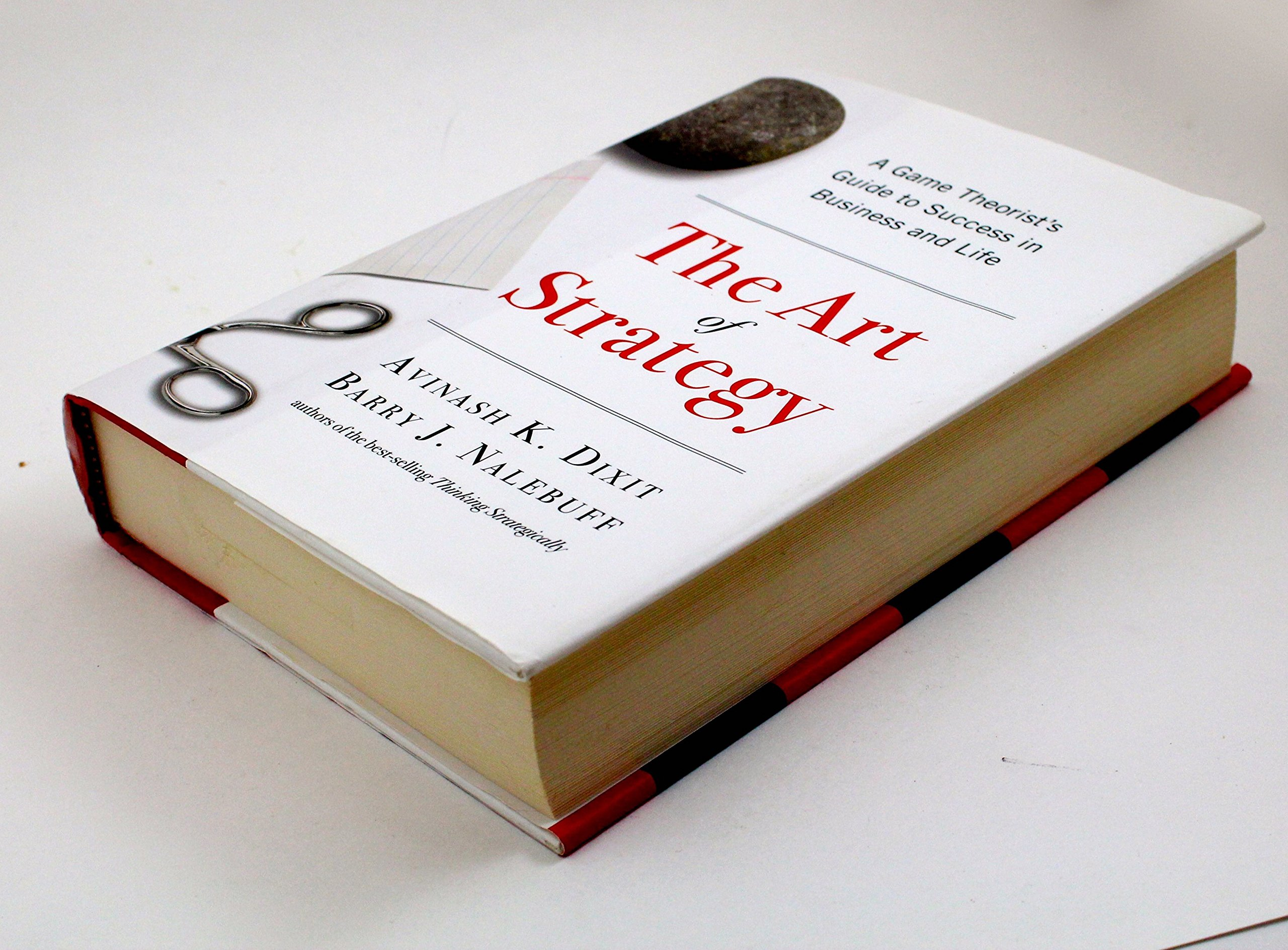

The Art of Strategy: A Game Theorist’s Guide to Success in Business & Life by Avinash K. Dixit and Barry J. Nalebuff
Avinash K. Dixit and Barry J. Nalebuff’s “The Art of Strategy” is a masterful exploration of game theory, offering practical wisdom for navigating the strategic interactions that permeate business, politics, and everyday life. This book isn’t just about winning; it’s about understanding the intricate dance of decision-making when others are also making choices that impact your outcomes. The authors promise to transform your strategic thinking by unpacking core game theory concepts through engaging stories and real-world examples. Prepare to delve into every important idea, insight, and practical application that makes this book an indispensable guide to thinking strategically.
Introduction: How Should People Behave in Society?
The introduction sets the stage by defining strategic behavior as interactions where your choices are interdependent with those of other active decision-makers. Unlike a lumberjack working against neutral wood, a general faces resistance, and so do we in our careers, relationships, and daily choices. The core idea is that your strategy must account for others’ aims, which can conflict or coincide with yours. This book aims to refine your strategic thinking by introducing the principles of game theory, the social science dedicated to studying such interactions.
The authors emphasize that while strategic thinking is an art, it is built upon foundational principles—the science of strategy, or game theory. They aim to make readers better strategists by teaching these principles through a mix of theory, illustrative examples, and case studies. They acknowledge that real-world situations are diverse and require adaptation of general principles. A key modern insight incorporated is behavioral game theory, which integrates human psychology and biases, dealing with people “as they are” rather than “as we might like them to be.” The goal is not a rigid set of rules but a flexible framework for thinking.
The authors highlight the book’s broad applicability, from business and politics to sports and social interactions. They stress that game theory, though young, offers vital insights that are too important to remain confined to academic journals. They also note the growing mainstream acceptance of game theory, evidenced by its popularity in university courses and public discourse, crediting Nobel laureates like John Nash and Thomas Schelling for their contributions. The introduction also offers a crucial caveat: there is no guarantee that the outcome of a game will be good for all players or for society, contrasting with the “invisible hand” of free markets. This suggests that simply playing a game well isn’t enough; one must also ensure they are “playing the right game.”
Chapter 1: Ten Tales of Strategy
This chapter introduces ten diverse tales to demonstrate the pervasive nature of strategic situations and offer preliminary thoughts on effective play. These stories serve as an appetizer, hinting at a conceptual framework developed later.
Tale #1: Pick a Number
The “Pick a Number” game illustrates the core concept that in a strategic game, you must account for the objectives and strategies of other players. If the number is chosen randomly, a binary search strategy (e.g., guessing 50, then 25) is optimal. However, if the opponent is actively trying to hide the number (as the authors do, aiming to minimize your payout), your strategy must adapt. The authors reveal they chose 48, anticipating common search patterns and then subtly influencing players to guess 49 by feigning a “hard to find” logic. This highlights the importance of putting yourself in the other player’s shoes and anticipating their multi-level thinking.
Tale #2: Winning by Losing
The “Survivor” anecdote with Richard Hatch demonstrates backward reasoning in a complex strategic situation. Hatch, facing a three-way final challenge, realized that winning the physical endurance contest and choosing an opponent would be disadvantageous. His best hope was to lose the challenge but ensure that Rudy, the most popular contestant, was eliminated. Kelly, his rival, had an incentive to win and eliminate Rudy, serving Richard’s strategic goal without him having to betray his alliance with Rudy. This showcases the power of anticipating future moves and understanding how your actions, or inactions, influence others.
Tale #3: The Hot Hand
This tale challenges the popular notion of a “hot hand” in sports, suggesting that strategic interaction influences observed performance. While statistics might deny individual streak shooting, a player with a truly “hot hand” (like Andrew Toney in basketball) might face increased defensive pressure, lowering their personal shooting percentage. However, this pressure creates opportunities for teammates, improving overall team performance. This highlights that individual metrics might not capture a player’s full strategic value. The example of LeBron James improving his left-handed shot to free up his right hand further illustrates how improving a “weakness” can strategically enhance overall effectiveness by altering opponent’s defensive allocations.
Tale #4: To Lead or Not to Lead
The 1983 America’s Cup final illustrates the strategic choice of leading versus following. Dennis Conner’s Liberty lost by failing to follow Australia II‘s risky maneuver. In sailboat racing, leaders often copy the trailing boat’s strategy (“monkey see, monkey do”) because the goal is to win, not just maintain a lead. This ensures you stay ahead if the follower’s gamble pays off. The analogy extends to stock market forecasting (leading forecasters follow the pack, newcomers take risks) and technological competition (Dell follows Kimberly-Clark’s diaper innovation). The key difference in business is that competition isn’t winner-take-all, allowing “second movers” to wait for proof of concept.
Tale #5: Here I Stand
The stories of Martin Luther and Charles de Gaulle demonstrate the power of intransigence or commitment in negotiation. By taking an irrevocable position, de Gaulle forced other parties to accept his terms or face a complete breakdown. This denies opponents the opportunity for counteroffers. However, the tale warns that such inflexibility can be costly: it can damage long-term relationships (de Gaulle’s chauvinism) or lead to disaster if conditions change (Ferdinand de Lesseps’s Panama Canal failure). The challenge is achieving selective inflexibility, a topic explored in Chapter 7.
Tale #6: Thinning Strategically
This tale, based on a real ABC Primetime experiment, explores commitment devices to overcome self-control problems (e.g., dieting). Participants (Cindy, Laurie, Ray) agreed to have embarrassing bikini photos publicly displayed if they failed to meet weight loss goals. This created a powerful external incentive for their “future selves” to adhere to their “current selves’” resolutions. Like Odysseus tying himself to the mast or Cortés scuttling his ships, they strategically cut off options to make failure more costly, thereby increasing their chances of success. This highlights that strategically limiting one’s own choices can be advantageous.
Tale #7: Buffett’s Dilemma
Warren Buffett’s campaign finance reform proposal illustrates the Prisoners’ Dilemma (the collective action problem). Both Democratic and Republican legislators face an individual incentive to support the reform (to gain a billion-dollar donation) regardless of what the other party does, even though collectively, they would prefer no reform (as it benefits them). This leads both to support the bill, costing the billionaire nothing. The classic Prisoners’ Dilemma, exemplified by the interrogation of Hickock and Smith in “In Cold Blood,” shows how individual self-interest can lead to a suboptimal outcome for the group. The “belling the cat” analogy further highlights the difficulty of collective action due to individual risk aversion.
Tale #8: Mix Your Plays
The story of Takashi Hashiyama’s Rock Paper Scissors game to select an auction house demonstrates the need for unpredictability in games of pure conflict. If your opponent can predict your move (e.g., Christie’s anticipating “always start with scissors”), they can exploit it. Randomized strategies (or mixed strategies) are crucial to prevent exploitation. The IRS audit example further illustrates that predictability renders enforcement ineffective. The chapter previews that strategic mixing involves more than simple rotation; it requires choosing proportions (e.g., tennis player’s forehand/backhand mix) that make opponents indifferent to their own pure strategies, as explored in Chapter 5.
Tale #9: Never Give a Sucker an Even Bet
This tale highlights the danger of accepting bets from informed parties, often leading to the winner’s curse. Sky Masterson’s father warns against bets where the other party has superior information (“squirt cider in your ear”). In zero-sum games like futures trading (for speculators) or poker, one party’s gain is another’s loss. If both believe they will win, one must be wrong. The key insight is that the other person’s willingness to trade or raise a bet conveys information about their knowledge. Winning an auction implies others valued the item less, a signal that you might have overpaid. The chapter previews how to bid to avoid this curse (Chapter 10) and the role of information asymmetries (Chapter 8).
Tale #10: Game Theory Can Be Dangerous to Your Health
The taxi ride anecdote underscores that strategic players are people, not machines, influenced by emotions, pride, and irrationality. The authors, applying game theory, tried to negotiate a lower fare, assuming the driver’s actions were purely economic. The driver, however, reacted with outrage, leading to a lose-lose situation. The story reveals the importance of understanding the other player’s perspective, including their motivations and how they perceive you. It also hints at the concept of larger games, where a seemingly isolated interaction might be part of an ongoing relationship with broader implications (e.g., the driver’s pride in front of his wife).
Key Takeaways from Chapter 1
This introductory chapter provided a foundational understanding of strategic thinking.
The core lessons:
- Interdependence is key: Your success depends on understanding and anticipating the decisions of others.
- Look forward, reason backward: Consider where your initial choices will lead, anticipating responses.
- Strategic actions speak louder: Actions (like throwing a steering wheel) are more credible signals than words.
- Cooperation and competition: Strategic interactions often involve both, not just zero-sum conflict.
- Unpredictability is a strength: In some games, randomness prevents exploitation.
- People are not purely rational: Emotions, pride, and context influence strategic choices.
Next actions: - Before making a significant decision, consider all active players and their potential responses.
- Reflect on past interactions where you might have misjudged another’s motivations or intentions.
Reflection prompts: - In what recent personal or professional decision did you fail to fully consider the strategic moves of others? How might “putting yourself in their shoes” have changed your outcome?
Chapter 2: Games Solvable by Backward Reasoning
This chapter introduces the fundamental principle of backward reasoning for sequential-move games, where players make alternating decisions. The key idea is to anticipate future responses and use this information to make the best current choice.
The First Rule of Strategy: Look Forward, Reason Backward
The chapter begins with the classic Charlie Brown and Lucy football scenario. Charlie Brown repeatedly falls for Lucy’s trick because he fails to anticipate her future action. The authors explain that Charlie should look forward to Lucy’s decision (she prefers to pull the ball away) and reason backward to his own best choice (refuse to kick). This is formalized as Rule 1: Look forward and reason backward. This principle applies to even more complex scenarios, like Charlie’s adult decision to invest in a potentially fraudulent “Freedonia” business, where the foreign businessman (Fredo) has an incentive to abscond with the money due to weak legal enforcement.
Decision Trees and Game Trees
The concept of a decision tree is introduced for solitary decision-makers, where choices branch out over time. For strategic interactions, a game tree is used, where different players make decisions at various nodes. The core of backward reasoning in a game tree involves:
- Starting at the end of the game.
- Determining the optimal action for the player whose turn it is at that final stage.
- “Pruning” suboptimal branches to eliminate future possibilities.
- Working backward, using these pruned results, to determine the optimal choices at earlier stages.
The line-item veto example demonstrates this. The President prefers an anti-ballistic missile system (M) over urban renewal (U). Without a line-item veto, Congress passes a package of U+M, which the President signs (outcome: (U,M) for both). With a line-item veto, Congress anticipates the President will veto U, leaving only M. Knowing this, Congress would rather pass nothing than only M. Thus, the President is worse off with more options, as the existence of the veto changes Congress’s strategy, leading to a less preferred outcome for the President. This highlights that greater freedom of action can sometimes be detrimental in games.
Strategies for “Survivors”
The “21 flags” game from Survivor: Thailand provides a practical example of backward reasoning in action. In this game, players take turns removing 1, 2, or 3 flags, and the person who takes the last flag wins. The optimal strategy involves ensuring the opponent always faces a multiple of 4 flags (e.g., 4, 8, 12, 16, 20). If a player faces 5 flags, they will lose if the opponent plays optimally. The game demonstrates how even seemingly simple rules can hide complex strategic depths, and how intuitive play often deviates from optimal play. The “Trip to the Gym No. 1” challenges readers to apply this logic to a “hot potato” variant. The analysis shows that despite initial misplays by contestants, the underlying logic of leaving the opponent with 4 flags (or a multiple of 4 plus 1, in the hot potato variant) is the key.
What Makes a Game Fully Solvable by Backward Reasoning?
For a game to be fully solvable by backward reasoning, three conditions are ideal:
- No uncertainty about the state: All players know exactly what has happened so far.
- No uncertainty about others’ motives/capabilities: Players know each other’s objectives (e.g., winning the game). This often involves putting yourself in others’ shoes.
- No strategic uncertainty: Players know what others will do in response to their choices, as moves are sequential and observable.
The authors contrast this with games of chance (e.g., card games with hidden hands) and simultaneous-move games where players act without knowing current choices. While ideal conditions are rare in real life, backward reasoning remains the starting point for analysis.
Do People Actually Solve Games by Backward Reasoning?
The chapter delves into the debate on whether people actually use backward reasoning, drawing on findings from behavioral economics and behavioral game theory. The ultimatum game (proposer offers split, responder accepts/rejects) is a prime example. Conventional economic theory predicts the proposer offers the smallest possible sum and the responder accepts (as anything is better than nothing). However, experiments show:
- Proposers offer substantial shares (median 40-50%).
- Responders reject low offers (below 20% rejected ~50% of the time).
Possible explanations for this deviation from purely selfish, rational backward reasoning include: - Inability to calculate: Unlikely for such a simple game.
- Other-regarding preferences: Players care about altruism, fairness, or social norms.
- Fear of rejection: Proposers anticipate responders’ reactions.
The dictator game (proposer dictates split, no rejection) reveals that proposers still give more than zero, suggesting some altruism. Experiments where roles are earned (e.g., by winning a quiz) show slightly smaller offers, indicating a sense of entitlement. “Neuroeconomics” research using fMRI shows anterior insula activity (linked to anger/disgust) in responders rejecting low offers, and pre-frontal cortex activity (conscious control) when unequal offers are accepted, suggesting emotional influence. Cross-cultural studies show variations in “reasonable” offers, but rejection thresholds are consistent, with some cultures (e.g., Machiguenga) showing less generosity and fewer rejections, and others more giving due to social norms.
Rationality vs. Other-Regarding Rationality
The authors conclude that while backward reasoning is a normative ideal, real-world behavior is influenced by “other-regarding” preferences. Behavioral game theory extends rationality to include these factors. The concept of evolutionary survival value is proposed: societies with norms of fairness and altruism may be more successful due to less internal conflict and better collective action. The “testosterone experiment” in ultimatum games even suggests a biological basis for “moralistic aggression.” The key takeaway is to start with backward reasoning, then modify it to account for human psychology and social norms, especially when players are novices or stakes are small.
Very Complex Trees
For games like chess, a complete backward reasoning solution is computationally infeasible due to the vast number of possible moves. Chess experts combine forward-looking analysis (science) with value judgment of intermediate positions (art/experience). Computers excel at brute-force calculation but also incorporate human “knowledge” of openings and mid-game positions. This “synthesis of science and art” is the recommended approach for complex real-world games.
Being of Two Minds
A major challenge in backward reasoning is predicting what others actually will do, not just what you would do in their shoes. It’s hard to “erase” your own strategic knowledge when trying to put yourself in their position. Hiring outsiders for business simulations can help ensure objectivity.
Case Study: The Tale of Tom Osborne and the ’84 Orange Bowl
Coach Tom Osborne’s decision to go for a one-point conversion (then a two-point attempt for the win) at 31-23, rather than a two-point attempt first, is analyzed. Using backward reasoning, the authors argue Osborne made a mistake.
The core lesson: If he failed the first two-point attempt, the score would be 31-23. A subsequent touchdown would make it 31-29, still allowing a two-point conversion for a tie. Osborne’s actual strategy meant missing the second two-point attempt guaranteed a loss. The strategic principle is to take risks as quickly as possible when you have multiple chances, leaving options open for later recovery. This applies broadly to career choices, investments, and dating.
Key Takeaways from Chapter 2
This chapter established backward reasoning as a fundamental tool for sequential games, while also highlighting its limitations and extensions.
The core lessons:
- Rule 1: Look forward and reason backward: Always anticipate future consequences to make present decisions.
- Game trees visualize choices: They help structure complex sequential interactions.
- Freedom can be detrimental: More options aren’t always better; they can change others’ responses.
- Human factors matter: Other-regarding preferences (fairness, altruism) and emotions influence outcomes.
- Complexity requires adaptation: For highly complex games like chess, combine theoretical rigor with practical judgment.
- Take risks early: If you have multiple attempts or chances, try the risky option first to preserve future options.
Next actions: - For any multi-step decision, explicitly map out potential future choices and outcomes for yourself and others.
- Consider how your own biases (e.g., assuming others are purely selfish) might influence your strategic predictions.
Reflection prompts: - Think of a time you were in a sequential negotiation or decision. Did you effectively use backward reasoning? How did your opponent’s (or your own) potential “irrationality” play out?
Chapter 3: Prisoners’ Dilemmas and How to Resolve Them
This chapter dives deep into the Prisoners’ Dilemma, a pervasive game theory concept where individual rationality leads to collectively suboptimal outcomes. It explores various manifestations of the dilemma and strategies for achieving cooperation.
Many Contexts, One Concept
The chapter opens by illustrating the wide-ranging presence of the Prisoners’ Dilemma in diverse situations:
- Price wars between competing businesses (e.g., gas stations, supermarkets).
- Political parties adopting centrist policies, neglecting core supporters to win swing voters.
- Overexploitation of common resources like fisheries (“tragedy of the commons”).
- Individual free-riding in collective action (e.g., Yossarian in Catch-22 not wanting to be the last to die).
In each case, individuals acting in their own self-interest lead to a worse outcome for everyone compared to if they had collectively cooperated.
A Little History
The Prisoners’ Dilemma was conceived by Merrill Flood and Melvin Dresher at the Rand Corporation, but popularized by Albert Tucker, who devised the memorable story. The core idea is that each player has a dominant strategy (e.g., confess, cut prices, fish aggressively), which is always the best choice regardless of what the other player does. However, when both players pursue their dominant strategy, they end up in an outcome that is worse for both than if they had both chosen the alternative (cooperate). This highlights a fundamental challenge to the “invisible hand” idea that individual self-interest always leads to collective good.
A Visual Representation: The Payoff Table
The authors use the example of Rainbow’s End and B.B. Lean, rival mail-order clothing firms, to introduce the game table or payoff table for simultaneous-move games. Each firm chooses between a high price ($80) and a low price ($70).
- If both charge $80, both profit ($72,000).
- If one cuts to $70 and the other stays at $80, the cutter gains ($110,000) and the other loses ($24,000).
- If both cut to $70, both profit less ($70,000) than if they both charged $80.
Rule 2: If you have a dominant strategy, use it. Both firms realize that cutting prices to $70 is their dominant strategy. This leads them to the suboptimal outcome of both charging $70 and making $70,000, illustrating the dilemma. The game is not zero-sum, meaning both can be better or worse off together.
Some Preliminary Ideas for Resolving the Dilemma
The challenge then becomes how to induce cooperation when defection is individually rational. Strategies to resolve the dilemma often involve:
- Rewards: Paying a player to cooperate. This can be problematic if not credible (e.g., promises to reward may be reneged).
- Punishment: Deterring defection by creating future costs. This is a more common and effective method.
Tit for Tat
Robert Axelrod’s famous computer tournament in the 1980s showed the surprising success of the Tit for Tat strategy in repeated Prisoners’ Dilemma games. This strategy:
- Cooperates in the first period.
- Mimics the rival’s action from the previous period thereafter.
Axelrod praised its clarity, niceness (never initiates defection), provocability (punishes defection), and forgivingness (restores cooperation). Tit for Tat’s strength lies in its ability to encourage cooperation and avoid exploitation without being overly aggressive. However, the authors argue that Tit for Tat has a critical flaw in real-world scenarios: mistakes or misperceptions can lead to endless cycles of retaliation (“echoes”), as seen in historical feuds like the Hatfields and McCoys. This suggests Tit for Tat is “too provocable, and not forgiving enough.”
More Recent Experiments
Thousands of Prisoners’ Dilemma experiments reveal nuanced findings:
- Cooperation occurs significantly often even in one-shot games (e.g., “Friend or Foe” game show).
- In repeated games with random pairings, cooperation often declines but doesn’t go to zero.
- In repeated games with the same pair, mutual cooperation often builds, though players may defect near the end of a finite sequence. This defies backward induction logic (which predicts immediate defection), possibly due to players acting as if the game might continue or trying to establish a reputation as a “reciprocator.”
- Multiperson dilemmas (e.g., Professor Battalio’s classroom experiment, contribution games) show that individuals tend to free-ride, leading to suboptimal collective outcomes.
- The ability to punish social cheaters (even at personal cost) dramatically increases contributions in contribution games. Neuroeconomic studies (PET scans) suggest people derive pleasure from punishing cheaters (dorsal striatum activation), indicating a deep biological root for such behavior.
How to Achieve Cooperation
Successful cooperation regimes require several elements:
- Detection of cheating: Fast and accurate detection is crucial (e.g., airlines monitoring fares).
- Nature of punishment: Must be effective (e.g., social ostracism, loss of future gains).
- Clarity: Rules and consequences must be clear to all (e.g., Tit for Tat’s simplicity).
- Certainty: Players must believe defection will be punished and cooperation rewarded.
- Size: Punishment should be proportional to the offense, avoiding excessive harshness (which makes errors costly).
- Repetition: Ongoing relationships allow for punishment and reward over time, making cooperation more likely. Low interest rates (making the future more valuable) and stable group composition also favor cooperation.
- Solution by Kantian Categorical Imperative: Some argue cooperation stems from “quasi-magical thinking”—believing one’s own cooperative act influences others, even when it logically cannot. While illogical, this thinking can lead to better collective outcomes in society.
Dilemmas in Business
Firms in an industry face a Prisoners’ Dilemma when it comes to collusion (keeping prices high). They want to avoid price wars, but each is tempted to undercut.
- Explicit collusion (e.g., Archer Daniels Midland, turbine manufacturers) is illegal but can be sustained by clear rules and detection devices (e.g., lunar calendar bidding scheme, area code signaling in spectrum auctions).
- Tacit agreements are harder to enforce but avoid antitrust penalties. Meet-the-competition clauses or most-favored-customer clauses serve as credible threats/assurances, making defection less profitable and more easily detectable.
Tragedies of the Commons
Overfishing, global warming, and other common resource depletion problems are multiperson Prisoners’ Dilemmas. Elinor Ostrom’s work on successful common-pool resource management highlights prerequisites for cooperation:
- Clear group boundaries: Who has rights to the resource.
- Clear rules on permissible actions (e.g., time of use, technology).
- Clear, graduated punishment systems (verbal chastisement to fines).
- Effective detection methods (e.g., mutual monitoring, designing rules for observability).
- Local information and user participation in designing rules.
Ostrom emphasizes that these systems cope with dilemmas rather than overcoming them perfectly.
Nature Red in Tooth and Claw
Prisoners’ Dilemmas also appear in nature:
- Kin selection: J.B.S. Haldane’s quote (“For more than two brothers, or more than eight cousins, yes”) illustrates the genetic basis for altruism among close relatives.
- Reciprocal altruism: Vampire bats sharing blood meals, or wolf packs hunting, exemplify cooperation among non-kin where interactions are stable and long-lasting, supported by individual recognition and score-keeping.
Case Study: The Early Bird Kills the Golden Goose
The “early bird” finches on Daphne Major who snip cactus stigmas to get nectar faster illustrate a “cancerous adaptation.” While it provides an individual short-term advantage, it sterilizes the cactus, ultimately destroying the food source for the entire population. This is a variant of the “stag hunt” game, where individual short-term gains (chasing a hare) can undermine a collective long-term benefit (hunting a stag). Unlike a classic Prisoners’ Dilemma, the incentive to cheat isn’t always there; it depends on the actions of others. If too many snip, individual finches are incentivized to join in because the collective resource is doomed anyway. The dilemma is a “confidence game,” with two equilibria: one where all cooperate and thrive, and another where individual self-interest leads to collective ruin.
Key Takeaways from Chapter 3
This chapter elucidated the pervasive nature of the Prisoners’ Dilemma and the varied mechanisms for fostering cooperation.
The core lessons:
- Individual rationality can lead to collective irrationality: The Prisoners’ Dilemma is a stark reminder that self-interest doesn’t always yield optimal collective outcomes.
- Dominant strategies can be destructive: When everyone has a dominant strategy, it often leads to a suboptimal Nash equilibrium.
- Repetition fosters cooperation: Ongoing relationships allow for tit-for-tat strategies and the building of trust.
- Credibility is paramount: For threats or promises to induce cooperation, they must be believable and enforceable.
- Mechanisms for cooperation exist: From explicit contracts to social norms, there are many ways to overcome dilemmas.
Next actions: - Identify any “Prisoners’ Dilemmas” in your own life (e.g., team projects, household chores) and brainstorm ways to introduce detection, punishment, or credible commitments.
- When faced with a one-shot interaction, consider whether the other party might be influenced by “other-regarding” preferences.
Reflection prompts: - In what collective action problem have you recently participated? Did you free-ride, or did you contribute? What factors influenced your choice, and what was the outcome for the group?
Chapter 4: A Beautiful Equilibrium
This chapter delves into Nash equilibrium, a pivotal concept in game theory that offers a solution for simultaneous-move games where players choose their best strategies given what they believe others will do.
Big Game of Coordination
The chapter begins with the “Stag Hunt” game (or the hunting game). Fred and Barney can hunt Stag (high payoff if coordinated) or Bison (high payoff if coordinated), or go for Rabbits individually (lower but guaranteed payoff). The problem is they’ve forgotten which big game they agreed on. This game is different from the Prisoners’ Dilemma because neither player has a dominant strategy; their best choice depends on what the other does. This leads to circular thinking about what the other is thinking.
Squaring the Circle: John Nash’s Contribution
John Nash’s beautiful equilibrium concept “squares the circle” of simultaneous decision-making. A Nash equilibrium is an outcome where each player chooses the strategy that is best for them, given what the other players are doing, and everyone’s beliefs about what others are doing are correct. In such a state, no player has an incentive to unilaterally change their strategy.
Finding Nash Equilibrium
The authors revisit the pricing game between Rainbow’s End and B.B. Lean, expanding the price choices.
- Best Responses: For each possible price chosen by one firm, the other firm identifies its optimal counter-price. These are the “best responses.”
- Nash Equilibrium: A cell where both players’ chosen prices are a best response to the other’s choice is a Nash equilibrium. In the expanded pricing game, the Nash equilibrium is found at a price of $40 for both firms, resulting in $40,000 profit each. This is worse for both than the $80 price if they could collude, re-emphasizing the Prisoners’ Dilemma aspect.
Rules for Finding Nash Equilibria
The chapter provides a systematic approach:
- Rule 3: Eliminate dominated strategies and strategies that are never best responses. These are choices that are always worse (dominated) or never optimal regardless of the opponent’s action. This simplifies the game table.
- Rule 4: Search for mutual best responses. After eliminating suboptimal strategies, identify cells where each player’s action is the best response to the other’s.
Games with Infinitely Many Strategies
The concept of Nash equilibrium extends to games where strategies (e.g., prices) can be chosen from a continuous range rather than discrete options. This is illustrated graphically with best-response curves. The intersection of these curves represents the Nash equilibrium, confirming the $40/$40 price outcome.
A Beautiful Equilibrium?
The authors explore whether Nash equilibrium accurately predicts real-world outcomes.
- Theoretical Strength: A Nash equilibrium is logically robust because any deviation by a single player would make them worse off. If an outcome is not a Nash equilibrium, at least one player has an incentive to change their strategy.
- Empirical Evidence (Mixed):
- Laboratory Experiments: Initial ultimatum game results (generous offers, low rejections) seemed to contradict selfish Nash predictions. However, when “other-regarding rationality” (altruism, fairness, fear of rejection) is incorporated into player preferences, Nash equilibrium often does explain observed behavior. Novices may not play Nash initially, but often converge with experience.
- Real-World Observations (Industrial Organization): Studying firm competition is complex due to unknown costs, demand functions, and multiple competitive dimensions. While researchers face handicaps, the Nash equilibrium concept is a valuable tool, though results are mixed and require ongoing research.
- Auctions: Empirical estimation of auction games (discussed in Chapter 10) shows considerable success for Nash predictions.
- Multiple Equilibria: When a game has multiple Nash equilibria (like the hunting game), the theory alone doesn’t predict which will emerge. This requires additional factors like focal points (Thomas Schelling’s contribution).
Which Equilibrium? The Power of Focal Points
Focal points are outcomes that players’ expectations converge upon due to common experiences, culture, language, or arbitrary salience.
- Meeting in NYC: Schelling’s classic experiment shows people converging on “noon” and prominent landmarks (Grand Central, Empire State Building, Times Square). Success depends on mutual understanding of “obviousness.”
- Dividing Cities: Kreps’s experiment on dividing cities geographically highlights how nationality or common experience can create focal points (e.g., dividing by Mississippi River).
- Choosing Numbers: “1” is often a focal point for positive integers.
- Stock Market (Keynes’s Beauty Contest): Investors chase “hot stocks” that others believe will be hot, creating self-fulfilling prophecies often anchored by arbitrary “round numbers” or analyst recommendations.
- CEO Compensation: CEOs target being “better than average,” leading to escalating pay scales as everyone aims for an “above-average” meeting point.
Battles and Chickens
These games also feature multiple Nash equilibria but with conflicting interests.
- Battle of the Sexes (or Hunting Game Variant): Fred prefers Stag, Barney prefers Bison, but both prefer to be together. Equilibria: (Stag, Stag) and (Bison, Bison). Conflict arises over which equilibrium. Credible commitments (explored in Chapter 7) or negotiation/randomization (e.g., alternating hunts) can resolve this.
- Chicken (or Hunting Game Variant): One swerves, the other goes straight. Equilibria: (Go Straight, Swerve) and (Swerve, Go Straight). If both go straight, it’s the worst outcome. Here, commitment to “Go Straight” (e.g., throwing out the steering wheel) forces the opponent to swerve. The conflict is sharper, as attempts to achieve one’s preferred outcome can lead to mutual disaster.
Finding Nash Equilibria: Successive Elimination
Rule 3: Eliminate from consideration any dominated strategies and strategies that are never best responses, and go on doing so successively. This simplifies the game by removing choices a rational player would never make. If this process leads to a unique outcome, it’s a Nash equilibrium. This method is often a shortcut to finding the equilibrium without full inspection.
Case Study: Half Way
The “Half Way” game (pick a number closest to half the other’s number) illustrates the two conditions of Nash equilibrium: (i) each player chooses a best response to their beliefs, and (ii) each player’s beliefs are correct.
- Iterated elimination of dominated strategies: If Abe picks X, Bea should pick X/2. If Bea picks X/2, Abe should pick X/4. This process converges to 0.
- Nash Equilibrium: (0,0) is the Nash equilibrium. If Abe picks 0, Bea’s best response is 0. If Bea picks 0, Abe’s best response is 0.
The chapter notes that in real play, people rarely pick 0 initially, showing that correct beliefs are hard to form without experience. However, with repeated play, they often converge to 0, demonstrating the learning aspect of Nash equilibrium. The problem with mobile phone calls highlights that with multiple equilibria (You call/I wait; I call/You wait), social conventions are often needed to coordinate.
Key Takeaways from Chapter 4
This chapter provided a robust framework for analyzing simultaneous-move games, introducing the concept of Nash equilibrium.
The core lessons:
- Nash Equilibrium (Rule 4): A state where no player can unilaterally improve their outcome by changing their strategy, given the others’ strategies. It’s a logically stable prediction.
- Dominant and Dominated Strategies (Rule 3): Simplify games by eliminating choices that are always worse or never best.
- Focal Points: Essential for coordinating on one equilibrium when multiple exist, often relying on shared context, culture, or salience.
- Games are contextual: Cultural, historical, and accidental factors influence equilibrium selection (e.g., QWERTY keyboard).
- Truthful Revelation: Nash equilibrium can help predict behavior in games where information is revealed through actions.
Next actions: - When facing a simultaneous decision, identify potential Nash equilibria.
- Consider what common ground or “focal points” you might leverage to coordinate on a preferred outcome.
Reflection prompts: - Think of a situation where you and another person were “reading each other’s minds” to make a decision. Did you converge on a particular outcome? Was it a Nash equilibrium, and how did “focal points” or shared assumptions play a role?
Chapter 5: Choice and Chance
This chapter introduces the concept of mixed strategies, where players randomize their choices to prevent opponents from exploiting predictable patterns, particularly in games of pure conflict.
Wit’s End
The scene from The Princess Bride where Vizzini attempts to deduce which goblet contains poison illustrates the pitfalls of circular logic when interests are diametrically opposed. Vizzini’s reasoning (if Westley poisons A, I pick B; but Westley knows I know, so he poisons B, so I pick A, etc.) leads to an endless loop. This problem is common in sports like soccer penalty kicks where both kicker and goalie must choose a side simultaneously. The only way to avoid being exploited by a clever opponent is to be unpredictable—to choose moves randomly.
Mixing It Up on the Soccer Field
The soccer penalty kick is presented as a classic zero-sum game (or constant-sum game, where payoffs sum to a constant, like 100%). The kicker’s gain is the goalie’s loss.
- Pure Strategies: Kicker chooses Left or Right; Goalie chooses Left or Right.
- No Pure Strategy Nash Equilibrium: If the kicker always goes Left, the goalie always goes Left, but then the kicker should go Right, and so on. The game lacks a stable outcome in pure strategies.
- Mixed Strategies: To avoid predictability, players must randomize their choices. The goal is to choose proportions such that the opponent is indifferent between their pure strategies, as they cannot exploit any systematic choice.
- For the kicker (using real-world data): optimal mix is ~38.3% Left, ~61.7% Right. This yields a success rate of ~79.6% regardless of the goalie’s pure strategy.
- For the goalie: optimal mix is ~41.7% Left, ~58.3% Right, also yielding ~79.6% for the kicker.
- Minimax Theorem (John von Neumann): In two-player zero-sum games, the maximum payoff a player can guarantee (maximin) is equal to the minimum payoff the opponent can force (minimax). This means players should choose the mixture that makes the opponent indifferent between their pure strategies.
Rule 5: In a game of pure conflict (zero-sum game), if it would be disadvantageous for you to let the opponent see your actual choice in advance, then you benefit by choosing at random from your available pure strategies. The proportions in your mix should be such that the opponent cannot exploit your choice by pursuing any particular pure strategy from the ones available to him—that is, you get the same average payoff when he plays any of his pure strategies against your mixture.
Theory and Reality
The chapter notes a strong agreement between theoretical mixed strategy predictions and actual play in high-stakes professional sports (soccer, tennis), where players have strong incentives and learn from experience. However, laboratory experiments often show subjects failing to randomize correctly. This is attributed to:
- Artificiality of lab settings: Novice subjects, small stakes, and implicit instructions not to randomize.
- Difficulty of true randomness: Humans naturally fall into predictable patterns (e.g., “too many reversals” in coin flips). Objective mechanisms (like watching a second hand on a watch) are needed.
The importance of true unpredictability is highlighted, as systematic patterns (even complex ones) can be exploited.
Child’s Play: Rock Paper Scissors
The Rock Paper Scissors game is a symmetric zero-sum game. The theoretical mixed strategy solution is to randomize all three moves with equal 1/3 probabilities. However, the World RPS Society notes that human players try to find and exploit “unconscious but nonetheless predictable patterns,” leading to complex “gambits” that deviate from pure randomness. This underscores the human tendency to seek patterns even where none exist.
Mixing It Up in the Laboratory
Laboratory experiments on mixed strategies often show discrepancies with theoretical predictions. This is partly due to the artificial environment, small stakes, and subjects’ lack of experience. However, the tendency of humans to deviate from true randomness, often by introducing too many reversals, is a consistent finding. The “Chaos School” of RPS, advocating pure randomness, is criticized by those who believe human “impulses” can be exploited.
Mixing in Business and Other Wars
Mixed strategies are less common in business and politics because most games are non-zero-sum, and mixing can lead to lower payoffs if not perfectly coordinated.
- Price Discount Coupons: Firms (e.g., Coke and Pepsi) can use randomized promotions to attract customers. However, uncoordinated mixing can lead to mutual promotions that cancel out effects and reduce profits. Tacit cooperation (alternating promotions) is a better outcome.
- Lower Monitoring Costs: Randomization is widely used to achieve compliance at lower cost (e.g., tax audits, drug testing, parking meters). A high penalty with a low probability of detection can be more cost-effective than 100% enforcement with low penalties. The expected punishment should fit the crime.
- Signal Jamming: In military contexts, attackers use decoys or dud shells to force defenders to expend resources on false positives, making defense prohibitively expensive.
How to Find Mixed Strategy Equilibria
The chapter provides a brief mathematical and graphical explanation for calculating the optimal mixed strategy proportions in two-player zero-sum games. The key is to find the proportions that make the opponent indifferent between their pure strategies. The apparent paradox of one player’s optimal mix depending on the other player’s payoffs is explained: each player is trying to keep the other indifferent.
Case Study: Janken Step Game
This variant of Rock Paper Scissors assigns different step values for winning with Rock (1), Paper (5), or Scissors (2). It’s a zero-sum game. To find the equilibrium mixed strategy, each player must choose proportions for their three moves (Rock, Paper, Scissors) such that the opponent is indifferent between their three pure strategies. By setting the expected payoffs of the opponent’s three pure strategies equal to each other, the equilibrium probabilities for the first player’s mix can be calculated. This ensures that no opponent can gain an advantage by predicting a non-random choice.
Key Takeaways from Chapter 5
This chapter introduced mixed strategies as a crucial tool for achieving unpredictability and optimality in strategic interactions.
The core lessons:
- Embrace unpredictability: In games of pure conflict, choosing actions randomly prevents exploitation by opponents.
- Optimal mixes make opponents indifferent: The correct proportions ensure that no single pure strategy yields a better outcome for the opponent.
- The Minimax Theorem: Guarantees that in two-player zero-sum games, the best a player can guarantee themselves equals the best the opponent can limit them to.
- Real-world vs. Lab: Mixed strategy theory holds strong in high-stakes professional contexts but less so in artificial lab settings.
- Mixing for efficiency: Randomization can reduce monitoring costs in enforcement (e.g., audits) and prevent predictable patterns.
Next actions: - Identify situations where predictability might be exploited (e.g., recurring negotiations, competitive actions) and consider how to introduce randomness.
- Reflect on instances where you (or others) have tried to “guess” an opponent’s patterns – how did that work out?
Reflection prompts: - How might you apply the concept of mixed strategies to a recurring challenge in your work or personal life to gain an advantage or prevent being exploited? What are the practical challenges of true randomization?
Chapter 6: Strategic Moves
This chapter delves into strategic moves, which are actions taken by a player to change the game itself in their favor, rather than merely playing optimally within a given game structure. These moves often involve commitment, threats, or promises.
Changing the Game
The chapter starts with the common failure of New Year’s resolutions, often due to the “future self” succumbing to temptation. This is framed as a game between a resolute “current self” and a weak-willed “future self.” The “current self” can make a strategic move by implementing a commitment device that changes the “future self’s” incentives (e.g., placing the alarm clock across the room, or the ABC Primetime bikini photos). These moves are intended to be irreversible or to alter payoffs such that the desired action becomes optimal for the “future self.”
The famous chicken game example (disconnecting the steering wheel) further illustrates how restricting one’s own freedom of action can be advantageous. By making retreat impossible, you force the opponent’s hand. This is a counterintuitive but powerful aspect of strategic moves. The authors warn that such moves can be risky if not executed perfectly or if the opponent anticipates them.
A Little History
The pioneering work of Thomas Schelling in the late 1950s and early 1960s is credited with developing the concept of strategic moves, including commitment, threat, and promise. His work emphasized the importance of credibility. Later, Reinhard Selten formalized the concept of subgame perfect equilibrium, a refinement of Nash equilibrium that incorporates backward reasoning and credibility, for which he shared the Nobel Prize in 1994.
Commitments
A commitment is an unconditional strategic move where a player irrevocably chooses a course of action, making them the first mover. The alarm clock example demonstrates how the “night self” commits to waking up early by placing the alarm out of reach. This changes the game’s payoffs for the “morning self,” making getting up the better option. Represented in a game table, the “set alarm” strategy might appear dominated if viewed as a simultaneous move, but it is beneficial because it changes the opponent’s (future self’s) optimal response. Thus, dominance loses significance when analyzing first-mover strategic moves.
Threats and Promises
Unlike unconditional commitments, threats and promises are conditional strategic moves. They involve establishing a response rule in advance, stating how you will react to another player’s actions.
- Threat: Punishes undesirable actions (e.g., “No dessert unless you eat your spinach”).
- Promise: Rewards desirable actions (e.g., “If you keep your price high, so will I”).
To be effective, these moves require: - First-mover status: You must establish the response rule before the other player acts.
- Credibility: The other player must believe you will actually carry out the threat or promise, even if it’s costly for you to do so at the moment of execution. This often necessitates changing the game’s payoffs or constraining your own future choices.
The meet-the-competition clause in catalog sales is a prime example: Rainbow’s End printing “$80 with a footnote: We will meet any lower price” makes a threat of matching price cuts credible and automatic, deterring rivals like B.B. Lean from undercutting.
Deterrence and Compellence
Strategic moves aim to influence others’ behavior.
- Deterrence: Stopping someone from doing something they would otherwise do (e.g., US threatening nuclear response to Soviet invasion of Western Europe). This often involves imposing a cost on the undesired action.
- Compellence: Forcing someone to do something they would not otherwise do (e.g., bank robber demanding money under threat of violence). This often involves imposing a cost for inaction.
Both threats and promises can be deterrent or compellent. A key challenge is that fulfilling a threat or promise often involves a cost to the strategic mover, creating an incentive to renege after the desired behavior is achieved. This again highlights the crucial role of credibility.
Warnings and Assurances
These are distinct from threats and promises because they simply involve stating your intentions (what you will do because it’s in your interest), rather than establishing a new, costly response rule.
- Warning: Stating a future action that is in your interest anyway (e.g., President warns he will veto a bill).
- Assurance: Stating a future rewarding action that is in your interest anyway (e.g., B.B. Lean assuring Rainbow’s End it will maintain high prices if mutual cooperation is a long-term equilibrium).
Warnings and assurances are informational; they don’t change the game’s underlying incentives but clarify them. Threats and promises are genuinely strategic because they involve actions that are not immediately optimal unless the strategic move has made them so.
Other Players’ Strategic Moves
It’s crucial to consider how others’ strategic moves affect you.
- Relinquishing First-Mover Advantage: Sometimes, it’s better to allow another player to make an unconditional move if there’s a second-mover advantage (e.g., America’s Cup).
- Responding to Threats/Promises: You are never better off by allowing someone to threaten you (it restricts your choices). However, you can be better off by allowing someone to make a credible promise, as it may lead to win-win outcomes (e.g., one prisoner making a credible promise not to confess).
Similarities and Differences Between Threats and Promises
- Status Quo: The distinction between a threat and a promise often depends on how the status quo is defined. A threat to punish inaction is a promise to reward action, and vice-versa.
- Cost: Threats can be less costly if successful (they don’t have to be carried out), while promises must be fulfilled. However, threats carry the risk of being called and incurring the cost.
- Purpose/Deadline: Deterrence (preventing an action) is often better achieved by threats (which don’t need deadlines). Compellence (forcing an action) usually requires promises with deadlines to prevent procrastination (“salami tactics”).
Clarity and Certainty
For strategic moves to be effective, their consequences must be clear (not confusing, like Stalin’s arbitrary punishments) and certain (believable, not just words). A graduated penalty system (e.g., minor fines for initial parking violations, increasing for repeat offenses) can be both clear and credible.
Large Threats
Using overwhelmingly large threats (e.g., nuclear war over a minor economic dispute) is often ineffective because they lack credibility. The cost of carrying them out makes them unbelievable, especially given the inevitable risk of error. This leads to the strategy of brinkmanship.
Brinkmanship
Brinkmanship involves the deliberate creation of risk to compel an opponent. It’s not a cold, calculated threat of certain disaster, but rather increasing the probability of a mutually undesirable outcome until the opponent backs down.
- “One in six” Russian Roulette: Bud White in L.A. Confidential escalates the risk of shooting the suspect, forcing information.
- Slippery Slope: Schelling argues the “brink” is a gradually steepening slope, not a sharp precipice. Each escalation (e.g., the Cuban Missile Crisis, labor strikes) increases the risk of accidental escalation, compelling one side to “blink.”
- Fog of War: Uncertainty, miscommunication, and human factors make it difficult to control escalation, contributing to the perceived risk.
Brinkmanship is dangerous; if both sides refuse to back down, the feared outcome can occur (e.g., Tiananmen Square massacre, Romanian Revolution). It highlights the art of balancing calculated risk with the potential for disaster.
Case Study: Two Wrongs Keep Things Right
This case explores how parents can make threats to punish children more credible.
The core lesson: To make a threat credible, ensure that carrying it out is in your best interest at the moment of execution.
- Teamwork: With two parents, one parent’s (e.g., the father’s) threat to punish becomes credible if backing down would mean breaking an agreement with the other parent (the mother), which is a greater cost.
- Self-Punishment: Dean Karlan’s “Commitment Store” example (paying $1,000 per pound if he exceeded 175 lbs) shows how one can ensure self-punishment by making the penalty go to someone (or something) with an independent incentive to enforce it. By taking money from his friend, Karlan made it rational for his friend to take money from him in the future, thus keeping both accountable. This links back to the idea of contracts and reputation.
Key Takeaways from Chapter 6
This chapter provided a deep dive into strategic moves—the art of changing the game itself.
The core lessons:
- Strategic moves alter the game: Commitments, threats, and promises are not just choices within a game, but actions that reshape the game’s payoffs or available choices.
- Commitment is unconditional: Irrevocably choosing a path.
- Threats and promises are conditional: Stating how you will respond, but requiring credibility.
- Credibility is paramount: A strategic move is useless if the other party doesn’t believe you will follow through.
- Restricting options can be powerful: Removing your own flexibility can force an opponent’s hand.
- Brinkmanship is calculated risk: Deliberately escalating the risk of a mutually undesirable outcome to force compliance.
- The art of strategy: Thinking up effective and credible strategic moves is more art than science, requiring deep understanding of context and human psychology.
Next actions: - Before making a significant decision, consider if you can make a strategic move (commitment, threat, or promise) to change the game in your favor.
- Evaluate your strategic moves for credibility: What would prevent you from backing down? What would convince others?
Reflection prompts: - Can you recall a situation where you (or someone else) tried to use a strategic move that lacked credibility? What was the outcome, and what could have been done differently to make it believable?
Chapter 7: Making Strategies Credible
Building upon the previous chapter, this chapter focuses specifically on the “how” of strategic moves: the concrete methods for making your commitments, threats, and promises believable.
In God We Trust?
The story of God and Adam and Eve in the Garden of Eden highlights the problem of credible threats. God’s initial threat of “surely die” lacked credibility because carrying it out would be too costly (destroying His creation). As predicted by the serpent, God reneged on the full threat, imposing a less drastic punishment. This illustrates that even divine threats can suffer from a credibility problem if fulfilling them is against the threatener’s ultimate interest. Even Harry Potter’s promise to Griphook demonstrates that words alone, even from a hero, may not be credible without aligning incentives or consequences.
The Eightfold Path to Credibility
The authors categorize methods for enhancing credibility into eight tactics, based on three principles:
- Change the Payoffs: Make it in your self-interest to follow through.
- 1. Write Contracts: Agree to penalties if you fail to follow through. The key is that the enforcing party must have an independent incentive to enforce the contract, preventing mutual renegotiation after the fact. The Nick Russo dieting bounty failed due to renegotiation; the cocaine addict rehabilitation center succeeded because the enforcers’ jobs and reputations were tied to enforcement. Court systems work due to judges’ professional ethics and career incentives, while Mafia protection and diamond merchant tribunals rely on reputation and extralegal enforcement (e.g., social ostracism, violence).
- 2. Establish and Use a Reputation: Your past actions create a reputation that makes future strategic moves credible. If you back down, you lose this valuable asset. Mafia toughness (requiring violent acts), President Kennedy’s public declarations during the Cold War, and George H.W. Bush’s “no new taxes” pledge all illustrate the power (and risk) of staking one’s reputation.
- Limit Ability to Back Out: Physically or psychologically constrain your options.
- 3. Cut Off Communication: Make an action truly irreversible by preventing yourself from receiving counter-orders or information that might change your mind. Dr. Strangelove’s General Ripper sealing off his base and destroying radios is a fictional example. However, this is risky if you also need to know if the opponent has complied or if accidental execution occurs.
- 4. Burn Bridges Behind You: Eliminate the option of retreat, forcing yourself to fight or succeed. William the Conqueror burning his ships, Cortés scuttling his fleet in Mexico, and Polaroid‘s single-minded focus on instant photography against Kodak are historical and business examples. Conversely, East Germany dismantling the Berlin Wall used “building bridges” as a commitment to reform by making mass exodus possible.
- 5. Leave the Outcome Beyond Your Control, or Even to Chance: Design a mechanism that automatically triggers the threatened action if a condition is met, removing your agency. Dr. Strangelove’s Doomsday Machine (automatic nuclear retaliation) is an extreme example. Brinkmanship is a “controlled loss of control,” creating a risk (e.g., Russian Roulette, escalating a conflict) that compels the opponent.
- Use Others to Help Maintain Commitment: Leverage external parties or group dynamics.
- 6. Move in Small Steps: Break a large, difficult-to-commit-to action into many smaller ones. Each small step is easier to commit to and builds trust. The “gain from breaking a little one may be more than offset by the loss of the remaining contract.” This is common in contractor payments and implies that “going out of business” sales are risky for consumers.
- 7. Develop Credibility Through Teamwork: Alcoholics Anonymous uses peer pressure; the ancient Roman army ensured loyalty by making failure to kill a deserter a capital offense, forcing mutual enforcement. The West Point honor code similarly makes failing to report cheating a serious offense.
- 8. Employ Mandated Negotiating Agents: Use an agent (e.g., union leader, sports agent, machine, bureaucrat) who has a limited mandate or whose reputation/career depends on adhering to the agreed-upon position, making them inflexible where you might be tempted to compromise. This is useful when you are negotiating with someone with whom you share other bonds that make you reluctant to be firm.
Undermining Your Opponent’s Credibility
The chapter also discusses strategies for counteracting an opponent’s strategic moves.
- Contracts: Propose renegotiation of a contract if it’s mutually beneficial at the moment of renegotiation, even if it violates the original terms.
- Reputation: Counter an opponent’s reputation by keeping their actions secret (e.g., demanding secrecy for special discounts) or by revealing inconsistencies.
- Communication: Prevent an opponent from making a credible commitment by being unavailable to receive their message or demonstrating its pointlessness (e.g., a child crying too loudly to hear a threat).
- Burning Bridges: Sun Tzu’s advice to “leave an outlet free” for an enemy, preventing them from fighting to the death.
- Moving in Steps: Use “salami tactics” to defy threats in small, seemingly insignificant steps, making it not worthwhile for the opponent to invoke the costly punishment each time.
- Mandated Agents: Demand to speak directly to the principal rather than the inflexible agent, challenging the agent’s authority.
Case Study: A Textbook Example of Credibility
This case study examines the problem of textbook pricing and used book markets.
The core lesson: The existing system creates a Prisoners’ Dilemma for publishers and students, leading to higher new textbook prices and frequent revisions.
- Publisher’s Dilemma: If used books are readily available, publishers make fewer sales. To compensate, they raise new book prices and issue new editions frequently to make old ones obsolete. This strategy hurts students (higher net costs, obsolete books) and even publishers (some students avoid buying new books, fearing obsolescence).
- The Problem: Students know a revision is coming, making them reluctant to buy expensive new texts. The system creates a wedge where publishers charge more, yet students receive less value.
- Solutions for Credibility:
- Banning used book sales: Impractical and unpopular.
- Leasing/Renting textbooks: Students pay a deposit, returned upon book return. This makes used books less of a concern for publishers, allowing them to lower initial prices and reduce revision frequency.
- Selling licenses: Like software licenses, students pay for access to the text. The university pays for the license and bills students. This eliminates the physical used book market, aligning incentives for publishers and students.
The case concludes that in general, when commitment is problematic, renting rather than selling a product can eliminate incentives to exploit the used market, benefiting all parties by aligning interests.
Key Takeaways from Chapter 7
This chapter emphasized that credibility is not intrinsic but built through deliberate actions.
The core lessons:
- Credibility is earned, not given: Mere words are insufficient; actions (and their consequences) are what convince.
- Altering payoffs: Make it in your self-interest to follow through on threats or promises.
- Limiting options: Strategically removing your own flexibility can force an opponent’s hand.
- Leveraging others: Teams and agents can achieve credibility where individuals cannot.
- Understand the opponent’s credibility: Just as you build yours, analyze how others establish (or fail to establish) theirs.
- The art of strategy: Applying these principles requires creativity and deep situational understanding.
Next actions: - Review your own past “failed” commitments or threats. Which of the eight credibility paths could have been applied?
- Analyze a recent negotiation: What did each side do to build or undermine credibility?
Reflection prompts: - Think of a situation where you needed to convince someone of your resolve. Which of the eight paths to credibility did you, or could you have, used? What were the challenges?
Epilogue to Part II: A Nobel History
This epilogue bridges the first two parts of the book, summarizing key game theory concepts and introducing the evolving understanding of information in strategic interactions, especially as highlighted by Nobel laureates.
The epilogue traces the history of game theory from John von Neumann’s early focus on zero-sum games and cooperative games, to John Nash’s breakthrough concept of Nash equilibrium for general non-cooperative games. It emphasizes that Nash’s contribution allows for analysis even when players act separately but their interests are mixed.
It then introduces subsequent Nobel laureates who refined and extended Nash’s work:
- John Harsanyi (1994 Nobel): Extended Nash equilibrium to games where players are uncertain about others’ preferences.
- Reinhard Selten (1994 Nobel): Refined Nash equilibrium with concepts like subgame perfect equilibrium, addressing the issue of multiple equilibria and incorporating the idea of small mistakes, akin to backward reasoning in sequential games.
A crucial development is the role of information asymmetries:
- Robert Aumann (2005 Nobel): Contributed the concept of common knowledge, where not only do players know something, but they know that the other knows it, and so on, infinitely. The absence of common knowledge is often the more realistic case.
- Information Manipulation: When players lack perfect information, the game becomes about concealing, revealing, and interpreting information.
The epilogue highlights three other Nobel Prizes awarded for contributions to information economics and mechanism design, which are closely related to game theory:
- 1996 Nobel (James Mirrlees and William Vickrey): Focused on designing games to elicit truthful revelation of private information. Mirrlees worked on optimal tax systems, while Vickrey analyzed auctions (e.g., the Vickrey auction).
- 2001 Nobel (George Akerlof, Michael Spence, and Joseph Stiglitz): Explored how markets can fail due to information asymmetries.
- Akerlof’s “Market for Lemons”: Showed how unobservable quality can lead to adverse selection and market collapse.
- Spence’s “Signaling”: Developed strategies (like education) for informed parties to credibly convey private information.
- Stiglitz’s “Screening”: Developed strategies (like insurance policies with different deductibles) for uninformed parties to elicit private information.
- 2007 Nobel (Leonid Hurwicz, Eric Maskin, and Roger Myerson): Honored for their work on mechanism design, the theory of how to design rules of a game to achieve specific outcomes, especially when players have private information. This includes designing contracts that incentivize agents to reveal information or exert effort.
The epilogue sets the stage for Part III by emphasizing that understanding who knows what and how information is manipulated (concealed, revealed, interpreted) is essential for strategic thinking. It underscores that many “Nobel ideas” are understandable and applicable without complex academic training.
Chapter 8: Interpreting and Manipulating Information
This chapter explores how players in strategic games manipulate information to their advantage and how others can interpret these actions. It focuses on signaling, screening, and signal jamming.
The Marrying Kind?
The personal anecdote of Sue asking her boyfriend to get a tattoo to prove his long-term commitment illustrates the need for a credible signal. Words of love alone are insufficient. The tattoo would be a costly action for someone not truly committed, but relatively cheap for someone who is. This differential cost makes the signal credible, as only the genuinely committed would be willing to incur it. Her boyfriend’s refusal, therefore, credibly signaled his lack of true commitment.
Tell It Like It Is?
The chapter questions whether people can be trusted to tell the truth.
- Aligned Interests: When interests are aligned (e.g., ordering a steak), truth-telling is expected.
- Conflicting Interests: When interests conflict (e.g., a waiter recommending an expensive dish, a poker player’s bluff, a politician’s promise), statements are viewed with suspicion. The greater the conflict, the less a message can be trusted.
- Ignoring Messages: In games of pure conflict, a rational player might ignore an opponent’s verbal statements entirely, as they are likely to be misleading or part of a multi-level deception (e.g., kicker saying “I’m going right” in a penalty kick).
The core principle: Actions (including tattoos) speak louder than words. Players interpret others’ actions for their information content and manipulate their own actions to convey desired information.
King Solomon’s Dilemma
King Solomon’s strategy to identify the true mother of a child (threatening to cut the child in half) is presented as a classic example of information revelation. The true mother’s (unwillingness to see the child harmed) vs. the false claimant’s (indifference to the child’s life) emotional responses credibly signal their true claims. However, the authors point out that if the false claimant were strategically rational, she would have simply mimicked the true mother’s response, making the king’s test inconclusive. This highlights that a signal must be unprofitable for a rational liar to mimic.
Devices for Manipulating Information
- Signaling: Actions intended to convey a player’s private information credibly to others. These actions must be more profitable for the “good” type to take than for the “bad” type.
- Law firm lavish hospitality: Signals high value for recruits, as it’s costly if recruits aren’t valued.
- College degree/MBA: Signals general ability and future career intentions, as it’s costly (tuition, foregone salary) for less able/less committed individuals to obtain. This can lead to a “rat race” of over-education if all types engage in signaling.
- Used car warranty: A credible signal of high quality because it’s more costly for an owner of a “lemon” to offer. The cost difference is crucial.
- Screening: Actions taken by a less-informed player to elicit private information from a more-informed player, by setting up choices such that different types will reveal themselves through their selections.
- Requesting a warranty: A buyer asking for a warranty effectively screens sellers.
- MBA programs as screening: Firms use MBAs to screen for managerial talent, assuming the less talented find the cost of an MBA prohibitive.
- Bureaucratic delays in Workers’ Compensation: Requiring extensive paperwork or long waits screens out false claimants who value their time highly (e.g., healthy individuals).
- In-kind benefits: Giving wheelchairs instead of cash to the disabled screens out pretenders.
- Signal Jamming: Actions taken to obscure or confuse an opponent’s interpretation of signals.
- Cleaning a dirty car: A “careless” owner can mimic a “careful” owner’s signal, making the signal uninformative (a pooling equilibrium).
- Mixed strategies in poker: Players deliberately bluff to prevent opponents from perfectly inferring their hand strength, making their actions partially informative (a semi-separating equilibrium).
A Little History
George Akerlof’s “Market for Lemons” (1970) is a seminal work showing how information asymmetry (sellers know car quality, buyers don’t) can lead to market failure. If buyers assume average quality, the price drops, driving out good quality cars (“peaches”), leaving only bad ones (“lemons”)—a problem of adverse selection.
- Michael Spence’s “Market Signaling” (1974) explained how informed parties (like sellers of good cars, or talented job applicants) can use costly signals to reveal their private information.
- William Vickrey and James Mirrlees developed screening mechanisms (e.g., auction design).
- Michael Rothschild and Joseph Stiglitz applied screening to insurance markets, explaining how different policy plans (deductibles, co-insurance) screen out high-risk individuals.
- Positive selection (Capital One): Some offers (like balance transfer credit cards) can selectively attract profitable customers by appealing most to those with the desired characteristics (e.g., “revolvers” who pay back loans).
Signaling by Not Signaling
Sometimes, the absence of a signal itself conveys information.
- Sherlock Holmes’s “curious incident of the dog in the night-time”: The dog not barking signaled familiarity.
- Pass/fail courses in college: Students who choose pass/fail might be signaling that they expect a low grade, as highly able students would take the course for a letter grade to distinguish themselves. This can lead to a “pooling equilibrium” where pass/fail signals low ability.
- “Too Cool for School” (Countersignaling): In some contexts (e.g., established academics, the “old rich”), the most powerful signal is not signaling at all. Refusing to flaunt credentials or wealth can signal that one is so secure in their status that they don’t need to signal. This is a counterintuitive strategy where silence or understated behavior becomes a signal.
Price Discrimination by Screening
Firms often use screening to practice price discrimination when they don’t know customers’ willingness to pay. They offer different versions of a product, with attributes and prices designed so that different customer types will self-select.
- Hardcover vs. Paperback books: Separates impatient, high-value buyers from patient, low-value buyers. The cost difference is often less than the price difference.
- “Lite” software versions or slowed-down printers/DVD players: Disables features to create a cheaper version, screening out high-value users who would pay more for full functionality. The firm deliberately “damages” its own product to capture lower-value customers.
- Airline pricing (First vs. Economy class): Airlines set prices and features to incentivize business travelers (high willingness to pay, desire for comfort/flexibility) into first class and tourists (low willingness to pay) into economy. The incentive compatibility constraint ensures business travelers prefer first class, and the participation constraint ensures tourists still buy economy tickets. This requires sacrificing some potential profit to achieve separation.
The core idea is that firms create “artificial” differences or inconveniences (e.g., waiting a year for paperback, reduced features, restrictive flight rules) to separate customer types, allowing them to extract more revenue.
Case Study: Going Undercover
An anthropologist studying a coven of witches found that their meetings were held in the nude.
The core lesson: Nudity served as a credible screening device.
- Self-Selection: For a true believer, being nude is relatively costless. For a skeptic or undercover observer (like an anthropologist), it’s highly uncomfortable and hard to rationalize. This effectively filters out those who are not genuinely committed to the group.
- High Cost for Liars: The cost of mimicking the signal (nudity) is prohibitive for those who don’t share the true commitment, making the signal highly effective in identifying genuine members. This is analogous to gang initiation rites that involve costly, irreversible actions.
Key Takeaways from Chapter 8
This chapter revealed the strategic interplay of information, showing how actions convey meaning.
The core lessons:
- Actions speak louder than words: Especially when interests conflict, players interpret actions for their true information content.
- Signaling: Credibly conveying private information through costly actions that “bad types” cannot profitably mimic.
- Screening: Designing choices to elicit private information from others.
- Signal jamming: Obscuring your signals or mimicking others to confuse.
- Information asymmetry causes market failures: Leads to problems like adverse selection but also creates opportunities for strategic solutions.
- Countersignaling: Sometimes, not signaling at all can be the strongest signal, indicating high status or confidence.
- Price discrimination: Firms use “versioning” (damaged goods, different features) to screen customers and charge different prices.
Next actions: - Before believing a claim, ask: “What action is this person taking that credibly supports this claim?”
- When trying to convey a message, ask: “What action can I take that is costly for me if my message is false, but cheap if it’s true?”
Reflection prompts: - Think of a recent time you were trying to make a good impression or assess someone else. How did you (or they) use signaling or screening, consciously or unconsciously? What did you learn?
Chapter 9: Cooperation and Coordination
This chapter explores challenges to collective welfare that arise from uncoordinated individual actions, even when those individuals are rational and have similar preferences. It examines situations where collective gains are possible, but individual incentives lead to suboptimal outcomes.
For Whom the Bell Curve Tolls
The chapter opens with examples where competition in relative performance leads to wasteful effort:
- Ivy League Football: Colleges overspent on athletics to gain relative advantage, but average win-loss records remained 50:50. Their solution was a collective agreement to limit spring training.
- Student Grades (Bell Curve): When grades are relative, students over-study to gain an advantage, leading to higher collective knowledge but unchanged relative grades. A “no-studying” cartel could be mutually beneficial, but is hard to enforce due to individual temptation to cheat.
- Cigarette Advertising: Companies advertised defensively, canceling each other out. A legal ban on advertising (an external enforcement mechanism) surprisingly benefited them by ending the wasteful competition.
The common theme is a “rat race” or multiperson Prisoners’ Dilemma, where individual effort to gain relative standing cancels out, leaving everyone worse off (or with too much effort for the same outcome). The solution requires enforceable collective agreements or external intervention.
The Route Less Traveled
The Berkeley-San Francisco commute example illustrates how individual selfish choices in resource allocation can lead to inefficient outcomes.
- Congestion Externality: Drivers choose the fastest route. If the Bay Bridge is faster, more drivers take it, increasing congestion and travel time for everyone on the bridge. This external cost is not borne by the individual driver making the choice.
- Equilibrium vs. Optimum: The equilibrium (4,000 cars on Bay Bridge, 6,000 on BART, both 40 min) is stable because no individual can unilaterally improve their commute. However, a socially optimal distribution (2,000 cars on Bay Bridge, 8,000 on BART, saving 20,000 person-minutes) is better for the collective but unstable without intervention.
- Solutions: A toll on the bridge (pricing the externality) or private ownership of the bridge (incentivizing the owner to maximize revenue by optimizing flow) can guide individual choices toward the socially optimal outcome.
Catch-22?
This section focuses on coordination failures that lead to being “locked in” to an inferior standard, even when a better one exists.
- QWERTY Keyboard: The historical accident of QWERTY’s dominance (designed to slow typists to prevent jamming) perpetuated its use, even with superior alternatives like DSK (Dvorak’s Simplified Keyboard) that would save time.
- Bandwagon effect: If most people use QWERTY, new typists learn it, reinforcing the standard. This creates multiple equilibria (QWERTY dominance or DSK dominance).
- Inertia: Retraining costs and lack of simultaneous adoption prevent a switch, even if the new standard is objectively better.
- Gasoline Engines vs. Steam: Historical accidents (e.g., a car competition, hoof-and-mouth disease removing steam-car water sources) led to gasoline’s dominance, possibly over a superior alternative.
- Light-Water Nuclear Reactors: Early military choices (compactness for submarines) led to light-water reactor dominance, even if other technologies (heavy-water, gas-cooled) might have been safer or more cost-effective with similar R&D.
The key insight: Early stages of technology adoption can have path dependence, leading to “lock-in” to suboptimal standards even if later superior alternatives emerge. This justifies government intervention or coordinated action to shift standards.
Faster Than a Speeding Ticket
This section examines the social dynamics of speeding.
- Behavioral Equilibrium: If everyone speeds, it’s safer to speed with the flow of traffic, and the chance of getting caught is low (safety in numbers). If everyone is law-abiding, it’s safer to obey, and the chance of getting caught speeding is high. This creates two stable equilibria: one where everyone speeds, and one where everyone obeys the limit.
- Tipping Point: A slight shift from one equilibrium can lead to a “tipping” phenomenon, where behavior rapidly moves towards the other extreme.
- Policy Implications: Short, intense enforcement campaigns can be more effective than moderate, long-term enforcement in shifting behavior from a “speeding” equilibrium to a “compliance” equilibrium.
- CAFE Standards/SUV example: Similar logic applies to car size. If many drive heavy SUVs, individuals feel safer in SUVs, perpetuating low fuel economy. Higher CAFE standards can be a coordination device to shift the fleet to lighter, more fuel-efficient cars, making everyone safer and better off.
- Milton Friedman on Poverty: Even a conservative economist argued that collective action (government programs) to alleviate poverty is justified because individual charity suffers from a free-rider problem (everyone wants others to pay, leading to insufficient contributions).
Why Did They Leave?
The phenomenon of racial segregation in neighborhoods is explained using Schelling’s model of tipping.
- Racial Tolerance vs. Segregation: Even if individuals are tolerant and prefer mixed neighborhoods, a slight shift in racial composition can trigger a bandwagon effect.
- Unstable Middle Equilibrium: A perfectly balanced neighborhood is inherently unstable. If a few white families leave, the proportion of whites falls, making it less attractive for other white families to move in, leading to a cascade towards an all-black neighborhood. Similarly, a slight increase in white population can lead to an all-white neighborhood.
- Informational Externalities: One family’s move affects others’ decisions, but there’s no price mechanism to internalize this cost.
- Policy Solutions (Oak Park, IL):
- Banning “For Sale” signs: Prevents rapid information spread that can trigger panic selling.
- Property value insurance: Guarantees homeowners won’t lose value due to racial change, removing the economic fear that accelerates tipping.
These policies don’t force integration but prevent the dynamics of tipping by removing or obscuring the signals that would otherwise trigger a cascade.
It Can Be Lonely at the Top
This section illustrates problems with piecemeal decision-making and relative performance incentives.
- Law Firm Partnership: Junior associates vote on a partnership cutoff. Each step-by-step increase in the cutoff is supported by those who are above it (raising the quality of partnership without affecting them) and those far below it (improving the “average quality” of the rejected pool, making their own rejection less damning). The result is a slippery slope leading back to no one making partner, even though everyone preferred the initial state where all made partner.
- Moral: Piecemeal decisions can lead to collectively undesirable outcomes if the cumulative effect is not considered. It’s better to negotiate package deals rather than incremental steps.
- Failing Strategically: Sometimes, it’s better to fail at a difficult task (applying to Harvard, climbing Everest) than an easy one. This is because the perceived negative signal of failure is lower when the task is ambitious, limiting the damage to one’s reputation or perceived ability.
Politicians and Apple Cider
This section examines political positioning and the median voter theorem.
- Centrist Convergence (Hotelling’s Model): In a two-party system with voters distributed along a liberal-conservative spectrum, candidates have an incentive to converge to the median voter’s position to capture more than half the votes. This leads to an “echo” rather than a “choice” for voters, as both parties become too similar.
- Three Parties: With three parties, simple convergence to the median can lead to instability and endless cycles as parties try to outmaneuver each other by jumping to the “outside” to capture new voter bases.
- Strategic Misrepresentation: Voters have an incentive to misrepresent their preferences by exaggerating their extremism if the outcome is based on the average voter position, but not if it’s based on the median. When the median voter determines the outcome, truthful voting becomes a dominant strategy.
- Location Problems: The principle extends to physical location, explaining why businesses cluster in central areas.
Why the Constitution Works
This section introduces a complex game theory result (from Dixit and Nalebuff) that explains the stability of the U.S. Constitution.
- Multi-Dimensional Issues: When voter preferences involve multiple issues (e.g., taxes and social issues), a simple median voter solution doesn’t exist.
- Challenger Strategy: A challenger always has an incentive to locate near the incumbent, just off-center, to capture voters.
- Incumbent Strategy: The incumbent’s best strategy is to locate at the center of gravity of the voter distribution. Even in the “worst-case” scenario (a triangular distribution of voters), the incumbent can guarantee herself at least 4/9 (about 44%) of the vote in two dimensions.
- Stability of the Constitution: This research shows that with a two-thirds majority rule (like for constitutional amendments), there exists a stable status quo (the average position in the voter population) that cannot be defeated by a challenger. This explains why the U.S. Constitution has been remarkably stable despite societal changes; the high supermajority requirement prevents constant cycling and makes amendments hard.
All-Time Greats
This section looks at voting systems and their strategic implications, particularly for elections with multiple candidates.
- Baseball Hall of Fame (Plurality Voting): The rule allowing voters to choose up to ten candidates can lead to strategic voting. Voters may not vote for their truly most preferred candidates if they are unlikely to reach the 75% threshold, instead voting for more viable alternatives. This is the “spoiler effect” seen in political elections (e.g., Ralph Nader).
- Approval Voting: Proposed by Steven Brams and Peter Fishburn, this system allows voters to vote for as many candidates as they approve of. The candidate with the most approvals wins.
- Advantage: Reduces the incentive for strategic voting by allowing voters to express support for fringe candidates without “wasting” their vote.
- Problem: Voters may still vote strategically if they have preferences about the composition of the winning group (e.g., not wanting two sluggers elected in the same year, or prioritizing one complementary player over another).
- Quota Rules: Limiting the number of winners (e.g., only two new Hall of Famers) can still lead to perverse outcomes, as voters may concentrate votes on less popular candidates to push them past more popular ones.
Love a Loath’d Enemy
This section highlights how actors can strategically distort their stated preferences or priorities to influence outcomes, particularly when there are multiple decision-makers and the ability to act first.
- Charitable Foundations: A smaller foundation can quickly fund its secondary priority (e.g., Yale) with its entire budget. This forces a larger foundation or the government to fund the primary priority (e.g., homeless shelter) which they might have otherwise split, thus indirectly influencing the distribution of residual funds (e.g., diverting more money to Michigan). This is a form of first-mover advantage through strategic spending.
- Congressional Budgeting (before 1974 Act): Congress used to vote on less important expenditures first, leaving crucial projects to be funded later when money was tight, thus compelling their approval. The 1974 Budget Act addressed this by requiring votes on budget totals first.
- Relying on others to “save” you: Individuals or entities may “under-contribute” to a common good, betting that others (who value it more intensely or have deeper pockets) will step in to cover the shortfall.
Case Study: The Tie of Power
This case examines the strategic importance of the Vice President’s tie-breaking vote in the U.S. Senate.
The core lesson: While seemingly infrequent, a tie-breaking vote (or the potential for one) can be highly instrumental in determining outcomes on critical issues, giving the Vice President significant strategic power.
- Low Frequency, High Impact: The Vice President rarely votes, but when they do, it’s on a 50:50 split, meaning their single vote is pivotal and directly determines the outcome. This makes their vote strategically as important as any individual senator’s on those particular issues.
- Power in Tie-Breaking: The fact that the Vice President’s vote is only cast in a tie means that if all 100 senators are present and split 50:50, the Vice President’s single vote is the only one that matters.
- Wider Applicability: This concept of a “pivotal voter” applies to any decision-making body. Your vote matters most when it has the potential to create or break a tie.
- Strategic Implications: Knowing the Vice President has this power can influence legislative strategies and negotiations, as parties will factor in the likelihood of a tie and the Vice President’s stance.
Key Takeaways from Chapter 12
This chapter highlighted how voting systems are games where strategic behavior can distort outcomes.
The core lessons:
- No perfect voting system: Any system is flawed and can lead to strategic voting, producing outcomes that don’t reflect true preferences.
- Strategic voting (spoiler effect): In multi-candidate races, voters may vote for a less preferred but more viable candidate to prevent a worse outcome.
- Agenda control matters: The order of voting or decision-making can determine the final outcome (e.g., judicial decisions, budgeting).
- Median voter theorem: In one-dimensional issues, the median voter’s position tends to be adopted, and truthful voting is a dominant strategy.
- Two-thirds majority rule: Can ensure stability in multi-dimensional issues, preventing cycles.
- Approval voting: Reduces strategic voting incentives by allowing voters to support multiple candidates without fear of “wasting” their vote.
- Strategic distortion of preferences: Individuals or groups may feign extreme positions or prioritize less important issues to influence outcomes.
Next actions: - Before voting, consider how your choice might strategically influence the outcome beyond a simple preference.
- When observing group decisions, analyze whether the agenda or voting rules are influencing the outcome.
Reflection prompts: - Have you ever voted strategically instead of with your heart? What were the circumstances, and how did you feel about your choice and its outcome?
Chapter 13: Incentives
This chapter explores how to design effective incentive schemes to motivate desired behavior, particularly when effort or performance is unobservable (a problem known as moral hazard).
Why Did the Socialist Economic Systems Fail So Miserably?
The failure of socialist economies is attributed to a lack of adequate incentives. The quip “They only pretend to pay us, so we only pretend to work” captures the core problem:
- Unobservable Effort: Employers couldn’t reliably observe individual effort or innovation.
- Weak Link to Reward: Workers had little personal gain from high performance beyond mere adequacy. This created moral hazard, where individuals shirked or cut corners.
Market economies, with their profit motive, naturally offer better incentives. However, even within firms, managers must design internal incentive schemes to motivate employees.
Incentives for Effort
The example of hiring a student to proofread a book illustrates the problem of moral hazard:
- Unobservable Effort: The author cannot observe the student’s effort (whether they read thoroughly or shirk).
- Delayed Outcome: Errors may not be discovered until much later.
- The Dilemma: A fixed flat sum encourages shirking. A pure piece rate (per error found) might deter the student from taking the job if they fear finding too few errors.
- Solution: Hybrid Compensation: A combination of a flat sum (to ensure participation) and a bonus per error found (to incentivize effort). This aligns the student’s incentive with the author’s goal.
This principle applies widely, from software designers (stock options tied to project success) to managers (performance bonuses). The challenge is balancing the strength of incentives with the inherent risk if outcomes are also influenced by chance.
How to Write an Incentive Contract
The core problem is that effort is unobservable, so payment must be based on observable outcomes (e.g., sales, profit, project success).
- Outcome is Imperfect Indicator: Outcomes are also affected by chance (e.g., market conditions for a salesperson, hurricanes for an insurance company).
- Strength of Incentive: Stronger incentives (larger bonuses for success) are effective when the link between effort and outcome is clear and the chance element is small. If luck plays a large role, strong incentives may just reward luck, and workers will demand compensation for bearing risk.
Nonlinear Incentive Schemes
- Quota/Bonus Schemes: Pay a low fixed sum, plus a higher fixed sum if a target (quota) is met.
- Pros: Can provide powerful incentives if the quota is well-calibrated (hard to meet with low effort, easy with high effort).
- Cons: Can be ineffective if quotas are too high (discouraging effort) or too low (allowing early slacking). Prone to manipulation (e.g., pushing sales to next year).
- Linear/Proportional Schemes: (e.g., percentage commission) are more robust to changing circumstances and less prone to manipulation, though they may not provide optimal “kicks” at specific thresholds. Combinations of linear and nonlinear elements are often used in practice.
Carrots versus Sticks
- Average Payment (Participation Constraint): Must be high enough to attract workers, often influenced by competition from other employers.
- Spread of Payments (Incentive): Determines the motivation. A larger spread (difference between good and bad outcomes) provides stronger incentives.
- Carrot (Reward-Based): Higher payment for exceptional performance.
- Stick (Punishment-Based): Lower payment (or fine) for exceptionally poor performance.
- Stalin’s Gulag: An extreme “stick” system, but ineffective due to arbitrary and corrupt monitoring, severing the link between effort and punishment.
- CEO Compensation: Often criticized for large “golden parachutes” (high payments even for failure), suggesting that the participation constraint is vastly overfulfilled due to intense competition for top talent.
The Many Dimensions of Incentive Payment Schemes
Real-world jobs involve multiple tasks, workers, and long time horizons, complicating incentive design.
- Career Concerns: Workers may be motivated in early years by prospects of future salary increases and promotions, especially those with long careers ahead (e.g., assistant professors working for tenure).
- Repeated Relationships: If the same worker performs similar tasks repeatedly, the average outcome over time becomes a more accurate measure of effort (due to the law of large numbers), allowing for stronger incentives.
- Efficiency Wages: Paying workers a wage above the market clearing rate can deter shirking. The extra wage (efficiency premium) acts as a cost that workers lose if caught shirking, making it too expensive to cheat (e.g., paying a loyal mechanic slightly more to ensure honest work).
- Multiple Tasks:
- Substitutes: If tasks compete for effort (e.g., corn vs. dairy farming), strong incentives for one task can hurt the other. Incentives for each must be kept weaker.
- Complements: If tasks reinforce each other (e.g., beekeeping and apple orchards, teaching and research), strong incentives for both tasks create positive synergies. Organizational design should group complementary tasks.
- Heathrow Airport Example: Poor organizational design where complementary functions are separated (different bodies control security, shops, landing fees) while substitute airports are managed by one entity (BAA), leading to dysfunctional incentives and inefficiencies.
- Competition between Workers: When multiple workers perform similar tasks, their relative performance can be used to design incentives (e.g., ranking investment managers, prizes for top performers). Comparing outcomes helps filter out the common chance element, allowing for better assessment of individual effort.
- Motivated Workers: Intrinsic motivation (e.g., passion for the job, mission of a nonprofit) can reduce the need for extrinsic monetary incentives. In fact, large monetary incentives can sometimes crowd out intrinsic motivation (e.g., Gneezy and Rustichini’s IQ test experiment showing very small payments reduce performance). The advice is to offer significant financial rewards or none at all.
- Hierarchical Organizations: In multi-tiered organizations, bosses design incentives for subordinates. There’s a risk of “gaming the system” (e.g., a supervisor passing shoddy work to meet his own bonus target). This often means weakening incentives at lower levels to reduce the benefit of deception.
- Multiple Owners: When one worker reports to several bosses with potentially conflicting interests (e.g., public sector agencies), the aggregate incentives can be weak. Each owner might undermine the others’ schemes, leading to a “no man can serve two masters” problem and reduced overall effectiveness.
How to Reward Work Effort
The chapter provides a detailed example of motivating a chess programmer (Wizard 1.0) with unobservable effort.
- Problem: High effort costs $70,000 (80% success), routine effort costs $50,000 (60% success). Expected profit is higher with high effort ($90,000 vs. $70,000). But programmer can shirk.
- Solution: Offer a bonus for success ($100,000) and a penalty for failure ($10,000). This aligns incentives: a $20,000 expected gain from high effort makes it optimal for the programmer. The average payment is $70,000, and the owner gets $90,000 profit, just as if effort were observable. This effectively sells a percentage of the firm to the programmer.
- Real-world limitations: Fines may be illegal, or workers may lack capital to “buy into” the project. This means firms often have to offer less-than-optimal incentives and accept some loss due to unobservable effort and risk aversion.
Case Study: Treat Them Like Royalty
This case analyzes the royalty arrangement for authors and publishers.
The core lesson: The standard author-publisher contract uses a combination of advance payments and royalties to address moral hazard and information asymmetry.
- Advance Payments:
- Incentive for timely completion: Paid in installments (signing, manuscript delivery, publication).
- Risk transfer: Shifts some financial risk from author to publisher (who can spread it).
- Credible signal: A large advance signals the publisher’s belief in the book’s success.
- Royalty Arrangement (Percentage of List Price): This creates a conflict of interest regarding the book’s list price.
- Author’s Incentive: Maximizes total revenue (price * quantity) because royalties are a percentage of revenue.
- Publisher’s Incentive: Maximizes profit (revenue – costs). This means the publisher wants to charge a higher price than the author, as a slight price increase (even if it slightly reduces revenue) can significantly cut costs (fewer copies printed, lower author royalty payment).
- “Effective printing cost”: The publisher’s cost per copy is effectively higher than just the printing cost, as they also “pay” a royalty percentage on every sale. This pushes them to higher prices.
- Solution/Observation: Authors and publishers often negotiate the list price in the contract to align this incentive.
- Alternative Compensation: Paying authors a flat fee or selling licenses for the text (like software) would eliminate the publisher’s incentive to raise prices or issue new editions to circumvent used book sales, aligning incentives. This is a form of renting rather than selling intellectual property to control downstream market behavior.
Key Takeaways from Chapter 13
This chapter provided a comprehensive look at designing effective incentives for individuals and organizations.
The core lessons:
- Moral hazard: Unobservable effort requires incentive schemes tied to observable outcomes.
- Hybrid compensation: A mix of fixed payments (participation) and performance-based bonuses (effort) is often optimal.
- Linear vs. Nonlinear incentives: Linear schemes are robust, while nonlinear (quotas) can be powerful but fragile and prone to manipulation.
- Efficiency wages: Paying above market wages can deter shirking by increasing the cost of getting caught.
- Task interactions: Incentives for complementary tasks can be strong; for substitutes, they must be weaker.
- Relative performance schemes: Effective when chance elements are correlated across workers.
- Intrinsic motivation: Can be powerful but can be crowded out by extrinsic monetary incentives if not carefully designed.
- Organizational structure: Hierarchy and multiple principals can complicate incentive design.
Next actions: - Review an incentive system you are subject to or manage. Identify its core components (fixed vs. variable, linear vs. nonlinear) and potential flaws.
- Consider how “moral hazard” or “adverse selection” might be at play in your own professional or personal relationships.
Reflection prompts: - When have you been motivated by an incentive system that led to unintended or suboptimal behavior (either for you or for the organization)? How could the system have been designed differently?
Chapter 14: Case Studies
This chapter presents additional case studies, allowing readers to apply the strategic principles discussed throughout the book to various real-world scenarios.
The Other Person’s Envelope Is Always Greener
This paradox involves two envelopes, one with twice the money of the other (from a known set of amounts). Both Ali and Baba open their envelopes, see their amount, and then are given the option to switch. Each reasons that their expected gain from switching is positive.
The core lesson: The flaw in reasoning is ignoring the information revealed by the other person’s willingness to switch. If Ali has $160, she won’t switch. Baba, knowing this, won’t switch if he has $80 (because Ali would only switch if she had $40, which means Baba would lose). This backward reasoning process reveals that no one will ever switch, because by choosing to switch, you reveal that you have the lower value. The option to switch reveals information, and a rational player will use this information to their advantage. The apparent “win-win” is illusory because of the implicit information being conveyed.
Here’s Mud in Your Eye
At a concert, a person chooses a spot just behind a muddy area, thinking it’s the best seat. Later, latecomers stand in the mud, blocking the view.
The core lesson: This is a failure of “look forward and reason backward.” The person failed to anticipate the strategic behavior of others (latecomers would prioritize a view over avoiding mud) and how their collective action would alter the outcome. Optimal choice requires anticipating future actions and consequences, even those seemingly outside one’s direct control.
Red I Win, Black You Lose
At a Cambridge May Ball casino, Barry is ahead in chips. A woman bets her remaining chips on a “multiple of three” in roulette. Barry’s optimal strategy is to copy her bet.
The core lesson: This illustrates a second-mover advantage in a zero-sum game. By betting first, the woman reveals her strategy and her willingness to risk her entire stake. Barry, moving second, can exploit this information by copying her bet, ensuring he maintains his lead regardless of the outcome. Had Barry bet first, the woman could have chosen a complementary strategy to maximize her chances. This reinforces that seizing the initiative isn’t always an advantage; sometimes, revealing your hand first works to your opponent’s benefit.
The Shark Repellent That Backfired
A company’s board uses a “shark repellent” requiring a supermajority vote to change board structure, with a penalty for board members whose proposals fail. A hostile bidder (Sea Shells) buys a majority stake but only one board seat. They then propose a radical restructuring, which passes unanimously.
The core lesson: This demonstrates the power of backward reasoning and devious proposal design to overcome seemingly strong commitment devices. Sea Shells crafted a proposal with incentive compatibility constraints for each board member:
- The proposal was designed such that, when it came to the final votes, it was always in the individual board members’ interest to vote “yes” to avoid severe personal penalties (loss of seat and stock) or to gain a large share of the company.
- By ensuring that at each voting stage, the current voters would predict a positive outcome for themselves if they voted “yes” (given how later voters were incentivized), Sea Shells engineered unanimous support despite the initial intent of the anti-takeover measure. This highlights how clever design can manipulate individual rationality to achieve a desired collective outcome.
Tough Guy, Tender Offer
Robert Campeau’s two-tiered tender offer for Federated Stores offered a high price for the first 50% of shares and a lower price for the rest.
The core lesson: This illustrates a coercive strategy that exploits a dominant strategy for individual shareholders.
- Dominant Strategy: For any individual shareholder, tendering to Campeau’s offer is a dominant strategy, regardless of what other shareholders do. If enough tender, you get a blended price. If not enough tender, you get the high first-tier price. Not tendering means you risk getting stuck with shares worth less than the offer if the takeover succeeds.
- Collective Outcome: When everyone tenders (following their dominant strategy), the average price received is less than the pre-takeover price and worse than if the offer had failed. Thus, the two-tiered offer is coercive and allows the raider to acquire the company at a price lower than its true value.
This shows how individual rational choices can lead to a collectively worse outcome, and how an unconditional offer can exploit this dynamic.
The Safer Duel
This case asks whether making pistols more accurate would change the deadliness of a duel.
The core lesson: No, it doesn’t necessarily change the deadliness. This is a counterintuitive result that highlights how players adapt their strategies to changes in the game’s parameters.
- Strategic Adaptation: If pistols are more accurate, duelists will stand further apart before shooting. The optimal strategy in a duel is to wait until your probability of hitting the opponent is equal to their probability of missing. As long as players can adjust their distance (the strategic variable), the effective probability of success/failure for each shot remains the same, regardless of the inherent accuracy of the weapon.
- Focus on Effective Outcomes: The outcome (survival probability) depends on the strategic choices made, not just the inherent weapon capability in isolation.
The Three-Way Duel
Larry (30% accuracy), Moe (80%), and Curly (100%) are in a three-way duel. Larry shoots first, then Moe, then Curly.
The core lesson: This is a complex backward reasoning problem where the seemingly weakest player (Larry) wins by strategically refusing to take a shot (or shooting into the air).
- Backward Reasoning:
- If only two remain, the more accurate person shoots the less accurate one.
- Larry’s Dilemma: If Larry shoots at Moe and hits, Curly kills Larry. If Larry shoots at Curly and hits, Moe kills Larry (or misses).
- Larry’s Optimal Strategy: Larry’s best move is to shoot into the air (or deliberately miss). This leaves Moe and Curly, the two strongest, to shoot at each other.
- Moe will shoot at Curly (the perfect shot) to eliminate the biggest threat.
- If Moe hits Curly, Larry can then shoot at Moe.
- If Moe misses Curly, Curly kills Moe. Larry then gets to shoot Curly.
- Counterintuitive Outcome: Larry, the worst shot, has the highest chance of survival (41.2%), followed by Moe (56%), while Curly, the perfect shot, has the lowest (14%).
Moral: In multi-party conflicts, a weaker player may benefit by laying low or refusing to engage until stronger players eliminate each other. This is similar to the political strategy of waiting for front-runners to “knock each other out.”
The Risk of Winning
In a Vickrey sealed-bid auction (highest bid wins, pays second highest bid), the winner doesn’t know how much they’ll pay until after winning. Does this uncertainty cause bidders to lower their bids below their true valuation?
The core lesson: No, truthful bidding (bidding your true valuation) remains a dominant strategy in a Vickrey auction, regardless of risk aversion.
- Dominant Strategy: Bidding your true value ensures you win exactly when the item is worth more to you than the price you pay (the second highest bid). Bidding lower risks losing profitable opportunities; bidding higher risks winning at a price above your value.
- Uncertainty of Good News: While the amount you pay (if you win) is uncertain, this uncertainty is only over how much surplus you will get. You are guaranteed to pay no more than your bid and will always pay less than your value. The uncertainty doesn’t change the optimality of bidding your true value.
But One Life to Lay Down for Your Country
This case explores how armies motivate soldiers to risk their lives.
The core lesson: Motivation in extreme situations like war relies on a combination of conditioning, incentives, and strategic manipulation of perceived options.
- Conditioning (Boot Camp): Traumatic experiences like boot camp instill unquestioning obedience and alter personality, making rational self-preservation less dominant.
- Incentives (Material & Non-Material):
- Material: Looting, death benefits (though often minor compared to loss of life).
- Non-material: Medals, honor, glory, camaraderie, public recognition (King Henry V’s St. Crispin’s Day speech). These are powerful empty incentives because their value is symbolic but profoundly motivating.
- Strategic Commitment (Henry V): Henry’s offer for soldiers to leave if they lack “stomach for this fight” is a public commitment device. By publicly rejecting the offer, soldiers psychologically burn their bridges, creating a shared commitment not to flinch from death. This eliminates the individual free-rider problem of shirking.
- Dispelling Misinformation: Henry’s implicit signal that he shares the same risk as his soldiers (countering their belief he’d be ransomed) builds solidarity.
The case highlights that the “art of strategy” involves understanding and manipulating human emotions and social psychology beyond pure economic rationality.
Winning Without Knowing How
This “dot game” (ZECK) involves players removing dots and all dots to their northeast. The person forced to take the last dot loses. The question asks how one can show the first player has a winning strategy without knowing the strategy itself.
The core lesson: This is a proof by contradiction based on the principle of strategic equivalence or copycat strategy.
- Proof by Contradiction: Assume the second player does have a winning strategy.
- Strategic Equivalence: If the second player has a winning strategy, it must be able to counter any opening move by the first player. Consider the first player’s “trivial” opening move of taking only the extreme upper-right dot. The second player makes a response.
- Copycat Logic: The first player could have made that exact same response as their initial move. If that response is part of a winning strategy for the second player, it should also be a winning strategy for the first player.
- Conclusion: If the second player had a winning strategy, the first player could simply “steal” that strategy by mimicking the second player’s optimal counter-move as their own opening move. Since this is impossible (the second player’s strategy is a response), the assumption must be false. Therefore, the first player must have a winning strategy. The exact strategy is unknown, but its existence is guaranteed.
A Burqa for Prices
This case questions why companies advertise only parts of a product’s price (e.g., low car rental fees, high gas markups; cheap printers, expensive toner), making it hard to compare true costs.
The core lesson: This is another example of a “bad equilibrium” or coordination failure, similar to the QWERTY keyboard.
- Information Asymmetry/Complexity: Consumers struggle to calculate true “all-in” costs when prices are disaggregated and hidden fees are added.
- Prisoners’ Dilemma for Firms: If one firm were to advertise an “all-in” transparent price, it would appear more expensive to consumers who are only comparing the advertised base price. This puts the honest firm at a competitive disadvantage.
- Competitive Erosion of Profit: Because consumers are unaware of the true total cost at rival firms, companies compete fiercely on the advertised low prices, effectively giving away the product (e.g., printers, cell phones) and making up the profit on the “back end” (toner, minute overages). This can lead to fierce competition that erodes overall profits, even with hidden fees.
- Policy Solution: Legislation requiring “all-in” pricing (similar to online comparison sites for books) could shift the market to a better equilibrium for consumers by promoting transparency and allowing for fair comparison.
King Solomon’s Dilemma Redux
This revisits King Solomon’s problem of identifying the true mother, now proposing a game-theoretic solution.
The core lesson: To elicit truthful information when parties have conflicting interests, design a mechanism where lying is more costly than telling the truth, even if the “cost” is never actually incurred.
- Strategic Mechanism Design: Solomon sets up a game with escalating bids and fines.
- Truthful Revelation: The structure (Anna claims, Bess bids, Anna matches/doesn’t) is designed so that the true mother (who values the child more) will always find it rational to act in a way that reveals her claim. The false claimant, unable to sustain the higher bids or unwilling to pay the fines associated with misrepresentation, will back down.
- No Actual Payment: The key is that in the equilibrium, no bids or fines are actually paid. Their purpose is purely as a credible threat that deters lying. The “currency” of bids/fines can be non-monetary (e.g., community service), making it applicable even if financial means differ, as long as the relative valuation of the child is higher for the true mother.
Bay Bridge
This asks about the total waiting-time cost imposed by one additional car crossing the Bay Bridge during peak hours.
The core lesson: The externality (cost imposed on others) of an additional car entering a congested system is equal to the time it takes for that car to clear the system.
- Focus on Total Time: The easiest way to calculate the cost of one additional car is to imagine that car waiting until the traffic clears. The time it waits is the total extra delay imposed on all other cars if it had entered the stream of traffic.
- Redistribution vs. New Cost: The total waiting time for all cars combined remains constant if the additional car just “shuffles” the waiting among existing cars. The externality is precisely the time the extra car would have to wait itself if it were to pull over and let everyone else pass first.
What Price a Dollar?
Martin Shubik’s dollar auction game, where the highest bidder wins a dollar but both the highest and second-highest bidders pay their bids.
The core lesson: This is a classic example of escalation and entrapment due to the logic of avoiding a loss.
- Avoiding Loss: If you are the second-highest bidder (e.g., 55 cents) and the highest is 60 cents, you stand to lose 55 cents. By bidding 65 cents, you become the highest bidder and now stand to lose only 35 cents (win $1, pay 65 cents, plus the 55 cents you already “lost”). This creates a strong incentive to continue bidding.
- Slippery Slope: The logic of “cutting your losses” or “winning back what you’ve spent” leads to bids far exceeding the dollar’s value. The game escalates until one player runs out of money or the cost of winning becomes prohibitive.
- Equilibrium: The only rational equilibrium is to not bid at all, or for the first bid to be $1 and no one else bids. Any other starting point leads to escalation.
Moral: This game illustrates the dangers of being drawn into a conflict where avoiding a loss becomes the primary motivator, leading to irrational escalation, similar to arms races or costly business disputes.
Key Takeaways from Chapter 14
This chapter provided diverse applications and deeper insights into strategic principles.
The core lessons:
- Information is power: What others know (and what they don’t know) shapes their strategic choices.
- Actions reveal truths: People’s choices, even seemingly small ones, can signal their true intentions or information.
- Anticipate consequences: Think through how your actions influence others’ choices, and vice-versa, across multiple layers.
- Beware of hidden traps: Games can be designed to exploit rational individual behavior to collective detriment (e.g., two-tiered bids, dollar auction).
- Coordination is difficult: Even when collective gains are possible, individual incentives can lead to suboptimal outcomes unless carefully managed.
- Strategic moves can be devious: Clever players can design proposals or take actions that manipulate the game’s incentives to their advantage.
Next actions: - When evaluating any proposal or situation, consider the “winner’s curse”: What information is revealed by the other party’s willingness to engage?
- Think about a “slippery slope” situation in your life. How could you have avoided the first step, or how could you have introduced a mechanism to stop the slide?
Reflection prompts: - What is the “dollar auction” in your life—a situation where you’ve been drawn into escalating costs to avoid a loss, even when the prize itself was not worth it? How did you, or could you have, escaped?


Leave a Reply