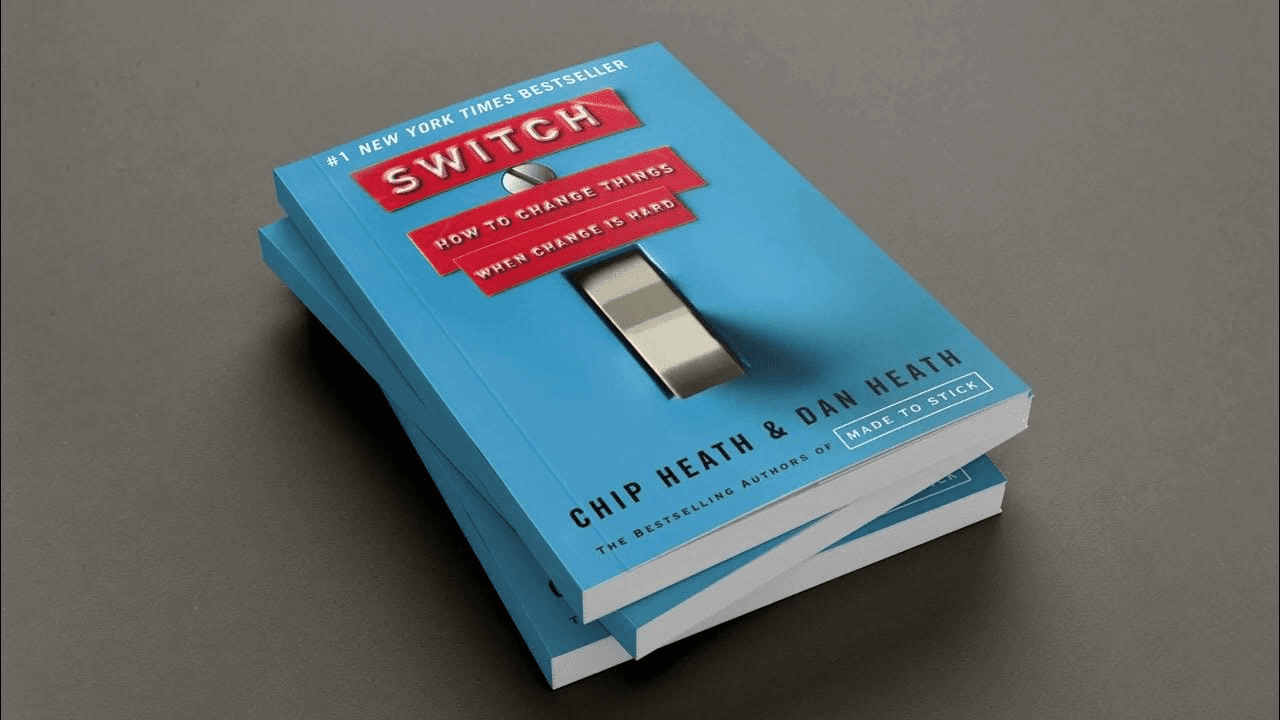

Switch: How to Change Things When Change Is Hard by Chip Heath and Dan Heath
In a world constantly grappling with the paradox of wanting change but finding it incredibly difficult, Chip and Dan Heath offer a powerful and accessible framework in their book, Switch. They argue that whether you’re trying to improve personal habits, transform an organization, or spark societal shifts, the fundamental dynamics remain the same. This isn’t just another self-help book; it’s a deep dive into decades of scientific research, distilled into actionable strategies that illuminate why some changes succeed effortlessly while others crash and burn. Get ready to dismantle your preconceived notions about human nature and discover that what often looks like resistance or laziness is actually a predictable response to underlying psychological forces. We’ll unpack every essential idea, compelling example, and practical insight from Switch, guiding you through the authors’ revolutionary perspective on making change stick.
Three Surprises about Change
This opening chapter kicks off by challenging our intuitive understanding of change, revealing three surprising truths that underpin the entire book’s framework. It sets the stage for understanding why change is often hard and how we frequently misdiagnose the problem.
The Popcorn Paradox: A Situation Problem
The first surprise about change is brilliantly illustrated by Brian Wansink’s popcorn study. Unsuspecting moviegoers were given free popcorn that was five days old and stale. Some received it in medium buckets, others in large, “swimming pool-sized” buckets. Despite the popcorn being wretched and unfinishable, people with large buckets ate 53% more than those with medium buckets. The key takeaway: people weren’t eating for pleasure or to finish their portion, but simply because the larger container made it easy. This demonstrates that what often looks like a people problem (gluttony) is often a situation problem (bucket size). We tend to attribute behavior to inherent character flaws (“Big Gluttons”) rather than environmental factors, leading us to focus on hard, motivational solutions (“motivate them to eat healthier!”) instead of simple, environmental tweaks (“give them smaller buckets”).
The Schizophrenic Brain: Rider and Elephant
The second surprise delves into human psychology, positing that our brains are inherently schizophrenic, operating with two independent systems. This tension is as old as Plato’s charioteer or Freud’s id and superego. The authors introduce their own vivid metaphor:
- The Rider: Represents our rational, conscious, deliberative side. It plans, analyzes, and thinks long-term.
- The Elephant: Symbolizes our emotional, instinctive, pleasure/pain-seeking side. It provides the energy and drive.
The core problem is that the Rider’s strength (planning) is often matched by the Elephant’s power (motivation). The Rider can tug the reins temporarily, but the Elephant ultimately wins in a long tug-of-war. For change to happen, both must agree on the direction. When they disagree, the Elephant’s reluctance can paralyze the Rider.
Self-Control as a Limited Resource: Laziness or Exhaustion?
The radish/chocolate-chip cookie study dramatically illustrates the Rider’s crippling weakness: its limited self-control. Participants who had to resist delicious cookies (taxing their self-control) gave up significantly faster on an unsolvable puzzle than those who freely ate cookies. This reveals that self-control is an exhaustible resource, like a muscle. When people try to change, they’re often trying to alter automatic behaviors, which requires careful supervision by the Rider. This drains the mental muscles needed for creative thinking, focus, impulse inhibition, and persistence. The second surprise is that what looks like laziness or resistance is often exhaustion. People wear themselves out trying to change.
The Glove Shrine: Finding the Feeling
To overcome the Elephant’s reluctance and the Rider’s exhaustion, we need to “find the feeling.” Jon Stegner’s story at a manufacturing company exemplifies this. Instead of analytical presentations about purchasing costs, he piled 424 different types of work gloves, each tagged with its wildly varying price, onto a boardroom table. This visceral display shocked executives, leading to a profound emotional realization: “We’re crazy! We’ve got to make sure this stops happening.” This immediate feeling of disgust and determination, rather than dry data, galvanized them into action. The display spoke directly to their Elephants, providing the motivation that analysis alone could not.
The 1% Milk Campaign: Lack of Clarity
The third surprise is that what looks like resistance is often a lack of clarity. In West Virginia, public health experts wanted to encourage healthier eating. Instead of vague calls to “eat healthier” (which would cause the Rider to “spin its wheels” with endless options), they focused on one critical move: switching from whole milk to 1% or skim milk. They highlighted that one glass of whole milk had the same saturated fat as five strips of bacon, creating an “Oh, gross!” reaction (an Elephant appeal). By making the goal crystal clear (“Next time you’re in the dairy aisle… reach for a jug of 1% milk”), they saw a dramatic increase in low-fat milk sales. Ambiguity paralyzes the Rider, while clear direction unleashes action.
The Three-Part Framework: Rider, Elephant, Path
The chapter concludes by introducing the core framework of the book, which addresses these three surprises:
- Direct the Rider: Provide crystal-clear direction, because resistance is often lack of clarity. (Think 1% milk).
- Motivate the Elephant: Engage people’s emotional side, because laziness is often exhaustion. (Think Glove Shrine and the radish study).
- Shape the Path: Tweak the environment, because a people problem is often a situation problem. (Think popcorn buckets).
This framework is designed for those without scads of authority, emphasizing influence, inspiration, and motivation over fiat. The extraordinary success of Donald Berwick’s “100,000 Lives Campaign” in healthcare, saving lives without wielding formal power, is presented as a testament to the framework’s potency. He used clear goals, emotional appeals (mother of a girl killed by medical error), and shaped the environment (easy enrollment, training, peer support) to achieve dramatic change.
Find the Bright Spots
This chapter hones in on the Rider’s tendency to obsess over problems and offers a powerful counter-strategy: finding and cloning what’s already working. This approach provides clear direction and instills hope.
Jerry Sternin in Vietnam: The Power of Positive Deviance
In 1990, Jerry Sternin of Save the Children was given six months to fight malnutrition in Vietnam, with minimal resources. The conventional wisdom focused on pervasive problems like poverty, poor sanitation, and ignorance—all “TBU” (true but useless) because they were too vast to fix quickly. Sternin’s breakthrough was to search for “bright spots”: very poor kids who were healthier than average. He asked local mothers, “Did you find any very, very poor kids who are bigger and healthier than the typical child?” Their “Có, có, có” (Yes, yes, yes) was the first clue.
Sternin and the mothers observed these bright-spot families and discovered unconventional, yet effective, feeding practices:
- Frequent feeding: Instead of two large meals, healthy kids ate four smaller meals a day, which their malnourished stomachs could process better.
- Active feeding: Parents hand-fed children and encouraged them to eat even when sick.
- Unconventional foods: Mothers added tiny shrimp, crabs from rice paddies, and sweet-potato greens (considered “low class”) to their children’s rice, providing much-needed protein and vitamins.
These local, sustainable solutions could never have been predicted by an outsider. Sternin refused to simply announce “rules”; he knew knowledge does not change behavior. He organized cooking groups where 50 malnourished families, in groups of 10, practiced these new habits daily, bringing their own ingredients. This “acting their way into a new way of thinking” addressed the Rider (specific instructions), Elephant (hope and feeling of capability), and Path (social pressure from group cooking). The “Not Invented Here” problem was solved because solutions emerged from within the community. Within six months, 65% of kids were better nourished, and the program eventually reached 2.2 million Vietnamese, becoming a national model.
The Rider’s Problem Focus: “Bad is Stronger than Good”
The Rider, with its analytical nature, tends to overanalyze problems rather than seeking out solutions or bright spots. This often leads to “analysis paralysis.” Psychologists confirm a fundamental bias: “Bad is stronger than good.” We spend more time viewing negative photos, remember bad feedback longer, and spontaneously explain negative events. Our vocabulary reflects this, with negative emotion words outnumbering positive ones. This problem-seeking mindset means that when something is working well, the Rider doesn’t think much about it, but when things break, it snaps to attention. This is why parents focus on the F on a report card rather than the A.
Solutions-Focused Therapy: The Miracle Question and Exception Question
John J. Murphy, a school psychologist, used solutions-focused brief therapy (SFBT) to transform Bobby, a disruptive ninth-grader. Unlike traditional therapy that digs into past problems (“archaeology”), SFBT focuses solely on solutions.
- Miracle Question: “Suppose that… a miracle happens and all the troubles that brought you here are resolved. When you wake up… what’s the first small sign you’d see that would make you think, ‘Well, something must have happened—the problem is gone!’?” This helps clients identify tangible, specific signs of progress.
- Exception Question: “When was the last time you saw a little bit of the miracle, even just for a short time?” This uncovers “exceptions” – moments when the problem was absent or less severe. These exceptions are bright spots, proving the client is capable of solving their own problem.
Murphy applied this to Bobby, asking, “Tell me about the times at school when you don’t get in trouble as much.” This led to identifying Ms. Smith’s class as a bright spot. Murphy discovered specific behaviors (greeting Bobby at the door, providing easier work, checking understanding). He then shared these specific tips with other teachers. By focusing on what worked for Ms. Smith and cloning it, Bobby’s major infractions dropped by 80% in three months. This demonstrated that small, specific changes can have a big impact on big problems, and that what looks like stubbornness is often a lack of clarity about what to do differently.
The Genentech Cautionary Tale
The Genentech case with the underperforming drug Xolair serves as a cautionary tale: when two saleswomen in Dallas-Fort Worth sold 20 times more of the drug than their peers, managers viewed their success with suspicion, speculating about unfair advantages rather than investigating them as bright spots to learn from. This highlights the Rider’s tendency to find problems even in successes.
The chapter concludes by emphasizing that to pursue bright spots is to ask “What’s working, and how can we do more of it?” This solution-focused mindset is crucial for change, as even in failure, there is success to be found and amplified.
Script the Critical Moves
This chapter addresses the Rider’s tendency towards decision paralysis when faced with too many choices or too much ambiguity. The solution lies in providing crystal-clear instructions: scripting the specific, critical behaviors needed for change.
The Paradox of Choice: Decision Paralysis
The chapter opens with the medical dilemma study, where doctors were more likely to opt for hip surgery when presented with two untried medications (28%) than with just one (47%). This counterintuitive finding highlights decision paralysis: more options, even good ones, can freeze us and make us retreat to the default (the status quo). This phenomenon is rampant:
- Jam Study: Customers were 10 times more likely to buy jam when presented with 6 options versus 24.
- 401(k) Enrollment: For every 10 investment options, employee participation drops by 2%.
- Speed Dating: People made more “matches” when meeting 8 singles versus 20.
Decisions tax the Rider’s self-control. When change brings new choices and ambiguity, the Elephant becomes anxious and insists on the familiar, default path (the status quo). This is why “big-picture, hands-off leadership” often fails in change situations – the paralyzing part is precisely in the details and the lack of clarity. Ambiguity is the enemy.
Alexandre Behring: Four Rules for Financial Triage
Alexandre Behring, a young executive, took over America Latina Logistica (ALL), a privatized Brazilian railroad in chaos with severe financial constraints. To combat inevitable decision paralysis, he didn’t try to fix everything at once. Instead, he scripted the critical moves with four clear rules for investments:
- Unblock revenue: Invest only in projects that would generate short-term revenue.
- Minimize up-front cash: Prioritize solutions costing the least money upfront, even if more expensive long-term or lower quality.
- Faster is better than best: Prefer quick fixes over superior long-term solutions.
- Use what you’ve got: Reuse or recycle existing materials instead of buying new.
These rules, like the 1% milk campaign, translated ambiguous goals into concrete behaviors. For example, when facing a locomotive shortage, ALL engineers repaired old ones rather than buying new, boosting fuel capacity for more routes, and recycled old tracks for repairs. By staying focused on these critical, immediate moves, Behring eliminated ambiguity, making it easier for his people to act and eventually leading the company from an $80 million loss to a $24 million profit in three years.
The Food Pyramid: An Example of How Not to Script Moves
The U.S. government’s Food Pyramid is presented as an anti-pattern for change. Its complex, abstract design (vertical color streaks, “ounce equivalents,” “teaspoons of oil”) makes its meaning completely opaque to the average person. It offers no clear, actionable instructions, unlike the transparent “change oil every 3 months or 3,000 miles” rule for cars. This demonstrates that when goals are ambiguous, confusing, and divorced from daily experience, they fail to change behavior, leaving the Rider to spin its wheels in analysis.
Behavioral Goals vs. Outcome Goals
A pioneering study of organizational change found that while most successful and unsuccessful efforts set outcome goals (e.g., “improve inventory turns by 50%”), successful transformations were more likely to set behavioral goals (e.g., “project teams would meet once a week and each team would include at least one representative of every functional area”). This reinforces the idea that until you can ladder down a change idea to a specific behavior, you’re not ready to lead a switch.
Parent-Child Interaction Therapy (PCIT): Scripting Abusive Parents
The toughest test for scripting critical moves is Parent-Child Interaction Therapy (PCIT) for abusive parents. These parents often blame their children’s “bad” character. PCIT doesn’t focus on their past or emotions. Instead, it provides highly specific, scripted behaviors:
- Five-minute play sessions: Parents are instructed to play with their child for five minutes daily, giving 100% attention, not criticizing, and not asking questions, but letting the child lead.
- Real-time coaching: Therapists observe through a one-way mirror, coaching parents via earpiece to imitate the child’s actions, praise good behavior, and agree with the child (e.g., “Pink is not a good color for the rainbow! I think I’ll do red.”).
- Specific command formula: Later, parents learn to give commands by combining them with a reason (e.g., “Johnny, it’s almost time for the bus to come, so please put your shoes on now.”).
These seemingly unnatural behaviors, practiced daily, become instinctive. The study showed that only 20% of PCIT parents re-offended over three years, compared to 60% of those in anger management. This staggering result suggests that even severe “character problems” like child abuse can be mitigated by providing clear, concrete instructions on what to do, proving the immense power of simple scripting.
Miner County: Small, Scripted Moves for Community Revival
The struggling Miner County, South Dakota, faced decline due to lost jobs and youth out-migration. High school students, inspired by a book about rural decline, sought to reverse this. Their research revealed that half of residents shopped outside the county. This led to their first rallying cry: “Let’s keep Miner dollars in Miner County.” They scripted a critical move: if residents spent just 10% more of their disposable income locally, it would boost the economy by $7 million. This specific, actionable goal galvanized the community.
Other small, scripted actions emerged: residents came together to dig up 400 tree stumps in one day (a “good feeling” event that built cohesion and hope). These small, concrete efforts, combined with the clear call to action, led to an astonishing $15.6 million increase in local spending a year later. This demonstrates the asymmetry between the scale of the problem and the scale of the solution: big problems are often solved by a sequence of small, scripted moves that get people moving, rather than through complex, overwhelming plans.
Point to the Destination
This chapter explores how providing a vivid and inspiring destination picture can help the Rider find direction and motivate the Elephant to embark on the journey.
Crystal Jones: “You’re going to be third graders.”
Crystal Jones, a Teach For America first-grade teacher in Atlanta, faced a class with vast skill gaps, many students barely able to hold a pencil. Instead of using abstract metrics (like “increase phonics skills to Transitional”), she set a destination postcard that resonated deeply with her young students: “By the end of this school year, you’re going to be third graders.” This goal was aspirational and tangible—third graders were seen as “bigger, smarter, and cooler.”
Jones cultivated a “scholar” identity in her classroom, encouraging students to define the term and share what they learned. This created a positive emotional pull for the Elephant. By spring, 90% of her students were reading at or above a third-grade level. This success illustrates that effective goals don’t just direct the Rider; they “hit you in the gut,” appealing to both intellect and emotion.
Laura Esserman: “Everything under one roof.”
Laura Esserman, a surgeon at UCSF, was appalled by the fragmented, anxiety-inducing process for breast cancer patients. Her destination postcard was a radical vision: a Breast Care Center where a woman could walk in at the beginning of the day and walk out with a diagnosis and treatment plan – “everything under one roof.” This vivid picture of a patient-centered experience, replacing weeks of agonizing waits, served as a powerful motivator.
Despite having minimal institutional power, Esserman started small, operating the center four hours a day, one day a week. She cajoled departments to collaborate, even giving up her own allocated space in a new building to house radiology services on the same floor. This demonstrated a willingness to make sacrifices for the vision. The center’s success, driven by this clear and compelling destination, led to a massive increase in patients and national recognition, ultimately creating the “under one roof” reality. This shows how a compelling destination can redirect the Rider’s analytical energy from obsessing over problems to figuring out how to get there.
Beyond SMART Goals: The “Gut-Smacking” Destination
The chapter critiques SMART goals (Specific, Measurable, Actionable, Relevant, Timely) as often lacking emotional resonance, making them better for steady-state situations than for change. Goals like “improve the liquidity ratio by 30 percent” rarely inspire the Elephant. Instead, a “gut-smacking” goal is needed, one that appeals to both Rider and Elephant.
The Problem of Rationalization: Black-and-White Goals
When the Elephant doesn’t fully commit to a goal, the Rider can engage in rationalization, creating “wiggle room” for failure. Vague goals like “Be healthier” or even precise ones like “boost revenue by 14.2%” can be rationalized away. To combat this, the authors introduce Black-and-White (B&W) goals: all-or-nothing targets that leave no room for ambiguity or self-deception.
BP’s “No Dry Holes”: Eliminating Wiggle Room
In the 1980s, BP’s oil exploration unit was spending too much on drilling, with a high rate of “dry holes.” Explorers often rationalized failures by “tinkering with the math” of expected value or claiming “strategic value.” Ian Vann, BP’s head of exploration, set a shocking B&W goal: “No dry holes.” This goal was initially seen as preposterous, but it forced explorers to:
- Tighten analyses: They stopped hiding behind probabilities and used every scrap of data.
- Collaborate: Geologists systematically mapped and aggregated information, drilling only in “green” (favorable) regions across all geological tests.
- Resist external pressure: The “No dry holes” mandate empowered frontline employees to push back against “strategic” drills that were likely to fail.
This B&W goal eliminated rationalization and transformed BP’s hit rate from 1 in 5 to an industry-leading 2 in 3 by 2000. It proved that when you eliminate the wiggle room, people stop trying to hide and are forced to “drill smarter.”
Shearson Lehman: “I.I. or Die”
Jack Rivkin transformed Shearson Lehman’s underperforming research department. He set a clear destination: “Get us into the Top 5” of the Institutional Investor (I.I.) rankings (a “gut-smacking” goal). He also scripted critical moves:
- 125 client conversations per month: Analysts were required to make this specific number of calls and post notes, creating public accountability and competition.
- Cite colleagues’ work: Analysts had to cite others’ research twice in presentations, fostering a team mentality.
These combined strategies transformed the department from 15th to 1st in the I.I. rankings within three years. This success highlights that you don’t need to anticipate every turn; focus on a strong beginning (scripted moves) and a strong ending (destination postcard), and the team will be ready for unexpected opportunities (like the Amgen Epogen blockbuster).
The chapter concludes by summarizing the Rider’s strengths (visionary, tactician) and weaknesses (limited strength, paralysis, problem focus). The solution is to follow bright spots, provide a compelling destination, and script critical moves, preparing the Rider to lead the switch and face the Elephant’s reluctance.
Find the Feeling
This chapter emphasizes that logical arguments alone are often insufficient to drive change. To motivate the Elephant, you must appeal to emotion, making people feel something rather than just think something.
Robyn Waters at Target: SEE-FEEL-CHANGE
Robyn Waters, Target’s “ready-to-wear” trend manager, faced the challenge of transforming Target from a copycat discounter into a design powerhouse. The merchants, being numbers-driven, saw no data supporting the shift to “trendy” colors. Instead of creating a business case (ANALYZE-THINK-CHANGE), Waters adopted a SEE-FEEL-CHANGE approach:
- Bright-colored M&Ms: She brought in huge bags of bright M&Ms to meetings, pouring them into a glass bowl to demonstrate the emotional impact of color (“See, look at your reaction to color!”).
- iMacs and boutique photos: She showed samples of Apple’s colorful iMacs and photos from trendy international boutiques, letting merchants “ooh and aah” and see what was possible.
- Mock-up displays: She created mock-ups with actual clothing samples to show how a “pop” of blue could work.
Waters helped her colleagues see what was possible, which made them feel energized, hopeful, and competitive. This emotional connection bypassed their analytical skepticism and slowly built momentum, product by product, eventually transforming Target’s merchandise. This illustrates that successful change bypasses intellect to hit emotions.
The Re-Mission Game: Medicine Means Power
Pam Omidyar of HopeLab created the Re-Mission video game to help teenage cancer patients comply with critical, but unpleasant, chemotherapy regimens. The game featured a nanobot character, Roxxi, zapping tumor cells. Despite many teens playing only a few levels, their medication adherence increased by 20%, doubling their survival odds.
The key insight was that the problem wasn’t a lack of knowledge; it was an identity problem. Teens didn’t want to be “the sick kid.” The game provided an emotional connection: “You are Roxxi, boldly defeating cancer. You fuel your ray gun by taking chemotherapy and antibiotics. Medicine means power.” The game transformed how they felt about their medicine, from a reminder of sickness to a source of control and strength, thus motivating the Elephant.
The Pitfalls of Positive Illusions: Attila the Accountant
People often hold positive illusions about themselves, seeing themselves as “above-average drivers,” “great leaders,” or “good team players.” This makes it hard to get a clear picture of where they are and why change is needed. Attila the Accountant, a meticulous but “pretty much hated” accounting head at a state agency, rigidly rejected vendor invoices for minor errors. He saw himself as a “good accountant” focused on rigor.
To make Attila feel the problem, his superiors took him on a field trip to visit the struggling nonprofits that relied on his department. He saw firsthand their chaotic environments, their shoestring budgets, and the real impact of delayed payments on their ability to care for kids (delaying payroll, skimping on food). This experience delivered a gut-check that shattered his positive illusion: he realized being a “good accountant” also meant being a service provider. He returned transformed, still yelling, but now about getting checks out on time because “People have to make payroll!” This dramatically shows how direct experience can bypass self-deception and trigger emotional change.
The Limited Power of Fear: Beyond the Burning Platform
While negative emotions like fear (e.g., “burning platform” rhetoric) can motivate quick, specific actions, they are less effective for complex, ambiguous changes requiring creativity and open-mindedness. Fear tends to have a “narrowing effect” on thought, focusing attention on immediate threats but stifling broader thinking or innovation. For instance, gun-crime victims may vividly recall the gun but not the perpetrator’s beard.
The Broadening Power of Positive Emotions
Psychologist Barbara Fredrickson’s research on positive emotions (“What Good Are Positive Emotions?”) argues that they are designed to “broaden and build” our repertoire of thoughts and actions. Joy makes us want to play and explore, building skills. Interest broadens what we investigate, making us open to new ideas. Pride encourages us to pursue bigger goals.
Robyn Waters’s success at Target stemmed from her ability to instill hope, optimism, and excitement—positive emotions that fostered creative thinking and collaboration, allowing for gradual, product-by-product cultural shift, rather than a fear-driven, urgent mandate. Finding the feeling is about engaging emotions to build momentum, and positive emotions are crucial for encouraging the creativity and persistence needed for enduring change.
Shrink the Change
This chapter focuses on a critical strategy for motivating the Elephant: making the perceived magnitude of the change small enough that it doesn’t spook the Elephant and deter action.
Hotel Maids: The Endowed Progress Effect
A study of hotel maids revealed that 67% didn’t believe they exercised regularly, despite their physically demanding jobs. When one group was told they were, in fact, getting plenty of exercise (e.g., 40 calories for changing linens), they lost an average of 1.8 pounds in four weeks without changing their habits or diet. This astonishing result, which the authors argue is not a placebo effect, is attributed to the endowed progress effect. Just like the car wash loyalty cards where customers with two pre-stamped slots were more likely to finish, the maids were given “two stamps on their card.” They realized they were already Exercisers, much closer to the goal line than they thought. This feeling of progress was tremendously motivating, inspiring them to exert a little more effort in their daily tasks without consciously “exercising.”
The 5-Minute Room Rescue: Lowering the Bar
The Elephant is easily demoralized by daunting tasks. The “5-Minute Room Rescue” tackles this by shrinking the change. Instead of dreading “cleaning the whole house,” you set a timer for 5 minutes and simply start clearing a path in the worst room. This makes the task seem non-threatening and low-commitment. The Elephant thinks, “How bad can 5 minutes be?” Once started, the momentum often builds (a “virtuous circle”), as the initial small victory reduces dread and fosters confidence, leading to further action. The key is to lower the bar so low that it’s impossible for the Elephant to resist.
Dave Ramsey’s Debt Snowball: Motivation Over Math
Dave Ramsey’s Debt Snowball method for paying down debt advises listing debts from smallest to largest, then paying minimums on all but the smallest, which receives every available extra dollar. Once the smallest is paid off, that payment amount rolls into the next smallest, and so on. Critically, Ramsey recommends ignoring interest rates and focusing on the smallest debt first, even if it’s low interest.
Financial advisors cringe at this, as simple math dictates paying off high-interest debt first. But Ramsey understands motivation is more important than math in this context. Paying off a small, low-interest debt quickly provides a “quick win” for the Elephant, creating a feeling of victory and momentum that fuels further effort against larger debts. It combats the hopelessness of seeing little progress on a huge debt, proving to people that they can win. This is another example of shrinking the change to build confidence and “light your fire.”
Steven Kelman’s Procurement Reform: Small Wins in Government
Steven Kelman, leading procurement reform in the federal government, faced massive inertia and a $320 billion budget. He knew he needed quick, visible successes to build momentum. He didn’t try to overhaul everything at once. Instead, he engineered “small wins”:
- Credit Card Pledge: He challenged agencies to double their use of government credit cards for small, inexpensive purchases (like computer disks), making it easier for employees to buy what they needed without bureaucratic hurdles.
- Past Performance Pledge: He pushed for agencies to formally commit to considering vendors’ past performance in contract decisions, a break from old rules. He rallied support by highlighting that “almost everyone but you is participating,” creating social pressure.
These specific, achievable pledges provided demonstrable forward momentum, leading to 70% of frontline employees supporting reform within five years and an “A” grade from the Brookings Institution. Small wins, like “inch pebbles,” build hope and confidence (Elephant fuel) and generate the social proof needed to overcome inertia.
The Miracle Scale: Quantifying Progress
Solutions-focused therapists use a “miracle scale” (0-10) to help patients quantify progress toward their “miracle.” By asking patients where they are on the scale (e.g., “I’m at a 2”), therapists can celebrate the starting point and ask, “What would it take to get you to a 3?” This focuses attention on attainable, visible small milestones rather than an overwhelming distant destination. It gives the Rider clear direction and the Elephant boosts of hope, making progress feel tangible and encouraging perseverance.
Coaches and the Growth Mindset: Building Habits of Winning
Coaches like Bill Parcells and John Wooden understand the power of small wins. They focus on “small, visible goals” (e.g., “be a well-conditioned team,” “flawless special teams work”) rather than just the ultimate championship. Achieving these smaller goals builds momentum, making players “break the habit of losing and begin to get into the habit of winning.” This concept aligns with Karl Weick’s idea that a small win “reduces importance, reduces demands, and raises perceived skill levels.”
This chapter emphasizes that when faced with a daunting task, the critical strategy is to shrink the change – by setting small, achievable goals, breaking down tasks, or highlighting existing progress. This builds the Elephant’s confidence, turning dread into a virtuous cycle of action and success.
Grow Your People
This chapter explores how cultivating a sense of identity and fostering a “growth mindset” can provide people with the intrinsic motivation and resilience needed to sustain change, particularly when facing inevitable failures.
Paul Butler and the St. Lucia Parrot: Cultivating Identity
In 1977, the St. Lucia Parrot was on the brink of extinction (only 100 left). Paul Butler, a young conservationist, embarked on a mission to save it without formal power or budget. He understood he couldn’t make an economic case; he had to make an emotional case rooted in identity: “This parrot is ours. Nobody has this but us. We need to cherish it and look after it.”
Butler used creative tactics to immerse St. Lucians in this new identity:
- Public engagement: He held puppet shows, distributed T-shirts, encouraged local bands to record parrot songs, and had volunteers in parrot costumes visit schools.
- Symbolic representation: He persuaded a telecom company to print calling cards featuring the St. Lucia Parrot next to the bald eagle, visually asserting its national significance.
Through these efforts, St. Lucians began to embrace the parrot as part of their national identity. This powerful emotional connection made it possible to pass and enforce conservation laws. By 2008, the parrot population had surged to 600-700, and poaching had ceased. Butler’s success, replicated globally through Rare’s “Pride campaigns,” demonstrates how cultivating identity can “grow your people,” giving them the strength and determination to act in ways aligned with that identity, even when objective “consequences” aren’t immediately clear.
The Identity Model of Decision Making
James March’s “identity model” of decision making explains why identity is so powerful. We often ask:
- Who am I?
- What kind of situation is this?
- What would someone like me do in this situation?
This model suggests that choices are often based on alignment with our self-image, rather than a cold cost-benefit analysis. A change effort that violates someone’s identity is likely to fail. The key is to make the change a matter of identity, not just consequences.
Lovelace Hospital: Nurses’ Professional Identity
Lovelace Hospital addressed high nurse turnover by focusing on professional identity. Instead of asking why nurses left, they used Appreciative Inquiry to discover why some nurses stayed: they were “fiercely loyal to the profession of nursing.” Hospital administrators then amplified this identity by:
- Recognizing extraordinary performance.
- Developing an orientation program that stressed the noble nature of nursing.
- Creating mentorship programs to improve skills.
This cultivated the nurses’ inherent pride in their profession, leading to a 30% decrease in turnover and improved patient satisfaction ratings.
Brasilata: The “Inventors” Identity
Brasilata, a Brazilian steel can manufacturer, defied industry norms to become an innovation leader by creating a new identity for its employees: “inventors.” New hires signed an “innovation contract,” and management challenged employees to find ways to improve products, processes, and reduce costs. This identity wasn’t inherent; it was made up and cultivated.
The program was wildly successful, with employees submitting over 134,000 ideas in 2008 (145.2 ideas per inventor). This led to innovations like a new steel can design inspired by car bumpers (deforming on impact to reduce stress) and a 35% reduction in energy consumption during a national crisis. The “inventor” identity became a source of pride and fueled continuous innovation, demonstrating how a chosen identity can be a powerful engine for business success and employee engagement.
Foot-in-the-Door Technique: Small Steps to New Identities
The Freedman-Fraser “foot-in-the-door” study showed that people are receptive to developing new identities through small commitments. Homeowners who first agreed to place a tiny “Be a Safe Driver” sign (or even “Keep California Beautiful” petition) were four times more likely to accept a huge, eyesore “Drive Carefully” billboard two weeks later. The small, initial compliance seemingly sparked a subtle shift in identity—they saw themselves as “concerned citizens”—which then guided their subsequent, larger decisions. This suggests that identities can “grow” from small beginnings.
Growth Mindset vs. Fixed Mindset: Embracing Failure
To sustain change, especially when facing new identities, people must be prepared for “Salsa Moments” (failure). The chapter introduces Carol Dweck’s research on mindsets:
- Fixed Mindset: Belief that abilities are static. People avoid challenges, fear failure (as it exposes “true” inability), and avoid effort. (e.g., “I’m a terrible salsa dancer, I was born that way.”)
- Growth Mindset: Belief that abilities are like muscles, built through practice. People embrace challenges, view failure as learning, seek feedback, and put in effort. (e.g., Tiger Woods overhauling his swing after winning championships).
Dweck’s study with junior-high math students demonstrated that teaching a growth mindset (“the brain is like a muscle that can be developed with exercise”) for just two hours over eight weeks dramatically reversed declining grades, turning “I suck at math” into “I can do better.” This shows that a growth mindset can be taught and is crucial for perseverance through struggle, reframing failure as a natural part of the learning process rather than a sign of inherent inadequacy.
Minimally Invasive Cardiac Surgery (MICS): Learning vs. Performing
Amy Edmondson’s study of hospitals implementing MICS (a new, less invasive heart surgery) provided powerful evidence for the growth mindset.
- Successful teams adopted a “learning frame”: they anticipated difficulty, practiced diligently (e.g., scheduling six cases in one week, keeping the same team for fifteen cases), and saw early struggles as opportunities to learn and improve.
- Unsuccessful teams had a “performance frame”: they aimed to “get it right on the first try,” were motivated by competition, and reverted to old habits when facing challenges.
The leaders of successful teams, like Dr. M at Mountain Medical Center, acted as coaches, focused on practice, and actively created routines for learning. This demonstrates that expecting failure en route to success (as IDEO’s “project mood chart” also suggests) is crucial. Failure is a necessary investment, and a growth mindset buffers against defeatism.
The chapter concludes by highlighting Molly Howard, a principal who transformed a high-poverty high school by fostering a “college-bound” identity and implementing a “Not Yet” grading system instead of Fs. This combination instilled a growth mindset, ensuring students continued to strive until they achieved competency. Growing your people by cultivating identity and a growth mindset is about building their confidence and resilience, making them feel “big” relative to their challenge, even when the path is tough.
Tweak the Environment
This chapter dives into the third component of the Switch framework: shaping the Path. It argues that often, what appears to be a “people problem” is actually a “situation problem,” and that by changing the environment, you can dramatically shift behavior, even for seemingly “stubborn” individuals.
The Fundamental Attribution Error: Situation vs. Character
The chapter reintroduces the popcorn study as a prime example of the Fundamental Attribution Error: our innate tendency to attribute others’ behavior to their character (“What a jerk!”) rather than the situational forces influencing them (“Gosh, I wonder what’s wrong that he is in such a hurry?”). This bias complicates relationships and organizational change, leading us to focus on changing people’s core traits rather than their context. The authors argue that situations are often easier to tweak than people’s core character. “What looks like a people problem is often a situation problem.”
The Food Drive Study: Jerks with a Map
A study on college students’ food donations starkly illustrates the power of situation. Researchers categorized students as “saints” (charitable) or “jerks” (uncharitable).
- Basic Letter: Only 8% of saints donated, and 0% of jerks.
- Detailed Letter: This letter included a map to the booth, a request for a specific item (can of beans), and a suggestion to link it to an existing trip (e.g., “when you’d ordinarily be near Tressider Plaza”). With this clearer “Path,” 42% of saints donated, and 25% of jerks donated.
This astonishing result shows that even the most uncharitable individuals were significantly influenced by smoothing the Path. A jerk with a map was three times more likely to donate than a saint without one. This underscores that no matter your role, you have some control over the situation.
Tweaking the Environment: Making the Right Behaviors Easier
Tweaking the environment is about making desired behaviors a little bit easier and undesired behaviors a little bit harder. Examples abound:
- Amazon’s 1-Click ordering: Reduces effort for desired behavior (spending money).
- Time Sheet Fiasco: A consulting firm struggled with consultants not using a new online time sheet. Executives assumed obstinacy, but a consultant discovered the real issue: a confusing “wizard” interface. Removing the wizard immediately boosted compliance. The people weren’t defiant; they were simply following the easiest Path.
- BlackBerry Addiction: A personal example where the authors tweaked their environment to combat e-mail distraction (Chip deleted the alert sound and covered the icon; Dan bought an old laptop with no internet). These self-manipulations beat self-control.
- Amanda Tucker’s Office Rearrangement: A Nike country manager’s team complained she didn’t listen. She realized her office setup (computer screen visible from her chair) encouraged her bad habit. She rearranged her desk to remove the distraction, making her “listen” more effectively. This was a physical tweak to the environment that changed her “kind of person.”
Becky Richards and Medication Vests: Visible Interruptions
Becky Richards at Kaiser South San Francisco Hospital aimed to reduce medication errors. She realized errors happened due to distractions in noisy nursing units. Her solution: bright orange “medication vests” that nurses would wear while administering meds, signaling to others, “Don’t bother me right now.”
Initially, nurses and doctors hated the vests, finding them demeaning. However, a six-month pilot showed a 47% drop in medication errors. Once the data proved the vests’ effectiveness, the “hate faded,” and they were widely adopted. The vests didn’t change nurses’ character or motivation; they simply made the bad behavior (interrupting) visible and therefore harder, and the good behavior (focus) easier.
Sterile Cockpit and Quiet Hours: Designing for Focus
The airline industry’s “sterile cockpit” rule (no non-essential conversation below 10,000 feet) prevents distractions during critical flight phases. An IT group applied this to software development by establishing “quiet hours” (Tuesday, Thursday, Friday mornings before noon). This created a “sterile cockpit” for coders, reducing interruptions and enabling them to meet a stringent nine-month development goal. These examples show how consciously reshaping the Path can lead to the emergence of desired behaviors, even when people haven’t fundamentally changed.
The Haddon Matrix: Preventing Bad Outcomes
The Haddon Matrix offers a systematic way to think about preventing bad outcomes by breaking down events into three phases:
- Pre-event: Interventions to prevent the event from happening (e.g., clear lane markers for car wrecks, regular computer check-ups to prevent crashes).
- Event: Interventions to reduce injury during the event (e.g., seat belts and airbags, mirrored hard drives to prevent data loss during a crash).
- Post-event: Interventions to minimize damage after the event (e.g., speedy emergency medical teams, automated nightly network backups).
This framework allows for comprehensive solutions that disregard “hearts and minds” and simply make bad behavior impossible or less damaging. You can design an environment where, even if people want to behave badly, the situation prevents it.
Rackspace: Tearing out the Call Queue
In 1999, Rackspace, an internet hosting company, had a “denial of service” model, viewing customer calls as costs. After a furious customer tracked down founder Graham Weston due to ignored emails, Weston made a 180-degree turn. He hired David Bryce to lead customer support and implemented a radical Path tweak: he threw out the call-queuing system.
Without a safety net, phones would just keep ringing until someone picked up. This made it impossible to dodge customers. The change became a critical symbol of their new “Fanatical Support” ethos. This single environmental tweak transformed Rackspace’s customer service, making it the industry leader and consistently ranking among the best places to work. It powerfully demonstrates that changing the situation can transform behavior without changing people’s core character.
Build Habits
This chapter explores how to make new behaviors stick by turning them into habits, which essentially put the Elephant on “autopilot” and reduce the Rider’s need for constant self-control.
Mike Romano: Environment-Driven Recovery
Mike Romano, a Vietnam veteran, became addicted to opium during his service. Upon returning to Milwaukee, he found it significantly easier to quit, successfully weaning himself off the drug within a month and remaining clean for decades. White House research on returning soldiers confirmed this broader trend: despite high addiction rates in Vietnam, only 1% remained addicted after returning home.
The explanation lies in the power of the environment. Romano’s new environment in Milwaukee functioned like an “antidrug theme park”:
- Supportive social network: Surrounded by family and a new girlfriend who pressured him to quit.
- Distracting work and activities: Construction, house painting, and art classes diverted his focus.
- Absence of cues: No more fellow addicted soldiers, no easy access to drugs.
- Reinforced non-use: Girlfriend’s pressure and social taboos against drug use.
His old habits were stitched into his Vietnam environment and receded when he returned home to a neutral (or even deterring) environment. This demonstrates that habits are essentially behavioral autopilot and are profoundly influenced by our surroundings.
Action Triggers: Creating “Instant Habits”
Since dramatically shifting environments isn’t always feasible, the chapter introduces “action triggers” as a powerful tool to lay the mental groundwork for new habits. An action trigger is a specific mental plan: “When I encounter situation X, I will perform response Y.”
- Christmas Eve Paper Study: College students who set action triggers for writing a paper (e.g., “I’ll write this report in my dad’s office on Christmas morning before everyone gets up”) had a 75% completion rate, compared to 33% for those without triggers.
- Hip/Knee Surgery Recovery: Patients setting action triggers for walks (e.g., “I’ll walk at 10 AM after breakfast”) recovered significantly faster, bathing independently in 3 weeks vs. 7 weeks for others.
Action triggers work by preloading decisions, bypassing the Rider’s need for conscious deliberation and conserving self-control. They effectively “pass the control of behavior on to the environment,” protecting goals from distractions and competing urges. While not foolproof (e.g., for serious smoking addictions), they are incredibly effective for bridging the “intention-behavior gap.”
Patti Poppe: Blue Lines and Blue Men for Safety
Patti Poppe, a department manager at a General Motors plant, needed workers to adopt a new, simple safety policy (wear goggles with side shields, no bare skin exposed). Her solution incorporated multiple “Path” strategies, including building habits:
- Scripted critical moves: Policy boiled down to two clear rules.
- B&W goal: Rules applied to everyone in the plant, always.
- Rally the herd: Universal compliance flipped the social norm.
- Action trigger: She painted a large blue line around the plant and posted blue wooden men wearing gear at entry points. This created a visual cue: “When I cross this line, that’s my cue to put on my gear.”
This created an “instant habit” for safety, making the behavior automatic. Injuries at the plant dropped 21%.
General Pagonis: Stand-Up Meetings for Focus
General William “Gus” Pagonis, leading Gulf War logistics, created a habit to ensure efficient communication: daily 8:00 AM stand-up meetings for 30 minutes.
- Open attendance: Anyone could attend, fostering open information exchange.
- Standing-only: This physical constraint naturally kept the meeting concise. As Pagonis noted, people fidgeted and looked at watches, “pretty quickly, the conversation comes back into focus.”
This simple tweak to a routine meeting format served the mission (focus, clarity, efficiency) and was easy to embrace, becoming a “free” habit that didn’t tax the Rider. It demonstrates how leaders can consciously design habits to reinforce team goals.
Natalie Elder: Valet Service for Calm
Natalie Elder, principal of the lowest-scoring elementary school in Tennessee, faced extreme chaos. She realized she needed to “get control of the building before I could teach.” Her strategy involved creating a series of consistent routines to bring order to the mornings:
- Valet Service: Elder and staff greeted every student at the car, opened doors, said good morning, and walked them to the cafeteria. This smoothed the transition from often-raucous home environments.
- Disciplined Assembly: Every day started with a structured assembly, including call-and-response (“We’re a school of what?” “Excellence!”), character lessons, pledges, songs, and quick quizzes.
- “Traveling arms”: Kids walked silently to class with arms folded, reducing disruptions.
By imposing order and continuity through these routines, Elder cleared the Path for learning and transformed the school’s atmosphere from chaos to calm, leading to improved student behavior and test scores.
Checklists: Humble Tools for Habit and Clarity
Checklists, often seen as mundane, are powerful tools for building habits and directing the Rider.
- Dr. Peter Pronovost’s ICU checklist: A five-part checklist for inserting intravenous lines, though containing no new science, nearly eliminated line infections in Michigan ICUs, saving 1,500 lives and $175 million. It educated people on the “ironclad right way” to do things (Rider direction) and ensured mission-critical elements were done every time (habit building).
- Cisco Systems’ acquisition checklist: Helps avoid “blind spots” in complex decisions, ensuring all critical issues (relocation of engineers, service plan, etc.) are considered.
Checklists simplify complex tasks, ensure consistency, and provide insurance against overconfidence. They help create environments where “bad behavior” (like medical errors or missed due diligence) becomes less likely, often without needing to address people’s internal motivations.
The chapter concludes by reinforcing that by tweaking the environment and building habits, leaders can relieve the Rider’s burden, allowing positive behaviors to happen on “autopilot,” and making change stick.
Rally the Herd
This chapter highlights the powerful influence of social signals and how behavior is contagious. To drive change, it’s essential to understand and strategically leverage the “herd” — to make desired behaviors visible and to foster a sense of shared purpose.
The Bystander Effect: The Power of Social Cues
The chapter begins by illustrating how we instinctively look to others for cues, especially in ambiguous situations. The Bibb Latané and John M. Darley studies on the bystander effect demonstrate this:
- Smoke-filled room: 75% of lone students reported smoke, but only 38% of three-person groups did. Each individual’s inaction signaled to the others that the smoke wasn’t a big deal.
- Falling woman: 70% of lone bystanders helped, but only 40% of pairs did.
This shows that “peer perception is plenty” – we imitate others’ behaviors, consciously or not. In change situations, which are inherently unfamiliar, this social influence is paramount. If the herd is paralyzed, individuals will be too.
Contagious Behavior: From Obesity to Towels
Behavior is highly contagious:
- Obesity: A 32-year study found that if someone became obese, the odds of their close friends becoming obese tripled, even across distances. People change their idea of what’s an acceptable body type by observing their peers.
- Drinking: College males with roommates who drank frequently in high school saw their GPAs drop.
- Hotel Towels: A sign stating that “the majority of guests” reuse towels increased towel reuse by 26%. This highlights the power of publicizing existing norms when they align with desired behavior. Conversely, publicizing low compliance can hurt.
The key insight is that to change things, you must pay close attention to social signals, as they can either guarantee or doom a change effort.
Gerard Cachon at MSOM: Publicizing Review Times
Gerard Cachon, editor of the academic journal MSOM, faced a problem of incredibly slow peer review times (7-8 months, often over a year). He had no direct authority over the volunteer reviewers. His strategy to “rally the herd” involved:
- Direct the Rider (Destination): He announced a bold goal to review papers within 65 days (72% faster than before).
- Motivate the Elephant (Identity): He appealed to reviewers’ professional pride: “We’re operations people, for Pete’s sake. We should be leading the way on efficiency!”
- Shape the Path (Herd): Every Friday, he posted an Excel spreadsheet online showing the status of every paper and each reviewer’s performance.
This public visibility of group norms created powerful social pressure. Reviewers saw themselves as bottlenecks and quickly improved. MSOM achieved the fastest turnaround time in its field, demonstrating how publicizing peer performance can make good behavior contagious.
Jay Winsten and the Designated Driver: Simulating a Social Norm
Jay Winsten, a Harvard public health professor, aimed to create the “designated driver” social norm in the U.S., a concept non-existent at the time. He didn’t rely on PSA campaigns. Instead, he worked with over 160 prime-time TV shows, asking for just “five seconds” of dialogue naturally incorporating the concept into plots (e.g., L.A. Law, Cheers).
This strategy simulated a social norm in fictional contexts. By repeatedly exposing people to the idea, they began to accept it as normal. Within three years, 9 out of 10 Americans were familiar with the term, and alcohol-related traffic fatalities significantly declined. Winsten leveraged the power of the Path (TV environment) to make the behavior contagious by creating the perception of a herd where none yet existed.
Fataki in Tanzania: Mocking Bad Behavior
In Tanzania, “sugar-daddy” relationships (older men with underage girls) fueled HIV spread, yet had no strong social taboo despite 89% public opposition. USAID and Johns Hopkins experts aimed to change this by giving voice to quiet resentment and making the behavior subject to social ridicule.
They created Fataki, a villain character (Swahili for “explosion” or “fireworks”)—an older man who shamelessly pursued young girls but never succeeded due to outside intervention. Fataki was featured in radio spots, banners, and eventually became a widely recognized, mocked symbol for undesirable behavior. This campaign:
- Created a mocking label: Made it “OK to laugh at this,” counteracting the status of sugar daddies.
- Encouraged interventions: Modeled how outsiders (waitresses, friends) could disrupt the behavior.
- Rallied the herd: Made the implicit social disapproval explicit, transforming quiet opposition into public conversation and shaming.
Within months, 44% of people spontaneously identified Fataki with the sugar-daddy behavior, and 75% discussed him. This shows how making negative social norms visible and mockable can change a culture by unleashing the latent opposition of the herd.
Organizational Molting: Free Spaces and Oppositional Identity
Katherine Kellogg’s study of two teaching hospitals (Alpha and Beta), implementing an 80-hour workweek for interns (reducing 120-hour shifts), revealed the power of culture and “free spaces.” Despite a mandate, interns resisted the change (signing out patients) because it conflicted with their deeply entrenched identity of “working hard and not handing stuff off” and “being here all the time.”
At Alpha (successful):
- “Free spaces”: Daily, hour-long afternoon rounds in private corners allowed reform-minded residents to meet, discuss, and develop an “oppositional identity” (“old school vs. new school,” “team responsibility vs. doing it all yourself”). This incubates new language and values.
- Rehearsed responses: Interns mentally rehearsed how to respond to resistance.
At Beta (failed): Rounds were short, often remote, and held in public areas, preventing the development of a shared identity or language.
Alpha’s success shows that to change culture, leaders must: provide free spaces for reformers to gather and coordinate unseen; build habits of discussion and mental rehearsal; and rally the herd by helping reformers articulate their new values and make them contagious.
The chapter concludes by reaffirming the Fundamental Attribution Error: the “jerks” in the food drive study and the “resisters” in hospitals were not inherently bad, but rather products of their environment. By shaping the Path and rallying the herd, even perceived “change enemies” can become allies.
Keep the Switch Going
The final chapter addresses the crucial question of sustaining change, emphasizing that change is a continuous process, not a single event. It brings together previous concepts to show how to maintain momentum.
Approximations and Mango: Reinforcing Small Steps
“A long journey starts with a single step,” but maintaining momentum is key. The authors draw inspiration from animal trainers who teach complex behaviors (dolphins jumping through hoops, monkeys skateboarding) through “approximations” – rewarding each tiny step toward the desired destination. This means constantly looking for and reinforcing even the smallest positive behaviors.
- Amy Sutherland’s “What Shamu Taught Me”: She applied this to her husband’s peccadillos, praising him for small improvements (“drove just a mile an hour slower, tossed one pair of shorts into the hamper”). This reinforcement led to positive changes.
- Psychologist Alan Kazdin: Advises parents to “catch their children being good,” praising “components” of desired behavior (like a baby’s first wobbly step) rather than waiting for perfect execution.
This approach counters our natural tendency to grouse more than praise. It emphasizes that change is a process, not an event. Persistence is fueled by consistent “mango” (reinforcement) for every approximation of desired behavior.
Snowballing Effects: Mere Exposure and Cognitive Dissonance
Once change begins, several psychological forces work in its favor to help it snowball:
- Mere Exposure Effect: The more you’re exposed to something, the more you like it. Initial resistance (e.g., to the Eiffel Tower) fades into acceptance and even adoration as familiarity grows.
- Cognitive Dissonance: People dislike acting in one way and thinking in another. Once a small step is taken in a new direction, it becomes harder for them to dislike the new behavior. As they act differently, their identity evolves to match the new behavior (e.g., Brasilata’s “inventors”).
These forces ensure that inertia, initially an opponent, eventually shifts to supporting the change, allowing small changes to compound into big transformations.
The Paradox of Parenting: Massive Change That Works
The authors offer parenthood as the ultimate example of a massive, wrenching change that generally works well. It provides a perfect illustration of the Switch framework in action:
- Clear, vivid destination: We’ve all seen parents in action and have clear ideas of what a “good parent” looks like (Rider directed).
- Emotional motivation: Rosy-eyed couples are excited by the “bundle of joy” (Elephant motivated), embracing short-term sacrifices.
- Powerful identity: “Parent” is a strong identity that influences decisions.
- Shrunk change: Friends and family offer support, shrinking the burden in early months.
- Shaped Path: Society has numerous supports for parenting (high chairs, maternity leave, school systems, neighborhoods).
Parenthood demonstrates that when the Rider, Elephant, and Path are all aligned, dramatic and enduring change is not only possible but can feel natural.
The book concludes by reiterating that change follows a pattern, regardless of who is leading it or the scale of the challenge. From government bureaucrats saving lives (Donald Berwick) to teachers transforming students (Molly Howard) to executives overhauling customer service (Rackspace), the success stories shared all leverage the same core strategies: directing the Rider, motivating the Elephant, and shaping the Path. This pattern, once understood, empowers anyone to initiate and sustain meaningful change.
Key Takeaways
- Change isn’t a problem of people, but of context: What looks like resistance or laziness is often a predictable human response to ambiguous goals, exhausted willpower, or an unsupportive environment.
- Engage both mind and heart: Successful change requires clear direction for the rational “Rider” and deep motivation for the emotional “Elephant.”
- Clear the way for action: The “Path” – the environment and routines – must be shaped to make the desired behaviors easier and the undesired ones harder.
The core lessons:
- Find the bright spots: Don’t just focus on problems; identify what’s already working, however small, and clone it. This provides actionable solutions and hope.
- Script the critical moves: Translate abstract goals into concrete, specific behaviors to overcome decision paralysis and give clear direction.
- Point to the destination: Paint a vivid, “gut-smacking” picture of the future to inspire and guide the Rider and Elephant. Use Black-and-White goals to eliminate rationalization.
- Find the feeling: Data isn’t enough; trigger an emotional connection (anger, hope, empathy, pride) to motivate the Elephant.
- Shrink the change: Break down big challenges into small, manageable steps to reduce dread and build momentum through quick wins.
- Grow your people: Cultivate a desired identity (e.g., “inventors,” “scholars”) and foster a “growth mindset” to promote resilience, learning from failure, and sustained effort.
- Tweak the environment: Make desired behaviors easier and undesired ones harder by changing physical or social cues, or even making bad behavior impossible.
- Build habits: Leverage action triggers and consistent routines to make new behaviors automatic, reducing the Rider’s need for constant self-control.
- Rally the herd: Harness the power of social contagion by making positive behaviors visible and creating environments where desired norms flourish.
Next actions:
- Identify your “switch”: What specific change do you want to make, and for whom?
- Diagnose the core obstacle: Is it a Rider problem (confusion)? An Elephant problem (lack of motivation/exhaustion)? Or a Path problem (unsupportive environment)? Use the book’s examples as a guide.
- Brainstorm one small tactic for each: How can you direct, motivate, and shape the path, even if it feels trivial? Start with the easiest one.
Reflection prompts:
- Think of a time you successfully made a significant change in your life or organization. Which of the Switch principles did you (perhaps unknowingly) apply?
- Consider a change effort that failed. How might applying the Rider-Elephant-Path framework have altered the outcome?




Leave a Reply