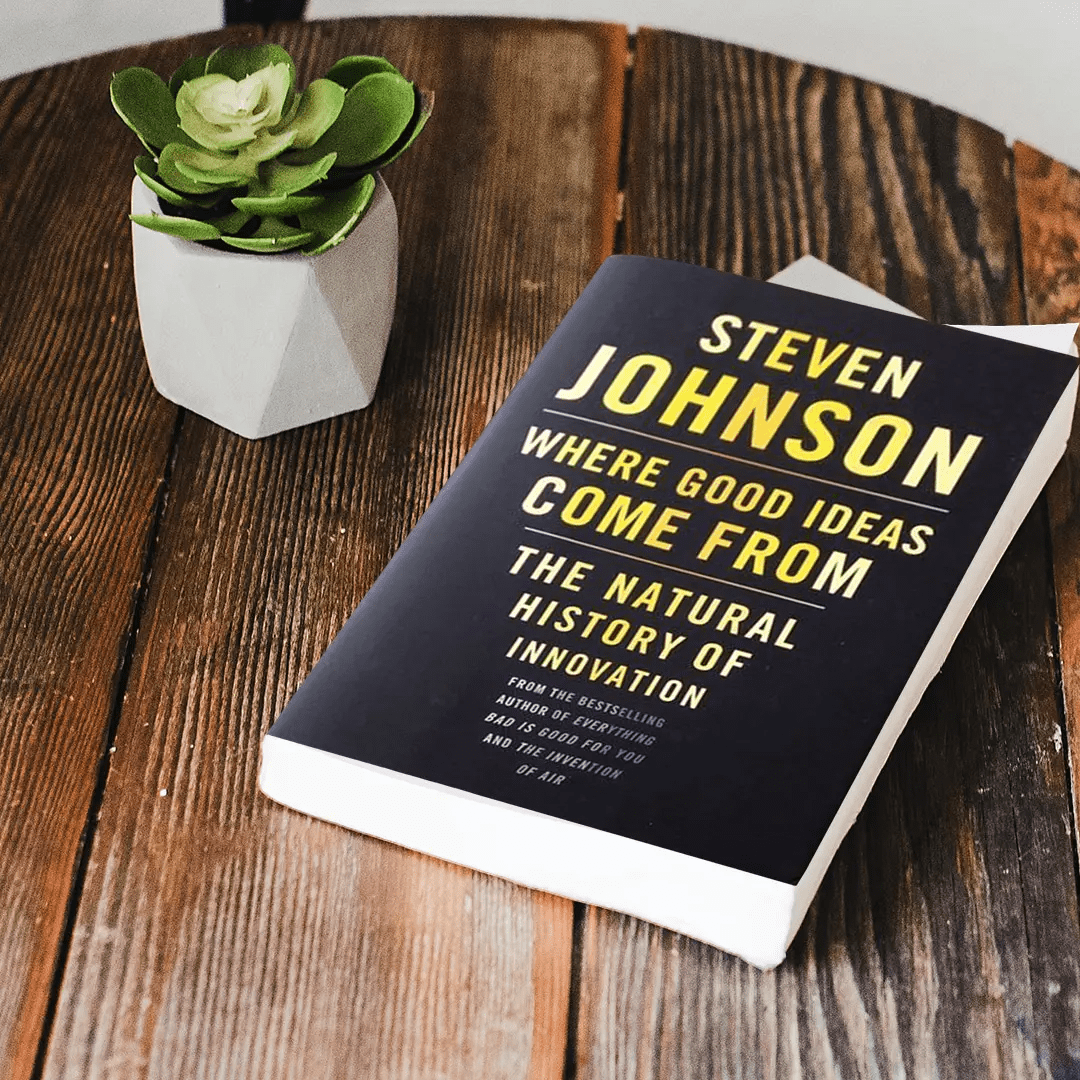

Where Good Ideas Come From: The Natural History of Innovation by Steven Johnson
Steven Johnson’s “Where Good Ideas Come From: The Natural History of Innovation” is a captivating exploration of the environments and patterns that foster groundbreaking ideas across history, from the biological world to human culture and technology. Johnson challenges conventional notions of innovation as a solitary flash of genius, instead revealing how fertile conditions—often mimicking natural systems—are crucial for nurturing, connecting, and evolving new insights. Through a “long zoom” perspective, he invites readers to understand innovation not as an isolated event, but as an ongoing process shaped by a recurring set of principles. This summary promises to break down every important idea, example, and insight from the book, presenting them in clear, accessible language, ensuring nothing significant is left out.
I. – THE ADJACENT POSSIBLE
This chapter delves into the concept of the adjacent possible, a foundational idea that explains both the limits and the boundless creative potential of innovation. It argues that new ideas are not conjured from thin air but are built from existing “spare parts” in a given environment.
The NeoNurture and Bricolage
Johnson introduces the NeoNurture incubator, a device designed for developing countries. Traditional incubators are expensive and hard to repair in low-resource settings. Designer Timothy Prestero and his team, inspired by Dr. Jonathan Rosen’s observation that automobiles are ubiquitous and repairable even in remote areas, created the NeoNurture using automobile parts. Sealed-beam headlights provided warmth, dashboard fans circulated air, and door chimes served as alarms. This ingenious solution demonstrates that good ideas are works of bricolage, assembled from the detritus of existing elements rather than manufactured entirely new. Just as Stephen Jay Gould observed recycled tire sandals as a testament to “human ingenuity,” Johnson argues that ideas are similarly constrained by and built from their surroundings.
Stuart Kauffman and the Adjacent Possible
The concept of the adjacent possible is borrowed from evolutionary biologist Stuart Kauffman. It refers to the set of all possible first-order combinations achievable from a given set of existing elements. For instance, in prebiotic chemistry, the initial molecules (ammonia, methane, water, carbon dioxide, amino acids) could form a finite series of transformations. However, they could not spontaneously form a sunflower, as that requires subsequent innovations like chloroplasts and DNA.
The remarkable truth about the adjacent possible is that its boundaries expand as you explore them. Opening one “door” into a new combination immediately reveals new doors that were previously inaccessible. The spontaneous formation of fatty acid membranes in the primordial soup, for example, created a fundamental division between “inside” and “outside,” which then opened up the possibility for putting things inside—like food, organelles, and genetic code—leading to the evolution of the cell. Similarly, the evolution of the semilunate carpal bone in dinosaurs provided greater wrist flexibility, which later exapted into wings and flight. The development of opposable thumbs in human ancestors unlocked new cultural possibilities for tool-making.
The Multiple and Ahead of Its Time Ideas
The concept of the adjacent possible helps explain the phenomenon of the “multiple”: when the same brilliant idea occurs independently to multiple scientists or inventors around the world at roughly the same time. Sunspots were discovered simultaneously by four scientists in 1611, the electrical battery by two in 1745-46, and oxygen by three between 1772-74. This isn’t coincidence or “zeitgeist” but rather a reflection that the necessary “parts”—both conceptual frameworks and literal technologies—have become available, making the discovery or invention enter the adjacent possible. For example, the discovery of oxygen required the concept of air as distinct gases and advanced scales to measure weight changes.
Conversely, ideas that are “ahead of their time” typically fail in the short term because they transcend the adjacent possible. Charles Babbage’s Analytical Engine, conceived in 1837 as the first programmable computer, was a conceptual masterpiece. However, it relied entirely on mechanical gears and switches, which would have been hopelessly slow and prone to error in the steam-powered mechanical revolution. The necessary “spare parts”—vacuum tubes or integrated circuits—for fast, reliable computation didn’t exist for over a century. Similarly, YouTube in 1995 would have failed due to slow dial-up connections and the lack of a robust video platform like Adobe Flash.
Cultivating the Adjacent Possible
The core insight is that innovative environments excel at helping their inhabitants explore the adjacent possible. They achieve this by exposing a wide and diverse sample of spare parts (mechanical or conceptual) and encouraging novel ways of recombining them. Environments that block or limit these combinations—through punishment of experimentation, obscuring possibilities, or making the status quo too comfortable—will produce fewer innovations. The Keeling Islands’ coral reef, with its immense biodiversity in nutrient-poor waters, is a natural example of an environment supremely gifted at recycling and reinventing its ecosystem’s spare parts. The Apollo 13 mission’s “mailbox” carbon dioxide filter illustrates how quickly a solution can be “cobbled together” when the available “spare parts” are clearly defined and the need is urgent. The challenge for innovation is often discovering what those spare parts are and ensuring that you’re not just recycling the same old ingredients.
II. – LIQUID NETWORKS
This chapter posits that a good idea is fundamentally a network, both at the neural level within the brain and at the societal level. It explores how liquid networks—characterized by high density and plasticity—are essential for fostering new connections and insights.
Ideas as Neural Networks
Johnson argues that an idea is not a single entity but a “swarm”: a specific constellation of thousands of neurons firing in sync. For an idea to emerge, two preconditions are vital:
- Sheer size of the network: The brain’s 100 billion neurons and 100 trillion distinct neuronal connections create an incredibly complex, high-density network, far larger than the World Wide Web.
- Plasticity: The network must be capable of adopting new configurations. New ideas involve brand-new assemblages of neurons. Highly interconnected, constantly exploring new patterns, these networks are also capable of preserving useful structures.
The brain behaves differently when creating compared to performing repetitive tasks, with neurons communicating in distinct ways and networks taking on different shapes. The goal is to push the brain towards these more creative networks by placing it in environments that mimic these high-density, plastic network signatures.
Carbon, Water, and Primordial Innovation
The earliest innovation engine on Earth demonstrates the power of liquid networks. Carbon, with its four valence electrons, is uniquely talented at forming connections, particularly with hydrogen, nitrogen, oxygen, and phosphorus, which constitute 99% of living organisms. Carbon’s combinatorial power is central to life’s origin, making it a connector. The Miller-Urey experiment showed that basic organic compounds essential to life spontaneously formed from primeval gases and simulated lightning, highlighting carbon’s role.
However, carbon’s talents alone are insufficient without a medium for collision. Liquid water (H2O), with its strong hydrogen bonds, maintains a wide liquid temperature range and acts as a fiendishly talented dissolver. This combination of fluidity and solubility makes water a “randomizing” environment that encourages collisions and new networks of elements, while strong hydrogen bonds allow stable new combinations to endure. The primordial soup was a high-density liquid network, where connection-hungry carbon atoms collided, leading to the first organisms.
Christopher Langton and the Edge of Chaos
Computer scientist Christopher Langton’s concept of the “edge of chaos” describes the fertile zone for innovative systems: between too much order (solid state) and too much anarchy (gaseous state).
- Gas: Chaos rules; new configurations are possible but instantly disrupted.
- Solid: Patterns are stable but incapable of change.
- Liquid: New configurations emerge from random connections, but the system retains enough stability to preserve new creations.
Human brains operate as a liquid network, and innovative environments should reflect this.
Cities as Liquid Networks
The emergence of human settlements into cities represented the first human-built liquid networks. After millennia of nomadic, “gaseous” hunter-gatherer existence, agriculture led to groups numbering thousands, drastically increasing possible connections and enabling “information spillover.” This density led to a dramatic surge in the societal innovation rate. While it’s hard to definitively prove causation, the correlation is strong: cities not only made innovation easier but also served to preserve accumulated wisdom before writing.
The European Renaissance further exemplified this, flourishing in the urban networks of Northern Italy (Genoa, Venice, Florence). Unlike the overly ordered medieval culture, these cities allowed ideas to circulate freely. The invention of double-entry accounting, though essential to capitalism, was not patented but developed collectively and circulated through these liquid networks, highlighting the value of shared ideas. Cities and markets recruit more minds into exploring the adjacent possible, leading to more useful innovations. It’s not the “wisdom of the crowd” as a hive mind, but rather individuals getting smarter through connection, generating the “wisdom of someone in the crowd.”
Work Environments and Collective Flow
Kevin Dunbar’s in vivo study of molecular biology labs revealed that most important ideas emerged not from solitary work but during regular lab meetings around a conference table. Group discussions helped recontextualize problems, challenged assumptions, and fostered productive analogies. This underscores that the physical architecture of work environments is crucial.
Closed offices with private doors freeze liquid networks. Companies like TBWA/Chiat/Day experimented with “nonterritorial” offices, but too much chaos proved problematic. A better model is MIT’s legendary Building 20, a temporary structure that lasted 55 years due to its flexibility and ease of reconfiguration. Its cheap construction meant residents felt no qualms about tearing down walls to adapt space to new ideas. Microsoft’s Building 99 similarly features modular spaces, write-on/wipe-off walls, and “mixer stations” to facilitate constant informal chatter and “information spillover,” designed to “leak” and promote collective flow. This echoes Mihaly Csikszentmihalyi’s concept of “flow” as an energized, fluid state of mind.
The chapter concludes by reinforcing that creating an innovative mind means immersing it in environments that share the characteristics of liquid networks: high density, easy connections, and a capacity for constant transformation.
III. – THE SLOW HUNCH
This chapter delves into the nature of ideas, arguing that most world-changing innovations are not sudden “eureka!” moments but rather “slow hunches” that gradually take shape over time, often needing to connect with other partial ideas.
The Phoenix Memo and the Twin Hunches of 9/11
Johnson uses the Phoenix memo (July 10, 2001) as a prime example of a failed spark. FBI agent Ken Williams detected an “inordinate number” of individuals of “investigative interest” enrolling in flight schools, suggesting a long-term plot by Usama bin Laden to infiltrate civil aviation. Though prophetic and containing “great wisdom and foresight,” the memo was largely ignored, labeled “routine,” and failed to reach top officials. Even if it had, the FBI’s antiquated information architecture (the Automated Case Support system) made it impossible to cross-reference visa applications with flight school records in real-time.
The core problem, Johnson argues, was that Williams’s hunch was incomplete. It needed to connect with another critical hunch: that of the flight instructors at Pan Am International Flight Academy in Minnesota, who became suspicious of Zacarias Moussaoui (who paid cash and was overly interested in cockpit doors). When the Minneapolis FBI office, led by Harry Samit and Greg Jones, tried to get a search warrant for Moussaoui’s laptop, it was denied as “speculative” and “shaky.” Agent Jones even warned Moussaoui might “try to fly something into the World Trade Center.”
The crucial lesson is that liquid networks create environments where partial ideas can connect, acting as a “dating service for promising hunches.” The FBI’s “black hole” system, designed around “need to know” restrictions and a “stovepipe mentality,” actively prevented these connections, effectively becoming a “hunch-killing system.”
The Nature of Slow Hunches
While Malcolm Gladwell’s Blink focuses on instant “gut instincts,” Johnson contends that most world-changing ideas are slow hunches. They start as a “vague, hard-to-describe sense” of an interesting solution or opportunity, lingering in the mind, sometimes for decades, gradually assembling new connections and gaining strength.
- Joseph Priestley’s discovery of oxygen and plant respiration built on a 20-year obsession with trapping spiders in glass jars.
- Charles Darwin’s theory of natural selection was not a sudden “Malthusian epiphany” on September 28, 1838, as he claimed in his autobiography. Howard Gruber’s study of Darwin’s notebooks revealed that all core elements of the theory were present months earlier, but Darwin “failed to understand that he has the solution at his fingertips.” The idea “drifted into his consciousness over time, in waves.” Even his observations on the Galápagos finches took five months to fully grasp their significance.
Cultivating Slow Hunches
To preserve and nurture slow hunches, Johnson offers several strategies:
- Write everything down: Darwin meticulously maintained commonplace books where he recorded quotes, improvised ideas, dismissed false leads, and drew diagrams. This platform allowed his ideas to evolve through “duet between the present-tense thinking brain and all those past observations recorded on paper.”
- Commonplace books: This Enlightenment-era practice involved transcribing interesting passages from reading, creating a personalized “encyclopedia of quotations.” John Locke developed an intricate indexing system for his, which Erasmus Darwin (Charles’s grandfather) also used. These books balanced methodical arrangement with surprising new links, allowing “unruly, unplanned meanderings.” They served as a “repository for a vast miscellany of hunches,” where ideas could “mingle and breed” through rereading.
- Embrace unexpected connections: Just as the 19th-century guide Enquire Within Upon Everything sparked young Tim Berners-Lee’s imagination, leading to his early “Enquire” software, the Web itself is an “archetypal slow hunch” that matured over a decade. Berners-Lee’s vision of a “hypertext notebook” at CERN was a “process of accretion, not the linear solving of one problem after another.”
- Create space for hunches in work environments: Berners-Lee’s superiors at CERN allowed him to tinker with his side project, giving him the flexibility and connection needed to nurture his idea. In contrast, the FBI’s “stovepipe” architecture actively prevented hunches from connecting.
- “Innovation Time Off”: Companies like Google (20-percent time) and 3M (15-percent rule) formally allocate time for employees to work on passion projects. This led to successful products like AdSense, Orkut, and Gmail. Krishna Bharat’s StoryRank, which became Google News, was developed during 20-percent time and was a “mirror image” of the Phoenix memo failure, as it created a tool to automatically assemble clusters of relevance and association. This shows the power of an organizational culture that encourages hunches to evolve and connect.
IV. – SERENDIPITY
This chapter explores serendipity, the accidental discovery of meaningful things, as a crucial driver of innovation. It argues that environments fostering “happy accidents” are vital for allowing hunches to crystallize into powerful ideas.
Dreams and Serendipitous Collisions
Ideas are neural networks, and their connections can be chemical and electrical. The hybrid electrochemical nature of nerve communication was established by Otto Loewi’s frog heart experiment, which came to him in a dream. During REM sleep, acetylcholine-releasing cells fire indiscriminately, creating chaotic, semi-random associations. Most are meaningless, but occasionally, the dreaming brain “stumbles across a valuable link that has escaped waking consciousness.”
- Dmitri Mendeleev formulated the periodic table after a dream.
- John Carew Eccles conceived his theory of synaptic inhibitory action in a dream.
- Ullrich Wagner’s experiment showed “sleeping on the problem” significantly improved subjects’ ability to discover hidden patterns in a mathematical task. This demonstrates that dreams are the mind’s “primordial soup,” facilitating serendipitous collisions of creative insight.
- Friedrich August Kekulé’s dream of the Ouroboros serpent led to his insight into the benzene molecule’s ring structure, revolutionizing organic chemistry. This was serendipitous, but it was anchored by his years of wrestling with the problem.
Chaos in the Waking Brain
The waking brain also thrives on generative chaos. Neuroscientist Robert Thatcher’s study of children’s brain waves found that longer periods of “noise” (neurons out of sync), rather than perfect “phase-locking” (synchrony), correlated with higher IQ scores. This suggests that the brain’s chaos mode allows it to experiment with new links between neurons, acting as a “kind of background dreaming” for new connections. William James’s description of “a seething caldron of ideas” in higher minds aligns with this.
Sex and Genetic Serendipity
Sexual reproduction, while more complex than cloning, is a biological innovation strategy. By scrambling two distinct sets of DNA each generation, it introduces novel genetic combinations, providing “new ideas” to meet challenges like scarce resources or parasites. The water flea Daphnia switches from asexual to sexual reproduction when conditions get tough, demonstrating that when nature needs new ideas, it “strives to connect, not protect.” This principle is also linked to the spread of beneficial mutations.
Cultivating Serendipity
Johnson outlines ways to foster serendipitous connections:
- Physical activity: Strolls or showers remove one from task-based focus, allowing the mind to enter a more associative state and stumble upon overlooked connections, as seen with Henri Poincaré’s mathematical breakthroughs on his walks. Poincaré envisioned “atoms” of ideas detaching and forming new combinations through “mutual impacts.”
- Deep reading: Bill Gates and Ray Ozzie’s annual reading vacations, where they immerse themselves in diverse materials, compress information intake, giving new ideas more opportunities to network among themselves.
- Digital Commonplace Books: Johnson’s personal use of DEVONthink to curate a digital archive of quotes and his own writing creates a “digital extension of my imperfect memory.” Its semantic algorithm detects subtle connections, leading to “private serendipity” by suggesting related passages he might have forgotten, enabling new ideas to take shape from “a trail of associations the machine has assembled for me.”
The Web and Serendipity
Contrary to common complaints about the Web diminishing serendipity, Johnson argues it has increased it:
- Browsing: The Web’s hypertext structure allows “unlikely trails of connection and chance.” It’s easier to stumble upon brilliant, surprising content online than by randomly browsing library stacks.
- Newspaper comparison: While print newspapers offer “architecture of serendipity” by forcing exposure to varied stories, the NYTimes.com front page offers vastly more links (315 vs. 23), providing more opportunities for accidental discovery.
- Filters vs. Native Architecture: While the Web allows for filters (e.g., personalized feeds), its native architecture—a global, distributed medium where anyone can publish, and a hypertext document structure—ensures an endless supply of surprising information and lightning-speed navigation.
- Google as a serendipity supporter: While seen as a “serendipity killer” due to targeted searches, Google also helps when users have a vague “hint” of interest. It provides an “information anchor” for exploration, turning “hints and happy accidents into information.” The directive for the Web: “look everything up.”
Innovation and Openness
Johnson argues that intellectual property laws (patents, DRM, trade secrets) create “artificial scarcity” by building walls between ideas, with the explicit aim of encouraging innovation by rewarding creators. However, these closed environments inhibit serendipity and reduce the overall network of minds engaging with a problem.
- R&D labs historically functioned as “idea lockboxes,” protecting secrets but also from ideas that might improve them.
- Open innovation platforms (e.g., IBM, Procter & Gamble) share leading-edge research, allowing outside firms to improve on innovations. Nike’s GreenXchange released 400 eco-friendly patents, enabling “commercial exaptations” where ideas could be used in “non-competitive” fields (e.g., shoe rubber for bike tires). This demonstrates a “cooperative advantage” from openness.
- Brainstorming, while aiming for openness, is finite in time and space, making it less effective than systems where “brainstorming is something that is constantly running in the background.”
- Public hunch databases (like Google’s company-wide email list for suggestions or Salesforce.com’s Idea Exchange) make ideas visible, allowing others to comment, expand, and vote on them, creating an “architecture for organizational serendipity” and tangible evidence that ideas make a difference. These systems harness both individual and collective intelligence.
V. – ERROR
This chapter makes a powerful case for the generative power of error in the history of innovation. It argues that mistakes, far from being mere setbacks, often provide crucial “paths out of comfortable assumptions” and stimulate new exploration.
Lee de Forest and the Audion
Lee de Forest’s invention of the Audion (triode), which made radio, television, and early computers possible, is a prime example of “the steady, persistent accumulation of error.” In 1900, de Forest observed a Welsbach burner flame flickering in response to his spark gap transmitter. He mistakenly believed the flame was detecting electromagnetic signals, leading him to his hunch that a gas could be a wireless detector.
Despite this fundamental misunderstanding, he kept tinkering. His subsequent designs, including placing a third “grid” electrode in a gas-filled bulb, worked to amplify audio signals, even though their reliance on low-pressure gas limited their reliability. It took a decade for others to realize the device worked far better in a true vacuum (hence “vacuum tube”). De Forest himself admitted, “I didn’t know why it worked. It just did.” His invention was a success built on a profound misinterpretation.
Generative Mistakes in Science
The history of science is “replete with stories of good ideas…that occurred to people while they were out on a stroll.” This is not an anomaly. A surprisingly large number of transformative ideas stem from contaminated laboratory environments or simple mistakes.
- Alexander Fleming discovered penicillin when mold accidentally infiltrated a Staphylococcus culture.
- Louis Daguerre invented the daguerreotype after mercury fumes from a spilled jar unexpectedly produced a perfect image on his silver plates.
- Wilson Greatbatch invented the implantable cardiac pacemaker when he accidentally grabbed the wrong resistor for his oscillator, causing it to pulse like a human heart. This mistake triggered a connection to his five-year-old hunch about irregular heartbeats as a signal transmission problem.
These generative mistakes worked because they connected to existing “slow hunches” in the minds of their creators.
The Value of Being Wrong
William Stanley Jevons argued that “The errors of the great mind exceed in number those of the less vigorous one.” This isn’t just about higher productivity; it’s that error itself is a productive force. “Being right keeps you in place. Being wrong forces you to explore.”
- Thomas Kuhn noted that paradigm shifts often begin with anomalies in data, when predictions are repeatedly wrong. Joseph Priestley expected his mint plant in a bell jar to die without oxygen but was wrong; the plant thrived. This “error” led him to discover that plants expel oxygen.
- Kevin Dunbar’s studies of microbiology labs found that over half of experiments yielded unexpected results. Scientists often dismissed these as “noise,” but outsiders in lab meetings were more likely to see the mistake as meaningful, fostering breakthroughs. The discovery of cosmic background radiation by Arno Penzias and Robert Wilson was initially dismissed as meaningless static until a chance conversation suggested it was a signal from the Big Bang.
Noise, Dissent, and Creativity
Charlan Nemeth’s psychology experiments demonstrated the positive impact of noise and dissent on creativity. When test subjects free-associated on colors, their responses were predictably conventional. However, when Nemeth introduced actors who deliberately misidentified colors (e.g., calling blue slides “green”), the other subjects’ subsequent free associations became markedly more original and eclectic. This shows that introducing “inaccurate information” or “dissenting” opinions forces others to rethink their biases and explore new rooms in the adjacent possible, even if the “dissent” is technically incorrect. The “best innovation labs are always a little contaminated.”
Evolution and Error
Error is fundamental to evolution. Without random mutation in DNA, evolution would stagnate. While most mutations are harmful, every now and then, one opens a new wing of the adjacent possible. Darwin himself struggled with the concept of random variation, proposing the ultimately false theory of pangenesis (where traits acquired during an organism’s lifetime could be passed on). This was his “greatest error” – a failure to understand the “protean force of error.”
While cells have elaborate DNA repair mechanisms, the human genetic mutation rate is roughly one in thirty million base pairs, resulting in about 150 mutations per child. Some scientists argue this represents an “optimal balance” between too much mutation (lethal) and too much stability (stagnation). Susan Rosenberg’s research showed bacteria increased their mutation rates when stressed by low energy, shifting the risk/reward balance for innovation.
Sex and error are interconnected: sexual reproduction allows beneficial mutations to spread without being overwhelmed by negative ones linked to high mutation rates, effectively harnessing the generative power of error while mitigating its risks. In essence, “Sex lets us learn from the mistakes of our genes.”
Ultimately, innovation environments thrive on useful mistakes and suffer when quality control becomes too rigid. The “fail faster” mantra of the Web startup world reflects this. As Benjamin Franklin put it, “error is endlessly diversified” and forces us to explore, while “truth is uniform and narrow.”
VI. – EXAPTATION
This chapter introduces the concept of exaptation, an evolutionary biology term, to explain how innovations often arise from borrowing a trait or technology optimized for one use and then adapting it for a completely different function.
Gutenberg and the Wine Press
Johannes Gutenberg’s printing press is a classic example of combinatorial innovation driven by exaptation. Each key component—movable type, ink, paper, and the press itself—existed before Gutenberg. His genius lay in borrowing a mature technology from an entirely different field: the wine press.
The screw press had been used for centuries by the Greeks and Romans for wine and olive oil. By the 15th century, it was highly optimized for mass wine production in the Rhineland. Gutenberg, a goldsmith and failed mirror manufacturer, took this machine designed to “get people drunk” and transformed it into an “engine for mass communication.” His innovation relied not on conceiving something entirely new, but on his ability to reach beyond his expertise and concoct new uses for an older technology.
Exaptation in Biology
Coined by Stephen Jay Gould and Elisabeth Vrba, exaptation describes when an organism develops a trait for a specific use, but it’s later hijacked for a completely different function.
- Bird feathers: Initially evolved for temperature regulation in non-flying dinosaurs, they were later exapted for flight in creatures like Archaeopteryx. Once used for flight, feathers then evolved further for aerodynamics (e.g., asymmetrical vanes).
- Lobe-finned fish (Sarcopterygii): Their swim fans, originally for aquatic life, were exapted for walking as descendants moved onto land, eventually leading to the basic architecture of all mammalian ankles and feet (autopods). This autopod was then further exapted into primate hands, wings, or even back to flippers in seals.
Exaptations are crucial to rebutting “intelligent design” arguments, showing that extraordinary traits don’t need a single, linear purpose from their origin.
Exaptation in Human Culture
Human creativity abounds with exaptations:
- Punch cards: Developed by Joseph-Marie Jacquard in the early 1800s to weave silk patterns on mechanical looms, they were later borrowed by Charles Babbage to program his Analytical Engine and remained crucial for computers until the 1970s.
- Lee de Forest’s Audion (vacuum tube): Designed for amplifying radio signals, it was unwittingly exapted to serve as an electronic switch for the high-speed logic gates of the first digital computers like ENIAC, aiding in hydrogen bomb calculations. Its original function was “making signals louder,” its exapted function was “turning those signals into information.”
- The World Wide Web: Tim Berners-Lee designed its protocols for academic research sharing. But it was exapted for shopping, photo sharing, and pornography. Sergey Brin and Larry Page exapted the hypertext link (designed for navigation) to assess quality, creating PageRank for Google.
- Literary exaptation: Franco Moretti documented how narrative devices, like Edouard Dujardin’s “stream of consciousness” (originally short introspections), were exapted by James Joyce in Ulysses to capture the “churn and distractibility of mental life.” Dickens’s Inspector Bucket exapted into the detective fiction genre. New genres are often built on old devices.
- Rhetorical/Figurative Exaptations: Arthur Koestler argued that “all decisive events in the history of scientific thought can be described in terms of mental cross-fertilization between different disciplines.” Examples include Francis Crick’s sculpture metaphor for DNA’s replication, Johannes Kepler’s religious metaphor for planetary motion, and Doug Engelbart’s “desktop metaphor” for graphical interfaces. Kekulé’s mythical serpent was an exaptive metaphor for the benzene ring.
Cities, Subcultures, and Coffeehouses
Claude Fischer’s research showed that big cities nurture subcultures much more effectively than smaller communities. Specialized interests (e.g., beetle collecting, improv theater) need critical mass to survive. This clustering creates positive feedback loops, attracting unconventional residents. Jane Jacobs observed that cities support a greater variety of businesses, from supermarkets to “Viennese bakeries,” and small businesses outnumber large ones in “lively and popular parts of cities.”
Cities are ripe for exaptation because they:
- Cultivate specialized skills and interests within subcultures.
- Create a liquid network where information from these subcultures can “leak out” and influence neighbors in surprising ways. This explains superlinear scaling in urban creativity.
“Third places”—public spaces distinct from home or office—are crucial. 18th-century English coffeehouses fostered Enlightenment innovations, Freud’s salon shaped psychoanalysis, and the Homebrew Computer Club sparked the personal computer revolution. These spaces bring different fields of expertise into collision, where “the true sparks fly.” The modernists of the 1920s, sharing Parisian cafés, exemplified this, with literary stream of consciousness influencing cubism and futurism shaping urban planning.
Weak Ties and Multi-Disciplinary Thinking
Martin Ruef’s study of entrepreneurial careers showed that the most creative individuals had broad social networks extending outside their organizations, involving people from diverse fields. These “diverse, horizontal social networks” were three times more innovative than uniform, vertical ones. Ronald Burt’s study at Raytheon Corporation similarly found innovation emerged from individuals bridging “structural holes” between tightly knit clusters.
This validates Mark Granovetter’s “strength of weak ties” argument. Weak ties don’t just transmit information efficiently; they transmit it from different contexts or “idea-spaces.” Gutenberg’s weak ties to Rhineland vintners allowed him to exapt the wine press.
Watson and Crick’s discovery of DNA’s double helix was an exaptation of ideas from biochemistry, genetics, information theory, and mathematics (Crick’s sculpture metaphor). Rosalind Franklin’s purely inductive X-ray crystallography approach, confined to one discipline, limited her vision. Watson and Crick’s notorious “long, rambling coffee breaks” illustrate their collaborative, cross-disciplinary approach.
Apple’s Concurrent Production
Even Apple, despite its secrecy, practices a form of internal exaptation through “concurrent or parallel production.” Instead of a linear development chain, all groups (design, manufacturing, engineering, sales) meet continuously, brainstorming and trading ideas. This “messier and more chaotic” process fosters dialogue between different disciplines, allowing the original idea to evolve through collaboration rather than being “hollowed out.”
Multi-Tasking and Hobbies
Great innovators often build a cross-disciplinary “coffeehouse” into their own routines. Darwin studied coral, bred pigeons, and researched geology, each “contributing useful links of association and expertise to the problem of evolution.” Joseph Priestley moved between chemistry, physics, theology, and politics. Benjamin Franklin conducted electricity experiments, theorized the Gulf Stream, and designed stoves. John Snow, while solving cholera, also invented ether administration technology and researched lead poisoning. These individuals engaged in “slow multitasking”: one project takes center stage, while others “linger in the margins of consciousness,” allowing for cognitive overlap and the exaptation of ideas from one domain to another. Snow’s understanding of gas diffusion from his anesthesia work helped him dismantle the “miasma” theory of cholera. “Chance favors the connected mind.”
VII. – PLATFORMS
This chapter argues that platforms—physical, biological, or digital—are generative environments that foster a remarkable diversity of innovation by enabling emergent behavior and the efficient recycling of resources.
Coral Reefs as Platforms
Charles Darwin’s theory of atoll formation was his first major scientific contribution. He realized that the Keeling Islands, rather than being mere volcanic peaks, were “monuments raised by myriads of tiny architects”: reef-building coral (Scleractinia). These soft polyps build calcium-based exoskeletons (aragonite) which, after death, form vast underwater mausoleums. Darwin’s insight was that as volcanic islands slowly subsided into the sea, the coral colonies built their reefs faster than the mountain descended, forming the distinctive circular atoll shape.
A coral reef is a platform in a profound sense: its mounds, plates, and crevices create a habitat for millions of other species, an “undersea metropolis of immense diversity.” This is Darwin’s Paradox: how such nutrient-poor waters could generate so much life. The answer lies in the reef’s function as an “ecosystem engineer” (a term coined by Clive Jones). Like beavers building dams that transform forests into wetlands, coral creates a platform that sustains a remarkably diverse assemblage of life. Platform building is an exercise in emergent behavior: the individual polyps aren’t trying to create a metropolis, but their steady labor leads to a higher-level system.
GPS: From Cold War to Civilian Use
The Global Positioning System (GPS) exemplifies an emergent platform. In 1957, William Guier and George Weiffenbach at the Johns Hopkins Applied Physics Laboratory (APL) observed Sputnik 1’s microwave signals. Using the Doppler effect, they figured out not only the satellite’s speed but also how to map its orbit.
Frank T. McClure, APL’s deputy director, then posed the “inverse problem”: if you know the satellite’s orbit, can you calculate the location of a receiver on the ground? This was crucial for guiding Polaris nuclear missiles from submarines. Guier and Weiffenbach confirmed its feasibility, leading to the Transit system. In 1983, after Korean Air Lines Flight 007 was shot down due to faulty navigation, Ronald Reagan declared satellite-based navigation a “common good” for civilian use, and it became GPS.
The APL was a platform that “encouraged and amplified hunches,” allowing different fields to collide, leading to one of the most generative technologies of the 21st century. Like the coffeehouses of the Enlightenment or the Homebrew Computer Club, these physical spaces act as “emergent platforms,” making people think differently and encouraging productive collisions.
Stacked Platforms in Culture and Technology
Generative platforms often come in “stacks.”
- The Web: Tim Berners-Lee built the Web (HTML, HTTP) on top of the existing Internet platform (derived from ARPANET, TCP/IP). He didn’t have to invent inter-computer communication. YouTube was built by stitching together the Web, Adobe Flash, and Javascript. This layered approach explains how three individuals could create YouTube in six months, while HDTV took 20 years.
- Scientific Paradigms: Kuhn’s paradigms are scientific “software platforms”—rules that govern inquiry. They are rarely overthrown but are built upon. Darwin’s natural selection theory was a platform for Mendelian genetics, molecular genetics, and ecosystems ecology.
- Creative Arts/Genres: Genres (e.g., bildungsroman, detective fiction, cubism, jazz) are the “platforms and paradigms of the creative world.” They provide implicit rules for traditionalists and frameworks for adventurous artists to “confound expectations.” Miles Davis’s “So What?” worked within the Dorian scale and on the stable platform of the valved trumpet.
- Twitter: Its 140-character limit comes from SMS. Much of Twitter’s functionality (e.g., @ replies, hashtags, search of live feeds) was spontaneously invented by its users or by third-party developers.
The Twitter API (application programming interface) is key. The founders built the API first, exposing all data, and then built Twitter.com on top, leveraging a “cooperative advantage”: the largest and most diverse ecosystem of software being built on their platform, where “good ideas can come from anywhere.”
Government as Platform
The success of open platforms extends to the public sector.
- Apps for Democracy (Washington D.C.): Vivek Kundra, then D.C.’s CTO (later national CIO for Obama’s Data.gov), invited developers to build applications using open government data. This led to 47 apps in 30 days for $50,000, which would have cost the city $2,000,000 using traditional methods. This demonstrated that “some of the best ideas for government are likely to come from outside the government.”
This platform model can help governments innovate by reducing costs and leveraging citizen intelligence.
The Power of Recycling and Waste
Platforms have a “natural appetite for trash, waste, and abandoned goods.”
- Artificial reefs: Decommissioned subway cars are sunk off the Delaware shore to create artificial reefs, providing shelter and breeding grounds, increasing biomass by 400%. They become “ecosystem engineers” in retirement.
- Urban development: Jane Jacobs observed that “innovation thrives in discarded spaces.” Riskier or smaller enterprises gravitate to older, cheaper buildings, rather than new construction. The “frenetic energy of a large city” creates a constant supply of less-desirable environments for imaginative reoccupation.
- Coral reef nutrient recycling: The symbiotic relationship between coral and zooxanthellae (algae) involves them using each other’s waste products. Sponges hidden in reef cavities consume phytoplankton and expel nutrients for the coral. This efficient reuse of resources (both shelter and biological waste) explains Darwin’s Paradox: the reef’s astonishing diversity in nutrient-poor waters.
- Calera: Brent Constantz, inspired by coral biomineralization, founded Calera to “grow” cement from seawater and carbon dioxide (CO2). He realized that factory exhaust (pollution) could be a resource for building materials, transforming pollution into a valuable “spare part.”
- Web’s recycling: A Twitter post about soup, with geo-data, is recycled by Foursquare, Outside.in, local news, and Google, creating new connections and value for multiple tasks. This happens because the information stands on layers of stacked, open platforms (Twitter API, SMS, RSS, GPS, HTTP, TCP/IP) that allow building “without asking for permission.” The “real benefit of stacked platforms lies in the knowledge you no longer need to have.”
Conclusion: THE FOURTH QUADRANT
This conclusion synthesizes the book’s arguments through a framework of “four quadrants” of innovation, challenging the prevailing orthodoxy that market capitalism is the sole engine of good ideas.
Willis Carrier and the Archetypal Myth
Willis Carrier’s invention of air conditioning in 1902 (starting with a dehumidification system for a printing factory) fits the archetypal myth of modern innovation: a clever individual in a private lab, driven by ambition and riches, has a sudden flash of insight, changing the world. This narrative supports the doxa of market capitalism as an unparalleled innovation engine, contrasting it with the perceived inflexibility of planned economies. Carrier’s story, however, lacks the patterns of liquid networks, coffeehouse exaptations, or brilliant mistakes, and ends with a triumphant patent. The question is: is he an anomaly or the norm?
The Four Quadrants of Innovation
To assess this, Johnson proposes a framework for classifying 200 important innovations from the past 600 years:
- Quadrant 1: Individual, Market-based (e.g., Willis Carrier, Gutenberg): Single inventor or small, coordinated team in a private firm aiming for profit.
- Quadrant 2: Networked, Market-based (e.g., vacuum tube, television): Multiple private firms or groups collaborating for profit.
- Quadrant 3: Individual, Non-market (e.g., Tim Berners-Lee’s Web, Leonardo da Vinci): Amateur scientists, artists, or hobbyists sharing ideas freely, without direct commercial incentive.
- Quadrant 4: Networked, Non-market (e.g., the Internet, modern research universities): Large, collaborative networks (open-source, academic) where ideas flow freely without proprietary restrictions.
Historical Patterns of Innovation
- 1400-1600 (Renaissance): Most innovation clusters in Quadrant 3 (non-market individuals). Information networks were slow, and commercial incentives underdeveloped. This era birthed the “inventive genius” myth (da Vinci, Copernicus, Galileo). Few first-quadrant (individual, market) innovations existed.
- 1600-1800 (Enlightenment): A dramatic shift occurs. Quadrant 3 surrenders its lead to Quadrant 4 (networked, non-market). A majority of breakthrough ideas emerge in collaborative environments. This was driven by the printing press, blossoming postal systems, increased urban density, and new intellectual hubs like coffeehouses and the Royal Society. Many great minds (Newton, Franklin, Priestley) sought no financial reward. While market incentives (Industrial Revolution, patent laws) emerged, most commercial innovation remained “collective invention.”
- 1800-Present (Modern Age): Contrary to expectations that Quadrant 1 (individual, market) would dominate, it turns out to be the least populated. For every Alfred Nobel (dynamite), there are many collective inventions like the lightbulb (Edison + rivals) or the vacuum tube. Major incursions into the adjacent possible required company. Even more striking is the explosion of Quadrant 4 activity.
The Power of the Fourth Quadrant
Why has Quadrant 4 flourished without direct economic incentives?
- Openness vs. Artificial Scarcity: Market-based incentives, while spurring innovation, also force protection (patents, copyrights, trade secrets), creating “artificial scarcity” and inefficient markets for ideas. Quadrant 4 environments lack these costs, allowing ideas to flow freely.
- Liquid Networks: All the patterns of innovation—liquid networks, slow hunches, serendipity, noise, exaptation, emergent platforms—thrive in open environments where ideas flow in unregulated channels. In controlled environments, they suffocate.
- Research Universities: Modern academic research is largely Quadrant 4. Ideas are published to be refined and built upon, with circulation restricted only by proper acknowledgment, not patents. This information commons fosters “pure” sciences and research with commercial applications (e.g., oral contraceptive, genomic science), often creating emergent platforms for commercial development.
- Reduced Transmission Costs: The Internet has made sharing good ideas virtually free, making it harder to stop information spillover. Quadrant 4 participants focus on new ideas, not building “fortresses around the old ones.” Ideas are refined and expanded by other minds.
- “Hybrid Economy”: This quadrant often operates outside conventional capitalism and socialism, blurring lines into what Lawrence Lessig calls a “hybrid economy,” where open networks complement private firms.
The Reef as a Metaphor for Innovation
Johnson argues that the conventional view of nature as “ruthless competition” (Darwin’s “war of nature,” invoked by Marx and Engels as a critique of capitalism, but by others as a defense) is incomplete. Darwin himself emphasized the “tangled bank”—the complex interdependencies and symbiotic connections of an ecosystem.
- The Reef: A coral reef is a perfect metaphor for Quadrant 4 innovation. Competition exists, but its marvelous biodiversity comes from organisms learning to collaborate (coral, zooxanthellae, parrotfish borrowing and reinventing each other’s work). It shares resources and thrives on efficient recycling, doing “much more with less.”
- Cities and the Web: Like the reef, they compulsively connect and remix information. The city, a platform outside the marketplace, allows ideas to collide and recombine, new enterprises to occupy abandoned spaces, and disciplines to borrow from one another. The Web, too, has transformed from a “desert” into a “coral reef” through its open, recycling, and connective nature.
Final Thoughts and Actionable Advice
The core maxim: “we are often better served by connecting ideas than we are by protecting them.”
The historical record shows that market-based competition has no monopoly on innovation. While financial rewards can motivate, they also introduce inefficiencies. The fourth quadrant (networked, non-market) has been an “extraordinary space of human creativity and insight,” especially with the Internet.
Governments should view themselves as open platforms (as advocated by Tim O’Reilly). The Internet itself, a publicly funded, open platform, allowed countless private fortunes to be made. Generative platforms require liquid networks, slow hunches, serendipitous collisions, exaptations, and recycling—all best achieved in an information commons.
Johnson concludes with actionable advice for individuals to foster their own “tangled bank”:
- Go for a walk.
- Cultivate hunches.
- Write everything down, but keep your folders messy.
- Embrace serendipity.
- Make generative mistakes.
- Take on multiple hobbies.
- Frequent coffeehouses and other liquid networks.
- Follow the links.
- Let others build on your ideas.
- Borrow, recycle, reinvent.
Key Takeaways
The core lessons from “Where Good Ideas Come From” are:
- Innovation is a networked process, not a solitary event. Good ideas are rarely born in isolation but emerge from the collision and connection of existing “spare parts” and partial hunches.
- Openness and connectivity are more valuable than protection and secrecy for fostering innovation. While intellectual property serves a purpose, environments that prioritize the free flow and recombination of ideas tend to be more fertile.
- “Liquid networks” are crucial. These are environments (whether neural networks in the brain, bustling cities, or the open Internet) characterized by high density, fluidity, and a balance between order and chaos, enabling surprising connections.
- “Slow hunches” are the norm, not sudden “eureka” moments. Important ideas often take years to develop, requiring consistent cultivation and a supportive environment where they can encounter complementary insights.
- Error and serendipity are generative forces. Mistakes and accidental discoveries are not merely setbacks but opportunities to explore new possibilities and challenge assumptions, often leading to breakthroughs.
- “Exaptation” is a powerful innovation mechanism. Ideas, traits, or technologies developed for one purpose can be borrowed and repurposed for entirely new and unanticipated functions.
- Platforms, particularly “stacked” and “open” ones, accelerate innovation. They provide foundational layers upon which others can build, reducing costs and fostering emergent behavior. This is evident in biological ecosystems like coral reefs and digital ones like the Web.
Next actions readers should take immediately, and why they matter:
- Diversify your information intake and connections: Actively seek out ideas from different fields, disciplines, and social circles. This increases the pool of “spare parts” for your own hunches to connect with.
- Cultivate a system for capturing fleeting thoughts and observations: Whether through a digital commonplace book or physical notebooks, writing things down allows slow hunches to persist and mature, preventing valuable ideas from being lost.
- Embrace opportunities for casual collaboration and informal discussion: Seek out “third places” or create informal “mixer stations” in your work environment. This encourages “information spillover” and serendipitous collisions between diverse ideas.
- Don’t be afraid to make mistakes or challenge existing assumptions: Recognize that error can be a productive force, forcing exploration and leading to unexpected insights. Adopt a “fail faster” mindset where applicable.
- Think about how your work or ideas can be a platform for others: Consider how to make your contributions more open and reusable, allowing others to build upon them. This fosters a “cooperative advantage” and wider innovation.
Reflection prompts:
- What “slow hunches” have you been nurturing in your own mind, and what steps can you take this week to expose them to new “spare parts” or connecting hunches?
- How can you introduce more “liquid network” characteristics (density, diverse connections, fluidity) into your daily routine or your work environment to foster more serendipitous discoveries?




Leave a Reply