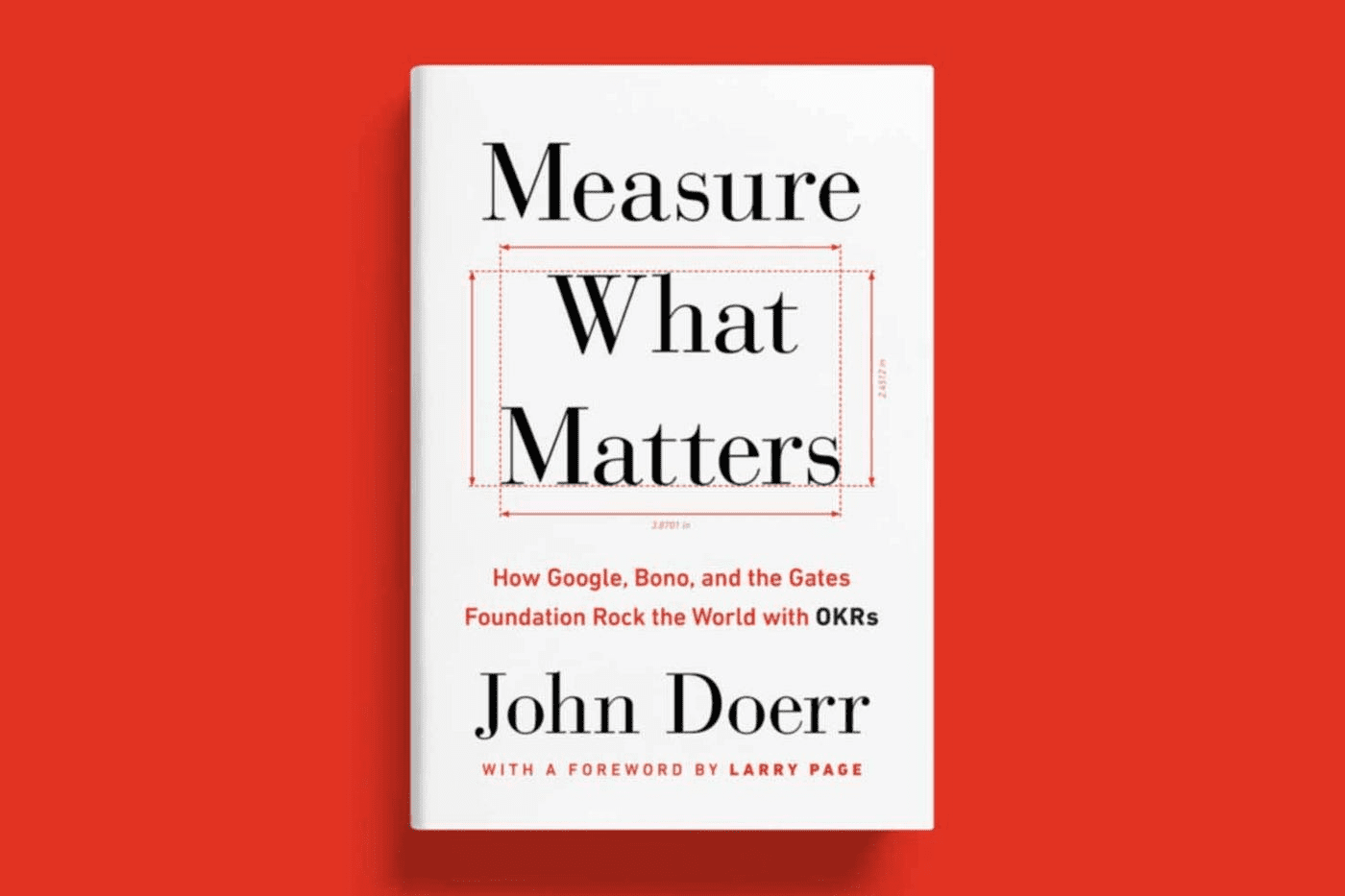

Mastering “Measure What Matters”: A Guide to OKRs and Transformative Execution
John Doerr’s “Measure What Matters” is an insightful and engaging journey into the world of Objectives and Key Results (OKRs), a powerful goal-setting framework that has revolutionized how leading organizations like Google, Intel, and the Gates Foundation achieve ambitious outcomes. This book serves as a vital handbook for any leader or team striving for greater focus, alignment, and accountability in a rapidly changing world. Doerr, a legendary venture capitalist and former Intel executive, distills decades of experience to show how this deceptively simple methodology can ignite innovation, elevate performance, and foster vibrant, value-driven cultures. Through compelling real-world stories and practical guidance, “Measure What Matters” promises to unlock the wisdom of OKRs, enabling readers to transform their approach to goals and achieve what once seemed impossible. In the following summary, we will meticulously break down every important idea, example, and insight presented in this transformative book, ensuring comprehensive coverage and clear, accessible explanations.
Google, Meet OKRs
This foundational chapter introduces us to the origins of OKRs at Google, illustrating how a powerful framework can convey “superpowers” to an organization. In 1999, John Doerr, a venture capitalist, made a significant investment in a young Google, founded by Larry Page and Sergey Brin. Despite their visionary ideas and entrepreneurial energy, the founders lacked management experience, and Google needed a system to make tough choices, keep their team on track, and measure what mattered. Doerr brought them his “gift”: OKRs, short for Objectives and Key Results, a collaborative goal-setting protocol he had learned at Intel under Andy Grove.
Doerr explains that an Objective defines WHAT is to be achieved. Objectives should be significant, concrete, action-oriented, and inspirational. They act as a “vaccine against fuzzy thinking.” Key Results benchmark and monitor HOW we get to the objective. Effective KRs are specific, time-bound, aggressive yet realistic, measurable, and verifiable. As Google’s Marissa Mayer famously stated, “It’s not a key result unless it has a number.” KRs are either met or not, leaving no room for doubt. Once all KRs are completed, the objective is necessarily achieved. Doerr presented his own OKRs for that day: finish his presentation on time, create sample Google OKRs, and gain agreement for a three-month OKR trial.
The chapter addresses the “Goals Gone Wild” critique, acknowledging that goals can be misused, but emphasizes that well-defined, challenging goals are essential for high performance. Research by Edwin Locke and Gallup surveys confirm that productivity is enhanced by clear, challenging goals and that engaged work groups generate more profit. OKRs link goals to a broader mission, respect targets and deadlines, adapt to circumstances, promote feedback, and celebrate wins. Google embraced OKRs because they were elastic, data-driven, and transparent, aligning perfectly with the company’s open culture and bold thinking. Larry Page and Sergey Brin, along with Eric Schmidt, demonstrated fierce commitment to OKRs, setting the tone from the top. This early adoption and continuous refinement of OKRs became a crucial factor in Google’s exponential growth, leading to products with billions of users and a market capitalization exceeding $700 billion. The chapter concludes by outlining the four OKR “superpowers”: Focus and Commit to Priorities, Align and Connect for Teamwork, Track for Accountability, and Stretch for Amazing, which will be explored in detail throughout the book.
The Father of OKRs
This chapter delves into the origins of OKRs with Andy Grove, the visionary leader at Intel, who transformed the concept of goal setting and management. John Doerr recounts his first encounter with Grove in 1975, when Doerr was an intern at Intel. Grove, then executive vice president, emphasized that at Intel, “it almost doesn’t matter what you know. It’s what you can do with whatever you know or can acquire and actually accomplish [that] tends to be valued here.” This focus on execution over expertise became Intel’s mantra: “Intel delivers.”
Grove had implemented a goal-setting system in 1971, which he called “iMBOs” (Intel Management by Objectives), influenced by Peter Drucker’s “management by objectives and self-control.” However, Grove’s system significantly departed from traditional MBOs. While MBOs were often annual, private, top-down, and tied to compensation, Grove’s OKRs were quarterly or monthly, public and transparent, included bottom-up input (~50%), and were mostly divorced from compensation, encouraging aggressive and aspirational goals. Grove’s key innovation was explicitly linking objectives to “key results”, a term he appears to have coined, which were measurable and verifiable milestones. Doerr’s own first OKR at Intel, focused on demonstrating the 8080’s superior performance, exemplified this clear, public, and liberating approach.
Intel’s OKRs became the company’s “lifeblood,” integral to weekly one-on-ones, staff meetings, and divisional reviews, ensuring rigorous execution in the complex semiconductor business. Doerr witnessed Grove’s demanding yet approachable leadership, characterized by “creative confrontation” and an openness to good ideas. Grove enforced discipline (e.g., “Andy’s Late List” for tardiness) but also fostered a culture where managers “leave our stripes outside when we go into a meeting,” valuing free discussion and merit. Doerr’s personal experience, from a product manager to a sales rep in Chicago, solidified his appreciation for OKRs as a tool for discipline, constancy, and clear communication. Grove’s enduring legacy is this practical, impactful management system, which Doerr later shared with Google.
The chapter concludes by outlining Dr. Grove’s Basic OKR Hygiene:
- Less is more: Limit objectives to three to five per cycle, each with five or fewer key results, to ensure focus.
- Set goals from the bottom up: Encourage teams and individuals to create about half of their OKRs to promote engagement.
- No dictating: OKRs are a cooperative social contract, requiring collective agreement and ongoing negotiation of key results.
- Stay flexible: Modify or discard key results mid-cycle if circumstances change.
- Dare to fail: Encourage aspirational OKRs that push beyond immediate grasp, understanding that some failure is part of peak performance.
- A tool, not a weapon: Separate OKRs from compensation to encourage risk-taking and prevent sandbagging.
- Be patient; be resolute: Recognize that adopting OKRs requires trial and error and takes time (four to five quarterly cycles) to build “mature goal muscle.”
Operation Crush: An Intel Story
This chapter vividly illustrates how OKRs, pioneered by Andy Grove, enabled Intel to overcome an existential threat in the microprocessor market—a campaign known as Operation Crush. In late 1979, Intel’s leading 16-bit microprocessor, the 8086, was losing ground to faster, easier-to-program chips from Motorola and Zilog. A desperate telex from a sales manager spurred Andy Grove, then COO, to launch a corporate crusade. Jim Lally set the aggressive tone: “We have to kill Motorola… We’re gonna roll over Motorola and make sure they don’t come back again.”
Bill Davidow, head of Intel’s microcomputer systems division, was tasked with leading Operation Crush. He famously introduced the phrase “as measured by” (a.m.b.) into Intel’s company OKRs, making explicit the direct link between objectives and measurable results. Without modifying a single product, Grove and his team revamped their marketing strategy, shifting focus from selling to programmers to selling to CEOs, emphasizing long-term systems and services over short-term ease of use. This strategic pivot leveraged Intel’s strengths in its broad product family, technical support, and lower cost of ownership.
Operation Crush exemplified all four OKR superpowers:
- Focus: The singular objective was to restore Intel’s market leadership.
- Alignment: The message was cascaded rapidly and clearly throughout the entire organization, from top management to the sales force, marketing, and engineering, ensuring everyone pointed “in the same direction.”
- Tracking: OKRs provided unambiguous, time-bound criteria for assessment, allowing for rapid implementation and clear reporting. For example, a corporate objective to “Establish the 8086 as the highest performance 16-bit microprocessor family” included key results like “Develop and publish five benchmarks” and “Get the 8MHz part into production.” An engineering objective was to “Deliver 500 8MHz 8086 parts to CGW by May 30.”
- Stretching: The audacious goal of two thousand “design wins” (crucial agreements for clients to integrate the 8086 into their products), a 50% increase over the previous year, pushed the sales force beyond their perceived limits. This was a rallying point, driven by a “no one left behind” incentive—a trip to Tahiti for all who met the quota, but forfeited if anyone failed.
The entire company turned “on a dime,” mobilizing quickly and apolitically due to the embedded OKR system and Intel’s culture of collective accountability. By year-end 1980, Intel achieved over 2,300 design wins, effectively routing Motorola and securing the 8086’s dominance, which became foundational for the IBM PC and Intel’s future. The chapter concludes by highlighting Grove’s belief that “Great companies are improved by crisis,” and how OKRs were the secret weapon in this transformative victory.
Superpower #1: Focus and Commit to Priorities
The first OKR superpower, Focus and Commit to Priorities, emphasizes the critical need for organizations to identify and commit to a select few initiatives that truly matter, while deferring less urgent ones. This disciplined approach starts at the top, with senior leadership personally committed to the process and investing the time to choose what counts. Doerr stresses that “Ideas are easy. Execution is everything.”
Key aspects of this superpower include:
- Top-Line Goals and Leadership Commitment: Organization-level OKRs begin with senior leaders. Google, for instance, turned to its mission statement (“Organize the world’s information and make it universally accessible and useful”) to guide its top-line objectives. The most impactful OKRs can originate from frontline contributors, as seen with Rick Klau’s YouTube login objective, which Larry Page elevated to a company-wide OKR, providing clear priority for other teams. Leaders must model the behavior they expect; “talking a good OKR game is not enough.” Bill Campbell famously stated, “When you’re the CEO or the founder of a company… you’ve got to say ‘This is what we’re doing,’ and then you have to model it.”
- Clarity in Communication: Top-line goals must be clearly understood throughout the organization, conveying both the “why” and the “what.” Leaders need to articulate how individual goals relate to the broader mission, repeating the message until it’s deeply ingrained.
- Key Results: Care and Feeding: KRs are the practical, metric-driven “hows” that drive an objective. They typically include hard numbers for gauges like revenue, growth, active users, or quality. Three to five KRs are usually sufficient per objective; too many can dilute focus. KRs should also be challenging.
- What, How, When (Cadence): While some companies start with an annual cycle, Doerr recommends a quarterly OKR cadence as best suited for fast-changing markets, curbing procrastination and leading to real performance gains. Shorter-term goals drive actual work and keep annual plans honest. The best cadence is the one that fits the business context and culture.
- Pairing Key Results: To safeguard quality while pushing for quantitative deliverables, it’s crucial to measure “both effect and counter-effect.” The Ford Pinto disaster and the Wells Fargo scandal serve as cautionary tales of one-dimensional goals that prioritized quantity (e.g., cost, sales targets) over crucial qualitative factors (e.g., safety, ethical behavior). Grove advocated pairing output-focused KRs (e.g., vouchers processed) with quality-focused counterparts (e.g., errors found).
- The Perfect and the Good: OKRs are works in progress, not commandments. They can be modified or scrapped mid-cycle. Key results should be succinct, specific, measurable, and their completion must result in the attainment of the objective.
- Less Is More: As Steve Jobs noted, “Innovation means saying no to one thousand things.” Doerr stresses that the ideal number of quarterly OKRs is three to five. Too many objectives blur focus and distract from vital tasks. OKRs are stringently curated goals that merit special attention and link to a larger purpose. Andy Grove emphasized that “if we try to focus on everything, we focus on nothing.” Larry Page echoed this, saying winning organizations need to “put more wood behind fewer arrows.”
Focus: The Remind Story
This chapter demonstrates the critical role of focus in choosing the right goals, as exemplified by Brett Kopf, cofounder of Remind. Remind, an app enabling secure text communication between teachers, students, and parents, arose from Kopf’s personal struggle with ADHD and dyslexia and his teacher’s help in breaking down tasks. This experience highlighted the importance of clear communication between teachers and families for student achievement.
Kopf and his brother David initially “fumbled in the dark,” lacking focus and wasting time on intricate plans rather than understanding their users. Their turning point came with Imagine K12, an education start-up accelerator, where Brett committed to a single, ten-week goal: interview 200 teachers. This intense focus on user needs revealed a crucial problem: teachers needed a secure, accessible, private, and less labor-intensive way to communicate with students and parents than traditional phone trees or permission slips. Their crude beta version, demonstrating anonymous two-way texting, immediately resonated with teachers.
Remind achieved “hockey-stick growth” by scaling quickly without marketing, relying on word-of-mouth and the service’s free nature. Early goals were qualitative, but with Series A funding, they adopted quantitative metrics like Weekly Active Teachers (WAT), Monthly Active Teachers (MAT), and retention. When John Doerr encountered Remind, he noted their “serious goal orientation,” with objectives taped to the bathroom mirror.
In February 2014, Doerr introduced OKRs to Remind, providing a structured method to maintain focus amidst accelerating growth. Even with only fourteen employees, OKRs helped them prioritize mission-critical tasks, such as hiring and app development, by forcing them to defer “delight” features (like repeated messages) that didn’t move the needle for user engagement. The system enabled a more collaborative, less top-down approach, ensuring everyone understood company priorities. Brett Kopf himself found OKRs invaluable for his personal focus, limiting himself to three or four individual objectives that guided his daily actions.
The chapter emphasizes that OKRs eliminate ambiguity and politics, making it clear what everyone is working on and why. Leaders like Kopf modeled vulnerability by openly sharing their progress and failures, fostering an environment where it’s “okay to make a mistake.” While Remind initially struggled with setting overly ambitious OKRs, they learned to refine their goal-setting “muscle” over time. OKRs ultimately helped Remind become a “better-managed company, a company that executes,” securing significant Series C funding and advancing its mission to empower student success by focusing on what truly matters.
Commit: The Nuna Story
This chapter explores the crucial aspect of commitment within the OKR framework, particularly the need for sustained leadership buy-in for successful implementation, as demonstrated by Jini Kim’s journey with Nuna. Nuna, a healthcare data platform, was founded by Kim, driven by her personal experience navigating the complex Medicaid system for her autistic brother. Her initial exposure to OKRs came as a product manager at Google, where they served as an “indispensable compass.”
Nuna’s early years were marked by financial struggles and rejection. Kim and her cofounder, David Chen, learned the market the hard way, eventually signing Fortune 500 companies. A pivotal moment arrived when Nuna won a contract to build the first-ever database for all Medicaid members—74.5 million lives across 50 states and territories. This “enormous undertaking” in business, infrastructure, and employee growth demanded unprecedented focus and commitment.
Nuna’s initial attempt to implement OKRs in 2015, rolling them out to all twenty employees from day one, failed due to insufficient commitment from leadership. People either didn’t set individual OKRs or ignored them. Kim realized she had “underestimated what it took to introduce them, much less to execute them effectively,” akin to trying to run a marathon without gradual training. This led to a crucial insight: structured goal setting must prosper through executive commitment first. Managers need time to acclimate to OKRs and view them as practical tools, not perfunctory exercises.
In mid-2016, Nuna relaunched OKRs with renewed commitment from leadership. Kim personally became an “OKR shepherd,” relentlessly following up via email, Slack, and in-person requests to ensure everyone set their OKRs. Critically, she realized that leaders must “practice what they teach” and model the behavior they expect. By sharing her own individual OKRs publicly at all-hands meetings, she demonstrated her accountability and inspired the team to rally around the process. Her OKRs, like “Continue to build a world-class team” with key results such as “Recruit 10 engineers” and “100% of candidates feel they had a well-organized, professional experience,” invited constructive input and showed that the leader, too, was accountable.
Nuna learned to use private OKRs when internal perception of a new role or initiative was uncertain, allowing for deeper commitment before public disclosure. As Nuna scaled and diversified its offerings, OKRs forced crucial conversations, improved alignment, and made deadlines feel more attainable. The company embraced perseverance and adaptation, understanding that the system wouldn’t be perfect initially. This deep commitment, rooted in their mission to improve healthcare for everyone (symbolized by Kim’s brother Kimong, who gave the company its name), allowed Nuna to build a secure, flexible data platform impacting millions and transforming healthcare—a daunting commitment made possible by their dedication to OKRs.
Superpower #2: Align and Connect for Teamwork
This chapter explores the second OKR superpower: Align and Connect for Teamwork. In today’s transparent, hyperconnected world, public goals are more likely to be attained, and open goal setting promotes collaboration. John Doerr highlights that at most companies, goals remain secrets, leading to inefficiencies where “some significant percentage of people are working on the wrong things.”
Key elements of this superpower include:
- Transparency as a Catalyst: OKRs foster a culture of transparency, allowing even junior staff to see everyone’s goals, from the CEO down. This open visibility promotes meritocracy, reveals where the best ideas originate, and helps surface redundant efforts. When a colleague publicly tracks their progress and struggles, others can jump in to offer support, deepening work relationships.
- Alignment is Critical: Once top-line objectives are set, alignment ensures that day-to-day activities are tied to the organization’s vision. Companies with highly aligned employees are significantly more likely to be top performers. A lack of alignment is often the number-one obstacle between strategy and execution. OKRs clarify what needs to get done first and knit individual work to team efforts and the overall mission, serving as a powerful vehicle for vertical alignment.
- The Grand Cascade (and its pitfalls): Traditional goal setting involves cascading objectives down the hierarchy. Doerr uses an imaginary football team, the Sand Hill Unicorns, to illustrate this. The General Manager’s objective (“Make money for the owner”) cascades to the Head Coach’s objective (“Win the Super Bowl”), which then cascades to offensive, defensive, and special teams coordinators. While cascading can forge unity and ensure focus on chief concerns, it has four adverse effects when rigidly applied: loss of agility (slow adoption), lack of flexibility (resistance to mid-cycle revisions), marginalized contributors (shuts out frontline input), and one-dimensional linkages (less effective for horizontal connection).
- Bottoms Up! (The Google Way): Fortunately, OKRs enable a more flexible approach. Goals can be shared without rigid, lockstep cascading, skipping hierarchy levels. Google’s “20 percent time” for engineers, which led to Gmail, exemplifies how liberating sharp minds and encouraging bottom-up goals fosters innovation. Laszlo Bock, former head of Google’s People Operations, describes a “market-based approach” where top OKRs are known, and other OKRs are visible, allowing teams to converge. A healthy OKR environment balances alignment and autonomy, fostering a creative tension between top-down and bottom-up goal setting (ideally around half-and-half).
- Cross-functional Coordination: Unacknowledged dependencies are a leading cause of project slippage. OKRs promote lateral, cross-functional connectivity (peer-to-peer and team-to-team), breaking down silos and enabling quicker, more coordinated decisions. This is crucial for innovation and complex initiatives, as demonstrated by Google’s ability to drive collaboration across diverse teams simply by making OKRs public.
Align: The MyFitnessPal Story
This chapter illustrates how alignment—the second OKR superpower—is crucial for an organization’s day-to-day progress, even when it’s challenging to achieve, through the story of MyFitnessPal. Cofounded by brothers Mike and Albert Lee, MyFitnessPal began as a personal solution for tracking calories, growing into a leading health and fitness app with over 120 million users.
In their early days, when MyFitnessPal was just Mike and Albert, their goal setting was focused and measurable, tackling one objective at a time (e.g., “launch on the iPad by such-and-such a date”). Alignment was simple due to their small size. However, as the company grew rapidly (from 10 to 35 million users), entropy set in. Mike observed that when leaders assign big, purposeful projects to multiple individuals, they can “pulling out of alignment and charging in different directions.” He noted that productivity decreased during this scaling phase, highlighting the need for more structured goal setting.
John Doerr introduced OKRs to MyFitnessPal in 2013, promising a solution for alignment. However, initial implementation was “harder than anticipated.” They made several mistakes:
- Created OKRs for people instead of matching people to OKRs, leading to a “cornucopia” of company OKRs that diluted focus.
- Objectives were too narrow or too nebulous, and HR managers struggled to connect to product or revenue goals.
- Failed to make crucial dependencies explicit, leading to breakdowns in cross-team coordination. A top-priority marketing OKR for personalized emails, for instance, failed to inform engineering, causing significant delays.
This “wake-up call” spurred MyFitnessPal to address the need for greater alignment between teams. They implemented periodic integration meetings for the executive team, where department heads presented goals and identified dependencies, asking critical questions: “Are we meeting everyone’s needs for buy-in? Is a team overstretched?” Mike emphasized that each OKR should have a single owner to maintain accountability, even if multiple teams have parallel objectives.
Over time, their OKR process improved, making objectives more precise and measurable. They learned to pin key results to deadlines rather than solely revenue, especially for new features, then reassess impact with real data. They also adapted their goal design, sometimes aiming for incremental progress and at other times, “swinging for the fences” with ambitious stretch goals.
The acquisition by Under Armour presented new alignment challenges, as Mike had to coordinate multiple apps with different cultures within a much larger organization. He used OKRs to define capacity constraints and clarify core priorities for the UA Connected Fitness division. By sharing high-level OKRs transparently, he could explain resource allocation and address “unacknowledged dependencies” from other departments. This fostered mutual understanding and led to better, tougher choices about where to place bets. Ultimately, MyFitnessPal’s success demonstrates that strong alignment, though challenging, is essential for growth, allowing teams to move “from hero culture to team culture.”
Connect: The Intuit Story
This chapter highlights the power of connectivity through OKRs, demonstrating how transparent, visible goals break down silos and foster collaboration across an organization, as exemplified by Intuit. Intuit, known for Quicken, TurboTax, and QuickBooks, has a long history of adapting to technological disruptions by staying ahead of the curve, earning a spot on Fortune’s “World’s Most Admired Companies” list for many years.
Intuit’s culture, ingrained by cofounder Scott Cook and strengthened by “Coach” Bill Campbell, always emphasized openness and the idea that “the best idea should win, not the biggest title.” Atticus Tysen, Intuit’s CIO, embraced this culture and, in 2014, introduced OKRs to his IT department (Enterprise Business Solutions, or EBS) as Intuit transitioned to cloud-based software and an open platform. Tysen’s goal was not “bureaucratic compliance” but “enthusiastic compliance,” allowing the system to prove its value organically.
Intuit’s OKR implementation highlights several key benefits of connectivity:
- Enhanced Visibility and Accountability: Every employee in EBS now owns three to five business objectives (plus personal ones) per quarter. The system’s simplicity and transparency mean “everyone in the company know[s] exactly what we were doing, and how, and why.” This clarity builds trust and helps employees understand how their work contributes to the company’s “True North” mission.
- Global Collaboration: Implementing OKRs worldwide helped to cohesively unite dispersed teams (e.g., U.S. and Bangalore), eliminating the mystery of what headquarters was doing and fostering shared understanding despite time differences. The adoption of common verbs like “rationalize, modernize, and secure” within the department demonstrated consistent strategic alignment.
- Live Data from the Cloud: The shift to cloud computing enabled Intuit to focus on real-time data and analytics. OKRs became a tool to ensure that every Intuit worker could make decisions based on “live” data. This allowed teams, like data and financial systems, to identify and address cross-dependencies immediately, leading to more efficient collaboration.
- Improved Workforce Technology: To address challenges in asynchronous collaboration (e.g., time zone differences), a key result for workforce technology was elevated to a top-level OKR. This led to the integration of new tools like Slack, Google Docs, Box, and BlueJeans into a single authentication system, streamlining communication and improving productivity for global teams.
- Horizontal Connections: Initially, most IT employees aligned vertically with their managers. However, Tysen pushed for horizontal connections, encouraging engineers to link to each other’s objectives across teams (e.g., ecommerce and billing). This shifted the culture from senior committee mandates to real autonomy and interconnected problem-solving, where teams proactively coordinate and advocate for each other.
Intuit’s story underscores that OKRs, when coupled with a culture of openness and mutual respect, can foster deep connections, transforming an organization into a more agile, transparent, and effective “team of teams.”
Superpower #3: Track for Accountability
This chapter emphasizes tracking for accountability, the third OKR superpower, highlighting how continuous monitoring and adaptation are vital for achieving goals. Unlike static traditional goals, OKRs are “living, breathing organisms” that allow organizations to flag problems, back out of dead ends, and modify objectives on the fly.
Key aspects of tracking for accountability include:
- The Setup: Dedicated OKR Management Software: While simple spreadsheets can start an OKR process, they don’t scale. Organizations increasingly adopt robust, dedicated, cloud-based OKR management software to enhance visibility, drive engagement, promote internal networking, and save time. These platforms provide dashboards for creating, tracking, editing, and scoring OKRs with ease. At AOL, for instance, the implementation of such a platform transformed “disconnected” goals into real-time, coordinated operations.
- OKR Shepherd: For universal adoption and effective functioning, an OKR shepherd (or multiple shepherds) is crucial to prod individuals to commit to setting and tracking their OKRs. Jonathan Rosenberg’s persistent, even “mean” emails to Google product managers who missed OKR deadlines served as a classic example of this role, emphasizing that OKRs are “not administrative busywork, it’s an important way to set your priorities.”
- Midlife Tracking (Regular Check-ins): People are inherently motivated by seeing their progress. Regular check-ins (preferably weekly) are essential to prevent slippage and keep OKRs relevant. These check-ins, inspired by Peter Drucker and Andy Grove’s emphasis on one-on-ones, allow teams to quantify progress, identify obstacles, and refine key results. When a committed OKR is failing, a rescue plan is devised. OKRs act as “guardrails, not chains or blinders,” allowing for agile course-correction.
- Four Options During Tracking: At any point in the cycle, teams have four options:
- Continue: If a “green zone” (on track) goal is progressing well.
- Update: Modify a “yellow zone” (needs attention) key result or objective in response to workflow changes or external shifts. This involves recalibrating timelines or reallocating resources.
- Start: Launch a new OKR mid-cycle if a new need arises.
- Stop: When a “red zone” (at risk) goal has outlived its usefulness, it’s best to drop it. This allows teams to “fail fast” and pivot, as Remind did when its peer-to-peer payment system flopped, leading to a successful event-driven system. It’s crucial to notify all stakeholders when an OKR is dropped.
- Wrap-up: Rinse and Repeat (Scoring, Self-assessment, Reflection): At the end of an OKR cycle, a wrap-up consists of three parts:
- Scoring: OKRs are scored objectively (e.g., Google’s 0.0-1.0 scale, where 0.7-1.0 is green, 0.4-0.6 is yellow, and 0.0-0.3 is red), typically by averaging key result completion rates. Intel’s Operation Crush OKRs, for example, were rigorously scored, revealing both successes and failures.
- Self-assessment: Objective data is enhanced by the goal setter’s thoughtful, subjective judgment, considering extenuating circumstances. This allows for nuanced understanding beyond raw numbers and helps refine future goal setting.
- Reflection: A crucial, often overlooked step, reflection involves asking: “Did I accomplish all of my objectives? What obstacles did I encounter? What have I learned?” This post-hoc evaluation helps transform failures into “seedlings of new success” and refines future OKR approaches.
Track: The Gates Foundation Story
This chapter powerfully illustrates the importance of tracking for accountability (Superpower #3) in achieving ambitious goals, as demonstrated by the Bill & Melinda Gates Foundation. In 2000, the foundation, a $20 billion “start-up,” faced the audacious mission of “Everyone deserves a healthy and productive life.” Bill Gates, accustomed to rigorous goal setting at Microsoft, needed a system to channel this ambition, adapt to fluid field conditions, and make informed choices.
The foundation adopted OKRs in 2002, introduced by CEO Patty Stonesifer after a pitch from John Doerr. They used a global health metric called Disability-Adjusted Life Years (DALY) to provide a data-driven framework for key results, helping them focus on high-impact areas like vaccines. Bill Gates, a “huge fan of goals,” emphasized the distinction between a directional mission and a concrete objective with measurable steps. He recalled turning down grants due to unclear goals, highlighting how OKRs provided the confidence to make the right calls.
The Gates Foundation’s experience with OKRs demonstrates:
- Ambition with Discipline: OKRs allowed the foundation to be both ambitious (e.g., eradicating Guinea worm disease) and disciplined, ensuring that resources were making progress against substantial key results. Their “80/90 rule” for vaccine coverage became a practical metric.
- Adaptation and Reallocation: When measurable key results revealed a lack of progress or an objective was deemed unachievable (like the initial 2015 malaria eradication goal), the foundation reallocated capital. This iterative process, including changing data sets mid-stream, ensured they were always learning and adjusting. Patty Stonesifer noted that setting “really big goals” helped identify the most important levers for impact.
- Continuous Learning: The ongoing fight against malaria, the deadliest animal on the planet, exemplifies their rigorous tracking. The 2016 objective for “Global eradication of malaria by 2040” has specific key results focused on proving radical cure approaches, preparing for scale-up, and sustaining global progress. This commitment to data-driven progress allows them to constantly assess their strategy.
The chapter concludes by highlighting that the Gates Foundation’s success lies in its ability to track what matters, allowing for continuous assessment and strategic pivots in their monumental efforts to improve global health. Bill Gates’s own reflection underscores that while ambitious, directional goals are vital, they must be backed by concrete objectives and a clear understanding of how to measure progress.
Superpower #4: Stretch for Amazing
This chapter explores the fourth OKR superpower: Stretch for Amazing, which pushes organizations beyond their comfort zones to achieve seemingly impossible feats. John Doerr emphasizes that innovation is compulsory for survival, and conservative goal setting stifles it. “Big Hairy Audacious Goals” (BHAGs), a term coined by Jim Collins, capture imagination and galvanize effort, leading to new levels of performance. Research by Edwin Locke confirms that harder goals consistently lead to higher levels of performance, even if they are less frequently achieved, as they foster greater motivation and engagement.
Key elements of this superpower include:
- Two OKR Baskets (Committed vs. Aspirational): Google categorizes its OKRs into committed goals (tied to metrics like product releases, bookings, hiring, expecting 100% attainment) and aspirational (or “stretch”) goals (bigger-picture, higher-risk ideas, expecting an average of 60-70% attainment, meaning failure 30-40% of the time is considered success). The balance between these two depends on the organization’s risk tolerance and current business needs.
- The Need to Stretch: Andy Grove, inspired by Maslow’s hierarchy of needs, understood that while some individuals are naturally driven to achieve their “personal best,” stretch goals can elicit maximum output from everyone. Intel’s Operation Crush serves as a prime example: the audacious goal of two thousand “design wins” for the 8086 microprocessor (a tripling of previous numbers) pushed the sales force beyond perceived limits, despite initial reluctance and the unpopularity of the chip. This seemingly impossible target, coupled with incentives (a trip to Tahiti) and peer pressure, ultimately led to over 2,300 wins and Intel’s market dominance.
- The Gospel of 10x: Google embodies this concept, famously striving for ten times (10x) improvement rather than incremental gains. This requires rethinking problems and exploring technical possibilities, as seen with Gmail’s initial 1 gigabyte storage (500 times more than competitors), which reinvented web-based email. 10x thinking accepts the risk of “colossal misfires” but leads to “remarkable” achievements even when targets are missed.
- Stretch Variables: Successful stretch goals require a belief in their attainability and clear communication of the outcome’s importance. Over-stretching a team too quickly can cause it to “snap.” While Google embraces a 60-70% attainment rate for aspirational goals, some companies, like MyFitnessPal, prefer to treat all OKRs as committed, aiming for 100% attainment. However, Doerr suggests that leaders should set at least a modest stretch to encourage continuous improvement. There’s no “magic number” for the “right” stretch, but the goal should be to maximize value and aim for “amazing.”
The chapter concludes by emphasizing that the reward for meeting challenging goals is “that you get to play again,” highlighting the continuous cycle of ambition and achievement that stretch goals foster.
Stretch: The Google Chrome Story
This chapter delves into the Stretch for Amazing superpower through the lens of Sundar Pichai’s leadership in developing Google Chrome. Astro Teller of Google X defines stretch goals as those that force a complete rethinking of the approach. Pichai, now Google’s CEO, embodied this ethos, driving Chrome’s development to become the most popular web browser globally, despite initial setbacks.
Pichai’s background as an electrical engineer at Applied Materials instilled in him a methodical approach to goal setting. Joining Google in 2004, he quickly saw the internet evolving from a content platform to an applications platform, a foundational insight for Chrome. His early success scaling Google Toolbar by more than 10x demonstrated the power of ambitious OKRs.
In 2008, Google’s product management team set a top-level annual objective for Chrome: “Develop the next-generation client platform for web applications,” with a key result of “Chrome reaches 20 million seven-day active users.” This was a formidable stretch, as they were starting from zero. Pichai understood Google’s OKR climate, where 70% attainment on aspirational goals was considered a success, and failure was part of the process. Larry Page encouraged teams to be “uncomfortably excited” and have “a healthy disregard for the impossible,” pushing Pichai to keep striving despite initial doubts about reaching the 20 million user target.
Key insights from Chrome’s journey include:
- Embracing Failure as a Catalyst: When Chrome initially struggled to gain market share and the Mac version was delayed, forcing them to rely solely on Windows users for their target, it prompted them to “dig deeper.” The failure to meet the 2008 goal (they didn’t reach 20 million users) led to rethinking their strategy rather than giving up.
- Radical Problem Solving: Google’s battle against latency (delay in data transfer) inspired a sub-OKR for Chrome to turbocharge JavaScript. This moonshot project, named “V8,” aimed for 10x improvement. Danish programmer Lars Bak achieved over 20x improvement within two years, demonstrating that stretch goals can lead to unexpectedly massive gains.
- Strategic Pivots and Distribution: The initial failure led the team to find new distribution deals for Chrome and launch major offline marketing campaigns (like the “Dear Sophie” ad) to educate users on the browser’s value as an applications platform.
- Relentless Pursuit of Ambition: In 2009, Chrome again missed its stretch goal of 50 million users (reaching 38 million). Undeterred, Pichai proposed 100 million users for 2010, which Larry Page pushed even higher to 111 million, a “classic stretch goal.” This forced them to “reinvent the business of Chrome” and pursue new distribution (OEM deals) and expanded demographics (OS X and Linux versions). A “passive alert” for dormant users led to a surge, allowing them to hit 111 million users ahead of schedule.
Pichai’s father’s experience of technology “fading away” when using Chrome deeply influenced his pursuit of simplicity and accessibility. This vision later inspired the development of Chromebooks, an operating system designed around the Chrome browser. The Chrome story vividly demonstrates how stretch OKRs, coupled with perseverance, strategic adaptation, and a willingness to fail, can propel a product and company to achieve monumental success.
Stretch: The YouTube Story
This chapter provides a second compelling example of the Stretch for Amazing superpower, detailing YouTube’s exponential growth under CEO Susan Wojcicki and VP of Engineering Cristos Goodrow. Wojcicki, an early Google employee and key figure in its advertising success, had the foresight to advocate for Google’s acquisition of YouTube in 2006, foreseeing online video’s disruption of network television.
By 2012, YouTube, a market leader, needed to reaccelerate its innovation pace. Susan, as the new CEO in 2014, inherited one of Google’s most aggressive stretch goals: reaching one billion hours of daily user watch time by 2016—a 10x growth target. This objective was set with the understanding that it must be pursued responsibly.
Key takeaways from YouTube’s journey include:
- OKR Culture from the Start: Wojcicki recalls John Doerr’s initial OKR pitch at Google in 1999, highlighting how OKRs are “especially useful for young companies just starting to build their culture” by providing clarity and structure. At Google, top-down OKR guidance was balanced with significant discussion and give-and-take on key results, fostering a culture where leaders emphasize goals and challenge teams.
- Focusing on “Big Rocks”: Cristos Goodrow found YouTube’s OKRs in 2011 to be unfocused, with too many objectives. Shishir Mehrotra, then leading YouTube’s tech side, introduced the “Big Rocks Theory” (popularized by Stephen Covey) to prioritize. This helped YouTube leadership identify a few crucial “big rocks” for the quarter and year, ensuring the most important initiatives were tackled first.
- A Better Metric: Watch Time: The pivotal shift came in 2011, when Goodrow argued that YouTube’s true currency was user “watch time,” not just views or clicks. This was initially heretical to Google Search’s ethos (which aimed to get users off the site quickly) and would negatively impact initial ad revenue. However, Goodrow convinced leadership that longer watch times indicated greater user satisfaction and engagement. The “Watch time, and only watch time” email led to a watch-time-optimized recommendation algorithm in 2012, making YouTube more user-friendly.
- The Billion-Hour BHAG: In November 2012, YouTube set the 1 billion hours daily watch time by 2016 objective. This 10x increase was framed by Shishir as less than 20% of global television watch time, providing context and making the “impossible” feel more attainable.
- Principled Stretching and Mutual Support: YouTube committed to “principled stretching,” even making watch-time-negative decisions (e.g., stopping recommendations of “trashy, tabloid-style videos”) to prioritize user experience and responsible growth. The billion-hour OKR became a “religion” for Goodrow, who felt personally accountable and even threatened to resign if it wasn’t met. Susan Wojcicki, while new, supported this ambitious goal, fighting to secure necessary infrastructure (egress bandwidth) from Google’s server group.
- Relentless Iteration and Top-Down Support: Despite warm-weather doldrums and lagging growth, the team relentlessly pursued tiny advances (finding ~150 in 2016 alone) that collectively accelerated watch time. Crucially, Larry Page and Sergey Brin publicly supported YouTube’s billion-hour goal, even when Google Search teams were skeptical, providing the autonomy needed for success. YouTube hit its target ahead of schedule in October 2016.
The chapter concludes by noting that the landmark OKR had unanticipated benefits, like increased daily views, and inspired infrastructure redesigns, prompting everyone at YouTube to “think bigger.” As YouTube’s role evolves, it continues to seek new metrics beyond watch time to ensure user satisfaction and social responsibility.
Continuous Performance Management: OKRs and CFRs
This chapter introduces the concept of Continuous Performance Management and its core components: CFRs (Conversations, Feedback, Recognition), arguing that these are the modern alternative to the “costly, exhausting, and mostly futile” annual performance reviews. Doerr emphasizes that while OKRs are powerful goal-setting tools, CFRs are the “complete delivery system for measuring what matters,” giving OKRs their “human voice” and capturing the full richness of Andy Grove’s method.
Key elements of this new model include:
- The Flaws of Annual Performance Reviews: Traditional reviews are criticized for their recency bias, stack rankings, and bell curves, making them unfair and poorly measured. They consume significant manager time (7.5 hours per report) with low effectiveness (only 12% of HR leaders deem them “highly effective”). This system reduces individuals to numbers, overlooking the human element.
- Reinventing HR with Continuous Performance Management: A growing number of companies are ditching or augmenting annual reviews with ongoing conversations and real-time feedback. This enables year-round improvements, makes alignment and transparency imperative, and allows managers to address struggles proactively. This shift aims to lift individual achievement, boost morale, and foster personal development.
- Annual vs. Continuous Performance Management: A table highlights the stark differences:
- Annual: Annual feedback, tied to compensation, directing/autocratic, outcome-focused, weakness-based, prone to bias.
- Continuous: Continuous feedback, decoupled from compensation, coaching/democratic, process-focused, strength-based, fact-driven.
- The Synergy of OKRs and CFRs: Doug Dennerline, CEO of BetterWorks, emphasizes that the “marriage between the two” is the “real home run.” CFRs provide the context for OKR achievement, allowing for discussions on goal difficulty, strategic relevance, and motivation. Without goals, conversations lack focus; without conversations, goals lack depth and insight.
- An Amicable Divorce (Compensation from OKRs): A crucial first step is to separate compensation (raises and bonuses) from OKRs. These should be distinct conversations: compensation as a backward-looking assessment, and CFRs as ongoing, forward-looking dialogues focused on five questions: What are you working on? How are your OKRs coming along? Anything impeding work? What do you need from me? How do you need to grow? When goals are tied to pay, employees “sandbag” and avoid stretching, hindering innovation. Google, for instance, segregates raw OKR scores from compensation decisions, with OKR numbers even “wiped from the system” after each cycle.
- Conversations (Grove’s Legacy): Building on Andy Grove’s mandate for regular one-on-one meetings (which he called “the subordinate’s meeting”), CFRs emphasize authentic, richly textured exchanges. These focus on: goal setting and reflection, ongoing progress updates, two-way coaching, career growth, and lightweight performance reviews. Managers evolve from taskmasters to teachers and coaches, fostering future improvement.
- Feedback: Feedback, defined as an opinion “grounded in observations and experiences,” must be integral and specific. Transparent OKRs facilitate multidirectional feedback (manager-to-employee, employee-to-manager, peer-to-peer). Progressive companies use always-on, anonymous feedback tools and 360-degree feedback to gain insights, break down silos, and improve cross-functional teamwork.
- Recognition: The “most underestimated component,” recognition is performance-based and horizontal, fostering a “culture of gratitude.” Examples include JetBlue’s value-driven peer-to-peer system. Recognition should be frequent, specific, shared (stories), and tied to company goals to maximize impact and engagement. OKR platforms are ideal for enabling this.
Ditching Annual Performance Reviews: The Adobe Story
This chapter provides a compelling case study on the successful transition from traditional annual performance reviews to continuous performance management with CFRs, as undertaken by Adobe. Six years ago, Adobe faced the common pitfalls of annual reviews: managers spending excessive time (8 hours per employee), demoralizing employees, and experiencing high voluntary attrition after review cycles. This antiquated HR approach contradicted Adobe’s values and hindered its transition to a cloud-based subscription model.
The catalyst for change was Donna Morris, an Adobe executive, who, during a business trip to India, impulsively announced the company’s intent to abolish annual reviews and stack rankings. Although this was before internal discussions, Morris quickly mobilized the company to embrace “Check-in,” Adobe’s new continuous performance management system.
Key aspects of Adobe’s Check-in system:
- Values-Driven Transformation: The old system contradicted Adobe’s core values: genuine, exceptional, innovative, and involved. Check-in aimed to align performance management with these values, focusing on “goals and expectations” (Adobe’s term for OKRs), regular feedback, and career development.
- Decoupled Compensation: Check-in sessions are decoupled from compensation. Managers are given budgets and empowered to determine salary and equity annually based on performance and market conditions, without forced ratings or rankings. This removes the competitive element between teammates and allows for more honest conversations.
- Manager as Business Leader and Coach: Check-in treats every manager as a business leader, truly responsible for their reports’ growth and compensation. Leaders model openness to feedback and questioning. Adobe invested in web-based training conferences and an employee resource center with templates and videos to equip managers (and employees) with constructive feedback skills.
- Frequent and Specific Feedback: Employees now receive highly specific performance feedback at least once every six weeks, often weekly, through scheduled Check-ins and ad hoc conversations. This ensures everyone knows “where they stand and how they’re contributing value to the company.” Feedback is multidirectional (manager-to-employee, employee-to-manager, and peer-to-peer), especially important in Adobe’s heavily matrixed structure.
- Culture of Growth and Psychological Safety: Check-in fosters an environment where it’s “okay to make a mistake,” promoting learning and growth. Corrective feedback, while difficult, is framed as a “greatest gift.” This shift is a big part of Adobe’s culture change, leading to increased employee engagement and significantly reduced voluntary attrition. Employees feel they can make a real impact and grow their careers internally, rather than leaving the company.
The “Adobe Before-and-After Chart” clearly illustrates the transformation, showing how the company moved from annual, paperwork-heavy, compensation-tied reviews to continuous, flexible, dialog-driven performance management. Adobe’s success demonstrates that a focus on building capabilities and enabling people to deliver for the company, rather than bogging them down with processes, is the true mechanism for success.
Baking Better Every Day: The Zume Pizza Story
This chapter illustrates how OKRs and CFRs contribute to continuous improvement and foster a strong, value-driven culture within a scaling organization, as exemplified by Zume Pizza. Zume, a Silicon Valley start-up, is disrupting the $10 billion U.S. pizza delivery market by combining robotics and artisanal pizza-making, aiming for world-class quality at a competitive price. Their “baking-on-the-way” trucks, equipped with ovens and sophisticated logistics, aim to deliver hot pizza minutes after ordering.
Cofounders Julia Collins and Alex Garden (who first encountered OKRs at Zynga Studios and Microsoft’s Xbox Live) recognized the need for structured goal setting early. Initially, with only two people, understanding was implicit. However, as Zume grew to 16 salaried employees and 36 hourly workers, managing complex interdependencies (manufacturing, robotics, software development, menu creation) became challenging. Traditional project management software like LiquidPlanner or JIRA couldn’t answer the core question: “What’s the most important thing to do?”
Zume implemented OKRs three weeks after launch to ensure everyone knew their top priorities. Initially, Alex and Julia set all company objectives, aiming for 100% top-down alignment to ensure mission-critical tasks were done. This approach helped instill discipline and clarity in their rapidly scaling operation.
Key insights from Zume’s story:
- OKRs as a Training Tool for Executives: Alex Garden emphasizes the implicit value of OKRs as a “superb training tool for executives and managers.” They teach leaders to manage within resource constraints and to focus on the quality of decisions rather than just volume of work. OKRs formalize reflection, forcing leaders to step back and align their decisions with company needs. This ingrained rigor helps new managers “think like leaders from the start.”
- Enhanced Engagement and Collaboration: While some employees may leave due to the clarity OKRs bring, those who stay become more inspired and engaged, “bought in to the mission.” As the team grew, the OKR process naturally became more collaborative, with department heads taking on a “more creative role” in developing key results, leading to more realistic and better-framed goals. An example is Product Manager Vaibhav Goel’s OKR for deploying the “baking-on-the-way” fleet, which meticulously tracked oven and rack delivery.
- Better Transparency and Accountability: OKRs forced Zume to clarify ownership (e.g., separating new revenue responsibility for marketing from repeat revenue for product). When dependencies arose (e.g., manufacturing delays affecting delivery radius), OKRs facilitated a less charged, more constructive conversation because “My KR is at risk” is a problem to be solved collectively, not a blame game. This fosters a “best-idea-wins culture” where dissent is welcomed, and individuals are free to call out even the CEO.
- Improved Conversations (CFRs in Action): Zume mandates biweekly, one-hour, one-on-one conversations between managers and direct reports that explicitly “don’t talk about work.” These sacred times focus on the individual’s personal and professional goals, aspirations, and energy levels. This “altruistic” approach paradoxically leads to deeper insights into what motivates or impedes employees, allowing leaders to adjust workloads and support personal development, which ultimately benefits the company’s long-term execution.
- Stronger Culture: Zume’s founding principles—”Serving food to people is a sacred trust” and “Every American has a right to delicious, affordable, healthy food”—are prominently displayed and directly translate into OKRs (e.g., “Delight customers,” with KRs for Net Promoter Score and taste tests). OKRs became the “Esperanto” (shared vocabulary) for their eclectic team, bridging different backgrounds and ensuring everyone understands the company’s mission and how their work connects to it. This “madness,” combined with the OKR framework, fosters a safe, trust-based environment for risk-taking and innovation.
Culture
This chapter explores the profound interrelationship between culture and OKRs/CFRs, asserting that culture “eats strategy for breakfast” and serves as the living expression of an organization’s values and beliefs. It argues that healthy culture and structured goal setting are interdependent, providing the foundation for sustained high performance.
Key insights on culture and OKRs:
- Culture as Efficiency and Shared Values: Andy Grove viewed culture as a manual for quicker, more reliable decisions, a “set of values and beliefs” that ensures consistent behavior. A strong, positive culture, fostered through articulation and, even more importantly, by example, reduces the need for formal rules and procedures.
- Google’s Project Aristotle and OKR Alignment: Google’s internal study of 180 teams, Project Aristotle, identified five factors for standout performance: structure and clarity (the core of OKRs), psychological safety, meaning of work, dependability, and impact of work. OKRs directly contribute to structure and clarity, while transparency and alignment in an OKR environment enhance dependability and foster a sense of collective responsibility, pushing individuals to take pride in progress.
- Catalysts and Nourishers: Teresa Amabile and Steven Kramer’s “Progress Principle” highlights two elements for high-motivation cultures: “catalysts” (actions supporting work, like OKRs) such as clear goals, autonomy, and open learning; and “nourishers” (acts of interpersonal support, like CFRs) such as respect, recognition, and encouragement. When OKRs provide purpose and clarity, CFRs supply the energy and build enthusiasm, leading to infectious enthusiasm and daily improvement.
- Real-Time Feedback and Pulsing: In the new world of work, annual employee surveys are giving way to real-time feedback through “pulsing”—simple, quick, wide-ranging online questionnaires (weekly or monthly) that capture signals on workplace culture, morale, and goal progress. This allows leaders to listen and respond proactively before issues escalate.
- Coursera’s Values-Driven OKRs: Coursera, an online higher education platform, explicitly connected its OKRs to its five core values (e.g., “Students first,” “Think big and advance pedagogy,” “Care for teammates”). This allowed teams to articulate goals aligned with the company’s mission and broader values, fostering a friendly, inclusive culture.
- Dov Seidman and “Out-Behavior”: Business philosopher Dov Seidman argues that “HOW we do anything means everything.” Culture guides behavior, and in a hyperconnected world, behavior defines a company. Companies that “out-behave” competitors (e.g., through trust, transparency, risk-taking, innovation) outperform them. Seidman’s “trust index” quantifies abstract values by measuring specific behaviors (e.g., information flow, whether speaking up is punished or celebrated). His research found that “self-governing organizations” with high “active transparency” scored significantly higher in innovation, engagement, loyalty, and market share.
The chapter concludes that an OKR/CFR culture is fundamentally transparent and accountable. It fosters top-down alignment, team-first networking, and bottom-up autonomy and engagement, leading to vibrant, value-driven cultures. While OKRs often drive culture change, some situations, like Lumeris, require cultural barriers to be addressed before OKRs can take root effectively.
Culture Change: The Lumeris Story
This chapter provides a powerful illustration of how culture change can be a necessary prerequisite for the successful implementation of OKRs, as experienced by Lumeris. Lumeris, a St. Louis-based healthcare technology and solutions firm, aims to transform traditional fee-for-service “sick care” into a value-based system focused on prevention and efficient resource use. Its CEO, Mike Long, envisions rationalizing the nation’s opaque healthcare supply chain.
Initially, Lumeris’s attempt to use OKRs was superficial. Despite high “paper” participation, the process lacked genuine accountability, executive buy-in, and connection to actual work. Andrew Cole, the new head of HR, diagnosed a “passive-aggressive approach” and a lack of trust: employees didn’t understand “What’s in this for me?” Cole recognized that without addressing cultural barriers, OKRs would be rejected like a “donor organ.”
Lumeris’s culture was fragmented, with two clashing internal cultures: risk-averse Essence Healthcare (the insurance arm) and risk-taking Lumeris (the tech arm). This “culture gap” hindered progress. Cole initiated a radical HR transformation in May 2015:
- Leadership Accountability: The first step was removing senior leaders who weren’t living the core values of ownership, accountability, passion, and loyalty. This demonstrated a commitment to holding executives accountable for the desired culture.
- Empowering Employees: Employees were explicitly told they had the “obligation” to hold the executive team accountable, fostering a shift from fear to trust. This involved one-on-one conversations to convince employees that collaboration, shared accountability, and transparency would be rewarded.
- Hiring “A Players”: Lumeris focused on replacing underperforming HR professionals and strengthening middle management, implementing a clear objective to “Institute a culture that attracts and retains A players” with KRs focused on optimizing recruitment, scrubbing job descriptions, and retraining interviewers.
Only after these cultural shifts was Lumeris ready for OKRs. In April 2016, a 60-day pilot program for 100 employees in the operations group relaunched the platform. With improved training and software, even initial skeptics became enthusiasts. Managers, like the SVP for operations, actively engaged with the OKRs, driving a realization among employees that their efforts were truly being noticed.
Key outcomes of the OKR resurrection:
- Psychological Safety and Vulnerability: The process of “plunging into OKRs” was initially “terrifying” due to the need for public vulnerability and admitting failures. However, it fostered a culture where “there was no shame in trying your hardest and failing,” helping people “fail smart and fail fast.” Honest, two-way conversations between managers and reports revealed personal motivations and allowed for support.
- Brutal Transparency Without Judgment: Art Glasgow, Lumeris’s President and COO, became the executive sponsor, championing “brutal transparency without judgment.” His monthly business reviews focused on “selling your reds”—where leaders openly discussed at-risk OKRs. The team would then brainstorm solutions, and individuals would “buy” colleagues’ reds, volunteering to help, fostering deep cross-departmental solidarity (“We’re all in the same bathwater”). This unique approach reinforced interdependence and intentional coordination.
- From Hero Culture to Team Culture: OKRs shifted Lumeris from a “hero culture” where individuals worked in silos to a “team culture” where departments actively collaborated (e.g., operations tying objectives directly to sales goals). This unexpected benefit fostered a sense of “I’m here, let me help you.”
Lumeris’s story demonstrates that culture must be nurtured first to create an environment of trust and accountability for OKRs to take root. Once embedded, OKRs then sustain and deepen that new culture, helping to win people’s hearts and minds and achieve staggering potential in transforming healthcare.
Culture Change: Bono’s ONE Campaign Story
This chapter presents another compelling example of culture change driven by structured goal setting, this time through Bono’s ONE Campaign. For nearly two decades, Bono, the U2 frontman, has waged “an experiment in anti-apathy on a global scale.” His activism began with the Jubilee 2000 debt relief initiative and led to the cofounding of DATA (Debt, AIDS, Trade, Africa) and later, the nonpartisan, grassroots ONE Campaign.
Bono describes U2’s early ambitions, measuring success first by political impact (e.g., anti-apartheid shows) and later by album and ticket sales. Similarly, DATA and ONE started with clear goals like debt cancellation and universal access to anti-AIDS drugs. Despite initial skepticism, their “punk rock” approach and singular focus proved successful, leading to a dramatic reduction in AIDS-related deaths and new HIV infections. Bono emphasizes the importance of visualizing and describing the “Everest”—even if it seems impossible—before attempting the climb.
As ONE grew, it faced challenges similar to scaling businesses: “way too many goals” (e.g., green revolution, girls’ education, energy poverty, global warming) and a lack of transparency and internal schism between different organizational cultures. Their audacious goals led them to “stretch too thin and get people worn out.”
Here’s how OKRs facilitated culture change at ONE:
- Framework for Passion: Tom Freston, ONE’s board chairman, championed OKRs, which “forced us to think clearly and agree on what we could achieve with the resources we had.” They provided a “frame to hang our passion on,” transforming board meetings and sharpening strategy and execution, making ONE a more effective “weapon in the fight against extreme poverty.”
- The Pivot (“Who are we working for?”): John Doerr’s probing question, “Who are we working for? Who’s the client here?”, sparked a fundamental pivot. Influenced by an African proverb (“If you want to cut a man’s hair, it is better if he is in the room”) and backlash against Western-centric aid (e.g., Dambisa Moyo’s Dead Aid), ONE realized it needed to integrate African perspectives, align with African priorities, and work in and with Africa, not just for it. This led to a concrete OKR to “Proactively integrate a broad range of African perspectives into ONE’s work,” with key results focused on hiring African staff, expanding the African Advisory Board, and undertaking participatory trips to Africa. This change fostered better listening and collaboration.
- Measuring Passion: Bono acknowledges Bill Gates’s challenge to move beyond mere “signers” to truly engaged “members” and “activists.” This led ONE to develop metrics to “measure activists’ passion,” finding ways to track and reward members for taking multiple actions. This “totally OKR” approach allowed them to demonstrate real impact to their board.
- Cultivating “Madness” within Structure: While initially wary of becoming “too organized” or “corporate,” Bono realized OKRs provided the necessary “intellectual rigor” and structure. John Doerr’s reminder, “If everything’s at green, you failed,” encouraged them to embrace more “big ambitions” rather than incremental gains. The OKR framework cultivated the “madness” and “chemistry” of the organization, providing an environment for risk-taking and trust, where “failing is not a fireable offense”—a “safe place to be yourself.”
The chapter concludes by emphasizing that ONE’s impact is built on a foundation of principles and structure provided by OKRs, allowing their passion and intellectual rigor to “effect change” and ultimately cultivate a culture where “magic is around the corner.”
The Goals to Come
In the concluding chapter, John Doerr reiterates his central mantra: “Ideas are easy; execution is everything.” He emphasizes that OKRs and CFRs are powerful tools that enable organizations of all types and sizes to “move mountains” and achieve the “seemingly impossible.” He envisions Andy Grove’s brainchild transforming every walk of life, impacting GDP growth, healthcare outcomes, school success, government performance, business results, and social progress.
Doerr is particularly excited about the potential for OKRs to spread, citing examples like Orly Friedman introducing them to elementary schoolchildren at the Khan Lab School, where children learn to set their own objectives and key results for learning. He believes that widespread deployment of structured goal setting and continuous communication, with rigor and imagination, could lead to exponentially greater productivity and innovation across society.
The adaptability of OKRs is a key strength; “There is no dogma, no one right way to use them.” Organizations can find their own points of emphasis and make the tool their own, whether it’s simply making goals transparent, adopting a quarterly planning cadence, or implementing a full suite of CFRs. Doerr invites readers to continue the conversation on whatmatters.com and by emailing him.
He articulates his “ultimate stretch OKR”: to empower people to achieve the seemingly impossible together, to create durable cultures for success and significance, and to prime the pump of inspiration for all the goals—especially your goals—that matter most. The book ends with a dedication to Andy Grove and “Coach” Bill Campbell, two extraordinary mentors who embodied the spirit of OKRs through their commitment to honest communication, data-driven operating excellence, and a deep belief in people’s potential. Campbell’s legacy of “Be better every day” underscores the continuous pursuit of improvement that OKRs champion, highlighting that the reward for meeting challenging goals is “that you get to play again.”
Key Takeaways
“Measure What Matters” powerfully demonstrates that the OKR framework, combined with CFRs (Conversations, Feedback, Recognition), is a transformative system for achieving exceptional performance and fostering vibrant organizational cultures. It’s not just about setting goals, but about how an organization focuses, aligns, tracks, and stretches to achieve them. The book provides compelling evidence that transparency, accountability, and a commitment to continuous improvement are the hallmarks of winning organizations.
Here are the core lessons readers should remember:
- Focus is Paramount: Less is more in goal setting. Identify 3-5 crucial objectives per cycle and commit to them, clearly communicating what truly matters to everyone.
- Alignment Drives Impact: Break down silos and ensure every individual’s work connects to the company’s “True North.” A healthy mix of top-down and bottom-up OKRs, with explicit cross-functional dependencies, maximizes collective effort.
- Tracking Ensures Accountability and Agility: OKRs are living documents requiring regular check-ins and honest, objective grading. This allows for agile course-correction, rapid iteration, and the freedom to “fail fast” and pivot when necessary.
- Stretch for Breakthroughs: Embrace ambitious, “10x” goals. Aspirational OKRs, even if not fully achieved, push teams beyond their comfort zones, fostering innovation and uncovering new capabilities. Create a psychologically safe environment where daring to fail is encouraged.
- CFRs Humanize Performance: Divorce compensation from OKRs to foster honesty and risk-taking. Implement continuous conversations, specific feedback (multidirectional), and frequent recognition to build trust, motivate employees, and support their growth.
- Culture is the Foundation: OKRs and CFRs are powerful cultural catalysts. They instill discipline, clarify values, promote transparency, and build interdependence, transforming an organization into a self-governing, high-performing “team of teams.” Address cultural barriers, especially around trust and accountability, before or in parallel with OKR implementation.
Next Actions:
- Start Small, Learn Fast: If new to OKRs, begin with a pilot program in a single department or leadership team to build “goal muscle” incrementally before a wider rollout.
- Define Your “Big Rocks”: Work with your team to identify the 3-5 most important objectives for the next quarter. Ensure they are significant, concrete, and inspiring.
- Quantify Your KRs: For each objective, define 3-5 measurable, unambiguous, time-bound key results. If a KR doesn’t have a number, it’s not a KR.
- Prioritize Transparency: Make your team’s OKRs (and your own) visible to everyone. Encourage honest progress updates and open discussion.
- Implement Weekly Check-ins: Establish a cadence for regular one-on-one and team meetings to review OKR progress, identify obstacles, and provide coaching.
- Practice CFRs: Actively engage in conversations, provide specific feedback, and recognize contributions, big and small, across your team. Model the desired behaviors yourself.
- Reflect and Adapt: At the end of each cycle, score your OKRs honestly, reflect on successes and failures, and use these learnings to inform your next set of goals.
Reflection Prompts:
- What is the single most important objective my team needs to achieve in the next quarter, and what are the 3-5 measurable results that will confirm its attainment?
- How can I, as a leader, model transparency and vulnerability in my own OKR journey to foster a culture of trust and psychological safety?
- What current “business as usual” activities or ingrained habits might be hindering our ability to “stretch for amazing,” and how can OKRs help us challenge these limitations?




Leave a Reply