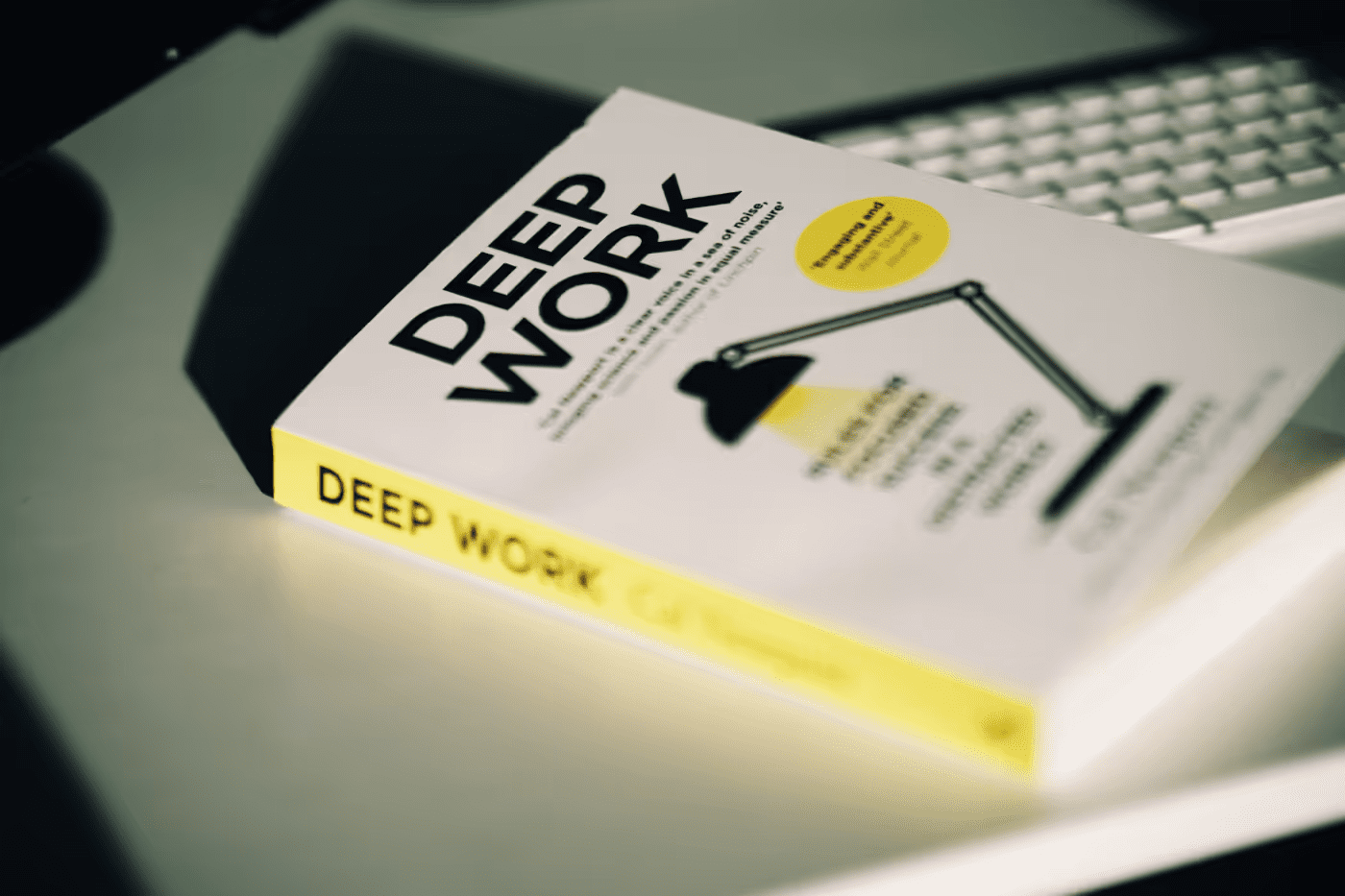

The Profound Power of Focus: A Summary of Deep Work by Cal Newport
Cal Newport’s Deep Work: Rules for Focused Success in a Distracted World is a compelling exploration of a skill that is becoming increasingly rare yet exponentially valuable in our modern economy: the ability to focus intensely on a single task without distraction. Newport, a renowned computer scientist and author, argues that amidst the constant pings of emails and social media, those who cultivate the discipline of “deep work” will not only thrive professionally but also experience a richer, more meaningful life. This summary will meticulously break down every important idea, example, and insight from the book, presenting Newport’s powerful arguments and actionable strategies in clear, accessible language, ensuring nothing significant is left out.
Introduction: The Case for Deep Work
The book opens by introducing the concept of Deep Work—professional activities performed in a state of distraction-free concentration that push your cognitive capabilities to their limit, leading to new value, improved skills, and efforts that are hard to replicate. Newport illustrates this with the example of Carl Jung, who, in 1922, built a secluded retreat called the Tower at Bollingen to foster undistracted writing and thinking. Jung’s commitment to deep work allowed him to develop analytical psychology and challenge Sigmund Freud’s established ideas, ultimately becoming one of the twentieth century’s most influential thinkers. This wasn’t an escape from work but a means to advance it, prioritizing intense concentration over immediate, shallow pursuits.
Newport extends this historical theme, noting that influential figures like Michel de Montaigne, Mark Twain, Woody Allen, Peter Higgs, and J.K. Rowling all cultivated environments and habits to protect their deep work. Bill Gates’s famous “Think Weeks” exemplify this practice in a corporate context. These historical and modern examples highlight that deep work is not a nostalgic affectation but a crucial ability for high-level accomplishment.
In stark contrast, modern knowledge workers are rapidly losing their familiarity with deep work. The pervasive rise of network tools—emails, SMS, social media, and infotainment sites—has fragmented attention. A 2012 McKinsey study found knowledge workers spend over 60% of their week on electronic communication and Internet searching, with nearly 30% on email alone. This leads to Shallow Work: non-cognitively demanding, logistical tasks often performed while distracted, which create little new value and are easy to replicate. Newport emphasizes that constant engagement in shallow work can permanently reduce one’s capacity for deep work, as noted by Nicholas Carr in The Shallows.
Newport disavows the philosophical debate about whether the Internet is inherently good or bad. Instead, he focuses on a pragmatic, individualized thesis: The Deep Work Hypothesis. This hypothesis states that the ability to perform deep work is becoming increasingly rare at the exact same time it is becoming increasingly valuable in our economy. Consequently, the few who cultivate this skill and make it central to their working life will thrive.
The introduction sets the stage by illustrating this hypothesis with the story of Jason Benn. Benn, a financial consultant, realized his job could be automated by an Excel script, prompting him to quit and learn computer programming—a complex skill requiring deep work. Despite previous struggles with distraction (spending 98% of his time surfing the web on a business plan project), Benn drastically changed his habits. He locked himself in a room with only textbooks and note cards, dedicating five or more disconnected hours daily to studying. This intense “deep work bootcamp” enabled him to excel at the notoriously difficult Dev Bootcamp and land a $100,000 developer job in Silicon Valley—a significant leap from his previous $40,000 salary. Benn’s transformation exemplifies how cultivating deep work leads to both quickly mastering hard things and producing at an elite level, two crucial abilities for success in the modern economy.
Chapter 1: Deep Work Is Valuable
This chapter elaborates on why deep work is a valuable asset in the modern economy, highlighting three groups poised to thrive in the “Great Restructuring” driven by digital technology, as identified by MIT economists Erik Brynjolfsson and Andrew McAfee in Race Against the Machine.
The High-Skilled Workers
This group is personified by Nate Silver, the election forecaster. As intelligent machines and data analytics become more sophisticated, individuals who can effectively work with and tease valuable results out of increasingly complex systems will be highly valued. Silver’s mastery of large databases, SQL, and statistical analysis software like Stata exemplifies this. Success in this area requires honing the ability to master hard things quickly, a process that is continuous given rapid technological change.
The Superstars
Represented by programmer David Heinemeier Hansson (creator of Ruby on Rails), this group benefits from winner-take-all markets. High-speed data networks and collaboration tools have eliminated geographical barriers in many knowledge work sectors, allowing companies to hire the “best of the best” globally. Economist Sherwin Rosen’s “imperfect substitution” theory explains that talent isn’t a commodity; quality matters, and the very best capture the bulk of the market. To become a superstar, mastering relevant skills is necessary, but also translating that potential into tangible, valuable results at an elite level.
The Owners
Embodied by venture capitalist John Doerr, this group comprises those with capital to invest in new technologies. As digital technology reduces the need for labor, a larger proportion of wealth generated flows back to the owners of intelligent machines. The Instagram acquisition, with its high valuation and small employee count, illustrates this unprecedented shift in reward distribution, making access to capital highly advantageous.
Newport argues that while becoming an owner is not universally accessible, the other two groups are. To join them, two core abilities are crucial:
- The ability to quickly master hard things.
- The ability to produce at an elite level, in terms of both quality and speed.
These two core abilities, Newport contends, depend fundamentally on the ability to perform deep work.
Deep Work Helps You Quickly Learn Hard Things
Drawing on Antonin-Dalmace Sertillanges’s The Intellectual Life, Newport emphasizes that to learn complex material requires intense concentration. This idea is supported by K. Anders Ericsson’s research on deliberate practice, which states that differences between experts and normal adults stem from “life-long periods of deliberate effort to improve performance in a specific domain.” Deliberate practice requires focused attention on a specific skill or idea and feedback for correction. Newport highlights that “diffused attention is almost antithetical to the focused attention required by deliberate practice.”
Neuroscience provides a biological basis for this, attributing improvement to myelin, a fatty tissue that insulates neurons, allowing them to fire faster and cleaner. When you focus intensely on a specific skill, you force the relevant neural circuit to fire repeatedly, triggering myelination and solidifying the skill. Distraction, conversely, fires too many circuits haphazardly, preventing useful myelination. Thus, learning hard things quickly is an act of deep work.
Deep Work Helps You Produce at an Elite Level
Newport introduces Adam Grant, the youngest full professor at Wharton, as an example of elite production. Grant’s extraordinary output (multiple major journal articles and a bestselling book annually) is attributed to his thoughtful work habits, particularly his batching of hard intellectual work into long, uninterrupted stretches. Grant teaches in one semester to dedicate the other to research, and within research periods, he isolates himself for two to four days at a time, putting an auto-responder on his email.
Grant’s success aligns with Newport’s High-Quality Work Produced = (Time Spent) x (Intensity of Focus) formula. By maximizing his intensity, Grant maximizes output per unit of time. This formula is further explained by Sophie Leroy’s concept of attention residue. When switching tasks, a “residue” of attention remains stuck on the previous task, dampening performance on the new one. This residue is especially thick if the prior task was unbounded or low-intensity. Grant minimizes this residue by working deeply on a single task for extended periods. Even quick email checks introduce residue, fragmenting attention and reducing effectiveness. The conclusion is clear: optimizing performance requires extended periods of full concentration on a single, distraction-free task—i.e., deep work.
What About Jack Dorsey?
Newport addresses the common counter-argument: individuals who thrive without depth, like Jack Dorsey (founder of Twitter and Square), who maintains a hyper-fragmented, meeting-heavy, always-available schedule. Newport concedes that such high-level executives often thrive through non-deep means because their role is often that of a “hard-to-automate decision engine,” processing inputs from smart subordinates. Their value lies in quick decision-making, not sustained deep thought.
However, Newport stresses that this “rule of specificity” means Dorsey’s approach cannot be extrapolated to other jobs. Many roles that seem to require constant connectivity (e.g., management consultants, certain managers) actually benefit from protected deep work, as evidenced by studies (like Leslie Perlow’s at Boston Consulting Group) showing improved results when forced to disconnect. While deep work isn’t the only valuable skill, niches where it’s advisable to not foster it are increasingly rare. Unless strong evidence suggests otherwise, prioritizing depth is the optimal path to thrive professionally.
Chapter 2: Deep Work Is Rare
This chapter addresses a paradox: if deep work is so valuable, why are businesses increasingly prioritizing activities that actively undermine it, such as open offices, instant messaging, and social media presence? Newport argues that the rarity of deep work isn’t due to inherent weakness but rather arbitrary reasons rooted in flawed thinking and the ambiguity of knowledge work.
The Metric Black Hole
Newport introduces the concept of the metric black hole: the difficulty in precisely measuring the bottom-line impact of deep work or the true cost of distraction. Tom Cochran, Atlantic Media’s CTO, quantified that his company spent over a million dollars annually on email processing. While insightful, such calculations are complex and don’t easily separate value created from cost. This lack of clear metrics allows depth-destroying behaviors to persist because their negative impacts are not easily detected, unlike, say, a manufacturing defect. Thomas Piketty’s observation that it’s “objectively difficult to measure individual contributions to a firm’s output” further highlights this ambiguity in knowledge work.
The Principle of Least Resistance
Newport posits that without clear feedback on bottom-line impact, people tend towards behaviors that are easiest in the moment. This is the Principle of Least Resistance. The ubiquitous culture of connectivity (e.g., immediate email responses) persists because it makes life easier in the short term. Instant answers from colleagues simplify workflow, and running one’s day from the inbox feels satisfyingly productive without requiring complex planning (like David Allen’s Getting Things Done). This principle also explains why standing meetings and short, open-ended “Thoughts?” emails are common—they’re easier for the sender, even if they create more work for others. These behaviors, protected by the metric black hole, prioritize short-term comfort over long-term value and deep work.
Busyness as a Proxy for Productivity
Unlike professors with clear metrics like an h-index (a quantifiable measure of publication impact, as exemplified by Richard Feynman avoiding administrative duties to focus on “good physics work”), many knowledge workers lack clear indicators of their value. In this “bewildering psychic landscape” (Matthew Crawford), they revert to an industrial-era definition of productivity: doing lots of stuff in a visible manner. This is Busyness as Proxy for Productivity.
Constantly sending/receiving emails, scheduling meetings, quick IM responses, and open-office interactions all make one seem busy and productive. Marissa Mayer’s ban on remote work at Yahoo, based on server logs showing a lack of visible online activity, exemplifies this mindset. However, this is anachronistic; knowledge work often requires deep, non-visible thought, as seen in Adam Grant’s highly productive, yet often isolated, writing process. The metric black hole prevents clear demonstrations of how busyness hinders value creation, allowing this outdated proxy to thrive.
The Cult of the Internet
Newport argues that our society has fallen into a technopoly (Neil Postman’s term), where new technologies are assumed to be good simply because they are high-tech. Evgeny Morozov further elaborates on this as “the Internet” becoming an uber-ideology, synonymous with progress and innovation. Organizations like The New York Times push journalists like Alissa Rubin to tweet, not because it empirically improves their deep journalistic work, but because “the Internet” dictates it. Jonathan Franzen’s criticism of Twitter, for instance, was met with ridicule, not debate, because it challenged this ingrained ideology.
Deep work, relying on “old-fashioned” values like quality and craftsmanship, is at a severe disadvantage in this technopoly. It often requires rejecting high-tech distractions. This displacement of deep work by shallow, high-tech behaviors is not based on empirical inferiority but on the pervasive cultural belief that anything related to “the Internet” is inherently necessary. The metric black hole allows this “cult of the Internet” to flourish, making deep work seem outdated or irrelevant.
Chapter 3: Deep Work Is Meaningful
This final chapter of Part 1 shifts from the economic value of deep work to its inherent meaning, arguing that a deep life is not just lucrative but also a life well-lived. Newport draws on neurological, psychological, and philosophical arguments to support this claim.
A Neurological Argument for Depth
Newport introduces Winifred Gallagher’s Rapt, which explores the connection between attention and happiness. After a severe cancer diagnosis, Gallagher found that deliberately focusing on positive aspects of her life, rather than her illness, significantly improved her subjective experience. Her conclusion: “Who you are, what you think, feel, and do, what you love—is the sum of what you focus on.” This idea is supported by researchers like Barbara Fredrickson (cognitive appraisal of emotions) and Laura Carstensen (fMRI studies showing elderly brains actively inhibit negative stimuli).
Applying this to deep work, Newport argues that dedicating time to deep endeavors inherently creates a mental world rich in meaning and importance. Deep work’s intense concentration also hijacks attention, preventing the mind from dwelling on “smaller and less pleasant things” that populate daily life. Conversely, shallow work, like constantly checking emails filled with minor stresses or trivial concerns, constructs a working life dominated by “stress, irritation, frustration, and triviality.” The “idle mind is the devil’s workshop” suggests that unfocused attention often drifts to negative self-reflection. Thus, increasing deep work leverages the brain’s machinery to maximize meaning and satisfaction in one’s professional life.
A Psychological Argument for Depth
Newport turns to Mihaly Csikszentmihalyi’s work on flow, a state where “a person’s body or mind is stretched to its limits in a voluntary effort to accomplish something difficult and worthwhile.” Csikszentmihalyi’s experience sampling method (ESM), using pagers to record activities and feelings in real-time, revealed that people are often happier at work, particularly when deeply immersed in a challenging task, than when relaxing. This is because work often provides built-in goals, feedback, and challenges that encourage involvement and concentration.
Deep work is inherently suited to generate a flow state. Phrases used to describe flow (stretching cognitive limits, concentrating, losing oneself) directly describe deep work. Since flow generates happiness, the connection is clear: building one’s working life around deep work—activities conducive to flow—is a proven path to deep satisfaction.
A Philosophical Argument for Depth
Newport leverages Hubert Dreyfus and Sean Dorrance Kelly’s All Things Shining, which laments the loss of “sacredness” and meaning in a post-Enlightenment world where individuals are solely tasked with defining meaning. Their solution lies in craftsmanship. Through the example of a master wheelwright, they argue that craftsmen find meaning not by generating it but by “cultivating in himself the skill of discerning the meanings that are already there” in their materials and tasks. This frees them from nihilism by connecting them to an ordered world of inherent value.
Newport extends this to knowledge work. He argues that there’s nothing intrinsic to manual trades that makes them unique in generating this sacredness. Any pursuit supporting high levels of skill, even modern computer programming (as articulated by Santiago Gonzalez), can be a craft. The key is a “rarified approach” to work, not a rarified job. Deep work is essential to cultivate craftsmanship, as it’s necessary to hone skills and apply them at an elite level. Therefore, embracing deep work transforms a knowledge work job from a “distracted, draining obligation into something satisfying—a portal to a world full of shining, wondrous things.”
The chapter concludes by combining these three arguments, asserting that deep work fosters meaning from neurological, psychological, and philosophical perspectives. Humans are, in essence, Homo sapiens deepensis, thriving in depth and languishing in shallowness. A deep life is, unequivocally, a good life.
Rule #1: Work Deeply
This rule focuses on transforming deep work from an aspiration into a consistent, significant part of your daily schedule. Newport introduces the concept of the Eudaimonia Machine, an architectural design by David Dewane, intended to create a space for “deep human flourishing” by enabling maximum deep work. It features a gallery, salon, library, office space, and specialized “deep work chambers” designed for total focus. While such an ideal environment is rare, Newport explains that we can simulate its effects through routines and rituals.
Newport highlights that simply having good intentions for deep work is insufficient due to the finite and depleting nature of willpower, as shown by Roy Baumeister’s research. Desires for distraction (checking email, social media, web surfing) are constant and often win out. The key to developing a deep work habit is to minimize the willpower needed to transition into and maintain unbroken concentration by adding routines and rituals to your working life. These strategies are designed with limited willpower in mind, helping you achieve significantly more deep work consistently.
Decide on Your Depth Philosophy
Newport emphasizes the importance of choosing a deep work philosophy that fits your specific circumstances. He outlines four distinct approaches:
- The Monastic Philosophy: This approach, exemplified by computer scientist Donald Knuth and writer Neal Stephenson, aims to maximize deep efforts by eliminating or radically minimizing shallow obligations. Practitioners often have a single, well-defined, and highly valued professional goal (e.g., writing books), which provides clarity for ruthlessly pruning distractions like email and speaking engagements. It’s suitable for individuals whose contribution is discrete, clear, and individualized, allowing for an “unapologetic disconnection” from the world.
- The Bimodal Philosophy: Pioneered by Carl Jung with his Bollingen Tower retreat, this philosophy involves dividing time into clearly defined stretches for deep pursuits and leaving the rest open to everything else. During deep periods, the bimodal worker acts monastically, seeking intense, uninterrupted concentration (minimum one full day). Outside these periods, they remain accessible for shallow work. This approach suits individuals who need both deep focus for breakthroughs and substantial non-deep commitments (like Jung’s clinical practice or Adam Grant’s teaching and public engagement). It requires flexibility but can be compatible with more jobs than expected.
- The Rhythmic Philosophy: Inspired by Jerry Seinfeld’s “chain method” for joke writing (crossing off days on a calendar with an X), this philosophy transforms deep work into a simple, regular habit. The goal is to generate a rhythm that removes the need for daily willpower-draining decisions about when to go deep. It’s often implemented by setting a fixed starting time each day, as seen in Brian Chappell’s doctoral dissertation work, where he consistently woke early to write for two hours before his full-time job. This approach is “astronomically productive and guilt-free,” logging large numbers of deep hours over time, and is common for standard office jobs that don’t allow multi-day disappearances.
- The Journalistic Philosophy: This approach, exemplified by journalist and biographer Walter Isaacson, involves fitting deep work wherever you can into your schedule. Isaacson, while rapidly rising through Time magazine, wrote an 864-page book by seizing any available twenty-minute or hour-long blocks to intensely focus. This philosophy is not for novices, requiring the ability to rapidly switch between shallow and deep modes, which demands significant willpower and confidence in one’s abilities. Newport himself largely follows this approach, scheduling deep work at the beginning of the week and refining it daily, taking advantage of canceled meetings or unexpected free time.
Ritualize
Newport argues that to maximize deep work sessions, you must build rituals of strictness and idiosyncrasy, much like Robert Caro (Pulitzer-winning biographer) or Charles Darwin. Mason Currey’s cataloging of famous thinkers’ habits reveals that “waiting for inspiration to strike is a terrible, terrible plan.” Great minds “think like artists but work like accountants.” Their rituals minimized friction in transitioning to depth, allowing them to go deep more easily and consistently.
An effective ritual needs to address three general questions:
- Where you’ll work and for how long: Specify a location (e.g., a quiet office, a specific library) and a fixed time frame (e.g., ninety minutes, two hours) to make the session a discrete challenge.
- How you’ll work once you start to work: Establish rules and processes to maintain structure, such as a ban on Internet use or tracking metrics like words produced per interval. This reduces the mental effort of self-litigation.
- How you’ll support your work: Ensure your brain gets the necessary support, like good coffee, appropriate food, or light exercise (like walking). This systematization minimizes energy drain from minor decisions.
Finding the right ritual may require experimentation, but the effort is worthwhile as it provides the structure and commitment needed to consistently enter deep focus and create meaningful work.
Make Grand Gestures
This strategy involves leveraging a radical change to your normal environment, coupled with a significant investment of effort or money, to support a deep work task. This dramatically increases the perceived importance of the task, reducing procrastination and injecting motivation. J.K. Rowling, struggling to finish The Deathly Hallows, checked into a luxurious suite at the Balmoral Hotel, paying over $1,000 a day, which helped her achieve the necessary concentration.
Other examples include Bill Gates’s “Think Weeks” in isolated cabins, Alan Lightman’s two-month summer retreats to a remote island without phone or internet, authors building writing cabins (like Michael Pollan), and William Shockley locking himself in a hotel room to invent the junction transistor. More extreme cases include Peter Shankman booking a round-trip business class flight to Tokyo to write an entire book manuscript in 30 hours. These gestures are not about the amenities but the psychological commitment they represent, helping to unlock mental resources for deep work. Sometimes, to go deep, you must first go big.
Don’t Work Alone
Newport explores the nuanced relationship between deep work and collaboration. While open offices, like Facebook’s new headquarters or Square’s, are designed to foster serendipitous creativity (allowing spontaneous interactions and idea flow, as seen in MIT’s Building 20 and Bell Labs), they often do so at the expense of concentration. Newport argues that truly effective innovation stems from a hub-and-spoke architecture: exposing oneself to ideas in collaborative “hubs” (e.g., long hallways, common areas) and then retreating to private “spokes” (e.g., soundproofed offices) to work deeply on those inspirations. MIT professors, for instance, insisted on soundproofed offices within the open-plan Stata Center.
Furthermore, even in the “spoke” (isolated deep work), collaboration can be beneficial through the “whiteboard effect.” Working side-by-side with someone on a problem, like Walter Brattain and John Bardeen inventing the transistor at Bell Labs, can push both individuals to deeper levels of depth, leveraging each other’s insights and preventing avoidance of difficult mental challenges.
Newport’s guidelines for collaborative deep work:
- Separate serendipitous encounters from deep thinking: Optimize each effort independently, rather than mixing them into a “sludge” that impedes both.
- Leverage the whiteboard effect when appropriate: Collaborative deep work can yield superior results for certain problems, pushing individuals deeper than if working alone.
Ultimately, while isolation has its merits, the right kind of collaboration can elevate deep work, provided it supports unbroken concentration rather than fragmenting it.
Execute Like a Business
Inspired by Clayton Christensen’s observation that “execution is more difficult than strategizing,” Newport adapts the “4 Disciplines of Execution” (4DX) framework to cultivate personal deep work habits. This framework, developed by Chris McChesney, Sean Covey, and Jim Huling, helps organizations successfully implement high-level strategies, and Newport applies it to individual efforts.
- Discipline #1: Focus on the Wildly Important Goals (WIGs): Instead of vaguely aspiring to “do more deep work,” identify a small number of ambitious, specific outcomes that deep work will achieve. These should offer tangible and substantial professional benefits to spark motivation. For Newport, this was publishing five high-quality peer-reviewed papers in an academic year, a goal that felt “terrifying” and “aroused a terrifying longing,” as described by David Brooks.
- Discipline #2: Act on the Lead Measures: To measure progress, differentiate between lag measures (what you’re ultimately trying to improve, like published papers) and lead measures (new behaviors that drive success on lag measures). Lag measures come too late for behavioral correction. For deep work, the lead measure is “time spent in a state of deep work dedicated toward your wildly important goal.” Tracking this daily provides immediate feedback and motivates consistent deep effort.
- Discipline #3: Keep a Compelling Scoreboard: “People play differently when they’re keeping score.” A physical scoreboard in your workspace, displaying your deep work hours (e.g., tick marks on a wall chart), creates a sense of competition and reinforcing motivation. Newport circled his deep work tallies when he achieved significant milestones in his academic papers, viscerally connecting effort to results and calibrating his expectations for needed hours.
- Discipline #4: Create a Cadence of Accountability: Implement a “rhythm of regular and frequent meetings” for accountability. For an individual, this means a weekly review where you confront your scoreboard, celebrate successes, diagnose failures, and commit to specific actions to improve your deep work score for the coming week. This disciplined review ensures deep work remains a priority amidst competing obligations.
Newport attributes his own academic productivity (doubling his average paper output in a single year while writing a book) to rigorously applying the 4DX framework to his deep work. The framework provides a systematic way to conquer the difficulty of execution.
Be Lazy
This strategy argues that regular, substantial downtime is crucial for deep work, allowing the brain to recharge and achieve breakthrough insights. Tim Kreider, a self-proclaimed “laziest ambitious person,” found that retreating to an “undisclosed location” without internet or TV was necessary to get “real writing done.” He asserts that “idleness is not just a vacation… it is as indispensable to the brain as vitamin D is to the body.”
Newport suggests a specific heuristic: at the end of the workday, completely shut down all consideration of work issues until the next morning. No after-dinner email checks, no mental replays of conversations. This provides three benefits:
- Downtime Aids Insights: Unconscious thought theory (UTT) by Ap Dijksterhuis suggests that for complex decisions with many vague constraints, the unconscious mind is better suited to untangle them due to its greater neuronal bandwidth. Providing conscious brain time to rest allows the unconscious to work on complex problems, diversifying productive effort.
- Downtime Helps Recharge Energy for Deep Work: Attention Restoration Theory (ART), by Rachel and Stephen Kaplan, explains that spending time in nature (or other “inherently fascinating stimuli” like casual conversation, music, or exercise) replenishes directed attention, a finite resource essential for concentration. Interrupting evenings with work prevents this deeper relaxation and restoration, reducing effectiveness the next day.
- The Work That Evening Downtime Replaces Is Usually Not That Important: Anders Ericsson’s research on deliberate practice shows that deep work capacity is limited (around one hour for novices, up to four for experts). After hitting this daily limit, any additional work is typically shallow and low-value, so deferring it to protect rest is a net gain for overall productivity.
To implement this, commit to no work incursions after the shutdown. Crucially, develop a strict shutdown ritual: review every incomplete task, goal, or project, confirm a trusted plan for its completion or capture it for later revisiting, and then say a set phrase (e.g., “Shutdown complete”). This ritual combats the Zeigarnik effect (incomplete tasks dominating attention), by assuring the mind that all obligations are captured and will be addressed, freeing up mental resources. While initially annoying, this ritual eventually becomes a permanent, vital part of maintaining deep work.
Rule #2: Embrace Boredom
This rule emphasizes that the ability to concentrate intensely is a skill that must be trained, and this training involves weaning the mind from a dependence on distraction. Adam Marlin’s daily Talmud study, an intense mental discipline, helped him make “highly creative insights” in his business, demonstrating that consistent “mental strain has built his mental muscle.”
Newport cites Clifford Nass’s research, which revealed that constant attention switching online has a lasting negative effect on the brain, making multitaskers “chronically distracted” and “mental wrecks” unable to filter irrelevancy or maintain focus, even when they want to concentrate. Therefore, efforts to deepen focus will struggle if one simultaneously flees the slightest hint of boredom. This rule provides strategies to improve intense concentration and overcome the craving for distraction.
Don’t Take Breaks from Distraction. Instead Take Breaks from Focus.
Newport critiques the Internet Sabbath or digital detox (e.g., William Powers’ suggestion of one day offline a week) as insufficient for rewiring a distracted brain. Just as one day of healthy eating won’t lead to weight loss if the rest of the week is gorging, occasional breaks from distraction won’t cure a chronic craving for stimuli.
Instead, Newport proposes an alternative: schedule in advance when you’ll use the Internet, and then avoid it altogether outside these times. Keep a notepad to record your next allowed Internet block. The core idea is that the constant switching between high-stimuli/low-value activities and low-stimuli/high-value activities, at the slightest hint of boredom, is what weakens mental “attention-selecting muscles.” By segregating Internet use, you minimize giving in to distraction, allowing these muscles to strengthen. For example, knowing you have 30 minutes until your next Internet block turns potential boredom into a “concentration calisthenics” session.
Key points for success:
- Works even with frequent connectivity: If your job requires many online checks, simply schedule more numerous Internet blocks. The crucial part is maintaining the integrity of your offline blocks.
- Maintain absolute internet-free time outside blocks: If you need online info in an offline block, don’t break the rule immediately. Instead, reschedule your next Internet block to start with at least a five-minute gap. This separation prevents immediate gratification and strengthens resistance.
- Schedule Internet use at home too: If evenings and weekends are spent on screens, this undoes workday brain rewiring. Schedule offline blocks even outside work to resist the “cognitive crutch” of constant distraction.
Work Like Teddy Roosevelt
This strategy involves injecting Rooseveltian intensity into your workday. Identify a high-priority deep task, estimate its normal completion time, then set a drastically reduced, hard deadline. Publicly commit to it if possible, or use a countdown timer. This forces you to work with blistering intensity: no email, no daydreaming, no social media. This acts as interval training for your attention centers, systematically increasing your ability to concentrate.
Practice this no more than once a week initially, then increase frequency as your confidence grows. The self-imposed deadline forces deep work and makes distraction impossible, thus strengthening your distraction-resisting “muscles” by forcing you to endure boredom. After a few months, your understanding of focus will be transformed, and you’ll find more free time for other pursuits, just like the young Roosevelt, who balanced intense study with numerous extracurricular activities.
Meditate Productively
Newport suggests adopting productive meditation: taking a period of physical activity (walking, jogging, driving, showering) where you are physically occupied but not mentally, and focusing your attention on a single, well-defined professional problem. This could be outlining an article, making progress on a proof, or sharpening a business strategy. Like mindfulness meditation, you must continually bring your attention back to the problem when it wanders.
Newport used this practice during his postdoctoral years at MIT, working out book outlines and solving knotty technical problems during his daily walks. This practice rapidly improves deep thinking by:
- Strengthening distraction-resisting muscles: It forces repeated redirection of attention back to the problem.
- Sharpening concentration: It pushes focus deeper on a single problem.
Productive meditation should occur 2-3 times per week, leveraging otherwise wasted time. Newport offers two suggestions for success:
- Be Wary of Distractions and Looping: As a novice, the mind will offer unrelated but seemingly interesting thoughts. Gently remind yourself to return to the problem. Beware of looping, where the mind endlessly rehashes what it already knows to avoid diving deeper into difficult challenges. Actively redirect your attention to the next step.
- Structure Your Deep Thinking: Provide structure by first reviewing relevant variables for the problem (e.g., main points of a chapter, assumptions for a proof). Then, define a specific next-step question using these variables. Once solved, consolidate your gains by clearly reviewing the answer. This cycle of reviewing, questioning, and consolidating acts like an intense workout for concentration, accelerating deep work improvement.
Memorize a Deck of Cards
Newport reveals that memory training can dramatically improve general concentration ability. He cites Daniel Kilov, an Australian memory champion diagnosed with ADHD, who transformed into a world-class mental athlete and a top university student after training his memory. Research by Henry Roediger at the University of Washington found that memory athletes excel in “attentional control”: the ability to maintain focus on essential information. Kilov’s academic success stemmed from his memory training incidentally sharpening his deep work skills.
Newport encourages readers to replicate a key piece of memory athlete training: memorizing a shuffled deck of cards using the technique taught by Ron White, a former USA Memory Champion. This technique leverages the brain’s natural ability to remember scenes rather than abstract information:
- Prepare your “memory palace”: Cement in your mind a mental walkthrough of five rooms in your home, with ten distinct, large items in a set order in each room (plus two more for a total of 52). Practice recalling this walkthrough.
- Associate cards with memorable people/things: Assign a memorable person or thing to each of the 52 cards (e.g., Donald Trump for King of Diamonds, linking wealth to diamonds). Practice instant recall for each card.
- Memorize the shuffled deck: As you go through your mental walk-through, take each card from the shuffled deck and imagine its corresponding memorable person/thing doing something memorable near the item in that room. For example, Donald Trump wiping mud off his expensive loafers on your entry mat.
This practice, while seemingly peculiar, forces unwavering attention, strengthening your general concentration ability like a muscle. If card memorization feels too odd, choose other structured thought processes that require intense, unwavering attention, such as studying a complex text or learning a musical instrument by ear. The core principle is that concentration is a skill that must be trained consistently.
Rule #3: Quit Social Media
This rule tackles the pervasive impact of network tools on deep work, arguing for a more stringent approach to their use. Newport opens with Baratunde Thurston’s 25-day digital detox, which, while beneficial in reducing stress and rediscovering life offline, was ultimately temporary. Thurston’s quick return to hyper-connectivity highlights the impotence with which most knowledge workers approach digital distraction.
Newport rejects the binary choice of either total digital abstinence or passive acceptance of distraction. Instead, he advocates for a middle ground: recognizing that network tools aren’t inherently evil, but applying a much stricter threshold for allowing them access to your time and attention. Most people, he contends, should be using far fewer such tools.
The Any-Benefit Approach to Network Tool Selection
Newport observes that most people justify using social media (like Facebook or Twitter) with “surprisingly minor” or “random” benefits (e.g., entertainment, reconnecting with old friends, making lightweight connections). He calls this the Any-Benefit Approach: justifying use if any possible benefit, or anything that might be missed, can be identified.
The problem with this approach is that it ignores the significant negatives: these services are engineered to be addictive, robbing time and attention from deep work and other valuable pursuits. This leads to burned-out, hyper-distracted connectivity. Newport stresses that network tools are just tools, no different from a blacksmith’s hammer. Skilled laborers traditionally apply sophistication and skepticism to tool adoption, not just any-benefit thinking.
Newport introduces Forrest Pritchard, a sustainable farmer, who sold his hay baler despite its obvious benefits. Pritchard’s decision was based on a complex analysis of direct costs, opportunity costs (e.g., time spent haymaking couldn’t be used to raise chickens for profit, which also produced soil-enhancing manure), and long-term impact on soil fertility (his “baseline”). He prioritized what truly mattered for his farm’s health.
This leads to Newport’s Craftsman Approach to Tool Selection: Identify the core factors determining success and happiness in your professional and personal life. Adopt a tool only if its positive impacts on these factors substantially outweigh its negative impacts. This stands in opposition to the “any-benefit” mindset and demands a nuanced, thoughtful accounting, similar to how other skilled trades approach their tools. The following strategies provide structure for practicing this craftsman approach.
Apply the Law of the Vital Few to Your Internet Habits
Newport points to authors like Malcolm Gladwell, Michael Lewis, and George Packer, who avoid Twitter, not because it’s useless, but because its benefits don’t outweigh its negatives for their specific goals. Lewis, for example, prioritizes deep research and writing, and Twitter’s accessibility would “sap his energy.” These authors exemplify the craftsman approach.
The strategy involves:
- Identify 1-2 main high-level goals in your professional and personal life (e.g., for Lewis: “To craft well-written, narrative-driven stories that change the way people understand the world”; for personal life: “To maintain close and rewarding friendships with a group of people who are important to me”). Keep them high-level, not specific targets.
- List 2-3 most important activities that help achieve each goal. These activities should be specific enough to picture but general enough not to be one-time outcomes (e.g., for Lewis: “Research patiently and deeply,” “Write carefully and with purpose”; for personal life: “Regularly take the time for meaningful connection,” “Give of myself to those who are most important to me”).
- Evaluate each network tool: For every tool you use, assess its impact (substantially positive, substantially negative, or little impact) on each key activity.
- Decide: Keep the tool only if it has substantial positive impacts on these core activities and those impacts outweigh the negatives.
This method often leads to abandoning many tools. The justification for focusing on only 2-3 “most important” activities is the Law of the Vital Few (80/20 rule): 80% of a given effect comes from 20% of the causes. In life goals, the top 20% of activities (often the top 2-3 on a list) provide the bulk of the benefit. Spending time on low-impact activities (even if they offer minor benefits) is a zero-sum game; that time is taken away from higher-impact activities, leading to lower overall benefit. By redirecting time from, say, finding old friends on Facebook to taking a good friend to lunch, you get more out of activities already known to yield large benefits.
Quit Social Media
Newport suggests a “packing party” equivalent for social media: ban yourself from using all social media services for thirty days. Don’t deactivate accounts or announce your absence. Just stop, cold turkey. After 30 days, ask two questions for each service:
- Would the last thirty days have been notably better if I had been able to use this service?
- Did people care that I wasn’t using this service?
If both answers are “no,” quit permanently. If “yes,” return. If ambiguous, lean towards quitting. This strategy targets social media specifically due to its highly addictive, personalized, and unpredictably intermittent nature, which severely damages concentration.
This experiment helps break the fear of missing out (FOMO) and the delusion that one’s online activity is crucial. Social media, Newport argues, “short-circuits” the connection between producing real value and receiving attention. It has replaced the “timeless capitalist exchange” with a “shallow collectivist alternative”: “I’ll pay attention to what you say if you pay attention to what I say—regardless of its value.” Most content on Facebook or Twitter would attract no audience on a traditional platform, but within these services, it gains “likes” and comments, giving a “simulacrum of importance.” The 30-day ban reveals the reality: for most, social media isn’t crucial; it’s a “lightweight whimsy,” a product designed to capture and sell attention to advertisers. This provides a more grounded view, allowing individuals to reclaim control over their time and attention.
Don’t Use the Internet to Entertain Yourself
Inspired by Arnold Bennett’s How to Live on 24 Hours a Day, Newport challenges the idea that leisure time should be unstructured. Bennett argued that the “typical man” tragically wastes his 16 free hours after work by seeing them as mere “prologue and epilogue” to his disliked job. Instead, Bennett suggested using this “day within a day” for rigorous self-improvement, like reading literature.
Newport applies this to modern knowledge workers, whose leisure is often consumed by “low-brow attention economy” sites like BuzzFeed, Huffington Post, and Reddit. These sites are designed to be maximally attention-catching, leveraging psychological tricks to keep users engaged, and they act as a “cognitive crutch” against boredom. This constant engagement weakens the mind’s ability to resist distraction, making deep work harder.
The solution: Put more thought into your leisure time. Don’t default to whatever catches your attention. Instead, plan in advance how you want to spend your evenings and weekends. Structured hobbies, a set reading program (as Newport does, reading 3-5 books simultaneously), exercise, or in-person social activities provide quality alternatives. This fills the vacuum that addictive websites thrive in.
Newport echoes Bennett’s view that such structured relaxation doesn’t exhaust but energizes the mind. By giving your mind “something meaningful to do throughout all your waking hours,” you end the day more fulfilled and start the next more relaxed than if you’d “bathe[d] for hours in semiconscious and unstructured Web surfing.” This preserves the ability to concentrate and helps you “experience, perhaps for the first time, what it means to live, and not just exist.”
Rule #4: Drain the Shallows
This rule focuses on ruthlessly identifying and reducing shallow work to a minimum, freeing up more time for deep efforts. Newport introduces 37signals (now Basecamp), a software company that shortened its workweek from five days to four. Co-founder Jason Fried explained that this was “about doing less work,” not cramming 40 hours into four days. The reduction disproportionately eliminated shallow work, and because deep work remained untouched, productivity stayed the same or even increased. Fried noted that when people have less time, they become “stingy with their time” and “don’t waste it on things that just don’t matter.”
37signals later experimented further by giving employees the entire month of June off for deep work on self-directed projects, free of all shallow obligations. This “pitch day” at the end of the month produced valuable projects that likely wouldn’t have emerged otherwise. These experiments demonstrate that shallow work is often less vital than it seems, and its reduction (or replacement with deep work) can lead to greater success.
Newport acknowledges that some shallow work is inevitable for most knowledge jobs (e.g., responding to important emails). The goal is taming shallow work’s footprint, not eliminating it. He also highlights that deep work capacity is limited (up to four hours for experts). However, the typical eight-hour workday is often fragmented by meetings, calls, and other scheduled events, making it easy for shallow work to crowd out even this limited deep work time. Therefore, despite the brain’s deep work capacity, ruthlessly reducing shallow work remains urgent to ensure enough time for meaningful effort.
Schedule Every Minute of Your Day
Newport introduces a powerful strategy to combat time autopilot and the insidious creep of triviality: schedule every minute of your day. He cites studies showing how much people underestimate their time usage (e.g., British adults estimate 15-16 TV hours/week but actually watch 28; Americans estimate 7 hours sleep but get 8.6). This lack of awareness allows the trivial to fill the gaps.
Newport’s suggestion:
- At the start of each workday, use a notebook to list hours down the left side.
- Divide the day into blocks and assign specific activities to each block (e.g., 9-11 a.m. for “writing press release”). Minimum block length is 30 minutes. You can batch small, similar tasks into generic task blocks and list them to the side.
- Guide your day by this schedule.
When the schedule inevitably breaks (estimates are wrong, interruptions occur), take a few minutes to create a revised schedule for the remaining time. Don’t despair; the goal is not rigid adherence, but maintaining thoughtful control over your time.
Tactics for stability:
- Accurate estimation: Overcome initial wishful thinking and conservatively estimate task times.
- Overflow conditional blocks: Schedule a block for a task, followed by a flexible block that can extend the prior task if needed or be used for pre-assigned non-urgent work if the task finishes on time.
- Liberal use of task blocks: Scatter many, larger-than-needed task blocks throughout the day to absorb unexpected needs.
Newport addresses the concern that this level of planning is “burdensomely restrictive.” He counters that it’s about thoughtfulness, not constraint. He allows for spontaneity (e.g., if a major insight strikes, he’ll abandon his schedule to pursue it, then re-plan). This structure, ironically, can lead to more creative insights by ensuring regular time for grappling with new ideas, deep work, or brainstorming, while the flexibility allows pursuit of unplanned breakthroughs.
Quantify the Depth of Every Activity
To make clear and consistent decisions about the depth of tasks, Newport provides a simple, surprisingly illuminating question: “How long would it take (in months) to train a smart recent college graduate with no specialized training in my field to complete this task?”
Examples:
- Editing an academic article (Example #1): Requires cutting-edge field knowledge, taking years of study. Answer: 50-75 months (very deep).
- Building a PowerPoint presentation on sales figures (Example #2): Requires PowerPoint knowledge, organizational format, and basic sales metric understanding. Answer: 2 months (shallow).
- Attending a project meeting (Example #3): Requires project and participant understanding, organizational dynamics. Substantive content is rare. Answer: 3 months (shallow).
This thought experiment helps quantify depth: many months of training indicate a deep task leveraging expertise, while quick pick-up indicates a shallow task. Once you know where your activities fall, bias your time towards the former. Shallow tasks may feel productive but offer a measly return on time investment.
Ask Your Boss for a Shallow Work Budget
Newport proposes asking a crucial, rarely-asked question: “What percentage of my time should be spent on shallow work?” If you have a boss, discuss this. If self-employed, ask yourself. Settle on a specific percentage, typically 30-50% for non-entry-level knowledge jobs.
Sticking to this budget requires changes: saying “no” to shallow projects, aggressively reducing shallowness in existing ones (e.g., proposing results-driven reporting instead of weekly status meetings, limiting email response times). This strategy doesn’t eliminate shallow obligations but places a hard limit on them, freeing up significant, consistent time for deep work.
Crucially, getting your boss’s agreement provides implicit workplace support and cover when you decline or restructure a project. Faced with the true cost of paying a highly trained professional to spend 30+ hours/week on emails and meetings, most bosses will agree to streamlining, even if it causes minor inconvenience. For the self-employed, this reveals how little value is produced in “busy” schedules, providing confidence to scale back on shallow activities. If a boss’s answer implies 100% shallow work, it signals that the job doesn’t support deep work, and a transition to a new position valuing depth should be considered.
Finish Your Work by Five Thirty
Newport introduces fixed-schedule productivity: setting a firm goal of not working past a certain time (e.g., 5:30 p.m.), and then working backward to find productivity strategies that satisfy this declaration. He exemplifies this himself, rarely sending emails or working after 5:30 p.m. or on weekends, yet maintaining high academic productivity (e.g., publishing 20 peer-reviewed articles, winning grants, writing books as a junior professor).
He explains this paradox through Radhika Nagpal’s experience. Nagpal, a Harvard CS professor, deliberately limited her workweek to 50 hours pre-tenure, despite academic norms of extreme overwork. She achieved this by setting drastic quotas on major shallow endeavors (e.g., only 5 trips/year, limiting paper reviews). This asymmetric culling reduced shallow work while preserving deep efforts (original research), ultimately leading to tenure and rapid promotion.
The benefits of fixed-schedule productivity:
- Time freed up without diminishing value: Ruthlessly reducing shallow work allows more energy for deep work, leading to higher output.
- Necessitates careful organization: The looming cutoff forces sharp organizational habits, leading to more value produced from limited time.
- Shifts to a scarcity mindset: Any obligation beyond deepest efforts becomes suspect, raising the bar for access to your time and attention. Your default answer becomes “no.”
- Challenges assumptions about work culture: Ignoring after-hours emails, for instance, often reveals that immediate responses aren’t actually expected, despite perceived norms.
Fixed-schedule productivity is a powerful “meta-habit” that forces individuals to optimize their time use. It makes deep work central, as every minute becomes precious, driving ruthless efficiency and a clear focus on value creation.
Conclusion
Newport reiterates the central argument for deep work by returning to the origin story of Microsoft’s founding. Bill Gates’s “prodigious feat of concentration” in hacking the BASIC programming language for the Altair in eight weeks, often collapsing from exhaustion, exemplifies his “preternatural deep work ability” and “serial obsession.” This highlights that deep work is not a moral or philosophical stance but a pragmatic recognition that the ability to concentrate is a skill that gets valuable things done. It enabled Gates to create a billion-dollar industry in less than a semester.
Newport shares his own journey of continually deepening his work habits over a decade. As a graduate student, deep work allowed him to be productive without working excessive hours. As a professor, facing increased obligations and looming tenure, he proactively bolstered his deep work “muscles” through artificial constraints (e.g., extended lunch breaks, writing a book), refining his ability to block out deep work hours, and obsessively seeking disconnected locations (e.g., Barker Engineering library, Lewis Music Library). He even bought an expensive lab notebook to induce more care in his thinking. This “recommitment to depth” led to his academic productivity improving from two papers a year to four.
His third year as a professor marked an “extreme depth” phase, driven by writing this book, the upcoming tenure process, and a personal desire to compensate for a grant rejection. He became ruthless in declining commitments, worked more in isolated locations, prominently displayed his deep work hour tally, and relentlessly worked on problems in his head during all physically occupied, mentally free times (walking the dog, shoveling snow, commuting). This “deep work machine” transformation more than doubled his average academic productivity to nine peer-reviewed papers in that single year, while maintaining his “prohibition on work in the evenings.”
While Newport admits his year of extreme depth was cognitively exhausting and will be moderated, the experience reinforced his core message: Deep work is way more powerful than most people understand. It’s a transformative experience to leave the distracted masses and join the focused few.
Key Takeaways
The profound power of cultivating deep work is undeniable, leading to both professional success and a more meaningful life. It’s a skill that must be trained and protected in our increasingly distracted world.
The core lessons:
- Deep work is rare and valuable: In the modern economy, the ability to focus without distraction on cognitively demanding tasks is a superpower. It enables rapid learning of hard things and elite-level production.
- Shallow work is pervasive and destructive: Email, social media, and constant connectivity fragment attention and reduce deep work capacity, often based on flawed beliefs about productivity and the “cult of the Internet.”
- Willpower is limited: Relying solely on motivation to do deep work will fail. Routines, rituals, and thoughtful strategies are essential to minimize the willpower needed to transition into and sustain deep focus.
- Downtime is essential: Rest allows the unconscious mind to process complex problems, recharges attention, and replaces low-value shallow work.
- Boredom is a tool: Embracing boredom and intentionally resisting distraction rewires your brain to tolerate less novelty, strengthening your ability to concentrate deeply.
- Strategic tool use: Don’t default to using network tools because they offer any benefit. Apply a craftsman’s mindset, assessing their substantial positive and negative impacts on your core life goals.
- Structure liberates: Scheduling every minute, quantifying activity depth, and setting shallow work budgets and fixed work times forces disciplined use of your limited time and attention, leading to greater output.
Next actions:
- Choose a deep work philosophy: Decide between monastic, bimodal, rhythmic, or journalistic approaches based on your current circumstances and commit to it.
- Develop a deep work ritual: Design specific routines for where, how long, and how you will work deeply, along with support mechanisms.
- Practice productive meditation: Integrate focused thinking on a single problem into your physically occupied, mentally free time (e.g., walks, commutes).
- Consider a 30-day social media detox: Experiment with a temporary ban to assess the true impact of these tools on your life.
- Implement fixed-schedule productivity: Set a strict end time for your workday and work backward to ensure critical tasks are completed, and shallow work is minimized.
- Quantify your shallow work: Use the “college graduate” thought experiment to objectively assess the depth of your tasks and prioritize accordingly.
Reflection prompts:
- What percentage of my current workweek is truly dedicated to deep work, and how does this align with my professional ambitions?
- What is one current distraction (digital or otherwise) that I can immediately reduce or eliminate by applying the craftsman approach, and what high-impact activity will I redirect that freed time towards?
- How can I better leverage boredom in my daily life to strengthen my concentration “muscles” and make deep work easier?


Leave a Reply