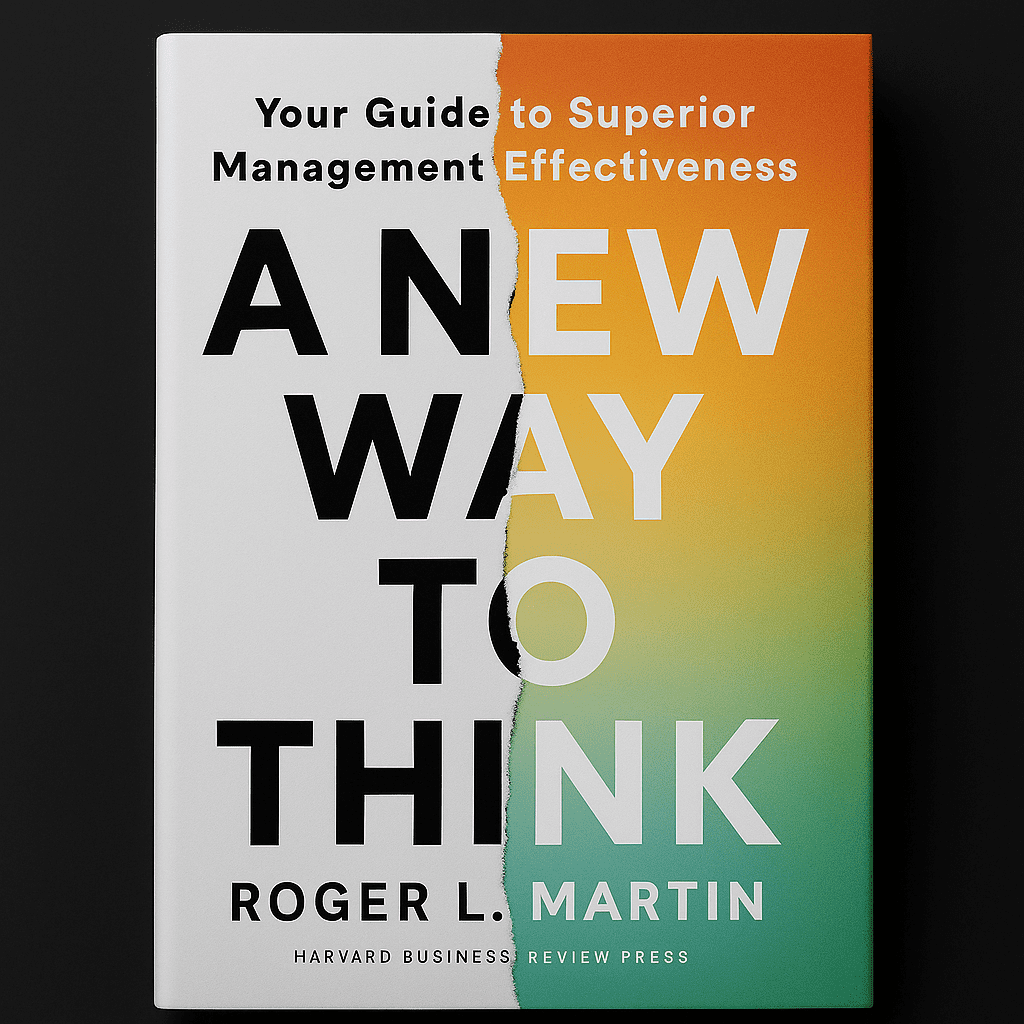

A New Way to Think: Your Guide to Superior Management Effectiveness
In “A New Way to Think: Your Guide to Superior Management Effectiveness,” Roger L. Martin, hailed as the world’s number one management thinker, challenges us to fundamentally rethink the accepted models that guide our business decisions. Martin argues that many traditional frameworks, often embraced with zealous rigor, consistently fail to deliver desired outcomes not because of poor application, but because they are inherently flawed. This extraordinary book serves as an essential guide for executives, pushing them to question ingrained assumptions and adopt new, more effective ways of thinking about everything from competition and strategy to talent and innovation. Prepare to immerse yourself in a provocative exploration of fourteen dominant but often ineffective management models, as Martin dismantles them and offers superior alternatives that promise to revolutionize how you lead and how your organization thrives. We will break down every important idea, example, and insight from the book in clear, accessible language, ensuring nothing significant is left out.
Introduction: Thinking Differently about the Essentials of Management
Roger Martin begins by confronting a common fallacy: the belief that when a management model fails, it’s due to insufficient rigor in its application. He argues that this “insanity” leads executives to try harder with the same flawed approaches, yielding consistently unsatisfactory results. Instead, Martin posits that poor results often stem from a model that isn’t fit for purpose, requiring a new way to think and a different underlying model. He asserts that questioning established models and building new ones from first principles, though arduous and scary, is crucial for progress.
Martin’s work, often in collaboration with Harvard Business Review, has focused on diagnosing why existing models fail and proposing superior alternatives. He emphasizes his adherence to the Karl Popper/Imre Lakatos school of falsificationism, which suggests there are no “right” or “wrong” answers, only “better” and “worse” ones. This means models should be continuously tested against results, and if they fall short, replaced by better ones, acknowledging that even the best models will eventually be found wanting. He frequently uses Procter & Gamble (P&G) and its former CEO A.G. Lafley as primary examples, owing to his long and deep advisory relationship with the company, providing firsthand illustrations of the concepts. The book is structured into fourteen self-contained chapters, grouped into four general categories: Context, Making Choices, Structuring Work, and Key Activities, designed to be read in any order of interest or need.
PART ONE: On Context
Competition: It happens at the front line, not at the head office.
This chapter challenges the traditional view of business competition as a war between corporations (e.g., Boeing vs. Airbus). Martin argues that competition primarily happens at the front line, where individual customers choose between products and services that meet their needs. Customers have limited visibility or concern for the corporate layers behind the product. A poor product won’t be saved by its corporate affiliation; for instance, Microsoft’s Office suite doesn’t convert Mac users to Windows.
This reframing from “optimal hierarchy” to “organizing for value” fundamentally alters how managers should think about their roles. If the customer judges the value, then frontline people are best placed to determine what customers value. The job of every corporate level above the frontline is to help the level below it serve the customer better. This creates a chain of internal customers, where each lower level is the customer of the level above it. For example, Hair Care needs to add net competitive value to Pantene, and Beauty Care must help Hair Care, and so on. If a layer isn’t generating net value that ultimately helps the product win at the front line, it’s superfluous or detrimental.
The value higher layers provide must be considerable to justify the two inevitable costs they impose:
- Costs of coordination: Delays and suboptimal decisions due to necessary approvals from higher levels.
- Direct costs: Salaries, support staff, office space, and IT for managers at that level, all supported by frontline profits.
Higher levels can earn their place by providing services that exploit operational scale and accumulated investment:
- Operating scale: Like Frito-Lay delivering various snacks directly to stores, or Boeing sharing R&D costs across military and commercial aircraft.
- Cumulative investment: L’Oréal leveraging its Paris brand for new cosmetic lines, or P&G’s expertise in fragrances across diverse products.
Creating a Theory for the Firm is crucial, requiring iteration between portfolio composition and value-adding rationales. This involves developing a draft value-adding rationale for each subsequent level down to the frontline. The process typically requires two or three rounds of back-and-forth refinement and produces four intermediate outputs:
- The key capabilities needed to serve customers at the front line: Identifying which capabilities to invest in (e.g., shared distribution or R&D) and at what level. A.G. Lafley at P&G identified five “reinforcing rods”: go-to-market, compelling innovations, deep consumer understanding, brand building, and scale.
- The customers, products, and services you should drop: Businesses that can’t be sufficiently helped by being part of the organization should be removed to prevent diminishing competitiveness. P&G’s fifteen-year divestiture process (foods, pharmaceuticals, weak beauty brands) exemplifies this.
- The customers, products, and services you should add: Investing in expanding the portfolio where the corporation can bring substantial advantages. P&G acquired Clairol, Merck consumer health, and Gillette to leverage its core capabilities.
- The layers you should eliminate: Any layer incapable of adding net value should be removed. P&G eliminated the geographic region president level for its top countries to streamline go-to-market efforts.
This front-line-back approach to corporate strategy requires significant work and continuous re-evaluation. Most companies, lacking this perspective, allow corporate structures to swell, leading to reactive cost reduction and delayering. Proactively structuring corporate strategy from the front line back creates genuine opportunities and competitive advantages.
Stakeholders: To actually create shareholder value, put customers before shareholders.
Martin examines the shift from managerial capitalism (where professional managers ran firms divorced from ownership) to shareholder value capitalism (where maximizing shareholder wealth became the primary corporate purpose). He argues that despite the latter’s dominance since 1976, shareholders haven’t been significantly better off in real returns. This leads to a provocative insight: if the goal is to create shareholder value, focusing solely on shareholders is a flawed approach. Instead, Martin proposes that putting customers first is what truly leads to corporate success and shareholder enrichment, echoing Peter Drucker’s view that a business’s primary purpose is to acquire and keep customers.
The chapter highlights the flawed logic of shareholder value maximization. Shareholder value is the discounted value of all future cash flows, heavily influenced by expectations about future performance, not present earnings. CEOs cannot indefinitely raise these expectations, leading them to pursue short-term strategies or manage expectations downwards. This dynamic creates a “game they can and do win” that ultimately hurts shareholders, as talented executives are pushed to make moves that, while temporarily boosting share price, aren’t sustainable.
Martin advocates for a model where companies seek to maximize customer satisfaction while ensuring an acceptable risk-adjusted return for shareholders. He cites Johnson & Johnson’s (J&J) “credo” as an exemplar, which explicitly places customers first, followed by employees, communities, and finally stockholders. J&J’s handling of the 1982 Tylenol poisonings, involving a massive nationwide recall despite local incidents, demonstrates this commitment. This decision, though costly in the short term, solidified customer trust and ultimately led to long-term shareholder success. Similarly, P&G’s statement of purpose prioritizes improving consumers’ lives, with shareholder value as a result, not the primary goal.
Companies that don’t prioritize shareholder value often achieve impressive returns because their CEOs are free to concentrate on building the real business. Paul Polman’s tenure at Unilever exemplifies this; by prioritizing long-term innovation, branding, and sustainability, he told shareholders to sell if they didn’t like his approach, yet delivered significant stock price increases.
Compensation is another key point of difference. Short-term, stock-based compensation encourages CEOs to manage expectations rather than drive genuine progress. In contrast, A.G. Lafley’s compensation at P&G, with long vesting and holding periods extending beyond retirement, incentivized long-term business building. Lafley even switched P&G’s bonus metric from Total Shareholder Return (TSR) to Operating TSR, based on sales growth, profit margin improvement, and capital efficiency, metrics that business unit presidents could truly influence.
The core argument is that prioritizing customers forces a focus on improving operations, products, and services, leading to real value creation. While a healthy share price remains a natural constraint, making it the prime objective creates a temptation to sacrifice long-term, operations-driven value for temporary, expectations-driven gains. Reinventing the purpose of the firm to prioritize customers, not shareholders, improves corporate decision-making and fosters sustainable success.
Customers: The familiar solution usually trumps the perfect one.
Roger Martin explores why seemingly well-performing companies like Instagram, PepsiCo, and Coke often pursue radical rebrandings, and why these efforts frequently backfire (e.g., Instagram’s logo change, New Coke). He argues that this behavior stems from a misunderstanding of competitive advantage, particularly the notion that it’s fleeting in a fast-paced business world, necessitating constant adaptation and superiority. Martin counters this by asserting a key truth: the familiar solution usually trumps the perfect one. Sustainable performance isn’t about always being the “best fit” but about helping customers avoid having to make a choice. This is achieved by building cumulative advantage.
Drawing on behavioral psychology, Martin explains that the brain is a “gap-filling machine” that loves automaticity and processing fluency. Repeated experiences make perceptions easier and faster, leading to intuitive judgments. When a product becomes familiar and accessible, the easiest thing to do is to buy it again. This creates a cycle where share leadership increases over time, as each purchase slightly widens the “ease gap” against competitors. Tide detergent’s seventy-five years of market dominance, outcompeting rivals like Surf, exemplifies this inexorable growth of cumulative advantage. Martin notes that customer loyalty is often overrated; big brands achieve high loyalty because of habit, while niche brands like Tom’s toothpaste, despite passionate fans, have lower loyalty rates, surviving because enough customers occasionally buy small brands.
While a superior value proposition is essential to attract customers initially, sustaining that advantage requires converting the proposition into a habit, not a choice. Cumulative advantage is defined as the layer a company builds on its initial competitive advantage by making its product an “ever more instinctively comfortable choice.” MySpace’s failure, often attributed to competitive unsustainability, is reinterpreted as a failure to build cumulative advantage; its design fostered clutter and inconsistency. In contrast, Facebook’s success lies in its consistent look and feel, rigid standards, and reliable experience, making it an addictive, habit-forming platform.
Martin outlines four basic rules for building cumulative advantage:
- Become popular early: Early market share advantage, achieved through aggressive pricing (e.g., Samsung’s affordable Android phones) or free samples (e.g., Tide’s launch with washing machines, large internet successes like Uber, Airbnb, Google, Twitter, Instagram, and eBay), leads to lower costs and higher profitability (Bruce Henderson’s Experience Curve).
- Design for habit: Consciously creating an offering that becomes an automatic response. BlackBerry’s “CrackBerry” addiction exemplifies this. Design elements like distinctive colors (Tide orange) and shapes, or fitting products into people’s environments (Febreze bottle redesign), encourage use. The Amazon Dash Button is a prime example of designing for reordering habits.
- Innovate inside the brand: Introduce changes in a way that allows the new version to leverage the cumulative advantage of the old. P&G learned this with Liquid Tide and subsequent innovations (Tide plus Bleach, Tide Coldwater, Tide Pods), ensuring consistent branding and packaging. When change is necessary, like Netflix transitioning from DVDs to streaming, success lies in accentuating what doesn’t have to change, making “improved” more comfortable than “new.”
- Keep communication simple: Recognize that the mind prefers “thinking fast” (subconscious, habit-driven) over “thinking slow” (conscious, analytical). Marketers’ clever, complex ads can backfire, as viewers might subconsciously associate the product with perceived flaws or difficulties rather than benefits. Simple, direct messages that promote desired actions (like buying the product) are more effective.
The chapter concludes by emphasizing that true sustainable advantage comes from understanding the dominance of the subconscious mind. Products and services that are easy to access and reinforce comfortable buying habits will, over time, outperform innovative but unfamiliar alternatives. Companies should beware of constant rebranding and instead focus on these four rules to sustain and extend their initial competitive advantage.
PART TWO: Making Choices
Strategy: In strategy, what counts is what would have to be true—not what is true.
Roger Martin challenges the conventional, data-driven, and analysis-heavy approach to strategy-making, which often perpetuates the status quo and consumes vast amounts of time with little impact. He argues that this focus on “what is true” leads to fear-driven, risk-averse behavior. Instead, he proposes a more scientific, hypothesis-driven approach: In strategy, what counts is what would have to be true—not what is true. This involves creating and testing novel cause-effect hypotheses, identifying what must be different about the world for these hypotheses to work, and then assessing their feasibility.
Martin outlines a seven-step approach to strategy-making:
Step 1: Move from Issues to Choice
- Traditional strategy focuses on problems (e.g., declining profits). The new approach requires framing the problem as a mutually exclusive choice between two or more options. This forces focus on what to do next, rather than just analyzing the challenge.
- Procter & Gamble (P&G)’s dilemma in the late 1990s exemplifies this: transform Oil of Olay into a prestige brand, or buy an existing major skin care brand. This framing made the magnitude of the decision clear.
Step 2: Generate Strategic Possibilities
- This is the ultimate creative act in business, where a “possibility” is a “happy story” describing how a firm might succeed (where to play and how to win). It needs internal consistency but not proof.
- Teams should generate three to five possibilities in depth, including the status quo, to force examination of its viability. P&G explored options for Olay: abandoning it for an acquisition, keeping it mass-market, taking it prestige-channel, reinventing it as “masstige” for mass channels, or extending Cover Girl into skincare.
- The group tasked with generating possibilities should be diverse, include junior executives and outsiders, and avoid senior leaders dominating. Rules include separating creation from testing and suspending judgment. Probing questions (inside-out, outside-in, far-outside-in) help spark creativity. A good set of possibilities will question the status quo and include at least one “uncomfortable” option.
Step 3: Specify the Conditions for Success
- For each possibility, define what must be true for it to be a terrific choice. This step is not about arguing what is true, but what would have to be true. This avoids conflict and helps reveal underlying logic and reservations.
- Conditions should be declarative statements (e.g., “Channel partners will support us”). Every group member must agree on the list of conditions for them to feel confident in the possibility.
- The list should be weeded to ensure only “must-have” conditions remain, eliminating “nice-to-haves.” This makes the list truly binding. The team then seeks agreement on these conditions from executives and other colleagues who have a say in the final choice, before analysis begins.
Step 4: Identify the Barriers to Choice
- Critically assess which conditions are least likely to hold true, defining the biggest barriers. This can be done by imagining which condition one would “buy a guarantee” for.
- The most skeptical member about a condition is a valuable obstacle and should be encouraged to raise concerns. P&G’s Olay team identified three key barriers: mass-channel consumers accepting a higher price point, mass-channel players creating a new “masstige” segment, and P&G’s ability to execute prestige-like elements in mass retail.
Step 5: Design Tests for the Barrier Conditions
- For each key barrier condition, design a test to determine if it holds true. The test can be a survey, an interview, or data crunching, but the entire group must believe the test is valid.
- The most skeptical member about a condition should lead the design and application of its test, as they will have the highest standard of proof. Mutual assured destruction (everyone setting a high bar) encourages fairness.
Step 6: Conduct the Tests
- Apply the “lazy person’s approach to choice”: test the condition the group feels is least likely to hold up first. If it fails, the possibility can be eliminated, saving resources.
- Bring in external experts or internal functional units to conduct the tests, focusing solely on testing the agreed-upon conditions, not revisiting them. This approach prioritizes depth over breadth in analysis, targeting critical concerns.
- P&G’s testing of the Olay masstige pricing condition found that a $18.99 price point (higher than initially thought) attracted prestige shoppers and signaled differentiation to mass shoppers, while $15.99 failed. This demonstrated how rigorous testing can reveal unexpected insights.
Step 7: Make the Choice
- This step is often anticlimactic. The group simply reviews the analytical test results and chooses the possibility with the fewest serious barriers.
- Strategies chosen this way can be surprisingly bold, as seen with P&G’s successful Olay Total Effects launch, transforming a low-end brand into a multibillion-dollar “masstige” line.
Martin concludes by highlighting three fundamental mindset shifts required:
- From “What should we do?” to “What might we do?”
- From “What do I believe?” to “What would I have to believe?” (requiring imagining each possibility as a great idea).
- From “What is the right answer?” to “What are the right questions?” and “What specifically must we know?”
This possibilities-based approach relies on and fosters a team’s ability to inquire, making it a truly scientific process for strategy development.
Data: Creating great choices requires imagination more than data.
Roger Martin challenges the prevailing belief that all business decisions, especially strategic ones, must be driven by rigorous data analysis. While recognizing the value of the “scientific method” derived from Aristotle, Martin argues that it has been misapplied to situations where it does not belong. He asserts that creating great choices requires imagination more than data, distinguishing between aspects of the world that “cannot be other than they are” (governed by scientific laws) and those that “can be other than they are” (influenced by human agency and choice).
Martin questions whether business is truly a science in all aspects. Aristotle himself, while foundational to the scientific method for understanding immutable natural phenomena, also believed in free will and the power of human choice to change the future. Business strategy and innovation, particularly, fall into this realm of possibilities, where analyzing history cannot predict or transform future behavior. Great innovations, like the iPhone or the railroad, introduced enormous behavioral shifts that prior data could not have predicted. While science informs innovation, the real genius lies in imagining what doesn’t yet exist.
The critical skill for executives is to deconstruct every decision-making situation into “cannot” (necessity) and “can” (possibility) parts:
- “Cannot” situations: Governed by immutable laws (e.g., physics in a bottling line). Here, data and analytics are masters for optimizing the status quo.
- “Can” situations: Involve human agency, behavior, and innovation (e.g., combining bottling steps like LiquiForm did). Here, design and imagination are masters, with analytics serving them.
Martin emphasizes that the presence of data is not sufficient proof that outcomes cannot be different. Data is merely evidence, and its meaning isn’t always obvious. The absence of data doesn’t preclude possibility; for genuinely new outcomes, no prior evidence exists. The Lego Group’s decision to challenge data suggesting girls weren’t interested in bricks, leading to the successful Lego Friends line, illustrates this.
Breaking the Frame is crucial for imagining new possibilities. The status quo often limits perception. Martin recounts advising a consulting firm stuck on the “starvation cycle” of non-profit funding, believing donors inherently disliked indirect costs. By encouraging listening and empathizing with stakeholders (a qualitative research method), the firm discovered donors disliked mistrust in cost management, not the costs themselves, opening new solutions.
Creating a new frame requires constructing persuasive narratives, which differ fundamentally from natural science. Aristotle’s Art of Rhetoric outlines three drivers of persuasion:
- Ethos: The author’s credibility and authenticity to inspire change.
- Logos: The logical structure of the argument, rigorously transforming problems into possibilities.
- Pathos: The capacity to empathize with the audience, inspiring large-scale movement.
A compelling narrative often uses a strong metaphor that captures its arc (e.g., a merged insurance company as a “thriving city”). Cognitive science shows metaphors boost “associative fluency,” linking unrelated concepts to create new ideas (e.g., Samuel Colt’s revolver from a ship’s wheel, Velcro from burrs). Metaphors also aid adoption by making innovations relatable (e.g., “horseless carriage,” “BlackBerry” as a pager that emails). The Segway’s failure is partly attributed to its lack of a relatable metaphor.
When making choices, especially in the “can” world:
- Testing involves creating data through experimenting with prototypes. Rather than analyzing existing data, you observe user reactions to new things and iterate.
- Multiple narratives should be nurtured and tested through prototyping to reach consensus on the most compelling one.
Martin warns against applying scientific analysis to the entire business world. While useful for understanding immutable elements, it can lead to the false belief that change isn’t possible, leaving the field open to innovators who demonstrate otherwise. The price of misapplying analytics is missed opportunities and disbelief in insurgent success.
PART THREE: Structuring Work
Culture: You can only change it by altering how individuals work with one another.
Roger Martin delves into the elusive concept of corporate culture, defining it as a “book of rules” residing in employees’ minds that guides their interpretations and behaviors, especially in unusual or high-impact situations. The strength of a culture is determined by the similarity of these internal “rule books.” When a new strategy demands changes in behaviors, a powerful, ingrained culture can severely impede progress. Martin argues that most CEO efforts to change culture fail because they don’t grasp a fundamental truth: you can only change culture by altering how individuals work with each other.
Martin’s perspective is rooted in his organizational steering mechanisms concept, which categorizes how a company operates:
- Formal mechanisms: Conscious decisions like organizational structures, systems, and processes (e.g., reporting structure, compensation, budgeting). These are directly controlled by leadership.
- Interpersonal mechanisms: How individuals interact face-to-face, influenced by psychological makeup (e.g., open conflict discussion vs. ignoring).
- Cultural mechanisms: Shared mental guidebooks and unwritten rules that interpret situations and determine responses. These emerge from formal and interpersonal interactions.
These mechanisms form an interrelated system with feedback loops. For instance, a formal separation of sales and marketing can lead to interpersonal conflict, which in turn embeds a cultural rule of “marketing is always unrealistic,” reinforcing future conflict. CEOs often try to initiate change by altering formal mechanisms, but this alone is insufficient. Culture is a “derivative construct” emerging from the interaction between formal and interpersonal mechanisms. Direct attempts to change culture by fiat (like Coty Inc.’s CEO demanding a “startup mentality”) often fail because they don’t address the underlying interpersonal dynamics. Nokia’s failed transformation in the early 2000s illustrates this: a restructuring intended to foster entrepreneurship failed because existing cultural aversion to failure and local reward systems reinforced old behaviors.
To change culture indirectly, Martin advocates for micro-interventions in interpersonal dynamics, focusing on three areas:
1. Structure and Preparation: Throwing out the slide deck
- A.G. Lafley wanted to shake up P&G’s bureaucratic strategy review process, where business unit presidents prepared massive, “bulletproofed” PowerPoint decks and issue sheets to defend proposals. The process was a “gigantic exercise in second-guessing,” driven by mutual, but false, assumptions of its utility (Abilene Paradox).
- Martin and Lafley’s intervention: Forbid lengthy presentations, require pre-sent decks, and specify only three discussion topics in advance, with no more than three new pieces of paper brought to the meeting.
- This forced teams into robust discussions exploring ideas rather than corporate theater. It took four years for the unwritten norms to shift, transforming strategy-making into a generative thinking exercise.
2. People: Introducing peer working groups
- At Amcor’s Executive Development Program (EDP), participants presented “personal strategic initiatives” (PSIs) to global management team (GMT) bosses, leading to performance reviews rather than open strategic discussion.
- Intervention: Create peer working groups (subgroups of 3, then 6) where participants helped each other develop PSIs. Instructions emphasized being “useful and constructive,” allowing imperfect work to be discussed.
- This fostered an environment where the focus shifted from critique to improvement, leading to broader, more speculative discussions and improved PSI quality.
3. Frames: Asking for help rather than a grade
- An unnamed Fortune 25 company suffered from a dysfunctional “us-versus-them” culture between its executive team and board, where executives presented “perfect” plans and the board nitpicked to add perceived value.
- Intervention: Advised executives to invest less in impressing and more in asking for help. For a technological disruption, the CEO asked board members for insights from their diverse industry experiences: “What have you seen as the most successful ways…?” and “What do you think we might be missing…?”
- This reframed the interaction from a “grade” to a collaborative problem-solving session, leading to valuable insights, improved engagement, and a perception of management’s strong thinking.
Martin provides a powerful personal example of leading culture change at the University of Toronto’s Rotman School of Management as dean (1998–2013). Despite a toxic culture and perception as a distant second to a rival school, he avoided bold announcements or structural changes. Instead, he relentlessly focused on changing interpersonal steering mechanisms:
- Faculty review: He added a one-hour meeting after annual reports, asking “How can we help?” to encourage professors to own their goals and see administration as a support system. He famously provided a laptop to a lecturer, circumventing policy, because she genuinely needed it to do her job, demonstrating individualized support.
- Managing conflict: When faculty members complained about colleagues, Martin would cheerily suggest going to the other person’s office together to work it out (“campaign for adult behavior”). This led to direct conflict resolution rather than back-channel complaints.
- External stakeholders: He pushed for a “Doctrine of Relentless Utility”, making the school as useful as possible to alumni, business, and media without immediately asking for anything in return. The annual Lifelong Learning (LLL) day for graduates (free for alumni, charged for non-alumni) became a huge success, building engagement and even generating revenue, demonstrating the power of consistent usefulness.
Martin concludes that direct cultural change is doomed; true change comes from disciplined micro-interventions in human interactions. This requires time and repetition, but the consequences are profound and durable.
Knowledge Work: You must organize around projects, not jobs.
Roger Martin addresses the persistent struggle companies face in managing knowledge workers, leading to a destructive cycle of hiring and firing, especially during economic downturns. He argues that this inefficiency stems from two fundamental misunderstandings: applying the manual work model (fixed, daily tasks) to knowledge work and assuming knowledge is inseparably bundled with workers. Martin proposes an alternative paradigm: you must organize around projects, not jobs. This shift, common in professional services firms, can lead to greater productivity and the end of the “binge-and-purge” cycle.
Martin characterizes knowledge workers as producing decisions, operating in “decision factories.” Their raw materials are data, their production processes are meetings, and their output includes analyses, recommendations, and decisions. These decision factories have become a major corporate cost, often exceeding manual labor costs, as companies invest in R&D, branding, IT, and automation. He illustrates this with a bread manufacturer that significantly reduced direct labor costs with a new plant, but saw a surge in indirect knowledge worker costs, making capacity utilization critical. The “Rising Share of Knowledge Work” sidebar shows that SG&A (proxy for white-collar) has significantly increased as a proportion of revenue for Dow Jones 30 companies since 1972, while COGS (proxy for blue-collar) has decreased.
The two critical drivers of productivity are work structure and the ability to capture experience lessons, which are interdependent.
- Work structure in the decision factory: Most companies organize knowledge work around “jobs”, assuming consistent, daily tasks like those in a product factory (e.g., a VP of Marketing’s ongoing responsibilities). However, knowledge work is primarily project-based, leading to peaks and valleys of intensity. This job-based structure institutionalizes excess capacity (workers having little to do between projects) and discourages knowledge workers from admitting spare capacity for fear of being deemed unproductive or cut. This leads to the binge-and-purge cycle.
- Knowledge in the decision factory: Knowledge development progresses from mystery (inefficient experimentation), to heuristic (a body of wisdom guiding processes), to algorithm (a formula for guaranteed success, codified in manuals). In product factories, knowledge typically pushes toward algorithms (e.g., McDonald’s, FedEx). However, in decision factories, knowledge often remains at the heuristic level, where experience and judgment are key. This is partly due to the inherent complexity of unique decisions (e.g., entering a new country). More critically, the job-based structure disincentivizes knowledge workers from codifying heuristics into algorithms, as it could lead to them being replaced by less expensive, lower-skilled workers. Since knowledge work is “hidden between their ears,” senior executives resort to mass layoffs when costs need cutting, hoping to eliminate excess capacity.
Martin proposes a better way, rooted in the practices of successful professional services firms (e.g., Accenture, McKinsey) and Hollywood studios, which organize around projects:
1. Redefining the Job Contract (Flow-to-the-Work):
- Instead of fixed, permanent jobs, full-time employees are seen as flowing to projects where their capabilities are needed. This allows companies to reduce overall knowledge worker numbers and redeploy resources flexibly, minimizing downtime.
- Unilever’s assistant brand manager for Dove exemplifies this: her role is a series of projects with varying intensity.
- P&G’s Global Business Services (GBS), under Filippo Passerini, adopted this “flow-to-the-work organization” after outsourcing routine work. During the Gillette acquisition, GBS’s project-based structure allowed it to quickly channel resources, integrating back-office functions in a mere fifteen months, saving nearly $2 billion. P&G is now rolling out this project-based approach across the company.
2. Toward the Knowledge Algorithm:
- Shifting to a project-based structure facilitates but doesn’t guarantee knowledge codification. Knowledge workers must be persuaded to go the extra mile.
- P&G became a leader in this by codifying its brand-building heuristic into frameworks (BBF 1.0, 2.0, etc.) to accelerate learning for young marketers and reduce costs.
- GBS also moved finance and accounting preparatory work for strategic planning from individual heuristic-based tasks to an algorithm, enabling software to assemble data packages, saving hundreds of hours.
- Modern machine learning technologies (e.g., Ant Financial’s small-business lending, radiography diagnosis) demonstrate the potential to reduce even complex knowledge work to algorithms.
While not all knowledge work can be reduced to algorithms, the key is to invest significant knowledge worker resources in projects that move knowledge forward from mystery to heuristic to algorithm. This helps organizations avoid binge-and-purge cycles, improving knowledge worker productivity and allowing them to focus on solving the next new mystery.
Corporate Functions: Give them their own strategies.
Roger Martin challenges the common assumption that while corporations and business units need strategies, corporate functions (like IT, HR, R&D, finance) merely exist to serve business units. He argues that this view is flawed and leads to functions defaulting to one of two damaging unconscious models. The key truth is: corporate functions need their own strategies too. Without one, they become a drag on performance.
Martin explains that every organization has a strategy, even if unwritten or unconscious, deducible from its actions and the logic behind them. When a function makes choices (e.g., finance mandating a seven-year cash payout, IT outsourcing development, HR standardizing hiring), it’s making strategic bets. The problem arises when these choices are made without an explicit, coherent strategy.
Functions without explicit strategies likely default to one of two detrimental patterns:
- The servile strategy: Based on the belief that functions exist solely to serve the business units. This leads to functions trying “to be all things to all people,” spreading resources too widely, becoming undifferentiated, reactive, and ultimately ineffective. They struggle to recruit talent and face constant threats of redundancy or outsourcing, as they fail to serve any business unit particularly well.
- The imperial strategy: Functional leaders prioritize their function’s work and interests, paying little attention to alignment with business unit needs or overall corporate strategy. They may benchmark against “excellent” functions in other companies regardless of strategic fit (e.g., IT benchmarking Google). This leads to bloat, arrogance, and overreach, diverting corporate resources to activities that make little difference to market competitiveness, especially since functions often act as internal monopolies.
Martin emphasizes that functions can and do contribute greatly to competitive advantage (e.g., P&G’s products research, WestRock’s logistics). To follow these exemplars, functions must discard unconscious strategies and make clear, focused, explicit choices that strengthen firm capabilities.
How to Create Effective Functional Strategy:
The process begins by defining the problem, asking:
- What is the implicit current strategy of the function? (Reflected in its daily choices.)
- What are the strategic priorities of the rest of the corporation, and is the function critical to them?
This helps leaders identify disconnects and areas for improvement, without excessive research.
Then, the function must answer a pair of interrelated questions:
1. Where will we play?
- Identify primary internal customers (business units most important to the firm’s overall strategy).
- Define the core offering of the function to these customers (closely related to the firm’s competitive advantage).
- Determine what part of the offering will be outsourced and what delivered internally.
- Example: An HR function focusing on improving design creativity might target business-unit CEOs as customers, offer recruiting/developing young designers as its core value, and outsource administrative tasks. Different functions might focus on different corporate strategic priorities (e.g., HR on China growth, risk on EU regulations).
2. How will we win?
- This is more challenging for functions, as they don’t directly compete with other companies’ functions. The appropriate benchmark is often an outsourced provider.
- The function must articulate how it will deliver a superior value proposition to its internal customers.
- Example: A compliance function aiming to win trust might focus on forging deep relationships with factory managers, or by creating high-impact, individualized online training for workers.
Martin illustrates this with Four Seasons Hotels and Resorts’ talent strategy:
- Defining the problem: Four Seasons, unlike most hotel chains that treat labor as a cost to minimize (leading to high turnover), sought to redefine luxury as service, requiring a different approach to frontline staff.
- Where to play and how to win: The talent team identified frontline staff as its primary internal customer, focusing on hiring, retaining, and motivating them to deliver superior service. They committed resources to five-interview hiring processes (selecting for attitude over experience) and invested in extending staff tenure, treating entry-level jobs as career starting points. This created a virtuous circle: longer tenure justified higher investment per person, leading to better-trained, more experienced staff without higher overall talent costs.
- The “Territory That Strategy Left Behind” sidebar explains how corporate strategy theory focused on product lines, leaving functions without strategic guidance when corporate structures evolved from functional to business-unit centric and then back to centralized functions for efficiency.
In conclusion, functions are not mere servants or petty tyrants. By developing coherent, explicit strategies, they can guide and align their actions, effectively allocate resources, and dramatically enhance the competitive value they provide, becoming vital engines of the business, just like their business-unit counterparts.
PART FOUR: Key Activities
Planning: Recognize that it’s no substitute for strategy.
Roger Martin challenges the common misconception that planning is synonymous with strategy. He argues that while executives know strategy is important, its inherent confrontation with an unknowable future and the need to make definitive, risk-laden choices makes it “scary.” This fear often leads to a natural, comfortable escape into planning, which involves detailed, seemingly precise forecasts and initiatives. Martin asserts a crucial truth: planning is no substitute for strategy. If a strategic plan feels comfortable, it’s likely not good; true strategy involves placing bets and making hard choices, embracing discomfort to increase the odds of success rather than eliminate risk.
Martin identifies three “comfort traps” that lead to confusing planning with strategy:
1. Getting into the Plan:
- “Strategic planning” processes typically produce plans with a lofty vision/mission, a long list of initiatives, and detailed financials, often projecting five years but only committing to year one.
- While improving budget thoughtfulness, this mistakes planning for strategy. Planning typically avoids explicit choices about what not to do, doesn’t question assumptions, and is constrained by affordability. It feels “doable and comfortable,” but lacks true strategic choice.
2. Focusing on Costs:
- Costs are “comfortable” because they are largely under the company’s control (e.g., hiring, real estate, advertising). They can be planned with relative precision.
- However, planning-oriented managers mistakenly apply this same approach to revenue planning, treating it as equally controllable and predictable. This leads to frustration when planned revenue doesn’t materialize.
- Revenue is controlled by customers, who can freely choose competitors or opt not to buy. Unlike costs, revenue is neither fully knowable nor controllable, making revenue planning an “impressionistic exercise.” Exceptions like long-term contracts (e.g., Thomson Reuters) or order backlogs (e.g., Boeing) provide some short-term predictability, but long-term revenue is always customer-dependent. The fundamental difference in predictability means planning cannot magically create revenue; it’s a distraction from the harder job of acquiring and keeping customers.
3. Self-Referential Strategy Frameworks:
- Even managers attempting real strategy can fall into this trap by using frameworks that focus on what the company can control, avoiding external uncertainties.
- Emergent strategy (Henry Mintzberg): While Mintzberg intended to encourage managers to adapt to environmental changes, many interpret it as an excuse to avoid making strategic choices until the future becomes “sufficiently clear.” This avoids “angst-ridden decisions” and leads to simply replicating competitors’ successes (“fast follower”), which never produces unique advantage.
- Resource-Based View (RBV) / Core Competence (Wernerfelt, Prahalad, Hamel): This popular framework suggests competitive advantage comes from possessing valuable, rare, inimitable capabilities (“core competencies”). While appealing because it focuses on controllable internal investments (e.g., sales force, R&D lab), capabilities alone don’t compel customers to buy. Only capabilities that produce a superior value proposition for customers do, but customers and context are unknowable/uncontrollable. Managers often prefer to invest in “certain” capabilities, blaming “capricious customers” if success doesn’t follow.
Escaping the Traps:
Companies stuck in these traps often have large strategic planning groups, focus on cost/capability metrics, have planners present strategy to the board, and demand “proof” of success. Escaping requires a discipline that embraces angst and conforms to three basic rules:
1. Keep the strategy statement simple: Focus on key choices influencing revenue decision makers (customers). This means defining where to play (which customers to target) and how to win (how to create a compelling value proposition). A good strategy can be summarized on a single page, grounded in these two choices.
2. Recognize that strategy is not about perfection: Strategy is about shortening the odds of bets, not achieving certainty. Managers, boards, and regulators must internalize that strategy involves risk and uncertainty, especially since it’s primarily about revenue. Demanding “surety” or “thoroughness” in decision-making processes paradoxically undermines real strategy-making.
3. Make the logic explicit: Write down the beliefs about customers, industry evolution, competition, and capabilities that must be true for the chosen strategy to make sense. This allows for rigorous comparison with real events, enabling quick adjustments when results deviate and improving future strategic decision-making. Mintzberg’s vision of adaptation is realized when logic is explicit.
While planning, cost management, and capability building are essential, they must serve strategy, not dominate it. If a company is “comfortable” with its strategy, it’s likely not making the conscious effort to prevent these activities from overshadowing true strategic choice, risking missing important environmental changes.
Execution: Accept that it’s the same thing as strategy.
Roger Martin fundamentally challenges the deeply ingrained management doctrine that execution is distinct from strategy. He argues that the popular notion, fueled by figures like Jamie Dimon and Larry Bossidy, which suggests that “strategies most often fail because they aren’t well executed,” is deeply flawed and unhelpful. Martin proposes a radical alternative: execution is the same thing as strategy. He asserts that the false distinction leads to narrow thinking, unintended negative consequences, and prevents organizations from achieving success.
The common metaphor for strategy and execution is the human body: the brain (top management) formulates, and the body (organization) executes. This portrays lower-level employees as “choiceless doers” who simply follow manuals and instructions. Martin debunks this with his experience shadowing Mary, a bank teller in the early 1980s. Mary, a top performer, had developed her own sophisticated customer segmentation and differential service models, adapting her interactions based on customer “flavors” (transaction-focused, advice-seeking, social). None of this was in her manual. She was making strategic choices within her sphere, but the bank’s “choiceless doer” model prevented her from sharing these insights upwards. Senior management, blinded by the rigid model, failed to recognize or benefit from such front-line strategic insights.
Martin argues that the choiceless-doer dilemma fails at all organizational levels. Everyone, from the CEO down to the frontline employee, makes choices under constraints and uncertainty. The distinction between formulation and implementation is “pointless” and “does great damage”:
- Employees become bureaucrats: They rigidly follow rules, prioritize faithful execution over customer best interest, and utter phrases like “it’s company policy.”
- Managers make abstract choices: They assume everything downstream is simple implementation, failing to recognize the difficult choices employees face. If results are good, management takes credit for “great strategy”; if poor, they blame “flawed execution.”
- Lose-lose game for employees: Little credit for success, lots of blame for failure, leading to helplessness and punching timecards rather than reflecting on improvements.
- Vicious circle: Disconnected employees withhold customer data, forcing senior managers to hire outside consultants for data. Resulting choices are seen as inexplicable, leading to further distrust, belligerence, and arbitrary rules from management, and withholding of data from employees. Relationships between organizational levels suffer from mistrust.
To fix this, Martin proposes Strategy as a Choice Cascade, replacing the brain-to-body metaphor.
- The corporation is viewed as a “white-water river” where choices cascade from top to bottom. Each upstream choice affects downstream choices.
- Top-level choices are broad and abstract (e.g., “In what businesses will we participate?”).
- Lower-level choices are more concrete and day-to-day (e.g., a branch manager’s hiring/training decisions, a CSR’s real-time interaction with a customer).
- The goal is to empower employees to make thoughtful choices within the context of upstream decisions.
- Four Seasons Hotels and Resorts exemplifies this. CEO Isadore Sharp redefined luxury as service and empowered every employee, from chambermaid to valet, to make choices guided by the Golden Rule (“deal with others… as we would want them to deal with us”). This meant empowering employees to “make it right” for guests. This approach, by letting people choose, led to Four Seasons consistently being ranked among the best companies to work for and top in customer satisfaction.
A Cascade of Better Choices (sidebar) outlines how upstream choice makers can enable better downstream decisions:
- Explain the choice and rationale: Be explicit about the “why” behind decisions.
- Explicitly identify the next downstream choice: Guide subordinates on what their next choices should be.
- Assist in making the downstream choice as needed: Offer genuine help.
- Commit to revisiting and modifying the choice based on downstream feedback: Signal openness to reconsideration as results roll in, valuing employee input.
This choice-cascade model creates a virtuous strategy cycle. Valuing downstream choices and encouraging feedback allows information to flow back upstream, improving the knowledge base for higher-level decision-makers. The employee becomes both “chooser and doer.” Martin critiques traditional “empowerment” as often being a sham, a “buy-in session” where managers try to persuade employees to mechanically execute their “brilliant” strategies. This approach violates the Golden Rule, creating an artificial distinction between strategy and execution, and ultimately leads to disconnected, disengaged workers.
Martin concludes that we need to abandon the false distinction between strategy and execution and revisit our upstream theory. Only by seeing them as one, and truly empowering employees to make choices, can organizations break free from the “scourge of buy-in sessions” and realize the promise of empowerment.
Talent: Feeling special is more important than compensation.
Roger Martin observes that as the world has shifted to a knowledge economy, and capital has become more accessible, power has gravitated from capital to talent. Top-end talent, unlike most of the workforce, is not fungible and its work is decidedly unique, making it invaluable to organizations. This has led to skyrocketing earnings for managerial talent (e.g., Steve Ballmer, Eric Schmidt, Meg Whitman) and a prevailing belief that big monetary rewards are key to recruitment and retention. Martin strongly challenges this, asserting that in his experience, truly talented people are not solely or even highly motivated by compensation. Instead, he proposes an alternative model: feeling special is more important than compensation. The secret to managing high-end talent is treating them as valued individuals, not just members of an elite group.
Martin illustrates this with the story of Giles, a global account manager at Monitor Company, who asked for paternity leave. Martin initially responded, “At your level, you can do pretty much whatever you want.” But Giles looked sullen. Martin realized Giles didn’t want to be treated as “just another GAM,” even if it was an “exalted class.” He wanted to be treated as an individual, to hear, “We care about you and what you need.” The emotional impact of feeling uniquely special was more important than the concrete outcome, which was the same. Martin notes this dynamic with other icons like Michael Jordan and Van Halen; their seemingly “spoiled brat” behaviors are often a deep need to feel distinct and recognized for their unique contributions. Talented individuals strive for uniqueness, work harder, and hold themselves to higher standards.
The chapter further highlights this with the sad story of Aaron Rodgers, the superstar quarterback for the Green Bay Packers. Despite being the highest-paid player, Rodgers grew increasingly unhappy due to “people issues” with Packers management. The general manager drafted a potential successor without consulting Rodgers, and cut Rodgers’s favored wide receiver days after Rodgers praised him, quipping, “Last time I advocated for a player he ended up going to Buffalo.” Rodgers eventually explained his displeasure: “The organization looks at me and my job as just to play… Based on what I have accomplished… should entitle myself to a little more input… The opportunity just to be in conversations… makes you feel like you’re important; you are respected.” He implicitly contrasted his situation with Tom Brady, who had significant input in player acquisitions at the Tampa Bay Buccaneers after leaving the Patriots. The Packers’ failure to treat Rodgers as a special individual led to his eventual contract dispute and likely departure. While some team owners like Bob McNair might complain of “inmates running the prison,” Martin argues it’s about treating stars as unique individuals, not letting them run the show.
Martin offers three “never do” rules for managing stars to make them feel special without necessarily putting them “in charge”:
1. Never dismiss their ideas:
- Talented individuals invest deeply in their skills and want input on how those skills are applied and developed. Dismissing their ideas (like the Packers cutting Kumerow) can be deeply jarring and lead to their departure.
- Eric Yuan’s story (founder of Zoom) exemplifies this: his idea to rewrite Webex for smartphones was dismissed by Cisco, leading him to leave and create a deadly competitor. Talent “does not take kindly to being dismissed out of hand” and “always has options.”
2. Never block their development:
- Star performers are highly sensitive to how their talent is used. If they feel their path forward is blocked, they will seek opportunities elsewhere.
- This means providing opportunities for growth and learning, tailored to their individual needs, even if it means challenging HR policies that enforce homogeneity or rigid timelines. Martin recounts battling HR to give a less seasoned consultant a senior role, recognizing the importance of individual development.
- Blocking talent’s progress (as with Eric Yuan at Cisco) ensures they will “unblock themselves” elsewhere.
3. Never pass up the chance to praise them:
- While intrinsically motivated, stars need recognition because they constantly push boundaries and flirt with failure.
- Praise must be individualized and specific, tied to unique accomplishments, not generic. A “terrific year” commendation, even with a financial reward, can be taken negatively if it’s not specific.
- Martin recounts his own efforts as dean of Rotman to give specific praise to impactful professors. He contrasts this with a “cold, uncaring” email from another dean to a star professor, granting business-class travel without acknowledging major heart surgery or a prestigious lifetime achievement award. Such missed opportunities for personalized recognition diminish loyalty and future engagement.
Martin concludes that while talent can extract huge sums and pose risks, its positive side is enabling “special, tail-of-the-distribution outcomes.” To leverage this, leaders must treat their best people as individuals: don’t dismiss their ideas, don’t block their development, and don’t miss chances to shower them with specific praise.
Innovation: The design of the intervention is as critical as the innovation itself.
Roger Martin discusses the evolution of design, from physical objects (trains, furniture) to user interfaces, user experiences, corporate strategy, and even complex systems. He notes that as design becomes more abstract and complex, a new challenge arises: the acceptance of the “designed artifact” by stakeholders. This leads to a crucial truth about innovation: the design of the intervention is as critical as the innovation itself. Applying design thinking to the processes around innovation—not just the innovation itself—is essential for turning new ideas into realities.
Martin explains that when a new product (like a hybrid car model) is introduced, designers typically focus on creating a “fabulous design,” leaving “knock-on effects” (e.g., organizational changes, job impacts) to others. However, as designs become more complex and less tangible (e.g., a new customer experience, a business model, or an entire business ecosystem), the designer can no longer ignore these potential ripple effects. The MassMutual example illustrates this: its “Society of Grownups” (a “master’s program for adulthood” for younger people) wasn’t just a new life insurance product but a multi-channel customer experience that required redesigning every aspect of the organization. Similarly, self-driving vehicles demand new collaborations and behaviors across manufacturers, regulators, and users, posing intimidating large-scale integration problems. Many genuinely innovative strategies fail because their introduction isn’t adequately designed.
Designing the Intervention grew organically from iterative prototyping, initially used to predict customer reactions to products. IDEO popularized this by engaging users early with low-resolution prototypes, iteratively improving the product based on feedback. This rapid prototyping not only refined the artifact but also became a highly effective way to gain funding and organizational commitment. For complex, intangible designs like corporate strategy, this translates into iterative interaction with the decision maker:
- Engage the executive early to define the problem.
- Return to confirm possibilities for exploration.
- Return again to affirm analytical approaches.
This process ensures the proposed direction isn’t a “jolt from left field” but gradually wins commitment throughout its creation.
When the challenge is introducing change to a system (e.g., a new business or school), interactions must extend to all principal stakeholders. Martin uses the example of Intercorp Group’s social engineering experiment in Peru, led by CEO Carlos Rodríguez-Pastor Jr. His ambition was to build Peru’s middle class, moving beyond banking to enter education and other businesses. He understood that this required carefully engineered stakeholder engagement.
Designing a New Peru (Intervention Design):
- Seeding a culture of innovation: Rodríguez-Pastor encouraged managers to learn insights by sending them to top schools and companies (e.g., IDEO) and creating Intercorp’s own design center, La Victoria Lab. This participative approach, rather than imposed ideas, built an innovative management team.
- From wallets to hearts and minds (Education): To address Peru’s lagging education, Intercorp decided to enter the business with a value proposition for middle-class parents (Innova Schools). This was a minefield of vested interests.
- Priming stakeholders: Intercorp began by sponsoring an annual award for “the teacher who leaves a footprint,” giving cars to winners, establishing its genuine interest in improving education and paving the way for acceptance of a corporate-owned school chain.
- Designing a new model (Innova Schools): Intercorp partnered with IDEO to develop a technology-enabled model where teachers acted as “guides on the side.” They engaged hundreds of students, teachers, and parents in a six-month human-centered design process to gather feedback on classroom design and interactions.
- Piloting the program: A full-scale pilot demonstrated that students, parents, and teachers loved the model (e.g., parents insisted on keeping laptops). Based on insights, the model was tweaked, and parents/teachers became huge advocates. This led to over sixty Innova Schools serving 50,000 students.
- Spreading the wealth (Supermarkets): Intercorp expanded its supermarket chain, Supermercados Peruanos, into provinces. Recognizing the risk of impoverishing local communities, they stimulated local production through the Perú Pasión program. This initiative, supported by NGOs and local government, helps small farmers and manufacturers upgrade capabilities to supply the supermarkets, turning them into regional/national suppliers. This involved early engagement and partnership to build capacity, not just extract value.
Martin concludes that intervention design is a multistep process of many small steps, not a few big ones. Iterative interactions with users and stakeholders are essential for refining designs and building confidence. Design thinking, while originating for tangible products, is even more powerful for managing intangible challenges like getting people to adopt innovative ideas and experiences.
Capital Investment: Assume that its value is reset as soon as it is embedded.
Roger Martin scrutinizes the common corporate practice of capital investment and its measurement, arguing that it often leads to flawed decisions and explains why private equity (PE) firms consistently “unlock hidden value.” He highlights the case of DuPont selling its performance coatings business to Carlyle Group (renamed Axalta), which Carlyle then took public for a massive return in just over three years. Martin contends that this disparity is rooted in a fundamental mistake: comparing future cash flow estimates with historical cash invested (book value). The key truth is: capital investment’s value is reset as soon as it is embedded.
Martin differentiates between two types of capital:
- Unfettered capital: Cash and its equivalents (marketable securities, tradable assets) valued at market price, which incorporates all current expectations of value creation.
- Embedded capital: Capital sunk into assets not readily convertible into cash (production facilities, brands, patents). These are valued on the balance sheet at purchase value less depreciation/amortization (book value). These represent the majority of corporate investments and are what enable value creation.
The act of converting unfettered to embedded capital involves commitment. As Pankaj Ghemawat argues, competitive advantage comes from irreversible investments that commit a corporation to a particular capability. Industries with easily convertible assets (e.g., US scheduled air transport, with liquid markets for planes and gates) tend to suffer from overcapacity and lower value creation, as the “cost of commitment” is low, leading to overinvestment. Corporate managers’ role is to invest in assets that are not easily convertible, creating value by embedding unfettered capital.
Martin critiques how companies measure value creation using standard methodologies like EVA (economic value added) or SVA (shareholder value added), which compare return on capital invested (ROIC) to the weighted average cost of capital (WACC). EVA uses the book value of assets (or a pro rata share of corporate assets) to calculate the capital charge. If ROIC > WACC, value is created (positive residual cash flow – RCF); if ROIC < WACC, value is destroyed. This analysis is applied to individual business units to justify investment or divestiture.
However, Martin argues that this approach is flawed because it ignores the market’s immediate revaluation of capital:
- When a large investment is made, expectations about its future value are immediately factored into the share price. If DuPont invests in a coatings plant and the market expects $X in future profits, the stock price adjusts immediately.
- If the unit meets expectations, the stock price won’t budge (absent other factors), even if it generates a positive ROIC on book value. The market has already accounted for that value.
- If the unit falls short of expectations, the market reduces the share price, even if it still generates a positive ROIC on book value.
- The only thing that pushes up a stock price is positive new information.
This means traditional methods implicitly assume that the next dollar invested will yield the same return as the previous one, regardless of new information. A business with a high book RCF might continue to appear attractive for investment, even if new incremental investments are destroying value (because the new investment is small relative to cumulated historical investments). Conversely, a business with a negative book RCF might be shunned, even if a new injection of capital could create significant value, because it can’t immediately undo past “sins.”
A New Approach: The capital charge should immediately reflect the expectations of value created or destroyed at the time unfettered capital is transformed into embedded capital.
- At the company level, this is expected cash flow return on market capitalization. The total market value of debt and equity (not book value) should be used as the denominator.
- At the business unit level, embedded capital’s value can be calculated by dividing the unit’s cash flow by the corporate parent’s expected cash flow return on market capitalization.
- At the moment of investment, the RCF should be zero, as the market price already incorporates all available information and expected value creation. Value is only created or destroyed after investment by new information that revises expectations.
The sidebar, “The Common Mistake in Calculating Value Creation,” uses Johnson & Johnson (J&J) in 2018 as an example. J&J generated $15.3 billion in cash flow on $89.1 billion of book capital (17% ROIC), while its WACC was 6%, yielding a positive book RCF of $10 billion. However, its market value of debt and equity was
405.5billion.Itscashflowreturnon∗marketcapitalization∗was3.8405.5 billion. Its cash flow return on *market capitalization* was 3.8% (less than 6% WACC), indicating a **405.5billion.Itscashflowreturnon∗marketcapitalization∗was3.8
9 billion destruction of shareholder value** according to the market. None of J&J’s three businesses earned a return on its cost of market capital. This demonstrates that traditional EVA calculations can mislead by not accounting for the value already priced into the stock.
Martin concludes that PE firms succeed because large corporations, using traditional EVA, divest businesses that appear to offer few prospects based on book value, creating an arbitrage opportunity for PE firms to buy capital at a price reflecting artificial low expectations. If companies understood that capital markets deal in expectations, not historical facts, and made investment decisions accordingly, PE firms would lose a major source of profit.
M&A: You need to give value to get value.
Roger Martin addresses the puzzling persistence of mergers and acquisitions (M&A) frenzies despite a consistent track record of abysmal failure (70-90% of acquisitions). He highlights massive failures like AT&T’s divestitures of DirecTV and Time Warner after huge losses, and Microsoft, Google, HP, News Corporation, and Yahoo’s write-offs of their acquisitions. While acknowledging successes (Apple’s NeXT, Google’s Android, Berkshire Hathaway’s GEICO), Martin argues they are exceptions. The surprisingly simple, counterintuitive truth about M&A is: you need to give value to get value. Companies that focus on what they will get from an acquisition are less likely to succeed than those that focus on what they have to give it. This echoes Adam Grant’s “Give and Take” principle.
When a buyer is in “take” mode (e.g., AT&T wanting satellite TV distribution, Microsoft wanting smartphone hardware), the seller can inflate the price, extracting most or all future value. This leaves little room for the buyer to earn a return, especially if they don’t understand the new market. This was the case in the cited disasters where buyers paid top dollar and brought nothing unique to the acquired entities.
However, if an acquirer has something to give that will make the acquired company more competitive, the picture changes. The acquirer can earn rewards if the target cannot make that enhancement on its own or with another acquirer. Martin identifies four ways an acquirer can improve a target’s competitiveness:
1. Be a Smarter Provider of Growth Capital:
- This works well in countries with less developed capital markets (e.g., Indian conglomerates like Tata and Mahindra).
- In developed markets, it’s harder, as activists often force diversified companies to break up when corporate banking activities don’t add competitive value. However, in new, fast-growing industries with high uncertainty (e.g., Facebook’s acquisition of Oculus, leading app developers to build for the platform), providing requisite resources can be a significant value-add.
- Facilitating the roll-up of a fragmented industry for scale economies is another way (e.g., private equity firms), where the largest existing player brings the most scale. However, some fragmented industries (like Loewen Group’s funeral homes) offer no meaningful competitive advantage from size.
2. Provide Better Managerial Oversight:
- This involves transferring superior strategic direction, organization, and process disciplines.
- This is “easier said than done,” as seen with Daimler-Benz’s failed acquisition of Chrysler or GE Capital’s overexpansion and subsequent near-collapse. Warren Buffett even admitted overpaying for Kraft Heinz.
- Danaher offers a strong example, with over 400 acquisitions since 1984, attributing success to its Danaher Business System. This system, focused on “people, plan, process, and performance,” is rigorously installed and monitored in every acquired business to improve competitive advantage, not just financial control.
3. Transfer Valuable Skills:
- The acquirer directly transfers a specific, often functional, skill, asset, or capability, possibly through personnel redeployment. The skill must be critical to competitive advantage and more highly developed in the acquirer.
- Pepsi-Cola’s transfer of direct store delivery (DSD) logistics skills to Frito-Lay after their 1965 merger is a historical example. However, PepsiCo’s Quaker Oats acquisition was less successful as Quaker primarily used warehouse delivery, where PepsiCo had no DSD advantage.
- Google’s turbocharging of Android development after acquiring it is a modern example. However, Google failed with the hardware-centric Motorola handset business, where it lacked a special advantage. This method requires intimate knowledge of the new business and an acquired company that is welcoming to the transfer.
4. Share Valuable Capabilities:
- The acquirer makes a capability or asset available for sharing, rather than direct transfer. This means the acquiring company doesn’t move personnel or reassign assets.
- Procter & Gamble shares its multifunctional, colocated customer team capability and media buying capability with acquisitions (e.g., lowering advertising costs by 30%). It also shares powerful brands (e.g., Crest for SpinBrush). This didn’t work for Norwich Eaton Pharma, whose distribution differed.
- Microsoft shared its ability to sell the Office suite by including Visio software after its acquisition. However, it had no valuable capability to share with Nokia’s handset business.
- Success here depends on understanding the underlying strategic dynamics and ensuring actual sharing. The AOL-Time Warner merger (164 billion) is a prime example of failure when the economics of content sharing didn’t make sense (exclusive sharing would hurt Time Warner’s broader distribution).
Why is the party still happening? Martin attributes the M&A lottery to perverse incentives:
- CEO compensation: Stock-based compensation strongly correlates with company size and a successful acquisition can provide a massive personal “pop.” Even failed acquisitions can result in significant severance packages.
- Accounting rules (FASB): After the dot-com bubble burst, the FASB changed rules for intangible asset write-offs. Now, auditors decide impairment, meaning acquisitions, even at extraordinary prices, can avoid immediate earnings impact as long as the core business is doing well and market cap exceeds book value.
Martin concludes that given these systemic biases and the “macho psychology” of big deals, more value-destroying deals are likely. However, if one changes their thinking about M&A—viewing targets as opportunities to give value through growth capital, smarter management, or complementary capabilities—then M&A can indeed be a very successful way to grow.
Afterword
In the afterword, Roger Martin reflects on the book’s core message: to encourage readers to rethink dominant management models that may have failed them, shifting the blame from their own poor application to the model’s inherent flaws. He encourages readers to experiment with the alternative models presented in the book, emphasizing that learning comes not from endlessly reapplying a flawed model, but from trying new ones, observing results, and adjusting.
Martin stresses the concept of “owning your models.” If you continue to blame yourself for a model’s failure while still trying to use it more effectively, then “your model owns you,” creating a “monopoly on the use of your brain.” Instead, you should hold your models accountable for producing promised results, and “toss them out” if they consistently fall short. While models become dominant for a reason and deserve a fair chance, Martin advocates for “healthy impatience.”
He expresses his realism that some of his proposed models may not be widely adopted, particularly his approach to execution (Chapter 10). He recounts two recent conversations, one with a scholar and one with a practitioner, both of whom strongly adhered to the common saying, “a mediocre idea well executed is superior to a great idea poorly executed.” Martin challenged them on how one would truly know if an idea was “great” if it was “poorly executed” and failed to deliver. Neither had a satisfactory answer. The practitioner admitted the principle was to “ensure action orientation” but didn’t consider that it would guarantee action focused on mediocre ideas. The scholar defined “greatness” by “expert opinion on novelty or technical brilliance,” which Martin points out has no known correlation with commercial success.
Martin concludes that both the scholar and practitioner are “owned by the model,” continuously working on “execution practices” without progress, as they fail to question the underlying flawed assumption. His hope for readers is to “open your mind just a crack” for each of the fourteen models. He encourages experimentation, confident that testing these alternative models will lead to new observations and further advance management practice, ultimately enhancing management effectiveness.
Key Takeaways
The core lessons of Roger Martin’s “A New Way to Think” revolve around the idea that ingrained management models, though widely accepted, are often fundamentally flawed and hinder progress. Instead of blaming ourselves for poor execution, we must question the models themselves and be willing to adopt superior alternatives. True effectiveness comes from embracing uncertainty, fostering imagination, and empowering individuals at all levels to make strategic choices, not just follow orders.
The most important insights to remember include:
- Competition is won at the front line, necessitating that every corporate layer serve and add net value to the layer below it, ultimately empowering frontline customer service.
- Prioritize customers over shareholders for long-term value creation; focusing solely on shareholder value can lead to short-termism and unintended negative consequences.
- Familiarity trumps perfection for customers; build cumulative advantage by designing for habit and innovating within existing brand equity.
- Strategy is about making bets on “what would have to be true,” not just analyzing “what is true.” It requires imagination, hypothesis generation, and rigorous testing of critical conditions.
- Execution is indistinguishable from strategy; empower all employees to make choices within a cascaded framework, rather than treating them as “choiceless doers.”
- For top talent, feeling special is more important than compensation; recognize their unique contributions, never dismiss their ideas, and actively support their development.
- Corporate functions need their own strategies to provide focused value, avoiding the pitfalls of being either servile or imperial.
- Capital investment’s value resets upon embedding; evaluate investments based on their current market expectations, not historical book value, to avoid flawed resource allocation.
- In M&A, focus on what you can give the acquired company, rather than just what you can get, to create true value.
- Planning is not strategy; strategy is about making hard choices and accepting risk, while planning is about managing controllable elements.
Next actions you should take immediately, and why they matter:
- Identify a prevailing model you’re currently using that consistently yields frustrating results. Don’t immediately blame your application; consider if the model itself is flawed. This opens the door to genuine improvement.
- For a current problem, try framing it as a choice between mutually exclusive possibilities, including the status quo. This shifts focus from analysis to action and reveals underlying assumptions.
- Engage with your frontline employees or immediate subordinates not to “get buy-in,” but to genuinely understand their challenges and solicit their strategic insights. This will foster trust and uncover valuable, real-time data.
- Analyze your team’s or function’s implicit strategy. Does it default to a “servile” or “imperial” mode? Begin to articulate an explicit “where to play” and “how to win” for your unit.
- Reflect on your “star” talent. Are you treating them as valued individuals or merely as members of an elite group? Consider how you can tailor praise and development opportunities.
Reflection prompts:
- What ingrained “truths” in your organization might actually be flawed models holding you back?
- Where in your organization are employees acting as “choiceless doers,” and how might empowering them to make more strategic choices transform performance?
- Which current project or initiative would benefit most from a “what would have to be true” approach rather than a traditional “what is true” analysis?




Leave a Reply