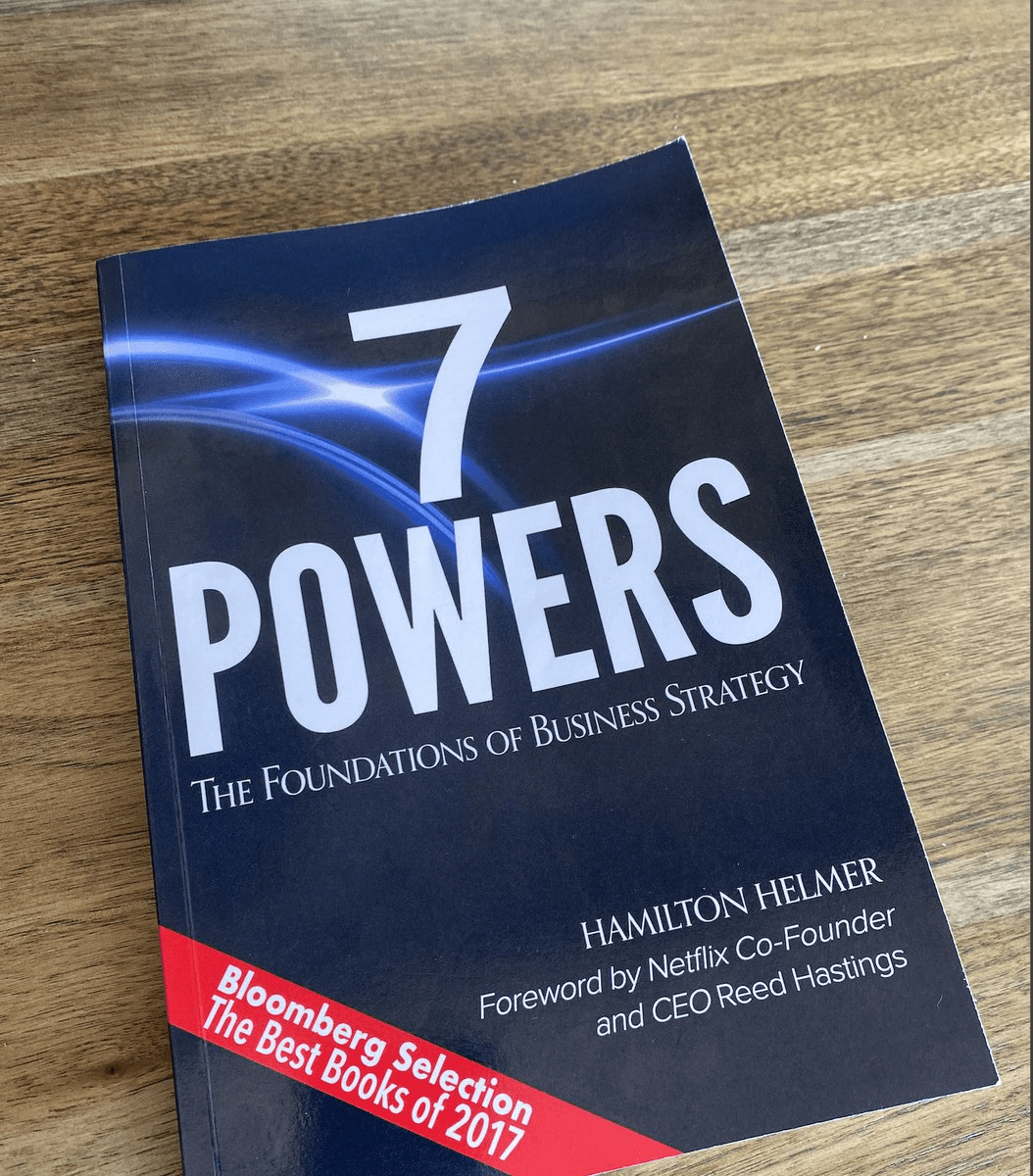

7 Powers: The Foundations of Business Strategy by Hamilton Helmer
Hamilton Helmer’s 7 Powers: The Foundations of Business Strategy offers a concise yet profoundly insightful framework for understanding the core determinants of long-term business value. Drawing on decades of experience as a strategy advisor, active equity investor, and Stanford lecturer, Helmer distills the complex world of competitive advantage into seven distinct types of “Power.” This book aims to equip business leaders, entrepreneurs, and investors with a “strategy compass”—a simple, actionable, and comprehensive guide to identifying, creating, and sustaining competitive advantages that lead to persistent differential returns. By providing a clear lens through which to analyze strategic landscapes, Helmer promises to bring critical challenges and their solutions into sharp focus, ensuring readers understand what it truly takes for a business to thrive amidst relentless competition. This summary will comprehensively break down every important idea, example, and insight from the book in clear, accessible language, leaving no significant concept untouched.
Introduction: The Strategy Compass
The introduction to 7 Powers sets the stage by arguing that enduring business success hinges on a few decisive strategy choices made amidst profound uncertainty. Helmer asserts that the intellectual discipline of strategy can indeed make a difference, but only by developing a “prepared mind” in those on the ground. He introduces the concept of “simple but not simplistic” as the high hurdle for an effective strategy framework. The book’s core, the 7 Powers framework, is presented as a tool that covers all attractive strategic positions, making it not simplistic, while its unitary focus on Power ensures it’s simple enough for practical application.
Helmer uses Intel’s dramatic success in microprocessors versus its failure in memories to define core concepts. Despite shared advantages like being a first-mover, strong management, and a fast-growing market, Intel’s memory business succumbed to competition, while microprocessors generated enduring value. This leads to the central definition of Power: “the set of conditions creating the potential for persistent differential returns.” This Power is the “Holy Grail of business,” difficult but essential. Helmer then defines Strategy (the intellectual discipline) as “the study of the fundamental determinants of potential business value,” which is both positive (revealing foundations) and normative (guiding value creation). He distinguishes this from strategy (a company’s specific approach) as “a route to continuing Power in significant markets,” which he calls The Mantra.
To formally link strategy to value, Helmer introduces the Fundamental Equation of Strategy (FES): NPV = M₀ * g * s * m.
- NPV represents net present value of expected future free cash flow (fundamental shareholder value).
- M₀ is current market size.
- g is the discounted market growth factor.
- s is long-term market share.
- m is long-term differential margin (net profit margin in excess of capital cost).
The product of M₀ and g represents market scale, while s and m represent Power. Intel’s memory business failed because competitive arbitrage drove ‘m’ negative, whereas microprocessors maintained a high ‘m’ due to Power. This confirms The Mantra as an exhaustive characterization of strategic requirements. Helmer emphasizes that persistence is key to Power, as most of a business’s value comes from out-years; thus, strategy is about dynamic equilibrium and establishing an unassailable perch.
Each of the 7 Powers will be examined through dual attributes:
- Benefit: How Power materially augments cash flow (increased prices, reduced costs, lessened investment needs).
- Barrier: What prevents competitive arbitrage from eroding the Benefit, ensuring duration.
Finally, Helmer notes that Power involves the interaction of industry economics and a specific business’s competitive position. Competition is complex, including potential and functional competitors, as any one can drive down margins. The focus is always on a single strategically separate business, even within a larger corporation. The role of leadership is crucial in creating Power, even if it cannot overcome a fundamentally bad business without it.
Chapter 1: Scale Economies – SIZE MATTERS
This chapter introduces Scale Economies as the first Power type, exemplified by Netflix’s transition from DVD-by-mail to streaming. Initially, Netflix’s DVD business held power through Counter-Positioning against Blockbuster and modest Process Power. However, the digital future loomed, threatening to supplant physical DVDs. Netflix’s streaming business, initially lacking clear Power sources due to accessible technology and demanding content owners, required a new strategy.
The crucial shift for Netflix came in 2011 when they made a radical commitment to original content and exclusive streaming rights, starting with House of Cards in 2012. This transformed content costs, a major component of their structure, into a fixed-cost item. This meant that while Netflix paid a high price for a show like House of Cards, the cost per subscriber declined significantly as their subscriber base grew. A smaller competitor would face prohibitively high costs per subscriber for similar content, creating a radical change in industry economics. This prevented a “value-destroying commodity rat race.”
Scale Economies are defined as: “A business in which per unit cost declines as production volume increases.”
- Benefit: The primary benefit is reduced cost. For Netflix, a larger subscriber base directly translated into lower content costs per subscriber for originals and exclusives.
- Barrier: The barrier arises from the “prohibitive costs of share gains” for competitors. In an established market, a smaller firm trying to gain market share (to improve its cost position) would have to offer lower prices, which the scaled leader could match using their superior cost structure. This makes such competitive moves value-destroying for the follower, creating a powerful disincentive. Intel’s microprocessor dominance against AMD is another example where superior scale allowed Intel to consistently fend off challenges.
The 7 Powers Chart is introduced, showing how each Power type fits into the Benefit (enhanced value / lowered cost) and Barrier (inability / unwillingness) framework. Scale Economies are placed under Lowered Cost (Benefit) and Unwillingness (Barrier), as competitors rationally choose not to engage in unprofitable price wars.
Beyond fixed costs, Scale Economies can emerge from:
- Volume/area relationships: Where production costs are tied to area, but utility to volume (e.g., bulk milk tanks).
- Distribution network density: Increased density allows more economical route structures (e.g., UPS).
- Learning economies: Learning that leads to reduced costs or improved deliverables correlated with production levels.
- Purchasing economies: Larger buyers securing better input prices (e.g., Walmart).
Netflix’s stock price trajectory demonstrates the enormous payoff of their successful strategy, which was not monotonic, reflecting periods of high flux and the need for operational excellence to realize potential value.
Helmer introduces Surplus Leader Margin (SLM) as a way to calibrate Power intensity. For Scale Economies, SLM is roughly proportional to [Scale Economy Intensity] * [Scale Advantage].
- Scale Economy Intensity (industry economics) is measured by the relative significance of fixed costs (C / Leader Sales).
- Scale Advantage (competitive position) is measured by the ratio of Leader Sales to Follower Sales (or [Leader Sales / Follower Sales] – 1). Both terms must be significantly positive for Power to exist.
Netflix’s strategy involved a two-pronged assault: changing industry economics (originals/exclusives making content fixed cost) and gaining scale advantage through early adoption. This chapter concludes by emphasizing that Netflix’s rise was driven by crafting a “route to continuing Power in significant markets,” with Scale Economies at its cornerstone.
Chapter 2: Network Economies – GROUP VALUE
This chapter explores Network Economies, where the value of a service increases as more customers join the network, using the case of BranchOut’s attempt to challenge LinkedIn via Facebook. Rick Marini launched BranchOut, a professional networking app, in 2010, aiming to leverage Facebook’s massive user base (10x LinkedIn’s 70 million members) by enabling seamless data download from LinkedIn. He understood the “winner take all” dynamic of Network Economies.
Marini’s tactics seemed to gain traction, with users rapidly growing to 14 million by spring 2012, attracting significant investment. However, BranchOut’s growth eventually collapsed because users did not want to bridge their personal (Facebook) and professional (LinkedIn) lives, a crucial boundary for network effects. Facebook itself learned this lesson with its failed “Facebook at Work” rollout. LinkedIn’s success is predicated on users finding value in the presence of other professionals, creating a self-reinforcing spiral.
Network Economies are defined as: “A business in which the value realized by a customer increases as the installed base increases.”
- Benefit: A leader in Network Economies can charge higher prices due to the enhanced value offered by a larger installed base. For LinkedIn, the sheer number of listed professionals and recruiters allowed them to charge more for their HR Solutions Suite than smaller competitors.
- Barrier: The barrier is the “unattractive cost/benefit of gaining share.” The value deficit of a follower can be so large that the price discount needed to attract users is “unthinkable.” BranchOut would have needed to “pay” users to switch from LinkedIn, making the investment colossal and unprofitable.
Key attributes of industries with Network Economies:
- Winner take all: Once a firm achieves a certain leadership degree, it often becomes insurmountable. Google+’s failure to unseat Facebook is a prime example.
- Boundedness: Network effects are constrained by the character of the network (e.g., personal vs. professional interactions). LinkedIn and Facebook coexist because their networks serve different purposes.
- Decisive early product: Rapid scaling is critical, often determined by the product’s early appeal (e.g., Facebook triumphing over MySpace).
Network Economies are placed on the 7 Powers Chart under Enhanced Pricing (Benefit) and Unwillingness (Barrier), reflecting the rational economic decision of competitors not to pursue value-destroying challenges.
The Surplus Leader Margin (SLM) for Network Economies is proportional to [Network Economy Intensity] * [Absolute Installed Base Advantage].
- Network Economy Intensity (industry economics) is represented by δ, the benefit accruing to each existing network member when one more member joins, relative to variable cost. A higher δ means stronger network effects.
- Absolute Installed Base Advantage (competitive position) is the difference between the leader’s and follower’s installed base (Sᴺ – Wᴺ).
If δ is too small relative to cost or potential installed base, a firm may never reach profitability, even with positive network effects. This explains the challenges faced by some Silicon Valley startups like Twitter. Indirect network effects, such as the availability of complementary products (e.g., smartphone apps for an operating system), also contribute to this Power, creating a stronger value proposition for customers and increasing the SLM. This analysis highlights that for Power to exist, both the intensity of the network effect and a significant lead in installed base are crucial.
Chapter 3: Counter-Positioning – SCYLLA AND CHARYBDIS
This chapter introduces Counter-Positioning, Helmer’s “favorite form of Power” due to its contrarian nature and ability to defeat seemingly unassailable incumbents. The case study is Vanguard’s assault on active equity management. John C. Bogle founded Vanguard in 1975 with a radical charter: an equity mutual fund that simply tracked the market (“passive index funds”) and operated “at cost,” returning all profits to shareholders. This was a direct challenge to the dominant active management model.
Vanguard’s fundamental advantage was the iron law of active management: active funds, on average, must underperform passive funds after expenses. Despite a slow start, Vanguard’s assets under management soared, especially with the advent of ETFs. Actively managed funds lost hundreds of billions, while passive funds gained.
Counter-Positioning applies when: “A newcomer adopts a new, superior business model which the incumbent does not mimic due to anticipated damage to their existing business.”
- Benefit: The new business model is superior, offering lower costs and/or higher quality deliverables. Vanguard offered substantially lower costs (no expensive portfolio managers, reduced channel costs, less trading) leading to higher average net returns.
- Barrier: The incumbent’s “collateral damage”. Powerful incumbents, like Fidelity, rationally choose not to adopt the new model because the expected damage to their highly profitable existing business (e.g., high fees from active funds) outweighs the potential gains from the new, lower-margin business. This is why incumbents often appear “paralyzed.”
Counter-Positioning is placed on the 7 Powers Chart under Lowered Cost / Enhanced Pricing (Benefit) and Unwillingness (Barrier), due to the incumbent’s rational decision not to cannibalize its existing profits.
Helmer clarifies that not all incumbent failures are Counter-Positioning:
- Stand-Alone Unattractive is NOT Counter-Positioning: If the new approach simply doesn’t offer attractive returns on its own, it’s not CP. Kodak’s failure in digital photography wasn’t due to collateral damage to its film business; digital imaging simply wasn’t an attractive business for Kodak because its strengths in film didn’t translate. This is Schumpeter’s “gales of destruction,” where technology shifts render an incumbent’s core business irrelevant, not due to a strategic misstep, but a fundamental lack of Power in the new domain.
When the new approach is stand-alone attractive, the incumbent’s “no” decision is due to collateral damage, leading to three types of Counter-Positioning:
- Milking (Negative Combined NPV): The incumbent rationally foregoes the new model because the revenue decline from cannibalizing its existing, higher-margin business would more than offset any gains from the new, lower-margin offering. Fidelity chose to “milk” its active fund business.
- History’s Slave (Cognitive Bias): The incumbent’s leadership, influenced by past successes and deeply embedded “routines,” underestimates the potential of the new approach, even if an objective analysis would suggest a positive incremental NPV. Ned Johnson’s “Why would anyone settle for average returns?” comment is an example.
- Job Security (Agency Issues): The personal incentives of the incumbent’s CEO or decision-makers (e.g., compensation tied to short-term results or specific division profits) lead them to reject objectively attractive investments in the new model that would disrupt their current power or compensation structure.
Helmer highlights that Counter-Positioning is distinct from Disruptive Technologies (DT). DT describes new technologies that initially offer lower performance but higher convenience/affordability and eventually supplant incumbents (e.g., Kodak vs. digital). CP focuses on the incumbent’s rational (or biased) inaction due to cannibalization, regardless of the technology’s nature (e.g., In-N-Out vs. McDonald’s, where no new tech is involved). The concepts are not synonymous and have many-to-many mappings.
Observations on Counter-Positioning:
- Relative Power: CP is only relative to the incumbent; it doesn’t guarantee Power against other challengers using the new model (e.g., In-N-Out vs. Five Guys).
- Challenger’s Posture: Challengers can influence incumbent delay by avoiding triumphalism and maintaining a respectful tone.
- Non-exclusive: Unlike Scale or Network Economies, multiple challengers can be Counter-Positioned against the same incumbent.
- Toughest Management Challenge: CEOs like Nokia’s Stephen Elop face immense internal pressure when Counter-Positioned, leading to a typical “Five Stages”: Denial, Ridicule, Fear, Anger, Capitulation (often too late).
- Dabbling: Incumbents often “dabble” in the new model without full commitment, failing to address the challenge meaningfully.
The Surplus Leader Margin (SLM) for CP shows that the higher the incumbent’s margins (O_m), the higher the SLM for the challenger, meaning the incumbent has more to lose. This makes CP a potent challenge to highly successful incumbents. The Competitive Position for CP is simply having adopted the heterodox model, while Industry Economics reflect the model’s superiority and its capacity to inflict collateral damage.
Chapter 4: Switching Costs – ADDICTION
This chapter introduces Switching Costs, exemplified by the seemingly paradoxical situation of SAP customers who, despite being unhappy with the software’s complexity and performance, continue to pay substantial annual maintenance fees. This “lock-in” is explained by the high costs and uncertainties involved in migrating to a new system.
The Hewlett-Packard (HP) case study highlights the agony of switching ERP systems. HP’s 2004 migration to SAP for its North American server sales divisions, despite careful planning and contingency measures, resulted in a $160 million financial hit due to order delays and lost business. Customers could easily buy from Dell or IBM, but the internal disruption of switching ERP was too high. This illustrates not just the high monetary costs (new software, complementary applications), but also procedural costs (employee retraining, loss of familiarity, risk of errors) and relational costs (severing ties with existing service teams, loss of identity).
Switching Costs are defined as: “The value loss expected by a customer that would be incurred from switching to an alternate supplier for additional purchases.”
- Benefit: A firm with embedded Switching Costs can charge higher prices than competitors for equivalent follow-on products or services because customers face a significant hurdle to leave. This benefit applies only to current customers for additional purchases.
- Barrier: Competitors must compensate customers for these switching costs, which makes challenging an incumbent distinctly unattractive. The incumbent can set prices that give rivals a cost disadvantage, making share gains unprofitable for challengers.
Switching Costs are placed on the 7 Powers Chart under Enhanced Pricing (Benefit) and Unwillingness (Barrier), as competitors are unwilling to incur the cost required to offset the customer’s switching burden.
Types of Switching Costs:
- Financial: Directly monetary costs (e.g., purchasing new software licenses).
- Procedural: Costs from loss of familiarity, retraining, and the risk/uncertainty of adopting a new product (e.g., SAP’s integration across many departments).
- Relational: Costs from breaking emotional bonds with products, communities, or service providers.
Switching Costs Multipliers are tactics that enhance this Power:
- Product Line Extension: Developing more add-on products (as SAP has done with its vast array of offerings) increases the revenue covered by switching costs and the intensity of entanglement. Acquisitions often accelerate this.
- Deep Integration and Training: High levels of integration into customer operations and extensive training build procedural and relational switching costs.
Switching Costs are a non-exclusive Power type; competitors like IBM and Oracle also benefit from high customer retention. The major value contribution comes from acquiring customers before competitive arbitrage (often price competition) erodes the benefit for new customer acquisitions. Thus, the intensity of Switching Costs primarily derives from Industry Economics (how significant these costs are in a given industry), while Competitive Position is binary: you either have the customer or you don’t. This Power can also pave the way for others, such as Network Effects (by connecting users) or Branding (if product preference spills over).
Chapter 5: Branding – FEELING GOOD
This chapter introduces Branding as a Power type, exemplified by Tiffany & Co.’s ability to charge a substantial price premium for diamonds that are objectively identical to those sold by competitors like Costco or Blue Nile. A 2005 Good Morning America comparison and analysis by a gemologist confirmed Tiffany’s significant markup.
The premium for Tiffany diamonds stems from customer sentiment captured in online forums, where buyers emphasize the “peace of mind” and “extra value” associated with the Tiffany name, particularly its provenance and recognition by the recipient. Tiffany, founded in 1837, has meticulously cultivated its brand through long-term quality control, consistent aesthetic design (elegance), exclusivity, and flawless craftsmanship. Their iconic Tiffany Blue Box itself carries monetary value, symbolizing this heritage, elegance, exclusivity, and flawlessness.
Branding is defined as: “The durable attribution of higher value to an objectively identical offering that arises from historical information about the seller.”
- Benefit: A brand can charge a higher price due to:
- Affective valence: Positive emotional associations elicited by the brand, distinct from objective product value (e.g., Coke vs. store brand cola in a blind taste test).
- Uncertainty reduction: “Peace of mind” that the branded product will consistently meet expectations (e.g., Bayer aspirin vs. generic). This benefit does not depend on prior ownership, unlike Switching Costs.
- Barrier: Hysteresis, meaning the brand can only be created over a lengthy period of reinforcing actions. Copycats face daunting uncertainty and high investment runways with no assurance of achieving significant affective valence, plus the risk of trademark infringement.
Branding is placed on the 7 Powers Chart under Enhanced Pricing (Benefit) and Hysteresis (Barrier), reflecting the long, sustained effort required to build a powerful brand.
Challenges and Characteristics of Branding:
- Brand Dilution: Releasing products that deviate from or damage the brand image can “reset the hysteresis clock,” undermining its Power (e.g., Halston’s failed partnership with J.C. Penney).
- Counterfeiting: Free-riding on a brand’s reputation through false association can undermine its Power by flooding the market with inconsistent offerings (e.g., Tiffany suing Costco and eBay).
- Changing Consumer Preferences: Evolving preferences can diminish a brand’s value if it doesn’t adapt (e.g., Nintendo’s family-friendly brand struggling as gaming demographics matured).
- Geographic Boundaries: Brand value may not transfer across regions (e.g., Sony’s TV brand in the US vs. Japan).
- Narrowness: Branding Power is a much stricter concept than general “brand recognition.” High awareness isn’t necessarily Power; it might be a result of Scale Economies. A strategist must differentiate.
- Non-exclusivity: Multiple direct competitors can have strong brands (e.g., Prada, Louis Vuitton, Hermès), all still earning superior returns to unbranded competitors.
- Type of Good: Only certain goods have Branding potential.
- Magnitude: Must justify a significant price premium, often consumer goods tied to identity or luxury, where signaling exclusion is possible. Business-to-business goods rarely have significant affective valence.
- Duration: Requires enough time to achieve the magnitude.
The Surplus Leader Margin (SLM) for Branding is a function of Brand Value as a multiple of the weaker firm’s price (B(t)) and time (t). Industry economics define the potential maximum multiple (Z) and the brand cycle time compression factor (F), while competitive position is determined by time (t) in brand development. This emphasizes that brand value builds over time, creating a barrier to entry.
Chapter 6: Cornered Resource – MINE ALL MINE
This chapter introduces Cornered Resource as a Power type, exemplified by Pixar Animation Studios’ unprecedented and sustained success in the movie business. Pixar’s Toy Story (1995) was a moonshot that led to a string of ten highly acclaimed and commercially successful films, achieving gross profitability nearly four times the industry average. This sustained success, involving multiple directors and teams, indicated a unique source of Power.
The “Factor X” behind Pixar’s Power is identified as The Brain Trust, a core group of creative individuals who forged deep bonds during the studio’s challenging early years. This included John Lasseter (animation genius), Ed Catmull (CGI pioneer and creative manager), and Steve Jobs (brilliant entrepreneur). This trio, despite early struggles and Jobs’s substantial financial support, created a unique collaborative environment. Lasseter’s decision to stay at Pixar rather than return to Disney, stating he could “make history” at Pixar, highlights the personal choice aspect of this Barrier.
Cornered Resource is defined as: “Preferential access at attractive terms to a coveted asset that can independently enhance value.”
- Benefit: The resource produces “superior deliverables” or lower costs. For Pixar, the Brain Trust consistently produced uncommonly appealing films, driving huge box office returns. Other examples include drug patents, ownership of a critical natural resource, or proprietary manufacturing technology (like Bausch and Lomb’s spin casting).
- Barrier: The resource is “fiat”—meaning it is secured by decree, whether legal (patents, property rights) or personal (loyalty, unique skills). This prevents competitors from accessing or replicating it. Disney’s eventual acquisition of Pixar was motivated by the realization that bringing Pixar’s talent to Disney Animation was the only way to revive that division, confirming the transferability and value of this Cornered Resource.
Cornered Resource is placed on the 7 Powers Chart under Enhanced Pricing / Lowered Cost (Benefit) and Fiat (Barrier), reflecting the preferential access to a valuable asset.
Helmer outlines five screening tests for a Cornered Resource to qualify as Power:
- Idiosyncratic: The firm consistently acquires coveted assets at attractive terms. The Power lies in the ability to acquire, not just the asset itself. Pixar’s Brain Trust was largely restricted to specific individuals whose shared experiences and unique talents were not easily replicated or infused into new directors.
- Non-arbitraged: The firm pays a price for the resource that does not fully arbitrage out its rents. Movie stars, for example, are coveted but their compensation often captures most of the value they create, thus not qualifying as a Cornered Resource. Pixar’s Brain Trust, while highly compensated, created value far exceeding their pay.
- Transferable: The resource creates value not just at one company but also if moved to others. Bob Iger’s decision to place Catmull and Lasseter at the helm of Disney Animation, leading to its revival, demonstrated the transferability of this resource.
- Ongoing: The resource explains continued differential returns. Some factors might be formative but become embedded, losing their ongoing causal link (e.g., Dr. Spenser Silver’s role in Post-it notes vs. the patent itself). Steve Jobs was crucial to Pixar’s early ascent but his ongoing presence wasn’t needed for its continued success; the Brain Trust, however, endures.
- Sufficient: The resource alone is sufficient for continued differential returns, assuming operational excellence. Specific leadership, for example, often fails this test if other complements to their talent are missing (e.g., George Fisher at Kodak). The Pixar Brain Trust as a unit is seen as the sufficient Cornered Resource.
The Surplus Leader Margin (SLM) for a Cornered Resource reflects the per-unit increase in profits (Δ) derived from the superior deliverables or lower costs, minus the fixed annual cost (k) of the resource. The Industry Economics relate to the magnitude and persistence of the resource’s value, while the Competitive Position is simply whether you possess the resource or not.
Chapter 7: Process Power – STEP BY STEP
This chapter concludes the 7 Powers framework by introducing Process Power, highlighting its rarity using the case of Toyota Motor Corporation and its Toyota Production System (TPS). By 1969, Toyota’s quality stood in stark contrast to Detroit’s “planned obsolescence.” Eiji Toyoda’s 1950 visit to Ford’s River Rouge Plant, coupled with inspiration from supermarkets, led him to develop the TPS over decades.
The TPS, a complex system of interlocking procedures like just-in-time production, kaizen, kanban, and andon cords, resulted in unsurpassed quality and efficiency. Toyota’s US market share grew from 0.1% in 1969 to nearly par with GM and Ford by 2014, while GM’s share plummeted. This shift persisted for decades, despite GM’s attempts to replicate TPS through a joint venture with Toyota called NUMMI (1984). Toyota offered full transparency, and NUMMI achieved low defect rates, but GM could not replicate these results in its other facilities.
As Ernie Shaefer, a GM plant manager, observed, the visible production techniques were merely the tip of the iceberg; the deeper “system that supports the NUMMI plant” was not understood or transferable. This illustrates the Barrier of Process Power.
Process Power is defined as: “Embedded company organization and activity sets which enable lower costs and/or superior product, and which can be matched only by an extended commitment.”
- Benefit: The company achieves improved product attributes and/or lowered costs through embedded process improvements. Toyota consistently delivered quality increases and cost reductions through TPS.
- Barrier:Hysteresis: These process advances are difficult to replicate and require an extended period of sustained evolutionary advance. This inherent “speed limit” for imitation stems from two factors:
- Complexity: Process improvements that touch many parts of vast, complex chains (like automobile production) are inherently challenging to replicate quickly.
- Opacity: The knowledge is often tacit, developed through decades of trial and error and not formally codified. Even Toyota couldn’t fully explain it, as evidenced by NUMMI’s non-transferability.
Process Power is placed on the 7 Powers Chart under Lowered Cost / Enhanced Pricing (Benefit) and Hysteresis (Barrier), reflecting the long-term, embedded nature of the advantage.
Helmer discusses the relationship between Process Power and the discipline of Strategy:
- Strategy vs. Operational Excellence: While Process Power involves evolutionary bottom-up improvement (a core aspect of operational excellence), it differs because of the rarity of the Barrier—the unyielding, long-time constant for imitation. Most operational excellence is readily mimicked and thus subject to competitive arbitrage, not leading to Power. Process Power is “operational excellence, plus hysteresis.”
- The Experience Curve: This empirical observation (costs declining by 15-30% for every doubling of units produced) often leads to a false assumption of Process Power. However, it typically refers to gains over time shared across all firms, not differences in relative position at a single point in time. It testifies more to the ubiquity of competitive arbitrage than to unique Power.
- Routines: Drawing from Richard R. Nelson and Sidney G. Winter’s “An Evolutionary Theory of Economic Change,” Helmer notes that innovations are often driven by adaptive “routines.” While such routines are valuable, most lack the Barrier needed for Power; they represent a Benefit without sustained competitive advantage.
The Surplus Leader Margin (SLM) for Process Power reflects how much lower a leader’s costs (c) are than a follower’s due to its embedded process. The Industry Economics define the potential magnitude and sustainability of this leverage through a function D(t), which grows over time. The Competitive Position is determined by time (t), as it takes a long time to build up this Power.
With Process Power, Helmer completes the 7 Powers Chart and the Competitive Position/Industry Economics table, affirming that these seven types are exhaustive for understanding strategic positions. The book now transitions from Statics (“Being There”) to Dynamics (“Getting There”).
Part II: Strategy Dynamics
Chapter 8: The Path to Power – “ME TOO” WON’T DO
This chapter marks the transition to Strategy Dynamics, addressing the crucial question: “What must I do to establish Power?” Helmer asserts that while the 7 Powers framework covers all attractive strategic positions, understanding how to achieve them is equally vital. The answer, in short, is that all Power starts with invention.
Helmer revisits Netflix’s streaming business to illustrate this. His initial investment hypothesis in 2003 was based on Netflix’s Power in DVD-by-mail (Counter-Positioning, Process Power, Scale Economies). However, he recognized the transitory nature of DVDs and the lack of evident Power sources in digital streaming. Content owners could “variable cost price” their programming, eliminating Netflix’s scale advantage.
Netflix’s response was adaptive and experimental, starting with modest investments in streaming (Watch Now, 2007) and gradually expanding. They focused on operational excellence (UI, recommendation engine, IT infrastructure), but Helmer emphasizes that these efforts alone were insufficient for Power, as they could be mimicked by competitors.
The decisive shift came when Ted Sarandos, Netflix’s content chief, pursued exclusives (e.g., Epix, 2010), converting some content costs from variable to fixed. This leveraged Netflix’s scale into Scale Economies. When content owners started bargaining hard for a larger share of these returns, Netflix took the next logical step: originals (e.g., House of Cards, 2011). This unequivocally made content a fixed cost, cementing Scale Economies and altering Netflix’s bargaining position. This transformed streaming from a commodity business into a “bankable cash flow generator.”
Helmer draws two key takeaways:
- “Getting there” (Dynamics) is completely different from “being there” (Statics). Early success based on high market share from aggressive pricing often proves fleeting without underlying Power. The 7 Powers framework identifies the desirable destinations, which informs which journeys are worth taking.
- Invention is the first cause of every Power type. Whether it’s a product, process, business model, or brand, Power originates from creating something new that offers a substantial economic gain. “‘Me too’ won’t do.” This emphasizes passion, monomania, and domain mastery over “bloodless analytics.”
The Topology of Invention and Power outlines this dynamic:
- Flux in external conditions (e.g., technological advances, competitive shifts) creates threats and opportunities.
- Resources (existing capabilities, idiosyncratic talents) intersect with these external conditions.
- Invention arises from this intersection, often through “crafting” rather than “design.” This is the first step, but most inventions, like operational excellence, do not automatically lead to Power.
- Power is achieved when the invention is deliberately steered to create a Barrier against competitive arbitrage, leveraging one of the 7 Power types.
Invention has a “one-two value punch”: it not only opens the door for Power but also propels market size (M₀ and g in the FES). The growth of the market itself is driven by “compelling value”—products or services that are so superior in the eyes of the customer that they evoke a “gotta have” response.
Helmer identifies three paths to creating compelling value:
- Capabilities-Led: A company translates an existing capability into a product with compelling value, even if the customer need is initially unknown. Adobe Acrobat is an example; Adobe leveraged its expertise in software and graphics to create a transparent document-sharing solution, which found its compelling value when the Internet (HTML’s limitations) created an unmet need for preserving visual integrity. This path is profoundly risky due to unknown customer needs, requiring patience and appropriate morphing.
- Customer-Led: Many players recognize an unmet customer need, but no one knows how to satisfy it. Corning’s fiber optics exemplify this. The need for vastly increased communications traffic was clear, but the technical challenge of achieving glass transparency for optical fibers was immense. Corning’s Frank Maurer and his team’s invention of the vapor deposition process for pure silica, despite being resource-constrained compared to competitors, provided the breakthrough. The uncertainty here is primarily technical.
- Competitor-Led: A competitor has a successful product, and the inventor must produce something so much better (in whole product terms) that it elicits the “gotta have” response. Sony PlayStation is an example. Entering a market dominated by Nintendo and Sega, Sony’s Ken Kutaragi pushed for real-time 3D graphics, a “step-change” in immersion, leading to a massive market explosion. This path often requires gut-wrenching, big-bang commitments and formal arrangements with complement providers (e.g., game developers, telecom giants). The uncertainty is two-fold: will the features be attractive enough, and will competitors be sufficiently delayed?
The chapter concludes by reinforcing that the 7 Powers provides the ready guide to identify Power openings amidst the flux of invention.
Chapter 9: The Power Progression – TURN, TURN, TURN
This chapter tackles the second crucial question of Dynamics: “When can I establish Power?” Helmer uses Intel’s microprocessor business as a case study to illustrate the Power Progression framework.
Intel’s path to Power in microprocessors was long and uncertain, marked by internal dissension (e.g., Bill Graham’s opposition) and external challenges (slow customer adoption, superior competitor products like Motorola’s 68000). The decisive moment was Operation Crush, an aggressive sales and marketing assault that led to Intel’s 8088 winning the IBM PC contract. This contract, for a product that unexpectedly exploded in popularity, provided the “mother lode application” for Intel’s microprocessors.
Intel’s enduring $100B+ market cap resulted from three of the 7 Powers, all rooted in this critical period:
- Scale Economies: Intel gained a massive scale advantage from the IBM PC’s success, leading to lower per-unit costs for chip design, factory design, and early adoption of lithography advances. This advantage has never been relinquished.
- Network Economies: Early PC applications (Lotus 1-2-3, MS-DOS) were programmed specifically for Intel processors, locking in other PC makers to Intel-compatible chips. This created a powerful network effect.
- Switching Costs: Once customers owned PCs with Intel-specific software, switching to non-Intel machines meant losing their investment in programs.
Helmer emphasizes that these Power types were established during the takeoff period—the stage of explosive growth (defined as 30-40% annual unit growth). During takeoff, high flux and arbitrage lags allow for differential customer acquisition at favorable terms. Intel made a decisive break from competitors “just under the wire”; if the PC market had matured without their lead, these Power opportunities would have vanished. Companies with strong financials in this stage, but no established Power, will see their gains dissipate once growth slows and competitive arbitrage catches up.
The Power Progression framework categorizes when different Power types are typically established across three time windows:
- Stage 1: Before – Origination: The period before compelling value leads to rapid sales acceleration.
- Cornered Resource: Most likely established here (e.g., Intel reacquiring microprocessor rights from Busicom, drug patents, the Intel triumvirate of Noyce, Moore, and Grove). This Power is “locked in early” if executed well.
- Counter-Positioning: Must occur in origination, as the new business model creates the takeoff for the challenger by vexing incumbents.
- Stage 2: During – Takeoff: The period of explosive growth (unit growth > 30-40% annually).
- Scale Economies: Requires gaining a decisive market share lead during explosive growth.
- Network Economies: Requires achieving a critical installed base edge before the market tips.
- Switching Costs: Requires acquiring a customer base at favorable terms before competition arbitrages out the value of new customer acquisition.
- Helmer emphasizes that if these three Powers are not established during takeoff, the opportunity vanishes forever.
- Stage 3: After – Stability: Growth has slowed from explosive levels, but the business may still be growing considerably.
- Process Power: Requires time to evolve complex, opaque processes that defy speedy emulation (e.g., Toyota’s TPS). This typically only avails itself in the stability stage.
- Branding: Requires a lengthy period of consistent, reinforcing actions to build affective valence and reduce uncertainty (e.g., Hermès, Tiffany). Not enough time usually exists in earlier stages.
The Time Character of the Four Barriers reinforces this timing:
- Hysteresis (Process Power, Branding) barriers require long time constants, making them stability-stage phenomena.
- Collateral Damage (Counter-Positioning) is initiated by a new business model that sparks the challenger’s takeoff, placing it in origination.
- Fiat (Cornered Resource) involves securing rights that are likely to be underpriced early in a product’s lifecycle, before its value becomes widely known, thus placing it in origination.
- Cost of Gaining Share (Scale Economies, Network Economies, Switching Costs) only applies meaningfully during takeoff, when high flux allows for differential acquisition at favorable terms. In stability, share gains become too costly due to market transparency and entrenched competition.
Empirical validation from student research papers at Stanford supports the Power Progression’s stage timing.
Helmer concludes by emphasizing the “Dynamics Difference”:
- Broadened Scope: Dynamics considers how a company influences market size (M₀, g) in addition to Power (s, m), making these endogenous variables.
- Operational Excellence’s Role: While not strategic in Statics (due to imitability), operational excellence becomes highly strategic during takeoff due to shortened imitation timeframes. Apple’s failure with the Apple III, despite its early lead, illustrates how a lack of operational excellence during takeoff can be fatal. Intel’s Operation Crush, on the other hand, shows how aggressive execution can secure Power.
- Leadership: In Dynamics, leadership is fundamental to establishing Power, driving initiatives like Operation Crush or early product bets.
The 7 Powers framework, coupled with the understanding of the Power Progression, serves as the “strategy compass” to guide leaders in their “high-flux formative moments” toward fulfilling The Mantra: “A route to continuing Power in significant markets.”
Key Takeaways
Hamilton Helmer’s 7 Powers provides an indispensable framework for understanding and achieving sustainable competitive advantage. The core lessons revolve around the fundamental drivers of business value and the critical role of invention and timing in securing them.
The Core Lessons:
- Power is the Holy Grail: Sustainable business value (persistent differential returns) is directly derived from “Power”—the set of conditions creating these returns despite competition. Without it, even operational excellence leads to commoditization.
- The Mantra for Strategy: A viable strategy is defined as “a route to continuing Power in significant markets.” This comprehensive statement encompasses both the source of advantage and its market scale.
- The 7 Powers are Exhaustive: Helmer’s framework identifies seven distinct, non-simplistic types of Power: Scale Economies, Network Economies, Counter-Positioning, Switching Costs, Branding, Cornered Resource, and Process Power. Each offers a unique Benefit and a Barrier to competitive arbitrage. If your business has none of these, it is fundamentally vulnerable.
- Dynamics are Different from Statics: Understanding “being there” (Statics—the types of Power) must precede “getting there” (Dynamics—how Power is established). However, the processes of establishing Power (Dynamics) are distinct from merely sustaining it.
- Invention is the First Cause: All Power originates from invention—of products, processes, business models, or brands. “Me too” won’t do. This invention also drives market size, giving it a “one-two value punch.”
- Timing is Everything (The Power Progression): Different Power types have distinct “windows of opportunity” for their establishment.
- Origination Stage: Cornered Resource, Counter-Positioning.
- Takeoff Stage: Scale Economies, Network Economies, Switching Costs.
- Stability Stage: Process Power, Branding.
Missing these windows means forfeiting the opportunity to establish certain types of Power forever.
Next Actions:
- Assess Your Current Power: For your primary business, identify which of the 7 Powers, if any, you currently possess relative to your key competitors (direct, functional, and potential). Be brutally honest about the strength of your Benefits and Barriers.
- Evaluate Your Growth Stage: Determine if your business is in the origination, takeoff, or stability stage. This will narrow down which Power types are potentially available for you to establish.
- Identify Power Opportunities: Based on your current stage, actively brainstorm and analyze potential inventions (product, process, business model, brand) that could create one of the available Power types. Focus on creating “compelling value” for customers.
- Prioritize Barrier Creation: When pursuing invention, always look to the Barrier first. Operational excellence is essential, but ensure your efforts lead to an unassailable advantage, not just imitable improvements.
- Refine Your Strategy: Formulate your strategy as a clear “route to continuing Power in significant markets.” Regularly revisit and adapt this strategy as external conditions and competitive dynamics evolve.
Reflection Prompts:
- Looking at your own business or a company you admire, can you clearly articulate its primary source(s) of Power using the 7 Powers framework? How robust are its Benefits and Barriers?
- Considering your industry’s current growth stage, which Power types are most realistically attainable for your business right now? Are you making the strategic bets necessary to capture those opportunities, or are you focused on “me too” operational excellence?





Leave a Reply