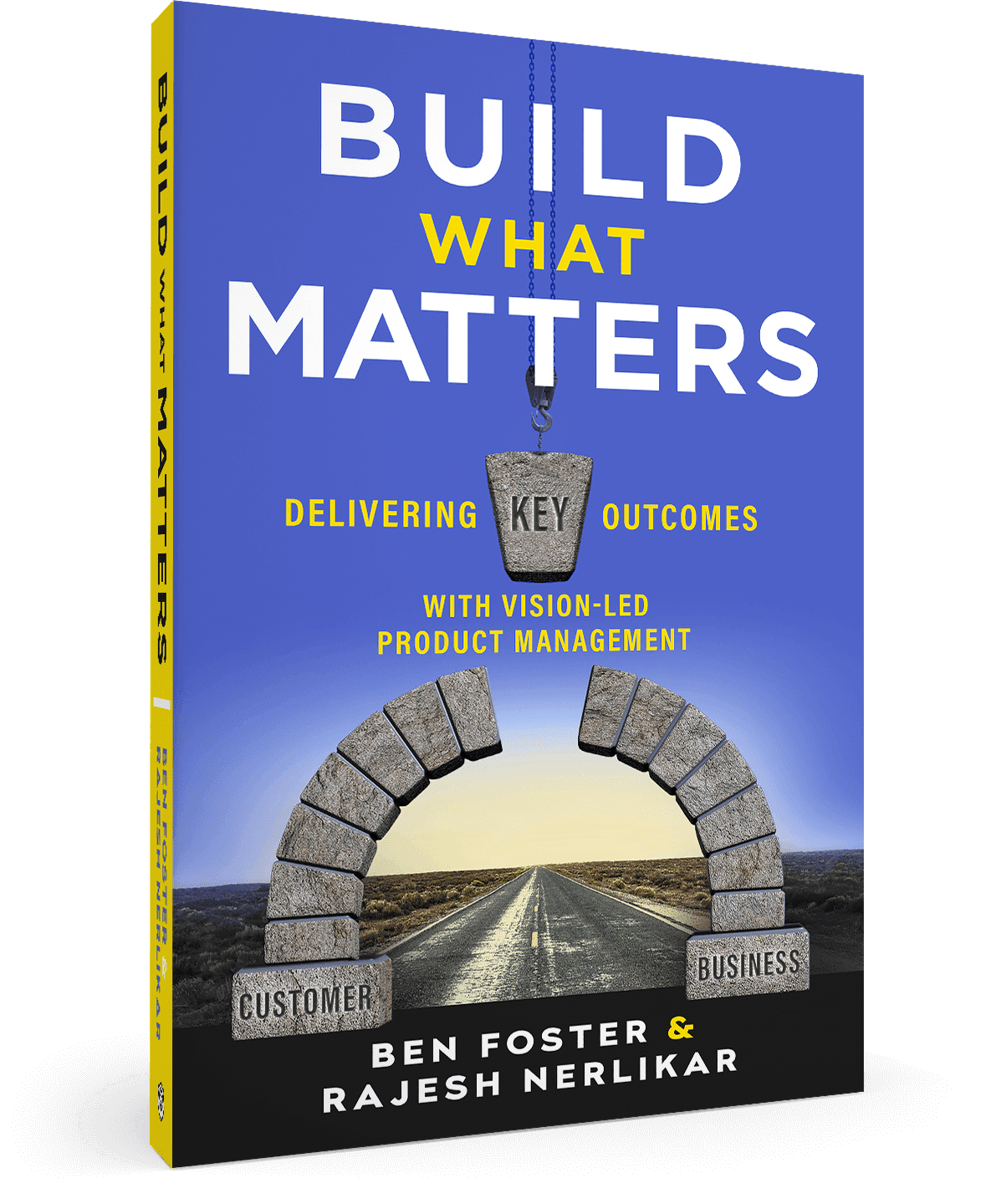

Build What Matters: Delivering Key Outcomes with Vision-Led Product Management
In “Build What Matters,” Ben Foster and Rajesh Nerlikar present a transformative framework for product management, rooted in their extensive experience advising over sixty tech companies and engaging with more than 250 organizations. They argue that successful product management isn’t just about shipping features; it’s about a vision-led approach that consistently focuses on delivering key customer outcomes to drive business results. This book is a practical guide for founders, product leaders, aspiring product professionals, and investors seeking to maximize product development impact by creating a clear, inspiring product vision and strategy. Foster and Nerlikar promise to break down every important idea, example, and insight from their framework, showing readers how to overcome common dysfunctions and build products that truly matter.
Chapter One: Why Product Isn’t Working
This chapter provocatively examines the pervasive dysfunctions that plague product teams, highlighting that while happy product teams may be alike, unhappy ones are unhappy in their own unique ways. Foster and Nerlikar identify ten common patterns they’ve observed, all of which stem from deeper, systemic issues.
Top Ten Dysfunctions in Product Management
The authors introduce ten distinct patterns that hinder product effectiveness, emphasizing that experiencing these issues is common and doesn’t necessarily indicate incompetence. These include:
The Hamster Wheel: Product teams focus almost entirely on hitting deadlines (output) with little regard for the actual outcome. They deliver quickly, but often deliver the wrong thing. Ben Foster’s story of “Measuring Lines of PRD” at eBay vividly illustrates this, where product managers were literally given quotas for documentation pages, leading to “monster PRDs for overdesigned features” that wasted engineering capacity.
The Counting House: An obsession with internal metrics (like revenue or MAUs) without regard for customer success. This leads companies to believe that good internal numbers automatically mean product success, missing the core question of how to deliver greater value to customers.
The Ivory Tower: Product teams become so disconnected from customers that they build products no one wants or needs, assuming they know best. Rajesh Nerlikar’s personal anecdote of “Assuming What Users Want” with his dating app, Wentroductions, perfectly exemplifies this, where he relied on personal experience instead of customer discovery, leading to product failure despite a well-built app. This also fosters mistrust between product, go-to-market, and engineering teams.
The Science Lab: All efforts are focused on superficial, highly measurable improvements through A/B testing, neglecting real innovation. This leads to stagnation, as companies “constantly trying to eke out more value from their existing solutions run the risk of stagnating.”
The Feature Factory: The endless building of incremental features based on individual customer or stakeholder demands, often missing larger market opportunities. Ben Foster’s “The Color-Coded Roadmap” at Opower illustrates this, where contractual client commitments perpetually pushed out more meaningful improvements, making the company a “feature factory.”
The Business School: Overanalyzing everything with complex mathematical models (NPV, ROI), leading to analysis paralysis and avoidance of tough judgment calls. Initiatives are prioritized based on “outrageous assumptions” or low-effort improvements, ignoring broader customer strategy.
The Roller Coaster: Sudden pivots due to a short time horizon and impatience for immediate results, stifling true innovation. This “fail-fast” mentality, taken to the extreme, results in “false negatives” and product whiplash.
The Bridge to Nowhere: Overengineering products for future, unconfirmed needs, leading to wasted resources and delayed market entry. Engineers “get excited about developing the infrastructure to get the product just right,” but often build for a future that never materializes.
The Negotiating Table: Product managers try to satisfy all competing stakeholder requests, leading to suboptimal prioritization driven by avoiding discomfort rather than strategic alignment. This fundamentally misunderstands product management’s role, which is not to hit short-term sales quotas but to enable much bigger future opportunities.
The Throne Room: A founder or CEO micromanages product decisions, preventing team empowerment and consistent direction. Ben Foster’s “Constantly Changing Priorities” at Adchemy exemplifies this, where the CEO’s quarterly pivots led to confusion and eventual company failure.
The Commonalities
Despite their apparent differences, these dysfunctions boil down to three core themes: an internal focus that distracts from customer value, product teams caught in a defensive posture with little authority for innovation, and an overemphasis on short-term, measurable business outcomes leading to superficial changes. These themes highlight a fundamental lack of clear direction, which a strong product vision can resolve, preventing both product failure and manager burnout. As Gibson Biddle wisely states, “Product leadership is defined as inspired communication of a vision.”
Chapter Two: The Solution
This chapter introduces Vision-Led Product Management as the antidote to the common dysfunctions, emphasizing that becoming truly product-driven is the foundation for success.
Being Product-Driven
Being product-driven means two core things:
- Addressing a customer’s need through a solution applicable to the broader market: A product-driven company builds solutions for an entire market segment, not one-off custom solutions for individual clients. They “gamble that the product they’ve created will address the needs of many customers.” The authors use a customer desires map to illustrate this, showing how a product focuses on a specific segment (black box/white dots) and expands (black dots) rather than chasing every unique desire (gray dots outside the box). This requires saying “no to most product requests” to avoid becoming a services-driven company.
- Product decisions come first, and other decisions follow: The product acts as the “driver” in the company’s “system of gears,” aligning all functional teams—sales, marketing, engineering—around the product strategy. Unlike brand-driven (Nike) or technology-driven (AI firms) companies, product-driven companies identify market opportunities and design scalable solutions first, then build go-to-market tactics around them. CrossLead’s case study illustrates how identifying a disconnect between their value proposition and actual product delivery led them to narrow their target persona and build a more strategic roadmap.
How To Know Whether You’re Product-Driven
Five traits characterize a product-driven company:
- Product management and UX design are the closest to the customer, constantly building understanding.
- The company addresses multiple customers with a single solution, focusing most roadmap time on broad benefits.
- It prioritizes technology to solve problems and scale every part of the business.
- It actively listens to current customers and prospects to predict future needs and market shifts.
- It often succeeds by saying no to custom solutions, recognizing the high opportunity cost of bespoke development. Contactually’s pivot to focus solely on real estate agents exemplifies the “power of focus” gained by saying “no” to a broader, disjointed customer base, leading to increased revenue and eventual acquisition.
Why Being Product-Driven Matters
The benefits of being product-driven are massive for both customers and the company:
- For Customers: It keeps prices low (near-zero marginal cost of software), time-to-value low (immediate availability), and offers the latest-and-greatest through continuous upgrades.
- For the Company: It’s more profitable due to low marginal costs and repeatable solutions, leads to much higher valuations (6-8x higher multiples than services firms due to scalability and growth potential), and enables product-led growth strategies like viral adoption and freemium models (e.g., Miro).
Introducing Vision-Led Product Management
The authors introduce their framework with a visual overview:
- Key Customer Outcome (Chapter Three): Defining “your metric of progress” – if you deliver an outcome customers care about, business success follows.
- Customer Journey Vision (Chapter Four): A detailed description of the future customer journey with your product, from initial trigger to long-term retention, to achieve the key outcome.
- Product Strategy (Chapter Five): A plan for getting from today’s product to the vision, working backward and accounting for business realities, dependencies, and measurable milestones.
This framework is about vision-led value creation, focusing on expanding customer value by fulfilling a transformative vision, rather than solely trying to extract more value from existing solutions. This prevents companies from entering the “product danger zone” where customer value is exceeded by value capture. An inspiring vision also yields ancillary benefits in hiring, employee retention, and fundraising, as people and investors are drawn to compelling future states. Ben Foster’s story of joining GoCanvas illustrates this, as the company’s product vision was inspiring enough to recruit him and later attract significant investment.
Chapter Three: Key Outcomes
This chapter delves into the crucial first step of the Vision-Led Product Management framework: identifying and defining key outcomes for both customers and the business. The core idea is that “what gets measured gets managed,” but it’s vital to measure true signals of value delivery, not just easy-to-track internal metrics.
Your Customers Need To Care
The authors stress that product success hinges on customer value. Most companies over-focus on internal metrics like revenue targets (“$100 million in recurring revenue!”) without linking them to what customers actually want. Disrupting an industry doesn’t happen directly; it happens by “solving a customer need so well that the industry is changed forever.” The key question is: “What outcomes will my product produce for my customer?”
Ben Foster’s “Hidden Shipping Costs” story at eBay perfectly illustrates the danger of optimizing the wrong metric. Focusing on “items viewed per search conducted” led to a terrible customer experience because users had to click through multiple items to find actual total prices, ultimately driving them to competitors like Amazon. The real customer desire was to “find what I’m looking for” easily, not to click on many items.
Product management should focus on delivering value to customers (useful features, usability, speed) before extracting value for themselves (increased prices, optimized flows). Melissa Perri’s “value exchange system” highlights that businesses must first fulfill customer wants and needs. Companies often fall into the trap of over-optimizing value capture because it offers “low-hanging fruit” and is easier to measure, assuming their product is “good enough.” However, true growth comes from vision-led value creation, expanding the customer value constraint. American Express Platinum’s continuous addition of perks is an example of ongoing investment in customer value. If value derived from customers exceeds value delivered, the company enters a “product danger zone” ripe for disruption.
Driving Business Results via Customer Outcomes
While financial results are critical, customer value creates the opportunity for sustainable financial outcomes. Product management’s role is to create a product that is both valuable to customers and profitable for the business. The responsibility is a “team sport”:
- Product team: Ensures the product delivers real customer value profitably. This is something “only they can do.”
- Go-to-market teams (sales, marketing, customer success): Derive business value from the product’s inherent customer value.
Product management owns the “far future”, focusing on enabling much bigger numbers multiple quarters or years out, by identifying real value drivers for customers and bringing them to life in the product. The graphic “Ownership of the Company’s Future by Team” clearly depicts how product management works on the longest time horizon (2-5+ years), ahead of marketing (1-2 years), sales (2-4 quarters), and customer success (1-2 quarters).
Choosing the Key Customer Outcome
The key customer outcome is the driving force behind demand for your product—it’s why they use it and how they’ll determine continued use. It’s not about how they use it.
- Examples: Twitter (feel connected, not read posts), Peloton (stay in shape, not cycle), Google Docs (collaborate, not type words), Salesforce (close more deals, not track pipelines).
- It must be an outcome customers care about and will sacrifice for, ensuring business results.
- Qualitative Outcomes: While ideally measurable, conceptual or emotional outcomes are acceptable (e.g., “confidence in personal finances” for HelloWallet). Ten Percent Happier’s use of “impact metrics” through surveys (e.g., “I express anger or judgment less frequently”) to correlate qualitative outcomes with app usage is a great example.
- Multiple Outcomes: Complex business models (e.g., marketplaces like Etsy with buyers and sellers, B2B2C) may require an outcome pyramid for each stakeholder. Rajesh Nerlikar’s “Too Many Outcomes” story at HelloWallet illustrates the challenge of disparate buyer outcomes (stress reduction, retirement readiness, lower healthcare costs) and the need to focus.
- The 10x Outcome: The chosen outcome should be something you can improve dramatically for customers, leading to a “radically different or obviously superior” solution (e.g., Facebook connecting hundreds of friends, not just a few).
Choosing the Key Business Outcome
Equally important is aligning on the key business outcome—how the health of the business will be measured. While often financial (revenue, profit), it’s crucial to discuss and agree upon (e.g., growth through new customers vs. retention, building unique data assets, investing in brand). Disagreements on product priorities often stem from a fundamental disagreement on what product success means internally. Aligning on how to “keep score” minimizes friction.
Developing Outcome Pyramids
The authors recommend creating customer outcome pyramids (and business outcome pyramids) as an alternative to overwhelming dashboards. The pyramid structure offers several benefits:
- Defines relationships: Clearly shows leading (bottom) vs. lagging (top) indicators.
- Limits metrics: Forces focus on essential metrics.
- Visualizes context: Helps understand which metrics need attention.
- Delegates goals: Allows assigning specific metric goals to product managers.
Example for a B2B SaaS product: Key outcome at the top is “Good ROI,” breaking down into benefits (grow revenue, cut costs) and costs (direct, indirect), which then further decompose into specific dimensions (e.g., “sales cycle length” under “cut costs”). Opower’s “cost per kWh saved” illustrates a precise key customer outcome that directly linked to utility buyers’ ROI.
The Durability of Outcome Pyramids
Outcome pyramids should be relatively stable (2-3 years), as frequent changes create a “moving target.” If uncertain, “zoom out” to a bigger pyramid encompassing potential future outcomes (e.g., Uber’s core outcome moving anything more efficiently, enabling UberEats and JUMP scooters).
The Process in Action
Chuckwagon, a fictional B2C SaaS startup, is used as an example. Their primary customer outcome is “time spent on meals,” broken down into planning, cooking, and cleaning time, and further into specific dimensions like grocery travel time and prep time. This defines “specific dimensions of value creation.” Their business outcome pyramid focuses on “revenue growth (ARR),” breaking down into “paid app subscriptions” and “grocery delivery,” which synergize with customer outcomes (e.g., grocery delivery boosts revenue and saves customer time). This direct comparison helps identify smart product inclusions for the end-state vision.
Chapter Four: Customer Journey Vision
Chapter Four emphasizes that merely defining a key customer outcome isn’t enough; companies must also define a customer experience that will actually generate that outcome. This is the foundation of product leadership, ensuring teams are unified around an actionable and achievable solution.
Writing It Down
The authors insist on capturing the customer journey vision as a written artifact, rather than relying on verbal communication or “folklore.” This provides a single source of truth, allows for future reference, and makes it easier to highlight changes as the vision evolves. It forces clarity and exposes vague assumptions.
Being Bold
A customer journey vision must be bold and transformative, pushing for “10x” improvements rather than slight tweaks. This requires creativity and a willingness to “test the limits of an executive team’s tolerance for risk.” Marty Cagan’s advice: the vision “needs to inspire” and may “require a leap of faith.”
Recommendations for boldness:
- Foster a culture of ideas: Respect ideas regardless of title (e.g., “innovation days”).
- Teardown competitors: Identify weaknesses and opportunities beyond what they do, looking for what they should be doing.
- Look outside your industry: Apply innovation dynamics from other fields.
- Identify and exploit “unfair advantages”: How can proprietary data or unique assets create an unrivaled experience?
- Observe customer behavior: Look for inefficiencies from using multiple tools (e.g., copy-pasting between apps).
- Design thinking exercises: Use “superpowers” prompts to encourage bolder solutions.
Determining Your Time Horizon
The product vision needs to be realistic and achievable. The authors recommend a default of three years for the time horizon, balancing long-term thinking with feasibility. A shorter horizon might be needed for startups with limited runway or rapidly evolving markets (e.g., digital cameras during smartphone emergence). A longer horizon (5+ years) might suit enterprise companies or stable industries (e.g., oil and gas).
Jeff Bezos’s “Institutional Yes” strategy at Amazon, focusing on unchanging customer needs (wide selection, great prices, fast delivery, phenomenal customer support), exemplifies a durable, long-term vision. This led to products like the Kindle. The key is to find a balance where the problem isn’t likely to change before the solution is delivered, but the vision is still bold enough to be transformative. Rajesh Nerlikar’s “Time Horizons and Financial Results” at Morningstar illustrates the pitfalls of an unrealistic multi-year vision (7-8 years instead of 2-3) for a bundled product, and the miscalculation of user time horizon for financial wellness goals, leading to the product’s eventual sale.
Elements of a Customer Journey Vision
The vision is a story detailing the future customer journey to deliver the 10x outcome, covering all major stages from initial trigger to long-term retention. It should be broad rather than deep in detail, but detailed enough to be plausible and prevent ambiguity.
The six major stages of the customer journey:
- Trigger: The point where the customer begins looking for a new solution because their current one isn’t good enough. This can be internal (impulse, e.g., hunger for GrubHub) or external (stimuli, e.g., an ad for a cybersecurity scan exposing vulnerabilities). The vision should articulate how to control or guide these triggers. Rajesh Nerlikar’s “The Behavioral Science Behind Triggers” at Opower (peer comparison for energy saving) and HelloWallet (CREATE funnel cues) emphasizes understanding the user’s state of mind and providing explicit cues.
- Discovery: The stage where the customer learns about your product and associates it with their problem. This involves awareness, brand reputation, and word-of-mouth. Companies face challenges if they are in a crowded market or if their product solves a new, unrecognized problem. The vision needs to articulate how customers will discover the product (e.g., SEO, viral growth loops like Miro).
- Evaluation: The customer decides whether to invest time and attention to try the product. This is a brief window where they look for reasons to reject the product. The vision must explain what immediate objections will be addressed and what “color saturation” (the key appealing attribute) will make them take the next step.
- Trial: The customer uses the product to decide if they want to commit. This is like a “test drive.” The vision must consider criteria for purchase, required investment, time to early results, and risks if it fails. Ben Foster’s “The Literal ‘Aha’ Moment” at GoCanvas highlights the importance of identifying “product qualified leads” (PQLs) through a sequence of onboarding steps that make the value proposition “come alive” during the trial phase.
- Engagement: Post-commitment, the customer needs to engage deeply to maximize value. The vision should address how customers will learn about and use all relevant features, and how they will get assistance. Slack’s multi-layered engagement for enterprise clients is an example.
- Retention: The decision to continue using the product, effectively customer loyalty. The vision needs to define drivers of loyalty, including whether customers are getting and aware they are getting expected value. Poor retention is severe for SaaS businesses.
Special Considerations: Adapt these stages for unique products (e.g., marketplace companies like Upwork need buyer and seller journeys; product-led growth companies have viral loops that accelerate trigger, discovery, evaluation, and trial).
Ensuring Competitive Differentiation: The Kano Model
The Kano Model is key for understanding how product features translate to perceived customer value and ensuring intentional differentiation.
- Must-Haves: Basic requirements to compete (e.g., seat belts in a car, GDPR compliance). Lack of these prevents market entry. Satisfaction plateaus once met.
- Performance Features: Features customers consider during evaluation and trial, allowing you to surpass competitors. Satisfaction scales linearly with quality (e.g., gas mileage, reliability). The goal is to be “best for a specific targetable segment.”
- Delighters: Unexpected features customers greatly appreciate, dramatically enhancing the experience (e.g., heated steering wheel, parallel parking). They drive “coolness factor,” word-of-mouth, and exponential satisfaction. Prioritizing delighters in an MVP is crucial for customer retention and avoiding “false negatives” where a product’s lukewarm response is misinterpreted.
Evolution of Customer Expectations
Customer expectations change over time; delighters become performance features, and performance features become must-haves (e.g., power steering, dual smartphone cameras). A forward-looking vision must account for this evolution, aiming to delight customers three or five years from now.
Communicating Your Vision Clearly
A vision is only good if understood and rallied around. Avoid vague, verbal folklore.
- Written Artifacts: Capture the vision in a read-and-referenceable format.
- Visual Communication Tools:
- Comic Strip: Tells the customer journey story visually and digestibly, using individual frames, thought bubbles, and speech bubbles to emphasize key realizations and decisions. It should be short, holistic, and human, conveying feelings.
- Vision Mock-ups: Visual representations of what the product could look like, fleshing out comic strip panels. These are “concept cars” to spark debate and feedback, not locked-in deliverables.
- Customer Diary Entries: An imaginary journal from the customer’s POV, detailing thoughts and actions throughout the journey. Ben Foster used this effectively at GoCanvas to make the vision customer-centric.
Optional Components of a Vision Document
- Personas: Composite sketches of specific user or buyer types within the target market, describing key outcomes, concerns, and decision-making criteria. Differentiate between buyer and user personas, especially for B2B. Maintained by product and design.
- Design Principles (or Product Principles): Guiding beliefs and values for product development (e.g., Opower’s “Assume people don’t care” and “Always lead with action”). These create constraints to prevent products from becoming bloated with features that undermine core value, like a Swiss Army Knife that becomes too large.
Chapter Five: Product Strategy
Chapter Five transitions from defining the “what” of the product vision to the “how” of achieving it, emphasizing that a strategic plan is essential for realizing a vision. It’s about working backward from the end-state, like planning a complex military campaign or climbing Mount Everest, acknowledging that while plans may change, the act of planning is invaluable.
How Will You Get Where You’re Going?
A strategic plan maps the journey from Point A (today) to Point B (end-state vision). The Agile community’s perception that planning is a waste of time due to unpredictability is dismissed; having a plan, even one subject to change, is far superior to no plan at all. It ensures efforts are purposeful, and continuous adjustment is expected. Dan Olsen emphasizes that product creation is “necessarily iterative” and that changing hypotheses and strategy based on learning is “doing it right.”
Working Backward
Product strategy is best defined by working backward from the end-state vision, identifying the necessary “stepping stones” (strategic milestones) to get there. This ensures every step leads toward the desired outcome. WHOOP’s commitment to their initial vision of continuous physiological tracking, despite technical hurdles, exemplifies this steadfastness. Their correct pivots (e.g., from high upfront cost to subscription model) were made because they understood what was foundational to the customer experience versus negotiable. As Will Ahmed states, “If you don’t listen to your customers, you’re going to miss the important feedback… but if you listen to customers too bluntly, you may lose sight of what the purpose of your product actually is.”
Gap Analysis
The first concrete step is a gap analysis, comparing the customer journey vision to the customer’s actual journey today. This brutally honest assessment reveals necessary improvements, including product capabilities, data assets, user volume, brand awareness, partnerships, or relationships.
Sequencing the Work
After identifying gaps, the next step is to sequence activities, taking into account business limitations and dependencies (logical, technical, competitive, financial). Six key strategic drivers influence this sequencing:
- Navigating the Financial Situation and Fundraising: Strategy must align with financial runway. Milestones should be set to attract funding or achieve profitability (e.g., building what’s needed for the next investor round).
- Acquiring and Extending a Competitive Advantage: Apply the Kano Model to strategic sequencing:
- Must-Haves: Earn the Right to Play: These are foundational and must be included first. Tesla’s Supercharger network is a prime example; addressing “range anxiety” (a must-have) was critical to enable mass market adoption of electric vehicles, even though it was an external infrastructure problem.
- Performance Features: Earn the Right to Win: Surpass competitors in key areas for specific customer segments. Strategy involves focusing on segments where your product can be “best when compared to all viable alternatives,” even if it’s a fraction of the market.
- Delighters: Earn the Right to Win Again: Unexpected features that dramatically enhance customer experience, driving “coolness factor,” word-of-mouth, and loyalty. These are crucial for customer retention. It’s vital to include delighters even in an MVP, as they prevent “false negatives” where a product’s initial lukewarm reception is misinterpreted as lack of market opportunity.
- Serializing Market Segments: Expanding gradually, e.g., one geographic market then globally, or SMBs then enterprise, or one use case then another.
- Serializing Outcome Delivery: Delivering value related to the same overarching outcome in phases, often by expanding from a single product to a multi-product platform (e.g., Costco adding photo services, Amazon Prime adding streaming, Peloton adding yoga). This builds on initial trust.
- Resolving Technology and Data Dependencies: Investing in underlying assets (e.g., proprietary data, unique algorithms) that enable future product capabilities. LinkedIn building its social network to power recruiter tools is a strong example of this long-term play.
- Creating Strategic Leverage: Utilizing non-product advantages like partnerships, patents, strong reference customers, or brand equity (e.g., Apple’s exclusive deal with AT&T for early iPhones, Opower leveraging its early market traction and client results to dominate behavioral energy efficiency). This is crucial when first to market to fend off competitors.
Establishing Milestones
The strategic plan should define three to five major milestones that indicate progress towards the vision. These milestones, measured using outcome pyramids, serve as reassessment points for the strategy, allowing for adjustments due to market changes, new technology hurdles, financial shifts, or competitor moves. These updates are ideal for sharing with executive teams and boards.
Piecing It All Together
Chuckwagon’s strategic plan is used as an example: their 5-year plan serializes outcome delivery (meal planning, grocery shopping, cooking) for the same target audience. This sequencing is justified by financial bootstrapping (Milestone 1’s paid Recipe Plans), and strategic leverage (building a user base for grocery delivery partnerships in later milestones). DrFirst’s Huddle app case study highlights how clarifying the key user outcome and mapping the customer journey helped prioritize target audiences and use cases, allowing them to present a concrete roadmap that connected to their long-term “Healthiverse” vision. This demonstrated the power of the Vision-Led Product Management framework for new products and gaining executive alignment.
Chapter Six: Creating a Balanced Roadmap
Chapter Six focuses on the practical execution of the vision and strategy: creating a balanced roadmap that allocates resources across different types of product development, ensuring both long-term vision fulfillment and short-to-medium term business health.
Why Roadmaps Are Valuable
The authors emphasize the necessity of roadmaps, countering recent debates. Roadmaps:
- Connect near-term changes to mid-term strategic milestones and the long-term vision.
- Help other teams (marketing, sales) plan initiatives aligned with product direction.
- Communicate priority sequencing and spark alignment discussions.
- Facilitate communication between product leaders and individual product managers.
Three Categories of Product Development
All product development activities fall into one of three categories, which should run simultaneously:
- Innovation: Making progress against strategic milestones towards the vision. This is future-focused.
- Iteration: Getting better results from what’s already built, including minor improvements, new features, A/B tests, and one-off requests. This is optimization-focused.
- Operation: Maintaining the product and running the business, including technical architecture, performance, security, bug fixes, and uptime. This is revenue protection-focused.
Why You Should Allocate Top-Down First
The authors strongly advocate for a top-down allocation of investment (e.g., 60% innovation, 30% iteration, 10% operation) at the executive level. This approach offers significant benefits:
- Ensures trade-offs are understood by executives before granular decisions.
- Ensures right decisions for company/customer by preventing “disjointed (or ulterior) motives of competing stakeholders.”
- Prevents product managers from playing defense against constant demands, providing “air cover” to push back on short-term requests. This is a “hallmark of product-driven companies” – the ability to say no. Ben Foster’s “The Tokens System” at Opower perfectly illustrates this, where a top-down agreement on 15-20% capacity for client commitments vs. 80-85% for roadmap work transformed the sales-product relationship and reduced one-off requests by 80%.
- Simplifies prioritization by comparing “apples to apples” within each category, avoiding the “business school” dysfunction.
- Contributes to healthy company culture by aligning teams to common, customer-centric goals.
Determining Your Allocation
The appropriate allocation depends on the product’s lifecycle stage:
- Early Stage (Idea/First Version): 100% Innovation, then shifts to 60% Iteration as early customers provide feedback. Little Operation focus.
- Growth/Scale: Iteration decreases, Operation increases as more customers join.
- Mature/Stable: Innovation increases again (for next-gen products), Iteration is minimal, Operation is significant for maintenance.
This table provides general rules of thumb but encourages adjustment based on corporate objectives and competitive landscape.
A Prioritization Framework for Each Category
Once top-down allocation is set, each category needs its own prioritization framework:
Innovation:
- Focus on strategic milestones from the product vision. What needs to be built to reach the next milestone?
- Partner closely with engineering leadership to design systems appropriately, understand technical debt, and ensure scalability. This reduces technical debt and generates buy-in.
- Consider the S-curve of innovation: be aware when your current product is nearing a plateau and it’s time to invest in the next innovation to avoid stagnation and disruption.
Iteration:
- Focus on incremental value delivery to customer or business (new features, optimizations, UX enhancements).
- Use the RICE framework (Reach, Impact, Confidence, Effort) for scoring projects: (Reach * Impact * Confidence) / Effort.
- Reach: Number of customers/prospects affected.
- Impact: Magnitude of business result.
- Confidence: Degree of team confidence in results (triangulate from quantitative data, qualitative data, competitive intelligence). Holly Hester-Reilly emphasizes designing experiments to “de-risk your development activities as cheaply and quickly as possible.”
- Effort: Resources needed (story points, developer-days).
- Review RICE output critically to avoid collecting unrelated “quick wins”, ensure alignment with overall product beliefs, group work into cohesive themes, and consider stakeholder implications.
Operation:
- Focus on ongoing maintenance and running costs (SLAs, data privacy, security, COGS, regression tests).
- Prioritization is often difficult to compare to customer-facing features, so a dedicated percentage allocation is crucial.
- Bug Fixing: Can be zero-tolerance, SLA-based, or (recommended) a quality score/maximum threshold for bugs by severity, allowing active management of code quality.
- Rajesh Nerlikar’s “The Business Value of Operational Tools” at Opower highlights building internal tools (like Automated Tip Targeting) with the same user-centric approach as external products, as these improve internal team efficiency and drive business value.
Chapter Seven: The Right Processes
This chapter details the actionable steps for implementing Vision-Led Product Management, from defining outcomes and crafting the vision to establishing maintenance processes and managing dashboards. It emphasizes that processes are vital for putting the framework into action.
Steps for Identifying the Key Customer Outcome
- Executive Brainstorm: Gather executives; ask each to identify their hypothesis for the key customer outcome.
- Customer Research & Validation: Treat executive answers as hypotheses and validate with customers. Use The 5 Whys technique (developed by Taiichi Ohno at Toyota) to uncover root needs, moving from superficial feature desires to deeper motivations (e.g., auto-tagging feature to “risk mitigation” for patent lawyers). Combine quantitative and qualitative data.
- Alignment & Documentation:
- Identify the decision-maker (product executive or CEO).
- Call out and prioritize different customer segments/personas if needed.
- Document the decision: Include assumptions, options, and rationale for future reference.
- Outcome Pyramids: Create customer and business outcome pyramids, breaking down the key outcome into “pillars of value delivery.” Metrics at the bottom should be product usage, leading indicators of success.
- Change Management: If a key outcome needs to change, hold a special meeting to explain why and its impact on vision, strategy, and roadmap.
Steps for Crafting the Customer Journey Vision
- Forward-Thinking Customer Feedback: Talk to customers who understand market trends to validate if the chosen outcome is right and if the journey is inspiring and realistic. This external validation before internal validation prevents debates based on internal opinions.
- Internal Input: Get direct input from customer-facing teams (sales, marketing, support, account management) and engineering leadership (for feasibility, complexity, tech risks). Also, explore third-party sources (App Store reviews, industry reports).
- Asynchronous Iteration: The product leader should draft the customer journey first in a “heads-down” phase. Then, share the early version with stakeholders one at a time for feedback, making wholesale revisions. This avoids “too many cooks in the kitchen.”
- Refine & Communicate: Solidify the vision, then share it with the product team, customers, and prospects for further refinement. Aim for commitment, not 100% consensus.
Steps for Crafting the Product Strategy
- Cross-functional Offsite: Conduct an offsite meeting including product, design, engineering, marketing, sales, and customer success.
- Pre-Work: Share customer research in advance to set context. Ask teams to come prepared with ideas (foster discussion, not just presentation).
- Resolve Disconnects: Identify disagreements (risk tolerance, competitive threats, market direction) and work to resolve them. It’s more important to agree on the decision-making process than the decision itself. The CEO or product leader is the ultimate decision-maker (“Disagree and commit”).
- Offsite Session: Use an offsite location to encourage creativity. Facilitate discussion, deal with difficult decisions then and there, call out assumptions/risks, and define key success milestones and reassessment milestones.
- Communicating Updates: Regularly share development accomplishments, results, learnings, next steps, and adjustments with the CEO and executive team, especially for board meeting updates.
Sharing the Outcomes, Vision, and Strategy
Once ready, communicate the outcomes, vision, and strategy to the entire company.
- Presentation Quality Matters: Rehearse, predict questions, refine presentation, use compelling visuals. Inspire people.
- Living Documents: Emphasize that the vision and strategy are flexible and will be reassessed/readjusted.
- Ben Foster’s “Letting Customers Speak” story at GoCanvas illustrates the power of using actual customer interview audio highlights to build trust and demonstrate the basis for product decisions.
Adjusting Direction
Maintain Vision-Led Product Management artifacts with processes for regular reassessment:
- Ongoing Validation: Build a discipline of continuous discovery and validation by talking to customers regularly (4 hours/week recommended if no specialist). This is crucial for informing what to build, not just optimizing what’s already prioritized. Practices include usability studies, sales calls, customer check-ins, site visits, missed opportunity interviews, and product advisory boards. MarketSmart’s consistent user research (importance vs. satisfaction surveys, user interviews) helped them identify their “north star” and avoid building based on gut feelings.
- Ongoing Iteration: Track outcome metrics to ensure iterative changes deliver value. Octopus Interactive’s “Rapid Experimentation” with rideshare screens, measuring “content interactions per driver hour,” demonstrates a simple, durable metric that provides rapid feedback and allows for quick A/B testing and phased rollouts.
- Making Updates: Reassess roadmap at 1/3 or 1/4 mark of overall time horizon (e.g., quarterly for 1-year roadmap, annually for 3-year vision). Reassess strategy at strategic milestones or due to major market changes (competitor launch, regulations).
- Handling Inbound Product Requests: Product managers should not simply “jam” all requests into the roadmap. Requests should contribute to the end-state vision or represent broader market demand. Paul Fredrich at Ordergroove illustrates how maintaining an “idea bank,” providing transparency on “what’s not on the roadmap and why,” and using a consistent framework like RICE for evaluation, reframes the question from “can we build this?” to “is this worth displacing other good ideas?”
- Ensuring Roadmap Balance: Tag roadmap items by category (innovation, iteration, operation) and periodically check if actual allocation matches targets.
Executing Your Roadmap
The product backlog is where vision and strategy meet execution.
- Magical Backlog: The backlog doesn’t “magically appear”; it’s built from the three categories of investment (innovation, iteration, operation).
- Roadmap Buckets: Vision/strategic planning feeds innovation; customer feedback/A/B tests feed iteration; bugs/internal tools feed operation. These are merged into the product backlog and then into sprint backlogs.
- Avoid small-scale bias: Interlacing priorities from all three categories based on top-down allocation ensures innovative work isn’t neglected for quick wins.
- Creating the Roadmap Document:
- DO: Tag initiatives by category and target allocation; paint a future picture for other teams; clarify rationale (problems solved, value created, outcomes delivered); leave room for plans to shift (ragged edge).
- DON’T: Predict too far ahead with false precision; provide same fidelity for every team; make unnecessary commitments; play “roadmap Tetris.”
- Communicating Internally: Present to executives first, then separately to major groups (engineering, sales, etc.) to address specific needs. Use surveys for feedback.
- Communicating Externally: Generally “No, never” for detailed internal roadmaps due to risk of over-promising. If sharing, minimize detail, focus on broad themes, and buffer dates. Salespeople should never share internal roadmaps with customers.
- Software Development Methodologies: Choose methodologies appropriate for each category (e.g., focused innovation sprints, Scrum for iteration, Kanban for operations). Rajesh Nerlikar’s “Innovation Sprints” at HelloWallet/Morningstar show the power of dedicated time, freedom, and focus for creative breakthroughs.
- Assessing Product Development Efficiency: Track percentage of roadmap completed rather than just story points.
- “Demo in Reverse”: Product managers should show engineers the impact of their work (outcome delivered, lessons learned) quarterly, demonstrating that their efforts are not wasted. Engineers “deserve to know that the work they’re doing isn’t a waste of time.”
Creating And Managing The Product Metrics Dashboard
Product leaders need a simple, daily-updated dashboard showing key outcome metrics for both the company and the customer, potentially including temporary performance metrics. Expose it internally for transparency, connecting individual efforts to overall success.
Chapter Eight: The Right Team
Chapter Eight underscores that even the best processes are ineffective without the right people. It provides guidance on building product teams, from the first hire to scaling a mature organization, emphasizing the importance of culture and diversity.
The Evolution of a Product Team
The organizational structure of a product team evolves with company growth. Initially, the founder juggles all product responsibilities. As the company matures, these responsibilities are delegated to others. The graphic illustrates this evolution, beginning with the first product hire.
Making Your First Product Hire
The first product hire should typically be a Senior Product Manager (SPM), not a VP or CPO, as it’s usually too early for the founder to fully delegate the vision. An SPM can follow the founder’s vision and execute a balanced roadmap without excessive handholding. Four clues indicate it’s time for this hire:
- Founder time constraint: The founder’s schedule is dominated by fundraising, hiring, and operations.
- Engineering working on “wrong things”: Doubt about whether the engineering team is delivering maximum value.
- Five or more engineers: A product manager can keep five engineers busy, justifying the cost by preventing wasted effort (e.g., $150k wasted on $600k engineering budget).
- Launching a second product: Context switching and managing priorities across multiple products overwhelm a team without a dedicated PM.
What to Look for When Making Your First Product Hire
A strong product mindset is the most critical characteristic, revealed by:
- Customer empathy: Deep understanding of customer needs.
- Curiosity: A drive to learn continuously.
- Humility: Openness to being wrong and learning from mistakes.
- Adaptability: Ability to adjust to changing circumstances.
- Intelligence: Problem-solving ability.
- Data-driven decision-making: Using data to inform choices.
- Continuous improvement: Always seeking better ways.
- Scrappiness: Resourcefulness and ability to get things done with limited resources.
The authors highlight that the “best product managers” often lack formal experience but are self-directed learners. Internal hires (Associate Product Managers) from other functions can be good candidates if they’ve exhibited a product mindset.
The Value of Homework Assignments
Homework assignments are highly recommended for all prospective product management hires, despite being controversial. They provide a real-world glimpse into a candidate’s product mindset that resumes and conversations can’t. While they might deter some candidates, they reveal a candidate’s willingness to “roll up their sleeves” and allow for focused discussion on relevant product decisions during interviews. Assignments should be real business challenges, take 2-3 hours max, and serve as a basis for deeper questions about their thinking.
Making Your Second Product Hire
The second hire often coincides with launching a new product. This could be a junior/associate product manager (APM) for simpler tasks, complementing the senior PM. This is also a good time to balance the team’s strengths.
Hiring a Product Executive (VP/Director): This makes sense when the CEO/founder can no longer focus on product strategy, typically after an MVP, a few satisfied paying customers, and at least two product managers are in place. The CEO must be ready to delegate product strategy decisions. Susan Hunt Stevens’s story at WeSpire illustrates hiring a head of product too soon; as CEO, she still needed to be the “head of product” at that early stage, and the team needed an individual contributor PM instead.
Establishing Design
As the product team grows, design should become its own function, separate from product management. An early-stage org might have 2 PMs and 1 Product Designer, who initially handles both UX and UI design.
- UX Design: Focuses on usability, user mental models, and essential task performance.
- UI Design (Visual Design): Focuses on visual look and feel, brand mirroring, consistency, and design systems.
Eventually, UX and UI may decouple due to differing skillsets. Designers reporting directly to the head of product (peer relationship with PMs) gives them a stronger voice and reflects how they should collaborate.
Scaling a Product Organization
Maintain optimal ratios: 5-7 Developers : 1 Product Manager : 0.5 UX Designer : 0.3 UI Designer : 1-2 QA Engineers. In hypergrowth, hire PMs 3-6 months ahead of engineers to allow time for customer needs and priority definition.
As the number of PMs grows, over-communicate lines of responsibility to avoid confusion and ensure ownership (e.g., for bug prioritization, technical debt). An intermediate management level (Directors of Product) may be needed when PM teams exceed 5-6 direct reports, responsible for coaching, interpreting strategy, and delivering on cross-team milestones/metrics.
Product Owner Versus Product Manager
The authors advise against splitting the product function into distinct Product Manager (strategy) and Product Owner (execution) roles. While common, the cons (continuous “telephone game,” lack of full accountability, disempowering engineering, bloated processes) outweigh the pros. Modern Silicon Valley startups rarely use this model.
The Role of Product Operations
A relatively new role, Product Operations (Product Ops), centralizes functions for product team effectiveness, making decentralized functions more efficient. Responsibilities include:
- Internal documentation, release notes, training materials.
- Organizing stakeholder input meetings.
- Procuring software tools for PMs/UX.
- Evaluating PM efficiency metrics.
- Maintaining product metrics dashboards.
- Training new PMs and facilitating knowledge sharing.
- Setting/enforcing policies.
- Pulling engineers/designers into early product decisions.
Ben Foster’s story of establishing Product Ops at Opower demonstrates its impact, freeing up PMs for strategic work and improving overall organizational productivity and predictability.
Conway’s Law
Conway’s Law states that “Any organization that designs a system will produce a design whose structure is a copy of the organization’s communication structure.” This means organizational seams will be reflected in the user experience. If desktop and mobile app teams don’t collaborate, the user experience will feel disjointed. The trick is to “minimize the negative consequences by placing the seams in the organization where they will have the least impact.”
Organizing a Team of Product Managers
Six general ways to structure product teams, each with pros and cons:
- By Product: For companies with distinct products (e.g., Uber Ride, Uber Eats, JUMP).
- By Feature: Assigning PMs to specific features (e.g., Uber booking, payment). Creates dependencies and can slow delivery.
- By Technical Layer: Based on software layers (data, APIs, UI) or operating systems (iOS, Android, Web). Often leads to “dependency hell” and slow delivery.
- By Customer Segment or Persona: PMs focus on specific user types (e.g., full-time drivers, business travelers). Requires heavy coordination to avoid duplication or deviation.
- By Customer Journey Stage: PMs for discovery, trial, engagement, retention. Aligns with vision but requires design coordination for cohesive experience.
- By Performance Metric: PMs focus on specific KPIs (e.g., new customer revenue, ARPA, NPS). Pushes accountability but can lead to teams working on the same components.
A hybrid approach is also possible. The choice depends on maximizing autonomy, minimizing Conway’s Law impact, creating clear responsibilities, and optimizing for the product lifecycle stage.
Establishing a Healthy Culture
Culture is defined as “the everyday behavior of employees.” A healthy product culture supports Vision-Led Product Management through:
- Dedicating Time to Customer Discovery: Combats the “game of telephone” between product managers and customers in large organizations. Practices include usability studies (with prospects), sales calls, customer check-ins (QBRs), site visits, missed opportunity interviews, and product advisory boards. Christian Idiodi: “Those who have the power in a company are the ones who are perceived to be the customer experts.”
- Focusing on Collaboration: Product managers need to listen and exhibit empathy. Use 360-degree feedback to assess collaboration. Ultimately, the PM is the decision-maker; trust in sound decisions matters more than universal likeability.
- Delegating Decision-Making: Use KPIs and org structure to empower individual contributors. Foster a culture of innovation by providing clarity, removing roadblocks, and giving context.
- Emphasizing Diversity: Actively invest in diversity (gender, race, age, socioeconomics, personality, perspective, experience). Diversity is both ethical and boosts business performance (innovation, margins, revenue). Rethink Impact fund’s thesis: “Diverse teams aren’t just good for the world, they’re also good business.” Reframing “culture fit” to “which person would contribute most to our collective ability to achieve outcomes for our customers” promotes broader perspectives. Rajesh Nerlikar’s experience at Morningstar bringing in APMs with a “consumer product mindset” and diverse backgrounds into a traditionally retirement-focused team demonstrates the value of varied perspectives for user-centricity. Avoid fear of limited domain expertise; too much can hinder innovation.
Key Takeaways
“Build What Matters” distills product management into a powerful, customer-centric framework. The core lesson is that true product success stems from a clearly defined, inspiring vision of the customer’s future experience, backed by a strategic plan and a balanced roadmap, all executed by a capable, diverse, and well-structured team. Neglecting any of these elements—especially the relentless focus on the customer outcome—leads to the common dysfunctions that plague product development.
To begin implementing these insights, immediately assess your current product team against the Ten Dysfunctions of Product Management from Chapter One. Understand which pitfalls are most prevalent in your organization, as this diagnostic step is crucial for identifying where to focus your initial improvement efforts. This simple self-assessment can reveal systemic issues that, once acknowledged, become the starting point for a transformative journey towards building products that genuinely matter to both your customers and your business.
How would identifying and addressing your top 2-3 product dysfunctions unlock new potential for your team and product within the next quarter?




Leave a Reply