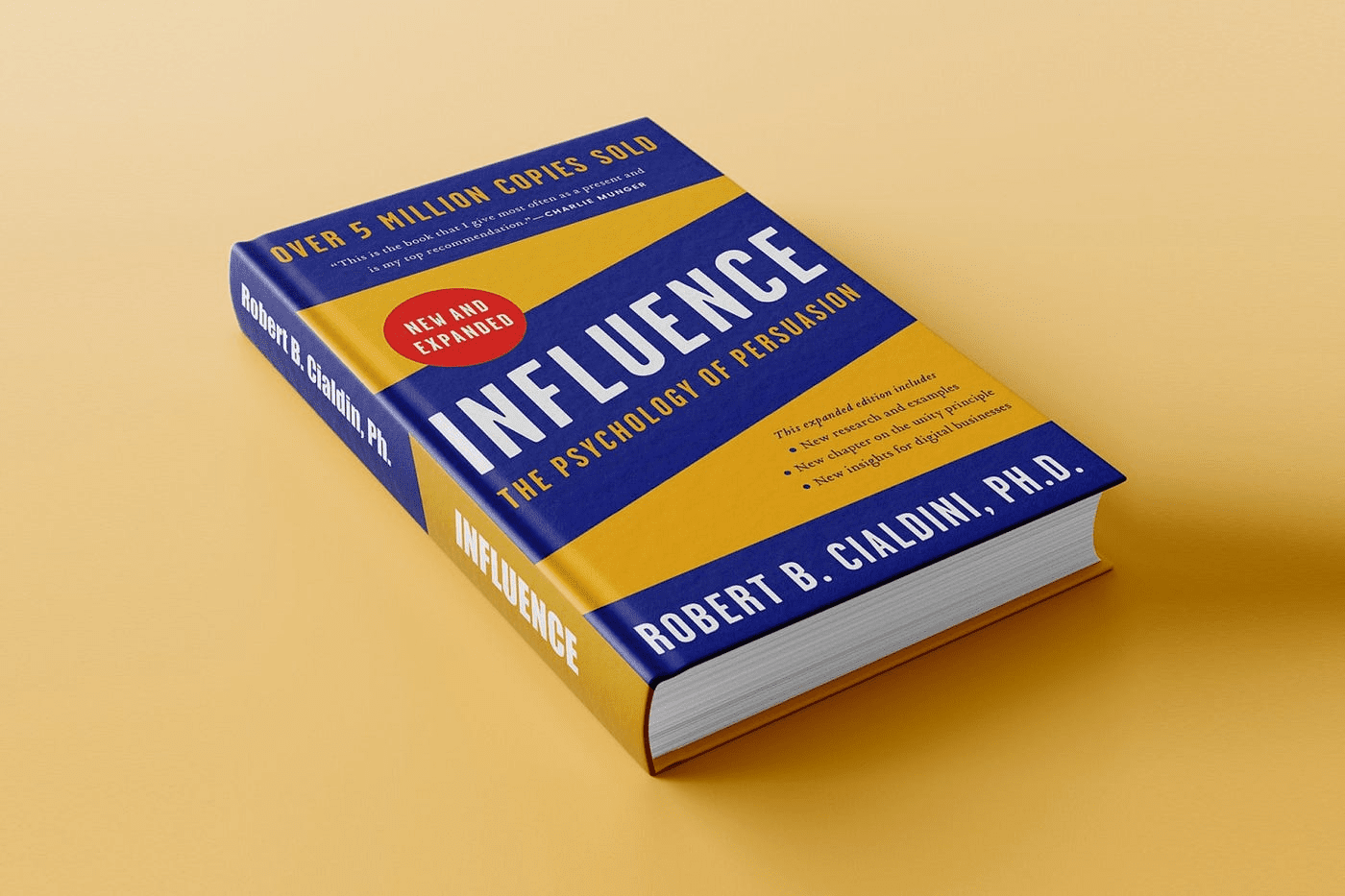

Influence: The Psychology of Persuasion – A Deep Dive into Cialdini’s Masterwork
Quick orientation
Robert B. Cialdini’s “Influence: The Psychology of Persuasion” is a landmark exploration into why people say “yes.” As an experimental social psychologist, Cialdini spent years researching the psychology of compliance, combining laboratory experiments with immersive “participant observation” in the worlds of sales, fundraising, advertising, and recruitment. He sought to understand what makes a request effective and why we often agree to things, sometimes against our better judgment.
This book uncovers six fundamental psychological principles that govern our tendency to comply: Reciprocation, Commitment and Consistency, Social Proof, Liking, Authority, and Scarcity. Cialdini explains how these “weapons of influence” are often used by compliance professionals to persuade us, sometimes ethically and sometimes not. Understanding these principles is crucial not just for marketers or salespeople, but for anyone navigating social interactions, aiming to make informed decisions, and wishing to avoid being unduly manipulated. This summary will provide simple, clear explanations of every key idea, equipping you to recognize these powerful forces at play in your daily life.
Chapter 1: Weapons of Influence
This chapter introduces the concept of “fixed-action patterns” in human behavior, similar to automatic responses in animals, which can be triggered by specific cues. It explores how these mental shortcuts, while often efficient, can make us vulnerable to manipulation by those who understand how to trigger them.
Click, Whirr: Automatic Responding
Our complex world necessitates mental shortcuts to make decisions efficiently. These shortcuts often work like automatic tapes that play when a specific “trigger feature” is encountered.
- Trigger Features: Just as a mother turkey responds to the “cheep-cheep” sound of her chicks, humans can respond automatically to certain cues.
- “Because” Justification: Ellen Langer’s Xerox machine experiment showed that merely using the word “because” increased compliance, even if the reason given was not substantial (e.g., “May I use the Xerox machine, because I have to make some copies?”).
- “Expensive = Good”: The jewelry store owner who accidentally sold turquoise jewelry for double the price illustrates this stereotype. Customers, lacking expertise, used price as a cue for quality.
- Efficiency: These shortcuts usually serve us well, allowing us to act without exhaustive analysis of every situation.
- Vulnerability: This automatic responding makes us susceptible to those who know how to exploit these triggers for their gain.
The Contrast Principle
This principle affects how we perceive the difference between two things presented one after another. If the second item is fairly different from the first, we will tend to see it as more different than it actually is.
- Weight Perception: Lifting a light object first makes a subsequent heavy object feel heavier.
- Attractiveness: Seeing a very attractive person can make an average-looking person seem less attractive.
- Water Temperature: Placing one hand in hot water and another in cold, then both in lukewarm water, makes the lukewarm water feel cold to one hand and hot to the other.
- Retail Sales: Clothing stores instruct staff to sell the expensive item (like a suit) first. The price of subsequent, less expensive items (like a sweater or accessories) will seem smaller in comparison.
- Real Estate: Showing “setup” properties (undesirable houses at inflated prices) first makes the genuine properties look much better.
- Car Sales: Negotiating the car price first, then suggesting add-ons one by one, makes each extra seem trivial compared to the larger purchase price.
- Subtlety: The contrast principle works because it’s often undetectable, allowing manipulators to structure situations to their advantage without appearing to do so.
- Reader’s Report Example: Sharon’s letter to her parents used the contrast principle masterfully by first presenting a series of shocking (false) news items to make her bad grades seem minor in comparison.
This chapter sets the stage by showing that many of our decisions are not as thought-out as we believe, and specific triggers can elicit automatic compliance, a fact well understood by “compliance professionals.”
Chapter 2: Reciprocation: The Old Give and Take…and Take
This chapter explores the powerful and universal rule of reciprocation, which obligates us to repay what another person has provided. It details how this deeply ingrained social mechanism, essential for societal development, can be skillfully exploited.
The Rule of Reciprocation
The rule dictates that we should try to repay, in kind, what another person has provided us. This sense of future obligation is fundamental to human society.
- Universality: Sociologists like Alvin Gouldner assert that no human society is without this rule, which underpins division of labor, exchange of goods, and interdependencies.
- Future Orientation: It allows individuals to give resources with confidence that they are not lost, fostering cooperation.
- Historical Example: Ethiopia sent $5,000 in aid to Mexico in 1985, reciprocating aid Mexico provided in 1935 when Ethiopia was invaded by Italy, despite Ethiopia’s own dire situation.
- Social Sanctions: We are taught to honor this rule, and those who don’t (moochers, ingrates) face social disapproval.
Overpowering Nature of the Rule
The reciprocity rule is so potent that it can overcome other factors that normally influence compliance, such as liking.
- Regan’s Coke Experiment: Subjects who received an unsolicited Coke from a confederate (Joe) bought significantly more raffle tickets from him, regardless of whether they liked him or not. Those who didn’t receive a Coke bought more tickets if they liked Joe.
- Hare Krishna Society: They give a “gift” (flower, book) before requesting a donation. This benefactor-before-beggar strategy dramatically increased donations by invoking reciprocation, even if the target didn’t like the Krishnas or want the gift.
- Politics: The rule operates in logrolling, campaign contributions (Keating’s “I certainly hope so” about contributions influencing senators), and constituent favors.
- Marketing – Free Samples: Supermarket samples or Amway’s “BUG” (a collection of products left for trial) create a sense of indebtedness, leading to purchases.
- Extreme Cases: A German soldier spared a captive who offered him bread. Diane Louie survived Jonestown partly by refusing special favors from Jim Jones, avoiding indebtedness.
Uninvited Debts
The rule can be triggered by an uninvited favor, reducing our ability to choose whom we wish to be indebted to.
- No Request Needed: We feel obligated to repay even if we didn’t ask for the initial favor. Charities sending unsolicited address labels with donation requests nearly double their success rate.
- Obligation to Receive: It’s often awkward or impolite to refuse a gift, putting the power in the hands of the giver. Joe in the Coke experiment chose the initial favor and the return favor.
- Unwanted Gifts: Hare Krishnas often retrieve discarded flowers from trash cans to recycle them, as even unwanted gifts effectively trigger donations.
Unfair Exchanges
The reciprocity rule can lead to unequal exchanges, where a small initial favor indebts someone to a much larger return favor.
- Psychological Burden: The discomfort of indebtedness makes us willing to give back more than we received to relieve this burden and avoid social disapproval.
- Regan’s Experiment Again: A 10-cent Coke often resulted in subjects buying 50 cents worth of raffle tickets.
- Student’s Car Example: A student lent her new car to a near-stranger who had jump-started it a month earlier; he totaled it.
- Sexual Obligation: Women report feeling uncomfortably obligated after a man buys them expensive gifts or even drinks, a concern supported by research showing women who accept drinks are judged more sexually available.
Reciprocal Concessions (Rejection-then-Retreat)
A more subtle application of reciprocity involves making a concession to someone who has made a concession to us. This leads to the “rejection-then-retreat” technique.
- Boy Scout Example: The author declined to buy $5 circus tickets but then bought $1 chocolate bars (a retreat from the larger request).
- Mechanism: If someone makes a concession (moves from a larger to a smaller request), we feel obliged to make a return concession (comply with the smaller request).
- Zoo Trip Experiment: Students asked first to volunteer for two years as delinquent counselors (refused) were three times more likely to then agree to chaperone delinquents on a one-day zoo trip (the smaller, retreat request) compared to those asked only the zoo trip request.
- Negotiation: Labor negotiators or TV producers (like Gary Marshall dealing with censors) often start with extreme demands they expect to be rejected, allowing them to “concede” to their actual goal.
- Contrast Principle: The smaller request also seems even smaller due to the contrast with the initial larger request.
- Watergate Example: G. Gordon Liddy’s initial $1 million and $500,000 plans were rejected before his “bare-bones” $250,000 Watergate break-in plan was approved, likely influenced by perceived concession and contrast.
- Increased Satisfaction and Responsibility: Victims of rejection-then-retreat often feel more responsible for and satisfied with the agreement, making them more likely to carry it out and agree to future requests.
How to Say No to Reciprocation
Recognize that the real opponent is the rule itself when exploited.
- Accept Genuine Favors: Participate fairly in the network of obligation.
- Redefine Exploitative Favors: If an initial favor is recognized as a compliance trick or sales device, redefine it as such. A trick does not need to be met with a favor. This frees you from the obligation.
- Exploit the Exploiter: If someone uses a “gift” as a sales tactic, you can accept the “gift” and decline the purchase, turning their weapon against them.
This chapter underscores that the reciprocity principle, while vital for social cohesion, has a potent dark side when used to engineer compliance through uninvited debts or strategic concessions.
Chapter 3: Commitment and Consistency: Hobgoblins of the Mind
This chapter delves into our deep-seated desire to be (and to appear) consistent with what we have already done or said. Once we make a commitment, personal and interpersonal pressures compel us to behave consistently with it, even if it’s not in our best interest.
The Drive for Consistency
Our culture highly values consistency, associating it with strength, rationality, and honesty, while inconsistency is often seen as undesirable.
- Racetrack Bettors: People are more confident in their horse’s chances after placing a bet, not because the horse’s chances changed, but because their commitment (the bet) pressures them to align their beliefs with their actions.
- Sara and Tim: Sara became more devoted to Tim after choosing him over another suitor, even though the conditions for her choice (Tim quitting drinking, marrying her) were not met. Her commitment drove her to justify her decision.
- Moriarty’s Beach Theft Experiment: People asked to “watch my things” were far more likely to intervene and stop a staged theft of a radio than those not asked, due to their prior commitment.
- Mental Shortcut: Consistency offers an escape from rigorous thought. Once a decision is made, we can often play our “consistency tape” automatically.
- Hiding from Unwelcome Truths: The TM lecture example showed people rushing to commit (pay) after a logical debunking of TM’s claims, precisely to avoid having to think about the uncomfortable implications and to maintain their hope.
Commitment as the Key
Securing an initial commitment is the crucial step for activating consistency pressures.
- Toy Companies’ Post-Christmas Sales: Manufacturers advertise specific toys heavily before Christmas, undersupply them, then re-advertise after Christmas. Parents, having promised the toys, feel compelled to buy them later, often at full price, to remain consistent with their promise.
- Small Commitments Lead to Larger Ones:
- American Cancer Society Survey: People who predicted they would volunteer if asked were 700% more likely to agree when actually asked.
- Voting Prediction: Asking people if they would vote increased turnout.
- “How are you feeling?” Tactic: Charity callers get targets to state they are “fine,” making it harder to then appear stingy when asked for a donation for the less fortunate.
- Chinese POW Indoctrination: Captors started with mild anti-American statements (“The United States is not perfect”). Once complied with, prisoners were pushed for more substantial commitments (listing problems, signing names, reading lists, writing essays), leading to changed self-image and collaboration.
- Foot-in-the-Door Technique: Getting compliance with a small request increases the likelihood of compliance with a subsequent, larger request.
- Freedman & Fraser’s “Drive Carefully” Sign: Homeowners who first agreed to display a tiny “Be a Safe Driver” sign were vastly more likely to later agree to an enormous, ugly “Drive Carefully” billboard.
- Beautification Petition: Even a commitment to a remotely related topic (state beautification) increased compliance with the billboard request, as it changed their self-image to “public-spirited citizens.”
Effective Commitments: Active, Public, Effortful
Commitments are most effective in changing self-image and future behavior when they possess certain characteristics.
- Active Commitments (The Magic Act): Writing things down provides physical evidence and requires more effort than verbal agreement, making the commitment stronger.
- Chinese POWs: Were pushed to write pro-Communist statements, even if just copying them.
- Self-Perception: Our actions inform us about our beliefs; written statements are powerful actions.
- Persuading Others: Written statements can persuade others that the author genuinely believes them, further reinforcing the author’s self-image.
- Amway’s “Write Down Your Goals”: Leverages the “magic” of written commitment.
- Sales Agreements Filled by Customers: Reduces cancellations for door-to-door sales.
- Testimonial Contests (“Why I like…”): Get many people to go on record praising a product, increasing their belief in it.
- Public Commitments (The Public Eye): Publicly taken stands are more resistant to change because we want to appear consistent to others.
- Deutsch & Gerard Line Estimation Study: Students who publicly wrote down their estimates were most resistant to changing them, even with new contradictory evidence.
- Hung Juries: More frequent with visible show-of-hands voting vs. secret ballots.
- Weight-Reduction Clinics: Clients write down goals and show them to others.
- Quitting Smoking: The woman who made public promises on business cards to everyone she respected.
- Effortful Commitments (The Effort Extra): The more effort put into a commitment, the more it influences attitudes.
- Tribal Initiations (Thonga): Severe hazing (beatings, cold, thirst, unsavory food, punishment, death threats) leads to greater group valuation.
- Fraternity Hazing: Similar brutal rituals persist despite attempts to ban them, as they build group loyalty and cohesiveness.
- Aronson & Mills’ Initiation Study: Women who endured a severely embarrassing initiation valued a (deliberately worthless) group more.
- Military Boot Camp: Intense training creates resilience and camaraderie.
The Inner Choice
For a commitment to produce lasting inner change, individuals must feel they made the choice freely, without strong external pressures (like large rewards or threats).
- Fraternities & Public Service: Fraternities resist incorporating public service into hazing because it would give pledges an external justification (“I did it for charity”) rather than internalizing the commitment to the group.
- Chinese POWs & Small Prizes: Small prizes for essay contests ensured prisoners couldn’t attribute their pro-Communist writings to a large reward, fostering inner responsibility.
- Freedman’s Forbidden Toy Experiment: Boys warned not to play with a robot with a mild admonition (“It is wrong”) largely avoided it weeks later. Boys given a severe threat played with it once the threat was gone. The first group took inner responsibility for their choice.
- Child Rearing: Use reasons just strong enough to produce desired behavior but not so strong that the child sees it as the sole reason, fostering internal belief.
Growing Legs to Stand On
Commitments that create inner change often “grow their own legs,” meaning people generate new reasons and justifications to support their decision, even if the original inducement is removed.
- Lowball Tactic: An advantage is offered to induce a decision (e.g., a good car price). After the decision is made, but before the deal is sealed, the original advantage is removed.
- Car Sales Example: A low price is offered, forms filled out, financing arranged. Then an “error” is found, or the boss disallows it, and the price increases. Customers, having already committed and built new justifications, often still buy.
- Sara and Tim: Tim promised to change (the “inducement”). Sara committed. Tim reneged, but Sara, having found “new reasons,” stayed.
- Pallak’s Energy Conservation Study: Homeowners promised newspaper publicity for saving energy did so. When publicity was withdrawn, they increased their conservation, having developed an internal “conservation-minded” self-image.
How to Say No to Commitment and Consistency
Recognize that “a foolish consistency is the hobgoblin of little minds” (Emerson). The goal is not to eliminate consistency but to avoid unthinking, automatic consistency.
- Stomach Signs: Listen to the feeling in the pit of your stomach when you realize you’re being trapped into complying with an unwanted request due to a prior commitment. Call out the manipulator on their tactic.
- Heart of Hearts: For deeper, less obvious inconsistencies (like Sara’s situation), try to access your true, unrationalized feelings. Ask the crucial question: “Knowing what I now know, if I could go back in time, would I make the same choice?” Trust the first flash of feeling.
- Gas Station Example: The author realized, via the “heart of hearts” question, that he wouldn’t have stopped for gas if he knew the real price initially; the justifications came after the stop.
This chapter highlights how our innate desire for consistency, when combined with specific commitment techniques, can be a powerful tool of influence, often leading us to justify and perpetuate choices we might not otherwise make.
Chapter 4: Social Proof: Truths Are Us
This chapter examines the principle of social proof: we determine what is correct by finding out what other people think is correct. We view a behavior as more correct in a given situation to the degree that we see others performing it.
The Principle of Social Proof
This principle is a convenient shortcut for determining how to behave, but it can be exploited when evidence is faked or when we respond mindlessly.
- Canned Laughter: TV executives use laugh tracks because experiments show they cause audiences to laugh longer and more often, and rate material as funnier, especially poor jokes. We respond to the sound of laughter as a cue, even if it’s artificial.
- Everyday Examples:
- Bartenders “salt” tip jars.
- Church ushers “salt” collection baskets.
- Evangelical preachers use “ringers” to come forward.
- Advertisers claim products are “fastest-growing” or “largest-selling.”
- Charity telethons list prior pledges.
- Discotheques create artificial waiting lines.
- Bandura’s Dog Phobia Treatment: Fearful children watched another child play happily with a dog for 20 minutes a day; 67% became willing to play with a dog. Filmed examples, especially with varied children, were also effective.
- O’Connor’s Film for Socially Withdrawn Children: A 23-minute film showing solitary children joining social activities caused withdrawn children to become highly social, an effect that lasted weeks later.
- Doomsday Cult Study (Festinger, Riecken, Schachter): When the prophecy of a world-ending flood and rescue by spaceship failed, members of a Chicago cult, who had made extreme commitments, didn’t disband. Instead, they drastically increased their proselytizing efforts.
- Reason: With physical proof shattered, they needed to establish social proof. If they could convince others, their own beliefs would seem truer. “Convince and ye shall be convinced!”
Causes of Death: Uncertainty
Social proof operates most powerfully when we are unsure of ourselves or when the situation is unclear or ambiguous.
- Pluralistic Ignorance: In ambiguous situations, everyone looks to others for cues. If everyone else appears calm (because they too are observing), the situation is misinterpreted as a non-emergency.
- Catherine Genovese Murder: 38 witnesses watched her prolonged attack without calling police. Latané and Darley proposed this was because there were so many observers.
- Diffusion of Responsibility: With many potential helpers, individual responsibility is reduced.
- Misinterpretation: Observers look to each other; seeing no outward alarm, they assume nothing is seriously wrong.
- Bystander Experiments (Latané & Darley):
- Seizure Study: A student having a “seizure” received help 85% of the time from a single bystander, but only 31% from five bystanders.
- Smoke-Filled Room Study: 75% of lone individuals reported smoke, but only 38% in three-person groups, and just 10% if two confederates ignored the smoke.
- Urban Environments: Cities naturally have more confusion, more people, and lower acquaintanceship, all factors that decrease bystander aid.
Devictimizing Yourself
To get help in an emergency, reduce bystanders’ uncertainty.
- Be Clear: Don’t just moan; use the word “Help.”
- Single Out an Individual: Point to one person and give specific instructions: “You, sir, in the blue jacket, I need help. Call an ambulance.” This assigns responsibility and clarifies the required action.
- Author’s Car Accident: After his accident, cars initially drove past. When he singled out drivers with specific requests, they immediately helped, and others followed suit.
Monkey Me, Monkey Do (Similarity)
The principle of social proof operates most powerfully when we are observing the behavior of people just like us.
- Average-Person Testimonials: Advertisers use “ordinary people” because viewers are more persuaded by those they see as similar.
- Wallet Study (Manhattan): Wallets were returned 70% of the time if the enclosed letter (from a “previous finder”) appeared to be from a similar American, but only 33% if from a dissimilar foreigner.
- School Antismoking Programs: More effective with same-age peer leaders.
- Dental Anxiety Film: More effective if the child in the film was the same age as the viewer.
- Author’s Son Learning to Swim: Chris learned to swim not from adults, but after seeing Tommy, another three-year-old, swim without a ring.
- The Werther Effect (David Phillips): Highly publicized suicide stories lead to an increase in suicides and “accidental” deaths (car/plane crashes) among similar individuals who see suicide as a more legitimate option.
- Specificity: Single-victim suicides lead to single-victim crashes; multiple-victim suicides lead to multiple-victim crashes. Imitation is age-specific too.
- Homicide Contagion: Highly publicized violence (e.g., heavyweight fights) can lead to increased homicides, with victims often similar to the loser of the fight.
- Jonestown Mass Suicide: Relocation to an isolated Guyanese jungle created extreme uncertainty and reliance on similar others (fellow cult members) for cues. The orderly suicide of the first few provided powerful social proof, compounded by pluralistic ignorance, leading to mass compliance. Jim Jones’s genius was in arranging group conditions to maximize social proof.
How to Say No to Social Proof
Recognize that social proof is often a valid shortcut, but be aware of its vulnerabilities.
- Identify Faked Social Proof: Be alert to counterfeit evidence like canned laughter or staged testimonials (“Consumers From Mars”). Disengage the automatic pilot and counterattack (e.g., boycott products, complain).
- Recognize Pluralistic Ignorance: In situations where a crowd seems inactive, realize they might not be acting on superior information but are also observing others. Don’t assume the crowd knows best; assess the situation independently.
- Buffalo Hunting Analogy: Buffalo, relying on the herd’s movement and not looking ahead, could be stampeded over cliffs. Similarly, uncritical reliance on crowd behavior can lead to disastrous “crashes.” Look up and around.
This chapter reveals that our reliance on others’ actions as a guide for our own is a fundamental and often useful heuristic, but one that can be disastrously misguiding when the social evidence is flawed, manipulated, or misinterpreted.
Chapter 5: Liking: The Friendly Thief
This chapter explains that we most prefer to say “yes” to the requests of people we know and like. Compliance professionals expertly leverage this principle by employing various tactics to increase their likability.
Making Friends to Influence People
The liking rule is so powerful that strangers will try to get us to like them to gain compliance.
- Tupperware Party: The core of its success is that the request to buy comes from a friend (the hostess), who profits from sales. This brings friendship, warmth, and obligation into the sales setting.
- Charity Canvassers: Organizations often use volunteers to solicit in their own neighborhoods.
- “Endless Chain” Method: Salespeople ask satisfied customers for names of friends, then approach these referrals mentioning the friend’s name, making it harder to turn away.
- Joe Girard: The “world’s greatest car salesman” attributed his success to offering a fair price and being someone customers liked to buy from.
Physical Attractiveness
Good-looking people have a significant advantage in social interaction due to a “halo effect,” where one positive characteristic (attractiveness) dominates how they are perceived.
- Automatic Positive Traits: We unconsciously assign traits like talent, kindness, honesty, and intelligence to attractive individuals.
- Politics: Attractive candidates receive more votes, though voters often deny this influence.
- Hiring: Good grooming can outweigh job qualifications.
- Legal System: Attractive defendants often receive lighter sentences or avoid jail more frequently. Victims who are more attractive may receive larger damage awards.
- Helpfulness and Persuasion: Attractive people are more likely to get help and be more persuasive.
- Early Accumulation: Even children benefit, with adults viewing their misbehavior as less naughty and teachers presuming them more intelligent.
Similarity
We like people who are similar to us in opinions, personality, background, or lifestyle.
- Dress: We are more likely to help those who dress like us (e.g., hippie vs. straight attire experiment).
- Background and Interests: Salespeople are trained to find and claim similarities with customers (e.g., hobbies, hometown).
- Insurance Sales: Salespeople similar in age, religion, politics, or smoking habits to customers are more successful.
- “Mirror and Match”: Sales trainees are taught to mirror a customer’s posture, mood, and verbal style to increase liking.
Compliments
We are highly susceptible to flattery and tend to like those who praise us, even if the praise is untrue or the flatterer has ulterior motives.
- McLean Stevenson’s Joke: “She said she liked me” as the reason for marriage.
- Joe Girard’s “I Like You” Cards: Sent monthly to over 13,000 former customers, contributing to his success.
- North Carolina Compliment Study: Men liked an evaluator who gave only positive comments best, even when they knew the flatterer needed a favor and even if the praise was inaccurate.
Contact and Cooperation
Generally, we like things that are familiar to us (mere exposure effect), but continued exposure under unpleasant conditions (like competition) leads to less liking. Cooperation, however, fosters liking.
- Familiarity: We prefer familiar faces (e.g., our mirror image vs. our true image). Familiar names can win elections.
- School Desegregation Problem: Simple contact in integrated schools often increased prejudice because the typical classroom environment is competitive, making students from different groups rivals.
- Sherif’s Robbers Cave Experiment: Separating boys into groups (Eagles and Rattlers) and fostering competition created intense hostility. Imposing common goals that required cooperation (e.g., fixing the water supply, pooling money for a movie) broke down barriers and led to friendships.
- Jigsaw Classroom (Aronson): Students in desegregated classrooms were formed into cooperative teams where each member had a unique piece of information needed for a test. This forced cooperation, reduced prejudice, and improved self-esteem and academic performance for minority students.
- Good Cop/Bad Cop Technique: This interrogation method works partly because the “Good Cop” appears to be cooperating with the suspect, working for them against the “Bad Cop,” fostering trust and compliance.
Conditioning and Association
We come to like or dislike things simply because they are associated with positive or negative experiences or people.
- Weatherman’s Plight: TV weathermen are often blamed for bad weather due to mere association, just as ancient Persian messengers bringing bad news were slain. “The nature of bad news infects the teller.”
- Positive Associations: Compliance professionals try to connect themselves or their products with positive things.
- Models in Ads: Attractive models lend their positive traits (beauty, desirability) to products like cars.
- Cultural Rages: Products linked to moon shots, Olympics, or “naturalness.”
- Celebrity Endorsements: Used by advertisers and politicians.
- Food (Luncheon Technique – Razran): People become fonder of things (e.g., political statements) they experience while eating. Political fundraising often involves meals for this reason. This is based on Pavlovian conditioning.
- Sports Fans and BIRGing (Basking In Reflected Glory): Fans associate strongly with their teams. They say “We won” but “They lost,” manipulating pronouns to connect with success and distance from failure. This is more pronounced when personal prestige is low.
- Stage Mothers: Attempt to gain prestige through their children’s success.
How to Say No to Liking
Instead of trying to block the myriad factors that cause liking, focus on the feeling of liking itself.
- Detect Undue Liking: If you find yourself liking a compliance practitioner more quickly or deeply than expected under the circumstances, recognize this as a red flag.
- Mentally Separate Requester from Request: Remind yourself that you’ll be living with the product or service, not the salesperson.
- Focus on Merits: Make your decision based solely on the merits of the offer, not on your feelings about the person making it.
This chapter reveals that liking is a powerful lubricant for compliance, and many tactics are designed to make us like the requester, often through subtle associations, similarities, or flattery, even if those connections are superficial.
Chapter 6: Authority: Directed Deference
This chapter investigates our deeply ingrained tendency to obey authority figures, often responding to mere symbols of authority rather than its substance. This deference can lead to compliance even with unreasonable or harmful requests.
The Power of Authority Pressure
Humans are socialized to obey legitimate authority, a tendency that is generally adaptive but can be exploited.
- Milgram’s Obedience Experiment: Ordinary individuals, acting as “Teachers,” were willing to deliver increasingly severe (though fake) electric shocks to a “Learner” (an actor) simply because an authority figure (a lab-coated researcher) instructed them to do so.
- High Obedience: About two-thirds of subjects went to the maximum 450-volt shock level.
- Distress: Subjects showed extreme stress but continued to obey.
- Key Factor: The experimenter’s commands were crucial; when the victim demanded to continue or when two experimenters gave conflicting orders, obedience plummeted.
- Real-World Obedience: The S. Brian Willson incident, where a train crew followed orders and ran over protesters, illustrates the power of obedience in real-life settings. Willson himself blamed “the system.”
- Societal Benefit: Systems of authority allow for complex social organization, resource production, and defense. We are taught from birth that obedience is right and disobedience is wrong (parental, school, legal, military, religious lessons like Abraham’s story).
- Shortcut: Obeying authority is often an efficient shortcut, as authorities usually possess superior knowledge or power.
- Mindless Deference: This can lead to obeying even when it makes no sense.
- Medical Context: Nurses often defer to doctors’ orders without question. The “rectal earache” case (nurse misread “R ear” as “Rear” and administered eardrops rectally) shows how authority can override common sense.
- Medication Errors: Many hospital medication errors are attributed to mindless deference to physicians.
Connotation, Not Content (Symbols of Authority)
We often react to symbols of authority rather than actual authority, making us vulnerable to those who can fake these symbols.
- Titles: The easiest and most difficult symbol to acquire.
- Professor Example: The author’s friend avoids using his “Professor” title because it makes conversations stilted and overly respectful.
- Height Distortion: Prestigious titles make people seem taller (e.g., a “professor” perceived as taller than a “student”). Size is often linked to status.
- Hospital Nurse Study (Hofling et al.): 95% of nurses were about to administer an unauthorized, dangerously excessive drug dose to a patient based on a phone call from an unknown “doctor,” highlighting the power of a mere title.
- Clothes: Uniforms and well-tailored business suits can trigger automatic deference.
- Security Guard Uniform (Bickman): People were significantly more likely to comply with odd requests (e.g., “Give him a dime!”) from someone in a security guard uniform than street clothes.
- Business Suit Jaywalking: 3.5 times more pedestrians followed a man in a business suit jaywalking against a light than one in work clothes.
- Bank-Examiner Scheme: Con artists use a conservative business suit for the “examiner” and a bank guard uniform for an accomplice to swindle victims, often elderly.
- Trappings: Items like jewelry and cars can signify status and authority.
- Luxury Car Honking Study: Motorists waited significantly longer before honking at a new luxury car stopped at a green light than at an older economy model, showing deference to the trapping of wealth.
- Underestimation of Impact: People consistently underestimate the influence of authority symbols on their behavior.
How to Say No to Authority
The key is to recognize when authority directives should be followed and when they should be resisted.
- Heightened Awareness: Be aware of the power of authority and the ease with which its symbols can be faked.
- Ask: “Is this authority truly an expert?” Focus on the person’s actual credentials and whether those credentials are relevant to the current situation. Distinguish relevant from irrelevant authority (e.g., Robert Young as an actor, not a doctor, for Sanka).
- Ask: “How truthful can we expect the expert to be here?” Consider the authority’s trustworthiness and potential biases. Experts with something to gain are less persuasive.
- Beware the “Arguing Against Own Interest” Tactic: Compliance practitioners sometimes mention a minor drawback of their product/position to appear honest and trustworthy, making their main arguments more believable (e.g., Vincent the waiter recommending slightly cheaper dishes initially to establish trust, then upselling on wine and dessert).
This chapter demonstrates that our learned deference to authority is a powerful motivator, but one that can be triggered by superficial symbols, leading to unthinking compliance if we are not vigilant.
Chapter 7: Scarcity: The Rule of the Few
This chapter explores the scarcity principle: opportunities seem more valuable to us when their availability is limited. This principle derives power from our tendency to use availability as a shortcut for quality and from our aversion to losing freedoms.
The Rule of the Few
Things that are rare or becoming rare are perceived as more valuable.
- Mormon Temple Example: The author felt a strong urge to tour a restricted section of a Mormon temple only when he learned it would soon become unavailable to non-members.
- Answering the Ringing Phone: The potential unavailability of an unknown caller often trumps an ongoing, known conversation.
- Loss Aversion: People are more motivated by the thought of losing something than by gaining something of equal value (e.g., homeowners motivated by potential loss from poor insulation; breast cancer self-exam pamphlets emphasizing potential loss).
- Collectibles: Rare items, especially “precious mistakes” (like a blurred stamp), are highly valued due to their scarcity.
- Limited-Number Tactic: Informing customers that a product is in short supply increases its perceived value (e.g., “only five convertibles left”).
- Appliance Store Tactic: Salesperson claims an item is sold out, waits for customer commitment when it seems most desirable (unavailable), then “finds” one.
- Deadline Tactic: Placing a time limit on an offer creates urgency (e.g., “sale ends soon,” “deal good for today only”).
- Magazine/Vacuum Sales: Salespeople claim they’re in the area for “just one day” to prevent prospects from thinking it over.
- Boiler-Room Scams: High-pressure phone sales often use urgency and scarcity, telling customers a deal is no longer available, then offering a “last chance” to get in.
Psychological Reactance
When our free choice is limited or threatened, our need to retain freedoms makes us desire the restricted item (and associated goods/services) more.
- “Terrible Twos”: Children around age two show strong reactance as they develop a sense of autonomy. In an experiment, toddlers went directly for a toy placed behind an obstructive barrier, ignoring an equally attractive, accessible toy.
- Teenage Rebellion: Similar to “terrible twos,” teenagers react against parental control as they strive for adult rights and freedoms.
- Romeo and Juliet Effect: Parental interference in a teenage romance can intensify the couple’s love and commitment. A Colorado study confirmed that as parental interference increased, so did romantic feelings.
- Virginia Slims Ads: Appealing to women’s desire for freedom, these ads coincided with a rise in smoking only among teenage girls.
- Kennesaw Gun Law: A law requiring adult residents to own guns led to increased gun sales primarily to out-of-town visitors whose freedom wasn’t restricted by the law, while local compliance was low.
- Dade County Antiphosphate Ordinance: Banning phosphate detergents led Miamians to smuggle them, hoard them, and perceive them as better products than before the ban (e.g., gentler, better whiteners). We assign positive qualities to justify our increased desire for restricted items.
- Censorship and Restricted Information: Banning information increases the desire for it and makes people more favorable toward it, even before receiving it.
- UNC Speech Ban: Students became more opposed to coed dorms after learning a speech against them would be banned, without hearing the speech.
- Purdue “Adults Only” Book Study: Students told a book was restricted to those 21+ wanted to read it more and believed they’d like it more.
- Jury Instructions: Telling jurors to disregard inadmissible evidence (like the defendant having insurance) can backfire, causing them to rely on it more and award higher damages.
- Exclusive Information: Information perceived as scarce or exclusive is more persuasive (Brock & Fromkin’s “commodity theory”).
- Beef Import Study: Customers told about an impending beef shortage via “exclusive” company contacts bought six times more than those who got a standard sales pitch.
Optimal Conditions for Scarcity
The scarcity principle is more potent under certain conditions.
- Newly Experienced Scarcity: We value things more that have recently become less available than those that have always been scarce.
- Worchel’s Cookie Study: Participants rated cookies from a jar of two as more desirable if their jar initially contained ten cookies that were then “taken away,” compared to those whose jar always had only two.
- Revolutions (James C. Davies): Revolutions are more likely after a period of improving conditions is followed by a sharp reversal, making established freedoms suddenly less available (e.g., American black riots in the 1960s, failed Soviet coup after glasnost).
- Inconsistent Parental Discipline: Granting privileges erratically establishes freedoms, making later enforcement more difficult and leading to rebellious children.
- Competition for Scarce Resources: We want scarce items most when we are in competition for them.
- Cookie Study Again: Cookies that became scarce due to “social demand” (others needed them) were rated most desirable.
- Advertising Tactics: Showing crowds rushing for a product or emphasizing “popular demand.”
- Rivalry: An indifferent lover’s ardor surges with a rival’s appearance. Realtors may invent “another buyer” to spur a decision.
- “Feeding Frenzy”: Shoppers at bargain sales, like fish in a chummed area, compete fiercely for items they might otherwise ignore. Department stores use “loss leaders” like chum.
- Barry Diller’s “Poseidon Adventure” Auction: Open bidding among TV networks for the movie led to an irrationally high price, driven by the “fever” of competition for a scarce resource.
How to Say No to Scarcity
Our typical emotional reaction to scarcity (arousal, narrowed focus) hinders rational thought.
- Use Arousal as a Cue: When you feel the emotional rush from scarcity influences, use that feeling as a signal to stop, calm down, and regain a rational perspective.
- Ask Why You Want the Item:
- For Possession: If you want it for the social, economic, or psychological benefits of owning something rare, then its availability is a good gauge of its value to you for that purpose.
- For Utility: If you want it for its function (to eat, drive, use), remember that scarce things do not function any better due to their limited availability. The scarce cookies didn’t taste better.
- Richard’s Car Selling Tactic: The author’s brother scheduled multiple buyers for the same appointment time, creating competition for a scarce car. Buyers, caught in the emotional rush, focused on possessing the car, not just its utility, and often paid the asking price.
This chapter demonstrates that the allure of “the rule of the few” is a potent motivator, often leading us to overvalue and pursue items or information simply because their availability is, or seems to be, limited.
Epilogue: Instant Influence: Primitive Consent for an Automatic Age
This concluding chapter reflects on the increasing necessity of mental shortcuts in our complex, information-saturated modern world. It emphasizes that while these shortcuts are vital, their reliability is threatened by exploiters, and we must actively protect them.
The Need for Shortcuts in a Complex World
Modern life’s pace and information overload demand we use simplified decision-making strategies.
- Automatic Responding: We often rely on single, highly representative pieces of information (like the six principles discussed) rather than using all relevant data, similar to animals’ fixed-action patterns.
- Efficiency: These shortcuts (reciprocation, consistency, social proof, liking, authority, scarcity) are popular because they are usually reliable and help us navigate a complex world efficiently.
- Information Overload: Human knowledge is expanding at an unprecedented rate. We face a “blitz of modern daily life” with more choices, faster changes, and more transient relationships. Technology (computers, extensive media) further inundates us with information.
- Created Deficiency: Unlike animals with inherently limited cognitive powers, we have created our own mental deficiency by constructing an environment so complex that our natural capacity to process information is increasingly inadequate. We must revert to more primitive, single-feature responding.
The Threat to Our Shortcuts
The danger arises when these normally trustworthy cues are falsified or misrepresented by compliance practitioners seeking to profit from our mechanical responses.
- Exploitation: As our reliance on shortcuts increases, so will attempts to exploit them.
- Example – Social Proof: An advertiser truthfully stating a toothpaste is “largest-selling” provides valid social proof. This is a fair use of the shortcut. However, an advertiser faking “unrehearsed interviews” with actors to create a false impression of popularity is an exploiter.
- Consequences of Exploitation: If the reliability of our shortcuts is undermined by trickery, we will use them less and become less able to cope efficiently with decisional burdens.
Protecting Our Shortcuts
We must actively counter those who threaten the integrity of our mental shortcuts.
- Identify Exploiters: The enemy is not someone who uses influence principles fairly, but those who falsify, counterfeit, or misrepresent the cues that trigger our automatic responses.
- Retaliate: We should be willing to use boycott, threat, confrontation, censure, or other means to retaliate against those who abuse these principles.
- Refuse to watch TV shows with canned laughter.
- Don’t tip bartenders who salt their own tip jars.
- Leave establishments that use fake popularity cues (like artificial lines) and inform others.
- Importance of Reliable Shortcuts: In today’s world, shortcuts are no longer luxuries but necessities. Protecting their effectiveness is crucial for navigating modern life. The stakes are too high to allow their betrayal.
The epilogue serves as a call to action, urging readers not just to understand these principles for self-defense, but to actively work towards preserving the integrity of these essential cognitive tools in an increasingly complex age.
Big-picture wrap-up
“Influence: The Psychology of Persuasion” reveals that much of our decision-making isn’t based on deep, rational thought but on reliable mental shortcuts or “weapons of influence.” Cialdini identifies six key principles—Reciprocation, Commitment & Consistency, Social Proof, Liking, Authority, and Scarcity—that guide our behavior, often automatically. While these shortcuts are usually beneficial and efficient, they create vulnerabilities that compliance professionals can exploit, leading us to say “yes” even when we shouldn’t.
- Core takeaway: Our responses to persuasive attempts are often automatic and triggered by specific psychological principles, making us susceptible to manipulation if we’re not aware of these forces.
- Next action: Start consciously observing your daily interactions and decisions. Try to identify which of Cialdini’s six principles might be influencing your choices or the choices of others. This awareness is the first step to more conscious decision-making.
- Practical application: Recognize that these principles are powerful tools. You can use them ethically to become more persuasive, but more importantly, you can defend yourself against unethical exploitation by understanding how they work.
- Defense strategy: The most effective defense isn’t to reject these principles outright (as they are often helpful), but to recognize when they are being artificially or unfairly employed against you and to disengage the “automatic pilot.”
- Modern relevance: As life becomes more complex and information-dense, our reliance on these shortcuts will increase, making it even more crucial to understand and protect their integrity from those who would abuse them for profit.
- Reflective question: Which of these principles do you think most often influences your own decisions, and in what situations are you most vulnerable?# Influence: The Psychology of Persuasion – A Deep Dive into Cialdini’s Masterwork
Quick orientation
Robert B. Cialdini’s “Influence: The Psychology of Persuasion” is a landmark exploration into why people say “yes.” As an experimental social psychologist, Cialdini spent years researching the psychology of compliance, combining laboratory experiments with immersive “participant observation” in the worlds of sales, fundraising, advertising, and recruitment. He sought to understand what makes a request effective and why we often agree to things, sometimes against our better judgment.
This book uncovers six fundamental psychological principles that govern our tendency to comply: Reciprocation, Commitment and Consistency, Social Proof, Liking, Authority, and Scarcity. Cialdini explains how these “weapons of influence” are often used by compliance professionals to persuade us, sometimes ethically and sometimes not. Understanding these principles is crucial not just for marketers or salespeople, but for anyone navigating social interactions, aiming to make informed decisions, and wishing to avoid being unduly manipulated. This summary will provide simple, clear explanations of every key idea, equipping you to recognize these powerful forces at play in your daily life.
Chapter 1: Weapons of Influence
This chapter introduces the concept of “fixed-action patterns” in human behavior, similar to automatic responses in animals, which can be triggered by specific cues. It explores how these mental shortcuts, while often efficient, can make us vulnerable to manipulation by those who understand how to trigger them.
Click, Whirr: Automatic Responding
Our complex world necessitates mental shortcuts to make decisions efficiently. These shortcuts often work like automatic tapes that play when a specific “trigger feature” is encountered.
- Trigger Features: Just as a mother turkey responds to the “cheep-cheep” sound of her chicks, humans can respond automatically to certain cues.
- “Because” Justification: Ellen Langer’s Xerox machine experiment showed that merely using the word “because” increased compliance, even if the reason given was not substantial (e.g., “May I use the Xerox machine, because I have to make some copies?”).
- “Expensive = Good”: The jewelry store owner who accidentally sold turquoise jewelry for double the price illustrates this stereotype. Customers, lacking expertise, used price as a cue for quality.
- Efficiency: These shortcuts usually serve us well, allowing us to act without exhaustive analysis of every situation.
- Vulnerability: This automatic responding makes us susceptible to those who know how to exploit these triggers for their gain.
- Mimics: Some people, like mimics in nature (e.g., Photuris fireflies), learn to copy trigger features to dupe others into desired behaviors.
The Contrast Principle
This principle affects how we perceive the difference between two things presented one after another. If the second item is fairly different from the first, we will tend to see it as more different than it actually is.
- Weight Perception: Lifting a light object first makes a subsequent heavy object feel heavier.
- Attractiveness: Seeing a very attractive person can make an average-looking person seem less attractive.
- Retail Sales: Clothing stores instruct staff to sell the expensive item (like a suit) first. The price of subsequent, less expensive items (like a sweater or accessories) will seem smaller in comparison.
- Real Estate: Showing “setup” properties (undesirable houses at inflated prices) first makes the genuine properties look much better.
- Car Sales: Negotiating the car price first, then suggesting add-ons one by one, makes each extra seem trivial compared to the larger purchase price.
- Subtlety: The contrast principle works because it’s often undetectable, allowing manipulators to structure situations to their advantage without appearing to do so.
- Reader’s Report Example: Sharon’s letter to her parents used the contrast principle masterfully by first presenting a series of shocking (false) news items to make her bad grades seem minor in comparison.
This chapter sets the stage by showing that many of our decisions are not as thought-out as we believe, and specific triggers can elicit automatic compliance, a fact well understood by “compliance professionals.”
Chapter 2: Reciprocation: The Old Give and Take…and Take
This chapter explores the powerful and universal rule of reciprocation, which obligates us to repay what another person has provided. It details how this deeply ingrained social mechanism, essential for societal development, can be skillfully exploited.
The Rule of Reciprocation
The rule dictates that we should try to repay, in kind, what another person has provided us. This sense of future obligation is fundamental to human society.
- Universality: Sociologists like Alvin Gouldner assert that no human society is without this rule, which underpins division of labor, exchange of goods, and interdependencies.
- Historical Example: Ethiopia sent $5,000 in aid to Mexico in 1985, reciprocating aid Mexico provided in 1935 when Ethiopia was invaded by Italy, despite Ethiopia’s own dire situation.
- Social Sanctions: We are taught to honor this rule, and those who don’t (moochers, ingrates) face social disapproval.
- Overpowering Nature: The reciprocity rule is so potent that it can overcome other factors that normally influence compliance, such as liking. Regan’s Coke experiment showed subjects bought more raffle tickets from someone who gave them an unsolicited Coke, regardless of liking.
- Hare Krishna Society: They give a “gift” (flower, book) before requesting a donation, invoking reciprocation even if the target didn’t like the Krishnas or want the gift.
- Marketing – Free Samples: Supermarket samples or Amway’s “BUG” (a trial collection of products) create a sense of indebtedness, leading to purchases.
Uninvited Debts and Unfair Exchanges
The rule can be triggered by an uninvited favor, and it can lead to unequal exchanges.
- No Request Needed: We feel obligated to repay even if we didn’t ask for the initial favor. Charities sending unsolicited address labels with donation requests nearly double their success rate.
- Obligation to Receive: It’s often awkward or impolite to refuse a gift, putting the power in the hands of the giver.
- Psychological Burden: The discomfort of indebtedness makes us willing to give back more than we received to relieve this burden and avoid social disapproval.
- Student’s Car Example: A student lent her new car to a near-stranger who had jump-started it a month earlier; he totaled it, showing a small favor leading to a larger, unfair return.
- Sexual Obligation: Women report feeling uncomfortably obligated after a man buys them expensive gifts or even drinks.
Reciprocal Concessions (Rejection-then-Retreat)
A more subtle application of reciprocity involves making a concession to someone who has made a concession to us. This leads to the “rejection-then-retreat” technique.
- Boy Scout Example: The author declined to buy $5 circus tickets but then bought $1 chocolate bars (a retreat from the larger request).
- Mechanism: If someone makes a concession (moves from a larger to a smaller request), we feel obliged to make a return concession (comply with the smaller request).
- Zoo Trip Experiment: Students asked first to volunteer for two years (refused) were three times more likely to then agree to chaperone delinquents on a one-day zoo trip (the smaller, retreat request).
- Negotiation: Labor negotiators or TV producers often start with extreme demands, allowing them to “concede” to their actual goal.
- Contrast Principle: The smaller request also seems even smaller due to the contrast with the initial larger request.
- Watergate Example: G. Gordon Liddy’s initial, much larger plans were rejected before his “bare-bones” $250,000 Watergate break-in plan was approved, likely influenced by perceived concession and contrast.
- Increased Satisfaction and Responsibility: Victims of rejection-then-retreat often feel more responsible for and satisfied with the agreement, making them more likely to carry it out and agree to future requests.
How to Say No to Reciprocation
Recognize that the real opponent is the rule itself when exploited.
- Accept Genuine Favors: Participate fairly in the network of obligation.
- Redefine Exploitative Favors: If an initial favor is recognized as a compliance trick or sales device, redefine it as such. A trick does not need to be met with a favor. This frees you from the obligation.
- Exploit the Exploiter: If someone uses a “gift” as a sales tactic, you can accept the “gift” and decline the purchase, turning their weapon against them.
This chapter underscores that the reciprocity principle, while vital for social cohesion, has a potent dark side when used to engineer compliance through uninvited debts or strategic concessions.
Chapter 3: Commitment and Consistency: Hobgoblins of the Mind
This chapter delves into our deep-seated desire to be (and to appear) consistent with what we have already done or said. Once we make a commitment, personal and interpersonal pressures compel us to behave consistently with it, even if it’s not in our best interest.
The Drive for Consistency
Our culture highly values consistency, associating it with strength and rationality. This drive can be a powerful motivator.
- Racetrack Bettors: People are more confident in their horse’s chances after placing a bet, aligning beliefs with actions.
- Sara and Tim: Sara became more devoted to Tim after choosing him, justifying her decision despite unmet conditions.
- Moriarty’s Beach Theft Experiment: People asked to “watch my things” were far more likely to intervene and stop a staged theft, due to their prior commitment.
- Mental Shortcut: Consistency offers an escape from rigorous thought.
- Hiding from Unwelcome Truths: The TM lecture example showed people rushing to commit (pay) after a logical debunking of TM’s claims, to avoid uncomfortable implications.
Commitment as the Key
Securing an initial commitment is the crucial step for activating consistency pressures. Often, small commitments lead to larger ones.
- Toy Companies’ Post-Christmas Sales: Parents, having promised advertised toys (later found undersupplied), feel compelled to buy them post-Christmas to remain consistent.
- “How are you feeling?” Tactic: Charity callers get targets to state they are “fine,” making it harder to then appear stingy.
- Chinese POW Indoctrination: Captors started with mild anti-American statements. Compliance led to more substantial commitments (writing essays), changing self-image and fostering collaboration.
- Foot-in-the-Door Technique: Agreeing to a small request increases compliance with a subsequent, larger one. Freedman & Fraser’s “Drive Carefully” billboard experiment demonstrated this, even when the initial commitment was only remotely related (beautification petition).
Effective Commitments: Active, Public, Effortful
Commitments are most effective in changing self-image and future behavior when they possess certain characteristics.
- Active Commitments (The Magic Act): Writing things down provides physical evidence and requires more effort, strengthening the commitment (e.g., Amway’s “write down your goals,” sales agreements filled by customers, testimonial contests).
- Public Commitments (The Public Eye): Publicly taken stands are more resistant to change (e.g., Deutsch & Gerard’s line estimation study, weight-loss clinic goals shown to others).
- Effortful Commitments (The Effort Extra): The more effort put into a commitment, the more it influences attitudes (e.g., tribal initiations, fraternity hazing, military boot camp all build group loyalty through hardship). Aronson & Mills’ study showed women who endured severe initiation valued the group more.
The Inner Choice
For a commitment to produce lasting inner change, individuals must feel they made the choice freely, without strong external pressures like large rewards or threats.
- Freedman’s Forbidden Toy Experiment: Boys warned not to play with a robot with a mild admonition took inner responsibility and avoided it weeks later. Boys given a severe threat played with it once the threat was gone.
- Child Rearing: Use reasons just strong enough to produce desired behavior but not so strong that the child sees it as the sole reason, fostering internal belief.
Growing Legs to Stand On
Commitments that create inner change often “grow their own legs,” meaning people generate new reasons and justifications to support their decision, even if the original inducement is removed.
- Lowball Tactic: An advantage is offered to induce a decision (e.g., a good car price). After the decision, the advantage is removed, but customers, having committed and built new justifications, often still buy.
- Pallak’s Energy Conservation Study: Homeowners promised newspaper publicity for saving energy did so. When publicity was withdrawn, they increased their conservation, having developed an internal “conservation-minded” self-image.
How to Say No to Commitment and Consistency
Recognize that “a foolish consistency is the hobgoblin of little minds” (Emerson). Avoid unthinking, automatic consistency.
- Stomach Signs: Listen to the feeling in the pit of your stomach when you realize you’re being trapped into complying due to a prior commitment.
- Heart of Hearts: For deeper inconsistencies, ask: “Knowing what I now know, if I could go back in time, would I make the same choice?” Trust the first flash of feeling.
This chapter highlights how our innate desire for consistency, when combined with specific commitment techniques, can be a powerful tool of influence.
Chapter 4: Social Proof: Truths Are Us
This chapter examines the principle of social proof: we determine what is correct by finding out what other people think is correct. We view a behavior as more correct in a given situation to the degree that we see others performing it.
The Principle of Social Proof
This principle is a convenient shortcut for determining how to behave, but it can be exploited when evidence is faked or when we respond mindlessly.
- Canned Laughter: TV executives use laugh tracks because experiments show they cause audiences to laugh longer and more often, and rate material as funnier, especially poor jokes.
- Everyday Examples: Bartenders “salt” tip jars, advertisers claim products are “fastest-growing,” charity telethons list donors.
- Bandura’s Dog Phobia Treatment: Fearful children watched another child play happily with a dog; 67% became willing to play with a dog.
- O’Connor’s Film for Socially Withdrawn Children: A film showing solitary children joining social activities caused withdrawn children to become highly social.
- Doomsday Cult Study (Festinger): When a prophecy failed, cult members increased proselytizing to build social proof for their threatened beliefs.
Causes of Death: Uncertainty
Social proof operates most powerfully when we are unsure of ourselves or when the situation is unclear or ambiguous.
- Pluralistic Ignorance: In ambiguous situations, if everyone else appears calm (because they too are observing), the situation is misinterpreted as a non-emergency.
- Catherine Genovese Murder: 38 witnesses watched her attack without calling police, partly due to pluralistic ignorance and diffusion of responsibility.
- Bystander Experiments (Latané & Darley): Showed that the presence of multiple passive bystanders significantly reduces the likelihood of intervention in an emergency.
- Urban Environments: Cities often have conditions (confusion, populousness, low acquaintanceship) that decrease bystander aid.
Devictimizing Yourself
To get help in an emergency, reduce bystanders’ uncertainty.
- Be Clear: State your need for help directly.
- Single Out an Individual: Point to one person and give specific instructions: “You, sir, in the blue jacket, I need help. Call an ambulance.” This assigns responsibility.
Monkey Me, Monkey Do (Similarity)
The principle of social proof operates most powerfully when we are observing the behavior of people just like us.
- Average-Person Testimonials: Advertisers use “ordinary people” for persuasion.
- Wallet Study (Manhattan): Wallets were returned more often if a letter inside from a “previous finder” seemed to be from a similar American.
- Author’s Son Learning to Swim: Chris learned to swim after seeing Tommy, another three-year-old, swim without a ring.
- The Werther Effect (David Phillips): Highly publicized suicides lead to an increase in suicides and “accidental” deaths among similar individuals. This effect is specific regarding victim similarity and type of incident.
- Jonestown Mass Suicide: Relocation to an isolated jungle created extreme uncertainty and reliance on similar others (fellow cult members) for cues. The initial suicides provided powerful social proof, leading to mass compliance.
How to Say No to Social Proof
Recognize social proof as a useful shortcut, but be aware of its vulnerabilities.
- Identify Faked Social Proof: Be alert to counterfeit evidence like canned laughter or staged testimonials. Counterattack by boycotting or complaining.
- Recognize Pluralistic Ignorance: In ambiguous situations, don’t assume others know more; assess the situation independently.
- Buffalo Hunting Analogy: Buffalo relying on herd movement could be stampeded over cliffs. Don’t blindly follow the crowd; look up and around.
This chapter reveals that our reliance on others’ actions as a guide is fundamental but can be misleading when social evidence is flawed or misinterpreted.
Chapter 5: Liking: The Friendly Thief
This chapter explains that we most prefer to say “yes” to the requests of people we know and like. Compliance professionals expertly leverage this principle by employing various tactics to increase their likability.
Making Friends to Influence People
The liking rule is so powerful that strangers will try to get us to like them to gain compliance.
- Tupperware Party: Its success largely hinges on the request to buy coming from a friend (the hostess).
- “Endless Chain” Method: Salespeople get referrals from satisfied customers, approaching new prospects by mentioning a mutual friend.
- Joe Girard: The “world’s greatest car salesman” focused on offering a fair price and being someone customers liked.
Factors that Create Liking
Several factors reliably cause liking, and compliance professionals use them.
- Physical Attractiveness: A “halo effect” makes good-looking people seem more talented, kind, honest, and intelligent. They receive preferential treatment in politics, hiring, and the legal system.
- Similarity: We like people similar to us in opinions, background, dress, or lifestyle. Salespeople often feign similarities.
- Compliments: We are highly susceptible to flattery, even if untrue or from someone with ulterior motives. Joe Girard sent monthly “I like you” cards to thousands of customers.
- Contact and Cooperation: Familiarity (mere exposure) generally breeds liking, but not if contact is under unpleasant, competitive conditions (e.g., initial school desegregation problems). Cooperation towards common goals, however, fosters significant liking.
- Sherif’s Robbers Cave Experiment: Hostility between boys’ groups was overcome by introducing superordinate goals requiring cooperation.
- Jigsaw Classroom (Aronson): Cooperative learning structures in desegregated classrooms reduced prejudice and improved liking among students.
- Good Cop/Bad Cop: The “Good Cop” fosters liking by appearing to cooperate with the suspect.
- Conditioning and Association: We like or dislike things associated with positive or negative experiences or people.
- Weathermen and Bad News: People dislike those who bring unpleasant information (like bad weather), even if they didn’t cause it.
- Positive Associations in Advertising: Linking products with attractive models, celebrities, or current cultural rages (e.g., Olympics, “naturalness”).
- Luncheon Technique (Razran): People become fonder of things experienced while eating.
- Sports Fans and BIRGing (Basking In Reflected Glory): Fans associate with winning teams (“We won”) and distance from losing ones (“They lost”) to enhance their public image.
How to Say No to Liking
Focus on the feeling of liking itself rather than trying to block all its causes.
- Detect Undue Liking: If you like a requester more quickly or deeply than expected, it’s a red flag.
- Mentally Separate Requester from Request: Remind yourself that you are acquiring the product/service, not the salesperson.
- Focus on Merits: Base your decision solely on the offer’s merits, not your fondness for the requester.
This chapter shows that liking is a key to influence, and numerous tactics are used to make us like those who want our compliance.
Chapter 6: Authority: Directed Deference
This chapter investigates our deeply ingrained tendency to obey authority figures, often responding to mere symbols of authority rather than its substance. This deference can lead to compliance even with unreasonable or harmful requests.
The Power of Authority Pressure
Humans are socialized to obey legitimate authority, a tendency that is generally adaptive but can be exploited.
- Milgram’s Obedience Experiment: Ordinary individuals delivered severe (though fake) electric shocks to a “Learner” under an authority figure’s (researcher’s) orders, despite extreme personal distress.
- Societal Benefit: Authority systems enable complex social organization. We are taught obedience from birth through various social institutions.
- Shortcut: Obeying authority is often an efficient shortcut, as authorities usually possess superior knowledge.
- Mindless Deference: This can lead to obeying even when it makes no sense, as seen in medical contexts where nurses might unthinkingly follow flawed doctor’s orders (e.g., the “rectal earache” incident).
Connotation, Not Content (Symbols of Authority)
We often react to symbols of authority rather than actual authority, making us vulnerable.
- Titles: Can make people seem taller and alter social interactions (e.g., the author’s “Professor” friend). The Hofling hospital study showed nurses obeying phone orders from an unknown “doctor” for a dangerous drug dose.
- Clothes: Uniforms (like security guard attire in Bickman’s studies) and well-tailored business suits (as in the jaywalking experiment) can trigger automatic deference and compliance. The bank-examiner swindle exploits these symbols.
- Trappings: Items like luxury cars can signify status and command deference (e.g., motorists waiting longer to honk at a luxury car).
- Underestimation of Impact: People generally underestimate the influence of authority symbols on their behavior.
- Robert Young Sanka Commercials: Leveraged his association with “Marcus Welby, M.D.” to sell coffee, using the appearance of authority.
How to Say No to Authority
The key is to recognize when authority directives should be followed and when they should be resisted.
- Heightened Awareness: Be conscious of authority’s power and the ease of faking its symbols.
- Ask: “Is this authority truly an expert?” Evaluate their credentials and relevance to the current situation.
- Ask: “How truthful can we expect this expert to be here?” Consider their trustworthiness and potential biases. Be wary if they stand to gain from your compliance.
- Beware the “Arguing Against Own Interest” Tactic: Some compliance practitioners mention a minor drawback to appear honest, thereby increasing credibility for their main pitch (e.g., Vincent the waiter).
This chapter demonstrates our strong tendency to obey authority, often cued by superficial symbols, which can lead to unthinking compliance if not critically assessed.
Chapter 7: Scarcity: The Rule of the Few
This chapter explores the scarcity principle: opportunities seem more valuable to us when their availability is limited. This principle derives power from our tendency to use availability as a shortcut for quality and from our aversion to losing freedoms.
The Rule of the Few
Things that are rare or becoming rare are perceived as more valuable.
- Mormon Temple Example: The author’s interest in a temple tour spiked only when he learned access was temporarily and uniquely available.
- Loss Aversion: We are more motivated by potential loss than potential gain (e.g., home insulation ads, breast cancer pamphlets).
- Collectibles: Rare items, especially “precious mistakes,” are highly valued.
- Limited-Number Tactic: Informing customers that a product is in short supply (“only five left”) increases its perceived value.
- Deadline Tactic: Placing a time limit on an offer (“sale ends soon”) creates urgency.
Psychological Reactance
When our free choice is limited or threatened, our need to retain freedoms makes us desire the restricted item more.
- “Terrible Twos” & Teenage Rebellion: Classic examples of reactance to restrictions on freedom.
- Romeo and Juliet Effect: Parental interference can intensify a teenage romance.
- Censorship: Banning information often increases desire for it and makes people more favorable towards its (unheard) arguments (e.g., banned speech, “adults only” book).
- Kennesaw Gun Law / Dade County Phosphate Ban: Restrictions led to increased desire and perceived value of the restricted items, even if only among those not directly constrained or by causing people to see the banned item as better.
- Exclusive Information: Information perceived as scarce or exclusive is more persuasive (beef import study).
Optimal Conditions for Scarcity
The scarcity principle is more potent under certain conditions.
- Newly Experienced Scarcity: We value things more that have recently become less available (Worchel’s cookie study: cookies more desired if supply dropped from abundant to scarce). This is linked to political turmoil when established freedoms are curtailed.
- Competition for Scarce Resources: We want scarce items most when we are in competition for them (cookie study: cookies scarce due to “social demand” were most desirable). This is exploited by tactics like showing rivals for a product or creating “feeding frenzies” in sales. Barry Diller’s “Poseidon Adventure” auction exemplified this.
How to Say No to Scarcity
Our typical emotional reaction to scarcity hinders rational thought.
- Use Arousal as a Cue: When you feel the emotional rush from scarcity influences, use that as a signal to stop and calm down.
- Ask Why You Want the Item:
- For Possession: If for the benefit of owning something rare, its availability helps gauge value.
- For Utility: If for its function (to eat, drive, etc.), remember scarce things don’t function better (scarce cookies don’t taste better).
- Richard’s Car Selling Tactic: Scheduling multiple buyers simultaneously created competition for a scarce car, driving up desire based on possession, not just utility.
This chapter shows how the allure of limited availability powerfully motivates us, often leading to overvaluation if we don’t distinguish between the thrill of possession and an item’s actual utility.
Epilogue: Instant Influence: Primitive Consent for an Automatic Age
This concluding chapter reflects on the increasing necessity of mental shortcuts in our complex, information-saturated modern world. It emphasizes that while these shortcuts are vital, their reliability is threatened by exploiters, and we must actively protect them.
The Need for Shortcuts in a Complex World
Modern life’s pace and information overload demand we use simplified decision-making strategies.
- Automatic Responding: We often rely on single, highly representative pieces of information (like the six principles discussed) rather than using all relevant data, similar to animals’ fixed-action patterns.
- Efficiency: These shortcuts (reciprocation, consistency, social proof, liking, authority, scarcity) are popular because they are usually reliable and help us navigate a complex world efficiently.
- Information Overload: Human knowledge is expanding at an unprecedented rate, forcing us to deal with it in a more simplified, animal-like fashion.
- Created Deficiency: We have created a world so complex that our natural capacity to process information is increasingly inadequate, making shortcuts necessities, not luxuries.
The Threat to Our Shortcuts
The danger arises when these normally trustworthy cues are falsified or misrepresented by compliance practitioners seeking to profit from our mechanical responses.
- Exploitation: As our reliance on shortcuts increases, so will attempts to exploit them.
- Example – Social Proof: An advertiser truthfully stating a toothpaste is “largest-selling” provides valid social proof. However, faking “unrehearsed interviews” to create a false impression of popularity is exploitation.
- Consequences of Exploitation: If the reliability of our shortcuts is undermined, we will use them less and be less able to cope efficiently with modern life’s decisional burdens.
Protecting Our Shortcuts
We must actively counter those who threaten the integrity of our mental shortcuts.
- Identify Exploiters: The enemy is not someone who uses influence principles fairly, but those who falsify, counterfeit, or misrepresent the cues.
- Retaliate: We should be willing to use boycott, threat, confrontation, censure, or other means to retaliate against those who abuse these principles (e.g., refuse to watch TV with canned laughter, complain about fake ads).
- Importance of Reliable Shortcuts: Protecting the effectiveness of our shortcuts is crucial for navigating modern life. The stakes are too high to allow their betrayal.
The epilogue serves as a call to action, urging readers not just to understand these principles for self-defense, but to actively work towards preserving the integrity of these essential cognitive tools.
Big-picture wrap-up
“Influence: The Psychology of Persuasion” reveals that much of our decision-making isn’t based on deep, rational thought but on reliable mental shortcuts or “weapons of influence.” Cialdini identifies six key principles—Reciprocation, Commitment & Consistency, Social Proof, Liking, Authority, and Scarcity—that guide our behavior, often automatically. While these shortcuts are usually beneficial and efficient, they create vulnerabilities that compliance professionals can exploit, leading us to say “yes” even when we shouldn’t.
- Core takeaway: Our responses to persuasive attempts are often automatic and triggered by specific psychological principles, making us susceptible to manipulation if we’re not aware of these forces.
- Next action: Start consciously observing your daily interactions and decisions. Try to identify which of Cialdini’s six principles might be influencing your choices or the choices of others. This awareness is the first step to more conscious decision-making.
- Practical application: Recognize that these principles are powerful tools. You can use them ethically to become more persuasive, but more importantly, you can defend yourself against unethical exploitation by understanding how they work.
- Defense strategy: The most effective defense isn’t to reject these principles outright (as they are often helpful), but to recognize when they are being artificially or unfairly employed against you and to disengage the “automatic pilot.”
- Modern relevance: As life becomes more complex and information-dense, our reliance on these shortcuts will increase, making it even more crucial to understand and protect their integrity from those who would abuse them for profit.
- Reflective question: Which of these principles do you think most often influences your own decisions, and in what situations are you most vulnerable?




Leave a Reply