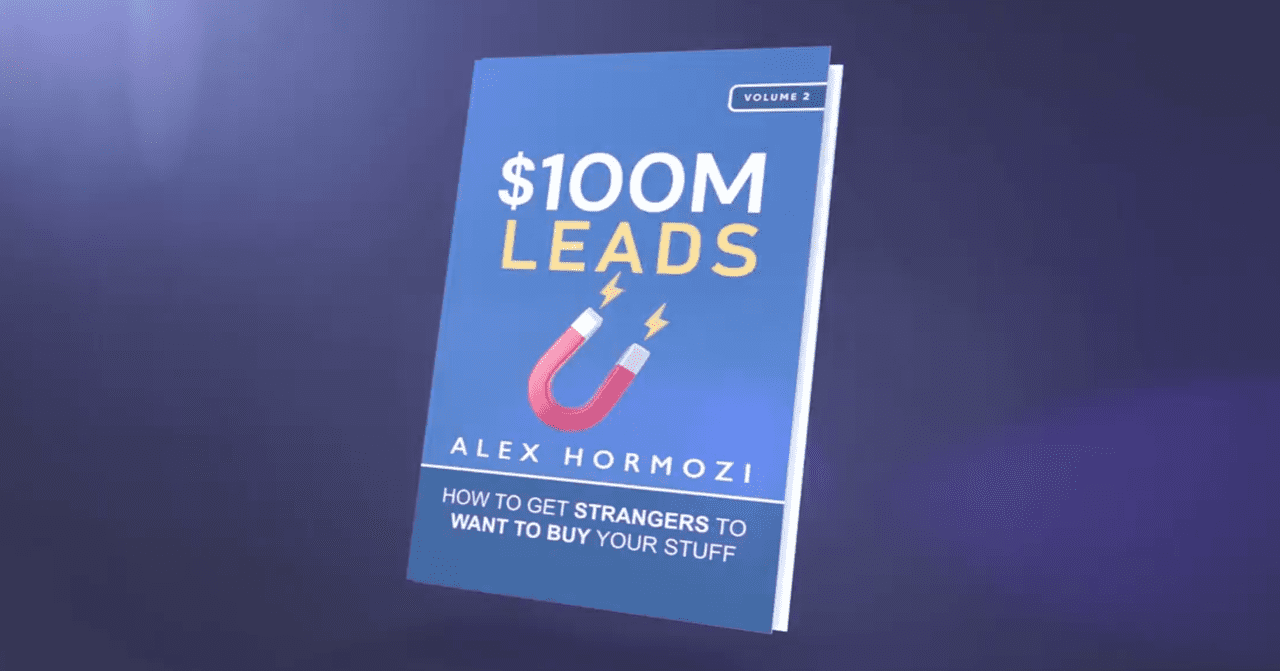

$100M Leads: Complete Summary of Alex Hormozi’s System for Getting Strangers to Buy Your Stuff
Introduction: What This Book Is About
Alex Hormozi’s $100M Leads is the highly anticipated follow-up to his first book, $100M Offers. This book tackles the critical challenge of generating leads for any business, addressing the common problem entrepreneurs face: not having enough potential customers interested in what they sell. Hormozi, a successful entrepreneur who built a portfolio of companies generating over $250 million in annual revenue, shares his proven advertising methods that generated over 20,000 leads daily across diverse industries. He emphasizes that while having a Grand Slam Offer (covered in his first book) is essential, it means nothing if strangers don’t know it exists.
This book provides a comprehensive blueprint for becoming a “lead-getting machine,” transforming businesses by increasing lead flow reliably and affordably. Hormozi aims to democratize business knowledge, providing value to entrepreneurs earning under $1 million in profit to help them reach that milestone for free. For those already exceeding $1 million in profit, he offers the potential for investment and accelerated growth through his holding company, Acquisition.com, which boasts an average 1.8x revenue and 3.01x profit growth for its portfolio companies within the first 12 months.
The book is structured to guide readers from zero leads and skills to building a $100 million-plus lead machine. It starts by defining what a lead truly is, explains how to engage leads effectively, reveals the “Core Four” fundamental lead generation methods, shows how to leverage “Lead Getters” (other people) to amplify efforts, and concludes with actionable plans for immediate implementation. Hormozi’s personal journey, marked by significant financial setbacks and triumphant comebacks, underscores the life-saving importance of mastering lead generation, offering readers a “get out of jail free card” in the unforgiving world of business.
Related top book summaries:
- Continuous Discovery Habits – Complete Book Summary & All Key Ideas
- Product management theater; Marty Cagan interview
- Inspired – Complete Book Summary & All Key Ideas
- Transformed – Complete Book Summary & All Key Ideas
- The Lean Product Playbook – Complete Book Summary & All Key Ideas
Section I: Start Here
How I Got Here: The Initial Setback
In March 2017, Alex Hormozi faced a devastating $150,000 in refunds from two gym launches. His business, Gym Launch, which filled gyms with members, was unexpectedly sabotaged by two gym owners who encouraged refunds. This event, coupled with a prior financial loss of all his life savings due to a fraudulent partner, left him completely broke and responsible for paying his team without any income. This crisis spurred him to find a new, more reliable way to generate revenue, shifting from physical gym launches to a more scalable, direct-to-consumer model.
How I Got Here: The Gym Launch Breakthrough
A year prior to the refund crisis, Hormozi had scaled his own gyms to five locations by opening them at full capacity from day one. He presented his advertising method at a conference, which garnered immense interest, leading over 100 people to ask him to teach them. This inspired the creation of Gym Launch, with an initial offer to fill a gym in 30 days for free, taking the first 6 weeks of membership fees as payment. This model was highly effective, booking him out for over two years with referrals. He then sold his own gyms to go all-in on Gym Launch, seeking a more leveraged model of co-ownership.
How I Got Here: The Pivot to Online and Licensing
After the $150,000 refund crisis, desperate for cash, Hormozi brainstormed solutions. His girlfriend, Leila, suggested leveraging her online fitness coaching, which had minimal overhead. They decided to run ads to a sales page for an online fitness program, using existing materials. This quickly generated $1,000 per day in sales, with cash upfront and low refund risk. While effective, it wasn’t enough to cover the $150,000 debt quickly.
How I Got Here: The Accidental Licensing Model
During calls to cancel upcoming gym launches to focus on the online fitness business, one gym owner begged Hormozi to just teach him the process. Desperate to get off the phone, Hormozi quoted $6,000 for his “secrets,” a price he thought would scare the owner off. To his shock, the owner immediately agreed. Subsequent calls with other gym owners led to sales of $8,000 and then $10,000 for the same licensing materials. In a single day, he collected $60,000 with zero fulfillment cost. This accidental discovery of licensing his advertising system directly to gym owners proved to be the breakthrough.
How I Got Here: Rapid Growth and Diversification
In the next 30 days, the licensing model generated $215,000 in profit, easily covering the $150,000 in refunds. The system was highly effective, adding an average of $30,000 in cash to gyms in their first 30 days. This led to a surge of referrals. Gym Launch finished its first year with $6.82 million in revenue, and the next calendar year, a staggering $25.9 million in revenue and $17 million in profit. Hormozi attributes this success to the belief and support of Leila, a credit card, and the ability to generate leads. This foundational skill became his “get out of jail free card,” applicable across various industries and business models.
The Problem This Book Solves: The Lack of Advertising
The core problem this book addresses is that most businesses don’t get enough leads because they don’t advertise enough. This leads to potential customers being unaware of a business’s existence, resulting in less money. The solution lies in aggressive and effective advertising. Businesses grow in two fundamental ways: getting more customers and making existing customers worth more. This book focuses entirely on the first, achieving it by getting more, better, and cheaper leads reliably from various sources. Doubling lead flow can effectively double business revenue.
What’s In It For Me?: Earning Trust Through Value
Alex Hormozi offers this book and its accompanying course for free (or at cost) with the explicit goal of earning the reader’s trust. He aims to provide more value than expensive courses or programs. His business model is simple: provide better free products than the market’s paid ones, earn the trust of entrepreneurs making over $1 million in profit, then invest in those businesses to accelerate their growth. For everyone else, he commits to providing free help indefinitely, operating on a principle of shared trust where his models work because they have a proven track record. This approach has led to significant growth for his portfolio companies, demonstrating the efficacy of his methods.
Acquisition.com’s Mission: Making Business Accessible
Acquisition.com’s mission is to make real business accessible to everyone. Hormozi believes businesses solve problems and make the world better, and there are too many problems for any one person to tackle. By sharing his business-building frameworks rather than hoarding them, he aims to help create as many businesses as possible to solve a multitude of global issues. He positions himself not as a problem-solver for cancer or hunger, but as a value provider to the entrepreneurs who will tackle these challenges.
Basic Outline of This Book: From Zero to $100M Leads
The book’s structure progresses logically, starting from zero clients and skills and escalating to managing a $100 million-plus lead machine. Section I provides the foundational context and origin story. Section II clarifies what makes advertising truly effective, debunking common misconceptions. Section III reveals the “Core Four” methods for lead generation: Warm Outreach, Posting Free Content, Cold Outreach, and Running Paid Ads. Section IV explains how to leverage “Lead Getters”—customers, employees, agencies, and affiliates—to scale lead generation. Finally, Section V concludes with a one-page advertising plan for immediate implementation and a roadmap for long-term growth, emphasizing continuous improvement and volume.
Section II: Get Understanding
Leads Alone Aren’t Enough: Defining an Engaged Lead
Alex Hormozi begins by clarifying the definition of a “lead.” Many people have different interpretations, from clicking an ad to providing an email address. For Hormozi, a lead is simply “a person you can contact.” However, he quickly emphasizes that leads alone are insufficient. The true output of effective advertising is an “engaged lead”—someone who actively shows interest in the stuff you sell. This distinction is critical because merely having contact information (a lead) without interest (engagement) is a waste of time and resources. The core purpose of this book is to teach readers how to generate these valuable engaged leads.
Engage Your Leads: Offers and Lead Magnets
Hormozi recounts his personal struggle with webinars, initially believing them to be the “magic” solution for sales, only to experience zero engagement. His breakthrough came from accidentally creating a “Free Case Study” video, which resulted in a flood of booked calls. This experience taught him that people want something they actually desire, not just what you think they should want. This led to the concept of lead magnets, which are offers of valuable, lower-cost, or free solutions to narrow problems that, once solved, reveal a larger problem addressed by the core offer.
Lead Magnets Get Leads to Engage: The Salty Pretzels Analogy
A lead magnet is a complete solution to a narrow problem. It serves as a low-barrier-to-entry offer designed to attract and qualify potential customers. Hormozi uses the analogy of salty pretzels at a bar: they solve the narrow problem of hunger, making patrons thirsty for a drink (the core offer). A good lead magnet should be valuable enough to be charged for, and its consumption should make the lead desire more of what the business offers, leading them closer to purchasing the core offer. Engaged leads are more likely to buy higher-cost offers later if they’ve already invested their time in a valuable lead magnet.
Seven Steps To Creating an Effective Lead Magnet: Overview
Creating an effective lead magnet requires a systematic approach. Hormozi outlines seven crucial steps:
- Step 1: Figure out the problem you want to solve and who to solve it for. This focuses on a narrow, meaningful problem that reveals a larger problem solvable by your core offer.
- Step 2: Figure out how to solve it. This involves choosing one of three solution types: revealing a problem, offering a sample/trial, or providing one step of a multi-step process.
- Step 3: Figure out how to deliver it. Delivery methods include software, information, services, or physical products.
- Step 4: Test what to name it. The headline, image, and subheadline are crucial for attracting attention and driving engagement.
- Step 5: Make it easy to consume. Accessibility across different formats and platforms increases take rates and consumption.
- Step 6: Make it darn good. The lead magnet should provide so much value that people feel obligated to pay for it, building immense goodwill.
- Step 7: Make it easy for them to tell you they want more. This involves clear Calls To Action (CTAs) with compelling reasons to act now.
Step 1: Figure Out the Problem You Want to Solve and Who to Solve It For
This foundational step involves identifying a narrow and meaningful problem that, once solved, naturally leads to a larger problem that your core offer addresses. Hormozi illustrates this with his own book: it solves the problem of getting engaged leads for businesses under $1 million in profit, which, once achieved, reveals the need for scaling—a problem his company, Acquisition.com, solves through investment. He introduces the Problem-Solution cycle: every problem has a solution, and every solution reveals more problems. The goal is to choose a problem for your lead magnet that makes the need for your core offer obvious and earned.
Step 2: Figure Out How to Solve It: Three Types of Lead Magnets
There are three main types of lead magnets, each offering a different kind of solution:
- Reveal Their Problem (“Diagnosis”): This type makes the audience aware of a problem they didn’t know they had, often highlighting consequences of inaction. Examples include website speed tests or posture analyses that show ideal vs. current states.
- Samples And Trials: This provides full but brief access to a core offer, limiting use by number or time. It’s effective for recurring solutions to recurring problems, like free adjustments for posture or food samples.
- One Step Of A Multi-Step Process: This offers a valuable initial step of a larger solution, with the remaining steps requiring purchase of the core offer. Hormozi’s book itself is an example, providing lead generation frameworks that lead to the need for scaling services.
Step 3: Figure Out How to Deliver It: Four Delivery Methods
Lead magnets can be delivered in various formats, which can be combined with the three solution types for maximum impact:
- Software: Tools like spreadsheets, calculators, or small applications that perform a task for the user. Example: a dashboard comparing gym stats to industry averages.
- Information: Educational content such as courses, lessons, interviews, keynote presentations, or tips. Example: a mini-course on writing effective ads for gyms.
- Services: Performing free work, such as a website audit, a free adjustment, or the first layer of a multi-step service. Example: running gym owner ads for free for 30 days.
- Physical Products: Tangible items that users can hold. Example: a book like “Gym Launch Secrets.” Hormozi emphasizes creating as many versions of a lead magnet as possible and rotating them to keep advertising fresh and discover which ones perform best.
Step 4: Test What To Name It: The Headline’s Importance
According to David Ogilvy, the headline accounts for 80 cents of every advertising dollar. It’s the most critical element because five times more people read the headline than any other part of a promotion. A compelling headline, image, and subheadline can dramatically increase engagement (2x, 3x, or even 10x). Hormozi demonstrates this by showing how he tested different titles and subtitles for his own book, finding that small changes like “How to” significantly impacted perceived value. Testing headlines is paramount because if no one notices or clicks, the quality of the content inside is irrelevant.
Step 5: Make It Easy To Consume: Accessibility and Format
People naturally gravitate towards things that require less effort. To maximize the consumption and impact of a lead magnet, it must be easy to consume. This involves offering content in multiple formats and ensuring accessibility across various devices. For software, this means phone and computer compatibility. For information, it implies offering video, text, and audio formats. Services should be available at convenient times and via multiple communication channels (video, phone, in-person). Physical products need simple ordering, fast delivery, and clear instructions. Providing choices increases engagement significantly, as evidenced by Hormozi’s $100M Offers book, which sees a near-even split in consumption across ebooks, physical books, audiobooks, and videos.
Step 6: Make It Darn Good: Give Away The Secrets, Sell The Implementation
The quality of a lead magnet is judged by the marketplace, and providing too little value is a greater risk than giving too much. A lead magnet should be so valuable that people feel obligated to buy from you, providing more value than the cost of your core offer even before purchase. This builds goodwill and trust. Hormozi argues against being afraid to give away “secrets,” as mediocre free content can actively harm a business’s reputation and push potential customers to competitors. The goal is to demonstrate immense value upfront, which increases the perceived value of your paid offerings, making potential customers more likely to convert.
Step 7: Make It Easy for Them to Tell You They Want More: Calls To Action
Once a lead consumes the lead magnet, they may be ready to buy or learn more. This is the moment for a clear Call To Action (CTA). Good CTAs have two components:
- What to do: Simple, direct instructions (e.g., “Call now,” “Click the button,” “Book a call”).
- Reasons to do it right now: Incorporating scarcity (limited availability), urgency (limited time), or even simply “making up a reason” (e.g., “because it’s my birthday”) to motivate immediate action. Hormozi emphasizes that even bad reasons are often better than no reason at all. Ethical scarcity, based on actual business limitations (e.g., capacity for new clients), is highly effective. By making it easy to engage further and providing compelling reasons for immediate action, businesses can significantly increase their conversion rates from engaged leads to customers.
Section II Conclusion: The Power of an Engaged Lead
This section clarifies that leads alone are insufficient; engaged leads are the true objective of advertising. An effective lead magnet is the key to achieving this, as it attracts ideal customers, increases engagement compared to direct core offer advertising, provides substantial value that encourages consumption, and predisposes the right people to buy. By mastering the creation and deployment of valuable lead magnets, businesses can generate more interested prospects, increase revenue, and deliver greater value simultaneously. The next step is to learn the four core ways to advertise these compelling offers to the target audience.
Section III: Get Leads
The Core Four Advertising Methods: An Overview
To generate engaged leads, businesses must let people know about their offerings. This process is categorized into four fundamental advertising methods, known as the “Core Four.” These methods are derived from combining two types of audiences (warm and cold) with two communication styles (one-to-one and one-to-many):
- Warm Outreach: One-to-one communication with a warm audience (people who already know you).
- Post Free Content: One-to-many communication with a warm audience.
- Cold Outreach: One-to-one communication with a cold audience (strangers).
- Run Paid Ads: One-to-many communication with a cold audience.
Hormozi states that these four methods are the only ways to advertise, providing a simple framework for understanding and executing lead generation. Mastering them offers an “everlasting get out of jail free card” for business success.
#1 Warm Outreach: How to Reach Out to People You Know
Warm outreach involves one-to-one contact with your existing network (friends, family, followers, past/current customers). It is the most cost-effective and easiest way to find people interested in your offerings. Hormozi shares his personal story of starting his first business, “The Free Training Project,” by contacting everyone he knew via calls, texts, and Facebook messages, offering free 12-week fitness training in exchange for testimonials and charity donations. This initial warm outreach resulted in his first six clients and subsequent referrals, eventually replacing his prior job’s income. This method is reliable, works whether you have 100 or 1 million contacts, and can be scaled with automation over time.
How To Do Warm Reach Outs in 10 Steps: Strategy
Warm outreach is a fantastic method for acquiring the first five clients for any new product or service, or for re-engaging existing lists with new offerings. The 10-step process ensures a systematic and effective approach:
- Step 1: Get your list. Compile contacts from phone, email, and social media.
- Step 2: Pick a platform. Choose the platform with the most contacts to start.
- Step 3: Personalize your message. Use specific details about the contact to make the outreach feel genuine.
- Step 4: Reach out to 100 people every day. Consistency and volume are key, with up to three attempts per contact.
- Step 5: Act like a human when they respond. Use the Acknowledge-Compliment-Ask (ACA) framework to guide the conversation.
- Step 6: Make them an offer. Leverage the value equation (dream outcome, perceived likelihood of achievement, time delay, effort/sacrifice) to present a compelling proposition, often by asking if they know anyone who fits the criteria.
- Step 7: Make it easy for them to say yes, make it free. Offer the service for free in exchange for testimonials and feedback, especially for initial clients.
- Step 8: Start back at the top. Once one platform’s contacts are exhausted, move to the next.
- Step 9: Start Charging. Once referrals begin, gradually increase prices from free to discounted to full price.
- Step 10: Keep Your List Warm. Regularly provide value through content and occasional “9-word emails” to maintain engagement.
Step 1: “But I don’t have any leads…” → Everyone Has A List
Hormozi asserts that everyone has a warm list of contacts, even if they don’t realize it. He challenges readers to immediately pull up their phone contacts, email accounts, and social media profiles. The cumulative total of phone numbers, email addresses, followers, friends, and connections across all these platforms constitutes a readily available list of leads. This exercise demonstrates that the initial hurdle of “not having leads” is a misconception, as most people have more than enough contacts to begin their warm outreach efforts.
Step 2: “But I don’t know where to start…” → Pick A Platform
To begin warm outreach, the simplest starting point is to pick the platform where you have the most contacts. This could be your phone’s contacts, your email list, a specific social media platform (like Facebook or LinkedIn), or even physical mail. The specific platform doesn’t matter as much as simply choosing one and starting. The strategy is to systematically work through one platform, then move to the next, eventually covering all available channels to maximize reach within your warm audience.
Step 3: “But what do I say?” → Personalize Your Greeting
Effective warm outreach requires personalizing each message to make it feel genuine rather than automated or generic. Hormozi advises using something specific you know about the contact as the reason for reaching out. This could involve checking their social media profiles for recent updates or shared interests. The goal is to break the ice authentically, without immediately asking for anything, and to establish rapport by demonstrating that you’ve put thought into the outreach. An example: “Saw you just had a baby! Congrats! How is the baby doing? How are you?”
Step 4: “Now what?” → Reach. Out. To. One. Hundred. People. Every. Day.
Consistency and volume are paramount for warm outreach. Hormozi’s “Rule of 100” states that you must reach out to 100 people every day with personalized messages. This includes calls, texts, emails, or direct messages. Each contact should be attempted up to three times (once per day for three days, or once per week for physical mail) until a response is received. This disciplined, high-volume approach ensures sufficient effort to generate results, reinforcing the principle that “to get what you want, you have to deserve what you want” through diligent action.
Step 5: “What do I say when they respond?” → Act Like a Human.
Once a warm contact responds, the goal is to engage genuinely using the A-C-A framework: Acknowledge, Compliment, Ask.
- Acknowledge what they said by restating it in your own words, demonstrating active listening.
- Compliment them on what they shared, ideally linking it to a positive character trait.
- Ask another question to subtly guide the conversation towards topics relevant to your offer. This human-centered approach builds rapport, trust, and liking, which are crucial for subsequent offer presentation. It also provides practice in finding positive aspects in others, improving overall communication skills.
Step 6: “How do I know if they’re interested?” → Make Them an Offer.
After a “normal” amount of conversation (3-4 exchanges or minutes), it’s time to test for interest by making an offer. Hormozi leverages the “Value Equation” from $100M Offers, which emphasizes maximizing Dream Outcome and Perceived Likelihood of Achievement while minimizing Time Delay and Effort & Sacrifice. The key is to present an offer that sounds so good, people feel “stupid saying no.” Crucially, the initial “offer” is often framed as an inquiry for a referral: “Do you know anybody who is (describe their struggles) looking to (dream outcome) in (time delay)? I’m taking on five case studies for free, because that’s all I can handle… Does anyone you like come to mind?” This low-pressure approach encourages self-identification or referrals, leading to a win regardless of the direct answer.
Step 7: “How do I get them to say yes?” → Make it easy for them to say yes. Make it free.
Once people show interest, the goal is to make the offer incredibly easy to accept, ideally by making it free (for the first five clients). Hormozi recommends being transparent: “Since I’m only taking on five people, I can give you all the attention you need to get brag-worthy results. And I’ll give it all for free so long as you promise to: 1) Use it 2) Give me feedback and 3) Leave a killer review if you think it deserves one. Does that sound fair?” This strategy is crucial for new products or services as it allows you to gain experience, refine your offering, and gather valuable testimonials and referrals without the pressure of charging upfront. Even free customers can convert to paying ones or generate future paying customers through referrals and positive reviews.
Step 8: “What Do I Do Once I’ve Reached Out To Everyone?” → Start Back At The Top
Once you’ve exhausted your contacts on one platform, the strategy is simple: move to the platform with the next most contacts and repeat the process. This systematic approach ensures continuous lead generation. For example, if you start with phone contacts, then move to email, then LinkedIn. Hormozi estimates that consistently reaching out to 1000 contacts across platforms can provide ten days of solid work (a month including follow-ups). By this point, a few people will have accepted the free offer, and some will have converted to paying customers, generating referrals that sustain the cycle.
Step 9: “But I can’t work for free forever…” → Start Charging.
The transition from free to paid services is signaled by one key indicator: when people start referring new clients. At this point, you gradually introduce pricing. Hormozi suggests a phased increase: replacing the “free” offer with “80% off for the next five,” then “60% off for the next five,” and so forth. This “increase prices every five” rule creates genuine urgency and allows you to find the market’s sweet spot for your pricing as you gain experience and testimonials. This incremental pricing strategy ensures that you start monetizing once the value of your offer is proven and validated by referrals.
Step 10: “But what do I do from here?” → Keep Your List Warm.
Maintaining a warm list is a long-term asset. This involves regularly providing value through email, social media, and other channels. The goal is to keep your audience engaged and primed for future warm outreach. Hormozi emphasizes the “give-ask” process, where consistent value delivery builds goodwill. He highlights Dean Jackson’s “9-word email” (“Are you still looking to [4-word desire]?”), a highly effective, low-friction method for identifying engaged leads from a warm list. This sustained nurturing ensures a consistent and growing source of potential customers who are already familiar with and trusting of your brand.
Advertising Checklist Summary: Warm Outreach
Hormozi provides a concise, 10-line checklist for warm outreach, emphasizing the practical steps:
- List Size: Identify the number of personal contacts available.
- Platform: Choose the primary platform for outreach.
- Reach Outs: Commit to a daily number of outreach attempts (e.g., 100).
- Personalization: Tailor messages to each contact.
- ACA Framework: Use Acknowledge, Compliment, Ask in responses.
- Offer: Present a compelling offer (often free or deeply discounted initially).
- Referrals: Ask for referrals.
- Pricing Strategy: Gradually introduce pricing once referrals begin.
- Warm List Nurturing: Consistently provide value to the list.
- 9-Word Email: Use this simple technique for re-engagement.
This checklist distills the entire warm outreach strategy into actionable steps, reinforcing the importance of consistent effort and strategic execution.
Benchmarks: How Well Am I Doing?
Hormozi provides clear benchmarks for warm outreach success:
- Engagement Rate: Approximately one in five contacts (20%) should engage (reply) from warm outreach.
- Free Offer Acceptance: Roughly one in five of those who reply (20%) will accept your free offer.
- Conversion to Paid: One out of the four people who accept the free offer should convert to a paid offer later.
This means for every 100 warm reach-outs, you can expect about 20 replies, 4 free offer acceptances, and ultimately, 1 paying customer. This framework allows for predictable customer acquisition and highlights the potential for significant income. For example, 500 weekly reach-outs could yield 5 customers, generating over $100,000 annually from a $400 product, demonstrating the power of consistent, high-volume effort.
#2 Post Free Content Part I
How To Build An Audience To Get Engaged Leads: The Power of Personal Brand
Hormozi initially dismissed content creation, viewing it as a waste of time. However, observing the “overnight” billionaire successes of Kylie Jenner, Huda Kattan, Conor McGregor, and Dwayne “The Rock” Johnson, and a conversation with a famous friend, completely shifted his perspective. He realized that the content itself isn’t the compounding asset; the audience is. Building a personal brand and consistently posting free, valuable content grows a warm audience. This audience, in turn, is more likely to engage with offers and effectively amplifies all other advertising efforts. His personal experience of adding 200,000 people to his audience in 12 months, and then 1.2 million in the next six months by increasing content output tenfold, proved the power of volume.
How Building An Audience Works: The Sharing Multiplier
Posting free content allows for a one-to-many communication model with a warm audience, making it more efficient than one-to-one warm outreach. When content is perceived as valuable, people share it, expanding the audience exponentially. This continuous growth of a warm audience leads to more engaged leads and, consequently, more money. Free content also acts as a powerful warm-up tool for all other advertising methods, as prospects who find valuable content about your services are more likely to buy. While content creation requires consistency and innovation to stand out, its ability to scale audience growth and enhance advertising effectiveness is unparalleled.
The Content Unit: Three Core Components
All effective audience-growing content is built upon a fundamental “content unit” with three interconnected components:
- Hook attention: The initial element that grabs the audience’s notice and gives them a reason to stop scrolling and consume your content. This is measured by the percentage of people who start engaging.
- Retain attention: The elements that keep the audience engaged and consuming the content after the hook. This involves building curiosity.
- Reward attention: The delivery of value that satisfies the reason the audience started consuming the content in the first place. This is what makes people want to share and return for more.
These three components can happen simultaneously (e.g., in a short meme or jingle), but understanding them separately allows for more deliberate and effective content creation.
1) Hook: Grabbing Initial Attention
The primary objective of a hook is to redirect attention from whatever the audience is doing towards your content. Its effectiveness is measured by the percentage of people who begin consuming. To maximize this, hooks must use interesting topics, compelling headlines, and formats familiar to the target audience.
- Topics: Hormozi suggests five categories: Far Past (important life lessons), Recent Past (what happened recently, like client stories or meetings), Present (ideas captured in real-time), Trending (applying expertise to current events), and Manufactured (creating new experiences to document). Personal experiences are highly effective as they are unique to you.
- Headlines: Critical for getting noticed, headlines should incorporate elements from “the news” (Recency, Relevancy, Celebrity, Proximity, Conflict, Unusual, Ongoing) to generate interest.
- Format: Content must match the popular and expected format of the platform (e.g., short, vertical videos for TikTok/Reels) to maximize interaction and visibility. The visual and auditory presentation matters as much as the content itself.
2) Retain: Sustaining Engagement with Curiosity
Once attention is hooked, the next step is to retain it through curiosity. Hormozi emphasizes embedding unresolved questions in the audience’s mind, making them want to know “what happens next.” His three favorite methods for doing this are:
- Lists: Presenting items (facts, tips, ideas) sequentially, often with a theme, and explicitly stating the number of items (e.g., “7 Ways I invested $1000”).
- Steps: Outlining actions that must be completed in a specific order to achieve a goal (e.g., “3 Steps to Creating a Great Hook”).
- Stories: Describing real or imaginary events that have a lesson or takeaway, making listeners curious about the narrative’s progression.
These methods can be used individually or interwoven (e.g., a list of steps, with a story for each step) to keep the audience actively engaged throughout the content.
3) Reward: Delivering Value and Satisfying Expectations
The ultimate measure of content quality is whether it rewards the audience and satisfies the reason they started consuming it. This “value per second” determines if content is shareable and if the audience will return. Reward happens when:
- The right audience is hooked with appropriate topics, headlines, and formatting.
- They are retained through lists, steps, and stories that build curiosity.
- The content clearly satisfies the initial hook and resolves the embedded questions.
If content fails to reward (e.g., delivers fewer promised items, or irrelevant information), it won’t be shared, and future engagement will decline. Audience growth is the ultimate metric for successful content reward; if the audience isn’t growing, the content isn’t good enough and requires refinement based on feedback.
So what’s the difference between short and long form content?
The fundamental difference between short and long-form content is simply the number of content units linked together. A short piece of content might be a single content unit (hook, retain, reward), while a longer piece strings multiple units in a row. For example, a single step in a five-step process could be a content unit; combining all five steps creates a longer piece. Longer content requires more skill because it demands a greater number of “good” content units to be strung together consistently, keeping the audience engaged over an extended period. Hormozi recommends starting with shorter content to build skill, gradually moving to longer formats as proficiency grows.
#2 Post Free Content Part II
Monetize Your Audience: Mastering the Give : Ask Ratio
The core principle for monetizing a warm audience is mastering the give : ask ratio. Inspired by Gary Vaynerchuk’s “jab, jab, jab, right hook,” this strategy emphasizes providing immense value (giving) before making an offer (asking). By consistently depositing goodwill through rewarding content, audiences pay more attention, trust you more, and are more likely to act when an ask is made. Hormozi points out that while established platforms like TV and Facebook use a roughly 3.5:1 ratio of giving to asking, growing platforms (and businesses that want to grow) dramatically over-give, often providing value 10x or more before making an ask. His preferred strategy is “give until they ask,” where the sheer volume of value provided compels the audience to seek out ways to pay or engage further, fostering deeper trust and more profitable customer relationships.
How To Make Money From Content: Ask Strategies
While “give until they ask” is the ideal, Hormozi acknowledges that sometimes businesses need to make direct asks. These “asks” function as commercials within your content, where you interrupt your value delivery to promote your offerings. Since it’s your audience, the cost is in potential loss of trust or slowed growth, but the financial cost of advertising is free. Hormozi details two main strategies for weaving promotions into content:
- Integrated Offers: Advertising within every piece of content while maintaining a high give : ask ratio (e.g., 30-second ads in an hour-long podcast). The CTA is typically placed after a valuable moment or at the end of the content.
- Intermittent Offers: Making many “give” pieces of content, then occasionally creating a dedicated “ask” piece (e.g., 10 value posts followed by one promotional post). This works particularly well for short-form platforms.
Whether advertising a lead magnet or a core offer, the key is to be clear, compelling, and offer something so valuable that the audience feels compelled to act.
How to Scale It: Depth Then Width vs. Width Then Depth
To scale a warm audience through content, Hormozi outlines two opposing strategies:
- Depth then Width: This approach involves maximizing a single platform first (quantity and quality of content) before moving to the next. The advantage is compounding audience growth on one platform and requiring fewer resources. The disadvantage is reliance on a single channel, making the business vulnerable to platform changes or bans.
- Width then Depth: This strategy involves getting onto every relevant platform early while maintaining content, then maximizing content creation across all platforms simultaneously. The advantage is broader, faster reach and the ability to repurpose content efficiently. The disadvantage is higher labor, attention, and time costs, often leading to scattered, lower-quality content if not managed well.
Hormozi recommends picking an approach and consistently implementing it, emphasizing that consistent effort over time is the ultimate driver of audience growth.
Why You Should Make Content (even if it’s not your primary advertising strategy)
Hormozi initially undervalued free content, giving all credit to paid ads, until his ads were unexpectedly shut off. He discovered that 78% of his clients had consumed at least two long-form pieces of his content before booking a call. This revealed that free content was nurturing demand and warming prospects, even for cold audience methods. Content provides strangers an opportunity to discover, gain value from, and share your stuff. It also warms up prospects coming from cold advertising methods (like cold outreach and paid ads), making them more receptive. Therefore, creating relevant content, even if not a primary advertising strategy, is crucial because it improves the effectiveness and return on investment of all other advertising efforts.
7 Lessons I’ve Learned From Making Content: Key Insights
Hormozi shares seven crucial lessons from his journey in content creation:
- Shift from “How to” to “How I”: Instead of prescribing, share personal experiences and preferences (“How I Built My 7-Figure Agency” vs. “How To Build…”). This makes content bulletproof against criticism and less preachy.
- Repetition is key: Audiences don’t see every post. You’ll get bored of your content before your audience does. Continuously repeat core messages to ensure wider reach and retention.
- Puddles, Ponds, Lakes, Oceans: Start by narrowing your content’s focus to a specific niche or local area (“puddle”) where you can become a recognized authority. Once you dominate that, gradually expand to broader topics or markets.
- Content creates tools for salespeople: High-performing content pieces can be repurposed as valuable resources for sales teams, addressing common prospect concerns before or after sales calls.
- Free content retains paying customers: Valuable free content enhances the perceived ROI for paying customers, increasing loyalty and retention. Conversely, bad free content can negatively impact the perception of paid products.
- Higher standards, not shorter attention spans: People binge long-form content when it’s engaging. The challenge isn’t attention spans but offering something compelling enough to compete for limited time.
- Avoid pre-scheduling posts: Manually posting creates a direct feedback loop, motivating creators to make content “that much harder” to ensure quality, leading to better performance than pre-scheduled content.
Benchmarks – How Well Am I Doing?
To assess content performance, Hormozi focuses on audience size and growth rate.
- Total followers and reach: This measures the absolute size of your audience and how many people are seeing your content.
- Rate of getting followers and reach: This measures the speed of growth (e.g., 50% monthly growth).
He emphasizes that while outputs (followers, reach) are important, consistently focusing on inputs (posting cadence) is crucial. Measuring both absolute and relative growth allows for varied perspectives on success. Hormozi’s own podcast, “The Game,” took five years of consistent, multiple weekly episodes to break into the Top 100 business podcasts in the US, illustrating that long-term consistency is key to achieving significant results.
Your First Post: Overcoming Initial Fear
Hormozi encourages immediate action, even if it feels imperfect, by making an “ask” with your very first public post. He shares his own “goonish” first business post to illustrate that perfection isn’t necessary for initiation. The core message is to overcome the fear of judgment, as “if someone won’t speak at your funeral, you shouldn’t care about their opinion while you’re alive.” The initial post serves as a brave step into the content creation journey, leading to an immediate engaged lead if successful, or providing crucial feedback for future improvement.
So What Do I Do Right Now?: Integrating Content Creation
Hormozi advises integrating content creation into daily routines in addition to warm outreach. Free content, while less predictable, complements warm outreach by growing the warm audience, thereby providing more people for warm outreach efforts. The daily commitment should include:
- Warm Outreach: 100 daily reach-outs.
- Content Creation: 100 minutes daily creating content, releasing at least one piece per day.
This dual approach ensures a consistent generation of engaged leads through both direct communication and audience building, laying the groundwork for a six- or seven-figure business even before venturing into cold audiences.
#3 Cold Outreach
How To Reach Out To Strangers To Get Engaged Leads: The Power of Persistent Pursuit
Hormozi recounts the dire situation in July 2020, amidst COVID-19, where 30% of his brick-and-mortar reliant businesses went under, and paid ads were crippled. A chance Instagram message from a former sales candidate who excelled at 100% cold outreach for a gym software company doing $10 million a month became his new hope. This discovery shattered his limiting beliefs about market size and validated the power of private advertising. Despite initial failures and team resistance, his new hire’s cold outreach efforts slowly but surely gained traction, growing from 0 sales in September to $480,000 in monthly revenue by May. This experience taught Hormozi the importance of proper expectations (it takes time) and the immense value of working with experienced individuals, underscoring that cold outreach can build a reliable customer-getting machine through sheer volume and persistence.
How Cold Outreach Works: Overcoming Stranger’s Resistance
Cold outreach involves one-to-one communication with cold audiences (strangers). Unlike warm outreach, it lacks inherent trust, introducing three primary problems:
- No contact information: You first need a way to reach them.
- Ignored messages: Even if you can contact them, they’ll likely ignore you.
- Lack of interest: Even if they give you attention, they may not be interested in your offer.
Hormozi outlines a three-step process to overcome these hurdles: 1) Get a way to contact them; 2) Figure out what to say; 3) Contact them until they’re ready and able to listen. The solution lies in finding qualified strangers, reaching out to them in high volume, through multiple channels, and overwhelming them with upfront value. Cold outreach is inherently a numbers game, where consistent effort ultimately leads to engaged leads.
Problem #1: “But how do I contact them?” → Build a List
The first hurdle in cold outreach is acquiring a targeted list of contact information for qualified strangers. Unlike warm outreach, where contacts are readily available, cold outreach requires proactive list building. Hormozi employs a tiered approach:
- Software: Subscribe to lead scraping software that pulls names, job titles, and contact information from various sources based on specific criteria. Test samples for accuracy and responsiveness.
- Brokers: If software is insufficient, work with multiple list brokers, testing their samples to find reliable, targeted leads.
- Elbow Grease: Manually scrape lists by joining industry-specific groups or communities and extracting contact information from directories or profiles. While time-consuming, this method yields the freshest leads, less likely to have been bombarded by other cold outreach efforts. The emphasis is on building highly specific lists (e.g., “hedge fund managers managing over $1B”) to maximize efficiency, understanding that the more effort invested in list building, the more unique the leads.
Problem #2: “I have my list, but what do I say to them?” → Personalize, Then Give Big Fast Value
With a list in hand, the next challenge is crafting messages that resonate with strangers who lack trust. Hormozi emphasizes two critical factors:
- Personalization (Act Like You Know Them): Make the message appear as if it’s coming from someone the prospect knows. This involves researching 1-3 pieces of personal information (e.g., recent social media activity, shared connections) about each lead. Starting with a personalized opener (e.g., “Hey Alex, I watched a few of your videos…”) increases the likelihood of getting attention, as people are more inclined to engage with those who have taken the time to learn about them.
- Big Fast Value (Give Away the Farm): Unlike warm outreach, strangers demand immediate and substantial incentives. The offer or lead magnet must be “BIG FAST VALUE”—so compelling that they feel “stupid saying no.” Hormozi recounts how changing their lead magnet from a “game planning session” (sales call) to actual free service tripled their take rates. The goal is to demonstrate immense value upfront, overwhelming prospects with generosity to earn their interest and move them forward.
Problem #3: “I’m not getting enough chances to tell people about my amazing stuff, what do I do?” → Volume
Even with a targeted list and compelling message, success in cold outreach hinges on volume and persistence. Hormozi outlines three strategies for increasing reach:
- Automated Delivery: Automate message delivery wherever possible (e.g., pre-recorded voicemails, templated emails/texts) to achieve massive scale without manual effort per message. This trades some personalization for significantly higher volume.
- Automate Distribution: Utilize tools (e.g., auto-dialers, email blast software) to send messages to large lists simultaneously, further enhancing scale. The balance between personalization and automation depends on the target audience’s size and specificity.
- Follow Up (More Times, More Ways):
- Multiple Attempts: Contact leads more than once (like trying to reach parents in an emergency) to break through initial unresponsiveness.
- Multiple Channels: Use diverse methods (email, text, phone, DM) as people respond differently to various communication types.
- Recycle Lists: Re-contact unresponsive leads after 3-6 months, as circumstances change, creating new opportunities for engagement.
The core idea is to act with genuine persistence, as if the prospect’s well-being depends on receiving your solution, ultimately overwhelming them with value and opportunity.
Three Problems Strangers Create→Solved: Building Foundation
This section emphasizes the cumulative nature of lead generation. Hormozi structures the book to build skills progressively: mastering warm outreach first, then integrating content creation to grow the warm audience, and finally, transitioning to cold outreach. This progression ensures that by the time readers tackle the challenges of contacting strangers, they’ve already developed foundational sales and advertising skills. The three core problems of cold audiences—finding the right list, getting attention, and fostering engagement—are systematically addressed by these methods, leading to a robust and scalable lead generation process.
Benchmarks–How well am I doing?: Measuring Cold Outreach Success
Hormozi stresses the critical importance of tracking metrics meticulously in cold outreach, citing his own failures when metrics were ignored. He provides examples for various platforms:
- Phone Calls: For 100 cold calls, aim for a 20% pick-up rate and 25% of pick-ups leading to lead magnet acceptance, resulting in 4 engaged leads (1 per hour). The goal is to make at least 3x the lifetime profit per customer compared to acquisition cost.
- Email: For 100 personalized emails, target 30% open rates and 10% reply rates (3 engaged leads). A sample case showed 4% lead engagement.
- Direct Message: For 100 personalized video/voice memos, aim for 20% replies, yielding 20 engaged leads.
For all methods, the success benchmark is clear: Cost to Acquire a Customer (CAC) should be at least one-third of the Lifetime Gross Profit (LTGP). This disciplined measurement ensures profitability and guides scaling decisions.
Costs: Understanding Labor-Intensive Investment
Cold outreach is primarily labor-intensive, with most costs tied to payroll and software. Hormozi provides an example calculation for a cold calling team:
- Paying reps $15/hour plus $50 per “show” (shown appointment).
- With leads costing $0.10 each and reps making 200 calls/day, generating 2 shows/day.
- Total daily cost per rep: (8 hours * $15/hr) + (2 shows * $50/show) + (200 leads * $0.10/lead) = $120 + $100 + $20 = $240 for 2 shows.
- This results in a cost per show of $120.
- If 33% of shows close, the CAC (excluding sales commissions) is $360.
- With a $3600 profit per sale, this yields a 10:1 return (LTGP:CAC).
This demonstrates that while boring and tedious, cold outreach, when executed efficiently, can be brutally effective and scalable by simply adding more personnel.
This Sounds Hard, Why Bother?: The Seven Benefits of Cold Outreach
Despite its perceived difficulty and time commitment, cold outreach offers significant strategic advantages:
- No need for extensive content/ads: Focus on refining one powerful message.
- Competitive secrecy: Operations are private; competitors don’t know your methods.
- Incredibly reliable: Direct correlation between input volume and engaged leads, making lead flow predictable.
- Fewer platform changes: Rules for private communication (calls, emails) are more stable than public platform algorithms.
- Less compliance pain: Fewer restrictions on claims compared to public advertising platforms.
- No spokesperson dependency (Sellable Business): Builds a business that doesn’t rely on the founder’s personal brand, increasing its acquisition value.
- Hard to copy: The multi-step, often invisible, process of list scraping, personalization, and distribution, combined with team management, makes it difficult for competitors to replicate.
These benefits highlight cold outreach as a robust and enduring lead generation channel, offering long-term stability and value.
Your Turn: Commitment to Cold Outreach
Hormozi encourages readers to commit to implementing cold outreach as part of their daily advertising efforts. He provides a sample “action card” to guide this commitment:
- Lead Type: Specify the target lead (e.g., Customer, Affiliate, Employee, Agency).
- Campaign: Describe the cold outreach campaign (e.g., “Cold email to gym owners”).
- Daily Action: Define the daily volume (e.g., “100 personalized emails”).
- Cost/Effort: Estimate daily cost (e.g., “$10 in software”).
- Why: State the motivation (e.g., “To get 3 new customers per month”).
This concrete planning emphasizes moving from theory to consistent, measurable action, leveraging cold outreach to expand beyond existing warm audiences.
#4 Run Paid Ads Part I: Making An Ad
How To Publicly Advertise to Strangers: The Fastest Path to Scale
Hormozi recounts his first successful Facebook ad in 2013, an “ugliest ad you’ve ever seen” that generated nearly $5700 from a $1000 investment. This “6-week challenge” concept later became a $1.5 billion industry promotion. Paid ads are the most direct way to advertise one-to-many to cold audiences, effectively trading money for guaranteed reach. Unlike other methods where reach is limited or dependent on external factors (like sharing), paid ads allow businesses to scale visibility rapidly. The challenge shifts from simply “do ads work?” to “how efficiently can you make them work?” The goal is to maximize the percentage of “needles” (engaged leads) found within the “haystack” (broad audience) by precise targeting and compelling ad creative.
How Paid Ads Work: Finding Needles in the Haystack
Paid ads operate on the principle of efficiency: putting your offer in front of the right people. This involves a four-step process:
- Pick a platform: Select platforms where your ideal audience congregates.
- Target them: Utilize platform tools to narrow down the audience to those most likely to buy.
- Craft the ad: Design ads (copy, visuals, offer) that resonate with the target audience and repel others.
- Get permission to contact them: Convert ad viewers into engaged leads by capturing their contact information.
The process starts broad (the entire world) and systematically narrows the focus to increase the percentage of interested individuals, thereby making advertising more efficient. As ads become profitable in smaller, specific audiences, the budget can be expanded to larger, broader ones, leading to higher overall revenue, even if efficiency slightly decreases.
Step 1: “But where do I advertise?” → Find a platform where these four things are true
Choosing the right advertising platform is foundational. Hormozi looks for platforms where:
- He has personally used it and derived value as a consumer, indicating a foundational understanding of its mechanics.
- The platform allows for targeting of people interested in his specific offering.
- He understands how to format ads specifically for that platform’s conventions (visuals, copy, length).
- He possesses the minimum financial resources required to place an ad on that platform.
These principles remain constant even as platforms evolve. The recommendation is to start with one platform that meets these criteria and begin observing ads on it as a learning exercise.
Step #2: “But how do I get the right people to see it?” → Target them
Targeting is crucial for ad efficiency, ensuring the right message reaches the right audience. After platform selection, the next layer of targeting occurs within the platform itself. Modern advertising platforms offer two primary methods, which can be used separately or combined:
- Lookalike Audience Targeting: Upload a list of existing customers (or warm/cold leads) to the platform. The platform’s algorithm then creates a larger audience profile of users similar to your provided list. This leverages existing customer data to find new, highly qualified prospects. The quality and size of your seed list directly impact the lookalike audience’s effectiveness.
- Factor-Based Targeting: Apply filters such as age, income, gender, interests, and location to refine the audience. For example, excluding age ranges irrelevant to your product or targeting specific interests (e.g., pet owners for pet products).
Combining these methods, especially using filters on top of a lookalike audience, creates a highly specific target, leading to more efficient ads and better early wins. These initial wins provide the capital to expand to broader audiences later, scaling advertising efforts.
Step #3 “But what should my ad say?” → Call Out + Value + Call to Action (CTA)
An effective ad structure comprises three critical elements:
- Call Outs: The most crucial part, designed to grab attention within the first five seconds. Like a “cocktail party effect,” this uses words (labels, yes-questions, if-then statements, ridiculous results) or nonverbal cues (contrast, likeness, scene) to make the target audience immediately feel, “this is for me.”
- Value: Once attention is captured, the ad must articulate why the audience should be interested. Hormozi’s “What-Who-When Framework” guides this:
- What: Present the Dream Outcome (max benefit) and its Nightmare opposite (pain of not buying); the Perceived Likelihood of Achievement (minimizing risk) and its Risk opposite (consequences of inaction); Speed (how fast results come) and Time Delay opposite (current slow trajectory); Ease (minimal effort/sacrifice) and Effort & Sacrifice opposite (current struggle).
- Who: Show how the product improves the prospect’s status in the eyes of others (spouse, kids, colleagues, rivals).
- When: Illustrate the consequences of buying (or not buying) across their Past, Present, and Future timelines.
- Calls to Action (CTA): Clear, simple instructions (e.g., “Click this button,” “Call this number”) given immediately after interest is established, often enhanced with urgency, scarcity, and bonuses. The web address for the CTA should be short and memorable.
Step #4 “How do I get their info?” → Get Permission To Contact Them
After an ad successfully captures interest and prompts action, the crucial next step is to obtain the prospect’s contact information, transforming them into an engaged lead. Hormozi recommends using a simple landing page for this purpose. The landing page should be easy to navigate, with a clear focus on words and images. It’s essential that the landing page visually and linguistically matches the ad that brought the prospect there, ensuring a seamless “click to close” experience. This consistency builds trust and reinforces the prospect’s decision to take the next step. By leveraging Robert Cialdini’s principle of consistency, reminding prospects that their current action (clicking the ad) aligns with the next action (providing contact info) increases conversion rates. The goal is not to sell immediately but to gain permission for further communication.
#4 Run Paid Ads Part II: Money Stuff
How much do I spend?: The Three Phases of Scaling Paid Ads
Hormozi outlines three distinct phases for managing ad spend, emphasizing that efficiency and strategic investment are more crucial than raw creativity:
- Phase One: Track Money. Before spending any money, ensure robust tracking systems are in place to accurately measure returns. Without tracking, ad spend is equivalent to gambling. This foundational step is non-negotiable for understanding what works and what doesn’t.
- Phase Two: Lose Money (Invest in a Money Printing Machine). This is the learning phase, where money is “lost” initially to identify winning ads. Hormozi budgets two times the cash collected from a customer in the first 30 days for testing new ads (e.g., if $100 profit in 30 days, allow up to $200 ad spend). If an ad generates no leads at all, it’s shut off after spending 1x the 30-day cash. The philosophy is to identify even small “winners” (e.g., one ad breaking even or making a small profit out of ten) and then “100x down” on them, scaling significantly.
- Phase Three: Print Money. Once ads are profitable (making back more than they cost), the goal is to spend as much as possible. Budgeting is reversed from sales goals (e.g., if 100 customers are desired at $100 CAC, budget $10,000, plus a 20% buffer for scaling inefficiencies). This phase leverages the identified winning ads to generate limitless leads, transforming advertising into a predictable money-printing machine.
How well am I doing?: Cost & Returns – Efficiency Benchmarks
Hormozi measures paid ad efficiency using the Lifetime Gross Profit (LTGP) to Customer Acquisition Cost (CAC) ratio.
- LTGP is the total revenue a customer brings over their lifetime, minus the direct costs of delivery.
- CAC is the total cost to acquire that customer.
A profitable advertising campaign has LTGP greater than CAC. Hormozi observes that businesses struggling to scale often have an LTGP:CAC ratio below 3:1. Getting this ratio above 3:1 is a key indicator of readiness for scaling. The two levers to improve this ratio are lowering CAC (more efficient ads) and increasing LTGP (better business model). He notes that CACs across competitors in the same industry are often similar; the real differentiator for winners is how much they make per customer (LTGP), highlighting the importance of optimizing the business model once CAC is reasonable.
My ads aren’t profitable, how do I fix it?: Client Financed Acquisition
A common issue is that while LTGP may be greater than CAC, the profit from the first purchase is often less than CAC, creating a cash flow bottleneck that prevents scaling. Hormozi’s solution is Client Financed Acquisition: ensuring that the customer pays back more than the cost to acquire and fulfill them within the first 30 days (leveraging credit card terms).
- Example: A $15/month membership ($10 gross profit/month, $100 LTGP over 10 months) with a $30 CAC. Initially, only $10 comes in, making it cash flow negative.
- Solution: Offer a $100 upsell (100% margin) that 1 in 5 new customers take. This adds an average of $20 per customer, bringing the first 30-day gross profit to $30 ($10 + $20).
- Result: The business breaks even on acquisition costs within 30 days, effectively acquiring “free customers” after that initial period. This allows cash to be recycled immediately to acquire more customers, eliminating money as a bottleneck and enabling limitless scaling.
Personal Lessons from Paid Ads: Key Takeaways
Hormozi shares critical lessons from his extensive experience with paid ads:
- Don’t Confuse Sales Problems With Advertising Problems: A common pitfall is blaming ads when engaged leads are qualified but not buying. If prospects have the problem and money but don’t convert, it’s a sales issue, not an ad issue.
- Your Best Free Content Can Make The Best Paid Ads: Content that performs well organically (generates sales or high engagement) often translates directly into highly effective paid ads. User-generated content (UGC) like testimonials and reviews are particularly powerful, creating a self-sustaining stream of potential ad creatives.
- If You Say You Suck At Something, You Will Probably Suck At It: Self-limiting beliefs (e.g., “I’m not techy”) are detrimental. Hormozi learned this the hard way, spending years avoiding tech until frustration forced him to learn website design in hours, demonstrating that perceived difficulty often masks a lack of commitment.
Your Turn: Taking Action on Paid Ads
Hormozi provides direct instructions for readers to take their first step into paid advertising:
- Immediate Action: Search “HOW TO PLACE A [PLATFORM] AD” and spend $100 to place your very first ad. This small investment is crucial for overcoming the mental barrier and gaining hands-on experience.
- Commitment: Fill out a “Paid Ads Checklist” daily:
- Lead Type: What type of lead are you targeting (e.g., Customer)?
- Campaign: Describe the ad campaign (e.g., “Facebook lead ad for gym owners”).
- Daily Action: Specify daily ad spend (e.g., “$400 per day”).
- Cost/Effort: Detail costs and effort (e.g., “Media buyer management time”).
- Why: State the goal (e.g., “To get 10 new customers per day”).
This actionable plan emphasizes starting small, committing to consistent daily investment, and accepting the initial phase of learning (which involves “losing money”) as an investment in skill development.
Paid Ads Part II Conclusion: Efficiency Over Creativity
Paid ads represent the fastest avenue for scaling lead generation. Hormozi stresses that efficiency outweighs creativity in determining success. While “copy” and “creative” are important, understanding the underlying numbers—CAC and LTGP—is paramount. Winning in paid ads is about knowing when to cut losing campaigns and when to “double down” aggressively on profitable ones. He advises readers to focus on building skills from the other three core methods first, as they are less costly and provide valuable experience transferable to paid advertising. The ultimate goal is to make ads consistently profitable, allowing for continuous scaling.
Core Four On Steroids: More Better New
How To Get Even More Leads: More Better New
Many entrepreneurs hit a plateau, mistakenly believing their market is “saturated” after achieving initial success (e.g., $1-3 million annually) on a single platform with one advertising method. Hormozi debunks this “Size Of The Pie Fallacy” by introducing his “More, Better, New” framework for unlocking limitless leads.
- More: Increase the volume of your current advertising activities (e.g., more reach-outs, more content, higher ad spend).
- Better: Improve the efficiency and effectiveness of your existing methods through continuous testing and optimization, focusing on constraints.
- New: Expand into new channels, platforms, or core four activities entirely when “more” and “better” yield diminishing returns.
This framework provides a systematic approach to aggressive growth, challenging the notion of market saturation and encouraging relentless action.
More: The Power of Volume
The most straightforward way to get more engaged leads is simply to do more of what’s already working. Even without immediate improvements in quality or efficiency, doubling inputs will generally double outputs. Hormozi emphasizes this “crank up the volume” approach for significant increases in lead flow. His “Rule of 100” serves as a foundational daily commitment:
- Warm Reach Outs: 100 reach-outs per day (email, text, calls).
- Post Content: 100 minutes per day creating content, releasing at least one piece daily.
- Cold Reach Outs: 100 reach-outs per day (email, text, calls, flyers), often leveraging automation due to lower response rates.
- Paid Ads: 100 minutes per day making paid ads, running them for 100 consecutive days with a committed daily budget, aiming for Client Financed Acquisition.
This intense, consistent volume ensures rapid learning and guaranteed lead generation, transforming the advertising game.
Better: Optimizing for Higher Returns
Getting “better” means improving the efficiency of your advertising efforts, yielding more leads for the same amount of work. This is achieved exclusively through testing. Hormozi advises doing “more” until something “breaks” (i.e., CAC becomes unsustainable), then identifying that “constraint” (the step with the biggest drop-off) and making it “better.” He uses a 30% opt-in, 5% apply, 50% schedule example to show that fixing the 5% apply step (the constraint) yields a 100% increase in leads, far surpassing improvements elsewhere. His testing protocol involves:
- One test per week, per platform.
- Avoiding multiple simultaneous changes to isolate results.
- Prioritizing tests that impact the biggest constraint.
- Running tests long enough for sufficient data (typically one week).
- Logging all test results to build an institutional knowledge base.
This systematic approach ensures continuous improvement, extracting maximum value from existing efforts before needing to venture into entirely new strategies.
New: Expanding Reach and Channels
After exhausting “more” and “better,” the next frontier for growth is “new places in new ways.” This addresses the “Size Of The Pie Fallacy,” where businesses mistakenly believe their small niche is the entire market. “New” involves:
- New Placements: Utilizing different ad formats or content sections within an existing platform (e.g., Instagram stories vs. posts).
- New Platforms: Expanding to entirely new advertising channels (e.g., from Instagram to YouTube).
- New Core Four Activities: Adding a completely different advertising method (e.g., moving from only paid ads to also doing cold outreach).
Hormozi’s preference for expansion follows a logical order: new placements on existing platforms, then known placements on new platforms, and finally, entirely new core four activities. This strategy ensures continuous market expansion and lead generation once current channels are optimized.
‘More Better New’ Summary: The Growth Cycle
The “More, Better, New” framework is a continuous growth cycle. You first push “More” of what’s working until you hit a constraint or diminishing returns. Then, you focus on making that constraint “Better” through systematic testing and optimization. Once further improvements yield lower returns, you expand to “New” placements, platforms, or core four activities. This cycle repeats indefinitely. Hormozi stresses asking, “What’s stopping them from doing ten times what they’re currently doing?” to identify the current constraint. He highlights that all Core Four methods compound: money, systems, and experience gained from one method accelerate mastery of the next, creating a synergistic growth engine.
Section IV: Get Lead Getters
Building A $100M Lead Machine Is All About Leverage: Amplifying Efforts
Hormozi introduces the concept of leverage as the key to building a $100M lead machine, likening it to Archimedes’ lever and fulcrum. Leverage in advertising means getting more output for the same amount of time spent. While personal effort in the “Core Four” (warm outreach, content, cold outreach, paid ads) yields a linear increase in leads, true exponential growth comes from getting other people to advertise for you. This allows you to work less for the same leads, or work the same amount for vastly more leads, by amplifying your efforts through others.
Lead Getters Give You Leverage: Four Scenarios of Growth
Hormozi illustrates the power of lead getters through four scenarios, showcasing increasing levels of leverage:
- Scenario #1 (You are the lead getter): You personally execute the Core Four, resulting in low leads and low leverage for high work.
- Scenario #2 (You get a lead getter): One person does the Core Four on your behalf, maintaining low leads but achieving high leverage for low work (you don’t advertise yourself).
- Scenario #3 (You get lots of lead getters): You focus on recruiting multiple lead getters, leading to high leads and higher leverage for high work (you’re managing many lead getters).
- Scenario #4 (You get a lead getter who gets lead getters): You recruit someone who then recruits other lead getters, resulting in high leads and the highest leverage for low work (your initial effort scales exponentially without continuous direct involvement). This progression demonstrates how lead getters are essential for moving from personal effort to large-scale, self-sustaining lead generation.
Outline of The “Lead Getters” Section: Categories of Amplification
Lead getters are not actions you do (like the Core Four), but people (or entities) you recruit to do the Core Four on your behalf. They themselves start as leads who become engaged and convert. The “Lead Getters” section outlines four primary types of allies crucial for scaling:
- #1 Customer Referrals: Existing customers who bring new leads.
- #2 Employees: People within your business dedicated to lead generation.
- #3 Agencies: External businesses providing lead-getting services.
- #4 Affiliates: Independent businesses promoting your offerings to their audiences.
Each type offers a unique form of leverage, allowing for increased lead flow with less direct effort from the entrepreneur. Mastering these relationships is key to building a lead-getting machine that operates independently.
#1 Customer Referrals – Word of Mouth
How Referrals Work: The Power of Organic Growth
Hormozi shares his accidental discovery of the power of customer referrals when his paid ads were shut off for two weeks, yet his business continued to generate over $500,000 per week. He then saw nearly an entire room of 700+ paying gym owners confirm they learned about his business through another gym owner. A referral occurs when a referrer sends an engaged lead to your business, with the best referrals coming from happy customers. Referrals are vital because they lead to higher Lifetime Gross Profit (LTGP) (referrals buy more expensive stuff, more often, often in cash) and lower Customer Acquisition Cost (CAC) (free customers). This results in exponential growth, as one customer can bring two, who bring four, and so on, making it the most scalable form of advertising.
How Referrals Grow Your Business: Exponential Compounding
Referrals are critical because they foster exponential growth rather than linear. While the Core Four methods yield leads roughly proportional to effort (e.g., double ads, double leads), word of mouth allows one customer to bring multiple, creating a compounding effect. This is captured by the equation: Referrals (in) minus Churned Customers (out).
- If referrals > churn: Business grows autonomously.
- If referrals = churn: Business needs other advertising just to maintain.
- If referrals < churn: Business must advertise simply to break even.
Businesses like PayPal and Dropbox achieved massive scale through viral referral programs. The challenge for most small businesses is that their churn often matches or exceeds referrals, creating a “hamster wheel of death” where growth is stagnant or negative without constant, expensive acquisition efforts.
Two Reasons Most Businesses Don’t Get Referrals: Product and Asking
Most businesses fail to generate significant referrals due to two primary issues:
- Their product isn’t good enough: Many business owners mistakenly believe their “everyone loves our stuff” product is remarkable, when in reality, it’s just “okay” or “unremarkable”—not worthy of remark. Hormozi challenges this by asking, “Why are my customers too embarrassed to tell everyone they know about my product?” He emphasizes the concept of “goodwill,” defined as the difference between the value customers receive and the price they pay. To build goodwill for referrals, the focus must be on increasing perceived value, not just lowering price.
- They don’t ask for them: Even with a great product, customers won’t refer unless prompted. Businesses often overlook the simple act of asking, missing out on leveraging existing customer satisfaction.
Six Ways To Get More Referrals By Giving More Value: Enhancing Goodwill
To generate more referrals, focus on building goodwill by consistently delivering more value. This aligns with elements of ad creation:
- Sell Better Customers: Identify and target your “perfect fit” customers—those who gain the most value from your product. These high-value customers are most likely to refer.
- Set Better Expectations: Lower initial promises while maintaining quality. This allows you to overdeliver, creating delight and goodwill.
- Get More People Better Results: Identify what your most successful customers do differently, then force new customers to replicate those actions through structured onboarding or incentives, leading to higher average success rates.
- Make Faster Wins: Break down the customer journey into smaller, quicker “wins.” Deliver incremental progress frequently (e.g., daily updates, early deliveries) to increase perceived speed and satisfaction.
- Keep Making Your Stuff Better: Continuously improve your product by reducing customer effort and sacrifice. Use customer service data, surveys, and reviews to identify common problems and systematically implement solutions, following a process of “survey, change, implement, measure, repeat.”
- Tell Them What To Buy Next (Upsell): Satisfy customers’ desire for more by offering additional products or services. This extends customer lifetime value, deepens their commitment, and provides more opportunities for them to refer friends to various offerings.
One Question to Rule Them All: The Ultimate Referral Mindset
Hormozi presents a powerful thought experiment to force a focus on customer value and referrals:
Imagine you’ve lost all but one customer, and advertising gods decree that all future customers must come from this one customer, with severe penalties for non-compliance.
- How would you treat this sole customer?
- What results would they need to get?
- What would their onboarding look like?
- What type of customer would you choose (if you could only have one)?
This exercise compels businesses to prioritize providing immense, undeniable value to every customer, ensuring an experience so remarkable it compels them to refer. It forces a mindset where referrals are not just a bonus, but the fundamental engine of growth.
Referrals: Ask For Them: Proactive Referral Generation
Simply having a great product isn’t enough; you must actively ask for referrals. Hormozi emphasizes treating referral requests like offers, highlighting the value the referrer gains (e.g., social status, incentives) by introducing their friends. He cites Dropbox and PayPal’s viral referral programs (giving free storage/credit to both referrer and friend) as prime examples of how strategic incentives can drive exponential growth. Asking for referrals must be a deliberate, structured part of your sales and customer success processes.
Seven Ways To Ask For Referrals: Strategic Incentives
Hormozi outlines seven effective strategies for proactively asking for referrals, focusing on incentives and timing:
- One-Sided Referral Benefit: Pay your average Customer Acquisition Cost (CAC) to either the referrer or the new friend (e.g., a $200 check for a successful referral or $200 off for the friend).
- Two-Sided Referral Benefits: Split the CAC between both parties (e.g., $100 cash for the referrer, $100 off for the friend for a $500 program with $200 CAC). This was used by Dropbox and PayPal.
- Ask For A Referral Right When They Buy: Integrate the referral request directly into the sales process (e.g., on the contract or checkout page), asking for names of friends they’d want to do the program with, emphasizing better results with a buddy.
- Add Referrals As A Negotiation Chip: Offer discounts or special terms in exchange for immediate referrals (e.g., reduce a $500 down payment to $400 if they make three 3-way text introductions).
- Referral Events: Run short-term promotions (1-4 weeks) where customers earn points, credits, or bragging rights for bringing friends, often with team-based challenges.
- Ongoing Referral Programs: Continuously promote the benefits of working with others through free content, outreach, and ads, making referrals a consistent part of the business culture.
- Unlockable Referral Bonuses: Create non-cash incentives (VIP status, exclusive courses, merchandise) for customers who refer and/or leave testimonials. The more “insane” the bonus, the more referrals.
You’re Only Limited By Your Creativity: Combining Referral Strategies
Hormozi encourages creative combination of referral strategies. For example, offering a gift card worth one-third of the program’s cost to customers, which they can give to a friend if they sign up. This gift card has an expiration date (7-14 days) to create urgency. The referrer gains status by giving a valuable gift, and a three-way introduction makes it feel more personal. He also suggests selling these gift cards (at a discount) exclusively to friends of customers, making the referrer look generous while providing a profitable customer acquisition channel. The core message is that creativity in structuring referral programs can lead to highly effective and profitable word-of-mouth growth.
Conclusion: Referrals as a Way of Doing Business
Referrals are not a mere advertising “hack” but a fundamental “way of doing business” rooted in goodwill. Customers refer when they perceive low risk and high benefit, meaning their friend will have a positive experience (protecting the referrer’s social capital) and they receive an incentive. Businesses cultivate this by providing exceptional value and proactively asking for referrals through various incentivized programs. The ultimate goal is a compounding business model where customers continually bring new customers, ideally reaching a point where advertising beyond this becomes optional. This requires a steadfast commitment to delivering more value than received and constantly building trust.
#2 Employees
How Employees Work: Scaling Through Delegation
Hormozi highlights the critical role of employees in scaling advertising efforts. He shares a story where his company’s cold outreach sales plateaued due to high sales rep churn. The root cause was identified not as a sales issue, but a bottleneck in the hiring process. By fixing the screening process (e.g., group interviews, focusing on work ethic over specific skills), hiring outpaced churn, and cold outreach sales doubled in six weeks. Lead-getting employees are individuals within your business, trained to execute the Core Four advertising methods on your behalf. This means more lead-getting employees translate to more engaged leads for your business, and crucially, less direct work for you. It allows you to trade your personal effort for managerial oversight, creating leverage.
Why Employees Make You Wealthy: Turning a Job into an Asset
Employees are essential for wealth creation because they enable your business to run without your constant direct involvement. If a $2 million profit business requires the founder’s round-the-clock presence, it’s essentially a high-paying job, not a valuable asset for acquisition. However, if the same $2 million profit business operates independently, it transforms into an asset that can be sold for significant multiples (e.g., $10 million+). This shift from liability to asset frees your time for strategic investments or other pursuits, making you considerably wealthier. The fundamental lesson is that while you might initially be able to do tasks better than your employees, you cannot do everything better than all your employees. Delegating and trusting them to perform is key to scalable wealth.
Everything I Thought I Knew About Employees Was Wrong: Challenging Limiting Beliefs
Hormozi openly admits to holding limiting beliefs about employees early in his career, such as “If you want it done right, you gotta do it yourself” and “Nobody can replace me.” He realized these were false and detrimental. He constantly compared himself to his hires, gloating when he outperformed them and complaining when they underperformed, failing to see that he was responsible for hiring and training them. His “poverty” (both financial and in skill) led him to hire cheap talent and then blame them. The turning point was realizing he couldn’t do everything better than all his employees. He adopted new beliefs: “If you want it done right, get someone to spend all their time doing it,” “If I can do it, someone else can do it better,” and “Everyone is replaceable, especially me.” These beliefs fostered a healthier culture and made his time more valuable, enabling him to focus on higher-leverage activities.
How To Get Employee Leads: The Internal Core Four
Just as you use the Core Four to acquire customers, you apply the same principles to acquire employees. Hormozi highlights the direct parallels:
- Warm Outreach (Customers) → Asking Your Network (Employees): Leveraging personal connections.
- Cold Outreach (Customers) → Recruiting (Employees): Proactive engagement with potential talent.
- Post Content (Customers) → Posting Job Openings (Employees): Publicly advertising opportunities.
- Paid Ads (Customers) → Promoting Job Postings (Employees): Paying for increased visibility of job opportunities.
Similarly, lead getters for employees also have equivalents: - Customer Referrals → Employee Referrals
- Affiliates → Associations, Guilds, Listservs
- Agencies → Staffing Firms
- Employees → Employees (training/mentoring new hires)
This framework simplifies talent acquisition, treating it as an advertising challenge where more effort leads to more (and better) candidates.
How To Get Employees To Get You Leads: Document, Demonstrate, Duplicate
Once employees are hired, the next step is to train them to become effective lead-getters. Hormozi uses the “3Ds” mental model:
- Document: Create a detailed checklist of every step involved in performing the lead-getting activity, as you do it. Record yourself to capture nuances. The goal is for a stranger to be able to follow the checklist and achieve an A+ result.
- Demonstrate: Perform the task in front of the employee, walking them through the checklist step-by-step. Adjust the checklist based on any questions or confusions the employee has.
- Duplicate: Have the employee perform the task themselves, following the checklist while you observe. Provide immediate feedback and refine the checklist until they consistently achieve the desired result.
This systematic training ensures that employees can reliably replicate your lead-getting processes, transforming them into independent lead-generating assets for your business. Hormozi emphasizes focusing on their ability to follow directions (competence) over immediate results (performance), and offering praise for correct execution, while fixing the instructions when errors occur.
How to Calculate Returns From Lead-Getting Employees: Metrics and Profitability
To ensure lead-getting employees are profitable, it’s crucial to track their performance meticulously. Hormozi outlines the calculation:
- Cost per Engaged Lead: Total Payroll / Total Engaged Leads. (e.g., $100,000 payroll / 30,000 leads = $3.33 per engaged lead).
- Customer Acquisition Cost (CAC): Cost per Engaged Lead * (Number of Engaged Leads per Customer). (e.g., $3.33/lead * 10 leads/customer = $33.30 CAC).
- Lifetime Gross Profit (LTGP) to CAC Ratio: LTGP / CAC. (e.g., if LTGP is $4000, $4000 / $33.30 = 120:1, making it highly profitable).
Hormozi suggests that if your CAC is within 3x the industry average, your advertising is “good enough,” and the focus should shift to increasing LTGP. If CAC is higher, it’s either an advertising problem (leads are unqualified) or a sales problem (qualified leads aren’t buying). This question—”Do my engaged leads have the problem I solve and the money to spend?”—helps identify the bottleneck and the specific employees (advertising or sales) to focus on.
Conclusion: The Unstoppable Power of a Trained Workforce
Hormozi concludes this section by emphasizing a crucial perspective shift: an entrepreneur’s job is to advertise and sell the vision of the company to both employees and customers. Anyone can be taught “ground level” lead-getting jobs. The focus should be on how you train, not just who you hire. He advocates for hiring based on willingness to learn and work ethic (iron will), then systematically training them using the Document, Demonstrate, Duplicate model. This approach transforms employees into powerful lead-generating allies, making your business more scalable and valuable. By building a robust system for employee lead generation, you secure a continuous flow of prospects, achieving what a single person cannot.
#3 Agencies
How Agencies Want You To Think They Work: The Traditional Trap
Hormozi shares his extensive, often frustrating, experience with advertising agencies. Agencies promise to handle paid ads, outreach, or content distribution, claiming faster, better, and more cost-efficient results due to their expertise and established teams. However, his typical experience involved an initial positive phase (excitement, valuable onboarding, senior rep assigned) followed by a predictable decline: the senior rep was moved to newer clients, a junior rep took over, results suffered, and eventually, he’d cancel and restart the cycle with a new agency. He labels this “the cycle of insanity.” He cautions that while agencies can be valuable, their traditional model often leads to dependency and inconsistency.
How I Use Agencies Now. And How You Can Too.: A Partnership for Knowledge Transfer
Hormozi’s breakthrough with agencies came from a shift in his approach: instead of relying on them to just “do the work,” he began using them as teachers. His current approach is a knowledge transfer strategy:
- He sets upfront terms with agencies, stating: “I want to do what you do in my business, but I don’t know how. I’d like to work with you for 6 months so I can learn how you do it. Plus, I’ll pay extra for you to break down why you make the decisions you do and the steps you take to make them. Then, after I get a good idea of how it all works, I’ll start training my team on it. And once they can do it well enough, I’d like to change to a lower cost consulting arrangement.”
- Most agencies are receptive to this, as it guarantees a higher initial fee and a longer-term (albeit lower-paying) consulting relationship.
This strategy gets “the best of both worlds”: better short-term results from their expertise, and crucial long-term skill acquisition for his internal team, making the business less dependent on external providers. He even hires two agencies—one to maintain activity, and a more expensive one to teach deeper insights.
How to Pick The Right Agency: A 10-Point Checklist
After years of trial and error, Hormozi developed a 10-point checklist for selecting effective agencies:
- Referral-Based: The best agencies are found through trusted referrals, not just their own ads.
- Prominent Clients: They have a track record of good results with recognizable companies.
- Waiting List: High demand often indicates high quality.
- Clear Sales Process: Transparent, realistic expectation setting without “funny business.”
- Long-Term Strategy: Focus on sustainable growth, not short-term hacks, with clear timelines.
- Clear Needs: They precisely articulate what they need from you and how they’ll use it.
- Regular Communication: Propose consistent meeting schedules and transparent progress updates.
- Simple Reporting: Provide clear, understandable metrics that compare costs to results.
- Good Offer: Their promise of dream outcome, perceived likelihood of achievement, time delay, and effort/sacrifice aligns with your needs.
- Expensive: Quality agencies are typically expensive, though high cost alone doesn’t guarantee quality.
This systematic evaluation helps identify agencies that will be true partners in skill development and long-term growth.
Conclusion: Agencies as Skill Acquirers
Hormozi redefines the role of agencies: they are not just service providers but avenues for skill acquisition. His strategy of explicitly hiring them to teach, with a clear deadline for knowledge transfer to his internal team, transforms a potential dependency into a long-term asset. While this approach is more expensive initially (paying both the agency and your internal team learning), the cost is justified by the millions earned from the acquired skill. He emphasizes that with consistent application of this model, his teams can surpass agency performance within six months, allowing him to cut ties or transition to a lower-cost consulting arrangement. This reinforces the idea that investing in learning is a core advertising strategy that yields compounding returns.
#4 Affiliates and Partners
How Affiliates and Partners Work: The Power of Leveraged Sales Forces
Hormozi recounts the launch of Prestige Labs, his supplement company, where a $1 million investment in software and training, and $3 million in inventory, initially yielded only $150,000 in sales in three weeks. However, in the fourth week, sales exploded to over $450,000, continuing to average 300+ orders per day, all without him personally advertising. This success was driven by affiliates: independent businesses that promote your products or services to their existing audiences in exchange for compensation. Affiliates are distinct from referrals as they are entire businesses with their own advertising capabilities. They represent one of the highest-leverage lead getters available, creating an army of sales forces working on your behalf.
Why You Want An Affiliate Army: Exponential Revenue Growth
An affiliate army creates multiple, compounding streams of leads and customers, enabling incredibly rapid scaling. Hormozi illustrates this by comparing linear customer acquisition (e.g., 10 customers/month = $100k/month revenue) with affiliate acquisition. Selling 10 affiliates per month, each bringing one $10,000 customer, means adding an additional $100,000 in revenue every single month from the same initial effort. His software company, ALAN, scaled to $1.7 million per month in six months by leveraging a tiered affiliate structure: super-affiliates bringing agencies, agencies bringing local businesses, and local businesses bringing end consumers. Each layer amplified lead generation, demonstrating how affiliates can transform a business into an exponential growth engine.
How To Build An Affiliate Army in Six Steps: A Comprehensive Blueprint
Building an affiliate army is an advanced lead-getting strategy, but Hormozi provides a six-step blueprint based on his experience with Prestige Labs and ALAN (over $75 million in revenue from 5000+ affiliates):
- Step 1: Find Your Ideal Affiliates: Identify businesses with warm audiences that contain your ideal customers.
- Step 2: Make Them an Offer: Craft a compelling value proposition that appeals to affiliates’ desire to make more money with minimal effort.
- Step 3: Qualify Them: Get affiliates to “invest” (time, money, or product usage) to ensure their commitment and activiation.
- Step 4: Figure Out What To Pay Them: Determine fair compensation based on new customers and recurring sales, often using a tiered payout structure.
- Step 5: Get Them Advertising (Launch): Use the “whisper-tease-shout” method to activate affiliates and generate initial sales.
- Step 6: Keep Them Advertising (Integration): Embed your product into their core offerings for long-term, consistent lead flow.
This systematic approach ensures both recruitment and sustained performance of your affiliate network.
Step 1: Find Your Ideal Affiliate: Pinpointing Partners
The first step is to identify businesses that naturally serve your target customers. Hormozi suggests brainstorming based on your best customers:
- What do they buy? Who provides that stuff? (e.g., if customers buy supplements, who sells fitness equipment or gym memberships?)
- Where do they go? What businesses are in those surrounding areas? (e.g., if customers go to gyms, what other local businesses do they frequent?)
- What do they like to do? Who provides those services?
For direct-to-consumer businesses, consider the employers of your consumers. He recommends creating a “hit list” categorized by type of business (software, products, services, etc.). Businesses fitting multiple categories are often ideal. This targeted approach ensures that your advertising efforts for recruiting affiliates are focused on those most likely to have relevant, engaged audiences.
Step 2: Make Them An Offer: Value Proposition for Businesses
When recruiting affiliates, your offer must appeal to them as businesses looking to grow. The affiliate offer follows the same “Call Out + Value + Call to Action” structure as other ads.
- Call Out: Identify potential affiliates directly (e.g., “ATTENTION SPA OWNERS”), or highlight their customer’s needs or the results their business promises.
- Elements of Value: The offer should demonstrate how partnering with you allows them to:
- Make more money from current customers (Dream Outcome).
- Get more leads than their current offer (Dream Outcome).
- Have a high chance of working (Perceived Likelihood of Achievement), leveraging existing customer desire for the product.
- Achieve this without building, delivering, or supporting the product themselves (Effort & Sacrifice).
- Start selling tomorrow (Time Delay).
The core is presenting a clear, compelling path to increased revenue and efficiency for the affiliate’s business.
Step 3: Qualify Them: Ensuring Affiliate Commitment
To ensure affiliates are committed and actively participate, Hormozi advocates getting them invested upfront. This helps filter out uncommitted partners and ensures they prioritize your product. He recommends two primary ways to achieve this:
- Make Them A Customer: Require affiliates to buy and use your product themselves to maintain affiliate status. This confirms their belief in the product and deepens their understanding.
- Make Them An Expert: Charge for onboarding and training that certifies them as a product expert. This covers advertising costs and ensures affiliates are well-equipped to promote your product effectively. Hormozi suggests charging 10-20% of what an average active affiliate makes in their first 12 months to maximize active sign-ups. The idea is that if they pay, they pay attention, leading to higher follow-through and better results.
Step 4: Figure Out What To Pay Them: Payout Structures
Determining affiliate compensation involves two key considerations: what they get paid for and how much they get paid.
- What They Get Paid For: Pay for the specific actions you want them to take, primarily new customers and repeat customers. As tracking improves, you can pay for earlier steps like lead magnet downloads or appointments set.
- How Much They Get Paid: Base payouts on your maximum allowable Customer Acquisition Cost (CAC). For example, if your CAC is $40, that’s your maximum payout. Hormozi suggests a three-tier payout structure to incentivize performance and manage costs:
- Tier 1 (25% CAC): For initial agreement/product purchase.
- Tier 2 (50% CAC): Once they activate (e.g., complete certification, run first launch).
- Tier 3 (100% CAC): For sustained high performance (e.g., maintaining a minimum number of customers).
This tiered approach ensures higher payouts for more productive affiliates, while lowering the blended average payout, allowing for higher profitability or reinvestment into affiliate acquisition and contests.
Step 5: Get Them Advertising – Launch: Whisper-Tease-Shout
To activate affiliates and generate initial momentum, launches are key. Affiliates advertise your lead magnet or core offer to their audience before it’s officially available, building anticipation. Hormozi uses the “whisper-tease-shout” method:
- Whisper (Call Outs): Months or years out, build curiosity through hints, behind-the-scenes glimpses, and showing the effort behind the product (e.g., draft versions of a book). This makes the product seem like a big deal.
- Tease (Elements of Value): Weeks out, start satisfying curiosity by revealing the product and its core value propositions using the “What-Who-When” framework (dream outcome, speed, ease, and how it impacts the prospect and those around them).
- Shout (Call to Action): Days out, give specific, urgent calls to action, emphasizing bonuses, scarcity, and guarantees for early adopters. This creates a buying frenzy.
The key is to do all the work for the affiliates by providing them with ready-to-use advertising materials, making it easy for them to “plug and play” and generate immediate results.
Step 6: Keep Them Advertising: Long-Term Integration Strategies
Maintaining long-term affiliate engagement requires integrating your product into their core offerings. Hormozi outlines three strategies, from easiest to hardest, to ensure enduring lead flow:
- Affiliates Give Your Lead Magnet Away: They offer your free lead magnet (e.g., a free massage, nutrition consult) with every purchase of their own product. This enhances their offer’s value while providing you with qualified leads to upsell.
- Affiliates Sell Your Lead Magnet: They sell your lead magnet (e.g., a discounted massage, a paid workshop) to their audience, keeping all the upfront cash. Your profit comes from subsequently selling your core offer to these now-engaged leads.
- Affiliates Sell Your Core Offer: Affiliates directly sell your main product or service to their customers, becoming an additional income stream for them. This usually involves splitting a higher percentage of the lifetime gross profit, but requires only delivery from your end.
All three strategies aim for a “win-win”: the affiliate enhances their business, and you gain consistent, high-quality lead flow. Integration is the long-term strategy for sustained affiliate success.
Three Case Studies You Can Model: Real-World Affiliate Success
Hormozi provides three diverse case studies demonstrating effective affiliate strategies:
- National Tax Preparation Services: A friend’s $50M business partners with new entrepreneur trainers. Their lead magnet is a free LLC setup for the affiliate’s customers. After the launch, they upsell bookkeeping and tax prep services to these new businesses, with zero paid ad spend on their part, relying solely on affiliate-generated leads.
- Prestige Labs (Supplements): Hormozi’s own company leverages Gym Launch (gym licensing business) as an affiliate. Gym Launch introduces new gym owners to Prestige Labs, who then promote a free 28-day challenge with supplements to their members. Gym owners sell the supplements during nutrition orientations to new members, splitting the profit, leading to massive scale.
- Local Business (Chiropractors): A portfolio company teaches chiropractors to partner with high-volume businesses like gyms. The chiropractor offers a free or low-cost workshop (e.g., on posture/exercise) to the gym’s members, splitting the revenue. Long-term, the gym includes 1-2 free adjustments with new memberships, making every new gym member a lead for the chiropractor.
These examples highlight the versatility of affiliate models across different industries and product types.
Costs and Returns: Measuring Affiliate Profitability
Unlike other advertising methods, affiliate returns are calculated by comparing the Cost to Acquire an Affiliate (CAA) with the Gross Profit from all customers the affiliate brings (after commissions).
- Example: $4000 CAA, average affiliate generates $90,000 in gross profit (from $120,000 in sales at 75% margin) over 12 months. If 40% ($36,000) is paid to the affiliate, $54,000 remains.
- Affiliate LTGP:CAA ratio: $54,000 / $4000 = 12.5:1.
Hormozi aims for a ratio of at least 3:1, but ideally much higher (5:1, 10:1+). To improve this ratio, businesses can:
- Lower CAA: Improve affiliate ads, offers, and sales processes.
- Increase LTGP & Decrease CAA: Get more affiliates to activate through effective launch processes.
- Increase LTGP: Make affiliates worth more by improving integration strategies.
A tiered payout structure for affiliates can also significantly lower the blended average payout, further boosting the LTGP:CAA ratio and overall net profit.
Conclusion: Affiliates as Enduring Lead Flow
Affiliates are not a “trick” but a strategic partnership where independent businesses advertise your offerings for mutual benefit. You use the Core Four to recruit them, then treat them like valuable customers, providing more value than they expect (especially by minimizing hidden costs). If structured correctly, affiliates can provide a compounding, enduring lead flow that theoretically eliminates the need for other advertising, as they continuously bring new leads month after month. This relies on the business’s goodwill, leadership, and product value. Hormozi asserts that the main reasons businesses don’t leverage affiliates are lack of awareness, knowledge, or willingness. His goal is to solve all three of these issues, demonstrating the immense, profitable potential of building an affiliate army.
Section IV Conclusion: Get Lead Getters
The Power of Lead Getters: Leveraging Beyond Self
This section concludes the exploration of “Lead Getters” by summarizing their importance: they amplify your lead generation efforts by doing the Core Four (warm outreach, post content, cold outreach, paid ads) on your behalf. These lead getters—Customer Referrals, Employees, Agencies, and Affiliates—are themselves acquired through the Core Four, creating a powerful, compounding system.
- Customer Referrals: Offer the highest potential for low-cost, exponential growth, fueled by goodwill.
- Employees: Provide direct control over lead generation and build an internal asset that scales your business without you.
- Agencies: Offer a pathway to learn new skills and platforms, which can then be transferred internally, reducing long-term dependency.
- Affiliates: Once activated, they can operate independently, creating multiple streams of leads and customers for your business.
The overall message is that while individual effort is essential initially, true scale comes from leveraging others to multiply your reach and impact.
Navigating the Growth Journey: From Natural Progression to Strategic Choices
Hormozi acknowledges that for many entrepreneurs, the progression through lead generation methods happens naturally:
- Warm outreach is the initial step for personal connections.
- Posting free content builds a wider audience.
- Cold outreach expands beyond known contacts.
- Paid ads offer the fastest route to scale.
Similarly, Lead Getters often follow a natural sequence: - Customer referrals emerge from a strong product.
- Employees are hired to handle increasing workload.
- Agencies are brought in for specialized skills or new platforms.
- Affiliates are pursued once internal systems are robust.
He emphasizes that success is inevitable for those who stick to a chosen strategy and do not quit or switch methods after initial losses. Learning takes time, and expecting “overnight success” is a delusion that prevents long-term commitment.
Section V: Get Started
Advertising in Real Life: Open To Goal: The Mindset Shift
Hormozi recounts a pivotal lesson from a mentor after a failed flyer campaign (300 flyers, zero leads, one angry call). His mentor revealed the scale of his own testing (5000 flyers per test, daily) and the low conversion rates (0.5-1%). This exposed Hormozi’s dramatic underestimation of the volume required for advertising success. He realized his failure wasn’t due to poor methods but insufficient effort (“1/1500th the level of effort required”). This led to a profound mindset shift: success is about “volume” and a commitment to doing what’s required, not just “doing your best.” He adopted the “Open To Goal” philosophy from a gym chain that required sales managers to sign up five new members per day, no matter how long it took. This means committing to achieving a specific outcome daily, regardless of the effort required, unlocking an unprecedented level of drive and productivity.
How I Make Open To Goal Work For Myself: High ROI Habit Stack
Hormozi shares his “highest ROI habit stack” for consistently operating with an “Open To Goal” mindset:
- Waking up early (4-5 AM): Requires going to bed early.
- Getting right to work: No lengthy rituals or routines, immediate focus on tasks.
- No meetings until noon: Ensures a long, uninterrupted block of highly productive work in the morning.
This structured approach allows him to complete his most critical tasks (often advertising-related) before distractions arise. He sets daily goals based on his capacity and only attends to other demands (fires, meetings, etc.) after his “dedicated block of work” is complete. He attributes his massive growth (Gym Launch from $400K/month to $4M/month, Acquisition.com portfolio to $16M+/month) to this disciplined focus on consistently executing advertising tasks in his protected “Open To Goal” time, emphasizing that “Do more than they do, and you will have more than they have.”
One Page Advertising Checklist
Step #1: Pick The Type Of Engaged Lead To Get
The first step in Hormozi’s simplified one-page advertising checklist is to clearly identify the target type of engaged lead. This can be:
- Customers: Direct purchasers of your product or service.
- Affiliates: Independent businesses who will promote your offerings.
- Employees: Individuals to hire who will contribute to lead generation or other business functions.
- Agencies: External partners who will provide specialized advertising services.
Choosing a clear target provides focus for all subsequent advertising efforts.
Step #2: Pick Rule of 100 or Open To Goal. Commit To Your Daily Advertising Actions
Once the lead type is chosen, the next step is to commit to a daily volume of advertising actions using either the “Rule of 100” or “Open To Goal” philosophy.
- Rule of 100: Commit to performing 100 primary advertising actions per day for 100 consecutive days (e.g., 100 warm reach-outs, 100 minutes of content creation, 100 cold reach-outs, $100 daily ad spend).
- Open To Goal: Commit to performing actions until a specific daily outcome is achieved, no matter how much time or effort it takes (e.g., “get 5 new customers per day”).
This step emphasizes unwavering commitment and consistent, high-volume action as the bedrock of successful lead generation.
Step #3: Fill Out The Advertising Checklist For That Daily Action
With the lead type and daily commitment chosen, the next step is to fill out a specific advertising checklist tailored to the chosen Core Four method. This involves detailing:
- Lead Type: (e.g., Customer)
- Campaign: (e.g., “Warm outreach to past clients”)
- Daily Action: (e.g., “100 personalized texts”)
- Cost/Effort: (e.g., “1 hour of my time”)
- Why: (e.g., “To generate 2 booked calls”)
This structured planning ensures clarity, accountability, and prevents wasting time on vague or undefined efforts, immediately putting you into action.
Step #4: Do this daily action until you have enough money to afford paying someone else to do it.
The fourth step emphasizes sustained, personal execution of the daily advertising actions defined in the previous steps. The goal is to perform these actions consistently until the business generates sufficient revenue or profit to hire someone else to take over that specific lead-getting activity. This provides a clear financial milestone and forces the entrepreneur to actively engage in the most profitable activities until they can be delegated, leveraging their own time and effort to fund future growth.
Step #5: When you do, go back to step 1. Make employees your new target lead type. And repeat steps 1-4 until you have the help you need. Then, scale again.
Once a lead-getting activity is generating enough revenue to hire for it, the process enters a new phase of scaling through delegation. The fifth step instructs:
- Return to Step 1: Now, change your target “Type of Engaged Lead” from customers to “Employees.”
- Repeat Steps 1-4: Apply the same rigorous process to attract, recruit, and hire the necessary talent to take over the previously self-executed lead generation tasks.
- Scale Again: Once employees are effectively managing those tasks, freeing up your time, you can then focus on initiating new lead-generating activities (More, Better, New) or recruiting other types of lead getters (Agencies, Affiliates) using the same systematic approach. This continuous cycle of personal execution, delegation, and expansion is the roadmap to building a large-scale lead machine.
Conclusion: The Power of a One-Page Plan
Hormozi stresses that reading alone doesn’t generate leads; advertising does. He critiques complex, multi-page business plans as often useless, advocating instead for the simplicity and directness of his one-page advertising checklist. This concise format eliminates excuses, distractions, and delusions, forcing entrepreneurs to confront the “naked truth” of their daily actions. By committing to an “open to goal” mindset, structuring the day for uninterrupted work, and diligently filling out and executing the one-page plan, entrepreneurs can immediately begin generating more engaged leads and unmask the mystery behind lead generation.
The Roadmap – Putting it All Together
Zero to $100,000,000: The Seven Levels of Advertising Scale
Hormozi provides a roadmap outlining seven distinct levels of advertising scale, from starting out to building a $100M+ revenue business, to help entrepreneurs identify their current position and future steps:
- Level 1: Your friends know about the stuff you sell. Focus on warm outreach to personal contacts.
- Level 2: You consistently let everyone you know about the stuff you sell. Maximize personal warm outreach and content posting.
- Level 3: You get employees to help you do more advertising. Hire personnel to execute Core Four activities, freeing your time.
- Level 4: Your product is good enough to get consistent referrals. Focus on product improvement and strong referral programs (25%+ customers from referrals).
- Level 5: You advertise in more places in more ways with more people. Expand to new audiences, platforms, and media types; add more lead getters or Core Four activities.
- Level 6: You hire killers. Recruit battle-hardened executives and department heads to lead advertising activities and channels autonomously.
- Level 7: (Beyond $1 Billion): Hormozi promises to update this level once he personally crosses the $1 billion mark, reinforcing that growth is an ongoing journey.
This roadmap clarifies the progressive steps required to scale lead generation from initial personal efforts to a massive, self-sustaining machine.
The $100M+ Lead Machine: A Future Vision
Hormozi paints a vivid picture of a business operating as a $100 million+ annual revenue lead machine:
- Media Team: Scales massive amounts of free content across various media types and platforms.
- Warm Audience Offers: Regularly makes offers to a ravenous warm audience, making new launches immediately profitable.
- Paid Ads Teams: Multiple teams running and scaling profitable paid ads across diverse platforms.
- Cold Outreach Team: A dedicated team generating new customers through cold outreach.
- Affiliate Manager: Manages launching and integrating new affiliates to expand reach.
- Recruiters: Recruiters and agencies continuously bring in more lead getters.
- Product Excellence: The product is so strong that at least a third of new customers come from referrals.
- Executive Autonomy: The executive team drives all this growth with minimal founder involvement.
- Unlimited Leads: The business generates more engaged leads than it can possibly handle.
This ambitious vision, while taking 5-10 years to build, represents the ultimate outcome of consistently applying the book’s principles.
A Decade in a Page
Most Important Insights from $100M Leads: The Distilled Wisdom
Hormozi distills the entire book into a concise list of key takeaways:
- Lead Definition: Focus on engaged leads, not just contacts.
- Engagement: Turn leads into engaged leads with compelling offers or lead magnets.
- Core Four: Master the only four ways to advertise (warm outreach, free content, cold outreach, paid ads).
- Maximizing Core Four: Continuously apply “More, Better, New” strategies.
- Lead Getters: Leverage customers, employees, agencies, and affiliates for amplified growth.
- Real-World Advertising: Adopt “Rule of 100” and “Open To Goal” mindsets and use the one-page advertising plan.
- Scaling Roadmap: Understand the seven levels of advertiser growth toward a $100M+ lead machine.
These bullet points serve as a concise summary of the entire framework, reinforcing the progression of skills and strategies.
The Many Sided Die: A Parable for Persistence
Hormozi concludes with the parable of “The Many Sided Die.” In this game, players roll a die (either 20-sided or 200-sided, unknown to them) with only one green side and the rest red. Rolling green turns a red side green, making future greens more likely; rolling red does nothing. The game ends if you stop rolling.
- The Player: Continues rolling regardless of outcome, knowing “The more I roll, the more greens I get.” They understand that with enough rolls, hitting green becomes the norm.
- The Friend: Complains about luck, gives up after a few reds, and eventually quits.
The lesson: the number of sides on your die (initial circumstances or perceived “luck”) doesn’t matter as much as persistence. Everyone gets a many-sided die, and while some may roll green sooner, the only two guarantees are: 1) The more times you roll, the better you get. 2) If you quit, you lose. This fable is Hormozi’s parting gift, a powerful metaphor for the inevitable success that comes from unwavering effort and refusal to quit in business and life.




Leave a Reply