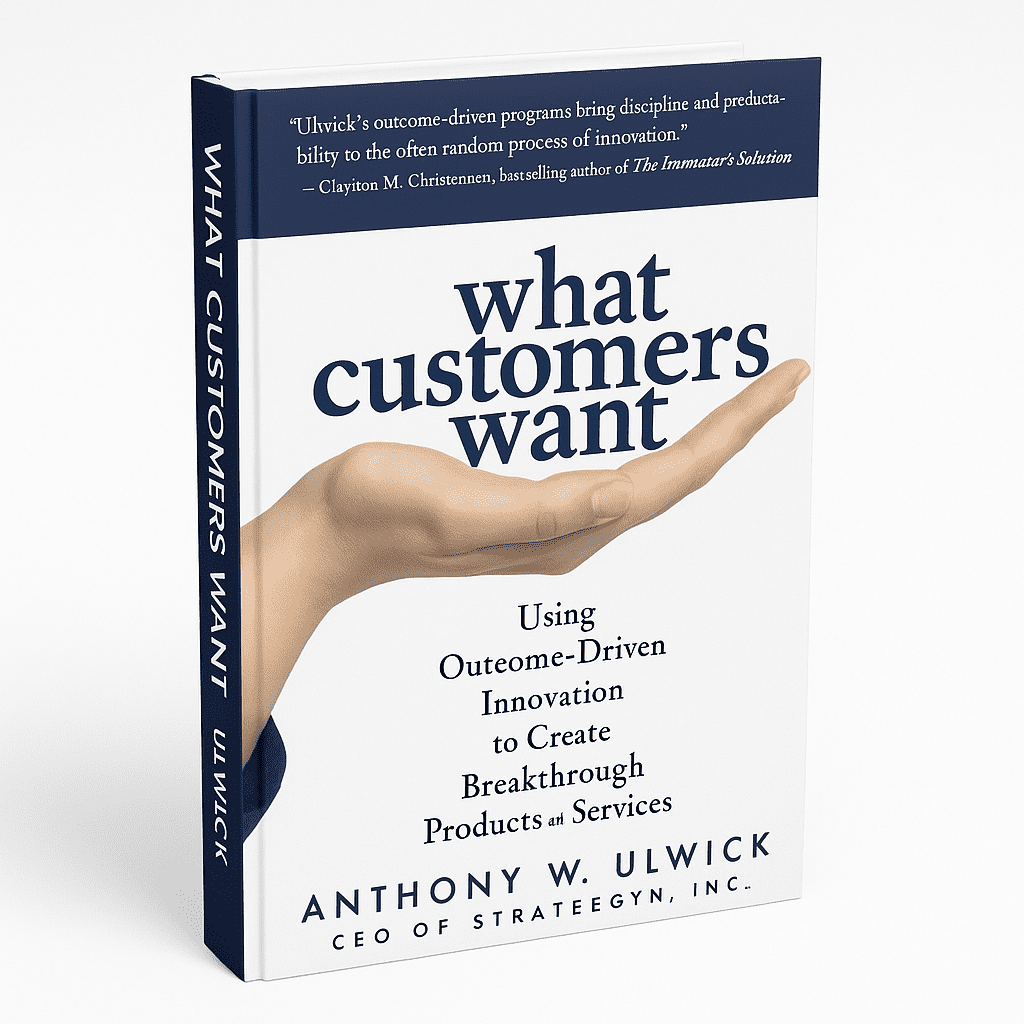

What Customers Want: An Outcome-Driven Approach to Creating Breakthrough Products and Services
Anthony Ulwick’s “What Customers Want” presents a paradigm shift in innovation. The book argues that traditional “customer-driven” approaches, which rely on listening to the “voice of the customer” in the form of needs, wants, and solutions, are fundamentally flawed and lead to high failure rates. Ulwick proposes an “outcome-driven” innovation process that focuses on understanding what customers are trying to achieve when performing a job (their desired outcomes) and using these as metrics to guide innovation efforts. This method aims to transform innovation from an unpredictable art to a systematic and measurable science, leading to more successful and breakthrough products and services.
Formulating the Innovation Strategy: Who Is the Target of Value Creation and How Should It Be Achieved?
Defining the innovation strategy is the crucial first step in the outcome-driven process. This involves deciding what type of innovation to pursue, which growth options are most suitable, and who in the value chain is the primary target for value creation. Without this upfront clarity, companies risk misdirecting their efforts and resources.
- Types of Innovation: Companies should consider product or service innovation (improving existing offerings), new market innovation (creating solutions for underserved jobs), operational innovation (improving business processes for efficiency), and disruptive innovation (using technology to challenge existing business models in overserved markets). The choice depends on the company’s position and market dynamics.
- Growth Options: The customer-jobs matrix outlines four options based on targeting consumers or nonconsumers and new or existing jobs: helping current users get a job done better, helping current users get more jobs done, helping new customers do a job that others are already doing, or helping new customers do a job nobody is doing yet. Most companies default to the first, but the others often offer significant growth potential.
- Targeting in the Value Chain: Companies must identify the specific individual or entity in the value chain whose judgment of value is most critical, such as the end user, purchaser, channel partner, or OEM. Mistakes include ignoring the end user, failing to consider all relevant customers, and relying on secondhand information from intermediaries like channel partners or sales forces instead of going directly to the source.
- Handling Multiple Constituents: It is often beneficial to consider multiple customers in the value chain, even if it adds complexity. By understanding the desired outcomes of various stakeholders (e.g., patients, care providers, administrators in healthcare), companies can discover broader opportunities and prioritize inputs based on strategic importance.
Mini-recap: Formulating a clear innovation strategy requires deliberate consideration of different innovation types, suitable growth options, and the key value chain members to target, avoiding common pitfalls in customer identification.
Capturing Customer Inputs: Silence the “Voice of the Customer”—Let’s Talk Jobs, Outcomes, and Constraints
The second step is gathering the specific customer information needed to drive innovation. Unlike traditional methods that rely on vague feedback, the outcome-driven approach focuses on capturing precise data about customers’ jobs, desired outcomes, and constraints. This information is foundational for predictable innovation success.
- Why Gather Customer Requirements: Companies need to understand what customers want to achieve when performing a job and how they measure success to create valuable products and services. This understanding precedes idea generation and concept evaluation, unlike traditional approaches.
- Issues with Traditional Requirements Gathering: Three main problems plague traditional methods: a lack of a standard definition for “requirements” (lumping together solutions, needs, benefits, etc.), companies believing they are collecting the right data when they are not, and excessive focus on collection methods rather than the type of data collected.
- Commonly Collected Data: Companies typically gather solutions (customer-suggested product features), specifications (detailed design characteristics), needs (high-level, imprecise descriptions like “reliable”), and benefits (statements of desired value like “faster”). These are vague and hinder effective innovation.
- Needed Inputs for Innovation: To master innovation, companies must capture three distinct types of data: jobs to be done (tasks or activities), desired outcomes (metrics for successful job execution), and constraints (obstacles preventing job completion). These provide a clear, actionable framework for value creation.
- Methods for Obtaining Information: Any research method (interviews, focus groups, observational research) can be effective, provided the interviewer knows exactly what to look for (jobs, outcomes, constraints) and actively guides the conversation to elicit these specific inputs. This contrasts with passively recording customer statements.
- Choosing Which Inputs to Capture: The specific data collected depends on the innovation objective. Improving an existing offering requires focusing on outcomes for the primary job. Finding new growth opportunities involves exploring ancillary jobs. Addressing adoption barriers means focusing on constraints.
Mini-recap: Effective innovation hinges on moving beyond the vague “voice of the customer” to capture precise information about customer jobs, desired outcomes (metrics for success), and constraints, which can be done using various methods once the target data types are understood.
Identifying Opportunities: Discovering Where the Market Is Underserved and Overserved
With the necessary customer inputs gathered, the third step is to pinpoint which jobs, outcomes, and constraints represent the most attractive opportunities for value creation or cost reduction. This moves beyond guesswork to a data-driven identification of market potential.
- Defining Opportunity: In the outcome-driven paradigm, an opportunity for growth is specifically defined as an outcome, job, or constraint that is underserved (important but not well satisfied). Overserved outcomes represent opportunities for cost reduction. This precise definition guides focused innovation efforts.
- Common Mistakes in Prioritizing: Companies often fail to prioritize effectively due to reliance on opinions or convenience. Mistakes include improving areas already satisfied (overserving), improving unimportant outcomes, and making improvements that negatively impact other, more important outcomes, leading to wasted resources and product failures.
- Prioritizing Opportunities: Opportunities are prioritized quantitatively using a five-step research method involving a survey where customers rate the importance and satisfaction of identified jobs, outcomes, and constraints. The results are entered into the opportunity algorithm.
- The Opportunity Algorithm: This formula calculates an opportunity score for each input: Opportunity = Importance + max(Importance – Satisfaction, 0). Scores range from 0 to 20. High scores indicate underserved areas; lower scores indicate overserved areas. This allows for objective prioritization.
- Identifying Underserved and Overserved Markets: Opportunity scores reveal where the market is underserved (high scores, representing opportunities for improvement) and overserved (low scores, representing opportunities for cost reduction). Specific score ranges indicate the level of opportunity (e.g., >15 is extreme, 12-15 is high).
- Value Migration: While outcomes are stable, their satisfaction levels change over time due to new technologies and products. As outcomes become satisfied, opportunities for value creation migrate to other underserved outcomes. The opportunity algorithm helps track this migration.
- Competitive Analysis: The outcome-driven paradigm shifts competitive analysis from comparing product specifications to comparing offerings against customer outcomes. This reveals true strengths and weaknesses from the customer’s perspective, guiding decisions on which features to emulate and when to ignore competitors’ moves.
Mini-recap: Identifying opportunities moves from guesswork to a quantitative process using customer inputs and the opportunity algorithm to reveal and prioritize underserved areas for improvement and overserved areas for cost reduction, guiding effective competitive analysis and anticipating value migration.
Segmenting the Market: Using Outcome-Driven Segmentation to Discover Segments of Opportunity
Market segmentation is the fourth step, but traditional methods often hinder innovation by creating arbitrary groups. Outcome-driven segmentation uniquely groups customers based on their desired outcomes, revealing “segments of opportunity” with distinct unmet needs.
- Purpose of Segmentation: For innovation, segmentation’s purpose is to group customers who have a unique set of underserved or overserved outcomes. This allows companies to tailor solutions and value propositions effectively.
- Evolution of Segmentation: Segmentation has evolved from purely demographic, to include psychographic and purchase behavior data, and later “needs-based” approaches. However, applying these methods, often chosen for other business functions like sales or accounting, to innovation is problematic.
- Ineffectiveness of Traditional Methods: Traditional methods create “phantom targets” that are not homogeneous in their desired outcomes, making it difficult to create products that appeal specifically to them. Effective segmentation for innovation must group customers based on shared desired outcomes.
- Outcome-Based Segmentation: This unique approach uses customers’ desired outcomes as the basis for segmentation and, critically, uses the opportunity score (not just importance) as the clustering variable. This directly identifies groups with unique unmet needs.
- Performing Outcome-Based Segmentation: The process involves collecting desired outcomes and their importance/satisfaction ratings via a survey, using factor analysis to identify key outcome groups, choosing representative outcomes as segmentation criteria, conducting cluster analysis based on opportunity scores, and profiling the resulting clusters with demographic/psychographic data to understand who they are.
- Addressing Challenges: Outcome-based segmentation helps identify unique opportunities in mature markets, find demanding segments willing to pay more, pinpoint unattractive segments to avoid, discover overserved segments for disruptive innovation entry points, determine the best way for new entrants to enter a market, and identify segments with high potential growth.
- Job-Based Segmentation: Distinct from outcome-based segmentation (finding opportunities within a market), job-based segmentation uses underserved jobs as the clustering basis to discover entirely new markets where customers are struggling to get a task done.
Mini-recap: Outcome-based segmentation provides a powerful method for innovation by grouping customers based on their unique underserved outcomes, enabling companies to identify and target “segments of opportunity” for tailored value creation and growth strategies, distinct from job-based segmentation used for finding entirely new markets.
Targeting Opportunities for Growth: Deciding Where to Focus the Value Creation Effort
Once opportunities and segments of opportunity are identified, the fifth step is strategically choosing which to pursue. This targeting process dictates where resources will be focused to maximize value creation and achieve a unique competitive position.
- Difference in Targeting for Innovation: Targeting for innovation means selecting specific underserved or overserved outcomes to address, not just selecting customer segments. The goal is surgical precision in focusing improvement or cost-reduction efforts.
- Attractive Broad-Market Opportunities: Companies should prioritize large opportunities in the overall market. Types include related opportunities forming a theme (allowing unified messaging), unrelated high-score opportunities, a single major opportunity addressed with a new ancillary product, overserved outcomes for cost reduction, and opportunities requiring long-term technology development.
- Effective Segment-Specific Targeting Strategies: After addressing broad market opportunities, companies can target unique needs within specific outcome-based segments. Strategies include identifying opportunities that span multiple segments, building a single product platform for multiple segment solutions, pursuing the least-challenging segments first to build momentum, and targeting segments representing attractive price points (especially for new entrants or disruptive strategies).
- Achieving a Unique Competitive Position: Targeting underserved outcomes directly leads to a unique and valued competitive position. By being the first to successfully satisfy outcomes that competitors miss or fail to address effectively, a company differentiates itself in a way that resonates with customers and drives market share.
- Reasons Companies Fail to Target: Failure to target key opportunities, even after identification, can stem from rejecting data that doesn’t align with pre-existing beliefs, fear of threatening jobs, or unwillingness to develop new competencies required to address the opportunities. Managers may attack the methodology or commission conflicting studies to avoid acting on the findings.
Mini-recap: Targeting for innovation involves strategically selecting specific underserved or overserved outcomes to pursue, starting with broad market opportunities before focusing on segment-specific ones, which enables companies to achieve unique and valued competitive positions by addressing what customers truly want.
Positioning Current Products: Connecting Opportunities with Valued Product Features
The sixth step is to leverage the identified opportunities by strategically positioning current products. By highlighting how existing offerings already address key underserved outcomes, companies can generate immediate revenue gains without needing new product development.
- Why Messaging Often Fails: Messaging frequently misses the mark because companies are unaware of true market opportunities (underserved outcomes), use vague language (needs, benefits) that doesn’t connect product features to specific desired results, and stick to outdated messages about outcomes that are no longer underserved.
- Prerequisites for Effective Messaging: A solid messaging strategy requires knowing the opportunities (underserved outcomes), having products that actually address those outcomes, identifying the specific product features responsible for addressing them, and assessing where current messaging is ineffective.
- Effective Messaging: The most impactful messaging directly connects a product’s specific features to the underserved outcomes they satisfy. Messages can be built around an outcome theme (grouping related outcomes) or a single specific outcome (highlighting a particular advantage). This precision resonates strongly with customers.
- Emotional vs. Functional Messaging: The decision to message emotionally or functionally depends on the product category. High-function, low-emotion products (e.g., medical devices) should focus on functional benefits. Low-function, high-emotion products (e.g., cosmetics) rely on emotional appeals. High-function, high-emotion products (e.g., cars) can blend both. Misapplying emotional messaging to purely functional products is often ineffective.
- Sales Force Impact: Providing sales teams with outcome-driven insights allows them to tailor pitches effectively. Knowing which outcomes are most important and underserved for a specific customer, and how the company’s product addresses them, empowers the sales force to focus on true value and drive immediate revenue generation.
- Outcome-Based Branding: An outcome-based brand links the product name or identity directly to the job it helps customers perform (e.g., Sawzall). This creates strong brand recall whenever customers think about performing that specific job, fostering a powerful connection and driving customer preference.
Mini-recap: Leveraging existing products involves refining messaging and branding strategies to explicitly connect product features to the underserved outcomes they satisfy, ensuring communication is precise, relevant, and aligned with customer desires, whether focusing on functional or emotional aspects depending on the product type.
Prioritizing Projects in the Development Pipeline: Separating the Winners from the Losers
The seventh step focuses on the product development pipeline. Using the outcome-driven framework, companies can objectively evaluate initiatives, prioritizing those that address targeted opportunities and eliminating those that don’t, thereby increasing success rates and reducing wasted resources.
- Project Prioritization Issues: Companies struggle with pipeline prioritization due to difficulty determining which concepts truly address market opportunities, a compulsion to fund numerous projects to “cover all bases,” emotional attachment that makes it hard to kill failing projects, and spreading resources too thin across too many initiatives.
- Identifying Winners and Losers: The method requires a clear understanding of targeted underserved outcomes. A cross-functional team evaluates each project or initiative’s potential to satisfy these outcomes using a quantitative assessment.
- The Evaluation Process: The process involves selecting projects/initiatives to evaluate, forming a diverse and objective team, evaluating each initiative against the targeted outcomes by estimating customer satisfaction levels (on a 1-5 scale, converted to 0-10), and assessing the results by comparing satisfaction estimates to current product performance.
- Identifying Top Priority Efforts: Initiatives that demonstrably improve satisfaction levels for targeted, high-opportunity outcomes are prioritized. Initiatives addressing multiple high-opportunity outcomes are generally prioritized over those addressing only one or two. Lower cost, effort, and risk can also influence prioritization among initiatives with similar value delivery.
- Identifying Initiatives to Abandon: Initiatives that fail to improve satisfaction for targeted opportunities, or worse, those focused on unimportant or overserved outcomes, are identified as candidates for abandonment. This frees up resources for more promising projects and avoids investing in likely failures.
- Addressing Competitive Products: Evaluating potential competitor products against the targeted outcomes reveals if competitors are addressing key opportunities. This insight informs counter-strategies, allowing companies to prioritize initiatives that address competitive threats or confidently ignore misguided competitor efforts focused on unimportant areas.
Mini-recap: Prioritizing the development pipeline becomes a structured process of evaluating initiatives based on their potential to satisfy targeted underserved outcomes, enabling companies to focus resources on likely winners, accelerate their development, and eliminate projects that fail to deliver desired customer value.
Devising Breakthrough Concepts: Using Focused Brainstorming and the Customer Scorecard to Create Customer Value
The final step in the outcome-driven process is generating new product or service ideas to address any remaining targeted opportunities not covered by current offerings or pipeline projects. This involves focused brainstorming and rigorous concept evaluation using the customer scorecard.
- Why Traditional Brainstorming Fails: Traditional brainstorming is often unfocused, leading to numerous ideas of questionable value. Employees lack direction on which specific outcomes to target, sessions are often judged by quantity over quality, and companies lack effective methods to evaluate the true potential value of generated ideas.
- Generating Breakthrough Concepts: Breakthrough concepts are successfully generated by focusing creative energy precisely on the identified underserved outcomes. Knowing exactly what customers want to improve allows for targeted ideation, ensuring generated ideas address real opportunities and are worthy of pursuit.
- Focused Brainstorming Mechanics: Guidelines for focused brainstorming include staying strictly focused on targeted outcomes, aiming for significant (“breakthrough”) improvement (e.g., reaching 8.0 satisfaction on a 0-10 scale), using constraints (like cost or technology limitations) to enhance creativity and practicality, quickly eliminating ideas that don’t meet the target satisfaction levels, and optimizing the best ideas for cost, effort, risk, and sustainability.
- Why Traditional Concept Evaluation Fails: Common methods (internal assessments, qualitative focus groups, quantitative surveys) fail because they don’t evaluate concepts based on their ability to satisfy all customer outcomes. Customers may not be aware of all their outcomes or the impact of new technologies, and evaluations often test a limited, potentially flawed, set of pre-selected ideas.
- The Customer Scorecard: This tool is used by an objective company team (not customers) to quantitatively evaluate how well a proposed concept satisfies all customer outcomes (typically 50-150). Outcomes are listed, and the team estimates the potential satisfaction level for each. The total score (summing weighted satisfaction levels) indicates the overall value delivered compared to existing solutions.
- Application in Practice: Companies like Pratt & Whitney use the customer scorecard to evaluate potential investments. By comparing the value delivered by proposed solutions against existing and competitive offerings, they can make data-driven decisions on which concepts to pursue, often leading to dramatically improved solutions and significant returns.
- R&D’s Role: Outcomes that are difficult to address with existing technologies or focused brainstorming become targets for R&D or acquisition. Providing R&D with specific, prioritized underserved outcomes ensures their efforts are focused on creating solutions that will deliver real customer value, increasing the likelihood of successful innovation.
Mini-recap: Creating breakthrough concepts moves beyond unfocused brainstorming by targeting specific underserved outcomes and using the customer scorecard for objective, quantitative evaluation, ensuring generated ideas deliver significant value and accelerating R&D efforts toward addressing customer needs.
Epilogue: Tactical Tips for Managers
Implementing outcome-driven innovation requires organizational change. Overcoming inertia and ingrained habits is key. These ten tactical tips offer practical guidance for managers seeking to adopt this more predictable and successful approach to innovation.
- Language Precision: Establish a common language for innovation, distinguishing between vague terms (needs, wants, solutions) and actionable inputs (jobs, outcomes, constraints). Ensure everyone understands how outcomes serve as metrics for value.
- Separate Marketing and Development Roles: Clarify responsibilities and information needs. Marketing gathers data for sales/advertising; development (or research) gathers data on jobs, outcomes, and constraints for innovation. Don’t force development to use inappropriate marketing data.
- Expand Research’s Role: Empower market researchers to be proactive strategists who uncover opportunities (underserved outcomes) and inform relevant teams. Invest in foundational research to define opportunities, not just validate ideas.
- Treat as Infrastructure Investment: View adopting outcome-driven innovation as an investment in a critical business process, similar to CRM or ERP systems. This shift in perspective justifies the necessary resources for training and research.
- Use Internal Networks: Leverage existing quality or process improvement teams (like Six Sigma black belts) to initiate outcome-driven thinking and practices internally. This builds capability with minimal risk and cost.
- Abandon Ineffective Approaches: Discontinue using tools like QFD for front-end innovation if they are not effectively identifying customer outcomes. Focus on methods designed specifically for capturing and prioritizing jobs, outcomes, and constraints.
- Share Information: Make the collected data on jobs, outcomes, and constraints easily accessible across the organization. This ensures all employees involved in innovation are focused on the same opportunities.
- Start with Internal Projects: Practice the methodology on internal process improvements (operational innovation) to gain experience and confidence before applying it to external product innovation. This minimizes risk during the learning phase.
- Repurpose Customer Satisfaction Studies: Integrate questions about customer outcomes into existing customer satisfaction surveys. This leverages current research budgets to gather valuable data for both performance measurement and innovation guidance.
- Treat Opportunities as Sacred: Once identified and validated, treat the list of prioritized underserved outcomes as invaluable. Embrace them, communicate them widely, and make them the central focus for all innovation efforts, rewarding employees for addressing them.
Mini-recap: Successfully adopting outcome-driven innovation involves changing organizational language, roles, and practices, treating it as a strategic investment, leveraging internal capabilities, abandoning outdated methods, sharing information, starting with internal projects, integrating with existing research, and treating identified opportunities as the focal point for all value creation efforts.
Big-Picture Wrap-Up
“What Customers Want” fundamentally challenges the prevailing approach to innovation, arguing that simply listening to the “voice of the customer” as currently practiced is a recipe for failure. Anthony Ulwick posits that true innovation success stems from understanding the customer’s “job to be done” and the metrics (desired outcomes) they use to judge successful performance. By systematically identifying and prioritizing these outcomes, companies can objectively discover where markets are underserved or overserved, target the most attractive opportunities, develop tailored messaging, evaluate pipeline projects, and generate truly breakthrough concepts, transforming innovation from an art to a predictable, data-driven science that delivers consistent customer value and company growth.
- Core Lesson: Innovation success is predictable when companies focus on helping customers get specific jobs done better by satisfying their previously hidden, desired outcomes.
- Next Action: Assess your current innovation process. Identify where you currently gather customer requirements and what type of information you actually collect. Compare this to the jobs, outcomes, and constraints framework to see where improvements are needed.
- Reflective Question: If you knew with certainty the top 10 underserved outcomes in your market, how would that change your current product strategy, development priorities, and marketing messages?




Leave a Reply