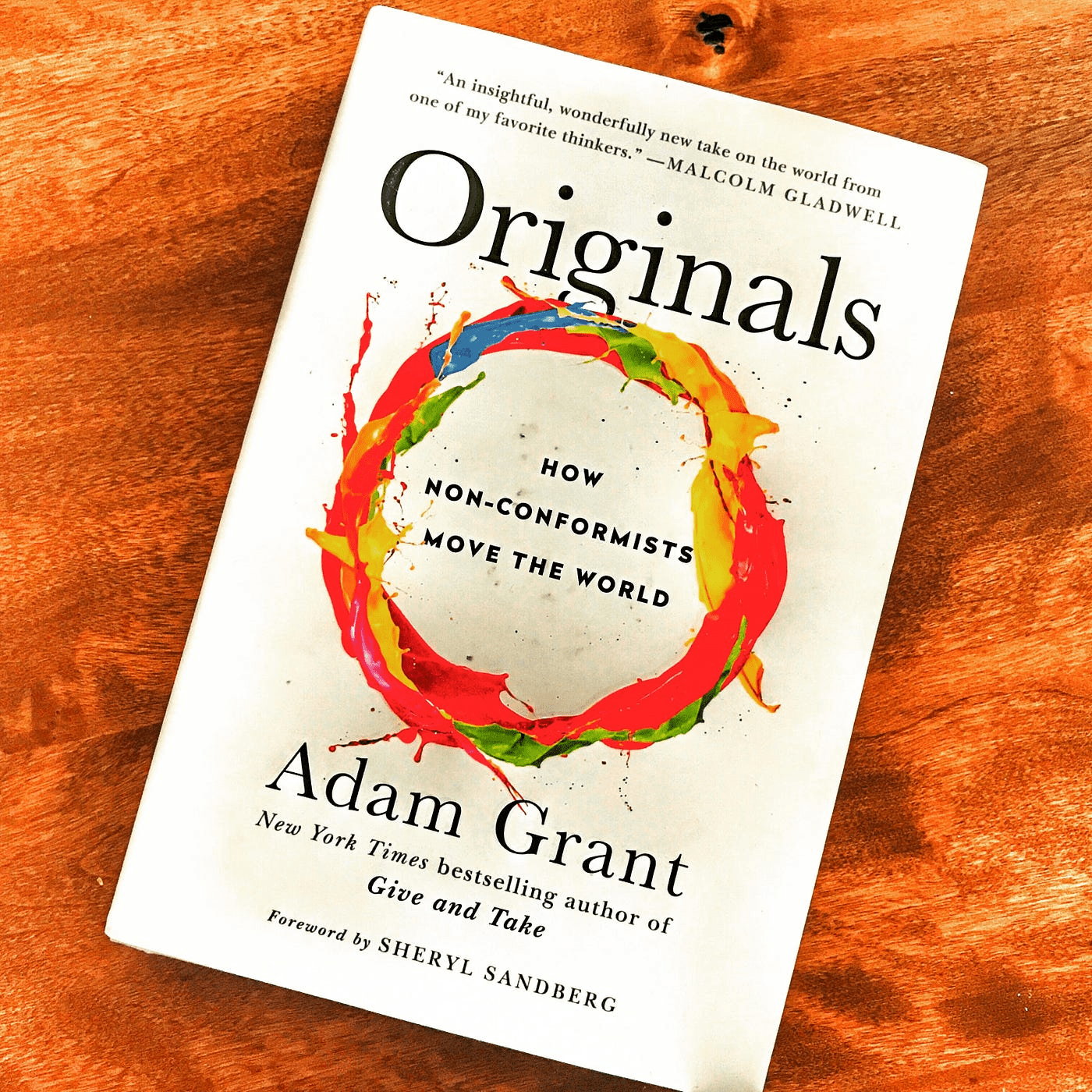

Originals: How Non-Conformists Move the World by Adam Grant — A Complete Summary
Adam Grant, an organizational psychologist, explores the mindset and actions of “originals”—people who generate novel ideas and champion them to make the world a better place. Challenging conventional wisdom, Grant reveals that originality isn’t an innate trait but a skill that can be learned and nurtured. This book debunks myths about risk-taking, creativity, and leadership, offering practical strategies for individuals, leaders, and parents to foster originality in themselves and others.
1. Creative Destruction
This chapter introduces the concept of originality and contrasts it with conformity. It argues that progress depends on those who challenge the status quo.
The Risky Business of Going Against the Grain
The first step to being original is questioning why things are the way they are, especially the defaults we often accept without thinking.
- Question the Default: The founders of Warby Parker questioned the high cost of eyeglasses, a long-accepted default in the industry, leading them to find a way to make them more affordable online. This questioning, fueled by “vuja de” (seeing the familiar as new), revealed that the default price was not inherent but a choice, and thus, reversible.
- Browser Preference as a Signal: Economist Michael Housman’s study showed that employees who used non-default browsers (Firefox or Chrome) stayed in their jobs longer and performed better. This wasn’t due to tech savviness but the initiative shown in seeking better options, which translated to a proactive approach at work.
- System Justification: People, especially the disadvantaged, often rationalize undesirable status quos as legitimate. This psychological phenomenon of system justification prevents them from questioning or changing their circumstances, robbing them of the moral outrage needed for change.
- Originality is Not Innate: Child prodigies, despite exceptional talent, often fail to become revolutionary adults because they master existing domains rather than challenging them. Their focus on achievement and seeking approval hinders the development of originality.
- The Fear of Failure: The drive to achieve, while important, can crowd out originality because a strong desire to succeed leads to a dread of failure, pushing people towards guaranteed success rather than pursuing unique accomplishments.
- Reluctant Revolutionaries: Many historical figures who drove change, like Martin Luther King, Jr., and the American Revolutionaries, were initially hesitant to pursue originality and were often pushed or supported by others to take a stand.
Why Risks Are Like Stock Portfolios
Many successful originals balance radical risks in one area with caution in others.
- Balanced Risk Portfolios: Successful originals don’t put all their eggs in one basket. Like making a risky stock investment while playing it safe with others, they balance danger in one domain (like starting a business) with caution in another (like keeping a day job).
- Day Jobs as Security: Keeping a day job while launching a new venture provides a sense of security that allows for more freedom to be original without the pressure to rush or compromise quality. Examples include Phil Knight (Nike) and Steve Wozniak (Apple).
- Risk Aversion and Success: Research suggests that entrepreneurs who are more risk-averse and keep their day jobs have significantly lower odds of failure than those who quit, indicating that playing it safe in some areas can contribute to long-term success in original endeavors.
- Calculated Risks: Successful entrepreneurs and even historical figures known for challenging norms often take calculated risks, avoiding genuinely hazardous activities while being willing to defy conventional expectations.
- Prioritizing Risk Reduction: The founders of Warby Parker prioritized de-risking their business from the start, developing a free home try-on program to address customer hesitation about buying glasses online. This strategic move, born from a risk-averse approach, was key to their early success.
- Originality is a Choice: Originality is not a fixed personality trait but a conscious choice to reject defaults and explore better options, as demonstrated by individuals like Abraham Lincoln and Google employees who customized their jobs.
2. Blind Inventors and One-Eyed Investors
This chapter delves into the challenges of identifying truly original ideas and avoiding false positives (predicting success for a failure) and false negatives (predicting failure for a success).
Creative Destruction
Understanding how to recognize original ideas is crucial because the biggest barrier to originality isn’t generating new ideas but selecting the right ones.
- The Segway’s Failure: Despite being championed by tech icons and receiving significant investment, the Segway became a major tech flop. This illustrates how even savvy minds can misjudge the potential of a novel idea.
- Seinfeld’s Unexpected Success: Initially dismissed by network executives and test audiences as a “glorious mess” and expected to fail, Seinfeld went on to become one of the most popular and influential TV shows of all time, highlighting the prevalence of false negatives in idea selection.
- Idea Selection is the Challenge: The core problem for originality is not a shortage of new ideas (many ideas are unique) but a lack of people who can effectively recognize which original ideas are likely to succeed.
Blind Inventors and One-Eyed Investors
Creators often struggle to objectively evaluate their own ideas due to biases and closeness to their work.
- Creators’ Overconfidence: Studies show that creators tend to be overconfident in judging their own work. This is partly due to the inherent uniqueness of new ideas, making it easy to overlook flaws, and confirmation bias, which leads them to focus on strengths while ignoring limitations.
- Geniuses Miss Their Hits: Even highly acclaimed creators like Beethoven and Picasso struggled to identify their most influential works among the many pieces they produced, often revisiting earlier, discarded ideas that would later become masterpieces.
- Quantity Fuels Quality: The most prolific creators across various fields, from music to science to comedy, produce a large volume of work. This high output increases the variation of their ideas, raising the probability of stumbling upon something truly original and successful.
- First Ideas are Conventional: Early ideas are often the most similar to existing defaults. It’s by generating numerous ideas and exploring more remote possibilities, often through persistent effort and deliberate practice, that creators are more likely to find truly original concepts.
- Seek Peer Feedback: Creators are often too close to their ideas to evaluate them accurately. Feedback from peers, who share domain expertise but lack the creator’s personal investment, provides the most reliable judgments for predicting an idea’s success.
- Tempering Conviction with Feedback: Dean Kamen’s secrecy around the Segway prevented valuable customer feedback, which might have revealed practical issues earlier. Opening ideas to external input is crucial for identifying flaws and making necessary adjustments.
Prisoners of Prototypes and Parochial Preferences
Managers and test audiences often fall victim to biases that lead them to reject novel ideas.
- Managers’ Risk Aversion: Managers tend to focus on the potential costs of investing in bad ideas, leading to a higher rate of false negatives where promising, novel ideas are rejected.
- Prone to Prototypes: Expertise and experience can create “cognitive entrenchment,” where people become prisoners of established prototypes and struggle to appreciate ideas that deviate significantly from the norm. This makes it harder for experts to recognize radical innovations.
- Test Audiences Mirror Managers: Focus groups and test audiences are often no better than managers at predicting the success of novel ideas. They evaluate new concepts against existing templates rather than experiencing them for their potential.
- Creating in a Creative Mindset: Engaging in idea generation oneself, even for a short time, can make individuals more open to novelty and improve their ability to recognize the potential in unusual ideas when evaluating others’ proposals.
- Experience Shapes Evaluation: While managerial experience alone doesn’t guarantee better evaluation of novel ideas, experience in a creative role within the same domain, like Rick Ludwin’s background in various comedy formats influencing his support for Seinfeld, can provide valuable perspective.
The Double-Edged Sword of Experience
The combination of broad and deep experience is key to recognizing originality, as it allows for both understanding a domain and seeing beyond its conventions.
- Broadening Knowledge: Individuals with diverse experiences outside their primary domain, such as Nobel laureates in science who engaged in the arts, are more likely to generate original ideas and recognize novel solutions.
- International Experience: Working in foreign countries, especially those with different cultures, can enhance creativity by exposing individuals to new perspectives and encouraging them to synthesize novel ideas with their existing knowledge. The duration of this experience, allowing for internalization and synthesis, is crucial.
- Insider-Outsider Perspective: Rick Ludwin’s success in championing Seinfeld stemmed from his deep experience in comedy combined with his broad experience outside the traditional sitcom format. This insider-outsider status allowed him to recognize the show’s potential despite its unconventional nature.
The Hazards of Intuition: Where Steve Jobs Went Wrong
Reliance on intuition can be misleading, especially when it’s not grounded in relevant experience.
- Intuition Requires Experience: Intuition is reliable only in domains where people have extensive experience and the environment is predictable. In rapidly changing or unfamiliar areas, intuition can be easily swayed by superficial factors, leading to poor judgments.
- Domain Inexperience and Hubris: Steve Jobs’s strong intuition, which was successful in technology, was not reliable in the transportation domain. His lack of experience in this area, combined with the hubris stemming from past successes, left him vulnerable to misjudging the Segway’s practical viability.
- Enthusiasm is Misleading: While perceived passion is often seen as a positive sign in entrepreneurs, it can be misleading. Intuitive investors can be swayed by enthusiasm, but it’s the entrepreneur’s passion for execution, demonstrated through action and a track record of building businesses, that is a more reliable indicator of success.
- Execution Matters: Dean Kamen’s history showed him to be a brilliant inventor, but his passion lay more in creation than in execution. Successful innovation requires not just a novel idea but the ability to successfully bring it to market and scale it, a skill that the Segway’s early investors failed to adequately assess.
Corrective Lenses for Idea Selection
Improving idea selection requires questioning assumptions, embracing feedback, and focusing on execution.
- Challenge Defaults and Seek Breadth: Adam Grant’s misjudgment of Warby Parker stemmed from being entrenched in the traditional eyewear model. Generating ideas and exploring different perspectives before evaluating new proposals can help overcome these biases.
- Transparency in Idea Selection: Warby Parker’s “Warbles” program, which made idea submissions transparent and allowed employees to comment and discuss, fostered a meritocratic idea selection process where ideas were evaluated by peers, who are often better judges of originality.
- Start Fast, Slow Down for Feedback: Successful originals often start quickly with a tentative idea and then slow down to gather feedback from peers and potential customers before fully committing and rolling out the product. This iterative process helps refine the idea and ensure its viability.
- Measure Success by Batting Average: Given the inherent uncertainty in predicting the future of novel ideas, it’s important to view success in idea selection like a batting average in baseball – a good success rate is achieved over time through numerous attempts and continuous learning.
- Focus on Execution: Forecasting the success of a novel idea requires looking beyond the originator’s enthusiasm for the idea itself and focusing on their demonstrated passion for execution and their track record of successfully building and bringing products to market.
3. Out on a Limb
This chapter explores the challenges of speaking up with original ideas and how to do so effectively without jeopardizing one’s career and relationships.
Creative Destruction
Voicing a dissenting opinion or championing change often comes with risks, particularly when lacking status within a group.
- Penalized for Speaking Up: Research indicates that employees who frequently voice ideas and concerns upward are less likely to receive raises and promotions, and those who speak out against injustice can face criticism from peers.
- Power Without Status: Exercising power or influence without having earned the respect or admiration (status) of others is often met with resistance and negative perceptions, leading to a vicious cycle of resentment and potentially destructive behavior.
- Idiosyncrasy Credits: Status grants individuals “idiosyncrasy credits,” the latitude to deviate from group expectations and voice original opinions without being penalized. These credits are earned through respect and contributions, not just formal rank.
- Earning Status First: Carmen Medina, a CIA analyst, learned from her early failures to speak up by first focusing on earning status within the organization through her work in information security before championing her vision for online information sharing.
- Changing the System from Within: Medina’s approach of building credibility and networks within the CIA before pushing for radical change demonstrates how individuals can become “tempered radicals” who challenge the status quo by first establishing themselves within the existing system.
Putting Your Worst Foot Forward: The Sarick Effect
Counterintuitively, highlighting the weaknesses of an idea can make it more persuasive, especially to skeptical audiences.
- Disarming the Audience: Leading with weaknesses disarms a skeptical audience, as it signals sincerity and openness rather than aggressive salesmanship, encouraging them to lower their mental defenses and engage in problem-solving.
- Appearing Smart: Revealing flaws in an idea can make the presenter appear more knowledgeable and discerning, as it demonstrates a thorough understanding of potential challenges and anticipates criticisms.
- Building Trust: Being upfront about downsides builds trust and credibility, as it suggests honesty and modesty. This, in turn, makes the presenter’s arguments for the idea’s strengths more convincing.
- The Ease of Retrieval Bias: Acknowledging the most significant problems with an idea makes it harder for the audience to generate their own objections. As they struggle to identify other flaws, they may conclude that the identified problems are not that severe. This is the Sarick Effect.
- Balance and Self-Doubt: Carmen Medina’s later success in speaking up stemmed from her more balanced approach, acknowledging potential drawbacks to her ideas and expressing a degree of doubt, which made her more credible to skeptical colleagues.
Unfamiliarity Breeds Contempt
New ideas are often met with resistance simply because they are unfamiliar. Repeated exposure and linking new concepts to familiar ones can increase acceptance.
- The “Tapping” Problem: It’s difficult for creators to imagine how their new ideas sound to someone hearing them for the first time because they are so familiar with the “tune” in their own heads. This leads them to undercommunicate their ideas.
- Undercommunicating the Vision: Leaders often undercommunicate their vision for change, making it difficult for employees to fully understand and internalize it, as the vision is only a small part of their overall communication exposure.
- The Mere Exposure Effect: The more often people are exposed to something, even nonsense words or reversed images of themselves, the more they like it. Familiarity breeds comfort, not contempt, making new ideas less threatening with repeated exposure.
- Strategic Exposure: Repeated, short exposures to a new idea, spaced out over time and mixed with other communications, can increase liking and acceptance, as demonstrated by Carmen Medina’s blog posts about open information sharing at the CIA.
Quitting Before Leaving
While exiting a dissatisfying situation is an option, staying and voicing concerns can be more impactful, though it depends on the context and support system.
- Exit, Voice, Persistence, Neglect: Individuals facing dissatisfaction have four choices: leaving the situation, actively trying to improve it, tolerating it, or staying while reducing effort. Voice requires believing your actions can make a difference and caring deeply.
- The Power of a Supportive Boss: A supportive direct manager significantly impacts an employee’s commitment and sense of influence, making them more likely to voice concerns and take risks, as Carmen Medina experienced after finding a supportive supervisor at the CIA.
- Disagreeable Managers Can Be Advocates: While agreeable people may avoid conflict and struggle to challenge others on your behalf, disagreeable managers, who are more comfortable with confrontation, can sometimes be better advocates for original ideas.
- Middle-Status Conformity: People in the middle of a status hierarchy are often more risk-averse and conformist than those at the top or bottom, as they have more to lose by challenging the status quo. This can make it harder to voice original ideas from a middle-management position.
- Idiosyncrasy Credits from Junior Colleagues: Gaining respect and status from junior colleagues can provide “idiosyncrasy credits” and make it more difficult for senior leaders to dismiss original ideas, as Carmen Medina found with rising stars at the CIA.
Speaking While Female, and the Double Jeopardy of Double Minorities
Voicing original ideas can be particularly challenging for women and double minorities due to societal stereotypes and biases.
- Speaking While Female: Women often face backlash when they speak up assertively, as it can violate gender stereotypes. This can lead to lower performance evaluations and a perception of being less loyal, particularly in male-dominated environments.
- Speaking Up for Others: Women can avoid backlash when voicing concerns on behalf of others, as it aligns with communal stereotypes and makes their actions appear less self-serving.
- Double Jeopardy for Double Minorities: Double minority group members, like Black women, can face harsher evaluations for failure but may have more flexibility in defying category stereotypes when demonstrating competence.
- Earning Status as a Minority: For minority groups, earning status and demonstrating competence before exercising power is crucial to increase the likelihood of being heard and to mitigate against negative biases.
The Road Not Taken
Deciding whether to stay and fight or leave a stifling environment is a critical choice for originals, and both paths can lead to impactful change.
- Voice vs. Exit: While voice aims to improve a situation for everyone, exit primarily changes an individual’s circumstances. Hirschman argued that voice is fueled by a lack of exit options.
- Exit Can Foster Originality: In modern times, with greater mobility, leaving a restrictive organization can be a path to originality, allowing individuals to pursue their ideas elsewhere, as Donna Dubinsky did after facing resistance at Apple and 3Com.
- Preparing for Exit: Voicing opinions while also securing a risk portfolio (like having backup plans) can provide the courage to speak up and the option to leave if the environment remains resistant to change.
- Regret of Omission: Ultimately, research suggests that people tend to regret actions they didn’t take (errors of omission) more than mistakes they made (errors of commission), highlighting the importance of voicing ideas and taking initiative.
4. Fools Rush In
This chapter challenges the conventional wisdom about acting quickly and being the first mover, highlighting the unexpected benefits of strategic procrastination and delayed action.
Creative Destruction
The timing of when to take original action is critical and often counterintuitive.
- The Myth of Acting Early: We are often told to act quickly and be the first mover, believing it’s the key to success and beating competitors.
- The Early Worm Gets Caught: However, rushing can lead to disadvantages. Being first doesn’t guarantee success, and waiting can offer strategic benefits.
- Timing is Critical: Original actions have a greater chance of impact when they are timed correctly.
The Other da Vinci Code
Procrastination, often seen as a vice, can actually be a valuable resource for creativity and originality.
- Procrastination and Originality: Studies suggest that intentional procrastination, by delaying progress on a task, can lead to more creative ideas because it provides time for divergent thinking and prevents settling on the first idea too quickly.
- Incubation Time: Putting off a task allows ideas to “incubate” in the back of the mind, potentially leading to novel solutions that might not have emerged with immediate, focused effort.
- Historical Procrastinators: Many original thinkers and inventors, like Leonardo da Vinci and Abraham Lincoln, were known to procrastinate on their work, suggesting that for complex, creative tasks, waiting can be beneficial.
- Originality Cannot Be Rushed: Da Vinci’s approach to painting, which involved working on ideas over many years alongside other projects, demonstrates that groundbreaking originality often requires time and cannot be forced according to a rigid schedule.
- Thinking Out Inventions: Procrastination for creators is not necessarily laziness but can be a period of “productive brainstorming,” where ideas are mentally formed and refined before being committed to paper or concrete form.
The Discipline to Delay
Strategic procrastination, where work is intentionally delayed but remains in the back of the mind, can be a powerful tool for generating original ideas and staying open to improvisation.
- The Zeigarnik Effect: People have a better memory for incomplete tasks than completed ones. This means that when a task is left undone, it remains active in our minds, potentially allowing for continued processing and the emergence of new insights.
- Delayed Work, Broader Ideas: Martin Luther King, Jr.’s “I Have a Dream” speech benefited from delaying the final drafting process, allowing for a wider range of ideas from his advisers and the emergence of the powerful promissory note metaphor, possibly through the Zeigarnik effect.
- Openness to Improvisation: Procrastination can keep creators open to spontaneous insights and improvisation. By not rigidly adhering to an early plan, they can incorporate new ideas that arise during the process of creation or presentation.
- Strategic Flexibility: Leaders who tend to delay work can be more strategically flexible, adapting their approaches to capitalize on new opportunities or defend against threats, rather than sticking to a predetermined, potentially outdated plan.
- Refining Through Practice: Martin Luther King, Jr.’s use of the “dream” theme in earlier speeches allowed him to refine and perfect the message before delivering it spontaneously at the March on Washington, demonstrating how prior practice can support improvisation.
Pioneers and Settlers
Being the first mover with a new idea or product is often a disadvantage rather than an advantage.
- The First-Mover Disadvantage: Studies show that pioneers (the first to market) have significantly higher failure rates and capture smaller market shares than settlers (those who enter later).
- Reasons for Failure: Pioneers are prone to overstepping (making investments the market isn’t ready for), facing market uncertainty alone, making all the mistakes themselves, and getting stuck in their early offerings as consumer tastes change.
- Settlers Learn and Adapt: Settlers can learn from the pioneers’ mistakes, improve upon their technology, observe market changes, and enter when the market is more defined, allowing them to focus on providing superior quality or a better solution.
- Timing in Movements: Just as in business, original ideas and movements can fail if they are ahead of their time. Waiting for the right cultural or technological moment can increase the likelihood of acceptance and success.
- Not Rushing to Be First: If you have an original idea, the goal should not be simply to beat competitors to the market but to time your entry strategically, allowing for learning, adaptation, and reducing the risks associated with being a pioneer.
The Two Life Cycles of Creativity: Young Geniuses and Old Masters
Originality can manifest and peak at different stages of life depending on whether creators adopt a conceptual or experimental approach.
- Young Geniuses: Conceptual innovators, who formulate a big idea and execute it quickly, often peak early in their careers, bringing fresh perspectives to a field shortly after their first exposure. However, they risk getting stuck in established habits of thought.
- Old Masters: Experimental innovators solve problems through trial and error, learning and evolving over time. They often peak later in their careers, accumulating knowledge and skill over decades. This approach is more sustainable, allowing for continuous discovery.
- Age vs. Approach: While age can sometimes lead to conservatism, the method of innovation (conceptual vs. experimental) is a better predictor of when originality will peak and how long it will last.
- Sustaining Originality: To maintain originality over time, particularly as expertise grows, adopting an experimental approach—making fewer advance plans and testing tentative ideas—can lead to new discoveries and prevent creators from merely reproducing past ideas.
- Experimentation as a Marathon: The experimental approach, while slower, allows creators to gather material, learn from their discoveries, and maintain originality by constantly mixing different elements and staying open to unexpected outcomes.
5. Goldilocks and the Trojan Horse
This chapter explores how originals can build and maintain coalitions to advance their ideas, focusing on the challenges of working with different groups and navigating conflict.
Creative Destruction
Building coalitions is crucial for originals, as challenging the status quo often requires the support of others.
- Challenging the Status Quo: Original efforts often involve a minority group challenging a majority, making alliances and coalitions essential for gaining influence and achieving change.
- Instability of Coalitions: Coalitions, while powerful, are inherently unstable and depend heavily on the relationships and dynamics among their members, which can lead to conflicts and fragmentation.
The Narcissism of Small Differences
Groups, even those with shared goals, can be driven apart by minor differences and horizontal hostility.
- Horizontal Hostility: Radical groups often view more mainstream groups with prejudice and animosity, seeing them as less committed or authentic to the shared cause, even when they have similar fundamental objectives.
- Distinguishing from Moderates: The more strongly individuals identify with an extreme group, the more likely they are to seek differentiation from more moderate groups that they perceive as threatening their values or identity.
- Methods over Goals: Differences in strategic tactics and methods of engagement can be a significant source of conflict within movements, even when members share the same ultimate goal.
- Shared Tactics Foster Affinity: Sharing similar methods of action, such as protesting or lobbying, can create a sense of shared identity and community between groups, even if they care about different causes.
- Common Goals Aren’t Enough: Lucy Stone’s conflict with Susan B. Anthony and Elizabeth Cady Stanton, despite their shared goal of women’s suffrage, was fueled by differences in their methods and alliances.
Tempered Radicals
To gain support and form alliances, originals often need to temper their radicalism and present their ideas in ways that appeal to mainstream audiences.
- Obscuring Radical Features: Meredith Perry, the founder of uBeam, gained technical collaborators by initially obscuring the radical purpose of her invention (wireless power) and simply asking experts to design specific components.
- Focusing on the “How” over the “Why”: While sharing the “why” can be inspiring, explaining the “how” of a novel idea or policy can make it seem less radical and more practical, leading to greater acceptance and cooperation.
- The Trojan Horse Strategy: Originals can “smuggle” their radical vision inside a Trojan horse by framing it as a means to a more conventional or widely accepted goal, making it more palatable to potential allies.
- Foot-in-the-Door Technique: Starting with a small, moderate request before revealing a larger, more radical one can help gain initial commitment and make potential allies more receptive to the full vision.
- Avoiding Alienation: Movements like Occupy Wall Street can alienate potential allies by branding themselves with radical tactics or names, rather than adopting more inclusive framing and offering diverse ways to participate.
Enemies Make Better Allies Than Frenemies
Counterintuitively, former adversaries who have been converted to the cause can be more valuable allies than ambivalent “frenemies.”
- Ambivalent Relationships are Stressful: Relationships that are both positive and negative (“frenemies”) can be more stressful and detrimental than purely negative relationships because of the constant uncertainty and need to be on guard.
- Converting Enemies: Focusing on converting opponents can be more effective than trying to salvage ambivalent relationships. Converted rivals are often more committed and effective advocates because they have overcome initial doubts and understand the perspective of resisters.
- Gain and Loss in Esteem: People are more sensitive to gains in esteem than to a consistent level of support. Someone who transitions from an adversary to an ally is seen as more trustworthy and persuasive than someone who has always been supportive.
- Leveraging Understandings: Former adversaries who have been converted understand the doubts and misgivings of those who are still resisting, allowing them to marshal better arguments and be more credible sources for persuasion.
- Engaging Opponents: Lucy Stone’s success in gaining allies stemmed in part from her willingness to engage with her opponents and convert them, rather than solely focusing on strengthening ties with existing supporters.
Familiar Makes the Heart Grow Fonder
Linking a novel idea to something familiar can increase its acceptance and make it more palatable to a broader audience.
- Novelty and Familiarity: Highly successful original ideas often begin with a novel template and then incorporate elements of familiarity to make them understandable and appealing to the audience.
- Connecting to Classics: The writers of The Lion King made their original story more palatable to Disney executives by framing it as a version of Hamlet, demonstrating how linking a novel concept to a familiar classic can foster understanding and acceptance.
- Familiarity Infusion: After generating a novel idea, incorporating elements of familiarity can make it seem more practical and increase its chances of acceptance, as demonstrated by the pen design inspired by an in-line skate.
- Goldilocks Pitch: The effectiveness of an argument for change depends on striking the right balance of radicalism. While radical arguments can attract dedicated followers, moderately tempered arguments, linking the novel idea to familiar values or goals, are often necessary to convert mainstream allies.
- Public Motherhood Framing: In the women’s suffrage movement, framing the right to vote as a way for women to protect their homes (a familiar, conservative value) was effective in gaining the support of the Woman’s Christian Temperance Union, a key ally.
United We Stand: Creating Coalitions Across Conflict Lines
Reuniting fragmented groups requires addressing the underlying causes of conflict and finding ways for members to bridge their differences.
- Conflicts Within Groups: Conflicts between groups are often caused and intensified by conflicts within the groups themselves, as internal disagreements can spill over and exacerbate external tensions.
- Doves as Negotiators: In conflicts, it’s often more effective to have moderate members (“doves”) from each group negotiate, as they are more likely to focus on common goals and problem-solving than hardline members (“hawks”).
- Addressing Ambivalence: The deep distrust and unpredictable behavior in ambivalent relationships, like Lucy Stone’s with Anthony and Stanton, made reunification difficult. Stone wisely chose to avoid re-engaging with them directly.
- Passing the Torch: As older members who remember the causes of division pass on, younger members with fewer ingrained animosities can be more open to reunification and finding common ground.
- Learning from Past Mistakes: The women’s suffrage movement’s repeated fragmentation highlights the difficulty of learning from past mistakes, as new radical factions and alliances with controversial figures continued to emerge.
- Tempered Radicalism Prevails: Ultimately, the women’s suffrage movement succeeded when it adopted a more tempered approach, focusing solely on the vote and using strategies that appealed to a broader range of women, as embodied by Carrie Chapman Catt’s leadership.
6. Rebel with a Cause
This chapter explores the origins of originality and rebellion, examining the influence of siblings, parents, and mentors on individuals’ tendencies to challenge the status quo.
Creative Destruction
Being original often requires a willingness to take risks and go against the grain, a tendency that can be shaped by early life experiences.
- Risk-Taking in Baseball: Stealing bases in baseball is a risky move, particularly stealing home. The players who excelled at this often demonstrated a broader tendency to take risks.
- Jackie Robinson’s Rebellion: Jackie Robinson, known for breaking the color barrier in baseball and taking risks on the base paths, exemplified a life of challenging social norms and staying resolute in the face of adversity.
- Challenging the Status Quo: Going against deeply ingrained traditions and expectations, whether in sports, society, or other domains, involves inherent uncertainty and risk.
Born to Rebel
Birth order can influence an individual’s propensity for risk-taking and originality.
- Laterborns Take More Risks: Studies show that younger siblings are significantly more likely than older siblings to attempt risky actions in baseball and participate in sports with higher injury rates, suggesting a greater appetite for risk.
- Impact on Intellectual and Political Progress: This birth order effect extends beyond physical risk-taking, with laterborns being more likely to champion radical ideas in science and support political revolutions, potentially accelerating social and intellectual progress.
- Birth Order and Personality: While controversial, research indicates that birth order can influence personality traits, with firstborns tending to be more dominant and conscientious, and laterborns more open to risk and original ideas.
- Logic of Appropriateness: Individuals who consistently challenge the status quo often operate using a “logic of appropriateness,” basing decisions on their identity and what someone like them ought to do, rather than a “logic of consequence,” which focuses on predicting outcomes. This internal compass can drive rebellious behavior.
Niche Picking: Competing by Not Competing
The dynamic between siblings, particularly the desire to stand out, can contribute to the development of originality and risk-taking in laterborn children.
- Personality Differences Within Families: Differences in personality are often more pronounced within families than between them, suggesting that shared genes and upbringing alone don’t fully explain who children become.
- Niche Picking: Younger siblings, facing the challenge of competing directly with older siblings who may already excel in traditional areas, often choose different “niches” to distinguish themselves, such as developing humor or pursuing unconventional talents.
- Age Distance Matters: The age gap between siblings can influence niche picking. Smaller gaps may lead to more direct competition, while larger gaps can create opportunities for younger siblings to pursue niches without direct rivalry.
- Comedians as Rebels: Comedians, known for their originality and rebellion, are disproportionately more likely to be lastborn children, suggesting that humor may be a niche chosen by younger siblings to gain attention and stand out.
- Conventional Niches Filled: The older siblings of many successful comedians often pursued more conventional, achievement-oriented careers, leaving the niche of humor open for the younger children.
The Slippery Slope of Strict Parenting
Parenting styles, particularly the level of strictness and autonomy granted to children, can significantly influence their willingness to challenge norms.
- Relaxing Rules for Laterborns: Parents often become less strict and more flexible with laterborn children, granting them more autonomy and facing fewer chores, which can contribute to a greater willingness to take risks.
- Autonomy and Protection: The unusual autonomy and, in some cases, the fierce protection received by laterborn children can nurture their tendency to be original, as they are less constrained by rules and more likely to follow the lead of other children rather than strictly emulating adults.
- Challenging Authority: Lizz Winstead’s experience as the youngest of five in a conservative family illustrates how greater freedom and less parental oversight can lead to a lifetime of “chronic pluckiness” and a willingness to challenge authority.
- Freedom and Risk: Granting children the freedom to explore and take risks, within reasonable boundaries, is essential for fostering originality. However, this freedom can also lead to rebellious behavior that is destructive if not guided by a strong sense of right and wrong.
Great Explanations
The way parents discipline children and explain their actions significantly shapes their moral development and whether they channel their originality in positive or negative directions.
- Reasoning Over Punishment: The parents of Holocaust rescuers were more likely to discipline their children using reasoning and explanations for why behaviors were inappropriate, emphasizing the consequences for others, rather than relying on punishment or scolding.
- Internalizing Values: Reasoning helps children internalize moral principles, allowing them to develop a code of ethics that guides their behavior and encourages them to question rules that don’t align with their values.
- Focusing on Consequences for Others: Explaining the impact of bad behavior on victims fosters empathy and guilt, motivating children to right wrongs and behave better in the future, and influencing adults as well, such as encouraging handwashing in hospitals.
- Logic of Appropriateness vs. Consequence: Highlighting the consequences for others shifts decision-making from a “logic of consequence” (can I get away with it?) to a “logic of appropriateness” (what should a person like me do?).
- Shaping Moral Compass: Carl Anderson’s explanation to Jackie Robinson about how his gang behavior was hurting his mother represented a turning point, motivating him to leave the gang and channel his energy in a more constructive direction.
Persona Noun Grata, or Why Nouns Are Better Than Verbs
Affirming a child’s character, rather than just praising their actions, can help them internalize moral identities and motivate them to make ethical choices.
- Character Praise: Praising a child for being a helpful person, rather than just for doing a helpful thing, is more likely to lead to sustained generosity, as it becomes part of their identity.
- Earning Identity: Even very young children are more likely to engage in a behavior if they are asked to be a certain type of person (e.g., a “helper”) rather than just to help, as they want to earn that identity.
- Appealing to Character in Adults: This principle extends to adults; framing a plea in terms of character (e.g., “Don’t be a cheater”) is more effective in preventing unethical behavior than focusing on the action itself (“Please don’t cheat”).
- Values vs. Rules: Moral standards are forged not just by reacting to bad behavior but also by explicitly stating values and explaining why they are important. Values encourage internalization and an internal compass, while rules can lead to a fixed view of the world.
Why Parents Aren’t the Best Role Models
While parents can nurture the impulse to be original, individuals often need to find their own role models outside the family to elevate their aspirations and guide their originality.
- Role Models Elevate Aspirations: Exposure to role models, particularly those who have achieved original accomplishments, can significantly raise individuals’ goals and aspirations.
- Mentors Over Parents: Mentors, rather than parents, often have a greater impact on individuals’ commitment to driving meaningful change and pursuing originality in their chosen fields.
- Finding Role Models: Individuals can find role models in biographies of historical figures, fictional characters in beloved novels, or even unconventional mentors who challenge norms.
- Fictional Characters Inspire: Fictional characters can be particularly inspiring role models because they perform actions never before accomplished, making the impossible seem possible and expanding the scope of what individuals believe they can achieve.
- Stories Influence Values: Children’s stories that emphasize original achievements can influence the values of future generations and contribute to innovation rates.
- Originality and Niche Picking: Compelling role models for originality can expand individuals’ awareness of unconventional paths and inspire them to pursue originality regardless of their birth order or the traditional niches already filled by siblings.
7. Rethinking Groupthink
This chapter challenges the traditional understanding of groupthink, arguing that cohesion is not the primary culprit and exploring what truly prevents it.
Creative Destruction
Groupthink, the tendency to prioritize consensus over dissent, is a major barrier to originality within organizations.
- The Polaroid Case: Polaroid’s failure to embrace digital imaging, despite developing early prototypes, is presented as a classic example of groupthink, where a strong internal culture and shared assumptions prevented the company from adapting to changing market conditions.
- Groupthink Defined: Groupthink occurs when a cohesive group prioritizes unanimity, overriding realistic appraisal of alternative courses of action and stifling dissenting opinions.
- The Myth of Cohesion: The traditional theory of groupthink posits that high group cohesion leads to poor decision-making by discouraging dissent.
A Bolt from the Blueprint
A strong culture, particularly one built on commitment, can be a significant asset in a company’s early stages.
- Founder Blueprints: Founders of high-tech startups often adopt different organizational blueprints: professional (skills-focused), star (potential-focused), or commitment (values and relationships-focused).
- Commitment Blueprint Success: Startups with commitment blueprints, emphasizing shared values and strong emotional bonds among employees, have significantly higher survival rates and better chances of going public in their early stages.
- Polaroid’s Early Culture: Polaroid’s initial success was fueled by a commitment culture focused on intensity, originality, and quality, hiring diverse individuals passionate about the mission rather than just specific skills or star power.
Growing Pains: The Dark Side of Commitment Cultures
As organizations mature, the very strengths of a commitment culture can become weaknesses, leading to insularity and resistance to change.
- Homogeneity and Inertia: Over time, organizations, especially those with strong commitment cultures, tend to become more homogeneous, weeding out diversity of thought and values, which hinders their ability to recognize and adapt to changing environments.
- Insularity in Volatile Markets: In dynamic industries, big companies with strong cultures can become too insular, resisting outside input and dissenting opinions, leading to slower growth and reduced ability to innovate.
- Avoiding Dissent: Leaders in struggling companies often seek advice from like-minded individuals, reinforcing existing perspectives rather than challenging them with diverse insights.
- Value of Dissent: Dissenting opinions, even when wrong, stimulate divergent thinking and can lead to better decision-making by forcing groups to re-examine assumptions and consider novel solutions.
- Overconfidence and Reputational Concerns: The real culprits behind groupthink are often overconfidence in existing assumptions and the fear of reputational damage from voicing dissenting opinions, as seen in Polaroid’s reluctance to embrace digital imaging.
“Think Different” Culture
Building a strong culture that promotes dissent and values diversity of thought is key to preventing groupthink and fostering originality.
- Dissent as a Core Value: Strong cultures can be built on a commitment to promoting dissent and valuing diversity of thought. This is what distinguishes a healthy strong culture from a cult.
- Challenging Authority: In organizations that value dissent, employees are expected to challenge senior leaders and voice critical opinions without fear of punishment. This radical transparency combats conformity.
- Idea Meritocracy: Decisions are made based on the quality of ideas, not status or seniority. This requires open debate and a system for valuing different perspectives.
The Devil You Know
Assigning a devil’s advocate is less effective than unearthing authentic dissenters.
- Confirmation Bias: When individuals have a preference, they tend to seek out information that supports it and overlook information that challenges it.
- Authentic Dissent is Powerful: Assigning someone to play the role of a devil’s advocate is less effective in stimulating genuine critical thinking and challenging majority preferences than having an authentic dissenter who genuinely holds a minority opinion.
- Sincerity and Persuasiveness: Authentic dissenters are more persuasive because their views are perceived as sincere, challenging others to doubt themselves rather than just doubting the designated dissenter.
- Unearthing Disagreement: Leaders should create mechanisms for uncovering authentic areas of disagreement within the organization, encouraging employees to voice their critical opinions openly.
- Thoughtful Disagreement: Ray Dalio of Bridgewater emphasizes the importance of “thoughtful disagreement” to find out what is true, creating a culture where employees are expected to debate and reconcile their differences openly.
Finding the Canary in the Coal Mine
Creating a culture where employees feel safe to raise problems and dissenting opinions is crucial for preventing errors and fostering innovation.
- Problems Over Solutions: While it seems intuitive to ask for solutions, encouraging employees to bring problems to the table first fosters a culture of inquiry, ensuring that a broad range of perspectives are considered before pursuing solutions.
- Canaries: Designating specific individuals or groups to act as “canaries”— trusted employees known for being sensitive to potential problems and willing to speak up—can provide a reliable channel for critical feedback before decisions are made.
- Transparency and Accountability: Making problems and feedback transparent, such as through an issue log, and holding employees accountable for voicing their concerns can create a climate where dissent is expected and valued.
- Believability Scores: In an idea meritocracy, opinions are weighted by an individual’s “believability”—a measure of their judgment, reasoning, and historical accuracy in a particular domain. This system prioritizes the quality of input over status or seniority.
- Challenging Principles: In a strong culture that values dissent, employees should be encouraged to challenge the core principles themselves, ensuring that the organization’s foundations are continuously stress-tested and refined.
When Principles Collide
Even in cultures that value dissent, conflicts can arise when different principles clash. Resolving these conflicts requires open dialogue and a mechanism for determining which ideas are best.
- Prioritizing Principles: Organizations should prioritize their principles to provide guidance when different values or norms conflict. Disagreement about the relative importance of principles can hinder performance.
- Inquiry over Advocacy: When conflicts arise, the focus should be on inquiry—understanding each other’s perspectives and the underlying causes of the disagreement—before moving to advocacy.
- Idea Meritocracy in Practice: Resolving disagreements should be based on the quality of ideas and reasoning, not status, seniority, or authority. This can involve relying on the judgment of believable individuals or, ideally, gathering data through experiments.
- Transparency in Conflict: Making conflicts and the process of resolving them transparent can help employees learn from the experience and reinforce the cultural norm of open disagreement.
- Cultivating Openness Early: Organizations can encourage originality and dissent from day one by incorporating entry interviews and fostering a culture where new hires are encouraged to question the status quo and identify areas for improvement.
Movers and Shapers
The most impactful originals not only generate original ideas but also create cultures that empower others to do the same.
- Qualities of Shapers: Individuals who shape the world are often independent thinkers, non-conformists, brutally honest, and willing to act in the face of risk.
- Cultures of Originality: The greatest originals build cultures that unleash originality in others, fostering environments where new ideas are welcomed, debated, and given a chance to flourish.
- Preventing Groupthink: Creating a culture that values dissent, transparency, and continuous questioning is essential for preventing groupthink and ensuring that an organization can adapt and thrive over time.
8. Rocking the Boat and Keeping It Steady
This chapter explores how individuals can manage the emotions that arise when challenging the status quo, including anxiety, apathy, ambivalence, and anger.
Creative Destruction
Originality often involves navigating a landscape of challenging emotions, requiring individuals to develop strategies for managing fear and staying motivated.
- Emotional Challenges of Originality: Going against the grain with original ideas is an uphill battle filled with failures, barriers, and setbacks, which can lead to emotions like anxiety, self-doubt, and apathy.
- Managing Emotions is Key: Individuals who are effective at managing their emotions are more likely to speak up with original ideas and be successful in championing them.
The Positive Power of Negative Thinking
Contrary to popular belief, dwelling on potential negative outcomes can be a productive strategy for managing anxiety and fueling motivation.
- Strategic Optimism vs. Defensive Pessimism: Strategic optimists anticipate the best and stay calm, while defensive pessimists expect the worst and feel anxious. Surprisingly, both can perform equally well.
- Anxiety as Motivation: For defensive pessimists, deliberately imagining worst-case scenarios intensifies their anxiety and converts it into motivation to prepare thoroughly and avoid failure.
- Realistic Appraisal: Unlike blind optimism, defensive pessimism involves a realistic assessment of potential problems, leading to exhaustive planning and a sense of control that reduces fear when the actual event arrives.
- When Fear Becomes a Friend: Lewis Pugh, the cold-water swimmer, learned to make fear his friend by using it to prepare more rigorously and identify potential problems, allowing him to take calculated risks despite intense anxiety.
- Overcoming Self-Doubt: When self-doubt creeps in, defensive pessimists harness anxiety to drive their preparation and increase their chances of success, demonstrating that even negative emotions can be productive when channeled effectively.
Don’t Stop Believin’
Reframing fear as excitement can be a powerful way to activate the “go system” and motivate action, especially when initial commitment is uncertain.
- Public Speaking Fear: Public speaking is a common fear. Conventional advice to “calm down” is often ineffective.
- Reframing Fear as Excitement: Studies show that relabeling anxiety as excitement significantly increases persuasiveness and confidence in speeches and improves performance on challenging tasks.
- Activating the Go System: Fear is an intense emotion that activates the “stop system.” Reframing it as excitement, an equally intense positive emotion, allows individuals to tap into the “go system” and move forward.
- Focusing on Possibility: When commitment is uncertain, focusing on the potential positive outcomes and the “sliver of excitement” about the possibility of success can help overcome fear and activate the “go system.”
- Outsourcing Inspiration: Leaders can inspire action by outsourcing inspiration to those who are directly affected by the cause. Hearing personal stories from beneficiaries can be more authentic and motivating than the leader’s words alone.
- Combining Leader Vision with User Stories: The most inspiring approach combines a leader’s overarching vision with personal stories from users or beneficiaries, providing both direction and emotional fuel for action.
Strength in Small Numbers
Knowing you are not alone in your dissent can dramatically increase your willingness to challenge the majority.
- Conformity Pressure: People often conform to the majority, even when they know the majority is wrong, due to fear of ridicule or being alone in their opinion.
- The Power of a Single Dissenter: The presence of even one other person who shares a minority opinion can significantly reduce conformity pressure and embolden individuals to express their true beliefs.
- Emotional Strength in Small Groups: Having even one friend in a group can reduce feelings of loneliness and provide the emotional support needed to challenge the status quo.
- Signaling Support: Resistance movements use symbols and small acts of defiance to signal that others are willing to step forward, helping individuals overcome fear and realize they are part of a larger group.
- Humor as a Weapon: Using humor to challenge authority can be a powerful way to overcome fear and mobilize action. Dilemma actions, where opponents are put in a lose-lose situation that exposes them to ridicule, can make dissent feel less threatening and more empowering.
The Burning Platform
Creating a sense of urgency by highlighting the negative consequences of the status quo is crucial for motivating people to take risks and embrace change.
- Urgency for Change: Successful change initiatives require establishing a sense of urgency, convincing people that change is needed now and that clinging to the status quo is a guaranteed loss.
- Highlighting Losses Over Gains: When people perceive a behavior as risky, emphasizing the negative consequences of not changing is more effective in motivating action than highlighting the benefits of changing. The prospect of a certain loss makes taking a risk more appealing.
- “Kill the Company” Exercise: Asking executives to brainstorm ways to put their own company out of business can create a sense of urgency by highlighting the risks of inaction and the need for innovation.
- The Gap Between What Is and What Could Be: Effective communicators of change start by describing the unacceptable reality of the status quo and then contrast it with an inspiring vision of what could be, making the gap as large as possible to fuel dissatisfaction and motivation.
- Alternating Indignation and Hope: Speeches that effectively motivate change often alternate between expressing indignation at the present state of affairs and offering hope for a better future, tapping into both anger and the desire for improvement.
- Progress Made vs. Progress Left: When commitment is wavering, focusing on the progress already made reinforces conviction. Once commitment is fortified, highlighting the work left to be done creates a sense of urgency and fuels further action.
The Show Must Go On
Managing anger productively requires directing it towards the perpetrators of injustice and channeling it into a desire for justice and a better system.
- Deep Acting vs. Surface Acting: Deep acting, where individuals actually change their inner feelings to align with the emotions they wish to display, is a more sustainable strategy for managing emotions than surface acting, which involves faking emotions.
- Venting Fuels Anger: Venting anger by focusing on the perpetrator of injustice does not release rage but intensifies it, potentially leading to aggression towards the target and innocent bystanders.
- Focusing on the Victim: To channel anger productively, individuals should focus on the victims of injustice, which activates empathetic anger—a desire to right wrongs done to others—and motivates them to seek justice and a better system rather than just retaliation.
- Empathetic Anger: Empathetic anger turns on the “go system” and compels action but encourages thoughtfulness about how to best respect the victim’s dignity and work towards constructive change.
- From Apathy to Action: Displaying images of victims can infuse a situation with empathetic adrenaline, turning apathy into righteous indignation and motivating people to take action for others.
- Happiness of Pursuit: Pursuing originality and striving to make the world better, while potentially challenging, can lead to a different kind of satisfaction and a greater sense of meaning and purpose than simply seeking personal happiness.
Actions for Impact
These actions are designed to help individuals, leaders, and parents foster originality and drive positive change.
Individual Actions: Generating and Recognizing Original Ideas
- Question the default: Don’t accept the status quo; ask why it exists and how it can be improved.
- Triple your ideas: Generate a large quantity of ideas to increase the chances of finding original ones.
- Immerse yourself in new domains: Broaden your knowledge and perspectives by learning new skills, taking on different roles, or exploring different cultures.
- Procrastinate strategically: Delay working on creative tasks to allow for divergent thinking and incubation of ideas.
- Seek feedback from peers: Get unbiased and insightful feedback from colleagues who share your domain expertise.
Individual Actions: Voicing and Championing Original Ideas
- Balance your risk portfolio: Offset risks in one area of your life by being cautious in another.
- Highlight reasons not to support your idea: Disarm skepticism and build trust by being upfront about the weaknesses of your idea.
- Make your ideas more familiar: Repeat your ideas and connect them to concepts that the audience already understands.
- Speak to a different audience: Target your ideas to disagreeable people who share your methods, as they can be better allies.
- Be a tempered radical: Frame your radical ideas within more conventional goals or values that resonate with your audience.
Managing Emotions
- Motivate differently based on commitment: Focus on progress left to go when committed, and progress made when uncertain.
- Don’t try to calm down: Reframe anxiety as excitement to activate your “go system.”
- Focus on the victim: Channel anger productively by focusing on the suffering of victims to seek justice.
- Realize you’re not alone: Find allies to bolster your courage and willingness to act.
- Initiative or persistence: If you don’t take action, the status quo will remain.
Leader Actions: Sparking Original Ideas
- Run an innovation tournament: Create a focused process for collecting and evaluating new ideas.
- Picture yourself as the enemy: Use exercises like “kill the company” to create a sense of urgency for innovation.
- Invite diverse pitches: Encourage employees from all functions and levels to share their ideas.
- Hold an opposite day: Challenge assumptions and foster original thinking by exploring the opposite of widely held beliefs.
- Ban passive language: Encourage analytical thinking and contribution by restricting the use of unanalyzed preferences.
Leader Actions: Building Cultures of Originality
- Hire for cultural contribution: Seek candidates who can enrich the culture with diverse perspectives, not just fit in.
- Shift to entry interviews: Gather novel ideas and make employees feel valued from their first day.
- Ask for problems, not solutions: Foster a culture of inquiry and ensure that problems are identified before pursuing solutions.
- Unearth devil’s advocates: Identify and empower authentic dissenters to challenge majority opinions.
- Welcome criticism: Model receptivity to feedback and create a safe environment for challenging ideas.
Parent and Teacher Actions
- Ask about role models: Encourage children to think about how original individuals would approach problems.
- Link good behaviors to moral character: Help children internalize moral identities by praising their character when they do good deeds.
- Explain consequences for others: Foster empathy and guilt by explaining how bad behaviors hurt others.
- Emphasize values over rules: Encourage children to develop an internal moral compass based on principles.
- Create novel niches: Provide opportunities for children to distinguish themselves and explore original paths.




Leave a Reply