
Quick Orientation
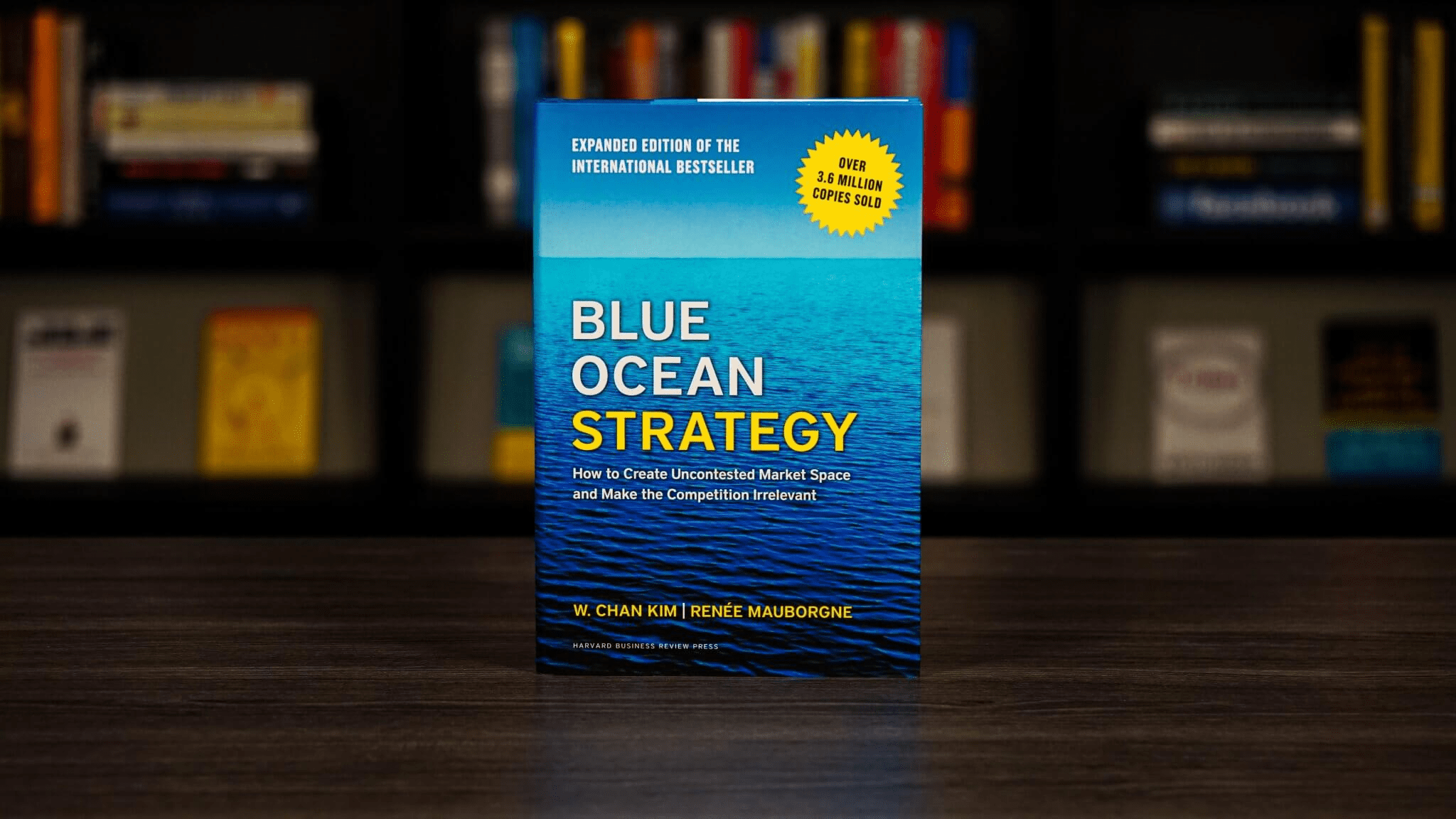
“Blue Ocean Strategy: How to Create Uncontested Market Space and Make the Competition Irrelevant” by W. Chan Kim and Renée Mauborgne challenges traditional competitive strategy. Instead of focusing on beating rivals in crowded “red oceans” of existing industries, the authors propose creating new, uncontested market spaces or “blue oceans” characterized by new demand and profitable growth. The book provides frameworks and tools for systematically identifying, formulating, and executing these strategies, emphasizing value innovation – creating a leap in value for both buyers and the company by simultaneously pursuing differentiation and low cost. This summary captures all the core ideas, examples, and frameworks presented in the book in an easy-to-read format, ensuring you understand the complete blueprint for making competition irrelevant.
Help! My Ocean Is Turning Red
Many managers feel trapped in industries defined by intense competition, shrinking margins, and rising costs – a “red ocean.” This feeling is common across businesses, non-profits, and government organizations. The “Blue Ocean Strategy” framework offers a way out, focusing on creating uncontested market space with new demand and strong, profitable growth.
Escaping the Red Ocean
The concept of red oceans represents all existing industries, characterized by defined boundaries, known rules, and fierce competition over existing demand. Blue oceans, conversely, represent unknown market spaces, new demand, and opportunities for highly profitable growth where competition is irrelevant.
- Red Ocean: Companies compete intensely within known market space, leading to price wars and commoditization.
- Blue Ocean: Uncontested market space is created, demand is generated, and the rules of the game are set by the creator.
- Cirque du Soleil Example: Instead of competing with traditional circuses, Cirque du Soleil created a new form of entertainment appealing to adults and corporate clients, making the competition irrelevant.
The Need for Blue Oceans
While competing effectively in red oceans will always be necessary, the current business environment, marked by increasing supply, globalization, and commoditization, makes it insufficient for sustained high performance. Creating blue oceans is increasingly vital for capturing new profit and growth.
- Supply Exceeding Demand: Accelerated technological advances and globalization have led to overcapacity in many industries.
- Commoditization: Products and services become more similar, making price the primary factor for selection.
- Shrinking Profit Margins: Intense competition drives down prices and squeezes profits.
- New Trends: Rising calls for creative solutions in various sectors, public megaphones amplifying customer voice, shifts in global demand to emerging markets, and the ease of becoming a global player all highlight the need for differentiation and low cost simultaneously.
Focus on the Strategic Move
Analyzing companies or industries in isolation may not fully explain high performance. Instead, focusing on the “strategic move” – the set of managerial actions involved in making a major market-creating business offering – is key to understanding how blue oceans are created and sustained.
- Company vs. Strategic Move: Studies like “In Search of Excellence” and “Built to Last” show that long-term excellence is often tied to specific strategic moves rather than inherent company traits.
- Industry Structure: The book argues that industry structure is not fixed but can be shaped by the actions of industry players, moving strategy from a zero-sum to a non-zero-sum game.
- Systematic Creation: Blue oceans are not random occurrences but can be created systematically through analytical frameworks and tools.
- Execution Built-In: Successful blue ocean strategies integrate execution from the start, particularly through the practice of fair process.
- Strategy Creation: The book aims to provide a step-by-step model for strategy creation, going beyond explaining why companies succeed or fail to prescribing how they can formulate and execute high-performance strategies.
Value Innovation
Value innovation is the cornerstone of blue ocean strategy, aiming to make the competition irrelevant by creating a leap in value for both buyers and the company. This is achieved by simultaneously pursuing differentiation and low cost, breaking the traditional value-cost trade-off.
- Value and Innovation: Value innovation occurs when innovation is linked to utility, price, and cost positions, unlike technology-driven or market-pioneering innovation that may lack commercial value.
- Breaking Trade-Off: Blue ocean strategy rejects the idea that companies must choose between differentiation and low cost.
- Cirque du Soleil Example: Eliminated costly elements of traditional circuses (animals, star performers) while raising and creating new elements from the theater (story line, artistic music), achieving differentiation at a lower cost.
- Aligned System: Value innovation requires aligning an organization’s utility, price, cost, and people propositions.
- Reconstructionist View: Value innovation is based on the belief that market boundaries and industry structure can be reconstructed by the actions and beliefs of industry players.
PART ONE: Blue Ocean Strategy
CHAPTER 1: Creating Blue Oceans
This chapter introduces the core concept of blue ocean strategy, contrasting it with traditional red ocean competition and highlighting value innovation as its foundation.
Red Oceans vs. Blue Oceans
The market universe is divided into red oceans of existing industries and blue oceans of new, uncontested market spaces.
- Red Ocean Description: Fierce competition, shrinking profits, focus on outperforming rivals for existing demand.
- Blue Ocean Description: Untapped market space, demand creation, opportunities for highly profitable growth, competition is irrelevant.
- Creation Within: Most blue oceans are created from within red oceans by expanding industry boundaries, not necessarily by inventing entirely new industries from scratch.
The History of Blue Ocean Creation
Blue oceans are a recurring feature of business history, with new industries constantly emerging and existing ones being reshaped. This challenges the view of fixed industry structures.
- New Industries Emerge: Many major industries today were unknown just decades or a century ago.
- Changing Classifications: The shift from the SIC to NAICS system reflects the significant expansion of new industry territories.
- Military vs. Business Strategy: Traditional strategy is often rooted in military concepts of competing over limited terrain, whereas business has the capacity to create new market space.
Impact of Blue Oceans
Creating blue oceans has a significantly greater impact on both revenue and profit compared to competing within red oceans.
- Study Results: A study of 108 business launches showed that while line extensions (red ocean moves) accounted for 86% of launches, blue ocean creations (14% of launches) generated a disproportionately higher share of total revenues (38%) and profits (61%).
- Performance Benefits: The data indicates that creating blue oceans leads to strong, profitable growth.
Rising Importance of Blue Oceans
Several global trends are making the creation of blue oceans more imperative today than ever before.
- Supply Exceeds Demand: Industrial productivity and globalization have increased supply beyond existing demand in many sectors.
- Accelerated Commoditization: Increased similarity among brands leads to greater price competition.
- New Global Trends: Rising calls for creative solutions in essential industries (healthcare, education), the influence of public megaphones (social media), the locational shift in future demand (emerging markets requiring affordable value), and the ease of becoming a global player all intensify the need to stand out.
From Company/Industry to Strategic Move
Focusing on the strategic move, rather than the company or industry, is key to understanding the creation of blue oceans and sustained high performance.
- No Permanent Excellence: History shows that neither companies nor industries maintain permanent excellence.
- Strategic Move Defined: A set of managerial actions involved in making a major market-creating business offering.
- Compaq Example: The blue ocean strategic moves Compaq made in servers were successful even if the company itself was later acquired.
- Common Patterns: Research across various industries revealed consistent strategic patterns behind successful blue ocean creations.
Value Innovation: Cornerstone of Blue Ocean Strategy
Value innovation is the core strategic logic of blue ocean strategy, focusing on making the competition irrelevant by creating a leap in value for buyers and the company.
- Beyond Benchmarking: Value innovators don’t benchmark competitors; they redefine the problem and create unprecedented value.
- Simultaneous Pursuit: Value innovation achieves differentiation and low cost simultaneously, breaking the traditional trade-off.
- Cirque du Soleil Example: Eliminated costly circus elements while adding intellectual and artistic elements from theater, attracting a new audience and lowering costs.
- Alignment: Value innovation requires aligning utility, price, and cost activities.
- Strategic vs. Operational: Value innovation is a strategic move embracing the entire system of activities, unlike subsystem-level innovations.
- Reconstructionist View: Value innovation is based on the belief that market boundaries and industry structure can be reconstructed.
Formulating and Executing Blue Ocean Strategy
Creating blue oceans can be systematic and actionable by applying principles and frameworks to manage risk and maximize opportunity.
- Systematic Approach: The book provides practical frameworks to address the perceived high risk of venturing beyond existing markets.
- Formulation Principles: Reconstruct market boundaries, focus on the big picture, reach beyond existing demand, and get the strategic sequence right.
- Execution Principles: Overcome key organizational hurdles, build execution into strategy, align value, profit, and people propositions, and renew blue oceans.
- Risk Attenuation: Each principle helps mitigate specific risks associated with blue ocean creation and execution.
The chapter concludes by emphasizing the practical methodologies offered in the book to enable systematic blue ocean creation and capture.
CHAPTER 2: Analytical Tools and Frameworks
This chapter introduces foundational analytical tools essential for formulating and capturing blue oceans, illustrating their application through the US wine industry.
The Strategy Canvas
The strategy canvas is a central diagnostic and action framework for building a compelling blue ocean strategy, visualizing the current market and charting a potential future.
- Diagnostic Tool: Captures the current state of competition, showing where rivals invest and what customers receive.
- Action Framework: Helps visualize a company’s current and potential future strategic profile.
- Horizontal Axis: Represents the factors the industry competes on and invests in.
- Vertical Axis: Shows the offering level buyers receive for each factor.
- Value Curve: Graphic depiction of a company’s relative performance across competitive factors.
- US Wine Industry Example: Showed convergence in value curves for both premium and budget wines, indicating intense competition on similar factors like price, image, aging quality, and complexity.
Limitations of Conventional Thinking
Traditional competitive approaches and extensive customer research often fail to reveal blue ocean opportunities.
- Benchmarking Pitfall: Focusing on competitors leads to incremental improvements rather than groundbreaking value.
- Customer Insight Limits: Customers tend to ask for “more for less” of existing features, not envisioning new market spaces.
- Reframing Needed: Shifting strategic focus from competitors to alternatives and from customers to noncustomers is crucial.
The Four Actions Framework
This framework helps companies reconstruct buyer value elements to craft a new value curve that breaks the differentiation-low cost trade-off.
- Eliminate: Which factors taken for granted should be eliminated?
- Reduce: Which factors should be reduced well below the industry standard?
- Raise: Which factors should be raised well above the industry standard?
- Create: Which factors should be created that the industry has never offered?
- Cost Reduction: Eliminating and reducing factors helps lower the cost structure.
- Value Enhancement: Raising and creating factors helps lift buyer value and create new demand.
- [yellow tail] Example: Casella Wines applied the four actions to create a fun, easy-drinking, easy-to-select wine, eliminating complexity and aging quality emphasis, reducing price (compared to premium), and raising fun and adventure.
The Eliminate-Reduce-Raise-Create Grid
A supplementary tool to the Four Actions Framework, the grid pushes companies to act on all four questions, facilitating a systematic approach to value innovation.
- Simultaneous Pursuit: Ensures companies consider both differentiation and low cost.
- Identifying Overengineering: Highlights companies that only raise and create, increasing costs without sufficient value.
- Managerial Understanding: Easily understood at all levels, promoting engagement.
- Challenging Assumptions: Forces rigorous scrutiny of competitive factors and implicit assumptions.
- Cirque du Soleil Example: Showed how eliminating animals and star performers and reducing multiple arenas, while raising and creating new artistic elements, led to a unique, low-cost, and differentiated offering.
Three Characteristics of a Good Strategy
An effective blue ocean strategy, as visualized on a strategy canvas, possesses three complementary qualities: focus, divergence, and a compelling tagline.
- Focus: The value curve clearly emphasizes a few key factors.
- Divergence: The value curve stands apart from competitors’, reflecting a unique strategic profile.
- Compelling Tagline: A clear, memorable phrase that communicates the essence of the strategy to buyers.
- Southwest Airlines Example: Focused on friendly service, speed, and frequent point-to-point departures, diverging from traditional airlines and having a clear tagline (“The speed of a plane at the price of a car—whenever you need it.”).
Reading the Value Curves
The strategy canvas provides rich insights into a company’s current and future strategic position.
- Blue Ocean Strategy: Value curve exhibits focus, divergence, and a compelling tagline.
- Caught in Red Ocean: Value curves converge with competitors, indicating intense competition on similar factors.
- Overdelivery without Payback: High levels on many factors without corresponding market share or profitability, suggesting oversupplying customers.
- Strategic Contradictions: Inconsistencies in the offering levels or between offering and price.
- Internally Driven: Language used in the strategy canvas reveals whether the strategy is driven by external demand or internal operations.
The chapter concludes by highlighting the power of these analytic tools in providing a structured approach to creating blue oceans and making the competition irrelevant.
PART TWO: Formulating Blue Ocean Strategy
CHAPTER 3: Reconstruct Market Boundaries
The first principle of blue ocean strategy is to reconstruct market boundaries, addressing the search risk and systematically identifying commercially compelling blue ocean opportunities. This involves challenging conventional assumptions about competition.
The Six Paths Framework
This framework identifies six basic approaches to systematically reconstruct market boundaries and create blue oceans.
- Challenge Assumptions: These paths challenge the conventional wisdom that keeps companies trapped in red oceans, such as defining the industry narrowly or focusing on existing customers.
- Systematic Exploration: Provides a structured way to look beyond existing boundaries.
- Commercially Viable Ideas: Leads to the identification of opportunities for value innovation.
Path 1: Look Across Alternative Industries
Companies compete not only with direct rivals but also with alternatives in other industries that offer different forms and functions but serve the same purpose.
- Alternatives vs. Substitutes: Alternatives are broader than substitutes, including products or services with different forms and functions but the same objective (e.g., cinema vs. restaurant for a night out).
- NetJets Example: Looked across commercial airlines and private jets, offering the convenience of private jets at a price closer to first-class commercial travel. Eliminated underutilized assets and staff costs, reduced travel time and hassle.
- NTT DoCoMo’s i-mode: Looked across mobile phones and the internet, offering key internet functions (email, simple info) on a mobile, easy-to-use, and affordable platform. Eliminated PC cost and complexity, reduced information overload and fear of online payments.
- Home Depot Example: Looked across hardware stores and professional contractors, offering contractor expertise at lower prices.
- Action Step: Identify alternative industries, understand why buyers trade across them, and focus on combining their decisive advantages while eliminating or reducing everything else.
Path 2: Look Across Strategic Groups within Industries
Strategic groups are clusters of companies within an industry pursuing similar strategies, often ranked by price and performance. Creating a blue ocean involves breaking from this narrow focus.
- Strategic Groups Defined: Groups of companies with similar strategies (e.g., luxury cars, economy cars).
- Trade-Up/Down: Understand the factors that make customers move between groups.
- Curves Example: Looked across traditional health clubs and home exercise programs, offering motivating collective workout (health club advantage) with time saving, lower cost, and privacy (home exercise advantage). Eliminated expensive facilities, extensive machines, and male presence; reduced workout time and price.
- Ralph Lauren Example: Combined high fashion with classical lines.
- Lexus Example: Offered high-end quality at a price closer to lower-end cars.
- Champion Enterprises Example: Combined prefab housing’s speed and low cost with on-site developers’ variety and quality image.
- Action Step: Identify strategic groups, understand why customers trade up or down, and combine the decisive advantages of different groups while eliminating or reducing other factors.
Path 3: Look Across the Chain of Buyers
In most industries, companies focus on a single buyer group (purchaser, user, or influencer), but there is a chain of buyers with different value definitions.
- Buyer Chain: Purchasers pay, users use, influencers sway the decision.
- Common Focus: Industries often converge on one group (e.g., pharma on doctors).
- Novo Nordisk Example: Shifted focus from doctors (influencers) to patients (users) in the insulin industry, creating user-friendly insulin delivery pens that removed the hassle and embarrassment of syringes and needles.
- Bloomberg Example: Shifted focus from IT managers (purchasers) to traders/analysts (users), offering terminals with built-in analytics and personal services.
- Canon Copiers Example: Shifted focus from corporate purchasers to users, creating desktop copiers.
- Action Step: Identify the chain of buyers, understand which group the industry focuses on, and explore how shifting focus to a different group can unlock new value.
Path 4: Look Across Complementary Product and Service Offerings
The value of a product or service is often affected by complementary products and services used alongside it.
- Total Solution: Define the complete set of products and services buyers seek when choosing your offering.
- Before, During, After: Think about what happens at each stage of the buyer’s experience.
- NABI Example: Looked beyond the initial purchase price of transit buses to the complementary activity of maintenance over the bus’s life cycle. Created fiberglass buses that reduced maintenance costs, fuel consumption, and emissions while increasing passenger comfort and revenue for municipalities.
- Philips Teakettle Example: Looked at the complementary product of water and its lime scale issue, creating a kettle with a filter.
- Dyson Vacuum Cleaners Example: Eliminated the need to buy and change vacuum cleaner bags (a complementary cost/hassle).
- Action Step: Identify complementary products and services, find the pain points in the total solution, and eliminate these through new offerings or bundles.
Path 5: Look Across Functional or Emotional Appeal to Buyers
Industries often converge on competing based either on price/utility (functional appeal) or feelings (emotional appeal). Challenging this orientation can open new market space.
- Functional vs. Emotional: Industries typically focus on one; challenging this can reveal new value.
- QB House Example: Shifted the Japanese barbershop industry from emotional (ritualistic, long) to highly functional (quick, low cost, hygienic). Eliminated hot towels, massages, and extensive treatments; reduced price and time; created air wash system and traffic light system.
- Cemex Patrimonio Hoy Example: Shifted cement’s appeal from functional input to the emotional “gift of dreams” for Mexican families building rooms, combined with innovative financing and construction know-how.
- Swatch Example: Transformed the functional budget watch industry into an emotional fashion statement.
- The Body Shop Example: Transformed the emotional cosmetics industry into a functional, no-nonsense offering.
- Direct Line Group Example: Transformed the emotional insurance industry into a functional, low-cost direct offering.
- Action Step: Determine your industry’s appeal, and explore how shifting to the opposite appeal can create new market space.
Path 6: Look Across Time
All industries are affected by external trends. Looking at these trends with a future perspective can reveal blue ocean opportunities.
- Decisive, Irreversible, Clear Trajectory: Focus on trends that meet these criteria.
- Beyond Projection: Don’t just project the trend; understand how it will change value for customers and impact the business model.
- Apple iTunes Example: Acted on the decisive, irreversible trend of illegal digital music file sharing, creating a legal, easy-to-use, and affordable online music store (iTunes) that provided superior utility over illegal downloads.
- Cisco Systems Example: Acted on the rising demand for high-speed data exchange, creating networking devices for seamless data exchange.
- CNN Example: Created a 24/7 global news network based on globalization trends.
- HBO Sex and the City Example: Acted on the trend of urban, successful women delaying marriage.
- Action Step: Identify relevant trends, understand their likely impact on customer value and the business model, and work back to define a future blue ocean strategy.
The chapter concludes by emphasizing that reconstructing market boundaries through these six paths is a structured process for discovering and creating blue oceans, not about predicting the future or random intuition.
CHAPTER 4: Focus on the Big Picture, Not the Numbers
The second principle of blue ocean strategy is to focus on the big picture, moving beyond number-crunching in strategic planning to visualize strategy on a strategy canvas. This mitigates planning risk.
Limitations of Traditional Strategic Planning
Most strategic planning processes keep companies anchored in red oceans due to their focus on existing conditions, market share within segments, cost cutting, and voluminous data-driven reports.
- Red Ocean Focus: Planning starts with analyzing existing competition and industry conditions.
- Number-Crunching: Emphasis on detailed financial data and reports rather than overall strategy.
- Muddled Strategies: Lack of clear, unified direction often results in a collection of tactics.
- Poor Communication: Strategies are often not easily understood or communicated to employees.
Drawing Your Strategy Canvas
Building the strategic planning process around drawing a strategy canvas helps companies focus on the big picture and visualize a break from the competition.
- Visualization Tool: Depicts the industry’s factors of competition, competitors’ profiles, and the company’s profile.
- Revealing Defects: Highlights lack of focus, convergence with competitors, and contradictions in the current strategy.
- Structured Process: The four-step process for drawing and discussing the strategy canvas pushes thinking towards a blue ocean.
Step 1: Visual Awakening
This step makes managers aware of the need for strategic change by having them draw the current strategy canvas, revealing the current state of play and its shortcomings.
- Face Harsh Reality: Drawing the canvas forces acknowledgement of the current competitive landscape.
- Revealing Defects: Highlights lack of focus and differentiation compared to competitors.
- Identifying Contradictions: Reveals inconsistencies within the strategy.
- Comparison with Competitors: Clearly shows convergence with rivals.
- EFS Example: European Financial Services managers drew their current strategy canvas for traditional and online foreign exchange businesses, revealing lack of focus, similarity to competitors, and contradictions (e.g., easy-to-use website but slow speed), creating a strong case for change.
Step 2: Visual Exploration
Sending managers into the field to explore the six paths to creating blue oceans and observing how people use or don’t use products/services is crucial for gaining fresh insights.
- Beyond Outsourcing: Managers should see the market firsthand, not rely solely on reports.
- Observe Alternatives and Noncustomers: Look beyond existing customers and industry boundaries.
- Observe Users: If customers and users are different, focus on the user experience.
- Explore Complementary Offerings: Understand the total solution buyers seek.
- EFS Example: Managers interviewed lost customers, new customers, competitors’ customers, noncustomers (e.g., internet companies), and users (accounting/treasury departments), observing complementary services and re-evaluating assumptions (e.g., account relationship managers were a weakness, not a strength).
- Develop New Strategies: Based on field insights, teams propose new strategies by drawing new value curves using the six path framework, aiming for distinctiveness and a compelling tagline.
Step 3: Visual Strategy Fair
Presenting proposed new strategies (value curves and taglines) to internal and external stakeholders for feedback provides diverse perspectives and helps refine ideas.
- External Judges: Inviting noncustomers, competitors’ customers, and demanding existing customers provides valuable, unbiased feedback.
- Transparency and Immediacy: Visual presentation and immediate feedback using sticky notes reduce politics and rely on the strength of the ideas.
- Synthesizing Feedback: Helps teams understand which aspects of their proposed strategies resonated and which were irrelevant or unclear.
- EFS Example: External judges provided feedback on proposed strategies, revealing that many perceived key factors were marginal to customers and highlighting common needs across diverse buyer groups. This led to refining the strategy and drawing a new value curve that was distinctive and addressed hidden market needs.
Step 4: Visual Communication
Communicating the final blue ocean strategy through a simple, one-page picture (the strategy canvas) makes it easy for all employees to understand and align their efforts.
- Easy Understanding: A visual representation is more accessible than lengthy documents.
- Aligning Efforts: Employees understand where the company is headed and what needs to be done.
- Basis for Decisions: The strategy canvas serves as a reference point for evaluating investment decisions and initiatives.
- EFS Example: Distributed the new strategy canvas to all employees, using it to guide investment decisions and ensure alignment across different departments and regions.
Visualizing Strategy at the Corporate Level
Visualizing strategy can also inform dialogue among business units and the corporate center, facilitating the transformation of a company’s business portfolio from red to blue.
- Sharing Canvases: Business units presenting their strategy canvases to one another improves understanding and facilitates the transfer of best practices.
- Samsung Electronics Example: Institutionalized the use of the strategy canvas in its Value Innovation Program Center and corporate conferences to drive value innovation across business units and transform its portfolio.
Using the Pioneer-Migrator-Settler (PMS) Map
The PMS map helps managers assess the growth potential of their current and planned business portfolios, identifying pioneers (blue oceans), migrators (value improvements), and settlers (me-too businesses).
- Growth Potential: Pioneers are the most powerful sources of profitable growth, while settlers contribute little.
- Portfolio Balance: A healthy portfolio has a balance of pioneers, migrators, and settlers for both future growth and current cash flow.
- Beyond Current Measures: The PMS map focuses on value and innovation as key parameters for future performance, not just historical measures like market share.
- Trajectory Visualization: Can depict the shift in a company’s portfolio over time.
The chapter concludes by emphasizing that visualizing strategy is a powerful way to inject strategy back into strategic planning and improve the chances of creating blue oceans.
CHAPTER 5: Reach Beyond Existing Demand
The third principle of blue ocean strategy is to reach beyond existing demand by focusing on noncustomers and building on commonalities across buyers, thus maximizing the size of the created blue ocean and mitigating scale risk.
Challenging Conventional Practices
Traditional strategy focuses on retaining and expanding existing customers, leading to finer segmentation. To create blue oceans, companies must shift their focus.
- Focus on Existing Customers: Conventional approach emphasizes catering to current buyer preferences.
- Drive for Finer Segmentation: Tailoring offerings to specific customer segments.
- Small Target Markets: Finer segmentation can limit the size of the market.
- Callaway Golf Example: Focused on noncustomers who found golf difficult, creating Big Bertha, a club that made the game easier and appealed to both noncustomers and existing customers.
- Reverse Course: Shift from customers to noncustomers, from differences to commonalities, and from segmentation to desegmentation.
The Three Tiers of Noncustomers
Identifying and understanding the universe of noncustomers is key to converting latent demand into real demand. There are three tiers based on their distance from the market.
- Untapped Demand: The universe of noncustomers represents a vast potential market.
- Deepen Understanding: Companies need insights into who noncustomers are and why they don’t buy.
First-Tier Noncustomers
These are “soon-to-be” noncustomers who minimally use the market’s offerings out of necessity but are looking for better alternatives and are ready to leave.
- Edge of the Market: Buyers who are dissatisfied but haven’t found a suitable alternative yet.
- Pret A Manger Example: Targeted professionals who minimally used restaurants for lunch but sought faster, healthier, and more affordable options. Created a value proposition offering restaurant-quality, fresh, fast, and reasonably priced sandwiches, attracting both soon-to-be and existing restaurant customers.
- Commonalities: Focusing on shared needs across these noncustomers reveals opportunities for desegmentation.
Second-Tier Noncustomers
These are “refusing” noncustomers who have consciously chosen against the market’s offerings because they find them unacceptable or beyond their means.
- Voted Against: Individuals who are aware of the industry’s offerings but have opted out.
- JCDecaux Example: Targeted companies that refused outdoor advertising because it wasn’t effective for comprehensive messages. Created “street furniture” (bus shelters with ad panels) in stationary downtown locations, increasing exposure time and effectiveness, attracting refusing noncustomers and increasing demand from existing ones.
- Commonalities: Identifying the reasons for refusal reveals key pain points and opportunities for value innovation.
Third-Tier Noncustomers
These are “unexplored” noncustomers who are farthest from the market and have never considered its offerings as an option because their needs are assumed to belong to other markets.
- Distant Markets: People whose needs are met by entirely different solutions or are simply ignored by the industry.
- Tooth Whitening Example: Oral care companies realized tooth whitening wasn’t exclusively a dentist service and tapped into the vast demand of individuals who had never considered professional teeth whitening.
- Joint Strike Fighter (JSF) Program Example: Aggregated the needs of three distinct military branches (Air Force, Navy, Marines) who had previously developed aircraft independently, creating a common airframe with shared components to lower costs and increase performance. Identified commonalities in core mission requirements and high-cost components despite historical differences.
- Commonalities: Identifying shared needs across these distant noncustomers reveals opportunities to redefine market boundaries.
Go for the Biggest Catchment
Focus on the tier of noncustomers that represents the largest potential market for your organization, and explore overlapping commonalities across tiers to expand the scope of latent demand.
- Scale of Opportunity: Varies across industries and over time.
- Organizational Capability: Choose the tier your organization is best equipped to target.
- Looking Across Tiers: When commonalities exist across multiple tiers, focus on all of them.
- Avoid Segmentation Trap: Prioritize reaching beyond existing demand before focusing on finer segmentation of current customers.
- Drawing Existing Customers: Value innovation for noncustomers can also attract existing customers who were implicitly accepting limitations.
The chapter concludes by highlighting that maximizing the size of the blue ocean requires a shift in focus from existing customers and finer segmentation to noncustomers and shared values, unlocking new demand.
CHAPTER 6: Get the Strategic Sequence Right
The fourth principle is to get the strategic sequence right, building a robust business model that ensures profitability for your blue ocean idea. This involves a four-step sequence: buyer utility, price, cost, and adoption, mitigating business model risk.
The Right Strategic Sequence
A blue ocean strategy must be built in a specific sequence to ensure commercial viability: creating exceptional utility, setting a strategic price, meeting a target cost, and addressing adoption hurdles.
- Buyer Utility: Must offer exceptional value to the target mass. If not, rethink the idea.
- Strategic Price: Price must be accessible to the mass of target buyers. If not, they can’t buy it.
- Target Cost: Must be able to produce at a cost that allows profitability at the strategic price. If not, innovate the business model or forgo the idea.
- Adoption Hurdles: Must address potential resistance from stakeholders. If not, execution will be hindered.
Testing for Exceptional Utility
Ensuring the offering unlocks exceptional utility for buyers is the starting point, moving beyond technology or novelty for its own sake.
- Beyond Novelty: Don’t be obsessed with technology; focus on how it improves buyers’ lives (simplicity, convenience, productivity, etc.).
- Philips CD-i Example: Failed because it offered complex technology without compelling buyer utility or ease of use.
- Motorola Iridium Example: Technological marvel but lacked utility for target users in buildings/cars.
- Value Innovation vs. Technology Innovation: Value innovation links innovation to what buyers value, unlike technology innovation alone.
- Buyer Utility Map: A tool to systematically assess utility across the buyer experience cycle and identify key utility levers.
From Exceptional Utility to Strategic Pricing
Setting the right strategic price is crucial to attract the mass of target buyers and ensure they can afford the offering, securing a strong revenue stream.
- Mass Adoption: Price must attract large numbers of buyers quickly, especially with increasing returns and network externalities.
- Volume over Price: Volume is key in knowledge-intensive industries with high development costs and low marginal costs.
- Free Riding: Ease of imitation, especially for non-technological innovations, makes immediate brand buzz and volume crucial.
- Price Corridor of the Target Mass: A tool to find the right price by looking at the price and volume of alternative products and services.
From Strategic Pricing to Target Costing
To maximize profit potential, work backward from the strategic price to a target cost, using price-minus costing.
- Price-Minus Costing: Deduct the desired profit margin from the strategic price to determine the target cost.
- Streamlining Operations and Cost Innovation: Focus on reducing costs across the value chain (e.g., assembly line, less expensive materials, location shifts).
- Swatch Example: Achieved a low target cost by simplifying design and manufacturing processes.
- Partnering: Leverage other companies’ expertise and economies of scale to reduce costs (e.g., SAP partnering with consulting firms, IKEA partnering with manufacturers).
- Changing the Pricing Model: If target cost can’t be met, innovate the pricing model (e.g., time-share, slice-share, freemium).
- NetJets Example: Used a time-share model to make private jets accessible.
- IBM Example: Shifted from selling to leasing tabulating machines to meet its strategic price.
- Value Innovation is Win-Win: Strategic pricing and target costing create a leap in value for both buyers and companies.
From Utility, Price, and Cost to Adoption
Addressing adoption hurdles from the outset, by educating and winning the support of key stakeholders (employees, partners, public), is crucial for successful execution.
- Threatened Status Quo: Blue ocean strategies often provoke fear and resistance.
- Employees: Address concerns about job impact and ensure they understand the rationale and benefits.
- Merrill Lynch Example: Faced resistance from employees when introducing online brokerage without addressing their concerns.
- Netflix Example: Engaged employees in the shift to streaming, explaining the necessity and preparing them for change.
- Business Partners: Address fears about revenue streams or market positions.
- SAP AcceleratedSAP Example: Won over consulting firm partners by showing how the new system would expand their client base.
- General Public: Address potential opposition, especially if the idea threatens social or political norms.
- Monsanto Example: Faced public opposition to genetically modified seeds due to failure to proactively educate and address concerns.
The Blue Ocean Idea Index
The BOI index provides a simple test to assess whether a blue ocean idea passes the four sequential criteria of utility, price, cost, and adoption.
- System View: Ensures the idea works as an integrated whole.
- Identifying Shortcomings: Helps refine the idea if it fails any of the criteria.
- Philips CD-i and Motorola Iridium: Failed the BOI index due to lack of utility, high price/cost, and/or adoption issues.
- NTT DoCoMo i-mode: Passed the BOI index by offering exceptional utility at a strategic price, meeting a target cost through partnering, and addressing adoption hurdles.
The chapter concludes by emphasizing that a commercially viable blue ocean idea is one that successfully passes through all four steps of the strategic sequence, ensuring both creation and capture of new market space.
PART THREE: Executing Blue Ocean Strategy
CHAPTER 7: Overcome Key Organizational Hurdles
The fifth principle is to overcome key organizational hurdles to make blue ocean strategy happen in action. These hurdles are cognitive, resource, motivational, and political. Tipping point leadership, which leverages factors of disproportionate influence, allows companies to overcome these fast and at low cost.
The Four Organizational Hurdles
Implementing a strategic shift, especially one as significant as a blue ocean strategy, often faces resistance and limitations within the organization.
- Cognitive Hurdle: Getting people to see and agree on the need for a strategic shift.
- Resource Hurdle: Limited resources for executing the strategy.
- Motivational Hurdle: Motivating key players to move fast and tenaciously.
- Political Hurdle: Overcoming internal and external resistance from vested interests.
Tipping Point Leadership in Action
Tipping point leadership defies conventional wisdom by focusing on concentrated efforts on factors of disproportionate influence to achieve rapid and low-cost change.
- Concentration, Not Diffusion: Focus efforts on the people, acts, and activities with the biggest impact.
- Disproportionate Influence: Small actions or inputs can have a large effect on performance or mind-set.
- NYPD Example: Bill Bratton, as police commissioner, transformed the NYPD despite budget freezes, low morale, and high crime, focusing on disproportionate influence factors to overcome the four hurdles.
The Pivotal Lever: Disproportionate Influence Factors
Identifying and leveraging factors that have a disproportionately positive influence on breaking the status quo, resource utilization, motivation, and overcoming political roadblocks is key.
- Focused Efforts: Don’t try to change everything or everyone at once.
- Maximize Impact: Target the areas that yield the biggest results with the least effort.
Break through the Cognitive Hurdle
To tip the cognitive hurdle, make people see and experience harsh reality firsthand, rather than relying on abstract numbers.
- “Seeing is Believing”: Direct experience is more powerful than data in changing mind-sets.
- Ride the “Electric Sewer”: Exposing managers to the worst operational problems makes the need for change undeniable.
- NY Transit Police Example: Bratton made managers ride the crime-ridden subway to see the reality ignored by statistics, prompting a shift in strategy.
- Sensitize Superiors: Show the worst reality to superiors to highlight problems and needs effectively.
- MBTA Example: Bratton used an uncomfortable ride in a small car to convince the general manager of the need for larger police cars.
- Meet with Disgruntled Customers: Direct interaction with dissatisfied customers provides powerful, unfiltered insights.
- Boston’s Police District 4 Example: Town hall meetings revealed that citizens were more concerned with quality-of-life crimes than major felonies, leading to a shift in police priorities.
Jump the Resource Hurdle
Overcome limited resources by multiplying the value of existing resources, focusing on hot spots, cold spots, and horse trading.
- Beyond More Resources: Focus on utilizing current resources effectively.
- Hot Spots: Activities with low resource input but high potential performance gains.
- Cold Spots: Activities with high resource input but low performance impact.
- Horse Trading: Exchange excess resources in one area for needed resources in another.
- NY Transit Police Example: Redistributed police officers to hot spots (stations/lines with high crime) instead of spreading them thin, achieving a significant crime reduction with the same number of officers.
- Redirect from Cold Spots: Changed the time-consuming process of criminal processing (a cold spot) using “bust buses,” freeing up officers for policing.
- Horse Trading Example: Traded excess unmarked cars for needed office space with the Division of Parole.
Jump the Motivational Hurdle
Motivate the mass of employees fast and at low cost by focusing on kingpins, using fishbowl management, and atomizing the strategic challenge.
- Beyond Grand Visions: Overarching visions may not inspire action in the ranks.
- Zoom In on Kingpins: Focus efforts on key influencers who can mobilize others.
- NYPD Example: Targeted precinct heads (kingpins) to influence the entire police force.
- Place Kingpins in a Fishbowl: Make kingpins’ actions and performance transparent and visible to peers and superiors.
- Compstat Example: Biweekly crime strategy review meetings where precinct commanders’ performance was publicly reviewed, creating intense motivation and accountability based on fair process.
- Fair Process: Transparency, inclusion, and clear expectations build trust and support.
- Atomize to Get the Organization to Change Itself: Break down the strategic challenge into bite-size, attainable goals for different levels.
- NYPD Example: Framed the challenge as making New York safe “block by block, precinct by precinct, and borough by borough,” making it actionable for every officer.
Knock Over the Political Hurdle
Overcome resistance from powerful vested interests by leveraging angels, silencing devils, and having a consigliere on the top management team.
- Anticipate Resistance: Identify who will fight the strategic shift.
- Consigliere: A politically adept insider who knows the organizational landscape and potential roadblocks.
- NYPD Example: John Timoney, Bratton’s number two, was a respected insider who helped identify potential resistors and supporters.
- Leverage Your Angels: Build coalitions with those who have the most to gain from the shift.
- Silence Your Devils: Find ways to neutralize those who have the most to lose; don’t fight alone.
- NYPD Example: Built an alliance with the mayor and a leading newspaper to counter the courts’ opposition to focusing on quality-of-life crimes.
- Irrefutable Facts: Back counterarguments with data and reason to disarm detractors.
Challenging Conventional Wisdom
Tipping point leadership offers an alternative to the traditional approach of organizational change by focusing on transforming the extremes to change the core fast and at low cost.
- Conventional Approach: Focuses on transforming the mass, requiring significant resources and time.
- Tipping Point Approach: Focuses on transforming the extremes (people, acts, activities with disproportionate influence).
- Leveraging Extremes: Changing the extremes creates an epidemic movement that rapidly affects the core of the organization.
The chapter concludes by emphasizing that overcoming organizational hurdles through tipping point leadership is crucial for actualizing a strategic shift and making blue ocean strategy happen.
CHAPTER 8: Build Execution into Strategy
The sixth principle of blue ocean strategy is to build execution into strategy from the start by creating a culture of trust, commitment, and voluntary cooperation through fair process. This minimizes management risk.
The Execution Challenge
Getting people throughout the organization to support and willingly execute a new strategy is crucial, especially for significant shifts like blue ocean strategy.
- Beyond Compulsory Execution: Aim for voluntary cooperation and initiative.
- Trepidation: Employees may be fearful of change and its impact on their jobs.
- Front-Line Importance: Execution happens daily at the front lines, where buy-in is essential.
- Fair Process: A key variable distinguishing successful blue ocean strategic moves.
Poor Process Can Ruin Strategy Execution
Even a sound strategy can fail if the process by which it is formulated and rolled out alienates the people needed to execute it.
- Lubber Example: A company with a value-innovative expert system failed because the sales force, who were not engaged or informed, felt threatened and sabotaged its implementation.
- Lack of Buy-In: Without trust and understanding, employees may resist or work against the new strategy.
The Power of Fair Process
Fair process, based on the theory of procedural justice, builds execution into strategy by creating buy-in and trust from the start. People care about the fairness of the process as much as the outcome.
- Procedural Justice: The belief that a process is fair, regardless of the outcome.
- Building Trust: Fair process makes people trust management’s intentions.
- Voluntary Cooperation: Inspires people to go beyond the call of duty.
- Causal Flow: Fair process leads to trust and commitment, which leads to voluntary cooperation.
The Three E Principles of Fair Process
Fair process is defined by three mutually reinforcing elements: engagement, explanation, and clarity of expectation.
- Engagement: Involving individuals in decisions that affect them, asking for input and allowing debate. Communicates respect and builds collective wisdom.
- Explanation: Ensuring everyone understands why final decisions were made. Builds confidence in managers’ impartiality and enhances learning.
- Expectation Clarity: Clearly stating the new rules, goals, targets, and responsibilities after the strategy is set. Minimizes political jockeying and focuses people on execution.
- Mutually Reinforcing: All three principles are necessary for fair process; any subset is insufficient.
A Tale of Two Plants
Comparing the implementation of a strategic shift in manufacturing at two Elco plants demonstrates the critical impact of fair process.
- Chester Plant: Failed to use engagement, explanation, and expectation clarity. Employees felt threatened, mistrusted management, and resisted the change, leading to declining performance. Managers brought in consultants without involving employees, didn’t explain the rationale for change, and were unclear about new expectations.
- High Park Plant: Practiced engagement, explanation, and expectation clarity. Despite initial expectations of resistance, employees understood the need for change, felt respected, and willingly cooperated in implementing the new manufacturing process, leading to successful execution. Managers involved employees in discussions, explained the strategic rationale, and clarified new roles and expectations.
Why Does Fair Process Matter?
Fair process is important because it conveys intellectual and emotional recognition to individuals, fostering trust, commitment, and voluntary cooperation.
- Intellectual Recognition: People want their ideas and intelligence to be valued and considered. This inspires them to share knowledge.
- Emotional Recognition: People want to be treated with respect and dignity, regardless of their position. This inspires them to commit energy and initiative.
- Intellectual and Emotional Recognition Theory: Fair process is strongly linked to both types of recognition, influencing people’s attitudes and behavior.
- Violation of Fair Process: Leads to intellectual indignation (hoarding knowledge) and emotional anger (resistance, sabotage).
- Retributive Justice: People may seek to punish those who violated fair process.
Fair Process and Intangible Capital
Commitment, trust, and voluntary cooperation are intangible capital that are essential for rapid, high-quality, and consistent execution of strategy, especially blue ocean strategy.
- Intangible Assets: These are valuable assets that allow companies to stand apart.
- Beyond Carrots and Sticks: Traditional incentives are insufficient for inspiring behavior beyond outcome-driven self-interest, especially where monitoring is uncertain.
- Execution Built-In: Fair process integrates execution into the strategy-making process, securing commitment from the start.
Fair Process and External Stakeholders
Fair process is also crucial for gaining the commitment and cooperation of external stakeholders, which is increasingly important in an interdependent world.
- Increased Importance: External stakeholders are outside hierarchical control and often have diverging interests.
- Beyond Contracts: While contracts are important, information asymmetry and differing interests make fair process central for effective execution.
- Slippery Slope: Lack of fair process with external partners can lead to missed deadlines, poor quality, and cost overruns.
- F-35 Program Example: Poor execution traced partly to a lack of engagement, explanation, and expectation clarity among the military, Lockheed Martin, and subcontractors, hindering knowledge sharing and voluntary cooperation.
- Addressing the Problem: Attempts are being made to rectify the situation through increased communication and clearer agreements, recognizing the importance of fair process for successful execution.
The chapter concludes by emphasizing that building execution into strategy through fair process is essential for creating the trust, commitment, and voluntary cooperation needed to successfully implement blue ocean strategy, both internally and with external partners.
CHAPTER 9: Align Value, Profit, and People Propositions
This chapter addresses the principle of alignment, ensuring that the three essential strategy propositions – value, profit, and people – are mutually reinforcing to create a high-performing and sustainable blue ocean strategy.
The Three Strategy Propositions
Any successful and sustainable strategy must align these three propositions: attracting buyers (value), making money (profit), and motivating people (people).
- Value Proposition: The offering must appeal to buyers.
- Profit Proposition: The business model must generate revenue greater than costs.
- People Proposition: Those working for or with the company must be motivated to execute the strategy.
- Holistic Approach: Success requires developing and aligning all three; focusing on only one or two leads to failure.
- Multiple Stakeholders: May require distinct people propositions for different internal and external groups.
- Top Management Responsibility: Alignment is a leadership function that cuts across traditional departmental silos.
Achieving Blue Ocean Strategic Alignment
Sustainable high performance for blue ocean strategy is achieved when all three strategy propositions are aligned around both differentiation and low cost.
- Differentiation and Low Cost: Unlike red ocean strategy, blue ocean strategy aligns all propositions to achieve both.
- Sustainability: Alignment makes a blue ocean strategy difficult to imitate, especially the people proposition.
- Reinforcing Synergies: A strong proposition in one area can support and strengthen the others.
Comic Relief Example
This UK charity achieved sustained high performance by aligning its value, profit, and people propositions around differentiation and low cost.
- Value Proposition (Donors): Eliminated guilt/pity, focused on fun (“fun”draising) through Red Nose Day, valued small donations, created a sense of community and personal contribution, held events bi-annually to avoid fatigue, and guaranteed 100% of donations go to charity (“golden pound”). This was differentiated and low cost for donors.
- Profit Proposition (Charity): Eliminated costly traditional fundraising methods (galas, grants, shops), leveraged existing retail for nose sales, focused on community fundraising for low staff costs, gained free media publicity, and had corporate partners cover operating costs to maintain the golden pound promise. This was differentiated and low cost for the organization.
- People Proposition (Staff, Volunteers, Partners, Celebrities): Created a legitimate, fun platform for volunteering (“fun”draising) through Red Nose Day, made participation easy, offered a sense of belonging to a greater cause, required minimal time commitment (bi-annual event), and provided tremendous free publicity for corporate sponsors and celebrities. This was differentiated and low cost for those involved.
- Aligned Synergies: The fun value proposition generated free media, which attracted corporate sponsors and celebrities, who covered operating costs, reinforcing the golden pound value proposition.
When a Strategy Is Not Properly Aligned
Lack of alignment can lead to a promising blue ocean idea failing to sustain its initial momentum, even with compelling value and profit propositions.
- Short-Lived Success: Innovations can generate excitement but fizzle out if not supported by all three propositions.
- Tata Nano Example: Had a compelling value proposition (affordable car for the masses) and a viable, differentiated, low-cost profit proposition (cost innovations in design/manufacturing). However, a major weakness in the people proposition for external stakeholders (the community where the plant was located, regarding land leasing and compensation) caused significant delays and dampened initial success.
- Negative Consequences: Misalignment can lead to execution problems, missed targets, and failure to meet expectations.
Putting It All Together
The examples of Napster and Apple’s iTunes illustrate the critical role of alignment in distinguishing between short-lived blue ocean ideas and sustainable success.
- Napster Example: Had a compelling value proposition (free digital music) but failed to align its external people proposition (with record labels) or develop a profit proposition, leading to its demise due to copyright infringement. Lacked a holistic strategy view.
- Apple iTunes Example: Created a set of fully developed and aligned strategy propositions. Compelling value for buyers (legal, easy, affordable). Compelling external people proposition for partners (record labels receiving 70% of revenue, promoting iPod sales). Strong profit proposition (revenue from sales and boosted iPod sales). This alignment led to sustainable success and market dominance.
The chapter concludes by emphasizing that aligning the value, profit, and people propositions around both differentiation and low cost is essential for creating a high-performing and sustainable blue ocean strategy.
CHAPTER 10: Renew Blue Oceans
Creating a blue ocean is a dynamic process. This chapter discusses how to manage imitation and when to renew blue oceans to ensure continuous high performance, preventing them from turning red.
Barriers to Imitation
Blue ocean strategies often face considerable barriers to imitation, prolonging their sustainability.
- Sustainability Factors: Various barriers, ranging from alignment to cognitive, organizational, brand, economic, and legal factors, make blue ocean strategies difficult to copy quickly.
- Alignment Barrier: The integrated system of value, profit, and people propositions is hard to replicate.
- Cognitive/Organizational Barrier: Conventional thinking and internal politics delay imitation.
- Brand Barrier: The unique brand reputation built by the value innovator is hard to overcome.
- Economic/Legal Barrier: Factors like natural monopoly, economies of scale, network externalities, patents, and legal permits can block or discourage imitation.
- Examples: Cirque du Soleil, Comic Relief, Apple’s iTunes, JCDecaux, Intuit’s Quicken, Salesforce.com have all enjoyed long periods without credible challenges.
Renewal
Eventually, imitation intensifies, turning the blue ocean red. Companies need to know when and how to create new blue oceans to renew their business or portfolio.
- Imitation and Convergence: As competitors copy the strategy, value curves converge, and competition heats up.
- Trap of Competing: Focusing solely on defending market share against imitators can lead a company into a red ocean battle.
- Renewal Needed: To avoid being trapped, companies must reach out for another blue ocean before the current one turns fully red.
Renewal at the Individual Business Level
Monitoring the strategy canvas helps single-business firms determine when to value-innovate again.
- Monitor Value Curves: Charting your company’s and competitors’ value curves visually indicates the degree of convergence and when the blue ocean is turning red.
- When Not to Renew: If the value curve still shows focus, divergence, and a compelling tagline, focus on maximizing the current blue ocean’s rent stream through operational improvements and expansion.
- When to Renew: Begin the process of creating a new blue ocean when your value curve starts converging with competitors’, and rivalry intensifies.
- Moving Target: Dominating the current blue ocean for as long as possible makes it harder for imitators to catch up.
- Examples: The Body Shop and Curves need to reach for new blue oceans as their original ones have matured and faced increased competition.
Renewal at the Corporate Level for a Multibusiness Firm
For companies with diverse business offerings, the dynamic Pioneer-Migrator-Settler (PMS) map helps monitor and plan the renewal of the corporate portfolio.
- Dynamic PMS Map: Visualizes the movement of businesses across pioneer, migrator, and settler categories over time.
- Portfolio Balance: A healthy portfolio balances pioneers (future growth), migrators, and settlers (current cash flow).
- Launching New Oceans: As pioneers become migrators, the company needs to launch new blue ocean businesses to maintain growth.
- Apple Inc. Example: Successfully managed its portfolio by launching new blue ocean businesses (iPod, iTunes, iPhone, iPad, App Store) as previous pioneers matured, maintaining strong profitable growth.
- Red and Blue Complementarity: Successful multibusiness firms need to excel in both red and blue oceans, managing competitive strategies for mature businesses while creating new markets for future growth.
- Microsoft Example: Has faced challenges due to heavy reliance on settler businesses (Office, Windows) and failure to launch new pioneers, impacting its stock price and talent attraction despite profitability.
The chapter concludes by emphasizing that blue ocean creation should be a systematic and repeatable process, and companies need to master both blue and red ocean strategies for sustained high performance in the increasingly competitive business world.
CHAPTER 11: Avoid Red Ocean Traps
This new chapter addresses ten common misconceptions or “red ocean traps” that prevent organizations from successfully creating blue oceans, even when they intend to. Understanding and avoiding these traps is crucial for proper application of blue ocean strategy tools.
Getting the Framing Right
Mental models and pre-existing knowledge can inadvertently lead managers to interpret blue ocean strategy through a red ocean lens, hindering successful implementation.
- Misconceptions: Common misunderstandings about the core concepts of blue ocean strategy.
- Impact on Practice: These traps lead to incorrect application of tools and methodologies.
- Perspective Matters: A correct understanding of the underlying concepts is essential for success.
Red Ocean Trap One: Customer-Led Strategy
The belief that blue ocean strategy is solely about being customer-led and focusing on existing customers.
- Incorrect Focus: Focusing on existing customers tends to lead to incremental improvements within the red ocean (“more of the same for less”).
- Noncustomer Insight: Blue ocean strategy gains insight from noncustomers, understanding why they avoid the industry and uncovering pain points and intimidation factors that limit market boundaries.
- New Demand: Analyzing noncustomers is essential for creating new demand.
Red Ocean Trap Two: Venturing Beyond Core Business
The belief that creating blue oceans requires venturing into industries outside the company’s core business.
- Risk Misconception: This belief makes blue ocean creation appear riskier than it is.
- Creation Within: Most blue oceans are created within existing industries by reconstructing boundaries, not by entering entirely new ones (e.g., [yellow tail] in wine, Wii in video games).
- Leverage Existing Knowledge: Creating blue oceans within the core business allows companies to leverage their existing knowledge and capabilities.
Red Ocean Trap Three: New Technologies
The misconception that blue ocean strategy is synonymous with new technologies.
- Technology is Not Defining: Many successful blue ocean moves did not involve new technologies (e.g., Comic Relief, Starbucks).
- Link Technology to Value: When technology is involved, its success in creating a blue ocean depends on how it unlocks compelling value for buyers (simplicity, ease of use, productivity).
- Value Innovation: Value innovation, not technology innovation, is the key to commercially compelling new markets.
Red Ocean Trap Four: First to Market
The belief that being first to market is essential for creating a blue ocean.
- Value Over Speed: Blue ocean strategy is about being first to get it right by linking innovation to value, not just being first.
- Examples: Apple was not the first to market with many of its successful products (iMac, iPod, iPhone) but succeeded by offering value innovation.
- Avoiding the Trap: Prioritize creating value innovation over speed alone.
Red Ocean Trap Five: Differentiation Strategy
The misconception that blue ocean strategy is the same as differentiation strategy.
- Red Ocean Differentiation: Achieved by offering premium value at a higher cost and price.
- Blue Ocean Difference: Pursues differentiation and low cost simultaneously by breaking the value-cost trade-off.
- “And-And” Strategy: It is not an either-or choice; both are achieved together.
- Avoiding the Trap: Focus on both raising/creating and eliminating/reducing factors to achieve simultaneous differentiation and low cost.
Red Ocean Trap Six: Low-Cost Strategy
The misconception that blue ocean strategy is a low-cost strategy focused on low pricing.
- Beyond Low Cost: Blue ocean strategy aims for a leap in buyer value at a lower cost to the company, but not necessarily the lowest price in the market.
- Strategic Pricing: Price is set to be accessible to the mass of target buyers, often by pricing against substitutes and alternatives, not just within the industry.
- Positioning: Blue oceans can be created at the low, middle, or high end of the market.
- Avoiding the Trap: Don’t just focus on eliminating/reducing costs; also focus on raising/creating value to achieve differentiation alongside low cost.
Red Ocean Trap Seven: Innovation
The belief that blue ocean strategy is synonymous with innovation per se.
- Innovation vs. Value Innovation: Innovation is a broad concept about originality and usefulness; value innovation specifically links innovation to a leap in value for the mass of buyers.
- Motorola Iridium Example: An innovation that failed to be a value innovation because it didn’t offer compelling utility for the target mass.
- Focus on Value Innovation: Blue ocean strategy’s core is value innovation, which is commercially viable.
Red Ocean Trap Eight: Marketing Theory / Niche Strategy
The belief that blue ocean strategy is solely a theory of marketing or a niche strategy.
- Beyond Marketing: While marketing is involved, blue ocean strategy is a holistic approach that includes value, profit, and people propositions, addressing organizational hurdles and execution.
- Alignment Needed: Success requires alignment across all three propositions, not just a compelling value proposition.
- Desegmentation, Not Segmentation: Blue ocean strategy focuses on aggregating demand by identifying commonalities across buyer groups, not on finer segmentation for niche markets.
Red Ocean Trap Nine: Competition is Bad
The belief that blue ocean strategy views competition as inherently bad.
- Beyond “Good” or “Bad”: Blue ocean strategy recognizes that competition can be detrimental to profitable growth in overcrowded markets where supply exceeds demand.
- Making Competition Irrelevant: The goal is to redefine industry boundaries and create new market space where competition is not a limiting factor.
- Industry Growth: Blue ocean strategy contributes to the growth of industries by expanding the market.
Red Ocean Trap Ten: Creative Destruction / Disruption
The belief that blue ocean strategy is synonymous with creative destruction or disruption.
- Displacement: Creative destruction and disruption involve displacing existing technologies, products, or services.
- Nondestructive Creation: Blue ocean strategy emphasizes nondestructive creation, expanding market boundaries or creating new spaces without necessarily destroying existing players or offerings.
- Redefining the Problem: Blue ocean strategy redefines the problem an industry focuses on, leading to offerings that often complement existing ones rather than displacing them.
- Examples: Viagra created a blue ocean without displacing an existing industry; Wii complemented existing video games.
The chapter concludes by stressing that a robust understanding of these red ocean traps and the proper framing of blue ocean strategy are essential for effectively using its tools and methodologies and achieving sustainable success in creating new market space.
Big-Picture Wrap-Up
“Blue Ocean Strategy” presents a powerful alternative to traditional competitive strategy by focusing on creating new market space rather than competing in existing ones. The core idea is value innovation, the simultaneous pursuit of differentiation and low cost, which breaks the traditional value-cost trade-off. This approach is systematic, relying on analytical tools like the strategy canvas and the Four Actions Framework, and can be implemented by looking across six defined paths to reconstruct market boundaries. Successful execution requires addressing organizational hurdles, building trust and commitment through fair process, aligning the value, profit, and people propositions, and managing the dynamic process of renewal. Avoiding common red ocean traps is essential to ensure that the frameworks are applied correctly and the strategy leads to sustainable, high-performance growth in uncontested market spaces.
- Core Lesson: Shift from competing in red oceans to creating blue oceans through value innovation.
- Next Action: Begin by drawing your current strategy canvas and exploring the six paths to identify potential blue ocean opportunities.
- Reflective Question: How can your organization redefine its industry’s problem to unlock entirely new demand?





Leave a Reply