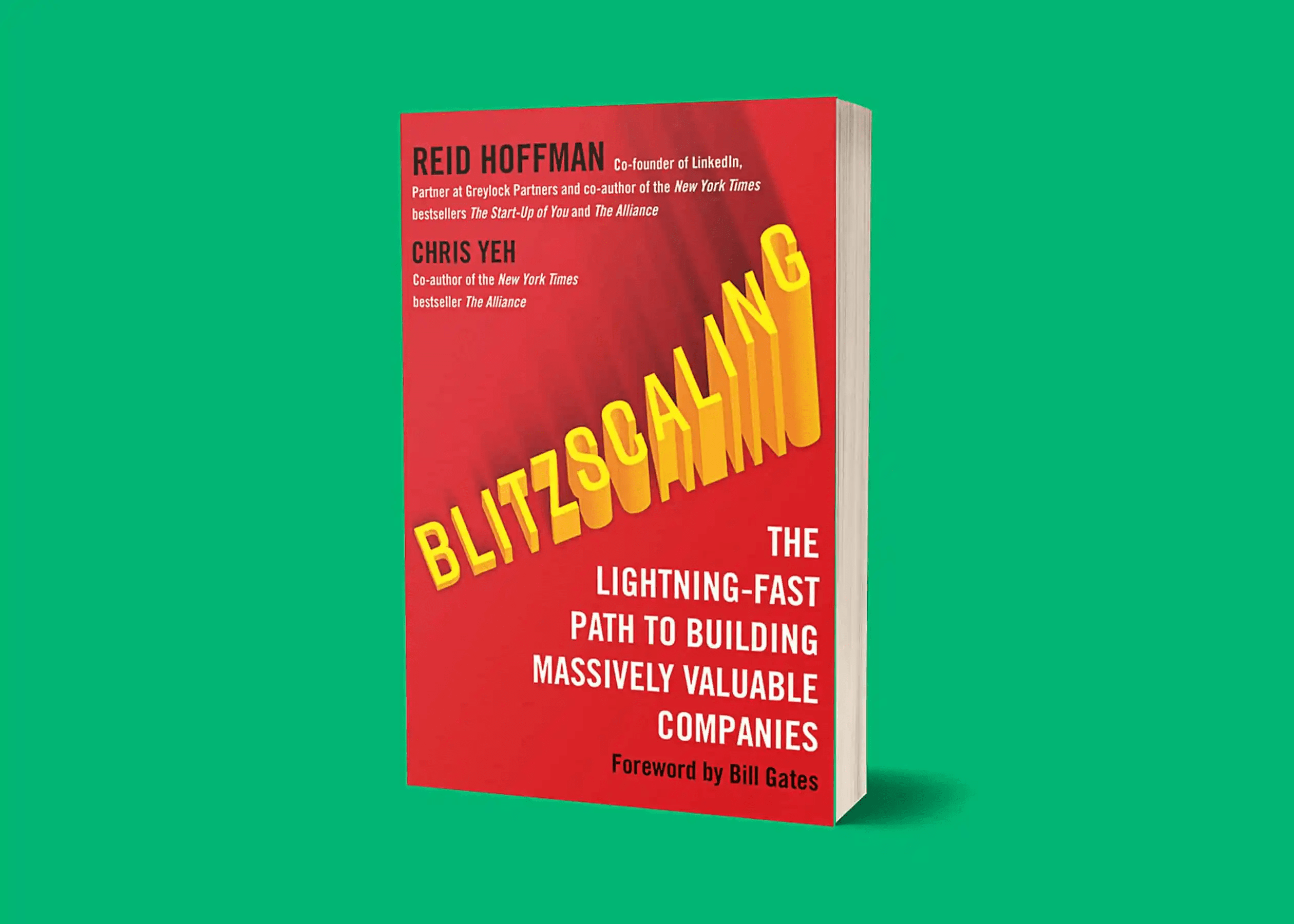

Blitzscaling: The Lightning-Fast Path to Creating Massively Valuable Businesses
“Blitzscaling” by Reid Hoffman and Chris Yeh is an essential guide for entrepreneurs, investors, and leaders navigating the hyper-competitive landscape of modern business. It dissects the aggressive growth strategy that prioritizes speed over efficiency in the face of uncertainty, allowing companies to achieve unprecedented scale and market dominance. This book isn’t just about getting big fast; it’s about purposefully breaking traditional business rules to win winner-take-all markets. Through compelling case studies of giants like Amazon, Google, Facebook, and even non-tech companies like Zara, Hoffman and Yeh provide a comprehensive framework for understanding when, why, and how to apply blitzscaling, and the critical role of innovation in business models, strategy, and management. You’re about to dive into every important idea, example, and insight from this groundbreaking work, presented in clear, accessible language, ensuring nothing significant is left out.
The authors, drawing on their deep experience in Silicon Valley, reveal that the internet has dramatically accelerated the “clock speed” of the world, making blitzscaling not just possible, but often necessary. The book explores how “network effects”—where increased usage by one user enhances the value for others—create powerful feedback loops that lead to superlinear growth and market dominance. This makes achieving “first-scaler advantage” paramount in many industries. However, this aggressive approach comes with significant risks and inefficiencies, demanding a counterintuitive mindset that embraces chaos and constant change. This summary will illuminate the intricate balance required to navigate these challenges, from designing innovative business models to transforming organizational culture, preparing you to thrive in the new era of speed and uncertainty.
Part I: What Is Blitzscaling?
This foundational section introduces blitzscaling as a framework and set of techniques for achieving massive scale at incredible speed, often making the company feel uncomfortable due to its rapid pace. It contrasts blitzscaling with other forms of growth and outlines its fundamental principles and the five stages a company moves through as it scales.
Defining Blitzscaling and its Purpose
Blitzscaling is characterized by prioritizing speed over efficiency in an environment of uncertainty. It’s not merely rapid growth, but a deliberate strategy to achieve “lightning” speed that can overwhelm competitors. The book emphasizes that this approach involves intentionally doing things that contradict traditional business wisdom. For example, Amazon’s seemingly “inefficient” capital consumption has often been criticized, but it allowed them to win key markets like online retail and cloud computing by moving incredibly fast. This strategy is justified when a market is “up for grabs,” because the risk of being too slow is far greater than the risk of inefficiency. Blitzscaling demands courage and skill, and relies on an environment willing to finance intelligent risks with financial capital (fuel) and human capital (oxygen).
Software’s Role in Accelerating Growth
The authors highlight how software is eating the world, enabling unprecedented scalability and rapid innovation. Historically, breakneck growth was limited to software or software-enabled hardware companies. Today, this extends to nearly every industry, as software allows companies to iterate and recover from missteps on “software timescales” (days or weeks) rather than “hardware timescales” (years). The internet has globally connected markets, allowing for massively scalable distribution channels. This increased velocity, coupled with the rising significance of network effects, makes blitzscaling powerful. For instance, a software update can upgrade a Tesla overnight, demonstrating how software innovation drives physical product improvement.
The Types of Scaling
The book clarifies blitzscaling by comparing it to three other types of growth, based on a matrix of efficiency vs. speed and uncertainty vs. certainty:
- Classic Start-up Growth (Uncertainty, Efficiency): Focuses on resource efficiency to “glide” and learn about the market, technology, and team. This is about establishing “product/market fit.”
- Classic Scale-up Growth (Certainty, Efficiency): Optimizes for maximum returns in stable, established markets, reflecting traditional corporate management.
- Fastscaling (Certainty, Speed): Sacrifices efficiency for increased growth rate when costs are predictable, often used for gaining market share or hitting revenue milestones.
- Blitzscaling (Uncertainty, Speed): Prioritizes speed above all else, even if it means significant operating inefficiencies and higher risk. It’s like assembling and igniting a jet engine on a plane while still building its wings.
While blitzscaling carries higher risks, it becomes an optimal strategy when the potential prize is large and competition is intense. The goal is to move from “zero to one” to “one to one billion” in a compressed timeframe. A company may use different scaling types at various points, often following an “S-curve” of growth: classic start-up, then blitzscaling, then fastscaling, and finally classic scale-up growth. This applies not just to whole companies, but to individual products and business lines, creating aggregate S-curves for the entire company.
The Three Basics of Blitzscaling
Successful blitzscaling hinges on three fundamental understandings:
- Blitzscaling is both an Offensive and Defensive Strategy: Offensively, it allows a company to surprise the market, bypass defended niches, exploit breakout opportunities (e.g., Slack blindsiding Microsoft). It builds long-term competitive advantages by leveraging leads, and opens access to capital as investors prefer market leaders. Defensively, it sets a pace that keeps competitors gasping, forcing them to react to your moves rather than developing their own differentiated strategies.
- Blitzscaling Thrives on Positive Feedback Loops: The company that achieves first-scaler advantage reaps significant benefits. McKinsey’s research showed high-growth companies offer significantly greater shareholder returns and are more likely to reach $1 billion in revenue. Once a scale-up gains high ground, talent and capital flood in. Top professionals seek impact and financial rewards with lower risk, while VCs are more confident investing in proven scale. This creates a virtuous cycle: more investment fuels growth, which further shrinks confidence intervals for investors. This is why Uber and Pinterest achieved massive valuations, dwarfing most publicly traded companies.
- Blitzscaling Comes with Massive Risks: Despite the advantages, rapid growth can lead to “cancer-like” uncontrolled issues. Facebook’s old motto, “Move fast and break things,” illustrated this; eventually, fixing bugs took more time than the speed gained. Successful blitzscaling requires maintaining control by rapidly fixing inevitable breakages. It demands reinvention of leadership style, product, and organization at each new phase. The example of Oracle in the late 1980s, which nearly went bankrupt due to single-minded sales growth neglecting technology and finance, underscores the danger of organizational growth not keeping pace with revenue and customer growth.
The Five Stages of Blitzscaling
Blitzscaling is not linear; each major growth increment creates qualitative and quantitative changes, often requiring different approaches. The book uses a community metaphor based on organizational scale (number of employees) to define five stages:
- Stage 1 (Family): 1–9 employees. Characterized by close, informal relationships.
- Stage 2 (Tribe): 10s of employees. Still relatively informal but requires more coordination.
- Stage 3 (Village): 100s of employees. Formal processes begin to emerge; direct relationships with all employees become impossible.
- Stage 4 (City): 1000s of employees. Requires significant formalization and multiple layers of management.
- Stage 5 (Nation): 10000s of employees. The company operates on a global scale, becoming a major player in its industry.
These stages provide a useful framework for understanding how management and leadership roles evolve. While employee count is the primary metric, the book notes that other measures like user, customer, and business scale also exist, and ideally, these should grow faster than employee count for greater profitability and less constraint on financial or human capital.
The Three Key Techniques of Blitzscaling
To build dominant companies, entrepreneurs and investors apply three core techniques, universal regardless of geography:
- Business Model Innovation: This is the most foundational technique. Many startups fail by focusing only on technology or product while neglecting how the company will actually make money. Innovative business models maximize growth by leveraging new technologies to outcompete established players. Google’s success, for instance, wasn’t just its search algorithms but its AdWords business model that monetized search by prioritizing relevance and performance. Tesla combines existing technologies with a novel business model rather than pioneering entirely new ones. Innovation in business models often stems from a combination of new technologies with effective distribution, scalable revenue, and efficient customer service under resource constraints. For PayPal, blitzscaling came before fully solving its business model, trusting that growth would create the necessary leverage.
- Strategy Innovation: This involves the explicit pursuit of extreme growth combined with an innovative business model to create massive value and competitive advantage. It goes beyond “get big fast” by purposefully doing things that defy traditional business thinking, like prioritizing speed over efficiency despite uncertainty. Competitive advantage stems from growth factors like network effects. Uber’s aggressive city-by-city expansion, with heavy subsidies, enabled faster critical scale and solidified its first-scaler advantage. Silicon Valley’s ruthlessness in valuing exponential growth, even if risky, drives entrepreneurs to pursue these strategies. Companies that fail to blitzscale in winner-take-most markets, like Nokia against Apple and Samsung, risk becoming irrelevant.
- Management Innovation: This technique addresses the extreme strains hypergrowth places on an organization and its employees. Blitzscaling companies must constantly reinvent their leadership style, product, and organization. Tripling employee count annually is common, requiring radical shifts in recruitment, coaching, and communication. It means embracing “counterintuitive rules” like hiring “good enough” people, launching imperfect products, and letting certain “fires burn.” Oracle’s past struggles with management lagging sales growth serve as a cautionary tale. Successful blitzscalers actively manage growth rather than being consumed by it.
Part II: Business Model Innovation
This part delves into the crucial role of business model innovation, explaining why it’s the foundation for exponential growth and how it distinguishes successful companies in the Networked Age.
The Primacy of Business Model Innovation
The Internet era is defined by business model innovation, not just technological breakthroughs. Many dot-com failures arose from simply transplanting old business models onto a new medium (e.g., eToys trying to “Amazon” markets without Amazon’s underlying innovations). Successful companies like Amazon, eBay, and Google thrived because they designed entirely new business models enabled by technology. Google’s AdWords transformed online advertising, making search far more valuable than traditional media. Even influential Internet innovators like Craigslist and Wikipedia, despite technological brilliance, never became massively financially valuable on their own because their business models didn’t prioritize it. True value creation comes from combining innovative technology with innovative products, services, and the business models that monetize them effectively.
Designing to Maximize Growth: The Four Growth Factors
To build a highly scalable business model, companies should maximize four key factors:
- Market Size: A fundamental starting point. A large market means many potential customers and efficient channels to reach them. Predicting Total Available Market (TAM) is a source of uncertainty but also opportunity. The market should ideally be growing quickly. Venture Capitalists (VCs) filter for “venture scale” markets (at least $1 billion in annual sales) to achieve their target returns. Sam Altman famously advised Airbnb’s Brian Chesky to project a $30 billion market, not $30 million, because “Investors want B’s, baby.” It’s crucial to account for how lower costs or product improvements can expand markets (e.g., Uber expanding the transportation market beyond traditional taxis) and the potential for expansion into adjacent markets (Amazon’s growth beyond books).
- Distribution: A good product with great distribution almost always beats a great product with poor distribution. Many startups overlook this. Dropbox, for instance, excelled due to its distribution, not just its product. The “mobile first” era has made distribution even harder, pushing innovators to find creative, low-cost methods like leveraging existing networks or virality.
- Leveraging Existing Networks: New companies tap into established user bases. PayPal integrated with eBay to let sellers easily add a “Pay with PayPal” button. Airbnb similarly allowed hosts to cross-post listings to Craigslist, despite its lack of an API. This boosts initial adoption but carries the risk of the existing network changing its rules (e.g., Zynga on Facebook, Demand Media on Google Search).
- Virality: Users bring in more users. This can be organic (e.g., LinkedIn users inviting contacts to build their network) or incentivized (e.g., PayPal’s $10 referral bonuses, Dropbox’s extra storage for referrals). Virality almost always requires a free or freemium product. Critical for virality is retention; Dropbox revamped its onboarding when activation rates were low, realizing that users bringing in new users doesn’t help if they immediately leave. The most powerful distribution often combines both strategies, like Facebook’s college-by-college rollout using organic social virality.
- High Gross Margins: This is a crucial, often overlooked, growth factor. Gross margins (sales minus cost of goods sold) indicate the long-term unit economics. Higher gross margins mean more cash to fund growth and expansion. Software businesses typically have high gross margins because duplication costs are near zero. Even SaaS businesses benefit from low cloud computing costs. Amazon is an outlier in retail (low margin), but its Amazon Web Services (AWS) is a high-margin SaaS business that fuels its overall profitability. High gross margins make a business attractive to investors, facilitating larger funding rounds at higher valuations, which is vital for blitzscaling. They also make it easier to afford operational necessities like customer support, as overhead costs scale with customers/units, not margins.
- Network Effects: The most crucial factor for sustaining growth and building a lasting franchise. The Internet has amplified network effects to unprecedented levels. A product or service has positive network effects when increased usage by any user increases its value for other users (e.g., Facebook, WeChat). These create superlinear growth and customer lock-in, making it extremely difficult for new entrants to compete. This leads to “increasing returns to scale” and often winner-take-all or winner-take-most markets.
- Five Categories of Network Effects:
- Direct Network Effects: Value increases directly with usage (Facebook).
- Indirect Network Effects: Usage encourages complementary goods (operating systems like Windows, iOS, Android).
- Two-Sided Network Effects: Usage by one group increases value for a different complementary group (eBay, Uber, Airbnb).
- Local Network Effects: Usage by a small subset increases value for connected users (e.g., wireless carrier “favorites”).
- Compatibility and Standards: Use of one product encourages compatible products (Microsoft Word file format).
- Aggressive Growth and Tipping Points: Network effects both produce and require aggressive growth. At low scale, they can exert downward pressure. Companies must pass a “tipping point” for value to kick in (e.g., Uber subsidizing rides to build liquidity). This can pose a challenge when subsidies need to be phased out (e.g., PayPal shifting from “always free”). Companies can also reshape the demand curve by designing products with individual value independent of network adoption (e.g., LinkedIn profiles as professional identity). The Internet’s connectivity lowers discovery costs and makes it easier to sustain network effects.
- Five Categories of Network Effects:
Designing to Maximize Growth: The Two Growth Limiters
Even with strong growth factors, companies must design around common obstacles:
- Lack of Product/Market Fit: This is the most critical limiter. As Marc Andreessen stated, it means “being in a good market with a product that can satisfy that market.” Without it, growth is expensive and difficult, and well-run companies can still fail. Non-obvious opportunities often arise from market changes that incumbents can’t adapt to (e.g., Charles Schwab leveraging deregulation). While full validation before building is hard, entrepreneurs should leverage network intelligence and research to maximize the chances of rapid product/market fit.
- Operational Scalability: Even with a scalable economic model, operations must keep up with demand. Dismissing this as a “high-class problem” is dangerous.
- Human Limitations: Growth increases the complexity of managing relationships exponentially (e.g., 4 to 6 people increases pairs from 6 to 15). Business models should aim for minimal human intervention (e.g., WhatsApp’s tiny staff for millions of users). Outsourcing (e.g., Airbnb’s photography) can help. Ultimately, massively successful companies require thousands of employees, demanding management innovations.
- Infrastructure Limitations: Inability to handle demand can be fatal. Friendster and early Twitter suffered from server meltdowns. Amazon Web Services (AWS) has become a solution for many, providing scalable computing infrastructure. The “power of modularity” allows complex products to be built from standardized subsystems. China’s manufacturing capabilities serve a similar role for hardware startups. Tesla’s growth, conversely, has been held back by manufacturing complexity.
Proven Business Model Patterns
Successful blitzscalers often follow distinct business model patterns that leverage growth factors and bypass limiters. These are principles, not exact recipes. While open-source software is valuable for engagement, it rarely produces massively profitable businesses. The proven patterns include:
- Bits Rather Than Atoms: Businesses based on electronic bits (software, digital content) scale more easily due to global reach, virality, network effects, and high gross margins. They iterate faster (faster product/market fit) and require fewer employees (e.g., Apple’s iPod, Netflix). Even atom-based businesses (like Amazon retail) can scale by heavily integrating software (inventory management, AWS).
- Platforms: Predating the Networked Age, platforms connect users and facilitate transactions. Today’s software-based platforms achieve global distribution instantly, with transactions via APIs at immense volumes. Achieving de facto standard status creates unassailable competitive advantage via compatibility and standards network effects. Examples include iTunes, Force.com, and Apple’s iOS ecosystem. These generate high-margin “taxes” from participants.
- Free or Freemium: “Free” has immense power for distribution and virality, jump-starting network effects to achieve critical mass. Facebook is free, monetizing via advertising. Freemium (e.g., Dropbox’s 2GB free storage) offers a free basic service and charges for upgrades, extracting value once product value is clear.
- Marketplaces: Highly successful, often leveraging two-sided network effects. Achieving liquidity (buyers and sellers quickly finding counterparts) makes them highly attractive, creating a positive feedback loop. They benefit from efficient market pricing (e.g., Google’s AdWords auction system). Online marketplaces overcome local market constraints and human/infrastructure scalability limits by dealing in bits (connecting) rather than atoms (holding inventory).
- Subscriptions: Provide predictable revenue streams, enabling aggressive long-term investments. Salesforce.com’s SaaS model revolutionized enterprise software by offering licenses in any quantity, expanding the market beyond large corporations. Netflix leveraged subscriptions to outspend traditional TV networks on original content, offering a personalized viewing experience.
- Digital Goods: Intangible products with high gross margins, usually generated from platforms (e.g., LINE’s stickers, in-game purchases in video games). They have nearly 100% gross margins as they add minimally to infrastructure or overhead.
- Feeds: Drive user engagement, advertising revenue, and retention. Facebook’s News Feed (and Twitter, Instagram, Slack) monetizes “eyeballs” through sponsored updates, carefully targeted using sophisticated algorithms. This pattern demonstrates the power of business model innovation over pure product/tech innovation.
The Underlying Principles of Business Model Innovation
Beyond specific patterns, deeper principles power technological and business model innovation:
- Moore’s Law: Predicts that computing power doubles every eighteen months, acting as a constant source of technological innovation. Entrepreneurs like Reed Hastings (Netflix) anticipate Moore’s Law, building long-term visions even if technology isn’t ready, then leveraging its inevitable progress (e.g., shifting from DVD-by-mail to streaming as bandwidth increased). This “anticipatory” approach turns pipe dreams into reality.
- Automation: Computers are faster, cheaper, and more reliable than humans, and their power relentlessly increases (driven by Moore’s Law). Automation applies to direct products (iPhone) and internal processes (Amazon warehouses, Google server farms), increasing productivity and scalability.
- Adaptation, Not Optimization: Successful scale-ups prioritize adaptation over optimization. Instead of fixed assembly lines, they practice continuous improvement through speed, experiments, and A/B testing. This fits rapidly changing products and markets (e.g., Amazon’s expansion into AWS, Facebook’s shift to mobile).
- The Contrarian Principle: Being “contrarian and right” provides a massive head start on achieving scale. If an opportunity is obvious, competition is fierce. If conventional wisdom ignores or disdains it (e.g., Amazon with e-commerce, Google with search, Facebook with social networks), a company gains time to refine its business model. Great ideas often look dumb initially, because business model innovations are unproven by definition. This principle is crucial for gaining first-scaler advantage.
Analyzing a Few Billion-Dollar Business Models
The book provides detailed analyses of LinkedIn, Amazon, Google, and Facebook, applying the four growth factors and two growth limiters to illustrate their success.
LinkedIn:
- Market Size: Leveraged the contrarian idea of an online professional identity in a post-dot-com bust era, targeting all white-collar professionals—a massive opportunity.
- Distribution: Started with organic virality (users inviting contacts) and enhanced it with tools like address book importers. Proved distribution before raising significant capital, focusing on “growth hacking” to reach 1 million users.
- Gross Margins: Initially struggled with monetization. Achieved profitability with freemium subscriptions, but the key was discovering that companies would pay for enterprise subscription products to find job candidates, providing high-gross-margin revenue and confidence to blitzscale.
- Network Effects: Built a massive strategic moat with three types: direct (more users = more value for all users), two-sided (more users attract more employers, which attracts more job seekers), and becoming a standard for professional identity.
- Product/Market Fit: The enterprise product for recruiters was the key inflection point, validated by sales team feedback indicating strong demand.
- Operational Scalability: Faced challenges supporting two distinct products (consumer and enterprise) and rapidly scaling a sales force while still developing the product. Used technology (e.g., “Merlin” tool) to automate sales tasks and alleviate scaling constraints.
Amazon:
- Market Size: Bezos’s vision of an “everything store” began with books (large, e-commerce friendly) and systematically expanded into numerous verticals, including Amazon Web Services (AWS), significantly expanding its initial market size.
- Distribution: Pioneered the Amazon Associates affiliate program, turning other websites into powerful distribution channels.
- Gross Margins: Initially low in retail due to low-margin nature and low prices. However, the third-party marketplace (nearly 50% of units sold) has higher margins. AWS (a high-margin, bits-based business) contributes 150% of Amazon’s operating income, fueling investment and dominance.
- Network Effects: Relatively weak direct network effects (product reviews are minor). Benefits from scale effects (Jim Collins’s “flywheel” of lower prices leading to more customers, sales, and efficiency). Strong network effects in AWS via indirect network effects and compatibility/standards.
- Product/Market Fit: Rarely struggled with product/market fit in core retail, jumping into hypergrowth immediately. AWS also had rapid uptake. Amazon has also experienced many failures outside its core business (e.g., Fire Phone), demonstrating that product/market fit is not guaranteed for every venture.
- Operational Scalability: World-class, shifting from outsourcing logistics to becoming a leading infrastructure company (AWS) and mastering logistics (fulfillment centers, Prime Now hubs), turning a limiter into a competitive advantage. Bezos’s strong, delegated leadership (e.g., Andy Jassy for AWS) enabled growth to over 541,900 employees.
Google:
- Market Size: Initially underestimated as “yet another search engine.” Google’s AdWords model (relevance-based, self-service advertising) generated far more revenue per search, and the increasing importance of search on the growing Internet created a massive market. Expanded through key acquisitions like Android, Google Maps, and YouTube.
- Distribution: Skillfully leveraged existing networks and partners: AOL search deal, Firefox partnership, acquisition of Android, and Chrome browser. AdSense program fed raw traffic into AdWords.
- Gross Margins: A phenomenally profitable company (61% gross margin) due to AdWords’ self-service advertising auction model focusing on purchase intent, yielding fat margins. This financial power funds big bets (Android, Chrome, X, Waymo).
- Network Effects: Leverages network effects in various business lines, though not ironically in core search. Waze (direct network effect), Android (indirect network effects for app developers), YouTube (two-sided network effects for creators and consumers), and Google G Suite (compatibility and local network effects).
- Product/Market Fit: Google’s core search and AdWords had incredible product/market fit. However, it took time to refine (initially tried enterprise search appliances, DoubleClick ads). Relies on bottom-up innovation and high tolerance for failure (e.g., Gmail success, Buzz/Wave/Glass failures), balanced by financial strength to cut losses (abandoning Google Video for YouTube).
- Operational Scalability: Excels due to heavy investment in internal tools and infrastructure. Innovates in people scalability with smaller teams for new products, larger for existing. Invests in people analytics (e.g., optimum interviews, performance reviews). Employs dedicated growth teams that combine marketing, product, and engineering.
Facebook:
- Market Size: Initially dismissed as a niche “social network for college students.” Mark Zuckerberg’s broader vision was to be the default way people stayed in touch, an enormous market.
- Distribution: Excelled with its college-by-college rollout, creating local critical mass (50%+ students requesting) for incredible virality. Leveraged existing friend networks to expand beyond colleges.
- Gross Margins: Started without an effective revenue model, but sponsored posts within the news feed made it wildly profitable (87% gross margin). This fuels talent, technology investments, and strategic acquisitions (Instagram, WhatsApp, Oculus).
- Network Effects: Leverages direct network effects (more users = more value for all) and local network effects (dominance at a college). Benefits from indirect network effects via platform services like Graph API and Facebook Connect.
- Product/Market Fit: Achieved rapid product/market fit for core consumer experience. Crucially, Zuckerberg led the shift from desktop to mobile-first (monetization via news feed ads). Also achieved product/market fit for advertisers by blocking inappropriate content and integrating ads into the News Feed, turning skeptical advertisers into loyal customers.
- Operational Scalability: Cultivated a philosophy of “Move fast and break things,” later evolved to “Move fast and break things with stable infrastructure.” This emphasis on speed allows rapid product development and continuous improvement. Every new engineer makes a code revision on day one.
Part III: Strategy Innovation
This part explores the strategic decisions involved in blitzscaling, particularly when to start and stop, and how the founder’s role transforms through the different stages of rapid growth.
When Should I Start to Blitzscale?
Deciding when to blitzscale is a critical strategic choice, often requiring throwing out conventional business rules. It’s only sensible when speed into the market is the critical strategy for achieving massive outcomes, whether for offensive or defensive reasons. A proven revenue model isn’t always necessary before blitzscaling; investors may fund growth based on potential. Slack raised significant capital before its revenue model was fully proven, based on rapid user adoption.
However, premature blitzscaling (“blitzfailing”) can destroy a nascent market (e.g., Webvan’s failure poisoning grocery delivery). Key factors to look for:
- A Big New Opportunity: A large, unserved or scrambled market with enormous potential value, often due to a technological innovation (e.g., YouTube leveraging network and mobile video technologies). The ultimate prize must justify the high costs and risks of blitzscaling. Alibaba’s success in China, anticipating its massive middle class, justified enormous investment.
- First-Scaler Advantage: The primary offensive reason for blitzscaling is to achieve critical mass that confers a lasting competitive advantage, often by triggering network effects (e.g., Uber or Airbnb). Blitzscaling is unlikely to succeed if a competitor already has this advantage (e.g., Amazon/Yahoo! failing against eBay). Critical mass is distinct from first-mover advantage; being first to launch doesn’t guarantee success without scaling.
- Learning Curve: Being first to climb a steep learning curve can create a lasting competitive advantage. Rapid scaling generates more data for learning (or machine learning), improving the product (e.g., Netflix’s journey from DVD-by-mail to streaming to original content, mastering various learning curves).
- Competition: The most common driver of blitzscaling. If competitors can realize an opportunity faster, moving faster reduces the risk of being outmaneuvered. The more intense the competition, the faster a company should move (e.g., Airbnb against Wimdu). Speed is a primary advantage startups hold over large companies.
- Good Times, Bad Times: Blitzscaling can work in any market condition, but the rate of growth is relative. Hot markets make it easier to attract capital and talent (e.g., Uber’s billions in funding). During downturns (e.g., Google’s deal with AOL during the dot-com bust), perceived risk might allow a company to outbid incumbents, leading to massive gains.
- Going Faster: This means prioritizing speed over efficiency, even at the cost of greater uncertainty. It involves making non-traditional decisions like rapidly doubling staff by prioritizing speed over meticulous hiring (ClassPass), while also focusing on risk management to mitigate downsides. Sometimes, however, not blitzscaling is the right choice if the market isn’t urgent, as LinkedIn initially did by focusing on a “slow and steady” approach before its enterprise product opportunity arose.
When Should I Stop Blitzscaling?
Blitzscaling is not a permanent state; no market is infinite. It should stop when the market stops growing or reaches its upper limit. Continuing to blitzscale in a mature market leads to crashing into a “ceiling” and internal conflict.
Leading indicators that it’s time to ease off the gas:
- Declining rate of growth (relative to market/competition)
- Worsening unit economics
- Decreasing per-employee productivity
- Increasing management overhead
When these signs appear, the current strategy won’t scale further, and it’s time to change course (e.g., Yahoo!’s revenue plateau and Google’s surpassing it). Groupon suffered from internal turmoil and CEO changes after its market suddenly stopped growing due to unsustainable promotions. Twitter faced similar issues when user growth stalled, despite revenue growth, highlighting the need to shift from aggressive hiring to efficiency.
Can I Choose Not to Blitzscale?
Not every business needs to blitzscale. Businesses like The French Laundry (a world-class restaurant) prioritize quality and unique experience over scale, existing in fundamentally different worlds from Amazon. The safest time not to blitzscale is when pursuing a low-margin business that investors are unwilling to fund aggressively. Many small “lifestyle” businesses fall into this category.
However, if conditions are ripe for blitzscaling, competitors may take on the risks you avoid, potentially destroying your market position (e.g., Airbnb vs. Wimdu, Amazon vs. independent bookstores). Even if you don’t face direct blitzscaling competition, its widespread impact (e.g., higher property values, tight labor markets in Silicon Valley) can still affect your business. Independent bookstores survived Amazon’s onslaught by migrating from “bookselling” to “literary community” businesses, offering a different, unscalable experience.
Blitzscaling Is Iterative
Successful blitzscaling is a serial problem-solving exercise. Each stage demands different solutions for people, product, and finance. Problems are “solved for now,” not forever. The “Do Things That Don’t Scale” advice extends: you constantly need to find new things that scale for the next stage, while simultaneously finding new non-scalable things to do. This requires planning ahead to ensure your core business model has scale advantages and network effects to begin with.
How Blitzscaling Strategy Changes in Each Stage
The optimal speed and strategy for blitzscaling evolve with each stage:
- Family/Tribe Stages (up to 100 employees): Challenging to clearly move faster than average startups. Companies must be the only competent player, have a brilliant growth strategy (e.g., PayPal’s viral marketing), or pursue scale more resolutely by making aggressive investments (e.g., Amazon’s history of aggressiveness). The downside is higher failure cost, but the upside is first-scaler advantage.
- Village/City Stages (100s-1000s employees): Speed of competing organizations becomes more varied. Blitzscaling shifts from raw aggression to differentiated, still aggressive strategies. Rapid, parallel market development (e.g., Airbnb’s international expansion) is a signature strategy, inefficient but distinguishes from slower competitors.
- Nation Stage (10,000s employees): Dominating an industry means growth slows. Scaling shifts to incubating and growing major new businesses. Companies must blitzscale new product lines to maintain upward trajectory (e.g., Apple launching iPhone while dominant in music; Google launching Android while dominant in search).
How the Role of the Founder Changes in Each Stage
A founder’s role transforms significantly as the company grows:
- Stage 1 (Family): The founder personally pulls the levers of hypergrowth, doing everything (e.g., writing viral email copy).
- Stage 2 (Tribe): The founder manages the people who are pulling the levers, focusing on making team members productive.
- Stage 3 (Village): The founder designs an organization that pulls the levers, focusing on big-picture organizational design. This is often when outside executives are hired.
- Stage 4 (City): The founder makes high-level decisions about goals and strategies (e.g., Mark Zuckerberg halting feature development for mobile). Tactical execution is delegated.
- Stage 5 (Nation): The founder figures out how to pull the organization back from blitzscaling its core business and start blitzscaling new product lines and business units (e.g., Steve Jobs at Apple focusing on operational effectiveness while launching iPod/iPhone).
Part IV: Management Innovation
This part outlines the critical management innovations needed to navigate the challenges of hypergrowth, focusing on eight key transitions and nine counterintuitive rules.
Eight Key Transitions
Successful blitzscalers must continually evolve their management practices.
- Small Teams to Large Teams:
- Family/Tribe: Small teams operate spontaneously and informally, highly adaptable (e.g., PayPal’s four rapid pivots in its first year).
- Village and Beyond: Larger teams require planning and formal processes as personal contact diminishes. Leaders must create systems to keep early employees connected to the mission, even if they’re no longer involved in every decision.
- “Marines, Army, Police” Metaphor: Marines (start-up people) thrive in chaos; Army (scale-up people) rapidly secure territory; Police (stability people) sustain. As companies scale, they may need to find new “beaches” for their “marines.”
- Elastic Limits of People: Few early employees can scale with the company. Setting correct expectations up front is crucial; focus on responsibility and career growth opportunities, not just titles. Sometimes, honest parting is better than letting an employee flounder in an unsuited role.
- Generalists to Specialists:
- Early Stages: Prioritize smart generalists who can tackle many different tasks in uncertainty (e.g., Matt Cohler at LinkedIn as a “firefighter” for urgent problems).
- Later Stages: Shift to hiring specialists with deep domain expertise crucial for scaling (e.g., Pat Wadors as LinkedIn’s CHRO).
- Dangers of Premature Specialization: Specialists are less fungible and may not be effectively utilized outside their area. Hiring specialists can also strain morale if early generalists feel sidelined.
- “Stem Cells” of the Organization: Generalists are still valuable in large organizations for exploring new products or tackling undefined problems.
- Hiring Cadence: Hire only generalists in Family stage; specialists are exceptions in Tribe; prudent in Village (executives/key contributors); almost all executive hires in City/Nation are specialists.
- Contributors to Managers to Executives:
- Distinct Roles: Managers handle day-to-day tactics and execute plans. Executives lead managers, focusing on vision, strategy, and organizational “fighting spirit.”
- Evolution of Need: Family stage may need no formal managers. Tribe needs managers for functional departments. Village stage requires executives to coordinate hundreds of employees across multiple managers.
- “Standard Start-up Leadership Vacuum”: Internally promoted managers lack executive role models. Hiring experienced outside executives is often necessary, despite potential cultural challenges. Ideal candidates have blitzscaling experience from similar stages.
- Integration: Blend outside hires with inside promotions (e.g., Mariam Naficy at Minted hiring outside for finance/HR, promoting internally for “secret sauce”). Outside hires should be culturally compatible and given opportunities to prove themselves (e.g., John Lilly at Mozilla hiring and integrating executives by bringing them in at lower levels first).
- Formal Structure: Hierarchy is essential for growth, not antithetical to it. Lack of structure becomes a bottleneck, hindering information flow and accountability (e.g., Cloudflare’s experiment with flat organization failing).
- Dialogue to Broadcasting:
- Family Stage: Informal, in-person “prairie dog” communication. Remote employees require conscious effort to keep in loop (e.g., Slack, 24/7 video conferences).
- Tribe Stage: Need to supplement one-to-one with processes like weekly company meetings (well-organized, agenda, interactive discussion, rituals beyond business).
- Village Stage and Beyond: Logistical challenges require lower frequency meetings (monthly/quarterly) and leveraging technology like videoconferencing (e.g., BlackRock using teleconferencing for all). Founder/CEO needs to develop broadcast channels (e.g., Brian Chesky’s Sunday emails at Airbnb, regular voicemails/videos from Patrick Collison, Shishir Mehrotra).
- Confidentiality: As company grows, more sensitive information becomes secret, requiring a shift from sharing all information by default.
- Inspiration to Data:
- Early Stages: Rely on gut instinct, as little analytics from customers. “If you don’t have customers to listen to, the best you can do is listen to your gut.”
- Later Stages: Data becomes lifeblood. Jeff Bezos’s “data beats opinion” policy at Amazon.
- Transition to Data: Start with basics (users, churn, engagement). Selina Tobaccowala at SurveyMonkey built data infrastructure from scratch, focusing on 3-5 key metrics (free users, paid conversions, engagement).
- Single Clarifying Metric: Some companies choose one overarching metric (e.g., YouTube’s “watch time” goal).
- Data Accessibility: Information must be easy to access and provide clear context.
- Evolving Metrics: Key stats change with growth. Vanity metrics (e.g., Twitter’s API calls) can be misleading.
- Data Infrastructure: Village stage requires common dashboards. City/Nation stages need dedicated Business Intelligence (BI) teams and growth teams (combining marketing, product, engineering) to drive and coordinate data-driven insights.
- Balancing Quantitative and Qualitative: Data-driven design is good for optimization, but “genius-driven design” (Apple) is needed for revolutionary products. Qualitative insights can reveal problems numbers miss (e.g., Facebook’s auto-tagging feature being “creepy” to focus groups but boosting engagement in tests).
- Single Focus to Multithreading:
- Early Stages: Startups are typically single-product companies (e.g., Dropbox’s focus despite Google Drive threat). This focus is key to beating larger competitors.
- Later Stages (City stage onwards): Scale-ups need to manage multiple product lines or business units to sustain growth. The organization becomes large enough to support divisions.
- Exploiting vs. Exploring: Mature business lines “exploit” existing markets; new threads “explore” new opportunities. “Ambidextrous organizations” structure new threads as independent units with integrated management.
- Strategic Necessity: Multithreading should occur when strategically necessary (e.g., LinkedIn addressing user engagement with multiple approaches when a single one failed).
- Costs and Incentives: Multithreading increases competitive bandwidth but comes with costs (e.g., organizational focus). Treat each thread as a different company with its own leadership and incentives, but ensure alignment with the overall company’s success. This is challenging but crucial for preventing internecine warfare and prioritizing overall company health.
- Pirate to Navy:
- Pirate Mentality (Early Stages): Startups are like pirates: lack formal processes, question rules, offensive, use surprise. Lower risk threshold as they have “nothing left to lose.”
- Ethical Piracy: Willing to break rules to change them for the better (e.g., PayPal challenging banking regulations) but not purely selfish. Social media scrutiny highlights need for ethical behavior.
- Joining the Navy (Village Stage): Time to adopt rules, play offense and defense. More blitzscaling is often the answer to lock out competition.
- City Stage: Defense becomes primary focus. Establish standards (e.g., Salesforce.com’s Force.com platform), offer complete solutions. In China, companies put teams on anything with traction; in Silicon Valley, talent scarcity makes fast-follower strategies less viable.
- Nation Stage: Transformation complete. Acquisitions become essential offensive and defensive plays (e.g., Google acquiring Android, Facebook acquiring Instagram/WhatsApp). Financial strategy (e.g., Apple’s cash hoard) supports M&A. Diversionary attacks force opponents to defend all territory.
- From Captain to Admiral: Founders like Travis Kalanick (Uber) struggle with this transition, clinging to “troubleshooter” roles rather than building unified executive teams. Dara Khosrowshahi’s task at Uber is to instill “navy” values (responsibility, doing the right thing) and build a cohesive management structure. A global business needs managers for individual markets, understanding market differences, and a unified executive team to coordinate.
- Scaling Yourself: Founder to Leader:
- Founders need universal skills: bold risk-taking, learning ability, living with paradoxes. They must keep their personal learning curve ahead of the company’s growth curve.
- Three Ways to Scale Yourself:
- Delegation: Find, hire, and manage good people, then transfer work. Crucial for founders, especially handing off functional leadership. Visualize the ideal hire (e.g., Joe Zadeh for Airbnb product).
- Amplification: Hire people who magnify your impact, not just free up your time (e.g., chief of staff, researchers). This significantly increases productivity.
- Making Yourself Better: Continuously learn, as the job description for founders constantly changes. Talk to other entrepreneurs (especially those one to five years ahead). Have a personal board of advisors or “board of directors” for feedback and guidance. Prioritize time for reflection and personal improvement, as Reed Hastings (Netflix) learned, it benefits the company.
Nine Counterintuitive Rules of Blitzscaling
These rules challenge conventional management wisdom to cope with blitzscaling’s frenzied pace.
- Embrace Chaos: Accept uncertainty and take action even with unresolved issues. Passive succumbing to chaos isn’t winning; embracing it means managing it. Use ABZ planning (Plan A: current best, Plan B: pivot, Plan Z: fallback for survival) to recover from mistakes. Be prepared for roles and job titles to shift constantly (e.g., Jamie Templeton at PayPal changing roles repeatedly). Chaos normalizes radical change, making the organization nimble.
- Hire Ms. Right Now, Not Ms. Right: Prioritize managers and executives who are “just right” for the current phase of growth, even if they might not scale to the next phase. The primary concern is current value. Don’t hire a manager of 1000 people for a 10-person company. “Scalability” is secondary. Be aware of which stages individuals prefer to avoid frustration. Knowing when to let someone go is also part of this rule (e.g., Minna King at LinkedIn/SurveyMonkey/Nextdoor, specializing in globalizing software at specific company stages).
- Tolerate “Bad” Management: Speed is more important than a perfectly “well-run” organization. This might mean frequent reorganizations, promoting people before they’re ready, or surprising staff with quick decisions. PayPal, despite its “bad” management (no formal career development, few rules), thrived because its chaos kept it nimble in the face of “Oh shit!” moments (fraud, competition). This normalized radical change for employees, making them adaptable.
- Launch a Product That Embarrasses You: Prioritize speed to market with an imperfect product over a slow, “perfect” launch. Early launch enables rapid feedback and learning, allowing faster iteration up the learning curve (tight OODA loop). SocialNet’s failure to launch early was a key lesson for Reid Hoffman. LinkedIn launched its MVP with minimal features, then used data to improve virality (address book import). The key is fixable flaws, not fatal ones; don’t endanger customers or reputation. Listen to data over anecdotal user feedback (e.g., Facebook’s auto-tagging being “creepy” but boosting engagement).
- Let Fires Burn: In blitzscaling, there are always more problems than resources. Prioritize fighting fires that genuinely threaten the company’s existence or growth, and consciously let less urgent fires burn. The art is knowing which to ignore (e.g., PayPal ignoring customer service issues initially to focus on fundraising and competition). A hierarchy of fires: distribution > product > revenue model > operations > competition > what’s next?
- Do Things That Don’t Scale (Throwaway Work): Engineers hate it, but inefficiency is the rule. Invest less in security, write non-scalable code, delay QA tools—if it allows for faster market entry and learning. This applies to all business aspects (e.g., Salesforce’s founder calling in favors, Kayak’s founder listing his personal number). Airbnb’s photography system evolved from founders doing it personally, to hiring freelancers tracked on spreadsheets, to automated software—each stage involved “throwaway” work that was necessary for speed at that moment.
- Ignore Your Customers: The classic “customer is always right” rule is often violated. Provide only necessary support that doesn’t slow you down, relying on forums or minimal email support. PayPal initially had two support people for exponentially growing transactions, choosing to ignore angry calls to focus on existential threats. This is a temporary solution; eventually, you must address customer service once critical growth battles are won.
- Raise Too Much Money: Entrepreneurs typically under-raise due to the “planning fallacy.” Blitzscaling companies should raise more, preferably much more, than needed. “Excess” cash provides a cushion for unforeseeable events and increases optionality for growth investments. It also signals strength to the market, deterring competitors. Blitzscaling involves high burn rates, as growth drivers (sales/marketing) often exceed revenues. However, spending should focus only on the critical path to the next phase of scale.
- Evolve Your Culture: Organizational culture (“a shared way of doing things”) is crucial and must be continuously evolved. Strong cultures lead to consistent behavior. Hire for cultural fit (e.g., PayPal prioritizing problem-solving engineers, LinkedIn seeking family-oriented hard workers). Culture informs behavior when rules are absent or break down (e.g., United Airlines’ poor response to customer incident vs. Southwest Airlines’ value-driven culture). Culture is shaped by founders’ personalities but emerges from the actions of many. Key levers: communications (e.g., Brian Chesky’s emails, Amazon’s memos, Steve Jobs’s office design) and people management (hiring, promotion, firing).
- “Ship of Theseus” Paradox: Companies constantly replace employees. Culture is one of the few mechanisms that allows the company to retain its essential identity despite rapid change.
- Cultural Pitfalls: Strong culture can become a cult, leading to homogeneity and groupthink. Avoid hiring for superficial “fit” that creates lack of diversity. Diversity debt (shortcuts in hiring) is a serious problem. Build inclusive cultures from the beginning, measure demographics, implement “Rooney Rule” equivalents, tie executive compensation to diversity goals. Beware of cultural hypocrisy (not living up to stated values), as it erodes credibility.
The Never-Ending Need for Change
Blitzscaling demands constant change. Markets mature, and even Nation-stage companies must find the next market to blitzscale (e.g., Intel from DRAMs to microprocessors, Amazon from e-tail to AWS). The “Red Queen” effect (running twice as fast to stay in the same place) applies. Blitzscaling is a race to build things that make the world better, with progress as the byproduct.
Part V: The Broader Landscape of Blitzscaling
This part expands the application of blitzscaling beyond Silicon Valley high tech, exploring its relevance in other industries, within larger organizations, and in non-business contexts, with a dedicated focus on China.
Blitzscaling Beyond High Tech
The principles of blitzscaling are applicable to any industry with strong growth factors and the ability to overcome growth limiters.
- Zara: A Spanish fast-fashion retailer, Zara demonstrates blitzscaling by prioritizing speed over efficiency to deliver what customers want faster than anyone else.
- Market Size: Global apparel is a trillion-dollar market.
- Gross Margins: Robust at 57%, despite low pricing, by avoiding overstock—a major drag for competitors.
- Distribution: Global network of stores.
- Operational Scalability: Achieves two-week product development (vs. 6 months industry average) and 48-hour store fulfillment by manufacturing most clothing in Spain in highly automated factories and using a partner network of small shops for finishing. This “inefficiency” (higher labor costs) buys incredible responsiveness.
- Shale Oil and Natural Gas Industry:
- Market Size & Margins: Enormous, high-margin industry with efficient distribution.
- Competitive Advantage: Leasing drilling rights provides an unbreakable ninety-nine-year monopoly on land.
- Chesapeake Energy: Blitzscaled by rapidly acquiring mineral rights, deploying an “army of land men” and paying aggressive prices sight unseen. This allowed them to capture vast reserves and leverage fracking improvements for massive profits.
- Risks: Chesapeake’s continued aggressive borrowing exposed it to the 2008 recession, leading to a sharp stock price decline, showing the high risks of sustained inefficiency.
Blitzscaling Within a Larger Organization
Blitzscaling can occur within established companies, offering distinct advantages and disadvantages.
- Advantages:
- Scale: Large companies can tackle opportunities requiring massive existing infrastructure (e.g., Amazon launching AWS from its own data centers; Quicken Loans launching Rocket Mortgage using its consumer marketing and financial relationships).
- Iteration: Established players can finance multiple, iterative blitzscaling attempts (e.g., Microsoft’s successive Windows versions, Xbox).
- Longevity: Can be patient with a single attempt, with longer time horizons than startups (e.g., Google’s long game with self-driving cars; Facebook’s with Oculus Rift).
- Mergers & Acquisitions (M&A): Can acquire businesses already blitzscaling or with that potential (e.g., Priceline acquiring Booking.com; Facebook acquiring Instagram/WhatsApp to fend off Snap).
- Disadvantages:
- Incentives: Large companies often penalize risk-taking and favor cautious expansion, with internal incentives misaligned with aggressive blitzscaling.
- Unstaged Commitment: Tendency to make large, unstaged investments rather than small, iterative experiments, effectively betting the company, due to internal reward structures and a desire for splashy announcements.
- Public Market Pressure: Publicly traded companies face pressure for short-term financial results, which conflicts with blitzscaling’s sacrifice of short-term efficiency for long-term value. (Some companies like Google/Facebook mitigate this with dual-class stock).
- Blitzscaling Hacks for Large Companies:
- Leverage experienced people/businesses: Partner with startups (e.g., GM investing in Lyft) or leverage VCs for realistic assessments.
- Treat new initiative as “company within a company”: Insulate the blitzscaling project from the rest of the company (e.g., Steve Jobs’s Macintosh team, Google’s Android team working in separate offices).
Blitzscaling Beyond Business
The principles of blitzscaling can apply to non-business contexts like nonprofits and political campaigns.
- Market Size: Measured by people helped, years of healthy life, or carbon sequestered (e.g., Gates Foundation tackling malaria).
- Distribution: Just as critical; “product” (social service, political candidate) impact is proportional to distribution effectiveness (e.g., Mozilla Foundation’s Firefox, Obama’s 2008 campaign leveraging internet for grassroots networks and virality).
- Gross Margin: Replaced by economic impact per dollar (e.g., $1 spent on malaria prevention generating $20 economic benefit).
- Network Effects: Rare but powerful when achieved (e.g., Khan Academy leveraging YouTube, then benefiting from educators integrating its content).
- Lack of Product/Market Fit: Still important, but nonprofits can receive funds for non-economic reasons. Effectiveness for “clients” generally correlates with fundraising from “customers” (e.g., Charity: Water’s transparency driving donations).
- Operational Scalability: Often a greater challenge for nonprofits due to less financial and human capital. Requires designing models that need fewer resources (e.g., Mozilla Foundation’s open-source model; Dress for Success leveraging partner organizations for client screening and volunteers).
- Competition: Less of a motivator than in business (e.g., Gates Foundation would welcome other malaria eradicators).
Examples:
- Dress for Success (DFS): Helped low-income women get jobs. Circumvented operational scalability challenges by partnering with other organizations (e.g., domestic violence shelters) for client screening and volunteers. Leveraged “franchising” to expand globally.
- Barack Obama for President (2008): Used blitzscaling (business model innovation) to catapult a little-known senator to the White House.
- Unprecedented use of connectivity for decentralized movement.
- Focused on small individual donations via internet (
650Mtotal,overhalffrom<650M total, over half from <650Mtotal,overhalffrom<200 donations). - Built and managed an army of volunteers using technology (MyBO social network, Neighbor-to-Neighbor canvassing tool, Vote for Change voter registration site). Chris Hughes (Facebook cofounder) brought Silicon Valley tools and expertise.
Blitzscaling in Greater Silicon Valley
The tech ecosystems on the US Pacific coast (Seattle, Los Angeles) are increasingly integrated with Silicon Valley.
- Intertwined Networks: Venture capital from Silicon Valley flows into Seattle startups; Amazon/Microsoft have Silicon Valley offices. LA’s “Silicon Beach” (Snap, SpaceX) has founders/investors tied to Silicon Valley.
- Integration Factors: Short flights, driving distances (Tesla Superchargers on I-5), and quality-of-life benefits facilitate integration of capital, talent, and learning networks.
Other Blitzscaling Regions to Watch
Beyond Greater Silicon Valley, other global hubs are emerging:
- US Cities: Boston (health tech), Austin, Boulder, New York City (fashion tech).
- Europe: London, Stockholm, Berlin (Rocket Internet). Stockholm produces high number of unicorns (e.g., Spotify). Spotify’s cofounders had prior blitzscaling experience, used freemium model, raised over $2.5B. However, restrictive housing/taxation policies in Sweden led Spotify to move majority of workforce to US.
- Asia/Africa/Latin America: India (Flipkart, $7.3B raised), Africa (M-Pesa mobile payments), Latin America (MercadoLibre), Israel (cybersecurity), Australia (Atlassian).
- Challenges/Opportunities in Emerging Ecosystems:
- Challenges: Lack established platforms (payment, shipping, professional services, experienced execs, aggressive VCs), leading to slower growth.
- Opportunities: Building own platforms (e.g., MercadoLibre’s Mercado Pago) creates major, compounding competitive advantages and higher long-term growth. Learning from past blitzscalers (MercadoLibre’s partnership with eBay for best practices).
China: The Land of Blitzscaling
China is emerging as an even better ecosystem for blitzscaling than Silicon Valley in some ways.
- Advantages:
- Massive and Disruptable Market: Fastest-growing economy. Mobile payments ($8.6T vs. US $112B in 2016). Didi Chuxing does 3x Uber’s global rides.
- Operational Scalability: Flexible labor market (e.g., 8,700 engineers in 15 days for iPhone manufacturing).
- Speed of Innovation/Recombination: Companies grow, break apart, recombine incredibly fast (e.g., Xiaomi’s rags-to-riches-to-rags-to-riches story in less than a decade).
- Intense Competition/Work Ethic: “996” model (9 AM to 9 PM, 6 days a week). Faster decision-making (e.g., Baidu HR question answered in 30 mins).
- Massive Talent Pool: Especially for women entrepreneurs (49 of 73 self-made women billionaires globally are Chinese).
- Nascent Industries: Many industries still up for grabs, from farming to chemicals.
- Lessons for China from Silicon Valley:
- Deeper Tech/Longer Time Horizons: Silicon Valley pursues “moonshots” (interplanetary travel, “cure death”).
- Collaboration: Silicon Valley’s culture encourages inter-company collaboration (e.g., Google open-sourcing TensorFlow).
- Institutional Knowledge: Silicon Valley’s decades of blitzscaling experience have created a denser talent pool of scale executives.
- Management/Hiring Practices: China’s insular approach (breeding leaders from within) can be a disadvantage; less mobility, less intermixing of ideas. (Though this is changing, with former Alibaba execs founding companies like Didi Chuxing).
- Future Collaboration: The biggest opportunity is for Silicon Valley and China to combine strengths (e.g., Nvidia GPUs from Silicon Valley, supercomputing expertise from China for speech recognition).
Defending Against Blitzscaling
Incumbents facing blitzscaling competitors have three options:
- Beat Them: Continue playing your traditional game if the blitzscaling attempt seems ill-suited to its business model (e.g., grocers’ “rope-a-dope” against Webvan’s unsustainable model).
- Join Them: Launch your own blitzscaling effort. Problematic due to expensive acquisitions and culture clashes (e.g., Walmart acquiring Jet.com, with subsequent culture clashes). However, doing nothing can be riskier.
- Avoid Them: Cede the current market and migrate to a new, less vulnerable one. IBM shifted from PCs to systems integration/consulting. Independent bookstores migrated from “bookselling” to “literary community” businesses, offering an unscalable experience (smell of books, friendly staff, cultural events).
The key is to decide quickly, as blitzscaling’s speed means delay is equivalent to doing nothing.
Part VI: Responsible Blitzscaling
This section addresses the ethical implications of blitzscaling, emphasizing the need to balance responsibility with velocity and how companies can mature responsibly within society.
Blitzscaling in Society
Successful blitzscalers often become key societal players, affecting everything from information consumption to economic opportunity and even the retail industry. “With great power comes great responsibility.” Responsible blitzscaling means going beyond maximizing shareholder value and obeying the law; it involves understanding and managing the impact of business actions on society. This is not just a moral imperative, but also good business strategy, as society provides the ecosystem for business. Responsible behavior can also preempt or delay burdensome government regulation.
The authors disagree with the idea that scale is inherently bad (e.g., Louis Brandeis’s views on trusts), arguing that today’s blitzscalers, unlike Gilded Age monopolies, must constantly win customers. Scale creates enormous value (e.g., smartphones, platforms for Slack/Netflix) and enables “moonshots” (SpaceX, Waymo). Instead of breaking up big companies, they advocate for Madisonian “Federalist No. 10” principles: fostering a diverse society with a variety of powerful companies to counterbalance any single entity’s malevolent goals. While blitzscaling creates winners and losers, it ultimately drives new businesses, innovations, and jobs, benefiting society as a whole. Legislation is often too slow and can disadvantage domestic companies in a global marketplace (e.g., Facebook/Twitter election issues).
Framework for Responsible Blitzscaling
Responsible blitzscaling requires distinguishing between forms of risk using two axes: Known vs. Unknown and Systemic vs. Nonsystemic.
- Uncertainty itself isn’t risk; it produces unknowns that can be discovered.
- Risk is uncertainty combined with the possibility of a negative outcome.
- Nonsystemic risk is localized and affects only a part of the system (e.g., fears of tech oligarchy, social media addiction). These often get broad media attention but don’t threaten the entire system. Critics of social media’s corrosive effects on discourse are correct, but the solution isn’t banning; it’s building policies and institutions to mitigate risks, and allowing audiences to become more sophisticated.
- Systemic risk can destroy the entire system (e.g., synthetic biology creating deadly pandemics). These require serious consideration and structural dialogue with broad stakeholders, as governments struggle to regulate rapid technological changes.
- Dynamic Distinction: The systemic/nonsystemic distinction can change. Facebook’s role in the 2016 election (fake news, data privacy) became a systemic issue due to its vast scale and impact on society. In such cases, dynamic public/private partnerships are needed. Pure self-regulation or traditional government regulation alone are insufficient. Solutions don’t need to be perfect, just better than what came before.
The Response Spectrum
Once a risk is categorized, responses fall into four categories:
- Take Decisive Action Now: For immediate, systemic risks (e.g., Brian Chesky’s response to Airbnb host’s trashed house, announcing the Airbnb Guarantee).
- Take Short-Term Action Now, But Defer Permanent Action Until Later: For systemic risks with no immediate permanent solution (e.g., PayPal eating credit card fraud costs temporarily while building detection systems).
- Note the Problem Now, and Commit to Taking Action Later: For manageable risks that will become systemic in the future (e.g., PayPal deferring work on illegal transactions but committing to building expertise later).
- Let It Burn: For unknown/nonsystemic risks, it may not be worth the effort to analyze or address.
Balancing Responsibility and Velocity as the Organization Grows
The balance shifts across stages:
- Family/Tribe Stages: Define company mission and lay the foundation for a responsible culture. Evaluate likely negative externalities of future success and reshape business model if necessary (e.g., Rockefeller Family Fund divesting from ExxonMobil due to climate impact). Take action to anticipate internal effects of growth, like building a diverse and inclusive network early to avoid “diversity debt” later.
- Village Stage: Ask: “What things, if I don’t fix them now, will be functionally impossible to fix at scale?” This is where the tension between morality and velocity is highest. Extrapolate future negative impacts with reasonable accuracy.
- City/Nation Stage: Take on incumbent responsibilities. Address previously deferred issues (diversity, legal compliance, social justice) proactively, as “all eyes are now on you.” Start thinking like a mayor or president, setting rules for the good of humanity, not just profits.
Key Takeaways
“Blitzscaling” argues that in today’s hyper-connected, fast-changing world, speed is the new stability. The core lesson is that companies, especially those in winner-take-all markets, must be prepared to prioritize rapid growth over efficiency and comfort to achieve lasting market leadership. This demands continuous innovation in business models, strategy, and management, alongside a willingness to embrace change and, at times, chaos. The ultimate success of a blitzscaling company hinges on its ability to learn and adapt faster than anyone else, making the deliberate cultivation of a learning mindset paramount for founders and leaders.
The most important step you can take immediately is to evaluate your own business or project against the four growth factors and two growth limiters. Where are your strengths, and where are your blind spots? Understanding these foundational elements will clarify whether blitzscaling is the right strategy for you, and where your efforts to innovate must begin.
Reflection Prompt: How can you, or your organization, identify an emerging “big new opportunity” that conventional wisdom is currently ignoring, and then harness a “Ms. Right Now” team to execute a blitzscaling strategy, even if it means launching a “product that embarrasses you”?




Leave a Reply