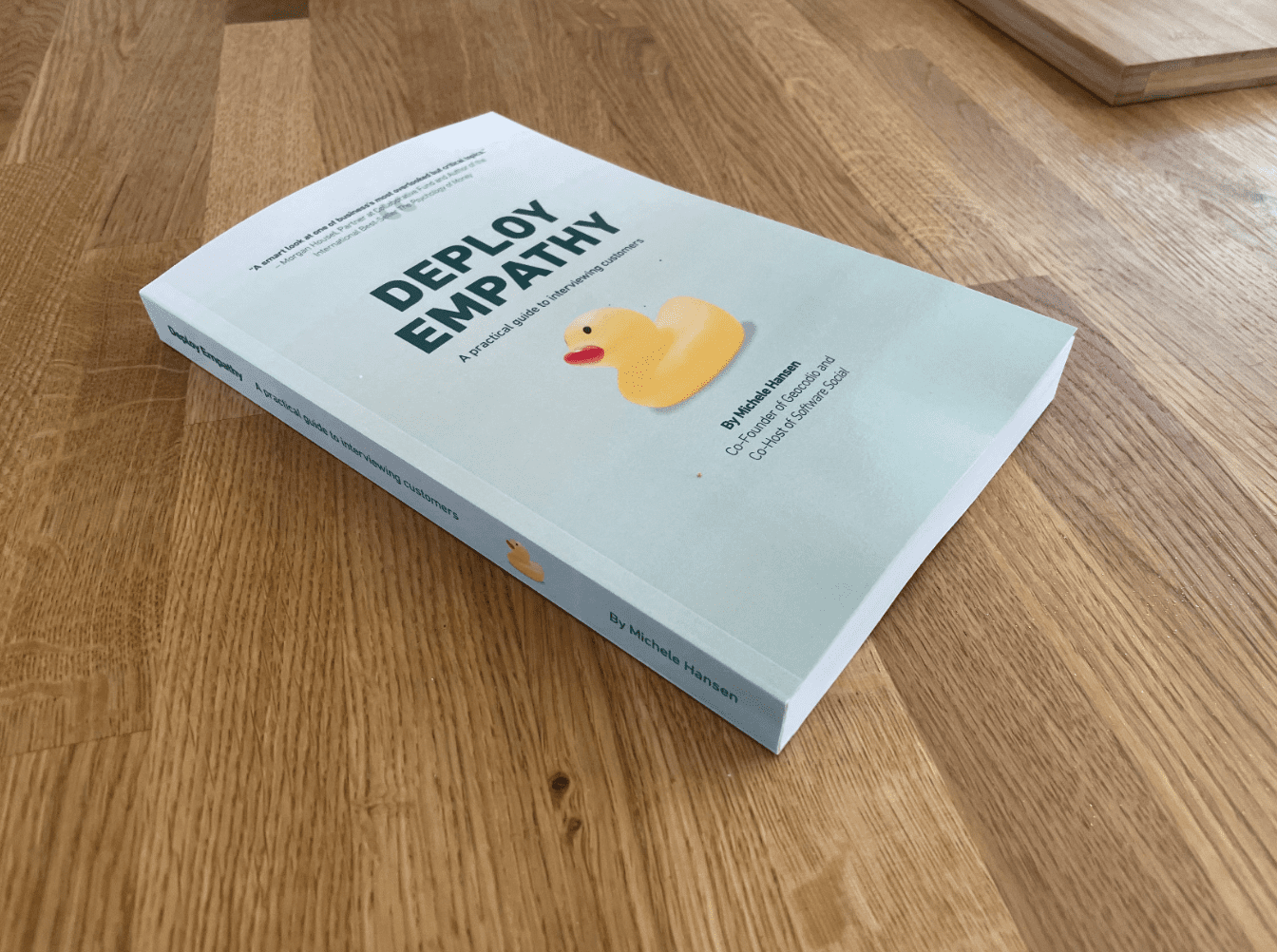
Deploy Empathy: A Practical Guide to Interviewing Customers
Quick orientation
Michele Hansen’s “Deploy Empathy” is a practical guide designed to help founders, product managers, developers, and marketers master the art of customer interviews. Drawing from her extensive experience building and growing Geocodio, a successful software-as-a-service company, Hansen emphasizes that empathy is a learnable skill crucial for creating products people truly want and need.
The book fills a gap in existing literature by providing specific words, phrases, and scripts for various customer interaction scenarios, making customer research accessible even to small teams and individuals with no prior UX background. It argues that by truly listening to customers, businesses can save immense time and resources, avoiding the common pitfall of building unwanted features.
Readers will discover how to conduct impactful conversations that uncover deep insights into customer motivations, pain points, and behaviors. This summary will break down every key idea from each chapter, offering clear explanations, practical examples, and actionable steps to help you deploy empathy effectively in your own work.
Part I: Using This Book
This section establishes the foundational principles of customer empathy, highlighting why it’s a critical, learnable skill for any business endeavor. It also outlines the book’s purpose and structure, guiding readers on how to best utilize its practical advice.
1. Empathy is a learnable skill
This chapter explains why empathy is paramount in understanding customers and how it can be developed. It emphasizes that talking to people, seemingly counterintuitive, saves time and effort in the long run.
- Empathy’s essence: Empathy is about understanding and acknowledging another person’s reasoning and emotions as valid, even if they differ from your own.
- Not agreement: Showing empathy does not mean agreeing with the other person’s ideas, but rather recognizing their perspective.
- Learned skill: Empathy is not innate; it’s a skill that can be consciously learned and improved through practice.
- Empathetic response: When someone shares a problem like a boss yelling, an empathetic response might be “That really hurt you,” encouraging deeper sharing, unlike sympathy or offering solutions.
- Business advantage: Integrating empathy into decision-making allows companies to uncover valuable opportunities overlooked by competitors.
- Stripe’s example: Payment processor Stripe encourages all team members, including developers, to directly interview customers, demonstrating integrated listening.
- Practice action: Begin practicing empathetic listening techniques with friends and family to build comfort and skill.
2. The neuroscience of listening
This chapter delves into the scientific reasons why attentive listening creates positive customer relationships and deep loyalty.
- Brain’s reward system: When people talk about themselves and their experiences, parts of the brain associated with motivation, reward, and enjoyment “light up.”
- Positive association: Being genuinely listened to makes people feel happy, and they transfer those positive feelings to the listener and their company.
- Builds support: Customers who feel heard often become the most vocal supporters and willing advocates for your product or service.
- Simple power: The mere act of listening alone, regardless of the perfect question or analysis, provides significant benefits to your company.
3. Why I wrote this book
The author explains the personal and professional journey that led to writing this book, highlighting its unique contribution to customer research literature.
- Geocodio’s foundation: The author’s software company, Geocodio, grew to over a million dollars in annual revenue by embedding customer listening into every decision.
- Filling a gap: This book provides specific scripts and phrasing for customer conversations, addressing a need for practical, action-oriented resources.
- Small team focus: Unlike many user research books for large organizations, this guide is tailored for small companies and solo founders.
- Stripe’s early days: Stripe’s founders personally answered support emails and watched users, embedding user research into their company’s DNA from day one.
- Author’s learning curve: The author initially believed customer research was too time-consuming but realized its immense value after learning “the hard way.”
- Embrace doubt: It’s natural to doubt the effectiveness of customer interviews, but following the methods in this book will yield useful feedback.
4. What this book can help you do
This chapter clarifies the practical applications of the book, outlining specific business challenges it helps to solve for various professionals.
- Solve business problems: The book provides tools to answer critical questions such as why people cancel, how to get more sales, or which features to prioritize.
- Launch confidently: It helps evaluate if people would pay for a product before significant development, reducing wasted effort.
- Understand customer needs: The book shows how to deeply understand buying motivations and retention drivers.
- Target audience: Written for anyone without a user experience background, including developers, product managers, marketers, and founders.
- Accessible expertise: It translates complex user research “tribal knowledge” into an approachable format for a broader audience.
5. How this book is structured
This chapter provides a roadmap for navigating the book, explaining its linear organization while encouraging flexible, non-linear reading.
- Logical flow: The book progresses from mental models to practical application, including recruiting, interviewing, and analysis.
- Flexible usage: Readers are encouraged to skip to relevant sections based on their immediate needs, using Appendix A as a cheat sheet.
- Key frameworks: Part II introduces core ideas like process thinking and the functional/social/emotional dimensions of problems.
- Practical skills: Part III guides readers on building interviewing skills, starting with practice interviews.
- Interview types: Part VII provides essential scripts for various scenarios, such as discovery, switch, cancellation, and interactive interviews.
Part II: Key Frameworks
This section introduces the foundational concepts and mental models that underpin effective customer interviews, guiding thinking on question formulation, follow-up, and analysis.
6. Everything is a process
This chapter introduces the fundamental concept that all tasks, no matter how simple, are actually multi-step processes, revealing opportunities for innovation.
- Tasks as processes: Common tasks like doing laundry or making coffee are not single items but combinations of tasks bundled into processes.
- Situational variability: Processes vary in time, tools, and complexity, and can change based on context, like available time or mood.
- Opportunity in steps: Making even one small step within a complex process easier, faster, or cheaper can create significant value.
- Laundry pod example: Laundry detergent pods eliminated the trivial step of measuring detergent, creating a multi-billion dollar market.
- Frequent and painful: People are most willing to pay for solutions to problems that are both frequent and painful.
- Uncover opportunities: Understanding the functional, social, and emotional dimensions of a process helps identify product, marketing, and pricing opportunities.
- Action step: Start noticing tasks in your daily life as detailed processes to train your observational skills for customer interviews.
7. The core questions
This chapter outlines the essential questions that form the backbone of any customer interview, emphasizing understanding the “why” behind customer actions through the Jobs to Be Done framework.
- Uncovering the “why”: Interviews aim to understand why people “hire” or “fire” products, not just what they do.
- Core questions list: Key inquiries include what they are trying to do overall, all steps in the process, where the problem fits, time/money spent, frequency, and what they’ve already tried.
- Jobs to Be Done: This framework helps conceptualize an individual’s overall goal and the context for achieving it, which products are “hired” to fulfill.
- Beyond tasks: Customers don’t just “grind coffee beans” (a task); they aim to “focus on their work” (a larger goal or Compelling Context).
- Product’s role: A product typically solves only one or two steps in a larger process toward a goal.
- Better satisfaction: Products that solve multiple steps faster, cheaper, or easier lead to higher customer satisfaction.
- Action step: Ground your interview scripts in these core questions to systematically uncover customer needs and motivations.
8. Functional, social, and emotional
This chapter expands on the idea of a process by introducing its three critical dimensions: functional, emotional, and social, which collectively drive customer decisions.
- Holistic understanding: Processes involve more than just functional elements; they include social complexities and emotional factors.
- Three dimensions: Understand the functional purpose (what it does), emotional dimension (how it makes them feel), and social dimension (how others are involved or perceive it).
- Coffee example: Choosing coffee based on specific grind (functional), enjoying the ritual (emotional), or sharing with coworkers (social).
- Luxury product example: Buying a designer watch for craftsmanship (functional), impressing others (social), and feeling deserving (emotional).
- Commercial viability: Probing frequency, current payment, and time spent reveals commercial potential.
- Context matters: The same person might choose different solutions for the same task based on situational context (e.g., leisurely weekend pour-over vs. hurried weekday pod coffee).
- Action step: When interviewing, consciously probe for insights across all three dimensions to understand the full context of their decisions.
9. Valuable, usable, viable, and feasible
This chapter introduces Marty Cagan’s framework for evaluating product ideas, emphasizing that customer input must always be filtered through business realities.
- Beyond customer wishes: Listening to customers doesn’t mean literally doing everything they suggest; their ideas must be evaluated.
- Four criteria for success: A successful product must be valuable (customer needs it), usable (customer can use it), viable (company can support it commercially), and feasible (company can build it).
- Customer knowledge gap: Customers only know what is valuable and usable; they cannot know what is viable or feasible for your company.
- Segway example: The Segway was valuable and usable but lacked commercial viability, unlike scooters which solved a similar problem with better business models.
- Post-interview evaluation: This evaluation happens after the interview, allowing you to absorb all information without immediate judgment.
- Action step: After each interview, filter customer ideas and feedback through the lenses of viability and feasibility from your company’s perspective.
Part III: Getting Started
This section addresses common anxieties about conducting customer interviews and provides a step-by-step guide and practice exercises to build confidence and skills.
10. You—yes you—can do this
This chapter directly addresses the anxieties and doubts new interviewers often face, providing reassurance and practical advice for overcoming them.
- Normalize nervousness: It’s completely normal to feel afraid, awkward, or exhausted by the prospect of talking to people.
- Embrace mistakes: Making mistakes is part of the learning process; self-compassion is key to developing empathy.
- Interviewer’s role: In a well-run interview, the interviewer speaks only about ten percent of the time, reducing pressure on those who find talking difficult.
- “Evaluating” not “validating”: Approach interviews with an open mind to “evaluate” ideas rather than “validate” them, avoiding confirmation bias.
- Listen to sample: Listening to the provided sample interview can help calm nerves by demonstrating how little the interviewer needs to say.
- Counter-instincts: Many natural conversational habits (interrupting, offering ideas) are counterproductive in interviews; conscious effort is needed to suppress them.
- Action step: Listen to the sample customer interview at deployempathy.com/sample-interview to see the techniques in action and build confidence.
11. Learn how to interview: A Step-by-step guide
This chapter provides a clear, sequential roadmap for gradually building the skills necessary to conduct effective customer interviews.
- Step 1: Read “How to Talk So People Will Talk”: Learn the core conversational tactics to encourage openness in others.
- Step 2: Do a practice interview: Conduct a practice session with a friend or family member on a broad topic, recording it for later review.
- Step 3: Analyze the practice interview: Review the recording to assess both the information gathered and your interviewing conduct, identifying areas for improvement.
- Step 4: Interview one person, then a few more: Start with a single potential or existing customer, then slowly scale up to five interviews, adjusting your approach.
- Step 5: Analyze your interviews: After five interviews, systematically analyze them using tools like journey maps or pain/frequency matrices to extract insights.
- Step 6: Make interviewing a regular part of your process: Integrate interviews into your ongoing workflow, rather than treating them as a one-off task.
- Action step: Commit to following these steps sequentially, allowing yourself time to learn and adapt at each stage.
12. Practice interviewing—no customers needed!
This chapter offers a low-stakes, practical exercise to help new interviewers gain comfort and confidence before engaging with real customers.
- Overcoming deterrence: Practice helps overcome the fear that interviews might be a waste of time or awkward.
- Low-stakes environment: Practice with someone you vaguely know (not a close friend or family member) to simulate a real interview without the pressure.
- “Recent purchase” prompt: Ask your practice partner about something new they bought recently, exploring the “why” behind their decision.
- Uncover deeper insights: Even simple purchases can reveal underlying emotions and decision-making processes. The author’s shampoo example shows deeper reasons for a casual buy.
- Value of being interviewed: Switching roles and being interviewed yourself can be just as, if not more, illuminating, revealing what works and what doesn’t.
- Building confidence: Successful practice helps transform interviewing from a scary unknown into an exciting discovery process.
- Action step: Find a loosely connected acquaintance for a 15-20 minute practice interview using the “recent purchase” prompt and the provided script.
13. Practice interview script
This chapter provides the specific script for the practice interview, guiding users to uncover functional, social, and emotional dimensions of a recent purchase.
- Ideal partner: Choose someone vaguely connected to you, like a coworker from a different department, rather than a close friend or family member.
- Topic focus: The interview centers on a product they recently bought for the first time, not a regular or pre-owned item.
- Key information: Listen for the underlying problem solved, frequency, previous solutions, time taken, importance, consequences, and other involved parties.
- Dimensions to probe: Explore the functional (literal problem), emotional (how it makes them feel), and social (others’ involvement/perception) aspects of the purchase.
- Sample questions: The script includes questions like “Where were you when you bought it?”, “What were you hoping it would do for you?”, and “Would you buy this product again?”.
- Non-perfect grammar: The questions are intentionally casual to put the interviewee at ease.
- Action step: Use this script with a practice partner, recording the session to analyze both the content and your interviewing technique.
Part IV: When Should You Do Interviews?
This section provides a mental model for deciding when to conduct customer interviews, differentiating between project-based and ongoing research for various business needs.
14. Interviews or numbers?
This chapter addresses the common question of whether to prioritize qualitative interviews or quantitative data, asserting that both are essential and complementary tools.
- Do both: Quantitative data tells you what is happening, while qualitative interviews tell you why. Both are necessary for a complete understanding.
- Context for metrics: Interviews provide the context and story behind metrics, explaining customer actions.
- Toolbox approach: Data analysis, surveys, and interviews are distinct tools in a broader research toolbox.
- Stripe’s approach: Stripe integrates user interviews with industry research and data analysis as a problem-solving tool.
- Problem alignment: Before conducting interviews, Stripe’s teams align on a specific problem and determine if interviews are the right tool to solve it.
- Action step: Always consider both quantitative and qualitative methods; if you have data, use interviews to understand the “why” behind it.
15. Project-based research
This chapter focuses on conducting targeted interviews with a defined question, goal, and timeline to address specific business observations or problems.
- Specific questions: Project-based research aims to answer narrow questions like “Why aren’t more people buying from this landing page?” or “How can we reduce support tickets for X?”.
- Combined approach: Typically involves initial quantitative analysis (analytics, support history) followed by qualitative interviews.
- Iterative process: After interviews, solutions are brainstormed, prototyped, and tested with the same customers in a cycle that can take 1-2 months.
- Stripe’s targeted research: Teams at Stripe initiate targeted research based on recurring feedback or rising needs, with all stakeholders involved.
- Workshop questions: Stripe curates and workshops interview questions internally to ensure high-quality insights and that “almost anyone can run with” the script.
- Action step: When a specific problem arises, combine data analysis with targeted interviews, and involve your team in the question formulation and review.
16. How many people should you talk to?
This chapter provides practical guidance on the ideal number of interview participants for various research goals, emphasizing diversity in participant selection.
- Rule of five: For most discrete problems, interviewing five people is generally sufficient to surface 80% of customer needs.
- Stop when repetitive: The true rule is to stop interviewing when you start hearing the same things over and over again.
- Complex problems: For highly complex problems or in the discovery stage, 10-15 interviews might be necessary.
- Participant diversity: Speaking to a diverse group of customers or potential customers is crucial for a complete understanding and identifying more opportunities.
- Accessibility example: Including disabled people in research uncovers unique pain points and broadens understanding beyond typical users.
- Opportunity cost: Leaving out groups of users means missing out on potential business opportunities and insights.
- Action step: Aim for at least five diverse interviews for any given problem; if insights are still varied, consider narrowing your scope and doing another set of five.
17. Research loops
This chapter explains the iterative nature of early exploratory research, where initial broad findings lead to successive rounds of narrowing the problem scope.
- Too broad a scope: If initial interviews yield wildly different insights, it indicates a broad research scope that needs narrowing.
- Iterative narrowing: Conduct research in loops: interview five people, analyze, narrow the focus, then interview another five.
- Problem identification: In each loop, identify frequent and painful problems, underserved needs, commercially viable problems, and those feasible for your company.
- Refining solutions: Subsequent loops might involve prototyping, interactive interviews, or card sorting to refine potential solutions based on narrowed insights.
- Action step: If your initial five interviews produce highly varied information, define a narrower problem area for your next set of interviews.
18. Ongoing research
This chapter describes how to integrate continuous customer listening into daily operations to maintain an evolving understanding of customer needs and inform broader strategy.
- Daily integration: Ongoing research is about continually updating your understanding of customer needs, not just project-based efforts.
- Stripe’s example: Stripe sends regular “gut check” emails to recent users, asking about their experience, with all team members participating in follow-up calls.
- Short surveys: Use one or two-question surveys integrated into the product experience, especially open-ended questions like “What did you use before you used [product]?”.
- Elicit motivations: Asking about previous solutions (e.g., “What did you use before?”) uncovers motivations for switching.
- New customers: Interview new customers (1-3 months in) to understand their switching motivations and gain marketing insights.
- Happy customers: Proactively interview long-time, happy customers to understand well-served use cases and identify opportunities for growth.
- Balance cancellations: Balance interviews with canceled customers (loss aversion) with those with happy customers to gain a broader perspective and improve product fit.
- Action step: Implement a one-question survey in your product and follow up on insightful responses to build a continuous understanding of your customer base.
Part V: Recruiting Participants
This section provides practical strategies and templates for finding and inviting interview participants, whether they are existing customers or potential users who don’t yet know your product.
19. Reddit and forums
This chapter provides a step-by-step guide to finding and recruiting non-customers for interviews through niche online communities like Reddit.
- Leverage niche communities: Reddit and other specialized forums are excellent for finding specific target audiences, even for professional fields.
- Pre-research: Determine precisely who you want to talk to (e.g., administrative assistants vs. doctors) and find relevant subreddits or forums.
- Check rules: Always verify that your recruitment post is allowed by the forum’s rules and avoid any overtly promotional language.
- Casual post: Craft a casual, research-focused post, stating you’re seeking help for research, describing the problem space (without biasing), who you’re looking for, and what’s expected.
- Incentives: A small incentive (e.g.,
10−10-10−25 gift card) can be helpful, especially for screen-share tests or if the problem isn’t acutely painful. - Manage applicants: Be prepared for many replies, select the best fit, and send timely follow-ups to both selected and non-selected applicants.
- Prompt payment: Send incentives during the call’s wrap-up to build trust, especially since they don’t know you.
- Action step: Identify a specific niche community, draft a research-focused post, and proactively recruit for your next set of discovery interviews.
20. Twitter
This chapter explains how to use Twitter to identify and recruit individuals who are already discussing the problems you aim to solve.
- Problem-space understanding: Twitter is a great resource for identifying people who are actively discussing the problem you’re interested in, including frustrations with competitors.
- Internet ethnography: Observe digital “watering holes” where potential customers discuss their challenges and opinions.
- Target frustrated users: Look for tweets where people express negative experiences with competitors or general frustrations with a process.
- Research before outreach: Thoroughly research a user before reaching out, linking to their specific problematic tweet or blog post in your message.
- Friendly outreach: Use polite, non-intrusive language in replies or DMs, clarifying that you’re seeking feedback, not trying to sell.
- No selling: It is crucial not to attempt to sell your product during these initial research calls; focus solely on gathering insights.
- Action step: Search Twitter for discussions related to your problem space, identify frustrated users, and send a polite, research-focused DM to invite a call.
21. LinkedIn
This chapter outlines strategies for recruiting business professionals on LinkedIn, emphasizing the importance of a personalized and respectful approach.
- Appeal to helpfulness: Successful LinkedIn outreach appeals to professionals’ desire to offer expert advice and insights.
- Personalization is key: Messages must be carefully and genuinely personalized; generic messages are ineffective.
- Research background: Research the individual and their company beforehand to tailor your message, referencing their relevant posts or company activities.
- Connection request strategy: Some find success by sending a connection request first, then sending a personalized message once the connection is accepted.
- Message formula: Clearly state who you are, why you want to talk to them specifically (complimentary phrasing), and what you hope to learn.
- Do not sell: Reiterate that the call is for research and advice, not a sales pitch, to maintain trust and increase response rates.
- Action step: Identify a specific professional profile on LinkedIn, research their background, and craft a personalized connection request or message seeking their expert insight.
22. Facebook groups and email lists
This chapter explores how to recruit interview participants from private and niche online communities like Facebook groups and specialized email lists.
- Private communities: These platforms offer access to highly specific and engaged demographics that are discussing relevant topics.
- No sales pitch: As with other social platforms, maintain a friendly, non-salesy tone in your recruitment posts.
- Clear formula: Your post should specify who you want to talk to, what you’re hoping to learn, what’s expected from participants, and any incentives offered.
- Recent experience: Crucially, ask for people who have recently gone through the process you’re researching, ensuring fresh, concrete experiences.
- Example post: “Have you bought a car recently? I’d like to build something that makes this easier… If that’s you… please message me.”
- Incentive consideration: An incentive is more likely to be necessary if you’re not asking about a specific, acute pain point.
- Action step: Identify a relevant Facebook group or email list, draft a concise and clear recruitment post focusing on recent experiences, and follow group rules.
23. Email
This chapter provides templates and strategies for effectively recruiting existing customers for interviews via email, emphasizing targeting and conciseness.
- Existing products only: This method is primarily for companies with an existing customer base; cold email outreach is generally not recommended for research.
- Targeted segments: Filter your customer list by criteria like signup date, revenue tier, or feature usage to find specific interviewees.
- Founder’s credibility: Use your title (founder, developer, PM) in the email to add an air of importance and sincerity to the request.
- Incentive of influence: For existing customers, the opportunity to influence the product roadmap is often a sufficient incentive.
- Short and scannable: Keep emails brief, use line breaks, and clearly state the time commitment, purpose, and how to schedule.
- Example template: “I’m the founder of [company] and I notice you [recently started using our product]… Your feedback will directly influence our roadmap.”
- Personal touch: Include a PS indicating that replies come directly to you, especially if the email is automated.
- Action step: Segment your customer list based on your research question, then send a targeted, personalized email invitation using the provided templates.
24. Surveys
This chapter explores how to leverage short, open-ended surveys as a preliminary step to identify potential interviewees and gather initial, high-value insights.
- Springboard to discovery: Use one or two-question surveys integrated into your product experience to prompt further, deeper conversations.
- High response rate: The shorter the survey, especially with an open-ended question, the higher the response rate.
- Effective questions: Ask questions that are easy to answer and yield insight, such as “What did you use before you used [product]?” or “How did you come across [product]?”.
- Avoid “magic wand”: Do not ask the “magic wand” question in surveys as it often elicits unhelpful “make it free” responses.
- Follow-up for context: Reply directly to survey responses asking for more context about their overall process or how they found you.
- “Nothing before” template: Provide a specific template for when customers say they used “nothing” before your product, prompting them to explain their prior need.
- Action step: Implement a short, open-ended survey in your product and actively follow up on responses to turn quick feedback into deeper customer understanding.
Part VI: How to Talk So People Will Talk
This is the most crucial part of the book, detailing specific conversation tactics designed to create a safe, judgment-free environment where interviewees feel comfortable opening up and sharing deeply.
25. Use a gentle tone of voice
This chapter stresses the importance of a calm and reassuring tone to make interviewees feel safe and encourage openness.
- Calm demeanor: Adopt a gentle, soft, and slow tone of voice, similar to a “late-night DJ voice,” to put the other person at ease.
- Create safety: This technique helps create a psychological environment where the interviewee feels safe to share without judgment.
- Genuine curiosity: Project genuine, non-judgmental curiosity in your voice.
- Respectful approach: Think of the customer as someone you respect and can learn from, rather than someone to condescend to.
- Avoid accusation: Phrases like “Why did you do it that way?” can sound accusatory; “What led you to do it like that?” in a gentle tone is better.
- Action step: In your next casual conversation, consciously try to use the gentlest voice you can muster and observe the other person’s reaction.
26. Validate them
This chapter explains the power of “validating statements” in encouraging interviewees to open up by showing deep engagement and acknowledging their perspective.
- Beyond agreement: Validation means recognizing their thoughts and actions are valid from their perspective, even if you don’t agree.
- Encourage talking: Most of what you say in an interview won’t be questions, but validating statements that show you’re listening and open.
- Maintain trust: Never break the bubble of trust by agreeing or disagreeing with their statements, which can remind them you have opinions.
- Neutral phrasing: Use phrases like “That makes sense,” “I can see why you’d do it that way,” or “It sounds like that’s frustrating.”
- Focus on “think”: Prefer “You think the process is complicated” over “You feel the process is complicated,” as “think” is often perceived as more neutral.
- Compliment via problem: Acknowledge that their job or problem “sounds challenging” to encourage them to elaborate.
- Action step: In your next conversation, when a friend shares a problem, respond with a validating statement like “That makes sense,” rather than offering solutions or advice.
27. Leave pauses for them to fill
This chapter highlights the counterintuitive yet powerful technique of using silence to elicit deeper and more meaningful information from interviewees.
- Embrace silence: After asking a question, resist the urge to fill the silence; wait for at least three “long beats” until it becomes uncomfortable.
- Elicit deeper insights: Interviewees will often fill the silence, and what they say then is frequently the most interesting and valuable part of the interview.
- Avoid prompting: Do not offer possible answers or rephrase the question if they don’t respond immediately, as this can bias their answer.
- Re-engagement: If a pause becomes too long and they question if you’re still there, gently state you were giving them a moment to think or jotting notes, reinforcing their importance.
- Teacher role: Long pauses and your non-verbal cues help elevate the interviewee into the role of a “teacher,” making them feel more important and willing to share.
- Action step: In your next everyday conversation, ask a question and consciously force yourself to wait in silence for several seconds before speaking again, observing the result.
28. Mirror and summarize their words
This chapter introduces two core active listening techniques—mirroring and summarizing—that magically encourage interviewees to elaborate without direct questioning.
- Parrot power: Like a parrot repeating words, mirroring (repeating their last few words) encourages elaboration.
- Negotiation tactic: Therapists and negotiators frequently use mirroring and summarizing to build rapport and extract more information.
- Summarizing for depth: Summarizing involves rephrasing what they’ve said, often labeling their feelings, to prompt further explanation.
- Neutral framing: When summarizing, use “It sounds like…” rather than “I’m hearing that…”, as it centers the situation, not you.
- No questions needed: These techniques are powerful because they elicit more information without explicitly asking follow-up questions.
- Example in practice: If they say “running into a lot of walls,” mirroring with “Can you tell me a little bit more about those hoops and walls?” encourages specifics.
- Action step: In your next conversation, try mirroring by repeating the last few words your friend says, then try summarizing what they’ve said as a statement.
29. Don’t interrupt
This chapter emphasizes the foundational principle of active listening: maintaining uninterrupted focus on the speaker to gather complete information.
- Active listening: Listening is not passive; it’s one of the most active things you can do to gather information.
- Psychotherapist model: Emulate psychotherapists’ calm, paused, and interruption-free listening style.
- Avoid journalist style: Do not interrupt like a political journalist who is trying to extract specific quotes or defend points.
- Self-awareness: Understand your own conversational baseline and natural tendency to interrupt, especially if your style is “simultaneous conversation.”
- Minimal responses: Limit your responses to “Mhmm,” “Can you say more?”, mirroring, or complete silence to encourage them to continue.
- Action step: For a week or two, consciously challenge yourself not to interrupt anyone in your daily conversations, noticing your own habits.
30. Use simple wording
This chapter advocates for using clear and straightforward language during interviews to ease cognitive load and encourage more natural responses.
- Ease and clarity: Simple wording helps put interviewees at ease and reduces the mental effort required to understand and answer your questions.
- Avoid jargon: Use common terms (“software”) instead of industry-specific acronyms (“SaaS”) unless you are certain the interviewee understands them.
- No perfect grammar: Don’t worry about perfect grammar or removing verbal fillers, as a natural tone fosters comfort.
- Rephrase on the fly: If you start with a complex question, rephrase it simply. For example, “What are your objectives?” can become “What are you trying to do, big picture?”.
- Code switching awareness: While jargon can sometimes build rapport, it’s safer to default to simple language to ensure clarity across all interviewees.
- Action step: Take a potential interview question you’ve formulated and simplify its wording, imagining you’re explaining it to someone completely new to the topic.
31. Ask for clarification, even when you don’t need it
This chapter introduces the subtle yet effective technique of asking for clarification, even when you already understand, to encourage deeper elaboration and show active listening.
- Elicit more details: Intentionally asking for clarification helps the interviewee elaborate and dive deeper into their process.
- Show active listening: It demonstrates that you are actively trying to understand their perspective, building trust.
- Rephrase for correction: Optionally, misstate something slightly to prompt the interviewee to correct you, often leading to incredibly detailed information.
- Example of misstatement: “First you go to your project manager, then you ask your manager for permission?” to clarify approval flows.
- Harmonious tone: Use your “most harmless voice possible” to ensure these questions are perceived as genuine curiosity, not a challenge.
- Overcoming unease: If asking clarifying questions feels uncomfortable, acknowledge that this might be due to past experiences (e.g., being shamed for asking questions in school).
- Action step: When a friend is recounting a story, try summarizing what they’ve said but slightly alter a minor detail, observing how they elaborate in their correction.
32. Don’t explain anything or get defensive
This chapter emphasizes the critical rule of resisting the urge to explain your product or defend your decisions during an interview, maintaining focus on the customer’s perspective.
- Resist explanation: Avoid explaining how your product was intended to work or your thought process behind its creation.
- Customer’s mental model: Your primary goal is to build a mental model of how things work from their perspective, not yours.
- Feedback is a compliment: When customers provide negative feedback, it often means they care about your product and its problem-solving potential.
- Deflect questions: If asked “Why does it work like this?”, deflect with a curious follow-up like “Can you tell me how you expected it to work?”.
- Unlocking insights: Suppressing the desire to explain is key to unlocking new insights about customer thinking and actions.
- Action step: The next time someone criticizes something you’ve done, instead of defending, try asking: “Can you just walk me through what you were expecting?”
33. Build on what they say
This chapter likens interviewing to improv comedy, highlighting the importance of accepting and extending the interviewee’s narrative without negation.
- “Yes, and…” principle: In an interview, you must “roll with whatever the other person does and build on what they do,” just like in improv.
- Avoid negation: Do not say “No,” “Yes, but,” or “Well, actually,” as these phrases disrupt the flow and safety of the conversation.
- Maintain rapport: Your goal is to create an environment of trust and safety where the interviewee feels comfortable being open and honest.
- Absorb and extend: Act like a sponge, absorbing what they say and building on it to encourage further sharing.
- Focused improv: Think of interviewing as a form of “empathetic business-driven improv,” where you respond to their narrative without introducing your own.
- Action step: In your next conversation, consciously notice any urges to negate or correct; instead, try to build on what the other person says using phrases like “Yes, and…”
34. Let them be the expert
This chapter explains why you must accept the interviewee’s version of reality, even if it’s factually incorrect, to preserve trust and gain true insight into their experience.
- Their truth matters: Everyone is the expert of their own experience, regardless of factual accuracy. Your goal is to understand their perspective.
- Preserve safety: Correcting an interviewee, even gently, shatters the sense of safety and reduces their willingness to share openly.
- Focus on understanding: If they state something factually wrong (e.g., using “Laravel for the frontend” instead of “backend”), ask “What was it like to use Laravel for the frontend?” to understand their mental model.
- Revealing insights: Their “errors” can reveal crucial information about their learning, misconceptions, or the information sources they use.
- No correction in moment: Do not correct them on the call; if facts matter, you can follow up later, but only if truly necessary.
- Action step: The next time you’re tempted to correct someone, ask yourself if it truly matters for your understanding of their experience, and look for context behind their “mistake.”
35. Use their words and pronunciation
This chapter extends the concept of “letting them be the expert” to mirroring their specific vocabulary and pronunciation, fostering deeper connection.
- Mirroring language: Intentionally adopt the interviewee’s specific words and even pronunciation, rather than using your own “correct” version.
- Build rapport: Using their language validates their experience and deepens the connection, showing you’re truly immersing yourself in their world.
- Avoid alienation: Correcting pronunciation (e.g., “Nev-AHH-da” vs. “Ne-VAD-ah”) or brand names (e.g., “MailMonkey” instead of MailChimp) breaks trust and reduces them to a lesser role.
- Maintain illusion: Your goal is to maintain the illusion that you are there solely to understand their unique perspective, free from judgment or correction.
- No mocking: While mirroring, ensure your tone does not come across as mocking; simply adopt their specific phrasing naturally.
- Action step: In your next conversation, if someone uses a specific word or pronounces something differently, consciously use their version in your follow-up.
36. Ask about past or current behavior
This chapter teaches how to uncover actual needs and willingness to pay by asking about concrete past or current actions, rather than hypothetical future behaviors or direct “pain point” questions.
- Facts over predictions: Humans are poor at predicting future behavior; instead, ask about what they have done or are doing.
- Avoid direct questions: Don’t ask “Would you use this?” or “What are your pain points?” as these are difficult to answer directly or can feel offensive.
- Symptoms of pain: Look for factual indicators of pain, such as time spent, reliance on manual solutions, use of multiple tools, or money already spent.
- Indirect inquiry: Instead of “What are your problems?”, ask “How long does it take to do [X]?” or “What tools do you use for [X]?”.
- “Struggle” nuance: Even “What are you struggling with?” can be off-putting; focus on what’s time-consuming or frustrating.
- Uncovering hidden pain: Customers often don’t articulate “problems” if they’ve never known alternatives (e.g., manual data normalisation taking hours).
- Action step: The next time you talk to a customer, ask them about what they have already used and paid for in the past, rather than what they would use.
37. Be a rubber duck
This chapter synthesizes all active listening skills by encouraging the interviewer to adopt the role of a “rubber duck,” passively listening to help the interviewee self-discover.
- Resist fixing: Avoid the natural inclination to propose solutions or offer your own ideas when someone shares a problem.
- Focus on understanding: Your well-intentioned desire to solve problems can impede your ability to fully understand the other person’s experience.
- “Rubber duck debugging”: Like a developer explaining a bug to a rubber duck to solve it themselves, your role is to listen so the interviewee can clarify their own thoughts.
- Empower self-discovery: Trust that by deeply listening, you’re helping them articulate their problem more clearly, which can lead them to their own solutions or insights.
- All skills combined: This mindset combines using a gentle tone, validating, leaving pauses, mirroring, not interrupting, simple wording, asking for clarification, not explaining, building on their words, letting them be the expert, and using their vocabulary.
- Action step: In your next conversation where someone shares a problem, consciously picture yourself as a rubber duck, focusing solely on listening without judgment or guidance.
Part VII: Interviews
This section provides a toolkit of specific interview scripts and strategies for various common scenarios, from exploring new ideas to understanding why customers buy, stick around, or cancel.
38. Interview Preparation
This chapter details essential logistical and mental preparation steps to ensure interviews are effective, focused, and respectful of the interviewee’s time.
- Audio over video: Conduct interviews primarily over audio; people are more open without the pressure of being seen.
- No distractions: Mute phones and notifications to give the interviewee your full, undivided attention.
- Mental preparation: Prepare yourself to focus by managing caffeine intake, food, and other personal needs that affect concentration.
- Target five people: Aim to interview a minimum of five people for any discrete, well-scoped problem.
- Flexible script: Don’t rigidly follow the script; let the conversation flow naturally and gently guide it back to relevant topics.
- Respect time: Stick to the promised interview duration; ask for permission to extend if the conversation is productive.
- Send thank-you notes: Always send a mailed, handwritten thank-you note to express appreciation.
- Appropriate incentives: Provide incentives (gift cards, swag) only when appropriate (e.g., for non-customers or churned users); always ask permission to send.
- Record with permission: Always ask for and obtain permission before recording interviews (often legally required).
- Plan note-taking: Decide how you’ll capture information in advance (printed script, digital notes, transcription service).
- Collaborate: If possible, have another team member join as a silent observer to capture different insights.
- Limit interviews: Do no more than one or two interviews per day to prevent mental fatigue.
- Formalities: Adjust your language formality to match the cultural and professional context of your interviewee.
- Never sell: Crucially, never try to sell your product or features during a research call; it breaks trust.
39. How can I evaluate this idea?
This chapter provides a script and guidance for conducting discovery interviews, which are designed to validate whether a perceived problem exists and matches potential customers’ conceptualization.
- Idea validation: Discovery interviews help determine if a problem you’ve noticed is real for others and if your understanding aligns with theirs.
- Beyond “will they buy?”: Focus on understanding the problem’s frequency, pain, past attempts at solution, current costs (time/money), and involved stakeholders.
- Iterative process: This is an early step in an exploratory research process, often followed by competitor research and quantitative analysis.
- Problem scope: “Process” can be broad (retirement) or narrow (scheduling a meeting), but always explore its depth.
- Recruitment strategy: Start by trying to recruit participants for free; use incentives if you face difficulty (which might signal low problem pain).
- Discovery script: The “Customer/problem discovery script template” includes opening questions, core substantive questions, the “reaching for the door” question, and closing remarks.
- Action step: Use the provided discovery script to explore a new product idea, focusing on the interviewee’s actual experiences and the details of their process.
40. Why did they buy?
This chapter focuses on “switch” interviews, designed to understand the customer’s journey from problem awareness to choosing your product (or a competitor’s), revealing powerful marketing insights.
- Understanding “switch”: The goal is to diagram the customer’s process from recognizing a problem to deciding to use a new product, including their motivations.
- Marketing insights: These interviews are invaluable for identifying reasons people switch, which can inform new marketing messages and landing pages.
- Customer journey: Explore how they discovered your product, what prompted the switch, and their satisfaction with the decision.
- The Four Forces: Understanding the pushes, pulls, anxieties, and inertia that influenced their decision to switch is key.
- Switch script: The “Switch script template” includes questions about their initial need, previous tools, when they started looking, hopes for the new product, and decision-makers.
- Casual tone: The script is intentionally conversational and casual, mimicking natural dialogue.
- Action step: Interview recent customers (or users of a competitor’s product) using the Switch script to uncover their decision-making timeline and primary motivators.
41. Why do they stick around?
This chapter focuses on interviewing long-time, happy customers to understand their specific use cases and motivations for retention, which can then be leveraged for growth.
- Value of happy customers: Happy, long-term customers offer insights into well-served use cases and opportunities for product and marketing improvements.
- Proactive understanding: Most companies overlook happy customers; proactively interviewing them provides a balanced perspective and identifies growth areas.
- Feature requests insights: In these interviews, explicitly ask for feature requests, then dig into the why behind them to understand their underlying needs.
- Relationship building: Interviews with happy customers can strengthen rapport, potentially leading to testimonials or deeper loyalty.
- Long-time customer script: The “Long-time customer interview script template” includes questions about their overall process, previous tools, how your service has changed their work, and dedicated space for feature suggestions.
- Balance with churn: These interviews help balance the focus on cancellation feedback, guiding product development towards use cases that are a good fit.
- Action step: Identify your top revenue-contributing or longest-standing customers and schedule interviews using the provided script to understand their success with your product.
42. Why did they cancel?
This chapter provides sensitive guidance for conducting cancellation interviews, emphasizing emotional preparedness and the goal of learning to prevent future churn rather than winning back the specific customer.
- Challenging interviews: Cancellation interviews are emotionally taxing due to customer disappointment and potential feelings of rejection for the founder/team.
- Goal is learning, not winning back: The primary objective is to understand why they canceled to prevent similar churn in others, not to re-convert the interviewee.
- Identify misfits: Cancellations can signal that marketing attracted customers with use cases not well-suited for the product.
- Incentives are key: Offer a monetary incentive (e.g., $25 gift card) for these interviews; avoid swag which can imply a sales attempt.
- Time management: Keep calls short (20-25 minutes), acknowledging their desire to move on.
- Cancellation script: The “Canceled customer interview script template” guides questions on what led to cancellation, why they chose you initially, and what they’ll use next.
- Validate, don’t defend: Listen without getting defensive or explaining your product’s intent; their perspective is paramount.
- Action step: After preparing emotionally, offer an incentive and use the provided script to interview a churned customer, focusing on their reasons for leaving and what they’ll do next.
43. What do they think?
This chapter focuses on interactive interviews, where you observe users interacting with a product, prototype, or website to uncover usability issues and deeper insights beyond verbal feedback.
- Direct observation: Interactive interviews involve putting a “physical” product (even a website or sketch) in front of someone to observe their real-time interaction.
- Beyond usability: While akin to usability testing, these sessions can also reveal fundamental flaws in your assumptions about value and the broader decision-making process.
- HIPAA example: The author’s experience with a healthcare product revealed a 6-18 month legal review cycle even for small plans, a non-technical barrier.
- Observation, not hints: The hardest part is observing users struggle without offering help; their struggles reveal critical insights for future improvements.
- Monetary incentives: Offer a monetary incentive for these sessions as they feel more like work than a conversation.
- Avoid “confusing”: Instead of asking “Is this confusing?”, ask “Does this make sense?” or “What part of that process didn’t really seem to make sense?”
- Interactive script: The “Interactive interview script template” guides the session from acclimating the user to exploring expectations, task analysis, and decision/purchase processes.
- Action step: Select a part of your product (or a prototype) and conduct an interactive interview, observing user behavior and asking open-ended questions about their expectations and actions.
44. What to prioritize?
This chapter introduces card sorting as a method to help customers prioritize problems and features, providing clear insights into unmet needs and willingness to pay.
- Customer prioritization: Customers can help prioritize problems and features, giving you a better sense of which needs are most acute and underserved.
- Visualizing problems: Use a tool like a Trello board to represent different problems as “cards” and ask customers to sort them by importance and satisfaction.
- Digging deeper: The sorting process often prompts customers to elaborate on their understanding of each problem, providing valuable context.
- Importance vs. satisfaction: Plotting problems on a matrix of “Importance” vs. “Satisfaction” helps identify high-pain, underserved areas (e.g., “Invoicing a customer who uses a procurement portal”).
- Combining insights: This method is best used in conjunction with other interview techniques to both clarify and prioritize problems.
- Action step: After gathering a list of problems from initial interviews, create a digital card sorting exercise and invite existing customers to prioritize them, narrating their thoughts aloud.
45. The “Reaching for the Door” question
This chapter introduces a crucial interview technique: asking a specific question near the end of the interview that often unlocks the most vital, previously unshared information.
- Crucial insights at the end: Modeled after medical consultations, people often save the most important information for the very end of a conversation.
- The question: Ask, “Is there anything else you think I should know?” roughly halfway through the allotted interview time.
- Wait in silence: After asking the question, remain silent and resist the urge to prompt or fill the space, allowing the interviewee to gather their thoughts.
- Overcoming reluctance: If they initially say “No,” gentle re-engagement (e.g., “Yes, I was just giving you space to think”) can encourage them to open up.
- Floodgates open: This question often acts as a springboard, leading to a flood of incredible insights about their process, fears, and hopes.
- Rapport payoff: The trust built during the first half of the interview primes them to share deeply when this critical question is asked.
- Action step: In your next interview, ensure you ask the “Reaching for the Door” question at the halfway mark and consciously practice waiting in silence for their response.
46. How to ask people how much they would pay
This chapter explains how to indirectly determine customers’ willingness to pay by focusing on their past and current behaviors, specifically time and money already spent.
- Facts, not predictions: Avoid asking “Would you pay for this?” or “What would you pay for this?” as these questions yield unreliable, polite opinions.
- Current payment: Ask about what they are currently paying (in time, money, or both) for existing solutions or workarounds.
- Pain and Frequency Matrix: Use this matrix to identify problems that are both high pain (complex, time-consuming, expensive to get wrong) and high frequency.
- Example scenario: An alumni fundraising professional’s process involves a week of manual data work for an annual event that nets millions; this indicates high willingness to pay for automation.
- Breaking down costs: For products solving multiple steps, break down time and money spent on each individual step and associated tools.
- Polite inquiry: When asking about money, use polite phrasing like “Can I ask how much you pay for that?”
- Action step: In your next interview, identify a problem they’re solving, then ask about how much time it takes, how often they do it, and what they currently pay for any tools or solutions used.
Part VIII: Analyzing Interviews
This section provides practical methods for extracting actionable insights from interview data, including creating simple customer journey maps and using the Pain and Frequency Matrix.
48. Drawing a simple customer journey map
This chapter introduces the customer journey map as a tool to visualize the customer’s process, enabling the identification of functional, social, and emotional elements at each step.
- Transcribe for detail: Get interviews transcribed (using AI tools like Otter.ai) to easily pull out key phrases and insights.
- Core questions review: Reread transcripts, highlighting information related to the customer’s overall goal, process steps, pain points, and tried solutions.
- Visualizing the journey: Draw a simple customer journey map that outlines each step a customer takes, noting the functional, social, and emotional aspects.
- Tools and constraints: For each step, also identify the tools used and any existing constraints. The journey might be non-linear with branches.
- Team analysis: In larger teams (like at Stripe), review notes and transcripts collaboratively to identify themes and specific quotes.
- Action step: After your next set of interviews, use the transcripts to sketch a simple customer journey map, detailing the functional, social, and emotional experiences at each step.
49. The Pain and Frequency Matrix
This chapter introduces a powerful framework for prioritizing problems by mapping them against their pain (or complexity/time) and frequency, identifying high-value opportunities.
- Prioritize acute problems: The more frequent and painful a problem is for customers, the more likely they are to be willing to pay for a solution.
- 2×2 grid: Plot problems on a two-by-two matrix with “Pain” (or complexity/time) on one axis and “Frequency” on the other.
- High-opportunity areas: Focus on problems in the high-pain/high-frequency quadrant (e.g., weekly podcast transcripts) or potentially high-pain/low-frequency (e.g., buying a house).
- Context matters: The same task can fall into different quadrants depending on the specific person’s context (e.g., a salesperson scheduling many meetings vs. an average person).
- Granular analysis: Apply the matrix not just to overall activities but also to individual steps within a larger process to identify specific pain points.
- Action step: For a task in your own life (e.g., doing laundry), plot its overall pain and frequency, then break it down into individual steps and plot each one to understand their relative pain and frequency.
Part IX: Pulling It All Together: Sample Interview
This section provides a real-world sample interview transcript and a detailed analysis, demonstrating how the book’s principles translate into actionable insights.
50. Sample interview transcript
This chapter presents a full transcript of a genuine customer interview, offering a concrete example of the conversational tactics and questions in practice.
- Real-world example: The transcript captures a live interview with a developer (Drew) about his experience with Simple File Upload, following a “Switch Interview Script.”
- Observe techniques: Readers can see how validating statements, mirroring, pausing, and indirect questioning are used in a natural conversation.
- Technical context: The interview contains technical terms, but the focus for the reader should be on the interaction style and information flow, not technical specifics.
- Listen for full benefit: Reading alone provides some value, but listening to the audio (available at deployempathy.com/sample-interview) is highly recommended for pacing and tone.
- Action step: Listen to the sample interview while reading the transcript, paying close attention to the interviewer’s techniques and the interviewee’s responses.
51. Sample analysis
This chapter provides a detailed breakdown of the sample interview, illustrating how to extract insights about overall goals, decision processes, and functional/social/emotional dimensions.
- Team analysis benefit: While individuals can analyze interviews, teams are often more effective at surfacing user needs.
- Overall goal: Identify the main objective the customer is trying to achieve (e.g., building a job listing platform).
- Decision process timeline: Map out the steps of their journey, from recognizing a problem to switching solutions and their current satisfaction.
- Unforeseen problems: Note how the customer encountered issues with a previous solution (Firebase Storage) due to a new migration (Next.js).
- Influencing dimensions: Break down how functional needs (uploading files), emotional factors (frustration, elation), and social influences (team, friend’s recommendation) impacted their decisions.
- Pain, Frequency, Willingness to Pay: Assess the business implications of the problem’s pain (time-consuming setup), frequency (ongoing file uploads), and its critical role in their product’s success.
- Action step: Review the sample analysis, applying the same analytical lens to your own practice interviews or initial customer conversations.
52. Quick analysis
This chapter demonstrates how to perform a rapid analysis of interview data to identify immediate actions and longer-term strategic insights, even when time is limited.
- Fast insights: A quick analysis focuses on extracting actionable steps that can be implemented relatively quickly.
- Immediate actions: Identify quick wins like optimizing website headlines (“Up and running in five minutes. It really is as easy as it looks”), requesting testimonials, or creating competitor comparison landing pages.
- User behavior clues: Drew’s search for Code Pen and his statement about wanting “easy” setup highlight the need for clear documentation and demos.
- Beyond features: Recognize that problems like “white knuckling” a solution due to frustration indicate deeper emotional and usability issues.
- Longer-term strategy: Identify strategic considerations, such as the role of social proof in awareness, the stickiness of the product category, and the impact of clear pricing models.
- Activation focus: Realize that product stickiness (hesitancy to switch once working) means activation after sign-up is crucial.
- Action step: After your next interview, spend 15-30 minutes extracting immediate actionable items for marketing or product, and note any longer-term strategic implications.
Part X: What Now?
This concluding section reinforces the value of deploying empathy and points to additional resources for deeper learning in related fields.
53. Related topics
This chapter offers a guide to further resources on important business and research topics not covered in depth by this book, serving as a springboard for continued learning.
- Specialized focus: This book focuses specifically on interview skills, intentionally excluding comprehensive guides on starting businesses, rigorous user research, or accessibility.
- Business growth: For starting an online business, resources like Amy Hoy and Alex Hillman’s 30×500 or Arvid Kahl’s Zero to Sold are recommended.
- Deeper research: For more rigorous user research methodologies, books like Steve Portigal’s Interviewing Users or Jim Kalbach’s Jobs to Be Done Playbook are suggested.
- Data analysis: For quantitative research (surveys, A/B tests, analytics), refer to Quantifying the User Experience or Erika Hall’s Just Enough Research.
- Usability and accessibility: Integrate people needing accommodations into research; resources like Lara Kalbag’s Accessibility for Everyone are key for accessible design.
- Action step: Identify areas where you need further knowledge beyond interviewing (e.g., business strategy, quantitative analysis) and explore the recommended resources.
54. Further reading
This chapter provides a curated list of influential books and courses that have shaped the author’s understanding of empathy and product development, encouraging continued learning.
- Empathetic communication: How To Talk So Kids Will Listen and Listen So Kids Will Talk and Nonviolent Communication offer primers on active, empathetic listening.
- Negotiation skills: Chris Voss’s Never Split the Difference teaches powerful negotiation techniques, many of which apply to interviews.
- Applied empathy: Indi Young’s Practical Empathy provides deep insights into applying empathy in a business context.
- Jobs to Be Done: Jim Kalbach’s The Jobs to Be Done Playbook offers a clear overview of the framework that underpins this book.
- Interview mastery: Steve Portigal’s Interviewing Users is a comprehensive guide to conducting user interviews, especially in person.
- Mindset shift: What Got You Here Won’t Get You There helps individuals unlearn competitive habits that hinder empathetic listening.
- Business foundations: Sales Safari (course) guides business idea validation, and The Mom Test highlights common pitfalls in asking about product ideas.
- Action step: Choose one or two books from this list that resonate with your current learning goals and commit to reading them to deepen your understanding.
Appendix B: For Founders
This appendix provides specific guidance for founders of small software companies, addressing unique challenges and opportunities related to customer interaction.
55. Research as a solo founder
This chapter emphasizes that customer research should be an integrated, ongoing part of a solo founder’s workflow, not just a one-off task before launch.
- Beyond pre-launch: Research isn’t only for pre-launch validation; it’s crucial for ongoing growth and product evolution in existing businesses.
- Lifeblood of the company: For the author’s company, Geocodio, customer feedback is the primary driver for prioritizing development and improvements.
- Integrated workflow: Research should fit into your existing daily or weekly routine, rather than being a separate, all-consuming project.
- Ongoing vs. project-based: Utilize both project-based research for specific questions and ongoing research for continuous customer understanding.
- Find your rhythm: As a founder, you’ll discover the frequency and methods of customer interaction that best suit your business and personal workflow.
- Action step: Reflect on your current workflow and identify small, consistent ways to integrate customer listening into your routine, even if it’s just one interview a month.
56. Feature requests as customer research
This chapter reframes feature requests from simple “to-dos” into valuable opportunities for deep customer understanding and problem discovery.
- Insightful window: Feature requests are a direct window into an acute customer problem, even if phrased as a solution.
- Beyond the “what”: Resist the urge to immediately evaluate feasibility; instead, dig into the why behind the request and the context of the customer’s overall process.
- Understand motivation: The goal is to understand the customer’s true underlying need and how the feature would help their process.
- Phone questions: On support calls, ask “Can you walk me through the context on when you might use this?” or “How much time does this currently take you?”.
- Email templates: For text-based requests, use short, open-ended emails that deferentially ask for “broader context,” “background,” or “big picture.”
- Cataloging ideas: Always record feature requests and the underlying problem/use case, linking them to customer accounts for future reference and follow-up.
- Delightful follow-up: Even years later, reaching out to customers when a requested feature is built creates immense appreciation and reinforces trust.
- Action step: The next time you receive a feature request, consciously pause your immediate reaction and use the provided templates to ask open-ended questions about the “why” behind it.
57. Sales, customer support, and customer research
This chapter provides prescriptive guidance on the critical importance of mentally separating sales, customer support, and customer research functions, and adapting your behavior accordingly.
- Distinct activities: Sales, customer support, and customer research are separate activities that require different approaches and mindsets.
- Avoid awkwardness: Mixing these roles (e.g., trying to sell during a research interview) breaks trust and leads to unproductive interactions.
- Support’s goal: Customer support’s primary goal is to quickly resolve a problem; deep questioning about underlying goals is inappropriate as customers want a fix, not a conversation.
- Sales’ goal: Sales focuses on building trust to determine product fit; it’s a low-trust environment where deep emotional probing is not suitable.
- Research’s goal: Customer research is a dedicated activity to deeply uncover underlying goals, activities, frustrations, and emotions in a high-trust, non-selling environment.
- Follow-up after support: If a research opportunity arises during support, resolve the issue first, then follow up later to schedule a dedicated interview.
- Never sell on research calls: Do not tell interviewees about existing features or attempt to sell other products; it shatters trust.
- Action step: Before your next customer interaction, consciously identify whether you are in a sales, support, or research context, and adjust your approach to align with that specific role.
58. Customer support
This chapter provides practical, empathetic response templates for founders navigating common and challenging customer support scenarios, emphasizing validation and problem-solving.
- Founders’ role: Founders often handle all customer support; this chapter equips them to do so empathetically, turning stressful situations into learning opportunities.
- Customer’s experience is right: Even if the customer is factually wrong, their experience of the problem is always valid and must be acknowledged.
- Defuse frustration: Empathetic language, apologies, mirroring, and labeling emotions (e.g., “This is frustrating”) help defuse tense situations.
- Empower solutions: If you are a leader, empower your support team to directly solve customer problems, preventing prolonged frustration.
- Handling mistakes: If your company messed up (e.g., outage, incorrect charge), proactively communicate, apologize, fix the issue, and explain preventative measures.
- Customer accuses you: If accused unfairly, calmly ask for their perspective, identify potential misunderstandings on your end (e.g., unclear messaging), and offer a refund/solution.
- Insulting behavior: For truly toxic customers, relentlessly agree with them (e.g., “You’re right, our software didn’t do what you needed”), then calmly “fire” them (e.g., refund and close account).
- Bug reports: Acknowledge bugs quickly, promise investigation, and follow up promptly to instill confidence.
- Action step: Review the specific support templates provided (for outages, accusations, bugs) and adapt them for common scenarios you encounter, prioritizing validating the customer’s feeling.
59. Research for goal setting
This chapter explains how the author uses customer research, specifically “customer portfolio analysis,” to inform strategic goal setting for revenue stability and growth at Geocodio.
- Customer portfolio analysis: Geocodio uses a unique approach, treating its top 80% revenue customers like a stock portfolio, analyzing by industry, company size, and revenue volatility.
- Strategic insights: This high-level view helps understand the customer base and informs top-line goals beyond just raw growth.
- Targeted growth: When aiming to grow in specific segments (e.g., financial services, healthcare), interviews uncover why those customers chose the product and what they value.
- Contextual value: Interviews reveal the value of features within specific industry contexts, guiding product adaptation and marketing.
- Action step: Analyze your customer revenue data to identify key segments (e.g., by industry or company size) and conduct interviews within those segments to inform your strategic goals.
Big-picture wrap-up
“Deploy Empathy” powerfully argues that genuine listening is not merely a “nice-to-have” but a fundamental strategic advantage for any business. Michele Hansen breaks down the often-intimidating world of customer research into actionable, repeatable processes, showing that anyone can master the skills to uncover profound insights. By shifting focus from assumptions to authentic understanding, businesses can build products that truly resonate, foster deep customer loyalty, and achieve sustainable growth.
The book’s core message is that by embracing empathy and specific communication techniques, you gain an unparalleled understanding of customer behavior and needs. This understanding is the cornerstone of effective product development, marketing, and strategic decision-making, leading to products that customers eagerly embrace.
- Core takeaway: Empathy is a learnable skill that transforms customer interactions into actionable insights, driving business success.
- Next action: Choose one interview script (e.g., Discovery or Switch) and commit to conducting your first two interviews this week, focusing intently on the listening techniques outlined in Part VI.
- Reflective question: How might a deeper understanding of your customers’ actual experiences reshape your most pressing business decisions?




Leave a Reply