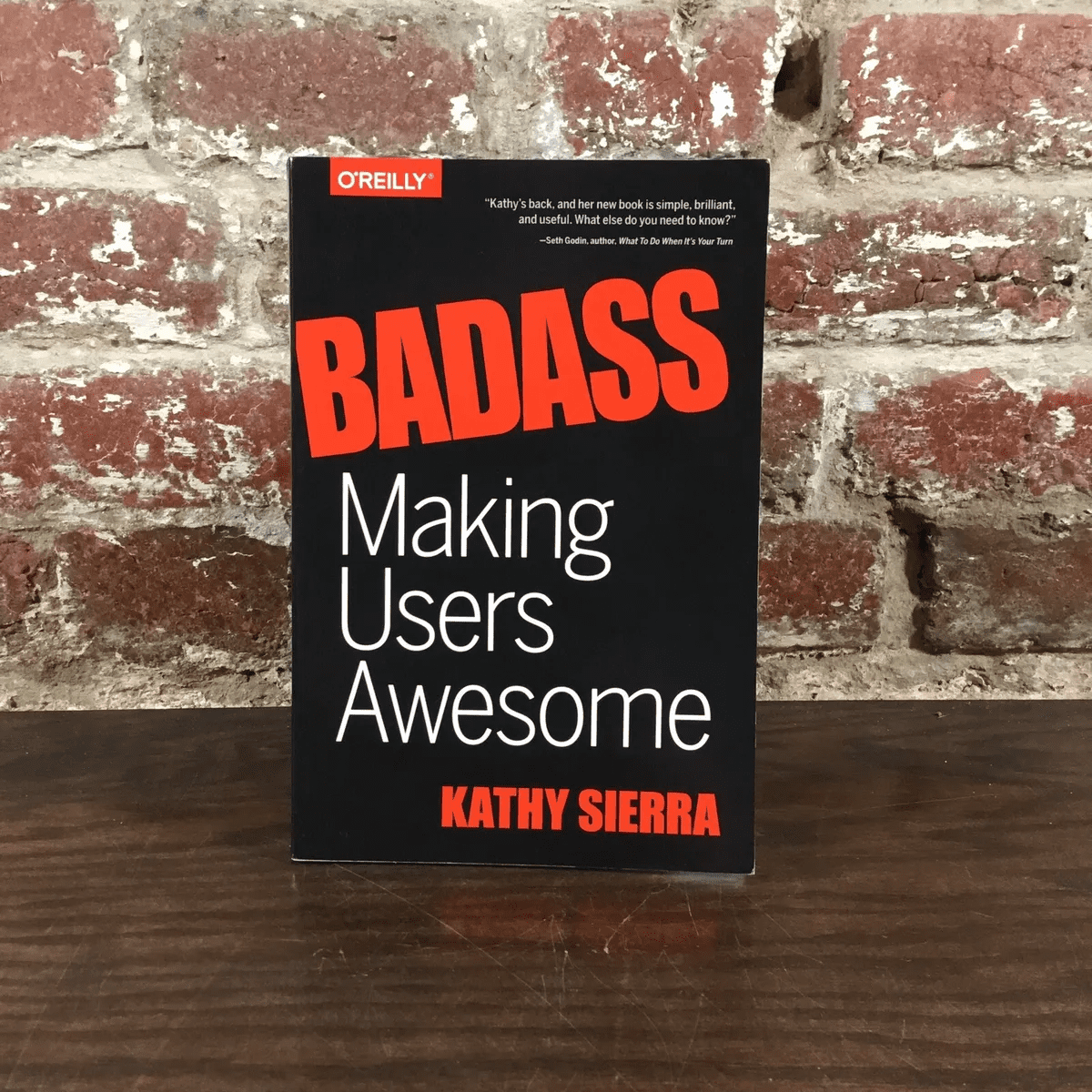

Badass: Complete Summary of Kathy Sierra’s System for Making Users Awesome
Kathy Sierra’s “Badass: Making Users Awesome” challenges conventional business thinking by proposing a radical shift in focus: sustained product success doesn’t come from having an awesome product, but from helping users become awesome through their interaction with it. This book offers a counter-intuitive yet astonishingly simple strategy for building products and services that thrive without massive marketing budgets or PR stunts. It’s for anyone involved in product development, engineering, marketing, user experience, and support – essentially, anyone who wants to build sustainably successful offerings by empowering their users. Sierra’s unique perspective, rooted in overlooked science, aims to reduce the role of luck and foster deeper, richer user experiences, not just during product use, but, more importantly, when users aren’t directly engaging with the product.
The Challenge: What You Need to Know
This introductory section sets up the core problem and the book’s central premise. It presents a thought experiment where a business must achieve bestselling status without a marketing budget, PR stunts, or short-term fads, emphasizing that this is a game of skill and strategy.
The Core Question of Success
Given competing products of equal pricing, promotion, and perceived quality, the book asks: Why does one outsell the others? The answer, Sierra argues, doesn’t lie within the product itself, but with those who use them. The goal is to craft a strategy for creating successful users, using techniques that don’t depend on large budgets and are often overlooked by even well-funded product teams.
The Problem with “Best Product Wins”
The book challenges the notion that the “best” product automatically wins. Sierra notes that there are too many examples where the objectively “best” product isn’t the bestseller. Even if “quality” could be universally defined, desirability doesn’t always increase as a function of quality. Furthermore, high desirability can actually drive perceived quality, meaning that if users love something, they are willing to accept flaws, problems, or even a higher price. This leads to users minimizing, downplaying, or even denying issues, spinning bugs as features because product/service love is nearly blind. Therefore, quality alone isn’t the answer.
The Flaws of Brand Engagement
Sierra questions the effectiveness of common marketing strategies, especially those focused on brand engagement. Strategies like having a strong social media presence, creating viral videos, or building a large following are described as an “arms race” that is exhausting and fragile, and not a robust, durable path to long-term success. The book argues that “engagement” in this context often drains user energy without providing real value, leading to the provocative statement: “On their deathbed, nobody will say: ‘If only I’d engaged more with brands.’” This highlights the need to find an alternative to out-spending, out-friending, or out-trending the competition.
The Power of Word of Mouth
The solution, Sierra proposes, begins with true, trusted recommendations, meaning honest, non-incentivized comments about the product or, more importantly, the results the user achieved with it. Nielsen’s Global Trust in Advertising report indicates that 92% of people trust recommendations from friends and family, and 70% trust online consumer reviews more than other forms of advertising. This Word of Mouth (WOM) is the common attribute of sustained bestsellers. The crucial question then becomes: What inspires these recommendations?
The Secret Answer: User Awesomeness
Sierra introduces the “Secret Answer D” to the question of what inspires WOM: it’s not about how the user feels about the product, company, or brand, but how the user feels about himself/herself when using the product. The feeling behind “This product is amazing!” is often “I am amazing because of what I can do with it.” This means the key attributes of sustained success don’t live in the product, but in the user. The product’s success “basks in the glow of our users’ result with it,” rather than users basking in the glow of an awesome product.
Designing for User Success
To illustrate this, Sierra asks readers to write an ideal Amazon review for their product, emphasizing that the review should reflect what users think and feel about themselves and their results, not just the product. This highlights a sad truth: often, brand goals (be perceived as awesome) and user goals (be awesome) are mutually exclusive. The challenge is to shift from a focus on the product being awesome to the user being awesome. Where sustained success is driven by recommendations, one finds badass users—smarter, more skillful, more powerful users who know more and can do more in a personally meaningful way. These users evangelize not because they like the product, but because they like their friends and want to help them achieve similar results.
Competing on User Awesomeness
The book argues that competing on user awesomeness offers “much more breathing room” and “not so much competition” compared to the crowded and painful space of competing solely on product awesomeness. This “blue ocean strategy,” inspired by W. Chan Kim and Renée Mauborgne, suggests that most companies focus on product quality, while few focus on the quality of the user’s results.
Defining “Badass at What?”
A crucial step is to define what “badass” means for the user. Sierra introduces the “Superset Exercise” which asks: “What are you a subset of?” The product or service (“your thing”) is a subset of some bigger, more compelling context. For example, video editing software is a subset of “making fabulous videos.” Nobody wants to be a “tripod master”; they want to use tripods to make amazing videos. The tool is just a tool; the compelling thing to be badass at is the bigger context it enables.
The Importance of Context in User Journey
The book emphasizes that people don’t want to be badass at using the tool itself; they want to be badass at what the tool helps them do. This distinction is critical because marketers often focus on the compelling context to attract users, but after the purchase, the focus shifts entirely to the tool (e.g., “you’ll take amazing photos” becomes “read the FAQ”). This disconnect kills motivation. Sustained bestsellers help their users get badass results in the bigger context.
Badass Means Higher Resolution
Beyond just results, “badass” means higher resolution and deeper, richer experiences. As users become more skilled, they perceive more detail in their domain. A classical music expert “hears” more, a wine sommelier “tastes” more, and an astronomer “sees” more than a layperson. This enhanced perception feels like a superpower and is intrinsically rewarding. This higher resolution also leads to an increased appreciation for higher-end versions, add-ons, and upgrades, as users can now perceive the value of more nuanced tools.
The Power of Word of Obvious
Badass users naturally talk about their results, providing authentic Word of Mouth (WOM). Even better is Word OF Obvious (WOFO), where the user’s results are so visibly impressive that others can see their capabilities without needing an explicit recommendation. For example, “Did you see Roy’s latest video? The color is amazing.” This direct observation of user success drives further business.
Avoiding “Faux-Badass”
Sierra warns against “faux-badass,” which focuses on making users feel badass rather than actually helping them be badass. Gamification awards for company-desired behaviors (like website visits or purchases) typically don’t contribute to genuine user skill or higher resolution. Similarly, “Customer Service Excellence” alone doesn’t mean “User Excellence.” While customer service is important for support, its role should be to enable users to be better, not just feel pampered. The core principle is: “Don’t make a better [X], make a better user of [X].” For instance, don’t make a better camera; make a better photographer.
Think Badass: A New Point of View
This section emphasizes the transformative power of shifting one’s perspective from product-centric to user-centric. It highlights how a new point of view can be more valuable than marketing budgets.
The Power of Point of View
Quoting Alan Kay, “Point of view is worth 80 IQ points,” Sierra asserts that a strong point of view can be more impactful than a large marketing budget or social media presence. The book’s core POV is: “To create sustained success, create high-resolution, badass users.”
Designing for the Post-UX UX
This concept introduces a critical shift in design thinking. Traditional User Experience (UX) focuses on the experience while using the “tool.” Sierra proposes the Post-UX UX, which is the “User Experience after using the ‘tool’.” This encompasses the UX of results: What did the experience enable? What can users now do, show others, or say to others? How are they now more powerful? This post-use experience is what drives success, recommendations, and the obviousness of user improvement.
The Post-UX Documentary Thought Experiment
To concretely imagine the Post-UX UX, readers are asked to envision a documentary camera crew tracking their users after they use the product. The goal is to visualize what users do in the minutes, hours, days, or weeks following product interaction. This includes who they talk to, what they say, and how they interact with their environment. This exercise helps teams deeply consider the real-world impact and results their product enables.
The User at a Dinner Party Thought Experiment
This thought experiment extends the Post-UX UX by focusing on the user’s social context. Teams are asked to imagine their user at a dinner party and consider what they can do to help the user be more interesting at that party. This involves giving the user things to talk about (that aren’t about the product itself) and things to show. This emphasizes designing not just for the user, but for the user’s friends, family, and peers, and how they perceive the user’s new capabilities.
The Search and Replace Thought Experiment
This powerful exercise involves taking common brand-centric questions (e.g., “How can we get more social media followers?”) and replacing “our” with “our users’.” This shifts the focus from brand goals to user goals: “How can we help our user get more social media followers?” This forces a radical re-evaluation of marketing and product strategies to prioritize user empowerment. Similarly, designing a T-shirt that makes “our user look good” instead of “us look good” exemplifies this mindset shift.
Competing Through User Performance
The book challenges teams to imagine their competitive advantage coming from how their users compare to the competition’s users. Instead of marketing based on internal benchmarks, companies should show their users out-performing their competition’s users at the bigger context. This demonstrates a fundamental commitment to user success.
The Importance of First Users
For new products or services, the goal remains the same: create badass users. This means focusing energy on attracting initial users who are likely to become better and are in a context where their improvements will be noticed. Instead of seeking external “influencers,” the focus should be on creating an influencer from within the target audience by helping a person become noticeably better and allowing word of mouth and word of obvious to emerge organically.
The User Journey: Navigating the Path to Awesomeness
This section delves into the stages of user development, from beginner to master, and identifies critical points where users often get stuck or give up. Understanding this journey is key to designing effective support and motivation.
Understanding The Badass User Curve
The Badass User Curve represents the user’s progression of ability over time, with the goal being “up and to the right.” This curve applies not just to mastering the tool, but primarily to mastering the compelling context the tool enables. If the tool is complex, there might be two curves: one for tool mastery and one for context mastery. Companies should aim to get users “further and faster up the curve.”
Key Thresholds on the User Curve
The user journey is marked by several milestones, but two are crucial:
- The Suck Threshold: This is the point where users feel “I hate this,” “I suck at this,” or “This can’t be right.” It’s the most vulnerable time for new users, as many drop out here.
- The Badass Threshold: This is the point where users feel “I kick ass” or “I’m world class.” The ideal curve encourages continuous progress towards and beyond this threshold.
Strategies later in the book will focus on helping users push through these thresholds and avoid plateauing.
The Danger in the Suck Zone
The Suck Zone is the period where new users experience pain, frustration, and a sense of failure. If users are lost here, they are unlikely to return. The book stresses that for anything truly “worth becoming badass at,” there will be pain. The key is not to eliminate the suck, but to help users survive it and shorten their time within it.
Why Users Don’t Upgrade or Switch Brands
Users who claw their way over the Suck Threshold to reach competence are often reluctant to upgrade to a new version or switch brands if it means returning to the Suck Zone. Losing previously hard-fought ability is painful, even if the upgrade promises more power. “Nobody wants to go back to the Suck Zone.”
The Stuck Zone: A Hidden Danger
Users can cross the Suck Threshold and become competent, but then level off and stop progressing. This is the Stuck Zone. While user retention might look good on a spreadsheet, these users aren’t increasing their resolution, gaining new skills, or becoming more powerful. Their enthusiasm will fade, and they won’t generate the desired dinner party conversations (Word of Mouth/Obvious). An example is a new camera owner who stays in “auto mode,” never exploring manual controls and deeper photography skills.
Addressing Entry-Level Tools
For companies offering only entry-level products, the challenge is to prevent users from outgrowing them once they become better. The solution is to focus on helping users become badass at a subset of the bigger context that doesn’t rely on advanced features. For instance, an entry-level camera maker can help users master gear-independent skills like composition and lighting within photography, rather than focusing on manual exposure controls.
“Good Enough” vs. “Badass” Motivation
Sierra acknowledges that many users may not aspire to be “world-class” or “Chuck Norris of X.” The good news is that users don’t have to go all the way to world-class to experience the intrinsic rewards of high-resolution knowledge, skills, and results. Simply getting past the Suck Zone can feel badass. The key is to treat all users as if they are trying to be badass, as this helps them build higher resolution abilities on a single, continuous path, even if some go further than others. Users should be informed that the early steps are the same regardless of their ultimate goal.
Science of Badass: Understanding Expertise
This section introduces the scientific foundation of expertise, explaining what it means to be an expert and how expertise is developed. It debunks the myth of “natural talent” and highlights the importance of deliberate practice and perceptual exposure.
Expertise as Applied Science
The book clarifies that “badass” is equivalent to “expertise,” “expert performance,” and “mastery.” It explains that expertise is not about popularity, years of experience, or depth of knowledge; it’s about what experts do, repeatedly, in a superior and reliable way. The science of expertise applies to all domains—technical, creative, intuitive, physical, or mental.
Defining Expert Performance
A technical definition of badass is: “Given a representative task in the domain, a badass performs in a superior way, more reliably.” This means experts make better choices, more consistently, than non-experts. The challenge for companies is to find or create a useful and specific definition of “better” performance for their context. Creative work, though subjective, can also be judged by reliable results (e.g., an expert comic writer produces more humorous comics, more reliably).
Debunking the Myth of “Natural Talent”
Sierra argues that “natural talent” is not an absolute requirement for reaching high levels of expertise in most non-sport domains. Decades of research show that for most people, the key is not domain-specific “gifts” but a “natural talent for focused practice.” Even without this, individuals can learn the meta-skill of building skill. While natural ability might give an early advantage, it can also lead to discouragement if progress later slows. The goal is to help users realize they can become better, regardless of perceived innate talent.
Building Skills: The Path to Mastery
This section focuses on the practical application of building skills, emphasizing effective practice methods that transform novice abilities into reliable mastery.
The Three States of Skill Acquisition
Skills progress through three categories: Can’t Do (A), Can Do With Effort (B), and Mastered (C). The goal is to move skills from A to B, and then from B to C, where they become reliable and automatic.
Why Traditional Skill Progression Fails
The common, linear progression from A to B to C, aiming for an “empty A board” (no new skills) and an “empty B board” (everything mastered), is not the path to high expertise. Experts constantly add new skills (keeping A full), move skills directly from A to C (unconscious mastery), and crucially, move skills backwards from C to B (de-automating) to refine or change deeply ingrained habits.
Why De-Automate Skills?
De-automating skills (moving them from Mastered/automatic to Can Do With Effort) is essential for:
- Breaking through “intermediate blues”: Automated skills can become limitations. As demonstrated by ski instructor Lito Tejedas-Flores, consciously re-examining and changing an automated skill can unlock advanced performance.
- Preventing deterioration: The myth of “use it or lose it” is misleading. “Using it is not enough.” Skills used but not consciously practiced can slowly deteriorate over time. Experts must continually refine even mastered skills.
How Experts Build Expertise
Experts continually add new skills, build skills consciously and unconsciously, and refine existing skills. They are not simply moving skills linearly; they manage a dynamic process of acquisition, automation, and refinement.
The Power of Better Practice
The critical differentiator between experts and experienced non-experts is that experts practiced better. It’s not about harder or longer practice, but better practice. This “better practice” is formally known as Deliberate Practice.
Understanding Deliberate Practice
Deliberate Practice is a specific form of explicit practice that moves skills from A to B (can’t do to with effort) and from B to C (with effort to mastered). It’s designed to fix the problem of having “too many things on the B board” (mediocre skills stuck in the “with effort” stage). Most practice activities that are not Deliberate Practice can actually be detrimental, as “practice makes permanent,” reinforcing mediocre habits.
Half-a-Skill Beats Half-Assed Skills
Deliberate Practice works by focusing on mastering one tiny, useless-on-its-own sub-skill at a time. This fine-grained approach is more effective and efficient than trying to learn too many complex skills simultaneously. While beginners might need a “minimum viable skillset” of a few half-assed skills to get started, the long-term path to mastery involves breaking down tasks into smaller, manageable units.
Rules for Deliberate Practice
Key principles for designing Deliberate Practice exercises:
- Target 95% reliability: Pick a small sub-skill that the user can’t do reliably, and aim for 95% reliability within one to three 45-90 minute sessions.
- Redesign if stuck: If 95% reliability isn’t reached within three sessions, the exercise is too broad or difficult. It must be split into smaller sub-tasks or have its performance criteria reduced.
Distinguishing Deliberate Practice from Other Activities
Many common learning activities, while valuable, are not Deliberate Practice:
- Working on a project: Projects are about discovery and problem-solving, not reliable skill-building.
- Working through a step-by-step tutorial: Tutorials are like remote control, executing someone else’s commands, not building independent skill.
- Playing a complete piece of music at a reliable speed: This is performing, not practicing for improvement.
- Practicing without immediate reliability: If a skill won’t become reliable within three sessions, it’s not effective Deliberate Practice.
The 10,000-Hour “Thing”
The “10,000-hour rule” popularized by Malcolm Gladwell refers specifically to 10,000 hours of Deliberate Practice, not just any practice-related activity. It’s a general observation, not a strict rule, and the actual hours can vary widely by domain and individual. However, many hours of Deliberate Practice are always required for deep expertise in complex domains.
Why Deliberate Practice Isn’t Universal
Despite its effectiveness, Deliberate Practice isn’t widely adopted because:
- The wrong ways to practice feel right: Most people have learned to practice badly, by simply doing more of what they already do, or attempting things far beyond their current ability.
- The right ways to practice feel wrong: Deliberate Practice always pushes beyond the current comfort zone, which can be subconsciously resisted. It involves focusing on small, often difficult, tasks until they are mastered.
Perceptual Exposure: Unlocking Unconscious Learning
This section introduces the second crucial element of expertise: learning through exposure to high-quality examples, often unconsciously. This “perceptual learning” can dramatically accelerate skill acquisition.
The Power of Perceptual Exposure
The second attribute of experts is that they were exposed to a high quantity, high quality of examples of expertise. This exposure, if designed correctly, can build expertise even without conscious awareness. This “magical” process (which is simply how brains work) is called perceptual knowledge.
The Chicken Sexing Example
The example of chicken sexing vividly illustrates perceptual knowledge. Experts could instantly determine the gender of newborn chicks with near-perfect accuracy but couldn’t explain how they did it (“I just… know.”). They trained new experts by having them guess, then providing immediate feedback (right/wrong). Over time, trainees began to sort correctly without consciously knowing the cues, demonstrating unconscious pattern detection.
Beyond Simple Identification Tasks
This phenomenon isn’t limited to chick sexing or WWII plane spotting. Experts in all domains develop unconscious perceptual knowledge, often referred to as intuition. This includes the ability to instantly recognize a good chess move, detect a forgery, or sense something wrong with code without being able to articulate why. This unrecognized, essential knowledge is a hidden key for faster progress and deep expertise.
Criteria for Effective Perceptual Exposure
Simply seeing examples isn’t enough. Perceptual exposure that builds expertise requires:
- High quantity of examples: The brain needs a large dataset to detect invariant patterns and separate signal from noise. More examples are always better.
- High quality examples: Exposure should only be to expert-level work.
- Diversity in examples: Examples should appear different on the surface but share the underlying invariant attribute.
- Compressed time and feedback: Fast, frequent feedback is crucial for the brain to learn.
Perceptual Learning in Flight Training
Studies by Kellman and Kaiser showed that non-pilots, after less than two hours of perceptual exposure with minimal instruction, could interpret cockpit instruments and perform navigation tasks faster and more accurately than seasoned pilots with hundreds or thousands of hours of experience. This demonstrates how perceptual training can dramatically compress typical learning times by helping the brain “discover” underlying patterns.
The Power of “Discovery” Over “Explanation”
For areas where perceptual learning can be used (e.g., photographic composition), creating a context for the learner’s brain to “discover” the pattern is far more powerful than simply explaining it. This moves beyond mere mechanics to develop a deeper, richer, and often unexplainable “feel” for the domain.
Warning: Avoid Exposing Users to Bad Examples
The brain is an automated recording and mimicking device. If users are exposed to examples of bad or beginner quality, their brain might inadvertently learn and imitate those bad patterns, even if they consciously know it’s “wrong.” If bad examples must be shown, they should be designed to evoke a visceral “something’s wrong” feeling (e.g., harsh filters, skull and crossbones). The best way to learn to spot “bad” is by strengthening the recognition of “good”.
Help Them Move Forward: Sustaining Motivation
This section shifts focus from skill-building mechanics to the psychological aspects of motivation, emphasizing the importance of removing obstacles and providing clear paths and payoffs.
Beyond the Pulling Magnet: Removing Derailers
The common approach to motivation is to make the “forward-pulling magnet” (enticing benefits) stronger. However, Sierra argues that users are often already motivated. The key question is not “What pulls them forward?” but “What makes them stop?” Focusing on reducing what slows or stops them (derailers) is more effective than adding more external motivation.
The Gap of Suck
One major derailer is the Gap of Suck, the painful disparity between what users wanted to achieve and what they are actually experiencing (frustration, difficulty, failure). For activities like snowboarding, this initial pain is unavoidable.
The Gap of Disconnect
Another significant derailer is the Gap of Disconnect. Users are initially attracted by the compelling context (e.g., “take amazing photos”), but after they buy the product, the company’s communication often shifts solely to the tool (e.g., “read the FAQ”). This disconnect kills motivation as users lose sight of the bigger goal and trust in the company to help them achieve it.
Death by a Thousand Derailers
Users face numerous internal and external derailers: “I suck at this,” “I’m confused,” “This is tedious,” “Worst. FAQ. Ever.” These are often unarticulated thoughts and feelings. The fundamental problem is that companies are not “there” to notice these frustrations and respond.
The Power of Acknowledgment
For inherent difficulties (like the first day of snowboarding), the secret to keeping users going is to acknowledge the struggle. Tell them directly: “Your first day will be frustrating and painful. But here’s what’s gonna happen…” The main reason people stop struggling is not the struggle itself, but because they don’t know that struggling is appropriate or that everyone experiences it. Knowing it’s normal and temporary restores confidence and trust.
Anticipate and Compensate for Derailers
The strategy is to Anticipate the most likely “faces” and “questions” users might have, and then Compensate for the inability to be there in person. This involves actively looking for common pain points in online discussion forums (especially independent user groups for the compelling context, not just the tool). Once identified, companies should be brave and Just Tell Them—in user manuals, marketing, support sites, social media, and even the product UI itself. Honesty builds trust.
Progress + Payoffs: Fueling the Journey
This section focuses on actively showing users their progress and providing meaningful payoffs along the way to maintain motivation and enthusiasm.
The Need for Consistent Payoffs
Users need to know they’re getting better and benefit from it throughout their journey, not just at the end. The benefits of being badass can’t only come once they’re fully expert.
The Performance Path Map
A Performance Path Map is a clear, credible roadmap defining steps of progression from beginner to badass. Like a martial arts belt system, it includes:
- Clear steps: Defining what “good” looks like at each level.
- Assessment: A way for users to know “you are here” relative to the full map.
- Credibility: A reason to believe the path works and that success is achievable without “natural talent.”
This map should be about what users do (skills, results), not just what they learn (knowledge, courses). Seeing a clear, demystified path boosts confidence and motivation.
Experts Disagree, but That’s OK
The fact that experts often disagree on “The One True Path” is encouraging; it means multiple paths can lead to mastery. This disagreement often stems from experts not consciously knowing their own learning process. The key is to design a robust path that equips users to be resilient, even if the learning materials aren’t perfect.
Progress as the Ultimate Motivator
The Progress Principle, coined by Teresa M. Amabile and Steven J. Kramer, states that making progress in meaningful work is the single most important factor for boosting emotions, motivation, and perceptions. Even small wins can make a significant difference in how users feel and perform. Therefore, the “belt” in a progress system is not the goal; it’s a reflection of meaningful progress and what that progress enables.
Lowering the Initial Threshold for Meaningful Action
To keep users motivated, companies should lower the initial threshold for users to do something meaningful within the first 30 minutes of using the product. This means surprising, delighting, and impressing users with what they can accomplish, not just what the product can do. This applies even if the “meaningful” action is small or not immediately practical, as long as it gives a hint of future power and makes the user feel more capable.
Enabling “Wild Experimentation Mode”
Fear of breaking things or losing progress can derail users. Companies should anticipate and compensate for this by designing “Wild Experimentation Mode,” which means giving users the freedom to just try things without fear. This could involve clear “DON’T PANIC” recovery instructions, easy reset steps, or even a literal “Go Wild” button in the UI that protects their work. The goal is to convince them to be brave.
The Motivating Payoff Loop
The ideal user path is a continuous series of loops, each featuring:
- A motivating “next superpower” goal.
- Practice + Exposure activities to build skills and knowledge.
- A payoff (ideas/activities to benefit from current “superpowers”).
These payoffs are hard-earned benefits of effort, not external rewards.
Intrinsically Rewarding Experiences
The ultimate payoff is intrinsically rewarding experiences—activities users find enjoyable and rewarding for their own sake, without external motivators. These lead to robust, long-term success. Two powerful intrinsic motivations are:
- High Resolution: The deeper, richer experience of perceiving increasingly subtle details that mere mortals miss (e.g., a classical music expert hearing more in music).
- Flow: The state of being “in the zone,” fully absorbed in a stimulating and challenging activity where time seems to disappear. This requires a balance between perceived challenge and current ability.
Jargon as a Tool and Reward
Counter-intuitively, domain-specific jargon can be a good thing. It’s a useful tool for efficient, high-resolution communication and a stimulating reward for those who’ve entered the “high-res world.” Companies should embrace, teach, and even invent jargon, helping beginners become fluent.
High-Payoff Tips and Tricks
Providing high-payoff tips and tricks (short-cuts, early “superpowers”) helps users feel powerful early on, giving them quick wins that exceed expectations. These are not a substitute for Deliberate Practice or Perceptual Exposure, but they can provide a “Minimum Viable Half-Assed Skillset” to get users started and motivated.
Support Cognitive Resources: Design for Brains
This crucial section delves into the neurological basis of learning and motivation, emphasizing the need to minimize cognitive drain and maximize users’ mental energy for skill acquisition.
The Limited Pool of Cognitive Resources
Drawing on a study by Professor Baba Shiv, Sierra explains that willpower and cognitive processing draw from the same, single pool of resources. Tasks requiring intense concentration, patience, or self-control deplete this pool. If a product is poorly designed or frustrating to use, it drains cognitive resources, which also drains willpower. This means users might struggle with complex learning tasks or making good decisions after encountering cognitive drains.
Reducing Cognitive Leaks
Becoming badass is hard and will require cognitive effort. The goal is not to eliminate all cognitive drain, but to minimize “leaks”—unnecessary expenditures of cognitive resources. This means not making users think about the wrong things.
Zeigarnik Effect Leaks
The Zeigarnik Effect describes how the brain keeps a background process running for unfinished or interrupted tasks, consuming cognitive resources. This “slow background leak” can reduce available resources for focus, practice, and learning. Anticipating and compensating for potential unresolved issues (e.g., clearly stating what happens if a device is accidentally unplugged) can reassure the brain and prevent these leaks.
Microinteractions and Uncertainty Leaks
Even seemingly small uncertainties, like wondering if a photo uploaded successfully or if a phone is truly on silent, can create cognitive microleaks. Good design, often through effective microinteractions, can provide clear feedback and confirmation, preventing these cumulative drains.
Feature Cost: Cake or Fruit?
When considering new features, teams should ask: “Is this feature worth the drain?” Does it directly contribute to user expertise in the meaningful bigger context, or is it a “cake feature” (draining resources) rather than a “fruit feature” (low cognitive cost)?
Delegating Cognitive Work
To reduce user cognitive leaks, companies should delegate cognitive work to “the world” (the device or external resources) rather than keeping it “in the user’s head.” This means:
- Don’t make them memorize: Provide cheat sheets, clear labels, or on-device information so users don’t have to recall infrequently used information.
- Make the right thing easy and obvious: Design with clear perceived affordances so the correct action is the most natural and likely one to take, minimizing decision-making effort.
- Don’t make them choose (unnecessarily): While choices can feel empowering, they are cognitively expensive. Provide trusted defaults, pre-sets, and recommendations, especially for beginners.
Automating Skills and Providing Practice Hacks
Moving skills from “with effort” (B) to “mastered/automatic” (C) frees up cognitive resources. Companies should help users automate skills where possible. Additionally, provide “practice hacks”:
- Design/recommend practice notebooks: Tools and templates for users to track progress, energy levels, and practice sessions.
- Recommend tracking apps: Simple apps like Lift can help users build consistent habits around practice without draining resources.
- Help with “top-of-mind” problems (MotivAider): For skills that require constant reminders (e.g., posture), tools like the MotivAider provide subtle, repeating nudges without requiring conscious willpower or draining attention.
Reducing the Need for Willpower
Since willpower is a limited cognitive resource, the goal is to reduce the need for it. Sierra provocatively suggests acting as if the user’s willpower was surgically removed. This means:
- Build automatic habits: Help users develop routines around necessary but non-intrinsically rewarding behaviors (e.g., charging camera batteries).
- Connect work to identity: When the “bigger context” (e.g., rock climbing) becomes part of the user’s identity, even non-enjoyable tasks (e.g., running for fitness) require less willpower because they are seen as part of “being” that identity.
- Avoid extrinsic rewards for sustained motivation: While tempting, external rewards can undermine intrinsic motivation, making activities less desirable on their own. Unexpected gifts are better.
Escape the Brain’s Spam Filter: Making Content Memorable
This final section focuses on how to design content and learning experiences that capture and hold the user’s attention by appealing to the brain’s innate preferences.
What the Brain Cares About
To get past the brain’s “spam filter” (which prioritizes what to pay attention to and remember), content must be injected with something the brain cares about. This means provoking a feeling, even a subtle one. Brains are naturally drawn to:
- Scary/threatening things: Elements that signal danger or risk.
- Faces, especially emotional ones: Human (and even non-human) faces displaying strong emotions.
- Young, helpless things: Babies, puppies, etc.
- Things that evoke a feeling: Humor, surprise, awe, or any emotional response.
- Odd, surprising, unexpected things: Novelty grabs attention.
- Unresolved tension: The Zeigarnik Effect can be used strategically to create curiosity and drive the brain to seek answers.
Making Content Visceral and Contextual
Rather than just stating facts, content should be visceral to get the brain’s attention and improve memorability. Using a diagram that evokes “horror” in a programmer to explain a bad design pattern, for instance, creates a lasting impression. Additionally, learning content should always be presented within the compelling context rather than just focusing on the tool. Marketing often does this well, while user manuals frequently fail by being dry and tool-centric, which the brain treats as “spam.”
The “Why? So What? Who Cares?” Test
To ensure knowledge is compelling, apply the “Why? So What? Who Cares?” test to every fact, procedure, or topic. Start with the most compelling reason why something matters, rather than burying the lead. This helps the brain understand the relevance and pay attention.
Reducing Information Overload
The best way to deal with the brain’s spam filter is to reduce the amount of things that need to get past it. This means being ruthless in filtering out unnecessary information.
Just-in-Time vs. Just-in-Case Learning
Brains prefer Just-in-Time (JIT) learning (learning only when/because you need to use it) over Just-in-Case (JIC) learning (learning knowledge before it’s needed). JIC knowledge can seem useless to the brain and is often filtered out or forgotten. If JIC knowledge is absolutely necessary, it must be validated (is it truly essential now?) and then “sold” to the brain by making it relevant and compelling.
Validating Knowledge Usefulness
To reduce cognitive drain from unnecessary knowledge, companies should:
- Put each topic on trial: Interrogate every fact, procedure, and concept using the “Why? So What? Who Cares?” test.
- Map knowledge to skills: Every piece of knowledge should be mapped to a specific skill it enables. Unmapped knowledge should be cut, as it likely drains resources without contributing to expertise. Intellectual curiosity is valid, but often comes after initial skill development, so JIC knowledge about history or side-topics should be minimized or placed in appendices.
Key Takeaways: What You Need to Remember
This final section condenses the core wisdom of “Badass: Making Users Awesome” into actionable insights.
Core Insights from Badass
- Shift your focus from product awesomeness to user awesomeness. Your product’s success relies on how awesome your users feel and are when using it, and the results they achieve.
- Prioritize authentic word of mouth and word of obvious. These organic recommendations stem from users feeling badass about their own accomplishments, not from your marketing efforts.
- Identify and design for the “bigger compelling context.” Your product is a tool; users want to be badass at what that tool enables them to do, not just at using the tool itself.
- Embrace “higher resolution” as a key benefit. As users become more skilled, they perceive more subtle details, leading to richer experiences and appreciation for advanced tools.
- Design for the Post-UX UX. Focus on the user’s experience after they use your product—what they can now do, show, or say to others.
- Acknowledge and compensate for the “Suck Zone” and other derailers. Users are often motivated; remove obstacles and address their struggles directly and honestly. Tell them it’s normal to struggle.
- Provide a clear “Performance Path Map” with frequent payoffs. Show users where they are, what’s next, and celebrate small, meaningful progress and intrinsically rewarding experiences.
- Ruthlessly manage user cognitive resources. Minimize cognitive leaks caused by poor design, unnecessary choices, and overwhelming information. Delegate cognitive work to the product or external aids.
- Appeal to the brain’s natural attention triggers. Make learning content visceral, surprising, emotional, and directly relevant (“Why? So What? Who Cares?”) to bypass the brain’s spam filter.
- Prioritize Just-in-Time learning. Deliver knowledge precisely when it’s needed, making it immediately relevant and memorable, rather than overwhelming users with Just-in-Case information.
- Help users build “meta-skills” for becoming badass. Encourage Deliberate Practice and Perceptual Exposure as the fundamental methods for skill acquisition, and teach them how to learn effectively.
- Recognize that “brand engagement” often competes with user progress. Unless your brand interactions directly make users better at their meaningful goals, they likely drain precious cognitive resources.
Immediate Actions to Take Today
- Define your “bigger compelling context” and articulate what it means for your users to be “badass” within that context.
- Map out your current user journey, identifying the “Suck Zone” and “Stuck Zone” specific to your product and its compelling context.
- Spend time in online discussion forums for your compelling context to anticipate common user struggles and questions.
- Review your onboarding process and identify ways to lower the initial threshold for users to achieve a “meaningful-within-30-minutes” result.
- Identify a key piece of “Just-in-Case” knowledge in your current support materials and apply the “Why? So What? Who Cares?” test to it.
- Brainstorm one “Wild Experimentation Mode” feature or policy you could implement to encourage fearless exploration.
- Consider how you can inject “feeling” or “visceral impact” into one piece of your current learning content (e.g., a FAQ answer, a tutorial step).
Questions for Personal Application
- What is the single most important skill our users could gain that would make them feel truly badass within our compelling context?
- Where are our users currently getting stuck on their journey, and what specific derailers are causing this?
- How can we modify our product, support, or communication to acknowledge user struggles and build trust?
- What is one “cognitive leak” our users experience that we can immediately reduce or eliminate?
- Are we inadvertently draining our users’ cognitive resources through unnecessary features, choices, or information overload?
- How can we design learning experiences that leverage “perceptual exposure” and “deliberate practice” more effectively?
- What explicit “payoffs” can we offer users at different stages of their journey to keep them motivated?




Leave a Reply