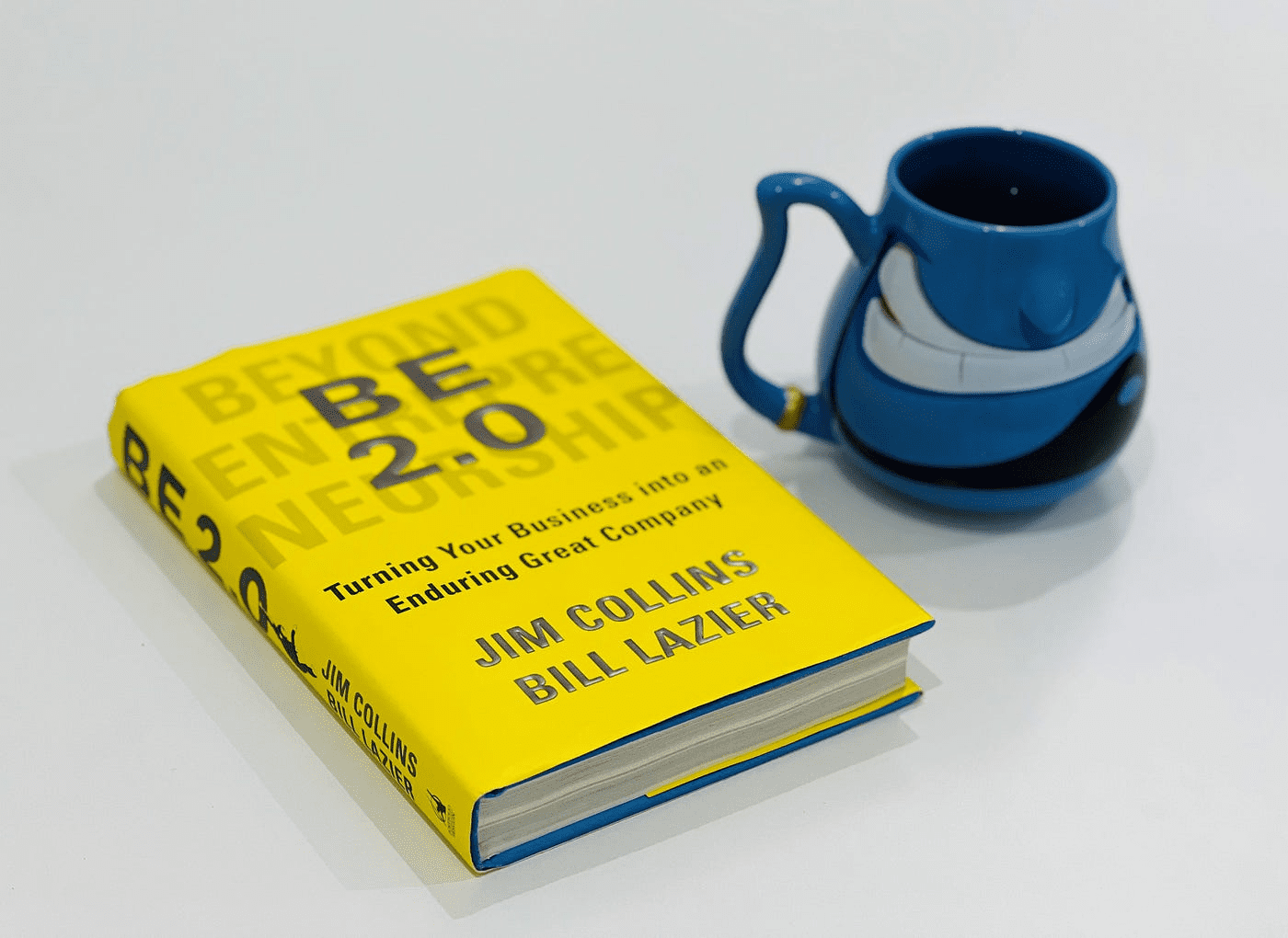

Unlocking Enduring Greatness: A Comprehensive Summary of BE 2.0 (Beyond Entrepreneurship 2.0)
Jim Collins, a revered figure in the study of leadership and organizational excellence, presents BE 2.0 (Beyond Entrepreneurship 2.0) not just as a re-release of his first book, but as a comprehensive blueprint for building enduring great companies. Co-authored with his mentor, Bill Lazier, the original Beyond Entrepreneurship laid the groundwork for understanding what makes businesses thrive beyond their initial startup phase. This updated edition, with nearly half of its content being new material designated as “Jim’s View from 2020,” expands on timeless principles of leadership, vision, strategy, and execution, specifically tailored for leaders of small to mid-sized enterprises. Collins promises a deep dive into every essential idea, example, and insight, aiming to equip readers with a holistic roadmap to transform their ventures into admired, lasting institutions that make a distinctive impact on the world. This summary commits to breaking down every important concept, ensuring you grasp the full wisdom the book offers in clear, engaging language.
Introduction: What Is BE 2.0?
The introduction sets the stage for BE 2.0, highlighting its purpose as a roadmap for leaders of small to mid-sized enterprises aspiring to build enduring great companies. Jim Collins introduces the original Beyond Entrepreneurship, co-authored with his mentor Bill Lazier, and reveals its surprising enduring popularity, even among highly successful entrepreneurs like Netflix co-founder Reed Hastings. Hastings famously advised aspiring CEOs to “Memorize the first eighty-six pages of Beyond Entrepreneurship,” underscoring the book’s foundational value.
Collins then explains the three primary reasons for creating BE 2.0. First, he maintains a fierce passion for entrepreneurs and leaders of small to mid-sized companies, recognizing that even the massive companies he studied later (like those in Built to Last or Good to Great) were once small start-ups. His curiosity always focused on understanding why some early-stage companies achieved lasting greatness while others didn’t. Second, he had substantial new material on crucial topics like people decisions, leadership, vision, and strategy that would directly benefit today’s entrepreneurs. This new content is integrated throughout the book as “Jim’s View from 2020” essays and new chapters, significantly expanding the original text while leaving Lazier’s original contributions largely intact. Third, and most importantly, BE 2.0 serves to honor and extend the legacy of Bill Lazier, whom Collins describes as the greatest mentor in his life. The book aims to transmit Lazier’s wisdom, inspiring new generations of leaders to build truly great companies. Collins expresses his hope that the book will help readers create iconic companies and that Lazier’s mentorship will live on through them.
Chapter 1: JIM’S VIEW FROM 2020: BILL AND ME
This chapter, a deeply personal reflection from Jim Collins, introduces readers to his pivotal mentor, Bill Lazier, and the profound impact Lazier had on Collins’s life and career. Collins describes meeting Lazier during his second year at the Stanford Graduate School of Business, a “lightning bolt of who luck” that changed his trajectory. At the time, Collins felt like a “high-energy propulsion machine with no clear guiding purpose,” and Lazier’s mentorship filled that void, inspiring him to commit to a life of research, writing, and teaching.
Collins details Lazier’s bold move in 1988, advocating for Collins, then only thirty and with no prior university-level teaching experience, to teach an entrepreneurship course at Stanford. This opportunity, which Collins likens to a minor league pitcher being called up to Yankee Stadium, was a “shot” that changed his whole life, leading to all his subsequent research and books. He emphasizes that Lazier’s greatness lay not just in his own success as an entrepreneur and academic, but primarily in his role as a magnificent mentor to hundreds of young people.
Collins then shares a set of life lessons gleaned from Bill Lazier, which he deems fitting to precede the business lessons as Lazier exemplified that true success encompasses how one lives one’s life:
- Never Stifle a Generous Impulse: Lazier demonstrated radical generosity, often framing his giving as if others were doing him a favor. Inspired by HP co-founder William R. Hewlett, who lived by the motto “Never stifle a generous impulse,” Lazier believed the American Dream was about doing useful work and giving freely to others. His generosity created a “generosity-energy flywheel” that built momentum throughout his life.
- Know When to Make the Irreversible Leap: Lazier, on the cusp of partnership at a prestigious accounting firm, resigned to pursue his entrepreneurial dream, believing comfort could suffocate his ambition. He understood that achieving “near-impossible dreams” often requires going “all in, fully committed, with no easy path to retreat.” Collins later applied this lesson in his own “Thelma and Louise moment,” leaving Stanford to become a “self-employed professor,” facing down financial precarity rather than keeping options open. The lesson: “If you spend your life keeping your options open, that’s exactly what you’ll do . . . spend your life keeping your options open.”
- Make the Trust Wager: When Collins was burned by misplaced trust, Lazier offered a profound “Trust Wager.” Instead of assuming untrustworthiness until proven otherwise, Lazier chose to “assume the best in people and accept that they sometimes disappoint.” He argued that trusting people actually helps them become more trustworthy, as they feel responsible to merit that trust. While acknowledging the pain of betrayal, Lazier believed the upside of trust (motivating the best people) far outweighed the downside of occasional disappointment.
- Build a Meaningful Life by Building Relationships: Lazier taught that life can be a series of transactions or relationships, with only the latter leading to a great life. He defined a great relationship as one where “If you were to ask each person in the relationship who benefits more from the relationship, both would answer, ‘I do.’” He exemplified a generous mentorship, expecting his mentees to pay it forward by becoming mentors themselves, thus creating an “expanding web of relationships.”
- Start with Values, Always Values: Inspired by L.L.Bean founder Leon Bean, Lazier believed entrepreneurial success was fundamentally about who you are, not just what you do. He challenged students to develop a guiding life philosophy “not defined by money,” emphasizing that values come first—before goals, strategy, or business plans. Lazier taught that “Living to core values is the hard stuff,” exemplified by Collins’s commitment to honor a speaking engagement during Hurricane Wilma, choosing to fulfill a commitment even when it was inconvenient and costly.
- Put the Butter on Your Waffles: After a heart attack, Lazier told Collins that he was “putting butter on my waffles,” signifying that he had lived a great life regardless of its length. He had experienced a “fabulous run, a wonderful life,” and everything after was a “bonus.” This lesson taught Collins that “the main question isn’t how to extend life as long as possible but how to live a life worth living all the way along.” Lazier’s joyful persistence and belief in enjoying one’s work were key.
The chapter concludes with Lazier’s peaceful passing in 2004, and Collins’s reflection that while he cried for what he’d never had when his father died, he cried for what he’d lost with Lazier. He honors Lazier’s legacy by recognizing the “altered trajectory” of thousands of lives, including his own, because of Lazier’s impact on their values and choices.
Chapter 2: JIM’S VIEW FROM 2020: GREAT VISION WITHOUT GREAT PEOPLE IS IRRELEVANT
This chapter emphasizes the paramount importance of people decisions in building great companies, asserting that “Great Vision Without Great People Is Irrelevant.” Jim Collins recounts a pivotal conversation with Steve Jobs in 2007, where Jobs, reflecting on Apple’s near-extinction in 1997, surprisingly didn’t speak of product ideas, but rather of the “right people” hidden within Apple. These individuals, with their “burning passion for the change-the-world vision” and “passionate dedication to making exquisite products,” were the foundation upon which Jobs rebuilt Apple, transforming it into a company that could be visionary beyond him, ultimately reaching a $1 trillion market capitalization. This illustrated Jobs’s shift from a “genius with a thousand helpers” to a leader obsessed with building a self-sustaining great company.
Collins argues that you need the right people far more than the right business idea, especially given that specific ideas often fail. He introduces the “first who” principle (first get the right people on the bus, then figure out where to drive it), which was a key finding in Good to Great. He expands on this by citing Ed Catmull, co-founder of Pixar Animation Studios, who believed great people could turn a bad idea into a great result by changing the story. Catmull’s “first who” strategy led to fourteen consecutive number one movies for Pixar, emphasizing that “Who are the great people to bet on?” is the primary question.
Collins stresses that in a world of chronic uncertainty and continuous “not normal” episodes, doubling down on the “first who” principle is crucial. Having the right people—those who can adapt to unexpected obstacles—is the best hedge against an unpredictable future.
He introduces the Number One Metric for any enterprise: the percentage of key seats on the bus filled with the right people for those seats. Collins defines a “key seat” as one where the person has power to make significant people decisions, failure could expose the enterprise to significant risk, or success would have an outsized impact. He recommends striving for 90 percent of key seats filled with the right people, identifying this as the number one priority if not yet achieved.
Collins then tackles the challenge of Knowing When to Shift from “Develop” to “Replace.” He notes that most leaders, when faced with a good-but-not-great performer in a key seat, tend to wait too long before making a decisive change (moving them to a different seat or off the bus). He offers seven questions to guide this difficult decision:
- Are you beginning to lose other people by keeping this person in the seat? (Mediocre performance or misaligned values drive away top talent.)
- Do you have a values problem, a will problem, or a skills problem? (Values problems require immediate replacement; will problems are harder but might be ignited; skills problems can often be developed if will and values are strong.)
- What’s the person’s relationship to the window and the mirror? (Right people look in the mirror for failures and out the window for success; wrong people do the opposite.)
- Does the person see work as a job or a responsibility? (Right people embrace broader responsibilities beyond mere tasks.)
- Has your confidence in the person gone up or down in the past year? (Confidence trajectory is a key indicator.)
- Do you have a bus problem or a seat problem? (The right person might be in the wrong role, or the role’s demands might have outstripped their capabilities.)
- How would you feel if the person quit? (Secret relief indicates a wrong person; genuine distraught indicates a right person.)
Collins emphasizes being rigorous, not ruthless, in making these decisions, requiring courage to be direct and compassion in delivery.
He further stresses: If You Want to Grow Your People, First Grow Yourself. He illustrates this with Anne Bakar, who became CEO of Telecare at 29 and grew herself from “Anne Bakar 1.0” to “Anne Bakar 3.0” alongside the company’s growth, eventually leading it to become an admired, billion-dollar enterprise. He highlights that most great leaders grow into their capabilities, driven by a desire to be worthy of the people they lead, rather than wanting to “be” a great leader. He debunks the myth that founder-entrepreneurs inevitably hit a managerial limit, citing Wendy Kopp (Teach For America), Gordon Moore (Intel), Bill Gates (Microsoft), Walt Disney, Bill Hewlett (HP), J. W. Marriott, Herb Kelleher (Southwest Airlines), Sam Walton (Walmart), Ed Catmull (Pixar), Fred Smith (Federal Express), Phil Knight (Nike), and familial successors like Peter Lewis (Progressive Insurance), J. W. Marriott Jr., and Katharine Graham (The Washington Post) as examples of founders who scaled to greatness. He also cites Leon Gorman of L.L.Bean, who defied student skepticism to grow the company fortyfold.
Collins advises leaders to Make the Most of “Who Luck,” distinguishing it from “what luck.” “Who luck” is the chance meeting with a person who changes your life, like his encounter with Lazier, or finding a great team member. He shares his own story of recruiting Terrence, a highly capable student he met serving hamburgers, who became a crucial part of his research team. He advocates for recruiting all the time, keeping a “first who” lens in everything, and recognizing “who luck” when it comes. He contrasts a “what” culture (what’s the idea?) with a “who” culture (who’s the right person?).
He encourages leaders to Focus on Your Unit and Take Care of Your People—Not Your Career. He cites Anne Mulcahy (Xerox CEO who engineered a turnaround) and General Lloyd Austin III (four-star general) as examples of leaders who focused on leading their “minibus” to exceptional results and taking care of their people, rather than obsessing over their next career move. This approach naturally leads to greater responsibilities.
Finally, Collins introduces the Jorge Paulo Dilemma: Do you have too many great young and talented leaders? He describes how Jorge Paulo Lemann and his partners built a “People Machine” and obsessed over finding, attracting, and developing great people, forcing them to pursue ever-bigger dreams to keep their talented individuals challenged. This “Dream-People-Culture” ultimately led to their acquisition of massive companies like Anheuser-Busch.
Collins concludes by asserting: If You Need Financial Incentives to Motivate, Then You Have the Wrong People. While acknowledging incentives have some impact, he argues they cannot turn the wrong people into the right people, and if someone needs them to perform, they lack inner drive. He cites the Cleveland Clinic (which pays physicians a simple salary) and Navy SEALs (motivated by respect and sacred promise) as examples of high-performing organizations without significant financial incentives. He warns against wrong incentives, citing the Wells Fargo scandal where an aggressive sales culture and misaligned incentives led to widespread unauthorized accounts, destroying customer trust and degrading the culture. The primary purpose of compensation, he states, is to attract and retain the right people—self-motivated and self-disciplined individuals who embrace core values.
The chapter culminates with a powerful call to Build a Culture Where People Depend Upon People. Referencing William Manchester’s memoir Goodbye, Darkness, about returning to his Marine unit in WWII, Collins highlights the profound motivation of not wanting to let comrades down. Fred Smith built Federal Express on this principle of people doing “unreasonable things to come through…for each other.” Collins asserts that in a world “impoverished in meaning,” leaders can create “work that matters” by building a culture of mutual dependence, ultimately giving people “something of immeasurable value.”
Chapter 3: Leadership Style
This chapter explores the critical role of leadership style in building a great company, emphasizing that it’s a “multiplier effect” that sets the tone for the entire organization. Collins opens with a cautionary tale of the “M Syndrome,” describing a highly credentialed, intelligent CEO whose ineffective and oppressive leadership style led his company into “the gloom and malaise of mediocrity.” M’s flaws included preaching trust while never trusting, demanding blind obedience, indecisiveness, lacking clear priorities, isolating himself, constant criticism without positive reinforcement, failing to communicate vision, and refusing to embrace new, bold initiatives, leading to stagnation and loss of ambitious people.
Collins clarifies that there isn’t one “right” leadership style for everyone; effective leaders can be diverse (e.g., Gandhi, Lincoln, Churchill, Thatcher). The key is to “Cultivate your own style; don’t try to be someone you’re not.”
He introduces the concept of Effective Leadership as having two parts: leadership function and leadership style.
- Leadership Function: The universal, number-one responsibility of a leader is to “catalyze a clear and shared vision for the company and to secure commitment to and vigorous pursuit of that vision.” This is non-negotiable.
- Leadership Style: This is unique to each individual, a personal artistry used to carry out the leadership function. Collins explains that while styles vary, certain elements of style are common among effective leaders: Authenticity, Decisiveness, Focus, Personal Touch, Hard/Soft People Skills, Communication, and Ever Forward. He uses the analogy of great writers, each with unique styles, but sharing common elements like engaging readers and using language well.
JIM’S VIEW FROM 2020: Just What Exactly Is “Leadership”?
Collins dives deeper into the essence of leadership, drawing insights from his two-year appointment at the United States Military Academy at West Point. He immediately debunks the myth of a “leadership personality,” noting that Wendy Kopp, founder of Teach For America and a personal hero, is shy and reserved, yet an incredibly impactful leader. Kopp’s leadership stemmed from her ability to define a clear and magnetic vision (a solid education for every child) and inspire people to believe in making impossible dreams come true.
Collins states that true leadership exists only if people follow when they would otherwise have the freedom to not follow. He differentiates leadership from “brute power” (rank, title, money, incentives), citing General Colin Powell‘s view that true command uses “the most delicate touch.”
He then crystalizes his definition of leadership, directly influenced by General Eisenhower: “Leadership is the art of getting people to want to do what must be done.” This definition emphasizes:
- Figuring out what must be done.
- Getting people to want to do it, not just do it.
- It is an art, requiring the cultivation of a distinctive leadership artistry.
Collins encourages readers to identify their unique leadership gifts—whether it’s defining vision (Kopp), holding a room with a speech (Anne Mulcahy), creating fun (Herb Kelleher), constitutional incapability of capitulation (Katharine Graham), or simplifying complexity (Bill Gates)—and to refine them like a great artist through decades of obsessive attention to craft. He reaffirms the wisdom of the original chapter’s distinction between function and style, concluding that uncharismatic leaders who confront brutal facts are far better than charismatic ones who lead to disaster. The ultimate test: if your company cannot be great without your personal charisma, it is not yet a great company.
Leadership Style Element 1: Authenticity
Authenticity is presented as the most important element of leadership effectiveness, meaning “authentically living the vision of the company.” Values and ambitions are instilled not by words, but by what leaders do.
- Show Your Conviction: Effective leaders convey “ferocious intensity” about their values, unafraid to show emotion (e.g., Jim Gentes of Giro Sport Design, Phil Knight of NIKE showing tears).
- Be the Best Role Model: Leaders must embody the culture they want to create, as their actions and attributes will “rub off” on others. Sam Walton (Walmart) exemplified frugality by driving a beat-up truck and eating cold sandwiches at board meetings. In contrast, Fortune Systems failed due to hypocrisy: preaching egalitarianism while senior managers enjoyed executive suites. Stated corporate philosophy must be a “genuine reflection of the values and beliefs you hold in your own gut.”
- Back Words with Action: Yvon Chouinard (Patagonia) demonstrated authenticity by donating 10% of profits to environmental causes and changing climbing gear to protect rocks decades before it was fashionable. Collins asserts that leaders who don’t back words with actions are “insincere,” “nauseating,” and “don’t deserve to be leaders.”
JIM’S VIEW FROM 2020: What Cause Do You Serve?
This essay emphasizes the power of Service—commitment to a cause bigger than oneself— as a fundamental motivator for great leaders. Collins observes this ethic permeating West Point, making cadets happier. He identifies Anne Mulcahy (Xerox), Gordon Moore (Intel), Wendy Kopp (Teach For America), and George C. Marshall as leaders who subjugated their own ambitions and egos in service to a larger cause. Marshall famously prioritized the war effort over personal glory by allowing Eisenhower to command D-Day while he remained in Washington.
Collins connects this to the Level 5 leadership concept from Good to Great, which combines personal humility with indomitable will in service to a cause beyond self. Level 5 leaders are “incredibly ambitious,” but their ambition is “first and foremost for the cause, for the company, for the purpose, for the work, not themselves.” He challenges readers to answer the question: “What cause do you serve? What cause are you willing to sacrifice and suffer for . . . What cause will infuse your life with meaning?”
Leadership Style Element 2: Decisiveness
Decisiveness is presented as an essential leadership attribute, particularly in small to mid-sized companies where delayed action can be catastrophic.
- Don’t Let Analysis Prevent a Decision: Leaders shouldn’t fall prey to “analysis paralysis.” While analysis is useful, it’s rarely conclusive, as assumptions heavily influence conclusions. The goal is to “make a decision, not to pulverize it with analysis.” David Starr Jordan, Stanford’s founding president, embodied this with his “yes or no at once and take my chances” approach.
- Follow Your Gut: Effective decision-makers combine hardheaded analysis with intuition. Paul Cook (Raychem Corporation) learned to “trust my intuition faithfully.” Collins advises paring down complex situations to their “essential elements” and asking: “Does your gut say ‘Yes’ or ‘No’?” He warns against fear-driven decisions disguised as intuition, which provide false relief. Harry Truman‘s unpopular decision to fire General MacArthur exemplified doing what “you know in your gut that you have to do.”
- A Bad Decision Is Often Better Than No Decision: Indecision, though seemingly comfortable, is usually disastrous in a dynamic business. Leaders must learn to live with making mistakes, viewing them as opportunities for “building muscle,” akin to an athlete pushing to the point of failure to get stronger. Paul Garvin (Motorola) advised: “Do not fear mistakes. Wisdom is often born of such mistakes.”
- Be Decisive but Not Bullheaded: Decisiveness doesn’t mean inflexibility. Leaders must be willing to adjust and adapt to new information. “Over the long run, it’s far better to be right than consistent.”
- Group Decision Making: Collins discusses a continuum of decision-making styles: delegative, pure consensus, participative, and autocratic. While no single style fits all situations, the most effective leaders tend to use participative decision-making extensively, benefiting from multiple viewpoints while the leader makes the final call. He distinguishes consensus from unanimity, defining it as “general agreement” where those who disagreed must still commit. Disagreement during the process is “good” as it clarifies issues, as Robert F. Kennedy observed during the Cuban Missile Crisis. Leaders also use delegative decision-making to empower and develop people, pushing decisions down the organization.
- Accept Responsibility and Share Credit: Leaders must shoulder full responsibility for poor decisions (“It’s my responsibility”) and share credit for good ones (letting “true leaders inspire people to do great things and, when the work is done, their people proudly say, ‘We did this ourselves,’” as Lao-tzu advised).
JIM’S VIEW FROM 2020: Good Decisions, Right Timeline
This essay expands on the intersection of decision-making quality and timing, drawing on insights from Intel’s “constructive confrontation” culture and historical examples. Collins emphasizes that sound decisions come from dialogue, debate, and disagreement, where “evidence, logic, and facts would trump personality, power, and politics.” This process, while slower than executive orders, increases the probability of wise action.
He cites Peter Drucker’s rule: “do not make a decision unless you have disagreement,” illustrating with Alfred P. Sloan of General Motors, who would postpone decisions if there was too much agreement to ensure thorough debate. Collins notes that George Washington was “slow to decide, firm in decision, and rare to second-guess,” cultivating open dialogue by practicing “self-discipline of silence.”
The Cuban Missile Crisis is presented as a prime example of making good decisions under immense time pressure. President Kennedy’s high “questions-to-statements ratio” early in the crisis showed his commitment to stimulating debate and understanding before issuing directives, even intentionally staying out of some debates to avoid influencing advisors.
Collins then contrasts this with situations requiring fast decisions, like Ben Sliney, FAA national operations manager, on 9/11. Sliney made the unprecedented decision to shut down all U.S. airspace within minutes, demonstrating that knowing the “right timeline” for a decision is critical.
He synthesizes this into a basic architecture of executive decision making:
- Determine how much time you have.
- Stimulate dialogue and debate—guided by facts and evidence.
- Make a decision, firm and unambiguous, once clear or when the clock runs out.
- Unify fully behind the decision and execute with fanatic discipline.
He stresses that execution after the decision is equally important. In a Level 5 leadership culture, team members commit to making the decision work, even if they initially disagreed, understanding that “True greatness requires a series of good decisions, supremely well executed, that accumulate one upon another over a long period of time.” This requires people who argue “out of passionate commitment to the success of the enterprise,” not self-interest.
Leadership Style Element 3: Focus
Focus is presented as a crucial leadership element, centered on the idea that “You can’t do everything; nor can a company on the path to greatness.”
- Take One Shot at a Time: Effective leaders create a short list of key priorities, ideally one, or a maximum of three. Bob Bright, former executive director of the Chicago Marathon, learned from his Marine experience to “Take one shot at a time. Don’t panic.” This applies to business: concentrating efforts on the number one priority until it’s complete.
- Manage Your Time, Not Your Work: Kenneth Atchity‘s insight that “work is infinite; time is finite” is key. Productivity comes from managing time, not trying to finish all work. Leaders should periodically track how their time is actually spent and ensure it aligns with top priorities. J. Willard Marriott advocated “Work fewer hours—some of us waste half our time,” and Winston Churchill managed his time to dedicate it only to the most important items.
- Hard Choices—Decisiveness Revisited: Setting priorities requires making tough choices and taking items off the list. Collins describes a CEO who “froze” when asked to prioritize, leading to nothing getting done and the company running into “serious difficulties.” The inability to make hard choices about what not to do is a common pitfall.
Leadership Style Element 4: Personal Touch
Personal touch is essential for leaders building great companies, who are always “hands on” and involved. There is “simply no excuse for being detached, removed, distant, or uninvolved.”
- Build Relationships: Great companies foster long-term, constructive relationships with customers, suppliers, investors, employees, and the community. This goes beyond formal “relations.” Employees in great companies have a relationship that transcends mere pay, feeling a sense of “we” even after leaving (like Joanne Ernst with NIKE). Customers feel a personal connection (like L.L.Bean). Leaders build these by investing personal time.
- Get out and talk to people. Walk around, sit in the lunchroom, learn names, and engage informally. Collins ridicules a general manager who tried to “schedule” MBWA (Management by Walking Around) in his office. Larry Ansin (Joan Fabrics) emphasized getting out from behind the desk and listening to people.
- Use Informal Communication: Brief, handwritten notes are a powerful method, showing awareness and care, as Bill Lazier himself experienced with his dean.
- Be Accessible and Approachable: Leaders should set a tone of approachability, using first names, and minimizing “status barriers” (private parking, ostentatious offices). Thomas J. Watson, Jr. (IBM) maintained an “open door policy” even as IBM grew to over 100,000 employees, ensuring the “head man was still available.”
- Know What’s Going On: Leaders should reject the idea of being detached as the company grows. They must seek firsthand exposure to the company’s rhythms by seeing and listening for themselves. Sam Walton (Walmart) constantly dropped into stores unannounced, even riding in a semi-truck to understand the transportation system directly.
- Reinforce Values with Symbolic Details: Effective leaders are obsessed with both vision and details, understanding that seemingly trivial details are actually “very high level statement[s]” about core values. Debbie Fields (Mrs. Fields Cookies) dramatically reinforced her quality standard by throwing “unhappy-looking” cookies into the garbage, declaring: “good enough never is.” The “Bill and Dave stories” at HP, like Bill Hewlett destroying a padlock on a stockroom door to symbolize trust, also became mythic.
- Personal Touch Versus Micro-management: Collins clarifies that personal touch is distinct from micro-management. Personal-touch leaders trust their people to make good choices and use symbolic acts to guide. Micro-managers, conversely, don’t trust and seek to control every detail, suffocating people and stunting their development. The aim is to “have your fingers on the pulse of the organization, yet not suffocate folks.”
JIM’S VIEW FROM 2020: Don’t Confuse Empowerment with Detachment
This essay powerfully contrasts empowerment with imperious detachment, arguing that true leadership involves making oneself highly accessible and engaged without micro-managing. Collins illustrates this with Jorge Paulo Lemann’s office setup in São Paulo – a simple table in the middle of a bustling, jumbled room, allowing him to constantly watch, listen, and converse. This demonstrated a deep belief in empowering his best people while remaining antithetical to detachment.
Collins observes that “imperious detachment” is a common thread in the decline of once-great companies, where executives retreat into “protective cocoon[s] of executive comforts,” issuing directives instead of asking questions, and filtering information. He cites Winston Churchill’s relentless pursuit of on-the-ground details, even creating a separate department to feed him “brutal facts” and attempting to be on a bombarding ship during D-Day. This shows that “If something is truly a strategic imperative, you need to give it your direct personal attention.”
He reinforces this with George Rathmann (Amgen), who personally commanded the legal battle against Genetics Institute to protect Amgen’s EPO patent, a strategic imperative. Kevin Sharer (Amgen CEO) later modeled this by constantly shifting “between altitudes,” from high-level strategic decisions to boardroom table dynamics, demonstrating a deep engagement with various levels of detail.
Collins directly challenges the notion that entrepreneurial leaders should “let go” and become hands-off as their company grows. He argues that the best entrepreneurs maintained a blend of hands-on and empowering styles, remaining connected to their people, aware of facts, and engaged in strategic imperatives. He warns that losing “voracious curiosity about tactical details” or insulating oneself leads to a “doom loop of decline.”
He then criticizes the “genius with a thousand helpers” model, where a brilliant individual makes all decisions and subordinates merely execute. While effective short-term, this model fails the test of enduring greatness because the company becomes listless once the founder departs. The ultimate goal, Collins states, is to become a “shaper of culture and builder of people” who are as fanatic about details and tactical excellence as the founder, ensuring the company’s greatness extends “for decades beyond your own life span.”
Leadership Style Element 5: Hard/Soft People Skills
Leaders who build great companies master the paradox of hard and soft: they hold people to incredibly high standards (hard) while going to great lengths to build them up and make them feel good (soft).
- The Importance of Feedback: Collins calls feedback, especially positive feedback, the “single most underused element of effective corporate leadership.” He argues that people perform better with a positive self-image and that the absence of feedback signals “We don’t care about you.” Great sports coaches like Tommy Lasorda (Los Angeles Dodgers) and John Wooden (UCLA basketball) exemplified constant encouragement. While critical feedback is necessary, poor leaders err on “too much critical feedback and too little positive feedback.”
- Leader as Teacher: Corrective feedback should be delivered with a “leader as teacher” mindset. Irv Grousbeck (Continental Cablevision) focused on examining the “event” rather than criticizing the “person,” asking questions to guide learning and emphasizing “we are sitting on the same side of the table.”
- The Role of High Standards: The “hard” side of the paradox involves high standards and expectations. Good leaders don’t demand high performance (implying laziness); they offer people the opportunity to “test themselves, to grow, and to do their best work.” Trammell Crow (master builder) gambled on young, inexperienced developers by giving them high responsibility, believing they would rise to the occasion. This combination of push/pull, hard/soft, high standards/positive reinforcement stimulates people to exercise their full capacity.
Leadership Style Element 6: Communication
Communication is a vital element of leadership style; a great company “thrives on communication.”
- Communicate Vision and Strategy: It’s not enough to develop a vision and strategy; leaders must communicate it constantly—speaking, writing, drawing, and referring to it at all times. Jim Burke (Johnson & Johnson) spent 40% of his time communicating the J&J Credo, and Doug Stone (Personal CAD Systems) drew strategy pictures “all over” to keep it front of mind.
- Use Analogies and Images: Employ vivid images, concrete examples, and stories to convey the company’s purpose and values. Franklin Roosevelt’s “Lend-Lease” parable of the garden hose, Steve Jobs’s “bicycles for the mind” analogy for computers, and Winston Churchill’s “broad, sunlit uplands” and “abyss of a new Dark Age” are powerful examples.
- Add Personal Touch to Formal Communication: Avoid “dull, turgid, and sterile” business writing. Great writers make readers feel like they’re having a personal conversation. Leaders should reveal themselves by sharing personal experiences and use a direct, personal, and unpretentious style (e.g., “we,” “you,” “I” instead of “one”; “We make a great beer” instead of jargon).
- Call a Duck a Duck—and Don’t Hide: Leaders must be honest and direct about unpleasant news. Collins critiques a CEO who tried to sugarcoat layoffs as a “staff readjustment” and delegated the announcement, leading to cynicism and loss of talent. He contrasts this with a more effective leader who would communicate the painful decision directly and explain the necessity, even if it hurts. “People hate being misled.”
- Stimulate Communication in Others: Communication should flow in all directions, not just top-down. Leaders set the tone by asking many questions and allowing time for answers, encouraging people to share “what is really on your mind,” ensuring fair hearings for disagreement, and making themselves approachable. They should also encourage impromptu meetings and direct communication between factions.
Leadership Style Element 7: Ever Forward
The final element of effective leadership style is an “ever forward” mentality—a constant drive for progress, personal growth, and renewed energy.
- Hard Work: Hard work is a given, but it must be distinguished from workaholism, which is compulsive and destructive. Hard work is “healthy, invigorating,” driven by a desire to get things done, not fear.
- Improve with Each Day: Leaders must never stop trying to become more effective, always seeking a “higher standard” and continual self-improvement. This involves paying attention to weaknesses, asking for brutal feedback (even from objective outsiders), and being willing to learn from it.
- Keep the Energy Up: If leaders become stale, so will the organization. They must maintain high energy, remain “excited and energetic,” and avoid “retir[ing] on the job.” This requires taking care of oneself physically, emotionally, and spiritually, seeking diversions, exposing oneself to new ideas, and constantly changing things to keep them fresh. Change, though it costs energy, “adds more energy than it uses up.”
- Optimism and Tenacity: Effective leaders possess a “basically optimistic view of the future,” believing the company can always make itself better. However, optimism must be paired with tenacity and persistence. Bob Miller (MIPS Computer) galvanized his company through his “resolute, firm conviction” and unwavering determination.
- Keep the Company Moving “Ever Forward”: Great companies are always progressing, never believing they are “good enough.” Paul Galvin (Motorola) and William McKnight (3M) emphasized constant motion. Greatness is a “long, arduous, torturous trail of continual development and improvement,” where successes are brief stopping points before seeking “new challenges, new risks, new adventures, new standards.”
- Touch the Spirit: Beyond clear vision and strategy, leaders must “touch people’s spirit.” This means appealing to the “higher side” of human nature—the desire for good to win, for the world to be a better place, for commitment, and for heroism. Like great teachers, leaders “idealize people” and have “resolute conviction that people can rise to this ideal,” changing people’s perceptions of themselves and inspiring them to express their “finer qualities.” The message: “We can accomplish our big, hairy goals. I know we can do it, because I believe in you.”
Chapter 4: Vision
Chapter 4 posits vision as the number one responsibility of a leader, defining it as the ability to “catalyze a clear and shared vision for the company and to secure commitment to and vigorous pursuit of that vision.” Collins aims to demystify vision, providing a concrete framework while preserving its essential “magic or spark.”
He begins by underscoring why vision is essential to greatness:
- Vision isn’t necessary to make money, but it is necessary to build an enduring, great company. He cites companies like IBM, L.L.Bean, Hewlett-Packard, Merck, Herman Miller, 3M, McKinsey & Company, Sony, McDonald’s, NIKE, Walmart, Disney, Marriott, Procter & Gamble, Boeing, Johnson & Johnson, Motorola, and Federal Express, noting that their compelling visions were instilled when they were still relatively small. “Vision precedes greatness, not vice versa.”
- Vision is also needed even for companies that want to remain small, as it provides clarity on desired character and avoids getting “pulled into rapid growth” for its own sake, as exemplified by a small company owner who nearly burned out by chasing a market opportunity inconsistent with her unarticulated vision.
Collins then outlines the four primary benefits of corporate vision:
- A Basis for Extraordinary Human Effort: Vision taps into the human desire for meaningful work, inspiring people to go to “phenomenal lengths” for ideals they believe in. Giro Sport Design assembly workers saw themselves making lives better, not just helmets. A clear, shared vision creates a “motive” and an “exhilarating task” that bonds a group, similar to how the British rallied against Hitler or NASA pursued the moon mission.
- A Context for Strategic and Tactical Decisions: Vision acts like a “compass and distant destination,” guiding decisions at all levels. Without it, companies “wander aimlessly” and act reactively. Bob Miller saved MIPS Computer from bankruptcy by first articulating a clear vision of what it wanted to become, demonstrating that “Strategy is impossible without first setting a vision.” Collins stresses: “Vision should drive strategy and strategy, in turn, should drive tactics, not the other way around.” He illustrates the dangers of lacking a clear aim with the U.S. War in Vietnam, where tactical success was overshadowed by strategic failure due to confusion over objectives.
- Cohesion, Teamwork, and Community: A shared vision prevents an organization from degenerating into “factions, turf wars, empire building, and petty politics.” Like John Wooden’s UCLA Bruins, vision unifies individual efforts towards a common goal. Ramtek Corporation pulled together from bankruptcy with a unifying mission. Vision is the “link” that allows for decentralization and autonomy while still moving in a unified direction, as people “sight on the same guiding star.”
- Evolving Past Dependence on a Few Key Individuals: To achieve enduring greatness, a company’s vision must transcend its founders, becoming “shared as a community” and primarily identified with the organization itself. The U.S. Constitution is a powerful historical example of founders codifying enduring principles to guide the country beyond their presence. Thomas J. Watson, Jr. mirrored this by creating the “Williamsburg Plan” for IBM. In contrast, Duncan Syme’s Vermont Castings suffered when his personal vision “went into retirement with Syme,” leading to a decline until he returned to “institutionalize” it. Truly visionary managers make the vision the “property of the entire enterprise.”
Collins introduces the Collins-Porras Vision Framework, stating that a good vision consists of three basic parts:
- CORE VALUES AND BELIEFS
- PURPOSE
- MISSION
He uses the analogy of pursuing a guiding star across a mountain range: Purpose is the unattainable guiding star, pulling you forward; Mission is the specific mountain you’re climbing at any moment, achievable; and Core Values and Beliefs are constant throughout the adventure.
Vision Component 1: Core Values and Beliefs
Core values and beliefs are the starting point of vision, acting like an “ether that permeates an organization—its decisions, its policies, its actions.” They are fundamental motivating principles, precepts about what is important in business and life. They are “absolutely authentic extension[s] of the values and beliefs you hold in your own gut,” not something you “set.” They are instilled primarily by what leaders do, not what they say. Leon Leonwood Bean’s 100% satisfaction guarantee, even for a shirt purchased 32 years prior, exemplified his sincere belief in “treat[ing] your customers like you would your friends.”
Collins provides examples of core values and beliefs from Herman Miller, Telecare Corporation, Johnson & Johnson, Hewlett-Packard, and Merck. He notes that these companies often view profit as a necessity, not the ultimate goal. He challenges the “maximize shareholder wealth” dogma, arguing that most great companies are formed to meet founders’ goals and express values, with profit being a “strategic necessity” that enables the broader purpose. Tom Chappell (Tom’s of Maine) stated that “Quantitative goals can’t invest purpose in a process that has none.”
JIM’S VIEW FROM 2020: Purpose Beyond Profits—Don’t Confuse Rare with New
Collins addresses a young person’s demand for leaders to provide a “why” beyond maximizing profits. He responds that this isn’t “new,” but rather a characteristic of the “greatest company builders [who] have always done that.” He emphasizes that greatness is rare, by definition, and that the core ingredient of being motivated by a purpose beyond mere economics has been exemplified for generations and “will almost certainly remain true forever.”
Vision Component 2: Purpose
Purpose is the “fundamental reason for your company’s existence—its ultimate reason for being.” It’s an outgrowth of core values and beliefs, providing meaning to work. A crucial aspect is that it’s “always worked towards, but never fully achieved,” like a guiding star, allowing for “meaningful work” and preventing “unproductive retirement,” as Steve Jobs noted: “I don’t feel that I’ll ever be done.”
A Statement of Purpose should be succinct (one or two sentences), broad, fundamental, inspirational, and enduring, capable of guiding the organization for at least 100 years. Examples include Merck (“preserving and improving human life”), Schlage Lock Company (“make the world more secure”), and Telecare Corporation (“help people with mental impairments realize their full potential”).
Collins introduces the “Five Whys” approach to discover purpose: starting with “We make X products” and repeatedly asking “why” until reaching the fundamental reason for existence (e.g., Patagonia’s purpose: “To be a role model and tool for social change”). He clarifies that every company already has an implicit purpose, and articulating it is a valuable exercise to test all decisions for consistency. He also notes that purpose need not be unique; it’s a motivating factor, not a differentiating one.
Vision Component 3: Mission
Mission is the “third key part of an effective vision,” defined as a “clear and compelling overall goal that serves as a focal point of effort.” Unlike purpose, a mission should be achievable and has a finish line and a specific time frame. Once fulfilled, you return to purpose to set a new mission. Collins introduces the famous term: Big Hairy Audacious Goal (BHAG).
He strongly advises readers to reject the standard mission statement, which is typically “bland, dull” and uninspiring (“true, but who cares?”). Instead, missions must be compelling and passionate (e.g., NIKE’s “Crush Reebok,” MIPS Computer’s “Make the MIPS architecture pervasive worldwide by the mid-1990s,” Henry Ford’s “democratize the automobile,” or Winston Churchill’s “seek to beat the life and soul out of Hitler and Hitlerism”).
Missions should be risky, falling into a “zone of discomfort” where success isn’t certain but believed possible. He cites IBM’s risky bet on the 360, Boeing’s gamble on the 707 and 747, and Procter & Gamble’s commitment to steady employment, all demonstrating a willingness to “go for it.” The belief that “once committed to a bold challenge, the probabilities of success change” is crucial.
Collins describes four types of missions:
- Targeting: Setting a clear, well-defined target (e.g., NASA’s moon project, Merck’s “preeminent drug-maker worldwide in the 1980s,” Sony’s “create a product that becomes pervasive worldwide” from 1952). He cautions that quantitative targets must be tied to something meaningful.
- Common Enemy: A powerful, competitive form of mission (e.g., Pepsi’s “Beat Coke!”, Honda’s “Yamaha wo tsubusu!” – We will crush Yamaha, NIKE’s “crushing Reebok”). This is often used by underdogs and can unify an organization from “survival mode” to “we shall prevail.”
- Role Model: Using admired organizations as images of what you want to become (e.g., Trammell Crow’s “IBM of the real estate industry,” Giro Sport Design aspiring to be the NIKE of cycling, Walmart using J.C. Penney).
- Internal Transformation: Rare, usually for organizations needing dramatic restructuring (e.g., U.S. Reconstruction, Jack Welch’s GE mission to develop “the sensitivity, the leanness, the simplicity and the agility of a small company”).
He discusses How Far in the Future? for missions, suggesting a 10- to 25-year horizon, and emphasizing the need to recognize when a mission is fulfilled and set a new one to avoid the “We’ve Arrived Syndrome.” This syndrome, exemplified by Strategic Software, Inc., occurs when organizations, having achieved an initial goal (like survival), lose their “unified purpose” and stagnate. New facilities can also symbolically trigger this syndrome, creating a false sense of having “made it.”
JIM’S VIEW FROM 2020: BHAGs, BHAGs Everywhere
This essay details the origins and widespread adoption of the term “BHAG” (Big Hairy Audacious Goal). Collins explains that he and Jerry Porras initially intended to use “mission” but found “BHAG” (pronounced BEE-hag) more effectively captured the spirit of the idea when teaching. The term gained traction, being used by CEOs, government leaders, and even Moses (according to Collins).
He outlines six tests for a good BHAG:
- Is it exciting to you and your people?
- Is it clear, compelling, and easy to grasp?
- Does it connect to the purpose of the enterprise?
- Is it undeniably a goal, not a verbose “statement”?
- Do you have substantially less than a 100 percent chance of achieving it, yet still believe you can achieve it if fully committed?
- Would you be able to clearly tell if you’ve achieved it?
The best BHAGs force big thinking, long-term building, and short-term intensity. They require “relentless sense of urgency, day after day, week after week, month after month, for years.” Most corporate BHAGs need 10 to 25 years to achieve. For BHAG-driven people, the “extended discomfort, the enduring quest, can itself be a form of bliss.”
JIM’S VIEW FROM 2020: Putting It All Together—DPR Construction and Its “Constitutional Convention” for Greatness
Collins presents a compelling case study of DPR Construction to illustrate the practical application of the vision framework. He describes meeting the company’s gruff, curmudgeonly founders who initially dismissed “vision talk” as academic theory. Collins challenged them to think of their company’s founding like the founding of the United States, creating enduring principles beyond just winning.
This led DPR’s founders to hold a “Constitutional Convention” at a winery, where they worked for days to articulate their core values, purpose, and mission (BHAG) using Collins’s framework. The critical breakthrough came in defining their purpose: “We exist to build great things”—great buildings, culture, client relationships, and a great company. Their initial audacious goal (BHAG) was “To become a truly great construction company by the year 2000,” which felt like a three-year-old wanting to graduate college by age 10.
DPR successfully achieved its BHAG, reaching $1 billion in revenue in 1998, and continued to build momentum, reaching $3 billion by 2015 and $4.5 billion two years later. They set a new, even higher mission: “to become one of the most admired companies—of any type, across all industries—by 2030.” Collins concludes that the “drive to build great things never ends,” exemplified by DPR’s continued success and planned entrepreneurial succession.
Chapter 5: JIM’S VIEW FROM 2020: LUCK FAVORS THE PERSISTENT
This chapter profoundly explores the role of luck in success, asserting that “Luck Favors the Persistent.” Collins opens with a personal anecdote about his climb of El Capitan, and his conversation with Tommy Caldwell, who was pursuing his audacious BHAG of free-climbing the Dawn Wall. Caldwell questioned if a BHAG had to be achievable, stating he went back to the climb not for success, but because “the climb is making me better, it’s making me stronger…I’m not failing, I’m growing.” This led Collins to the idea that the opposite side of success is not failure, but growth. Caldwell’s eventual success, achieved after seven years of setbacks and a grueling 19-day final ascent, was undeniably aided by a string of “extraordinary stroke[s] of good luck”—perfect weather and media attention—but equally true was that he wouldn’t have been in a position to receive that luck had he not persisted.
Collins draws a parallel to Steve Jobs’s “wilderness years” after being booted from Apple. Jobs could have retired, but he “stayed in the game,” toiling away with NeXT without public attention. His triumphant return to Apple in 1997, and its subsequent historic success, was also due to a series of “good luck” events (Apple’s near-extinction, its failure to find a buyer, its need for the very operating system NeXT had developed).
He then challenges the academic and popular notion that extreme success is primarily explained by luck. In Great by Choice, Collins and Morten Hansen systematically quantified luck events (unforeseen, significant, uncaused events) and found that great companies did not generally get more good luck, less bad luck, bigger spikes of luck, or better-timed luck than their comparisons. Instead, “What the best achieved, instead, was a higher return on luck.” Collins believes “about 50 percent of great leadership is what you do with the unexpected.”
He argues that overcoming bad luck and early setbacks can increase the odds of building an enduring great company. Visionary companies in Built to Last often had to overcome early failures, which “helped forge the organizational character.” Too much early good luck can lead to laziness and arrogance, while early failure, if mined for wisdom, builds capabilities for enduring success.
Collins likens life to a series of hands well played, not a single winning hand. As long as you avoid catastrophic bad luck, what matters is how well you play each hand over the long haul. He reinterprets Jobs’s story not as a Beethoven-like creative genius, but as a Winston Churchill-like hyper-resilient soul who exemplified “Never give in, never, never, never, never.” Churchill’s persistence in his wilderness years before WWII, and his continued work after being thrown out of office, positioned him for his “finest hours.”
The chapter concludes with a fascinating airplane conversation illustrating the paradox of luck: a successful restaurant owner attributes his success to “tremendous luck,” while a young aspiring baseball player believes he “can’t afford to believe in luck” because he must believe it’s “up to me.” Collins reconciles this by stating that those who build great companies “believe that luck won’t determine their ultimate achievement,” taking full responsibility for their fate. But once successful, they “write luck back into their own story,” which keeps them humble and drives continual improvement. The key is to be prepared for the uncontrollable and strong enough to survive and capitalize on opportunities. True greatness comes from relentlessly playing each hand well, understanding that “Luck doesn’t build great companies that last; people do.”
Finally, Collins includes a crucial caveat from Built to Last: “Be prepared to kill, revise, or evolve an idea . . . but never give up on the company.” The ultimate creation is the company, not a specific idea, allowing for persistence beyond any single success or failure.
Chapter 6: JIM’S VIEW FROM 2020: WHAT MAKES GREAT COMPANIES TICK—THE MAP
This chapter presents “The Map,” Jim Collins’s distilled, systematic roadmap for building a great company, summarizing decades of his research into twelve fundamental principles. The Map’s origins trace back to his initial question at Stanford: “what it would take to build an enduring great company.” His research, spanning over six thousand years of combined corporate history, systematically contrasted successful companies with their less successful comparisons (using the matched-pair method) to identify distinguishing principles, not just commonalities. He clarifies that his research studied historical eras of greatness, not companies as they are today, and that the principles apply to small businesses because all great companies started small and benefited from foundational excellence laid early.
The Map is divided into inputs (the path to greatness) and outputs (the definition of greatness). An overarching theme is discipline—self-discipline, disciplined people, thought, and action. Collins asserts that this combination with an ethic of entrepreneurship creates a powerful mixture for great performance.
The Map is structured in four basic stages:
STAGE 1: DISCIPLINED PEOPLE
Everything starts with people.
- Cultivate Level 5 Leadership: This is the critical ingredient. Level 5 leaders exhibit a paradoxical combination of personal humility and indomitable will. Their ambition is channeled into building a great team or organization and achieving a shared mission beyond themselves. They motivate with “inspired standards rather than inspiring personality.” (Directed reading: Good to Great, Chapters 1 & 2; Great by Choice, Chapters 1 & 2; Good to Great and the Social Sectors).
- First Who, Then What (Get the Right People on the Bus): Level 5 leaders prioritize “who” before “what.” They get the right people on and the wrong people off the bus, then figure out where to drive it. In chaotic environments, a “busload of disciplined people who can adapt and perform brilliantly” is the best strategy. Collins introduces “Packard’s Law”: “No company can consistently grow faster than its ability to get enough of the right people.” The number one metric to track is “the percentage of key seats on the bus that are filled with right people for those seats.” (Directed reading: Good to Great, Chapter 3; BE 2.0, Chapter 2).
STAGE 2: DISCIPLINED THOUGHT
Once the right people are in place, the focus shifts to disciplined thought.
- Embrace the Genius of the AND: Greatness builders are comfortable with paradox, rejecting the “Tyranny of the OR” (either A OR B) for the “Genius of the AND” (both A AND B). This means, for example, Creativity AND Discipline, Innovation AND Execution, Humility AND Audacity, Purpose AND Profit. Visionary companies pursue a core purpose beyond making money and generate substantial wealth. (Directed reading: Built to Last, Chapter 1, Interlude, Chapter 3).
- Confront the Brutal Facts (Live the Stockdale Paradox): Named after Admiral Jim Stockdale, this principle combines unwavering faith that you can and will prevail with the discipline to confront the most brutal facts of current reality. Leaders must avoid creating false hopes but equally never capitulate to despair. Level 5 leaders create a climate where the truth is heard, as failure to confront brutal facts is always a precursor to catastrophic decline. (Directed reading: Good to Great, Chapter 4).
- Clarify a Hedgehog Concept: Drawing from Isaiah Berlin’s fox (knows many things) and hedgehog (knows one big thing) analogy, Collins explains that great companies are more hedgehog than fox. A Hedgehog Concept is a simple, crystalline concept arising from the intersection of three circles: (1) what you’re deeply passionate about, (2) what you can be the best in the world at, and (3) what best drives your economic engine. This also involves the discipline to identify what you are not passionate about, cannot be best at, and does not make economic sense. Fanatical discipline in decisions consistent with these three circles generates momentum. (Directed reading: Good to Great, Chapters 5, 6, 7; Good to Great and the Social Sectors).
STAGE 3: DISCIPLINED ACTION
This stage translates disciplined thought into disciplined action, building and extending momentum.
- Build Momentum by Turning the Flywheel: Building a great enterprise is not a single event but a relentless pushing of a “giant, heavy flywheel”. Each turn builds on previous work, accumulating good decisions and execution, until a point of breakthrough where the flywheel gains “unstoppable momentum.” This illustrates the power of strategic compounding. (Directed reading: Good to Great, Chapter 8; Turning the Flywheel).
- Achieve Breakthrough with 20 Mile March Discipline: In turbulent environments, winners exhibit “20 Mile March” discipline—setting a standard of performance and hitting it with relentless consistency, regardless of conditions. This imposes “order amidst disorder, discipline amidst chaos, and consistency amidst uncertainty,” stimulating both short-term performance and long-term building through “consecutive consistency.” (Directed reading: Great by Choice, Chapter 3).
- Renew and Extend via Fire Bullets, Then Cannonballs: Great companies renew their flywheel by firing “bullets” (small, proven ideas with limited resources) to gain empirical validation and a “calibrated line of sight.” Once validated, they fire “cannonballs” (huge, concentrated investments) along that calibrated line, leading to outsized results. This principle scales innovation and extends the flywheel into new arenas. (Directed reading: Great by Choice, Chapter 4; Turning the Flywheel).
STAGE 4: BUILDING TO LAST
This final stage focuses on making a successful company built to last.
- Practice Productive Paranoia (Avoid the 5 Stages of Decline): The first step to lasting is “don’t die.” Great companies are vulnerable to decline. Leaders who thrive maintain hypervigilance in good times, obsessively asking “What if?” and building reserves, preserving a margin of safety, and bounding risk. Productive paranoia helps avoid the 5 Stages of Decline: (1) Hubris Born of Success, (2) Undisciplined Pursuit of More, (3) Denial of Risk and Peril, (4) Grasping for Salvation, and (5) Capitulation to Irrelevance or Death. (Directed reading: Great by Choice, Chapter 5; How the Mighty Fall).
- Do More Clock Building, Less Time Telling: “Time telling” is leading as a charismatic visionary on whom everything depends or searching for a single great idea. “Clock building” is shaping a culture that can thrive beyond any single leader and generating many great ideas. Clock builders create replicable recipes, training programs, and leadership pipelines, managing systems, not just people. The U.S. Constitution is a consummate act of clock building. (Directed reading: Built to Last, Chapter 2; Great by Choice, Chapter 6).
- Preserve the Core/Stimulate Progress (Achieve the Next BHAG): Iconic, visionary companies demonstrate the “Genius of the AND” by preserving their timeless core values and purpose and relentlessly stimulating progress through change, improvement, and innovation. They understand what remains constant (core values) and what must endlessly adapt (operating strategies, cultural practices). BHAGs are used to stimulate this progress, with each achieved BHAG leading to the next mountain to climb. (Directed reading: Built to Last, Chapters 4, 5, 10; Good to Great, Chapter 9; BE 2.0, “Vision”).
10x MULTIPLIER—RETURN ON LUCK
The Map also includes an amplifying input: Return on Luck. Great companies are not necessarily luckier, but they get a higher return on their luck (both good and bad). The critical question is “What will you do with the luck that you get?” High return on good luck boosts momentum; failure to absorb bad luck can stall the flywheel. “Luck doesn’t build great companies that last; people do.” (Directed reading: Great by Choice, Chapter 7; BE 2.0, “Luck Favors the Persistent”).
THE OUTPUTS OF GREATNESS
Finally, Collins defines the three outputs that define a great organization:
- Superior Results: Top-flight financial performance (business) or efficient delivery on social mission (social sectors).
- Distinctive Impact: Making such a unique contribution that its disappearance would leave a “gaping hole.” Greatness doesn’t equal big.
- Lasting Endurance: Prospers over a long period, bouncing back from setbacks, and transcending dependence on any single leader. The goal is to endure for centuries.
Collins concludes by noting that while the path to greatness is narrow, the Map helps significantly increase the odds. He emphasizes that greatness is a dynamic, never-ending process, and that adherence to these principles can lead to “daily happiness that comes from doing meaningful work with people they truly like and deeply respect.”
Chapter 7: Strategy
Chapter 7 demystifies strategy, asserting that it’s “easy” in concept but its execution (“tactics”) is hard. Collins rejects the notion of strategy as ponderous or overly academic, defining it simply as “the basic methodology you intend to apply to attain your company’s current mission.” A good strategy is not a thick, rigid plan, but a “clear, thoughtful, and uncomplicated methodology” that leaves room for initiative, opportunities, and innovation.
He outlines Four Basic Principles of Setting Effective Strategy:
- Directly descend from your vision: Strategy is the “means to an end” and impossible without a “crystal clear idea of what the end point is.” Vision must come first.
- Leverage strengths and unique capabilities: “Do what you’re good at.” This means focusing on “Distinctive Competence.”
- Be realistic: Take internal constraints and external factors into account. “Confront reality.”
- Involve those who will make it happen: Participation from implementers is crucial.
The Process of setting strategy involves:
- Review the vision (especially the current mission).
- Internal assessment: Strengths, weaknesses, resources, and innovations/new ideas. Collins emphasizes getting objective readings through employee surveys and outside input, focusing on what the company is “better at than anyone else.” He also stresses that innovation can shape strategy (e.g., the invention of the tank influencing WWI strategy, or HP’s entry into pocket calculators being influenced by innovation).
- External assessment: Industry/market trends, technology trends, competitor assessment, social and regulatory environment, macroeconomy and demographics, international threats/opportunities, and overall threats/opportunities. Direct input from customers is “essential.” He also emphasizes confronting reality, even unpleasant truths, and avoiding the “rose-colored glasses” that led to disasters like the U.S. War in Vietnam and the British appeasement of Hitler. Leaders must surround themselves with people who “tell it like it is,” personally stay in touch with what’s happening, and never punish people for telling the truth.
- Key decisions: Based on assessments, decide how to achieve the mission, broken down into categories: Products (or services), Customers (or market segments), Cash Flow (financial strategy), People and Organization, and Infrastructure.
Collins advises keeping the basic strategy short and elegant (no more than three typed pages), focusing on common sense and intuition over overly complicated matrices. He suggests a Multi-Year Rolling Strategy (3-5 years, revised annually) and setting Annual Strategic Priorities (no more than five, with specific person responsible). The Annual Strategy Meeting (an off-site with 5-10 key people) is crucial for this process.
JIM’S VIEW FROM 2020: The Essence of Strategy
Collins refines strategic thinking into three essential questions, drawing from military thinkers like Carl von Clausewitz:
- Where to place our big bets? This involves concentrating “force into a conflict’s center of gravity.” He cites Nucor (mini-mills), Microsoft (Windows), Walt Disney (animated films, Disneyland), Kroger (superstores), Apple (various products), Amgen (EPO), and Southwest Airlines (low-cost model) as examples of companies making “exceptionally good, highly concentrated big bets.” The key to good big bets is empirical validation (Fire Bullets, Then Cannonballs), proving an idea on a small scale before scaling it.
- How to protect our flanks? This means identifying and guarding against vulnerabilities in a “dangerous, turbulent world.” He uses Winston Churchill’s decision to reserve 25 fighter squadrons for Britain’s defense in 1940 as an example of having “buffers and reserves” to “absorb setbacks, attacks, bad luck, and even your own blunders.” The concept of productive paranoia (from Great by Choice) is vital here, encouraging leaders to prepare for unexpected changes decades in advance, maintaining high cash-to-assets ratios as a disciplined habit. He argues that “It’s what you do before the storm comes that most determines how well you do when the storm comes.”
- How to extend our victories? This involves aggressively following up on success. Collins critiques the Union Army’s failure to pursue Lee after Gettysburg, prolonging the Civil War. He links this to the flywheel effect, where the most significant results come from “relentlessly making the most of successful big bets,” by exploiting, expanding, and evolving winning strategies, rather than abandoning them for the “Next Big Thing” out of boredom. The “Next Big Thing is very likely the Big Thing you already have.”
He concludes by reiterating: “NEVER FORGET: VISION FIRST.” Sound strategy flows from clear vision, determining how to achieve the BHAG, guided by purpose and consistent with values. Strategy should break the BHAG down into base camps and annual strategic priorities, leading to a continuous cycle of setting and achieving new BHAGs.
JIM’S VIEW FROM 2020: If You Cannot Control Prices, You Must Control Costs
This short but impactful essay addresses a common strategic dilemma: what if your business lacks pricing power? Collins states that the best answer, informed by Warren Buffett’s insight that a great business can raise prices without a “prayer meeting,” is a strategic imperative: “If you cannot control prices, you must control costs.” He cites Southwest Airlines and Nucor as examples of great companies built in “not-so-great industries” by focusing on being low-cost, not just low-price.
Four Common Key Strategic Issues That Face Small to Mid-Sized Companies
Collins addresses four specific strategic issues:
- How Fast to Grow: Growth rate should be an explicit strategic decision tied to the company’s vision, not automatically assumed as desirable. Bill Hewlett advised “Don’t grow too fast,” warning that rapid growth can lead to losing values, perilous cash flow (half of bankruptcies follow record sales), hidden inefficiencies, stretched infrastructure, pressure on margins, human cost, increased complexity, reduced communication, and dilution of culture (the “warm bodies syndrome”). It can also breed arrogance, leading to disaster, as with Osborne Computer and Lightcraft. However, he acknowledges rapid growth is sometimes necessary (e.g., Compaq in personal computers). He cites University National Bank and Trust as an example of a successful, slow-growth company with superior service, low turnover, and motivated employees, proving that slow growth can work if it allows for “freedom and fun.” The question is, “What growth rate is most consistent with our vision?”
- Focus versus Diversification: A focused strategy (concentrating on one market/product line and being significantly better) is often most effective for small to mid-sized companies, maximizing limited resources and avoiding being an “also-ran.” Larry Ansin (Joan Fabrics) found diversification to be a time sink. Collins cites GFP, Inc., which failed after diversifying into too many unrelated businesses. However, he notes that most companies eventually diversify, and advocates for phased diversification, focusing on one line until objectives are met, then moving to a second. Vision should link directly to focus, as demonstrated by Celtrix Laboratories and Giro Sport Design staying true to their core purpose.
- Whether to Go Public: This is a “significant or lasting” decision. While it provides capital and liquidity, there are significant disadvantages: it’s a drain on management time, expensive (legal, accounting, underwriting fees), leads to managing in a fishbowl with financial disclosures, creates pressure to manage for the short term, and risks losing control and creating conflict of corporate purpose with shareholders. He cites Tensor Corporation, which lost its vision due to conflict with public stockholders, and L.L.Bean, which chose to remain private to protect its customer service standards. Seeking venture capital often implicitly means a strategic decision to go public or sell out.
- Whether to Lead a Market or Follow: While first-movers generally gain market share (e.g., Bomar with calculators, Visicorp with spreadsheets), this is no guarantee of greatness. Many pioneers lost their advantage due to competitors introducing better products or marketing (e.g., Texas Instruments and HP overtaking Bomar, Lotus 1-2-3 devastating Visicorp, Ford losing to GM, Boeing overtaking British Air). The ideal position is to be both first and best, continually working to improve. The chapter concludes by emphasizing that strategy is about being on the right track, but innovation and tactical excellence are needed to keep moving and avoid being “run over.”
Chapter 8: Innovation
Chapter 8 focuses on innovation as a core element of an enduring great company, defining it as a “done idea—an idea that has been implemented.” The biggest challenge is not stimulating creativity (which abounds), but “how to nurture the creativity that abounds all around us, and how to get that creativity acted upon and turned into innovations.” Companies need a “constant flow of new ideas, some of which are fully implemented.”
Collins identifies six basic elements of an innovative company:
- Receptivity to ideas from everywhere: Innovative companies are receptive not just to their own ideas, but to ideas from everywhere, and they act quickly on them. He contrasts this with individuals “well schooled in criticism” who find flaws rather than solutions. He provides a list of “Wet Blankets Through History” (e.g., Western Union rejecting the telephone, Yale deeming FedEx infeasible, Atari rejecting Apple computers), emphasizing that “many great ideas were at first thought to be stupid ideas.”
- Ideas from Outside: Fight the NIH (Not Invented Here) syndrome. Companies like Apple (Macintosh), McDonald’s, T/Maker, Johnson & Johnson (Tylenol), Procter & Gamble (Oxydol), and 3M (Wetordry sandpaper) all successfully adopted innovations from outside. Collins suggests practices like responding to outside ideas, employee swaps, hiring outside designers, encouraging group participation, funding travel to events, paying for journal subscriptions, inviting guest speakers, encouraging diverse reading, and having customer suggestion boxes.
- Ideas from Inside: Good ideas also bubble up from inside (e.g., Big Mac, Egg McMuffin, 3M Post-it Notes). Walmart has a Low Threshold for Change policy to encourage internal suggestions. Leaders like Jim Gentes (Giro), Masaru Ibuka (Sony Walkman), and L.L.Bean founders were also major sources of internal innovation. The goal is an organization “as receptive to new ideas as if those ideas had come from you.”
Idea-Push or Market-Pull?
Collins addresses the paradox of market-pull dogma (define market need, then innovate) vs. idea-push. Many breakthrough products (fax machine, Post-it Notes, Federal Express, Mrs. Fields Cookies, radio, microwave oven, Windham Hill Records) did not originate from market research. Companies like Sony consciously foster an idea-push approach, believing they “lead the public with new products, rather than ask them what they want.” He quotes Nayak and Ketteringham that “the bulk of successful commercial innovation results from ‘market pull’ rather than ‘technology push’” is “flatly wrong.” He concludes that companies need both idea-push (for original breakthroughs) and market-pull (for incremental innovations), being receptive to ideas no matter their origin. Often, idea-push works because the inventor “is the customer.”
Corporate Innovation Element 2: Being the Customer
This element highlights the power of solving your own problems or needs, arguing that if someone in your company creates an innovation for themselves, “there are probably other people in the world that would benefit from her invention.” Examples include Heidi Roizen (T/Maker) developing Personal Publisher, Jim Gentes (Giro) designing helmets while cycling, Steve Jobs and Steve Wozniak inventing the personal computer because they couldn’t afford one, and Earle Dickson creating the Band-Aid for his wife. This unleashes the “woodwork factor,” where previously unidentified customers “come out of the woodwork.” This is also what HP meant by its “next bench syndrome.” Suggestions include hiring customers (like NIKE hiring athletes), allowing employees to field-test products, distributing “personal idea journals,” and making the woodwork theory part of company mythology. If literal customer-being isn’t possible, simulate it by solving a single customer’s problem (like Johnson & Johnson’s Baby Powder) or getting close to customers through “touch and feel” observation (like Ballard Medical Products).
Corporate Innovation Element 3: Experimentation and Mistakes
Innovation is “fraught with the unknown” and requires “experimentation and mistakes.”
- Thomas Edison’s 9,000 iterations to invent the light bulb exemplify this: “I haven’t even failed once; 9,000 times I’ve learned what doesn’t work.”
- John Cleese’s “Gordon the Guided Missile” anecdote illustrates continuous correction through “many hundreds of mistakes.”
- Many innovations (Reebok’s “crinkle” shoe leather, microwave oven, 3M Post-it Notes) originated from accidental discoveries or simply “doing it”—trying something to see if it works. Powerfood’s Powerbar was created through “massive experimentation.”
- “Just Do It” mindset: Leaders should encourage action without excessive approval, remembering “it’s far easier to ask for forgiveness than permission.”
- Don’t Make It Big Before You Have To: Keep projects small as long as possible (e.g., Novellus Systems with 3-4 engineers), allowing for “easy endings” and quick, painless termination of failed experiments.
- The Role of Product Failures: Innovative companies are not afraid of product failures. Apple’s first two follow-on products (Apple III, Lisa) were failures, but the lessons learned led to the successful Macintosh. Henry Ford and Motorola also had valuable product failures. The aim is multiple product cycles—putting products on market, learning from shortcomings, and continuously improving. Collins includes “Breakthrough Innovation Cycle” diagrams to illustrate this.
- Good Mistakes and Bad Mistakes: A good mistake comes from “an honest effort to try something combined with a diligent attempt to execute it well.” A bad mistake is due to “sloppy, inattentive, or indifferent effort.” The worst mistakes are repeated ones. The value lies in the lesson learned.
- The Popcorn Image: An innovative company has a “popcorn image”—”lots of good ideas placed in a conducive environment, ‘popping’ into experiments all over the place.” This creates a “phenomenal” level of activity, as observed at Patagonia. Companies can stimulate this with uncommitted internal venture funds.
- Let Persistence Win: As Andy Grove (Intel) said, “No one is ever told to shut up, but you are asked to come up with better arguments. People are allowed to be persistent.” This fosters a “Darwinian” environment where the fittest ideas survive.
Corporate Innovation Element 4: People Being Creative
To remain innovative, a company needs people who are actively being creative.
- Collins debunks the myth that creativity belongs only to a special subset of humans; “All people have the capacity to be creative.” The first step is believing in their inherent creative capability.
- Help People Develop Their Creative Capabilities: Provide educational training (like NIKE does), educational materials (books like Creativity in Business), and encourage leaders to write their own “Innovation Manifesto” (a simple list of key points for employees).
- Hire and Nurture Unusual People: Seek out “creative misfits”—people with diverse, interesting activities who don’t fit molds (like Bill Wraith, who solved a finance problem through a “mish-mash” resume and naive approach). Leaders must also tolerate bizarre behavior from some creative individuals (like Tom Peters at McKinsey, or Vinod Khosla’s engineers at Sun Microsystems). As Max De Pree states, “If you want the best things to happen in corporate life, you have to find ways to be hospitable to the unusual person.” Fight the tendency for companies to attract only stability-conscious types as they grow.
- Hire Diverse Talents, But Not Divergent Values: Breadth and diversity breed creative insight. Hire an “eclectic bunch of folks” with different experiences, but keep core values tight (e.g., Giro Sport Design).
- Hire People Who Don’t Know Much: Naiveté can be an advantage. Many significant discoveries came because people were “naive” (like Ben Franklin with electricity). Conventional wisdom can be a “roadblock.” Bill Wraith purposely avoided traditional knowledge to solve a problem. Companies need a balance of experienced experts and “naive clean minds.”
- Hire Designers: Design talent is an underutilized creative resource. Graphic designers for branding and product designers (from early conception to aesthetics) are crucial. Companies like Braun, Giro, Patagonia, Joan Fabrics, Herman Miller, Olivetti, Bang and Olufson, and Yamaha either hire or extensively use outside designers. Good design should “permeate your company.”
Corporate Innovation Element 5: Autonomy and Decentralization
Creativity requires autonomy. Collins references K. C. Jones (Boston Celtics coach) giving players “a lot of leeway” and Stanford Business School giving new faculty “free rein.”
- Trust, Respect, and Courage: Leaders must hire good people, create the environment, and “get out of their way.” This is the “magic” that Tracy Kidder captured in The Soul of a New Machine, where engineers worked “overtime, without any real hope of material rewards” because managers gave them “enough freedom to invent.” Companies like Herman Miller and Merck similarly give autonomy to designers and scientists.
- The tendency of human organization is to move in the opposite direction—to seek control and order. This “oppressive desire to exchange life and soul for sterility and order” can eventually “strangle away the company’s life spirit.” This tendency must be “resisted with crushing vigilance.”
- Decentralization: Slicing up the Diamond: The basic solution to maintain innovation as a company grows is decentralization. By continually breaking the enterprise into small, semi-autonomous chunks (like Johnson & Johnson, 3M, Thermo Electron Corporation, Raychem), companies can retain the advantages of being small. A good rule of thumb is to consider this when reaching 100-200 people.
- Making Decentralization Work:
- Link to vision: A clear shared vision allows autonomous groups to “self-regulate.”
- Overcome lack of centralized control with increased communication and informal coordination.
- Facilitate knowledge transfer between sub-units (internal seminars, awards).
- Have an open system: Make lots of information available, even sensitive data.
- Avoid matrix structures: They “remove the fire of personal ownership.”
- Collins acknowledges the “duplication of effort” in decentralization but argues it’s worth the benefits, comparing it to the efficiency of a market-based economy vs. a centralized one. Organizations are “inherently messy,” and attempts to eliminate the mess are “doomed to failure.” Decentralization, like democracy, is “better than the alternative.”
Corporate Innovation Element 6: Rewards
The reward structure should explicitly recognize the importance of creative contribution. Collins gives examples of companies where compensation systems discouraged innovation.
- While creative people are often intrinsically motivated by interesting work and challenge, innovation should be explicitly rewarded because “All people, no matter how pure their motivations, are influenced by the reward systems.”
- Specific considerations:
- Make heroes of creative contributors through awards, honors, recognition (e.g., “great try” award for helpful failures).
- Set measurable innovation goals (e.g., 25% of revenue from new products introduced in past 5 years).
- Have a separate career track for creative contributors who don’t want management roles, with potentially lucrative compensation (e.g., Herman Miller valuing designers as highly as VPs).
- Compensate for specific valuable creative contributions (bonuses, royalties, profit sharing).
- Let people play “pinball”: The best reward for truly creative people is the opportunity to pursue more interesting, challenging work (as described by Tom West in The Soul of a New Machine).
Not Just Products but Processes
Innovation applies to all aspects of business—marketing, production, organization, etc.
- Creative marketing is crucial, especially for smaller enterprises with limited budgets. Patagonia used a spectacular catalogue, authentic photos, and relationships with magazine photographers to avoid large advertising costs. Bob Moog (University Games) hosted a radio game show. The Macintosh “1984” Super Bowl commercial is an example of creative marketing.
- Creativity in finance (e.g., Ben & Jerry’s personal-style stock offering).
- Innovation in manufacturing and operations: Federal Express solved package back-up by giving workers a minimum daily financial guarantee and allowing them to leave early if done, rather than enforcing speed standards.
Collins concludes that the basic elements of organizational creativity (receptivity, solving own problems, experimentation, creative people, autonomy, rewards) apply to all areas of business. “There’s no shortage of good ideas.”
Eight Management Techniques for Stimulating Creativity
Collins distills practical techniques for managers:
- Encourage; Don’t Nitpick: Be receptive to ideas, even “screwy” ones. William McKnight (3M) would tell inventors: “Sounds interesting. Give it a try. Get to work, and quick.” Don’t shoot down ideas prematurely.
- Be Not Judgmental: Harsh criticism destroys creativity. Fear of looking stupid is a major impediment. Respect people’s psyches; address the “event” not the “person.”
- Help Shy People: Some of the best ideas come from quiet, observant people who are often afraid to speak up. Encourage written suggestions, anonymous submissions, and draw them out in meetings.
- Stimulate Curiosity: Foster “relentless curiosity” by asking many open-ended questions yourself (not critical ones), and encouraging others to ask “why.” Regis McKenna (Apple, Intel marketing) encouraged people to write pages of questions before meetings. Never make people feel stupid for asking questions.
- Create Necessity: “Necessity . . . is the mother of invention.” Human beings innovate their way out of impossible situations. Consciously limiting resources (like Giro Sport Design lacking tooling money, leading to the LYCRA helmet cover) or setting “stiff, almost impossible, targets” (like Motorola’s Paul Galvin demanding $30 cost reduction) can force invention. Running lean even with resources is recommended.
- Allow Time Away from the Fray: Highly creative individuals need solitary time for thinking. Phil Knight (NIKE) believed ideas come from outside the office. Herman Miller lets designers work off-site. Encourage “at home” work days, quiet rooms, and require real vacations to clear the mind.
- Catalyze Group Problem Solving: While solitary time is good, group brainstorming also generates extraordinary ideas. Patagonia’s “Bangladesk” fosters close, spontaneous collaboration. The group must be free of “wet blankets” who prematurely critique ideas.
- Require Fun: “Fun leads to creativity.” If there’s “no joy, there will be little creativity,” as Ted Nierenberg (Dansk International Designs) observed. Work should be play, even if it’s hard.
Collins concludes by stressing faith in the creative process. Creativity is inherent in humans, and given the right conditions, it “is certain to emerge.” Innovation not only keeps a company healthy but also satisfies the basic human drive to create and moves humankind forward.
JIM’S VIEW FROM 2020: Creativity Is the Easy Part
Collins posits that creativity is natural and abundant in humans, akin to breathing, recalling how most people were creative as children. The real challenge, he argues, is “how to become self-disciplined while keeping vibrant the full force of your natural creativity.”
He emphasizes that innovation alone confers only limited competitive advantage. Citing Gerard Tellis and Peter Golder’s research in Will and Vision, he notes that pioneering innovators rarely (less than 10% of the time) become the big winners. His own research also found no systematic correlation between achieving enduring corporate performance and being first to market.
The primary strength of American business is not just its capacity to innovate, but its ability to scale innovation. While being first offers an initial advantage, “building a well-run company that can innovate repeatedly and execute at scale is a much more significant and sustainable advantage.” He warns entrepreneurs that while creative work is deeply satisfying, building an enduring great company requires channeling energy into both “the fun creative stuff” and “building a disciplined organization that can replicate and scale your innovations and deliver them with consistent tactical excellence.” His concluding mantra: “In the long run, best beats first.”
Chapter 9: Tactical Excellence
Chapter 9 stresses the paramount importance of tactical excellence—the diligent, consistent execution of vision and strategy. Collins uses analogies of climbing a sheer rock face (El Capitan, where knot-tying details are life-or-death) and writing a great novel (Hemingway rewriting a page 39 times to “get the words right”). He asserts that even with the most inspirational leader, profound vision, brilliant strategy, and a thousand great ideas, “if you don’t execute well, you’ll never be great.”
He highlights that many successful businesses attribute their success primarily to extraordinary execution rather than just the idea itself. Jim Gentes (Giro Sport Design), for instance, focused on “getting the helmets right.” Compaq Computer Corporation succeeded as an IBM clone by executing better than IBM. Walmart dominated discount retailing through Sam Walton’s “masterful execution.” Conversely, he describes a restaurant chain with a “great concept” that failed due to “little things”—poor execution of computerized orders, inconsistent food quality, and staff attitudes—leading to the maxim: “Great concept + poor execution = death” (or “bleak mediocrity” at best).
JIM’S VIEW FROM 2020: Deadlines: Freedom in a Framework
Collins introduces the concept of “Deadlines: Freedom in a Framework.” He shares a personal story of setting a challenging but achievable deadline with a contractor: not his deadline, but the contractor’s own 100% committed deadline, specific down to the time of day, with “zero-tolerance for missing.” This instilled accountability and urgency, leading to on-time, perfect work.
He argues that deadlines stimulate progress only if they are commitments, meaning A-level work delivered absolutely on time. He defines only two acceptable ways to miss a deadline: explicit, unsolicited absolution from the person to whom you committed, or true incapacitation from tragedy. If deadline slippage is routine, deadlines do more harm than good.
In a culture of discipline, deadlines empower people. It’s not about “disciplining people” but “finding self-disciplined people who always fulfill their commitments” and “crave wide latitude to do their best work.” This creates a “magical alchemy of superior performance and sustained results,” a “Genius of the AND” that blends freedom and structure, creativity and discipline.
From Vision and Strategy to Tactics
Translating vision and strategy into solid tactical execution requires:
- Keeping the vision, strategy, and current year’s strategic priorities constantly visible and referred to by all key people (e.g., Bill Hannemann of Giro).
- Milestone Management: Breaking down each strategic priority into “bite-sized,” discrete milestones, each with a responsible person and a specific completion date. The dates and milestones should be mutually developed and “signed up” for, creating psychological commitment.
JIM’S VIEW FROM 2020: SMaC Mindset
Collins introduces the “SMaC” mindset (pronounced “smack”)—Specific, Methodical, and Consistent—as the essence of consistent tactical excellence.
- SMaC is a way of thinking and acting, focusing on getting the right details right.
- He illustrates with a Marine Corps helicopter mechanic in a war zone who methodically counts his tools after an engine repair, ensuring no tool is left behind, embodying “SMaC saves lives.” Similarly, an open-heart surgery at Cleveland Clinic exudes SMaC with backup systems and checklists.
- Collins recounts his own near-fatal rock climbing accident on El Capitan caused by a lack of SMaC, highlighting how overlooking specific details can lead to catastrophe.
- Four basic elements of SMaC:
- Specific, replicable processes and mechanisms for consistency.
- Checking and cross-checking systems to prevent mistakes.
- Rigorous thinking for contingencies and backups.
- Continuous evolution of SMaC based on understanding the why behind processes.
- He warns against “mindless adherence to procedure” that turns a culture of discipline into bureaucracy, stressing that understanding the why prevents degeneration.
- He champions the military’s AARs (After-Action Reviews) as a systematic way to learn and improve. The Good to Great Project adopts AARs with three questions: What new learning from what went well? What new learning from what didn’t go well? What changes to our SMaC recipe can we make? This creates a repeating loop of learning, action, and improvement.
Creating an Environment Where People Attain Consistent Tactical Excellence
Collins argues that if people aren’t executing well, “it’s not their fault. It’s yours.” Leaders of great companies believe in the ability of ordinary people to perform extraordinarily well in the right environment.
He outlines five basic conditions under which people tend to execute well:
- Clarity on what to do: Clear goals, benchmarks, and expectations.
- Right skills for the job: Talents, temperament, and proper training.
- Freedom and support: Autonomy and the necessary tools.
- Appreciation for their efforts: Valuing respect and appreciation as much as money.
- Seeing the importance of their work: Understanding how their work contributes to a larger purpose.
He expands on the last point, citing a shoeshine expert who meticulously polished shoes because he understood their importance to his customers’ important meetings. He uses a WWII airplane parts manufacturer example where showing workers how their part contributed to the bomber’s performance and the war effort instantly boosted morale and quality. This emphasizes the power of knowing “other people are depending on them.” Fred Smith built Federal Express on this truth, creating an organization where “everybody was depending on you. You had to come through.” This is how L.L.Bean employees “warmed Richard Barber’s soul”—they felt personally responsible.
JIM’S VIEW FROM 2020: Expectations
Collins illustrates the power of expectations with an analogy of two planes delayed by a thunderstorm. Plane A’s pilot gives continually shifting, optimistic updates, leading to frustrated passengers. Plane B’s pilot sets low, realistic expectations, making the same delay feel like a “clearing up faster than we’d expected” bonus. Both planes take off at the same time, but Plane B has happier passengers. This demonstrates that managing expectations is crucial for perceived satisfaction.
A Mentality of Continual Improvement
Tactical excellence is a “path of continual improvement,” not an end point. He cites the Japanese miracle of quality transformation, heavily influenced by Dr. W. Edwards Deming’s philosophy of constant improvement. The idea is to “never stand still, to never be good enough,” endlessly measuring, evaluating, planning, implementing, and repeating the process, getting “better and better.” He introduces “The Shewhart Cycle for Continual Improvement” (Plan, Do, Check, Act).
A Six-Part Process
Creating an environment for consistent tactical excellence involves a never-ending six-part process:
- Hiring: It starts with hiring decisions. It’s more expensive to “un-hire” a poor choice. The primary assessment should be “values-fit” and attitude (e.g., Kristine McDivitt of Patagonia, Home Depot, Williams-Sonoma, L.L.Bean hiring people who love the outdoors or helping others). Good fits require looking at many applicants and extensive time (e.g., Stew Leonard’s Dairy hires 1 in 25). Always do reference checks (at least 2, preferably 5+). Avoid hiring outside people for senior positions; hire from within whenever possible.
- Inculturating: Instill and reinforce vision, especially core values, early. This begins in the hiring process. Provide “starter kits” (e.g., Telecare Corporation, Whole Foods Market), write company philosophy and history (personally, for employees), give company philosophy talks (e.g., Jim Miller of Miller Business Systems meeting every new employee), use a buddy program, and send new employees to training seminars emphasizing values (e.g., IBM).
- Training: Provide specific skills training at all levels, viewing it as a “tremendous business advantage.” L.L.Bean front-line employees get a full week of training. Parisan retail chain trains front-line employees for 45 hours. Use written materials, video/audio, apprenticeships (Dansk Designs, Goldman Sachs), outside courses (Stew Leonard’s, Home Depot), or develop own courses/universities (McDonald’s Hamburger University, Apple University).
- Goal-Setting: Ensure every employee has specific, mutually developed, achievable, and personally ambitious goals that dovetail with company vision and strategy. This takes time but grants “much more free rein.” Traditional annual reviews should shift to being primarily about goal-setting. Don Lyle (DEI Corporation) uses a quarterly goal-setting process that cascades from long-term vision to individual quarterly goals. Goals should be specific and measurable.
- Measuring: Define tactical excellence, measure it, and post results. L.L.Bean measures flawless shipments (99.89%), customer wait times. Marriott tracks Guest Service Index (GSI). Jim Miller (Miller Business Systems) tracks 95% on-time order completion. Deluxe Corporation aims for zero printing defects. Bob Evans Restaurant measures strict service standards. “People pay attention to that which is measured.” It can make work “more fun, like a game.” This links to Deming’s Shewhart Cycle for continual improvement.
- Appreciating: Make people feel respected and appreciated to get consistent tactical excellence. Terri at L.L.Bean felt appreciated through “little things”—juice and cookies, pats on the back, visits from the president. Appreciation should be informal, continuous, and timely, not just at review time. Use non-financial awards and recognition (e.g., Federal Express Golden Falcon and Bravo Zulu awards, Lenscrafters lapel pins, Ohio State “buckeyes”). Use financial rewards (small bonuses, stock options, enhanced discounts) in specific, personal ways to show appreciation for a job well done.
Technology and Information Systems
Collins briefly addresses the role of technology and information systems in tactical excellence, asserting they are powerful tools, not antithetical to human-centered enterprise. He cites Walmart and L.L.Bean as “people” companies that are “heavy users of information technology.” The key is a timely flow of data, like a cockpit’s instruments. The five most critical types of information to track are:
- Cash flow (current and projected, including payables/receivables).
- Financial accounting information (balance sheet, income statement, ratios).
- Cost information (by product/service line).
- Sales information (trends, segmented).
- Customer information (feedback, surveys, focus groups).
He urges companies to maximize technology use and ensure information is “easily digestible and useful.”
Trust
Collins emphasizes that “control” doesn’t work and that micro-management is destructive. People need freedom to act. Motivated, trained, and inculturated people don’t need to be “controlled” like children. He argues that all people should have the authority to make decisions that cost money (within their scope, e.g., L.L.Bean employees resolving a 30-year-old boot problem without approval). The principle: “I trust you to do your best to do the right thing.”
Rigorous Standards
Trust is one side, rigorous standards are the other.
- Values standards are most rigid: Disregard for core values means people should be asked to leave (e.g., Thomas J. Watson of IBM firing unethical employees, no matter how valuable). Inculcating values requires weeding out non-adherents.
- Performance standards are less rigid but very high: Companies that tolerate poor performance lose respect from good performers. While exploring causes of poor performance first (training, fit), companies must rigorously weed out those who “just don’t care,” consistently miss goals, or take personal advantage.
Collins concludes that the vast majority of people (80% in a Public Agenda Foundation study) “have an inner need to do the very best job I can, regardless of pay.” They want to be part of something they’re proud of, rise to challenges, and be respected.
JIM’S VIEW FROM 2020: Make People OPURs
Collins introduces the concept of an “OPUR” (One Person Ultimately Responsible) for every critical task or objective, leading to clear, unambiguous accountability (“I’m the OPUR”). He illustrates with a part-time, hourly employee at his own project who exemplified an OPUR mentality by creating a detailed plan for her vacation.
He then presents the “shovel walks” analogy: home owners are the OPUR for shoveling their sidewalks after a snowstorm, even if on vacation. In a good neighborhood, neighbors shovel for each other. This embodies the “OPUR ethic with a good-neighbor policy”—accepting full responsibility while also willingly “shoveling the walks” of others. This “magical combination” leads to both high individual/unit performance and overall group cohesion, creating a “high-performance environment and a great place to work.”
The Final “Secret”—Respect
Collins concludes by asserting that there is “nothing mysterious about building a great company.” The “secret,” if there is one, is respect. He cites Fred Smith’s observation that many company leaders “look down on the people who are working on the factory floor” and the example of Jaime Escalante (from “Stand and Deliver”), who taught inner-city kids advanced calculus by showing them “love and respect,” demanding more than anyone thought possible.
Great companies are built on a foundation of respect for customers, themselves, their relationships, and most importantly, their people at all levels and from all backgrounds.
- From respect grows trust.
- From respect grows openness and honesty.
- From respect grows freedom to act and make decisions.
- From respect grows belief in inherent creativity, intelligence, and problem-solving ability.
- From respect grows the expectation of high performance and the setting of high standards.
Ultimately, employees attain consistent tactical excellence because “someone believes they can.” Out of this foundational respect, a company itself becomes respected, rising to the stature of a role model that makes a positive impact on the world, not only through its products and services but also by demonstrating that “greatness and fundamental human decency and respect go hand in hand.” Collins ends by challenging readers to build such a company, one they can look back on with pride, knowing their “life has been well spent.”
Key Takeaways
BE 2.0 is more than a business book; it’s a profound guide for building a life’s work that matters, emphasizing that the human elements of people, values, and relationships are paramount to enduring organizational greatness. Jim Collins, through his systematic research and deeply personal insights from his mentor Bill Lazier, provides a comprehensive yet accessible framework for turning entrepreneurial ventures into admired, lasting institutions.
The core lessons readers should remember:
- People First: The single most important element in building a great company is getting the right people on the bus, and then figuring out where to drive it. Without the right “who,” even the most brilliant “what” is irrelevant.
- Values as Foundation: Greatness starts with deeply held, authentically lived core values and beliefs. These are not merely stated but demonstrated through every action and decision, forming the bedrock of the company’s culture.
- Purpose Beyond Profit: While profit is essential for survival, it is not the ultimate purpose of a great company. True greatness comes from serving a cause larger than oneself, infusing work with meaning and galvanizing extraordinary human effort.
- BHAGs Drive Progress: Big Hairy Audacious Goals (BHAGs) are compelling, challenging, and time-bound missions that focus energy and inspire people to achieve what seems unreasonable, pushing the company continually forward.
- Discipline Across the Board: Enduring greatness is built on disciplined people, disciplined thought, and disciplined action. This involves confronting brutal facts, embracing paradoxes (Genius of the AND), and relentless consistency (20 Mile March) in execution.
- Innovation Through Receptivity and Experimentation: Great companies don’t just generate ideas; they are supremely receptive to ideas from everywhere (inside and out), embrace experimentation, learn from mistakes, and foster autonomy to unleash creativity.
- Tactical Excellence as a Continuous Pursuit: Vision and strategy are meaningless without consistent, meticulous execution. This requires clear goals, continuous measurement, ongoing training, and a culture of profound respect where people feel appreciated and know their work is important, leading to self-motivated, high performance.
- Luck Favors the Persistent: While luck is undeniable, great companies don’t necessarily get more good luck; they get a higher return on the luck they receive, both good and bad. Persistence, especially in the face of setbacks, positions a company to capitalize on opportunities when they arise.
- Clock Building Over Time Telling: True greatness transcends individual genius. Leaders must build systems and cultures that can thrive and innovate long after their departure, institutionalizing principles rather than relying on personal charisma.
Next actions readers should take immediately:
- Assess your “who”: Evaluate your key seats. Are at least 90% filled with the right people? If not, make this your immediate #1 priority.
- Articulate your core values and purpose: Gather your team for a “Constitutional Convention” to explicitly define your company’s unchanging core values and its enduring reason for existence, testing them for authenticity.
- Set a BHAG: Craft a Big Hairy Audacious Goal that is exciting, clear, risky yet believable, and has a specific timeframe. Ensure it genuinely connects to your company’s purpose.
- Identify your “SMaC” processes: Pinpoint the specific, methodical, and consistent processes crucial for your company’s tactical excellence. Implement AARs to continuously refine and improve these.
- Confront a brutal fact: Identify one uncomfortable truth your organization is avoiding and commit to confronting it head-on, creating a climate where reality is heard.
Reflection prompts:
- “What cause do you serve?” Beyond your business goals, what deeply meaningful impact are you striving to make that would inspire extraordinary commitment from your people?
- “How would you feel if your company quit?” If your enterprise were to disappear tomorrow, who would miss it, and why? What unique contribution does your company make to the world that no other could easily replicate?
- “Are you willing to make the irreversible leap?” What comfort zones or perceived “safe paths” are holding you back from making the “all in” commitments necessary to achieve your most audacious dreams?


Leave a Reply