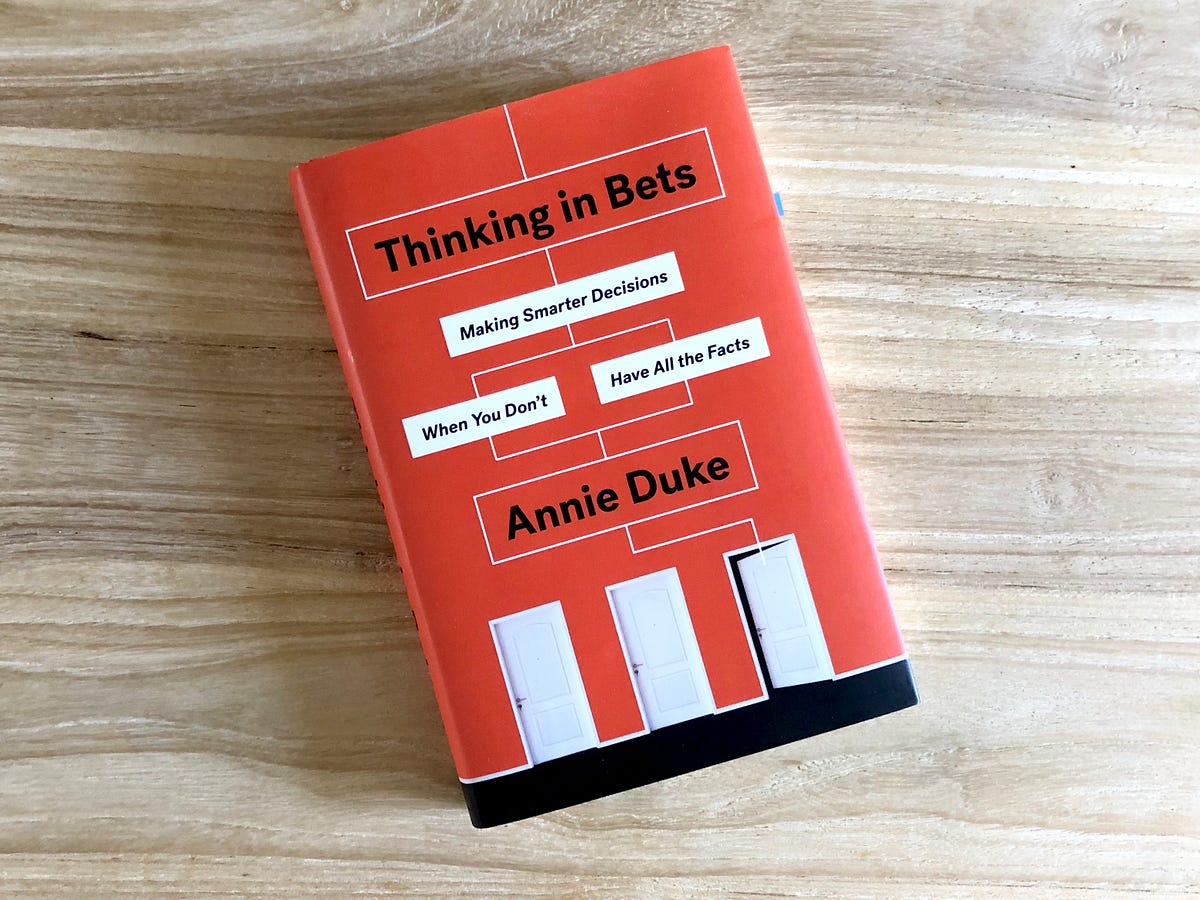

Thinking in Bets: Making Smarter Decisions When You Don’t Have All the Facts
Quick Orientation
In “Thinking in Bets,” former professional poker player Annie Duke argues that life is more like poker than chess. Unlike chess, where all information is visible and luck plays a minimal role, poker (and life) is a game of incomplete information and significant uncertainty. Duke demonstrates how adopting a “thinking in bets” mindset, focused on probabilistic thinking and continuous learning from outcomes, can significantly improve decision-making in all areas of life, from business and finance to relationships and personal growth. The book promises to provide practical strategies to overcome cognitive biases, separate decision quality from outcome quality, and make smarter choices when facing uncertainty.
INTRODUCTION: Why This Isn’t a Poker Book
This section introduces the author, Annie Duke, a former professional poker player with a background in cognitive psychology. It explains how her unexpected career path led her to view decision-making through the lens of poker and how this perspective offers valuable lessons applicable beyond the card table.
A Poker Player with a Cognitive Psychology Background
- Unexpected Path: Annie Duke initially pursued a Ph.D. in cognitive psychology at the University of Pennsylvania but took a leave of absence due to illness, leading her to poker.
- New “Lab”: Poker became a practical laboratory for studying human learning and decision-making under uncertainty.
- Fast Feedback: A poker hand provides immediate outcomes (win or lose money), offering quick feedback on decisions, although this feedback can be tricky due to luck.
- Career Success: Duke had a successful 20-year poker career, winning major tournaments and over $4 million, while her brother, Howard Lederer, also achieved significant poker success.
- Beyond Poker: Duke realized the decision-making strategies learned in poker were applicable to various fields and began speaking to professional groups.
- Practical Solutions: The core idea is that thinking in bets improves decision-making by separating outcome quality from decision quality, embracing uncertainty, learning from results, and managing emotions.
- Inevitable Mistakes: Mistakes and emotions are inevitable, but thinking in bets moves one toward objectivity and accuracy, which compounds over time.
CHAPTER 1: Life Is Poker, Not Chess
This chapter introduces the central metaphor of the book: life is a game of poker, not chess. It highlights the fundamental difference between decision-making in environments of complete information (like chess) and those with uncertainty and hidden information (like poker and life), and how our tendency to judge decisions by their outcomes (resulting) hinders learning.
Pete Carroll and the Monday Morning Quarterbacks
- Controversial Decision: Pete Carroll’s decision to call a pass play at the one-yard line in Super Bowl XLIX, which resulted in an interception and loss, drew immense criticism.
- Resulting in Action: Most people judged the decision based solely on the negative outcome, ignoring the strategic rationale and low probability of an interception in that situation.
- Carroll’s Defense: Carroll acknowledged the “worst result of a call ever” but maintained it would have been seen as brilliant if successful, highlighting the public’s focus on outcomes.
The Hazards of Resulting
- Equating Outcome and Decision Quality: Resulting is the tendency to judge the quality of a decision based on its outcome.
- Personal Application: We often identify our best decisions as those with good outcomes and our worst decisions as those with bad outcomes.
- CEO Example: A CEO identified firing a president as his worst decision because the company struggled afterward, even though the decision process itself was thoughtful and reasonable based on available information.
- Hindsight Bias: Resulting is often accompanied by hindsight bias, the tendency to see outcomes as inevitable after they occur (“I should have known that would happen”).
- Dangerous Pattern: Changing future decisions based on outcomes rather than the decision process itself is a dangerous pattern, like driving drunk and getting home safely but concluding it was a good decision.
Quick or Dead: Our Brains Weren’t Built for Rationality
- Seeking Certainty: Our brains evolved to create certainty and order, making us uncomfortable with the role of luck and randomness.
- Survival Mechanism: Historically, finding predictable connections (like rustling and lions) was crucial for survival, leading to a bias towards assuming connections even if they are false (Type I errors).
- Cognitive Systems: Daniel Kahneman’s System 1 (fast, automatic, intuitive) and System 2 (slow, deliberate, rational) describe competing brain functions.
- Overtaxed System 2: Our prefrontal cortex, responsible for deliberative thinking, is a thin layer on top of our “animal brain” and is already overtaxed, making it unrealistic to rely solely on it for rational decisions.
- Shortcuts: We need System 1’s shortcuts for daily life, but they come at a cost, leading to decision-making missteps.
- Visual Illusions: Like the Müller-Lyer illusion, knowing about our irrational tendencies isn’t enough to overcome them; we need practical work-arounds.
Two-Minute Warning
- Bridging Systems: Poker provides a unique laboratory for studying how people reconcile reflexive and deliberative thinking under pressure.
- Rapid Decisions: Poker players make hundreds of decisions per session under time constraints, with immediate financial consequences.
- Execution is Key: Success in poker depends not just on talent but on the ability to execute, avoid decision traps, learn rationally from results, and manage emotions.
Dr. Strangelove
- John von Neumann: A brilliant mathematician and scientist who contributed to game theory and other fields.
- Game Theory Basis: Von Neumann modeled game theory on a stripped-down version of poker.
- Real Games: Von Neumann distinguished “real games” like poker from computational problems like chess, noting that real life involves uncertainty, bluffing, and assessing others’ intentions.
Poker vs. Chess
- Chess: Has no hidden information and minimal luck. Outcomes closely correlate with decision quality, making mistakes easily identifiable.
- Poker: A game of incomplete information and significant luck. It’s harder to separate the contributions of decision-making and luck from outcomes.
- Life Like Poker: Most life decisions involve hidden information and luck, making it challenging to learn from results.
- Self-Deception: The uncertainty in poker (and life) provides room for self-deception and misinterpreting data.
“I’m not sure”: using uncertainty to our advantage
- Discomfort with Uncertainty: We are uncomfortable saying “I don’t know” or “I’m not sure,” often viewing it as a sign of weakness.
- Acknowledging Ignorance: Getting comfortable with uncertainty is crucial for better decision-making, as recognizing the limits of our knowledge is the first step toward truth.
- Objective Truth: Acknowledging uncertainty doesn’t mean there’s no objective truth, but rather that we are striving to get closer to it.
- Better Decision-Making: Great decision-makers embrace uncertainty and focus on estimating the likelihood of different outcomes.
- Expertise and Guessing: Experience improves the accuracy of our guesses about likelihoods, but no one can be certain of the future.
- Benefits of Uncertainty: Embracing uncertainty provides a more accurate view of the world and helps avoid black-and-white thinking.
Redefining wrong
- Outcome-Based Judgment: We often define “wrong” based solely on a negative outcome, even if the decision was probabilistically sound.
- Poker Example: In poker, a decision with a 24% chance of winning isn’t “wrong” just because it doesn’t win; it means one possible outcome occurred.
- Brexit Example: Judging bookmakers as “wrong” for predicting a low probability of Brexit after it happened is an example of outcome-based thinking, ignoring that low-probability events still occur.
- Probabilistic Thinking: Thinking probabilistically makes us less likely to use adverse results as the sole proof of a decision error, as we recognize the influence of luck and incomplete information.
- Spectrum of Outcomes: Outcomes are rarely 100% due to luck or skill; there are shades of grey, and decisions exist on a continuum between unequivocally “right” and “wrong.”
- Emotional Trade-Off: Giving up the certainty of being “right” (which feels good) to avoid the anguish of being “wrong” (which feels worse due to loss aversion) leads to a smoother emotional existence.
- Constant Guessing: Decisions are bets on the future based on our guesses about probabilities, and getting comfortable with this is the starting point.
CHAPTER 2: Wanna Bet?
This chapter delves into the idea that all decisions are bets and explores how our beliefs are the foundation of these bets. It highlights the haphazard way we form beliefs and their stubbornness, even in the face of contradictory evidence, and how the question “Wanna bet?” can trigger more objective evaluation of our beliefs.
Thirty days in Des Moines
- John Hennigan’s Wager: Professional gambler John Hennigan bet $30,000 that he could live for a month in Des Moines, a place unfamiliar and seemingly opposite to his Las Vegas lifestyle.
- Alternative Futures: The bet involved considering two distinct futures: moving to Des Moines or staying in Las Vegas, each with risks and rewards (financial, emotional, etc.).
- Negotiation: The bet’s terms and stake were negotiated, reflecting the perceived value and risks involved for both Hennigan and the other gamblers.
- Quick Regret: Hennigan regretted taking the bet after just two days and negotiated his way out for $15,000.
We’ve all been to Des Moines
- Decisions as Bets: Hennigan’s decision to move to Des Moines, while unusual in its explicit wager, is fundamentally similar to many life decisions like relocating or taking a job.
- Implicit Bets: Most decisions, though not explicitly framed as bets, involve choosing among alternative futures with potential benefits and risks.
- Betting Against Ourselves: When we make a choice, we are betting against all the other potential future versions of ourselves that we are not choosing.
- Opportunity Cost: Every decision has an opportunity cost, as we forgo other potential paths.
- Acknowledging Risk: Recognizing that decisions are bets brings the implicit risk and uncertainty into the open, leading to better decision-making.
All decisions are bets
- Broad Definition: The term “bet” extends beyond gambling to encompass any choice made based on the probability of future events, involving risk and a decision rooted in belief.
- Examples: Investments, parenting choices, job decisions, negotiations, and even ordering food are all fundamentally bets on potential futures.
Most bets are bets against ourselves
- Not Zero-Sum: Unlike gambling, most decisions aren’t zero-sum bets against another person.
- Alternative Futures: We bet against the future versions of ourselves we are not choosing, aiming for the future where we are better off (in terms of happiness, money, etc.).
- Uncertainty: We cannot be certain of the outcome of our choices due to factors outside our control (luck), which is where the risk lies.
Our bets are only as good as our beliefs
- Belief-Driven Bets: Our decisions are based on what we believe about the world and the likelihood of different outcomes.
- “As God is my Witness”: The story of Mr. Carlson believing turkeys could fly illustrates how misguided beliefs can lead to disastrous outcomes.
- Belief Calibration: A key skill in life is learning to objectively update our beliefs based on new information.
Hearing is believing
- Haphazard Belief Formation: We often form beliefs based on what we hear without vetting the information.
- Default to Belief: Our brains’ default is to believe what we hear is true, even if it’s labeled as false, especially under pressure.
- Evolutionary Push: This default setting is a vestige of an evolutionary push towards efficiency and survival, where questioning sensory experience could be dangerous.
- Abstract Beliefs: This haphazard process applies to abstract beliefs not based on direct experience.
- Common Misconceptions: Many widely held beliefs (like baldness coming from the maternal grandfather or dog years being seven human years) are inaccurate but persist through repetition.
“They saw a game”
- Impact of Beliefs on Perception: The Dartmouth-Princeton football game study showed how students’ pre-existing beliefs (their affiliation with the school) radically altered their perception and interpretation of the same events.
- Motivated Reasoning: Our beliefs affect how we process new information, leading us to interpret it in ways that confirm our existing beliefs.
- “They Saw a Protest”: A later study replicated this finding in the context of observing a political protest, showing that people’s cultural values influenced their perception of events.
The stubbornness of beliefs
- Difficult to Dislodge: Once a belief is lodged, it’s difficult to change, even with clear, contradictory information.
- Motivated Reasoning: We actively seek out evidence confirming our beliefs and ignore or discredit contradictory information.
- Poker Example: Players continue to believe in the profitability of “suited connectors” despite losing money with them, influenced by hearing others’ stories rather than their own results.
- Fake News and Disinformation: These thrive because people with consistent beliefs are less likely to question the information.
- Filter Bubbles: Social media algorithms contribute to confirmatory bias by showing us content aligned with our existing preferences.
- Protecting Self-Narrative: It feels bad to be wrong, so we resist changing beliefs that are integral to our self-image, making it hard to objectively evaluate information.
Being smart makes it worse
- Intuitive vs. Actual: Intuitively, smarter people should be better at spotting and overcoming bias, but research shows the opposite can be true.
- Blind-Spot Bias: Smarter people are better at recognizing bias in others but are more blind to their own biases.
- Motivated Numeracy: Studies show that more numerate individuals are better at spinning numbers to support their pre-existing beliefs, especially on emotionally charged topics.
- Evolutionary Wiring: We are wired to protect our beliefs, and intellect alone cannot overcome this.
Wanna bet?
- Triggering Vetting: The question “Wanna bet?” challenges our certainty and ideally triggers us to vet our beliefs by examining the evidence and sources.
- Honesty About Certainty: Being willing to bet money on a belief forces us to be more honest with ourselves about how sure we are.
- Increased Objectivity: Asking “Wanna bet?” promotes a more objective evaluation of information, leading to more accurate beliefs.
- Explicit Risk: Offering a wager makes the implicit risk of a belief explicit.
- Shifting Framework: Training ourselves to view decisions through the lens of “Wanna bet?” helps us recognize uncertainty and move away from black-and-white thinking.
Redefining confidence
- How Confident: Instead of thinking of confidence as all-or-nothing, we should focus on how confident we are, rating our certainty on a scale (like 0-10 or percentages).
- Acknowledging Uncertainty: Expressing confidence as a degree acknowledges the probabilistic nature of beliefs.
- Different Kinds of Uncertainty: Confidence levels can reflect incomplete knowledge or inherent uncertainty about the future.
- Plausible Alternatives: Expressing confidence can also involve stating a range of plausible alternatives.
- Benefits of Expressing Uncertainty:
- More Accurate View: Provides a more realistic representation of the world.
- Open-Mindedness: Reduces resistance to information that disagrees with us.
- Reduced Self-Judgment: Our narrative shifts from being “right” or “wrong” to calibrating beliefs based on new information.
- Increased Credibility: Makes us more believable communicators.
- Invites Collaboration: Encourages others to share relevant information and perspectives.
- Protects Listeners: Signals to listeners that the information needs further vetting.
CHAPTER 3: Bet to Learn: Fielding the Unfolding Future
This chapter explores the challenges of learning from experience, particularly the difficulty in separating the contributions of luck and skill to outcomes. It highlights how self-serving bias predictably distorts our interpretation of results and introduces the idea of using outcome fielding as a “bet to learn.”
Nick the Greek, and other lessons from the Crystal Lounge
- Poker as a Learning Environment: Poker, with its quick hands and immediate financial outcomes, should be an ideal learning environment.
- Nick the Greek: A player who held unusual, losing beliefs about poker strategy (e.g., aces are the worst hand, seven-deuce is the best) but blamed his losses on bad luck rather than questioning his strategy.
- Ignoring Feedback: Nick the Greek illustrates how people can resist learning from outcomes, even in an environment designed for feedback.
- Experience vs. Expertise: Experience alone isn’t enough to become an expert; the ability to learn from outcomes is crucial.
Outcomes are feedback
- Learning from Outcomes: We must actively interpret outcomes to learn from them; experience is what we do with what happens to us.
- Decisions as Bets: Every decision is a bet on a favorable future, and outcomes are the unfolding of that future.
- Feedback Loop: Ideally, outcomes feed back into belief formation and updating, creating a learning loop that reduces uncertainty.
- Sorting Outcomes: We face the decision of why an outcome occurred, often needing to determine if it was due to skill or luck.
- Challenge of Interpretation: Outcomes don’t come with labels indicating cause, making it hard to distinguish skill from luck.
Luck vs. skill: fielding outcomes
- Two Determinants: Outcomes are the result of skill (things under our control) and luck (things outside our control).
- Attributing Cause: Fielding an outcome involves betting whether it belongs in the “luck” or “skill” bucket.
- Nick the Greek’s Error: He consistently fielded his losses as bad luck and his wins as brilliant strategy, preventing him from questioning his beliefs.
- Ambiguity: The ambiguity of outcomes makes it difficult to accurately field them, as they are rarely 100% due to skill or luck.
Working backward is hard: the SnackWell’s Phenomenon
- Difficulty of Working Backward: It’s hard to determine the cause of an outcome by working backward, especially without complete information.
- SnackWell’s Example: People gained weight eating low-fat SnackWell’s but struggled to attribute the weight gain to the cookies rather than other factors, due to the prevailing belief that fat was the enemy.
- Rats and Uncertainty: Studies show that uncertainty (variable reinforcement) drastically slows learning in rats.
- Human Analog: Like rats on a variable reinforcement schedule, we often attribute bad outcomes to bad luck (“I’m due”) rather than questioning our decisions.
- Combined Influence: Outcomes are rarely purely luck or skill; they are usually a combination, making accurate fielding challenging.
“If it weren’t for luck, I’d win every one”
- Predictably Irrational Fielding: Our fielding errors are patterned and predictable: we take credit for good outcomes and blame bad ones on luck.
- Self-Serving Bias: This is the tendency to attribute positive outcomes to internal factors (skill) and negative outcomes to external factors (luck).
- Examples: Auto insurance forms with drivers blaming others, Chris Christie taking credit for job growth while denying responsibility for Bridgegate, lawyers attributing winning to their preparation and losing to the witness.
- Impact on Learning: Self-serving bias hinders learning by preventing us from examining our mistakes and reinforcing decisions that shouldn’t be.
- Phil Hellmuth: The famous poker player’s quote exemplifies this bias, suggesting that his losses are solely due to bad luck.
All-or-nothing thinking rears its head again
- Driver of Bias: Black-and-white thinking fuels motivated reasoning and self-serving bias.
- Protecting Self-Image: If outcomes are only “right” or “wrong,” information contradicting our self-narrative feels like an assault.
- Distorted View: Self-serving bias distorts our view of outcomes, maximizing our skill in good outcomes and minimizing it in bad ones.
- Emotional Cost: Attributing bad outcomes to fault feels bad, while attributing good outcomes to skill feels good, leading to a focus on protecting ego over accurate assessment.
People watching
- Learning from Others: We can potentially learn from other people’s outcomes.
- Free Information: Watching others allows us to learn without putting our own resources at risk.
- Bias in Watching: We field the outcomes of others predictably: blaming their bad outcomes on their fault and attributing their good outcomes to luck.
- Bartman Play: Steve Bartman was blamed for the Cubs’ loss after deflecting a foul ball, despite numerous factors outside his control contributing to the outcome.
- Double Standard: We hold others to a different standard than ourselves, quickly attributing blame for their failures.
Other people’s outcomes reflect on us
- Ego and Comparison: Blaming others’ bad results and failing to credit their good ones is influenced by ego and our tendency to compare ourselves to others.
- Schadenfreude: Deriving pleasure from others’ misfortune reflects this competitive drive.
- Zero-Sum Games: In zero-sum situations, our self-serving interpretation of our outcome requires a corresponding attribution for our opponent’s outcome.
- Competitive Drive: Our genes are competitive, and we are wired to compare ourselves to others, influencing our self-image and learning.
- Happiness and Comparison: Our happiness is often more dependent on how we compare to others than on objective circumstances.
Reshaping habit
- Habit Loop: Habits consist of a cue, routine, and reward.
- Changing Habits: The golden rule of habit change is to keep the cue and reward but insert a new routine.
- Bias as Habit: Motivated reasoning and self-serving bias are deeply rooted habits.
- Harnessing Craving for Approval: Groups can harness the craving for approval by rewarding accuracy and intellectual honesty.
- AA Example: AA groups provide rewards (tokens) for achieving sobriety, reinforcing the difficult habit change.
- Phil Ivey: A top poker player who exhibits different habits, focusing on identifying mistakes even after wins and seeking out opportunities to learn.
- Internalizing Approval: Regular reinforcement of exploratory thought by a group can lead to internalizing the group’s approval, making the new routine self-reinforced.
- Shifting the Routine: We can work to change the routine of what gives us positive self-image updates, substituting truthseeking for outcome-oriented credit-seeking and blame-avoidance.
- Working with Comparison: We can leverage our competitive nature by striving to be better at credit-giving, admitting mistakes, and open-minded assessment than our peers.
“Wanna bet?” redux
- Outcome Fielding as a Bet: Treating outcome fielding as a bet can shift our mindset, pushing us towards objectivity.
- Examining Beliefs: Betting on how we field an outcome forces us to examine and refine our beliefs about the influence of luck and skill.
- Open-Minded Exploration: Thinking in bets encourages exploring alternative hypotheses, even those that contradict our initial biases.
- Perspective Taking: Imagining how we would field an outcome if it happened to someone else (or vice versa) helps us get closer to the objective truth.
- Spectrum of Causes: Recognizing that outcomes are rarely 100% luck or skill allows for more nuanced updates of beliefs.
- Increased Compassion: Treating outcome fielding as bets fosters compassion towards ourselves and others.
- Giving Up Extremes: We are better off giving up the extreme feelings of being purely “right” or purely “wrong” for a more balanced emotional existence.
The hard way
- Difficulty of Change: Thinking in bets is initially hard and feels unnatural, as it goes against ingrained habits.
- Practice and Repetition: Reshaping habits requires time, preparation, practice, and repetition.
- Group Support: Having a group helps make these changes easier and more robust.
- Compounding Benefits: Even small improvements in decision-making quality compound over time, leading to significant changes in our lives.
- Learning Opportunities: Catching even a few extra learning opportunities missed by others can lead to significant advantages.
- Course Correction: Thinking in bets is like correcting a ship’s course; even a small correction can lead to a significantly different destination over time.
CHAPTER 4: The Buddy System
This chapter emphasizes the importance of seeking external help in improving decision-making. It argues for forming “truthseeking pods” or decision groups with a clear charter that promotes accuracy, accountability, and diversity of viewpoints, helping members overcome individual biases.
“Maybe you’re the problem, do you think?”
- Letterman’s Insight: David Letterman’s comment to Lauren Conrad, suggesting she might be the source of her drama, was perceptive but poorly delivered in an inappropriate setting.
- Outcome Fielding: Conrad, like most people, framed her drama as things happening to her (luck), while Letterman suggested she might have agency (skill).
- Truthseeking Requires Agreement: Effective truthseeking requires agreement from both parties to engage in such a challenging exchange.
- Lettermanning: Challenging someone’s outcome fielding without their agreement can be counterproductive.
The red pill or the blue pill?
- The Matrix Analogy: Choosing the “red pill” means choosing to see the world as it really is, even if uncomfortable, rather than living in a comfortable illusion (the “blue pill”).
- Truthseeking vs. Comfort: Truthseeking involves giving up comfortable, biased interpretations of the world.
- Needing Help: Like Neo needing help to defeat the machines, we need help to overcome our natural biases.
- Truthseeking Pods: A good decision group is a grown-up version of the buddy system, helping us fight bias.
- Limited Circle: We only need a few people willing to engage in truthseeking, not everyone in our lives.
- Balance: Different friends serve different needs; not all need to be part of a truthseeking pod.
- Acknowledging Difficulty: It’s okay to occasionally opt out of intense truthseeking to manage emotions, as long as it’s temporary and acknowledged.
Not all groups are created equal
- Group Benefits: Groups can improve decision quality by exploring alternatives and identifying biases.
- Confirmatory vs. Exploratory Thought: Groups can either amplify biases (confirmatory) or encourage open-minded consideration of alternatives (exploratory).
- Echo Chambers: Without an explicit charter for exploratory thought, groups naturally drift towards confirmatory thought, becoming echo chambers.
- Truthseeking Charter: A productive group needs a charter focused on accuracy, accountability (with advance notice), and openness to diverse ideas.
- Betting as Accountability: Betting is a form of accountability to accuracy, as the more objective person wins in the long run.
- Calibration: Calibration requires open-mindedness to diverse viewpoints and alternative hypotheses.
- Erik Seidel’s Example: Erik Seidel’s clear communication of his expectations for discussion (focus on strategy, not complaining about luck) exemplifies a good group charter.
The group rewards focus on accuracy
- Craving for Approval: We crave approval, especially from those we respect, and groups can harness this by rewarding accuracy and intellectual honesty.
- Difficult Habits: Motivated reasoning and self-serving bias are difficult habits to change and hard to self-reinforce.
- External Reinforcement: Getting approval from others for engaging in difficult truthseeking work helps reshape habits.
- AA Tokens: AA’s use of tokens for sobriety milestones is an example of a group providing tangible rewards for habit change.
- Reshaping Habits: My poker group helped me focus on identifying mistakes in my winning hands, separating outcome from decision quality, and reinforced this through their approval.
- Self-Reinforcement: Once exploratory thought becomes a habit, it becomes self-reinforced, as we internalize the group’s approval.
“One Hundred White Castles . . . and a large chocolate shake”: how accountability improves decision-making
- Betting as Accountability: A bet is a form of accountability, forcing us to answer for our actions or beliefs to others.
- Ira the Whale: The story of Ira the Whale eating 100 White Castle burgers after people bet against him demonstrates how accountability can force others to confront their inaccurate beliefs.
- Reducing Motivated Reasoning: An environment where bets are possible reduces motivated reasoning by making disconfirming information helpful for better betting.
- Loss Limits: Preset loss limits in poker act as a check against irrationally chasing losses, and accountability to a group makes it harder to break these limits.
- Internalizing Accountability: Imagining how we will answer to the group helps us spot errors and make better decisions even when alone.
The group ideally exposes us to a diversity of viewpoints
- Value of Diversity: Exposure to diverse opinions is crucial for gaining a complete understanding of a subject and testing the truth of opinions.
- Limitations of Individual Viewpoints: On our own, we are limited to our own perspective and information.
- Reducing Uncertainty: Diverse viewpoints reduce uncertainty by filling in gaps in our knowledge.
- De-biasing: Others can help us spot our biases, as it’s easier to see bias in others than ourselves.
- Engineered Diversity: Many organizations have recognized the need to actively create diversity of viewpoint (e.g., Dissent Channels, red teams).
- State Department Example: The State Department’s Dissent Channel allows employees to voice dissenting opinions without fear of reprisal, contributing to policy changes.
- CIA Red Teams: Red teams are dedicated to challenging conventional wisdom and identifying flaws in analysis.
- Maintaining Diversity is Hard: We naturally gravitate towards people who think like us, making it challenging to maintain diversity in groups.
Federal judges: drift happens
- Ideological Homogeneity: A study of federal judicial panels found that judges often succumb to groupthink, with panels of politically similar judges showing ideological dampening when a judge from the opposing party is present.
- Importance of Exposure: Exposure to diverse viewpoints is crucial, even for judges sworn to uphold the law.
- Supreme Court Clerks: The increasing homogeneity in the hiring of Supreme Court clerks contributes to the polarization of the court.
- Confirmation Bias: Even highly intelligent individuals can fall prey to confirmation bias.
- Guarding Against Clones: We must actively guard against forming decision groups composed of people who are too similar to ourselves.
Social psychologists: confirmatory drift and Heterodox Academy
- Lack of Viewpoint Diversity: A significant lack of political diversity exists in the field of social psychology, particularly a underrepresentation of conservatives.
- Impact on Science: This imbalance can reduce the quality of science by embedding political values into research questions and leading to biased interpretations of data.
- Heterodox Academy: An organization founded to fight the drift towards homogeneity of thought in science and academics.
- Confirmation Bias in Peer Review: Peer review is less effective at catching errors when the community of peers is politically homogeneous.
- Recommendations: Specific recommendations for encouraging diversity include anti-discrimination policies and actively seeking out contrary viewpoints.
- Universal Tendency: The tendency towards homogeneity and confirmatory thought is not limited to judges or scientists; we all experience it.
Wanna bet (on science)?
- Betting Markets for Accuracy: Betting markets where scientists wager on the likelihood of experimental results replicating were found to be more accurate than expert opinion alone.
- Accountability to Accuracy: Betting is a form of accountability that encourages objectivity.
- Business Application: Companies are using prediction markets to test decisions and encourage contrary opinions.
CHAPTER 5: Dissent to Win
This chapter outlines a blueprint for productive group interaction based on sociologist Robert Merton’s norms for the scientific community (CUDOS: Communism, Universalism, Disinterestedness, and Organized Skepticism), adapting these principles for effective truthseeking within decision groups.
CUDOS to a magician
- Robert K. Merton: A highly influential sociologist who established norms for the scientific community.
- Merton’s Norms (CUDOS): Communism (data sharing), Universalism (applying uniform standards regardless of source), Disinterestedness (vigilance against conflicts of interest), and Organized Skepticism (encouraging discussion and dissent).
- Blueprint for Groups: Merton’s norms provide a practical manual for designing rules of engagement for any truthseeking group.
Mertonian communism: more is more
- Communal Data Ownership: In science, data must be shared with the community for knowledge to advance.
- Open Communication: Secrecy is the opposite of this norm; full and open communication is its enactment.
- “Leaning Over Backwards”: Physicist Richard Feynman described the ideal of sharing everything that might invalidate one’s results.
- Applying to Groups: In decision groups, “more is more”; share all potentially relevant information, even if uncomfortable.
- Rashomon Effect: Different accounts of the same event can be dramatically different due to incomplete information and bias.
- Expert Sharing: Experts understand the value of sharing detailed information for better assessment.
- Rewarding Data Sharing: Groups should reward the process of sharing detailed information.
Universalism: don’t shoot the message
- Protecting Dissent: “Don’t shoot the messenger” highlights the need to protect and encourage dissenting ideas.
- Mertonian Universalism: The acceptance or rejection of an idea should not depend on the personal or social attributes of the source.
- Ignoring Source: We should evaluate the substance of information independently of where it came from.
- Poker Lesson: Learning to evaluate strategic choices regardless of whether they came from players initially labeled as “bad” was an expensive lesson in universalism.
- Practice Exercise: Create exercises to practice universalism, such as actively looking for things you agree with in sources you usually dislike.
- Imagining Different Sources: Imagine the same message coming from a source you value more or less to disentangle the message from the messenger.
- Omitting Source Information: When presenting information to a group, initially omit the source to avoid biasing the assessment.
Disinterestedness: we all have a conflict of interest, and it’s contagious
- Beyond Financial Conflicts: Conflicts of interest extend beyond financial incentives to include our built-in biases that interpret the world to confirm our desires.
- Not Naturally Disinterested: We do not process information independent of how we wish the world to be.
- Resulting as Conflict: Knowing how something turned out creates a conflict of interest that leads to resulting.
- Outcome-Blind Analysis: In science, outcome-blind analysis (where analysts don’t know the desired outcome) helps ensure disinterestedness.
- Applying to Groups: Share decision details without revealing the outcome to avoid infecting the group with outcome bias.
- Beliefs Are Contagious: Shield listeners from your own beliefs when seeking their opinion to avoid ideological conflicts of interest.
- Debating Opposing Sides: Reward group members for skillfully debating opposing points of view to encourage open-mindedness.
Organized skepticism: real skeptics make arguments and friends
- Skepticism vs. Cynicism: True skepticism is about questioning why things might not be true and is compatible with civil discourse.
- Embracing Uncertainty: Thinking in bets embodies skepticism by encouraging examination of our beliefs and confidence levels.
- Modulating Dissent: Organized skepticism leads to expressing disagreement with uncertainty (“I’m not sure about that”) rather than confrontation.
- Operationalizing Dissent: Actively incorporate dissent into group processes (e.g., devil’s advocate, anonymous dissent channels).
- Rewarding Constructive Dissent: Reward constructive dissent to reinforce diverse viewpoints being shared.
Communicating with the world beyond our group
- Express Uncertainty: Acknowledging uncertainty invites others to share information and dissenting opinions.
- Lead with Assent: Start by stating points of agreement before introducing dissenting information, using “and” instead of “but.”
- Seek Temporary Agreement: Ask if someone is looking to vent or seeking advice before engaging in truthseeking discussion.
- Focus on the Future: Discussing how to improve future outcomes is often less confrontational than rehashing past decisions.
- Children Example: Focusing on future improvement with children helps avoid defensiveness about past mistakes.
CHAPTER 6: Adventures in Mental Time Travel
This chapter explores the power of mental time travel to improve decision-making by recruiting past and future versions of ourselves. It introduces strategies like precommitment contracts, scenario planning, backcasting, and premortems to overcome in-the-moment biases and gain perspective.
Let Marty McFly run into Marty McFly
- Challenging Time Travel Rules: Unlike the “don’t meet yourself” rule in fiction, bringing past and future selves into present decisions is beneficial.
- Mental Time Travel: Our capacity for mental time travel allows us to access memories of the past and imagine possible futures.
- Distorted Scope of Time: In-the-moment thinking often distorts our view of time, magnifying present issues.
- Execution Decisions: We need help aligning our long-term goals with in-the-moment execution decisions.
- Delayed Consequences: Most life decisions don’t have immediate consequences, unlike poker where chips change hands constantly, highlighting the risk.
- Recruiting Selves: Past-you and future-you can act as decision buddies to help present-you make better choices.
Night Jerry
- Present vs. Future Self: Jerry Seinfeld’s “Night Guy” vs. “Morning Guy” illustrates how we prioritize immediate desires over future well-being.
- Temporal Discounting: We tend to overvalue immediate rewards and discount future ones.
- Retirement Savings: Saving for retirement is a major temporal discounting problem, as present spending is prioritized over future financial security.
- Visualizing the Future: Seeing age-progressed images of ourselves can make the future self more real and encourage better decisions (like saving for retirement).
- Neural Pathways: Thinking about the past and future engages brain areas involved in deliberative thinking, helping to overcome impulsive decisions.
Moving regret in front of our decisions
- Regret’s Problem: Regret occurs after the fact and cannot change the past.
- Time-Traveling Regret: If we can imagine future regret, it might influence present decisions to avoid a bad outcome.
- Age-Progression Technology: Seeing future-you can trigger regret for not planning adequately for retirement, before it’s too late to act.
- Loss Limits: Setting a loss limit in poker and imagining the regret of breaking it can prevent impulsive play.
- Decision Interrupts: Time-travel strategies create moments to pause in-the-moment decisions and consider past and future perspectives.
- 10-10-10 Rule: Asking about the consequences of a decision in 10 minutes, 10 months, and 10 years triggers mental time travel.
- Past Perspective: Asking how we would feel today if past-us had made a decision can also provide perspective.
- Preparing for Outcomes: Moving regret forward helps us anticipate and prepare for negative outcomes, reducing reactive responses.
A flat tire, the ticker, and a zoom lens
- Magnified Emotions: In-the-moment events can feel much worse than they are in the scope of our lives, leading to overreactions.
- Ticker Watching: Focusing on minute-by-minute fluctuations (like a stock ticker) distorts our perspective and amplifies emotional responses.
- Poker Scoreboard: The moving scoreboard in poker can also lead to ticker watching and emotional decision-making.
- Path Dependence: Our emotional response to an outcome is influenced by the path taken to get there, not just the final result.
- Time-Travel for Perspective: Mental time travel helps us gain perspective by viewing events in the context of the past and future, calming in-the-moment emotions.
“Yeah, but what have you done for me lately?”
- Distortion of Recent Past: The ticker doesn’t just magnify; it distorts our view of recent events.
- Emotional Response: Our emotional response is driven by recent fluctuations rather than overall performance.
- Decision Fitness: Making decisions while emotionally unhinged (on “tilt”) degrades decision quality.
Tilt
- Poker Jargon: “Tilt” describes making emotionally charged, irrational decisions due to recent negative outcomes.
- Physiological Signs: Tilt has emotional and physical manifestations.
- Amygdala Hijack: The emotional center (amygdala) can shut down the cognitive control center (prefrontal cortex) during tilt.
- Beyond Poker: Tilt is not limited to poker; it can occur in various situations where emotional reactions influence decisions.
- Precommitment Strategies: Recognizing the signs of tilt can lead to precommitting to actions (like walking away) to avoid making decisions in that state.
- Group Accountability: Truthseeking groups can incorporate questions and vigilance around tilt to promote accountability and better decision-making.
- Long-Term View: Taking a long-term view (“It’s all just one long poker game”) helps keep recent events in perspective and encourages rational thinking.
Ulysses contracts: time traveling to precommit
- Odysseus and the Sirens: The story of Odysseus binding himself to the mast to resist the Sirens’ song is the origin of the “Ulysses contract.”
- Preventing Irrationality: Ulysses contracts are precommitment strategies where past-us prevents present-us from doing something irrational.
- Lowering Barriers: These contracts can also be designed to make rational actions easier by lowering barriers.
- Levels of Binding: Precommitment contracts vary in how much they physically prevent action.
- Decision Interrupt: Even hurdles that don’t completely bind hands create a stop-and-think moment, triggering deliberative thought.
- Examples: Automatic retirement contributions, setting price limits for home buying, lawyers agreeing on settlement limits.
- Increased Rationality: Ulysses contracts increase the likelihood of making choices consistent with long-term goals.
Decision swear jar
- Identifying Warning Signs: A “decision swear jar” is a precommitment contract to identify language and thinking patterns that signal deviation from truthseeking.
- Accountability: Catching ourselves using these warning signs creates a stop-and-think moment, implementing accountability.
- Examples of Warning Signs: Language indicating illusion of certainty, overconfidence, irrational outcome fielding (blame/credit), complaining, dismissive characterizations, violations of universalism, magnifying moments, motivated reasoning, using “wrong,” lack of self-compassion, overly generous editing, infecting listeners with bias, discouraging engagement.
- Triggering Reflection: Identifying these terms as contract breaches triggers reflection and interruption of biased thinking.
Reconnaissance: mapping the future
- Planning for Uncertainty: Just as military operations require reconnaissance, we need to perform reconnaissance on the future before making decisions.
- Possible Outcomes: Any decision can result in a set of possible outcomes.
- Scenario Planning: Identifying possible futures and estimating their probabilities is crucial for better decision-making.
- Guessing Probabilities: We are already guessing the likelihood of outcomes when we make decisions; making it explicit helps move away from 0% or 100% certainty.
- Poker Example: Poker players constantly consider possible opponent responses, future decisions, and long-term impacts before making a bet.
- Benefits: Scenario planning increases decision quality, reduces reactivity, makes us nimbler, and helps identify areas for Ulysses contracts.
- Group Scenario Planning: Diverse viewpoints in a group improve scenario planning by identifying more scenarios and providing better probability estimates.
Scenario planning in practice
- ASAS Example: Working backward from the desired grant amount to its expected value (based on probability of receiving the grant) helped a nonprofit prioritize applications, budget realistically, and improve their grant-writing process.
- Benefits: Led to a more efficient work stack, realistic budgeting, improved accuracy of estimates, and organizational change.
- Sales Application: This process can be applied to sales teams for prioritizing, budgeting, and prediction accuracy.
- Complex Scenarios: Scenario planning becomes more complex with multiple possible futures and deeper decision trees.
- Pete Carroll’s Decision: Analyzing the possible outcomes and probabilities of running vs. passing shows the strategic rationale behind the decision.
Backcasting: working backward from a positive future
- More Effective Planning: Working backward from a future goal is more effective than forecasting from the present.
- New Yorker Analogy: Forecasting from the present risks a distorted view, magnifying the present and near future while blurring the distant future.
- Remembering the Future: Imagining the future utilizes the same brain pathways as remembering the past.
- Backcasting Process: Imagine achieving a positive outcome and then identify the steps and events that led to it.
- Examples: Strategic planning, trial strategy, weight loss.
- Benefits: Helps identify necessary steps, assess goal feasibility, and develop precommitments.
Premortems: working backward from a negative future
- Postmortem vs. Premortem: A postmortem analyzes a failure after it happens; a premortem investigates potential failures before they occur.
- Negative Visualization: Imagining a negative future complements backcasting’s positive visualization.
- Mental Contrasting: Research shows that imagining obstacles makes us more likely to achieve our goals.
- Process: Imagine failing to reach the goal and identify the reasons why.
- Benefits: Helps anticipate obstacles, improve planning, and protect against failure.
- Organized Skepticism: Premortems implement organized skepticism by giving permission to identify potential points of failure.
- Team Player Redefined: Being a team player in a premortem means being a productive heckler who identifies potential problems.
- Valuing Dissent: Premortems create a healthier organization by valuing dissenting opinions and preventing resentment.
Dendrology and hindsight bias (or, Give the chainsaw a rest)
- Time as a Tree: The trunk is the past, branches are possible futures, and the present is where they meet.
- Chainsaw of the Present: As the future becomes the past, the branches that didn’t occur are “cut off,” making the realized outcome seem inevitable.
- Hindsight Bias: The tendency to believe that whatever happened was bound to happen, ignoring other possible futures.
- Jentz v. ConAgra Foods: A legal case where the jury’s verdict was influenced by hindsight bias, failing to consider the probabilities of events before they occurred.
- Impact on Evaluation: Hindsight bias makes it difficult to realistically evaluate decisions or probabilities after an outcome.
- Memorializing Futures: Keeping a record of scenario plans helps prevent hindsight bias by preserving the memory of all possible futures.
- Outcome Junkies: We are naturally inclined to focus on outcomes, but weaning ourselves off this addiction leads to more happiness.
- Focus on Good Bets: Since favorable outcomes are not guaranteed, the goal is to make good bets based on calibrated beliefs and probabilities, rather than striving to be right every time.




Leave a Reply