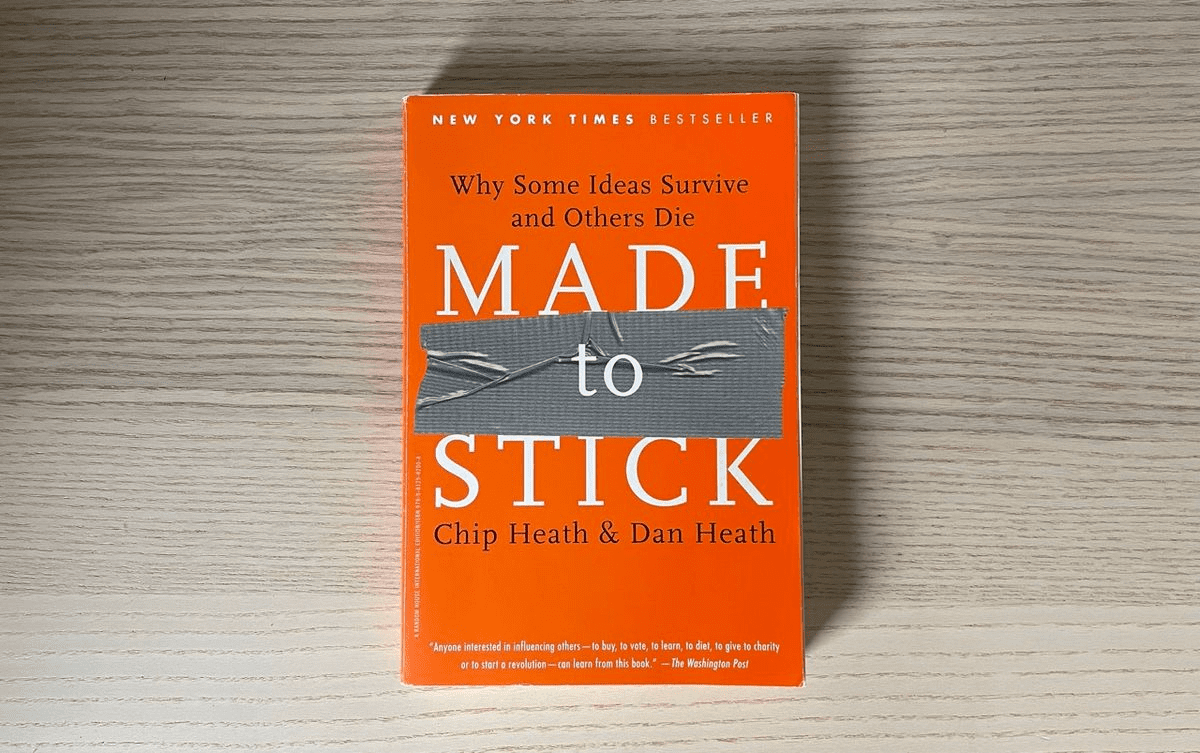

Made to Stick: Complete Summary of Chip and Dan Heath’s SUCCESs Framework for Creating Unforgettable Ideas
Introduction: What This Book Is About
Made to Stick: Why Some Ideas Survive and Others Die by Chip Heath and Dan Heath explores the fundamental principles behind ideas that gain traction, are remembered, and ultimately change behavior or thought. This book reveals that “sticky” ideas are not random occurrences but are meticulously crafted through a set of identifiable characteristics. The authors, through their diverse backgrounds in psychology and education, provide a practical framework to understand why some ideas thrive in the “marketplace of ideas” while others quickly fade away.
This summary will teach you the six core principles (SUCCESs)—Simple, Unexpected, Concrete, Credible, Emotional, and Stories—that make ideas stick, and how to apply them to your own communications. It reveals that the biggest obstacle to creating sticky ideas is the Curse of Knowledge, the difficulty experts face in explaining their knowledge to novices. By focusing on these principles, you will learn to transform your messages, making them more understandable, memorable, and impactful, regardless of your industry or role. This comprehensive summary covers every key insight and actionable advice from the book, ensuring you grasp its complete wisdom.
WHAT STICKS?
The Kidney Heist and Movie Popcorn: Unpacking Stickiness
The book opens with the urban legend of the Kidney Heist, a story so sticky it circulates widely despite being false. This legend is understandable, memorable, and effective in changing behavior (making people wary of accepting drinks from strangers). In stark contrast, a passage from a non-profit organization’s paper—full of jargon like “Comprehensive community building naturally lends itself to a return-on-investment rationale”—is quickly forgotten. The authors argue that while some ideas seem inherently interesting, many are made interesting through strategic design.
Art Silverman’s movie popcorn campaign for the Center for Science in the Public Interest (CSPI) provides a powerful example of a truthful, yet unsexy, idea made sticky. Silverman faced the challenge of communicating that a typical bag of movie popcorn contained 37 grams of saturated fat, far exceeding the recommended 20 grams daily. Instead of using dry statistics or bar graphs, he framed the message concretely and emotionally: “A medium-sized ‘butter’ popcorn…contains more artery-clogging fat than a bacon-and-eggs breakfast, a Big Mac and fries for lunch, and a steak dinner with all the trimmings—combined!” This unexpected and concrete comparison made the idea stick, leading to a plunge in popcorn sales and changes in theatre oil usage.
The Six Principles of Sticky Ideas (SUCCESs)
The Heaths propose six key principles that make ideas stick, forming the SUCCESs acronym:
- Simple: Find the core message and express it in a compact way. Prioritize to identify the single most important thing.
- Unexpected: Grab attention by violating people’s expectations (surprise), then sustain interest by opening knowledge gaps (curiosity).
- Concrete: Make ideas understandable and memorable by grounding them in sensory details and human actions. Avoid abstraction.
- Credible: Help people believe the idea by providing internal or external sources of credibility, such as authorities, anti-authorities, or vivid details.
- Emotional: Make people care about the idea by connecting it to things they already value, appealing to self-interest or identity.
- Stories: Provide simulation (how to act) and inspiration (motivation to act) through compelling narratives.
The Villain: The Curse of Knowledge
The primary obstacle to creating sticky ideas is the Curse of Knowledge. This phenomenon, illustrated by the tappers-listeners experiment, shows that once we know something, it becomes nearly impossible to imagine what it’s like not to know it. Tappers, hearing a song in their heads, vastly overestimated listeners’ ability to guess the tune from disconnected taps. Similarly, experts (CEOs, teachers, marketers) struggle to communicate effectively because they cannot easily recreate a novice’s state of mind. The Curse of Knowledge leads to abstract, jargon-filled messages that fail to stick. To overcome it, ideas must be transformed using the SUCCESs principles. For example, John F. Kennedy’s vision to “put a man on the moon and return him safely by the end of the decade” was sticky because it was Simple, Unexpected, Concrete, Credible, Emotional, and a Story—far more effective than an abstract mission statement.
Creativity through Templates
The book argues that creating sticky ideas is a learnable skill, not solely dependent on natural creative genius. Israeli researchers found that 89% of award-winning advertisements could be classified into six basic templates, such as the Extreme Consequences template (e.g., “Loose Lips Sink Ships” or “This is your brain on drugs”). In contrast, only 2% of less successful ads fit these templates. A study showed that novices trained on these templates produced ads rated 50% more creative and generated 55% more positive attitudes toward products than untrained groups. This suggests that creativity can be systematic, and adhering to proven templates can significantly improve idea stickiness.
CHAPTER 1: SIMPLE
Commander’s Intent: Stripping an Idea to Its Core
The U.S. Army’s concept of Commander’s Intent (CI) exemplifies simplicity. Despite elaborate planning, “No plan survives contact with the enemy.” Plans often become useless in unpredictable battlefields. CI is a crisp, plain-talk statement at the top of every order, specifying the plan’s goal and desired end-state. It never includes so much detail that it becomes obsolete. The CI allows soldiers at all levels to improvise while remaining aligned with the overall mission, like a single soldier on Hill 4305 focusing on protecting the Third Brigade’s flank. This approach helps in complex operations by forcing prioritization.
Colonel Tom Kolditz, head of behavioral sciences at West Point, recommends two questions for determining CI: “If we do nothing else during tomorrow’s mission, we must _________.” and “The single, most important thing that we must do tomorrow is _________.” Simplicity is about finding the core—the single, most important insight—and ruthlessly prioritizing by discarding superfluous elements, echoing Antoine de Saint-Exupéry’s quote on engineering elegance: “perfection not when there is nothing left to add, but when there is nothing left to take away.”
Finding the Core at Southwest Airlines
Southwest Airlines has maintained consistent profitability for over 30 years, largely due to its dogged focus on reducing costs. Herb Kelleher, Southwest’s longest-serving CEO, articulated the company’s core intent: “We are THE low-fare airline.” This simple idea guides every decision. For example, when marketing suggested offering a chicken Caesar salad on a flight, the response was to ask: “Tracy, will adding that chicken Caesar salad make us THE low-fare airline from Houston to Las Vegas?” The answer, of course, was no.
This core principle coordinates thousands of employees, allowing them to improvise based on intent. Employees understand that having fun is okay as long as it doesn’t jeopardize low fares. For instance, joking over the PA is fine, but throwing confetti that requires extra cleanup is not, as cleanup time increases fares. This demonstrates how a well-thought-out simple idea can powerfully shape behavior and provide the equivalent of a Commander’s Intent for a business.
Burying the Lead: The Journalist’s Lesson in Prioritization
Journalists are taught to use the “inverted pyramid” structure, placing the most important information (the “lead”) in the first sentence. This ensures readers get the essential facts regardless of how much they read. Information then decreases in importance. This structure originated during the Civil War, when telegraph lines were unreliable and reporters needed to send the most crucial details first before being cut off.
The common mistake is “burying the lead,” where the journalist loses direction in details and fails to highlight the central story. Don Wycliff, a prize-winning editorial writer, emphasizes spending 1 hour and 45 minutes of a two-hour writing time on getting a good lead because “everything will come easily” afterward. Finding the core message, like writing a lead, requires forced prioritization—choosing the single most vital piece of information.
Decision Paralysis: The Cost of Too Much Choice
Prioritizing is difficult because too much complexity and uncertainty can lead to decision paralysis. The economist L. J. Savage’s “sure-thing principle” suggested people would make the same decision if they preferred an outcome in all possible scenarios (e.g., buying property regardless of election outcome). However, psychologists Amos Tversky and Eldar Shafir proved this wrong. In their Hawaii vacation study, students who didn’t know their exam results (pass or fail) were 61% more likely to pay to wait for results, even though both passers and failers wanted to go to Hawaii. This demonstrates that irrelevant uncertainty can paralyze decisions.
Another study by Shafir and Donald Redelmeier showed that too many choices can also paralyze. When college students had to choose between attending a lecture by an admired author or studying, 21% chose to study. But when a third option—watching a foreign film—was added, 40% chose to study. Adding a third appealing option made students twice as likely to choose the less appealing studying option, showing how choice overload can lead to irrational inaction. Core messages help people avoid this by providing a clear priority.
Sun Exposure Clinic: Unburying the Lead for Health
The initial message on sun exposure from Ohio State University buried its most critical point. It started with the idea of a tan as a status symbol, then detailed causes of tanning and types of UV rays. The most impactful information—that “Skin damage from overexposure to the sun is cumulative over the years and cannot be reversed. Most serious and lasting damage occurs before age 18“—was buried in the fifth paragraph. This structure made the message non-sticky.
By unburying the lead, the revised message immediately emphasizes the irreversibility of skin damage, comparing it to aging. It states: “Skin damage from overexposure to the sun is like getting older: It is cumulative over the years and cannot be reversed.” This revision highlights the core message upfront, makes it simple and more unexpected by tying it to a familiar concept, and eliminates superfluous technical details (like melanin explanations). The core message is now more prominent and impactful.
Names, Names, and Names: The Power of a Simple Core
Hoover Adams, founder of the Dunn Daily Record in North Carolina, achieved a remarkable 112% penetration in his small town, outperforming national papers. His editorial philosophy was “relentlessly local,” summarized by his mantra: “Names, names, and names.” He explained, “The main reason anybody reads a local newspaper is for local names and pictures. That’s the one thing we can do better than anybody else.” He even claimed he’d print the entire phone book for names and would happily hire more typesetters if they could find more names.
This simple core, concrete in its demand for names, guided every decision at the paper, from what photos to run (boring committee deliberations over gorgeous sunsets) to story selection. Adams used gleeful exaggeration (atomic bomb on Raleigh isn’t news in Benson unless debris falls on Benson) to emphasize his zeal. His unwavering commitment to “Names, names, and names” served as a powerful Commander’s Intent, enabling employees to make consistent decisions aligned with the paper’s core value, making Adams ubiquitous through his simple, sticky idea.
Simple = Core + Compact: The Essence of Proverbs
Simplicity means being core and compact. While compactness alone can be empty (e.g., “The earth is flat”), profound compactness—like proverbs—is powerful. Cervantes defined proverbs as “short sentences drawn from long experience.” For example, “A bird in the hand is worth two in the bush” is compact, yet conveys a timeless truth across cultures (e.g., “Rather one bird in the hand than ten in the woods” in Sweden, “Better a titmouse in the hand than a crane in the sky” in Russia). This proverb, dating back to Aesop’s fables (570 BC), has survived for over 2,500 years due to its sticky nature.
Proverbs guide individual decisions within shared standards, often moral ones, such as the Golden Rule. They represent core wisdom in a compact format. Hoover Adams’s “Names, names, and names” functions as a journalistic proverb, a concise statement that guides individual decision-making throughout his organization.
The Palm Pilot Wood Block: A Visual Proverb Against Feature Creep
The Palm Pilot team fought “feature creep” (incremental complexity) that plagued early personal digital assistants (PDAs) like Apple’s Newton. Jeff Hawkins, the Palm Pilot team leader, wanted the device to be simple, focusing only on calendars, contacts, memos, and task lists. To enforce this core idea of simplicity and elegance, he carried a wooden block the size of the planned Palm Pilot.
Whenever someone suggested a new feature, Hawkins would pull out the wooden block and ask where it would fit. The “dumb” block became a visual proverb, a concrete, ever-present reminder of the product’s simple goals. It helped the team define the product by what it was not, preventing the device from being featured to death like its competitors. This tangible symbol ensured the core message of simplicity stuck internally.
Using What’s There: Tapping Existing Schemas
To pack a lot of meaning into a compact message, we must tap into the audience’s existing memory terrain—their schemas. The JFK, FBI, NATO, UPS, NASA, IRS exercise demonstrates this. Remembering random letters (JFKFBINATOUPSSAIRS) is hard, but remembering them as grouped acronyms (JFK, FBI, NATO, UPS, NASA, IRS) is easy. This is because our brains already have pre-stored “chunks” of information associated with these concepts. When we encounter the acronyms, we’re not “lifting” new information but simply retrieving a pointer to existing, rich data.
This principle is crucial for profound compactness. Instead of providing raw data, we use “flags” that trigger existing schemas in the audience’s mind. This allows us to convey complex information efficiently because the audience’s brain does much of the heavy lifting.
The Pomelo Schema: Creating Complexity from Simplicity
Schemas are collections of generic properties of a concept or category (e.g., “sports car” evokes a small, fast, red, two-door convertible). Using schemas allows us to create complexity through simplicity. Explaining a pomelo as “the largest citrus fruit… with a light yellow to coral pink flesh” is less effective than saying, “A pomelo is basically a supersized grapefruit with a very thick and soft rind.” The latter taps into the existing “grapefruit” schema, allowing the audience to quickly visualize and understand the new concept by adapting a known one.
This approach improves comprehension and memory. In terms of the inverted pyramid, “grapefruit-like” is a much stronger and clearer lead than “citrus fruit.” Good teachers intuitively use schemas, starting with simple, stripped-down examples (like trading apples and oranges) that build basic schemas, which can then be stretched or combined to teach more complex concepts. While not always perfectly accurate (e.g., the solar system model of the atom vs. “probability clouds”), accessible and useful ideas are better than accurate but useless ones.
Schemas in Hollywood: High-Concept Pitches
High-concept pitches in Hollywood are prime examples of schemas in action. Movies like Speed (“Die Hard on a bus”) or Alien (“Jaws on a spaceship”) receive $100 million green-lights based on a single sentence. These pitches invoke existing movie schemas in executives’ minds, allowing them to instantly grasp the film’s genre, budget, target audience, and key creative decisions. For instance, “Jaws on a spaceship” immediately tells a production designer that the spaceship should be dingy, oppressive, and sweaty, not immaculate like the Enterprise.
These pitches are Hollywood’s version of core proverbs. They radically accelerate the learning process by linking a new, intangible idea to something already known and understood. They show that analogies, rooted in shared schemas, can be incredibly powerful tools for achieving profound simplicity and coordinating large, complex efforts.
Generative Analogies: “Disney’s Cast Members”
Some analogies are “generative,” meaning they don’t just clarify a concept but also become platforms for novel thinking and behavior. The metaphor of the brain as a computer has driven cognitive psychology for decades. Similarly, Disney calls its employees “cast members,” a generative metaphor that consistently shapes behavior throughout the organization.
Disney’s “cast member” metaphor is communicated thoroughly:
- Employees audition for a role, not interview for a job.
- When in the park, they are onstage.
- Visitors are guests, not customers.
- Jobs are performances; uniforms are costumes.
This metaphor guides behavior even in unscripted situations; street sweepers, seen as performers, are highly trained to answer guest questions. This contrasts sharply with Subway’s “sandwich artists” metaphor, which is not generative because it clashes with the reality of assembly-line work (individual expression is discouraged). Generative metaphors derive power from substituting something easy to think about for something difficult, making them enduringly powerful.
CHAPTER 2: UNEXPECTED
Getting People’s Attention: Breaking a Pattern
The successful flight safety announcement by Karen Wood on a flight from Dallas to San Diego demonstrates how to get attention in a message-hostile environment. Instead of the usual dull spiel, Wood used jokes (“If you haven’t been in an automobile since 1965, the proper way to fasten your seat belt is to slide the flat end into the buckle”). Her humor broke the passengers’ pattern of tuning out, grabbing their attention and even eliciting applause.
Our brains are hardwired to notice changes. Consistent sensory stimulation makes us tune out (e.g., hum of an air conditioner), but a break in pattern (the air conditioner shutting off) immediately captures attention. Smart product designers use this by making warning lights blink or designing complex siren patterns. This chapter explores how to use surprise to get attention and interest to keep it.
The Enclave Ad and The Surprise Brow: How Surprise Works
The Ad Council’s “Enclave” minivan commercial (for the U.S. Department of Transportation) dramatically showcases unexpectedness. It starts like a typical minivan ad but culminates in a terrifying, fatal broadside collision. The tagline, “Didn’t see that coming? No one ever does. Buckle up…Always,” uses surprise to reinforce its core message about seatbelt safety. This ad is unexpected because it violates our schema for car commercials and real-life neighborhood trips.
Surprise is triggered when our guessing machines (schemas) fail. Its biological purpose is to jolt us to attention and prepare us to understand why the failure occurred, so we can repair our schemas for the future. The universal “surprise brow” (raised eyebrows, widened eyes) is the body’s way of forcing us to see more and take in new information. This intense focus helps sear unexpected events into our memories.
Avoiding Gimmickry: Surprise with Insight
While surprise grabs attention, gimmicky surprise (like a Super Bowl ad featuring wolves chasing a marching band, with no clear product link) is worthless because it doesn’t reinforce the core message. To be effective, surprise must be “postdictable“—meaning it makes sense in retrospect, but wasn’t predictable beforehand. The words PHRAUG (frog) and TAYBL (table) cause a “surprise brow” and an “Oh!” because they look unfamiliar but sound familiar, leading to insight. Made-up words like HENSION and BARDLE, which seem familiar but offer no solution, are surprising without insight, leading only to frustration.
To avoid gimmicky surprise, ensure it targets an aspect of your audience’s guessing machines that relates to your core message. This means breaking their expectations along a critical, counterintuitive dimension. Common sense is the enemy of sticky messages; we must expose the “uncommon sense” in our ideas.
Tire Chains at Nordstrom: Uncommon Sense in Action
Nordstrom is famous for outstanding customer service. To transform frontline employees into customer-service zealots, Nordstrom uses unexpected stories that break conventional service schemas (e.g., “Get customers in and out as fast as possible”). These “Nordies” stories highlight “uncommon sense” acts:
- A Nordie ironed a new shirt for a customer needing it for a meeting.
- A Nordie gift-wrapped products a customer bought at Macy’s.
- A Nordie warmed customers’ cars in winter.
- A Nordie refunded money for tire chains even though Nordstrom doesn’t sell them.
These stories shock new employees, forcing them to reevaluate their notions of “service.” They attack the unspoken assumption that service stops at the store’s door or is only for paying customers. The surprise is followed by insight, reinforcing Nordstrom’s core value of customer happiness, even at the expense of efficiency. This alignment between unexpectedness and core message makes the stories stick and effectively shapes behavior.
Journalism 101: The True Lead
Nora Ephron, the acclaimed screenwriter, learned the essence of journalism from her high school teacher. On the first day, students, expecting to learn about reporting facts (who, what, where, when, why), were given facts about a Beverly Hills High School faculty colloquium and asked to write the lead. Most students produced leads that simply reordered and condensed the facts.
The teacher’s shocking revelation was: “The lead to the story is ‘There will be no school next Thursday.’” This breathtaking moment instantly rewrote the students’ schema of journalism. It taught Ephron that journalism isn’t just regurgitating facts, but “figuring out the point. It wasn’t enough to know the who, what, when, and where; you had to understand what it meant. And why it mattered.” This simple, unexpected lesson, by directly challenging their preconceived notions, stuck with her for decades and shaped her career.
Foreign Aid Clinic: Combating Overspending Perceptions
The initial message about U.S. foreign aid spending (from the Intercommunity Peace and Justice Center) was dry and ineffective. It began with abstract facts about $15 billion in aid and $8 billion in economic assistance, mentioning the U.S. “spends proportionally the least amount on foreign aid.” This buries the lead and relies on numbers that are too large to grasp or remember. While it made one good comparison—$1 billion for sub-Saharan Africa is about the cost of a B-2 bomber—it lacked punch.
The revised message aims to break the schema that Americans think they overspend on foreign aid. It starts directly with the counterintuitive truth: “Americans persist in thinking we spend too much on foreign aid… Polls suggest that most Americans think the federal government spends about 10 to 15 percent of its budget on foreign aid. The truth is that we spend less than 1 percent, the lowest of any industrialized nation.” It then uses concrete and relatable comparisons for the aid to sub-Saharan Africa: “If everyone in the United States gave up one soft drink a month, we could double our current aid to Africa. If everyone gave up one movie a year, we could double our current aid to Africa and Asia.” This framing makes the numbers tangible, unexpected, and emotionally resonant.
Holding Attention: The Mystery of Saturn’s Rings
To keep people’s attention for complex messages, we can create mysteries. Robert Cialdini, a social psychologist, found that successful science writing often begins with a mystery story. An astronomer, for instance, started with the puzzle of Saturn’s rings: what they’re made of, and why three acclaimed scientific groups (Cambridge, MIT, Cal Tech) came to different conclusions (gas, dust, ice crystals). The answer unfolded over 20 pages of dense scientific information, revealing it was ice-covered dust. Cialdini noted, “I don’t care about dust, and the makeup of the rings of Saturn is entirely irrelevant to my life. But that writer had me turning pages like a speed-reader.”
This “Huh?” moment followed by an “Aha!” experience creates a need for closure, sustaining interest even for uninteresting topics. Cialdini successfully applied this in his classroom, where students were so engaged by mysteries that they protested when he tried to end a lecture before revealing the solution. Mysteries create a second-level unexpectedness, transforming fleeting surprise into enduring interest by inviting the audience on an unpredictable journey of discovery.
Curiosity in Hollywood Screenplays: The Turning Point
Robert McKee, a renowned screenwriting guru, emphasizes that “Curiosity is the intellectual need to answer questions and close open patterns.” A great script is designed with “Turning Points”—scenes that hook curiosity and make the audience wonder, “What will happen next?” and “How will it turn out?” (e.g., Billy Ray Valentine, the legless beggar in Trading Places, revealed to be a con artist, then turned into a commodities trader by the Duke brothers). This suspense sustains engagement, even through bad films.
McKee’s insights align with George Loewenstein’s “gap theory” of curiosity. Both suggest that stories create questions and open situations, compelling the audience to seek resolution.
The “Gap Theory” of Curiosity: Creating the “Itch” to Know
George Loewenstein’s “gap theory” of curiosity states that curiosity arises when we feel a gap in our knowledge. This gap creates a painful “itch” that we are driven to scratch by acquiring information. This explains why mysteries, crossword puzzles, and even celebrity gossip (knowing something about a person but craving the missing pieces) are so compelling.
A key implication is to open gaps before closing them. Instead of immediately presenting facts, communicators should first highlight specific knowledge people are missing. This can be done by posing a question or puzzle, pointing out that someone else knows something they don’t, or presenting situations with unknown resolutions (e.g., news teasers like “Which famous local restaurant was just cited—for slime in the ice machine?”). These teasers work by creating a knowledge gap and then promising to fill it.
Combating Overconfidence to Create Knowledge Gaps
People tend to be overconfident about how much they know, making it difficult to create knowledge gaps. In one study, people asked to generate solutions for a university parking problem identified less than 30% of expert solutions but predicted they’d identified 75%. To combat this, Nora Ephron’s journalism teacher made students publicly commit to their defective models of journalism before revealing the true lead (“No school next Thursday”), causing their schemas to fail.
Eric Mazur, a Harvard physics professor, uses “concept testing” where students publicly vote on answers to conceptual questions. This act of commitment makes them more engaged and curious about the outcome. Additionally, disagreement can highlight knowledge gaps: a study with fifth and sixth graders showed that those in discussions designed to produce disagreement were more interested in the topic and more likely to miss recess to watch a related film, compared to groups that achieved easy consensus.
Gaps Start with Knowledge: Roone Arledge’s NCAA Football Revolution
Curiosity arises from knowledge gaps, and paradoxically, more knowledge can lead to more curiosity (Loewenstein). However, if there’s not enough initial knowledge, there’s an “abyss” rather than a “gap.” Roone Arledge, then a 29-year-old at ABC, solved this problem for NCAA football broadcasts in the 1960s. College football was an insider’s topic, and ABC needed to make viewers care about unfamiliar teams.
Arledge’s solution, outlined in a three-page memo, was to “take the viewer to the game!” He revolutionized sports broadcasting by providing ample context and backstory: pre-shot film of campuses, stadium atmosphere, local fans, rivalries, and what the game meant to the schools. This “advanced organizer” approach filled enough knowledge to transform an abyss into a gap, creating interest. Arledge applied this toolkit to Wide World of Sports, introducing Americans to diverse, unfamiliar events by building context until viewers cared enough to ask “What happens next?” This strategy, now ubiquitous, was a powerful, sticky idea that stood the test of time.
Holding Long-Term Interest: The “Pocketable Radio” and “Man on the Moon”
Masaru Ibuka of Sony ignited his engineers’ passion in the 1950s with the vision of a “pocketable radio.” This was audacious—radios were furniture-sized, and Bell Labs thought a transistor radio was impossible. Ibuka’s vision created a huge knowledge gap (“How can we make a radio small enough for a pocket?”). This audacity, combined with the underlying insight, kept hundreds of engineers motivated for years, leading to the TR-55 in 1957, the world’s first pocketable transistor radio, selling 1.5 million units and putting Sony on the map.
Similarly, John F. Kennedy’s 1961 speech proposing to “land a man on the moon and return him safely by the end of the decade” was an audacious and unexpected goal. This created a massive, yet surmountable, knowledge gap (“How will we get there?”). Engineers immediately brainstormed the necessary technological advancements. Both “pocketable radio” and “man on the moon” were big, powerful, sticky ideas that sustained immense, long-term effort by creating surprise, insight, and manageable knowledge gaps.
CHAPTER 3: CONCRETE
The Power of Fables and the Perils of Abstraction
Aesop’s fable “The Fox and the Grapes” illustrates the power of concreteness. The story, with its vivid images of the fox jumping for grapes and then dismissing them as “sour,” has survived over 2,500 years and across cultures (e.g., Swedish “Sour, the fox said, about the rowanberries”). Its message, “It is easy to despise what you can’t get,” is abstract, but the concrete narrative makes it universally understood and remembered.
In contrast, modern business, education, and medicine are often plagued by abstract buzzwords (e.g., “customer-oriented visionary paradigm,” “metacognitive skills,” “idiopathic cardiomyopathy”). Abstraction makes ideas harder to understand, remember, and coordinate activities. Concreteness, by grounding ideas in sensory information and specific human actions, is crucial for sticky communication.
The Nature Conservancy: From Acres to “Eco-Celebrities”
The Nature Conservancy (TNC) initially used a “bucks and acres” strategy to protect land, which was concrete and appealing to donors (“results you could walk around on”). However, facing the challenge of protecting 40% of California (or 9% in “critical danger”), they needed new, less tangible methods like conservation easements and policy changes. These new strategies were abstract and less motivating.
TNC solved this by shifting from abstract land area (e.g., 2 million acres/year) to concrete “landscapes.” They set a goal to preserve 50 distinct landscapes (25 immediate priority) over 10 years. They named these areas, such as the Mount Hamilton Wilderness in Silicon Valley. This naming transformed abstract blobs on a map into tangible, “eco-celebrity” entities that engaged local groups and policymakers, as evidenced by a large grant from the Packard Foundation. Concreteness helps make ambiguous goals motivating and enables coordination.
Understanding Subtraction: Concreteness in Math Education
Concreteness helps novices understand new concepts. Studies comparing math education in Asia and the U.S. reveal striking differences. Japanese and Taiwanese teachers emphasize “Computing in Context,” explaining abstract mathematical concepts using concrete, familiar scenarios (e.g., “You had 100 yen but then you bought a notebook for 70 yen“). They also use Conceptual Knowledge questions, like demonstrating subtraction by physically removing 3 rows of 10 tiles from 5 rows of 10, then asking students how they knew it was subtraction. This occurred in 37% of Japanese lessons but only 2% in the U.S.
This approach builds abstract concepts on a concrete foundation. Teaching an abstract principle without a concrete basis is like “trying to start a house by building a roof in the air.” Novices crave concreteness because it allows them to construct understanding using their existing knowledge and senses.
Concrete Is Memorable: The Velcro Theory of Memory
Concrete ideas are easier to remember. Experiments show people remember concrete nouns (“bicycle,” “avocado”) better than abstract ones (“justice,” “personality”). Eric Havelock’s study of ancient Greek oral traditions (e.g., Iliad) found that concrete actions survived transmission over time, while abstractions evaporated.
David Rubin’s “Velcro theory of memory” explains this: our brain is like Velcro, with thousands of “loops.” The more “hooks” an idea has, the better it clings to memory. Recalling “the capital of Kansas” is abstract, but remembering “Hey Jude” evokes Paul McCartney’s voice and piano. “Mona Lisa” conjures a visual image, and a “childhood home” triggers a host of sensory memories (smells, sounds, sights). The Jane Elliott “Brown Eyes, Blue Eyes” experiment (where third graders experienced racial prejudice through forced segregation based on eye color) created brutally concrete hooks, ensuring the lesson on prejudice was unforgettable for decades.
The Path to Abstraction: Engineers vs. Manufacturers
The transition from novice to expert often involves moving from concrete to abstract thinking. Experts perceive concrete details as symbols of learned patterns and insights, naturally wanting to discuss ideas at a higher, abstract level. This is where the Curse of Knowledge becomes a problem. Beth Bechky’s study of a manufacturing firm that built silicon chip machinery found a communication gap between abstract-thinking engineers (focused on blueprints) and physical-level manufacturing teams (focused on machines).
When a part didn’t fit, engineers would instinctively try to fix their drawings, making them “increasingly elaborate” and more abstract, akin to a U.S. tourist speaking English more slowly and loudly to foreigners. The engineers had forgotten what it was like to be a non-expert looking at technical drawings. The solution wasn’t to meet in the middle but for engineers to engage at the concrete level of the physical machine, the “universal language” everyone understood fluently. The lesson is to find a common, concrete language when communicating.
Concrete Allows Coordination: From Moon to Runway
Concreteness makes targets transparent and aids coordination, even among experts. John F. Kennedy’s “man on the moon” goal and Sony’s “pocketable radio” vision were powerful because they were pleasingly concrete. No one at NASA or Sony quibbled over the meaning of “moon” or “pocketable.”
Similarly, when Boeing designed the 727 passenger plane in the 1960s, its goal was explicitly concrete: “The 727 must seat 131 passengers, fly nonstop from Miami to New York City, and land on Runway 4-22 at La Guardia.” This specific, measurable goal coordinated thousands of engineers across various disciplines, far more effectively than an abstract goal like “build the best passenger plane in the world.”
The Ferraris Go to Disney World: Experiential Concreteness
Stone Yamashita Partners, a San Francisco consulting firm, uses concrete, visceral, and visual techniques to drive organizational change. To help Hewlett-Packard (HP) secure a partnership with Disney and show how HP research could improve theme parks, they designed a 6,000-square-foot exhibit rather than a PowerPoint presentation. They invented a fictitious “Ferrari family” (three generations) and built a simulation of their Disney World vacation.
Visitors walked through rooms depicting the Ferraris’ journey, seeing how HP technology helped them buy tickets, schedule reservations, minimize ride waiting times, and even automatically download roller coaster photos into a digital frame in their hotel room. This living, breathing simulation made abstract e-services intensely concrete and sensory. It motivated HP’s skeptical engineers by showing the tangible benefits of their abstract research in a real-world, human context, demonstrating how concreteness can inspire and coordinate diverse expert teams.
White Things: How Concreteness Mobilizes the Brain
The “white things” exercise demonstrates how concreteness mobilizes and focuses the brain. When asked to list “white things” for 15 seconds, most people list about 7-10 items. But when asked to list “white things in your refrigerator” for the same 15 seconds, people often list a comparable number of items, and many feel it’s “easier.” This occurs because the concrete context of “refrigerator” focuses the brain, allowing it to tap into existing knowledge more effectively.
Similarly, it’s easier to think of five silly things your child has done in 10 years than five silly things people in the world have done in the same timeframe. Jerry Kaplan, founder of Go Computers, used this principle when pitching his pen-based computer idea to Kleiner Perkins. He tossed his maroon leather portfolio onto the table, declared it a “model of the future,” and the physical object sparked a dynamic, concrete brainstorming session among the venture capitalists, leading to a $4.5 million investment in his non-existent company. The concrete object became a shared “turf” for collaboration, helping experts apply their knowledge.
Oral Rehydration Therapy Clinic: The Packet of Salt and Sugar
The problem: Over 1.5 million children die annually from dehydration due to diarrhea in developing countries. The solution, oral rehydration salts (ORS), is cheap and effective. An initial message from PSI, a non-profit, was abstract, using terms like “replenish the fluids and electrolytes” and large numbers that were hard to grasp.
James Grant, former director of UNICEF, made the message concrete and compelling. He always carried a packet with one teaspoon of salt and eight teaspoons of sugar—the ORT ingredients. Meeting prime ministers, he would pull out the packet and say, “Do you know that this costs less than a cup of tea and it can save hundreds of thousands of children’s lives in your country?” This concrete prop, combined with the unexpected contrast (tea vs. lives), invited leaders to brainstorm solutions on the spot. Grant’s approach sacrificed scientific detail but gained motivational power by making the problem tangible and solvable.
Talking About People, Not Data: Hamburger Helper and Saddleback Sam
To make ideas concrete, focus on specific people. Melissa Studzinski, brand manager for Hamburger Helper at General Mills, tackled a decade-long sales slump. Instead of relying solely on “death binders” full of data, her team implemented “Fingertips“—sending marketing, advertising, and R&D staff to visit Hamburger Helper customers in their homes.
Studzinski learned that moms valued predictability over the product’s 30+ flavors or 11 pasta shapes. They just wanted their kids’ favorite flavor consistently. This concrete insight, gained from observing a woman cooking with a toddler on her hip, led the team to simplify the product line, resulting in “huge” cost savings and an 11% sales increase in 2005. Studzinski now thinks of these women when making brand decisions, making her abstract work concrete.
Similarly, Rick Warren, minister of Saddleback Church, created “Saddleback Sam“—a detailed, concrete profile of the typical unchurched man in their area (late thirties/early forties, college-educated, skeptical of “organized religion”). This “living, breathing, concrete presence” helps hundreds of volunteer leaders make decisions aligned with the church’s mission, such as avoiding telemarketing, which Sam hates. Focusing on specific people helps make abstract goals tangible and actionable.
CHAPTER 4: CREDIBLE
The Nobel-Winning Ulcer Insight No One Believed
In the early 1980s, Barry Marshall and Robin Warren discovered that stomach ulcers are caused by bacteria (H. pylori) and could be cured with antibiotics. This astonishing, Nobel-worthy insight (they received the Nobel Prize in medicine in 2005) was initially met with widespread disbelief. The medical community found it ludicrous that bacteria could survive in stomach acid. Furthermore, Marshall was a 30-year-old internist in training and Warren a staff pathologist, not typical sources for major medical breakthroughs, and they were from Perth, Australia—a “scientific backwater.”
Their correlation evidence was insufficient for skeptics. To prove causation, Marshall drank a glass of H. pylori in 1984, developing classic ulcer symptoms within days, then curing himself with antibiotics. Even this dramatic self-experiment faced quibbles, but it ultimately gained traction. This story highlights the immense challenge of establishing credibility, even for a revolutionary, proven truth.
External Credibility: Authorities and Anti-Authorities
To make people believe ideas, we often rely on external sources of credibility.
- Authorities: These are experts with framed credentials (e.g., Oliver Sachs for neuroscience) or celebrities whom we aspire to be like (e.g., Michael Jordan endorsing McDonald’s, Oprah recommending a book). Their status lends credibility.
- Anti-Authorities: Surprisingly, anti-authorities can be even more powerful. Pam Laffin, a 29-year-old mother of two who started smoking at age 10 and developed emphysema by 24, became the star of brutal anti-smoking TV ads in the mid-1990s. She showed her struggles, invasive procedures, and surgical scars. She died at 31. Laffin was not a celebrity or health expert, but a relatable, suffering smoker. Her personal experience provided unimpeachable honesty and trustworthiness, making her message incredibly credible and effective, unlike detached expert lectures or celebrity endorsements. Similarly, the Doe Fund uses formerly homeless men as “living proof” ambassadors.
Internal Credibility: The Power of Details
When external authorities aren’t available, ideas must have “internal credibility”—vouching for themselves. One way is through convincing details. The urban legend “The Boyfriend’s Death”, which involves a girl discovering her murdered boyfriend hanging from a tree, gains credibility from localized details (“right off Farm Road 121,” “on top of that bluff over Lake Travis”). Such vivid details make a claim seem more real and believable.
In a 1986 study simulating a trial, jurors evaluating Mrs. Johnson’s fitness as a mother were swayed by irrelevant but vivid details. For instance, a positive argument was bolstered by mentioning her son used a “Star Wars toothbrush that looks like Darth Vader.” While the details were not legally relevant, they boosted the argument’s credibility by making the underlying actions (diligent tooth brushing) easier to visualize and believe. These truthful, core details symbolize and support the main idea, as with the 73-year-old dancing man from the Liz Lerman Dance Exchange symbolizing true diversity.
Making Statistics Accessible: The Nuclear Warheads as BBs
Statistics are rarely meaningful in themselves; they need context. The Beyond War movement in the 1980s aimed to make the staggering scale of nuclear weapons credible. They used a simple demonstration: Geoff Ainscow would drop one BB into a metal bucket and say, “This is the Hiroshima bomb.” Then he’d drop ten BBs for the firepower of a nuclear submarine. Finally, for the world’s arsenal of 5,000 nuclear warheads, he’d pour 5,000 BBs into the bucket. The startling, prolonged clatter created a visceral, terrifying awareness of the scale, even though people wouldn’t remember the exact number. The goal was to convey the relationship—the massive scale-up from World War II to the present.
The Human-Scale Principle also makes statistics accessible by contextualizing them in everyday terms. Comparing scientific accuracy to throwing a rock from New York to Los Angeles and hitting a target within two thirds of an inch is far more impressive and tangible than throwing it from the sun to the earth and hitting within one third of a mile, even if the accuracy is identical. Stephen Covey used this by framing employee disengagement statistics (e.g., only 37% clearly understand goals) as a soccer team where “only 4 of the 11 players…would know which goal is theirs.” This vivid analogy creates a human context that makes abstract numbers impactful.
Shark Attack Hysteria Clinic: The Deer vs. Shark Credibility Test
The problem: Media-fueled shark attack hysteria makes people irrationally fearful, despite their extreme rarity. To combat this, a message from the Florida Museum of Natural History used a counterintuitive comparison: “Which of these animals is more likely to kill you? A SHARK or A DEER? ANSWER: The deer is more likely to kill you. In fact, it’s 300 times more likely to kill you (via a collision with your car).“
This message is unexpected (Bambi is deadlier than Jaws) and concrete, using a familiar animal for comparison. It taps into the audience’s own intuition (we don’t fear deer) as a source of credibility, rather than just abstract numbers. The absurdity of fearing sharks more than deer, despite the statistics, creates a humorous antidote to fear, making the truth more sticky. The less we rely on actual numbers, and the more we illustrate the underlying relationship with vivid comparisons, the more effective our statistics become.
The Sinatra Test and Safexpress: If You Can Make It There…
The Sinatra Test is passed when one example alone is enough to establish credibility in a domain (“If I can make it there, I’ll make it anywhere”). For example, a security contract for Fort Knox or catering a White House function. Safexpress, an Indian shipping company, used this to win a major Bollywood studio account. Jain, representing Safexpress, was met with skepticism about their ability to prevent piracy.
Jain used two powerful Sinatra Test examples:
- They successfully handled the release of the fifth Harry Potter book in India, delivering every book to every bookstore by 8 a.m. on release day, without leaks.
- They safely delivered examination papers for high school and university admissions, and carried the return answer sheets (the executive’s brother had recently taken his board exams, adding personal relevance).
These examples, full of concrete details, proved Safexpress’s reliability in mission-critical, high-risk situations far more convincingly than statistics. They made the client think: “If Safexpress can handle Harry Potter and national exams, they can handle our films.”
Edible Fabrics: A Triple Threat of Credibility
Bill McDonough, an environmentalist, uses a story to prove the consistency between business and environmental goals. His story passes the Sinatra Test while incorporating vivid details and statistics. In 1993, McDonough and chemist Michael Braungart were hired by Rohner Textil (Swiss textile manufacturer) to create a toxic-chemical-free manufacturing process for Steelcase chairs—a seemingly impossible task. The company’s fabric trimmings were considered hazardous waste and had to be shipped to Spain for burial (a vivid detail).
They approached chemical companies, asking for “all products…be as safe as pediatric pharmaceuticals. We’d like our babies to be able to suck on them and get health and not sickness.” Sixty companies refused. Finally, Ciba-Geigy agreed. They tested 8,000 common textile chemicals, and 7,962 failed. They were left with just 38 chemicals—”safe enough to eat”. Using only these 38, they created a full line of fabrics. When the process went online, Swiss inspectors found the water flowing from the plant was cleaner than the incoming drinking water—the fabric production was further purifying the water. The process also reduced manufacturing costs by 20%, and the scraps were converted into felt sold to Swiss farmers for crop insulation. This story’s combination of an impossible mission, concrete details (edible fabric, clean water), and a statistical relationship (38 safe chemicals out of 8,000) makes it extraordinarily credible and effective.
Where’s the Beef?: The Power of Testable Credentials
Wendy’s 1984 “Where’s the Beef?” ad campaign is a brilliant example of using testable credentials—outsourcing credibility to the audience. The commercial featured three elderly women, most notably Clara Peller, gawking at a huge bun with a tiny patty from a competitor. Peller’s cantankerous cry, “Where’s the beef?” implicitly challenged customers to verify Wendy’s claim for themselves by comparing burgers.
This campaign highlighted a genuine advantage (Wendy’s Single had more beef than Whopper or Big Mac) in an enjoyable way. The call to “see for yourself” made the claim falsifiable and therefore highly credible. Within two months, customer belief in Wendy’s larger patty increased by 47%, and revenues jumped 31% in the first year. This showed that allowing the audience to verify the claim (even if informally) is a powerful credibility booster. Urban legends, like the Snapple rumors, use a similar bait-and-switch: “See for yourself—there’s a circled K. Therefore Snapple supports the Ku Klux Klan.”
Our Intuition Is Flawed: Challenging Overconfidence with Testable Credentials
It’s hard to convince people that their intuition is flawed because we generally feel good about it. Psychologists use testable credentials to illustrate biases like the “availability bias” (judging probability by ease of recall, often skewed by emotion or media coverage).
A psychology textbook could simply state the definition of availability bias and provide statistics (e.g., 50% more suicides than homicides, 9x more tuberculosis deaths than floods, 80x more asthma deaths than tornadoes). However, a more effective approach is to first ask the reader to predict which events are more common (e.g., “Which kills more people: Homicide or suicide?”). This makes the reader experience their own flawed intuition firsthand, creating an “unexpected” moment that makes the concept of availability bias much more credible and memorable. This “try before you buy” approach helps people truly believe their intuition can be wrong.
NBA Rookie Orientation: AIDS and Testable Credentials
Educating NBA rookies about AIDS is challenging; they are young, newly famous, and have heard about AIDS their whole lives. The NBA developed an ingenious testable credential for its mandatory rookie orientation. After the first night, a group of attractive female fans flirted with the players in the hotel bar, making plans to meet later.
The next morning, the rookies showed up for their session, only to find those same women at the front of the room. Each woman introduced herself: “Hi, I’m Sheila and I’m HIV positive.” This unexpected revelation immediately made the threat of AIDS credible and immediate for the rookies. It demonstrated how easily their lives could spin out of control, making the abstract risk concrete and personal. This approach was far more impactful than the NFL’s tactic of having rookies put condoms on bananas or hearing ex-groupies talk about seduction. The NBA outsourced credibility to the experience itself, allowing the players to learn firsthand.
CHAPTER 5: EMOTIONAL
The Mother Teresa Principle: The Power of One
Mother Teresa stated, “If I look at the mass, I will never act. If I look at the one, I will.” Research from Carnegie Mellon University confirmed this principle regarding charitable giving. Participants were given $5 and a request to donate to Save the Children. One group received a letter with statistics on massive suffering in Africa (e.g., 3 million children affected by food shortages in Malawi). This group donated an average of $1.14.
Another group received a letter focusing on Rokia, a seven-year-old girl from Mali, describing her desperate poverty and how a financial gift would change her life. This group donated an average of $2.38—more than twice as much. Shockingly, a third group given both the statistics and Rokia’s story donated $1.43, less than the Rokia-only group. The researchers theorized that thinking analytically (statistics) reduced emotional empathy, which is crucial for inspiring action. Priming people to think analytically (e.g., with a math problem) before reading Rokia’s story further reduced donations to $1.26. This shows that feelings inspire people to act, and focusing on an individual elicits a stronger emotional response than abstract masses.
The Truth: Beating Smoking with Emotional Rebellion
Teenagers generally believe smoking is dangerous, yet many still smoke. The challenge is to make them care enough to act. The Truth campaign, launched by the American Legacy Foundation in 1998, achieved this by tapping into anti-authority resentment—a classic teenage emotion. One ad showed teenagers piling “Body Bags” (representing 1,800 daily tobacco deaths) outside a major tobacco company’s headquarters, shouting about the death toll.
In contrast, Philip Morris’s “Think. Don’t Smoke” campaign focused on rational decision-making (“thinking”). A 2002 study found that while 70% of teenagers remembered seeing both campaigns, the Truth campaign was spontaneously recalled by 22% (vs. 3% for Think). More importantly, teens exposed to the Truth campaign were 66% less likely to smoke, while those exposed to “Think. Don’t Smoke” were 36% more likely to smoke! The Truth campaign reframed rebellion: instead of smoking to rebel, teens now rebelled against “duplicitous Big Tobacco” by not smoking. It made teens care emotionally, driving action.
Semantic Stretch and the Power of Association
To make people care, we often associate something they don’t care about with something they do. However, this can lead to “semantic stretch”, where terms lose their power due to overuse or misuse. The movie review claiming Rashomon was a “cinematic extension of Einstein’s theory of relativity” used “relativity” (despite its actual scientific meaning being opposite) to evoke awe and profundity. Other scientific terms like “uncertainty principle” suffer similar stretch.
A study tracking newspaper articles over 20 years showed the word “unique” (meaning one of a kind) increased in usage by 73%, while “unusual” (less extreme) decreased. This suggests “unique” is now stretched to mean “unusual,” diluting its impact. This “emotional-association arms race” makes it harder to stand out; if everyone is “unique,” no one is.
Fighting Semantic Stretch: Reclaiming “Sportsmanship”
Jim Thompson, founder of the Positive Coaching Alliance (PCA), faced semantic stretch with “sportsmanship.” Once a powerful ideal (e.g., Lance Armstrong waiting for Jan Ullrich after a crash), the term had been diluted to merely “not doing something bad” (e.g., losing without whining). Sportsmanship trophies were seen as “consolation prizes for losers.” Thompson realized the underlying ideals (respect, manners) still mattered, but the term had lost its ability to motivate.
Thompson and the PCA rebranded it as “Honoring the Game.” This phrase implies a larger civic institution and a duty of respect owed to the sport itself. It’s a kind of “sports patriotism.” This new framing led to tangible results in youth basketball leagues: a dramatic reduction in technical fouls (from one every 15 games to one every 52), and in baseball, a 90% reduction in ejections. By shifting to new, distinctive turf, Thompson created an idea that made people care and motivated positive behavior.
Appealing to Self-Interest: The WIIFY Principle
One of the most reliable ways to make people care is by appealing to self-interest. John Caples, a legendary mail-order copywriter, famously wrote the headline: “They Laughed When I Sat Down at the Piano . . . But When I Started to Play!” This ad, promising huge benefits for trivial costs (“Improve Your Memory in One Evening”), was incredibly successful because it articulated the WIIFY (“what’s in it for you”).
Caples argued that advertisers often emphasize features (e.g., “the world’s best seed!”) instead of benefits (“the world’s best lawn!”). He advocated spelling out the “benefit of the benefit”: people don’t buy quarter-inch drill bits, they buy quarter-inch holes to hang their children’s pictures. Jerry Weissman, a CEO coach, stresses that the WIIFY should be central to every speech and explicitly stated, as audiences are often distracted. The “How are we ever going to use this?” question from students highlights their need for a clear self-interest appeal.
Cable TV in Tempe: Visualizing Personal Benefits
A 1982 study in Tempe, Arizona, on promoting cable TV to homeowners demonstrated a subtle but powerful appeal to self-interest. One group received abstract information about cable’s benefits: “CATV will provide a broader entertainment and informational service to its subscribers.” This group subscribed at a 20% rate.
The second group was asked to imagine themselves enjoying the benefits: “Take a moment and imagine how CATV will provide you with a broader entertainment and informational service… think of how, instead of spending money on the babysitter and gas… you will be able to spend your time at home, with your family, alone, or with your friends.” This “imagine yourself” technique, with its emphasis on “you” and vivid mental simulation, made the benefits tangible. This group subscribed at a 47% rate. The study suggests that tangibility, rather than just magnitude, of benefits makes people care. It’s about people visualizing themselves enjoying the benefits.
Avoiding Maslow’s Basement: Beyond Basic Self-Interest
Abraham Maslow’s Hierarchy of Needs (physical, security, belonging, esteem, learning, aesthetic, self-actualization, transcendence) is insightful, but the “hierarchy” aspect—that lower needs must be met first—is largely bogus. People pursue all these needs simultaneously. Yet, many managers and marketers focus exclusively on “Maslow’s Basement” (physical, security, esteem, sometimes belonging), overlooking deeper motivations like learning, aesthetics, or transcendence.
Research shows we often project baser motivations onto others: we think we are motivated by self-esteem or learning, but others are motivated by money or job security. This leads us to overlook powerful, profound motivations. Floyd Lee, who ran the Pegasus mess hall in Iraq, exemplified this. Instead of merely providing food (physical need), he redefined his mission: “I am in charge of morale.” He enhanced food quality (marinated prime rib, fresh fruit platters) and created an oasis with sports banners and soft lighting, tapping into soldiers’ needs for respite, aesthetics, and a sense of normalcy (transcendence). His staff, inspired by this mission, delivered exceptional service despite having the same raw materials as other mess halls. Lee found a way to motivate his team by appealing to a higher purpose, transforming a basic service into a mission that provided a sanctuary.
The Popcorn Popper and Political Science: Identity Matters
The firefighter popcorn popper story illustrates that appealing to narrow self-interest can backfire. A marketer offered firefighters a popcorn popper as a thank-you for reviewing a fire safety film. Firefighters were angered, responding, “Do you think we’d use a fire safety program because of some #*$@%! popcorn popper?!” From a self-interest perspective, turning down a free gift is irrational.
However, from the identity-based decision-making model proposed by James March (Who am I? What kind of situation is this? What do people like me do in this situation?), their reaction makes sense. Firefighters see themselves as brave individuals who risk their lives for safety; they don’t need trivial gifts to be motivated by safety. Their identity dictated their response.
Donald Kinder’s research on political views supports this: narrow self-interest is “trifling” in predicting public opinion. People often don’t vote based on personal economic harm or benefit. Instead, “group interest” (based on race, class, religion, etc.) and principles often matter more than direct self-interest. Identity appeals tap into what kind of person we are or aspire to be, which can be a much more powerful motivator than basic needs.
Why Study Algebra?: Elevating Motivation with Identity
The perennial student question, “Why do I need to know this? When will I ever use this?” plagues algebra teachers. Traditional answers often resort to Maslow’s Basement appeals: “You need it for your diploma,” “for future math classes,” “for college admission,” or “for basic reasoning skills to buy a home.” These are appeals to security and esteem, or simply compliance.
Dean Sherman, an algebra teacher, offered a powerful, unexpected response: “Never. You will never use this.” He then clarified: “You lift weights so that you can knock over a defensive lineman, or carry your groceries or lift your grandchildren without being sore the next day. You do math exercises so that you can improve your ability to think logically, so that you can be a better lawyer, doctor, architect, prison warden or parent. MATH IS MENTAL WEIGHT TRAINING.“
This brilliant analogy (a Creativity plot) shifts the motivation from basic self-interest to higher Maslow levels like Learning and Self-actualization. It appeals to the student’s identity—who they want to become—by linking algebra practice to developing a more muscular, capable brain. This unexpected and concrete framing makes students care about algebra not for its direct application, but for its transformative impact on their intellectual capacity.
Don’t Mess with Texas: An Identity-Based Anti-Litter Campaign
Texas faced a severe litter problem, spending $25 million annually on cleanup. Traditional appeals like “Please Don’t Litter” or “Give a Hoot—Don’t Pollute” failed, as the target demographic—18-35 year-old, pickup-driving males who liked sports and country music (“Bubba”)—disliked authority and wasn’t swayed by cuddly animals. Dan Syrek’s research showed these litterers were “slobs” who needed to understand what they were doing was wrong.
The solution was the iconic “Don’t Mess with Texas” campaign. It used famous Texas athletes (Ed “Too-Tall” Jones, Randy White, Mike Scott) and musicians (Stevie Ray Vaughan, Willie Nelson) who, rather than giving stern lectures, conveyed the message: “Texans don’t litter.” Randy White crushed a beer can, threateningly saying he needed to “see him to deliver it.” The campaign tapped into the target audience’s identity as proud Texans, implying that littering was a dishonorable act that disrespected their state. This identity-based appeal was an instant success: within months, 73% of Texans recalled the message, and within a year, visible roadside litter declined by 29%. The campaign was so effective that a planned $1 million enforcement program was abandoned.
The Music of Duo Piano: Overcoming the Curse of Knowledge for Emotional Connection
The Murray Dranoff Duo Piano Foundation struggled to articulate its mission (“We exist to protect, preserve, and promote the music of duo piano”) in a way that made outsiders care. The phrase was meaningful internally but opaque to others (many thought of “dueling pianos” in bars). A consultant’s persistent questioning (“Why would the world be a less rich place if duo piano music disappeared completely?“) forced them to break through their Curse of Knowledge.
Their breakthrough came with this evocative description: “The piano is this magnificent instrument… And when you put two of these magnificent instruments in the same room, and the performers can respond to each other and build on each other, it’s like having the sound of the orchestra but the intimacy of chamber music.” This concrete, emotional analogy created immediate understanding and appreciation, making people care for the first time. This demonstrates how asking “Why?” multiple times (the “Three Whys” tactic) can help bypass the Curse of Knowledge and connect with core values that resonate emotionally with outsiders.
Creating Empathy: Stepping into the Patient’s Shoes
The design firm IDEO helped a hospital improve its workflow. To motivate staff to change, IDEO created a video shot from the perspective of an emergency room patient with a fractured leg. Viewers experienced the confusion, waiting, disembodied voices, and long stretches of ceiling. This simulation helped hospital staff “realize” the patient experience, making the problem concrete and evoking empathy. As psychologist Jane Fulton Suri noted, “There’s an immediate motivation to fix things. It’s no longer just some problem on a problem list.”
IDEO also used role-playing exercises (e.g., imagining being a French-speaking patient trying to find a father in the hospital with no English). These simulations helped staff step into customers’ shoes, restoring natural empathy and overcoming the tendency in business to focus on abstract patterns over particular human experiences. Empathy emerges from the particular, not the mass, driving people to care and act.
CHAPTER 6: STORIES
The Day the Heart Monitor Lied: Stories as Simulation and Inspiration
Gary Klein, a psychologist studying decision-making in high-stakes environments, highlights the power of stories. In a neonatal ICU, a nurse observed a baby’s fluctuating color. When the baby turned blue-black, the medical team assumed a collapsed lung based on the heart monitor showing a steady 130 beats per minute. The nurse, however, suspected a pneumopericardium (air strangling the heart), as she had seen a baby die from it before. Despite the monitor, she insisted, used a stethoscope, found no heartbeat, and immediately initiated chest compressions, telling the neonatologist to “Stick the heart.” The X-ray confirmed her diagnosis, and the baby’s life was saved. The monitor measured electrical activity, not actual heartbeats, highlighting the danger of relying too much on machines.
This story is a powerful teaching tool, providing both simulation (knowledge about how to act in a medical emergency) and inspiration (motivation to trust intuition and challenge authority). It’s an underdog story of a nurse challenging the chief neonatologist, saving a life by sticking to her guns. Stories connect knowledge to action, making it relevant and memorable.
Shop Talk in the Xerox Lunchroom: Learning Through Narrative
Julian Orr, a researcher, observed that Xerox copier repairmen frequently swapped stories during “shop talk.” One repairman recounted struggling for four hours with a “misleading E053 error code” (due to a new XER board configuration) that actually indicated a bad dicorotron. The story detailed his wild goose chase until he discovered the simpler, underlying problem.
This seemingly mundane “shop talk” is a form of instruction and entertainment. It allows listeners to mentally simulate how they would have handled the situation, updating their “E053 schema” to include the possibility of misleading codes. Stories provide the context missing from abstract prose, building in emotions (frustration), historical background (board change), and a meta-level moral (code skepticism). Stories are powerful flight simulators for the brain, preparing us to act effectively in future situations.
The Un-passive Audience: Mental Simulation Drives Action
Contrary to the idea of a “passive” audience, research suggests our minds actively simulate stories. A study showed that when participants read about “John put on his sweatshirt before he went jogging,” they read a later sentence about the sweatshirt faster than those who read “John took off his sweatshirt before jogging.” This implies we create a geographic simulation of stories, where objects left behind are mentally placed in a “more remote” location in our heads.
Furthermore, mental simulation helps with problem-solving and skill-building. A UCLA study found that students who mentally simulated how a problem unfolded (event simulation) were more likely to take specific action, seek advice, and report learning, compared to those who only simulated a positive outcome. Brain scans show that imagining an event activates the same brain modules as real physical activity. Mental practice (e.g., visualizing welding) can produce two-thirds the benefits of actual physical practice. Stories are effective because they function as flight simulators, providing contexts that make knowledge “lifelike” and preparing us to act.
Dealing with Problem Students: A Professor’s Story as a Flight Simulator
A typical university resource for dealing with “problem students” provides abstract, obvious advice: “Remain calm. Don’t become defensive. Attempt to diffuse their anger.” This is neither unexpected nor concrete enough to be useful.
In contrast, Professor Alyson Buckman’s informal story shared on a newsgroup offers a powerful flight simulator. She describes a student who “talked loudly and often” and “disagreed with me on every point.” Buckman tried various methods, then called the student and his “confidante” to the front. The defiant student only listened when told that other students were complaining about his behavior and suggesting “treatments” for him. His body language immediately changed. The story’s solution—using peer pressure—is concrete, unexpected, and emotional, allowing other professors to simulate the interaction and understand how to tackle similar situations. This makes it far more effective than bullet points.
Stories as Inspiration: The Tale of Jared
Subway’s “7 Under 6” campaign (seven subs under six grams of fat) was a modest success. However, their next campaign, featuring Jared Fogle, was a sensation. Jared, a college student, weighed 425 pounds and faced severe health risks. He invented his “Subway diet” (a foot-long veggie sub for lunch, a six-inch turkey sub for dinner) and, combined with walking, lost 245 pounds, dropping from 60-inch-waist pants to 180 pounds.
The story gained traction after an Indiana Daily Student article described his struggles and transformation (“Subway helped save my life and start over”). A Subway franchise owner, Bob Ocwieja, spotted a blurb in Men’s Health and proactively pushed the story to Subway’s ad agency. Despite initial resistance from the national marketing director and lawyers, the ad agency president, Barry Krause, made the commercials for free. The ad, airing January 1, 2000, became a viral hit, leading to calls from USA Today, ABC, Fox News, and Oprah. Subway’s sales jumped 18% in 2000 and 16% in 2001.
The Jared story functions as a pep talk, inspiring action. It’s Simple (eat subs, lose weight), Unexpected (fast food for weight loss), Concrete (60-inch pants, specific subs), Credible (anti-authority: a real person’s transformation), and Emotional (taps into self-actualization, overcoming huge odds). It’s a classic Challenge plot, motivating others to persevere. This demonstrates that spotting inspiring stories can be as powerful as creating them, especially when they align with the SUCCESs principles.
The Art of Spotting: Three Basic Plots
We often overlook potential sticky ideas. Learning story templates can significantly boost our spotting ability. After analyzing hundreds of inspirational stories (including those from Chicken Soup for the Soul and People magazine), the authors identified three basic plot types that inspire and motivate action:
- The Challenge Plot: A protagonist overcomes a formidable challenge and succeeds. This includes underdog stories, rags-to-riches tales, and triumphs of willpower. Examples: David and Goliath, the 1980 U.S. Olympic hockey team, Lance Armstrong, Rose Blumkin (who started a furniture business with $500 and built it into a $100 million company, still working at 100). Challenge plots inspire perseverance and courage, making us want to work harder.
- The Connection Plot: A story about people who develop a relationship that bridges a gap (racial, class, ethnic, religious, etc.). The Good Samaritan is the prototype, where an outcast helps someone from a hostile group. The Mean Joe Greene Coke commercial (scrawny white kid, towering Black athlete) is a simpler example. Connection plots inspire tolerance, collaboration, and compassion.
- The Creativity Plot: Someone makes a mental breakthrough, solves a long-standing puzzle, or attacks a problem innovatively. Examples: Newton’s apple and gravity, the Ingersoll-Rand “Drag Test” (engineers dragging potential plastic casings behind a rental car to test durability quickly). Creativity plots inspire us to think differently, be creative, and experiment with new approaches.
These plots help us recognize when life offers a “gift”—a story with built-in potential to inspire.
Stories at the World Bank: Stephen Denning’s Springboard
Stephen Denning, working in “corporate Siberia” on knowledge management at the World Bank in 1996, faced skepticism about his mission. He learned about a health worker in Kamana, Zambia (360 miles from the capital), who, struggling to fight malaria, used the Internet to find information on the CDC website in Atlanta. This anecdote became his “springboard story“—a narrative that helps people see how an existing problem might change, pointing to possibilities.
When Denning spoke to senior management for 10-12 minutes, he started with the bank’s knowledge-pooling difficulties, then told the Zambia story. Immediately afterward, executives were so galvanized that they raced to him, arguing he wasn’t doing enough to implement their idea. Denning realized: “How wonderful! They’ve stolen my idea. It’s become their idea!” Springboard stories combat skepticism, create buy-in, and mobilize action by inviting the audience to participate in problem-solving rather than debating an argument. They provide visible goals and barriers, shifting the audience into a solution-oriented mindset and customizing the message for each listener.
Key Takeaways: What You Need to Remember
Core Insights from Made to Stick
- Simplicity is about finding the core message and making it compact, like a proverb or a Commander’s Intent, not “dumbing down.”
- Unexpectedness grabs attention and sustains interest by violating schemas and creating knowledge gaps, but it must lead to insight, not just gimmickry.
- Concreteness makes ideas understandable and memorable by grounding them in sensory details and human actions, acting as a “Velcro” for memory and enabling coordination.
- Credibility requires sources that the audience trusts, which can include authorities, anti-authorities, compelling details, accessible statistics, or testable credentials that allow the audience to verify for themselves.
- Emotional ideas make people care by appealing to their self-interest (beyond basic needs) or identity, or by creating empathy for individuals rather than abstract masses.
- Stories provide simulation and inspiration, acting as mental flight simulators that prepare people for action and motivating them to overcome challenges, connect with others, or innovate.
- The Curse of Knowledge is the primary villain in communication; experts must work hard to translate their insights in ways that novices can understand and care about.
- Creativity in sticky ideas can be systematic, relying on proven templates and plots rather than unpredictable genius, and spotting existing sticky ideas is often more effective than creating new ones.
Immediate Actions to Take Today
- Identify the single most important message you need to communicate in your next presentation or email. Write it as a Commander’s Intent.
- Challenge your audience’s assumptions by starting with something unexpected or counterintuitive related to your core message to grab their attention.
- Translate abstract concepts into concrete examples or analogies, using vivid sensory details to make your message tangible and memorable.
- Consider a non-traditional source of credibility (like an anti-authority or a compelling individual story) rather than just statistics or experts.
- Frame your message to appeal to a deeper level of motivation, such as identity or learning, beyond just financial or security benefits.
- Look for stories in your own experience or organization that illustrate your point, focusing on Challenge, Connection, or Creativity plots to inspire action.
- Test your message on a “novice” who doesn’t share your Curse of Knowledge to see if it truly sticks.
Questions for Personal Application
- What is the absolute core message I need to convey? If I could only say one thing, what would it be?
- What common assumptions does my audience have about this topic, and how can I unexpectedly break one of them to get their attention?
- How can I make my idea tangible and concrete? What specific human actions, objects, or sensory details can I use to illustrate it?
- What makes my idea credible to this specific audience? Do I need an expert, an anti-authority, a compelling detail, or a testable credential?
- How can I make my audience care about this? What deeper emotional needs or identity aspirations can I tap into beyond basic self-interest?
- Is there a story I can tell (or find) that embodies my message and provides a mental simulation or inspiration for action for my audience?
- Am I suffering from the Curse of Knowledge? How can I ensure my message is understood by someone who knows nothing about my topic?




Leave a Reply